







Abstract
Students with emotional and behavioral disorders struggle with learning and retaining many aspects of mathematics. Tasks requiring conceptual understanding and reasoning are especially challenging. Given these difficulties, it is essential that teachers use techniques designed to support mathematical learning. We explain how to infuse peer-mediated strategies with two promising instructional techniques to scaffold learning and remembering of mathematical concepts and skills. Examples are illustrated within the context of an inclusive middle school mathematics course.
Keywords
Mrs. Jones, an algebra teacher, and her special education co-teacher, Mr. Rieden, are struggling to support their students in algebra class. Students struggle to memorize procedures and do not show reasoning behind the procedures that they are applying. In the most recent lesson on factoring polynomials, the teachers noticed that students were not factoring completely, grouping terms incorrectly, confusing factors and multiples, and were unable to explain their reasoning for correctly solved problems. In addition, students were having trouble trying to remember previously learned content. Recently, the teachers remarked that classroom behavior is becoming more and more problematic, especially for their students with challenging behaviors. Mrs. Jones and Mr. Rieden both agree that they need to intensify their instructional supports and facilitate peer-to-peer activities that promote positive social interaction.
Mathematical proficiency is central to the economic strength and global standing of the United States. Unfortunately, a pervasive national weakness in mathematical performance has been highlighted in recent reports. Higher order mathematics objectives—including reasoning and explaining, application, and problem-solving—are strongly emphasized across the Common Core State Standards (National Governors Association Center for Best Practices & Council of Chief State School Officers, 2010). These skills are also notoriously difficult for students with disabilities to master. Within the broader category of students with disabilities, students with emotional and behavioral disorders (EBD) also exhibit poor outcomes in learning mathematics, mirroring the outcomes of the general population of students with disabilities and, in some cases, performing significantly below those outcome levels.
Students with EBD tend to score in the lowest quartile in general academics (Gage et al., 2017) and score one to three grade levels behind in mathematics specifically. These deficits worsen as students age (Mulcahy et al., 2016). Although this mathematics underachievement must be addressed in both core and intervention settings, the difficulties may not be due solely to students’ EBD label. One logical explanation for poor performance is difficulties experienced or incomplete learning during initial instruction of mathematical concepts and skills. If students do not acquire the content during initial instruction, their performance on assessments will clearly be negatively impacted. However, initial learning is not the only variable affecting performance. Students maintaining or retaining what they learn across time is also problematic (Mattison et al., 2006). If students do acquire content but do not retain it across time, this will also negatively impact learning. The importance of addressing both initial learning and understanding, as well as long-term retention, is critical for improving the outcomes for students with EBD.
A lack of empirically validated instructional practices addressing initial learning and retention is too often the case when it comes to mathematics, as is seen in research documents on mathematics and multitiered system of supports (MTSS; Blackburn & Witzel, 2018; Riccomini & Witzel, 2010). Therefore, it is important to improve both core and intervention mathematics instruction, maximize the learning of students with EBD, and support positive social interaction.
Social skills deficits associated with EBD affect students’ work within a classroom, particularly in peer groups where students often reason through mathematics problem-solving. Because of such concerns, some students are not provided mathematics at a level requisite with their capabilities (Lane et al., 2008). For example, a student in middle school who struggles with factoring polynomials may also struggle with multiplication, a foundational skill for factoring. Therefore, teachers may be inclined to help with multiplication but not necessarily address the core need of factoring. Although interventions for multiplication are needed and a teacher’s focus on those interventions is well-intentioned, the core standard must still be taught so that the student may achieve a standard diploma and be better prepared for postsecondary employment or further schooling (Moore & Shulock, 2009).
Working on grade-level standards is required but interventions must still address deficit skills, particularly those that impact the ability to achieve in the grade-level standard. Without proficiency with basic facts, students are likely to experience cognitive overload when tackling more advanced mathematics (Woodward, 2006). This is because, instead of working to understand the core content, the students must work their way through computational needs, making a long task more arduous. Students who spend less time trying to remember facts while tackling complex mathematics are more likely to focus on the rigor of the mathematics standard and have less anxiety (Parkhurst et al., 2010).
If mathematics were the only concern for students with EBD, a concentrated effort using research- or evidence-based mathematics interventions would be sufficient for improving their achievement. Whereas, peer-mediated instruction (PMI) is an effective framework for improving students’ social, communicative, and academic behaviors because of the systematic reinforcement of positive behaviors (Collins et al., 2018). PMI, therefore, is a promising approach for increasing mathematics achievement when coupled with research- or evidence-based mathematics approaches (Dobbins et al., 2014).
Peer-mediated instruction is a universal term used to describe a variety of instructional strategies and procedures that vary in design and purpose, but all of them include a predetermined set of activities involving focused peer-to-peer interactions (Morano & Riccomini, 2016). For example, classwide peer tutoring, cooperative learning strategies, peer-assisted learning strategies, peer tutoring dyads, peer modeling, and peer assessment all fall into the PMI category (Ryan et al., 2004). PMI has been used across multiple grade levels, disability types, languages, and settings to address varied academic and social outcomes (e.g., Cole, 2013; Dunn et al., 2017; Kunsch et al., 2007; O’Donoghue et al., 2021; Tournaki & Criscitiello, 2003). In this article, we focus on the inclusive classroom setting.
In general, PMI activities are scheduled across multiple days and target previously taught academic content. Purposeful, direct peer-to-peer interactions that previously been taught, practiced, and reinforced are planned by the teacher. The activities include peer self-monitoring activities (Fries & Riccomini, 2012; Riccomini et al., 2008). PMI’s general framework and design flexibility allow teachers to combine PMI activities with other promising practices, thereby leveraging the effectiveness of both and increasing its use.
To help teachers address the mathematics concerns of students with EBD, we share two mathematics strategies using peer mediation. One instructional strategy targets the procedural and conceptual needs of complex standards that students must learn as part of their core curriculum. This is the use of visual representations, particularly the concrete to representational to abstract (CRA) sequence of instruction. This instruction type is particularly effective for students with attention-deficit/hyperactivity disorder (ADHD) and executive functioning disorder, which are common concerns for students with EBD (Witzel, 2020). The other mathematics strategy, Practice Test Retrieval (PTR), targets the strengthening of long-term learning of mathematics knowledge to address the challenges presented when students do not retain previously learned mathematics concept and skills. We situate both strategies within a peer-mediated framework.
Visual Representations
One of the more effective instructional practices that helps students build mathematics conceptual and procedural understanding is the use of visual representations. General use of visuals helps students build numerical understanding better than the abstract use of numbers and symbols alone (Park & Brannon, 2013). More importantly, a systematic use of visuals that has shown effectiveness with students with disabilities and mathematics difficulties alike is CRA.
What Is CRA?
This instructional type is a graduated sequence that includes three coordinated sequential stages of learning: Concrete, Visual Representation, and Abstract (E. Hughes et al., 2018). Consistent across the stages are the mathematics steps and verbal reasoning. The only difference is the type of representation used to answer the problem. The effectiveness of CRA is evident across multiple mathematics content areas and it has been highlighted in federal briefs and practice guides (e.g., National Mathematics Panel Final Report; Gersten et al., 2009).
C phase = Students learn a stepwise mathematics approach, using a concrete, hands-on approach with the use of manipulative objects. Students perform the mathematics task using manipulative objects while verbally reasoning the steps to solve the problem. Although much attention is given to this step during training, the use of manipulative objects in CRA is expeditious in that students only need to accurately perform the mathematics a few times to demonstrate procedural facility and verbal reasoning.
R phase = Students apply visual/graphical representations similar to the concrete manipulatives to solve problems. The student uses the visual representation along with verbal reasoning to show proficiency.
A phase = Students solve problems using abstract (Arabic) notation and verbal reasoning. When students struggle at this stage, it is often because the previous stages were not taught to mastery, including the use of verbal reasoning to help with the transition.
Why Does CRA Work?
The impact of CRA is well documented. In meta-analytic work (E. Hughes et al., 2014) and multiple federal guides, CRA has led to superior scores when compared with several other mathematics intervention approaches. In mathematics, the abstract notation is difficult to comprehend for some students, particularly students with learning difficulties (Witzel et al., 2008). Specifically, for students with EBD, executive functioning challenges impact self-regulation, problem-solving, and mental flexibility, and they are predictive of future general school success, including mathematics learning (Landrum et al., 2003). Executive functioning is also related to visuospatial working memory (VSWM), which directly impacts conceptual understanding of mathematics and procedural recall (Witzel, 2020). The VSWM is similar to a sketchpad in which students can mentally represent numbers and arithmetic, such as on a number line or through an area model. As CRA helps students with executive functioning by providing an externally sequenced set of representations, its effectiveness can be enhanced through increased verbal reasoning. Including systematic peer-mediated interactions within the CRA approach can increase the verbal reasoning that ties together each representation. Similarly, it can improve student communication, which is desirable for all students, but especially for those with EBD.
How to Implement CRA With Peer Mediation?
As transition between CRA stages occurs through verbal reasoning, adding a peer-mediated element by partnering students to discuss the manipulations and visual depictions can significantly enhance learning. Peer-mediated strategies involve students working together, often taking instructional roles, to help their matched peers reason through problem-solving. There are six steps to infuse CRA with peer-mediated strategies:
Teacher initiated: The teacher models several problems with think-aloud reasoning.
Peer design: The teacher assigns two students to each team and gives each a role, identified in some way (e.g., Purple and Gold). Teacher provides instruction on how to ask questions and reinforce each other’s work in teams. For students who display unique interpersonal issues that may interfere with productive peer interactions, the teacher provides a script of what to say during each student’s role and teaches the use of the script if the student shows hesitancy to interact.
Peer work: Students break off to solve problems in teams.
Concrete phase: When given a basic problem, the Purple student completes the problem while explaining the verbal reasoning of the approach to the Gold student. Meanwhile, the Gold student shares the Abstract steps explained by the Purple student. Sharing the abstract steps during each phase helps transition students through the sequence of instruction. After comparing their work, they switch roles. The Gold student leads the next problem, whereas the Purple student records the Abstract steps. Once each student shows mastery, the team moves to the Visual stage.
Representation phase: When given two to three slightly more complex problems, the Gold student completes the problem while explaining the verbal reasoning of the approach to the Purple student. Meanwhile, the Purple student shares the Abstract steps explained by the Gold student. After comparing their work, they switch roles. The Purple student leads the next problem, whereas the Gold student records the Abstract steps. They each take turns leading problems. Once each student shows mastery for problems of this complexity, the team moves to the Abstract phase.
Abstract phase: Given five or more complex problems, the Purple student completes the problem while explaining the verbal reasoning of the approach to the Gold student. Meanwhile, the Gold student shares the Abstract steps explained by the Purple student. After comparing their work, they switch roles. The Gold student leads the next problem, whereas the Purple student records the Abstract steps. They each take turns leading problems. Once they show mastery as a team, they work individually to complete problems, now with a priority to develop more fluent work to solve the problem.
Although this is peer-mediated, the teachers are actively involved during the instruction. Both teachers work with students to highlight successes, clarify key points, and challenge students’ thinking.
CRA Instructional Sequence for Factoring Binomials
Using the example of factoring, we apply CRA to the seventh-grade mathematics standard of factoring a binomial, such as 3x2 + 9x. A typical task analysis of factoring a binomial expression involves several steps. Table 1 is a chart showing those potential steps and aligned examples.
Steps of the Concrete–Representational–Abstract Instructional Sequence for Factoring a Binomial.
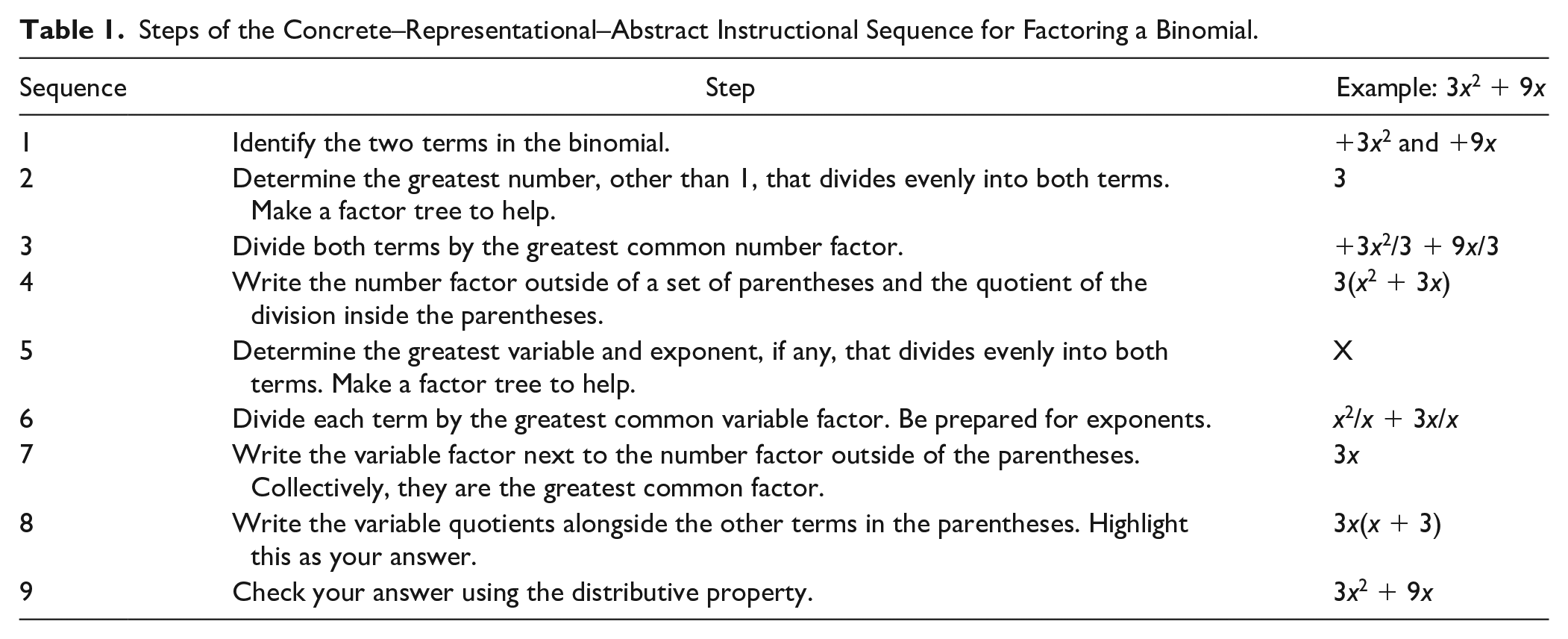
Although the visual display of steps is logical, it can be difficult for most students to easily recall. For complex mathematics tasks that require multiple steps and application of foundational mathematics skills, CRA is an effective strategy. Figure 1 illustrates steps used during the Concrete stage of the CRA approach.
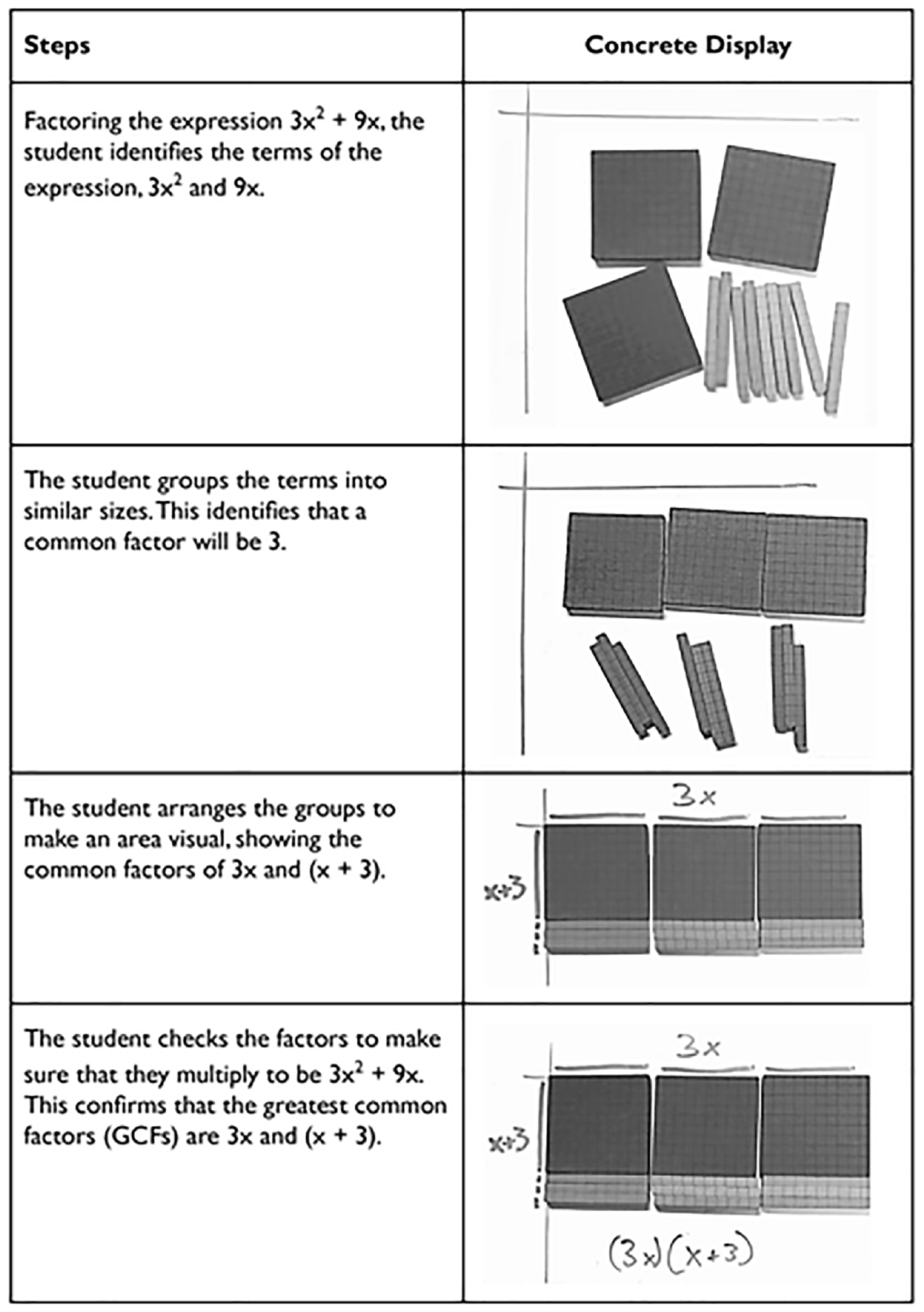
Visual representation of concrete–representational–abstract (CRA) sequence of instruction for factoring a binomial.
Many mathematics strategies that are accurate are hard to remember. The physical manipulation tied to verbal reasoning of CRA aids in memorizing mathematics procedures. The peer mediation during the process of problem-solving strengthens the verbal reasoning.
Integration of multiple and sequential representations make the complexity of the mathematics more accessible to students who may struggle to remember the multiple steps and reasoning of factoring a binomial expression. These manipulations would be followed first by drawings of the same objects for the visual step and then by using abstract notation only, following the same approach and verbal reasoning that the student learned during the C and R phases.
Mrs. Jones and Mr. Rieden prepare their first CRA lesson by teaching students about the concrete manipulatives for showing basic multiplication. Once students appeared confident with multiplication, the teachers modeled the lesson. After several demonstrations, they decided to move into guided practice in a peer-to-peer structure (Gold and Purple students). Using the manipulatives, students were more eager to discuss the process of factoring binomials with their partner and remained on task. The teachers noticed some hesitancy with factoring completely, but using the manipulatives made mistakes easier to recognize, encouraging the students to self-correct. As students showed success during this stage of learning, the teachers scaffolded students through the R and A lessons.
Practice Test Retrieval Technique to Enhance Long-Term Retention
After instruction in mathematics, teachers provide students opportunities to practice. Although the number of practice problems may vary by teacher, grade level, and topic, these opportunities generally include problems relating to the concept or skill taught in the lesson (i.e., factoring binomials). For example, an instructional lesson on factoring polynomials is generally followed by the students practicing multiple problems involving factoring polynomials. This may continue for several days, but once students have demonstrated a level of proficiency, teachers then provide cumulative review practice to help students maintain the concept of skill. The purpose of the initial practice that immediately follows the lesson is on initial acquisition, whereas the purpose of the cumulative review is on long-term retention. We are focusing on the long-term retention through the PTR strategy.
After several days of the students practicing factoring binomial problems with partners, the teachers observed that most students improved both in understanding the process and correctly factoring the binomials. In addition, quiz results revealed that most students accurately explained their approach. For the students who did not demonstrate mastery, Mr. Rieden provided small-group instruction focused on a more explicit connection of the R and A phases. After three small group sessions, the students completed a quiz and demonstrated proficiency with factoring binomials. Now that all students had demonstrated proficiency in the short term, Mrs. Jones and Mr. Rieden turned their attention to helping their students remember how to factor binomials using the PTR technique.
What Is PTR?
PTR is a technique used to strengthen the long-term retention of mathematics concepts and skills (C. Hughes et al., 2019). The effectiveness of PTR is well-documented and can be implemented in a variety of common classroom routines (Adesope et al., 2017; Putman et al., 2017). Although more research is needed specifically on its implementation with students with EBD, PTR can help to mitigate memory deficits common in students with EBD (Toffalini et al., 2017). PTR is not a new technique but is now receiving significant attention by teachers who are seeking more intensive techniques to boost their students’ retention.
Activities of PTR are much more effective than other common cumulative review activities, such as study guides, review games, looking back in notes or text, and additional practice opportunities similar to initial practice. Activities of PTR consist of four elements: (a) opportunity for free recall, (b) corrective feedback, (c) low-stakes activities, and (d) learner reflection (Agarwal et al., 2018; see Figure 2). Providing regular and frequent PTR activities including these four elements results in more “durable learning” or learning that lasts across time.
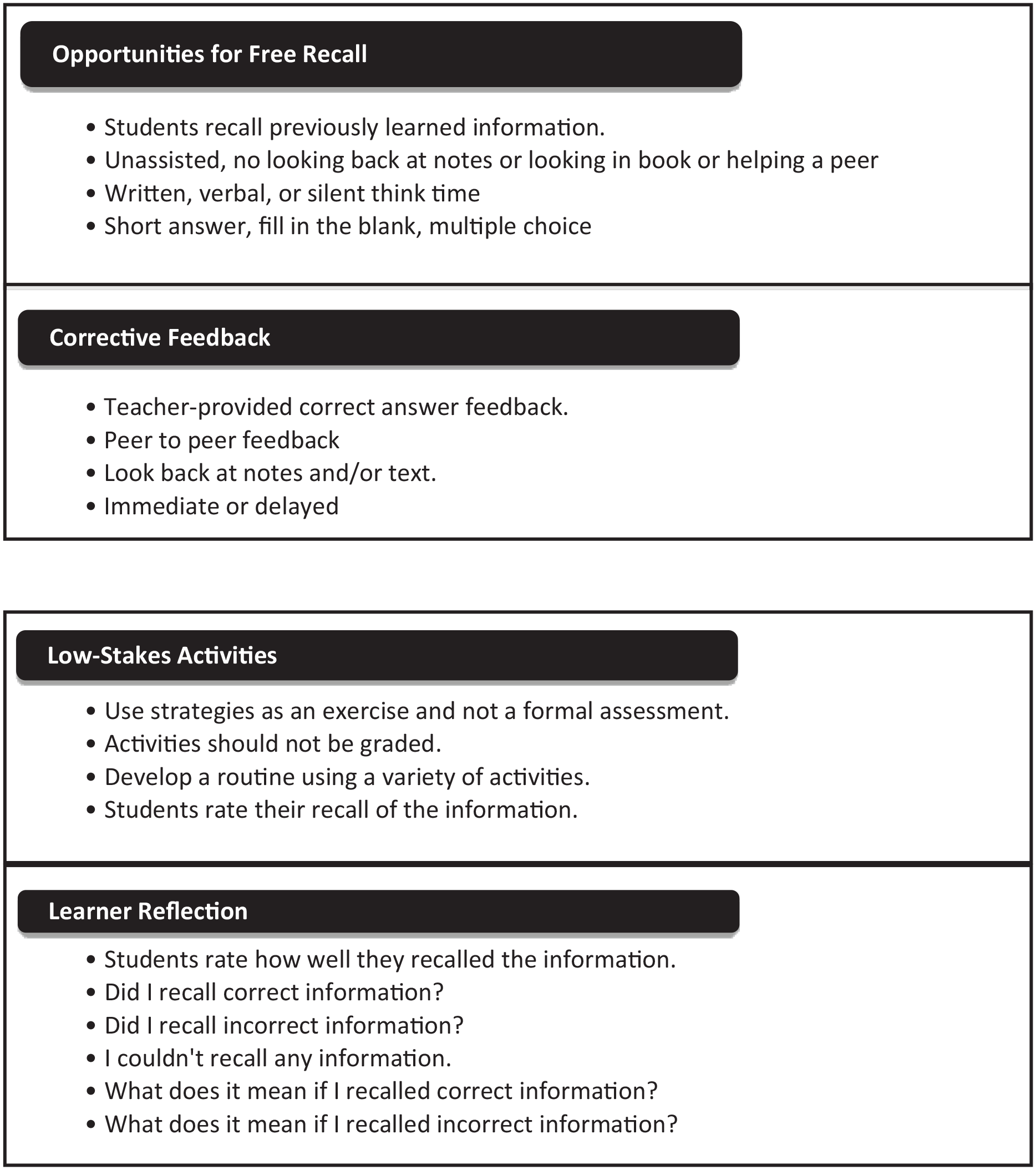
Four elements to include in practice test retrieval (PTR) activities.
Why Does PTR Work?
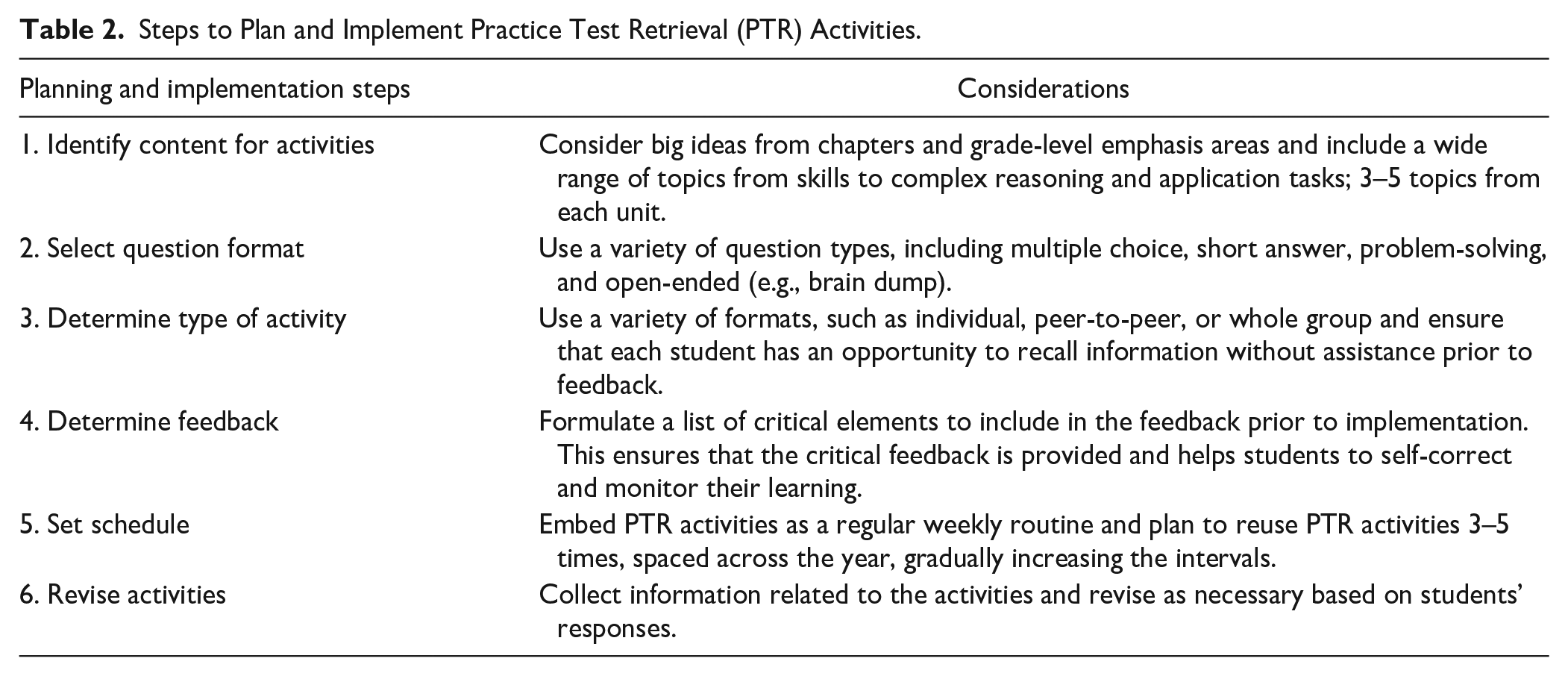
The primary element necessary for a PTR activity is a task requiring the learner to recall information from memory with no assistance. This is referred to as free recall. Although PTR has a long history of effective research results, the reason for its lasting effects is not well understood. Researchers are beginning to attribute the strong effect on retention to requiring students to actively recall information (e.g., previously taught and practiced information) with no assistance. This free recall cognitive process forces the activation of related information, which in turn strengthens the target information being retrieved. In other words, connections are being made to previously learned content that solidifies and better organizes the target information for the learner. These connections or encoding make it easier to recall the target information over longer periods of time, such as is the case with end of year assessments (Agarwal et al., 2018). If teachers help students remember more of what they learned across the academic year, performance on end of year assessments will likely improve. PTR activities should become a regular routine included in cumulative practice activities. Table 2 contains the steps for planning and implementing PTR activities.
Steps to Plan and Implement Practice Test Retrieval (PTR) Activities.
How to Plan and Implement PTR With Peer Mediation?
Once instruction and initial practice have occurred, allowing students to acquire the skill, PTR activities can begin. These activities can be conducted in a wide range of classroom spaces and structures, including whole-group, small-group, peer-to-peer, and individual activities. In addition, PTR activities can be incorporated into a variety of common activities already used by teachers, such as games, flash cards, clicker activities, dry erase boards, partner activities, and class discussions (see Morano, 2019). Almost all common activities can be modified to include the four elements required for PTR. When designing a PTR activity, the teacher must first identify the content to use. All content that has been taught is eligible for a PTR, but we recommend teachers select content that is a high priority in their grade level and important for future success. Using performance data from a variety of sources is recommended. When reviewing possible topics, select a variety of content that includes a mixture of concepts, procedures, problem-solving, and application. To promote the consistent use of PTR activities, develop a regular schedule or routine for embedding these activities as a typical part of the mathematics class. We recommend a routine that uses PTR activities once per week at the beginning of class. When logistically and pragmatically possible, planning and developing PTR activities is an excellent grade-level planning activity. A list of PTR activities is included in Table 3.
Practice Test Retrieval Activities.
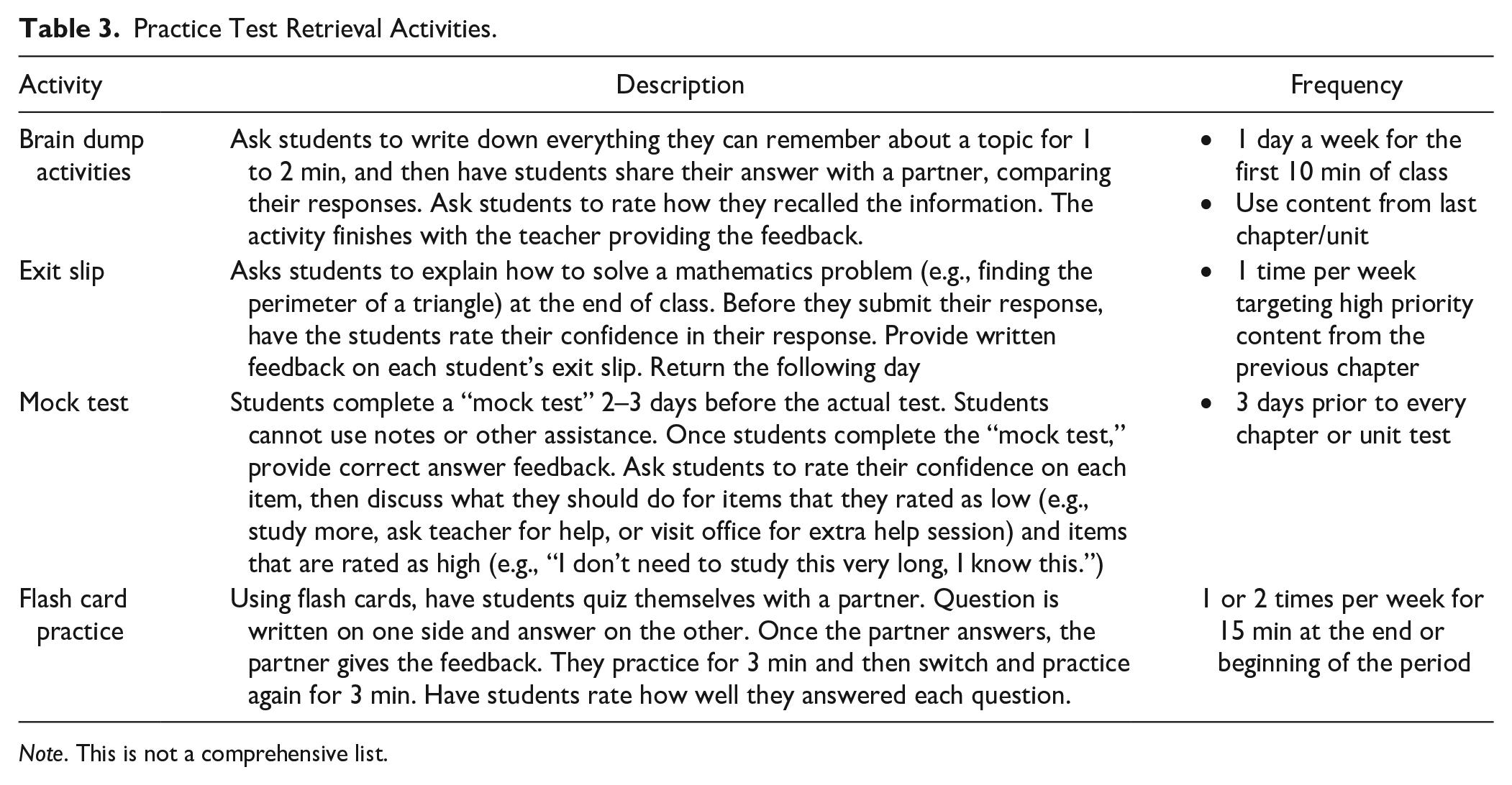
Note. This is not a comprehensive list.
Once the content and type of free recall activity is selected, the next step is to determine how to provide feedback. Providing student feedback is critical for both the students who recalled the correct information and those students who recalled incorrect information or no information at all. For the students who recalled correct information, the feedback can strengthen their confidence with the content. For the other students, corrective feedback is essential to help better organize the content and recognize that they need additional assistance either by devoting more time to studying or seeking support from their teacher (Bangert-Drowns et al., 1991). We recommend that teachers provide feedback in both verbal and written forms and, when possible, individualize feedback specific to students’ needs. Peer-to-peer feedback can also be utilized in PTR activities by having partners compare their responses. This can serve as the first level of feedback but should be followed by teacher feedback. The teacher feedback ensures that essential information is being provided to all students. We provide an extended example of one possible PTR activity for factoring binomials using a Brain Dump Activity with peer-to-peer feedback.
After learning about the PTR technique, Mrs. Jones and Mr. Rieden develop a weekly PTR routine that will become a regularly scheduled activity on Thursdays. They decide to apply the PTR technique to factoring binomials starting 2 weeks after the initial quiz and to repeat it once weekly for 4 weeks. In addition, the teachers will include a structured peer-to-peer element for the first level of feedback. Before using the activity, Mr. Rieden explains the purpose of the PTR activity, how it can help students remember what they are learning longer, and that these activities are just practice and not graded.
Brain dump activity to boost retention of factoring a binomial
A brain dump activity involves asking students to recall everything they can remember about previously learned topics, hence the name Brain Dump. In our example activity, the four essential elements of the PTR technique are applied to the Brain Dump Activity.
Preplanning and materials
The teacher designs a graphic organizer for the PTR Brain Dump Activity (see Figure 3). This tool helps organize the activity and includes the question, a response space, a problem to solve, a self-rating using emoji thumbs, and spaces for adding peer-to-peer and teacher feedback. The teacher also uses the color-coded partner structure that was described in the CRA sequence to provide opportunities for peer-to-peer discourse. The PTR activities occur 2 weeks, 3 weeks, and 4 weeks after the initial instruction on factoring binomials ended. Fifteen minutes at the beginning of the class period is allocated for the activity.
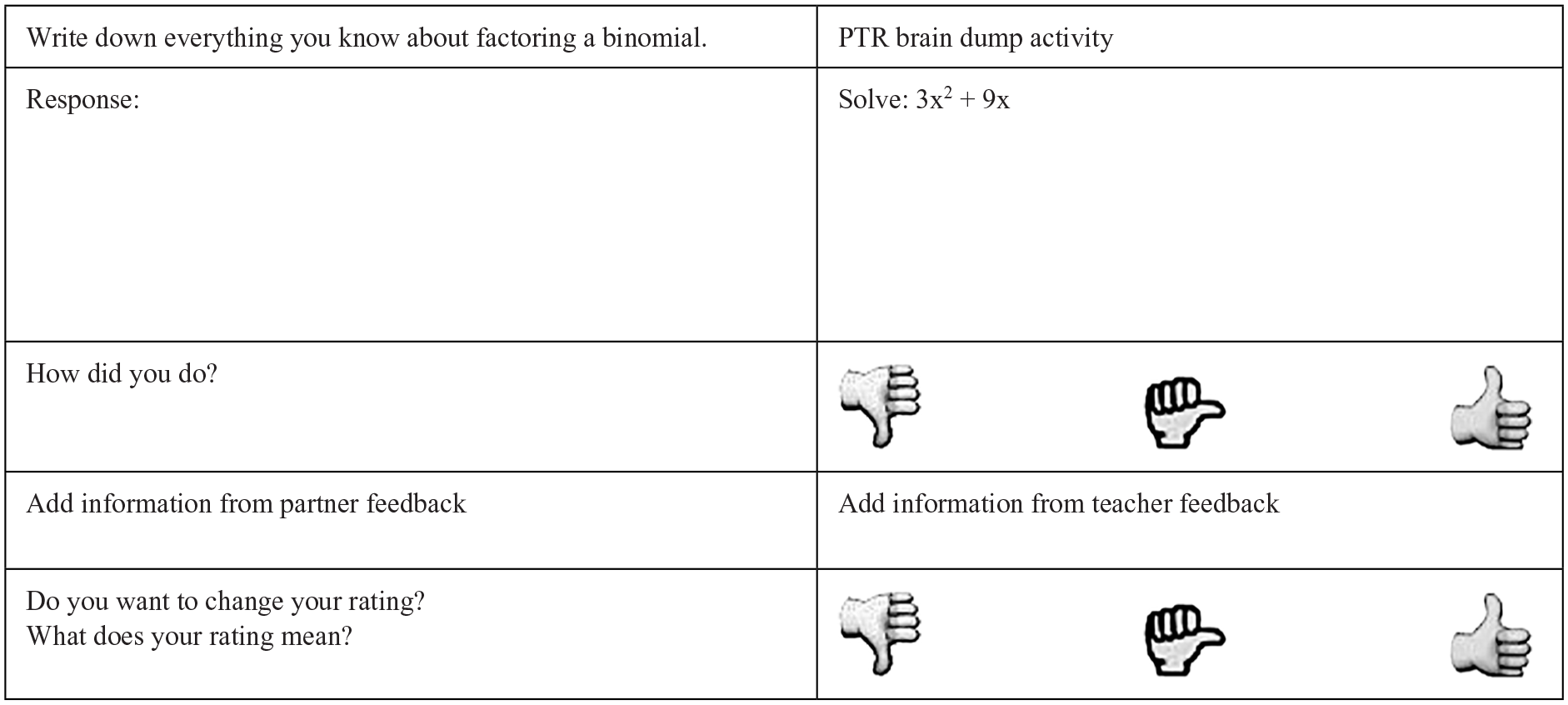
Practice test retrieval (PTR) brain dump activity sheet.
Opportunity for free recall
Students are given 2 min to write down everything they can remember about factoring a binomial. The teacher reminds students that they can write down important vocabulary, describe the process, draw a picture, or anything else that comes to mind. The teacher reassures students that it is not necessary to remember everything they have learned or to remember it perfectly. Rather, students are told that they are engaging in an exercise to help with retention. After the 2-min period, the teacher directs students to factor the binomial on their graphic organizer (3x2 + 9x).
Self-Reflection Opportunity 1 on initial response
After students have completed factoring the binomial, they are asked to rate their response and their solved problem using a thumbs up, thumbs sideways, or thumbs down emoji. This serves as their initial self-reflection activity to begin to better regulate their learning. If students appear to be hesitant, the teacher explains the purpose of rating their own learning and indicates that it helps ease anxiety related to grading.
Peer-to-peer feedback opportunity
Once all students have rated their responses, the teachers pair students for the first level of corrective feedback. Once pairs are formed, the teacher directs the Gold students to share their responses with their partner for 1 min and reminds the Purple students to compare their partners’ responses with their own responses. After 1 min, the students switch roles and the Purple students share their responses. Students can add missing information to their graphic organizer after comparing with their partner. During this time, the teacher monitors and observes any groups that are having trouble providing accurate or complete responses and provides individual assistance as necessary. This helps shape the teacher feedback that follows.
Teacher feedback opportunity
After the partners have compared their responses, the teacher provides the final opportunity for feedback in which the focus is on the most critical information. In this example, the teachers emphasize factoring the polynomial completely, how to group similar terms, the difference between factors and multiples, and the reasoning behind each step because data indicated these are common areas of misconception for their students. The feedback helps install confidence in the students who recalled the correct information and helps focus students who did not recall information.
Self-Reflection Opportunity 2
After the feedback is provided by the teacher, students are asked to rate their learning again, using the same set of emojis from the previous round. The teachers pose the following guiding questions: “Now, that you have seen your partners’ feedback and the teacher feedback, do you want to adjust your rating up or down or keep it the same? Was your response better than you initially thought or was it not as good as you thought?” Although providing two opportunities for self-reflection is optional, we recommend using two opportunities to help students become more strategic in self-monitoring their learning. Rating students’ responses before and after feedback will strengthen their ability to monitor their learning because they can see their response before and after feedback. For students with EBD, this type of reflection can help better develop their ability to self-regulate their own learning.
Closing the PTR brain dump activity
After discussion of the final rating, the teacher reminds students that they will complete more of these PTR activities every week to help them remember what they are learning. The teacher reassures students that mathematics learning is a continuous and recursive process that gets easier with greater recall of previous learning.
Given the progression of mathematics content, it is especially important to enhance and support students’ retention for their success. This is just one example of a PTR activity that can be easily incorporated into mathematics class without requiring major adjustments to typical routines. We encourage educators to consider implementing a variety of low-stakes activities that incorporate opportunities for free recall, feedback, and self-reflection to address the challenges associated with retention of important mathematical content for students with EBD.
Mrs. Jones and Mr. Rieden implemented three powerful mathematics instructional strategies to support their students’ mathematics performance. The use of CRA improved students’ procedural facility. Peer mediation improved students’ verbal reasoning and conceptual understanding. The use of PTR activities developed students’ maintenance skills. These strategies individually impacted students’ performance but together complemented each other in improving students’ mathematical achievement.
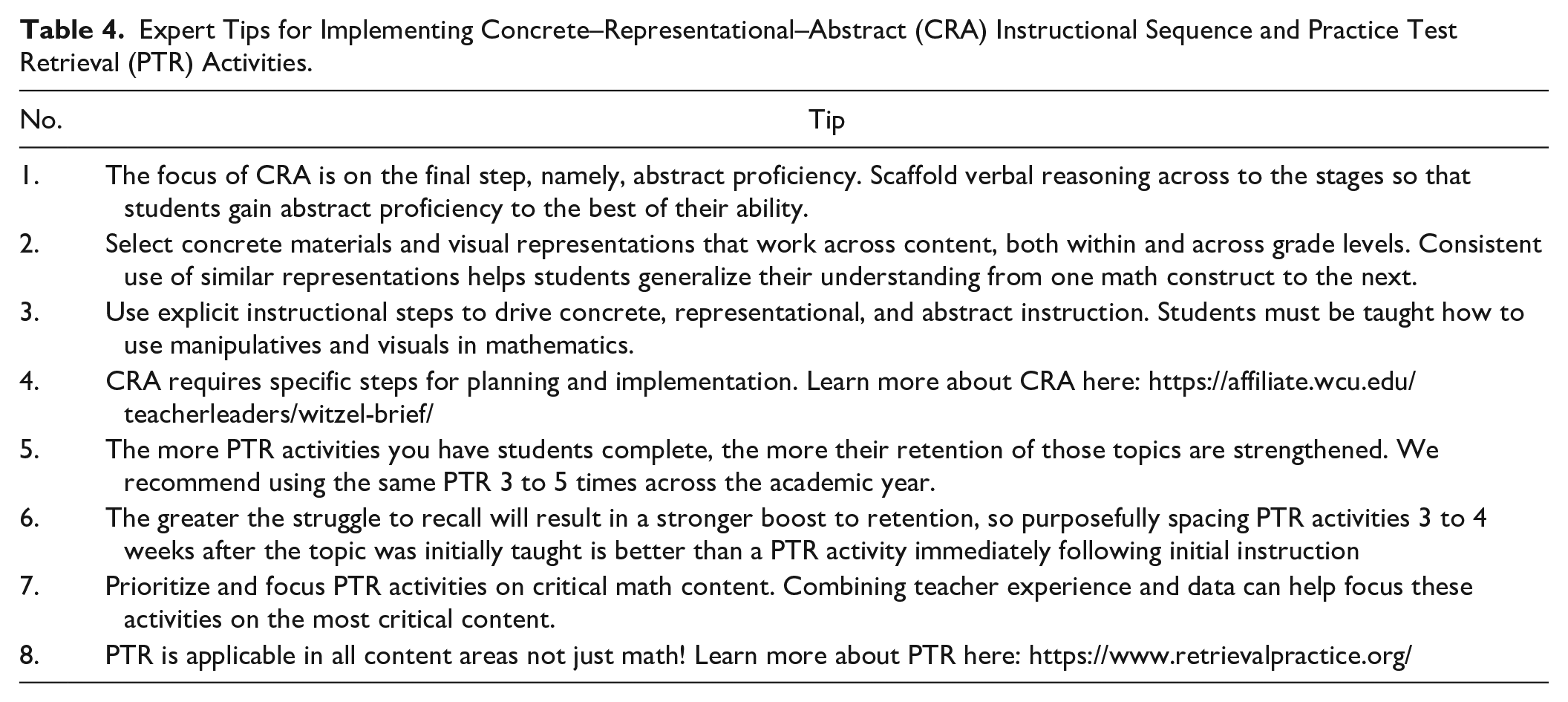
Both CRA and PTR are powerful strategies that may help students with EBD understand and use mathematics. However, each requires preparation and explicit instruction. Table 4 provides teachers with tips designed to further guide strategy development and implementation.
Expert Tips for Implementing Concrete–Representational–Abstract (CRA) Instructional Sequence and Practice Test Retrieval (PTR) Activities.
Conclusion
Students with EBD have significant academic and behavioral difficulties requiring teachers to use more intensive instructional supports. We described how the combination of peer mediation and research- or evidence-based practices such as CRA and PTR can be used to intensify instructional supports that target mathematics. Although we focused on mathematics, the strategies and techniques described are applicable across a variety of academic areas and age groups. Teachers should continue to consider combining research- or evidence-based interventions that simultaneously support learning and positive social interactions for students with EBD.
Footnotes
Declaration of Conflicting Interests
The author(s) declared no potential conflicts of interest with respect to the research, authorship, and/or publication of this article.
Funding
The author(s) received no financial support for the research, authorship, and/or publication of this article.