







Abstract
Token economies are a helpful, research-based tool for behavior intervention. However, the design and implementation process can be overwhelming. To address common challenges with token economy implementation, we describe the basic behavioral science behind a token economy, how to implement a token economy effectively, and how to avoid pitfalls along the way. We also provide advice on how to generalize token economies across settings and fade token economies, fostering a student’s intrinsic motivation and making reinforcement more naturalistic.
From Tokens to Intrinsic Motivation: Use of Reinforcement Systems in the Classroom
Cassidy Jenkins is a fourth-grade teacher in a suburban school district. She has a student in her class, Thomas, who has a diagnosis of Autism Spectrum Disorder and an Individualized Education Program (IEP) focused on supporting prosocial behaviors. He currently spends most of his time in general education with paraprofessional support about 50% of the time. Thomas has successfully transitioned from receiving instruction primarily in the resource setting to the general education setting. He uses a token economy reinforcement system in the school environment to support on-topic conversation (both during academic discussions and with peers during less structured times) and staying on task (i.e., staying in his seat, focusing conversation on the task at hand and not on irrelevant topics, and maintaining focus on work about 80-85% of the time) when doing independent work.
Token economies are a low cost, highly accepted, and research-based practice that are infinitely customizable for both the student and the teacher. A token economy is a system in which tokens that are earned for engaging in desired behavior can be exchanged for items or activities that are reinforcing for the student in order to change challenging behaviors into more prosocial or expected behaviors (Cihon et al., 2019). This method of reinforcement can be used in a wide variety of settings and can take many forms (Filcheck et al., 2004; Gillis & Pence, 2015; Hackenberg, 2018). Although token economies are widely used and can be effective, careful planning, progress monitoring, and evaluation for generalization and fading are needed to ensure students develop the skills to independently monitor their own behavior (Soares et al., 2016). These steps are critical to ensuring students learn to maintain expected behaviors in school without needing adult mediated external reinforcement (Hott et al., 2014). In order to fill an identified need in the literature base (Ivy et al., 2017), we aim to provide a clear and practical set of instructions to guide the process from development and implementation to generalization and fading and expand the prescribed technology of the token economy to promote longer lasting behavior change and more personal responsibility for those changes. In the case study, we follow a fourth-grade teacher, Ms. Jenkins, and her student, Thomas, as they ultimately fade a token economy after transitioning it from the special education setting to the general education classroom.
Rationale
Despite there being a multitude of methods to provide reinforcement to students, there are four primary reasons to implement a token economy in a classroom. First, token economies are considered a research-based (e.g., Cihon et al., 2019; Filcheck et al., 2004; Simonsen et al., 2008) and preliminarily evidence-based (Soares et al., 2016) practice. Second, token economies allow for nonverbal acknowledgment when a student is performing as expected (Kazdin, 1977). Third, token economies reinforce prosocial behaviors using a structured reinforcement strategy (Boerke & Reitman, 2014). And finally, token economies are relatively simple to systematically fade, even if this step has regularly been missed. This avoids dependence on external reinforcement over time, which is a common criticism of how token economies are used (Matson & Boisjoli, 2009).
Structuring the Token Economy
The driving force behind the token economy is the three-term contingency—every behavior is preceded by an antecedent and followed by a consequence (i.e., ABC; Cooper et al., 2020). In a token economy, this three-term contingency plays out in the following way. The antecedent (A) is a cue for the student to respond in a specific way. The behavior (B) is the prosocial behavior for the student to demonstrate that is made clear to both the student and the teacher or paraprofessional. The consequence (C) is the delivery of the token that acts as a reinforcer (Boerke & Reitman, 2014). Each student’s token economy should be individualized, while following a guiding set of behavioral principles (Ghezzi et al., 2008). Matson and Boisjoli (2009) describe token economies as “one of the most important technologies of . . . applied behavior analysts,” (p. 240) and as such, teachers need to ensure they follow the principles of that technology (i.e., set of standards for consistent implementation), which are given below.
After baseline data are gathered, the target behavior is identified. This might be a challenging behavior to decrease or a more prosocial/expected behavior to increase. Next, a preference assessment is conducted to identify the tokens and backup reinforcers. Then, baseline data are analyzed to determine a schedule for token delivery and token exchange for backup reinforcers. The finalized token economy plan is then communicated to all team members involved, including the student. Progress is monitored by taking measurement of the behaviors in question and use of the token economy. Finally, the tokens are generalized to the more natural setting and eventually faded as much as possible. These steps are discussed in greater detail below alongside examples from the case study vignette for clarification and implementation ideas.
How to Implement a Token Economy
Step 1. Identify Target Behavior
When the need for a reinforcement system arises, there are typically both target behaviors to decrease and a replacement behavior to increase. At this stage, operationally defining the behaviors is important to avoid confusion. Including examples and non-examples (i.e., what the behavior looks like and what it does not look like) can be helpful for teaching and monitoring progress. The behaviors chosen should be specific, measurable, and malleable. If the goal is to reduce a challenging behavior, the team picks one behavior to reduce and a replacement behavior (i.e., a socially appropriate behavior to replace the target behavior) to reinforce. For example, if the student is shouting out regularly in the classroom, calling out the answer without raising a hand when that is the expected classroom behavior, shout outs could be replaced with raising a hand. However, if the focus is more on improving the quality of or increasing the frequency of an already positive, prosocial behavior, then that is sufficient. An example of improving quality might be that if the student is finishing worksheets but is rushing through with little accuracy, then the target behavior could be checking the work before turning it in by working through the worksheet backwards. An example of increasing frequency might be encouraging a student who consistently answers correctly, but only when called on, to raise their hand more often to volunteer a correct answer (Boerke & Reitman, 2014).
Thomas’s special education teacher, Ms. Arnold, decided to focus on defining challenging behaviors first. Thomas was regularly discussing off topic items (e.g., making unrelated comments in response to her questions in 87% of opportunities in baseline) in the small group. Ms. Arnold awarded a token to Thomas each time he made an on-topic comment in small group conversations. When the plan transitioned to the general education classroom, Ms. Jenkins noticed that he was often staring off into space when he was supposed to be completing independent work. When she conducted a partial interval structured observation, she recorded off task behavior in 65% of the intervals in baseline. In response, she added staying on task as a target behavior (i.e., staying in his seat, focusing conversation on the task at hand and not on irrelevant topics, and maintaining focus on work about 80-85% of the time) he could earn tokens for as well.
Step 2. Conduct Preference Assessment
When teachers are planning behavior-related supports, determining student preferences should always be a priority, as motivation is necessary for behavior change (Cooper et al., 2020). In token economies, both the preference for the tokens (i.e., the delivery system) and the token exchange options (i.e., what the student is “working for”) should be considered. Preference assessment procedures range from simple and informal to more complex and formal. Preference questionnaires (e.g., https://howtoaba.com/preference-assessments/ or https://www.interventioncentral.org/teacher-resources/student-rewards-finder) can be helpful for students to express or select their likes and dislikes. These questionnaires allow the teacher to quickly determine an effective backup to the tokens that the student may not necessarily identify on their own. Even so, with many students, simply asking about favorite items (i.e., potential reinforcers) is often the easiest way to determine preference (Boerke & Reitman, 2014).
Because tokens can take many forms, using a preferred topic or item to design the token economy helps boost the motivation to earn reinforcement. For example, objects or pictures of a favorite character can be used as tokens. Backup reinforcers can also take many forms. Depending on the setting, this could be anything from a favorite snack to iPad time to lunch with the teacher and some friends. Failing to ask a student for their input may derail the entire token economy. It is important to ensure the token economy is person-centered throughout the planning process (i.e., getting their feedback at every step, ensuring the plan is working for them). The more the student is involved in the planning, the higher their buy-in is likely to be, thus increasing the likelihood of long term success.
Ms. Arnold observed that Thomas really enjoyed playing with paperclips, which was often a distraction. She asked Thomas if he would like the opportunity to earn paperclips to place into a jar to play with at the end of each class period. Thomas liked this idea, and upon earning them, would unbend the clips to make robots and towers. She also asked him if he would prefer to earn something else, and he identified that he would like to work for an occasional lunch with his special education teacher, since Thomas did not see her as often anymore. When the plan shifted to the classroom setting, because Thomas could not get up to put paper clips in a jar as often (it would be distracting to peers), the paraprofessional, Mr. Davidson, or Ms. Arnold created a token board using paper clips as tokens and placed them on his desk. Both options proved to be effective backup reinforcers.
Token economy physical characteristics
The actual physical characteristics of a token economy can vary depending on the student and setting for which the token economy is being used. For an individual student, a token economy might include a token board, which is generally the size of a sheet or half sheet of paper, with whatever the student is working for listed at the top and spaces at the bottom intended for tokens (Figure 1). The Velcro token board is popular; it allows the teacher to create even more visual interest by decorating the board and tokens with the student’s favorite characters or current interest. The tokens are small squares or circles that are printed and laminated with Velcro affixed to the back for ease of use. This provides a very clear first/then scenario for the student, with either a picture representation for the pre-reading student or a word or sentence for the reading student stating the backup reinforcer and boxes that show how many tokens they need to earn that backup reinforcer. For older students, the token board should be age appropriate (i.e., a piece of paper that receives checkmarks or a white board). Tokens can take other forms, but must be small, easily manipulated, and simple to implement in the classroom environment.

Example of a token board specialized for a student’s interest in space and space technology. Note. Moon: design vector created by rawpixel.com, www.freepik.com (https://www.freepik.com/vectors/design); moon rock: adapted from photo “The moon rock scoop used by Neil Armstrong and Buzz Aldrin training for Apollo 11” by jurvetson, licensed under CC BY 2.0; telescope: adapted from vector created by brgfx, www.freepik.com (https://www.freepik.com/vectors/girl); astronaut helmet: adapted from travel vector created by freepik, www.freepik.com (https://www.freepik.com/vectors/travel); planets and stars: adapted from star vector created by brgfx, www.freepik.com (https://www.freepik.com/vectors/star).
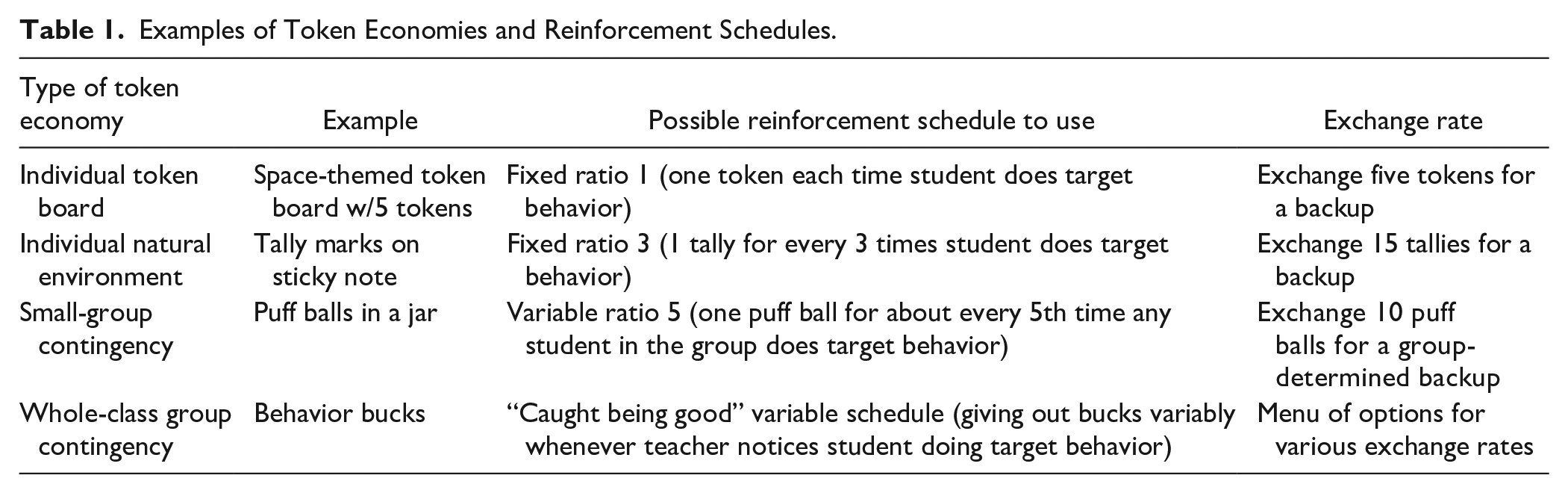
Token economies can also be used for class-wide reinforcement. A whole classroom system might look like a jar of puff balls, marbles, toy dinosaurs or another object matching the classroom theme for that year, where tokens are placed into the jar by students, teachers, or administrators for meeting either individual or group behavioral expectations. Examples of tokens for an individual student within a class-wide token economy might be post-it notes where teacher draws tallies, a paper strip that gets stamped, a sticker chart affixed to the desk, a small jar to put in objects for that student only, or a chart on the wall close by that student. Table 1 contains even more ideas. The appearance of a token economy can take any number of forms. The main idea is that the token economy is unobtrusive, of interest to the student, and easy for a teacher to use fluently (Boerke & Reitman, 2014).
Examples of Token Economies and Reinforcement Schedules.
Step 3. Define Reinforcement Schedule and Token Exchange Rate
For a token economy to work a few things must happen, the most important being the identification and introduction of conditioned reinforcers and backup reinforcers. A reinforcer is anything that increases the likelihood of the same or similar behavior in the future. An unconditioned reinforcer is something that intrinsically reinforces a behavior (typically linked to a biological response) like food, water, or physical touch. A conditioned reinforcer is something that has been paired with either unconditioned reinforcers or other conditioned reinforcers (e.g., videos, a board game) to become reinforcing (Cooper et al., 2020). In a token economy, these concepts are translated into tokens and backup reinforcers. Tokens are conditioned reinforcers. They are conditioned to reinforce the behavior by being paired with the backup reinforcer over time. The backup reinforcer is purchased or exchanged for tokens earned and typically an unconditioned reinforcer (e.g., favorite snacks, hugs). I can also be a conditioned reinforcer (e.g., iPad time, a note home to parents, a toy). Tokens then become a generalized conditioned reinforcer, which means they have value because of what they can be exchanged for in the future.
In Thomas’s token economy, the paperclips acted as conditioned reinforcers. They were backed up by other more immediately reinforcing activities, which were playing with paperclips or having lunch with his special education teacher. Over time, the paperclips took on reinforcing properties of their own as Thomas recognized he was meeting expectations and received praise statements from his teacher and paraprofessional. He began to associate the potential to earn longer term reinforcers and the intrinsic feelings of being successful with receiving paperclips.
Outside the classroom, money is a classic generalized conditioned reinforcer. On a smaller scale, a behavior bucks system in a classroom can be a generalized conditioned reinforcer for a group that functions just like money. These types of reinforcement systems help to fade more artificial token economies back to something reminiscent of how the real-world works (Cooper et al., 2020).
Ms. Arnold had a class-wide behavior management system in place, but Thomas required a more individualized plan to be successful. Most of the students in her class responded well to adding to the JenksJar (her behavior bucks system) whenever they were caught meeting classroom and schoolwide expectations. She gave students a toy dinosaur, her classroom theme for that year, to place into the jar whenever they were meeting class expectations, working hard on a challenging task, demonstrating the shared values of the classroom, or sometimes for noncontingent reinforcement. The class had developed a menu of rewards at the start of the school year to exchange for a full jar.
Token provision schedule
Tokens should be given on a predetermined and consistent schedule of reinforcement. This means either providing tokens based on an amount of time that has passed or a certain number of behaviors performed. When initially introducing a token economy, the schedules for both token provision and exchange should be dense (i.e., should occur frequently). For some students, it is necessary to provide tokens on a continuous schedule, where every single occurrence of the target behavior is reinforced with a token. However, for others, this may not be necessary. The rate at which tokens are provided is determined based on baseline data gathered about the student’s behavior. Providing tokens just slightly more often than the rate of the challenging behavior is a good place to start. This is the student’s way of showing frustration level and provides insight into how long they manage behavior without external support. For example, if a student is engaging in shouting out behavior every 3 min, a token could be provided on a fixed interval schedule of every 2 min and 30 s when no shouting out has occurred. Shouting out is operationally defined by the team to ensure that the student earns reinforcement appropriately. Once the token economy is introduced, information can be gathered on how the student responds to different token reinforcement rates and changes are made accordingly (Boerke & Reitman, 2014). To extend that example, that same student is now rarely shouting out since the introduction of the token economy. The team, therefore, decides to increase the interval to 10 min and continues taking data.
After conducting the preference assessment to determine Thomas’s interest for tokens and backup reinforcers, Ms. Arnold developed a menu that defined objects and activities for which he could trade in his tokens. These included playing with paperclips to create tiny animals, buildings, and other structures after earning 10 paperclips or paperclip tokens (approximately the amount he could earn in a half day of school), and his backup reinforcement options included lunch with his special education teacher after earning 45 paperclips or paperclip tokens.
In addition to determining how often tokens should be given, behaviors that qualify for a token should also be defined by the team. Tokens are given when the target behavior to reduce is in fact reduced or does not occur, and the target replacement behavior has occurred instead. The team members should be clear on exactly what behavior qualifies for a token and when tokens should not be given. The team should also decide how many tokens are given when the behavior does occur. More than one token could be given as a measure of the magnitude of the behavior. For example, if the target behavior is engaging in polite interactions with others, a student could receive one token for saying excuse me when someone is standing in their way, two tokens for greeting someone when they approach, and three tokens for allowing another student to go first in line. The level of reinforcement should match the response effort required to perform that behavior (Gillis & Pence, 2015). Trying to intervene on too many behaviors at once may create a problem for the team in that watching for too many behaviors may result in missed opportunities to give tokens and make the whole plan less effective. The operational definition of the behavior and token provision schedule is essential to a successful token economy.
The target behaviors defined by Thomas’ teachers included staying on topic during small group teaching arrangements and staying on task when doing independent work at his seat. Thomas was originally receiving tokens for every single on-topic comment he made in the small group special education setting. This was effective and was maintained when the plan shifted to the general education classroom setting. Ms. Arnold determined that between her and Mr. Davidson, they would be able to keep up with that schedule. When she added the receipt of tokens for staying on task, she and Mr. Davidson collected data on the duration Thomas was able to stay on task when doing independent seatwork. They determined that, on average, he could maintain his focus for 4 minutes at a time, so they decided to have the paraprofessional give a token on 3-minute 30-second intervals.
Token exchange rate
Token exchange rates are established at this time as well, which include how many tokens should be given altogether before the exchange can be made for the backup reinforcer. Much like token provision, exchange for backup reinforcers can be time-based or ratio-based. For example, the student might exchange only once a day or whenever they fill up the token chart. Again, the exchange rate is determined based on data and what is already known about the student. Like tokens, backup reinforcers can be provided based on the response effort required. For instance, the student uses a menu that lists a variety of reinforcers identified through preference assessment and based on function, all with varying numbers of tokens required for purchase. Using a menu helps to prevent satiation with a particular item or activity, provides the student with choices, and allows for ease in creating variety (Gillis & Pence, 2015). Providing tokens too often can create a student who is token-dependent and satiated or disinterested with the process. Too few tokens can stall the behavioral momentum and result in challenging behavior patterns. The same is true for token exchange rates. If challenging behaviors re-emerge, the exchange is too infrequent. If tokens are not provided as promised, or backup reinforcers are not given as promised, the student may begin to lose faith in the system and stop responding. It is imperative that the team abides by the original schedule to ensure the student maintains buy-in and for the token economy to continue working. This affects implementing similar systems in the future.
Ms. Arnold developed an exchange system whereby Thomas exchanged his tokens during the 20-minute time period right before lunch when other students were engaged in individually directed work projects and during the 30-minute period before the end of the day when students were engaged in packing up and getting organized to go home. Outside of those time periods, exchange for backup reinforcers was not available.
Response cost
Response cost, removing tokens when the target behavior for reduction occurs, is an effective tool for some students to emphasize that aversive consequences exist when challenging behaviors occur. For other students, the loss of a token may trigger more challenging behaviors and would be counterproductive to the token economy implementation. To use response cost successfully, it is important that you leverage student relationships, have a good understanding of their triggers, and proceed with response cost systematically and sparingly. Ensure a student does not attain or maintain a negative balance and that they can earn back the token that was removed. Response cost is not meant as a punitive measure. Rather, it can be included in systems as a way to provide a semblance of real-world response.
For Thomas’ plan, response cost was not a consideration. He had a history of what his teachers described as shutting down when positive punishment was administered. This behavior included sitting silently and staring at his desk and not responding when anyone talked to him. It would typically take between one and two hours to help him come out of that behavior. In order to keep momentum going, the team members decided to avoid a response cost component at present, but they could consider it in the future as they support Thomas in learning to cope with disappointment.
Step 4. Share the Plan
When discussing plan implementation, include the student. If the student is not included, the risk could be a lack of buy-in and reduced self-awareness and self-advocacy. Explain the system at their level of understanding, including how the plan will be implemented, when a student will earn tokens, when tokens will not be earned, how often tokens are exchanged, and when tokens might be taken away if using response cost measures. Explicitly train the staff implementing the plan so that it is consistently implemented with fidelity according to the research base and decisions are made based on student performance and the data. Common errors in implementation include rewarding the wrong target behaviors, giving tokens on an improper schedule, or recording faulty data, which should be preventable with this level of communication about the plan.
The student’s family should also be included in the student’s communication plan, which serves dual purposes. First, parents or caregivers can often provide some of the options for backup reinforcement. Some students will work for a positive note home, while others may want to earn time on their electronic devices. Parents can also provide verbal encouragement for the student to use the token economy at home, when they are not at school. Second, sending home a copy of the token economy, a daily behavior report card, or data collection sheet can act as a means of sharing progress and a motivator for staff to accurately and regularly record and report on data.
Ms. Jenkins and Ms. Arnold held a meeting with Mr. Davidson. They described the plan for using the token economy in the classroom and wrote out procedures for the paraprofessional. They gave the paraprofessional a progress monitoring data collection form and had him demonstrate for them how to give tokens using the chart in 3 different classroom situations. After that, they brought Thomas in and showed him the chart, described how it would be used, asked if he was okay with how it was set up, and ask if he had any questions. He agreed with the plan and was excited to start earning lunches with his special education teacher.
Step 5. Monitor Progress
As with any behavior intervention, progress toward the goal must be continually monitored. Otherwise, it is impossible to prove that the intervention plan is responsible for the behavior change. Progress monitoring of token economies is simple and can be done in several ways. A photocopy of the chart where tallies are recorded for the student also operates as a progress monitoring sheet that can be tracked and shared with all stakeholders. This provides a permanent product for progress monitoring. The number of tokens received per day or the number of times the student exchanged the tokens for the backup reinforcer should both be recorded and graphed daily. If the student is capable, they should participate in the recording process, which acts as a self-monitoring intervention to allow them to examine their progress as well. Using baseline data, an ambitious goal is determined both for decreasing the challenging behavior identified (if any) and for increasing the replacement behavior (Boerke & Reitman, 2014). See Figure 2 for an example of a data collection form.
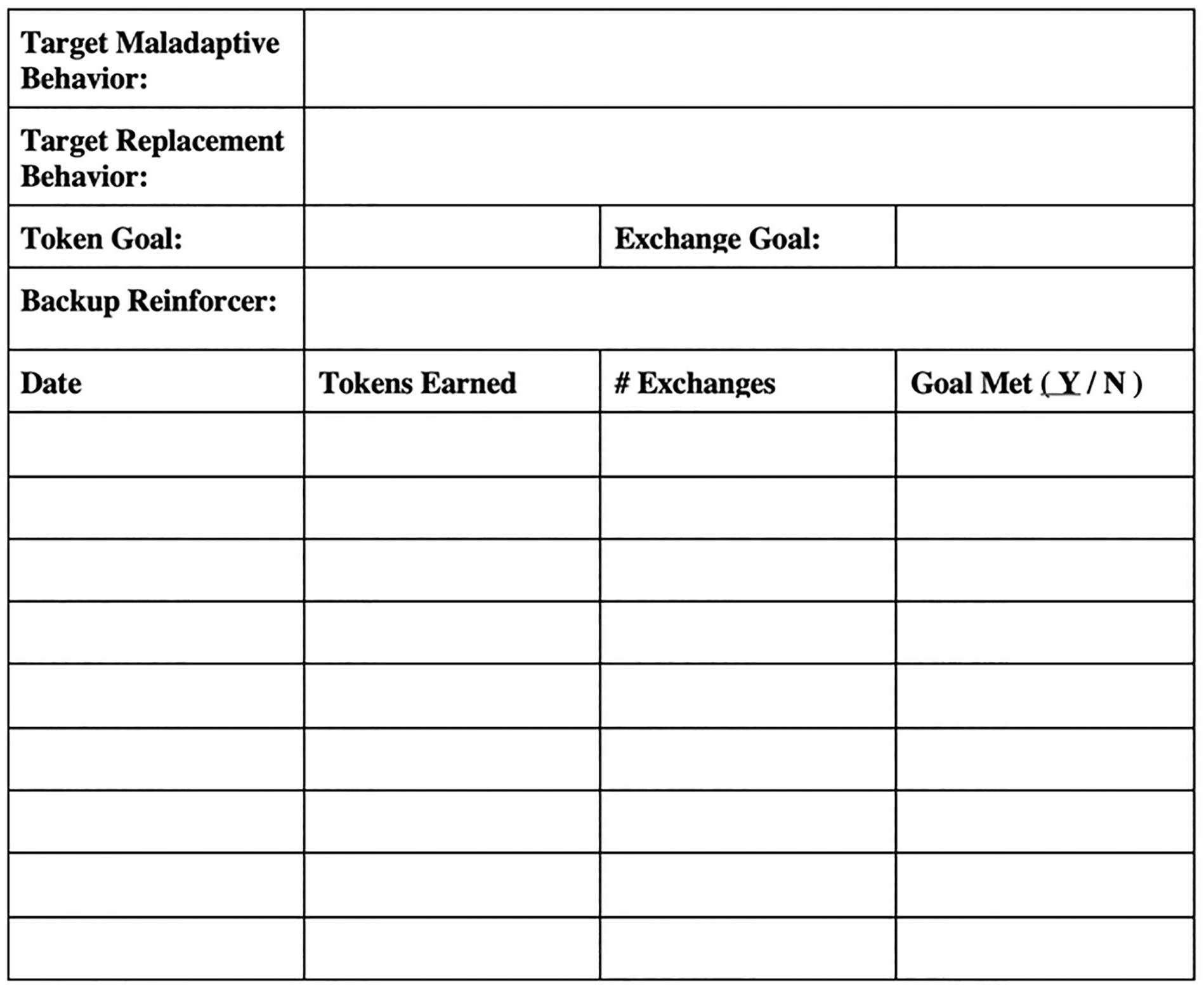
Sample data collection form for use with a token economy.
Thomas’ paraprofessional used the chart given to him by the classroom teacher to record the tokens earned each day, the number of exchanges made each day, and the chosen backup reinforcer for each exchange. He recorded the number of off-topic statements made each day, as Thomas seemed to be increasing his rate of off-topic comments, even though overall he was still making many more on-topic comments with the token economy in place. Every week, he gave the progress monitoring chart to Thomas’ special education teacher, who graphed the information and shared it with the team, including Thomas’ parents.
Step 6. Generalize Tokens
Once a token economy has been deemed effective, it will need to be generalized across environments and people. Generalization is the use of a new skill in a different context, with a different person, with different materials, or using a slightly different method (Cooper et al., 2020). Some options for generalization include varying the tokens themselves, varying the person who provides them, offering different backup reinforcers depending on the setting, and changing up the schedule of reinforcement depending on the setting (Boerke & Reitman, 2014).
A token economy might be the same one that is brought along to every place in school the child goes. The tokens might never be changed because they are the child’s favorite character and they would never work for something else. The same number of tokens may be used all the time. The child may not respond to anyone but their paraprofessional. These are possibilities and are valid observations but are not valid reasons to continue using the exact same token economy indefinitely. Generalizing across settings and people, reducing the amount of adult interaction with the intervention over time, and thinning reinforcement schedules over time are all cited as considerations for long-term success when implementing a token economy (Kazdin, 1977) and thus should be considered at each step of the process.
Thinning
Thinning is the process of reducing the existing schedule of reinforcement (Cooper et al., 2020). There are many options for thinning, but the main steps include reducing the number of tokens given per activity (also known as thinning the production ratio) or reducing the number of tokens required for the backup reinforcer (also known as thinning the exchange ratio; Gillis & Pence, 2015). When thinning the production ratio, the teacher could (a) keep a fixed ratio or interval reinforcement rate for giving tokens and extend the requirements or (b) introduce a variable ratio where the average gets progressively bigger. The possibilities for thinning are endless and completely dependent upon what is appropriate for the child, the target behavior, the setting, and the person implementing the token economy.
Given that, it might be tempting to cease using a token economy after the student has been successful with it for several weeks or months. However, ceasing an intervention without thinning back to the schedule of reinforcement in the natural setting (or very close) can be detrimental and cause a resurgence of the challenging behavior or the appearance of a new one (i.e., an extinction burst; Cooper et al., 2020). The time spent on the thinning process varies depending on the student. The team must be cognizant of the student’s history with behavioral interventions, monitor target behavior progress, and make decisions according to data patterns.
Thomas was using the token economy in the special education classroom before it was transitioned to the general education classroom. His teachers worked to plan for that generalization. They varied the setting and person providing the tokens. They made sure to coordinate as a team so that everyone was using the token economy in exactly the same manner. As time went on in the classroom, Thomas’ paraprofessional began to offer him other options for backup reinforcers at the start of each week, ensuring that he did not satiate on any given option.
Step 7. Fade Tokens
Although generalization involves using the token economy in a variety of settings or slightly altering the administration to be more flexible, fading is the process by which a stimulus (i.e., something in the environment) is gradually removed either completely or then replaced with something that is more natural and age appropriate (Cooper et al., 2020). With a token economy, it is easy to see how fading might be overlooked as the token economy is effective and supports student behavior, but in reality, the token economy is not meant to travel with a student for the rest of their educational career. Rather, it should be faded as soon as possible to closely resemble the support of a typical peer. Tokens can be changed or varied, altered in number, shifted from a Velcro chart to a sticky note with tallies, backed up by the classroom token economy and gradually replaced with class-wide reinforcers.
In elementary and middle school, many classrooms and buildings use class-wide or school-wide token economies, which can envelop the individualized token economy. The benefit of this is that it creates less work for the classroom teacher while also allowing the student to participate in the same systems as their typical peers. Figure 3 provides an example for fading. When the entire group can be a part of a contingency (i.e., behavior bucks or something similar), the teacher is using research-based methodologies (Maggin et al., 2012) to support all students and can make very minor tweaks within the broader system for students who need it. Teachers generally prefer when students can participate in self-monitoring or the whole group-based contingency over continuing individualized token economies (Oliver & Reschly, 2010), as it likely leads to less additional planning and implementation time and more time to focus on instruction.
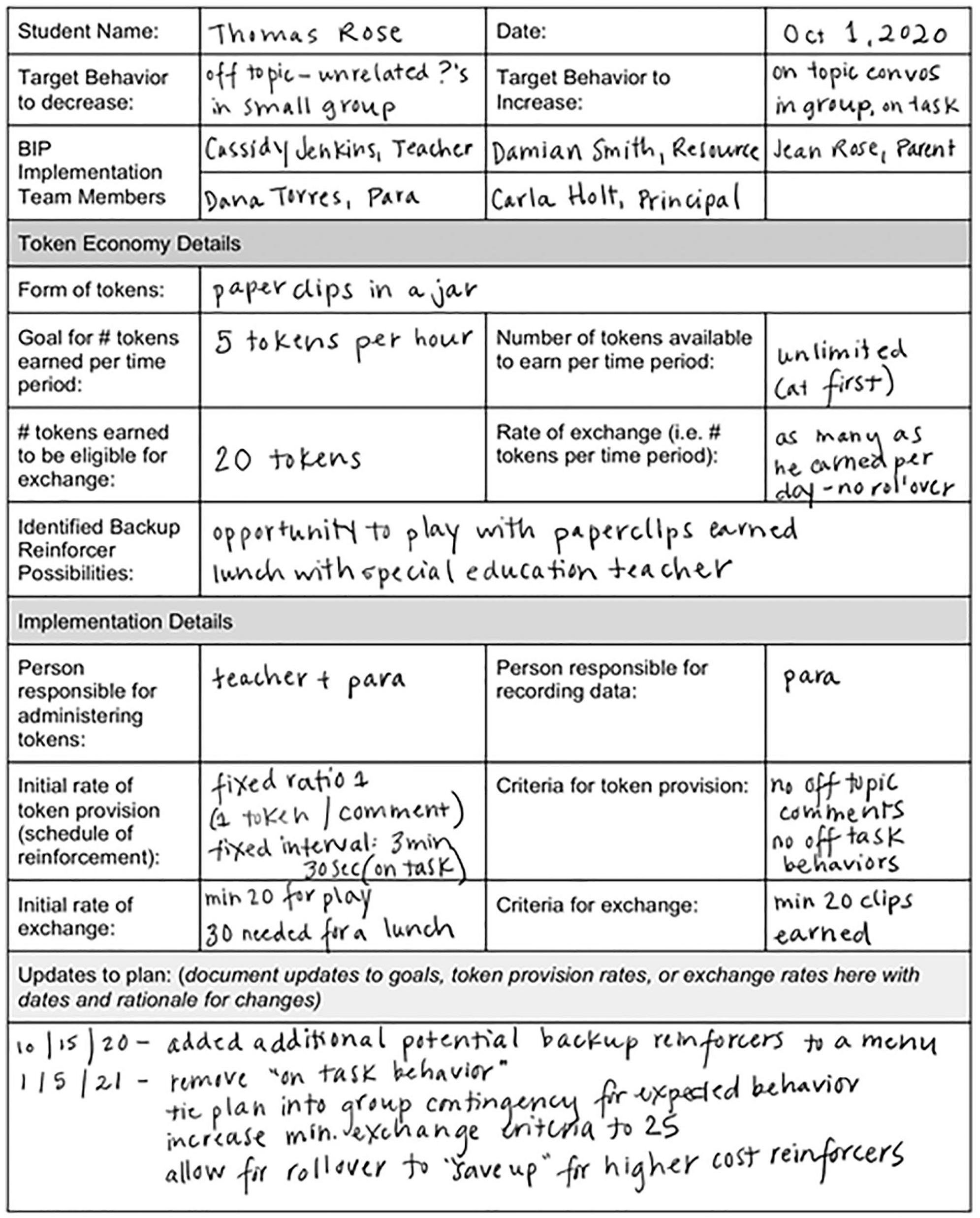
Example of a completed token economy implementation plan.
The token economy should be faded at a speed appropriate for that student. First, look at the data collected. Next, make decisions on fading after trends have been established (six to eight data points), setting goals for each new fading benchmark. Finally, communicate the fading plan clearly to the student and celebrate each success along the way (Boerke & Reitman, 2014). Once tokens are faded, follow the steps in Figure 3 to implement a self-monitoring system for self-regulation of behavior, ultimately fading back to intrinsic motivation.
Ms. Jenkins began fading Thomas’ token economy after returning from winter break. She removed on-task behavior from the plan, and used proximity as an intervention and “caught being good” tokens for the entire class, to support Thomas and several other students. The class earned a group reward if they achieved a certain number of tokens class wide. In addition, both teachers decided Thomas should receive a token once per hour for an on-topic comment and could exchange his tokens after achieving 25 tokens, with tallies from every day carrying over to the next. Thomas progressed and consistently increased on-topic comments each day. He reviewed his chart with his teacher at the end of each week and noticed how well he was doing with on-topic comments and was excited to earn his rewards. He was even more excited, however, to earn rewards for his class and be seen by his peers in a more positive light.
Step 8. Shift to Self-Monitoring
Shifting from an external token system to an internal system of self-monitoring, “a strategy for managing or regulating one’s own behavior” (Bruhn et al., 2015, p. 102), is another benefit to fading the token economy. If a student can learn to self-monitor early in their education, that bodes well for the rest of their educational experience as that skill correlates strongly with academic success (Ghanizadeh, 2017). Targeted reinforcement effectively reduces challenging behaviors in the classroom (Sheffield & Waller, 2010) and paves the way for learning socially appropriate behavior. Token economies are individualized and support initial skill development, but they are not as effective in larger groups and should be thought of as a temporary measure to allow the student to participate in more group-based contingencies and in self-monitoring. Thus, a more appropriate answer to effective reinforcement in a classroom setting (and even beyond when thinking about how that student will exist in the broader world) is self-monitoring, management, and regulation. If the contingency is taught, trained, shown to maintain across time, and generalized to necessary settings, it can be easily applied in larger group settings, such as a social group, a small learning breakout group, a teacher-led study group, and even a general education classroom (i.e., 20–30 students who can all reliably self-report with little to no guidance; Zaheer et al., 2019). Shifting from an adult-directed token economy to a self-directed one where self-monitoring of behavior is reasonable may help increase the likelihood of continued reinforcement for prosocial student behavior while reducing the amount of time a teacher or paraprofessional must spend monitoring the student’s behaviors. Maintenance and generalization of that prosocial student behavior are important (Hott et al., 2014) for long-term learning. When students are taught to be more independent by monitoring and managing their behavior, the teacher and paraprofessionals can focus on instruction of new skills and managing the overall classroom setting rather than honing in on one student’s behavior and reinforcement system.
By the end of the school year, Thomas and Ms. Jenkins faded the use of paperclips completely. Thomas began monitoring his own on-task behavior by engaging in noticing behavior when prompted at scheduled intervals to “check focus” by Mr. Davidson. He continued to enjoy participating in the whole class behavior monitoring system and was regularly able to put a dinosaur in the class jar to contribute to whole class rewards.
As we have shown, the token economy is a well conceptualized, research-based practice, the details of which are easily operationalized, making it straightforward to implement across a variety of educational contexts. The steps to implement a token economy, described above, are also shown in Figure 4. Use the sample token economy implementation plan, like the one in Figure 3, to help guide the process as well, from initial implementation to fading back out.
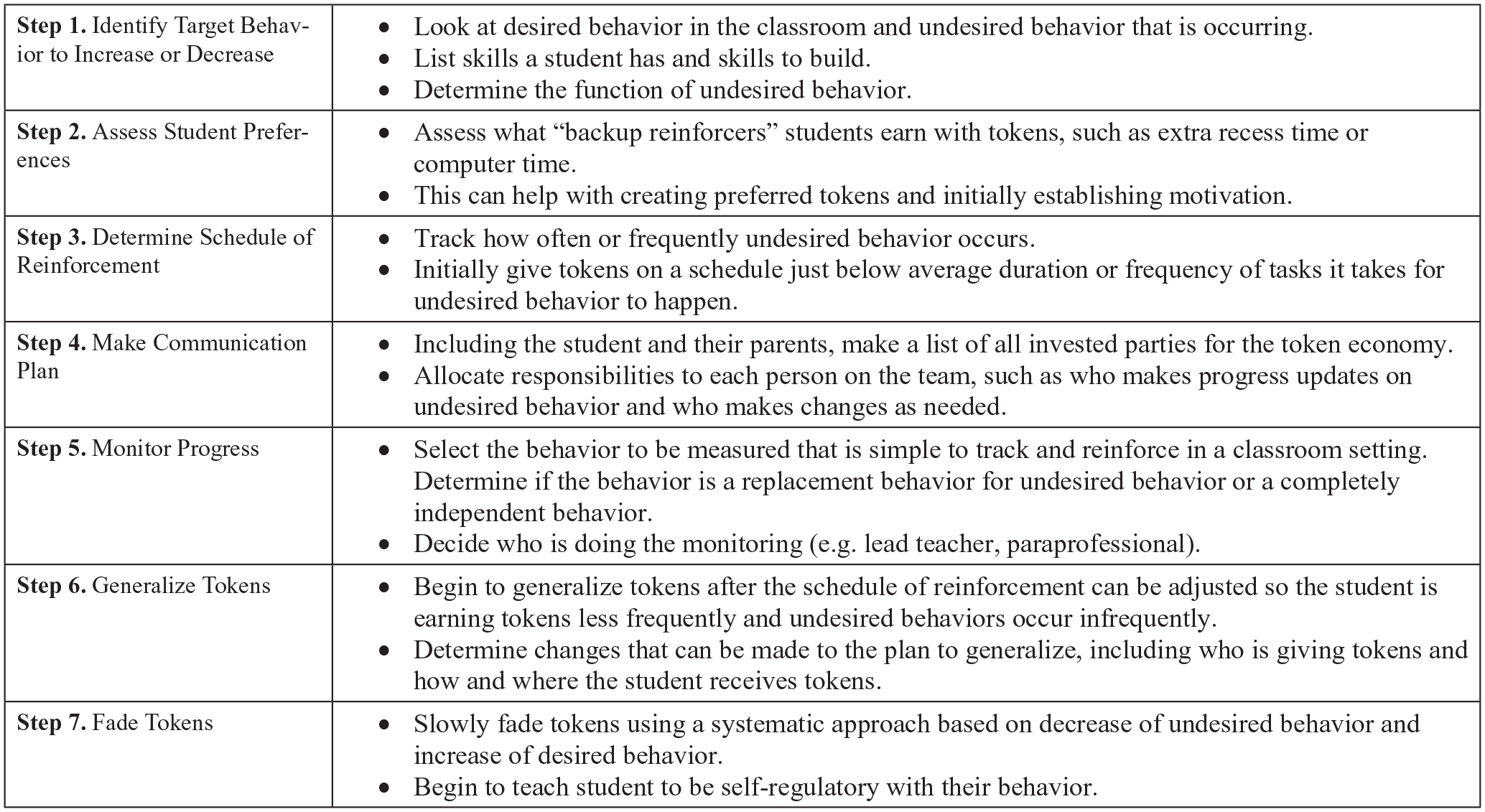
Token economy implementation.
Potential Barriers to Implementation
The use of external reinforcement systems in general education classrooms may create reinforcer dependence and damage intrinsic motivation in the long run, and while some literature has warned against the use of external reinforcers (Soares et al., 2016), we argue for a more systematic use of external reinforcers with proper fading procedures in place.
Issues may arise when the wrong schedule is applied. Students can stop responding after the token threshold is reached, which is often the case when artificial ceilings are applied (i.e., the student can earn a maximum number of tokens per day; Cihon et al., 2019; Tarbox et al., 2006). This creates a student who responds well in the beginning of the day but whose behavior may deteriorate after lunch time. In contrast, an artificial floor creates a student who gives up if they do not earn a specific number of tokens by a specified time and knows the window of opportunity has passed.
Another issue that comes with token economies is a rigid reliance on the tokens, where work is not completed outside of a “first/then” provision for tokens to come (Kazdin, 1977). If the token economy is not faded, the student may become dependent on a token system to achieve at school or maintain appropriate behaviors. When students lack the development of a more advanced intrinsic motivation to maintain socially valid behaviors, the need for external reinforcement may identify them as learners with significant support needs when that is not necessarily true. Finally, as with any structured intervention, token economies can begin to feel very artificial and inauthentic. The decision tree in Figure 5 can help teachers make decisions at each stage of the token economy to create a more authentic implementation.
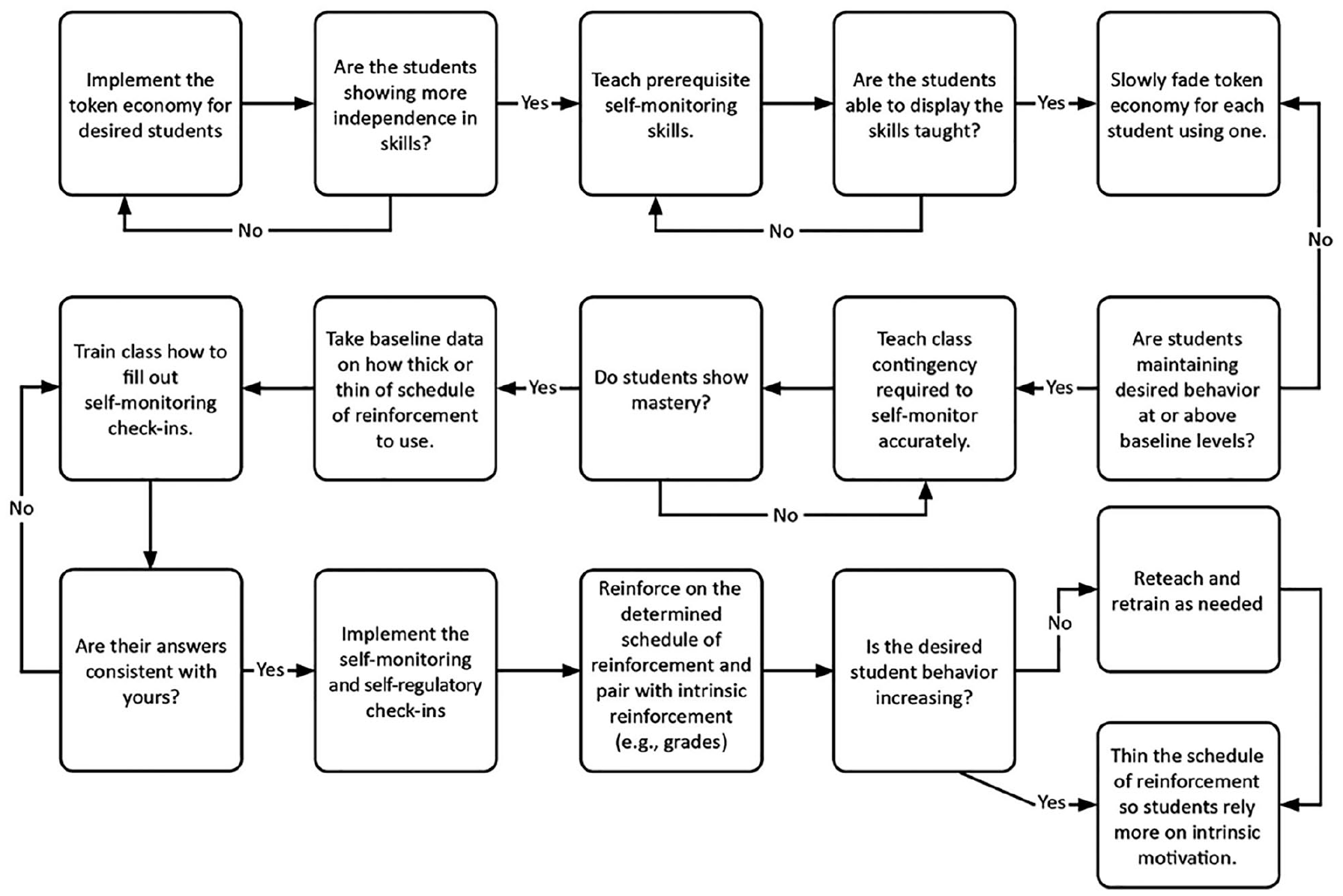
Token economy decision tree.
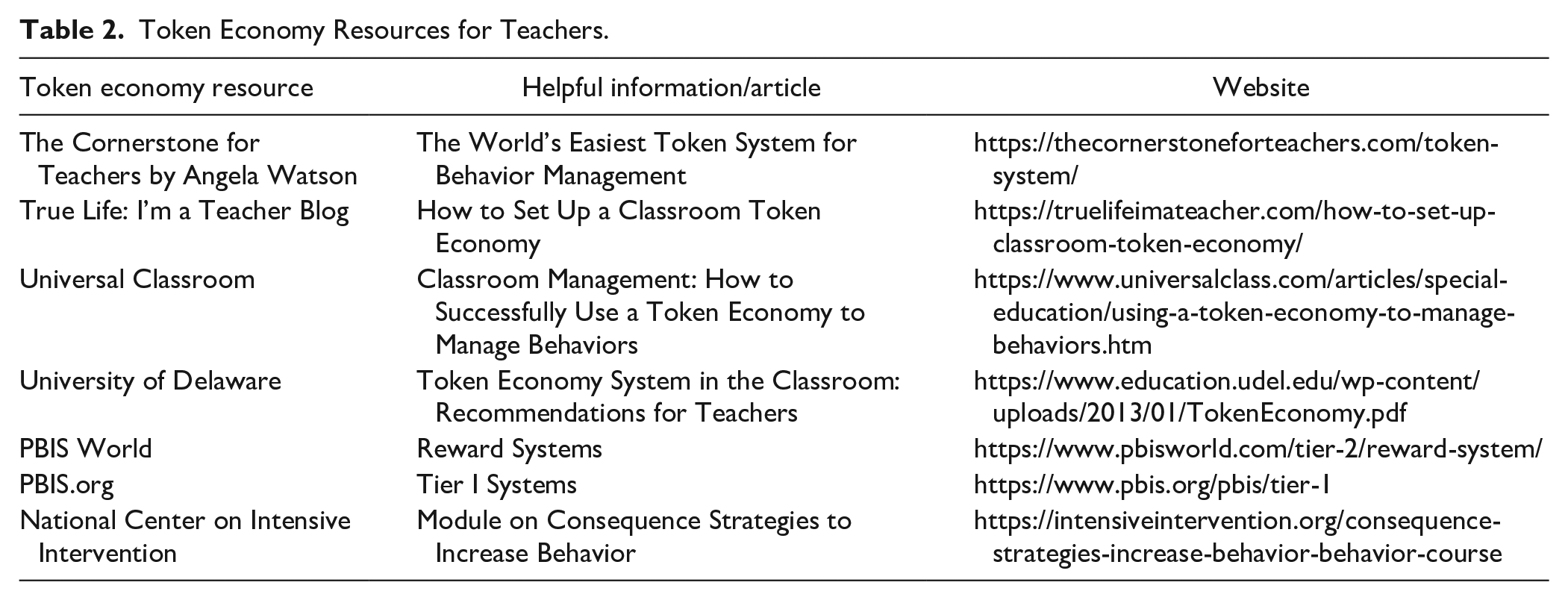
These issues can be accounted for in a few ways. First, be flexible with initial implementation of a token economy. Allow for in-the-moment decision-making about appropriate token-to-behavior ratios, which may help reduce the rigidity that comes with token economies (Cihon et al., 2019). Second, a focus on generalizing the token economy and then fading it should be in the plan from the beginning. Despite being a research-based practice, token economies are not consistently taught in special education teacher preparation programs (Oliver & Reschly, 2010) and are, therefore, likely not being implemented with fidelity or with intention to generalize and fade. There is a need for training professionals on implementing token economies effectively and efficiently (Gillis & Pence, 2015). These potential barriers can be ameliorated by following the task analysis presented above with fidelity, reading further about token economies to ensure high implementation fidelity (see Table 2 for additional resources), and ensuring that generalization and fading are the ultimate goals of any token economy plan.
Token Economy Resources for Teachers.
Conclusion
Despite the assertion of Boerke and Reitman (2014) that token economies “present considerable training and resource challenges to the potential user” (p. 377), if steps are implemented as described using Figure 5 as a reference, they are a powerful and not overly complex tool. Making decisions about implementation, developing a clear and concise plan, allowing for communication at every stage, regularly examining data, ensuring implementation fidelity, and including the student in the process may result in an effective token economy intervention. Taking it one step further to fade the tokens systematically over time and generalize the concept for the student into the broader classroom context will give them more independence in behavioral choices, less reliance on adult support, and more opportunities to participate in the general education setting, which ultimately may lead to more independence later in life.
Footnotes
Declaration of Conflicting Interests
The author(s) declared no potential conflicts of interest with respect to the research, authorship, and/or publication of this article.
Funding
The author(s) received no financial support for the research, authorship, and/or publication of this article.
