







Abstract
In this article, we provide guidance about when planned ignoring should be considered, questions that may arise, and step-by-step procedures for implementing. A scenario of a kindergarten student is used to illustrate planned ignoring and possible questions regarding implementation in an educational setting. Forms and resources are provided to assist with classroom implementation.
In education, research- or evidence-based practices are teaching actions that have been shown to be effective through varying amounts of high-quality research (Council for Exceptional Children, 2014). Although universal positive behavior supports (e.g., active teaching, increased opportunities to respond, behavior-specific praise) have proven effective for decreasing the majority of disruptive classroom behaviors (Gage et al., 2018), maladaptive behaviors do occur, and teachers need to be equipped to use a variety of research- or evidence-based practices to support students. Although elementary school educators are trained how to prevent behaviors from occurring, often little guidance is given on what to do when behaviors occur and continue to occur even after positive behavior supports have been attempted. For example, practitioner articles in peer-reviewed journals that address intensive behavior management strategies are being published in much smaller numbers compared with prevention strategies (Hott et al., 2019). Planned ignoring is an intensive behavior intervention supported by the principles of applied behavior analysis (ABA), the gold standard for treatment of autism and other disabilities (Cooper et al., 2020). The purpose of this article is to introduce planned ignoring, a research-based practice for addressing socially reinforced behaviors (Pokorski & Barton, 2020).
Ms. Jennings is a kindergarten teacher with 25 students ranging from 5 to 6 years old. She is a first-year teacher, having recently completed a bachelor’s degree in early childhood education. Her classroom management courses included instruction from professors who expressed their encouragement of universal positive behavior practices, including clear classroom expectations, behavior-specific praise, and positive whole classroom management systems. Ms. Jennings follows her training and implements positive behavior supports. However, Ms. Jennings’s training did not include supports for students with, or at risk for, autism or emotional and behavioral disorders who have not responded to universal positive behavior supports.
Ms. Jennings needs assistance to support Meaghan, a student who was identified by her preschool program as developmentally delayed due to social and emotional difficulties. As suggested by her mentor, Ms. Jennings spends weeks teaching classroom rules, modifying work, and attempting to prevent the disruptive behaviors. Ms. Jennings wonders if the only way to decrease the behaviors is to give Meaghan constant attention, which she believes is not feasible within a classroom setting.
Steps in the Planned Ignoring Intervention Process
Planned ignoring is considered a punishment-based intervention that should only be used with attention-maintained behaviors. An intervention is considered punishment-based when a stimulus immediately follows a behavior and the probability of the behavior occurring again decreases (Cooper et al., 2020). Examples of punishment-based interventions include planned ignoring, timeout, verbal reprimands, and loss of privileges. Figure 1 outlines the steps needed to implement planned ignoring. These steps include procedures that should be conducted to ensure the interventions being used are ethical and in the best interest of the student.
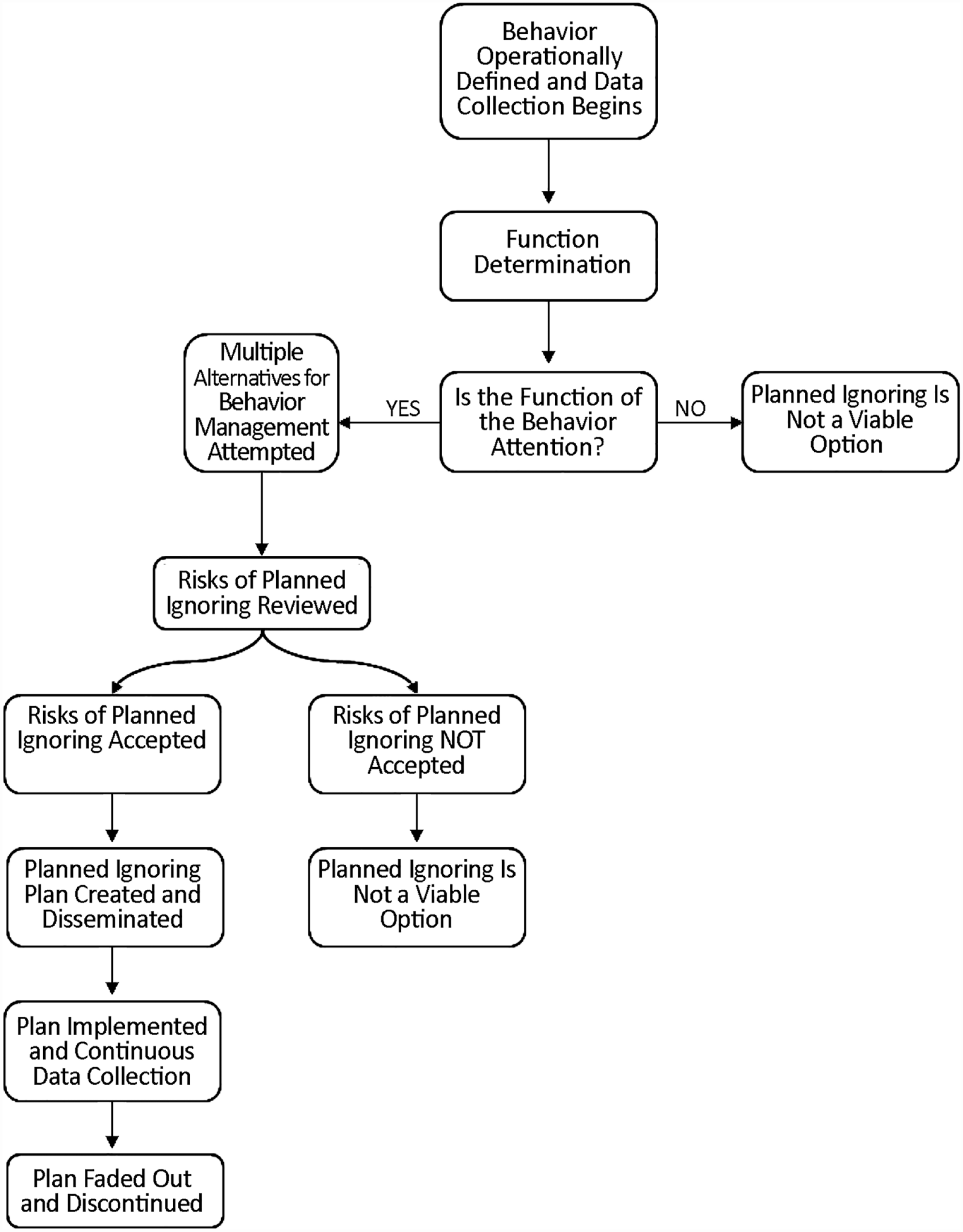
Planned Ignoring Flow Chart.
Step 1: Functional Behavior Assessment
The functional behavior assessment (FBA) process begins with data collection to observe and analyze the behaviors that are occurring in the classroom. Next, data are analyzed to give the team an objective view of the behavior, which is especially important when considering the implementation of planned ignoring. Although collecting data takes time, it is important to ensure that attention is what is maintaining the behavior. Figure 2 provides a completed example of an antecedent-behavior-consequence (ABC) data collection form that can help determine the function of a behavior (see Pence & St. Peter, 2018, for a more comprehensive description of ABC data collection).
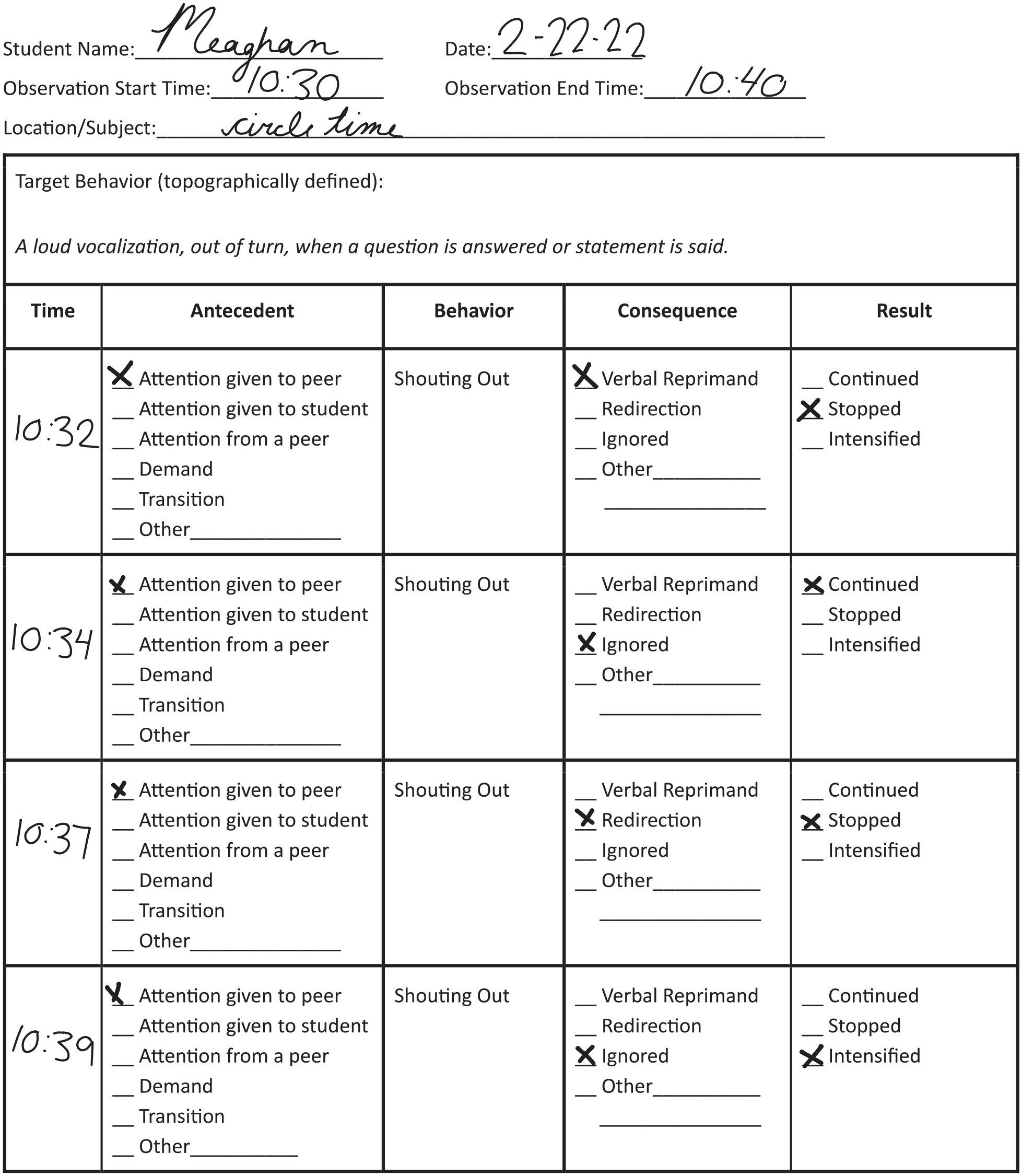
Example of an Antecedent-Behavior-Consequence Data Sheet.
Ms. Jennings needs additional assistance to effectively support Meaghan. She reaches out to her school’s special education teacher, Mr. Thomas, and arranges a meeting. Mr. Thomas tells Ms. Jennings that the first step she must take is to determine the function of Meaghan’s disruptive behaviors. He calls Meaghan’s parents and gains their written consent to complete an FBA to address behaviors of concern. Mr. Thomas gives Ms. Jennings data collection tools to conduct the FBA, explains how and when to use the tools, and offers to collect data himself on the disruptive behaviors. Together they create a topographical definition for the target behavior, shouting out, which they define as, “A loud vocalization, out of turn, when a question is answered, or statement is said.” They agree to meet in a week to review the data collected and determine next steps.
Step 2: Determination of Behavior Function
A multitude of trends can be seen when examining ABC data. Common antecedents for an attention-maintained behavior include (a) when adult attention is given to a peer, (b) peer attention is given to the student, (c) no adult attention is given to the student, and/or (d) no student attention is given to the student. In terms of consequence trends, the following can be seen when the behavior is attention-maintained: When the behavior is ignored, the behavior intensifies, or when the behavior is redirected or reprimanded, the behavior stops.
Data that Ms. Jennings and Mr. Thomas collected indicate that each time Meaghan “shouts out,” it ends in the teacher or other adult verbally telling her to stop. Prior to the “shouting out” occurring, it appears that the adult in the room is providing another student with attention. Ms. Jennings and Mr. Thomas agree that the data pattern suggests that a possible function of Meaghan’s shouting out is to gain adult attention. With this information, they are able to implement an intervention package focused on decreasing the target behavior and increasing a replacement behavior.
Step 3: Multiple Alternative Options for Behavior Management Explored
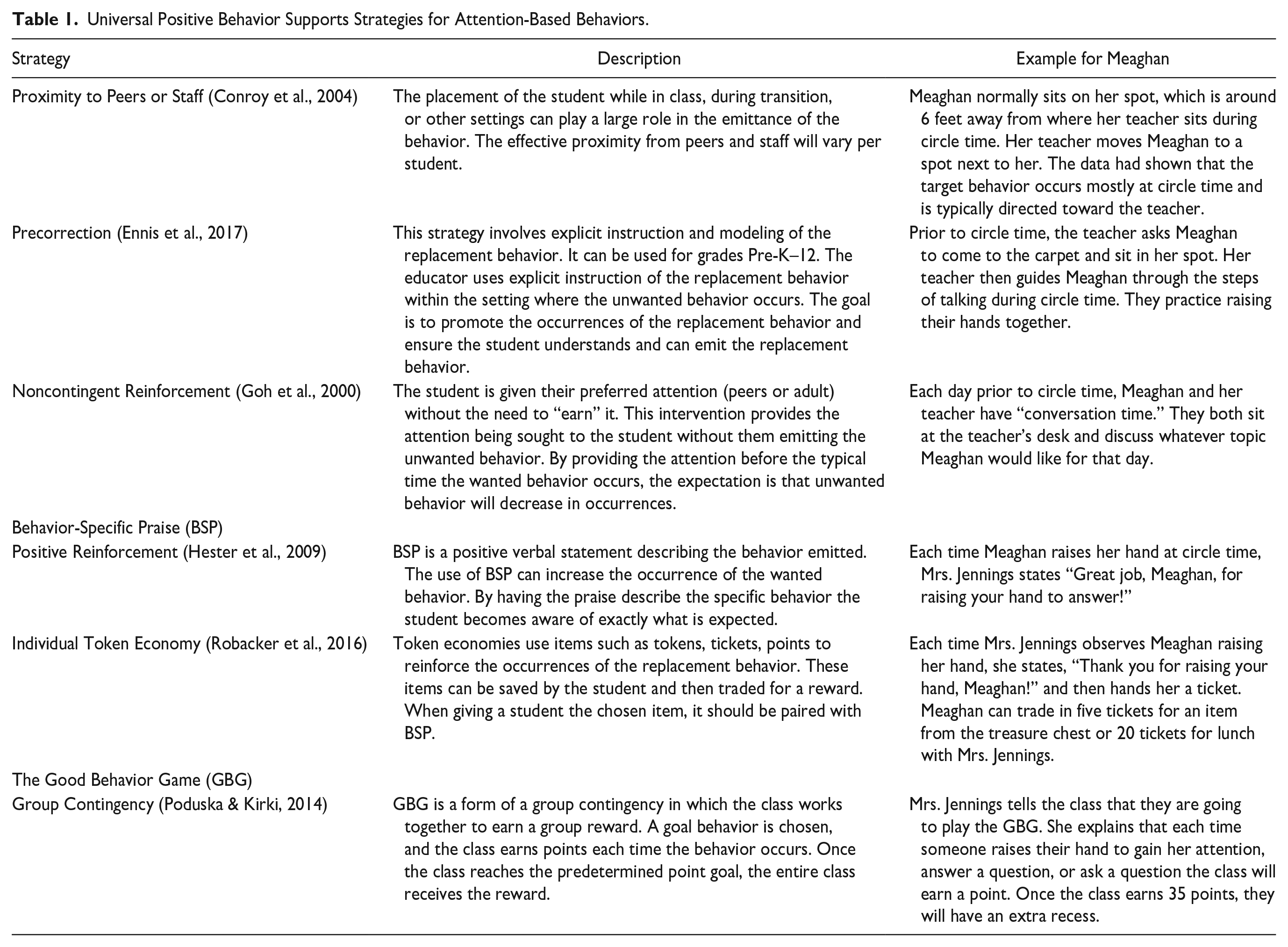
Prior to implementing planned ignoring, or any punishment procedure, alternative interventions based on reinforcement and environmental modifications must be attempted and evaluated (Janney et al., 2012). Strategies such as choice of task, choice of consequence, or mystery student can support a student with the attention being sought in an appropriate way (see Kern & Clemens, 2007 for antecedent strategies). These strategies are often valuable in not only managing a behavior but also teaching replacement behaviors. Table 1 provides examples of behavior management strategies that can be implemented for attention-maintained behaviors prior to considering planned ignoring.
Universal Positive Behavior Supports Strategies for Attention-Based Behaviors.
It is important to document each intervention attempted, implementation details, the amount of time that the intervention was implemented, and the outcome. Implementation details consist of the type of reinforcer (e.g., tokens, tickets, edibles), how often the reinforcer was earned, any assignments that were modified, how work is being modified, and how often the work is being modified. The implementation timeframe is when the intervention began, any interruptions that occurred during implementation (e.g., fall break, long-term absence), when the intervention was discontinued, and why it was discontinued. Figure 3 includes an example of an intervention implementation monitoring tool.
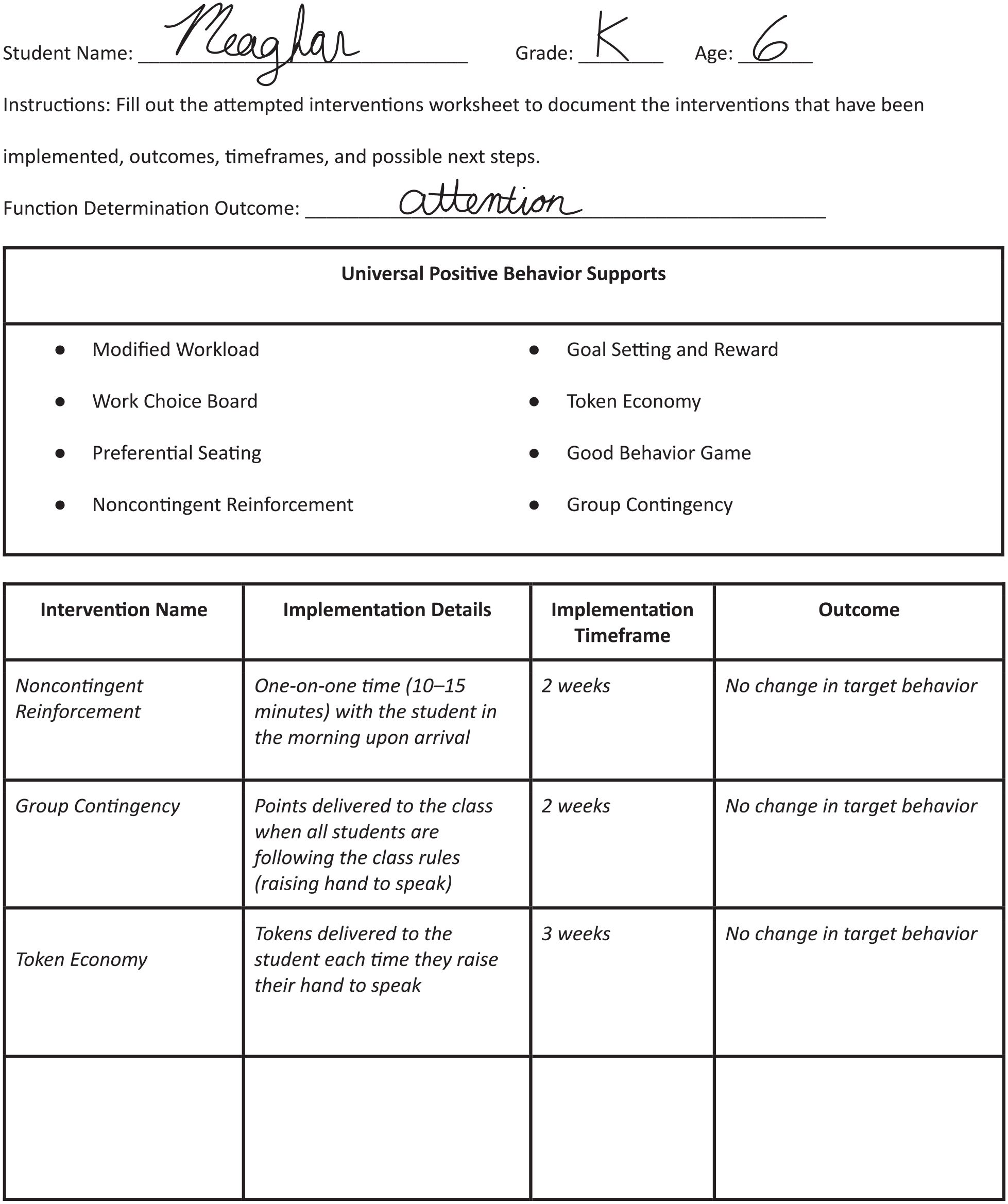
Attempted Interventions Worksheet.
With this documentation, an informed, data-based decision can be made on the next steps if multiple interventions have failed to support student progress. A minimum of 3 data points, much like when collecting baseline data (Maggin et al., 2021), should be collected before determining whether a change in intervention is necessary. In an educational setting, the number of changes from day-to-day vary. Therefore, a minimum of 3 to 5 data points should be collected before determining the need for a change in intervention (Cooper et al., 2020).
Once the function of Meaghan’s shouting out is determined, Ms. Jennings’s next step is to implement interventions designed to reduce the disruptive, undesirable behavior and replace it with a more acceptable behavior. After researching universal positive behavior supports at the recommendation of Mr. Thomas, Ms. Jennings decides to implement noncontingent reinforcement (Goh et al., 2000; see Table 1) as her first intervention. Each morning Ms. Jennings pulls Meaghan over to a kidney table to have “conversation time.” The goal is for Meaghan to receive the attention she was seeking without needing to shout out throughout the day.
Ms. Jennings continues to collect data on Meaghan’s shouting-out behavior during implementation. After 2 weeks, she shares the data with Mr. Thomas. He agrees that noncontingent reinforcement did not show a decrease in shouting out. He suggests that she implement a group contingency in which Ms. Jennings reinforces the entire class’s behavior with points when the entire class goes five minutes without shouting out or interrupting (see Ennis, 2018 for a detailed description of implementing a group contingency). They both decide to continue with noncontingent reinforcement while implementing the new intervention. The goal is to completely extinguish the shouting-out behavior as it is affecting the instruction of Meaghan and her classmates. Ms. Jennings implements this procedure and continues to collect data on Meaghan’s shouting-out behavior. When the addition of a group contingency shows minimal change to the target behavior, Mr. Thomas and Ms. Jennings implement an individualized token economy (Robacker et al., 2016; see Table 1) for Meaghan before reviewing the data and considering planned ignoring.
Step 4: Consider the Risks of Planned Ignoring
As noted previously, ethical concerns arise when implementing punishment-based procedures such as planned ignoring (Pokorski & Barton, 2020). Documenting and thinking critically about the possible benefits and risks of an intervention is good practice, no matter the intervention that is being recommended. The following steps are vital to ethical and effective planned ignoring implementation. Figure 4 shows an example of a Risk/Benefit Worksheet that can be used when making decisions about interventions to implement. If the risks outweigh the benefits, then an intervention should not be implemented, as it will not directly benefit the student (Carr, 2021). Even if there is a benefit to the teacher, but not the student, the intervention should not be implemented.
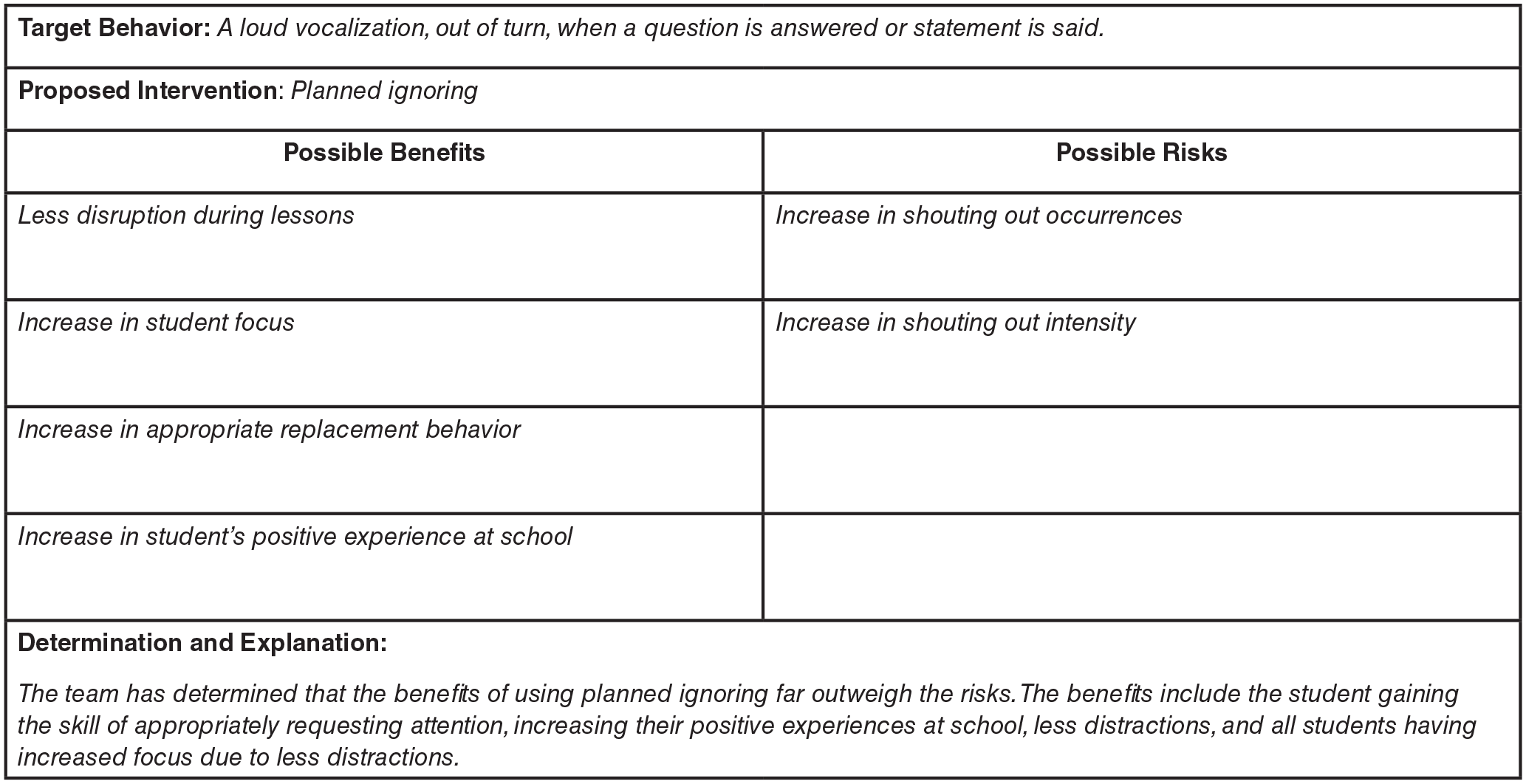
Risks/Benefits Worksheet.
The goal in any behavioral intervention is always to improve a student’s quality of life. Despite potential benefits to the teacher and other students, such as having uninterrupted instructional time or being able to cover more content, if the intervention could cause harm of any kind to the student receiving the intervention, it should never be considered.
Unanticipated consequences can occur when using planned ignoring. When planned ignoring is implemented, there is a chance that an emotional response could be emitted when attention is withheld (Cooper et al., 2020). Another possible side effect or risk may be an increase in occurrences or intensity of the target behavior for a short period of time. This phenomenon is called an extinction burst. If the plan continues to be followed with fidelity, the occurrences or intensity should decrease. When and if this occurs during the implementation of an intervention, the educator must decide if they can continue to ignore the increase (Hester et al., 2009). If the educator decides that the increase of occurrences, increase in intensity, or emotional response is not tolerable or is continuing longer than expected or resulting in additional problematic behaviors, the implementation should be discontinued immediately and the team should discuss alternative solutions. However, it should be considered that if the intervention is implemented and then discontinued during an extinction burst, the resilience of the behavior may increase, making it more difficult to manage. Even though there are possible side effects to the implementation of planned ignoring, the intervention provides an educator with an option to manage inappropriate behaviors when other strategies are not proving effective.
Ms. Jennings and Mr. Thomas have now attempted three positive behavior supports over the course of 7 weeks. Each intervention was implemented and documented for around 12 school days, allowing enough time to observe effects. Through a thorough data collection and analysis process, Ms. Jennings and Mr. Thomas show that the attempted interventions do not decrease the occurrences of the target behavior, shouting out.
Mr. Thomas suggests that they implement planned ignoring. Ms. Jennings agrees but expresses her concern that ignoring the behavior may make it worse. Mr. Thomas notes that an increase in frequency or intensity is a possible side effect of planned ignoring and that if Ms. Jennings does not feel comfortable ignoring the behavior, then they should not implement planned ignoring. Ms. Jennings makes a chart with the possible benefits compared with the risks of implementation (see Figure 4). After reviewing the benefits and risks, both teachers agree that the possible benefits outweigh the risks.
Step 5: Planned Ignoring Plan Created and Disseminated
Once the function of the behavior has been determined, multiple alternative interventions have been attempted, and risks have been assessed and accepted, planned ignoring might be considered as an effective intervention for attention-maintained behaviors. As noted previously, planned ignoring has been described as an intervention in which social reinforcers are withheld contingent upon the target behavior (Cooper et al., 2020).
Plan creation
At this point, the intervention team has determined the function of the behavior. The first step in crafting a behavior plan for planned ignoring is determining whose attention is reinforcing the behavior. The team may consider questions such as the following for different situations:
Is the student’s behavior of yelling inappropriate comments being maintained by the laughs of their peers?
Every time the student sweeps the items off their desk and refuses to work, does the teacher’s aide walk over and provide attention?
When the student screams profane comments, does the teacher verbally reprimand the behavior each time?
Once this information is confirmed, the educator can develop the intervention plan. The plan needs to include the function of the behavior, all adults and peers who are providing attention and reinforcing the behavior, the typical times or academic subjects when the behavior occurs, the alternative behavior to be reinforced, and the actions that will be taken during the occurrence of the target behavior and after the alternative behavior is produced (see Table 2).
Attention-Based Replacement Behaviors.
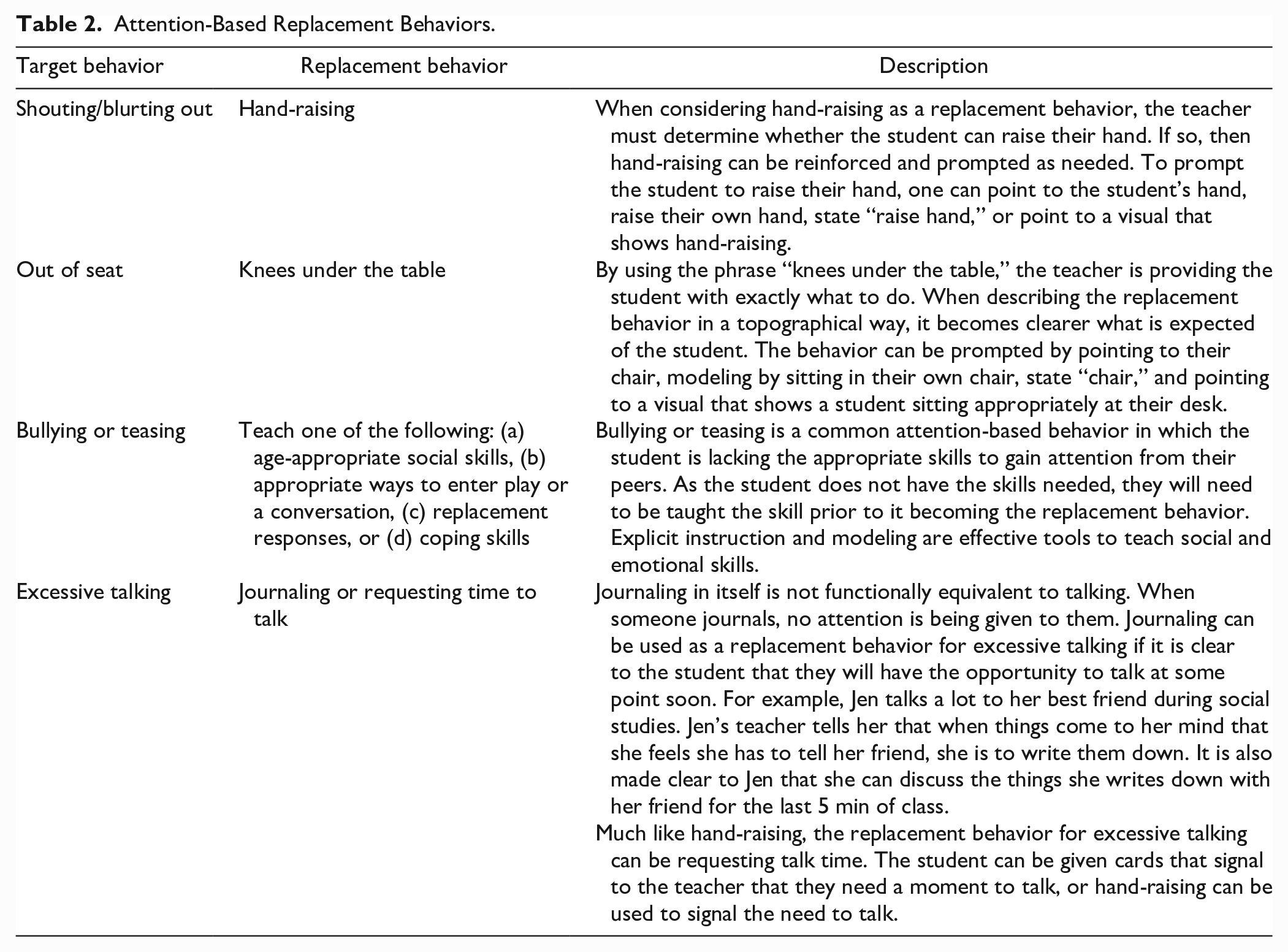
A vital part of creating a planned ignoring plan is choosing a replacement behavior. Often, when a punishment-based procedure is implemented, a replacement behavior is not taught or reinforced (Pokorski & Barton, 2020). It is unethical and unsustainable to decrease a behavior without increasing another. When the replacement behavior is emitted, it should be reinforced with the attention that would normally go to the target behavior. The replacement behavior must have the same function as the target behavior, that is, to gain the attention of someone, but doing so in a socially or contextually appropriate way. Table 2 provides examples of attention-seeking behaviors and possible replacement behaviors. Choosing the appropriate replacement behavior is important to the effectiveness of the plan. If the replacement behavior is not functionally equivalent—in Meaghan’s case attention-focused—then the plan will not be effective or ethical. The goal is for the occurrences of the replacement behavior to increase as the targeted or undesirable behavior decreases. Figure 5 shows an example of a document that can help educators in determining whether planned ignoring is appropriate and then supports the creation of a plan to implement the intervention effectively.
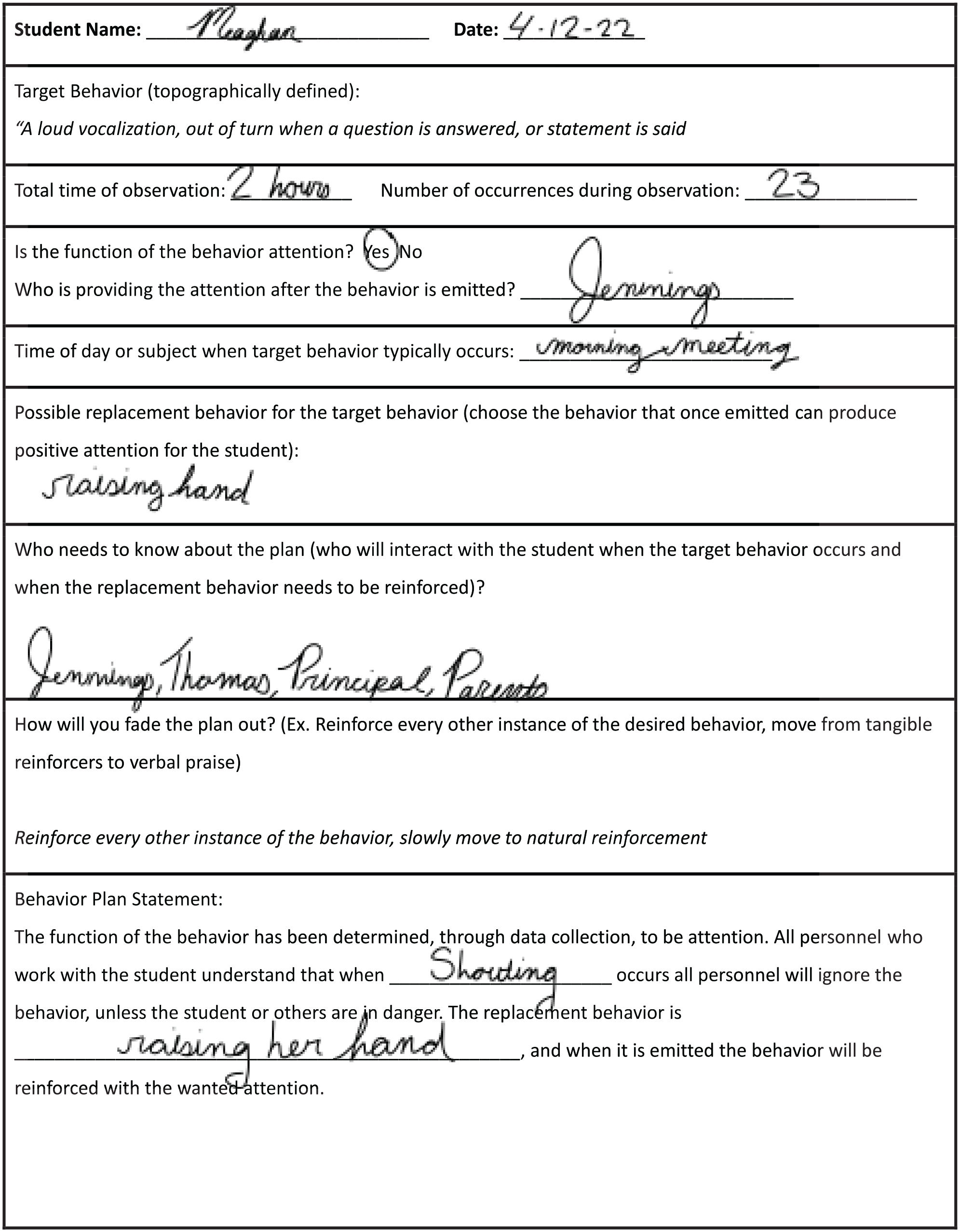
Planned Ignoring Plan Template.
Ms. Jennings and Mr. Thomas meet to create the formal behavior plan for their planned ignoring intervention. They record the target behavior, the function, who is providing the attention, possible replacement behaviors, and other important details. They then meet with Meaghan’s parents and the school counselor and decide that the best replacement behavior for shouting out would be for Meaghan to raise her hand to gain attention.
Plan dissemination
Disseminating the plan is a critical step in the planned ignoring intervention process. The teacher must think past the people in the immediate environment to include building-wide staff who also regularly enter the environment in which the target behavior occurs. For example, the principal may enter the room in an attempt to help manage the disruptive behavior and unknowingly give attention to the very behavior the teacher is attempting to ignore and extinguish. With proper dissemination of the plan, the accidental reinforcement of the disruptive behavior can be avoided and the integrity of implementation maintained.
Meaghan’s team also creates a list of school staff who need to be aware of the plan, as they do not want someone accidentally reinforcing the target behavior with attention. It is determined that the grade-level paraprofessional and the principal need to know about the plan. Meaghan’s parents give their consent for implementation and dissemination. Ms. Jennings gives each adult who may encounter the target behavior a copy of the plan and provides training.
Step 6: Plan Implementation and Continuous Data Collection
As with most interventions, outcomes of planned ignoring improve with consistent implementation (Hester et al., 2009). When the plan is not implemented consistently, there is a risk that the behavior will become resistant to extinction (Cooper et al., 2020). In this instance, planned ignoring would make shouting out harder to decrease or extinguish. Providing nonverbal attention is also something to be on the lookout for during the implementation phase. Even though everyone in the environment might not be giving verbal attention to behavior, nonverbal attention can continue to maintain the behavior. Nonverbal attention can be in the form of a stern look, snapping one’s fingers, tapping on the table, pointing toward the student’s chair, among many other behaviors. Adults in the environment should hold each other accountable to fully and completely ignore the target behavior to support consistency.
Continued data collection is an essential component of any intervention, including planned ignoring. Once the plan has been implemented, the observer will need to continue data collection periodically with an ABC form (see Figure 2) specific to each instance of implementation. For some students it may mean every other day, and for others it may mean every other subject. In Meaghan’s case it is important that enough data are being gathered to see whether attention is still maintaining the target behavior, if the behavior has intensified or increased in occurrences (extinction burst), and when the behavior has been extinguished.
A vital part of continued data collection is that the same behavior that was initially observed continues to be the target behavior. Like the baseline data collection, typically 3 consistent data points are sufficient when determining effectiveness and possible changes (Cooper et al., 2020). The topographical, objective definition should remain the same. If at any point the definition is no longer fitting, the plan should be reevaluated and a new FBA potentially conducted to ensure that attention remains the function of the new behavior.
Ms. Jennings begins implementing the intervention shortly after having the team meeting and disseminating the plan. On the first day, as Ms. Jennings conducts the class morning meeting, Meaghan begins shouting out answers while other students are answering. Ms. Jennings continues to teach and pays attention to the student who raised their hand to answer. She makes a point to verbally identify the expected behavior during that part of class by saying, “Class, remember it is important to raise our hands when we would like to answer or share.”
After the next question, Meaghan does not raise her hand, stands up, and shouts the answer. Ms. Jennings calls on a student who was sitting and raised their hand. She provides verbal praise to that student, saying, “Thank you for staying seated and raising your hand. What is the answer?” After the next question, Meaghan remains seated and quickly raises her hand. Immediately after she raises her hand, Ms. Jennings acknowledges her and says, “Meaghan, thank you for raising your hand! We are excited to hear your answer.” Shortly after, during a transition, Ms. Jennings notes the behaviors on the data collection sheet.
Step 7: Plan Faded Out and Discontinued
Once the data show that the behavior has been extinguished or dramatically reduced (depending on the behavior and the classroom expectations), the plan can begin to be faded out. Typically, when this decision is being made, even though the occurrences of the target behavior are now at zero, the replacement behavior is still being reinforced each time it occurs. It is unrealistic and not always appropriate for each instance of the replacement behavior to reinforced in the long run.
Much like continued data collection during implementation, the way reinforcement is faded out will depend on the situation. Two of the simplest ways to begin fading reinforcement are to decrease the intensity of reinforcement or begin reinforcing every other occurrence of the replacement behavior. A decrease in the intensity of reinforcement might look like behavior-specific praise that fades to a smile when the replacement behavior is emitted. If reinforcing every other instance is chosen, the natural progression would eventually lead to the replacement behavior being reinforced at random or at a level that would naturally occur in the classroom with typical students without the plan. At this point, planned ignoring is discontinued and the replacement behavior is reinforced sporadically and naturally. Figure 6 displays baseline and intervention data for Meaghan.
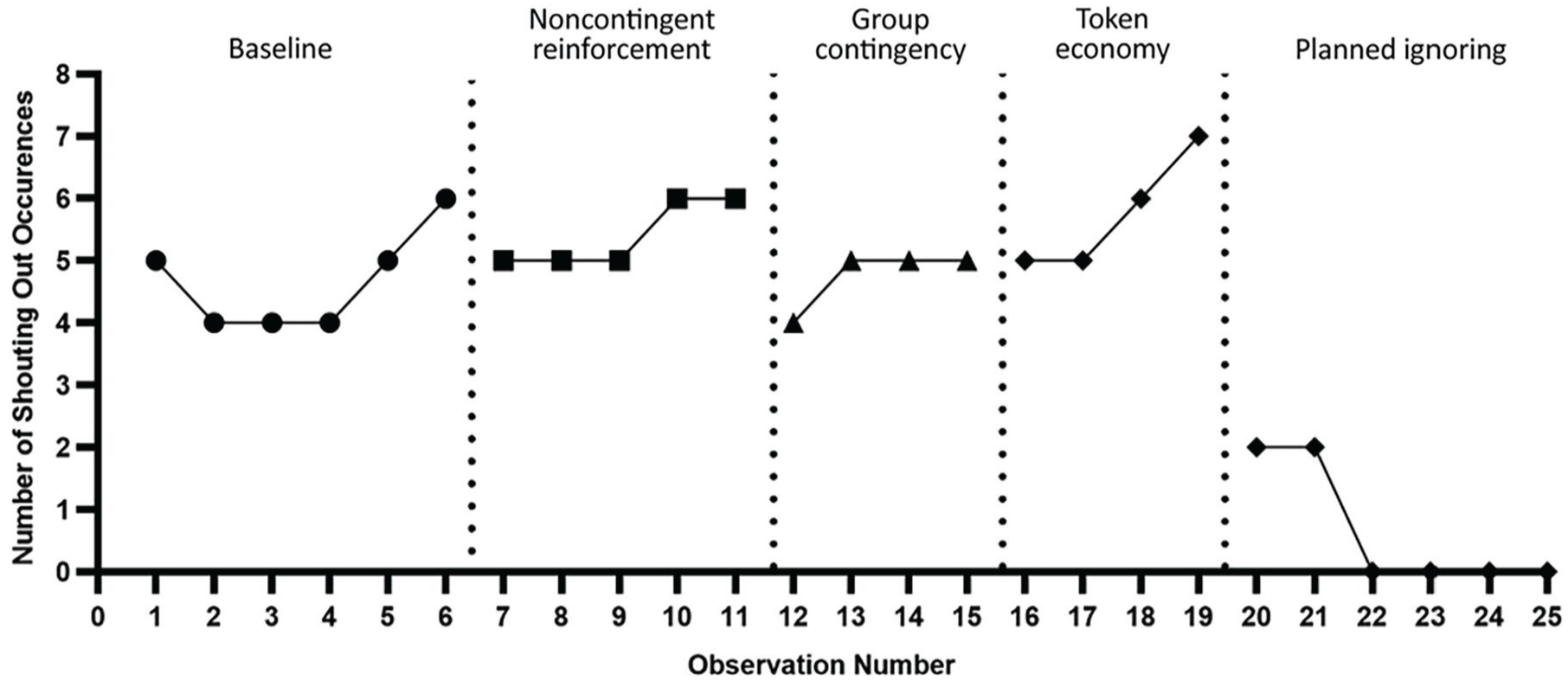
Data for Meaghan’s Intervention.
Ms. Jennings continues collecting data, which shows that the target behavior, “shouting out,” has decreased to 0 occurrences daily for 1 week. Based on the criteria of needing 3 to 5 data points to establish a trend, Mr. Thomas and Ms. Jennings decide the plan can be faded. Until that point, Ms. Jennings has been giving attention to Meaghan each time she raises her hand. Mr. Thomas suggests that Ms. Jennings begin only calling on Meaghan every other time she raises her hand during whole group lessons and during independent work. She waits 15 to 25 s before speaking to Meaghan after she raises her hand.
Mr. Thomas explains that Meaghan may begin shouting out again but to continue to ignore the shouting out and adjust the frequency of reinforcement. Ms. Jennings begins to fade out the immediate reinforcement, and the frequency of the target behavior is maintained. Ms. Jennings gradually increases the time between reinforcement until the behavior is reinforced at a natural level compared with other students. Due to Ms. Jennings’s data collection, planning, and implementation, she is able to decrease the target behavior and increase the desirable, appropriate behavior.
Conclusion
Planned ignoring is an intervention that can be considered when working with a behavior that has the function of attention. Even though it is a viable option for many situations, the necessary steps to determine the need for the intervention and actual implementation are not easily accessible for many situations. With planned ignoring, educators can decrease the occurrences of an unwanted behavior and increase the occurrences of an appropriate behavior. In addition, the resources provided by the authors can be used not only with planned ignoring but also with a multitude of situations that involve classroom behavior. The appendix provides additional resources that can be used to assist in the implementation of planned ignoring. Implementation fidelity, the extent to which an intervention is implemented as designed, is key to positive outcomes and a generally positive experience for both the educator and the student.
Footnotes
Appendix
Declaration of Conflicting Interests
The author(s) declared no potential conflicts of interest with respect to the research, authorship, and/or publication of this article.
Funding
The contents of this article were developed under a grant (SPIDERS) from the U.S. Department of Education, #H325D210042. However, those contents do not necessarily represent the policy of the U.S. Department of Education, and you should not assume endorsement by the Federal Government. Project Officer, Tina Diamond.
