







Abstract
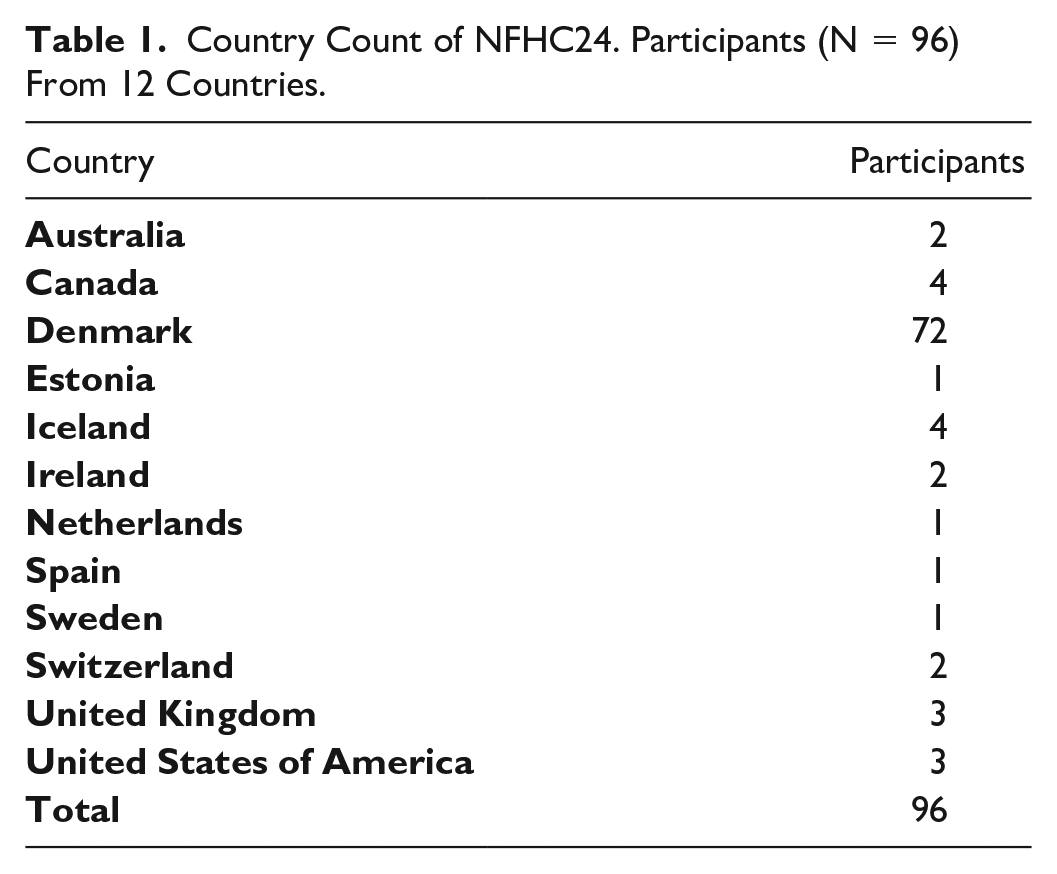
The sixth Nordic Family Health & Care Conference (NFHC24) took place from May 21 to May 23, 2024, and attracted 96 participants from 12 countries to Odense, Denmark (see Table 1). Denmark presented itself beautifully with stunning spring weather. We enjoyed the cultural side of Odense with river cruise, social dinner at the street food place Storms Pakhus, and gala dinner at Odense Harbor, Restaurant Nordatlanten. The gala dinner was enriched with musical performance by the local Rockabilly Band.
Country Count of NFHC24. Participants (N = 96) From 12 Countries.
In this report, we offer an overall impression of the inspiring NFHC24 presentations related to sharing interdisciplinary work to improve the health and well-being of families.
The History of the Conference
For the first time, the conference was interdisciplinary building on five former Nordic Family Nursing conferences. The history of the conference was that the first in 2002, the second in 2006, and the third in 2010 were all held in Kalmar, Sweden. The fourth was held in Odense, Denmark in 2014, and the fifth in Tampere, Finland, in 2018. The sixth conference was planned in Stavanger, Norway, in 2020 but canceled due to coronavirus disease 2019 (COVID-19). We decided that the conference should be revived.
The NFHC24 was organized by FaCe—Family focused Healthcare Research Center (https://www.sdu.dk/en/forskning/face) and The Danish Family Nursing Association (Dansk Selskab for Familiesygepleje—https://familiesygepleje.dk/), and practically executed by a very active scientific council.
The sixth Nordic Family Health and Care Conference
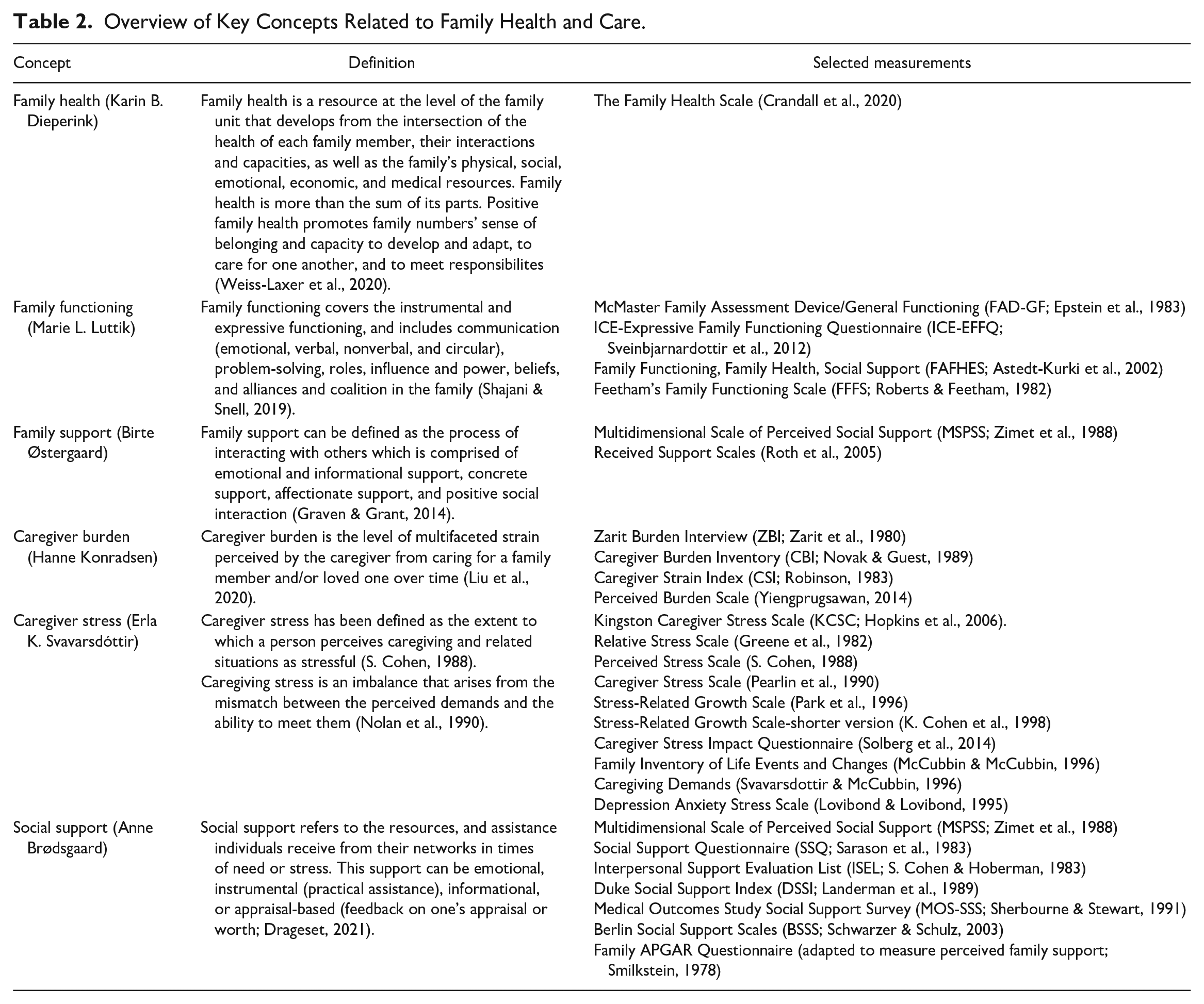
As the host of the NFHC24, Professor Karin B. Dieperink welcomed the attendees to 3 days filled with opportunities to engage and learn in six preconference workshops, four keynote presentations, 48 oral presentations, and 28 posters. The conference theme, “Sharing Interdisciplinary Work to Improve the Health and Well-being of Families,” focused on engaging interdisciplinary researchers, educators, and practitioners in a discussion of global concepts, trends, and issues facing families. The framework for the conference was established during the first pre-conference workshop “Family Health: What Concepts Are We Talking About?” by an abstract from the Fame-RN Group from Europe consisting of Karin B. Dieperink (Denmark), Marie Louise Luttik (the Netherlands), Birte Østergaard (Denmark), Hanne Konradsen (Denmark), Erla Kolbrún Svavarsdóttir (Iceland), Anne Brødsgaard (Denmark), Cristina García-Vivar (Spain), Romy Mahrer-Imhof and Lorenz Imhof (Switzerland). The key concepts presented were: Family health, Family functioning, Family support, Caregiver burden, Caregiver stress, and Social support (see Table 2).
Overview of Key Concepts Related to Family Health and Care.
Involvement and Support of Family in Health and Care
Implementation of a family-focused approach in care and research was given attention at the NFHC24. Starting at the preconference, Dr. Barbara Voltelen, Dr. Pernille Friis Rønne, and Dr. Anne Dichmann Sorknæs (Denmark) presented a workshop entitled “How Does Involvement of the Family Systems in Brief Encounters Become a Part of Everyday Clinical Practice?” The workshop offered knowledge on the perspective of family systems and highlighted the importance of incorporating the family-centered approach in the treatment of serious health conditions. The aim of the workshop was to equip participants with resources before entering the conference with key areas such as families affected by cancer, neonatology, pediatrics, and cardiac arrest or other life-threatening illnesses, as well as methods to reduce suffering in relation to grief and loss.
The preconference workshops, “Nuts & bolts of how health care teams can support families when a mum or dad of dependent children is at end of life” by professor Cherith Semple and Dr. Jeffrey Hanna (Ireland) and “Family Health Conversations and Therapeutic Questioning Theory and Practice” by Dr. Barbara Voltelen (Denmark) and Dr. Marie Louise Luttik (the Netherlands) offered a cohesive learning experience for health care professionals. The first workshop provided practical strategies for supporting families facing end-of-life situations, while the latter delved into the theoretical and practical aspects of engaging in meaningful health conversations. Together, they equipped attendees with a comprehensive skill set to effectively communicate and support families during critical times.
The preconference workshops, “Implementing the Actor-Partner Interdependence Model for Dyadic Data Analysis in family health research” by Dr. Mahdi Shamali (Denmark) and “Using Co-design to develop resources for the family with the family” by Dr. Elisabeth Coyne and Dr. Hazel Rands (Australia) emphasized advancing research methodologies in family health. The first workshop introduced a sophisticated analytical model to explore interdependent relationships within families, enhancing the precision of dyadic data analysis. The second workshop focused on co-design methodologies, fostering collaborative research that actively involves families in creating relevant health resources. Co-design, building from participatory design, is a trending method used by multiple research projects presented at the conference. Together, these workshops provided researchers with innovative tools to deepen their understanding and engagement with family health dynamics.
Keynote Speakers
Weaving practice, research, and education into caring for families can extend what is already known about family-focused approaches in health and care. The four excellent keynote speakers were interdisciplinary examples of this kind of integration. Each keynote speaker had a solid grounding in the work with families and family-focused approach in clinical practice and research. Dr. John S. Rolland (USA) offered the opening keynote speech and enlightened us about his work: “Serious Illness and Disability: A Multisystemic Family Approach.” From Professor in psychology Urdur Njarövik (Iceland), we learned about the role of family routines and emotion regulation in child behavior problems. The focus on families with children was reiterated by the third keynote speaker Professor RN Anne Brødsgaard (Denmark) illuminated with her keynote speech “Dad matters—a lot” revolving around the importance of the perspective of the fathers to neonatal children. In the last keynote speech, Associate Professor RN Elisabeth Coyne (Australia) had us all reflect on how we communicate and educate patients and families with an emphasis on health literacy with her presentation: “Weaving education into communication.”
Trends in Family Health and Care
Many of the projects presented during concurrent oral sessions and poster sessions argued the need for an interdisciplinary family-focused approach in clinical practice, education, and research across multiple settings. Emphasis was placed on the growing knowledge of implementing family-focused care, particularly in families with children, and in the care of conditions such as diabetes, cardiac arrest, and cancer, across various life phases. Both perspectives on knowledge translation during health care education and patient/family education were presented, with a greater emphasis on health literacy. Education in family-focused approach during health care education is evolving, giving health care students time to train their competences during education.
The conference gave room for presentations about current research projects regarding family-focused strategic practice and family-centered care, as well as inspiration for new research projects. As family caregivers become more present in patient care, there will prospectively be an increasing focus on a family-centered approach in clinical practice, education, research, and policy.
NFHC24 Awards
As an exciting initiative, all posters were presented during four poster walks with seven posters per walk (a total of 28 posters). Here, the presenters had the opportunity to pitch their project with a 2-min oral presentation. Each poster walk had two chairs who evaluated the poster and the pitch as a combined presentation. Among the assessments from the poster walks, one poster was voted to have deserved the Chairs Award for best poster. The Chairs Award went to MScN Helene Vasegaard Pedersen (Co-authors: MScN Anne Møller Clausen, PhD candidate Maiken Langhoff Kidholm, and Professor Karin B. Dieperink) on her visually informative poster “Young Adult Siblings and Cancer: A Scoping Review Exploring Psychosocial Functioning and Interventions.” Furthermore, a Public Award for best poster chosen by the participants at the conference was rewarded to MScN Jeannett Klitgaard (Co-authors: Professor Hanne Agerskov, and Postdoc Jette Marcussen) on her exciting poster “Development of family-centered interventions to support patients who are receiving hemodialysis.”
Networking and Research Collaboration
The NFHC24 provided rich opportunities for networking and active participation during the conference and social events. As the NFHC24 was an interdisciplinary conference, one of the objectives for the NFHC24 was to focus on promoting partnerships among interdisciplinary researchers to provide opportunities for in-depth discussion and further research on issues related to family health and care. The following professions were presented: practitioners, researchers, and educators from diverse disciplines, that is, nurses, physiotherapists, psychologists, occupational therapists, midwives, language teaching, and health promotion. Furthermore, we had participation from two patient representatives providing a valuable perspective to the discussions, and highlighting how patients can be included in the research process. Topics for future research were discussed, and research collaboration around specific populations, methods, frameworks, or settings was encouraged.
Professor Karin B. Dieperink (Denmark), host of NFHC24 and head of FaCe—Family focused health care research Center, suggested the establishment of a new network the Nordic Family Health & Care Network. The initiative was well met by the participants at the conference, and decisions were made to proceed with the establishment of such network. The network will be interdisciplinary to support the establishment of collaborations, research, knowledge dissemination, and education across multiple professions.
Conclusions
The sixth NFHC turned out to be very successful. Changing the conference from single-disciplinary to interdisciplinary turned out to be the right decision. Despite this change, there was still significant representation from the nursing field.
The future is bright for family health. We are eagerly looking forward to the next Nordic Family Health & Care Conference, which will be held at University of Bergen, Norway, May 22 to May 24, 2028.
Footnotes
Acknowledgements
The authors thank all the participants joining this conference. Their engagement in the presentations, discussions, and networking made this conference truly magical and inspiring; members of FaCe—Family focused Healthcare Research Center and the academic council for their dedicated efforts to create an unforgettable NFHC24 experience; the Danish Family Nursing Association for supporting the conference; Anne Møller Clausen and Karin B. Dieperink for all their hard work before, during, and after the NFHC24; the student helpers: Sólja Thomina Petersen, Katherine Maj Brænder Nielsen, Emma Sandberg Nautrup, and Hanna Shkarupa for set-up, IT, and all the practical help during the conference days.