







Abstract
Attitudes toward genetically modified (GM) foods have been extensively studied, but there are very few studies of actual consumer purchasing behavior regarding GM foods offering a consumer benefit. Using a field choice-modeling experiment, the authors investigate the trade-off between price and social desirability in consumer choices with regard to conventional, organic, and GM fruit. What consumers say they will choose in a survey and what they actually choose in a real-purchase situation may differ substantially when their decision is framed by a socially charged issue such as genetic modification. The results are analyzed in relation to established principles of diffusion of innovation.
Introduction
Genetic modification has generated intense public debate over the past decade, and genetically modified (also referred to as GM) foods remain controversial in many countries (Gaskell et al., 2006; Knight, Holdsworth, & Mather, 2008). Benefits and risks of new technologies have posed a major dilemma for modern societies in deciding on what is the “right” balance. Every technological advance carries some risk of adverse effects, and governments, society, and individual consumers weigh up the risks and benefits to decide “how safe is safe enough?” (Starr, 1969).
In Europe, a succession of food scares has resulted in a risk-sensitized society in which risk messages are subject to distortion and social amplification by fear appeals in the news media (Bergman, 2002; Kasperson et al., 1988; Laros & Steenkamp, 2004; Slovic, 2000; Slovic, Finucane, Peters, & MacGregor, 2004). When knowledge about a certain technology is limited, consumers rely on social trust to assess risks and benefits of that technology (Connor & Siegrist, 2010; Siegrist, Keller, & Kiers, 2006). Consumers can feel dread, leading to outrage about what “they” are doing to “our food.” Additionally, social desirability can lead consumers to feel that it is somehow unethical to purchase foods that “society” frowns upon.
Worldwide, the consumption of foods derived from GM crops is rising rapidly. On the one hand, scientists, biotechnology companies, and approximately 14 million farmers in 25 countries (James, 2010) have collectively voted by their actions that the benefits outweigh the risks. On the other hand, particularly in Europe, consumers have failed to see what benefits might accrue to them and have actively resisted introduction of GM foods (Gaskell et al., 2006). Greenpeace denounces GM technology as dangerous, despite numerous scientific assessments concluding that there is no evidence this is so (Kessler & Economidis, 2001). The French Academies of Sciences and Medicine (2002) blamed the rejection and overregulation of GM technologies in Europe on “a propagation of erroneous information.” In 2003, the Royal Society in London presented two submissions to a review by the U.K. government, stating there was no credible evidence that GM foods were more harmful than non-GM foods (Paarlberg, 2005). The Entransfood Report (European Commission, 2004) points out that the responses of the public to different risks are socially constructed. The work of Slovic and colleagues (Slovic, 2000; Slovic et al., 2004) demonstrates that technical risk estimates provided by experts and perceptions of risk by the public differ greatly—particularly when dread of unknown consequences is present. Risk benefit perceptions of GM foods have been shown to strongly influence consumer attitudes toward GM technology (Frewer, Howard, & Shepherd, 1995; Frewer, Scholderer, & Bredahl, 2003).
Public opposition to GM foods has been widely interpreted as reflecting the public’s misperception of risks, but some researchers question whether this is the real issue. According to Gaskell et al (2004), “the ‘Achilles heel’ of GM foods is not so much the misperception of the scientific risks, but rather the perceived absence of benefit for the consumer” (p. 193). In a related vein, Frewer et al. (2003) state,
The views of experts regarding what people should know and understand about a hazard may not chime with what it is that people are really concerned about. If this is indeed the case, it is understandable that risk communication may fail to influence people’s attitudes and subsequent risk behaviors (p. 1132).
Sir David King, former scientific advisor to the U.K. government, argues that unjustified vilification of GM foods in Europe is leading to needless deaths from starvation in poor countries (The Economist, 2010). However, despite the ongoing public debate in Europe, a vast amount of GM product enters the European food chain as domestic animal feed, and numerous food products containing GM ingredients are found on European supermarket shelves. A European Commission study titled “Do European Consumers Buy GM Foods?” concluded that the answer to the question posed is “Yes—when offered the opportunity” (European Commission, 2008).
The objective of this article is to consider consumer resistance to biotechnology in the context of the diffusion of innovation literature, which emphasizes the role of communication within social networks, and the importance of social acceptance in determining uptake of new technologies. The diffusion of innovation paradigm has spread from its roots in rural sociology to have a major impact on a wide range of scientific fields (Valente & Rogers, 1995); it seems surprising that its important theoretical implications have been disregarded by the biotechnology industry when assessing the likely acceptability or adoption of GM products by consumers.
Diffusion of Innovation
Rogers’s (1962, 2003) seminal work on the diffusion of innovations has led to a rich body of research in the marketing science field that provides valuable insights that can be applied to the controversy surrounding GM foods. Based on the classic study by Ryan and Gross (1943) of the progressive adoption of hybrid corn in Iowa, Rogers’s model provides an excellent basis for understanding how GM technology has diffused among producers in diverse countries. Furthermore, the same principles can be applied to adoption (or nonadoption) by consumers of the products of that technology.
Rogers (2003) defines diffusion as “the process in which an innovation is communicated through certain channels over time among the members of a social system” and includes “both the planned and the spontaneous spread of new ideas” (p. 5). Rogers defines five major characteristics that explain the different rates of adoption of particular technologies. Relative advantage is the degree to which an innovation is perceived as better than whatever it supersedes. Rogers sees this as including not just economic advantage but also social prestige, convenience, and satisfaction in all regards. Perception of relative advantage by a grower of crops might differ markedly from perceptions by consumers of end products derived from such crops—particularly with regard to social prestige (or, conversely, social abhorrence). Compatibility is the degree to which an innovation is seen as being consistent with existing values, belief systems, past experiences, and needs of potential adopters. Complexity is the degree to which an innovation is perceived as difficult to comprehend and use. Trialability is the degree to which an innovation can be sampled or experimented with on a limited basis prior to purchase or adoption. Observability is the degree to which the results of an innovation are visible to others. In addition, uncertainty or risk associated with the innovation has been emphasized by several subsequent scholars of diffusion of innovation. According to Arts, Frambach, and Bijmolt (2011, p. 135), perceived uncertainty has greater impact on purchase intentions than on actual adoptive behavior. Innovation adoption is seen as a complex decision process of multiple stages through which a potential adopter passes from first awareness to continued use of the innovation. Choice decisions depend on weighing up perceptions of the characteristics of the innovation and on making trade-offs, a process heavily dependent on emotional factors (Wood & Moreau, 2006) including social desirability (Castano, Sujan, Kacker, & Sujan, 2008).
Consumer Attitudes and Consumer Behavior
The theory of reasoned action (Fishbein & Ajzen, 1975) and the theory of planned behavior (Ajzen, 1991) have proven highly influential in leading marketers to anticipate a strong correlation between attitudes, intentions, and behavior regarding adoption of new technology. Thus, it is common practice to rely on market research of consumers’ attitudes toward an innovation and their purchase intentions in forecasting likely adoption of new products or services. However, consumers who “talk the talk” in surveys do not necessarily “walk the walk” when it comes to innovation adoption (Arts et al., 2011, p. 134). A meta-analysis reported a correlation of .53 between intention and behavior (Sheppard, Hartwick, & Warshaw, 1988). Van Ittersum and Feinberg (2010) state, “Intentions frequently provide biased measures of adoption propensity, sometimes underestimating actual adoption and other times overestimating it” (p. 809).
A great deal of research has been conducted on attitudes toward GM foods (see, e.g., Bellows, Alcaraz, & Hallman, 2010; Christoph, Bruhn, & Roosen, 2008; de Liver, van der Plight, & Wigboldus, 2005; Evans, Kermarrec, Sable, & Cox, 2010; Tenbult, de Vries, Dreezens, & Martijn, 2005). What has seldom been studied is the actual purchasing behavior of consumers when faced with real choices of GM food products in real markets (Knight, Mather, Holdsworth, & Ermen, 2007; Powell, Blaine, Morris, & Wilson, 2003). In this article, we report the results of choice-modeling experiments designed to test how consumers really behave when faced with choices in a climate of social uncertainty, as surrounds GM foods. According to Irwin (1999), “monetary valuation of ethically charged issues may not follow standard utilitarian principles” (p. 212). By comparing revealed preferences (RP) and stated preferences (SP), we can assess the extent to which consumers act in the way they say they will act in relation to a socially charged issue in the face of a price advantage. Adoption intentions are naturally aligned with SP measures and adoption behavior is aligned with RP measures.
Discrete Choice Modeling
Choice modeling has been widely used as a tool for making probabilistic determinations about human decision making; the multinomial logit (MNL) regression model is a good approximation to the economic principle of utility maximization (McFadden, 2000). This approach has been widely adopted for estimating consumers’ willingness to pay for certain attributes. Researchers in several fields have long been interested in stability of preferences and choices over time and space. Invariance assumptions underlie many choice and decision-making models in psychology, economics, and marketing (e.g., Fischoff, Slovic, & Lichtenstein, 1980; Huber, Payne, & Puto, 1982; Severin, Louviere, & Finn, 2001; Tversky & Kahneman, 1986).
Random utility theory (RUT) postulates that consumers have latent preferences or utilities that comprise the sum of observable components (explainable) and random components (not explainable). Comparisons of MNL model parameters from different sources of preference and choice data must take into account potential differences in variances of error components (Ben-Akiva et al., 1994; Louviere, Hensher, & Swait, 2000; Severin et al., 2001; Swait & Louviere, 1993). According to Severin et al. (2001), parameter differences in SPs and RPs are often due to differences in the respective error. The implication is that SP and RP data ought to provide equivalent measures of consumer willingness to pay for a given attribute, provided variance scale corrections are applied. Severin et al. (2001) argue that RUT allows one to pool different data sources (e.g., SP and RP) and rescale them to lie on a common utility scale. However, this argument may not make sufficient allowance for the role that social desirability could play in biasing SPs regarding an ethically and/or a socially charged issue. The price–quality heuristic may tend to override consumers’ societal conscience in RP situations, in contrast to the dominant operation of affective judgments in SP situations. In terms used by Kahneman and Knetsch (1992), willingness to trade off personal economic utility to gain “the warm glow of moral satisfaction” will be higher in a hypothetical transaction than in a real-purchasing situation where actual money is being put at risk.
In this article, we describe choice-modeling experiments to determine RPs of consumers regarding food labeled as GM and food having a clearly stated consumer benefit (absence of chemical spray residues) when consumers are placed in a real-purchasing situation. In addition, SPs of consumers in near-identical purchasing environments were measured using a paper-based questionnaire that presented the same information with accompanying colored photographs of the fruit. The main contribution of this article is to demonstrate how, in real food-purchasing situations, the price–quality heuristic may override perceptions based on socially desirable concerns and affective judgments; in SP situations, in contrast, societal conscience may override the price–quality heuristic, leading to nonequivalence of RPs and SPs for food products under conditions of social ambiguity and stigma. The implication of our findings is that provided GM foods have a well-communicated consumer benefit and/or price advantage, a sizeable proportion of the market is likely to accept them, despite large numbers of studies indicating largely negative consumer attitudes toward the GM concept.
Method
Revealed Preferences
The experiments reported here were conducted in purpose-built or vacant premises since it was not feasible to set them up in existing retail stores because of the potential to cause controversy and reputation damage for the retailer. Fruit stalls were set up alongside major highways, or urban streets, frequented by domestic and foreign motorists. The first such experiment took place in New Zealand, and subsequent experiments were undertaken in Sweden, France, Belgium, the United Kingdom, and Germany. Approximately 450 consumers visited each stall, providing a total of 2,736 consumer decisions for analysis. A major factor taken into account when deciding on this experimental protocol was the need to avoid contamination of choices made by subsequent customers, as would be inevitable in a street market situation, for example. Therefore, a drive-up/drive-off situation was selected.
Fruit were offered for sale with the label (in language appropriate to that market) conveying price and method of production manipulated experimentally. On sale in these fruit stalls were cherries (New Zealand, France, and Germany), strawberries (Sweden and United Kingdom), or grapes (Belgium), depending on seasonal availability in particular markets. Fruit likely to be eaten without washing were chosen, in order to enhance the salience of “spray-free” as an attribute. Fruit were labeled in three ways: (a) “Organic, Biogrow certified;” (b) “Low residue, local designation;” and (c) “100% Spray-free, genetically modified,” with variation from country to country in order to take account of the different customary terminology in the different languages. Prices were also set at three levels: (a) average market price advertised in that region, which changed from day to day as a function of supply and demand; (b) average market price plus 15%; and (c) average market price minus 15%. The different prices were assigned to each fruit category using a balanced fractional factorial experimental design, with price and production method sets (runs) changing every 50 customers. The fruit stalls were situated away from any existing orchards or fruit retailers to minimize the risk of upsetting other operators or of causing any transference of adverse reaction to such retailers.
Once customers had made their selection, but just before money changed hands, they were made fully aware that this was a university-run experiment, that it had received approval from the university ethics committee, and that all fruit on sale were in fact the same local, low–spray residue type. The nature of the fruit stall, the purpose of the experiment, and the fact that all the fruit displayed were the same were communicated verbally or by show card to avoid contaminating other shoppers if present. Shoppers were then given the opportunity of purchasing fruit at the lowest price shown.
In addition, in the European markets, shoppers were invited to indicate verbally why they had made the choice they had made, and these responses were recorded verbatim in the native language and translated into English. The analysis of the verbal responses involved coding and categorizing the comments using an inductive approach—thematic content analysis—following the six-stage approach that Braun and Clarke (2006) outline. Analysis of this qualitative data was iterative and reflexive to ensure that the comments fit the emergent categories. A peer coder reviewed a sample of the coded comments, and the results were discussed with the other researchers to ensure reliability.
The fruit stalls were staffed by carefully briefed and trained postgraduate students employed as research assistants. Native speakers of French, Swedish, and German were assisted by other students fluent in the respective languages. If shoppers asked about the GM that led to the 100% spray-free designation, they were told that the fruit were from plants that incorporated the Bacillus thuringiensis (Bt) toxin gene so that they made their own natural insecticide and therefore did not require spraying. If shoppers asked about the spray status of organic fruit, they were advised that Bt natural insecticide could have been sprayed onto the organic fruit to minimize insect damage. Currently, GM fruit is not available in any of the countries involved in these experiments. However, market knowledge on availability may be imperfect, especially with visitors. Very few consumers expressed surprise at these categories of fruit being on sale, and those who did were told that the GM fruit may have come from “an experimental orchard.”
Stated Preferences
We had anticipated that SP measurements would give equivalent results to the RP measurements in the pilot experiment run in New Zealand. Clearly, it would have been far less expensive, and logistically simpler, to use paper-based SP questionnaires when expanding the study to European countries. So that we could verify the equivalence of the SP and RP methods, we ran a follow-up experiment in the same locality as had been used for the fruit stall in New Zealand, using paper-based questionnaires to elicit SPs for the same price options and types of fruit depicted in color photographs and accompanying them with the same label information as used in the fruit stall. Exactly the same experimental design was used to vary prices among the three categories of fruit. To our great surprise, the results were strikingly different, leading us to question whether the fact that SP respondents in this experiment were pedestrians and/or customers of an adventure tourism operation, and not necessarily frequenters of roadside fruit stalls, could have explained the discrepancy. We therefore repeated the SP experiment, but this time ensuring that the respondents were customers leaving a genuine roadside fruit shop, having made a purchase of fruit. The same discrepancy between SP and RP was observed. Therefore, we realized that to obtain valid estimates in European countries, we would have to set up real retail situations designed to measure actual choices (RP) of shoppers, despite the extra cost and logistical complexity. To investigate the concordance/discordance issue further, we repeated the SP/RP comparison in Sweden and in Germany, ensuring that in each case the respondents were customers departing from roadside fruit stalls operated by genuine retailers. Results of these comparisons are shown in Table 1.
Comparison of RP and SP Market Share Simulation Estimates With the Scenario Where Organic Is Priced at a Premium and a Discount Is Offered for the GM Option, in Three Countries
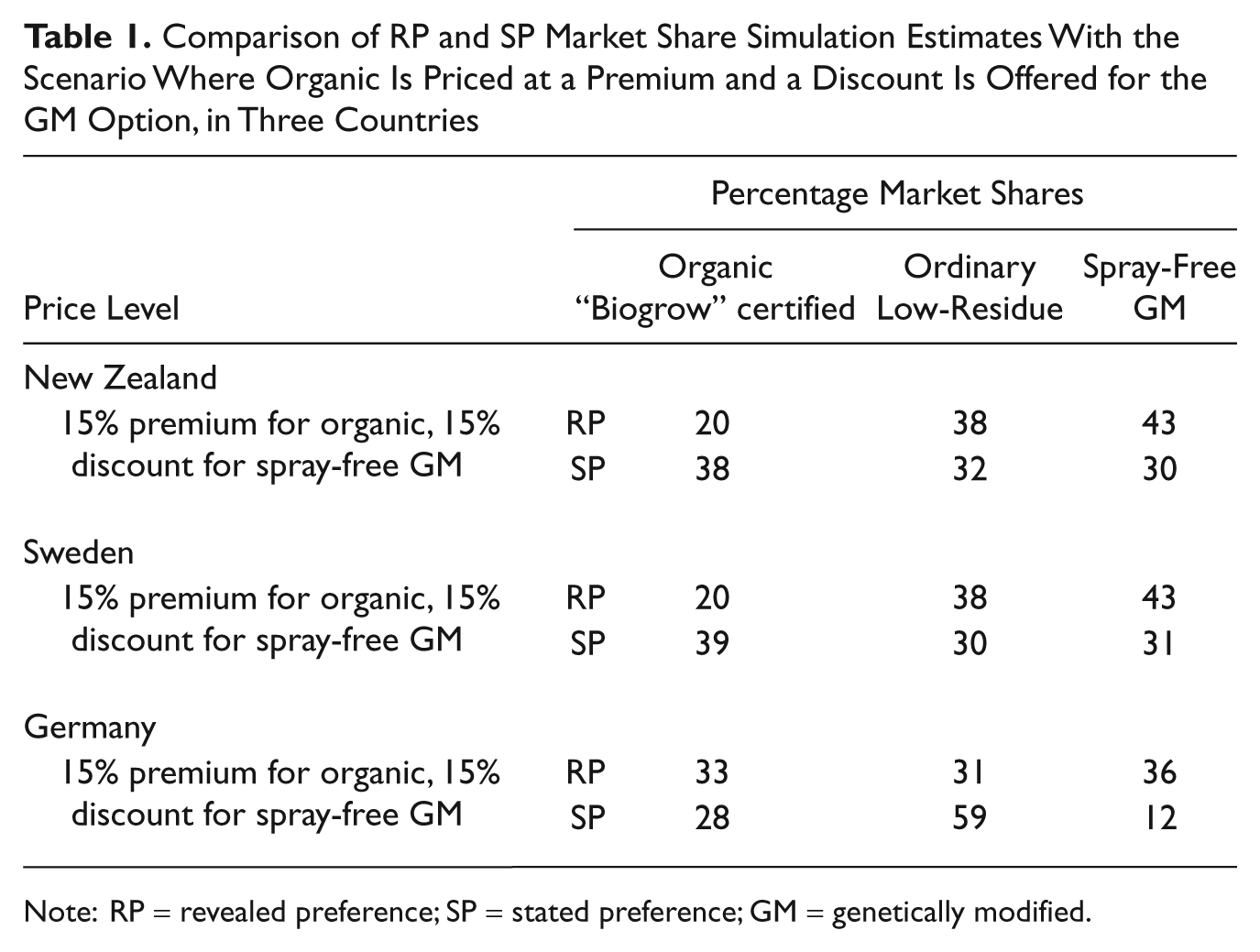
Note: RP = revealed preference; SP = stated preference; GM = genetically modified.
When using MNL models, each study location and measurement type has a different scale factor embedded in every parameter estimate. Also, the predicted market share of any one type of fruit is affected by the prices and intrinsic preferences of the other types. Thus, to fairly compare preferences across study locations and measurement types, market shares of all three types are estimated for the most likely market scenario of interest. The scenario chosen was one where the organic type was priced at a premium, as customers expect, and the GM spray-free type was sold at a discount, to reflect the reduced cost of production.
Results
Revealed Preferences
A conditional MNL (or discrete choice) regression model was used to analyze the data. In each of the six countries (Table 2), a marked preference for the organic option, compared with the spray-free GM option, is evident when all fruit types are offered at the average market price. However, in each country experiment, substantial price sensitivity for the GM option was evident in the RPs recorded in the actual fruit stalls. RPs changed substantially when there was a price differential, with a 15% premium for organic and a 15% discount for the spray-free GM option, to reflect the lower cost of production expected under this scenario. With the exception of the stall in Belgium, a surprisingly high market share (30% to 60%) was obtained when this moderate 15% discount was offered for the GM option. In the case of Belgium, we are concerned that the discrepant results may relate to the fact that this was the only one of the six situations in which nonlocal fruit (grapes imported from Italy) were used, rather than premium “local” produce. This factor may have interfered with price sensitivity of the revealed choices. A brief account of the RP data has been published elsewhere (Knight et al., 2007). We are now providing a much more detailed account of these findings and adding the comparison of SPs and RPs from experiments conducted in three countries, together with highly illustrative qualitative comments collected from fruit stall customers.
Market Share Simulation Estimates in Six Countries
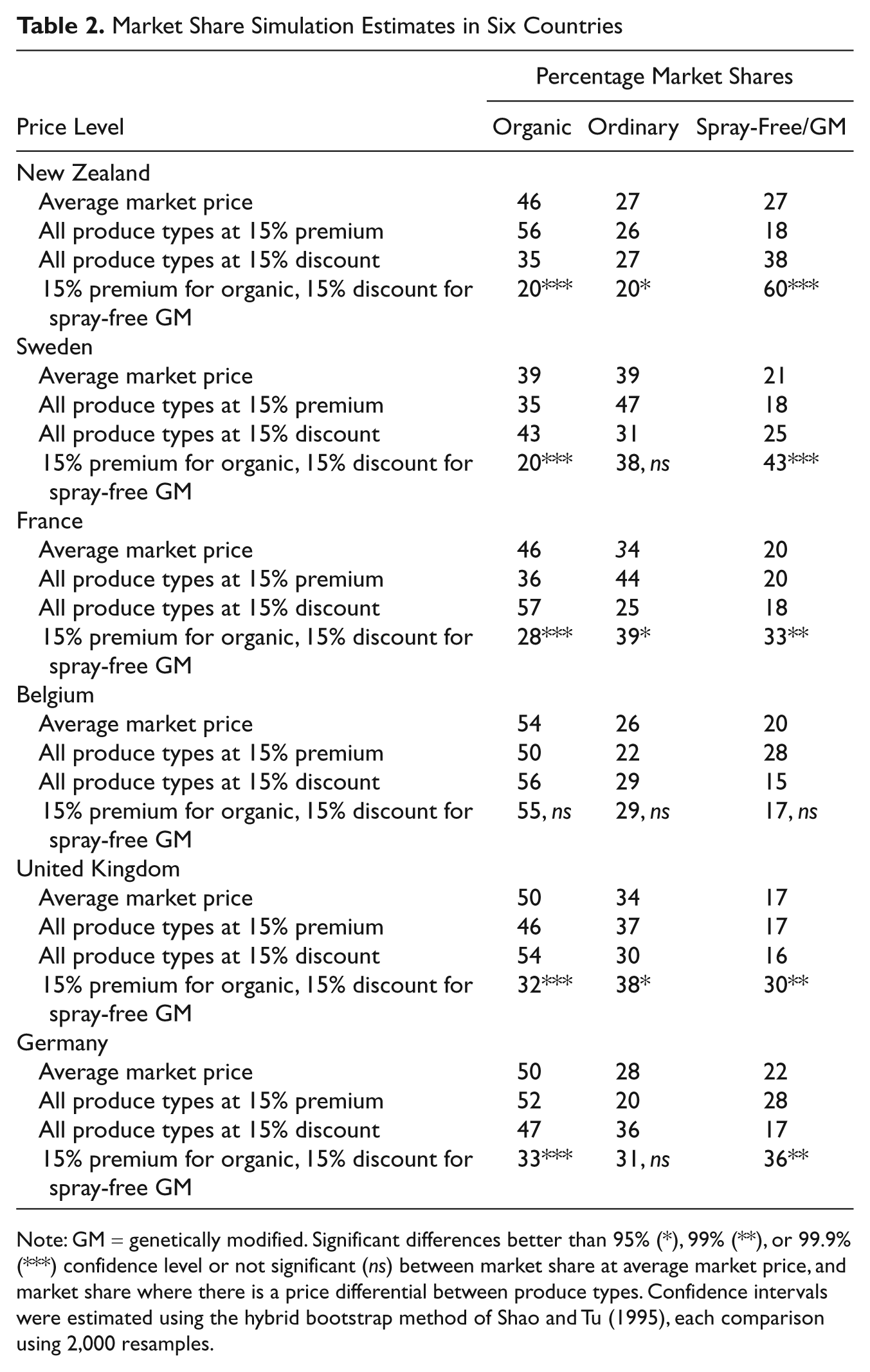
Note: GM = genetically modified. Significant differences better than 95% (*), 99% (**), or 99.9% (***) confidence level or not significant (ns) between market share at average market price, and market share where there is a price differential between produce types. Confidence intervals were estimated using the hybrid bootstrap method of Shao and Tu (1995), each comparison using 2,000 resamples.
Stated Preferences
A graphical comparison of the parameter estimates from the SP and RP methods is shown in Figure 1, where the axes indicate the size and sign of the parameter estimates. The three ellipses on (or on the right-hand side of) the vertical axes are the 95% confidence regions for the alternative fruit type intercepts; the three ellipses on the left-hand side of the vertical axes are the 95% confidence regions for the price sensitivity estimates of the three fruit types. Adamowicz, Louviere, and Williams (1994) provide a method for combining RP and SP data on the basis that both methods reflect the same process of making choices based on attributes in accordance with RUT.
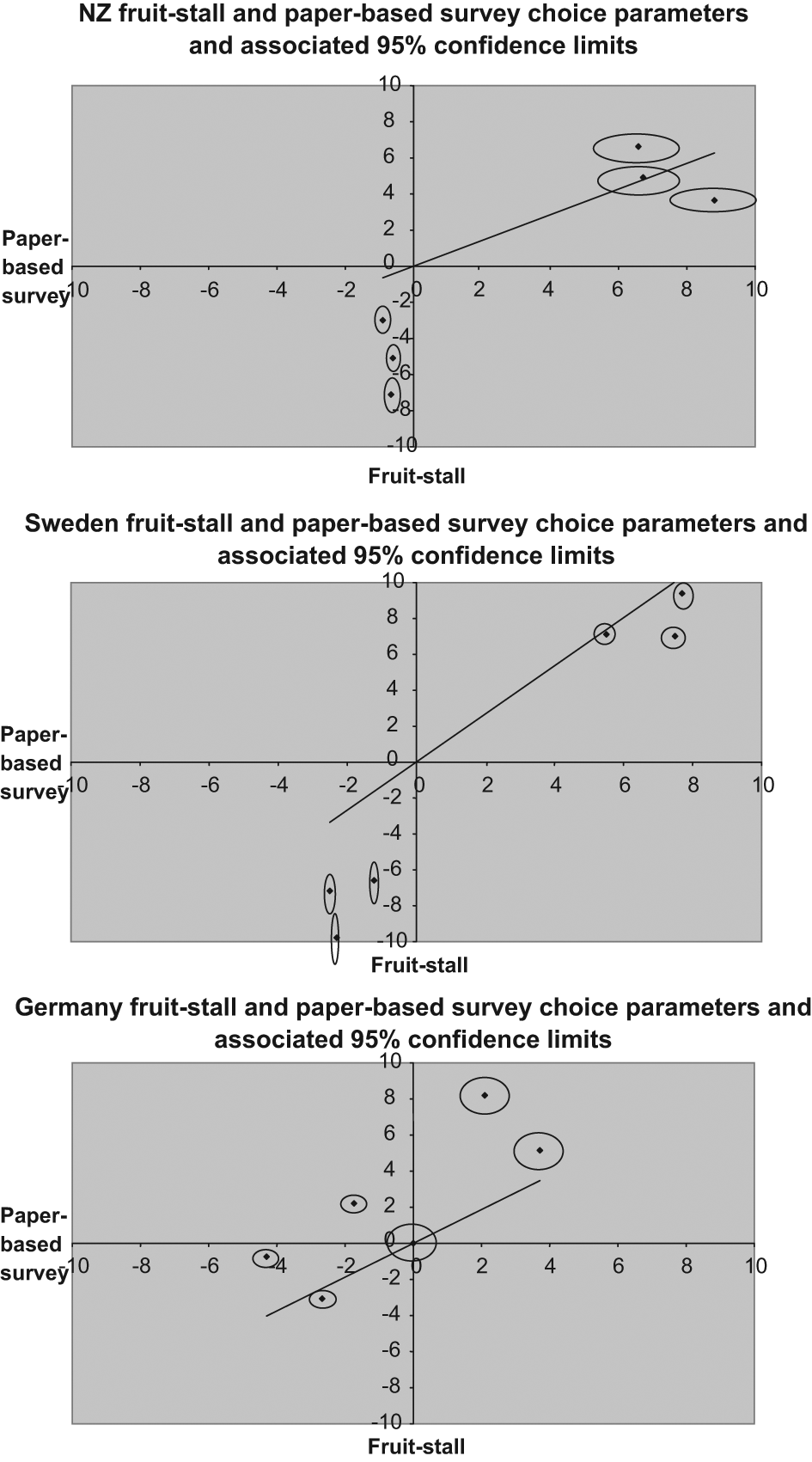
Comparison of revealed preferences (fruit stall) and stated preferences (paper-based survey) in choice-modeling experiments conducted in New Zealand, in Sweden, and in Germany
If the two measurement methods produce equivalent—that is, scalable—results, the error ellipses would touch or intersect the regression line. Clearly, this is not the case in any of the three situations presented here. These graphs demonstrate a change in inference both on which production type has the highest intrinsic value (decoupled from price) in the market and on which production type has the highest price sensitivity among GM, ordinary, and organic between the two types of experiment: stated (paper) preference or revealed (stall) preference.
Consumer Explanations for Choices
In addition to the consumer-revealed choices elicited in a real-world setting, the verbal explanations for their choices add a rich dimension to the study. An element of self-deception is apparent in the consumer choices that were explained by imagined differences in attributes—either appearance or taste. Appropriate illustrative examples of the wide range of explanations for their revealed choices are provided in Table 3. Because of space constraints, we present approximately 100 of the most revealing and interesting of the several hundred comments collected. These are discussed by category as follows.
Illustrative Comments Revealing Diverse Reasons for Consumer Choices

Note: GM = genetically modified; GE = genetically engineered.
Appearance, taste, and habit
Superior visual appearance and taste of the fruit were often mentioned as reasons for a choice, even though identical fruit was always used for all three categories in the RP experiments. Sometimes this gave rise to expressions of disbelief on being told that all fruit types were in fact identical—particularly when consumers had differentiated on the basis of taste and were totally convinced that the organic ones, for example, tasted sweeter or juicier. Habit (e.g. “I always buy XX”) was a frequent reason given for choosing conventional or organic over the novel GM offering.
Price
Cheapest price was naturally a major reason given for choices in all three categories. Consumers were sometimes perplexed when the organic option was offered at a lower price than the alternatives—as happened in the course of the fractional factorial design. Clearly, the expectation was that this option ought to be more expensive, given the higher cost of production and lower yield. Occasionally, customers indicated that they chose the most expensive option on the expectation that this implied better quality.
Anti-GM/anti-organic
Strong feelings against GM were anticipated, and this is reflected in many comments. What we had not anticipated was the frequency of negative views regarding organic. We were surprised by consumers who were knowledgeable about the sector and doubted its validity—for example, the “organic sheep farmer” who knew how easy it was to bend the rules. Consumers often expressed mistrust of one or the other technology and a high level of uncertainty.
Pro-organic/pro-GM
Strength of beliefs about the benefits of organic is reflected in numerous comments, often indicating a degree of moral conviction—better for the environment, better for children, and so on. Less anticipated were the many comments indicating positive views regarding GM. Often these related to the stated consumer benefit of the produce being free from chemical residues, but in addition there were several comments indicating interest in the technology and its potential advantages.
Nonsprayed/sprayed
The numerous comments regarding concern about spray residues indicate that this is a highly salient issue for consumers when purchasing fresh produce. Many consumers who chose organic believed that this offering is spray-free, even though the information that “organic Bt spray might have been used” was readily available if they asked. The difficulty we faced was that to maintain some semblance of reality and comparability to a usual retail situation, we could not foist extra information on customers over and above what one would normally expect to encounter. For example, conventionally produced fruit seldom carries information about spraying regimes or the chemical nature of sprays that have been applied. It is apparent that the “spray-free” designation of the GM offering did resonate with a large number of consumers and may in some cases have overridden an existing antipathy toward GM as the means of production.
Consumer Comments Indicating Social Desirability
Several of the recorded comments indicate that consumers were sometimes basing their choices on concerns about how others might view their behavior or how society might “expect” them to behave. Table 4 presents some of the most illustrative comments that indicate the influence of social desirability bias. “Morally, one should . . .”; “it is obvious that everyone would . . .”; “I think no one would . . .”; “everybody should support . . .”; and “consumers should look for . . .” are all indicators of this mode of thinking with regard to social expectancy.
Consumer Comments Illustrating Social Desirability With Regard to Choice of Organic
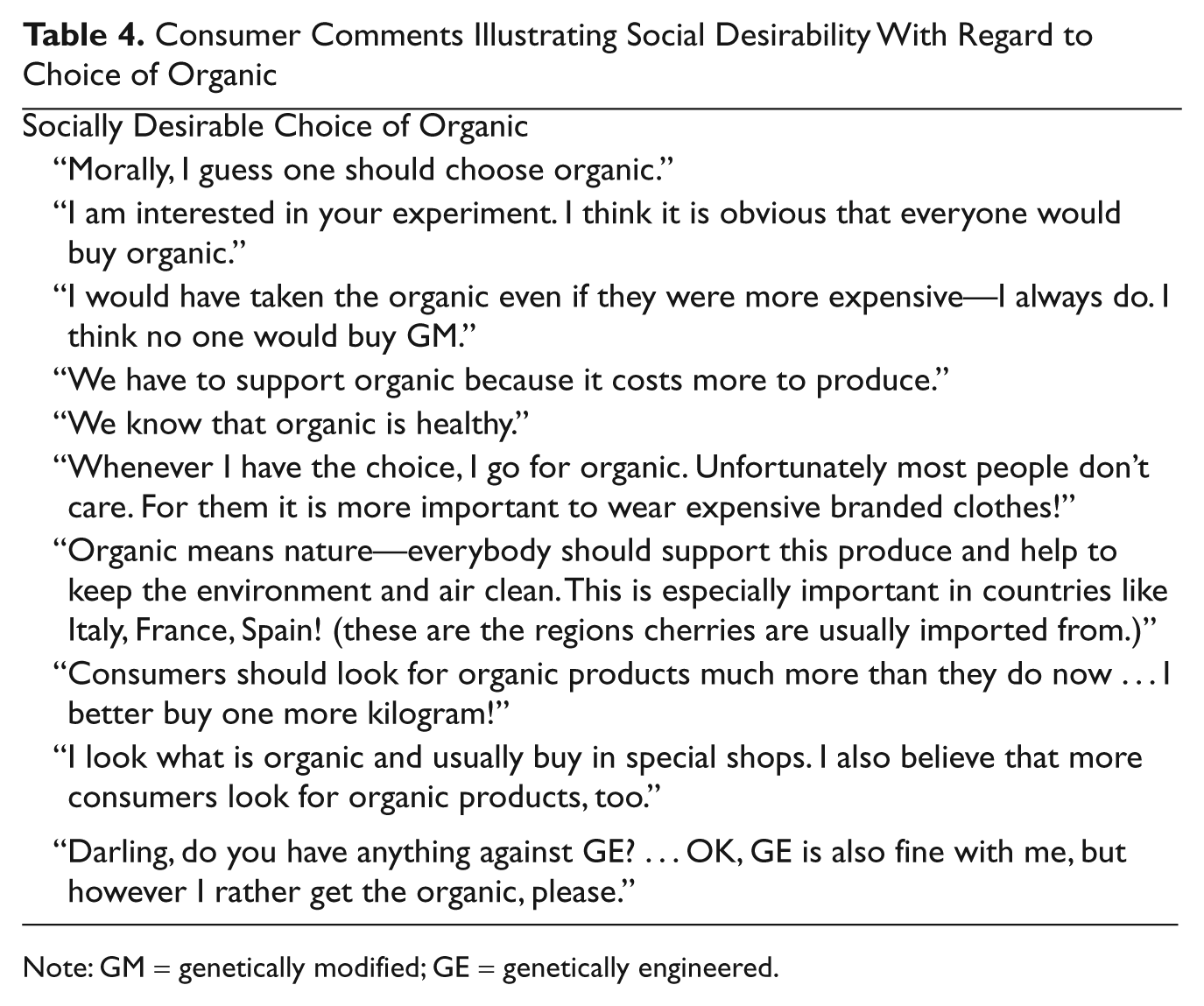
Note: GM = genetically modified; GE = genetically engineered.
Self-Justification of Choices
A considerable number of respondents made comments that suggested possible cognitive dissonance with regard to choices that they had made. In Table 5, we present examples that indicate self-justification of decisions that consumers, on reflection, might not feel entirely comfortable about. “I would have . . . if I had been alone, but . . .”; “it is hard to know, but . . .”; “if it is allowed to be sold, it cannot be bad . . .”; and “I wouldn’t have chosen if I had realized . . .” are examples of this type of discomfort shown after making their choice and of efforts made to rationalize the decision in retrospect.
Consumer Comments Indicating Self-Justification of Choices
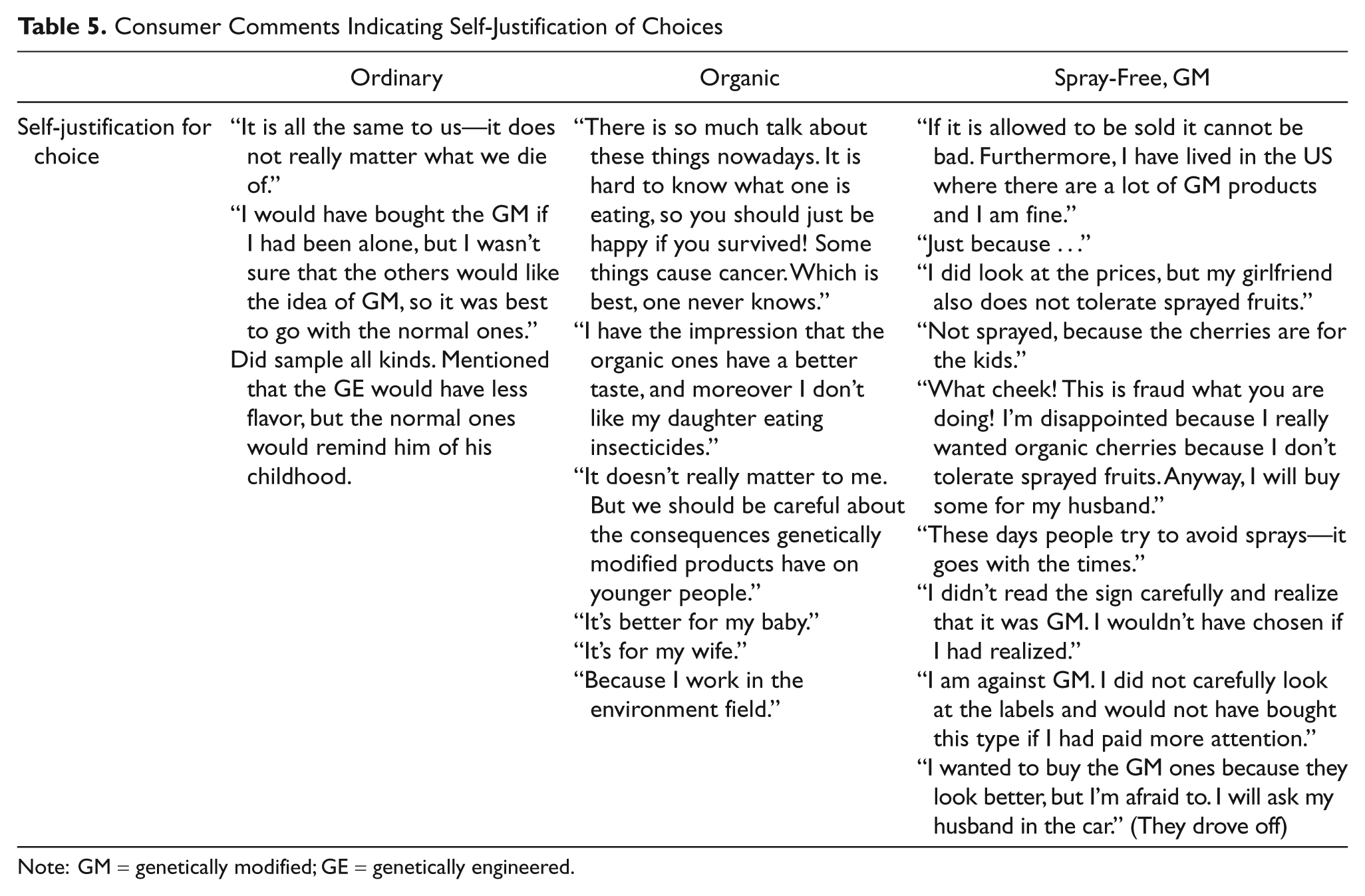
Note: GM = genetically modified; GE = genetically engineered.
Discussion
Societal pressure appears to strongly influence the way in which consumers make choices involving trade-offs between economic utility (price advantage) and their perceptions regarding GM, organic, or conventional methods of fruit production. Evidence for this is provided first by the observed major discrepancy between RPs and SPs applying identical experimental designs on closely matched samples and second by the verbal comments that explain revealed choices that consumers have made when faced with the three options on sale in a real-life selling situation.
The comparison of RPs and SPs indicates that under conditions of social pressure and controversy, such as those surrounding the GM issue, the parameter estimates differ substantially in the two methods and are not scalable. This implies that different mental processes are invoked in making choices under the two regimes. In an RP situation, consumers are not expecting that their decision—and their reasons for it—will be subjected to scrutiny by others. In contrast, in an SP situation, where respondents are being asked to complete a paper-based questionnaire containing exactly the same set of price and attribute information but accompanied by colored photographs of the fruit rather than the actual fruit, it is readily apparent that one’s response will be scrutinized—and in fact respondents may be completing the questionnaire under the administrator’s gaze. Under these circumstances, perceptions of social expectancy seem likely to be overriding price-quality judgments. Impression motivation is well understood to influence attitudes, which are likely to reflect the “shared reality” of others’ expectations (Agrawal & Maheswaran, 2005; Chen, Shechter, & Chaiken, 1996; Ratner & Kahn, 2002). In our experiments, we see a clear difference in price sensitivity, and in turn choice, depending on the circumstances under which choices are being observed.
The idea that “green” consumers express their political beliefs through actions in everyday life has been widely embraced. However, Pedersen and Neergaard (2006) conclude that the concept of the “green” consumer is oversimplified and fails to capture the actual complexity of consumer values, attitudes, and behavior. Peattie (2001) reported that 90% of U.K. consumers had a skeptical attitude toward green promotional campaigns, which might help explain the lack of consistency between environmental attitudes and actual behavior. Noussair, Robin, and Ruffieux (2004) point out that “the aversion to GMOs is based on both private considerations, such as potential health risk and a preference for natural foods, as well as social dimensions, such as environmental effects and ethical concerns” (p. 102). They question whether the anti–GM organisms sentiment expressed in surveys would be reflected in actual purchase behavior, suggesting that “surveys place respondents in the role of citizens, who make judgements from society’s point of view, rather than consumers, who make actual purchase decisions” (p. 103). Actual consumer behavior can neglect the externality that their consumption imposes, whereas their response to a survey will not. According to Noussair et al. (2004), “This is analogous to the consumer of electricity who is opposed to nuclear power but uses the electricity from the power grid, despite the fact that some of the electricity is generated with nuclear power” (p. 117).
The results of the fruit stall experiment reported here provide direct evidence that a sizeable segment of domestic and visiting consumers in New Zealand and in five European countries, where the GM issue has been particularly politicized, will buy GM products provided there is a clearly defined consumer benefit and this benefit is communicated effectively. Whether these are consumers with a propensity to try new and innovative products, whether they are consumers who are pro-GM, or whether they are mainly consumers who simply do not care about the issue needs exploring in further research.
Our results are consistent with certain other findings. Two studies indicate that in both France and the United Kingdom a significant proportion (up to 50%) of consumers may in fact be willing to buy GM foods if they are sufficiently discounted (Moon & Balasubramanian, 2003; Noussair et al., 2004). Research conducted in the United Kingdom found that in a “topic-blind” sample of 100 individuals, 93% willingly tasted and ate what they believed to be GM food in an experimental setting (Townsend & Campbell, 2004). Furthermore, 48% said they would buy GM food in the future—results that the researchers found “surprising in the context of other reports about attitudes and intentions toward GM food” (p. 1385). In an experiment conducted in all four Scandinavian countries, Grunert, Bech-Larsen, Lahteenmaki, Ueland, and Astrom (2004) found that a positive sensory experience with “GM cheese” could lessen negative attitudes toward GM technology and increase likely purchase intentions.
The 2005 Eurobarometer Report (Gaskell et al., 2006) found that “there are mixed opinions on the acceptability of buying GM food. The most persuasive reasons relate to health, the reduction of pesticide residues and environmental impacts” (p. 4). However, a recent study published in this journal concluded that knowledge about these kinds of issues did not substantially influence perceived risks or benefits of gene technology; the experiential system seems more important in this regard than the analytical system (Connor & Siegrist, 2010). According to Connor and Siegrist (2010), “Narratives and metaphors will be more important for the acceptance of gene technology than basic scientific knowledge or results of risk assessments” (p. 534). Perhaps to “narratives and metaphors” we need to add “good taste,” which is perhaps the most central benefit of food products (Grunert et al., 2004). GM products that provide enhanced taste benefits and/or price advantages are much more likely to win over consumers than are products conveying benefits only to producers or abstract benefits that are difficult to judge.
The results we present in this article are readily explained in terms of the theory of diffusion of innovations. A central pillar of this theory is that diffusion is based on a communication process “in which participants create and share information with one another in order to reach a mutual understanding” (Rogers, 2003, p. 35). Similarly, rejection of an innovation can be strongly influenced by peer pressure and societal disapproval (Rogers, 2003). Particularly with regard to relative advantage, it seems clear that the biotechnology industry has overlooked or ignored the need to provide well-communicated consumer benefits. The emphasis has been almost entirely on relative advantage for producers, who of course are the primary customers for biotechnology firms, but this can be seen to have been a rather myopic strategy. Rogers (2003) explicitly includes “social prestige factors” as a necessary component of relative advantage. So it comes as no surprise that products that become stigmatized as a result of news media and activist campaigns are seen by consumers as lacking relative advantage. Arts et al. (2011) found that relative advantage had a stronger effect on behavior than on intention, and this is borne out in the discrepancy we observe between the RP (behavior) and SP (intentions) results. Compatibility can be seen as compromised for consumers who value ethereal qualities such as “natural” or not “tampered” with; GM conflicts with existing belief systems for these consumers. Arts et al. (2011) in their meta-analysis were “not able to clearly distinguish between the effect of relative advantage and compatibility due to their high correlation” (p. 143). The findings of Grunert et al. (2004) referred to above show the clear relevance of trialability and observability to acceptance of GM food, as do the experiments reported here. Consumers visiting our experimental fruit stalls could observe and try (taste) fruit before they made their selection. Several comments reported in the first section of Table 3 indicate the relevance of trialability and observability: for example, “I chose these because I tried a cherry from this bucket and it tasted good”; “I tried all three types and found these ones tasted better”; “I bought this type because I thought they looked better.”
Arts et al. (2011) found that complexity more strongly inhibits behavior than intention, and this is also borne out in the observed discrepancy between RP and SP results. Complexity is an issue with regard to GM, because consumers who have limited understanding of biology and principles of genetics may well find the concept of genetic engineering impossible to comprehend, and perhaps scary as a result. Former European Union Commissioner for Trade Peter Mandelson stated in a speech at the European Biotechnology Info Day Bavarian Representation at Brussels, June 14, 2007: “Biotech can arouse strong emotions. There is something in human nature that can make us afraid of science, nervous of new technologies.” This has resulted in “an almost gothic fear of genetic engineering” in Europe (Pardo, Midden, & Miller, 2002, p. 10).
In part, these fears may stem from nonrational factors, as evidenced by studies showing that “magical beliefs” and “superstition” have both been found to correlate with negative attitudes toward GM food (Hagemann & Scholderer, 2006, 2007; Mowen & Carlson, 2003). Interestingly, a similar correlation was found with regard to “mutation breeding” (Hagemann & Scholderer, 2007), suggesting a lack of awareness of the role of selection of mutants in developing essentially all of the food crops and animal strains that form the basis of modern agriculture (Federoff & Brown, 2004). According to Saher, Lindeman, and Koivisto Hursti (2006),
Signs of magical thinking can be found in GM and OF (organic foods) attitudes. GM products evoke reactions as if they were “polluted” by the technique (Trewavas, 1999) and can be somehow contagious, while organic foods are ascribed almost esoteric properties which allegedly transfer to you in a “you are what you eat” manner (p. 325).
A substantial literature addresses these beliefs and the thought processes underlying them (Gaskell et al., 2000; Makatouni, 2002; Rozin et al., 2004; Trewavas, 2001). Since both GM and organic foods may be indistinguishable from conventionally produced foods, these beliefs can be interpreted as manifestations of “pollution” and “contagion” beliefs, which are indicative of magical thinking (Nemeroff & Rozin, 1989; Rozin & Nemeroff, 1990).
Evidence that these fears may stem from a lack of understanding of biology and the underlying science comes from the 2003 Eurobarometer survey of 17,000 consumers, which asked respondents to agree or disagree with the statement: “Ordinary tomatoes do not contain genes, while genetically modified tomatoes do.” Only 36% of the respondents across the 17 member countries were able to correctly identify this statement as false (Gaskell, Allum, & Stares, 2003). However, a recent study by Connor and Siegrist (2010) conducted in Switzerland showed that basic biological knowledge had very little impact on people’s risk and benefit perception of gene technology: “Narratives and metaphors will be more important for the acceptance of gene technology than basic scientific knowledge or results of risk assessments” (p. 534).
Limitations
Caution is needed in extrapolating the findings on a country-by-country basis or to retail situations in general as the experiments were conducted at single locations in each country. Furthermore, the findings may only be applicable to consumers who frequent drive-in fruit stalls. However, in all the countries where the study was conducted, this mode of selling seasonally available fresh fruit is widely used. A further limitation is that we had no means of directly measuring the extent to which subjects felt a need to conform to social pressure. This effect has been inferred from the behavior exhibited, and also from verbatim comments as shown in Tables 4 and 5.
Conclusion
The fruit stall experiments reported here add an important dimension to other studies of the GM issue by testing consumer behavior in an actual purchasing situation when there is a clearly stated consumer benefit in addition to price. It has long been known that attitudes and behavioral intentions fail to adequately predict behavior in some markets (Arts et al., 2011; Belk, 1985; Morrison, 1979; Morwitz, Steckel, & Gupta, 2007). We observe a major discrepancy between SPs and RPs, suggesting that respondents to surveys on such a controversial issue may respond in a manner that is influenced by social desirability, the basic human tendency to cast oneself in the “best” light and conform to societal rules. With regard to the GM issue, and indeed situations involving introduction of other novel and controversial technology, SP findings may provide an unrealistically negative view of how consumers will actually respond in a real-market situation. The results of this study emphasize how very important it is for the biotechnology industry to focus on developing products with well-defined consumer benefits and to adequately communicate these benefits to potential consumers.
Footnotes
Acknowledgements
We thank Amy Coleman, Jean-Baptiste Faucher, Karen Knightbridge, Charlotte McLeod, Miranda Mirosa, Romain Mirosa, Barbara Neve, and Anna Wellingham for help in these experiments. We are very grateful to the anonymous reviewers for greatly assisting us in developing this article further.
Declaration of Conflicting Interests
The authors declared no potential conflicts of interests with respect to the research, authorship, and/or publication of this article.
Funding
The authors disclosed receipt of the following financial support for the research, authorship, and/or publication of this article: This research was funded by the Agricultural and Marketing Research and Development Trust (AGMARDT) of New Zealand.