







Abstract
This article examines how two conflicting views regarding science-society relations—science as the arbiter of truth and as a social endeavor—perpetuate a tension in the way scientific consensus and evidence are called upon in climate change debate. In our analysis of interviews with climate change campaigners, we employ argumentation theory and social representations theory to identify and account for three discursive strategies of responding to climate contrarian arguments: direct confrontation by dichotomous arguments, de-dichotomization by addressing background assumptions, and concession to minor scientific uncertainties. We discuss these strategies emphasizing the science-society relations evident in each.
Keywords
The worldwide debate on the existence, anthropogenic nature, and risks of climate change (CC) has been one of the key arenas for discussing different views of science-society relations. Crucial issues, such as the policy implications of scientific evidence or uncertainty, are intensely called into question and hotly contested (Callaghan & Augoustinos, 2013; Demeritt, 2001; Jaspal, Nerlich, & Koteyko, 2013). According to several scholars, an idealistic view of science as a realm of pure facts uncontaminated by human values has been dominant in this debate (Latour, 2010; Oreskes, 2004; Wynne, 2014), not least because the United Nations Intergovernmental Panel on Climate Change (IPCC) has strongly relied on scientific consensus as the criterion for assuring the public of the existence and anthropogenic nature of the problem (Goodwin, 2009). Moreover, other important actors—environmental NGOs, the media in many countries—also took this direction in their efforts for mediating between the (international) scientific and policy spheres and the (national) public spheres (Grundmann & Scott, 2014; Ramos & Carvalho, 2008; Uzelgun & Castro, 2014). Thus, along the years, scientific evidence and consensus generalized as foundational criteria for grounding the legitimacy of anthropogenic CC policy decisions and action (Hulme & Mahony, 2010).
However, despite the increasingly generalized—albeit somehow unstable (see Ratter, Phillipp, & von Storch, 2012)—recognition by the public of the existence and risks of CC, the debate in many countries has not ceased to be “animated” by controversies between proponents of climate action and its contrarians (Jaspal, Nerlich, & van Vuuren, 2016). In these controversies, the contrarian camp has largely relied on the argument that scientific evidence is contaminated by the political agendas, interests, and aspirations of climate scientists (see Jaspal et al., 2013; Jaspal et al., 2016). The response of proponents of climate action has often been to discredit the contrarians’ claims on the same grounds, by arguing that their interests and values contaminate their knowledge claims (see Knight & Greenberg, 2011; Oreskes, 2004). Along the way, some scholars have contended that although this realist 1 perspective has its shortcomings in comparison to a constructionist one, it has to be maintained because “if global change is seen as primarily a social construction rather than an objective (albeit imperfectly understood) condition, then it poses little threat to the future of our species” (Dunlap & Catton, 1994, p. 23; see also Ceccarelli, 2011, McLaughlin & Dietz, 2008).
In sum, both proponents and contrarians have drawn on a purified view of science, arguing that social and political contingencies should be—and can be—carefully excluded from (our) science, in a classical export of impurity to the other (Mulkay & Gilbert, 1984). Such a view of science-society relations arguably perpetuated in the debate the dichotomized format of “deep disagreements” (Fogelin, 1985), sometimes embroiling even the IPCC (Hulme & Mahony, 2010) and, in some countries, closing down the space for policy decision and action (Callaghan & Augoustinos, 2013; Ceccarelli, 2011).
There is thus a need for the debate to move forward, opening more space for new arguments, decisions, and action. One way to contribute to this overarching goal is to render explicit what often remains implicit in controversies: the views, or representations, of science and science-society relations conveyed, as well as their consequences. Some research has been conducted in this direction through analyses of both expert (e.g., Callaghan & Augoustinos, 2013; Jaspal et al., 2016; Stehr & Grundmann, 2012) and everyday discourses (e.g., Hanson-Easey, Williams, Hansen, Fogarty, & Bi, 2015; Jaspal et al., 2013; Nerlich, 2010; Sadler, Chambers, & Zeidler, 2004; also Wolf & Moser, 2011). The present study extends this focus by looking at less studied but important actors of the CC debate: members of environmental NGOs that are active nationally and internationally in CC communication and policy, whose communicative practices contribute to new meanings and actions filtering into formal and everyday contexts. Carried out by analyzing an explicitly argumentative situation in which they argue against contrarian claims, our study aims to explore (1) the argumentative strategies they employ in criticizing the presented claims; (2) the representations of science they make explicit and criticize, as well as those that they implicitly convey; and (3) the communicative consequences that may follow from the arguments used and the representations conveyed.
To achieve these goals, two interrelated levels are addressed. First, we explore the role that persistent argumentative strategies—both micro-discursive choices (e.g., yes, but . . . constructions; Uzelgun, Mohammed, Lewiński, & Castro, 2015) and more complex ones (e.g., dissociation and de-dichotomization)—play in opening up or closing down space for arguing for climate action. Second, we examine how different representations of science and science-society relations uphold these strategies. Our analysis draws on argumentation theory (AT, van Eemeren & Grootendorst, 2004) as a methodological tool and on the social representations theory (SRT, Moscovici, 1988) as a theoretical one. We thus undertake the systematic exploration, at the interactional level, of argumentative processes and contents, combining it with the examination of how these are rooted at the societal level categories of meaning—social representations. The two are intertwined: Argumentative choices are shaped by particular representations of science, and social representations are generated, maintained, and transformed through discourse and argumentation (Castro, 2006; Kadianaki & Andreouli, 2015; Moscovici, 1988, 1994).
Below, after exemplifying how a purified and idealized image of science has been typically used in CC controversies, we summarize the contributions of AT and SRT and use them to analyze an argumentative situation from interviews with nongovernmental actors of CC. In the discussion, we consider the three argumentative strategies identified in the analysis in terms of their power to provide reasoned responses to counterclaims, thus advancing the CC debate.
How Climate Science Is Still Contested in the Public Sphere: The Example of “Climategate”
Only days before the 2009 Copenhagen climate summit, thousands of e-mail exchanges among the members of the Climatic Research Unit of the University of East Anglia were illegally retrieved and “leaked” into the public sphere. Labelled “Climategate” in a way that signifies the exposition of a “hoax” or “conspiracy” (Nerlich, 2010), the incident was an opportune moment for the long-standing climate contrarian efforts (see Jacques, Dunlap, & Freeman, 2008) to once again echo in the media (Grundmann & Scott, 2014; Jaspal et al., 2013). For climate contrarians, it was a revealing demonstration of how climate scientists were entangled in their data and how they were playing with or “constructing” their research outputs (see Jaspal et al., 2013; Latour, 2010).
In response, many proponents of climate action and scientists aligned with the IPCC resorted to a similarly purified representation of science, repeating the allegations that it is climate contrarians who contaminate a scientific debate by politically motivated claims (Knight & Greenberg, 2011). Commenting on such charges, a leading scholar in the field of science studies (Latour, 2010) lamented that it was embarrassing to see that proponents of climate action “had no better epistemology with which to rebut their adversaries” than “the old opposition between what is constructed and what is not constructed” and the same “idealistic view of science” (Latour, 2010, p. 478) that contrarians often use.
In the wake of “Climategate,” and the failure of the Copenhagen Summit to reach its anticipated outcomes, surveys recorded a decline in public trust in climate science in countries such as the United States, United Kingdom, and Australia (Lieserowitz, Maibach, Roser-Renouf, Smith, & Dawson, 2013; Ratter et al., 2012). This instability suggests that the public consensus about CC might still be fragile and that the prevailing epistemological framework through which the problem has so far been brought to the public sphere may be inadequate vis-à-vis the contrarian charges (Latour, 2010). To overcome this conundrum, it is necessary for research to move beyond treating positions in these controversies as individual perceptions and reasons (see Wolf & Moser, 2011), paying attention also to the argumentative choices of the key actors and the representations they convey to a worldwide debate occurring in formal and informal contexts. With the goal of contributing to a better understanding of these choices, in what follows we summarize insights from AT and SRT that can extend the analyses of controversies characterized by fervent confrontations locked in two sharply opposing views.
Linking Representation to Argumentation Through Communication
It has been argued that the IPCC’s commitment to quantitative inclusiveness—that is, consensus among scientists, admittedly a highly persuasive claim directed at nonscientists—has involuntarily contributed to the legitimization of a variety of objections by opening a wide argument space
2
(Goodwin, 2009, p. 9). Climate contrarians have exploited this space simply by claiming that there is not a complete consensus—that there are dissenting voices (see Ceccarelli, 2011). Below we present an example from a British TV documentary, in which such a claim is made: I’ve often heard it said that there’s a consensus of thousands of scientists on the global warming issue, and humans are causing a catastrophic change to the climate system. Well, I am one scientist and there are many that simply think that is not true. (John R. Christy, climate scientist, quoted in “The Great Global Warming Swindle,” 2007)
Such dichotomizing claims emphasize “the incompatibility of the poles and the inexistence of intermediate alternatives” (Dascal, 2008, p. 34), obscuring the paths of critical discussion in a way that renders the resolution of a dispute intractable. In AT, long-standing disputes that proceed from such confrontations are called “deep disagreements” (Fogelin, 1985). Deep disagreements “are immune to appeals to facts” and “remain recalcitrant to adjudication,” often because the sources of the disagreement are “allowed to lie in the background” (Fogelin, 1985, p. 5). One way to put such disagreements on a more rational basis is to foreground the background assumptions, rendering them as explicit standpoints (Fogelin, 1985), thus making discernible the representations that ground them. Pragmatic approaches within AT have shown that arguers are skillful not only in dealing with the explicit standpoints of their opponents but also in retrieving the implicit elements of a discussion, through “naïve reconstruction” (Jackson, 1992, p. 261). Moreover, they “conduct argumentation with attention to the practical consequences of speech,” and their orientation to the implicit elements is subordinate to their strategic deployment and consequences (Jackson, 1992, p. 268). This is in line with SRT, which shows that people adjust their discourse to their interlocutors with meta-knowledge about their representations and that in political life what we think that others think is of paramount importance for decision and action (Elcheroth, Doise, & Reicher, 2011).
According to AT, a presupposition can lie in the background due to it being taken for granted as common knowledge (Stalnaker, 2002). When such implicit knowledge “bridges” an explicitly stated premise to its conclusion, the presupposition is said to function as an unexpressed premise (Gerritsen, 2001). These implicit, unexpressed elements have manifold uses in different contexts, making it an impossible task to arrive at comprehensive, decontextualized systematizations (Gerritsen, 2001). Instead, AT focuses on making them explicit in analytical reconstructions (van Eemeren, Grootendorst, Jackson, & Jacobs, 1993). SRT likewise accentuates the importance of paying contextualized attention to the shifting, situated uses of social representations in discourse and argumentation (Castro & Batel, 2008; Kadianaki & Andreouli, 2015; Moscovici, 1994). Although many studies drawing from SRT use decontextualized word frequencies (e.g., Moloney et al., 2014) and this type of analysis can be useful for identifying representational contents, these methods fail to tap into representational processes that are crucial for understanding Self-Other relations (Castro & Mouro, 2016; Elcheroth et al., 2011; Kadianaki & Andreouli, 2015), especially those that take place when competing positions encounter and confront each other. In this line, studies drawing from SRT have developed analytic approaches increasingly focused on communication and discourse as a way to expand the understanding of the representational processes as an interpersonal endeavor embedded in socio-political realities (Callaghan & Augoustinos, 2013; Castro & Mouro, 2016; Jaspal et al., 2013; Kadianaki & Andreouli, 2015). Yet such studies do not always take systematically into account the implicit elements and micro-discursive choices conveyed in communicative practices. Our study thus extends and specifies them, by paying attention, through the systematic analytical scope of AT, to unexpressed premises and presuppositions as shared representations enacted in implicit ways in interactions. This pursuit extends the description of social representations “as embedded in (. . .) pragmatic inferences, namely presuppositions” (Moscovici, 1994, p. 167).
This, in turn, requires taking into account how the persuasive value of representations grounding arguments depends on the extent to which the former are valued in a certain society or a particular context (Castro & Mouro, 2016; Elcheroth et al., 2011). In this regard, SRT classifies representations into three types, of different social value (Moscovici, 1988). Hegemonic representations are highly valued: taken to describe the “way things are,” that is, naturalized, and often institutionalized, they “prevail implicitly” in diverse practices (Moscovici, 1988, p. 221) and are reproduced without being connected to any particular identity. Conversely, polemic representations are only valued by some identities, and communicated through micro-discursive choices that construct dichotomous oppositions (Castro, 2006); expressing antagonistic relations and deep disagreements (Fogelin, 1985) they typically lead arguers to resist negotiation (Callaghan & Augoustinos, 2013; Jaspal et al., 2013). Finally, emancipated representations, partly autonomous from the identities that initially elaborated them, result from the re-signification and hybridization of contents through micro-discursive choices such as yes, but . . . concessions, overcoming dichotomies, and oriented toward cooperation and dialogue (Castro, 2006; Mouro & Castro, 2012; Uzelgun et al., 2015).
Overview of the Aims of the Study
Assuming that different types of social representations can be strategically deployed by different actors as part of divergent projects (Bauer & Gaskell, 2008; Callaghan & Augoustinos, 2013; Castro & Batel, 2008), this study focuses on interviews carried out with experienced NGOs members active in CC policy. In analyzing them, our goal is threefold: (1) to systematically account for the argumentative strategies that nongovernmental actors of CC communication employ when responding to the claims made by contrarian scientists, (2) to identify the representations of science resorted to—in explicit and implicit forms—in responding to these claims, and (3) to examine to what extent different representations of science—more realist and more constructionist—are used, and how each helps closing down or opening up space for negotiating advances in climate action and for moving the debate forward. In doing so, we intend our analyses to be illustrative of what the combined use of AT and the SRT can offer to the examination of controversies extending under conditions of deep disagreement.
Method: Instigating and Analyzing Argumentation
We conducted (N = 22) in-depth interviews with experienced members of NGOs that are active in CC communication and policy in Portugal and Turkey, and are also partners to the international CC conferences and negotiation forums. In focusing on the discourse of NGO members involved nationally and internationally in the climate debate in the two countries, we assumed that they primarily belong to a global discourse and governance regime. The interviews were conducted in English. The selected organizations involved both international (Greenpeace, WWF) and national NGOs that are partners of global networks (e.g., BirdLife: Quercus, LPN, GEOTA, SPEA, and GAIA in Portugal; TEMA, TÇV, Su Vakfı, Doğa Derneği, and Ekoloji Kolektifi in Turkey). The participants were nominated by each organization after the initial contact by the researchers. Of the 22 interviewees, 8 held directorial positions in the organization, and 9 were climate campaign staff (mean experience in the organization was about 10 years); they all belonged to the highly educated segments of their societies, with 17 of them holding a postgraduate degree.
After initial open-ended questions, in order to instigate a stable argumentative context across the interviews and elicit structured argumentation, the interviewees were presented with video excerpts that featured controversial arguments. Immediately after each video excerpt, open-ended questions were asked, starting always with “What do you think the person in the video is saying?” Our assumption was that in their response, the main argumentative opponents of the interviewees would be those featured in the videos. In this study we focus on their responses to a video excerpt that features two scientists who dispute the consensus on the human causes of CC, arguing against the objectivity and trustfulness of the IPCC. Rather than providing a direct transcript of the video excerpt, 3 we present our reconstruction of their argumentation in Table 1, in order to help demonstrate how our interviewees oriented to the often-implicit elements without formal tools of argument analysis.
Reconstruction of the Arguments Conveyed in the Video Excerpt.
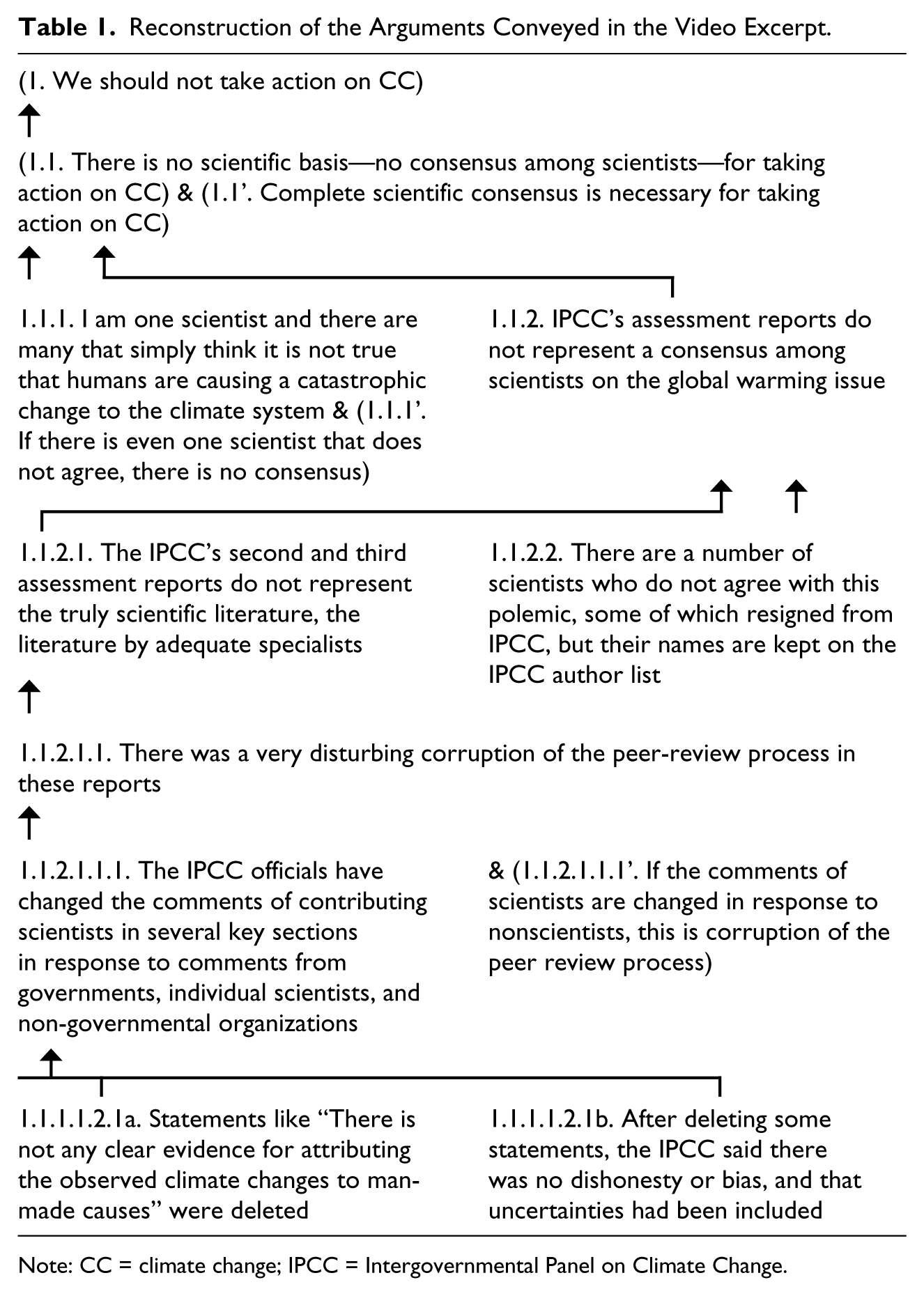
Note: CC = climate change; IPCC = Intergovernmental Panel on Climate Change.
In analyzing the arguments that respond to the claims made in the video excerpt, we followed the procedures described in van Eemeren and Grootendorst (2004), paying attention to the indicators of confrontation and concessions (e.g., but, however, still). For rendering the complex argumentation structures explicit, we used the concepts and numbering conventions 4 developed by the same authors (van Eemeren et al., 1993). Likewise, in uncovering the implicit premises we applied the pragma-dialectical method of normative reconstruction based on the principles of “logical minimum” and “pragmatic optimum” 5 (van Eemeren & Grootendorst, 2004, p. 117), focusing on the presuppositions made about the relation between science and society.
Since our interviewees are experienced participants in the global discourse on CC, we expected their argumentation to be oriented to the practical consequences of the contrarian scientists’ claims, showing a sophisticated reconstruction of the implicit features of the arguments in the video (see Table 1). This meant concentrating on the interviewees’ argumentative orientation to assumptions linked to different representations of science and their type (hegemonic, polemical, and emancipated), which enables the analysis to tackle not only the situated but also the persistent cultural and institutional aspects of the discourse under scrutiny. We achieved this by first reconstructing the recorded arguments (the first two authors) as exemplified in the analysis. Based on these, the three authors compared and discussed the explicit and implicit elements of the arguments in relation to the different views of science-society relations and to the reconstruction provided in Table 1. Three different strategies were identified in the material in this way, and in what follows, we offer two examples for each of them, providing a detailed reconstruction of only the more complex example.
Analysis
First Strategy: Direct Confrontation in a Dichotomous Opposition
Only few arguments directly confront the contrarian scientists’ claims presented in the video. We start with those. With the following two examples, we aim to emphasize that these arguments (1) constitute a refusal to actively engage with the presented arguments and (2) draw on the hegemonic view of science by representing (our) science as devoid of human interests.
Example 1 (Interview 8)
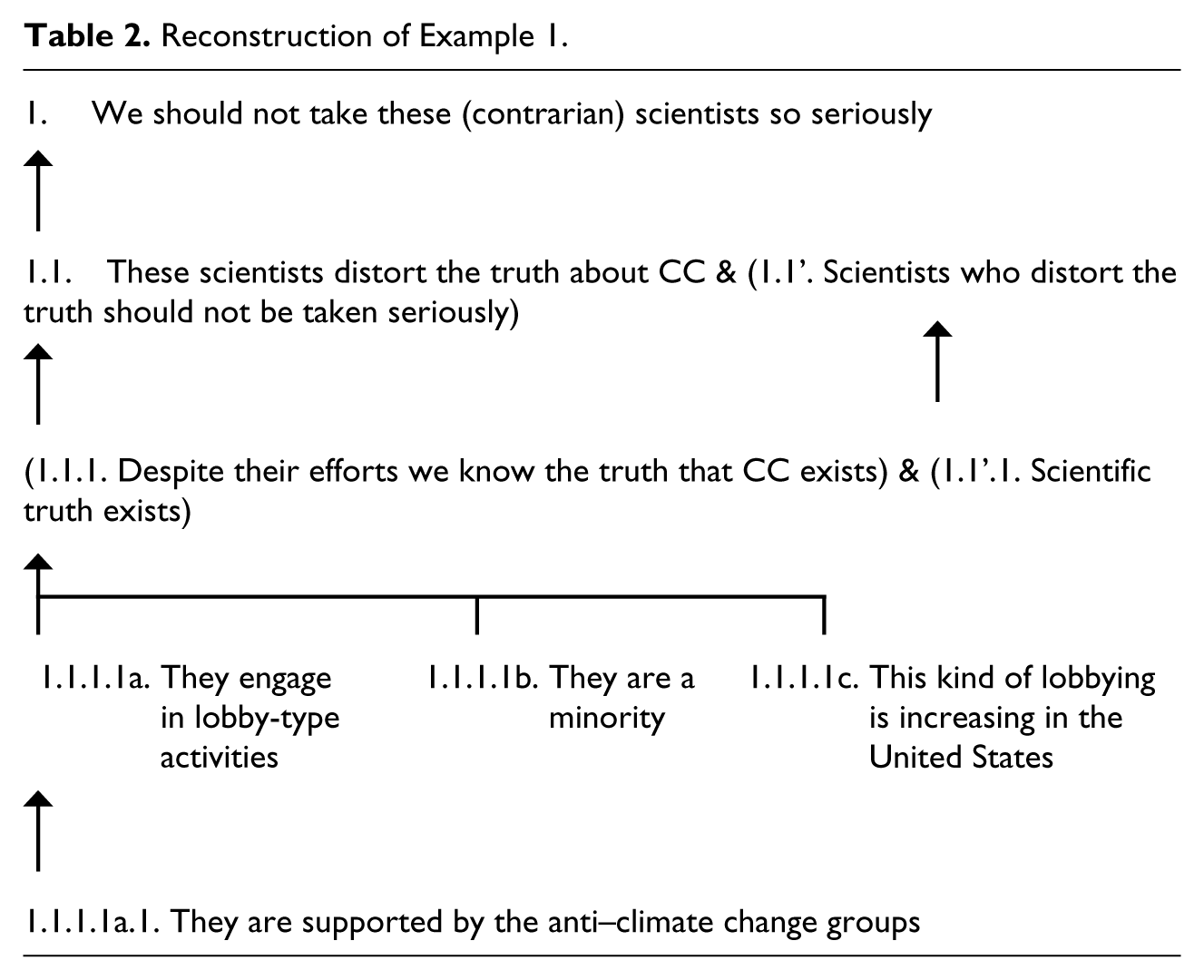
(So, what do you think the video is saying?) I think it’s basically a lobby-type distortion of the truth. It’s basically you know a bunch of . . . scientists . . . they could find who . . . you know anti-climate change people, groups. (. . .) Eeh . . . I think this is a minority, I mean I hear more and more that this kind of lobbying is increasing in the US, but I don’t really . . . I think we should take them seriously, but not that seriously.
In this example, first the arguments of the contrarian scientists are plainly dismissed by characterizing them as false (distortion of the truth) and motivated by lobbies, that is, as the bad science of the “others” (Mulkay & Gilbert, 1984). Next, the consensus on CC is discussed through a majority-minority opposition. The interviewee emphasizes that the counterclaims about the causes of CC are raised only by “a bunch of scientists” who share “the idea of the anti-CC groups.” That this minority is influential in some cultural-political territories is admitted, but as these territories are restricted, this eliminates any reason to take them seriously:
This disengagement from the content of the dispute (see Table 2, 1) rests upon “the truth” about CC (1.1). In other words, it draws on the hegemonic representation of science as the arbiter of truth, through which the contrarian scientists are depicted as “lobbying” and hence as practicing politics instead of doing their job. This is most evident in the support the implicit linking premise (see Table 2, 1.1’) provides: In general, we should not take seriously the scientists who distort the truth. Yet in this context, contrarian scientists do exactly this, supported by “anti–climate change groups” (1.1.1.1a.1). This circumstantial ad hominem 6 argument can be regarded as sound (Zenker, 2011) based on several studies originating in the United States (e.g., Jacques et al., 2008), suggesting that climate contrarianism is an organized movement connected to conservative think tanks, supported by the oil industry. Regardless, in arguing this way, the interviewee may be said to represent science (truth) in a strict disconnect from politics (lobbying).
Reconstruction of Example 1.
To get another glimpse of this disconnect, let us focus on an example in which the interviewee responds to the interviewer’s question about conflict and controversy in climate science:
Example 2 (Interview 4)
I don’t think that science has conflicts; people have conflicts. Because there are industries, there is this nuclear industry, there is this coal industry, there is this . . . eh, other industries, and there are scientists, eh engineers, making . . . working for these industries, and also involved in these processes, IPCC and other processes. So in this world money talks. I mean, the corruption can influence these scientists. (. . .) So we must find people really trustworthy . . .
In this excerpt, the interviewee presents the conflicts in (climate) science as imposed from outside to an otherwise pure domain. Directly confronting the claims conveyed in the video excerpt, she defends that there is no real scientific conflict in climate science or that there is consensus (see Table 1, 1.1). In asserting that contrary to people, science has no conflicts and emphasizing this contrast, the interviewee resorts to a hegemonic representation: the widely shared view of a pure science. According to this view, the polemics belong to the (impure) world in which “money talks,” whereas science operates—or should operate—in another, pure domain. An implicit distinction between science and (untrustworthy) scientists is thus drawn and helps purify science, since it is represented as exempt from the problems that may involve scientists (Mulkay & Gilbert, 1984). While justifying the contrast emphasized at the outset, this purification is further extended by drawing an explicit divide between scientists who work for the industries (implying hidden agendas, self-interest, as well as vulnerability to corruption) and those who cannot be corrupted by money (no self-interest, trustworthy).
Drawing on a realm of objective facts thus reconstructs the intervention of the social actors and interests as corruption; in the first of the identified strategies climate science is represented as suffering from the contamination of vested interests and agendas (of others). Hence, the debate is maintained “within” the space defined by the dichotomy (Dascal, 2008)—that is, the dichotomous format of the dispute is preserved.
A second strategy employed against the contrarian argument is to engage the dichotomy “from without,” namely, by de-dichotomizing the debate (Dascal, 2008).
Second Strategy: De-Dichotomization by Expanding the Disagreement Space
The second group of arguments focuses on how science is represented by the contrarian scientists, rather than directly confronting their controversial claims. These arguments are directed to refute the expressed claims not by questioning the interests of the opponents but by making explicit the incorrect assumptions on which they stand, thus strategically offering a “bigger picture.” This is most evident in the emphasis put on the problem of seeing the world in “black and white”:
Example 3 (Interview 21)
. . .It’s often I see in these reports is they, they talk about . . . as if science is black and white. So you know, those who say it’s wrong, those who say it’s right, and it’s either wrong or right. But actually, in all science, the truth is probably in the middle, you know, somewhere in the middle.
In this example the interviewee suggests opening up a “grey” zone of reconciliation and agreement, against a black-and-white polarization of the debate. The reasonableness of such arguments is built on not accepting the dichotomy presented in the video excerpt, thus not taking a position in it. The interviewee, instead of using the dichotomous meaning categories used in the first strategy, multiplies them in a strategy compatible with emancipated representations (Mouro & Castro, 2012). This allows her to present herself as impartial, or equidistant to both sides of the controversy. Unlike the first strategy, “the truth” is not already achieved (and on her side), but it is yet to be reached. As a consequence, the contrarian views are offered a space for recognition in the debate on the anthropogenic causes of the problem. In shifting the polemic from whether CC is fact or fiction, to a consideration of which presuppositions concerning science one should resort to for facilitating dialogue, the interviewee strategically expands the disagreement space (Lewiński, 2011), understood as the “entire complex of reconstructible commitments” that are relevant to the debate (van Eemeren et al., 1993, p. 95).
The advantage of this move becomes evident as a practical implication of her argument: that the parties to the debate (the contrarians too) have to reconcile, rather than simply reject/assert, the human causes of the problem. Since one way “to persuade is to get someone to change the rules and conventions by which they control their contributions to a discourse” (Harré, 1985, p. 137), we can say this is potentially a more persuasive strategy than the one exemplified above. This point may be made clearer by analyzing another example:
Example 4 (Interview 13)
We are . . . eh . . . forced to, or educated to see the world like black and white, like the good guy the bad guy, the eeh scientist says yes or says no. There is nothing in between, there is no ignorance, there is no uncertainty, there is no indecision, we have to take one side or the other, we cannot take anything in the middle. And especially the scientists, they have to be . . . they always know what is right. And so, this is very difficult to deal with. Of course if we are educated in this way, it is very convenient for, for oppressive governments, or for manipulating people. But it is very inconvenient for democracy and true empowerment of the people, and for critical thought and so on . . . and for advancing knowledge, true knowledge.
In this example too, the interviewee avoids engaging in a yes-no dichotomy between “the good guy” and “the bad guy.” His argumentation can be reconstructed as follows:
Notice that the implicit standpoint we need to cease discussing science in black-and-white terms (see Table 3) does not address any argument presented by the contrarian scientists (see Table 1). The interviewee calls out a presupposition (made about science) that lies in the background of the arguments raised in the video excerpt, treating it as a “virtual standpoint,” and criticizes it by virtue of its “relevance to the underlying purpose of the exchange” (van Eemeren et al., 1993, p. 95). It now becomes clearer that such arguments directed at the elements that lie at the background of a debate strategically reformulate the disagreement: On the one side there are those who conceive science in black-and-white terms, or as a matter of binary oppositions, and who dismiss the conflicting view; on the other side there are those who recognize the conflicting views and subject them to a debate through “critical thought,” in a way that is convenient for “democracy and true empowerment of the people.”
Reconstruction of Example 4.
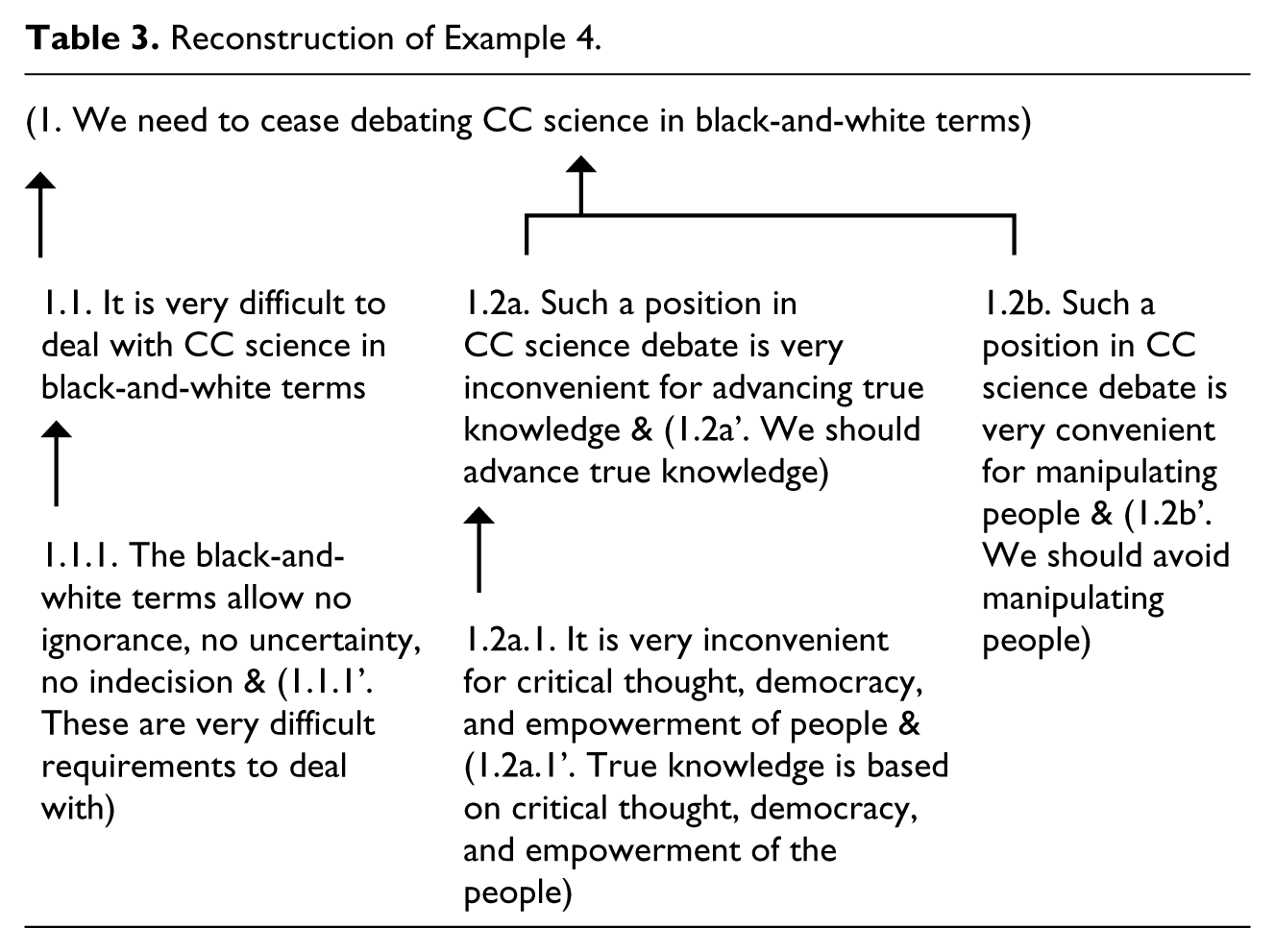
In both of the excerpts above, the argumentation initiated by assigning truth value to neither of the truth claims (be these black or white) concludes by upholding a reconciliatory process of advancing “true knowledge.” Then, for the interviewees who recognize conflicting scientific views as legitimate, true knowledge is still achievable through deliberative processes (see Table 3, 1.2a.1’) in which the holders of these views would have to compromise. Such nondichotomous, nondogmatic, open-ended encounters, where “critical thought” displaces incontrovertible truth claims, can be seen to resemble an expanded policy framework through which “empowered” people (nonexperts as well as experts) can join in negotiating and “advancing true knowledge” (see Demeritt, 2001, 2006). In other words, science is here represented as an inherently social, consensual form of knowledge: not disconnected from socio-political interests but continuous with them. In short, by extending politics into science, and thereby de-dichotomizing the conflict over the human causes of CC, it becomes possible for the interviewees to extend the scientific consensus in a way that opens space for a political one.
Third Strategy: De-Dichotomization by Conceding to Uncertainties
In a third group of arguments used more often in comparison to those above, the interviewees admit that there are uncertainties, conceding the claims made in the video. Characteristically, they do this in order to then restrict and confine these claims to the realm of science, and they argue that the points made by the contrarian scientists are no reason to give up political action on CC. These arguments are typically organized in a concessive yes, but . . . structure (see Uzelgun et al., 2015).
Example 5 (Interview 15)
It’s the fiftieth time that I hear this. You know, this is a big discussion. (. . .) [In order] to be sure, that the change in greenhouse effect, the gases caused this effect, you must cause this effect and measure. You could not make trials with land, with earth. So you have the probability, you are not sure 100%. You have the probability. (. . .) So, I could not as a scientist say, as a scientist, this is caused by that. As a scientist I could not, but as a politic, I must change the point of view. (. . .) If it is plausible that this action of the man caused an effect that is irreversible, this action could not, not must not, could not take place. The same for that, this is plausible, not sure, but it’s plausible, that the gases . . . so, the politics must take action.
This example is useful for highlighting two basic points: First, in the foundational part of the argument—until the concessive but—the interviewee seems to agree with the contrarian scientists. In this agreement preface (see Uzelgun et al., 2015) he, “as a scientist,” cannot but agree that there is only a probability and no certainty about the human causes of CC. Importantly, the reasons for not having certainty are also stated: “You could not make [controlled] trials with land, with earth.” Second, the but marks an argumentative move (and the repositioning of the arguer): As a political person he “must change the point of view” and consider the consequences. It is by virtue of the irreversible effects, and the “plausible” causal relation between human action and “the change in the greenhouse effect,” that he concludes, “politics must take action.”
In this most vivid demonstration of the shift from epistemic to practical reasoning in our corpus, science is only strategically—that is, in an agreement preface—represented as a realm of 100% certain, conclusive facts. Against such a representation of science, the interviewee argues that the focus of the debate must shift from epistemic certainties to practical consequences (the realm of the plausible, political). Importantly, this change of focus accompanies a multiplication of identities (Castro & Batel, 2008), through which the interviewee suggests that he is both a scientist and a political person—thus tempering the initially purified image of the—only certainty seeking—scientist. Let us now turn to another of the many examples in which the argumentation is structured in a similar way:
Example 6 (Interview 15)
Can you please tell me about your position on this issue? Actually you have already told me in the start, but how did you develop this stance? Well, I do know there’s quite a lot of uncertainty on on proving that climate change is anthropogenic or not, ehm, but, there’s, at the same there’s a lot of certainty, there’s some bits of evidence. And that’s where I . . . at the end it’s a . . . yeah, it has everything inside, it’s whenever you use it’s always a theory. And you have to be aware that, it’s a theory until you prove. It’s not my position to prove it strong, so I look at climate change in that sense: ok, there is some evident point on this direction, so let’s go, but that does not necessarily mean that this is a fact. Because, I don’t think there are facts anyway.
As in the previous example, the interviewee develops his argumentation from a virtual standpoint implicitly conveyed in the video excerpt (see Table 1, Argument 1.1), represented here as there is quite a lot of uncertainty in proving that climate change is anthropogenic (Table 4, 1.1.1.1a). In doing this, he confronts a pragmatic inference from the expressed propositions of the contrarian scientists 1.1.1 and 1.1.2 (designated in Table 1 as there is no scientific basis for taking action on climate change). Conceding this virtual standpoint of the scientists featured in the video, he accepts that CC is a theory rather than a fact, but this does not prevent him from advocating action (so let’s go):
Reconstruction of Example 6.
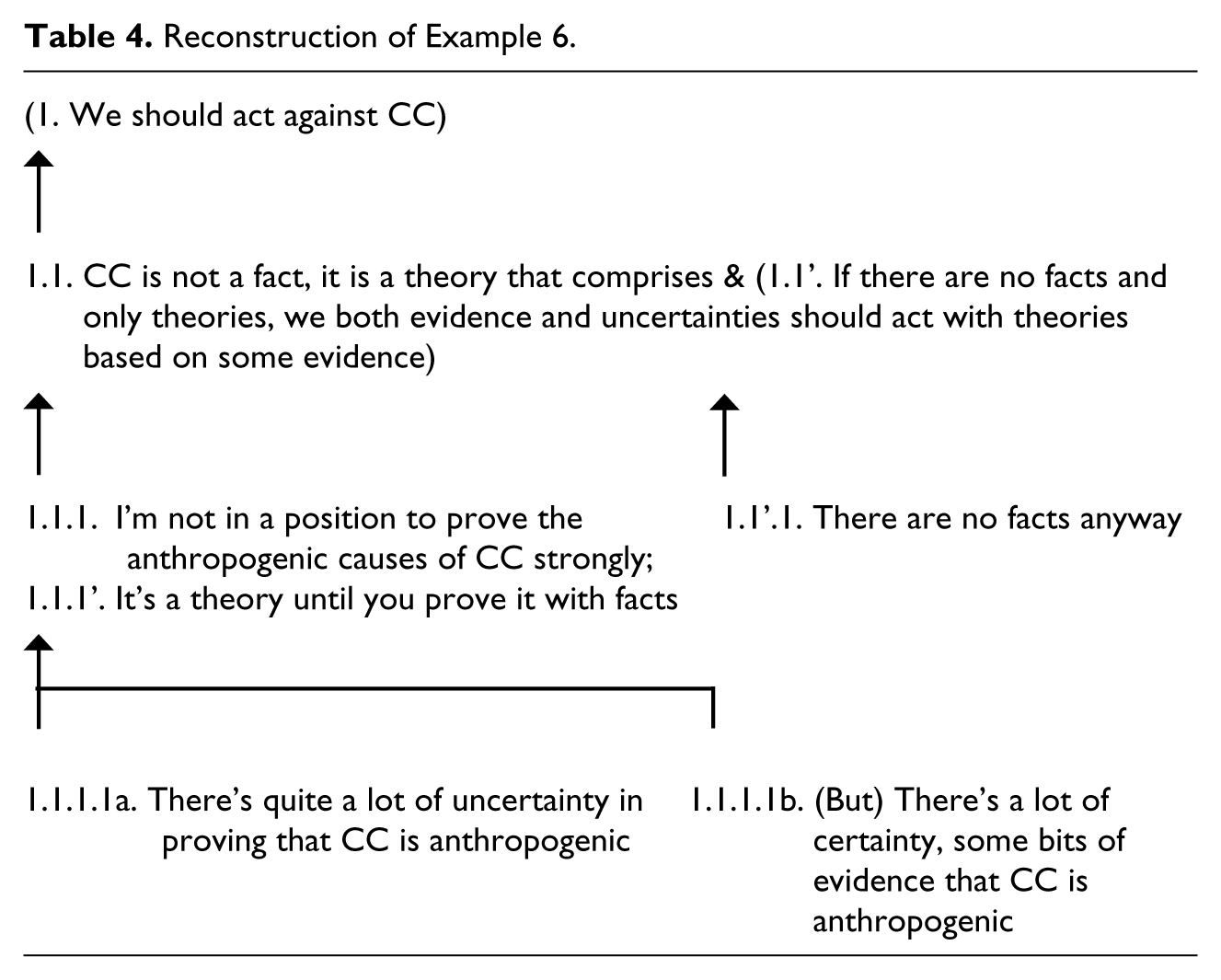
Such a contribution to the debate becomes possible by asserting that there are no facts (Table 4, 1.1’.1) but rather some evidence and some uncertainties (1.1). It is an unexpressed premise (1.1’) that links this epistemic reasoning to a practical conclusion and targets an unexpressed premise of the contrarian argument (1.1’ in Table 1). The interviewee engages with this premise, implicitly contradicting that we do not need to wait for proving the facts to engage in climate action (1.1’ in Table 4). In answering the interviewer’s clarification question, the interviewee makes explicit that at the foundation of his argumentation, there is an understanding of science that is inherently value-bound, expressing a constructionist view of scientific evidence:
Example 6 (continued)
Because who does research . . . is a human, whatever you do, it’s already an interpretation. (. . .) Choosing to ignore a bit rather than other bit, it’s a value decision. Putting your limit, this is our limit, of uncertainty, up from here we don’t take any decision, below here we can take all decisions, assuming that that’s they’re safe, that’s a value decision, where you put the limit. So, yeah, I don’t know, that’s . . . I don’t see science as pure thing.
In short, it is through a representation of science as intertwined with human values and decisions (Demeritt, 2001; Wynne, 2014) that the arguers can de-dichotomize the opposition, make concessions, recognize the other side’s case strategically, and still argue for taking action on CC. The positions enacted through such an image of science-society relations suggest that expecting full certitude from science is problematic; one should instead make the best out of the continuous encounter among theories and data, recognizing the values at the interplay rather than simply the evidence. Thus, the third group of arguments fit together well with the second group of arguments, since in both, the main achievements are to (1) provide an unperturbed, equable, apparently impartial view of the controversy; which (2) reconciles the dichotomized views about the causes of CC; while (3) criticizing the assumptions lying in the background of the contrarian view; and (4) crucially, rebutting and delegitimizing its practical conclusions.
Discussion
In this article we brought together contributions from SRT and AT for examining how representations of science and science-society relations feature in the discourse of experienced actors of CC communication and policy. We did this by looking at the argumentative strategies they employ in dealing with contrarian scientists’ claims. Three ways of arguing with the contrarians were identified. Importantly, these strategies are not mutually exclusive, and more than one of them were used in several interviews, focusing on different aspects of the contrarian argument. The three strategies are summarized below:
Focusing on the (hidden) agendas of contrarians with an idealistic view of science: For defending that there is scientific consensus and that CC is a fact, the first strategy symmetrically reverses the contrast created by the contrarians: “Theirs” becomes here the impure science and “ours” the pure one. This dissociation—separating true science from the contrarians’ claims—aims to discredit the opponents and exclude their claims from the realm of science. This is done by asserting truth as a central notion for science, thus resorting to the hegemonic representation of science against the contrarian claim that also draws on the same representation. In this way, arguers play their part in maintaining the debate dichotomized (Dascal, 2008) and thus locked.
Focusing on the dichotomizing assumptions grounding the contrarian arguments: Instead of taking a one-sided view in the dispute, this strategy is oriented to de-dichotomizing it with the instigation of a metadisagreement, expanding the disagreement space. This is done by “calling out” and criticizing the opponents’ presuppositions regarding science (e.g., that it is either wrong or right), upholding a constructionist view of science, and presenting it as a polemic representation, contrasting with the hegemonic view. A battleground of counterclaims for truth is thus strategically transformed into a middle ground of compromise, critical thinking, and deliberation, in a way that exposes the uncritical, nonreflexive views of the opponents.
Focusing on the pragmatic inferences of the contrarian arguments: This strategy is built upon mitigating the disagreement (yes), and shifting its locus (but). Conceding that there are uncertainties, arguers again avoid taking a one-sided view of the scientific knowledge about CC. But they question and criticize the pragmatic upshots of the contrarian claim, emphasizing its social and political consequences for action. What supports this move is a constructionist view of science as a limited human endeavor working with uncertainty and interpretation, proposed as an emancipated representation of the science-society nexus, one that allows participation and integration of different perspectives.
The first of these strategies repeats a dichotomous format that has so far contributed to the prolongation of a “manufactured controversy” (Ceccarelli, 2011), in which both sides resort to a hegemonic representation of science—realist, purified—to delegitimize the case of the other. This suggests that when called on to settle disputes that happen under conditions of deep disagreement, hegemonic ideas can generate dichotomous oppositions, locking the societal debate in repeated confrontations.
For the proponents of CC action, the burden of proof for such truth claims here poses the main problem, as the adversaries merely claim that inquiry is being unfairly stifled (Ceccarelli, 2011). Furthermore, whatever new knowledge is brought in to settle the controversy, it reveals its limits sooner or later (Stehr & Grundmann, 2012). Hence there are reasons for questioning whether engaging with the contrarian claims (solely) in the domain of science, whether with recourse to scientific orthodoxy or according to the vast majority view of scientists, is a helpful strategy.
Indeed, the experienced mediators of CC knowledge active in the nongovernmental sphere seem to employ, more than the first one, the second and the third strategies, upholding the continuity between science and society. In defending public awareness, participation, and political outcomes, and not the scientific orthodoxy, they transform the focus of a dichotomized argument space “from a battle over truth to a debate about how to act within uncertainty” (Edwards, 1999, p. 467). The transformation of the dispute—the expansion of the disagreement space—is achieved through the latter two strategies by targeting a representation (of science) that is hegemonic in the societal context. Through the second strategy, this representation is made explicit and directly confronted and is thus offered a polemic status, that is, opened up for discussion in the situated context. The third strategy, instead, is built on strategically hybridizing the two representations of science through a concessive format (yes, but . . .) in a way that the other side’s claims and presuppositions are recognized, before being criticized. In other words, the hegemonic idea of a pure science is transformed into an emancipated one by being accepted into the debate on CC but with reservations regarding its sufficiency: Yes, uncertainties are important in the debate but not sufficient to undercut mitigation policies (see Uzelgun et al., 2015). This serves to continue the debate at the societal level while restricting the contribution of the contrarian arguments at the interactional, and, most importantly, policy-making levels. The outcome of this argumentative labor is positive in that it neither dissociates too strictly (Strategy 1) nor tends to confound (Strategy 2) the expert and public spheres of the climate arguments.
Although this study did not attempt to compare Portugal and Turkey, it may be worthy to discuss the lack of difference between the responses collected in the two countries: That the three identified strategies were employed in similar ways in two different cultural and political contexts, we contend, can be understood in the light of the fact that central practical goals—or representational projects (Bauer & Gaskell, 2008)—are shared by the NGOs in these two contexts. Expressed in a different way, this lack of variance may be understood in the light of CC being primarily a global—and globalizing—discourse, and these organizations’ alignment with a global governance regime.
Combining theoretical and analytical insights of AT and SRT, this article made a case for their potential contributions to the study of public debate and controversies by focusing on crucial actors of CC communication—NGO experts mediating between (international) policy and scientific spheres and (national) public spheres. We exemplified, in particular, how the analytical scope of AT can provide a powerful tool for examining the implicitly conveyed elements in communicative practices and identifying representational processes in a systematic and accountable way. Increased attention to and better understanding of the representational and argumentative choices brought into play by social actors, especially in their strategic orientation to the representations brought into play by their opponents in contexts of dispute and public controversy, can contribute to overcoming some of the problems in public communication of significant issues such as CC. While this does not mean that reflexivity concerning one’s argumentative options would alone resolve such controversies, communicators of CC knowledge and policy may benefit from recognizing their relevance in overcoming some deep disagreements and in shifting the focus of this highly mediated debate from what is constructed and what is not constructed to what is well and what is badly constructed (Latour, 2010, p. 478).
Footnotes
Declaration of Conflicting Interests
The author(s) declared no potential conflicts of interest with respect to the research, authorship, and/or publication of this article.
Funding
The author(s) disclosed receipt of the following financial support for the research, authorship, and/or publication of this article: This work was supported by the Portuguese Foundation for Science and Technology (grant numbers FCSH/IFL–Pest-OE/FIL/UI0183/2013 and SFRH/BD/62102/2009 for Uzelgun, and grant numbers SFRH/BPD/74541/2010 and PTDC/MHC-FIL/0521/2014 for Lewiński).