







Abstract
While there is mounting evidence that humor can be an effective means of engaging publics, much remains to be learned about the contextual factors that shape how audiences receive and process humorous scientific content. Analyzing data from a controlled experiment (N = 217), this study explores the differential impact of exposure to stand-up comedy featuring a scientist that generates considerable laughter from the audience versus stand-up comedy lacking audience reaction. Among the key findings, audience laughter served to heighten the affective response of viewers, and affective response was positively linked to two forms of audience engagement with science.
Engaging the general public with science and communicating about scientific discoveries, principles, and issues is challenging, particularly for scientists who are trained to focus on technical details rather than on broad themes designed to attract and enthrall mass publics. In today’s hybrid media environment, we have begun to see greater diversification of science communication efforts given a general consensus that, to engage audiences, science needs to be seen as both interesting and fun (Riesch, 2015). It is perhaps not surprising then that the use of humor has been endorsed by communication scholars (Baram-Tsabari & Lewenstein, 2013; Goodwin & Dahlstrom, 2014) and a wide range of scientific associations and institutions (American Society for Cell Biology, n.d.; Science Riot, 2018). In fact, the American Association for the Advancement of Science has gone so far as to hold “Science Comedy Nights” at their most recent meeting (DC Science Writers Association, 2019), while the National Academy of Sciences has set up a “Science & Entertainment Exchange,” which connects those in the entertainment industry with scientific experts to facilitate accurate science and engaging storytelling in popular entertainment (see http://scienceandentertainmentexchange.org/). In short, humor is viewed as a promising means for fostering connections between average citizens and the world of scientific research (Riesch, 2015).
This increased interest in funny content is not particularly surprising given the impact of humor on attitudes and behaviors documented in recent scholarship. For example, recent work has documented the positive effects of exposure to humor on engagement with the climate change debate (Anderson & Becker, 2018; Becker & Anderson, 2019; Brewer & McKnight, 2015, 2017; Skurka et al., 2018) and the value of fictional entertainment programs like The Big Bang Theory in shaping views on the theory-driven and empirical nature of science (Li & Orthia, 2016). While the quality of the learning and scientific knowledge that can result from such popular portrayals of science is still an open research question (Szu et al., 2017), the reality remains that science entertainment content—and in particular humor that engages with scientific issues, themes, and representations of scientists—is an important tool for engaging citizens, and one that requires further study.
Analyzing data from a controlled experiment (N = 217), our research extends scholarship on the effectiveness of humor as a tool for scientific engagement. Specifically, our experiment considers the differential impact of exposure to stand-up comedy featuring a scientist that generates considerable laughter from the audience versus stand-up comedy lacking an audience reaction. Designed to test the effect of social cues connected to science humor on two types of audience engagement—endorsement of the stimulus materials themselves and engagement with the broader world of science being shared online—the present study points to the importance of contextual factors in shaping how audiences receive and interact with humorous scientific content. Furthermore, the present study moves beyond existing research by focusing not on whether humor affects audience attitudes and behavioral intentions but on what small alterations to such content—in this case, the inclusion or exclusion of audience laughter—can do to exacerbate (or attenuate) such effects. This approach carries with it a unique advantage that is not common to typical studies of humor. Rather than testing humorous and nonhumorous content that varies in a number of other ways (e.g., different characters, different persuasive content, different delivery styles), our approach focuses on identical stimuli that vary only in terms of the social cue of audience laughter that we manipulate. Prior to elaborating on our approach, however, we first provide some background on our dependent variables of interest.
Outcomes of Interest: Content Endorsement and Science Engagement
The analyses presented here will focus on two specific forms of beneficial audience engagement. The first is “content endorsement,” which focuses on the willingness of respondents to endorse and spread the stimulus content to others by means of the interactive features that social media offers, such as the “liking” and sharing options (Alhabash & McAlister, 2015; Kim, 2018). These interactive features are visible to other social media users, which makes them potentially powerful indicators of approval and important factors for helping content spread and “go viral” (Alhabash & McAlister, 2015). The ability for humorous scientific content to spread into different networks of individuals, including those who would not normally follow such content, is one potentially attractive goal of science communication in the social media space.
Our second dependent variable, “science engagement,” pushes our interest beyond endorsement of the actual stimulus materials and toward the broader world of online science content. We are interested particularly in whether a positive experience with the stimulus materials might motivate audiences to explore other pieces of science content and follow other scientists or scientific institutions online. In other words, we are interested in exploring whether a single positive interaction can spill over to produce broader interest in and following of other forms of science content.
Science-Related Comedy Use and Effects on Attitudes and Behavior
There is a growing body of research that suggests that people who watch entertainment content about current events benefit from consuming this type of content. For example, political communication studies reveal that viewers of late-night comedy programs (e.g., The Daily Show) are more attentive to politics, have higher levels of political knowledge, and participate more in the political process (e.g., Cao, 2008, 2010; Cao & Brewer, 2008; Xenos & Becker, 2009; Young & Tisinger, 2006). Additional work in this space has linked exposure to political comedy to enhanced feelings of political efficacy (Becker, 2011) and even stronger voting intentions among specific population subgroups (Moy et al., 2006).
Similar positive effects have been demonstrated in studies focusing on contentious science topics, most notably work focusing on climate change (Anderson & Becker, 2018; Brewer & McKnight, 2015, 2017; Feldman et al., 2011; Skurka et al., 2018). Controlling for a host of factors, consumers of satirical television news programs, like The Daily Show and The Colbert Report, tend to pay more attention to science, technology, and environmental news, including content about climate change. Viewers of The Big Bang Theory have been shown to engage in fact-checking of the experiments depicted in the show (Davis et al., 2011) or to debate the terminology employed by characters and the equations being discussed (Hewitt, 2009). Recent work has even offered evidence of increased intentions to engage in climate activism behaviors following exposure to satirical content from a Jimmy Kimmel Live! segment that tackled the issue of climate change with a mix of humor and indignation (Skurka et al., 2019). In sum, the general conclusion from this literature is that humorous and satirical presentations of content can serve as a vehicle for engaging viewers with scientific topics, including affecting subsequent information searches and even activism behaviors. With this information in mind, we propose the following hypothesis:
Hypothesis 1: Those reporting higher levels of science entertainment content consumption will report higher levels of (a) content endorsement and (b) science engagement.
Social Cues and Audience Perceptions
Laughter has been called contagious; when someone laughs, those hearing the laughter are likely to follow suit, and smile or laugh as well (Provine, 1992). Laughter can also push people beyond such surface-level or mimicked reactions and actually induce a form of instantaneous pleasure among those hearing it (Bachorowski & Owren, 2001). While the strength of this relationship is strongest during face-to-face interactions where the humorous interaction is the primary focus for all involved (Gervais & Wilson, 2005), it has also been demonstrated in situations where audiences consume media together (Devereux & Ginsburg, 2001; Fridlund, 1991).
Recent research has further demonstrated that laughter can influence how people emotionally respond to stimuli. Weber and Quiring (2019) found that the laughter of a confederate during the viewing of a short movie clip resulted in more laughter and smiling among study participants and that participant laughter was positively correlated with ratings of the movie clip’s funniness. Their work provided evidence for two processes at work. The first process argues that laughter operates as a form of primitive emotional contagion. Emotion as contagion is said to be a two-step process that begins when people automatically mimic the expression, posture, or vocalization of another (Hatfield et al., 1992; Hawk et al., 2011), a phenomenon that has been observed in several studies of laughter (Bavelas et al., 1987; Ramanathan & McGill, 2007), and one explained by the fact that the “observation of a behavior and its enactment share common cognitive representations” (Weber & Quiring, 2019, p. 176). According to Weber and Quiring (2019), “The mimicked behavior . . . induces the emotional state that usually corresponds with this behavior through feedback processes that link specific patterns of muscle activity with affective reactions” (p. 176). From there, the mimicked behavior (laughter) and corresponding state of emotion (joy/happiness/pleasure) become linked to the situation (and stimuli) that set the chain of events in motion to begin with. The result is a positive evaluation of the stimuli that caused the laughter in the observed other.
The second process is simpler and argues that laughter can act as a heuristic cue that tells a person that the content causing the laughter must be funny (Weber & Quiring, 2019). Laughter can be considered an especially powerful heuristic cue because it is a high-energy, obtrusive, and unambiguous indicator of pleasure. If a person hears and sees another person laughing at a video, for example, it serves as a strong indication that it is acceptable to also consider the video funny (Ramanathan & McGill, 2007). Importantly, this might occur whether or not the person hearing the laughter actually finds the video to be funny (Barsade, 2002; Olson, 1992). Hearing the laughter may also prompt the viewer to perceive the video differently than they otherwise would, as a form of biased or motivated processing (Taber et al., 2009; Taber & Lodge, 2006). Specifically, it might cause them to view it with an eye toward finding humor in the content with a complementary goal of also deriving pleasure from the viewing experience (Fuller & Sheehy-Skeffington, 1974).
The idea of laughter as a heuristic cue might be especially powerful in the context of science humor, which can reasonably be expected to be more complex than some other forms of humor. Getting a science-focused joke might require a baseline level of scientific knowledge or understanding that is not required for other types of jokes, such as slapstick humor, which focuses on “pie-in-the-face” situations where one’s status is degraded (Buijzen & Valkenburg, 2004). For those who do not get the humor, the laughter of others might be the only means of getting in on the joke. With this in mind, we propose the following hypothesis:
Hypothesis 2: Those in the audience laughter condition will report higher levels of experienced mirth than those in the condition lacking audience laughter.
People have different reactions to and experience different levels of humor from funny situations. The subjective nature of humor brings about an important methodological question within our study: Do we utilize the experimental condition as the primary independent variable of interest or do we focus on the experience resulting from that condition? While we manipulate audience reaction to the stand-up comedy routine by maintaining or removing the audience laughter in the clip, using the presence or absence of audience laughter as the independent variable would not account for differences in the amount of humor that individual respondents might perceive from the stand-up routine (Duncan & Nelson, 1985). In other words, respondents are likely to have reacted to even the same stimulus condition with different levels of experienced humor. We therefore have opted to use a measure of “experienced mirth,” rather than the experimental manipulation itself, as a predictor variable in our models. Furthermore, since we are primarily interested in the downstream effects of the psychological state elicited by the video, we chose to employ the psychological state itself as key antecedent instead of the message condition (O’Keefe, 2003). Thus, our remaining hypotheses focus on how experienced mirth influences the dependent variables of interest. Since laughter has been found to change how audiences rate the quality of content, and content quality is presumably tied to the information that audiences want to share and follow, we propose the following:
Hypothesis 3: Higher levels of experienced mirth will be associated with higher levels of reported (a) content endorsement and (b) science engagement.
Moderating Roles of “Content Preference” Variables
The impacts of humorous content cannot be expected to operate consistently across all audiences. Rather, they should vary based on individual traits. Need for humor (NFH) is a construct derived from individuals’ need for levity (Cline et al., 2003; Cline et al., 2011). It is a personality trait representing “an individual’s desire to experience both the humorous and whimsical traits found in self and others” (Cline et al., 2011, p. 20) and has four dimensions: (1) internal humor, (2) external humor, (3) internal whimsy, and (4) external whimsy. As we are primarily interested in how this personality trait interacts with one’s experience of mirth while watching a scientist deliver a comedy routine, we focus on external NFH. External NFH has to do with one’s preferences for being around funny people and funny situations (e.g., “I enjoy hearing someone tell a joke”). NFH has been found to moderate the relationship between exposure to humorous print ads and perceptions of advertising, with those scoring higher on NFH getting more out of humorous content and reporting higher ratings of the advertisement’s effectiveness (Cline et al., 2003). Work on political humor has shown that individuals high in NFH are more likely to engage with and learn from thematically related humor than from low-NFH individuals (Matthes, 2013). Given these findings, it is reasonable to assume that a similar moderating effect might be found concerning NFH and one’s willingness to share the stand-up video and to follow other scientists and science institutions on social media. Therefore, we expect the following:
Hypothesis 4: External NFH will moderate the relationship between experienced mirth on (a) content endorsement and (b) science engagement.
In addition to NFH, people vary in their preferences concerning the delivery of information. Coe et al. (2008) developed a measure of an individual’s appreciation for how news content is packaged and delivered to audiences—a construct they labeled “content affinities.” This measure focuses on one’s fondness for funny news sources, entertaining news content, and information that shares your point of view. Since science is generally considered a serious subject, we anticipate that content affinities may play a role in determining how receptive audiences are to the humorous presentation of scientific facts. Indeed, political communication work has found content affinities to be linked to preferences for different types of news sources over others (e.g., a preference for The Daily Show over The O’Reilly Factor; Coe et al., 2008). We anticipate that content affinities will interact with experienced mirth such that those with a preference for entertaining, funny, and congenial content who took pleasure from the viewing experience will be more open to spreading that content online. We also anticipate spillover effects such that they would be more willing to engage with other scientists and science-focused content online. This leads us to propose the following hypothesis:
Hypothesis 5: Content affinity will moderate the relationship between experienced mirth on (a) content endorsement and (b) science engagement.
Method
A two-condition experiment was administered online via Qualtrics between March 25 and April 9, 2019, among undergraduate students at a large public university in the southern region of the United States. Subjects (N = 217) were offered extra credit in exchange for their participation in the 15-minute online survey experiment. After a short pretest questionnaire measuring concepts, including media attention, interest in science and science media, orientations toward humor, deference to scientific authority, and scientific knowledge, subjects were randomly assigned to view a short video consisting of either stand-up science comedy with existing audience laughter (n = 107) or stand-up science comedy with the audience laughter removed (n = 110).
The stand-up science comedy videos feature Vince Ebert, a German physicist and comedian (see https://www.youtube.com/user/vinceebert/). The video content was a stand-up routine delivered in English and prepared for the 2018 Edinburgh Festival Fringe. Published on YouTube in June 2018, a 2-minute segment from the “Science Is the Best We’ve Got” clip was utilized in the experiment. The clip focuses on general science and science as a way of knowing and understanding our world, rather than any particular scientific topic. As a result, it sticks to largely uncontroversial topics, rather than issues characterized by considerable partisan debate (e.g., climate change). Subjects randomly assigned to the audience laughter condition (n = 107) saw the video in its original form, while subjects in the no audience laughter condition (n = 110) saw the same jokes and material with audience laughter removed from the clip. The videos were embedded into the survey experiment; all suggestions for related videos, ads, and the YouTube logo were removed. Controls were set so that subjects could not scroll through any sections of the video clips and had to remain on the screen for the duration of the clips. A series of manipulation checks followed in the posttest portion of the study, as well as questions tapping engagement with the video, message credibility and elaboration, and demographics. Measures used in the analysis are outlined below.
Key Measures
Dependent Variables: Content Endorsement and Science Engagement
Content endorsement (M = 3.23, SD = 1.46; Cronbach’s α = .93) was based on agreement (1 = strongly disagree to 7 = strongly agree) with a series of statements about the video content: (1) “The video is worth sharing with others,” (2) “I would recommend the video to others,” (3) “I would ‘like’ the video,” (4) “I would ‘share’ the video with others,” (5) “I would add my own comment to the video,” (6) “I would discuss the video with others,” and (7) “I enjoyed watching the video.”
Science engagement (M = 3.19, SD = 1.47; Cronbach’s α = .96) was based on agreement (1 = strongly disagree to 7 = strongly agree) with a series of statements about the video and “the extent to which the video would motivate you to . . .” (1) “pay more attention to science in the news,” (2) “pay more attention to science on social media,” (3) “find out more about scientific research,” (4) “follow Vince Ebert, the scientist in the video, on social media,” (5) “follow more scientists on social media,” (6) “follow more scientific institutions on social media,” (7) “follow more research centers on social media,” and (8) “pay closer attention to updates from scientists on social media.”
Independent Variables
Demographics
Controls for gender (1 = female; 65.9% of the sample vs. 34.1% male) and age (M = 21.12, SD = 1.24; range = 19-28) were included in the analyses. A measure of religiosity (M = 4.22, SD = 2.06) was based on the response to the question “How much guidance does religion provide in your everyday life?” (1= no guidance at all to 7 = a great deal of guidance). Political ideology (M = 4.24, SD = 1.46) was based on the mean response to two related questions (r = .67, p < .001); the terms liberal and conservative may mean different things to people, depending on the kind of issue one is considering . . .”: (1) “in terms of economic issues, would you say you are . . .” (1 = very liberal to 7 = very conservative) and (2) “in terms of social issues, would you say you are” (1 = very liberal to 7 = very conservative).
Content Preferences
The variable external NFH was an averaged index of six items asking respondents the extent to which they agreed with the following statements (1 = strongly disagree 7 = strongly agree): (1) “I make an effort to be around funny people,” (2) “I like situations where people can express their sense of humor,” (3) “I like to be around people who have a sense of humor,” (4) “I enjoy hearing someone tell a joke,” (5) “I prefer nonhumorous to humorous situations” (reverse coded), and (6) “I prefer my life to be filled with humor.” These six items capture external NFH (M = 6.09, SD = 0.86; Cronbach’s α = .86). A measure of content affinities was based on the participants’ reported level of liking or disliking the following when it comes to science information (M = 5.41, SD = 1.19; Cronbach’s α = .819): (1) when a source is sometimes funny, (2) when a source makes information enjoyable and entertaining, and (3) when a source shares your point of view on science.
Science Predispositions
A measure of science interest was based on the subjects’ level of interest (M = 4.22, SD = 1.38; r = .50, p < .001) in the following: (1) science and (2) environmental issues. A measure of science knowledge (M = 5.43, SD = 1.19) was based on the number of correct responses to seven factual statements about science (1 = definitely true to 4 = definitely false): (1) “The center of the earth is very hot,” (2) “The continents have been moving their location for millions of years and will continue to move,” (3) “All radioactivity is man-made,” (4) “Electrons are smaller than atoms,” (5) “Lasers work by focusing sound waves,” (6) “It is the father’s gene that decides whether the baby is a boy or a girl,” and (7) “Antibiotics kill viruses as well as bacteria.”
Science Media
A series of measures tapping consumption of science media were included in the analyses. A variable capturing how much attention subjects pay to science news online (M = 3.80, SD = 1.49; 1 = none to 7 = a lot) was based on the responses to two related items (r = .73, p < .001): (1) “stories related to science and technology” and (2) “stories about scientific studies in new areas of research.” A measure of science entertainment (M = 3.40, SD = 1.52) was based on how much subjects pay attention (1 = none to 7 = a lot) to (1) “science-themed comedies, such as The Big Bang Theory,” and (2) “science-themed dramas, such as CSI: Crime Scene Investigation.” A measure of trust in social media information (M = 2.96, SD = 1.23; Cronbach’s α = .85) was based on subjects’ mean level of trust (1 = do not trust at all to 7 = trust very much) across a range of social media platforms—for example, (1) Facebook, (2) Twitter, (3) Instagram, (4) Snapchat, (5) Reddit, and (6) YouTube—as sources of science information.
Stimulus Experience
Mirth or perceived humor (M = 4.51, SD = 1.48; Cronbach’s α = .933) was an averaged index of three items measured on 7-point semantic differential scales. Respondents were asked to describe the video using three pairs of words: (1) not humorous-humorous, (2) not funny-funny, and (3) not amusing-amusing.
Analytical Plan
Hierarchical ordinary least squares regression was privileged in the analysis given the continuous nature of the dependent variables. Hierarchical regression enters blocks of variables based on their presumed causal order, allowing researchers to assess the relative contribution of each variable block above and beyond previously entered blocks. For this study, hierarchical regression was ideal because it considers the impact of mirth resulting from exposure to the varied stimuli after controlling for key antecedent variables like interest in science and attention to science content across a range of media sources. To prevent problems of multicollinearity (Cohen et al., 2003), two sets of interaction terms were created by multiplying the standardized values of key independent variables: (1) the interaction between mirth and external NFH and (2) that between mirth and content affinities.
Results
Prior to testing our regression models, we used an independent samples t test to determine if the presence of audience laughter was significantly correlated with experienced mirth. In response to Hypothesis 2 (H2), we found a significant effect of the experimental manipulation on experienced mirth, t(214) = −6.418, p < .001. Respondents in the condition with no audience laughter reported lower mirth on average (M = 3.78, SD = .139) relative to those who viewed the video with laughter (M = 5.05, SD = .142). Next, we turn attention to the regression model predicting content endorsement.
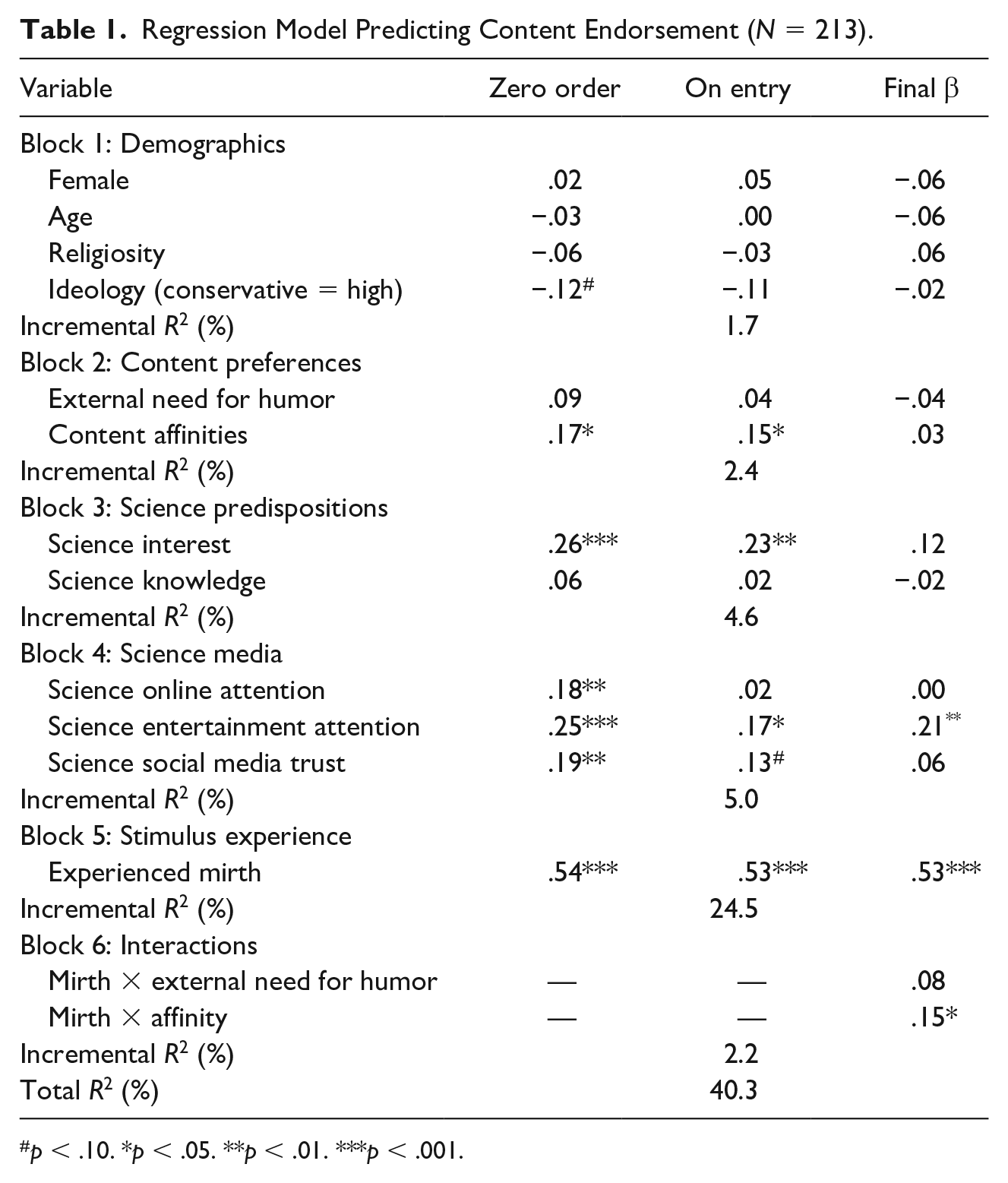
Table 1 displays the results for this analysis. As the data in Table 1 show, demographics, content preferences, and predispositions toward science (Blocks 1, 2, and 3) explain a relatively small amount of the variance in content endorsement (incremental R2 of 1.7%, 2.4%, and 4.6%, respectively). Consumption of science media, particularly in the form of science entertainment content (e.g., science-based comedies and dramas), was a significant predictor of content endorsement (β = .21, p < .01). H1a was supported. Overall, the science media block explained an additional 5.0% of the variance in the dependent variable.
Regression Model Predicting Content Endorsement (N = 213).
p < .10. *p < .05. **p < .01. ***p < .001.
Mirth resulting from exposure to the video stimulus material was the largest predictor of content endorsement even after controlling for demographics, predispositions toward science, and science media consumption. Those who found the video to be more humorous, funny, and amusing were significantly more likely (β = .53, p < .001) to score high on our measure of content endorsement. H3a was supported. This block of the regression model explained an additional 24.5% of the variance in the dependent variable. The interaction effects, which will be discussed shortly, accounted for 2.2% of the explained variance. Overall, the final model explained 40.3% of the variance in content endorsement.
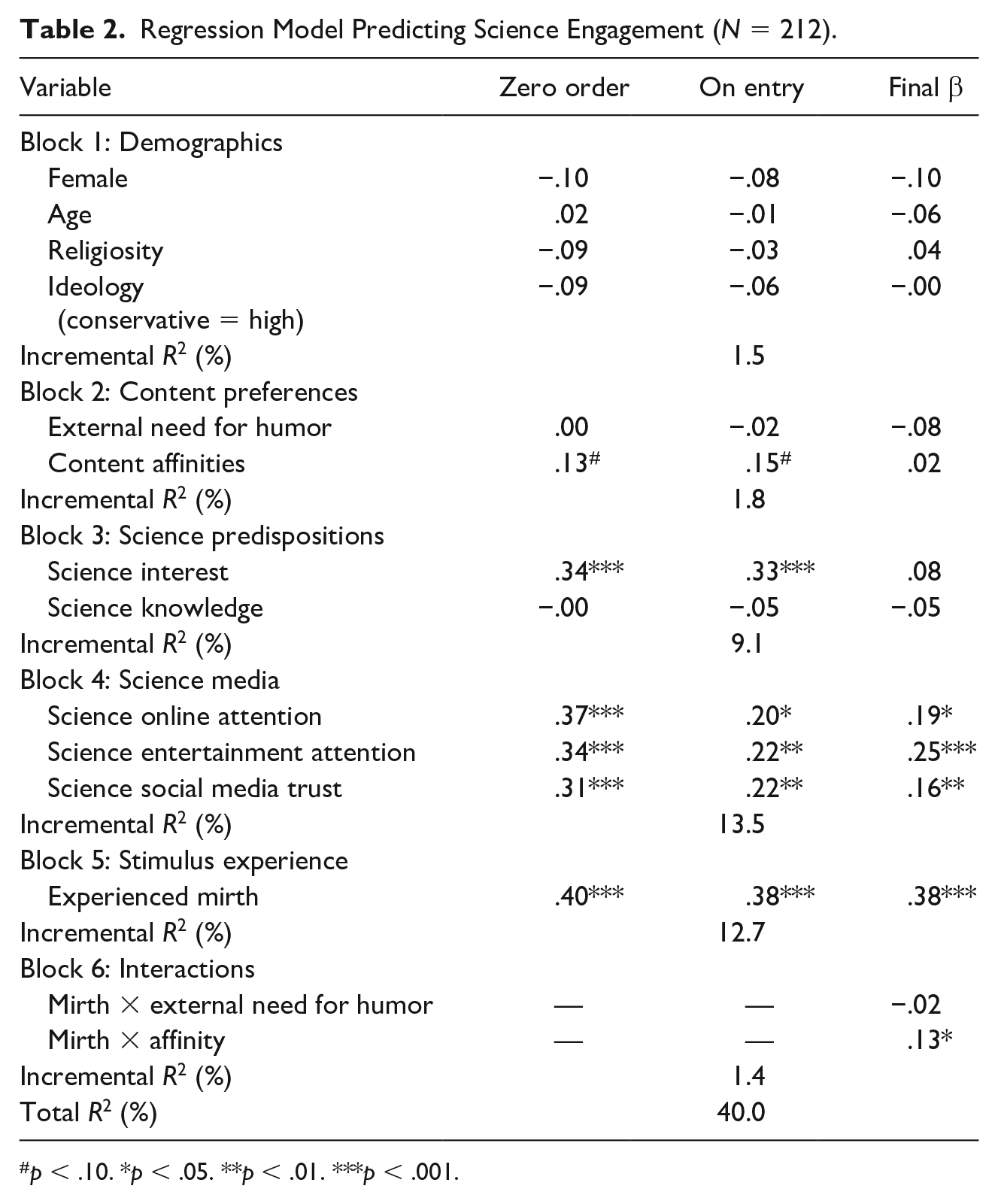
Table 2 displays the results for the analysis of science engagement. As the data in Table 2 show, demographics and content preferences explain a modest amount of the variance in science engagement (incremental R2 of 1.5% and 1.8%, respectively). Science predispositions explained an additional 9.1% of the variance, although none of the variables in that block were significant in the final regression model. Yet again, consumption of science media explains a significant amount of variation in the dependent variable (incremental R2 of 13.5%). Within the Science Media block, consumption of science news online (β = .19, p < .05), science entertainment (β = .25, p < .001), and trust in social media as a source for science information (β = .16, p < .01) are all significant, positive predictors of science engagement, offering support for H1b.
Regression Model Predicting Science Engagement (N = 212).
p < .10. *p < .05. **p < .01. ***p < .001.
Experienced mirth following exposure to the video was a significant predictor of science engagement (β = .38, p < .001) even after controlling for all other variables in the model. H3b was therefore supported. This block of the regression model explained an additional 12.7% of the variance in the dependent variable, while the block of interactions that followed accounted for an additional 1.4%. The full model explained a robust 40.0% of the variance in science engagement.
Outside of the main effects reported above, this analysis also explored how the mirth one experienced while viewing the stimulus materials might have interacted with a pair of items about one’s preferences for different types of humorous and scientific content. Across each of the two regressions we included a block with interactions between experienced mirth and each of the following: (1) external NFH and (2) content affinities. The results across the two regressions were nearly identical, with the interaction between mirth and content affinities emerging as significant in each case (H5a and H5b supported; lack of support for H4a and H4b). Figure 1 illustrates this interaction when content endorsement is the dependent variable of interest. As the figure shows, those scoring low on the content affinities measure have an increase in content endorsement as their experienced mirth increases; however, those scoring high on the content affinities measure have an even more pronounced increase in content endorsement as experienced mirth increases. A nearly identical pattern is present when this same interaction is tested with science engagement as the dependent variable (Figure 2).
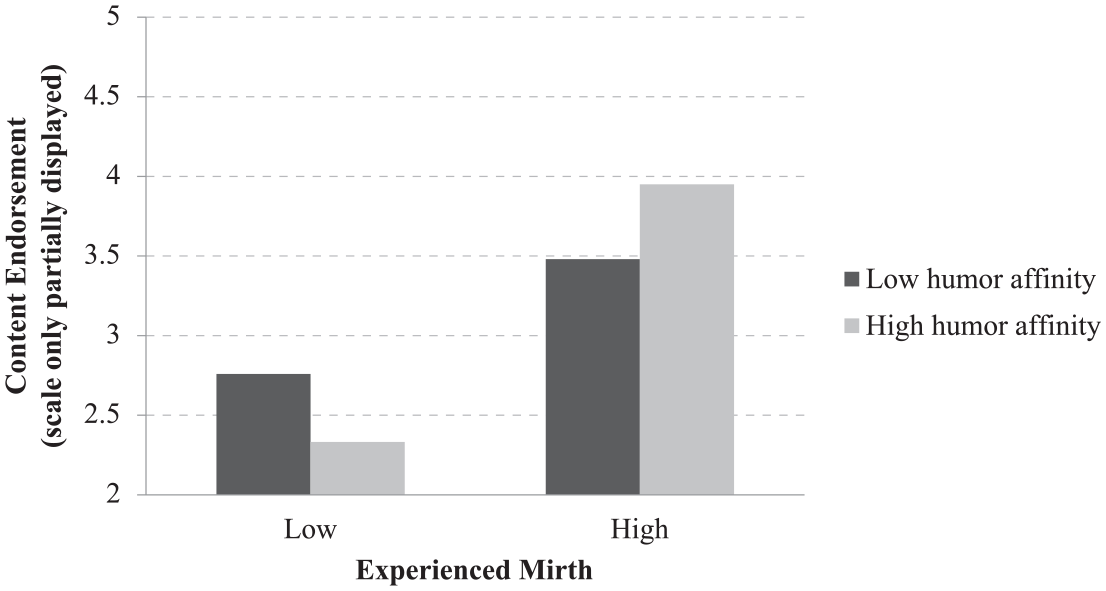
The interaction between content affinity and experienced mirth on content endorsement.
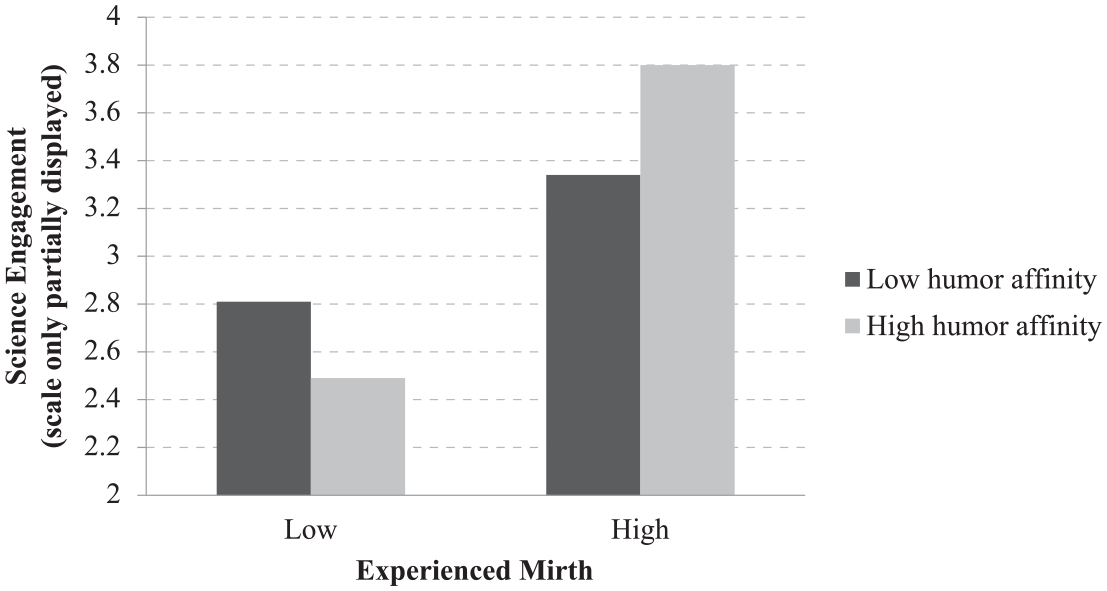
The interaction between content affinity and experienced mirth on science engagement.
Taken together the results of our analyses stress the importance of viewing the stimuli with the audience laughter on feelings of experienced mirth (H2 supported). In turn, mirth serves to positively affect both content endorsement (H3a) and science engagement (H3b), supporting the idea that the presence of the laughter acts as a social cue or contagion that encourages a positive reaction to the video content even if an individual subject does not find Vince Ebert’s jokes to be particularly funny. In effect, the crowd’s positive reaction to the comedy helps engender greater engagement with the content. Notably, the effect of the audience laughter is significant even after controlling for demographics, predispositions toward science, and importantly, science media consumption patterns.
Consumption of science media content—particularly content that is entertaining—is an important and significant factor driving both content endorsement (H1a) and science engagement (H1b). In the content endorsement analysis, consumption of science-based comedies and dramas was significant. In the science engagement analysis, consuming entertainment content was significant along with paying attention to science news online and trusting social media as a source of science information. In truth, the science comedy video with audience laughter may represent yet another piece of sharable science-based social media content, one that is both credible and entertaining. Overall, it seems abundantly clear that understanding the adjacent influence of science media preferences and consumption patterns needs to remain as an important part of the growing body of scholarship on engagement with science humor and entertainment content.
Discussion
This research set out to advance our understanding of the effects of science humor on two forms of audience engagement by testing the contagious effect of laughter as a relevant social cue. The results speak to the powerful impact that audience laughter and approval can have on both content-specific and broader forms of scientific engagement, and the value of considering a variety of forms of science comedy beyond politically oriented satire when looking for new ways to engage with public audiences (Osnes et al., 2019). In our particular case study, we found that seeing a scientist explain scientific concepts in the form of stand-up comedy can be even more impactful when those consuming the routine are helped along by audience laughter. While previous research has established that science and, in particular, scientists can be funny (Boykoff & Osnes, 2018), audience approval can serve to heighten such effects.
Before concluding, it is important to point out some limitations of the study. First, as noted above, we rely on an undergraduate student sample that was offered extra credit to participate. While a more representative population would have been ideal, it is worth noting that college-aged students have emerged as an especially important target population for science outreach campaigns focused on engagement (Eagan et al., 2011; Ramaley, 2005) and student samples are appropriate for the type of experimental work and theory-focused questions being examined here. Furthermore, our offer of extra credit may have served to compel the students in our sample to pay extra attention to the stimulus conditions and, indeed, the study as a whole. While it is impossible to know for certain how a more natural audience—one not motivated by extra credit—might have responded to the stimulus, there is at least some reason to believe that the findings reported here might be even more pronounced. That is, the presence of audience laughter may work even more strongly among those who are not explicitly told to view the content since the sound of laughter might trigger attention among those who are only passively experiencing the content—a trigger that would be lacking among those in the condition with no audience laughter. Of course, this is just speculation on our part and is something that is worthy of future empirical investigation.
Second, we rely on one set of experimental stimuli. While the only difference between the two clips is the presence or absence of the audience laughter, we understand that we are drawing conclusions based on a single case study. The comedian featured in the video, Vince Ebert, is from Germany. His accent may be less familiar to U.S. college students. He also focuses his routine on broad and largely uncontroversial science (i.e., science as a way of understanding the world) rather than any highly partisan scientific topics (e.g., the existence of climate change) that might offend or turn off some viewers. Future research should empirically test whether the findings outlined here replicate among different audiences using more controversial scientific topics.
Third, it is important to point out that our study was conducted online and focused on online content. While encountering science comedy on YouTube and other social media sites is certainly a natural behavior in our hybrid media environment, there are other ways to engage with science stand-up comedy that are in-person or more interactive. Finally, our dependent variables were measured largely with statements of hypothetical behaviors (i.e., agreement with statements like “I would ‘share’ the video with others” and it motivated me to “follow more scientists on social media”) rather than actual behaviors. While these types of measures are common in social science research focused on social media engagement, observing actual behaviors in the “real world” would have been preferred.
Despite these limitations, our research underscores the need to look deeper at the processes by which humor works to influence audience thinking and to better understand for whom humor is an appropriate outreach tool. First, and unsurprisingly, we found out that viewers who enjoy science entertainment content like comedies and dramas were more likely to report intentions to endorse the stand-up comedy and the broader world of science content online, while those who consume science information online and trust social media as a source of science information were similarly more likely to report broader engagement intentions.
More important, while there is a growing body of research focusing on the potential of humor as a tool for science communication, much of this work focuses on testing humorous versus nonhumorous content that will oftentimes vary in key attributes, including the person delivering the information and the persuasive quality of presented arguments. Our approach shifts the focus away from humorous versus nonhumorous comparisons and toward contextual factors that might attenuate or exacerbate humor effects. In doing so, we keep all aspects of the stimuli consistent across conditions, with the exception of our manipulated factor of audience laughter. Our results show that a small alteration to a humorous stand-up routine, specifically the inclusion or removal of audience laughter, influenced the mirth that audiences experienced. Furthermore, we found that science humor works best when subjects experience mirth or enjoy the content they are viewing, a reaction that can be tied to how others perceive the content. Whether through emotional contagion or a social cue that tells us something is funny, audience laughter serves to heighten the viewing experience leading to stronger intentions to endorse the content and engage with science more broadly.
Science humor is particularly impactful for those who already express a strong affinity for science content that is funny, enjoyable, and entertaining, and shares their point of view. As the results show, these high-affinity individuals were more likely to report engagement intentions with the video content given a satisfying viewing experience, or one that led to an expression of mirth. Before concluding, it is important to consider the question as to whether there might be a risk of audiences disengaging should they be exposed to content that fails to meet, or possibly violates, their expectations. For instance, might there be boomerang or backfire effects when providing serious science content in a comedic package to those with a low affinity for humor or, conversely, providing science content in serious terms to those with a high affinity for humor? While our work cannot definitively answer this question, given that both our conditions involved the same humorous stand-up routine, we are quite confident in stating that there are no obvious drawbacks to the inclusion of audience laughter when packaging humorous scientific content. Regardless of one’s affinity for humorous content, encountering laughter within the stand-up routine served to heighten experienced mirth. In turn, mirth was associated with higher scores on our endorsement and engagement measures. It is worth noting, however, that our experimental manipulation relied on actual audience laughter that was removed for some participants, rather than on the addition of a laugh track, which might be criticized as sounding artificial. Perhaps backfire effects would be more likely in a situation where audiences think the laughter is being used as a gimmick to enhance the appeal of the content.
In sum, training scientists to engage more successfully with humor and to create content that leads to an experience of mirth for general audiences is a valuable endeavor. While we chose to focus on mirth in our study, future research could consider other variables of interest, including different affective responses to humor that go beyond simple enjoyment. Altering the presence or absence of audience laughter was an easy and subtle manipulation in this particular experiment; however, it is not the only means by which even a factor like laugher might be tested. For example, we might test the effects of laugh-track laughter versus actual audience laughter. We could also manipulate the number of cuts within a video that show audience members laughing, the duration of time spent on such cuts, or the intensity of that laughter. Future research might also investigate differential reactions to science humor featuring male versus female comedians or humor that tackles more controversial or politically “hard” scientific issues (Carmines & Stimson, 1980). Existing research suggests that audiences respond well to humor about such controversial issues but that research is almost exclusively among friendly audiences who are already laughing (e.g., late-night television). What happens to laughter with controversial topics among tough audiences? And can laughter diffuse tensions enough to draw in new audiences? With previous research having established the potential for humor to positively affect audience engagement around science, we look forward to future work that expands on the contextual factors that might influence this potential.
Footnotes
Declaration of Conflicting Interests
The author(s) declared no potential conflicts of interest with respect to the research, authorship, and/or publication of this article.
Funding
The author(s) received no financial support for the research, authorship, and/or publication of this article.
