







Abstract
Although humor is a recommended strategy for scientists to connect with publics, there is a lack of empirical evidence concerning its effectiveness. We conduct an experiment to test how funny science on Twitter affects engagement intentions. We find that different humor types caused viewers to experience different levels of mirth, which mediated the relationship between our experimental manipulation and engagement intentions. We also find need for humor, an individual trait, to moderate the relationship between mirth and engagement intentions. These findings extend our understanding of humor in science communication and offer empirical evidence on which practical advice can be grounded.
Public engagement with science is integral to collective decision making in the governance of science in democratic societies, which is a normative assumption shared by many science communication scholars (Stilgoe et al., 2014). Importantly, engagement in settings outside of formal education environments, such as social media, is one way to increase public understanding of science (Falk & Dierking, 2010). Yet, there is a dearth of empirical evidence for how to effectively communicate science online to engage broad audiences.
As one possible strategy for increasing engagement, humor has been employed in science communication in several forms (e.g., a “Science Comedy Night” put on by members of the American Association for the Advancement of Science) and has been recommended by scholars who view it as an effective strategic tool for scientists to connect with publics (Baram-Tsabari & Lewenstein, 2013; Goodwin & Dahlstrom, 2014). To date, however, there is a paucity of empirical evidence that points to whether the use of humor is an effective strategy for engaging audiences with scientific information. Here, we conduct an experiment designed to test how funny science content on social media, curated and edited from actual Twitter posts, affects engagement intentions. Further, we examine how an individual trait, need for humor (NFH), might moderate the relationships between funny science and people’s intentions to engage with the content.
In addition to empirically studying humor as a strategy for science communication, we aim to extend research on social media engagement in the context of science. Thus, we follow the recommendations of a recent National Academies of Sciences, Engineering, and Medicine report (2017) that challenges researchers to use experimental methods that simulate “real-world communication environments” (p. 9) to test humor as an effective approach for communicating science on social media. Specifically, we report the results of an experiment designed to examine the extent to which humor in a science message on the microblogging platform, Twitter, is related to users’ engagement intentions. Although our experiment also involved manipulating the social media metrics associated with tweets, this study focused on the humor aspect of our experiment, not the social norms offered by likes and retweets associated with a post. Accordingly, our review of the literature focuses on social media engagement, the persuasive effects of humor on behavioral intentions, and NFH, which has been studied primarily in the context of advertising (Cline et al., 2003; Cline & Kellaris, 1999; Picard & Blanc, 2013), as a moderator of the relationship between humor and engagement intentions.
Social Media Engagement
In recent years, social media have become prominent channels for scientific information dissemination and exchange. This is due partly to opportunities afforded by the platforms; unique actionable features of social media enable users to have more interactive experiences. Social media are innately interactive, allowing and encouraging two-way communication (Su et al., 2017). Contrary to conventional top-down approaches, communicators can craft strategic messages to engage directly with various publics.
Although scholars’ conceptualization of engagement on social media has encompassed various elements, it highlights key roles of interactive features (e.g., likes and shares; Alhabash & McAlister, 2015; Kim, 2018). Consistent with the theorization of user-to-user interactivity (Chung, 2007), the academic definition of social media engagement has focused on analyzing interactive behaviors on social platforms. One commonly assessed engagement behavior involves affective expressions such as “liking” a Facebook or Instagram post or “favoriting” a Twitter message (Alhabash & McAlister, 2015). Such affective evaluation is visible to other users, allowing for interpersonal interactivity, and explicitly shows attitudinal judgment toward online information.
Another engagement behavior focuses on active information forwarding and exchange among users’ social networks either on- or offline (Alhabash & McAlister, 2015; Kim, 2018). Such behavior emphasizes the efficiency of the spread of online messages, that is, how likely the information may reach broad audiences. For example, users can repost others’ tweets, known as “retweeting,” or e-mail a Facebook post to others to allow other users to easily access content while enabling quick propagation of such information. Both types of engagement behaviors entail user-to-user communication and reflect “the sophistication of interactivity on social media” (Alhabash & McAlister, 2015, p. 1318).
Even though each type of engagement behavior focuses on a different aspect of user interactivity, the accumulated user engagement represented by social media metrics may collectively be used as a measure of message virality (Alhabash & McAlister, 2015). Such indicators may trigger social normative heuristics (Kim, 2018; Spartz et al., 2017; Sundar, 2008), influence how users form normative perceptions (Lee and Su, 2020), and shape behavioral outcomes toward messages (Alhabash & McAlister, 2015). As a result, in the present study, we conceptualize engagement as a behavioral intention at an aggregate level that includes liking, sharing, and reposting content on social media. With this in mind, we examine how message characteristics, specifically humor, embedded in social media messages may shape a user’s engagement intentions with science content.
Operationalizing Humor
Identification of humor types is generally considered the first step to studying audiences’ perceptions of humor (McCullough, 1993). There are many types of humor in the extant literature; a content analysis of over 300 humorous television commercials identified 7 categories into which humor types cluster (Buijzen & Valkenburg, 2004). These categories are slapstick, surprise, irony, clownish humor, satire, misunderstanding, and parody. Others have identified 11 forms of humor: irony, satire, sarcasm, over- and understatement, self-deprecation, teasing, replies to rhetorical questions, clever replies to serious statements, double entendre, transformations of well-known sayings, and parody (Martin, 2010).
These typologies of humor are based on three prominent theories in humor studies: relief, superiority or disparagement, and incongruity theories. Briefly, relief theories posit that laughter is the result of the release of tension; theories in this vein are predicated on Freud’s (1960) work on sexual and aggressive themes in humor. Superiority theories are rooted in expressions of aggression with every humorous situation consisting of a winner and loser (Gruner, 1976, 1997). Last, incongruity theories emphasize surprise and irony of humorous content; perceived incongruity is a crucial factor in whether something is perceived as funny. Scholars, especially those researching the communicative effects of humor, have primarily used incongruity theories in the last two decades as they focus more on the cognitive and perceptual aspects of humor relative to relief and superiority theories. We follow this tradition, aligning our work on humor in science with incongruity theories.
Drawing on previous classifications of humor (Buijzen & Valkenburg, 2004; Martin, 2010), we first conducted a preliminary content analysis of science humor on social media, specifically focused on Instagram and Twitter, between July 1, 2016, and June 30, 2017. Using a carefully constructed keyword search, we sampled 1,200 Twitter and Instagram posts about science humor and three coders categorized the relevancy and types of humor present in the posts. We found six categories to be most relevant to humor in science content: slapstick (Krippendorff’s alpha [KA] = .74), anthropomorphism (KA = .72), clownish humor (KA = .74), wordplay (primarily puns; KA = .76), satire or sarcasm (KA = .69), and parody (KA = .71). Results of this content analysis are presented elsewhere (McKasy et al., 2019). Wordplay, satire, and anthropomorphic humor were the most prevalent humor types in the sample, but for issues of practicality, we focus the present study on a single science joke that uses only wordplay and anthropomorphism, a point to which we will return in the discussion of our findings.
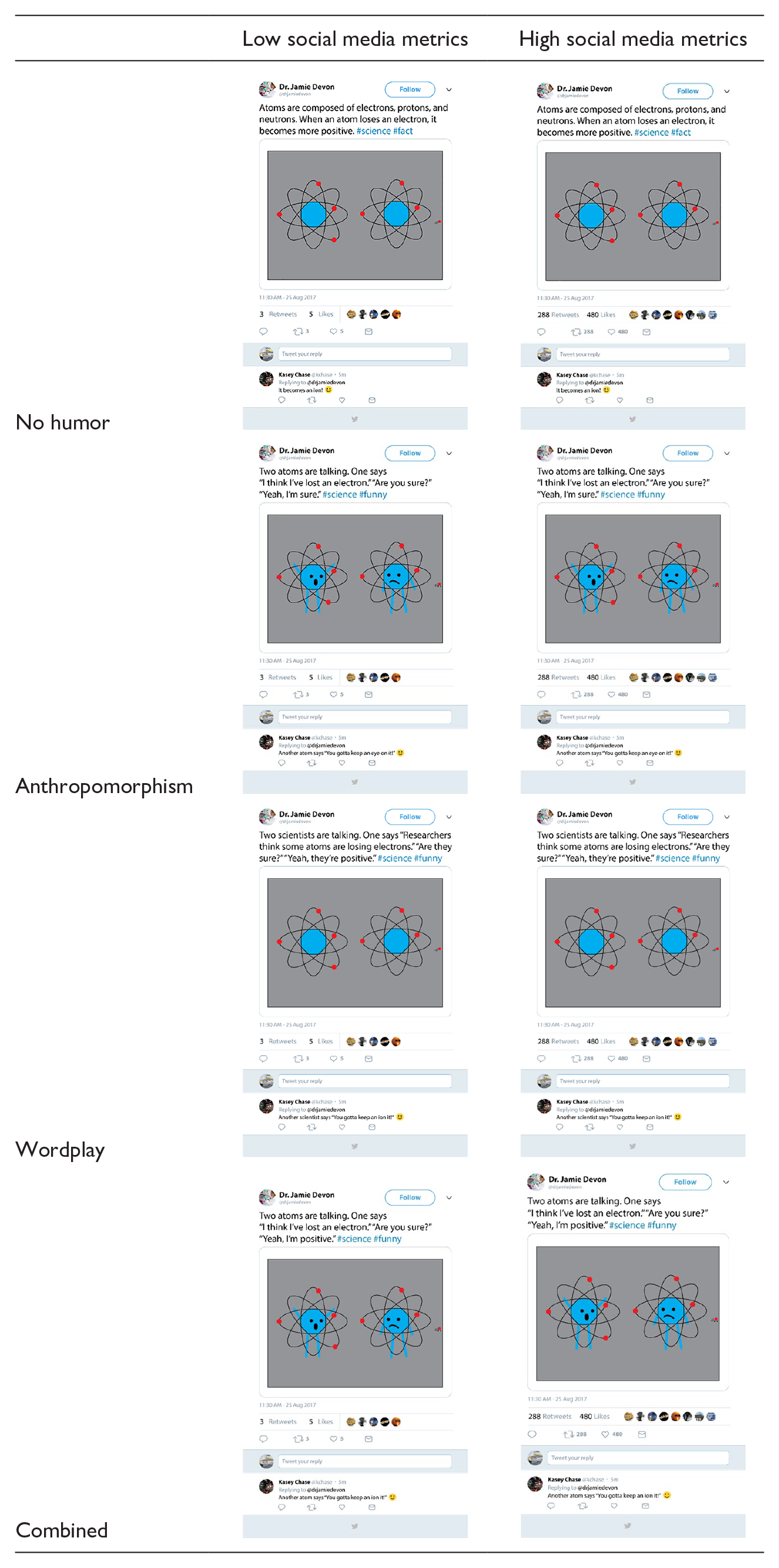
Wordplay is defined as the humorous use of words that evoke second meanings (Berger, 1976). It can involve playing with meanings of words or words that have different meanings but are pronounced similarly. Anthropomorphic humor, on the other hand, is defined as the attribution of human characteristics to animals or objects that lack human qualities (Buijzen & Valkenburg, 2004). The science joke used in our experiment deploys both these humor types (see the appendix for stimulus materials). Wordplay is deployed in the joke in the form of a pun, playing on the meaning of the word “positive” and scientific elements in the joke, atoms, are anthropomorphized by the addition of faces, arms, and legs. To examine the impacts of these different types of humor, we first establish that a science message designed to be funny, relative to one constructed to be nonhumorous, causes viewers to experience humor, or mirth.
Many studies focus on examining the effects of the presence of humor (e.g., Futerfas & Nan, 2017; Nabi, 2016). Yet, few have examined how different types of humor affect persuasive outcomes. Therefore, before examining the persuasive impacts of humor types, we investigate whether different types of humor in science content produce different levels of mirth among viewers.
Research Question 1: Do different types of humor (anthropomorphism, wordplay, and combined) present in a science message on Twitter influence perceived humor, or mirth, among viewers?
Humor is in the eye of the beholder. This results in an important methodological consideration for our experiment in which a message variation is related to a dependent variable through a hypothesized explanatory mechanism involving a mediating psychological state. Specifically, O’Keefe (2003) refers to this type of research claim as a Class III claim. Although we manipulate the humor type present in the experimental stimuli, to focus solely on the separate conditions as the independent variable that directly predicts the outcome would treat all respondents exposed to a particular condition as similar, despite differences in the amount of humor they might perceive (Duncan & Nelson, 1985). In other words, individuals respond to the same humorous message in different ways and these differences are not accounted for without perceived humor as a mediating variable. To overcome this, we use mirth as a mediating variable. Our subsequent hypotheses focus on how mirth, which results from the experimental manipulations of humor type, is related to the dependent variable of interest.
Persuasive Effects of Humor
Investigations of humor as a communication tactic have been conducted primarily in the context of advertising and entertainment. Research on advertising professionals shows they commonly assume that humor has a positive influence on ad-related outcomes (Madden & Weinberger, 1982). As a result of this intuitive assumption, humor is often used in advertising. Similarly, the use of humor has been recommended for science communication practitioners and professionals (Baram-Tsabari & Lewenstein, 2013; Goodwin & Dahlstrom, 2014). However, such well-intentioned, intuitive advice currently lacks strong empirical foundation. Extant research on humor shows it can have positive effects on attentiveness to and recall of messages (Blanc & Brigaud, 2014), affect evoked by messages, and likability (Wanzer et al., 1996). However, the persuasive effect of humor is far from consistent. A recent meta-analytic study finds that humor has the potential to enhance persuasive effects but there is little certainty about the extent to which these findings hold in different contexts (Eisend, 2011).
More recently, scholars have examined the role of humor in health communication. This body of work evidences that humor acts as a motivator of health-related behaviors (e.g., Futerfas & Nan, 2017; Moyer-Gusé et al., 2011; Moyer-Gusé et al., 2018; Nabi, 2016). In experiments designed to elucidate the effect of humor on intentions to engage in cancer self-examination, Nabi (2016) found that humor reduced anxiety, which was subsequently associated with more positive attitudes toward self-exams. More positive attitudes toward self-exams, in turn, increased intentions to engage in preventative behaviors. Other work finds humor to have differential effects on safe-sex behavioral intentions among men and women. One study found that the use of humor decreased perceptions of severity of the consequences of unintended pregnancy among men, which led to increased intentions to engage in unprotected sex (Moyer-Gusé et al., 2011). Another reports that funny narratives increased perceived severity of consequences among women and decreased intentions to engage in unprotected sex among women (Futerfas & Nan, 2017). In addition, humor has been found to increase positive affect toward an alcohol public service announcement, which increased perceived credibility of the source and decreased reactance to the message (Skalski et al., 2009).
Although studies have extended humor research from advertising to health communication, few have been conducted in the context of science. Much like the literature on humor and persuasion in political communication (Becker, 2014; e.g., Holbert et al., 2011; Landreville et al., 2010; Young, 2008), studies in science communication have focused on a single type of humor, sarcasm. A recent study compared the persuasive effects of fear and humor appeals in a climate change message (Skurka et al., 2018). Videos about climate change with either a humor or fear appeal were found to be equally effective in promoting intentions to engage in climate activism. The humorous video used irony and consisted of a weatherman incredulously describing and wondering about the causes of extreme weather events attributable to anthropogenic climate change. In an examination of climate change coverage on The Daily Show and The Colbert Report, Brewer and McKnight (2015) found that watching these satirical programs can shape people’s perceptions of climate change and that biased ideological processing can occur, though this was only the case in respondents who watched The Colbert Report. Yet another study on climate change found that one-sided messages that use sarcasm to disparage people who believe climate change is a hoax increased risk perceptions of viewers (Anderson & Becker, 2018).
This body of work offers heartening evidence that humor can be effective in science communication. Yet, it does not examine the persuasive effect of humor on engagement intentions in the online media environment in which people are likely to encounter such information. Moreover, in experiments, the humorous versus non-humorous message conditions often involve considerable variation in message characteristics between conditions. This common methodological challenge is faced by researchers interested in elucidating the role of humor in persuasion and, indeed, in persuasion research more broadly (Markiewicz, 1974). Recent calls in the area of framing have highlighted the need for the testing of equivalent messages (Cacciatore et al., 2016). Messages, of course, are unlikely to be wholly identical when humor is manipulated but we sought to make the experimental conditions in the present study as equivalent as possible.
Even though humor use in traditional forms of media has been relatively well studied, particularly in advertising, the digital media realm is still ripe for exploration (Shifman & Blondheim, 2010). Indeed, the majority of Americans now turn to the Internet to seek information about science (National Science Board, 2018). Increasingly, younger audiences go online for information (Su et al., 2015). And, they are seeking humorous sources of news (Feldman, 2007). Whereas recent work has found that humorous Facebook news posts have positive consequences for political participation by increasing message elaboration (Matthes & Heiss, 2019), studies of humor on social media engagement intentions are nascent. Here, we examine the persuasive effects of humor on a science message posted on Twitter. Given the evidence, though equivocal, leans toward humor motivating behavioral intentions, we posit a positive relationship between those who experience or perceive more humor and their behavioral intentions. In the context of the present work, we offer the following hypothesis:
Taken together, Hypothesis 1 and Hypothesis 2 posit a mediation model in which the variation of humor types in a science message impacts experienced mirth, which is associated with users’ intentions to engage with the Twitter conversation. Thus, we propose:
The Moderating Role of Need for Humor
Psychological events, such as those that occur when humorous messages have persuasive effects, happen in the context of the so-called life space (Lewin, 1951), which consists of two types of independent phenomena: (a) the individual traits of a person and (b) their environment or context. As a result, psychological events and their effects are not determined solely by individual traits or context alone; instead, they result from the interaction of the two. In the present case, the environment consists of humorous messages about science on social media and one relevant individual characteristic is one’s tendency toward humor, or NFH.
NFH is a construct derived from individuals’ need for levity (Cline et al., 1999; 2003; 2011). The label “need for” is intended to be consistent with other similar trait measures (e.g., need for cognition; Cacioppo & Petty, 1982, 1984) and conveys the motivational tendency of the trait (Cline et al., 2011). The broader construct, need for levity, represents “an individual’s desire to experience both the humorous and whimsical traits found in self and others” and describes a tendency to engage in or create levity (Cline et al., 2011, p. 20). This personality trait has four dimensions: (a) internal humor (the need to be the source of humor), (b) external humor (the need to experience humor from others), (c) internal whimsy (the need to act whimsically or spontaneously), and (d) external whimsy (the need to experience whimsy from others).
In subsequent research, this four-dimension measure was revised to include only the humor dimensions, hence the subscale known as NFH (Cline et al., 2003). Given that our outcome variable of interest is intentions to engage (e.g., share, retweet) with a science message on Twitter, we are primarily interested in the subscale, NFH, that is, respondents’ inclination to generate or be the source of humor and to experience humor from others. Therefore, in line with Cline et al. (2003), we conceptualize NFH as the two humor dimensions of the broader need for levity construct.
Scholars have found NFH to play moderating roles in humor studies. In a series of studies using print advertisements, only the attitudes of individuals with relatively higher NFH were influenced by humor (Cline et al., 2003). Thus, we expect individual NFH to moderate the relationship between mirth experienced from exposure to a humorous message and behavioral intentions. In the context of our experiment, we propose the following:
Method
Data were obtained through an experiment embedded in an online survey using opt-in panels from Qualtrics (2014), which randomly selects respondents from its online market research panel partners. The survey was fielded in October 2018. We used a quota sample that matched the 2013 U.S. Census American Community Survey in terms of age, gender, and geographic region. Individuals were notified via panel real-time software, e-mail, or text messaging, and invited to participate in the survey for incentives. A response rate cannot be calculated as we do not know how many individuals were invited to participate. This is a result of using Qualtrics’ real-time software in addition to e-mail or text invitations.
Experimental Design
The experiment employed a 4 (humor types) × 2 (social media metrics) between-subjects design (Shadish et al., 2002). Participants were randomly exposed to one of eight screenshots of a conversation on Twitter about science (see the appendix for stimuli). In all conditions, the Twitter conversation was started by a fictional scientist, Dr. Jamie Devon. The original post of the conversation was adapted from a common science joke on the Internet about atoms losing electrons that included text and an illustration, which reinforced the humor manipulation (Lee & Mason, 1999). Additionally, each condition included one response to the original post by a fictional user, Kasey Chase. This response was designed to strengthen the experimental manipulation and was consistent with the humor type condition. Gender-neutral names were used to avoid any confounding effects of source gender on the outcome variables of interest.
The four humor type conditions were no humor, anthropomorphism, wordplay, and combined (anthropomorphism and wordplay). In the no humor condition, the text of the post was altered to a science fact that was consistent with the joke. We also changed the hashtag in the no humor condition to “#science #fact” instead of “#science #funny.” In all conditions, we strived to keep the number of words in the post consistent (between 18 and 20 words not including hashtags). The humor was manipulated in the text and image of the Twitter post. Social media metrics were manipulated by changing the number of retweets and likes associated with the original tweet. In the low social media metrics condition, the original post had three retweets and five likes; the post in the high social media metrics condition had 288 retweets and 480 likes. As we were not focused on the effects of the social media metrics manipulation in this study, we controlled for this by including a dummy variable in our analysis with the high metrics condition coded high.
Before exposure to the experiment, participants responded to questions intended to tap individual characteristics (e.g., NFH, media use). Following exposure, respondents were asked questions designed to assess perceived humor elicited by the Twitter conversation as well as their intentions to engage with it.
Measures
The dependent variable, intentions to engage with the Twitter conversation, was created by averaging five items asking respondents how much they agree or disagree with the following statements on a 7-point Likert-type scale (1 = strongly disagree, 7 = strongly agree): “The Twitter conversation is worth sharing with others,” “I would recommend the Twitter conversation to others,” “I would ‘like’ the Twitter conversation,” “I would ‘retweet’ the Twitter conversation,” and “I would ‘share’ the Twitter conversation” (Cronbach’s α = .96, M = 4.12, SD = 2.05).
Humor type was a nominal variable with four categories: no humor, anthropomorphism, wordplay, and the combined (anthropomorphism and wordplay) humor condition.
We operationalized mirth by asking respondents to indicate how they would describe the Twitter conversation on five, 7-point semantic differential scales (not humorous-humorous, not funny-funny, not playful-playful, not amusing-amusing, not entertaining-entertaining). We averaged these items to create an index (Cronbach’s α = .94, M = 4.49, SD = 1.89).
NFH (Cline et al., 1999; 2003; Crawford & Gregory, 2008; Picard & Blanc, 2013) was an averaged index of eight items, three tapping external NFH and five measuring internal NFH (Cronbach’s α = .91, M = 5.09, SD = 1.34). To capture internal NFH, we asked respondents the extent to which they agreed with the following statements (1 = strongly disagree, 7 = strongly agree): “I am good at thinking-up jokes or funny stories,” “People expect me to say amusing things,” “I can crack people up with the things I say,” “I often come up with witty comments,” and “People tell me that I am quick-witted.” External NFH was measured by asking respondents, on the same 7-point Likert-type scale, the extent to which they agreed with the following three statements: “I like a good joke,” “I appreciated those who generate humor,” and “I enjoy being with people who tell jokes or funny stories.”
Data Analysis
Data analysis was conducted using IBM SPSS Statistics. Given our sample size, we opted to guard against Type I error by setting a more stringent level of significance (α = .01). We addressed Hypothesis 1 and Research Question 1 using analysis of covariance, controlling for the social media metrics manipulation. To address our remaining hypotheses, we used ordinary least squares regressions via the computational add-on, PROCESS 3.0 (https://www.processmacro.org; Hayes & Matthes, 2009; Hayes & Preacher, 2014; Preacher et al., 2007). We used Model 14 of the PROCESS macro for our estimation and specified that our predictor is a nominal variable with more than one category (Figure 1). Since the independent variable is multicategorical, we use the term relative when discussing direct and indirect effects 1 to describe our results as a function of how the humor manipulation variable is coded (for more information on mediation analysis with multicategorical independent variables, see Hayes & Preacher, 2014). Percentile bootstrap confidence intervals were estimated using 10,000 bootstrap samples.
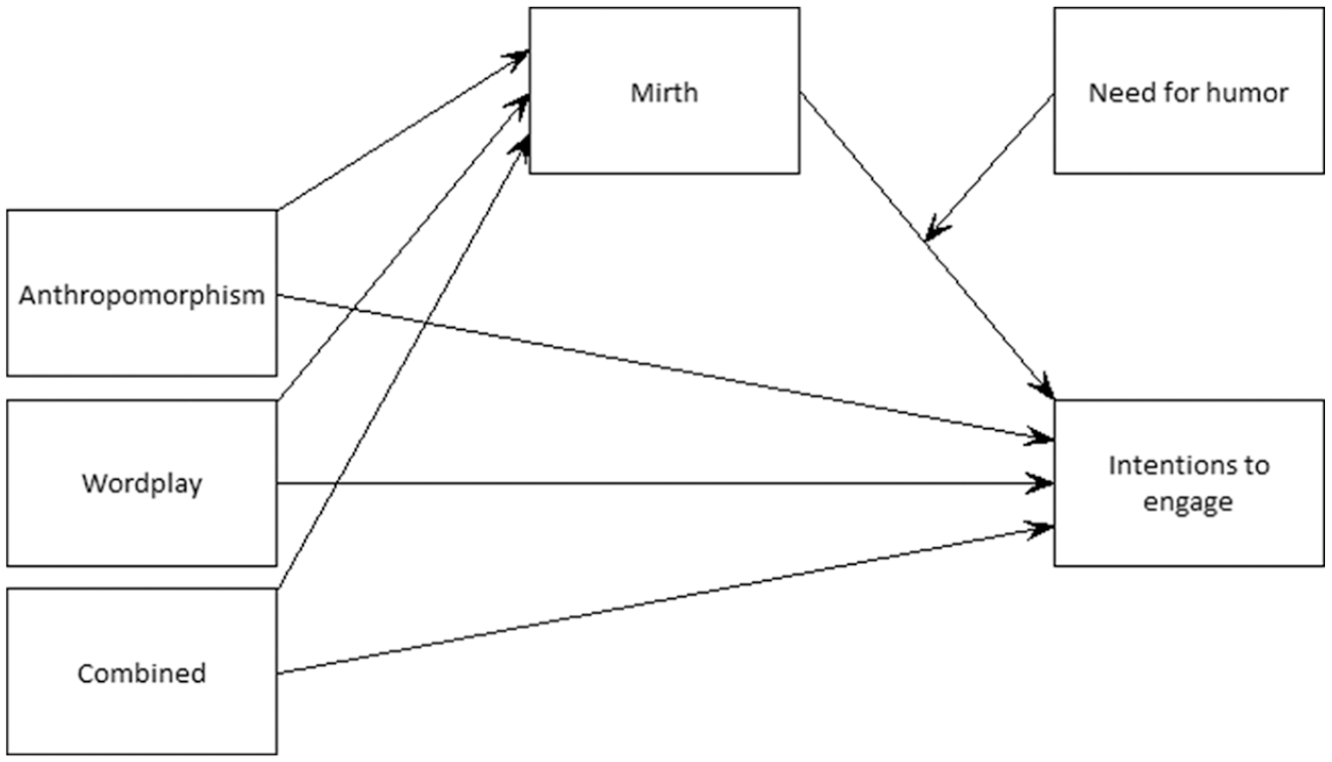
The estimated PROCESS model (Model 14) with nominal independent variable, humor type.
Results
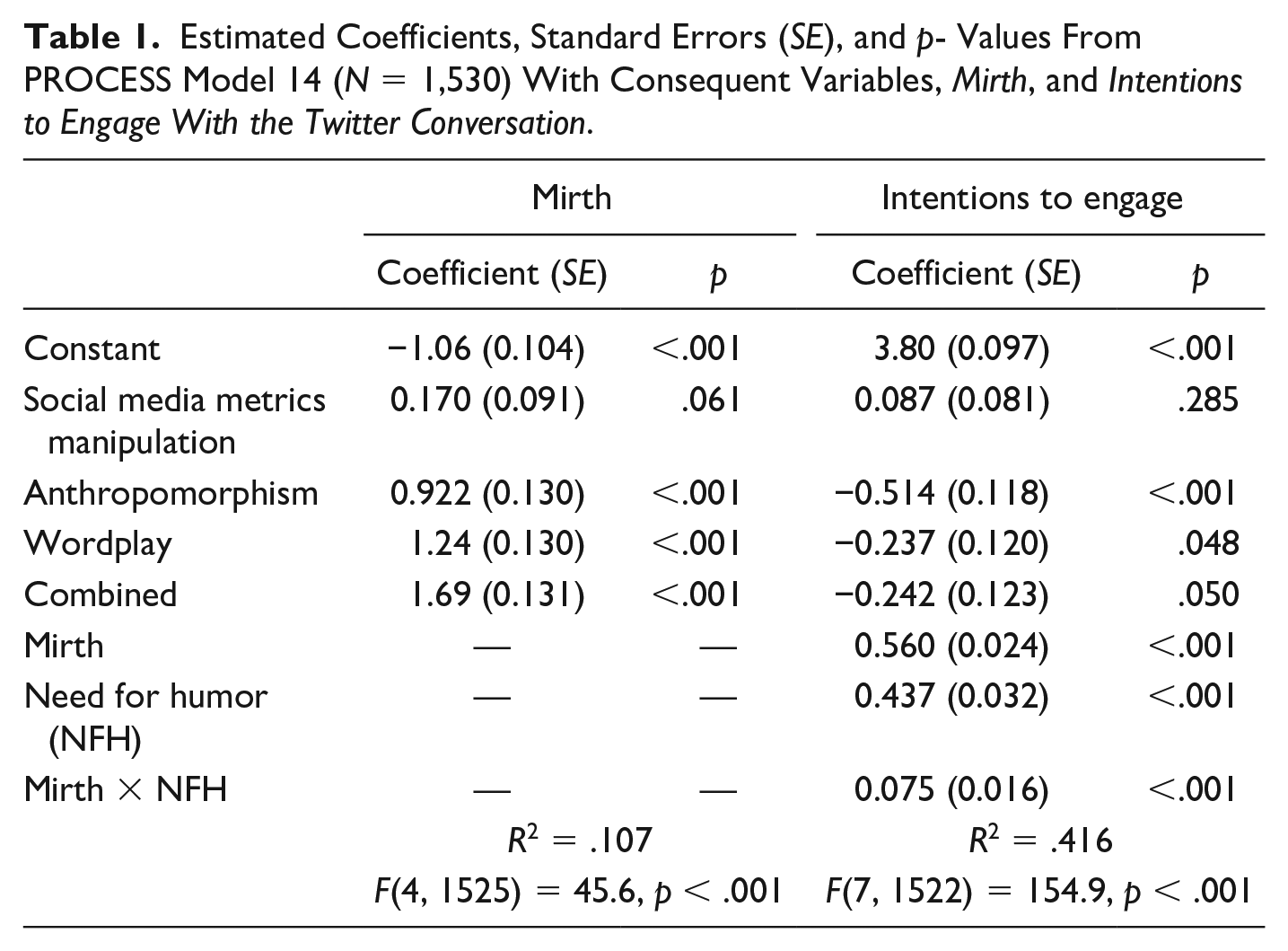
We found that the humor types, relative to no humor (Hypothesis 1a-Hypothesis 1c), caused respondents to experience greater mirth (Table 1). Using analysis of covariance, we found a significant effect of humor type on mirth (Research Question 1) after controlling for manipulation of the social media metrics in the Twitter conversation, 2 F(3, 1525) = 59.7, p < .001, partial η2 = .105. Respondents in the no humor condition reported the lowest levels of mirth, followed by those who viewed only anthropomorphic humor or wordplay. Respondents who viewed the combined condition experienced the most mirth. Pairwise comparisons revealed significant differences across all conditions except between those who viewed the anthropomorphism- and wordplay-only conditions (Figure 2).
Estimated Coefficients, Standard Errors (SE), and p- Values From PROCESS Model 14 (N = 1,530) With Consequent Variables, Mirth, and Intentions to Engage With the Twitter Conversation.
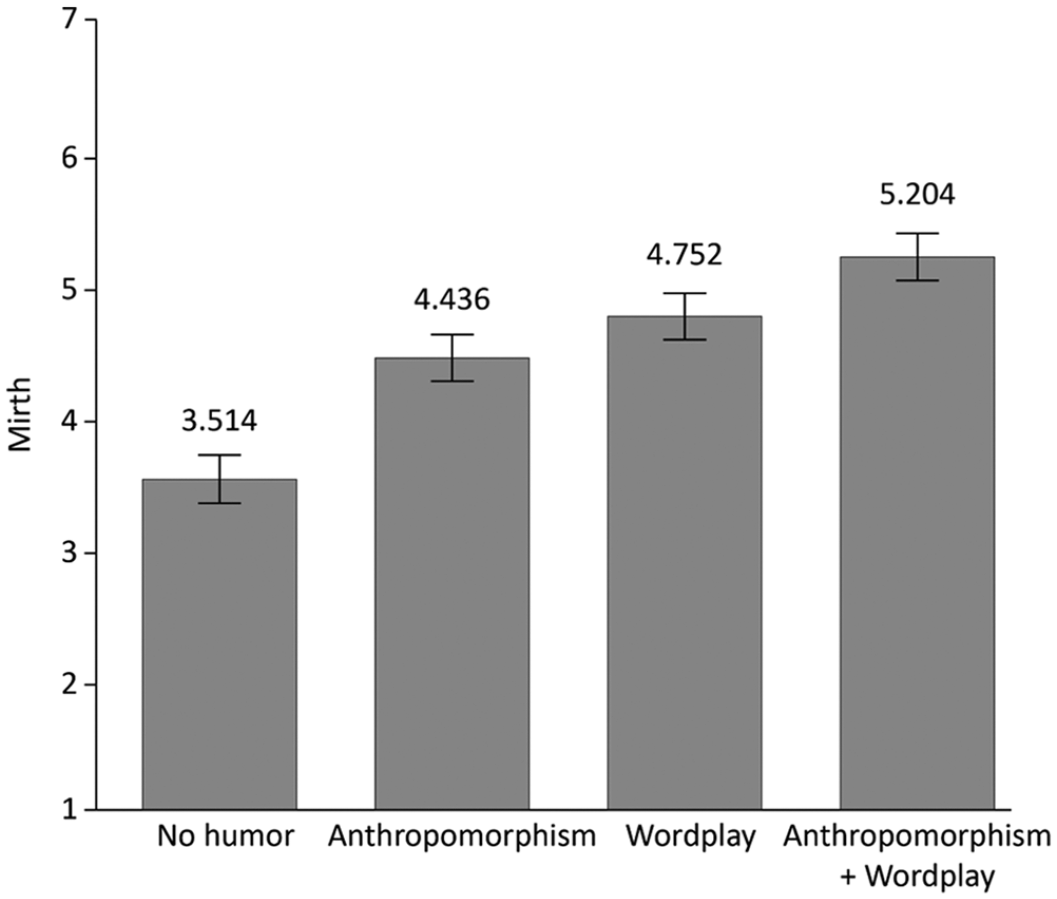
Mean and standard deviation of mirth among respondents in the experimental conditions (N = 1,530).
Regarding Hypothesis 2, we find a significant, positive relationship between mirth and intentions to engage (Table 1; Β = 0.560, standard error [SE] = 0.024, p < .001). We also find mirth to be a significant mediator in the relationship between our experimental manipulation of humor and outcome variable (Hypothesis 3). Moreover, NFH was a significant moderator of the path between mirth and the outcome variable (Hypothesis 4; Β = 0.075, SE = 0.016, p < .001). As hypothesized, among respondents with high NFH, those who experienced more humor as a result of the experimental stimulus also reported greater engagement intentions (Figure 3). Using 10,000 bootstrap samples, we estimated indexes of moderated mediation for the conditional pathways between each experimental condition and engagement intentions. The index of moderated mediation for the anthropomorphism, wordplay, and combined conditions were .069 (SE = 0.018, confidence interval, CI [0.038, 0.106]), .093 (SE = 0.022, CI [0.053, 0.138]), and .127 (SE = 0.028, CI [0.074, 0.184]), respectively.
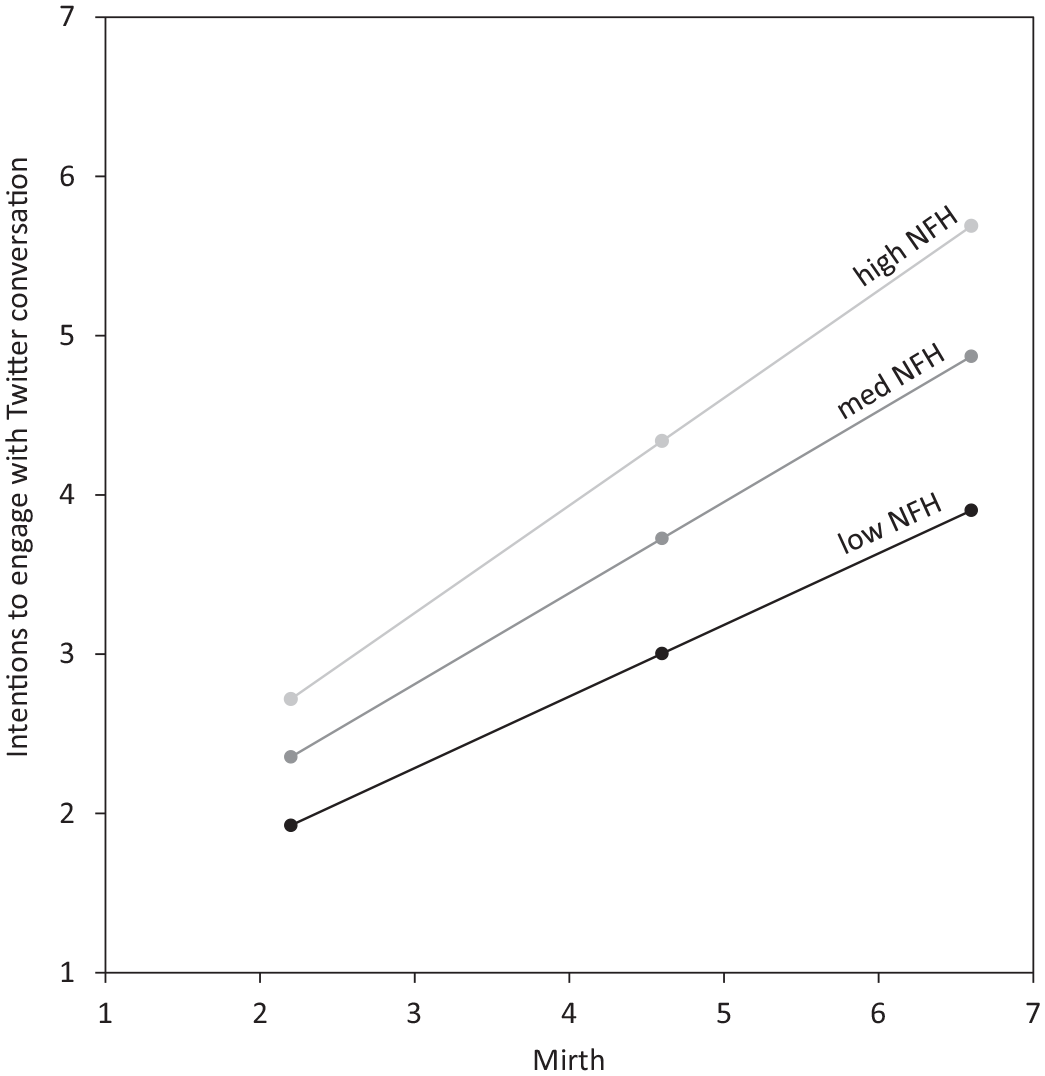
Moderating effect of need for humor (NFH) on the relationship between mirth and intentions to engage with the Twitter conversation (N = 1,530).
The relative conditional indirect pathways between the experimental conditions on intentions to engage with the Twitter conversation are shown in Table 2. That the confidence intervals do not include zero indicates that the conditional indirect effects are significant.
Relative Conditional Indirect Pathways of Humor Type, Moderated by Need for Humor (NFH) on Intentions to Engage With the Twitter Conversation.
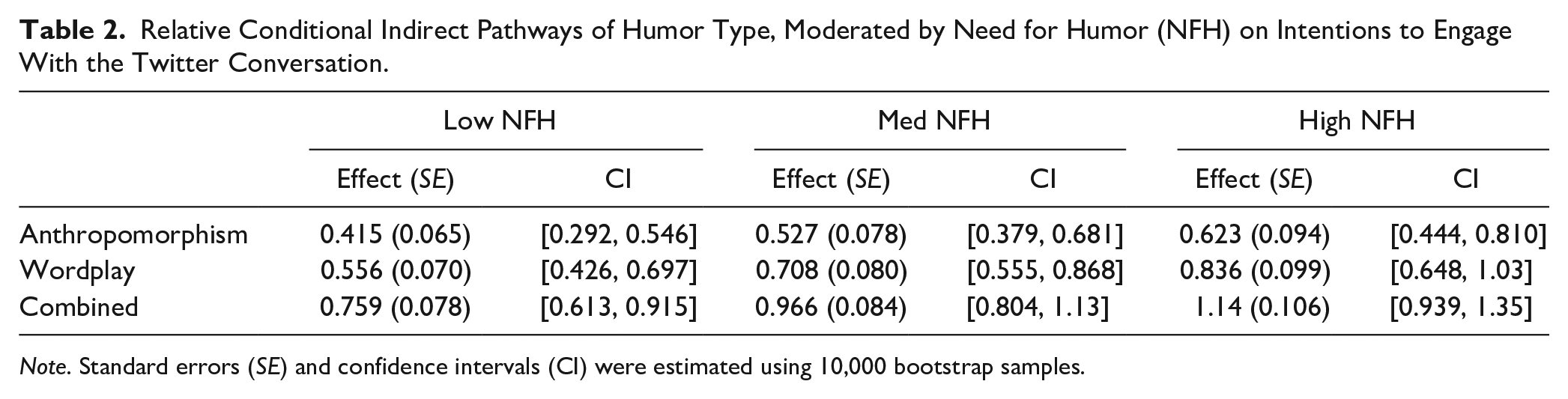
Note. Standard errors (SE) and confidence intervals (CI) were estimated using 10,000 bootstrap samples.
It is worth noting that the results of our PROCESS model show significant and negative relative direct pathways between the anthropomorphism (Β = −0.514, SE = 0.118, p < .001), wordplay (Β = −0.237, SE = 0.120, p = .048), and combined (Β = −0.242, SE = 0.123, p = .050) conditions, and engagement intentions. To determine the relative total effect, we regressed intentions to engage on humor types while controlling for the social media metrics manipulation and NFH (Hayes, 2017). The relative total effect of the anthropomorphism condition on engagement intentions was .0002 (SE = 0.136, p = .999); the anthropomorphism condition had no direct influence on respondents’ intentions to engage. The relative total effects of the wordplay and combined conditions on engagement intentions were .455 (SE = 0.136, p = .001), and .703 (SE = 0.137, p < .001), respectively.
Discussion
The present study examined the relationship between variations of a message characteristic, that is, the type of science humor used, and a distal persuasive outcome, intentions to engage with a Twitter conversation, using experienced humor, or mirth, as a mediating variable and NFH as a moderator. We found that people perceived different types of humor in messages about basic science to be amusing to different degrees. We also found that, relative to the no humor condition, the various types of humor caused viewers to experience greater mirth, which mediated the relationship between our experimental manipulation and outcome variable of interest. These findings contribute to existing scholarship by extending our understanding of humor in science communication and offering empirical evidence about the relationship between humor and people’s intentions to engage with science content, on which practical advice can be grounded.
Before a discussion of our findings, it is necessary to highlight some limitations of the present work. First, this study employed a nonprobability sample. However, we obtained a quota sample that matches recent U.S. Census Bureau data. Even though a quota sample is not optimal for generalizing about the adult population in the United States, it is suitable for experimentally addressing the relationships we proposed in our research question and hypotheses. A second limitation involves the artificiality of the experimental manipulation. This, of course, presents a concern for the ecological validity of our findings. We built our experimental stimuli from actual Twitter content. Yet, in real-world scenarios, there are typically more comments beneath a tweet. In the present experiment, however, to maintain equivalence across conditions, we purposefully employed only a single comment as part of the humor manipulation. The humor typology embedded in the comment is consistent with that of the tweet in order to strengthen the manipulation. A related limitation is the single-message design of our experiment. We only examined the effects of one science joke on experienced humor and mirth’s subsequent relationship with outcome variables. This, of course, begs the question of the extent to which our findings are generalizable. Although we chose to conduct our experiment using an uncontroversial science fact made humorous, we recognize that the relationship between humor audiences’ reactions may differ depending on the science context, among other factors. Thus, future scholarship should examine the relationship between humor on audience engagement using science topics that are relatively more salient to publics (e.g., climate change, artificial intelligence).
We chose to use two specific types of humor in our experimental design: wordplay and anthropomorphism. Despite these being prevalent in social media science content, as our content analysis revealed, we did not examine the humor type that was most common, sarcasm. Attempting to create equivalent messages while manipulating the presence of sarcasm (or satire) presents additional challenges to the experimental design. Future research should focus on testing messages containing satire and sarcasm that are equivalent as these types of biting humor can have negative consequences on people’s attitudes (Anderson & Becker, 2018) and behavioral intentions. For example, the satirical Twitter hashtag, #overlyhonestmethods, has been used by scientists joking about the rigor of their research methods. Although the themes associated with this hashtag have been examined (Simis-Wilkinson et al., 2018), we know little about how this affects—positively or negatively—perceptions of and trust in science and its practitioners. This example also highlights the critical need to understand how humor in online science communication can potentially affect lay audiences. A better understanding of humor will deepen our theoretical knowledge base and facilitate evidence-based science communication and engagement efforts, especially on popular social media platforms.
With these limitations in mind, the present research offers empirical evidence of the relationship between elements of science messages and engagement intentions on social media. Our findings have implications for message choices that face science communicators. We show that, at least on Twitter, a message that induces greater mirth is also one that has more people engaging with it. Increasingly, science communication research is providing evidence that strategic and deliberate choices need to be made when communicating scientific issues (e.g., Besley et al., 2019). Our work demonstrates that the use of specific types of humor in science messaging can enhance the perceived funniness of the message, which is positively associated with engagement intentions thus allowing practitioners of science communication to make strategic decisions when crafting messages.
Of the three humor types, anthropomorphism elicited the least mirth. We hypothesize that the anthropomorphic condition may have been viewed as somewhat juvenile by many in the audience. That is, even if the image was enough to produce a small chuckle among our experimental participants, the mere drawing of arms, legs, and facial expressions on a pair of atoms may not have been viewed as clever or sophisticated enough to actually share with the broad and diverse groups of friends that typically populate one’s social network. In our data collection, we allowed participants to add their own comment to the Twitter conversation. A brief examination of those comments shows a disproportionate number of negative comments among those participants in the anthropomorphism condition. 3 These include calling the content “a bit silly” or “kind of dumb,” with others sharing comments like, “wow, bad science jokes for the win.” This is not to say that audience comments were entirely positive in the other conditions, only that the most such comments were more common in the anthropomorphism condition, even when compared to the no humor condition.
This apparent tendency toward negative comments was not present for the remaining two conditions, which both contained wordplay. Additionally, respondents found content containing this type of humor more humorous than content containing only anthropomorphism. Among participants in those conditions, it may be that the pun was viewed as a wittier form of humor, and something that would not only show one’s sense of humor but also one’s knowledge. Although speculative, this suggests that audiences are cognizant of differences in their perceptions of funny content in comparison to what others might find humorous and they take this into consideration when determining whether to engage with the online content.
The moderating role of NFH illustrates that the relationship between humorous science content and engagement is not consistent across all groups of people. This is not particularly surprising; we expected that those with high NFH who experienced relatively more mirth from the humorous message would also report greater engagement intentions, which was the case. Of interest, however, was the strong direct relationship between NFH and engagement intentions, such that intentions to share or endorse the content were greater among respondents who scored higher on this individual trait. This relationship between NFH and engagement was present regardless of experienced mirth, that is, even among those who experienced little or no humor from the content. This pattern suggests that those with high NFH might be predisposed to sharing meme-type content or attempts at humor on social media, even when they themselves do not find that content to be particularly funny. Future research should tease out the effects of individual traits relative to those attributed to content.
Our findings raise additional questions about the use of humor to communicate science. While recent work has examined how humor is related to engagement for a scientist who is also a stand-up comedian (Cacciatore et al., 2020; Yeo et al., 2020), there remain open questions about whether funny information is better for message acceptance and, if so, among which groups of audiences? What other individual traits are likely to moderate the relationships between mirth and engagement with content? For example, do need for cognition or personality traits play a role? Researchers should also conduct work that teases apart the mechanisms by which humor operates. For example, is the mediation of the relationship between funny content and engagement distinct from that through mood or positive affect and emotions? Addressing these questions in future research will facilitate tests of theory such as the mood management theory (Zillmann, 1988), which applies to how individual select science information with the goals of diminishing bad moods while perpetuating good ones. Such research will enhance our understanding of the mechanisms around the use of humor in science communication and are likely to prove informative for practitioners looking for strategic ways to engage audiences with science humor.
Footnotes
Appendix
| Low social media metrics | High social media metrics | |
|---|---|---|
| No humor | ||
| Anthropomorphism | ||
| Wordplay | ||
| Combined | ||
Declaration of conflicting interests
The author(s) declared no potential conflicts of interest with respect to the research, authorship and/or publication of this article.
Funding
The author(s) disclosed receipt of the following financial support for the research, authorship, and/or publication of this article: This material is based on work supported by a funding incentive seed grant from the University of Utah and the National Science Foundation under Grant No. DRL-1906864. Any opinions, findings, and conclusions or recommendations expressed in this material are those of the authors and do not necessarily reflect the views of the University of Utah or the National Science Foundation.
