







Abstract
Qualities of organizations constitute dimensions of trustworthiness. Guided by the integrative model of organizational trust, we developed dimensions of trustworthiness of policymakers, technology developers, and media organizations that are involved in introducing artificial intelligence for autonomous vehicles. We collected data through six focus group discussions with the public in Singapore. In addition to the core dimensions of trustworthiness, the public would consider acclaim, collaboration, public communication, and affiliation. Further, we identified all the dimensions of trustworthiness as either ability-, recognition-, relation-, or principle-based. These findings carry important implications for the development of the model and stakeholders’ communication about science and technology.
Fully autonomous vehicles are touted to be revolutionary technology. Instead of humans steering vehicles, artificial intelligence (AI) drives vehicles. AI provides six levels of automation (i.e., levels 0 to 5; Society of Automotive Engineers [SAE], 2021). Level 3 autonomous vehicles (AVs) are slated for 2024. At this level of automation, AI drives AVs, but human backup is required (e.g., Paul, 2023). Commentaries on the prospects of fully AVs (i.e., Level 5) becoming a reality discussed how AI-automated driving reduces accidents (e.g., Marr, 2020). Ride-hailing services that maintain fleets of AVs can provide non-drivers and people with disabilities more options for commuting. For drivers, time that was once spent driving can be freed up for work or unwinding (McKinsey & Company, 2023). However, unforeseen circumstances (e.g., emergency aircraft landing on highways), which AI may not be sufficiently advanced to process, and inclement weather can compromise the performance of AI (The Economist, 2020). Dynamic driving environments raise concerns over safety and accountability. These are critical matters that technology developers and policymakers must address in the trajectory of development of AVs.
Technology developers and policymakers are two pivotal groups of experts involved in introducing AI for AVs (World Economic Forum [WEF], 2019). Robinson’s (2020) argument that public trust in operational standards of AI is contingent on public trust in related stakeholders underscores how stakeholders’ trustworthiness can have downstream effects on technological developments. Currently, technology developers strive to develop AI that can provide safe rides under various road conditions and protect riders’ data (e.g., Lim et al., 2017; Mulder & Vellinga, 2021). Based on the roles that they play, trustworthiness would entail qualities that enable the creation of reliable technology, ensure safety, and uphold righteousness in operations (Tan, 2022). Where public use is concerned, AI governance is essential for ensuring safe, equitable, and informed use (Taeihagh & Lim, 2021). Therefore, policymakers’ trustworthiness would encompass their ability to reduce social and economic repercussions, regard for stakeholders’ interest, and adherence to high standards. Essentially, the public would evaluate experts’ trustworthiness on their proficiencies.
The spotlight that media organizations place on AVs also renders them a pivotal stakeholder. They provide essential information on trajectories of development: while some platforms covered the future of AVs with positive overtones (e.g., Levin, 2023), some news outlets outlined how social, technological, and legal factors could delay developments (e.g., Chafkin, 2022). Media coverage also raises public awareness of the ethics that all stakeholders need to exercise in making AVs viable (e.g., Joshi, 2022). To facilitate democratic participation in the topic, it is essential that media organizations create a knowledge base and spur discussions on the esoteric topic (Jelinski et al., 2021). In this regard, the public would consider the ability to disseminate comprehensible information, the desire to represent stakeholders’ interests fairly, and the commitment to accurate reporting, when evaluating media organizations’ trustworthiness. Media organizations serve as conduits of information and possibly as influencers of public discourse. The public would base their assessments of media organizations’ trustworthiness on how effectively their coverage raises critical issues for consideration.
Policymakers, technology developers, and media organizations play indispensable roles in the introduction of AI for AVs. They create conditions for the effective delivery of AI-dependent technologies (Knowles & Richards, 2021). Given their responsibilities, public trust is a pertinent matter. Trust entails a trustor believing that a trustee possesses some qualities that make the latter trustworthy (i.e., trustworthiness; Smart et al., 2021). Ulahannan et al. (2018) found that qualities that enabled unbiased communications on AVs were important considerations for media organizations’ trustworthiness. It is evident from the public’s concerns over liability issues that robustness of policymakers’ regulations of AI also matters (Ulahannan et al., 2018). Credibility, in terms of extent of professional training and affiliation, and quality of innovations, is a consideration for assessing trustworthiness of AI developers (MacCoun, 2015). The public bases their trust on stakeholders’ trustworthiness. Policymakers’ perceptions of their trustworthiness among the public inform their approach to regulations. Yet, technology developers are concerned that tight regulations would hamper innovations (Widen & Koopman, 2022). Trustworthiness of media organizations is crucial for establishing credibility of other stakeholders. Key stakeholders who lack trustworthiness hinder technology adoption (Balta-Ozkan et al., 2013). As stakeholders’ trustworthiness carries strong implications, developing dimensions of trustworthiness would highlight what qualities are important considerations among the public.
Drivers and non-drivers are pertinent groups of the public in a driving-related context. Lifestage is an important reason for the difference in driving status. Owing to lifestyle patterns, individuals with families are more likely to drive (Lanzendorf, 2003). Among older adults, deteriorating body conditions are common deterrences to driving (e.g., Hansen et al., 2020; Ragland et al., 2004; Schouten et al., 2022). Competing life priorities and lack of economic resources are common reasons behind young adults’ decisions against owning cars (e.g., Ng, 2021; Schoettle & Sivak, 2014; Zipper, 2023). Yet, comprehensive public transport systems and availability of ride-hailing services motivate urbanities to go car-free (Chng et al., 2019; Schmidt, 2020). Together, practical constraints to driving and familiarity with ride-hailing services make good prospects for AVs to be popular among non-drivers. For instance, non-drivers in highly urbanized Singapore who find cars considerably expensive and use ride-hailing services (Chng et al., 2019) would enjoy additional perks of riding in on-demand AVs (e.g., low cost of shared rides) when such services become available. Given promises of low accident rates, AVs have the potential to provide safe rides for non-drivers who are deterred by the fear of driving (e.g., Schoettle & Sivak, 2014). However, overreliance on AVs and subsequent loss of driving skills, or the reluctance to learn how to drive, may come as a dismay to drivers who perceive driving to be a privilege (e.g., Arai et al., 2010). The future that different groups of the general public envision for the AV landscape can shape trustworthiness qualities that they look for in stakeholders who facilitate introductions of AVs.
Despite the dearth of comparisons between drivers’ and non-drivers’ opinions of AVs, scholars have made several observations. Post et al. (2021) and Öztürk et al. (2023) found that drivers preferred low levels of automation because they wanted to perform driving tasks. Drivers’ desires to retain control of vehicles stem possibly from their belief that driving is a right that they have earned (Arai et al., 2010). Moreover, drivers displayed more hostility toward AVs than non-drivers (Hudson et al., 2019). However, Lee et al. (2017) found that non-drivers displayed more excitement about using AVs than drivers. Similarly, Post et al. (2021) found that non-drivers expected AVs to be readily accessible so that they could enjoy greater mobility. Yet, Qu et al. (2019) found that non-drivers were more concerned about the negative implications of autonomous driving systems than drivers. Zhou et al. (2020) also found that uncertainty about performance can reduce non-drivers’ inclination to use AVs. Overall, drivers preferred vehicles with lower levels of automation, while non-drivers maintained some reservations about AV use.
Drawing upon the integrative model of organizational trust (Mayer et al., 1995), this study aims to develop dimensions of trustworthiness of policymakers, technology developers, and media organizations. The model delineates three dimensions of trustworthiness: ability, benevolence, and integrity. This study addresses several research gaps. The first is a lack of comprehensive consideration of stakeholders who are pertinent to AVs. Second, studies of trustworthiness in contexts related to AI have not considered AVs (e.g., Bilal & Várallyai, 2021; Qin et al., 2020; Wang et al., 2022). Based on past developments of trustworthiness dimensions in various contexts, we contend that dimensions of trustworthiness of the stakeholders would develop from matters unique to autonomous driving, such as liability issues. Developments of trustworthiness dimensions contribute to conceptual extension of Mayer et al.’s (1995) model. Noting that drivers and non-drivers can react to AVs differently, we examine similarities and differences between the dimensions of trustworthiness developed from their responses. The practical implication of this study is highlighting to stakeholders qualities of trustworthiness and recommending actions that they can take to strengthen their trustworthiness in the AV scene.
Technology developers and policymakers in Singapore—where this study is conducted—collaborate to fulfill the vision of introducing AVs for public use. Currently, the Singapore government funds research in AI technologies for AVs by public research centers (e.g., university-based research centers) and the industry (e.g., Chia, 2023; Smart Nation Singapore, 2023). Technology firms that are commercially-funded are also part of the AV development landscape in Singapore (e.g., Continental, 2018). Together, these technology developers drive the technical developments of AVs. Within the scope of this study, technology developers include, but are not limited to, engineers developing software, robotics, sensors, and communication systems; system security is another area of specialization (Perry, 2022; Udacity, 2021). In Singapore, the government charts deployments of AVs and oversees AI governance. While the WEF (2019) recognizes that civil society (e.g., civic tech groups, advocacy groups, and social entrepreneurs) can also participate in developing frameworks for AI governance, there are no known reports of civil groups actively taking part in efforts that lead policy formulation in Singapore. Hence, by policymakers, this study refers to officials in governmental organizations (e.g., the Infocomm Media Development Authority [IMDA] and Personal Data Protection Commission) and legal advisors (e.g., Johnston, 2018) who are involved in formulating AI policies. As these professionals have been updating the public on AI governance frameworks through policy-related publications (e.g., Model AI Governance Framework and two compendiums to illustrate how organizations are implementing AI governance according to the framework; IMDA, 2023), their policymaking efforts would be visible among the public.
Context of Study: Singapore
Singapore has a framework to guide introduction of AVs. The government’s partnerships with independent firms and research centers laid the groundwork for research and policymaking (Smart Nation Singapore, 2023). In 2019, the government released the Model AI Governance Framework, which guides organizations in implementing AI in structured, human-centric, transparent, and comprehensible manners (IMDA, 2023; Tan, 2019). In addition, works in establishing national standards for applications of AI technologies in AVs saw the release of Technical Reference 68. The documents set expectations for technical personnel to display competency, exercise care for road users’ safety, and uphold standards for quality assurance (Enterprise Singapore, 2022). The country’s approach has earned it the top spot in the AVs Readiness Index (KPMG International, 2020).
The state of research on trustworthiness in the AV context in Singapore warrants research on dimensions of stakeholders’ trustworthiness. While Chng (2020) stated that Singaporeans trusted the government to address privacy, infrastructure, justice, cybersecurity, and safety and environment issues, scholars have not examined stakeholders’ trustworthiness from a Singapore perspective. The study by Ho et al. (2020), which was based in Singapore, recognized media organizations and scientists as relevant stakeholders; developing dimensions of trustworthiness was not the focus. Subsequently, Chng et al. (2021) and Wu and Yuen (2023) measured public trust in AV in the context of transport services—developing dimensions of trustworthiness was also not the focus. Against the backdrop of media coverage of AV developments in Singapore, the visibility of stakeholders’ contributions would render development of dimensions of stakeholders’ trustworthiness from a Singapore perspective timely research.
Theoretical Framework: Trustworthiness of Stakeholders
This study draws on the integrative model of organizational trust by Mayer et al. (1995) to find out what dimensions of trustworthiness the public would consider when assessing the abovementioned stakeholders. In doing so, this research contributes to extant efforts at extending dimensions of trustworthiness.
Trust and trustworthiness are conceptually distinct. According to Mayer et al. (1995), trust is a party’s willingness to be subject to the actions of another party, based on an expectation that the other party’s actions will be beneficial for the first party. This is regardless of the ability of the first party to intervene. Inherent in maintaining trust is evaluating a trustee’s trustworthiness (Smart et al., 2021). Trustworthiness refers to qualities of a trustee that can earn a trustor’s willingness to be subject to the trustee (Smart et al., 2021). Mayer et al. (1995) delineated three dimensions of trustworthiness: ability, benevolence, and integrity. Ability (A) refers to skills and competence that enable a trustee to exert influence. Benevolence (B) refers to the extent to which a trustee desires to act with goodness. Integrity (I) refers to a trustee’s adherence to a set of principles that trustors deem to be acceptable.
As defined, trusting people entails expectations of performing tasks with beneficial outcomes. Ability would be a crucial consideration of trustworthiness in that it is a basis for trustors to be confident that trustees possess requisite technical expertise and knowledge to deliver desired outcomes (Deutsch, 1960; Jones et al., 1975). Benevolence would be another key consideration as having the disposition to act out of goodwill for others’ interests would contribute to trustors’ confidence in trustees (Jones et al., 1975). Fundamental to trustor-trustee relationships is trustees upholding strong principles when they perform tasks—without which, trustors cannot be confident that trustees have the propensity to act for beneficial purposes (McFall, 1987). Expectations to act in ways that deliver impactful outcomes position ABI at the core of trustors’ considerations when they decide whether it is worthwhile to entrust prospective trustees with responsibilities. Mayer et al. (1995) noted that Aristotle put forth intelligence, goodwill, and character as qualities that form a speaker’s ethos—that is, a set of beliefs that underlie relationships. The authors noted that these qualities draw a parallel with ABI. The fundamentality of these qualities to relationships that build on trustworthiness makes them strong candidates for forming the core dimensions of trustworthiness.
Reviewing earlier works, Mayer et al. (1995), Besley et al. (2021), as well as Besley and Tiffany (2023) found that scholars commonly raised ABI among dimensions of trustworthiness proposed. Specifically, Besley and Tiffany (2023) found that ABI contributed to confidence of and trust in scientists. Besley et al.’s (2021) consideration of the additional dimension of openness with ABI in examining public perception of scientists exemplifies an attempt at employing ABI as a basis for conceptual development. The consistency by which ABI facilitated conceptual developments of trustworthiness—as seen from the ABI foundation upon which other scholars expanded dimensions of trustworthiness and the consistent support across multiple studies (e.g., Akter et al., 2011; Bornstein et al., 2020; Pirson & Malhotra, 2011; Roy & Shekhar, 2009)—gives this study sufficient ground to consider ABI core dimensions of trustworthiness.
Applications of the concept of trustworthiness across many contexts have supported the core ABI dimensions and enabled theoretical extensions through qualitative research. Among these studies are those that examined dimensions of trustworthiness of experts (e.g., researchers and public health experts; Haynes et al., 2012; Mihelj et al., 2022), governmental stakeholders (e.g., Haynes et al., 2012; McKernan & Weber, 2016; Sharp et al., 2013), and service providers (Pirson & Malhotra, 2011). Table 1 presents details of these studies.
Developments of Main and Sub-dimensions of Trustworthiness in Past Studies.
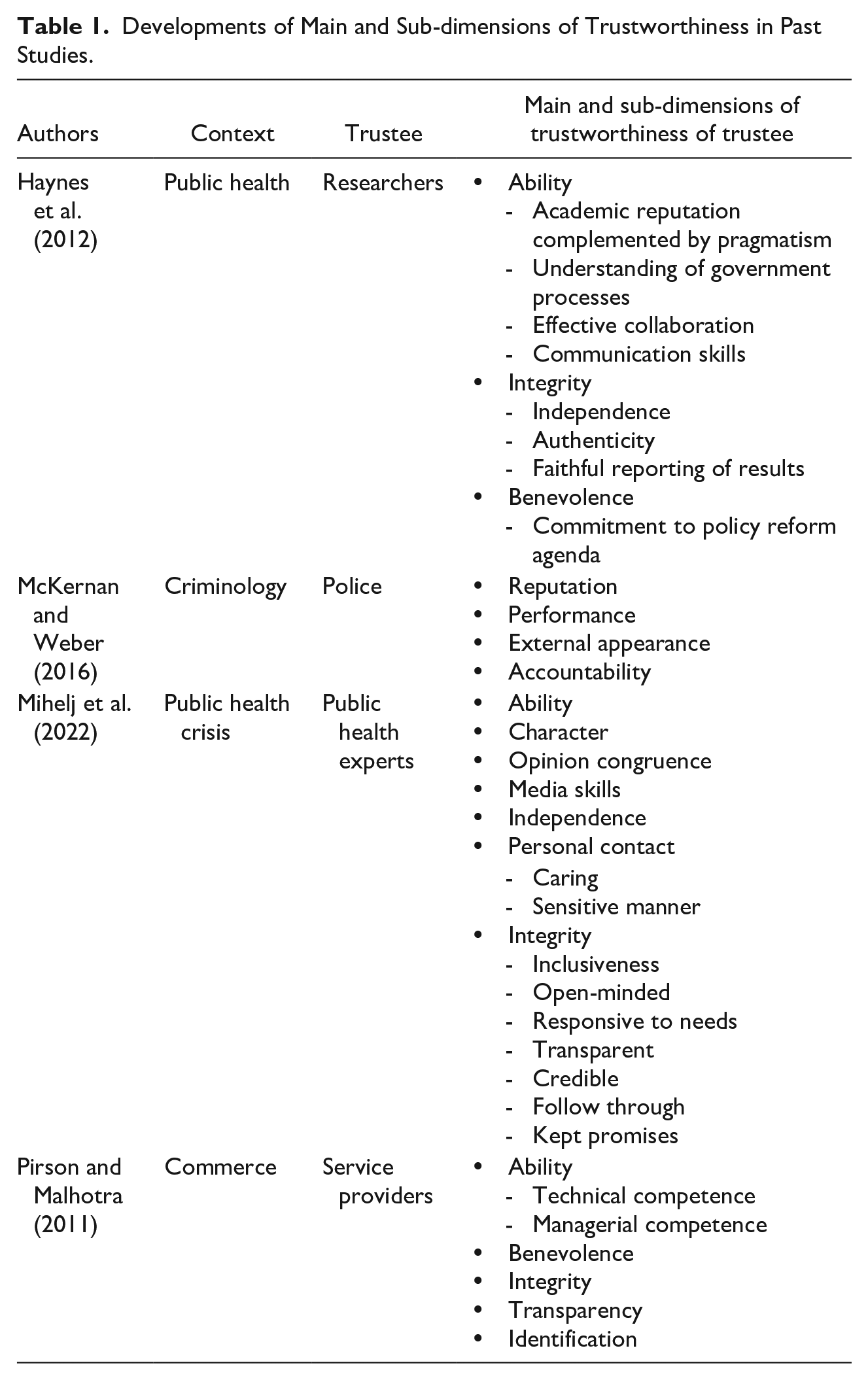
We made some observations of attempts at developing dimensions of trustworthiness. First, the development of external appearance of police as a dimension suggests that trustors’ considerations of trustees’ qualities can be dependent on context. Second, the development of transparency as a main dimension by Pirson and Malhotra (2011) and as a sub-dimension of integrity by Sharp et al. (2013) suggests that the field may not have agreed on what qualities are considered main and sub-dimensions. Yet, there is some consistency in the qualities that trustors consider regardless of context. Third, the sub-dimensions of ability: managerial and technical competences (Pirson & Malhotra, 2011) suggest that trustors draw upon their understanding of trustees’ scope of operation to assess trustworthiness. Fourth, the dimension of character reflected in Mihelj et al. (2022) appears to be conceptually similar to the dimension of integrity in Mayer et al.’s (1995) model. Büttner and Gòritz (2008) noted that different labeling of conceptually similar dimensions is a common phenomenon. Finally, while there have been developments in the dimensions of trustworthiness of stakeholders who play fiduciary roles, there are no known attempts at doing the same for media organizations.
Two bodies of research made further interpretations of dimensions of trustworthiness. Following the argument on the cognitive (i.e., based on trustors’ knowledge of trustees) and affective (i.e., based on trustor-trustee emotional bond) foundations of trust (Lewis & Wiegert, 1985), scholars explicated trust along cognitive and affect dimensions and studied associations between trustworthiness and trust. In doing so, scholars (e.g., Colquitt et al., 2011; McAllister, 1995; Tomlinson et al., 2018) alluded to the ability and integrity dimensions of trustworthiness as cognitive based. Similarly, they alluded that dimensions including interaction frequency, benevolence, and identification with trustees are affect based. Their works recognized a dichotomous cognitive-affective foundation in a trustor-trustee relationship. On the other hand, Lee et al. (2015) categorized dimensions of trustworthiness according to characteristics of trust subjects: capability-based and relationship-affecting. Although webpage features were the subject of trust, this manner of categorization affords adaptability in various contexts for identifying meaningful categories of trustworthiness dimensions. With the potential of expanding dimensions of trustworthiness of stakeholders through a new context, this study asks:
Research Question 1: What qualities of policymakers would drivers and non-drivers consider when having to assess their trustworthiness in governing AI used in AVs?
Research Question 2: What qualities of technology developers would drivers and non-drivers consider when having to assess their trustworthiness in developing AI used in AVs?
Research Question 3: What qualities of media organizations would drivers and non-drivers consider when having to assess their trustworthiness in communicating about AI used in AVs?
Research Question 4: What are the key similarities and differences in drivers’ and non-drivers’ considerations of (a) policymakers’, (b) technology developers’, and (c) media organizations’ qualities when having to assess their trustworthiness?
Method
We conducted focus group discussions (FGDs) with drivers and non-drivers. FGDs are effective means for generating new knowledge through spontaneous interactions (Parent et al., 2000). Stewart and Shamdasani (2015) emphasized that as members take references from others’ responses, the synergy can help surface ideas.
Recruitment and Sample
After obtaining approval from the university’s Institutional Review Board, we recruited participants through purposive and convenience sampling. We disseminated recruitment posters on social media platforms. To facilitate the comparison of drivers’ and non-drivers’ responses, we recruited accordingly. A driver is someone who (a) owns a valid Singapore driver’s license that is at least Class 3, 1 (b) has owned the license for more than a year, and (c) drives at least once a week. A driver does not own any driver’s license. We set the age eligibility to between 21 (i.e., the legal voting age in Singapore) and 77 years old. The age range aligns with the classification of Boomers as well as generations X, Y, and Z by the Pew Research Centre (Dimock, 2019). Registration took place on an online form. Participants provided their informed consent prior to the commencement of the sessions.
Group composition is a key consideration. To prevent inhibition of responses due to demographic differences (i.e., age; Ritchie et al., 2014), we grouped participants according to the four generations stated above. As some degree of heterogeneity can help generate diverse responses (Hisrich & Peters, 1982), we recruited males and females for each FGD session.
As 21 years old was the minimum age for eligibility, the age range of Generation Z was smaller: 21 to 26 years old. Therefore, we merged this group with Generation Y. There were three age classifications: (a) Generation Y and Z, (b) Generation X, and (c) Boomers in this study. Given the need to compare the responses of drivers and non-drivers, we conducted separate sessions for these groups. We conducted six FGDs, at which point the data reached saturation. We recruited 56 participants: 30 males and 26 females. Their ages ranged from 21 to 77 years old (M = 49.9, SD = 15.9). Table 2 presents the details of each session.
Details of Participants in Each FGD Session.
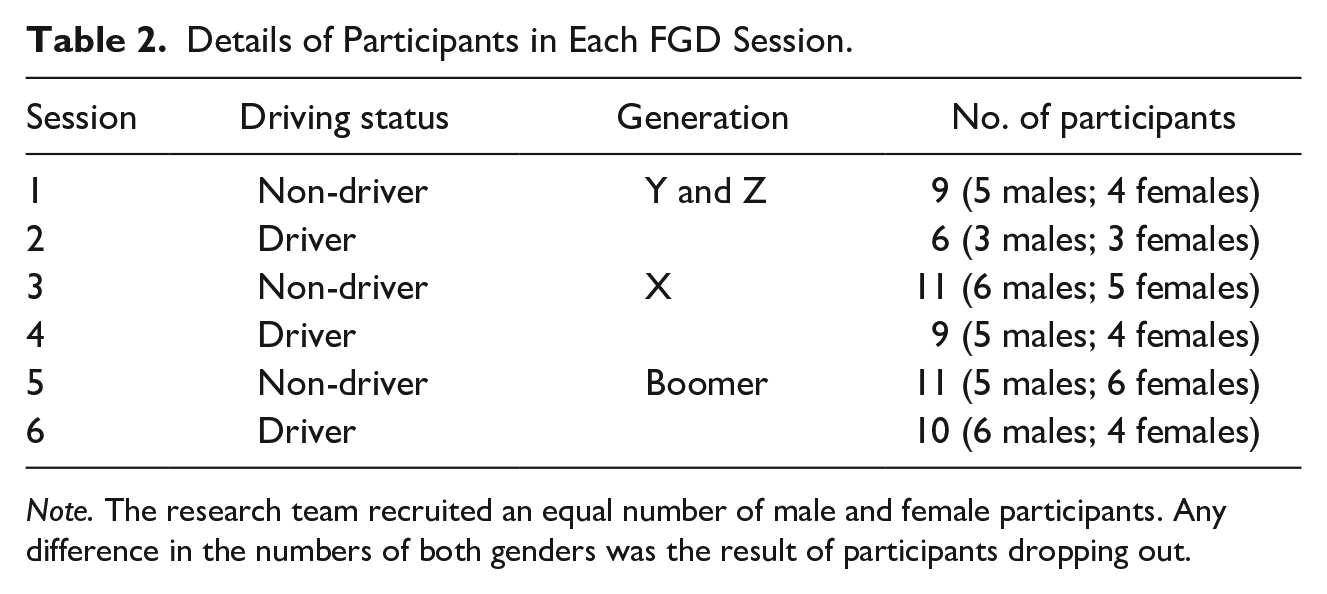
Note. The research team recruited an equal number of male and female participants. Any difference in the numbers of both genders was the result of participants dropping out.
Moderation and Moderator’s Guide
The FGDs took place between July and August 2023. A trained moderator conducted the sessions. To familiarize the participants with the study context, the moderator screened a video on AI and its applications in AVs. The moderator also introduced definitions of AI and AVs. An expert from the field deemed the content to be appropriate for a lay audience. The moderator posed questions according to the moderator’s guide and prompted the participants to elaborate when necessary. We present these materials in the Supplemental Material. Each FGD session lasted 2 hours; participants who completed the FGDs received SGD$100.
Analysis
The FGDs were digitally recorded, transcribed verbatim, and analyzed using NVivo 14. To ensure confidentiality, we de-identified all responses by replacing participants’ names with alphanumeric codes. For instance, “XND1” refers to the first participant of the Generation X non-driver group while “YZD3” refers to the third participant of the Generation Y and Z driver group. We use “B” to represent the Boomer groups.
The first author coded the data to identify qualities that corresponded with the ABI dimensions established by Mayer et al. (1995). Next, the coder took a grounded theory approach (Glaser, 1965; Glaser & Strauss, 1967) to identify additional qualities. Specifically, the coder used the constant comparative strategy to ascertain if a quality fits a previous code for a dimension, warrants a previous code to be modified, or calls for a new code to be developed (Tracy, 2013). Finally, the coder analyzed all codes to determine whether each one should be established as a main or a sub-dimension of trustworthiness.
Results
This study achieved congruence with earlier studies on trustworthiness in the development of the core ABI dimensions. Other qualities that reflect trustworthiness constitute new main and sub-dimensions. Commonalities among the dimensions enabled further categorizations in terms of capability, principle, recognition, and relation.
RQ1: Dimensions of Trustworthiness of Policymakers
Besides qualities that reflect the core ABI dimensions, we found qualities that form two additional main dimensions of trustworthiness: collaboration and public communication. We present the main and sub-dimensions of policymakers’ trustworthiness in Figure 1.
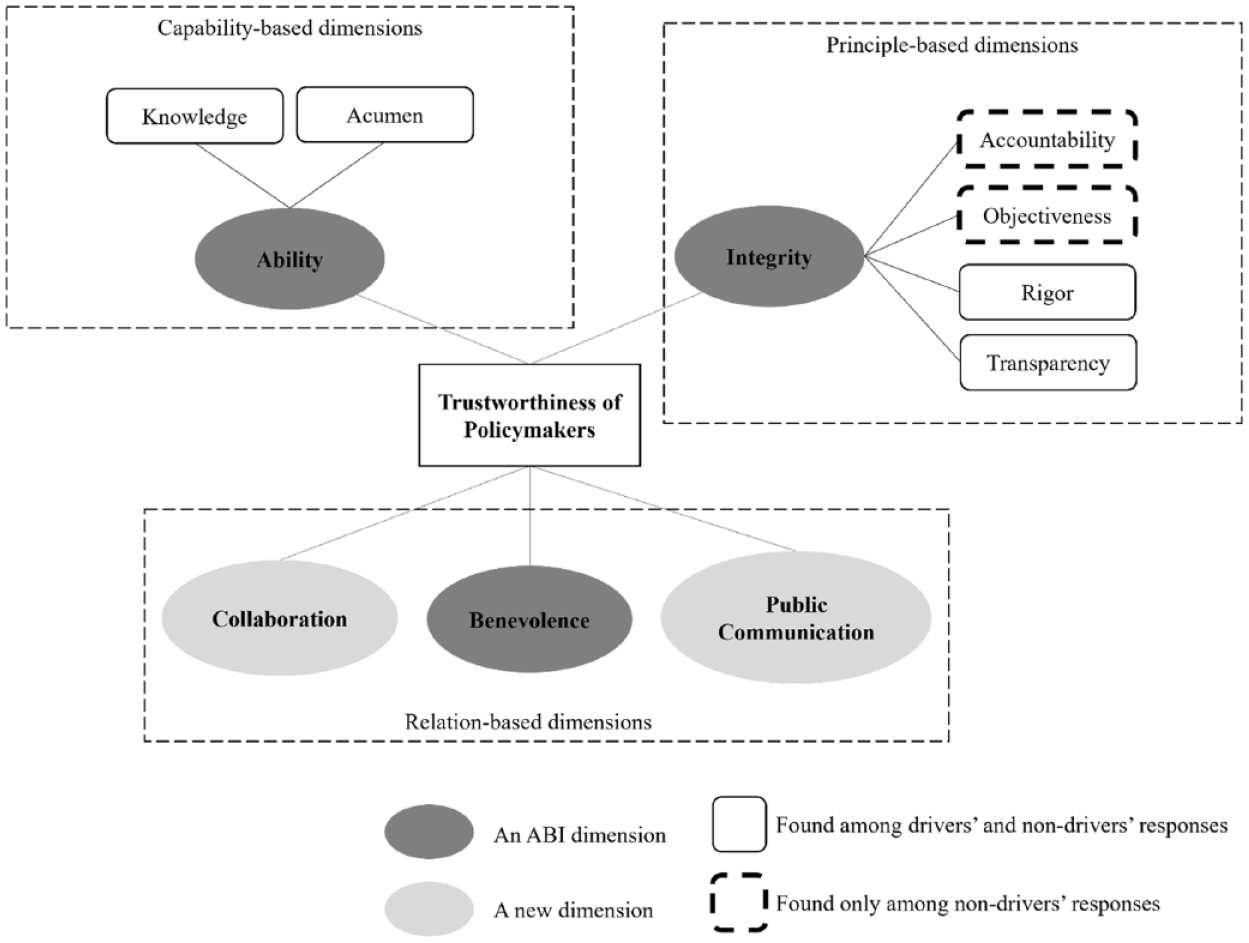
Dimensions of Trustworthiness of Policymakers.
For the main dimension of ability, drivers and non-drivers reflected that policymakers’ technical knowledge is an important consideration for trustworthiness. Some shared that to be trustworthy, policymakers need to “have a basic grasp of how the technology works” (YZD3). Acumen in policymaking also emerged. Several drivers commented that policymakers’ ability in building teams with diverse backgrounds to inform policymaking is more important than possessing technical knowledge. Drivers’ emphasis on acumen in making policies is supported by non-drivers’ comments on nurturing talents and forming multi-lateral policies to enable seamless international commute using AVs. Knowledge and acumen can be considered sub-dimensions of ability. Following Lee et al.’s (2015) categorization, we consider these main and sub-dimensions to be capability-based.
We developed four sub-dimensions, namely accountability, objectiveness, rigor, and transparency, for the main dimension of integrity. Drivers and non-drivers considered rigor and transparency. Rigorous regulation is exemplified in the responses “have laws that will protect drivers and companies” (YZD2) and “enforce planned [AV] maintenance schedule” (YZND7). Drivers and non-drivers also expected trustworthy policymakers to observe transparency: “if there’s failure, there’s a failure; don’t cover up and wait” (XD9) and “declare their conflicts of interests” (BND2). Non-drivers considered accountability, broadly in terms of “not pushing the blame and getting someone to be the scapegoat” (BND3) when accidents involving AVs occur. For the sub-dimension of objectiveness, non-drivers stressed that policymakers need to make decisions without being affected by conflicting interests or swayed by external influences. Collectively, these dimensions represent principle-based trustworthiness.
There are three main dimensions of trustworthiness that are relation-based. First, the main dimension of benevolence is substantiated by the expectations that trustworthy policymakers prioritize road users’ safety over profit-making. Seemingly carrying an assumption that high levels of autonomous driving can jeopardize users’ safety, a driver (YZD8) shared that he would assess benevolence on the levels of autonomous driving that policymakers allow on Singapore’s roads. Second, drivers and non-drivers raised collaboration as a consideration for trustworthiness: collaboration with technology developers to conduct research and inform policymaking. Drivers and non-drivers also shared that public communication would be an important consideration. They opined that policymakers who inform the public about their policymaking processes while getting public feedback would earn their trust. Overall, participants expected trustworthy policymakers to be keen on involving other experts and the public to help strengthen the rigor of their policymaking.
RQ2: Dimensions of Trustworthiness of Technology Developers
As before, participants considered the ABI dimensions and the main dimensions of public communication and collaboration. Acclaim was an additional dimension of trustworthiness. Following the previous practice of categorizing dimensions, we performed the same procedure for the dimensions of technology developers’ trustworthiness. We categorized the main dimension of acclaim and the constituent sub-dimensions as recognition-based. We present the main and sub-dimensions of technology developers’ trustworthiness in Figure 2.
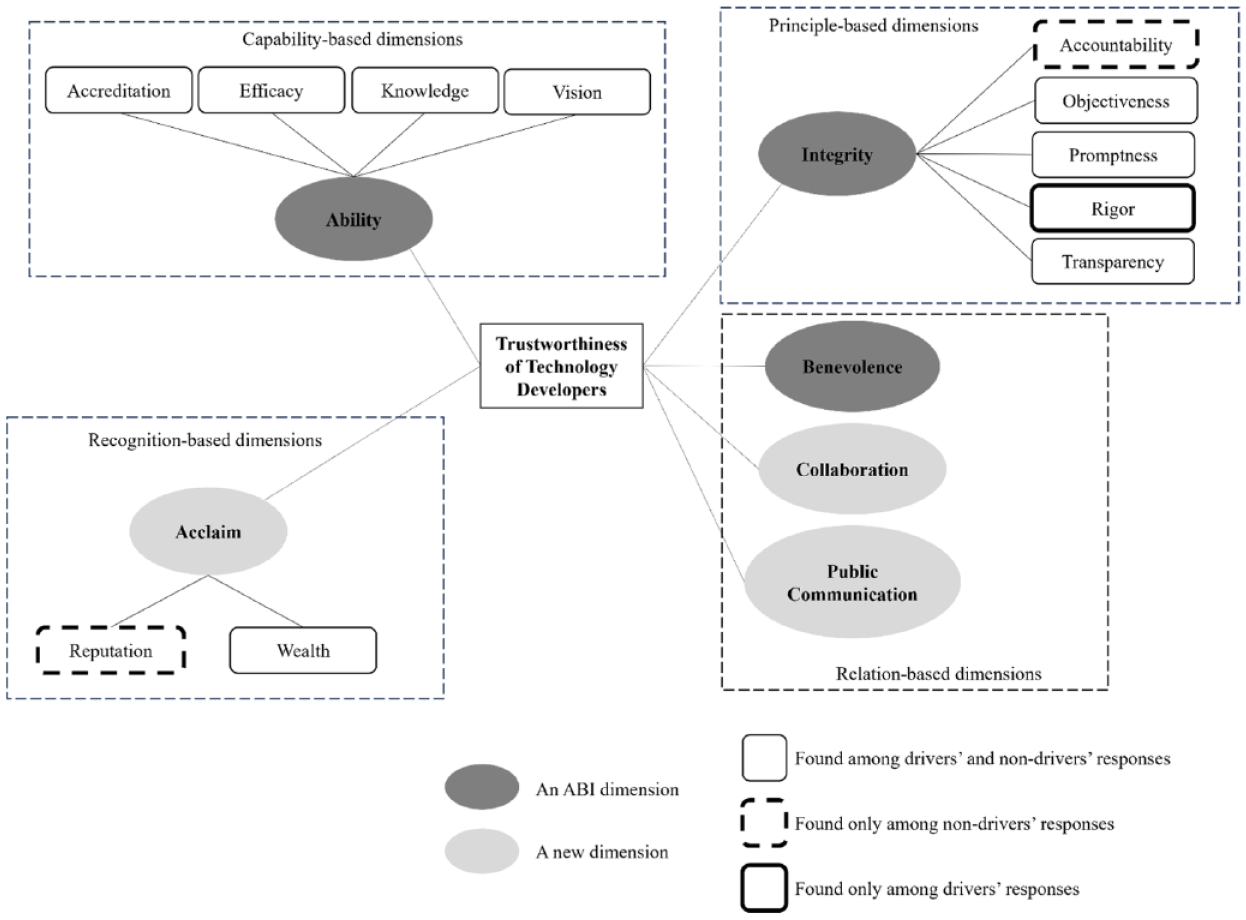
Dimensions of Trustworthiness of Technology Developers.
Participants would assess technology developers’ ability along the sub-dimensions of knowledge, accreditation, vision, and efficacy. Drivers and non-drivers expressed that knowledge gained from academic training and working experience contributes to trustworthiness. The comments “overseas [training] is not [good] enough to fit the local [context]” (BND10) and “could send more people overseas to learn” (BND8) alluded to technology developers with wide exposure and the ability to adapt knowledge for domestic situations being trustworthy.
Closely related to knowledge is accreditation. Specifically, this sub-dimension is substantiated by drivers’ and non-drivers’ expectations of trustworthy technology developers being experts who have received authentic qualifications, developed specializations, and earned licenses. Considering potential evolvements of AI technologies for AVs, drivers and non-drivers thought that technology developers who are visionary would gain trustworthiness. One driver (YZND5) explained that technology developers with strong visions can be trustworthy because their visions provide impetus to do their job well. Several non-drivers expressed that local technology developers who have the vision of enhancing AI technologies and customizing AVs for driving beyond Singapore would be deemed trustworthy. Finally, drivers and non-drivers stressed that efficacy, in terms of producing intended outcomes, is a fundamental ability that technology developers need to display. Besides emphasizing productions of safe, unbiased, and error-free AI technologies, participants highlighted that technology developers whose innovations are highly sought after would be trustworthy. These capability-based dimensions signal the public’s emphasis on requisite qualification and efficacious work.
The main dimensions benevolence, public communication, and collaboration highlight technology developers’ relation-based trustworthiness. Broadly, meeting consumers’ needs is a quality that drivers and non-drivers would consider when assessing benevolence. Examples of benevolence include maintaining data security, keeping costs low, providing after-purchase services, and catering to the diverse needs of consumers. One participant (YZD3) shared that using language that “enables laymen to understand AI technologies” would also reflect benevolence. On public communication, drivers and non-drivers would consider technology developers who share technical knowledge, get feedback on usability from customer segments, and allow people to test ride their AVs to be trustworthy. Finally, on collaboration, drivers and non-drivers agreed on assessing technology developers who collaborate with government agencies and counterparts of diverse expertise to be trustworthy. Overall, participants deemed technology developers who are people-oriented in their everyday operations to be trustworthy.
The main dimension of integrity and the constituting sub-dimensions of accountability, objectiveness, promptness, transparency, and rigor are principle-based considerations for trustworthiness. On accountability, a participant (YZND4) commented that technology developers who “try to wash their hands off [a situation]” cannot be trustworthy. Drivers and non-drivers reflected that they would deem technology developers who maintain objectiveness, particularly in terms of not displaying conflict of interest and refusing requests for special favors to be trustworthy. The comment “better to have some sort of third-party involvement” (YZD6) reveals the participant’s opinion that technology developers who put in place checks and balances to ensure equitable decision-making processes are trustworthy. Considerations of promptness highlight drivers’ and non-drivers’ emphasis on swiftness in delivering desired outcomes. On transparency, drivers and non-drivers thought that technology developers need to be “open” (BND2) about their operations. They opined that transparency can be demonstrated through maintaining documentations of operational procedures, staff accreditations, certifications of innovations, and financial status, and making them available for public reference. Finally, on rigor, drivers expect trustworthy technology developers to uphold high standards in their productions by putting their innovations through rigorous tests. Overall, participants would deem technology developers who uphold principles in their operations to be trustworthy because they can be trusted to fulfill their responsibilities without compromising public interests.
Finally, a group of qualities that we identified to be recognition-based emerged. Specifically, the main dimension of acclaim can be substantiated by the sub-dimensions of wealth and reputation. Notwithstanding the scarcity, wealth was a unanimous consideration for trustworthiness. Drivers and non-drivers perceived that technology developers who possess wealth and “strong market value” (YZND4) would be able to “sustain for the next 10, 20 years” (XD9) and bring their innovations to fruition. Relatedly, non-drivers would consider technology developers who have strong market reputation to be trustworthy. Besides evaluating technology developers on the qualities that they display when they innovate, the public would also consider the acclamations that technology developers have earned through their innovations.
RQ3: Dimensions of Trustworthiness of Media Organizations
Apart from qualities that reflect the core ABI dimensions, there are qualities that form an additional main dimension: affiliation. We label this dimension as relation-based. We present the main and sub-dimensions of media organizations’ trustworthiness in Figure 3.
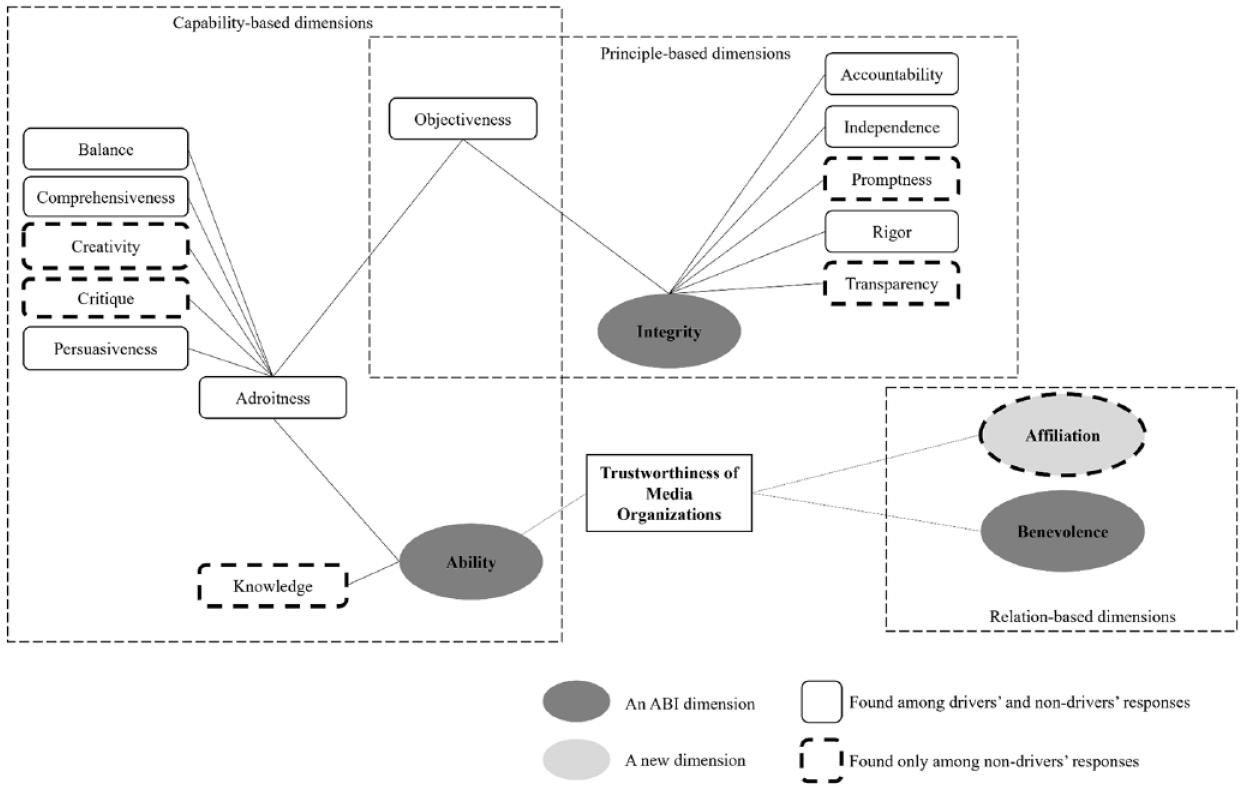
Dimensions of Trustworthiness of Media Organizations.
Participants considered multiple qualities when assessing media organizations’ ability. Non-drivers shared that they would assess media organizations’ knowledge of AI and AVs. We also found that adroitness is an appropriate sub-dimension of ability. Emerging patterns allowed us to identify further sub-dimensions of adroitness in content creation: balance, critique, comprehensiveness, creativity, persuasiveness, and objectiveness. On balance, drivers and non-drivers shared that trustworthy media organizations should report “good and bad news” (YZND8) and review “pros and cons of AVs” (BD5). On critique, non-drivers mentioned that trustworthy media organizations should be able to spur discussions on whether AV “is a need or a want” (XND4) and create meaningful content out of investigative journalism. Drivers and non-drivers regarded comprehensiveness, in terms of providing details to aid public understanding of AVs and AV-related crisis, to be an important quality. Creativity, which non-drivers thought should manifest through varied content, is also a consideration. Keeping in mind the potential of AVs to serve different segments of the public, drivers, and non-drivers raised persuasiveness as an important consideration. A non-driver (YZND8) mentioned that media organizations that target persuasive content at a segment of the public before using examples of “successful” conversions to target another segment would earn more trust than those that produce generic content. Drivers shared that media organizations that attempt to convince the public of the benefits of AVs through personal anecdotes can gain trustworthiness. Finally, on objectiveness, drivers and non-drivers said that trustworthiness would depend on adherence to standards such as framing technological progress realistically and basing content on facts. Altogether, ability can be a multi-faceted consideration for media organizations’ trustworthiness.
Integrity is also a multi-faceted dimension; the sub-dimensions are objectiveness, accountability, independence, promptness, rigor, and transparency. Drivers and non-drivers’ consideration of ability in producing objective content means they would consider objectiveness to be an integrity. Drivers and non-drivers elaborated accountability simply in terms of exercising the responsibility of networking with stakeholders. Noting the practice of creating sponsored content, many drivers and non-drivers pointed out that to be deemed trustworthy, and media organizations need to either be independent or declare paid partnerships. On promptness, non-drivers shared that media organizations that provide timely reports of crisis situations would be trustworthy. Drivers and non-drivers hold trustworthy media organizations to the standard of rigorous reporting in terms of providing details and verifying facts with experts. Finally, on transparency, non-drivers opined that trustworthy media organizations are expected to reveal “unflattering” information in the interest of the public during crises, even if it means affecting other stakeholders’ reputation. Evidently, participants hold media organizations to multiple standards in playing their roles in the AV scene.
The main dimensions of benevolence and affiliation are relation-based. On benevolence, drivers and non-drivers would assess media organizations on the extent to which they address information needs of the public, particularly the elderly and people with disabilities. On affiliation, which is a new main dimension, a non-driver mentioned that media organizations can gain trustworthiness by forging strong partnerships with technology developers to strengthen the rigor of their reporting. Possessing the keenness to serve the public and building networks would strengthen media organizations’ trustworthiness.
RQ4: Differences in Dimensions Between Drivers and Non-drivers
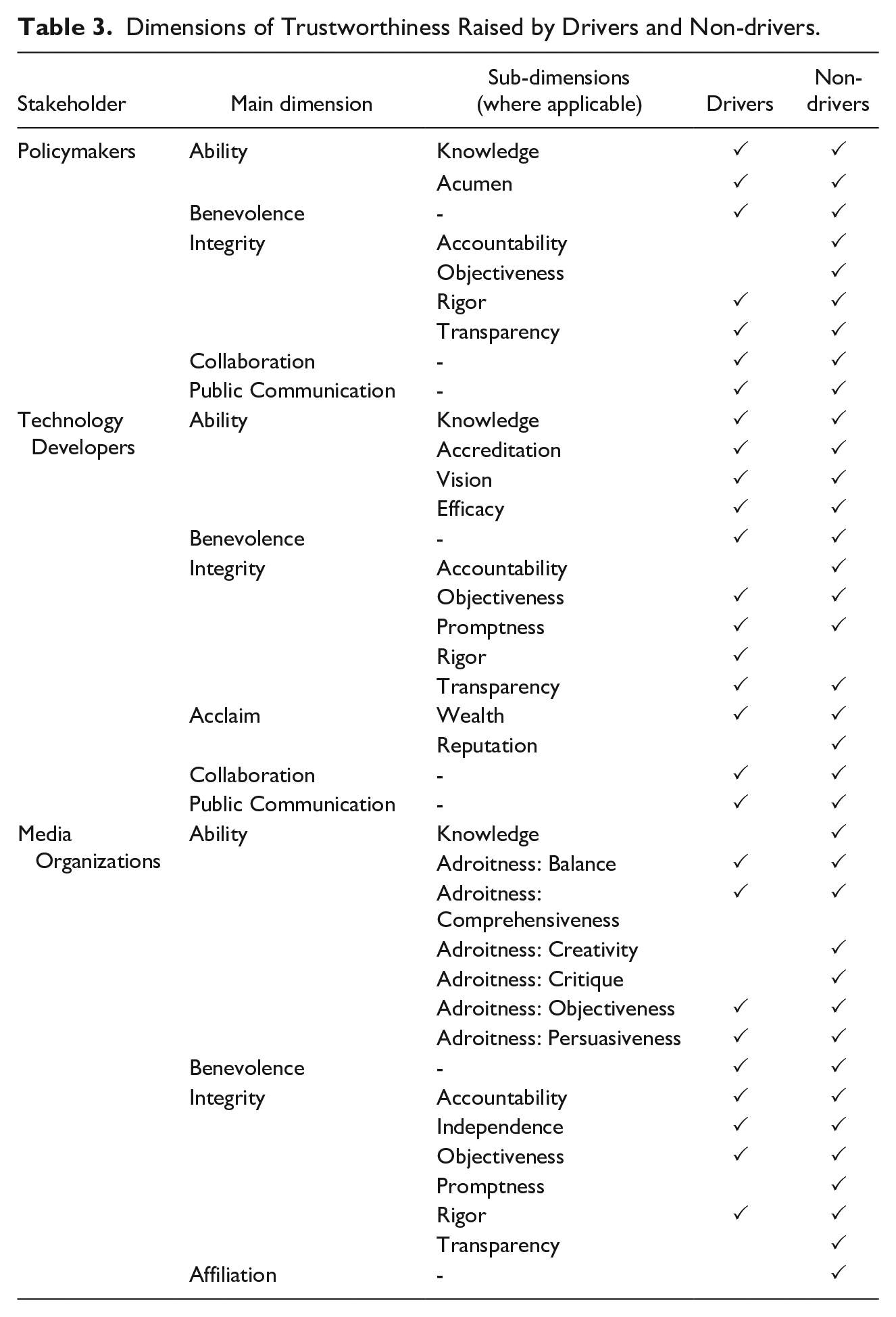
We consolidate the dimensions reflected in drivers’ and non-drivers’ responses in Table 3. On policymakers, the dimensions of accountability and objectiveness were reflected in the non-drivers’ responses but not in the drivers’ responses. Differences for technology developers lie in accountability, objectiveness, rigor, and reputation. Finally, differences for media organizations lie in knowledge, creativity, critique, promptness, transparency, and affiliation. All other dimensions were reflected in drivers’ and non-drivers’ responses.
Dimensions of Trustworthiness Raised by Drivers and Non-drivers.
Discussion
This study sets out to develop dimensions of trustworthiness of policymakers, technology developers, and media organizations that are involved in introducing AI for AVs based on the responses of the public in Singapore. Another aim is to compare the dimensions developed from drivers’ and non-drivers’ responses. Some of the qualities raised formed the ABI dimensions. The other dimensions developed concurred with those developed by earlier studies (e.g., transparency: Pirson & Malhotra, 2011; Sharp et al., 2013). Additional dimensions emerged: public communication and acclaim. Furthermore, our attempt at developing dimensions of trustworthiness of media organizations from an ABI approach provides insights on an important stakeholder involved in communicating science and technology (S&T) matters with the public. While the qualities that drivers and non-drivers raised for policymakers and technology developers were largely similar, non-drivers raised more qualities for assessing integrity of media organizations. We expound on the findings.
Dimensions of Trustworthiness
Table 3 consolidates the dimensions of trustworthiness developed. The key contribution of this study is the development of new main dimensions: acclaim and public communication. While Haynes et al. (2012) developed collaboration as a sub-dimension of ability, the qualification that participants provided for collaboration, in terms of the extent of policymakers’ and technology developers’ partnerships, facilitated the development of collaboration as a main dimension. Media organizations’ affiliations with other stakeholders is a similar development.
Development of Main Dimension: Acclaim
The development of acclaim as a main dimension is a noteworthy contribution to the literature. We established reputation and wealth as sub-dimensions of acclaim. While studies have found that reputation is a consideration for trustworthiness (e.g., Haynes et al., 2012; McKernan & Weber, 2016), research has yet to propose wealth. In relation to our earlier point on developing dimensions of trustworthiness based on uniqueness of matters related to AVs, we contend that participants could have raised wealth as a consideration of trustworthiness in the aftermath of a local company citing financial costs for halting developments of AVs (Kow, 2023). Wealth could be an important consideration because financial status can be indicative of technology firms’ ability to commit to success for the long term (Cladwell & Hansen, 2010). The parallel that we can draw between this argument and the quality of efficacy that participants raised suggests that technology developers’ track records are bases of the public’s consideration.
Development of Main Dimension: Public Communication
Public communication is a common consideration for trustworthiness of policymakers and technology developers. Possessing communication skills and media skills are related dimensions reflected in the literature (e.g., Haynes et al., 2012; Mihelj et al., 2022). The development of public communication as a dimension of trustworthiness from an S&T context brings an additional perspective to the bodies of literature on trustworthiness and science communication: besides considering requisite skills for communication when assessing trustworthiness, the public would consider stakeholders’ attempts at executing plans to communicate S&T matters with the public. Based on the activities that participants raised—information-sharing and public engagement sessions (i.e., correspond with the deficit-style 2 and dialogic-style of public communication of S&T respectively; Bucchi, 2008)—it appears that goals of communication are also part of the public’s consideration. The participants did not raise participatory-style communication activities. Yet, they alluded to media-led discussions that would critically assess the necessity of developing AVs. The alignment between participants’ responses and the literature on the model of science communication (Bucchi, 2008) points scholars in important directions for future research.
The nexus between public communication and trustworthiness is a point of departure for the bodies of literature on trustworthiness and science communication. On one hand, while scholars have discussed the role of science communication in raising public trust in science institutions and personnel (e.g., Metcalfe, 2019; Wynne, 2006), the literature has yet to establish the relative roles of deficit-, dialogic-, and participatory-style communication activities in building trust in S&T. On the other hand, the dimension of public communication is a contribution to scholarly works that extend Mayer et al.’s (1995) integrative model of organizational trust. Hence, we propose that future studies examine whether organizations’ deficit-, dialogic-, and participatory-style public outreach efforts are key considerations for trustworthiness.
Trustworthiness of Media Organizations
The results suggest that media credibility is a foundation upon which the public would evaluate trustworthiness of media organizations. Foremost, this study found that balance, comprehensiveness, persuasiveness, and objectiveness and are qualities that the public would consider when assessing media organizations’ adroitness (i.e., a sub-dimension of ability) in creating quality content. These qualities reflect items, such as “(not) biased” (e.g., Sundar, 1999) as well as “complete” and “will have impact” (Appelman & Sundar, 2016), that scholars have considered when constructing media credibility scales. Our observation mirrors Berdahl et al.’s (2016) note on the interdependence between credibility of stakeholders and perceptions of their trustworthiness among the public. The developments of creativity and critique reveal that participants would assess media organizations’ trustworthiness on qualities beyond adroitness in relaying information. In relation to the earlier point on trustors drawing upon their understanding of trustees’ scope of operation to assess trustworthiness, the developments of the sub-dimensions of creativity and critique suggest the possibility of the public basing their assessments on their expectations of media organizations carrying out participatory-style communication with the public. Altogether, the adroitness of media organizations can encompass ability in content creation and ability in playing different roles in communicating S&T with the public.
The development of the main dimension of affiliation for media organizations from participants’ responses indicates that institutional authority could be a basis upon which the public assesses trustworthiness. According to Wilson (1983), institutional authority refers to the influence that organizations gain from their affiliations with other organizations. For instance, authors can gain institutional authority from the organizations they are associated with (Firth & Cromwell, 2001). The possibility of institutional authority as a consideration adds a new perspective to the prevailing argument that trustees’ group membership (i.e., group similarity, in- and out-group) is part of trustors’ considerations (Armstrong & Yee, 2001; Brewer, 1979; Brewer & Silver, 1978). In this case, the public’s consideration of media organizations’ affiliations with expert stakeholders suggests that maintaining professional ties with expert stakeholders is a quality that would enhance the public’s willingness to be subject, as readers, to the information that media organizations provide. Evidence of the public also considering knowledge suggests that cognitive authority (i.e., knowledge or expertise that can influence others’ thoughts, opinions, or behaviors; Wilson, 1983) and institutional authority are complementary considerations. Drawing on these possibilities, we suggest that further studies explore authority as a dimension of trustworthiness.
Despite the brevity of responses on creativity and critique, the findings also provide useful references for future studies. First, creativity was elaborated only in terms of variety of media content. Therefore, it is not possible to determine whether participants would consider variety of tactics (e.g., humor, interviews; Besley et al., 2021; Yuan et al., 2022) and communication styles (e.g., aggressive vs. civil; Yuan et al., 2019). Furthermore, based on arguments on creativity being a competitive resource for organizations (e.g., Brown, 2016; Küng, 2017), it remains to be known whether the public would consider media organizations’ ability in creating creative content for segments of the public. This is an important direction for future research on trustworthiness of media organizations in delivering varied content on emergent technologies that can meet different informational needs of consumer segments. Second, although concerns over the ethical, legal, and social implications of AVs is pervasive (e.g., Shashkevich, 2017), participants did not refer explicitly to media organizations’ adroitness in presenting related information and spurring relevant public discussions. Against the backdrop of medialization of science (i.e., the interdependency between science and media to reach their communication goals; Weingart, 1998), we suggest that future studies examine whether media organizations’ adroitness in representing controversial aspects of science would be among the public’s considerations.
Comparisons of Dimensions From Drivers’ and Non-Drivers’ Responses
Drivers’ and non-drivers’ responses illuminate potential differences in how they would assess trustworthiness of the stakeholders. First, non-drivers raised accountability of policymakers and technology developers. This response could have stemmed from the coupling of non-drivers’ non-involvement in maneuvering vehicles and their concerns over the negative implications of AV use (Qu et al., 2019). Based on these characteristics of non-drivers, they would be inclined to stress accountability of stakeholders who carry the obligation of duty of care. Second, non-drivers raised technology developers’ reputation. Drawing on the reputation heuristics (Metzger & Flanagin, 2013), we contend that reputation is an important consideration among non-drivers because they attribute more value to authorized and recognized product manufacturers than otherwise. Third, the results showed that drivers raised rigor of technology developers. This consideration could be tied to drivers’ familiarity with the operations of automobiles and the related expectation that trustworthy technology developers need to establish and adhere to robust production procedures, especially for automated vehicles. Finally, where trustworthiness of media organizations is concerned, we observed that non-drivers raised more qualities than drivers. To explain this finding, we draw upon the finding by Lee et al. (2017) that non-drivers exhibited excitement over the prospective use of AVs and the argument by Bloch (1986) that product enthusiasts tend to engage in information-seeking. Therefore, non-drivers could have the tendency to emphasize more qualities out of their desire to attain new and quality information on AI and AVs. Except for differences in responses on media organizations, drivers and non-drivers raised largely similar responses for policymakers and technology developers.
Theoretical Contributions and Practical Implications
The applications of the integrative model of organizational trust in various study contexts facilitated the developments trustworthiness beyond the ABI dimensions. Applying the model to the context of AI used in AVs, this study has contributed to its conceptual development with new main dimensions and sub-dimensions. The development of the main dimensions of public communication and acclaim are the key contributions. The emergence of wealth as a new dimension enabled us to subsume it as a sub-dimension of acclaim together with reputation. The other conceptual contribution is the categorization of similar dimensions of trustworthiness. Following Lee et al.’s (2015) argument that involvement with external figures would affect relationships, we categorized the main dimensions of collaboration, benevolence, public communication, and affiliation as relation-based. We performed similar categorizations across the results for the three stakeholders: capability-based, principle-based, and recognition-based.
Based on the development of public communication as a main dimension of trustworthiness of policymakers and technology developers, we recommend that these two groups of stakeholders conduct communication activities with the public to achieve their communication goals. Based on the differences between drivers and non-drivers’ responses, other communication goals are building reputation and raising public awareness of their operational rigor among the appropriate audience segment. As these communication goals would be important at different phases of policymaking and technology development, stakeholders need to carry out appropriate communication activities to achieve their operational outcomes. In this manner, they would be able to maintain their trustworthiness among the public. Relatedly, media organizations need to consider the roles that they need to play in the communication of S&T matters with the public. Besides being conduit of information to facilitate information dissemination by policymakers and technology developers, media organizations need to initiate communication activities such as dialogues and co-creations of knowledge among policymakers, technology developers, and the public.
We also recommend that stakeholders form affiliations and collaborate with one another to strengthen their trustworthiness among the public. Such partnerships can complement the abovementioned communication activities. For policymakers, partnerships can be formed with technology developers and communication practitioners to refine governance approaches. Technology developers from public research laboratories and commercial firms can form partnerships with their local and overseas counterparts to expand domestic AV landscapes. Meanwhile, media organizations can feature significant milestones of their technology and policy partners. Based on the differences in drivers and non-drivers’ responses, it is important that media organizations display positive qualities that reflect their trustworthiness more visibly among the non-drivers. Such features can raise public awareness of policymakers’ and technology developers’ efforts while strengthening the trustworthiness of media organizations as their partnerships gain visibility.
Limitations of Study and Direction for Future Research
This study adopted an exploratory approach to examine dimensions of trustworthiness of policymakers, technology developers, and media organizations. In doing so, we developed dimensions of trustworthiness based on the qualities that Singapore-based participants would consider if they had to assess the stakeholders’ trustworthiness. Our approach cannot facilitate measurements of stakeholders’ trustworthiness. Hence, future studies can develop scales and collective quantitative data to measure stakeholders’ trustworthiness. As mentioned, the results are based on the responses given by the public in Singapore. We acknowledge that the social and political milieux could have prompted the participants to emphasize certain qualities over others; their inclinations to stress certain points over others could have inadvertently been reflected in their responses. Relatedly, this study referred to policymakers, technology developers, and media organizations in Singapore at the general level. We recognize that there can be different professional roles within each group of stakeholders (e.g., representatives of governmental organizations, civic tech companies, and social entrepreneurs among policymakers). Nevertheless, this study was able to achieve congruence with the literature through the development of ABI dimensions and other extant literature. Future studies can extend the scope of study by basing developments of trustworthiness dimensions in the AV contexts of other countries, conducting cross-country comparisons, and comparing dimensions of trustworthiness raised for specialists in governance, technology development, and communication. Recognizing that this study covers an emerging technology, we recommend that scholars examine whether groups of publics emphasize dimensions of trustworthiness over others in relation to their technological skepticism. These directions have the potential to provide deeper insights into communication efforts and developments of the trustworthiness concept.
Conclusion
Taking a theory-driven approach, this study found that ability, benevolence, integrity, public communication, acclaim, and partnership-related dimensions are those along which the public would assess stakeholders’ trustworthiness. Building on the findings, we propose directions for future research. Stakeholders who introduce AI for AVs can draw upon the dimensions to inform their plans for maintaining or gaining trustworthiness among the public.
Supplemental Material
sj-docx-1-scx-10.1177_10755470241248169 – Supplemental material for Trustworthiness of Policymakers, Technology Developers, and Media Organizations Involved in Introducing AI for Autonomous Vehicles: A Public Perspective
Supplemental material, sj-docx-1-scx-10.1177_10755470241248169 for Trustworthiness of Policymakers, Technology Developers, and Media Organizations Involved in Introducing AI for Autonomous Vehicles: A Public Perspective by Tong Jee Goh and Shirley S. Ho in Science Communication
Footnotes
Acknowledgements
The authors would like to thank Assoc. Prof. Yee Fen Lim, Assoc. Prof. Chen Lyu, Mr. Niels de Boer, and Ms. Samantha Yu Huang Tan for their help rendered to this project.
Declaration of Conflicting Interests
The author(s) declared no potential conflicts of interest with respect to the research, authorship, and/or publication of this article.
Funding
The author(s) disclosed receipt of the following financial support for the research, authorship, and/or publication of this article: This project is supported by the National Research Foundation, Singapore under its AI Singapore Program (AISG Award Number: AISG3-GV-2021-007).

Notes
Author Biographies
References
Supplementary Material
Please find the following supplemental material available below.
For Open Access articles published under a Creative Commons License, all supplemental material carries the same license as the article it is associated with.
For non-Open Access articles published, all supplemental material carries a non-exclusive license, and permission requests for re-use of supplemental material or any part of supplemental material shall be sent directly to the copyright owner as specified in the copyright notice associated with the article.
