







Abstract
Innovation research fighting for public attention and counteracting science-skeptical views raise the need for insights into why individuals are motivated to engage with scientific knowledge. Guided by the Planned Risk Information Seeking Model (PRISM), additionally considering mistrust in science and innovativeness, the study aimed to explain individuals’ intention to seek information about medical innovations. Findings of an online survey among German residents (N = 5,322) supported the utility of the extended PRISM to predict seeking intent. Most of the postulates of the PRISM were supported; mistrust served as a barrier to engagement with scientific knowledge, whereas innovativeness was of minor relevance.
Keywords
Introduction
Science communication focusing on medical innovations faces various challenges: First, under the conditions of information overload in digital media environments, science communicators are challenged to gain public attention for their topics (van Aelst et al., 2017). Second, public skepticism toward science is on the rise (Takahashi & Tandoc, 2016), and depending on the country and field of science, its authority can no longer be taken for granted (Rutjens et al., 2022). Third, most scientific knowledge is highly complex and difficult to acquire for laypersons. Particularly in the case of medical innovations, gaps in knowledge, high levels of medical and personal uncertainty related to the functionality and safety of new therapies or technologies, lack of scientific literacy, and high levels of scientific complexity complicate the understanding of the public (Hirschman, 1980; Plohl & Musil, 2021) and may contribute to higher levels of public skepticism (Rutjens et al., 2022). These challenges carry the risk of wasting resources devoted to innovation development if the public is unwilling to accept innovations (Dobre et al., 2009; Lee et al., 2008).
Against this background, examples such as vaccines or biotechnology illustrate that scientific success stories do not necessarily lead to high acceptance (e.g., Dubé et al., 2013; Priest et al., 2003). Therefore, for monitoring, analyzing, and predicting the acceptance of medical innovations, we take a social science perspective focusing on the communication-related determinants of accepting medical innovations and aim to understand why individuals are responsive to scientific information. We focus on individuals’ information-seeking intent as this behavior is known to positively affect knowledge gain (Kahlor & Rosenthal, 2009), informed attitude formation, and decision-making (Z. Liu & Yang, 2023). We attempt to investigate the predictors of information-seeking intent in the context of medical innovations using the example of smart implants for musculoskeletal, dental, and auditory applications. This example represents a new field of research in medicine aiming to address the high number of implant losses in various medical disciplines. Using safety-relevant concepts drawn from engineering science, smart implant systems should be developed that enable continuous monitoring of the implant in the body and early detect implant complications such as material corrosion, implant loosening, or biofilm formation using chemical, biological, or physical detection systems and transmit this information either to physicians or to autonomous implant-associated systems. Smart implants also aim to restore the initial functionality, for example, by the release of ingredients. However, these functions also come with challenges, such as using biocompatible materials for the sensors, errors in the detection or reaction, power consumption, data transfer rates, or robustness (Ledet et al., 2018). All these envisioned characteristics of the technology of smart implants are related to relatively novel risks and benefits, positive and negative affective responses, and the need to better understand this innovation (Z. Liu & Yang, 2023) instead of planning actions. Particularly potential risks and fears might alter individuals’ information needs, their information-seeking intent, and their acceptance of smart implants. Thus, gaining a better understanding of how individuals process information about smart implants is crucial for designing effective communication campaigns and deriving recommendations for the effective implementation of smart implant systems.
To understand individuals’ engagement with scientific knowledge about smart implants, we sought guidance from one of the most comprehensive models of information-seeking behavior, the Planned Risk Information Seeking Model (PRISM) (Kahlor, 2010). The context of smart implants characterized by the specific combination of particularly preliminary knowledge, high uncertainty, complexity, and no immediate affectedness of the public is a new terrain for PRISM helping to expand knowledge on PRISM’s utility across contexts. Our contribution to theory development covers also two extensions of the PRISM, which result from our focus on medical innovations: First, we add mistrust in science to the PRISM to acknowledge that when individuals lack the knowledge to understand the full complexity of medical innovations, mistrust serves as a heuristic to provide fast and effective attitude formation and decision-making (Cummings, 2014; Hendriks et al., 2016; Hmielowski et al., 2014). In Germany, 62% of the population indicates that they trust science somewhat or completely (Wissenschaft im Dialog, 2022). This value is rather high, but in line with international trends, a long-term decline in trust can be observed. Second, from an agency-driven perspective of the diffusion of innovation (Aldás-Manzano et al., 2009; Heinsch et al., 2021; Rogers, 2003), the implementation of medical innovations depends on an individual’s innovativeness—a psychological trait that determines the degree to which a person is willing to change and to embrace innovations comprising health technologies such as wearables, new therapies, or drugs (e.g., Barnett et al., 2011; Côté-Boileau et al., 2019; Dearing & Cox, 2018; M. Zhang et al., 2017).
To sum up, this work aims to examine the interface between science and society and present an analysis of predictors of individuals’ intention to acquire information on smart implants. The objective is two-fold: First, we aim to test whether the PRISM can be applied to the context of smart implants. Second, we supplement the PRISM by considering individuals’ mistrust in science and their innovativeness.
Theoretical Background
Using the PRISM to Predict Individuals’ Seeking Intent
PRISM aims to explain the intent underlying the deliberate behavior to obtain risk or health information (Kahlor, 2010). To explain this intention, PRISM pursues an integrative approach to existing models of information-seeking behaviors, such as the Risk Information Seeking and Processing Model (RISP) (Griffin et al., 1999; Yang et al., 2014), the Theory of Planned Behavior (TPB) (Ajzen, 1991), and the Comprehensive Model of Information Seeking (CMIS) (Johnson & Meischke, 1993). It has received strong support in various science- and health-related contexts (for an overview, see Ou & Ho, 2022).
PRISM postulates that individuals’ seeking intent is positively influenced by individuals’ attitudes, subjective norms, perceived seeking control, risk perceptions, affective risk responses, and perceptions of knowledge insufficiency (see Figure 1). Figure 1 illustrates the hypotheses that have been tested in prior PRISM studies and are again expected to be supported in the current context of smart implants.
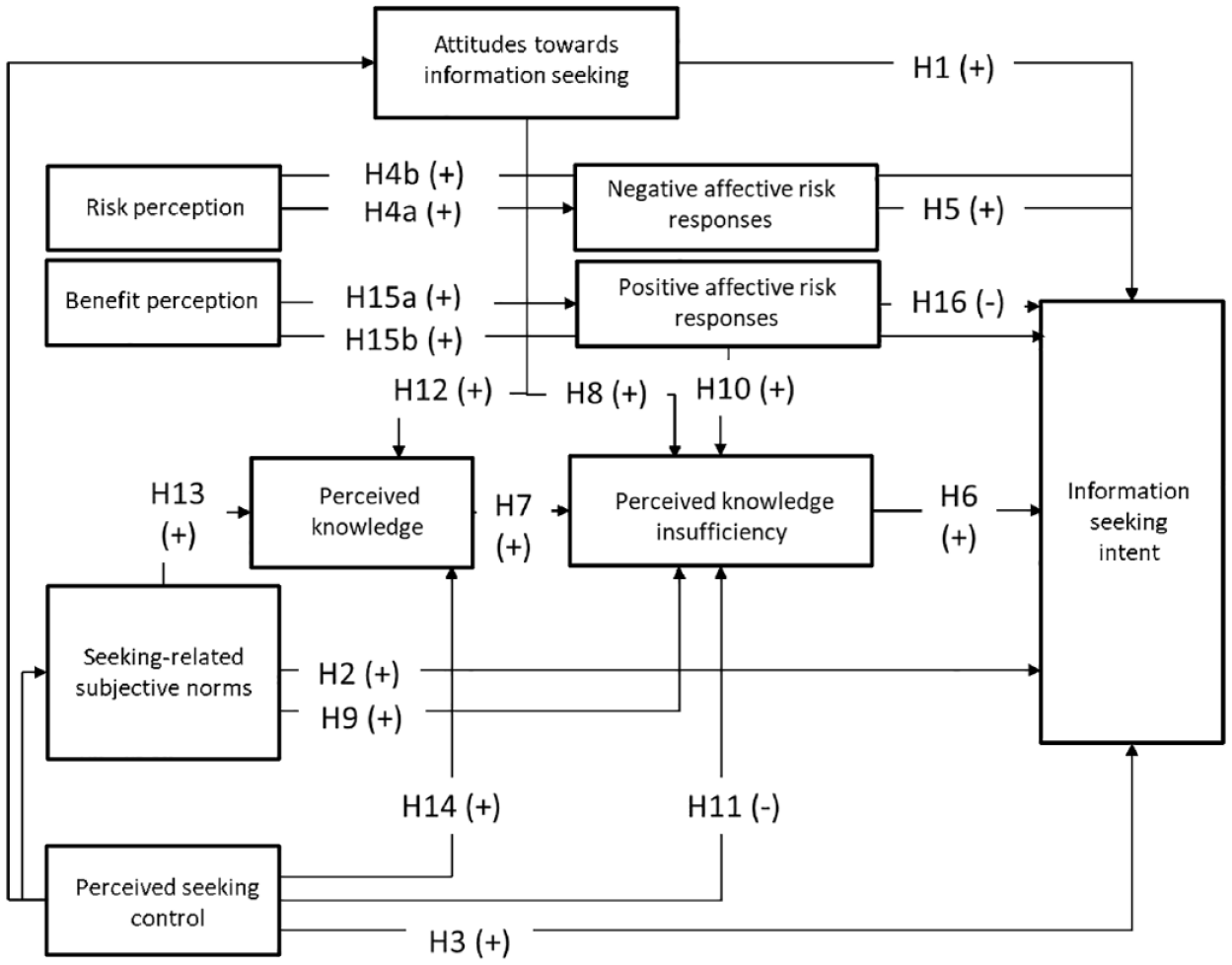
The Hypotheses Derived From the Planned Risk Information Seeking Model (Kahlor, 2010).
That seeking intent is the result of attitudes toward information seeking, subjective norms, and perceived seeking control was derived from the TPB (Ajzen, 1991). Attitudes toward information seeking capture the instrumental (e.g., useful) and affective evaluation (e.g., pleasant) of the efficacy and utility of information (Dunwoody & Griffin, 2015; Kahlor, 2007, 2010). Seeking-related subjective norms are group-identity-based codes of conduct that cover individuals’ perceptions of other’s approval of information-seeking behaviors (injunctive norms) and the perceived prevalence of information-seeking behaviors among an individuals’ reference group (descriptive norms) (Cialdini et al., 1990; Griffin et al., 1999; Gutteling & de Vries, 2017; Hovick et al., 2014; Lapinski & Rimal, 2005). The concept of perceived seeking control captures whether individuals are confident that they own the internal and external abilities to successfully acquire information (Ajzen, 1991; Kahlor, 2010; Ou & Ho, 2022). According to the meta-analysis of Ou and Hou (2022), associations of seeking intent and attitudes, norms, and seeking control were confirmed, but seeking-related subjective norms were the strongest predictor of information-seeking intent. Based on the PRISM and extant research, we addressed the positive relation between these predictors and information-seeking intent in Hypotheses 1 to 3 (see Figure 1).
The PRISM postulates in line with the RISP that risk perceptions and affective risk responses as well as perceived current knowledge and perceived knowledge insufficiency are related to more pronounced information-seeking intent (Kahlor, 2010). Risk perceptions consist of a cognitive response to the susceptibility and severity of a threat (So, 2013) and describe the relevancy of a risk to the individual (Gutteling & de Vries, 2017). The PRISM posits that the cognitive components of risk perceptions can evoke affective dimensions such as negative affective responses (H4a), which serve as a mental shortcut for risk judgment influencing information-seeking intentions (H5) (Hovick et al., 2014; Kahlor, 2010; So, 2013).
The role of the discrepancy between perceived knowledge and knowledge insufficiency depicts the assumption that the desired level of knowledge motivates information seeking. The predictors describe whether the individual perceives to know too little or too much about a certain topic to feel confident and form an accurate opinion (Dunwoody & Griffin, 2015; Kahlor, 2010; Yang et al., 2014). Although a positive relation between perceived knowledge and knowledge insufficiency was supported (H7), the theoretically derived assumption that perceived knowledge insufficiency is a direct driver of one’s seeking intent (H6) was so far insufficiently confirmed (Kahlor, 2010; see also Ahn & Kahlor, 2020; Brinker et al., 2020; Griffin et al., 1999; Yang et al., 2014).
In addition, the PRISM also postulates that perceived current knowledge and perceived knowledge insufficiency are determined by attitudes toward information seeking, seeking-related subjective norms, perceived seeking control, and affective risk responses (further explained in Kahlor, 2010; see Figure 1, H8-14).
Further developments of the PRISM also consider benefits perceptions and positive affective responses (Bessette et al., 2019; Kahlor et al., 2020; Yang & Kahlor, 2013) to acknowledge that individuals do not analyze risks separately from benefits for decision-making and complete evaluation of the acceptability of new technologies (Alhakami & Slovic, 1994; Bearth & Siegrist, 2016; Siegrist, 2000). Benefit perceptions are understood as the potential gain from medical innovations contributing to individuals’ relevancy assessment (Brown, 2005). In line with initial research, it is postulated that benefit perceptions are positively related to positive affective risk responses (H15a) (Link & Kahlor, 2023; Yang & Kahlor, 2013). Concerning the relationship between positive affective risk responses and seeking intent, it was postulated in line with the Uncertainty Management Theory (Brashers, 2001) that an optimistic view might lead to avoiding contact with additional information (Yang & Kahlor, 2013). Therefore, we postulate a negative relation between positive affective risk responses and information-seeking intent (H16).
Besides postulating that benefit perceptions result in more pronounced positive affective risk responses (e.g., Yang & Kahlor, 2013), the psychology of decision-making suggests that not only the affective but also the cognitive component of risk and benefit perceptions influence attitudes and behaviors such as the acceptance of a product (e.g., Siegrist, 2000). Extant studies also revealed a direct association between risk (and benefit) perceptions and information seeking (see Ou & Ho, 2022; Yang & Kahlor, 2013; Wang et al., 2021). Thus, we postulate that risk and benefit perceptions will be positively related to seeking intent, which is the basis of Hypotheses 4b and 15b (see Figure 1).
Beyond the PRISM: Modeling the Role of Mistrust and Innovativeness
Mistrust in Science
(Mis-)trust can be understood as an ascribed characteristic or a certain attitude toward science (Hartman et al., 2017) referring to the (un)willingness to accept vulnerability and (not) rely on a person or entity based upon positive (or negative) expectations and evaluations of scientists’ expertise, integrity, and benevolence (Hendriks et al.,2015, 2016; Mayer et al., 1995; Rousseau et al., 1998). To trust in science and scientists means to rely on these entities as providers of knowledge, while mistrust implies the opposite disposition (Hendriks et al., 2016). Individuals’ lower intention to rely on science might be related to a lower motivation to learn about scientific issues (Gauchat, 2011; Nadelson et al., 2014), which is also in line with assumptions of the CMIS suggesting that characteristics of an information channel (such as scientists) affect information seeking (see also Hovick et al., 2014). Therefore, we propose that mistrust will be negatively related to intentions to seek information about smart implants (see Figure 2, H17). In addition, relying on science as a provider of knowledge is also associated with individuals’ assessments of sources of scientific knowledge (Takahashi & Tandoc, 2016). Relying on science and scientists is linked to the belief to get reliable information (Hendriks et al., 2015) and a higher value of the provided information (Link et al., 2024; Wang et al., 2021), suggesting that attitudes toward science are linked to attitudes toward information seeking referring to science (Hovick et al., 2014). Based on this rationale, we propose that mistrust in science will be related to individuals’ more negative attitudes toward information seeking (H18) (Hovick et al., 2014; Slovic, 1993; Wang et al., 2021).
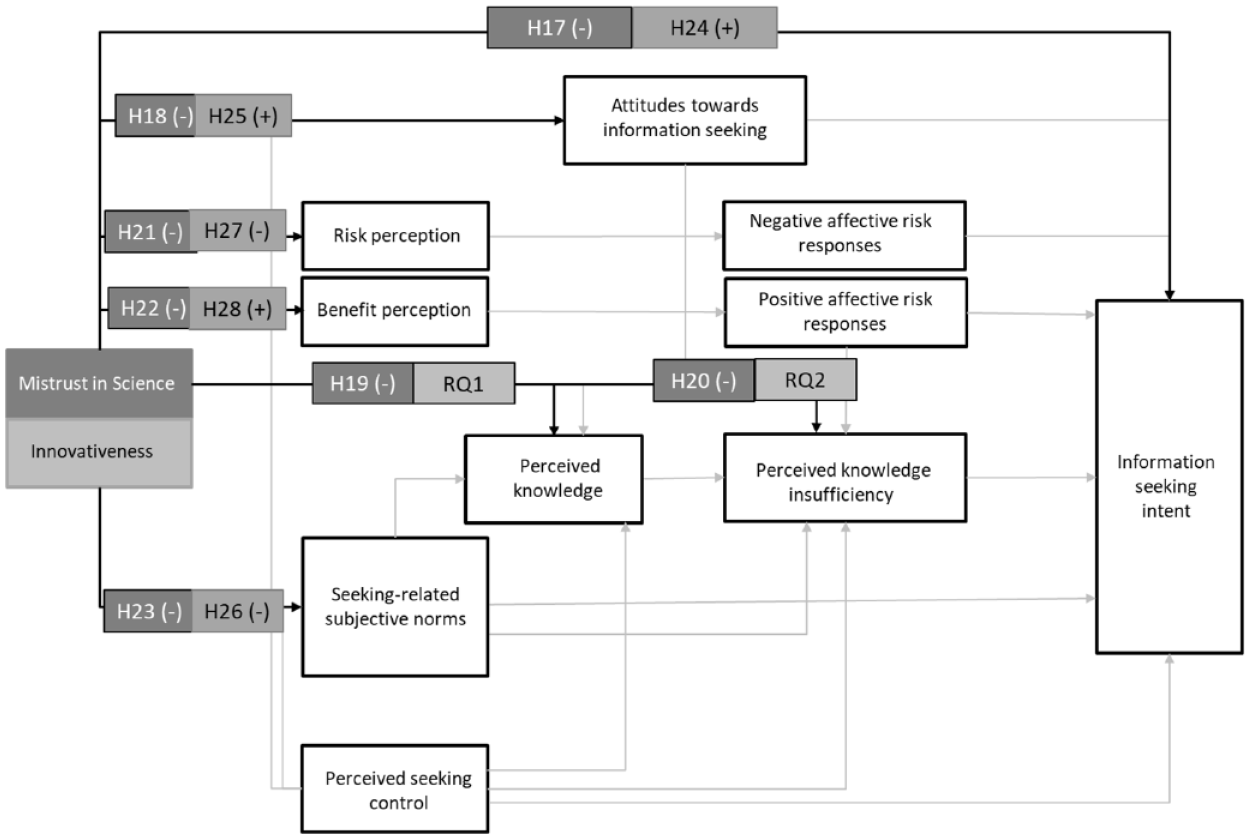
Overview of the Proposed Extended Planned Risk Information-Seeking Model (Kahlor, 2010).
Concerning the relationship between mistrust and current knowledge and knowledge insufficiency, extant research suggests that trust results in more knowledge gain (Moon et al., 2022). In this vein, it should be considered that mistrust also serves as a substitute for knowledge in decision-making when individuals are faced with new specialized scientific knowledge, which cannot be fully understood without deep scientific knowledge and when a cognitive framework to interpret and evaluate the information is lacking (Earle & Cvetkovich, 1995; Hendriks et al., 2016; Luhmann, 1989; Nadelson et al., 2014; Siegrist, 2000; Siegrist & Cvetkovich, 2000). Therefore, we postulate that mistrust in science will be linked to lower levels of current knowledge (H19), and lower levels of perceived knowledge insufficiency (H20).
Regarding subjective norms, individuals’ need for consistency in beliefs (Festinger, 1957) and cognitive biases such as the consensus bias (Marks & Miller, 1987) suggest that individuals overestimate the level to which others share their beliefs, attitudes, and behaviors. Therefore, H21 postulates that mistrust in science is related to less pronounced subjective information norms (see Figure 2).
Mistrust also serves as a cognitive heuristic to assess the risks and benefits of complex scientific issues such as medical innovations (Cummings, 2014; Lachapelle et al., 2014; H. Liu & Priest, 2009; Luhmann, 1989; Siegrist, 2000). Siegrist and Cvetkovich (2000) state that “lay judgments of risks and benefits might be based on an assessment of those who are responsible” (p. 713). These expert assessments contribute to the perceived predictability and controllability of risks, as well as the magnitude and nature of benefits (Plohl & Musil, 2021; Siegrist & Cvetkovich, 2000; Wang et al., 2021). In line with this rationale, recent research postulates a relationship between trust in science and risk and benefits perceptions of a hazard about which an individual has little knowledge. It was shown that trust is negatively related to risk perceptions and positively related to benefit perceptions (Plohl & Musil, 2021; Siegrist & Cvetkovich, 2000). Applied to the role of mistrust, we postulate the reverse direction of the correlations in Hypotheses 21 and 22.
Individuals’ Innovativeness
The Diffusion of Innovations (DOI) theory (Rogers, 2003) considers individuals’ innovativeness to distinguish various types of adopters of innovations. It is a central personality trait related to the tendency to adopt innovations such as treatments or healthcare applications (Barnett et al., 2011; Côté-Boileau et al., 2019; Hirunyawipdata & Paswan, 2006; Hong et al., 2017; M. Zhang et al., 2017). More innovative individuals have a higher demand for novelty (Aldás-Manzano et al., 2009; Z. Zhang & Hou, 2017), curiosity (Hong et al., 2017), and uniqueness (Heidenreich et al., 2017). Innovators are also described as self-perceptive and independent. They serve as opinion leaders and behave according to their standards (Dobre et al., 2009; M. Zhang et al., 2017), suggesting that they orient their information behaviors less toward others. Individuals with high innovativeness can also be characterized by their higher ability to cope with uncertainty as well as their risk-taking propensity (Aldás-Manzano et al., 2009).
These characteristics suggest that innovative individuals possess a higher motivation to acquire information for innovation-related knowledge enhancement (H23) and possess more positive attitudes toward information seeking (H24) compared to individuals with lower innovativeness (Li et al., 2021; Z. Zhang & Hou, 2017). In addition, we infer that innovativeness is related to less pronounced subjective information norms (H25) and lower risk, but higher benefits perceptions (H26 and H27) (e.g., Chauhan et al., 2019; Hirunyawipada & Paswan, 2006; Z. Zhang & Hou, 2017).
Regarding the role of innovativeness in knowledge insufficiency, contrary assumptions exist: On the one hand, it is suggested that innovative individuals primarily depend on their decisions on cognitive processes (Li et al., 2021), which might result in higher information needs and perceived knowledge insufficiency. Particularly regarding new technologies, knowledge insufficiency might be high (Griffin et al., 2004). On the other hand, Z. Zhang and Hou (2017) argue that innovative individuals require less information for decision-making as they are more likely receptive to innovations anyway. Therefore, the perceived knowledge insufficiency should be lower for highly innovative individuals than for those with low levels of innovativeness. Based on these conflicting assumptions, we derive research questions addressing the relationship between innovativeness and individuals’ perceived current knowledge (RQ1) and knowledge insufficiency (RQ2).
Method
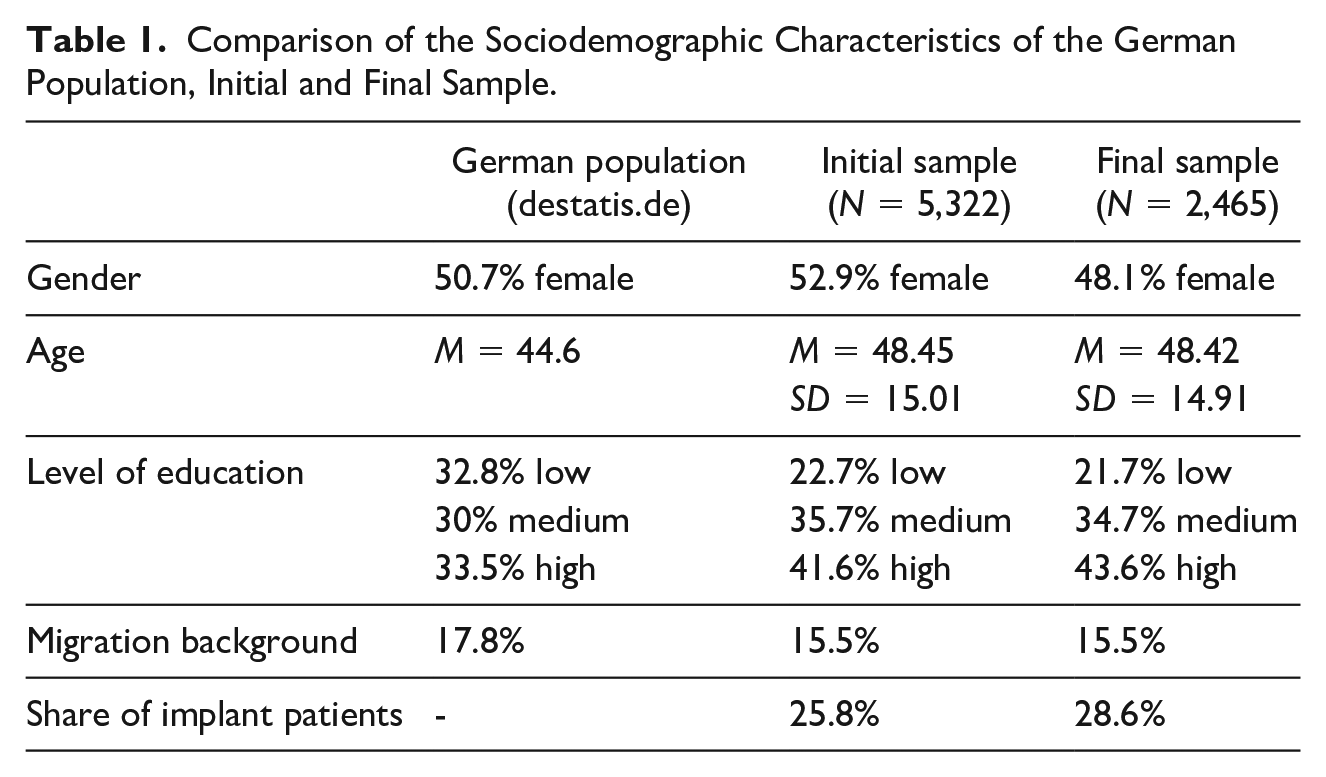
To test our hypotheses and answer our research questions, we conducted an online survey of a sample of German residents via a commercial German online access panel. The commercial panel consists of 400,000 panelists recruited through online and offline sources. Our sample of participants (N = 5,322) was stratified by gender, age, education, and region to match the German population. They were aged between 18 and 74 years (M = 48.5; SD = 15.01), half were female (52.9%), 22.7% had completed junior high school, 35.7% had a general certificate of upper secondary education (high school), and 41.6% had a least a university entrance qualification. 15.5% reported having a migration background (see Table 1 for a comparison with the German population). The study protocol was approved by the Central Ethics Committee of the Hanover University of Music, Drama, and Media. All participants were asked for their informed consent and were advised of their right to withdraw from participation at any time.
Comparison of the Sociodemographic Characteristics of the German Population, Initial and Final Sample.
Measures
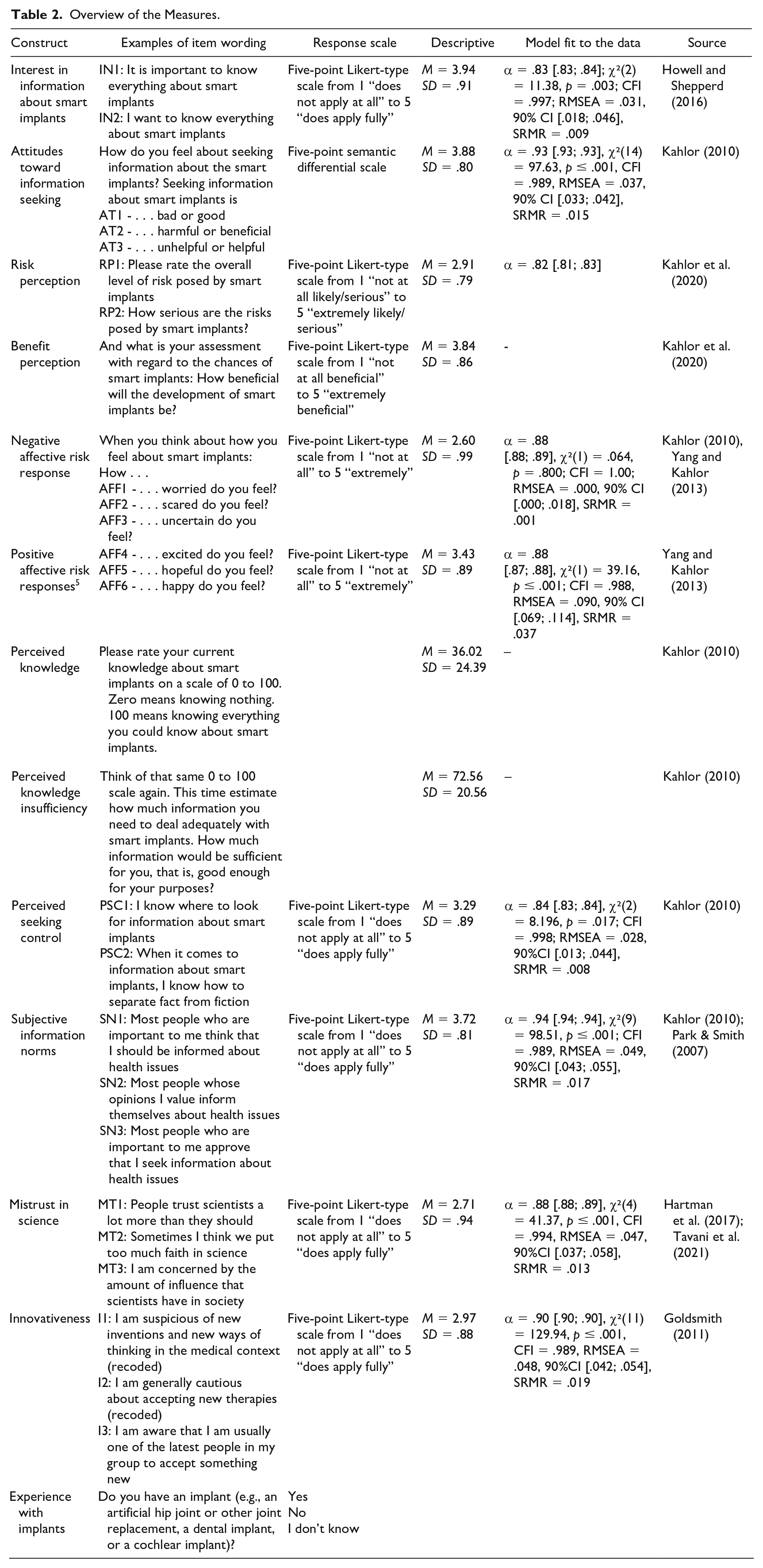
The operationalization was adapted from established measures that had already been translated into German in former research or were translated into German using a team translation approach. Except for attitudes toward information seeking, all items were measured on five-point Likert-type scales. The items’ wording as well as the type of scale can be found in Table 2. Before answering the questions, respondents were given a vignette describing the research on and characteristics of smart implants (see Online-Appendix). For all questions, respondents had the option to indicate that they could not make a corresponding assessment, which resulted in missing values.
Overview of the Measures.
Information Seeking Intent About Smart Implants
To describe individuals’ intent to acquire information about smart implants, we deliberately deviated from the established measurement of PRISM (Kahlor, 2010) focusing on individuals’ behavioral intent. As information on smart implants is preliminary and the public is not affected immediately, we aim to capture less the behavioral aspect but the motivational force underlying ongoing information seeking, which does not aim to make better decisions immediately, but to satisfy a personal interest, form attitudes (Takahashi & Tandoc, 2016), and to gain knowledge for future decision-making (Z. Zhang & Hou, 2017). Therefore, we adapted the Information Avoidance Scale of Howell and Shepperd (2016) capturing individuals’ openness to information about a specific issue. The participants reported their responses to a six-item measure. The internal consistency and fit of the measurement models were adequate (see Table 2). However, the measurement model showed problems with the different polarization of the items. Therefore, only the three items capturing openness were used for analysis (α = .84, M = 2.17, SD = .85).
Attitudes Toward Information Seeking
The attitudes toward information seeking were measured in line with Kahlor (2010). The measurement consists of seven 5-point semantic differential items asking the participants how they evaluate to acquire information about smart implants. The latent variable representing attitudes toward information-seeking showed an adequate fit to the data (α = .93, M = 3.88, SD = .80; see Table 2).
Subjective Information Norms
To assess how common and approved information acquisition was experienced among the individuals’ peers, we measured subjective information norms through the inclusion of injunctive and descriptive norms (Kahlor, 2010; Park & Smith, 2007). The measured applicability of five items showed an adequate fit to the data (α = .95, M = 3.72, SD = .81; see Table 2).
Perceived Seeking Control
In line with past research (Kahlor, 2010), respondents’ perceived ability to acquire information on smart implants was measured by a four-item construct. The measurement model showed an adequate fit to the data (α = .84, M = 3.29, SD = .89; see Table 2).
Perceived Current Knowledge and Knowledge Insufficiency
One’s perceived level of current knowledge (M = 36.02; SD = 24.39) and one’s desired level of knowledge (“perceived knowledge insufficiency”) about smart implants (M = 72.56; SD = 20.56) were both rated on scales between 0 and 100.
Risk Perceptions
Risk perceptions about smart implants were measured with two items that describe the risk components of susceptibility and severity (Kahlor et al., 2020). The two items were combined into a mean index for further analysis (α = .82, M = 2.91, SD = .79).
Benefit Perceptions
Benefit perceptions of smart implants were measured with a single item asking how beneficial smart implants were perceived to be for the respondents (Kahlor et al., 2020) (M = 3.84, SD = .86).
Positive and Negative Affective Risk Responses
Adapted from a measurement used by Yang and Kahlor (2013), participants were asked to indicate their positive and negative affective responses toward smart implants. The data of both measurement models were found to be satisfactory (negative: α = .88, M = 2.60; SD = .99; positive: M = 3.43; SD = .89; see Table 2).
Mistrust in Science
To measure individuals’ mistrust in science, we adapted the credibility of science scale (Hartman et al., 2017; Tavani et al., 2021). The fit of the measurement model was adequate (α = .88, M = 2.71, SD = .94; see Table 2).
Innovativeness
Individuals’ innovativeness was measured using seven adapted items of the subdimension “willing to try” of the global innovativeness scale (Goldsmith, 2011). The measurement model showed an adequate fit to the data (α = .90, M = 2.97, SD = .88; see Table 2).
Experience With Medical Implants
In addition, we asked the respondents whether they had an implant, which is considered a proxy of involvement with innovation in this specific medical area (Li et al., 2021) and should be included as a covariate. A share of 25.8% reported to have a medical implant (see Table 1).
Data Analysis
A latent variable structural equation model was conducted in R using the package lavaan to examine the paths and model fit of the proposed model. Before testing the structural model, we separately verified all measurement models (see Table 2). Indicators of model fit included chi-square, comparative fit index (CFI), root mean square error approximation (RMSEA), and standardized root mean residual (SRMR; Hu & Bentler, 1999).
In the initial sample, a proportion of up to 15% of missing values in single variables was found as the participants indicated that they felt not able to evaluate different aspects related to smart implants. The values were not missing at random, which was confirmed by the MCAR-test by Little, χ2(61506) = 66610.20, p ≤ .001. Thus, we decided against an imputation procedure and chose listwise deletion for dealing with the missing values. Thus, the analysis is based on a subsample (n = 2,465). The comparison between the final and initial sample (see Table 1) revealed that the share of women was slightly lower, while the proportions of individuals with higher education and experience with implants were slightly higher in the final sample.
Results
The extended PRISM showed a satisfactory model fit, χ2 (816) = 2581.59, p ≤ .001, CFI = .966, RMSEA = .030, 90% CI [.028, .031], SRMR = .059; Hu & Bentler, 1999. Since the other indices had satisfactory levels, the significant χ2-test was attributed to the sample size, Hoelter’s critical N (CN) = 706.93. In total, the model accounted for 36.0% of the variance in information-seeking intention about smart implants (see Table 3).
Modeling Individuals’ Information Seeking Intent About Smart Implants: Hypothesis Testing Results.
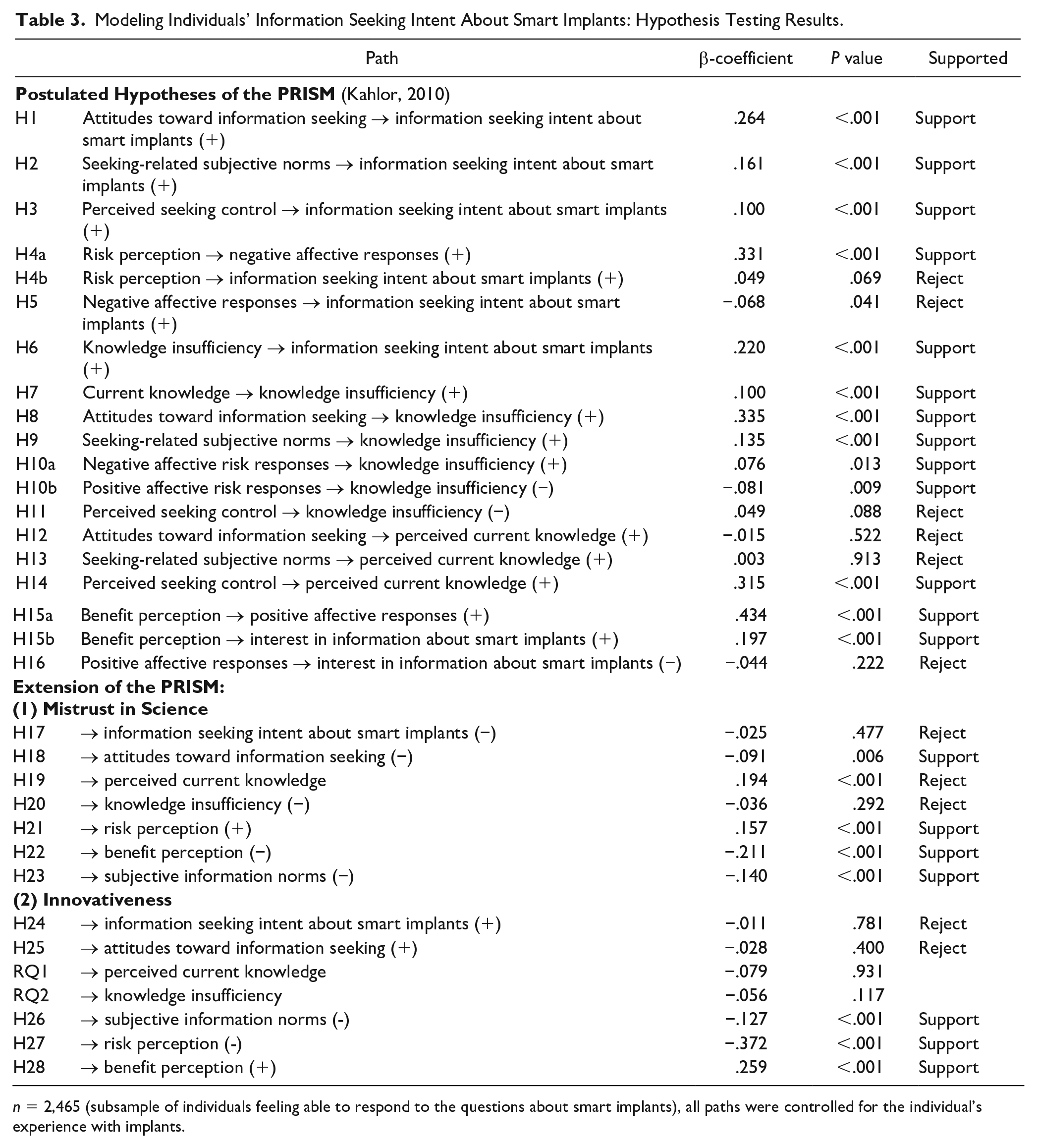
n = 2,465 (subsample of individuals feeling able to respond to the questions about smart implants), all paths were controlled for the individual’s experience with implants.
Testing the Postulated Paths of the Initial PRISM
Focusing on the original PRISM, the majority of relationships held up for individuals’ information-seeking intent about smart implants. Seeking intent was found to be positively associated with more positive attitudes toward information seeking (H1; β = .26; p ≤ .001), more pronounced subjective information norms (H2; β = .16; p ≤ .001), higher perceived seeking control (H3; β = .10; p ≤ .001), higher knowledge insufficiency (H6; β = .22; p ≤ .001), as well as more pronounced benefits perceptions (H15b; β = .20; p ≤ .001). Attitudes toward information seeking and knowledge insufficiency were among the strongest predictors of seeking intent.
The findings also support that current knowledge (H7; β = .10; p ≤ .001), attitudes toward information seeking (H8; β = .34; p ≤ .001), seeking-related subjective norms (H9; β = .14; p ≤ .001), negative (H10a; β = .08; p = .13) and positive affective responses (H10b; β = −.08; p = .009) were associated with perceived knowledge insufficiency. In addition, our findings supported that perceived seeking control was related to perceived current knowledge (H14; β = .32; p ≤ .001), and both affective responses were found to be related to risk and benefits perceptions (cf. H4a and H15a, see Table 3).
In contrast to the PRISM, we found no significant association between both affective responses and seeking intent (H5: negative affective response; β = −.01; p = .79; H16: positive affective response; β = −.04; p = .22). More pronounced risk perceptions were not related to higher seeking intent (H4b; β = .05; p = .069), perceived seeking control was not associated with perceived knowledge insufficiency (H11; β = .05; p = .088) and perceived current knowledge was neither linked to attitudes toward information seeking (H12; β = −.02; p = .52) nor seeking-related subjective norms (H13; β = .01; p = .91).
Testing the Role of Mistrust in Science
Focusing on the role of mistrust in science (see Table 3), we found that mistrust was not associated with seeking intent (H17; β = −.03; p = .48), which contradicts Hypothesis 17. However, except for the relation to perceived knowledge insufficiency (H20; β = −.04; p = .29), the findings indicate that mistrust was related to all other considered predictors of seeking intent. In line with the derived hypotheses, mistrust was negatively associated with attitudes toward information seeking (H18; β = −.09; p = .006), subjective information norms (H23; β = −.14; p ≤ .001), and benefit perceptions (H22; β = −.21; p ≤ .001) as well as positively related to risk perceptions (H21; β = .16; p ≤ .001). In contrast to H19, mistrust was not negatively but positively related to one’s perceived current knowledge (H19; β = .19; p ≤ .001).
Testing the Role of Innovativeness
Concerning individuals’ innovativeness, the individuals’ general tendency to adopt innovations was not related to their seeking intent (H24; β = −.01; p = .78), their attitudes toward information seeking (H25; β = −.03; p = .40) as well as their perceived current knowledge (RQ1; β = −.08; p = .93) and perceived knowledge insufficiency (RQ2; β = −.06; p = .12). Thus, we had to reject H24 and H25 and state for RQ1 and RQ2 that we found no relationship between innovativeness and one’s current knowledge or knowledge insufficiency. However, we found hypotheses-conforming relationships for the positive association between innovativeness and benefit perception (H28; β = .26; p ≤ .001), for the negative link between innovativeness and risk perceptions (H27; β = −.37; p ≤ .001), which can be rated as rather strong. We could further support the hypothesis that innovativeness was negatively related to subjective information norms (H26; β = −.13; p ≤ .001).
Discussion
In today’s digital media environments, science communication encounters immense competition for attention and increasing skepticism in audiences facing information overload. To better understand the interface between science and society, knowing which predispositions determine whether individuals are motivated to engage with scientific knowledge is becoming increasingly important. Knowing the motivational forces to seek information about medical innovations such as smart implants is not only relevant to broaden the range of applications for theoretical models such as the PRISM but also to provide further evidence in the field of science communication research by better understanding what contributes to seeking intent as a prerequisite to promote individuals’ acceptance of medical innovations, attitude formation, and complex treatment-related decision-making processes (Takahashi & Tandoc, 2016).
The Predictors of Information Seeking Intent About Medical Innovations
Overall, our findings support PRISM’s utility as a theoretical framework for explaining individuals’ intent to seek information about medical innovations such as smart implants. The postulated model explains a relatively high amount of variance in one’s seeking intent, which adds to studies that have applied the PRISM to various health and scientific contexts (Ahn & Kahlor, 2020; Hovick et al., 2014; Link et al., 2021; M. Liu et al., 2021; Ou & Ho, 2022). Our study complements extant research by predicting intent in innovation contexts, where higher barriers to acceptance have to be overcome than in areas of application with which people are already familiar.
Concerning the predictors relevant to information-seeking intent in the context of medical innovations, our results underline the role of subjective information norms, attitudes toward information seeking, behavioral seeking control, benefit perceptions, and perceived knowledge insufficiency (Kahlor, 2010; Kahlor et al., 2020). Focusing on the most potent associations, the findings suggest that individuals show a higher intent to seek innovation-related information when they perceive the information behavior to be favorable and when they perceive a higher knowledge gap. This contrasts previous PRISM-based studies that found little or no association between knowledge insufficiency and seeking intent or seeking behavior (Kahlor, 2010; Link et al., 2021; Wang et al., 2021; Yang et al., 2011, 2014). Instead, our findings support the rationale of Link and colleagues (2021), who found that perceived knowledge insufficiency plays a context-dependent role. Besides the personal relevance of information-seeking behaviors raising awareness for knowledge insufficiency, the present case suggests that the discrepancy has to reach a critical size to impact information behavior. Focusing on attitudes toward information seeking, their explanatory power varied in previous studies (e.g., Kessler & Zillich, 2019; Link et al., 2021; Ou & Ho, 2022; Wang et al., 2021). Attitudes toward information seeking were shown to be more influential among healthy compared to affected individuals (Link et al., 2021), which is also relevant to note for this study among a sample of the general public.
In contrast to the initial PRISM (Kahlor, 2010), negative and positive affective responses were not significantly associated with seeking intent. Instead, benefit perceptions were found to be directly related to individuals’ intent, which supports extant research highlighting the relevance of considering risk and benefits perceptions within the PRISM (Bessette et al., 2019; Kahlor et al., 2020). The higher relevance of benefit perceptions compared to both affective responses might indicate that medical innovations are assessed through a cognitive instead of an affective view. In addition, individuals reported possessing only low pronounced (negative) affective responses, which might be a characteristic of medical innovations individuals are neither knowledgeable about nor directly affected by (Z. Zhang & Hou, 2017).
The Role of Mistrust in Science
Focusing on the role of mistrust in science for individuals’ intent to seek information about medical innovations (cf. H17–H23), our findings indicate, in contrast to our theoretical rationale, no direct association between mistrust and seeking intent (Gauchat, 2011; Nadelson et al., 2014). However, they revealed small to medium associations between mistrust and the considered predictors of PRISM. In line with previous research and the derived hypotheses, a lower willingness to rely on science was related to less positive attitudes toward information seeking (Link et al., 2024; Wang et al., 2021), fewer benefit perceptions (Plohl & Musil, 2021; Siegrist & Cvetkovich, 2000), and lower pronounced subjective information norms (Festinger, 1957; Marks & Miller, 1987). For all mentioned predictors, the negative relation to mistrust indicates that those individuals who are more skeptical toward science possess a lower intent to perform information-seeking behavior.
Although we could not support that mistrust was related to a lower desired level of knowledge about smart implants, we found that individuals who are more skeptical toward science perceive themselves to possess a higher level of current knowledge. As mistrust might not serve as a substitute for knowledge (e.g., Earle & Cvetkovich, 1995; Hendriks et al., 2016; Nadelson et al., 2014; Siegrist, 2000), the participants are suggested to (perceive to) possess a higher knowledge about science to control and critically assess scientific information. However, this level of current knowledge might be biased in favor of a more skeptical view on science, which stresses the relevance of determining the relation between subjective and objective states of knowledge.
A further positive association was found between mistrust and risk perceptions, which is in line with existing research (Plohl & Musil, 2021; Siegrist & Cvetkovich, 2000). The higher current knowledge and higher risk perceptions of more mistrusting individuals might be associated with certain goals individuals pursue when seeking information (Chasiotis et al., 2020). Particularly critically assessing scientific information, preparing for counterarguing, or coping with emotional burdens, reducing negative emotions, and increasing positive ones might be more crucial than understanding or action planning (Brashers, 2001; Chasiotis et al., 2020).
To sum up, we found that mistrust was not a direct driver of individuals’ seeking intent but served indirectly as a barrier to information behaviors or might increase the likeability of risk-driven information behaviors. Furthermore, the findings revealed that mistrust influences the assessment of medical innovations and determines whether they are perceived as beneficial or harmful, which is crucial for an individual’s acceptance and compliance with innovative treatments such as smart implants. Thus, mistrust can be perceived as a background factor influencing the psycho-social predictors of information-seeking intent subsumed within the PRISM.
The Role of Individuals’ Innovativeness
Regarding individuals’ innovativeness, we could not support that this personality trait relevant to innovation diffusion was related to higher information-seeking intent (Li et al., 2021; Z. Zhang & Hou, 2017). It also did not influence attitudes toward information seeking. For perceived knowledge insufficiency, we can conclude that innovativeness is neither associated with a higher sufficiency threshold resulting in higher information needs (Chaiken, 1980) nor do we find support for the postulate that highly innovative individuals require less information for decision-making (Z. Zhang & Hou, 2017). These contradictions to the theoretically derived postulate might be related to the features of smart implants and their early phase of development. It can be assumed that innovativeness is most influential for the decision-making process before the adoption of an innovation (Hirunyawipdata & Paswan, 2006; Hong et al., 2017; Z. Zhang & Hou, 2017), which might limit its influence in the case of an innovation that is still under development, has not yet been used in practice such as smart implants and is of limited immediate personal relevance. The provisional nature and limited amount of extant knowledge also affected our decision to use a measurement of seeking intent capturing the motivation to becoming more knowledgeable instead of the behavioral intention to perform a search in the future and prepare for actions such as the early adaption of an innovation. This finding suggests that innovativeness is not related to information behaviors but to health behaviors.
The crucial role of innovativeness for decision-making and (early) adoption of innovations instead of information seeking becomes apparent regarding its relatively strong association with risk and benefits perception about smart implants. In line with previous research (e.g., Aldás-Manzano et al., 2009; Chauhan et al., 2019; Z. Zhang & Hou, 2017), our findings suggest that individuals with higher levels of innovativeness perceived fewer risks and more benefits, which might be more critical for decision-making than information behavior. In addition, we found a negative association between innovativeness and subjective information norms supporting that highly innovative individuals’ independence and opinion leadership (Dobre et al., 2009; M. Zhang et al., 2017) is associated with less pronounced norm perceptions.
In summary, the personality trait of innovativeness appears to have limited importance for individuals’ seeking intent. Concerning the development of parsimonious models of information-seeking behaviors, our findings revealed that innovativeness is not a relevant extension but an alternative approach to examine the acceptance of medical innovations. The results further suggest that it is important to assess the benefits and risks of innovations, which might directly impact decision-making, rather than the acquisition of information relevant to the preparation of decision-making.
Limitations and Tasks for Future Research
The study involves several limitations and provides starting points for further research. First, it should be noted that half of our sample felt unable to answer at least one question about smart implants. It can be assumed that those who felt unable to make an assessment also represent a relevant target group for science communication efforts. Theoretically and empirically, they need to be understood concerning the determinants of their information-seeking intent. We assume that their informational attitudes and behaviors as well as their science literacy differ from those of the analyzed subsample. Therefore, we do not claim to make statements for this group, but we advise future research to focus on this group. Second, instead of measuring seeking intent focusing on the behavioral aspect to perform information seeking we used a broader measurement focusing on the motivational aspect to acquire knowledge and learn about medical innovations. It can be assumed that our measurement is more related to internal factors such as one’s interest, whereas a measurement with a behavioral focus also considers external factors such as a lack of time or the competition for attention of various medical issues of interest. To the best of our knowledge, the relationship between various types of measures of seeking intent and actual information-seeking behaviors is understudied. Accordingly, we can only speculate to what extent the motivation is followed by information acquisition. Third, smart implants, as the innovation under study, are still in an early stage of development resulting in a low awareness of the public and a low state of available knowledge. Despite the description of the innovation in the questionnaire, this circumstance not only led to the already mentioned problems with the sample but also meant that the findings would not necessarily apply to other (medical) innovations about which more is already known, and a more informed judgment can be made. Overall, this points to the need to consider the degree of development and the salience of the issue under study in innovation acceptance research. Fourth, to consider the context under study more comprehensively, further research should consider the level of mistrust in medical science instead of science in general.
Conclusion and Practical Implications
The study provides evidence of predictors of seeking intent about medical innovations. The contribution to a better understanding of individual’s motivation to learn about these scientific issues was explicitly related to the following two objectives: First, we tested whether the PRISM is applicable to the context of medical innovations characterized by preliminary knowledge, high uncertainty, complexity, and no immediate affectedness of the public. Our findings support the robustness of the postulated assumptions and reveal which predictors are crucial. Second, we extended the PRISM to examine whether two constructs crucial to adopting scientific innovations at a very early stage of development and public awareness—mistrust in science and individual innovativeness—influence the predictors and seeking intent about scientific information. We found that neither mistrust in science nor innovativeness influenced individuals’ seeking intent. While mistrust served as a crucial inhibiting background factor associated with seeking intentions, innovativeness played a minor role in information behaviors. Our findings suggest that innovativeness is relevant for a person’s evaluation of innovations and might serve as a powerful heuristic for decision-making about innovations but is less important for understanding information behaviors referring to medical innovations. These findings are valuable to develop and specify parsimonious models of risk and health information seeking.
As a practical implication of our findings, we aim to stress in line with former research that mistrust in science is a major challenge for science communication efforts, public engagement, and acceptance of scientific progress. In particular, the current findings showed that mistrust is also a barrier to information behaviors relevant to informed decision-making, acceptance of, and compliance with medical innovations. Therefore, communication strategies and educational programs are needed that promote trust in science, for example, by increasing public understanding of scientific standards, using debunking strategies, or fostering individuals’ engagement with science. A second major implication can be derived, which informs the scientific innovation development process of smart implants: The large share of the population unable to assess smart implants points out the need for communication efforts to first raise awareness for the issue and inform the public about the ongoing medical innovation progress. For a theory-based development of a science communication strategy, a stepwise model of behavior changes such as the Transtheoretical Model of Behavior Change (Prochaska, 2008) might be useful here as it becomes clear that the communicative starting point is a very early stage of decision-making. After having created awareness for the topic, potentials, and goals, the risks and challenges need to be addressed to promote the public’s informed assessment and decision-making in the following stages of change.
Supplemental Material
sj-docx-1-scx-10.1177_10755470241253815 – Supplemental material for What Drives or Inhibits Individuals’ Intention to Seek Information About Medical Innovations?: Findings From an Online Survey Among German Residents
Supplemental material, sj-docx-1-scx-10.1177_10755470241253815 for What Drives or Inhibits Individuals’ Intention to Seek Information About Medical Innovations?: Findings From an Online Survey Among German Residents by Elena Link, Eva Baumann, Charlotte Schrimpff, Tanja Fisse and Christoph Klimmt in Science Communication
Footnotes
Declaration of Conflicting Interests
The author(s) declared no potential conflicts of interest with respect to the research, authorship, and/or publication of this article.
Funding
The author(s) disclosed receipt of the following financial support for the research, authorship, and/or publication of this article: This work was funded by the Deutsche Forschungsgemeinschaft (DFG, German Research Foundation) – SFB/TRR-298-SIIRI – Project-ID [426335750].

Author Biographies
References
Supplementary Material
Please find the following supplemental material available below.
For Open Access articles published under a Creative Commons License, all supplemental material carries the same license as the article it is associated with.
For non-Open Access articles published, all supplemental material carries a non-exclusive license, and permission requests for re-use of supplemental material or any part of supplemental material shall be sent directly to the copyright owner as specified in the copyright notice associated with the article.
