







Abstract
For centuries, poetry was the primary form of science communication. Poets practiced the literary craft of creating impactful and memorable poetry that also communicated scientific knowledge. While contemporary poets incorporate scientific information into their work, there exists scant scholarship on the poetics and craft elements of science poems. The poet must enact a balance between disparate syntax, diction, ideas, and form. Through poetic examples, I demonstrate how a science poem can contain clear scientific information and still function as art.
For centuries, poetry was the primary form of science communication. While scientists gathered facts, it was the poet’s job to situate the knowledge in literary traditions, cultural mythology, religious speculation, and moral law (Crawford, 2006). Thus, many scientific ideas entered the collective consciousness and imagination through poetry. The departure of poetry as a vessel for science communication occurred only recently, with scientific writing becoming restricted to a particular genre in the late 19th century (Roxburgh & Sprang, 2018). For years, poets practiced the literary craft of creating impactful and memorable poetry that also communicated scientific knowledge. While there are excellent examples of contemporary science communication in all literary genres and increasing attention on multidisciplinary exploration and propagation of scientific ideas, there is currently scant scholarship on the poetics and craft elements of science poems. What makes a science poem successful and what are the considerations in their creation? The poet must enact a balance between disparate syntax, diction, ideas, and form. Science poetry is somewhat of a formal challenge, using “cold” scientific material alongside “warmer” energy and imagery (Crawford, 2006, p. 54). Just as poets from the 12th century had to grapple with incorporating scientific information into literature, contemporary poets writing science poetry must skillfully wield scientific fact during artmaking to render a quality poem with transferable science knowledge.
Given the fact that both science and poetry arise from creative thinking that links contradictory mental domains, poetry remains especially well suited to serve as a vessel for presenting complex scientific information and situating that information in the feel-space 1 of personal and cultural experience. Poetry with scientific information “draws on discourse based on data, logic, principles (empirical logic), and a narrative that reflects intuitions, beliefs, values, imagery, and emotions that respond to personal experience (personal logic)” (Tada, 2019, p. 517). If done effectively, scientific information expressed in a poem can be more engaging than a scientific journal article and can broaden the reader’s perspective of the subject.
Poetry and science together can provide a more impactful, memorable, and beneficial understanding than science material alone because it can arouse emotional centers of the brain that are correlated with memory. Emotional arousal activates the amygdala, a portion of the brain that modulates memory storage in other areas of the brain (McGaugh et al., 1996). Scientific reasoning, emotional processing, and artistic creativity take place in different regions of the brain (Shi et al., 2017). Thus, art coupled with science has the benefit of presenting a suite of information the brain must interpret that excites more regions of the brain than if the scientific information was presented alone. This may enrich the experience and make it more likely that the knowledge is retained through stronger memory formation.
Scientific information is presented in a regular structure and form. In contrast, scientific information integrated into art is more irregular in structure and form. Thus, we “remark the features of a rare configuration because . . . irregularity is unexpected; in this sense . . . irregularity would require a more elaborate instruction than the average and can be said to carry more information” (Bronowski, 1969, p. 81). Science information alone presents an unwavering pitch, so to speak, and as such can be featureless. Science expressed in poetry, or around poetry, is more like listening to a complex and varied symphony with many instruments and tones. Poetry with science is irregular and unexpected. Thus, it carries more information that can simultaneously excite different regions of the brain while creating a rich encounter of both art and science (Shi et al., 2017).
Some may ask why contemporary poets should concern themselves with science poems. After all, many agree that poetry is a highly marginalized literary genre, and even if intelligible science content is disseminated through poetry, it would have a minimal impact on overall science literacy. Yet, art gives space to explore the ways in which the factual attributes of the world interact with experience. Art functions as a chiral to consciousness. Science is a honed reduction of a finite set of information, a peeled plait, and a specified thread. Science poems can offer a holistic and reintegrated way to encounter that scientific information. Scientific information can be absorbed and reprecipitated into poetry, to be in conversation with the information with added feel-space. The constraints of narrowed focus are lifted and the information can expand. Science poetry has an important role to play to give scientific information necessary context in the greater entanglement.
There are two main considerations to bear in mind for writing successful science poems with large amounts of clear scientific information: (a) the craft technique to incorporate the information with enough poetic maneuvering to deviate the language from a purely instructional form, and (b) the craft technique to ensure transferability of science content as literal language to be taken as fact. The first consideration is easy to address, if one feels confident that they can argue exactly what a poem is and when it is not just prose in poetic form. The key to a successful science poem is to ensure there are adequate craft and poetic moves to differentiate it from mere instructional prose. The poem must clearly do something else besides present information. Is it situating the science in feel-space? Is it disrupting, distorting, or questioning our understanding of the scientific matter? Is it placing that information in a greater context? The more science content, the more care must be taken to ensure that enough poetic moves are employed. With less science content, it is easier to incorporate the information without danger of creating something purely didactic and questionable as poetry. Ultimately, whether a science poem succeeds as art and not just informative language with line breaks is somewhat subjective, while the matter of understandable scientific information can be parsed into a more concrete discussion.
There are several craft techniques to ensure transferability of science content as literal language that can be taken as fact. As a scientist and poet, I have created a manuscript of science poems while deliberately examining their successes and failures after incorporating varying amounts of scientific information. From this work, I have concluded that a successful craft technique for including large amounts of clear scientific information is to offset poetic and scientific language. If factual language is maximally distorted in the process of writing the poem, it becomes inextricable from the poetic language. There is no assurance that a reader would be able to recognize that information as factual. For example, my poem “Marginalia on the Table of Elements Including Names, Symbols, and Atomic Numbers” contains a mixture of offset scientific and poetic language as well as a conglomeration of both:
Al Aluminum (13) Aluminum mines mock martyred trees, are blue with blood and bled metal.
Fe Iron (26) Iron round in remorse and railing, or rather square as ether bringer.
Co Cobalt (27) Cobalt the heavy colt, built into blood balm, vitamin B12, myelin.
Ni Nickel (28) Nickel the naughty sick, the poisoning lick, the stricken fickle, flaxen sack.
Cu Copper (29) Copper open to carry, like our hemoglobin, hauling O2 in hemocyanin.
Zn Zinc (30) Zinc the succulent one, neither zenith nor azure of zinnias, haze blue.
Se Selenium (34) Selenium into chiral hexagonal crystals, chirality an asymmetry, mirror.
Br Bromine (35) Bromine brown, born being diatomic molecules in all aggregation states.
Kr Krypton (36) Krypton rips kites, tinkers with crypt kits, tapers prior pyres, clips.
On the left, the element, symbol, and atomic weight are presented. These are factual representations of the elements, and it would be clear to most readers that this information is literal. The marginalia includes a fragment for each element presented. Some of these are literal and based on the true nature of the element, such as “Copper open to carry, like our hemoglobin, hauling O2 in hemocyanin.” Hemocyanin, made with two copper atoms and a protein chain, carries oxygen in some invertebrates. Selenium is another poetic line built with fact, “Selenium into chiral hexagonal crystals, chirality an asymmetry, mirror.” The most stable form of selenium is a chiral hexagonal crystal lattice. Chiral is a mirror image, such as the left and right hands. Other fragments play on the name of the element, its popular associations, or other imaginative musing. Because the fragments are a mixture of fact and language exploration, the overall effect is to occlude which fragments are factual and which are not. Ultimately, the only intelligible science becomes the list of elements.
Offsetting scientific language with poetic language can be achieved in several ways. It can be accomplished by physically separating the language and having contrasting diction, syntax, and form to alert a reader of the difference between the two. For example, my poem “There Will Be Harmonies” uses justification and different alignment and syntax to offset the science and poetic musing on the science:
cumulative values what is the foundation anodic (forward) and cathodic (reverse) reactions scarlet bluffs and sage harvest of thought of what significance entire system of shrilling shadow frankly, charm and brightness trout symphonies and wet stones quick to plunge into glossy undulations concentric currents viscosity and liquid ululations universal common intercept The reaction rate theory for viscosity is a statistical mechanical theory that assumes a liquid has a quasi-crystalline structure and consists of molecules vibrating about an equilibrium position. Under the reaction rate theory framework, a molecule can only move when: 1) there is an empty hole available to jump in and 2) the molecule has sufficient energy to overcome the attractive forces exerted by surrounding molecules. The energy necessary to form a hole with the size of a molecule in the liquid is assumed to be the same as that to vaporize a molecule. : the most irrational liquid number : constant intertwining of light and loss : volume of dream cones : ultramarine ideal constant : temperature of waxing grief
Based on the reaction rate theory, the free activation energy of viscous flow is linked to the liquid viscosity through the following expression:

where
N: the Avogadro’s number
h: Plank’s constant
V: molar volume
R: idea gas constant
T: temperature nothing illusory broadening and gradually slackening returning to glass stillness, viscous surface stained by polychrome hues intermittently mottled, darker, narrower there will be harmonies frankly, charm and brightness quick to plunge into shrilling shadow
Thus, by varying form, it becomes evident which language is literal and which is an exploration of what is literal. Form can also be varied by using italics, by using numbered lists or bullet points, or other clear delineation. A poet can separate poetic and scientific language, yet greater integration is also possible without occluding the scientific content.
Science poems can also have distinct areas of scientific ideas and poetic exploration by using juxtapositions of scientific images with poetic language. For example, in “Foraging Behavior of the Wood-rotting Fungus,” I include an image in tandem with the poetic language, thereby presenting scientific information where clarity of subject matter is intact and transferable:
Phanerochaete velutina spiders ki’s mycelium exploratory mode makes whirls dichotomous branches split & split again a wheel of touch a search of sugar proliferating white pinwheels radial extension these fractal dimensions when the fungus finds food ki prunes the links of lack o cord-forming basidiomycete mover of nutrients & carbon I want to know how you decide at the interface of the litter layer & soil horizon in the forest floor I too sieve for insight fingers graze white hyphae I envy cell-level directional memory because resource depletion because fractal lack I pinwheel & split again
from Fukasawa & Kaga (supplemental material)
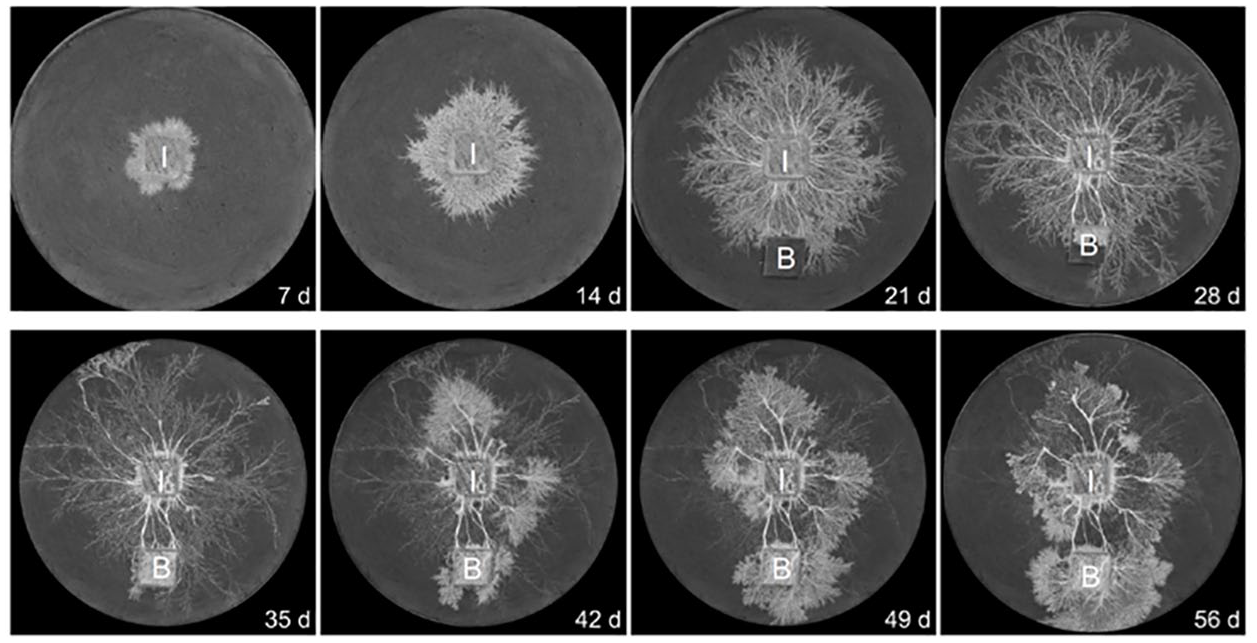
This poem is in conversation with the fungal research of Yu Fukasawa and Koji Kaga as well as Merlin Sheldrake from whom I first learned of their research. The poem contains this image because it addresses the growth of the fungus Phanerochaete velutina and how it exhibits cell-level directional memory. There is a mix of scientific and poetic language about the fungus, and the image provides context and results of the experiment. After I shared the poem with Japanese researcher Fukasawa, I obtained permission to include his image in my work. 2 This method of incorporating current research is also a way to broaden the conversation between artists and scientists.
It is not always the goal to maximize scientific information, and it is not necessary to do so for a science poem to be successful. Poems may share scientific ideas, concepts, vocabulary, or topics in limited ways yet still function as science poems that convey scientific knowledge. When there is less science content, then it is easier to present scientific discourse discrete from poetic discourse. For example, in my poem “When Birds Drink Seawater Salt Moves Through Their Blood Into Salt Glands and Out of Their Bodies,” the only science content is in the title, and the rest of the poem has different diction, syntax, and subject matter.
In conclusion, the more science content included in a poem, the more pressure there is on the craft element. The most successful craft technique to include clear scientific information is to contrast poetic and scientific language in the poem, which can be achieved by physically separating the language and using different diction, syntax, and form. Scientific images with poetic language can also be used to integrate and offset the two. Using my science poems as examples, I have demonstrated these techniques and have shown how science poetry can offer a holistic and reintegrated way to encounter scientific information. Science poetry, irrespective of the amount of scientific content, can lead to the encounter of scientific material more akin to the milieu of consciousness, adding informational science material to feel-space, where facts entangle with experience, and where simultaneity of sensorial, mental, and physical processes defies linearity.
Footnotes
Declaration of Conflicting Interests
The author(s) declared no potential conflicts of interest with respect to the research, authorship, and/or publication of this article.
Funding
The author(s) received no financial support for the research, authorship, and/or publication of this article.
Notes
Author Biography
