







Abstract
This meta-analysis synthesized 43 empirical articles to summarize the impact of communicating three distinct uncertainty types (i.e., epistemic uncertainty, consensus uncertainty, and technical uncertainty) in science communication. The results revealed divergent effects across these three uncertainty types. Specifically, communicating epistemic uncertainty was found to have a small yet positive effect on credibility perception (d = 0.09), with a nonsignificant impact on attitudes. Conversely, communicating consensus uncertainty (d = −0.12) and technical uncertainty (d = −0.15) demonstrated a slight negative effect on attitudes, without impacting credibility perception. In addition, topic domain, cultural uncertainty avoidance, and text length were important moderators.
Uncertainty constitutes an intrinsic facet of scientific inquiry (Pollack, 2003; Star, 1985). Scientific exploration is inherently characterized by complexities and intricacies, which pose challenges to straightforward explanations (Fischhoff, 2012). As new evidence emerges and methodologies evolve, scientific knowledge remains open to refinement and revision, which introduces an additional layer of uncertainty (Kuhn, 1970). Therefore, the intricate, evolving, and probabilistic nature of scientific endeavors is inevitably characterized by uncertainty (Bromme & Goldman, 2014). In this light, embracing uncertainty in the scientific process is crucial for promoting transparency within the science community (Thorp, 2023), building long-term public trust (Ihlen et al., 2022), and nurturing a sustainable scientific landscape (Kreps & Kriner, 2020).
Nevertheless, effectively conveying uncertainty to the public has long presented considerable challenges. For one thing, the intricate nature of scientific and technical information poses a significant obstacle to comprehensible communication, particularly when addressing a diverse audience (Osman et al., 2018). For another, integrating uncertainties in science communication carries the risk of evoking skepticism and misinterpretation among the general public (Kortenkamp & Basten, 2015). A notable illustration of this challenge manifested during the COVID-19 pandemic, wherein trust in scientists declined from 39% to 23% in response to the uncertainties faced by the scientific community as they progressively gained insights into the nature of the virus (Pew Research Center, 2023). Consequently, journalists often opt to report scientific findings as more certain beyond warranted (Retzbach & Maier, 2015) as a strategy to simplify complex information (Ebeling, 2008) and mitigate possible adverse repercussions (Lehmkuhl & Peters, 2016). All these aspects underscore the persistent dilemma confronted by the science community regarding whether and how to disclose uncertainties in science to the public.
Recently, a growing body of scholarship has explored the impact of communicating scientific uncertainty across diverse contexts, including medicine and health (Hendriks et al., 2023; Hinnant et al., 2023), environmental issues (Hendriks & Jucks, 2020; van der Bles et al., 2020), and cutting-edge technologies (Lin & Kim, 2022; Ratcliff et al., 2021). Despite the burgeoning literature on this front, a notable inconsistency prevails regarding the impact of uncertainty disclosure in science communication. For instance, some investigations suggest that communicating uncertainty yields adverse outcomes, such as increased scientific misperceptions (Cook et al., 2017), reduced trust in scientists (Han et al., 2018; Hinnant et al., 2023), and decreased support intention (Chang, 2015). Other studies, nevertheless, did not identify significant detrimental effects of uncertainty disclosure (Howe et al., 2019; Ratcliff & Wicke, 2023), or even observed a positive impact, such as increased credibility of scientists (Steijaert et al., 2021) and enhanced acceptance of scientific information (Lin & Kim, 2022). It is noteworthy that communicating scientific uncertainty is not simply a unidimensional construct; instead, it incorporates multiple types that permeate the processes of scientific communication (Rice et al., 2018). Against this backdrop, academics have exerted considerable attempts to define the communication of scientific uncertainty and forwarded a constellation of definitions, conceptualizations, and measurements for understanding the characteristics of various types of uncertainty (for reviews, see Lohse, 2023; Ratcliff, 2021). Scholars have argued that the heterogeneous conceptualizations and operationalizations of uncertainty in the literature may give rise to ambiguities and inconsistencies within the findings (Gustafson & Rice, 2020). To this end, a review study has attempted to consolidate the current findings, proposing a taxonomy of distinct types of uncertainty communication (Gustafson & Rice, 2020). While this conceptual review significantly enhanced our understanding of the nature and characteristics of uncertainty in science communication, it fell short of providing statistically meaningful insights into the precise magnitude of the effects of communicating uncertainty. Consequently, information pertaining to the most influential or significant type of uncertainty remains unknown. In light of the limitations, we seek to extend the scholarly discourse by undertaking a quantitative assessment of the effects associated with various types of uncertainty and the potential moderators.
The first goal of our study was to explore whether these effects of communicating are contingent on different types of scientific uncertainty. Following a comprehensive examination of the existing literature, we categorized uncertainty in science communication into three delineated classifications (i.e., epistemic, technical, and consensus uncertainties) (Gustafson & Rice, 2020; Ratcliff, 2021). On top of that, we aim to obtain a nuanced understanding by identifying potential moderators (i.e., topic domain, cultural uncertainty avoidance, and text length) that may influence the effects. This study contributes to a more comprehensive understanding of the impact of uncertainty disclosure in science communication, shedding light on the conditions that amplify, diminish, or nullify these effects. The findings also reveal promising avenues for future research.
The Role and Impact of Uncertainty Communication
Understanding and Communicating Uncertainty
Uncertainty refers to a condition characterized by the lack of definitive knowledge or predictability about the present or future when information is ambiguous, incomplete, or subject to variability (Babrow et al., 1998; Brashers, 2001). It encompasses both objective descriptions of uncertainty and subjective perceptions of uncertainty (Kahneman & Tversky, 1982; Ratcliff et al., 2022). The former involves expressing incomplete or imprecise information, while the latter refers to individuals’ cognitive and emotional responses to uncertain information.
Individuals experience uncertainty in interpersonal communication as a fundamental aspect of human interaction. Uncertainty reduction theory posits that humans have an innate drive to minimize uncertainty in social contexts (Berger & Calabrese, 1975). However, the uncertainty management theory offers a more nuanced perspective, suggesting that uncertainty can, in certain instances, lead to positive outcomes, such as hope and optimism, which may encourage proactive behaviors (Brashers, 2001). In addition, relational dialectics theory introduces the concept of dialectical tension, where individuals simultaneously seek stability (certainty) and novelty (uncertainty) in their relationships, necessitating a balance between these conflicting needs (Baxter & Montgomery, 1996; Baxter & Norwood, 2015). Together, these theories underscore the complex and multifaceted nature of uncertainty in interpersonal communication. Rather than being a solely negative experience, uncertainty can serve adaptive functions (Spiegelhalter & Riesch, 2011), facilitating information-seeking behavior (Bartoszek et al., 2022) and enhancing social bonding (Ersoy et al., 2023).
In science communication, a persistent tension in communicating uncertainty exists between the complex motivations of communicators and the evolving preferences of the audience. Some scientists minimize uncertainty to attract journalists’ interest (Maier et al., 2016) or to avoid negative consequences such as decreased public trust (Post & Maier, 2016). In contrast, others view transparent communication of uncertainty as an ethical imperative (Keohane et al., 2014), using it strategically to highlight further direction (Friedman et al., 1999), and hope that acknowledging uncertainty will foster more critical science engagement (Maier et al., 2016). Similar situations also apply to journalists, as they have to navigate the tension between accurate representation of uncertainty and the creation of engaging, accessible content for their audience (Dunwoody, 1999; J. Schneider, 2010). Moreover, public responses are shaped by individual differences, such as understanding of science (Frewer et al., 2002) and ambiguity tolerance (Ratcliff et al., 2023), which further highlight the complexity of the issue.
The Effects of Uncertainty Communication
Long-standing and intense debates focus on whether and how uncertainty should be conveyed to the public. In one regard, communicating uncertainty may lead to decreased trust in scientific institutions under certain circumstances (Besley & Nisbet, 2013), particularly due to the audience’s lack of knowledge (Maier et al., 2016) or pre-existing distrustful attitudes toward science (Frewer et al., 2002). In contrast, disclosing uncertainty can elevate trust in science (Johnson & Slovic, 1995), as a transparent and honest acknowledgment of uncertainty ultimately enhances perceived credibility (Jensen, 2008).
This intricate landscape has evolved as research efforts have expanded to explore a variety of uncertainty manifestations across different contexts of science communication (e.g., Gustafson & Rice, 2019; van der Bles et al., 2019). For example, Gustafson and Rice (2019) examined the effect of presenting disagreement (e.g., “although some scientists disagree”) as a form of uncertainty on people’s perceptions and attitudes within the environment and technology domains, observing a small negative effect. Another study compared the effects of point estimation (e.g., 116,000) versus range estimation (e.g., range between 17,000 and 215,000) on credibility perception, revealing no discernible difference between the two conditions (van der Bles et al., 2020). Recent scholarship has posited that heterogeneity may exist in both the conceptualization and operationalization of uncertainty communication and suggested that attention to this issue may provide a pathway to reconcile the contradictory findings (e.g., Eveland & Hively, 2009; Nir, 2011). Below, we will present a discussion on the prevalent typologies and propose our expectations regarding their respective impacts.
The Typology of Scientific Uncertainty
The earliest attempt to categorize uncertainty may primarily rely on the media’s reports of controversial topics. For example, Simis (2013) proposed engagement and temporal outcomes as two dimensions to categorize uncertainty and classified uncertainty into four types: personal-immediate, personal-long-term, remote-immediate, and remote-long-term uncertainty. Ruhrmann et al. (2015) studied presentations of uncertainty in molecular medicine reporting on television, delineating uncertainty primarily as conflicts or disputes among evidence and experts.
Gustafson and Rice (2019, 2020) went beyond the exclusive focus on controversy as the source of uncertainty and introduced a more comprehensive typology encompassing four distinct types of uncertainty: scientific, deficient, consensus, and technical uncertainty. This categorization originates from diverse aspects of the entire scientific procedure, including the nature of science, epistemology, conflicting evidence, and technology. Building upon this groundwork, Ratcliff (2021) divided uncertainty into study uncertainty, epistemic uncertainty, and consensus uncertainty, reflecting the methodological, scientific, and evidential origins, respectively. In our investigation, we adopted Ratcliff’s (2021) trichotomy, recognizing that scientific and deficient uncertainties posited by Gustafson and Rice (2019, 2020) often exhibit overlap (Li & Du, 2017, p. 4; van der Bles et al., 2019) and that the scholarly examinations of the uncertain nature of science have been relatively sparse in the literature (Gustafson & Rice, 2020).
Epistemic uncertainty reflects the inherently uncertain nature of science, acknowledging the presence of unknowns and limitations in scientific knowledge. It also includes recognizing known knowledge gaps and highlighting areas where our current understanding is limited (Pollack, 2003; Ratcliff, 2021). Epistemic uncertainty is typically described in qualitative terms, such as “seismic risk assessment is a field with little evidence to guide experts” (e.g., Nakayachi et al., 2018) or “it remains to be seen whether this medication is effective” (e.g., Steijaert et al., 2021). Some studies found epistemic uncertainty yielded nonsignificant main effects (Howe et al., 2019; Jensen et al., 2017). Nevertheless, Ratcliff et al. (2021) revealed that although disclosing epistemic uncertainty had no impact on attitudes toward the science community, it did lead to higher perception of researchers’ ethicality. Another study also indicated that explicitly acknowledging the epistemic uncertainty in seismic risk estimation increased the perceived honesty and openness of the experts (Nakayachi et al., 2018).
Technical uncertainty refers to inherent constraints in the tools, methods, or technologies employed in research procedures, which may result in imprecisions and possible inaccuracies. 1 These constraints encompass factors of equipment imprecision, measurement errors, and complexities in data collection (Gustafson & Rice, 2019; van der Bles et al., 2019). Scientists commonly manage uncertainty by converting it into systematic parameters (Friedman et al., 1999). This is often achieved by employing approaches such as numerical ranges (e.g., 16–24 out of 100) or probability distributions (e.g., 19%). Occasionally, it is communicated in a descriptive form, such as “Around this estimate, it could be somewhat higher or lower.” Some studies found that utilizing numerical ranges resulted in heightened concern and increased credibility perceptions toward communicators (Joslyn & Demnitz, 2021; Joslyn & LeClerc, 2016). Conversely, other studies found no significant effect of technical uncertainty on trust (Kerr et al., 2021; van der Bles et al., 2020).
Consensus uncertainty pertains to inconsistent evidence or disagreements among relevant stakeholders (e.g., scientists; government officials). This uncertainty manifests in several ways. One common form of presentation is through conflicting statistical proportions, which reveal varying levels of agreement among experts (Johnson, 2018). In addition, consensus uncertainty can be framed by presenting a conflicted story (Dixon et al., 2015) or by conveying a two-sided message (Lin & Kim, 2022). Experimental studies have shown that consensus uncertainty can have negative or null effects on attitudinal support and perceived credibility (Cook et al., 2017; Dixon et al., 2015). However, some studies suggest that presenting opposing scientific viewpoints can enhance attitudes or perceptions of credibility (Hendriks et al., 2023; Lin & Kim, 2022).
Based on an extensive literature review, we identify uncertainty perception, credibility perception, attitude, and behavioral intention as the four most relevant and prominent outcome variables of uncertainty in science communication. Uncertainty perception is defined as an individual’s subjective feelings of ambiguity or lack of certainty regarding a specific topic. 2 Credibility typically refers to the degree of trust in the authenticity and reliability of information or sources. Attitude pertains to a set of (un)favorable evaluations of the target object or behavior. Behavioral intention refers to the expectation of engaging in or planning behavior aligned with the persuasive intent of the information. Hence, the first set of research questions is as follows:
Research Question 1: How does each type of uncertainty affect uncertainty perceptions?
Research Question 2: How does each type of uncertainty affect credibility perceptions?
Research Question 3: How does each type of uncertainty affect attitudes?
Research Question 4: How does each type of uncertainty affect behavioral intentions?
Moderators
The effects of different types of uncertainty disclosure vary depending on the message, individual, and contextual factors (Ratcliff et al., 2022). Therefore, the second goal of this study is to explore potential factors moderating the effects of communicating scientific uncertainty.
First, we propose the topic domain as a potential moderator. Health, environment, and technology stand out as three prominent domains frequently covered by science communication. Previous research has found that uncertainty may have different effects across different domains. For example, Gustafson and Rice (2019) found that consensus uncertainty had a negative impact on environment domains (i.e., climate change), while no such impact was found in technology domains (i.e., Genetically Modified Organisms [GMOs]). Another study by Dixon et al. (2015) found that consensus uncertainty had a negative impact on credibility perceptions in health domains (i.e., the autism-vaccine link). This suggests that the influence of scientific uncertainty may depend on the specific domain.
Second, we deem that the effects of communicating uncertainty may exhibit variability depending upon recipients’ cultural uncertainty avoidance tendencies. Cultural uncertainty avoidance refers to “the extent to which cultural members feel threatened by uncertain or unknown situations” (Hofstede, 2013, p. 161). Specifically, countries with higher cultural uncertainty avoidance have a lower tolerance for ambiguity and are less willing to take risks and face unknown risks, while the opposite is true for countries with lower cultural uncertainty avoidance. For example, Kerr et al.’s (2021) cross-national study found that South Korea, with a high cultural uncertainty avoidance ranking, experienced a significantly greater negative impact of technical uncertainty on credibility perception compared to other countries. Conversely, no significant differences were observed between Japan and France, both of which have similar cultural uncertainty avoidance rankings. All these findings suggest that cultural uncertainty avoidance is a potential moderating variable.
The length of information is considered an important factor influencing the communication effects. According to the elaboration likelihood model (e.g., Petty et al., 1986), message length is considered both central and peripheral routes that allow for judgments of argument quality. Thus, longer messages are generally perceived as more informed because they appear to contain more arguments and additional background information. A meta-analysis on narrative persuasion suggested a facilitating effect of long texts on the effectiveness of narrative messages (Shen et al., 2015). Building on this analysis, we selected message length as the third potential moderator:
Research Question 5: Are there any moderating effects of (a) topic domain, (b) cultural uncertainty avoidance, and (c) text length on the impact of scientific uncertainty on uncertainty perceptions?
Research Question 6: Are there any moderating effects of (a) topic domain, (b) cultural uncertainty avoidance, and (c) text length on the impact of scientific uncertainty on credibility perceptions?
Research Question 7: Are there any moderating effects of (a) topic domain, (b) cultural uncertainty avoidance, and (c) text length on the impact of scientific uncertainty on attitudes?
Research Question 8: Are there any moderating effects of (a) topic domain, (b) cultural uncertainty avoidance, and (c) text length on the impact of scientific uncertainty on behavioral intentions?
Method
Literature Search
We conducted the literature search in major electronic databases. 3 The search strategy was designed to balance high-level scientific terms with specific area terminology to ensure comprehensive coverage. 4 The search was limited to articles published before July 8, 2023. This initial database search generated 1509 results. In addition, we examined the reference list of review articles on this topic (Gustafson & Rice, 2020; Lohse, 2023; Ratcliff, 2021, n = 48). To be thorough, we performed backward and forward reference searches through Google Scholar based on the collected publications to find further eligible studies (n = 28). We conducted another round of searches in July 2024 and identified another four articles. 5
Study Selection
Following the screening of titles and abstracts, 91 articles were selected, including journal articles, proceedings, and dissertations. Then, the studies selected met the following criteria. First, the article measured and treated (a) scientific uncertainty which we defined in the front (i.e., consensus uncertainty, technical uncertainty, and epistemic uncertainty) as the independent variable and (b) uncertainty perceptions or other outcomes (i.e., credibility perceptions, attitudes, and behavioral intentions) as dependent variables. Accordingly, irrelevant articles were excluded (n = 14). Second, each included study employed an experimental design comparing uncertainty condition(s) with a control group. Those studies lacking eligible uncertainty comparisons (n = 3) or their control group was not exposed to any message (n = 5) were excluded from our analysis. Third, the articles had to focus on the scientific context; studies conducted in socioeconomic contexts (e.g., unemployment estimation, tax) were excluded (n = 1). Fourth, each included study must report sufficient statistical information (e.g., means, standard deviations, t-test values, or correlation coefficients). When no statistics were available in the cases mentioned in the article, we contacted the authors for relevant data. Studies for which we did not receive the information were subsequently excluded (n = 23). 6 Finally, duplicative studies were excluded (n = 6). The details of exclusion and inclusion criteria can be found in Supplemental Appendix A.
After applying the above criteria, 43 articles were selected as the conclusive sample for the meta-analysis. They yielded 71 empirically independent studies, with a total sample size of 62,895 individuals. The details of the searching and screening procedure are presented in Figure 1.
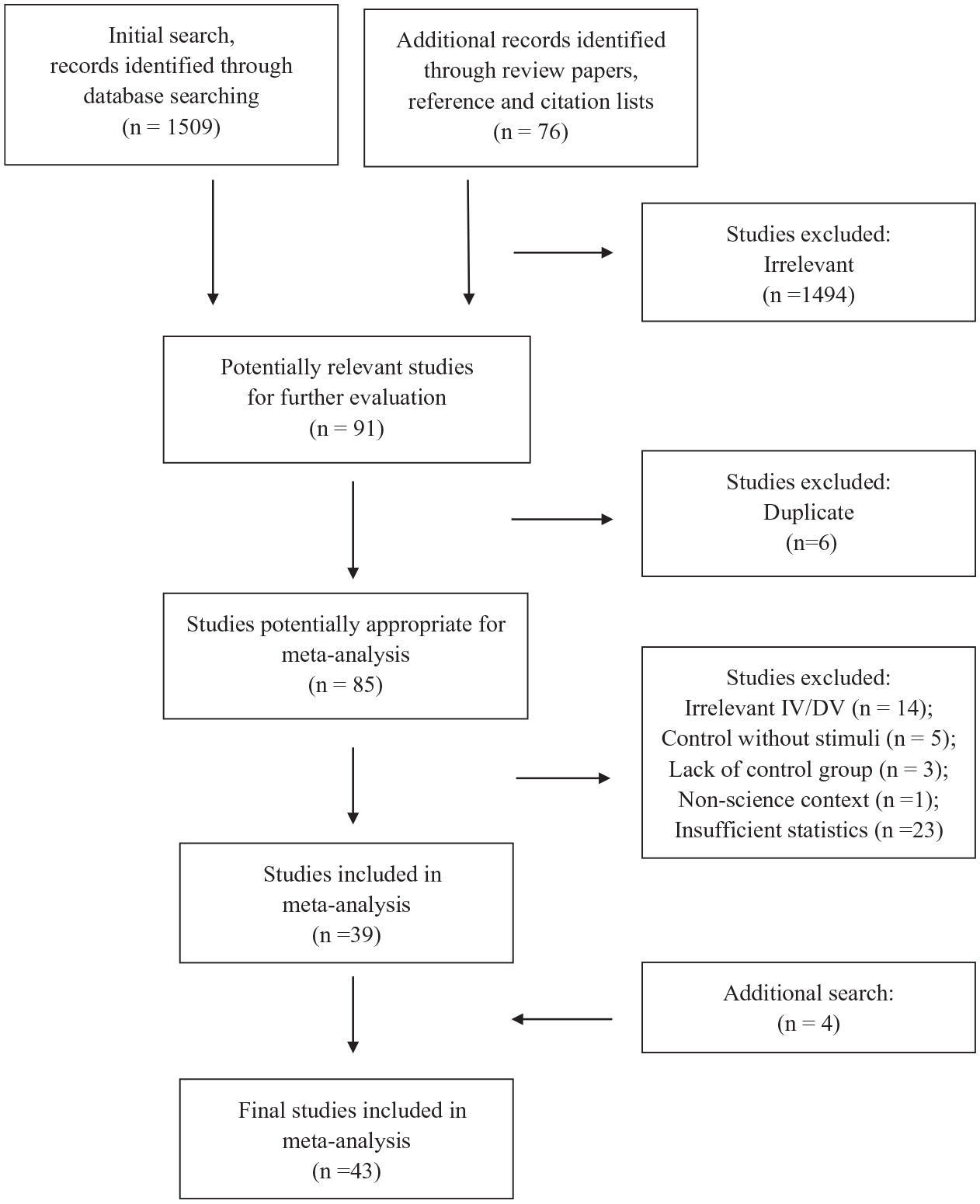
Flow Chart of Study Retrieval and Selection Process.
Variable Coding
Uncertainty Typology and Outcome Variable Coding
As defined previously, the uncertainty disclosure was categorized into three types. The definition, examples of operationalization, and inter-coder reliability (ICR) for each type are presented in Table 1.
Coding of Uncertainty Types.
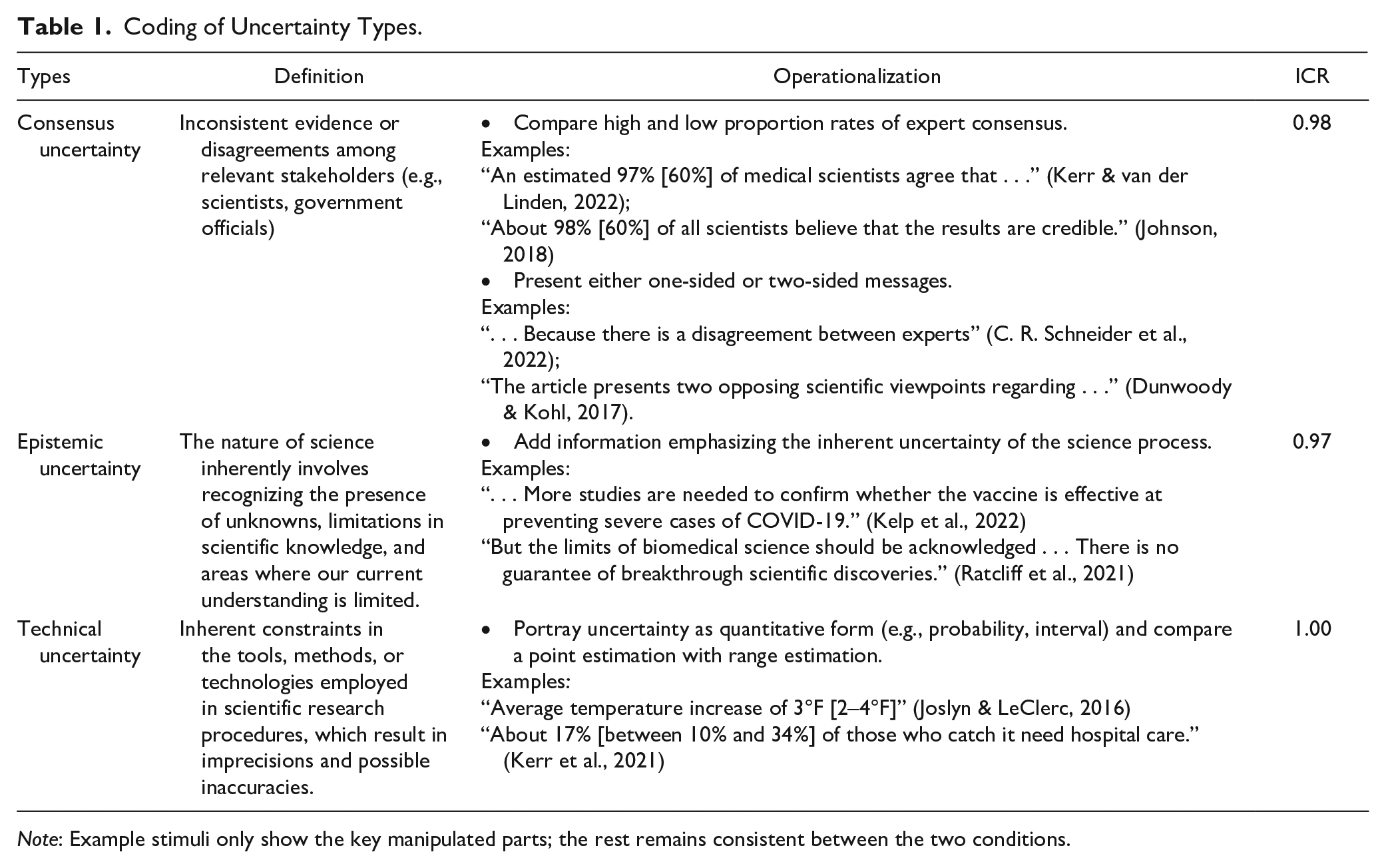
Note: Example stimuli only show the key manipulated parts; the rest remains consistent between the two conditions.
In sum, four outcomes were examined: uncertainty perception, credibility perceptions, attitudes, 7 and behavioral intentions. All the experiments assessed multiple effects. For example, Chang (2015) assessed the effect of consensus uncertainty on credibility perceptions, attitudes, and behavioral intentions. Consistent with Schmidt and Hunter’s (1999) suggestion, each effect in the current meta-analysis was treated as a separate unit of analysis. In total, the 71 empirical studies yielded 128 effects.
Moderator Coding
Topic Domain
The included studies were categorized into three major domains: health (e.g., nutrition, vaccines), environment (e.g., climate change, global warming), and technology (e.g., nanotechnology, gene editing). 8
Cultural Uncertainty Avoidance
Referring to Hofstedes’ index (0–100) (Hofstede, 1983, 2013), the level of cultural uncertainty avoidance for countries involved in the study was encoded as low or high. Following previous research practices (Wang et al., 2024; Watts et al., 2020), the 50th percentile was used as the cutoff point to divide countries into high (e.g., Japan, South Korea) and low (e.g., the United States, Germany) groups. 9
Text Length
Following previous research approaches (Larrimore et al., 2011), text length was coded as a continuous variable by retrieving the stimuli of each study. 10 Text length ranged from 23 to 1,227 words (Mdn = 123).
The coding process began with a discussion among the three authors to create the codebook framework. The first author then developed the detailed codebook, training the second author. To ensure reliability, two authors independently coded a random subsample of half the total sample. The inter-coder agreement was assessed using Krippendorff’s alpha, which ranged from .92 to 1, 11 indicating a high level of reliability. Discrepancies were resolved through discussions among all three authors. After validation, the first author coded the remaining articles. The complete coding books are provided in Supplemental Appendix A.
Effect Size Computation and Analysis
The standardized mean difference, Cohen’s d, was calculated to represent the effect of scientific uncertainty on outcomes (Cohen, 1992). A positive d value indicated that scientific uncertainties enhanced outcomes. Contrary to the fixed effects model, the random-effects model does not assume homogeneity in the study population and allows for generalization beyond the scope of the meta-analysis (Borenstein et al., 2010). Therefore, we used the random-effects model to estimate for all analyses. The Q statistic and I2 were used to assess the heterogeneity of the effect size. Finally, we examined publication bias using two approaches. We employed a funnel plot to visually assess the potential absence of studies with small effect sizes. Subsequently, we conducted Egger’s test, which offered statistical confirmation of publication bias (Egger et al., 1997). Statistical analyses were conducted using the Comprehensive Meta-Analysis Software (CMA) 3.0 program (Borenstein et al., 2013).
Results
Among these 71 studies, sample sizes ranged from 57 to 2,000 individuals (Mdn = 380), and 30 of these studies were published after 2020. The gender ratios varied from 31% to 100% for female participants (Mdn = 53%). In addition, 39% of the studies utilized student samples. Table 2 illustrates a summary of the studies included in our analysis. Table 3 shows the resluts of moderator analysis. The forest plots for main effects and moderator analysis can be found in Supplemental Appendices B and C.
Overview of Studies Included in Meta-Analysis.
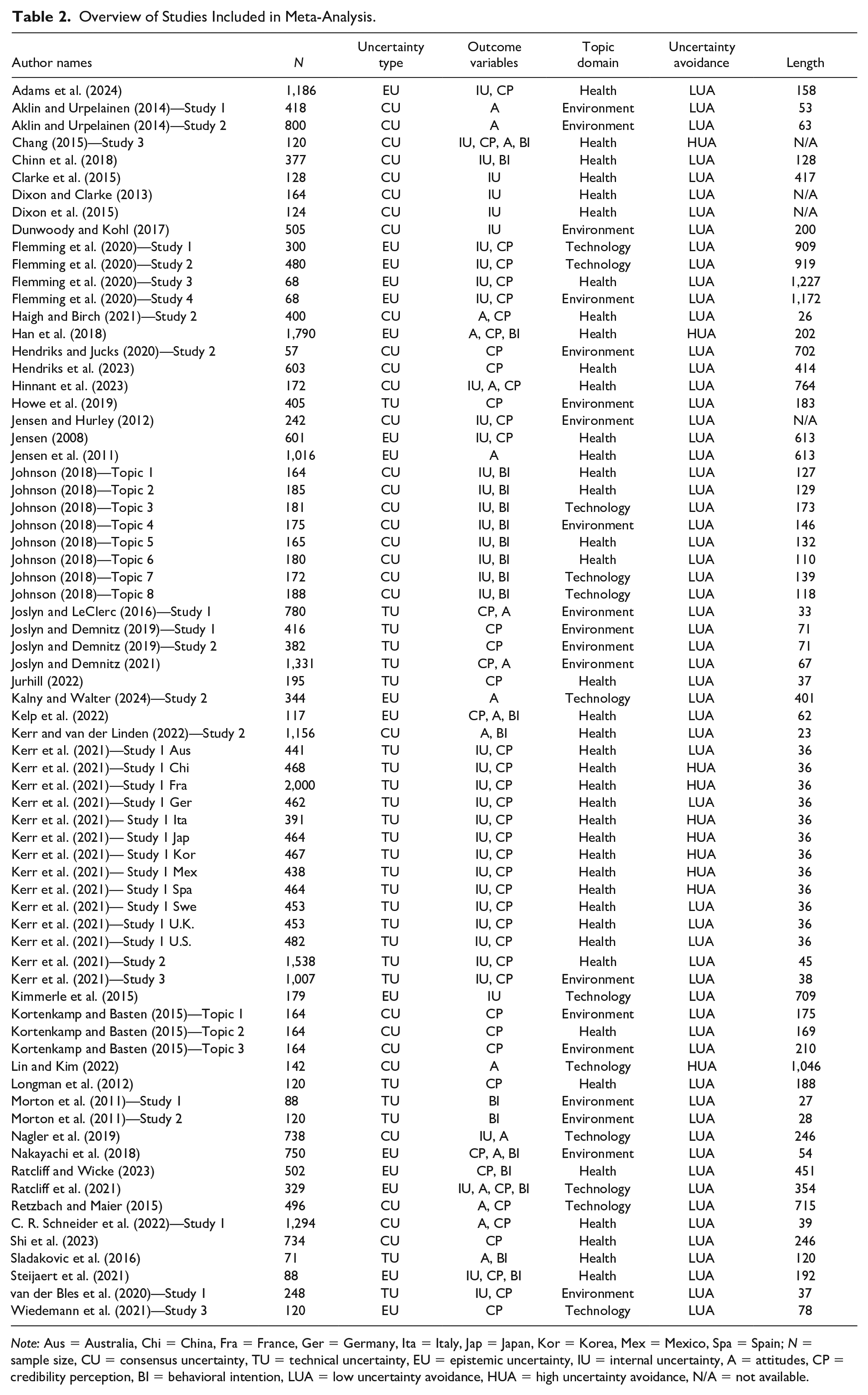
Note: Aus = Australia, Chi = China, Fra = France, Ger = Germany, Ita = Italy, Jap = Japan, Kor = Korea, Mex = Mexico, Spa = Spain; N = sample size, CU = consensus uncertainty, TU = technical uncertainty, EU = epistemic uncertainty, IU = internal uncertainty, A = attitudes, CP = credibility perception, BI = behavioral intention, LUA = low uncertainty avoidance, HUA = high uncertainty avoidance, N/A = not available.
Moderator (Subgroup) Analysis.
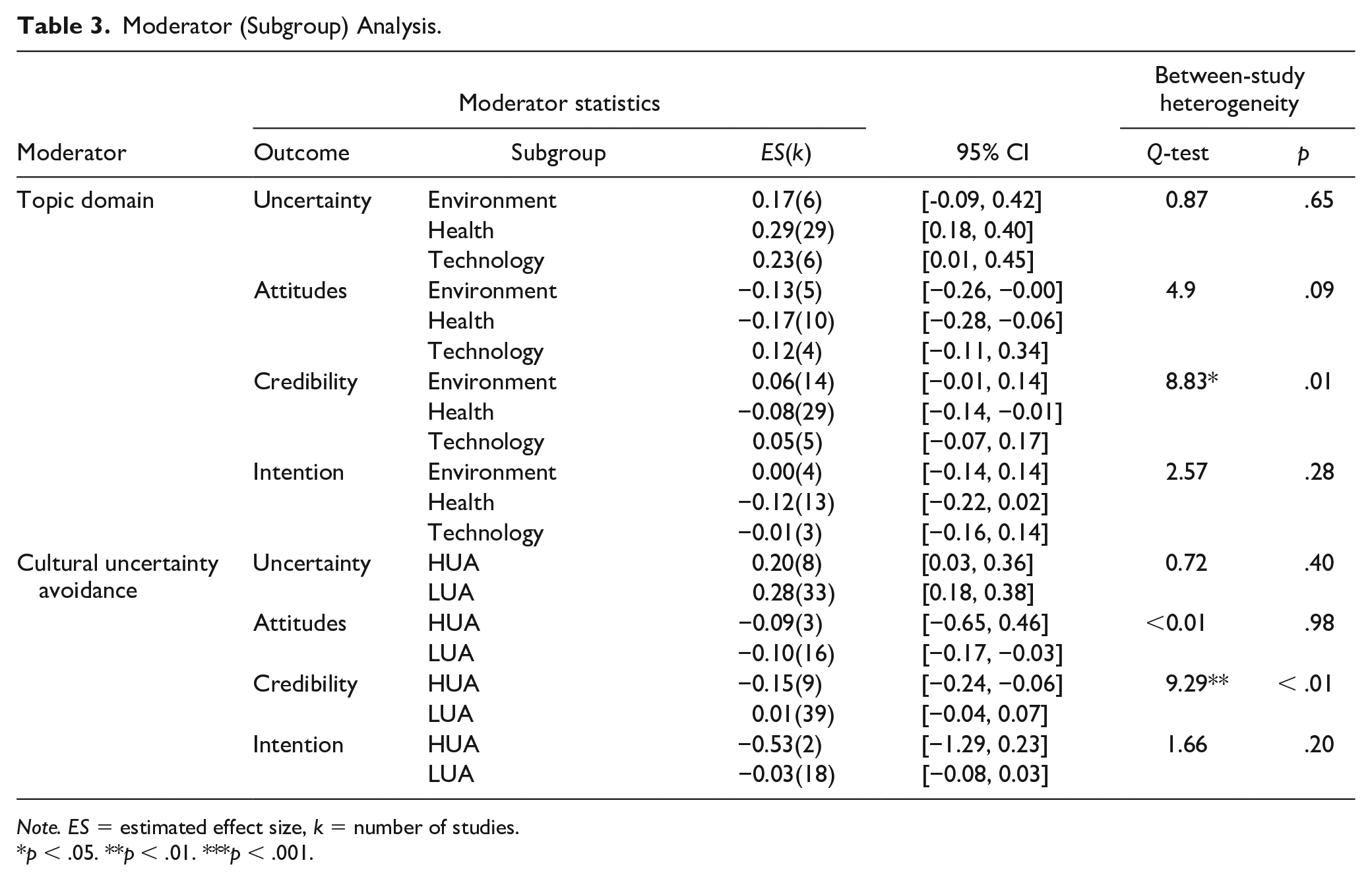
Note. ES = estimated effect size, k = number of studies.
p < .05. **p < .01. ***p < .001.
Weighted Effect Sizes by Comparison
RQ1 explored the overall effect size of different uncertainty types on perception. The random-effects model showed that consensus uncertainty had a medium summary effect (d = 0.41, k = 17, 95% confidence interval [CI] = [0.26, 0.56], p < .01); epistemic uncertainty had a modest overall effect (d = 0.29, k = 9, 95% CI = [0.00, 0.59], p = .05), and technical uncertainty had a weak overall effect (d = 0.13, k = 15, 95% CI = [0.05, 0.21], p < .01). RQ2 found that epistemic uncertainty had a small but significant summary effect on credibility perception, with a standardized mean difference of d = 0.09 (k = 13, 95% CI = [0.00, 0.17], p = .05). In contrast, the overall effect of consensus uncertainty (d = −0.08, k = 12, 95% CI = [−0.19, 0.02], p = .12) and technical uncertainty (d = −0.06, k = 23, 95% CI = [−0.13, 0.02], p = .12) were not significant.
RQ3 assessed the overall effects of different types of uncertainty on attitudes. The results showed that both consensus uncertainty (d = −0.12, k = 10, 95% CI = [−0.25, −0.00], p = .05) and technical uncertainty (d = −0.15, k = 3, 95% CI = [−0.24, −0.07], p < .01) had a marginal but significant overall effect on attitudes. On the contrary, the overall effect of epistemic uncertainty on attitudes was nonsignificant (d = −0.05, k = 6, 95% CI = [−0.21, 0.10], p = .50). Interestingly, RQ4 revealed that there was no significant overall impact of any uncertainty type on behavioral intentions: consensus uncertainty (d = −0.12, k = 11, 95% CI = [−0.24, 0.00], p = .06), epistemic uncertainty (d = −0.07, k = 6, 95% CI = [−0.18, 0.05], p = .24), and technical uncertainty (d = 0.04, k = 3, 95% CI = [−0.19, 0.28], p = .73).
Potential Moderators
To answer the RQ5, the results suggested that only text length significantly moderated the effect (Qbetween = 4.39, p = .04), with longer texts reducing uncertainty perception (b = −0.0003, p = .04). Topic domain (Qbetween = 0.87, p = .65) and cultural uncertainty avoidance (Qbetween = 0.72, p = .40) did not moderate the effect. RQ6 found that topic domain significantly moderated the impact of scientific uncertainty on credibility perception (Qbetween = 8.83, p = .01). Specifically, scientific uncertainty was perceived as less credible in the health domain (d = −0.08, p = .02), but not for technology domain (d = 0.05, p = .39) or environment domain (d = 0.06, p = .11). Cultural uncertainty avoidance was also indicated as a significant moderator for credibility perceptions (Qbetween = 9.29, p < .01), with a negative effect in high-avoidance countries (d = −0.15, p < .01), and no effect in low avoidance countries (d = 0.01, p = .70). However, text length had no significant moderating effect (Qbetween = 1.82, p = .18).
RQ7 explored moderators of the effect of scientific uncertainty on attitudes. Text length significantly moderated this effect (Qbetween = 7.63, p < .01). The longer text yielded a marginally positive impact on attitudes (b = 0.0004, p < .01). Neither topic domain (Qbetween = 4.9, p = .09) nor cultural uncertainty avoidance (Qbetween < 0.01, p = .98) had significant moderating effects. RQ8 investigated potential moderators of the effect of scientific uncertainty on behavioral intention. The analysis showed that topic domain (Qbetween = 2.57, p = .28), cultural uncertainty avoidance (Qbetween = 1.66, p = .20), and text length (Qbetween = 2.60, p = .11) did not significantly moderate this effect.
Publication Bias
We employed two methods to test for publication bias (Du et al., 2017). As shown in the funnel plot (Figure 2), most studies were symmetrically distributed around the center of the summary effect size, indicating the absence of publication bias. Since the subjectivity of interpreting funnel plots, we conducted Egger’s regression tests to assess publication bias (Egger et al., 1997). The Egger’s test was nonsignificant (t = 0.11, p = .91). Overall, we did not find any evidence of publication bias.
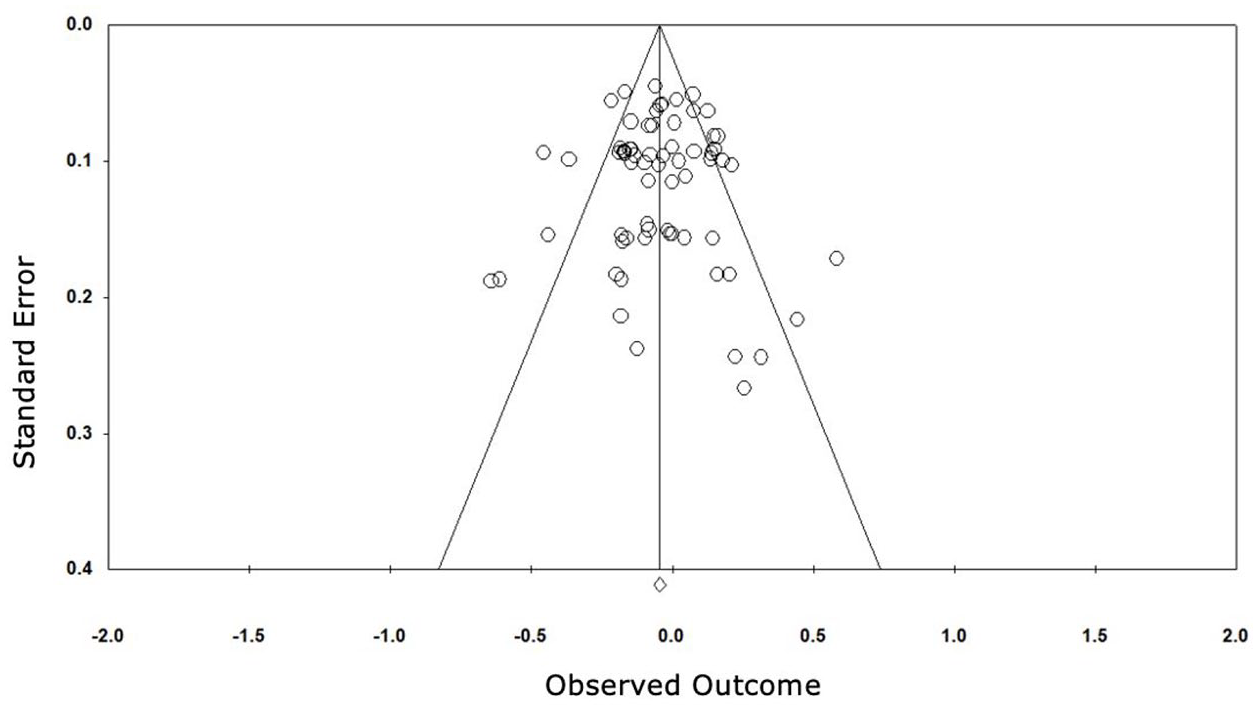
Funnel Plot of Effect Sizes to Check Publication Bias.
Discussion
Disclosing uncertainty is an integral part of scientific communication with the public. However, there remains a lack of consensus regarding its communicative impact. The current study employed a meta-analytic approach to assess how three types of scientific uncertainty affect communication and to identify factors influencing these effects. Our findings suggest a nuanced and complex pattern underlying the communicative process, indicating that further efforts should be made to investigate the underlying mechanisms and contextual factors.
Effects on Uncertainty
Our study found that all three types of uncertainty had modest yet significant effects on individuals’ perceptions. It is notable that the effects on perceived uncertainty were small. From a methodological perspective, two primary factors warrant consideration. First, when embedded within complex scientific contexts, experimental manipulations of uncertainty may prove insufficiently salient. The intricate nature of scientific topics can hinder recipients’ ability to fully process uncertain information, potentially overshadowing the intended effects of uncertainty manipulation. For another, we propose that measurement-related issues may contribute to the observed modest effect size. Specifically, the psychometric instruments employed to assess perceived uncertainty may lack the sensitivity to detect subtle fluctuations in perception. Alternatively, these measures may reflect individuals’ long-term dispositions rather than their immediate responses to uncertainty (e.g., “The effect of overprescribing antibiotics is uncertain”). Therefore, future studies can make efforts in the following directions: for the manipulation messages, it is suggested to reduce the complexity of the scientific information to allow uncertainty messages to be more salient and impactful; for the measures, items should explicitly measure people’s uncertainty perception toward the topic described in the message, rather than toward the subject or science. In addition, future studies may consider implementing a pre-and post-test design to examine the genuine effects triggered by uncertainty manipulations (Bolger et al., 2019). In our observation, only a limited number of studies employed this design (e.g., Retzbach & Maier, 2015).
Theoretically, the nuanced effect of uncertainty manipulations on perceived uncertainty can be understood through two possible explanations. First, this may indicate that the primary impact of such communications does not necessarily manifest as heightened uncertainty perceptions per se. Instead, it is plausible that disclosing uncertainty in scientific messages primarily increases perceptions of transparency and honesty, ultimately fostering increased trust in the scientific process and its communicators. That is, by openly acknowledging the inherent uncertainties, communicators may be perceived as more credible and trustworthy (Bromme & Goldman, 2014). Following this line of reasoning, perceived uncertainty may not serve as an optimal manipulation check but rather as a theoretically relevant construct (O’Keefe, 2003). Indeed, several scholars have attempted to establish relationships between uncertainty manipulation and various psychological variables, including perceived objectivity, critical reflection, and perceived reactance (e.g., Adams et al., 2024; Kalny & Walter, 2024; Ratcliff & Wicke, 2023). Furthermore, this may suggest potential differences in the cognitive mechanisms perceived by individuals across different types of uncertainty, indicating the need for a deeper understanding. We will elaborate on this in the theoretical implications section.
Effects on Credibility
Regarding credibility perception, our findings indicate that communicating both consensus and technical uncertainty have non-significant impact on credibility perception, which appears to differ from the conclusions drawn by Gustafson and Rice (2020). Those discrepancies can be attributed to the distinct corpus of studies in our meta-analysis, with our analysis adopting more stringent inclusion criteria due to methodological considerations. Moreover, our analysis incorporated recent studies that capture emerging trends in the field, many of which are contextualized within the COVID-19 pandemic (e.g., Hendriks et al., 2023; Kerr et al., 2021). This context may explain the observed differences in results, as these studies address the unique challenges posed by the global health crisis. Another possible explanation is that we used a different methodology to examine the existing literature. While narrative reviews aim to outline general trends based on notable studies, meta-analyses provide a quantitative synthesis that may enhance the ability to detect overall effects. By employing a random-effects model, our meta-analysis considers both sample size and variability between studies, which could contribute to findings with greater external validity.
For epistemic uncertainty, Gustafson and Rice (2020) noted that drawing conclusions is challenging due to the limited number of studies and inconclusive results. In our study, we found communicating epistemic uncertainty had a relatively small positive effect on credibility perception. This intriguing finding of epistemic uncertainty can probably be understood via the lens of attribution theory, which posits that individuals interpret behaviors based on perceived causes and subsequently adjust their responses accordingly (Crowley & Hoyer, 1994). In this light, epistemic uncertainty, rooted in uncontrollable external factors such as complexity in the natural world, may lead individuals to attribute uncertainty to external circumstances rather than scientists themselves. Consequently, individuals may easily acknowledge uncertainty as an inherent and unalterable limitation (Maxim & Mansier, 2014; Weiner, 1985). Furthermore, they may appreciate scientists’ willingness to engage in open conversations with the public, thereby attributing credit to their transparency.
Effects on Attitude
Compared with credibility perception, the effects on attitudes showed a relatively consistent pattern: while communicating epistemic uncertainty yielded a null effect, consensus and technical uncertainty had a small but negative effect. Lay epistemology theory may shed light on explaining this finding. This theory posits that certainty, consistency with prior attitudes, and accuracy serve as crucial cognitive factors guiding individuals’ information processing (Kruglanski, 1989; Landau et al., 2014). In contrast, consensus uncertainty, characterized by conflicting opinions, inherently contradicts the principle of consistency. Similarly, technical uncertainty, often presented as range estimations, contravenes lay expectations of precision. Consequently, both types of uncertainty may present cognitive challenges, potentially diminishing individuals’ motivation for deeper comprehension. This lack of clarity may engender frustration and disengagement, thereby reinforcing negative attitudes toward the presented information. Therefore, future studies can explore strategies to mitigate these negative effects. One potential way is to employ multimodal methods to facilitate comprehension and decrease backlash attitudes, particularly in the context of technical uncertainty (Padilla et al., 2021).
Effects on Behavioral Intention
It is noteworthy that despite the various impacts on credibility perception and attitude, these impacts did not further translate into behavioral intentions. One explanation is that behavior is influenced by a myriad of factors, among which uncertainty stands out as a significant one, although not always the decisive factor (Sheeran, 2002). A typical mind-set that would affect people’s decisions is the “better safe than sorry” principle (Aven, 2023; Pielke, 2002). For instance, despite individuals appreciating scientists’ transparent communication about the uncertainties of GMO foods—potentially enhancing their attitudes—they may still opt for what they perceive as the safer choice. This reflects their preference for perceived safety in the face of disclosed uncertainties. In this light, we encourage scholars to integrate insights from behavioral science and theories in specific subjects (e.g., Theory of Planned Behavior, Ajzen, 1991; Transtheoretical Model of Behavior Change, Prochaska & DiClemente, 1983). By integrating these behavioral theories with uncertainty communication research, we can develop more effective approaches to science communication that not only enhance credibility but also facilitate desired behavioral outcomes.
Moderators From Contextual, Cultural, and Message Levels
Our study identified the topic domain as a moderator such that uncertainty negatively affects credibility perception within the health topic domain but not for the environment and technology topic domain. This moderation effect may be explained by the construal level theory. According to this theory, people’s thinking and decision-making processes are influenced by their perceived proximity or distance to the subject matter (Trope & Liberman, 2010). Specifically, when considering the health domain, individuals tend to engage in detailed and sensory-oriented thinking due to the personal and self-relevant nature of such issues (Kim, 2019). Consequently, they may rely heavily on personal experiences while adopting a skeptical stance toward scientific research and expert opinions. In contrast, many individuals perceive environment or technology topic issues as psychologically distant (Tang & Chooi, 2023), prioritizing long-term and overarching goals. This “high-level construal” may lead individuals to place more trust in information provided by professionals.
In addition, cultural uncertainty avoidance emerges as another moderator shaping the communicating impact of scientific uncertainty on credibility perception. Specifically, compared to low uncertainty avoidance cultures, those characterized by high cultural uncertainty avoidance exhibit lower trust in uncertainty communication. This finding echoed a recent study, which highlighted the negative relationship between trust and uncertainty avoidance (Küçükkömürler & Özkan, 2022). However, this result should be interpreted with caution, since the effect size is relatively small, and most of the samples tested under high uncertainty avoidance culture come from a multicountry study (Kerr et al., 2021). Hence, future studies can examine the effect of uncertainty communication in more diverse cultures.
As we predicted, text length plays a moderating role in both uncertainty perception and attitudes. Specifically, text length showed a marginally negative relationship with uncertainty perception and positively related to attitudes. This result validates that verbosity can serve as an uncertainty reduction strategy, and individuals could be informed better about scientific findings (Berger & Calabrese, 1975; Flanagin, 2007). Nevertheless, the conclusion should be understood with care, due to the negligible effect size and potential for confounding with other factors. Therefore, we hope future research could further explore this effect by the following approach: first, experimental studies could examine the interaction with individual characteristics (e.g., perceived information overload, Tandoc et al., 2024) and second, future meta-analyses could conduct a more detailed operationalization, such as calculating the proportion of uncertainty text within the full text or identifying the specific positions where uncertainty text appears (e.g., Kalny & Walter, 2024).
Theoretical and Practical Implications
Building upon our findings, we developed a comprehensive theoretical framework to explain the observed patterns in the impact of various types of uncertainty in science communication. While we fully acknowledge the validity and utility of the current uncertainty typology predicated on its sources, we argue for a more profound investigation into the public’s interpretation of these sources. To bridge this gap, we propose to apply attribution theory (Weiner, 1972), with its focus on locus of control, stability, and controllability dimensions, to gain insights into the essential factors that shape the public’s interpretations of scientific uncertainty. Specifically, attribution theory postulates that individuals attempt to understand and explain events or behaviors by attributing causes to them along three dimensions: (a) locus of control (whether the cause is perceived as within the person [a.k.a., internal] or in the environment [a.k.a., external]); (b) stability (whether the cause is seen as constant or variable over time); and (c) controllability (the degree to which the cause is perceived to be under an individual’s control).
Our meta-analysis revealed a discernible pattern wherein epistemic uncertainty tends to positively affect credibility judgment, while consensus and technical uncertainty appear to attenuate individuals’ attitudes. We posit that this differential impact may be rooted in divergent attributions of these uncertainty sources. Our preliminary hypothesis suggests that epistemic uncertainty might be predominantly attributed to external, unstable, and uncontrollable factors (e.g., the inherent complexity and dynamic nature of the universe). Conversely, technical uncertainty might be construed as stemming from internal, stable, and potentially controllable factors (e.g., current methodological limitations that could be surmounted through technological advancements). Similarly, consensus uncertainty might also receive such characteristics (e.g., disagreements among experts that could potentially be resolved through further research or debate). Thus, these disparate attributional patterns may engender contrasting perspectives and expectations toward these two categories of scientific uncertainty. Figure 3 presents our tentative conceptualization of the attributional characteristics for each type of uncertainty along the three dimensions. It is important to note that these propositions represent our very preliminary interpretations and require rigorous empirical validation through methodologies such as in-depth interviews and large-scale surveys. Should this conceptual speculation withstand empirical examination, we believe that this theoretical framework provides a more profound foundation and a coherent structure for understanding the cognitive processes underlying public interpretations of scientific uncertainty, potentially stimulating new lines of inquiry and theoretical development in scientific uncertainty.
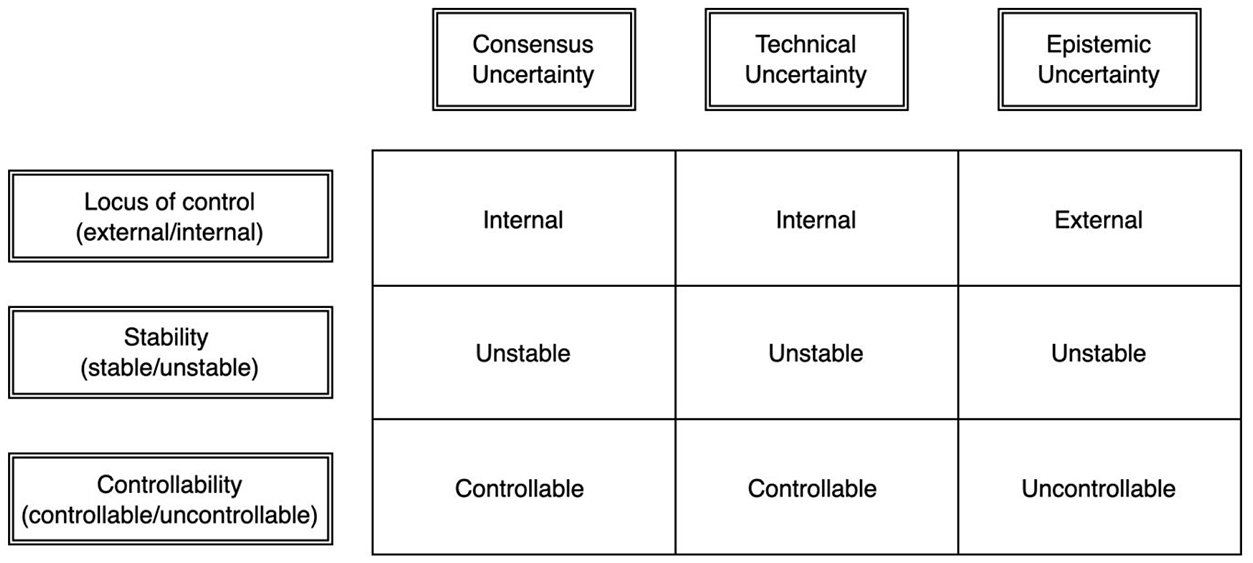
Preliminary Attribution Analysis of Each Uncertainty Type.
Our meta-analysis also offers some practical insights: First, educators and science communicators should prioritize teaching the nature of science, emphasizing its tentative, evolving, and adaptive nature within an iterative process of theory and empirical evidence. This approach can deepen our understanding and foster acceptance of scientific uncertainties. In addition, to address misconceptions about scientific endeavors, collaboration among scientists, journalists, and policymakers is essential. These scientific communicators should articulate the magnitude and categorization of uncertainty in a manner that is both accessible and contextually appropriate.
Limitations and Future Directions
Our study has several limitations that indicate directions for future research. First, due to the limited sample size, our study combined variables “attitudes” and “beliefs.” Future studies with a larger sample could explore them separately. Similarly, we also did not differentiate credibility types; future research should examine if scientific uncertainty affects source credibility and information credibility differently. Second, we recognize the challenge in categorizing topics that straddle health and technology (e.g., health technology). Future studies should develop clearer criteria to differentiate these overlapping contexts. Third, using country-level measures to gauge cultural uncertainty avoidance may oversimplify individual views. As Hofstede (2001) pointed out, cultural dimensions can vary widely within a country, and individuals may not reflect national averages. Our study does not account for these variations or cultural shifts over time (Beugelsdijk et al., 2015). With few studies (n = 3) measuring this at the individual level, we hope future research could directly assess uncertainty avoidance to better gauge its influence. Fourth, our meta-analysis shows significant small effects of uncertainty communication on public trust and engagement. However, these effects may not be practically significant in real-world contexts. Future studies should identify conditions that allow these small effects to accumulate or interact. More research on potential moderators related to audience characteristics (e.g., ideology, numeracy, trust in science) or message traits (e.g., modality) is needed. Fifthly, our moderator analysis combined three types of uncertainty into one predictor for statistical power, which might overlook nuances between uncertainty types. Future meta-analyses should analyze each type separately to capture these distinctions. Finally, despite our thorough search, some relevant studies might have been missed. Future meta-analyses should perform a more interdisciplinary and comprehensive literature review.
Conclusion
To conclude, this meta-analysis represented an initial synthesis of the existing research on the effects of three different types of scientific uncertainty (i.e., epistemic uncertainty, technical uncertainty, and consensus uncertainty). This study contributed to science communication in several ways. First, it refined the typology of scientific uncertainty by offering clear definitions and detailed operationalizations. Second, it presented a quantitative synthesis of the effects of these different types of uncertainty and identified moderators at the contextual, individual, and message levels. Finally, we proposed a comprehensive theoretical framework based on the observed patterns, which necessitates further validation in future research.
Supplemental Material
sj-docx-1-scx-10.1177_10755470251314129 – Supplemental material for A Meta-Analysis Synthesizing the Effects of Three Uncertainty Types in Science Communication
Supplemental material, sj-docx-1-scx-10.1177_10755470251314129 for A Meta-Analysis Synthesizing the Effects of Three Uncertainty Types in Science Communication by Zhuo Guo, Ke Liu and Meng Chen in Science Communication
Footnotes
Acknowledgements
The authors sincerely thank the two anonymous reviewers and Editor, Dr. Kahlor, for their invaluable guidance and support. The authors also extend special gratitude to scholars who generously agreed to provide their data.
Declaration of Conflicting Interests
The author(s) declared no potential conflicts of interest with respect to the research, authorship, and/or publication of this article.
Funding
The author(s) disclosed receipt of the following financial support for the research, authorship, and/or publication of this article: This work was supported by the Science and Technology Commission of Shanghai Municipality (No. 24DZ2301500).

Notes
Author Biographies
References
Supplementary Material
Please find the following supplemental material available below.
For Open Access articles published under a Creative Commons License, all supplemental material carries the same license as the article it is associated with.
For non-Open Access articles published, all supplemental material carries a non-exclusive license, and permission requests for re-use of supplemental material or any part of supplemental material shall be sent directly to the copyright owner as specified in the copyright notice associated with the article.
