







Abstract
Artificial intelligence (AI) has the potential to advance health care, industrial productivity, and environmental sustainability but also presents risks such as job loss and uncontrolled superintelligent machines. Understanding public opinion about AI is key for anticipating its governance. This study examines how media framing affects U.S. beliefs about AI and support for its development. A survey experiment involved respondents reading articles highlighting either AI’s benefits or risks, revealing how such information can influence opinion on AI’s societal impacts. The findings emphasize the crucial role of framing in shaping public views on AI, with implications for policymakers and stakeholders.
Introduction
Artificial intelligence (AI) has been defined as “a machine-based system that can, for a given set of human-defined objectives, make predictions, recommendations or decisions influencing real or virtual environments” (National Artificial Intelligence Act of 2020, H.R. 6216). This definition continues that AI systems “use machine and human inputs to (a) perceive real and virtual environments; (b) abstract such perceptions into models through analysis in an automated manner; and (c) use model inference to formulate options for information or action.” At present, AI is commonly used in mapping technologies, the recognition of handwriting for mail delivery, the filtering of spam, language translation, financial trading, and much more. Potential future applications of AI are nothing short of transformational (Faraboschi et al., 2023; Kurzweil, 2024; McLean et al., 2023; Sotala & Yampolskiy, 2014; Suleyman, 2023; Thiebes et al., 2021).
Research that examines factors shaping public opinion about AI is critical because it allows us to anticipate potential public acceptance or resistance that, in turn, could affect its governance and the trajectory of its development (Brewer et al., 2022; Choung et al., 2023; Zhang & Dafoe, 2020). General surveys have shown that most Americans state that they have heard at least “a little” about AI but are unfamiliar with many of its specific applications and have little experience with generative AI that can produce text or images (Ballard, 2024; Beets et al., 2023; Dupont et al., 2024; Faverio & Tyson, 2023; YouGov, 2024). Several national surveys report that the U.S. public holds ambivalent views toward AI, perceiving it as both promising and potentially threatening (Brewer et al., 2022; Zhang & Dafoe, 2020). A survey conducted in March 2024, for instance, found that 57% of Americans think that AI will decrease the number of jobs available in the Uniteed States compared to 10% who believe it will increase the job supply. On the contrary, 31% of Americans believe that AI will make their life easier, compared to 13% who believe it will make it harder (YouGov, 2024). The poll also revealed that 27% of Americans believe AI will have positive overall effects on society, while 42% believe it will have negative effects.
Although general response to AI as well as response to specific AI applications have been examined in both popular and scholarly literature, there has been relatively little systematic attempt to identify the ways that public opinion about the future development and regulation of AI can be shifted by targeted messaging. In a review of empirical research articles on AI attitudes, Koenig (2024) identified three theoretical perspectives on the acceptance of AI: its perceived usefulness and ease of use, the extent to which people believe that tasks can reliably be delegated to AI, and more general perceived risks to society. In this study, we focus on the third of these perspectives and operationally define “public opinion about AI” as including beliefs about the impact of AI on various aspects of daily life including jobs, health care, public safety, education, and quality of life, its overall benefits as opposed to its risks, general attitudes in support or opposition to the further development of AI, and attitudes about its governance. We examine the impacts of media framing on these aspects of public opinion concerning AI and also investigate downstream effects of the framing of AI on attitudes about the general benefits of science and technology.
The survey experiment reported in this paper contributes to the understanding of public response to AI. In this experiment, respondents were randomly assigned to read mock news articles either highlighting the current benefits and future potential of AI to improve human life or outlining the risks associated with further development of AI. The results underscore the powerful influence that framing can have on the public’s beliefs about and support for the future development of AI.
Framing and Opinions About AI
Media coverage surrounding emergent scientific technologies can play a powerful role in shaping the public’s related perceptions (Brewer et al., 2022; Brossard & Nisbet, 2007; Druckman & Bolsen, 2011; D. A. Scheufele, 1999; D. A. Scheufele & Lewenstein, 2005). News coverage surrounding advances in AI have risen dramatically in recent years, and this coverage may ultimately influence public support for AI’s development and regulation (Nguyen & Hekman, 2024; Ryazanov et al., 2024). Framing Theory provides an account of the process by which a communicator’s selection of specific considerations to emphasize about any “attitude object” can influence an audience’s related beliefs and opinions (Chong & Druckman, 2007). An emphasis framing effect occurs when exposure to a framed communication causes an audience to privilege the emphasized consideration by giving it greater “weight” relative to other potentially relevant considerations in the opinion formation process (Chong & Druckman, 2007). Exposure to a message highlighting the positive benefits of the future development of AI, for instance, may increase the salience of positive cognitions that are accessible when a related opinion is formed, whereas exposure to a message that emphasizes AI’s potential risks generates negatively accessible considerations (e.g., Brewer et al., 2022). At the macro-level, a “frame” refers to “a central organizing idea or story line that provides meaning to an unfolding strip of events . . . the frame suggests what the controversy is about, the essence of the issue” (Gamson & Modigliani, 1987, p. 143). This process entails “selecting some aspects of a perceived reality and mak[ing] them more salient in a communicating text, in such a way as to promote a particular problem definition, causal interpretation, moral evaluation, and/or treatment recommendations for the item described” (Entman, 1993, p. 52; italics in the original).
Scholars have begun to examine the content of frames in news articles to identify how AI is predominately portrayed by media (Chuan et al., 2019; Fast & Horvitz, 2017; Nguyen & Hekman, 2024; Ouchchy et al., 2020; Xian et al., 2024). Nguyen and Hekman (2024) conducted an automated content analysis of thousands of news stories published in four major media outlets (the New York Times, The Guardian, Wired, and Gizmodo) between 2010 and 2021 to identify the most prominent emphasis frames in related stories. Their content analysis found 14 distinct frames related to AI that fell into four “broader groups,” or meta-frames, that included AI & Politics, AI & Economics, AI & Research/Science, and AI in Society & Culture. They found that AI news often focused on consumer-centric technologies that may result in a broader transformations that generate economic growth due to gains in productivity and increased efficiency; however, they also identified an increase in frames associated with negative risks over time such as the rise of disinformation, increased cybercrime, concerns about loss of privacy and surveillance, and biases in data that harm marginalized groups. Furthermore, frames in news shifted over time “from portraying the technology as a concept or research subject and topic of science fiction to focusing on the concrete economic, social, cultural, and political impacts” (p. 448).
Chuan et al. (2019) studied AI news coverage in five major American newspapers between 2008 and 2019 and found that the benefits of AI were discussed more than the risks. The authors also identified three primary categories of benefits in news coverage that included economic effects, improving human life and well-being, and reducing human biases. On the contrary, the top five risks identified were misuse of AI, ethical or moral problems, loss of jobs, loss of privacy, and the shortcomings of the technology.
Individual-Level Emphasis Framing Effects
A large body of research has demonstrated that exposure to media frames can influence how the public forms beliefs about novel scientific innovations (e.g., Brossard & Lewenstein, 2009; Druckman & Lupia, 2016; Kahan et al., 2009; Lee & Scheufele, 2006; Nisbet & Mooney, 2007; B. Scheufele, 2006). In a study assessing the accuracy of accounts by U.S. newspapers with respect to research on the impacts of genetics on cancer outcomes and behaviors over the period July 2004 to June 2007, Brechman et al. (2011) found that news coverage may distort scientific findings in ways to “appeal to readers and be understood.” Recently, particularly since the public release of “free” tools for generative AI such as ChatGPT in November 2022, there have been several papers dealing with “hype” of news accounts about AI. In an analysis of 671 U.K. headlines about AI and ChatGPT from January to May 2023, Roe and Perkins (2023) found that “media representations often swing between extremes of promising potential and serious impending dangers.” On the contrary, Xian et al. (2024), in an analysis of U.S. and international news (including the Times of India and the South China morning post), found most articles were “neutral” or “positive” in sentiment about generative AI, with business-related articles particularly skewing positive.
Despite this research on how the media frame AI, there have been, to date, only a small number of studies have examined how exposure to media frames can influence the U.S. public’s general support for the development, funding, and regulation of AI. For example, Kleizen et al. (2023) conducted survey experiments in Belgium examining the effects of framed information on trust in government, behavioral trust (willingness to provide permission to the federal government to use their data) and “policy support,” defined as the belief that AI projects will enhance service delivery and support of the use of AI within governmental projects. They found that pre-existing attitudes about government, privacy, and AI had a stronger impact than the experimental conditions.
Similarly, Bingaman et al. (2021) found that using a combination of text and images, they could elicit “modest” changes in opinion: 58% of those who received no frame supported its development, while 59% who received a positive frame and 55% who received a negative frame supported its development. However, in this experiment, the treatments used to elicit a positive or negative response were short (i.e., one sentence) and perhaps not sufficiently detailed enough to produce large changes in respondents’ opinions, particularly given the general lack of familiarity or knowledge about the future impacts of AI. The positive treatment stated: “Some say that artificial intelligence can make people safer, improve lives, and solve many of the world’s problems” (social progress frame); the negative treatment stated, “Some say that artificial intelligence brings many dangers, will disrupt lives, and could spell the end of humanity” (Pandora’s Box frame). The study also employed images alongside the textual frames that included real-world personal assistants, real-world personal robots, and scary movie AIs. Despite the findings of only modest changes elicited in opinions toward AI in this study, one might expect that exposure to more detailed positive or negative frames as they would appear in a real-world news article might produce more pronounced effects on audiences.
Other research has investigated public response to specific applications of AI such as “killer robots” (Horowitz, 2016; Rosendorf et al., 2023; Young & Carpenter, 2018); or “unmanned aerial vehicles” (Kreps, 2014). Kim and Song (2023) found that people showed more trust in AI when they felt that the AI did not threaten their freedom of choice. In another study, Choi (2023) found that when the impacts of AI were presented as occurring in the near—as opposed to the more distant-future, respondents reported increased perceived risks but not perceived benefits. In a 2019 survey of Australian adults, Selwyn and Gallo Cordoba (2022: 1158) found that while attitudes toward AI are not fully formed, respondents can be swayed by information in the survey itself, suggesting “a willingness among many people to alter their opinions once having received further information about AI, and being asked to think through issues relating to AI and society.”
Finally, we note that AI is not just another new technology, but instead is described as transformational (Suleyman, 2023). Therefore, given the results of previous research on the impacts of framing on opinions about novel science and technology, this study hypothesizes the following:
Hypothesis 1a (H1a): Exposure to frames emphasizing the benefits of the development of AI will increase beliefs that AI will have positive impacts on jobs, health care, public safety, education, and the quality of people’s lives.
Hypothesis 1b (H1b): Exposure to frames emphasizing the risks of the development of AI will increase beliefs that AI will have negative impacts on jobs, health care, public safety, education, and the quality of people’s lives.
Hypothesis 2a (H2a): Exposure to frames emphasizing the benefits of the development of AI will increase beliefs that the benefits of AI will outweigh the risks.
Hypothesis 2b (H2b): Exposure to frames emphasizing the risks of the development of AI will increase beliefs that the risks of AI will outweigh the benefits.
Hypothesis 3a (H3a): Exposure to frames emphasizing the benefits of the development of AI will increase support for its development.
Hypothesis 3b (H3b): Exposure to frames emphasizing the risks of the development of AI will decrease support for its development.
Hypothesis 4a (H4a): Exposure frames emphasizing the benefits of the development of AI will express less support for the federal government regulating its development.
Hypothesis 4b (H4b): Exposure frames emphasizing the risks of the development of AI will express more support for the federal government regulating its development.
Effects of AI Frames on General Beliefs About Science and Technology and on the Invocation of the Precautionary Principle
Numerous studies have examined the influence of general trust in science on attitudes about specific technologies, although the strength and direction of findings are mixed (Dixson et al., 2022; Kahan et al., 2009; Koetke et al., 2021; Sjoberg, 2002). With respect to AI, previous survey experiments have found that individuals use AI-enabled technologies even though they do not trust them, a “trust paradox,” and that a major justification for such use is the expectation that future versions of the technology will prove to be more trustworthy, as well as provide benefits that exceed their risks (Kreps et al., 2023).
What remains understudied to date is the analysis of the impact of exposure to framed information about the effects of AI on general beliefs about the benefits and trustworthiness of science and technology. We therefore wanted to explore the possibility that that exposure to information stressing the benefits of AI might increase a general trust in science and technology to overcome new problems. Similarly, we wanted to see if negative messages about AI induced an increase in the general negative response to new technology and science. Therefore, we proposed this research question:
Research Question 1: Does exposure to positive or negative frames about the future development of AI affect general opinions about the effects that scientific innovations will have on humans and societies?
The converse of the general optimistic belief in the future benefits of AI development can be summed up in the notion of the “precautionary principle.” An early statement of this principle was Principle 15 of the Rio Declaration on Environment and Development in 1992: “where there are threats of serious or irreversible damage, lack of full scientific certainty shall not be used as a reason for postponing cost-effective measures to prevent environmental degradation.” The principle suggests that if there is potential for causing extensive harm, policy should err on the side of precaution, particularly when extensive scientific understanding of the effects is lacking. In the case of AI applications, the precautionary principle suggests that given widespread potential risk, it is better to regulate the technology until it has been thoroughly tested.
The application of the Precautionary Principle in the domain of AI is not without controversy. In a detailed review of the arguments around governance of AI development, Thierer et al. (2017) concluded that regulation based on the precautionary principle would needlessly impede the innovation and opportunity that AI promises. Instead, the authors argue, oversight should be based on “permissionless innovation” based on evidence and flexibility: “the burden of proof rests on those who favor precautionary regulation to explain why ongoing experimentation with new ways of doing things should be prevented preemptively” (Thierer et al., 2017, p. 48). In a more recent article, Thierer (2023) outlined some of the areas of risk that AI regulatory policy must consider, including the safety of children, data privacy, bias and discrimination, disinformation, and national security. However, he concludes that “AI risks deserve serious attention, but an equally serious risk exists that an avalanche of fear-driven regulatory proposals will suffocate different life-enriching algorithmic innovations.”
The precautionary principle has been invoked in studies of the acceptance of novel innovations, as it can help articulate the circumstances under which individuals’ attitudes and beliefs are colored by fears and uncertainties associated with new and unknown risks. It incorporates the frequent conflict between the desire to innovate and the desire to regulate: too much regulation may stifle innovation, just as too much unregulated innovation could cause unintended and unanticipated harm. As Marinakis et al. (2016) suggest, this conflict is sometimes resolved in the direction of caution or the “precautionary principle” combining both the fear of uncertainty with the fear of potentially catastrophic consequences. This tendency toward possibly exaggerated fears, or the “irrational weigher model” (Kahan et al., 2005), suggests that given a treatment including a description of AI that emphasized these characteristics, we might expect the experimental treatment to trigger the invocation of the precautionary principle. Therefore, we posed this research question:
Research Question 2: Does exposure to positive or negative frames about the future development of AI affect the likelihood that people will invoke the precautionary principle, preferring to slow development given the serious risks of the technology to humankind?
Survey Experiment
Research Design
To test our hypotheses and research questions, we conducted an experiment embedded in a large, nationally representative survey in the United States. Three experimental conditions were included in the study: a control condition in which respondents received only a brief definition of AI, a pro-AI condition in which the benefits of the further development of AI were outlined, and an anti-AI condition in which the risks of further development of AI were summarized. At the beginning of the survey, all respondents read a brief definition of AI: “Artificial intelligence is the ability of computers to learn and act like humans, such as recognizing patterns, making decisions, and solving problems.” Respondents in the control condition received no additional information before answering a common set of questions about their attitudes with respect to AI.
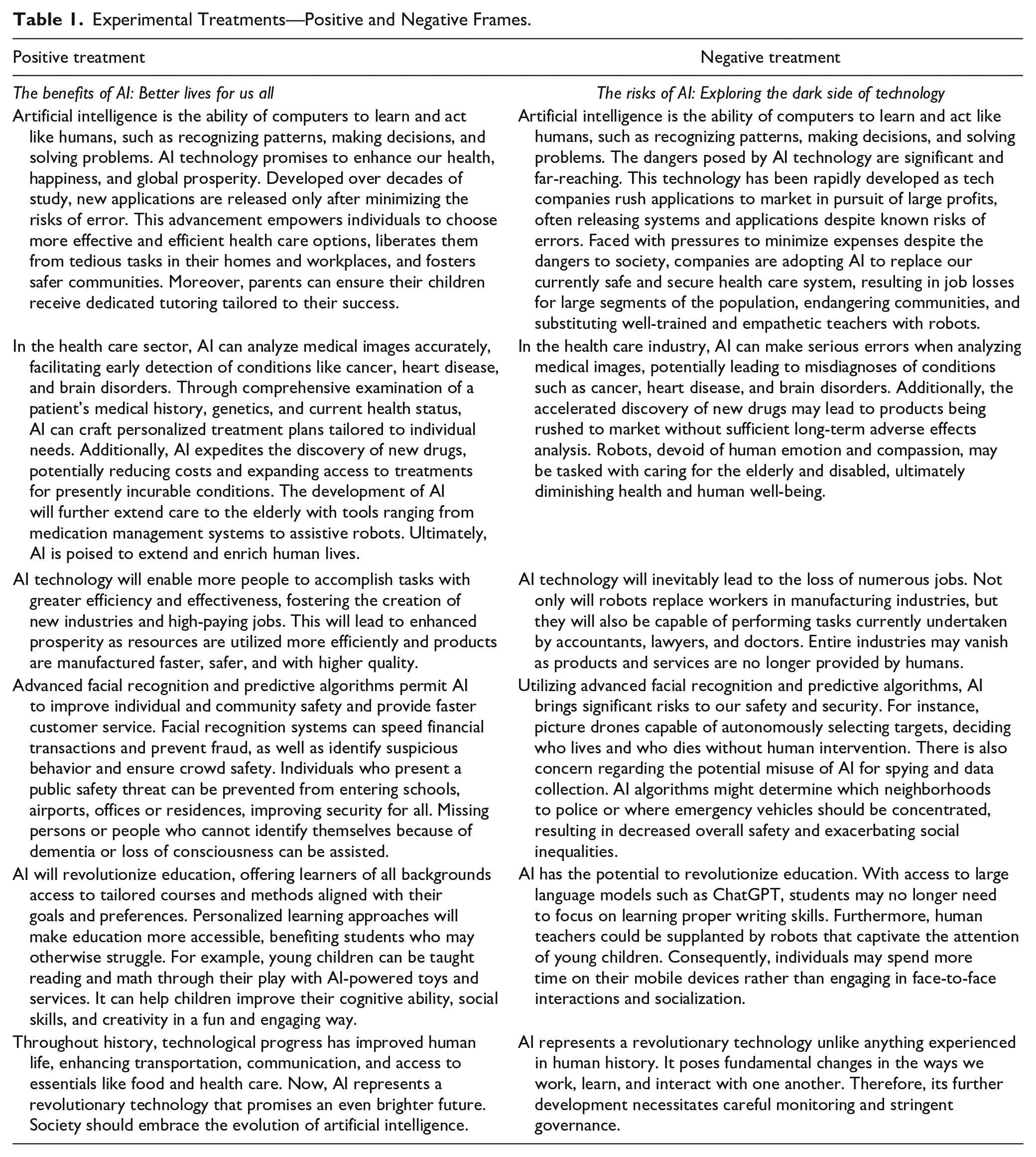
Participants randomly assigned to the positive condition read the remainder of an essay in the format of a mock news article (426 words) titled “The Benefits of AI: Better Lives for Us All” (Table 1). This text was designed to include some of the arguments that previous survey research has identified as the major factors that Americans identify as positive expectations for AI: that it will make us healthier, happier, and wealthier as individuals and as a society. The text mentioned improvements in health care including more accurate diagnosis and personal treatment, an increase in job efficiency, the use of facial recognition technology to improve public safety, and improvements in education through personalized learning. Those randomly assigned to the negative condition read a parallel essay in the form of a mock news article of approximately the same length (405 words) dealing with the same list of topics, but with a negative spin. For example, rather than revolutionizing education by providing tailored teaching access, the negative framing asserted that students might no longer learn writing skills and that they would spend more time interacting with mobile devices than with teachers.
Experimental Treatments—Positive and Negative Frames.
Measures
All participants were then asked a series of questions about their perceptions regarding how future AI advancements might impact jobs, health care, public safety, education, and overall quality of life. Specifically, AI Impact Beliefs were measured with five items that asked respondents to report (on a scale of 1–7 where 1 is definitely negative and 7 is definitely positive) the degree to which “future advancements in AI” would have “a more negative or positive impact on: (a) jobs, (b) health care, (c) public safety, (d) education, and (e) people’s quality of life” (alpha = .92). 1
We measured general attitudes about AI with three questions: (a) “Considering the further development of artificial intelligence, do you think the benefits outweigh the risks, or the risks outweigh the benefits? (1 = risks definitely outweigh the benefits; 7 = benefits definitely outweigh the risks) (Benefits Outweigh Risks); (b) “To what extent do you oppose or support the further development of artificial intelligence?” (1 = strongly oppose; 7 = strongly support) (Support Development), and (c) “How important is it for the federal government to regulate the further development of artificial intelligence?” (1 = not at all important; 7 = extremely important) (Support Regulation).
We assessed participants’ trust in science by asking whether they believe it addresses problems or creates new ones by asking, “Do you think that science enables us to overcome almost any problem or that science creates unintended consequences and replaces older problems with new ones?” (1–7 scale where 1 is definitely overcomes problems and 7 is definitely creates new problems). In addition, we measured the precautionary principle that scientists should fully understand potential issues before advancing new AI applications by asking the extent to which respondents disagreed or agreed with the following statement: “Scientists should understand all of the problems that might arise in the future before releasing more AI applications.” (1–7 scale where 1 is strongly disagree and 7 is strongly agree). 2
Sample
We test our hypotheses using data from an original survey fielded in May 2024 on a sample of 3165 respondents. The survey was conducted on Bovitz’s high-quality Forthright panel. Forthright Access is a privately managed company, and their internet panel is proprietary and managed by Bovitz, Inc. Although it is not a probability sample, it can be understood as “nationally representative” in that it is matched to census benchmarks for age, gender, education, Census region, and race (Mernyk et al., 2022). Respondents in the treatment conditions that spent less than 30 seconds on the treatment page were terminated from the survey. In addition, respondents that failed to pass an attention check question were excluded from our analyses. The control group included 1330 respondents, and 829 were in the positive and 877 in the negative condition. As an overview of our respondents, 68.5% were white, 49.3% were female, and the median income was in the $50–74,999 category, similar to national data as reported by the U.S. Census of Population (https://www.census.gov/quickfacts/fact/table/US/PST045222). 3
Results
To test our preregistered hypotheses, we estimate ordinary least squares regression models with robust standard errors omitting the relevant reference group (i.e., control condition) for each analysis. We present the results in a series of figures containing the plotted point estimates and error bars representing the 95% confidence interval. We also include the coefficient estimate and associated two-tailed p value as marker labels to provide additional clarity. The Supplemental Appendix contains the full models corresponding to each dependent variable for all estimates in a traditional table format. 4
Figure 1 reports the effect of the experimental treatments across our four primary dependent variables relative to respondents in the control condition. We begin by evaluating the degree to which exposure to positive or negative framed messages about AI shapes–related beliefs about its overall effects on jobs, health care, public safety, education, and people’s quality of lives. We find, in support of H1a, which exposure to the positively framed message increased beliefs that future advancements in AI would lead to positive impacts in these areas (b = 0.40, p = .001). Also, in support of H1b, exposure to negatively framed messages increased perceptions that future AI advancements would have negative impacts (b = −0.80, p = .001). To summarize, we find, in contrast to previous survey research finding only modest impacts (Bingaman et al., 2021), which exposure to positive or negative messages about the impacts of AI on humans and societies exerted a powerful effect on respondents’ related beliefs. These results are among the first to show the large impact that exposure to specific combinations of positive or negative emphasis frames—presented as they might appear in a real news article—can have on the public beliefs about the impacts of AI.
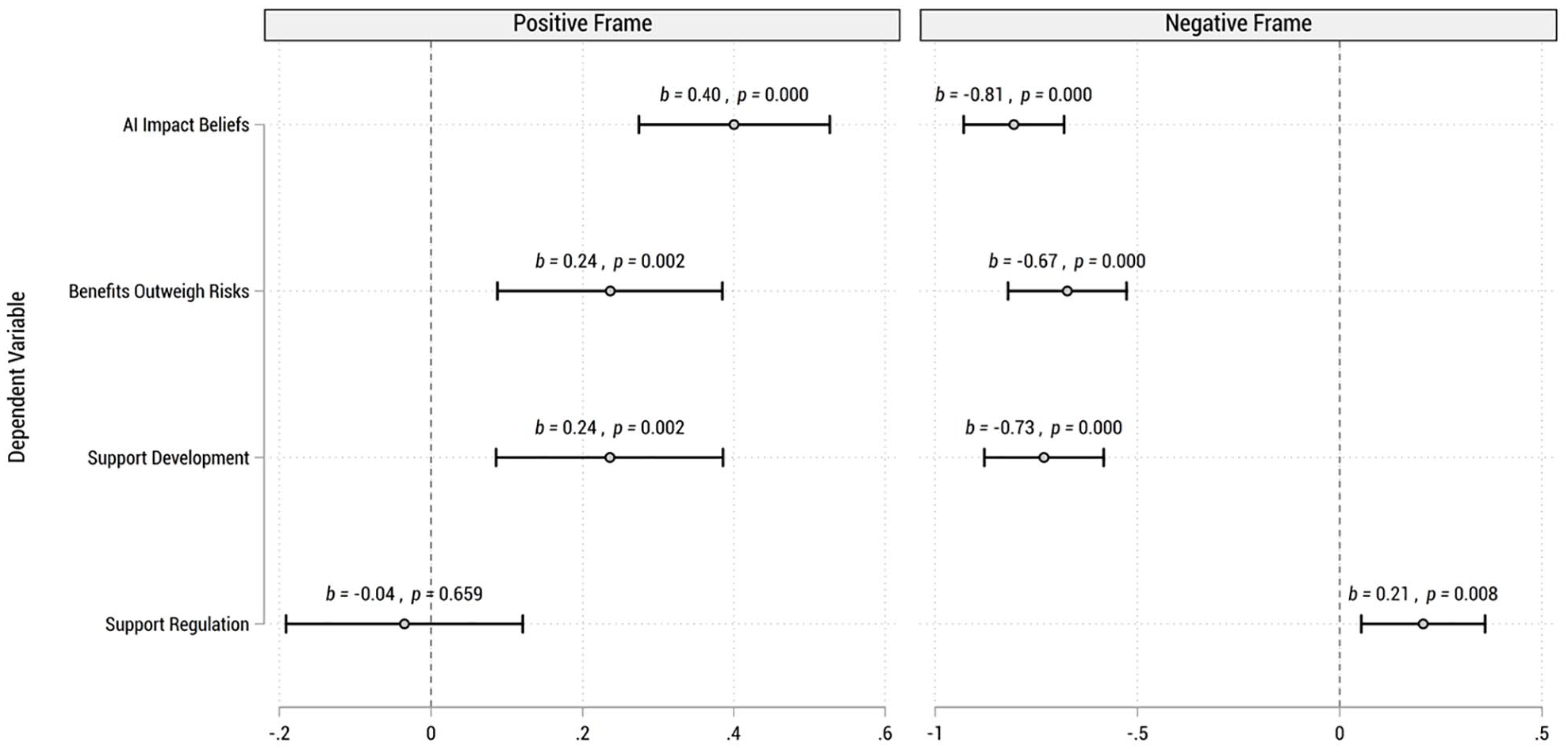
Main Treatment Effects on Primary Dependent Variables.
Our second set of hypotheses focused on the effect of exposure to the positive or negative frames about AI on perceptions regarding the degree to which the benefits of its development outweigh the risks, or vice versa. We find strong support for both H2a and H2b: exposure to the positive frame caused respondents to view the benefits of AI’s development outweighing the risks (b = 0.24, p = .002), while exposure to negative frames led respondents to express the opposite view that the risks of the development of AI outweigh its benefits (b = −0.67, p = .001). This result bolsters what we know about the strong impact that exposure to targeted emphasis frames can have on individuals’ views about AI by increasing the availability, accessibility, and perceived applicability of “impactful” considerations on a topic where the public has yet to form strong beliefs or opinions (Chong & Druckman, 2007; Zaller, 1992).
We next evaluate the impact of the experimental treatments on respondents’ general support for the development of AI and support for government regulation of its future development. Exposure to the positive message increased support for the development of AI (b = 0.24, p = .002), in line with H3a. Also, in support of H3b, we find that exposure to the negative message markedly decreased support for AI’s future development (b = −0.67, p = .001). This demonstrates the powerful impact that exposure one-sided frames in communication can have on the public’s general support for AI. Exposure to the positive message, counter to our expectation (H4a), did not reduce beliefs about the need for the federal government to regulate the future development of AI; however, in line with H4b, exposure to the negative message significantly increased respondents’ support for federal regulation of the development of AI (b = 0.21, p = .008). We return to the implications of these findings in the discussion section.
Figure 2 reports the effect of the experimental treatments on the primary outcome measured related to our research questions relative to respondents in the control condition. We evaluated two research questions regarding how exposure to the positive and negative message about AI might have impacts on general trust in science and the precautionary principle. We found that the positive message had no statistically significant effect on either trust in science or the precautionary principle (Figure 2). However, we found that exposure to the negative message had clear and strong downstream effects, decreasing trust in science (b = −.22, p = .001) and increasing agreement with the precautionary principle (b = .31, p = .001). In other words, although exposure to statements outlining the benefits of AI had no impact either on the downstream attitudes about trust in science and technology to solve the problems of humankind or to reduce the reluctance to experiment with new technologies given their risks, the treatment outlining the potential risks of AI had potent impacts on both issues. Respondents were thus more likely to attend to the messages about risks to humanity from future development of AI, triggering the invocation of the precautionary principle, and reducing stated faith in science and technology. That the negative treatment, but not the positive treatment, influenced these specific downstream beliefs about trust in science and the precautionary principle may stem from the public’s perceived role of “science” in AI development. Specifically, perhaps individuals (a) view AI development as a “tech pursuit” rather than a “science pursuit,” and (b) recognize solving these problems is a general responsibility of science. 5
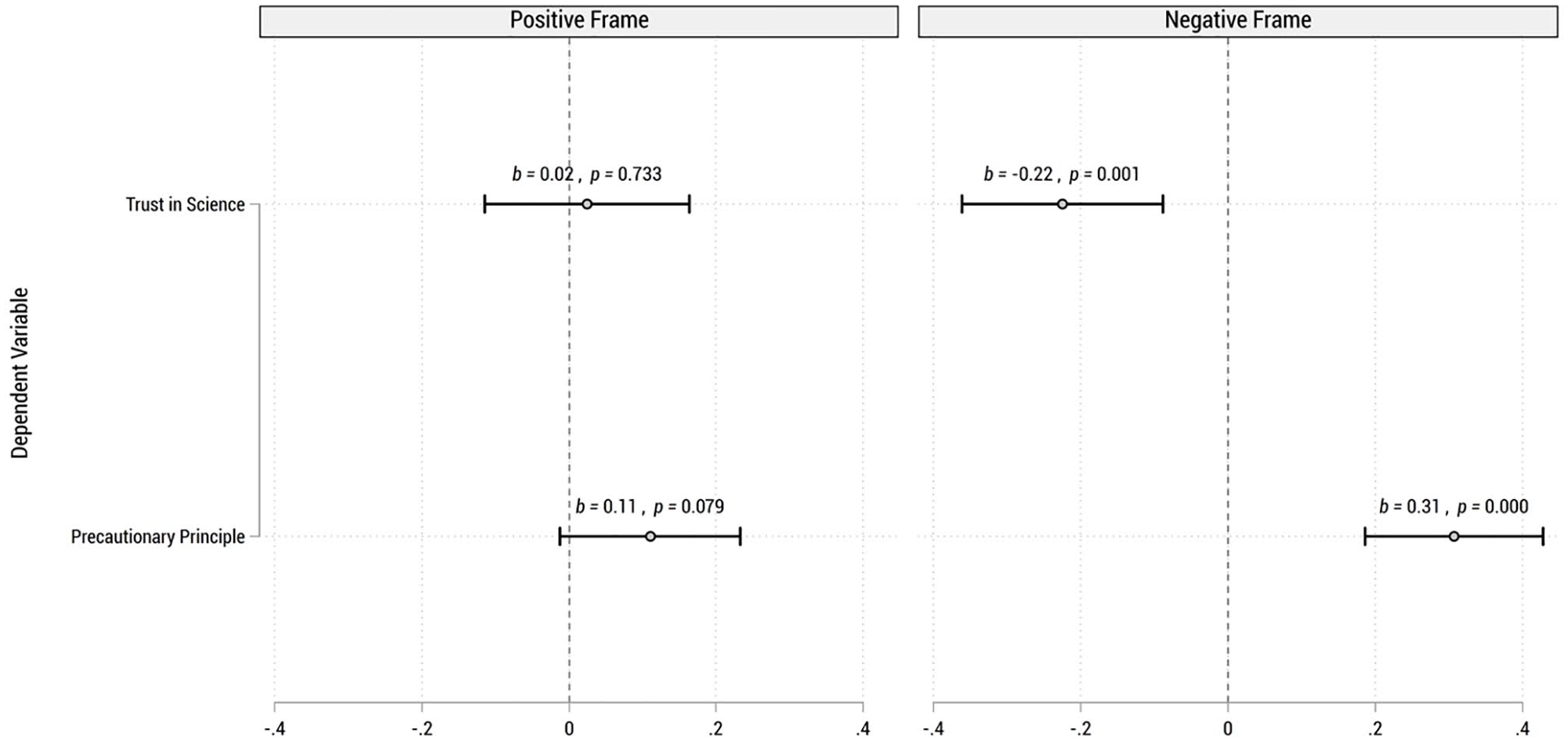
Trust in Science, Precautionary Principle—Main Effects.
Discussion/Conclusion
The survey experiment reported here demonstrates the strong impact of arguments emphasizing either the positive or the negative aspects and implications of AI. Those who read an essay in the form of a mock news article outlining the potential for AI to promote health, happiness, and prosperity were more likely to state that AI would have a positive effect on jobs, safety, education, health care, and the overall quality of human life. Those who read about the possible serious errors that could result from using AI, the possible harm done by unfeeling robots, or the potential for an increase in personal surveillance were more likely to state that there would be negative effects on jobs, health care, safety, education and quality of life. They also were more likely to emphasize the risks involved in AI, oppose its further development, and seek further regulation. In addition, this frame resulted in reduced trust in the potential for science and technology to improve human life as well as an increased strength in the belief in the “precautionary principle,” that is, a preference to slow the speed of development while the science behind its risks and benefits are explored further. These results, taken together, illustrate importance that targeted frames in communication can have on the public’s general views about emergent AI technologies and support for federal regulation of future developments. Put simply, how we “talk about” the future development of AI will impact what people think about its emerging benefits and risks. This study extends the growing body of research on emphasis framing effects and beliefs about AI technologies. It demonstrates that exposure to positively or negatively framed messages presented as mock news articles can powerfully impact the public’s views about the specific benefits and risks of AI as well as general support for its development and regulation. The results are also the first to demonstrate that exposure to negative frames that highlight the risks of AI can influence trust in science and support for the precautionary principle as related to AI’s future governance.
The development and diffusion of AI technology is inherently political. Mustafa Suleyman (2023: 156) argues that “this fact is radically under-recognized not only by our leaders but even by those building the technology itself. . . at times this subtle but omnipresent politicization is nearly invisible.” Public opinion will influence the pace, direction, and ethical boundaries of the future development and regulation of AI. New technologies rarely survive in the marketplace or overcome political and regulatory hurdles in the face of public opposition (Druckman, 2013). The more the public has a favorable view about emergent AI technologies, the more rapidly they will adopt changes in sectors such as health care, transportation, and education. Conversely, if the public becomes concerned about issues such as job losses, privacy, or safety, they may oppose AI integration and pressure policymakers to contain, limit, and control its development and deployment. Sieber et al. (2024: 1) argue, “Achieving greater public understanding of AI [is] important because of massive investments in AI by both the public and private sectors and because of AI’s impacts upon our daily lives.”
Based on the findings from our survey experiment, the dominant frames that are communicated to the public about AI’s benefits and risks will undoubtedly play a central role in the specific beliefs the public forms about AI. We acknowledge that our experimental treatments relied on the use of multiple frames regarding the potential benefits and risks of AI, as they would appear in a real news article. While this was intentional as a first step to demonstrate the powerful effect that combinations of prominent positive or negative news frames—as Framing Theory makes clear—can have on public opinion, a limitation is that we are unable to isolate the effect of any individual frame we employed in the treatments that highlighted the respective benefits or risks to jobs, health care, privacy, safety, and overall quality of life. The effects we reported because of exposure to these powerful frames in combination, perhaps unsurprisingly, are larger and more impactful across a range of attitudes and beliefs than previous studies that attempted to isolate the causal effect of a single framed message on the public’s related views (e.g., Bingaman et al., 2021). We also acknowledge that the question employed to measure respondents’ attitudes regarding whether “the benefits outweigh the risks” or “the risks outweigh the benefits” could have limited respondents’ ability to express a more nuanced or balanced view of AI, as measuring this relative evaluation of AI’s benefits and risks may not allow us to capture the full complexity of participants’ general attitudes.
Future research should focus on demographic variability in the response to these treatments with attention to the ways in which regulation of AI development can increase responsible development and deployment as well as address some of the concerns about the dangers of some of the applications for education, privacy, medical care, and civil liberties. As these technologies continue to emerge, it will also be important for future researchers to evaluate how the public evaluates prominent positive and negative frames regarding AI technologies in competitive information settings where respondents are presented with both positive and negative considerations in the same context. To date, few studies have evaluated public opinion formation in competitive framing contexts to evaluate the respective power of positive and negative arguments about the benefits and risks of AI when pitted against each other. It will also be important for future researchers to assess how attributing framed messages to “trusted or distrusted sources” such as scientists, a political party, or interest group might condition the impacts of the emphasis frames we employed.
Supplemental Material
sj-docx-1-scx-10.1177_10755470251317172 – Supplemental material for Framing Affects Support for the Development of Artificial Intelligence in the United States
Supplemental material, sj-docx-1-scx-10.1177_10755470251317172 for Framing Affects Support for the Development of Artificial Intelligence in the United States by Risa Palm, Justin T. Kingsland and Toby Bolsen in Science Communication
Footnotes
Declaration of Conflicting Interests
The author(s) declared no potential conflicts of interest with respect to the research, authorship, and/or publication of this article.
Funding
The author(s) disclosed receipt of the following financial support for the research, authorship, and/or publication of this article: Financial support for the cost of the survey was provided by the office of the Provost, Georgia State University.

Notes
Author Biographies
References
Supplementary Material
Please find the following supplemental material available below.
For Open Access articles published under a Creative Commons License, all supplemental material carries the same license as the article it is associated with.
For non-Open Access articles published, all supplemental material carries a non-exclusive license, and permission requests for re-use of supplemental material or any part of supplemental material shall be sent directly to the copyright owner as specified in the copyright notice associated with the article.
