







Abstract
This study examined how political ideology and science-related populism (SciPop) relate to both trust in federal science agencies and support for scientific funding in the United States. Using regression models, we analyzed perceptions of CDC, NIH, NSF, and EPA, as well as attitudes toward taxpayer-funded research and early 2025 proposed budget cuts. Both conservatism and SciPop predicted lower trust and reduced support for science funding, with SciPop emerging as the stronger predictor. This highlights the importance of understanding how anti-elite sentiment shapes public attitudes toward science, offering insights for science communication amid growing polarization and declining trust in scientific institutions.
In 2023, the United States spent an estimated US$940 billion on research and development, an investment that had been expected to grow over time (R&D; National Center for Science and Engineering Statistics, 2025). In terms of public support for these expenditures, evidence suggests that most of the U.S. public—regardless of partisan ideology—support either maintaining the rate of spending on government research funding or increasing the budget (Ognyanova et al., 2025). Despite this bipartisan support for science and health-related funding, President Donald J. Trump led considerable change to the nation’s research infrastructure early in his second term, reducing both the nation’s research budget as well as the workforce of the agencies that manage and implement the budget. This federal paradigm shift has prompted scientists to question whether U.S. prominence as a global leader in health and scientific research may be in jeopardy (Khalid, 2025; Sobel, 2025).
Perhaps more importantly for individual citizens, this shift may slow important discoveries and potential health treatments as well as reduce economic growth. Bush and Holt (2021) note that the United States’ past commitment to scientific research was fueled by the promise of enhancing health, quality of life, national security, and cultural development. In addition, the economic advantages of this commitment were clear. For each US$1.00 spent on research and development, estimates employing conservative lenses indicated that US$4.00 or greater was returned, resulting in billions of dollars in annual revenue that will be lost post-paradigm shift (Jones & Summers, 2022). Estimates with less conservative parameters indicate significantly greater return on investment (e.g., exceeding US$20.00 or higher per US$1.00 invested), magnifying the potential losses in revenue (Jones & Summers, 2022).
Perhaps due to the prospect of improved physical and economic health, the United States enjoyed bipartisan commitment to and support for scientific research and development in the past (Varmus, 2025). In short, regardless of political affiliation, ideology, or level of engagement, U.S. citizens and policymakers had long respected scientists and science and believed in protecting scientific work (Varmus, 2025). Yet, debates over climate change (Mann & Schleifer, 2020), the safety and efficacy of vaccines (Hamilton et al., 2015), and COVID-19 (Kossowska et al., 2021) have shaken trust in scientists and scientific governing agencies (Hamilton & Safford, 2021). Although the popular narrative is that conservatives are skeptical of science and scientists, the reality is not as clear-cut. Indeed, trust in science and scientists is often context dependent. Liberals are more skeptical of nuclear power (Dixon & Hubner, 2018), and conservatives are skeptical in the contexts of climate change and COVID-19. In the case of government spending cuts on scientific research, some conservatives have advocated increased discussions and slower, more thoughtful reform (Tollefson et al., 2025). On the other hand, recent polling suggests that Democrats are more in favor of increasing funding for scientific research whereas Republicans favor increasing funding for immigration enforcement and border security (Orth, 2025). In short, whether and, if so, how political ideology influences support for reducing government funding of scientific research and discovery remains an open question.
Beyond political ideology, other factors likely influence the extent to which individuals back the allocation of federal monies to support scientific research and discovery. One such factor attracting scholarly attention is science-related populist beliefs. Science-related populism is the belief that there is tension between the “ordinary people” and the “academic and scientific elite” regarding who should have decision-making sovereignty and truth-making sovereignty (Mede & Schäfer, 2020). Examples of decision-making sovereignty include control over determining which types of studies receive taxpayer dollars and what types of issues receive scholarly attention (Mede & Schäfer, 2020). Truth-making sovereignty is favoring commonsense knowledge over empirical knowledge (Mede & Schäfer, 2020). Although research on science-related populism is still in its relative infancy, researchers have examined how science-related populist beliefs influence general vaccination beliefs (Kohler & Koinig, 2023), feelings and attitudes related to COVID-19 and its various vaccinations (Eberl et al., 2021; Hawkins & Chinn, 2024), climate change beliefs (Huber, 2020; Huber et al., 2021, 2022), and trust in scientists (Zillich et al., 2024). Few studies, however, have examined whether science-related populist beliefs influence trust in federal government agencies and opposition to federal spending on scientific research. This gap is important because believing that the public should have more of a say in scientific research spending is a core pillar of science-related populism; thus, these beliefs likely influence support for more government oversight of scientific research and less tax dollar spending on it.
In this study, we collected public opinion data on the 23rd day of Trump’s second term in office. At the time of data collection, the Trump administration had recently laid off thousands of employees at various scientific and health government agencies and made large efforts to cut government spending on scientific research (Tollefson et al., 2025). This change to the operational frameworks of scientific agencies represents a significant departure from prior norms, establishing a natural inflection point for examining the intersection of science, politics, and institutional authority. As such, we focused on measuring public perceptions of four government agencies: the Centers for Disease Control and Prevention (CDC), the National Institutes of Health (NIH), the National Science Foundation (NSF), and the Environmental Protection Agency (EPA). Specifically, we examined trust in these agencies as operationalized by the belief that the agencies provide accurate and reliable information about health and/or science to the public. We also examined public support for government spending cuts to scientific research. Given divergent views and increased politicization, inquiry to better understand perceptions of federal science agencies, funding for scientific research, and the drivers of public opinion in these areas is needed.
Political Ideology and Trust in Federal Science Agencies
Public trust in science and scientists has remained largely stable, with 87% of Americans expressing confidence that scientists act in the public’s best interest (Tyson & Kennedy, 2024). Despite this general trust in the scientific community, political rhetoric has at times (as alluded to above), eroded some groups’ trust in science. Elite cue theory (Berinsky, 2009; Zaller, 1992), grounded in the elaboration likelihood model (Petty & Cacioppo, 1986), helps explain why and how political rhetoric can create divides in the public’s trust in science. When issues are complex, technical, unfamiliar, and require time/costs to fully understand—which frequently characterize science—elite cue theory posits that average citizens will look for cues about how to make sense of the issue (Gilens & Murakawa, 2002). Political leaders, prominent media personalities, celebrities, and important social network personalities may all comprise the “elite” from whom individuals take their cues. And research shows that people are more likely to follow a cue from someone they have identified as “like-minded” while they can simultaneously be dissuaded by an “elite” who is perceived as “non-like-minded” (Carmines & Kuklinski, 1990, as cited in Gilens & Murakawa, 2002). To the extent that scientists can position themselves as “like-minded,” they may be viewed as a source for elite cues. Partisanship, however, often serves as a powerful cue with respect to like-mindedness in highly political environments (Gilens & Murakawa, 2002). Thus, for the public, political leaders’ partisan affiliations may serve as cues to whether that leader is of like ideological mind.
In so much as conservative political leaders have increasingly framed science as adversarial to their agenda, trust in science and scientific agencies may be affected. Specifically, Republican politicians have made skepticism toward scientific findings—especially on climate change and public health—a central pillar of their recent rhetoric. For example, Rand Paul (R-KY) described efforts to mitigate climate change as “anti-American” (Killough, 2014). Throughout his first term, Trump frequently contradicted the recommendations of his own scientific advisors (Friedman & Plumer, 2020), a trend that escalated dramatically during the COVID-19 pandemic. Trump’s attacks on science were not merely rhetorical. The Union of Concerned Scientists documented over 200 instances in which the Trump administration undermined science policy, including restricting climate scientists’ research agendas and limiting public access to government-funded scientific findings during his first term in office (Union of Concerned Scientists, 2025). These repeated attacks on prominent scientific figures likely served to position scientists as “non-like-minded” and erode trust in science among those who viewed Trump as ideologically similar to themselves (Hameleers & Van der Meer, 2021).
The intersection of the pandemic and the 2020 presidential election further politicized public health institutions. Conservative social media and conservative mainstream media personalities’ rhetoric at that time may have served as additional “elite” cues impacting the Republican electorate’s views on science during the pandemic (Hamilton & Safford, 2021). Indeed, consuming conservative media during the pandemic reduced compliance with the CDC’s prevention recommendations (Zhu et al., 2024).
Although the criticism by conservative lawmakers and media was often directed at individual scientists, the criticisms of scientists likely served as cues for how to evaluate the import of federal government agencies. Trust in CDC, for example, significantly declined among Trump voters between 2016 and 2020 (Hamilton & Safford, 2021). Throughout the pandemic, Trump and other Republican leaders continued to impugn the credibility of health agencies, promoting unproven COVID-19 treatments such as hydroxychloroquine (Madanay et al., 2022) and restricting CDC’s ability to communicate directly with the media (Union of Concerned Scientists, 2022). Likely as a result, conservative individuals expressed significantly lower trust in CDC compared to their liberal counterparts (Latkin et al., 2020; Motta et al., 2023).
Given the current heightened political scrutiny of federal science agencies and the increased polarization surrounding scientific research from politicians (i.e., political elites) and media personalities (i.e., social elites) we propose the following hypotheses based on elite cue theory:
In recent years, there has been a shift from thinking about anti-science perspectives as tied solely to ideology and instead considering the role that populist beliefs play in these views. As such, we also consider the influence of science-related populist beliefs on perceptions of the government and government spending.
Science-Related Populist Beliefs and Perceptions of Federal Science Agencies
Populist beliefs appeal to individuals who feel disenfranchised and disrespected by societal elites (Norris & Inglehart, 2019). Although there are many definitions and understandings of populism, scholars generally agree that populism represents a set of ideas framing society as a moral struggle for political decision-making power, positioning a supposedly virtuous populace against a perceived corrupt elite (Mudde & Rovira Kaltwasser, 2018; Rooduijn, 2019). Importantly, populist attitudes are independent of political ideology and appear across the political spectrum (Huber et al., 2022). Attention to the populist movement heightened within the United States during the 2016 presidential election as then-candidate Donald Trump crafted messages appealing to populist beliefs central to his campaign communications (Lacatus, 2019; Oliver & Rahn, 2016). Indeed, Trump’s pledge to “drain the swamp” was a key part of his stump speech during his first presidential campaign (Meyer, 2017). This messaging illustrates one of the core missions of the populist movement—opposition to formal governance.
Although political populism speaks to science-related issues, in recent years, scholars have conceptualized science-related populism as a separate, yet related, set of beliefs specific to scientific issues (Eberl et al., 2023; Mede & Schäfer, 2020). Science-related populism frames a conflict between a virtuous ordinary public and a corrupt academic and scientific elite (Mede & Schäfer, 2020). This conflict arises from the belief that the elite unjustly monopolize science-related decision-making and the authority to define the truth, while the people rightfully seek to reclaim these roles (Mede & Schäfer, 2020). From this vantage point, knowledge produced by academic and scientific elites, viewed as ideologically biased and irrelevant, is rejected in favor of common sense as the legitimate basis for determining research agendas, funding, and the “broader production of truth” (Mede & Schäfer, 2020). Although political populism and science-related populism overlap significantly, they are conceptually and empirically distinct, as political populism primarily targets political elites and governance structures, whereas science-related populism specifically challenges scientific authority and expertise (see Eberl et al., 2023, for an empirical test of the difference). As such, we focus on science-related populism for the purpose of this study.
Within science-related populism, the core protagonists are the “ordinary people” and the “academic elite.” The academic elite are a subset of the general elite and perceived as the foe to the ordinary people. Members of the academic elite are typically thought of as experts with superior knowledge, academic training, or credentials in a specific subject matter (Motta, 2018). Drawing on work by Hartmann (2004), Mede and Schäfer (2020) defined the academic elite as “those who have epistemic authority and can make science-related decisions, that is organizations such as universities or scientific institutions as well as individual scholars and efforts” (p. 481). Academic and scientific elites are affiliated with a broad range of institutions (e.g., government agencies, colleges, universities, and private industry) and research fields (e.g., public health, natural sciences, social sciences). The majority of research on science-related populism to date has focused on conceptualizing science-related populism (e.g., Mede & Schäfer, 2020; Mede et al., 2021), understanding who science-related populists are (e.g., Lerner et al., 2025; Mede et al., 2022), examining how science-related populist beliefs predict context-specific science-related attitudes (e.g., Eberl et al., 2021; Huber et al., 2020, 2022; Kohler & Koinig, 2023), and science-related populists’ views toward scientists. Less research has examined how such beliefs influence perceptions of scientific agencies such as the NSF or CDC. This omission is an important oversight, as science-related populism fundamentally frames the conflict between ordinary people and academic elites as a struggle over “decision-making sovereignty” and “truth-speaking sovereignty.”
Science-related decision-making sovereignty refers to the authority to determine what research is conducted, by whom, when, and through what methods (Bimber & Guston, 1995). In non-populist scientific governance, this authority is typically vested in scientific institutions, peer-review processes, and funding agencies that allocate resources based on expert evaluation and established research priorities. However, within the framework of science-related populism, this sovereignty is contested, as the public challenges the control of academic elites over the direction of scientific inquiry. These parameters include the power to shape research agendas, allocate funding, design studies, and even restrict research in areas deemed controversial, ultimately reflecting broader claims to influence the direction of scientific inquiry (Mede & Schäfer, 2020). A central aspect of science-related populism is the tension between the public and academic elite over these power claims, as the former challenges the latter’s control over the production and governance of knowledge. Notably, the rhetoric surrounding recent decisions to cut federal funding for scientific research, as well as significantly reduce the workforce of scientific government agencies within the United States, speaks directly to this tenet of science-related populism.
For example, Trump issued an executive order titled “Ending Illegal Discrimination and Restoring Merit-Based Opportunity,” which stated,
Illegal DEI and DEIA policies not only violate the text and spirit of our longstanding Federal civil-rights law, they also undermine our national unity, as they deny, discredit, and undermine the traditional American values of hard work, excellence, and individual achievement in favor of unlawful, corrosive, and pernicious identity-based spoils system. (Exec. Order No. 14173, 2025)
Alongside this ban of Diversity, Equity, Inclusion, and Accessibility (DEIA) related activities, Trump’s administration called for halting all DEIA-related scientific research. One example is a study examining how racism can be coded into the training of artificial intelligence programs (Rodriguez et al., 2025). Other examples include examination of racial equity in STEM (Science, Technology, Engineering, and Mathematics) education and working with climate scientists to teach about climate action within the scientist’s classrooms (Press Release, 2024). These decisions to restrict funding for research perceived as ideologically biased speak directly to the decision-making sovereignty component of science-related populism. Indeed, science-related populists believe that ordinary people—rather than scientists/scientific entities—should decide what research is funded and conducted.
The final component of science-related populism is “truth speaking sovereignty,” which refers to the tension between the academic elite and ordinary people over what constitutes “true knowledge” (Bimber & Guston, 1995). Science-related populists believe that truth should be based on real-life observations and common sense rather than scientific, empirical knowledge (Mede & Schäfer, 2020; Waisbord, 2018). This belief contributes to lower trust in scientists, as science populists perceive common sense as superior to the expertise of scientists and scientific institutions (Cologna et al., 2025).
Science-related populist beliefs likely influence both the evaluation of scientific agencies and support for government spending cuts, independent of ideology as science-related populism occurs across the political spectrum (Mede et al., 2022). Science populist beliefs are associated with lower trust for politicized vaccines such as the COVID-19 vaccine and the measles, mumps, and rubella (MMR) vaccine (Kohler & Koinig, 2023), as well as the rejection of Big Pharma and Big Farms in favor of organic, locally produced food (Lello & Bertuzzi, 2025). Previous research has also found that trust in government is negatively correlated with science-related populism (Eberl et al., 2023). In the context of climate change, furthermore, Huber and colleagues (2020) found that populists had lower institutional trust. In addition, research on climate change and environmental protections often originates from federal environmental agencies, such as the EPA. Science-related populists generally believe that climate science research is driven by political agendas (Huber, 2020; Lockwood, 2018) rather than the will of the people. Indeed, climate change mitigation policies, such as transitioning to wind and solar energy, are often framed by Republicans and populists as job-eliminating measures (Fiorino, 2022). Likely as a result, science-related populists exhibit lower trust in federal science agencies, perceiving them as pursuing biased agendas (Krange et al., 2021). Taken together, we hypothesize the following:
Study Context
We collected data in mid-February 2025, approximately 3.5 weeks after the presidential inauguration. During his first 30 days in office, President Trump issued numerous executive orders, many designed to reshape federal agencies and governance (Gardenswartz, 2025). Some of these orders were met with legal challenges; others prompted debate across party lines. These executive orders were designed to advance the Trump administration priorities in areas such as immigration, trade, competition areas for transgender athletes, and redefining or eliminating DEI practices. Also, aligned with administration priorities in increasing government efficiency, included in the orders were workforce reductions (e.g., resignation options with deferred compensation, layoffs, and firings) at federal agencies (e.g., CDC, NIH, NSF, and EPA) and numerous shifts in federal grant funding (e.g., freezes, canceled study panels, prohibited communications, and reductions in overhead awarded) due to purported bloat in government spending in unnecessary areas and a reprioritized agenda (Gardenswartz, 2025; Kinnard, 2025; Mervis, 2025; Tollefson et al., 2025). These actions sparked wide media coverage across an array of platforms and outlets. Our research seeks to better understand factors influencing views of federal science agencies and scientific funding.
Method
Data for this study were collected through CloudResearch Connect’s census matching feature, which matches participants based on U.S. demographics (e.g., age, race, and ethnicity). A total of 500 individuals completed a 6-minute survey (Mdn = 5.37 minutes) in exchange for US$1.20. This survey was approved by the Institutional Review Board at the University of Louisville. The sample was evenly split by gender, with half identifying as female (n = 250). The average age was 45.6 (SD = 15.6). The racial composition was predominantly White (n = 390), followed by Black (n = 70) and Asian (n = 25). The majority of the sample held a bachelor’s degree (n = 192), followed by those who attended college but did not graduate (n = 114), a high school diploma or equivalent (n = 62), a master’s degree (n = 54), an associate degree (n = 50), and a PhD or professional degree (n = 23).
Measures
Independent Variables
Ideology
Ideology was measured on a 7-point scale ranging from “very liberal” (1) to “very conservative” (7; M = 3.54, SD = 1.86).
Science-related populist beliefs
Science-related populist beliefs were assessed using the Science-related (SciPop) scale developed by Mede et al. (2021). The scale consists of eight Likert-type items (1 = strongly disagree, 5 = strongly agree) measuring the four key components of science-related populism. Two items captured “conceptions of ordinary people” (“What unites ordinary people is that they trust their common sense in everyday life” and “Ordinary people are of good and honest character”). Two items tapped into “conceptions of the elite” (“Scientists are only after their own advantage” and “Scientists are in cahoots with politics and business”). “Demand for decision-making sovereignty” was measured using two items (“The people should have influence on the work of scientists” and “People like me should be involved in decisions about the topics scientists research”). The fourth component, “demand for truth-speaking sovereignty,” was measured with two items (“In case of doubt, one should rather trust the life experiences of ordinary people than the estimations of scientists” and “We should rely more on common sense and less on scientific studies”). Following prior research, we computed a composite SciPop score using the Bollen approach, averaging all eight items (M = 2.60, SD = .80,
Control Variables
Past research suggests that demographic characteristics of individuals can influence science-related populist beliefs as well as levels of trust in the government (Evans & Hargittai, 2020; Zulianello & Guasti, 2023). Thus, we included gender, formal education level, and salary as control variables.
Dependent Variables
Support for funding cuts
Support for federal funding cuts was assessed using two 5-point scale items, which were analyzed separately. First, participants were asked about their level of support for taxpayer money being used for scientific research: “Do you think that federal funding for scientific research is a good use of taxpayer dollars?” (M = 4.09, SD = 1.06). The second item asked about support for government spending cuts: “Some policymakers have proposed cutting federal funding for scientific and medical research to reduce government spending. Do you support or oppose these cuts?” (M = 2.05, SD = 1.31).
Perceived Trust
Perceived trust of four federal agencies (i.e., CDC, NIH, NSF, and EPA) was measured using two 5-point Likert-type scale items: “How much do you trust each of the following agencies to provide accurate information about health and/or science?” and “How much do you trust each of the following agencies to provide reliable information about health and/or science?” Individuals answered these questions for CDC (M = 3.38, SD = 1.27,
Data Preparation and Analysis
To test our hypotheses, we ran a series of linear regression analyses. For H1 and H3, we regressed political ideology and science-related populism, respectively, on reported perceptions of trust in the four science-related federal agencies: CDC, NIH, NSF, and EPA. To test H2, we regressed political ideology and science-related populism on the belief that federal funding for scientific research is a good use of taxpayer dollars. Similarly, we tested H4 by regressing political ideology and science-related populism on respondents’ expression of support (or lack thereof) for proposed federal spending cuts to scientific and medical research.
Before conducting the analyses, we assessed potential multicollinearity between ideology and science-related populism. Variance inflation factor (VIF) values indicated high collinearity, suggesting substantial shared variance between these predictors. To address this issue, both variables were mean-centered before inclusion in the regression models. Mean-centering helps mitigate multicollinearity while preserving the underlying relationships between variables, leading to more stable and interpretable estimates. In all regression analyses, we controlled for income, education, and gender. Like political ideology and science-related populism, household income and education were also mean-centered to facilitate clearer interpretation of model coefficients.
Results
In testing our hypotheses, we found statistically significant relationships between political ideology, science-related populism, and our outcome variables. Below we discuss these findings, beginning with results on perceived credibility of government agencies, followed by results regarding support for cuts to government spending.
Perceived Credibility of the Government Agencies
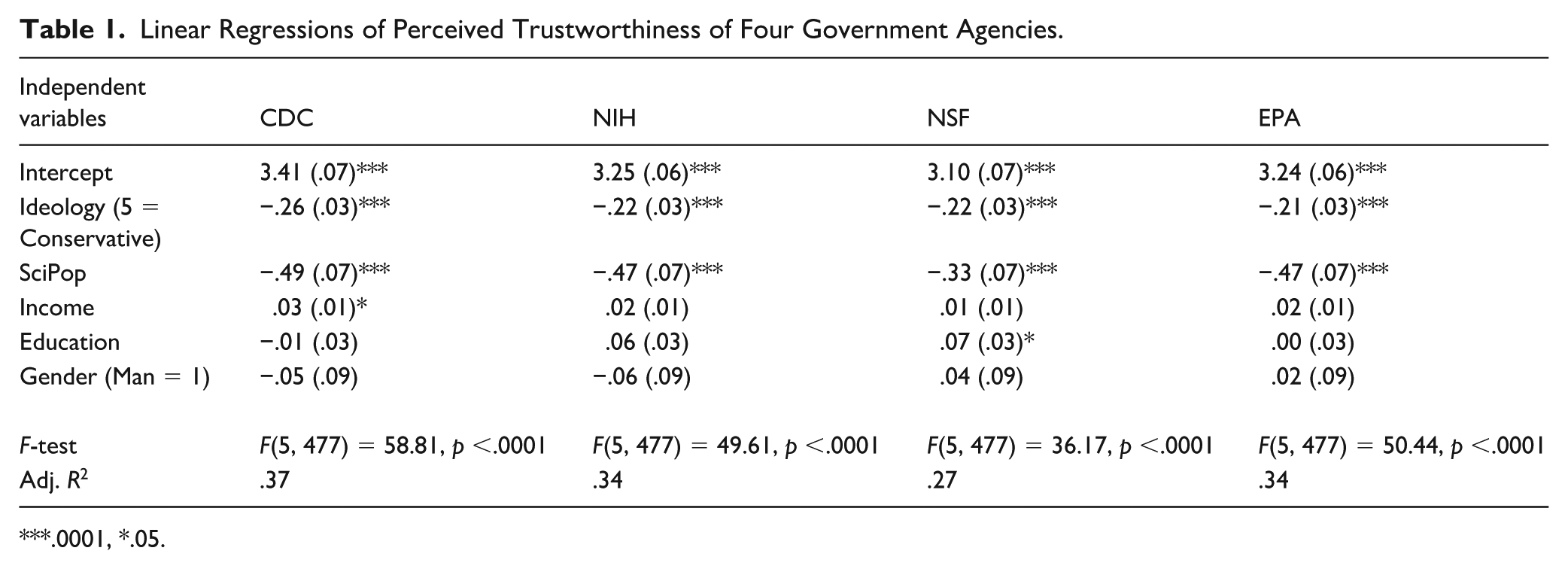
To test H1 and H3, we conducted four multiple linear regression analyses, with ideology and science-related populism (SciPop beliefs) as the independent variables and trust in each agency as the dependent variable (see Table 1). We hypothesized that conservative ideology would be associated with lower perceived trust of CDC (H1a), NIH (H1b), NSF (H1c), and EPA (H1d), and that higher SciPop beliefs would be associated with lower perceived trust of all four agencies (H3a–H3d).
Linear Regressions of Perceived Trustworthiness of Four Government Agencies.
.0001, *.05.
All four models were statistically significant. For CDC, science-related populism was the strongest predictor (β = −.49), indicating that individuals with stronger science-related populism beliefs rated the agency as less trustworthy, supporting H3a. Conservative ideology was also a significant predictor (β = −.26), supporting H1a and suggesting that more conservative individuals viewed CDC as less trustworthy. Among the control variables, income was a weak but significant predictor (β = .03), indicating that those with higher incomes tended to have slightly more positive evaluations of CDC. A similar pattern emerged for the NIH, where science-related populism was the strongest predictor (β = −.47), followed by ideology (β = −.22), supporting both H3b and H1b. None of the control variables were significant in this model.
For NSF, both science-related populism (β = −.33) and conservative ideology (β = −.22) significantly predicted lower trust perceptions, supporting H3c and H1c. In this model, education was also a significant predictor (β = .07), suggesting that individuals with more years of education evaluated NSF as more trustworthy. Finally, for EPA, science-related populism remained the strongest predictor (β = −.47), followed by ideology (β = −.21), supporting H3d and H1d. None of the control variables were significant.
Support for Government Spending Cuts
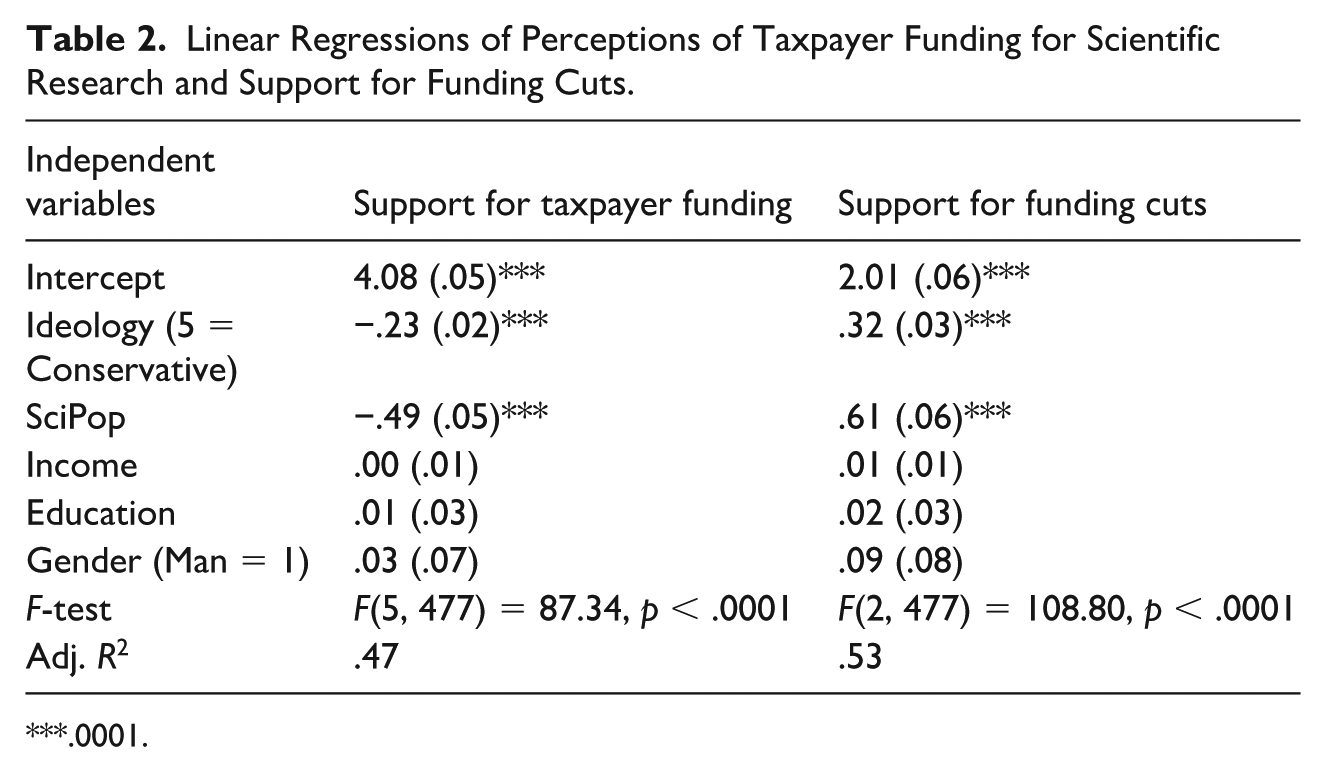
To test H2 and H4, we conducted two multiple regression analyses examining attitudes toward government funding for scientific research (see Table 2). First, we examined whether ideology and science-related populism beliefs predicted lower support for using taxpayer money to fund scientific research. The overall model was statistically significant, F(5, 477) = 87.34, p < .0001. As expected, conservative ideology was associated with lower support for taxpayer-funded scientific research (β = −.23), supporting H2. Similarly, science-related populism beliefs were negatively associated with support for government-funded research (β = −.49), supporting H4. None of the controls were significant in this model.
Linear Regressions of Perceptions of Taxpayer Funding for Scientific Research and Support for Funding Cuts.
.0001.
Next, we examined whether ideology and science-related populism beliefs predicted higher support for cutting federal funding for scientific research. The results mirrored the previous model, with conservative ideology significantly predicting greater support for funding cuts (β = .32), further supporting H2. Science-related populism beliefs were again the strongest predictor (β = .61), indicating that individuals with stronger science-related populist beliefs were more likely to support cuts to federal science funding, supporting H4. None of the controls were significant in this analysis.
Discussion
In recent years, science-related populist beliefs have risen worldwide, and the United States is no exception. In early 2025, the Trump administration set an anti-science agenda by significantly cutting government spending on scientific research and reducing the federal workforce at scientific agencies. Questions about the popularity of these funding cuts have arisen given that such cuts align directly with science-related populist beliefs of controlling what and how scientists research. This study, therefore, examined whether ideological and science-related populism beliefs influence both trust in federal science agencies as well as support for government spending cuts. Overall, we found that for all four agencies examined (i.e., CDC, NIH, NSF, and EPA) both conservative ideology and higher science-related populist beliefs were associated with lower perceived agency trustworthiness. Across all models, science-related populist beliefs were the strongest predictor of lack of agency trust, suggesting that these beliefs may play a somewhat greater role than political ideology in explaining views of agency credibility.
As most prior research on science-related populism has examined the public’s views of scientists, our findings expand knowledge regarding the range of science-related populists’ views. In particular, the findings suggest that the usual tension in science-related populism between ordinary citizens and academic elites extends to federal science agencies, which perhaps are seen as mouthpieces of elite groups and/or as key agents in decision-making sovereignty or truth-speaking sovereignty, key tenets of science-related populism. These findings align with the work of Krange et al. (2021), who, based on survey results in Norway, found that populism aligns with distrust of environmental organizations. Because science-related populism occurs across the political continuum (Mede et al., 2022), its effects may be greater than ideology alone and may have several outcomes (e.g., views of credibility, public interest, impartial/biased agendas). Additional research in this area might explore views of other organizations as well as enhanced conflict frames. Further, some previous work has reported variance in source credibility and populism (Peresman et al., 2025); thus, deeper investigation of experts leading agencies, the relationship between current governmental officials and particular agencies, and changes over time is warranted. Moreover, recent work by Fischer et al. (2025) suggests that our findings might also hold relevance for other market-oriented countries with similar structural and ideational frameworks. For example, Singapore and the United Kingdom both operate under relatively low regulation and low public funding market conditions. They also focus on ideation through science in academia, as well as political support and integration of science across their societies. Thus, our findings related to support for funding and trust in government agencies might translate to these countries’ populations.
For professional science communicators, the influence of science-related populism on belief systems means that efforts to rebuild trust may need to move beyond simply correcting misinformation or emphasizing expertise. Instead, communicators could consider approaches that acknowledge populist concerns about power, access, and representation in science. For example, highlighting transparency in decision-making, showing responsiveness to public values, or featuring community-level participation in research could help address the perceived distance between scientific government institutions and “the people.” Future research should explore how such message strategies resonate with audiences high in science-related populist attitudes, including whether appeals to shared values or procedural fairness can mitigate distrust.
Despite decades of high trust in science among the U.S. public, increasingly conservative politicians have asserted that science runs counter to the public good, fueling growing distrust among some groups and widening the gap in viewing scientific achievement as a point of national pride. Given these ideological shifts, increased skepticism of accepted scientific fact (e.g., COVID-19 protective behavior, vaccines, climate change), and the current political climate, it is not entirely surprising that conservative ideology was associated with lower perceived federal science agency credibility. Much additional research, however, is needed to understand the communication sources and strategies that contribute the most to devaluing science and discovery.
In our models, the control variables rarely yielded significant results. Income, however, was related to perceptions of CDC’s trustworthiness. Individuals in higher income brackets perceived CDC more positively than those in lower brackets. Given that CDC serves a “protective” function (i.e., safeguarding the nation’s health), perhaps participants with higher incomes are more aware of and/or more fully endorse this role. In addition, participants with higher education levels viewed NSF more favorably than those lower in formal education. Additional research to more fully understand these associations is needed.
Regression results also supported both our hypotheses on the value of using federal funds for research (i.e., H2 and H4). Conservative ideology and higher science-related populism beliefs were significantly related to less support for funding scientific research using tax dollars and more support for reductions in research funding. In both analyses, science-related populism was more strongly associated with opposition to federal funding of scientific research, indicating that populist views may influence perceptions of government use of tax funds beyond political ideology.
As noted above, science-related populist beliefs extend across political affiliations and philosophies (Mede et al., 2022) and influence an array of viewpoints, including government spending. Given that science-related populists are interested in setting agendas and determining research topics (Mede & Schäfer, 2020), it is not surprising that they questioned the effective use of tax funds for scientistic research and supported decreases in federal research funding. In future research, it will be important to investigate potential differences in support based on areas of research, such as whether science-related populists differentiate between all funding and funding in specific areas (e.g., climate change, food safety, vaccine development, or cancer treatment).
Limitations
Despite the advancements our study offers, there are several limitations worthy of note. First, the data from this study were self-reported. As a result, it is possible that individuals were affected by response bias. Although there is a possibility that our participants might have felt the need to hide their true opinions, we still detected differences across the ideological and science-related populist spectra. Thus, this limitation was likely minimized. Second, the data are cross-sectional, prohibiting the assessment of changes across time. Future research should consider collecting data at multiple time points to detect real-time changes in public perceptions of federal governing agencies. Similarly, future research should experimentally examine how different message features shape trust in agencies for science-related populists. We must also point again to the cross-sectional nature of our study. Although we used a mediation analysis to statistically test our research question, we cannot speak to causality given the nature of our data. Thus, our results should be interpreted with caution, and we encourage future retests of our premise using experimental research.
Third, it is important to note that we had a relatively small sample size that was drawn from an online panel. Although we recruited participants using census-matching procedures to enhance representativeness, the self-selected nature of online panel participants may have introduced selection bias into our sample. In addition, a sample size of 500 participants also limits the generalizability of our findings. While this number is sufficient for detecting medium-sized effects, it reduces power for identifying smaller but potentially meaningful effects and restricts our ability to examine more fine-grained subgroup differences. Future research with larger, more diverse samples should continue to explore the relationships we observed here to help improve the generalizability of our findings. Similarly, our sample skewed toward those with a higher-level of education than the public. It is therefore important that future research examines whether our results can be replicated with a sample that is closer to the general population in terms of education. Indeed, those from a working-class background, or with less than a high-school degree, often hold populist beliefs (Alvarez et al., 2023; Evans & Hargittai, 2020); thus, it is important to study these subpopulations specifically.
Finally, data were collected at a heightened political time (e.g., executive orders were underway, court cases were being filed, and considerable media coverage was taking place), which may have affected findings. Although we believe that the timing of this research is a strength, as it captured real-time public responses to shifts in government prioritization, it should be noted that public responses were likely in flux and may have differed based on the date of data collection. Relatedly, the study was conducted in the United States, limiting generalizability of the findings to other contexts. More specifically, beyond the timing of data collection, philosophical, historical, structural, and political factors may influence views of science agencies and support, suggesting the importance of future research in multiple nations. For example, future investigations might employ the lens of science communication ecosystems, developed by Fischer et al. (2025), to examine these constructs in other market-oriented ecosystems (e.g., Singapore, South Korea, and the United Kingdom) or explore possible differences in the United States and countries with other types of science communication ecosystems. In addition, similar work in nations with populist governments or where division among citizens exists along populist lines would contribute to enhanced understanding in this area of study. Despite these limitations, this research advances understanding of how science-related populism and political ideology may influence views of federal science agencies and taxpayer-funded research in the United States.
In summary, our study illustrates the importance of considering science-related populist beliefs in the context of public evaluations of scientific institutions. Our findings suggest the need for additional work investigating how perceptions of ordinary citizens and perceived elites, and the conflict dividing these groups, influence understanding and behavior across the political spectrum. Certainly, amid political upheaval, erosion of trust in science, questions regarding the legitimacy of the scientific enterprise, and calls to defund scientific research, such understanding is vital in developing communication to overcome ideological differences, rebuild trust, and re-establish credibility.
Footnotes

Ethical Approval
This research was determined exempt (#24.0800) by the institutional review board at the University of Louisville.
Funding
The authors disclosed receipt of the following financial support for the research, authorship, and/or publication of this article: This research was supported, in part, by an intramural grant from the University of Louisville. The content is solely the responsibility of the authors and does not necessarily represent the official views of the University of Louisville. The funding sponsor had no role in study design; data collection, analyses, or interpretation; manuscript preparation; or the decision to disseminate the results.
Declaration of Conflicting Interests
The authors declared no potential conflicts of interest with respect to the research, authorship, and/or publication of this article.
Data Availability Statement
Data is available upon request to the corresponding author.