






Abstract
This commentary argues that blanket exhortations against the “deficit model” limit the ability to have nuanced discussions about the potential impact of seeking and sharing different types of information. It specifically seeks to remind the science communication community that the evidence only suggests a weak relationship between a specific type of textbook science knowledge and pro-science attitudes. In contrast, there is substantial evidence that communication—including well-designed “one-way” communication—that includes information about risks and benefits, social norms, self-efficacy, and trustworthiness can affect beliefs and feelings. Furthermore, such outcomes are often associated with behavior.
Introduction
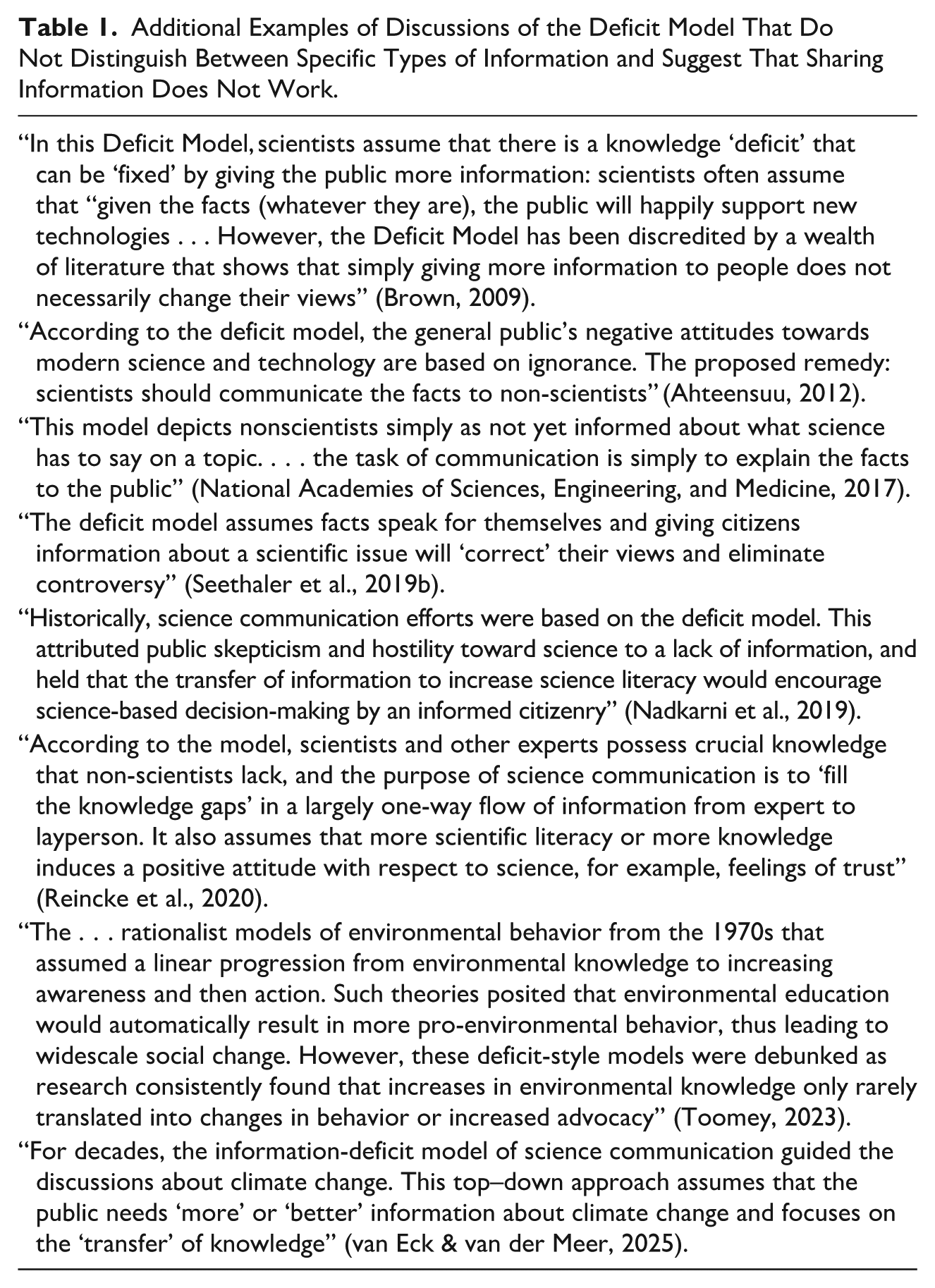
Too many science communication discussions incorrectly suggest that “one-way” sharing of science-related “information” (i.e., facts, knowledge) does not work. In contrast, this commentary argues that blanket exhortations against the “deficit model” limit researchers’ and practitioners’ ability to have nuanced discussions about the potential impact of well-designed exposure and attention to different types of information. For example, one otherwise excellent discussion of science communication training argued that science communicators need to move beyond the deficit model while defining this model as “the intuitive belief that simply providing information (‘filling the deficit of knowledge’) will change science-related attitudes or behaviors (Lewenstein & Baram-Tsabari, 2022, p. 291; see also: McKinnon & Vos, 2015).” Similarly, a key science communication handbook partly equated deficit thinking with the belief that people are “misinformed about science” (Bucchi & Trench, 2014, p. 4; see also: Seethaler et al., 2019a). Table 1 includes additional examples of regularly cited articles that suggest that sharing science information is unlikely to have a substantive effect.
Additional Examples of Discussions of the Deficit Model That Do Not Distinguish Between Specific Types of Information and Suggest That Sharing Information Does Not Work.
While there is no common definition of the deficit model (Trench, 2008), our argument here is that science communication discussions could benefit from recognizing that existing research shows that sharing science-related information, depending on the type of information and how it is shared, can affect what people believe and feel about science and scientists. Further, the evidence suggests that these beliefs and feelings can have small but cumulative effects on behavior. This means that, rather than eschewing the value of sharing information, science communicators might benefit from thinking more carefully about what specific types of information to communicate, as well as how to share that information. Importantly, consistent with the idea of two-way dialogue, science communicators might also benefit from more nuanced thinking about what specific types of information they can seek from others, as well as how to seek it. Different types of information are central ingredients in communication, and communicators can benefit from knowing what is in their pantry and which ingredients may help them make progress toward specific behavioral goals.
Our argument is grounded in the reality that (a) there are many kinds of science-related information, (b) all communication involves sharing and receiving these various kinds information, (c) engaging with such information will often affect what a person believes and feels, (d) believing accurate information should be understood as a form of knowledge, and (e) our beliefs and feeling often affects our behaviors. Note, however, that we do not argue that science communicators should ever treat people as though they are deficient (i.e., disrespectfully), nor are we arguing against the value of dialogue as a tool for the bidirectional sharing of information. Our argument focuses only on the value of talking about the effects of information exposure and attention (Slater & Rasinski, 2005) in more precise ways.
Empirical Research on the Deficit Model
We often see a lack of specificity about the type of information that is relevant to discussions about the knowledge deficit model. The quantitative research underlying the deficit model shows only that one specific type of science knowledge is weakly correlated with outcomes such as pro-science attitudes (i.e., risk and benefit beliefs). The research that Allum et al. (2008) summarize, in this regard, uses knowledge measures that include textbook, factual, and procedural knowledge as developed by Jon Miller and his colleagues for tracking science literacy in groups such as the American adult population (Miller, 1998). These measures mostly involve true/false or multiple-choice questions about topics such as whether the Earth goes around the sun and whether lasers work by focusing sound waves. By operationalizing knowledge narrowly as trivia-like textbook facts, this research provides little insight into the relationships between what people correctly believe (i.e., know) about any specific scientific topic and how they behave relative to that specific topic. It equally provides no insight into the effects of communicating different types of accurate information to give audiences opportunities to increase what they know (i.e., justifiably believe).
As noted, those who dismiss the value of sharing information to foster knowledge often fail to distinguish between the different types of science-related information a person could believe or communicate (see Table 1 for examples). In contrast, behavior change researchers have identified a well-established set of beliefs that are often associated with behavior, and about which a communicator could share or seek information. These include behavior-specific risks and benefit beliefs (i.e., attitudes, when aggregated), social norm beliefs, and behavioral control beliefs (i.e., self-efficacy or agency beliefs). Such beliefs are captured in models such as the Health Belief Model, the Theory of Planned Behavior, Protection Motivation Theory, and the Integrated Behavioral Model (Armitage & Conner, 2001; Carpenter, 2010; Floyd et al., 2000; Montano & Kasprzyk, 2015). Trust (i.e., credibility) researchers would further add that science communicators who want to foster trustworthiness beliefs to build trusting relationships may want to find ways to ethically demonstrate that they are high in ability (i.e., expertise), benevolence (i.e., goodwill), integrity (i.e., honesty; Hendriks et al., 2015; McCroskey & Teven, 1999; Schoorman et al., 2007), and openness (Besley et al., 2021; Reif et al., 2025).
We recognize that the type of scientific information a communicator could share lies on a continuum on which we envision the endpoints to be trivia-like textbook facts and behavior-specific information (e.g., risk/benefit information). One key consideration when sharing information in the context of science is thus the compatibility between the type of information shared and one’s behavioral goal. Like the principle of compatibility (Fishbein & Ajzen, 2010; Siegel et al., 2014), which partly posits that beliefs will be better predictors of behaviors when the measurement of the beliefs is specific to the behaviors in question, information that has greater correspondence to behavior-specific beliefs is more likely to impact that behavior. Thus, relative to textbook facts, behavior-specific information will likely have a stronger relationship with with specific behavioral goals. For example, understanding how glycoproteins enable viruses to penetrate and infect host cells (textbook information) is unlikely to change one’s intention to get a vaccine. However, knowing about the benefits of herd immunity and believing that herd immunity gained through vaccines can help protect populations vulnerable to specific diseases might influence vaccination intentions (Pfattheicher et al., 2022).
Of course, there is no magical piece of information that will affect every person in every context, but this does not detract from the reality that beliefs and associated feelings (i.e., evaluative beliefs) are key factors that shape how people make decisions about behaviors and that people develop their beliefs based on their experiences (Fishbein & Ajzen, 2010). According to theories of belief updating, the key is not whether there is two-way dialogue but whether the communication experience motivates and enables engagement with the information (Petty et al., 1997). Dialogue is one approach that can motivate and enable engagement, but so too can other formats (e.g., a compelling text, talk, video, or museum exhibit). Communicators who want to have an impact thus benefit when they ensure the information they share is as relevant as possible to the audience-specific behavioral context for their communication and that they have established context-relevant trustworthiness. Scientists seeking information through efforts to listen may similarly benefit from trustworthiness and ensuring that they seek types of information relevant to the decisions they are trying to make. Indeed, much of the sub-field of communication effects is premised on the reality that people share and receive information that can affect beliefs through a range of channels, over time (Cho et al., 2009).
Some might argue that beliefs about science-related behaviors and science-related actors do not count as scientific knowledge. We are agnostic about the terms used to refer to concepts in these arguments; instead, we are cautioning against flawed extrapolations based on a lack of clear explication and operationalization of key concepts. Specifically, findings showing a weak correlation between holding correct beliefs about textbook facts (i.e., science knowledge) and outcomes like support for science (or specific science products) do not provide evidence against the value of sustained, respectful, and engaging communication of various types of information. Indeed, sharing such information—even one-way sharing—can help people develop accurate beliefs about science and scientists so that they can make belief-relevant decisions. Similarly, scientists who seek varied types of information can also make better decisions about their research and communication choices.
A Path Forward
Naïve science communicators will often say their goal is to correct beliefs (i.e., “fight misinformation,” “raise awareness,” etc.) and then face criticism for “deficit thinking.” We see little value in criticizing such a communicator for a deficit mindset and exhorting them to engage in two-way communication. Instead, the type of response we suggest is generative questions like: “What do you expect would happen within a specific group if you were to successfully correct the information?” and “What behaviors by a specific group do you think would be different if their awareness was higher?” These “why” questions should be asked until the communicator identifies real-world behavioral contexts and specific audiences they want to help in specific ways. Besley and Dudo (2022) call these types of desired outcomes “audience-specific behavioral goals.”
Those who worry that having an audience-specific behavioral goal sounds too advocacy-oriented for scientists may benefit from recognizing that the goal behaviors could include wanting a priority audience to “consider relevant scientific information” related to that behavior. Equally, the behavior might be wanting someone to “share information” with scientists or wanting a scientist to “seek” information about a group’s needs or concerns. The key is that having an audience, a context, and a desired behavior allows communicators to use evidence-based theories (e.g., Mayer et al., 1995; Montano & Kasprzyk, 2015) to identify specific beliefs where there is a potential for change and then use these beliefs to prioritize associated information types (i.e., risk/benefit information, trustworthiness information, etc.) that communicators may want to share or seek through their communication efforts.
Past research suggests that common communication goals among scientists include wanting people to consider the insights of science in their professional or personal decision-making. This could encompass a wide range of behaviors from specific regulators using specific insights to make specific decisions, to individuals from across society turning to scientists as trusted sources of guidance. Others may want a group of youth to consider a science career or policymakers to fund research (Besley & Dudo, 2026). Ideally, scientists also prioritize goals focused on making sure that they—the scientists—make research and communication choices that correspond with societal needs (Besley & Downs, 2024).
In this regard, and perhaps paradoxically, helping science communicators start with their audience-specific behavioral goals can encourage scientists to listen to other societal actors. Scientists with ideas about audience-specific behavioral goals put themselves in a position to be reflexive about whether potential engagement goals may be appropriate in a given context. A key part of this reflexivity should include an eagerness by science communicators to update their behavioral goals in cases where it becomes clear that an initial goal was unrealistic given available resources or inappropriate given the needs or concerns of other societal actors (Garlick et al., 2025).
Helping science communicators develop specificity about the behavioral context for their communication efforts may also help the scientific community communicate more ethically. We are uncomfortable with discussions about the dangers of persuasion or advocacy (Fischhoff, 2007) that do not seem to recognize that all communication has potential effects on how people think and feel, as well as associated behaviors (Watzlawick et al., 1968). For us, this means that communicators have a responsibility to be intentional about their communication choices (i.e., strategic). We see nothing inherently wrong with science communicators saying, for example, that they would like individual, organizational, or civic decision-makers to consider research on the benefits of electric vehicles (EVs) or vaccines when making decisions on these topics and then doing what they can to ensure that they share their insights in ways that enable and motivate (Petty & Cacioppo, 1986) their priority audiences to consider their insights (i.e., engage with them). In contrast, it would seem disingenuous for a scientist to say that they have spent time and other resources studying EVs or vaccines but that they do not have a preference about whether you take their findings into account when making decisions. Scientists who develop insights and then fail to do what they can to share these insights with people who might benefit from them in engaging, sustained ways invite negative trustworthiness beliefs.
Ultimately, the most important thing is that more science communication discussions focus on the full range of outcomes that can occur as a result of the full range of intentional and unintentional choices that communicators can make. We hope this results in fewer vague discussions about what science communicators are doing wrong (e.g., taking a deficit approach) and more nuanced discussions about the degree to which it is reasonable and ethical to expect specific communication choices to affect specific outcomes, including cognitive and affective outcomes (i.e., beliefs and associated feelings) as well as concurrent behavioral outcomes.
In some cases, such work might explore the degree to which choices have different outcomes in different audiences and/or contexts. This might look like exploring whether communicating intellectual humility leads to scientists being seen as more trustworthy (e.g., Koetke et al., 2025) or seemingly unexplored topics such as whether providing scientists with information on non-scientists’ priorities shapes future research or communication choices. Further, it may be necessary to critique science communicators and scientific organizations if they consistently avoid designing and implementing communication activities that enable them to listen to others’ perspective with a goal of improving their research or communication activities, but we should avoid flippantly labeling any individual activity as being deficit-focused.
Footnotes
Authors’ Note
Any opinions, findings, conclusions, or recommendations expressed in this material are those of the authors and do not necessarily reflect the views of the USDA’s NIFA program.

Funding
The authors disclosed receipt of the following financial support for the research, authorship, and/or publication of this article: This material is based upon work supported by the United States Department of Agriculture’s National Institute for Food and Agriculture program (MICL02758).
Declaration of Conflicting Interests
The authors declared no potential conflicts of interest with respect to the research, authorship, and/or publication of this article.