






Abstract
Effective climate change communication requires persuasion strategies that align with the public’s cognitive modes of thinking, and authority appeal has shown promise. However, the impact of frequent authority appeals on communication effectiveness remains unclear. Two experimental studies were conducted to investigate the effect of frequent (vs. non-frequent) authority appeals on public climate action intentions. Study 1 revealed that frequent authority appeals diminished climate action intentions, including both climate-friendly behavior and support for mitigation policies, with psychological reactance as a mediator. It further found that this effect was moderated by political ideology: frequent authority appeals did not trigger significant reactance among conservatives. This neutralized the negative impact and even resulted in a significant positive effect on climate-friendly behavior. Study 2 replicated the negative effect of frequent authority appeals on climate action intentions and the mediating role of psychological reactance, and additionally found that rationale provision accompanying frequent authority appeals neutralized psychological reactance and turned the effect of frequent authority appeals on climate action intentions positive. Recommendations are provided for improving strategies to enhance public climate action intentions.
Keywords
Introduction
In the present context, climate change is recognized as a major global challenge (Levin et al., 2012). The international community has demonstrated extraordinary resolve and ambition through pivotal diplomatic achievements—establishing the United Nations Framework Convention on Climate Change in 1992, adopting the Kyoto Protocol in 1997, and crafting the landmark Paris Agreement in 2015—which collectively aspire to limit global temperature rise to well below 2°C above pre-industrial levels while earnestly pursuing the more ambitious threshold of 1.5°C. Translating this bold vision into reality demands not only governmental action and policy frameworks but also a comprehensive collective effort from all sectors of society (Bamberg et al., 2015). Specifically, given that climate change is, in part, the aggregate result of myriad individual actions such as household electricity consumption (Howlett & Rawat, 2019), it is essential for every individual to take climate action by modifying their consumption behaviors (Gosnell & Bazilian, 2021).
Nevertheless, there exists a significant gap between the public’s climate action intentions and the requirements for effectively addressing climate change (Zhao & Luo, 2021). This disparity can be attributed to psychological barriers and biases present in the public, which obstruct effective reasoning about the complicated issue of climate change and even discourage those who acknowledge it from taking action. For example, individuals may view climate change as distant and insignificant, leading them to underestimate its urgency and impact (Maiella et al., 2020; Moser, 2007), while others may see it as uncontrollable and overwhelming, reducing their motivation to take action (Moser, 2009; O’Neill & Nicholson-Cole, 2009). To bridge this action gap, existing research highlights the role of effective climate change communication in overcoming these psychological barriers and biases, and further emphasizes that such communication must incorporate persuasion strategies to be truly effective (Bloomfield & Manktelow, 2021; Moser, 2007, 2009; Moser & Dilling, 2011; Nisbet & Scheufele, 2009).
Among the persuasion strategies available, authority appeal is one that is frequently employed in climate change communication (Coen et al., 2021; Dong et al., 2025; Wynn, 2023). For instance, Dong et al. (2025) found that 47% of the 226,000 climate change videos on YouTube made use of authority appeal, underscoring its prevalence in real-world climate messaging. Authority appeal is an argument form that uses the verdict of authority figures to support claims or positions (Walton, 1997). For instance, if someone says, “According to a renowned scientist, climate change is caused by human activities”, they are using an authority appeal to support their statement—and notably, authority appeal is also one of the six principles of influence proposed by Cialdini (2007). This approach can be persuasive due to its alignment with the way people process information in complex situations. Specifically, when dealing with complex problems, people tend to employ a mental shortcut called “heuristic” to reduce the complexity of problems (Kahneman et al., 1982). Heuristics are sensitive to cues (e.g., the evaluation of information by trusted groups), allowing people to make quick, intuitive judgments based on these cues rather than engaging in more extensive investigations (Todorov et al., 2002). Given the complexity of climate information for the general public, people are likely to rely on this heuristic when evaluating climate change messages, and authority appeal facilitates this process by cueing people’s trust in authority figures, thereby increasing the persuasiveness of climate messages and promoting climate action intentions.
The effectiveness of authority appeal in enhancing communication has been confirmed across a range of research contexts (e.g., Beek et al., 2024; Bian et al., 2025; Hoogeveen et al., 2022; Knausenberger et al., 2019; Shao & Ieong, 2024). Within the specific domain of climate change communication, authority appeal has likewise been shown to shape public perception of climate messages in both directions: in pro-mitigation climate communication, Myers et al. (2015) and Constantino et al. (2021) found that highlighting scientific agreement and expert commitment strengthened public perception of pro-environmental norms and scientific consensus; more recently, Jarke-Neuert et al. (2025) showed that expert advice can guide individuals toward climate actions that achieve greater emissions reductions. In climate change denial communication, both Van Der Linden et al. (2017) and Cook et al. (2017) found that denial-framed appeals to authority—whether through contested petitions or fake expert messaging—undermined public perception of scientific consensus and exacerbated ideological polarization. However, the aforementioned studies all employ a one-shot experimental design that only examines the effect of authority appeal exposure (authority appeal vs. no authority appeal), without allowing for comparison across different levels of intervention frequency. Yet in real-world climate change communication—such as news articles, speeches, and documentaries—authority appeal is likely to be used frequently rather than as a one-time strategy (Bieniek-Tobasco et al., 2019; Hiles & Hinnant, 2014; Moser, 2016). To address this gap, the present study investigates the following research question: how frequent authority appeals shape public climate action intentions?
A growing body of research has examined the effects of frequent exposure to persuasive messages, yet the findings remain inconclusive. For instance, Lecheler and Vreese (2012) found that repetitive news framing had no significant incremental effect on public opinion beyond a single exposure, and Koch and Zerback (2013) similarly showed that the credibility-boosting truth effect of repetition was offset by reactance triggered by perceived persuasive intent, resulting in no overall significant gain. In contrast, Lecheler et al. (2015) demonstrated that repeated exposure to the same news frame significantly strengthened the intensity and durability of opinion change compared to a single exposure, while Shi and Smith (2016) similarly found that repeated fear appeal messages progressively enhanced threat perceptions and relevant behavioral intentions. Still other studies point to a more complex, non-linear pattern: Cacioppo and Petty (1979) found that message repetition produced an inverted-U effect on attitude change, with moderate repetition yielding the greatest persuasive impact and excessive repetition triggering counterarguments that eroded the effect, a pattern echoed by Fernandes (2013), who found that negative political advertising followed the same inverted-U trajectory across repetition levels. Given these inconsistent findings, the existing literature offers no clear answer to how frequently authority appeals influence climate action intentions, necessitating research that specifically examines this question.
The present study addresses this gap by investigating the effect of frequent (vs. non-frequent) authority appeal on climate action intentions. Specifically, we examine (a) the main effect of authority appeal frequency on climate action intentions, (b) the underlying mediating mechanisms through which this effect operates, and (c) the boundary conditions of this effect, including individual-level heterogeneity across different audience segments and potential strategies for moderating its impact. To this end, we develop a series of research hypotheses grounded in Psychological Reactance Theory, test them through two randomized between-subject experiments, and discuss the findings along with their practical implications for designing communication strategies that promote climate action intentions.
Theory and Hypotheses
Frequent Authority Appeals and Climate Action Intentions
The dual-process theory posits that individuals process information through two distinct modes: System 1, which is automatic and fast, and System 2, which is controlled and slow (Evans & Stanovich, 2013; Kahneman, 2011). In circumstances of high complexity, individuals tend to rely on System 1, making rapid intuitive judgments based on a limited number of cues—a process referred to as “heuristic” (Todorov et al., 2002). Due to the intricate nature of climate science knowledge, the general public tends to rely on heuristics rather than systematic evaluation when processing climate change information (Hornsey et al., 2016). Trust is one such heuristic, as individuals often decide whether to accept or reject a claim based on their trust in the source (Hmielowski et al., 2014; Sintov & Hurst, 2023). Authority appeal functions as a trust heuristic in science communication, allowing individuals to bypass extensive investigation and form judgments based on their trust in authority figures (Cummings, 2014). By leveraging this trust, authority appeal can directly promote climate action intentions—and when used frequently, repeated exposure is likely to further reinforce message credibility and salience, amplifying this positive direct effect.
However, frequent authority appeals may simultaneously trigger psychological reactance, which can suppress and even overshadow this positive direct effect. Psychological reactance theory holds that individuals generate reactance when they perceive messages as threatening their freedom of choice (Brehm & Brehm, 1981), resulting in a combination of anger and negative cognitions that undermine persuasive outcomes (Rains, 2013). Given that repetition may activate awareness of persuasive intent (Koch & Zerback, 2013), frequent authority appeals are likely to be perceived as overtly persuasive, triggering reactance that in turn undermines climate action intentions (Ma et al., 2019; Quick & Stephenson, 2007; Rains & Turner, 2007; Reinhart et al., 2007; Richards et al., 2017). We argue that this negative indirect effect via psychological reactance is sufficiently strong to mask the positive direct effect, resulting in a negative overall effect of frequent authority appeals on climate action intentions. On the basis of these arguments, we propose the following hypothesis.
The Moderating Role of Political Ideology
Prior research has indicated that individuals with different political ideologies may respond differently to climate change messages (Chan & Lin, 2022; Fielding et al., 2012; McCright et al., 2016), suggesting that political ideology may also shape how people respond to frequent authority appeals. To understand why, we draw on Moral Foundations Theory, which holds that human moral judgment rests on multiple universal psychological foundations (Haidt, 2012). Among these, the authority/subversion foundation concerns respect for hierarchy, tradition, and legitimate authority as a means of maintaining social order (Graham et al., 2013). Crucially, individuals differ in how much they rely on this foundation depending on their political ideology: liberals tend to prioritize the individualizing foundations—care and fairness—whereas conservatives place considerable weight on the binding foundations—loyalty, authority, and purity—in addition to care and fairness (Feinberg & Willer, 2013; Graham et al., 2009, 2013; Haidt & Graham, 2007; Kivikangas et al., 2021). Empirical research supports this pattern. For instance, Wolsko et al. (2016) found that framing environmental messages in terms of authority and loyalty significantly reduced conservatives’ skepticism toward climate change and increased their pro-environmental behavioral intentions, while such framing had little effect on liberals. These ideological differences suggest that conservatives, for whom authority represents a legitimate and valued moral foundation, are less likely to perceive frequent authority appeals as a threat to their freedom of choice. As a result, frequent authority appeals are less likely to trigger psychological reactance among conservatives. With the negative indirect effect via reactance attenuated, the positive direct effect of frequent authority appeals on climate action intentions is no longer masked, and the overall effect turns positive. On the basis of these arguments, we propose the following hypothesis.
The Moderating Role of Rationale Provision
Given that the negative effect of frequent authority appeals on climate action intentions operates primarily through psychological reactance, and that reactance can be mitigated through certain strategies (Bessarabova et al., 2017; Zhang, 2020), we propose that providing strategies to alleviate reactance may moderate the effect of frequent authority appeals on climate action intentions. The present study focuses on one such strategy: rationale provision. Rationale provision refers to the practice of providing the underlying evidence and reasoning behind a claim—for example, explaining not just that a scientist holds a position, but why, based on what data or logic. According to Self-Determination Theory, providing a rationale is a key autonomy-supportive practice that facilitates internalization—the process by which individuals come to genuinely understand and personally endorse an externally presented position (Deci et al., 1994). When individuals are given the reasoning behind a claim, they are better equipped to appreciate the importance and necessity of the advocated behavior, and to experience the resulting motivation as self-determined rather than externally imposed (Reeve et al., 2002; Steingut et al., 2017). This heightened sense of perceived autonomy, in turn, reduces perceptions of external control and freedom threat. As psychological reactance is fundamentally triggered by such perceived threats to one’s freedom of choice (Brehm & Brehm, 1981), rationale provision—by supporting autonomy and fostering internalization—makes reactance less likely to be activated under frequent conditions. When a rationale provision is present, the negative indirect effect of frequent authority appeals via psychological reactance is attenuated. As a result, the positive direct effect of frequent authority appeals on climate action intentions is no longer masked by reactance, and the overall effect becomes positive. On the basis of these arguments, we propose the following hypothesis.
Study 1
The first study aims to test Hypotheses 1 and 2 by conducting a between-subjects experiment to assess the impact of frequent authority appeals on climate action intentions. To capture both private and public dimensions of climate action, we selected two outcome variables: climate-friendly behavior (representing individual-level actions) and support for mitigation policies (representing collective-level support). We further examined the mediating role of psychological reactance in this relationship and the moderating role of political ideology.
Design and Participants
This study used a between-subject experimental design with one factor: frequency of authority appeals (frequent vs. non-frequent). We recruited UK adult participants for the experiment through the online crowdsourcing platform, Prolific. It is worth noting that participants recruited through online crowdsourcing platforms are just as representative as those recruited through offline channels (Mullinix et al., 2015). Among all online crowdsourcing platforms, Prolific participants showed the highest quality of responses and the most diverse characteristics (Peer et al., 2017).
Before recruiting participants, we calculated the required sample size using G*Power software with a power analysis. Specifically, we set the effect size (f) to 0.3378, with a statistical power of 95% and a significance level of α = .05. The effect size (f) was obtained from the effect size transformation tool provided by Lenhard and Lenhard (2016), which converted the effect size reported in a freedom-threat study (η2 = 0.1024; Dillard & Shen, 2005). The analysis indicated a minimum required sample size of 116. Given that we planned to conduct subgroup analyses by political ideology to test the moderating effect in Hypothesis 2, we recruited more than twice the minimum sample size to ensure adequate statistical power for these analyses.
In December 2025, we successfully recruited 286 participants, with 132 assigned to the non-frequent group and 154 to the frequent group. The mean age of the sample was 35.0 years (SD = 9.5), with 50.0% female participants. Moreover, 77.6% of the participants held a college degree or higher, 67.2% reported a monthly income below £3,000, and 42.3% identified their socio-economic status as average. Among them, 152 participants (53.1%) identified as conservatives (political orientation ≥ 5 on a 7-point scale). The sample characteristics across conditions are presented in Table 1.
Descriptive Statistics and Balance Tests by Experimental Conditions in Study 1.
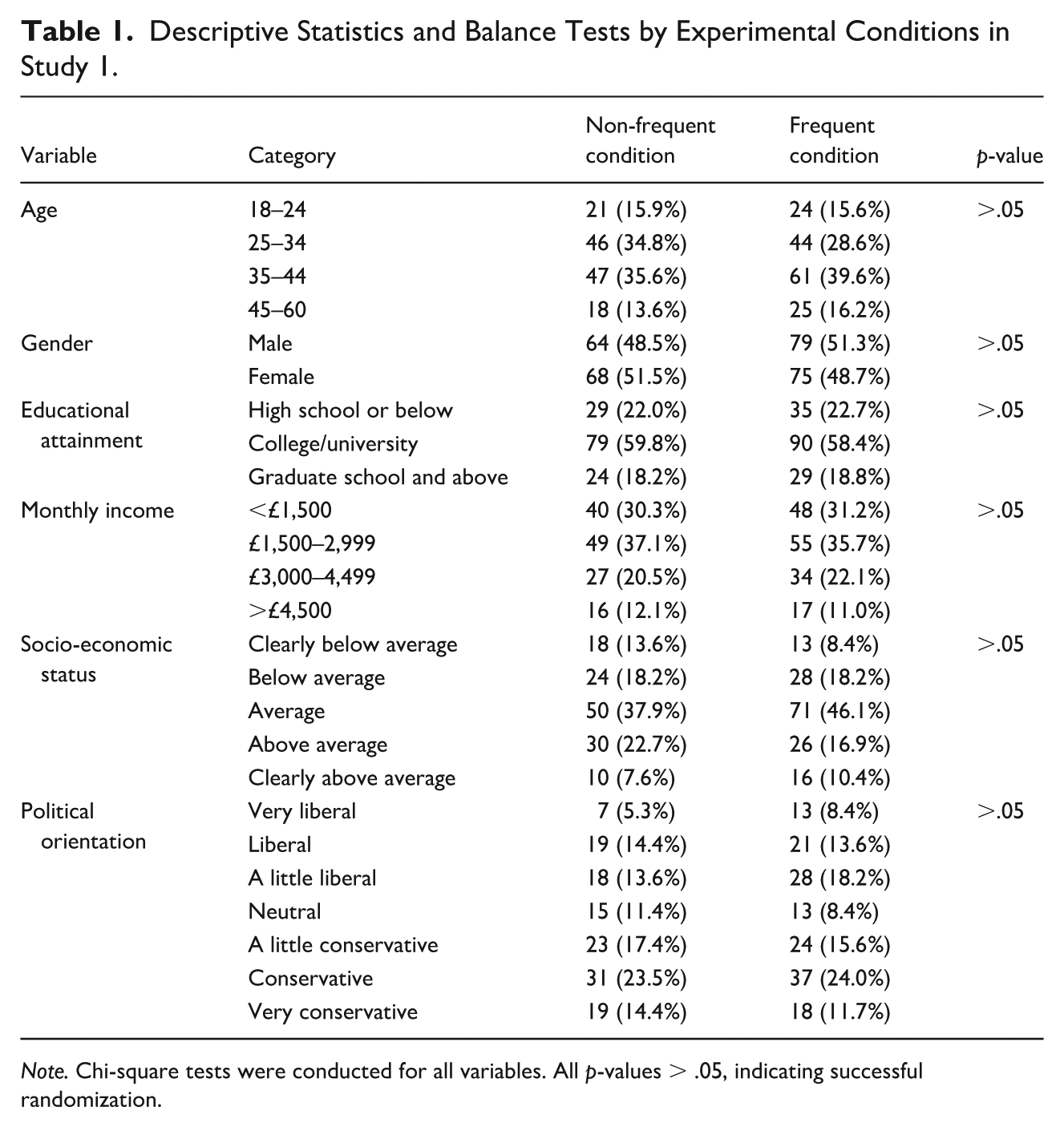
Note. Chi-square tests were conducted for all variables. All p-values > .05, indicating successful randomization.
Procedure and Materials
The experiment was implemented using Qualtrics, an online questionnaire platform. At the beginning of the questionnaire, all participants provided informed consent and were informed that their responses would be anonymous and confidential.
Frequency of Authority Appeals
All participants were randomly assigned to either the frequent or non-frequent group. Both groups read a climate change article that outlined the causes, potential impacts, and potential solutions of climate change (Loy & Spence, 2020), which included 9 scientific facts. The article was designed to be read in under 3 min (Koch & Zerback, 2013), consistent with previous studies on the repetition of persuasive techniques. In the frequent group, participants read an article that contained 9 authority appeals, with each scientific fact being supported by scientific authority figures (553 words). In the non-frequent group, participants read an article containing only 3 authority appeals, with only 3 out of the 9 scientific facts being supported by scientific authority figures (543 words). To enhance the authenticity of each authority appeal, the wording of each appeal was slightly modified (Koch & Zerback, 2013). The articles for both groups can be found in the Supplementary Material.
After manipulating the frequency of authority appeals, we assessed the perceived frequency of authority appeals in the climate change articles as a manipulation check. Perceived frequency was measured using a single item: “How frequently did the article cite scientific authorities or experts?” rated on a 5-point scale, ranging from 1 (not at all frequently) to 5 (very frequently).
Psychological Reactance
Psychological reactance was operationalized as the combination of anger and negative cognitions. The anger arousal was measured utilizing the 4 items (α = .91) proposed by Dillard and Shen (2005). The items assess to what degree the article made participants feel angry, irritated, annoyed, and aggravated. Each item was rated on a 5-point scale, ranging from 1 (strongly disagree) to 5 (strongly agree). The negative cognitions were measured utilizing the two items (α = .84) designed by Varava and Quick (2015): “My thoughts about this article are . . . (1 = positive, 5 = negative)” “My thoughts about this article are . . . (1 = like, 5 = dislike).” We did not adopt Dillard and Shen's (2005) thought-listing technique for assessing negative cognitions, as this technique is somewhat unwieldy outside of laboratory experiments. These two measures were averaged together to create our measure of psychological reactance.
Climate-Friendly Behavior
Participants’ intentions to engage in climate-friendly behavior were measured utilizing the twelve items (α = .91) designed by Chan and Lin (2022). The items assess the self-report likelihood that participants will take 12 climate mitigation actions in the next 6 months. Example items are “Turn off lights you’re not using” and “Walk, cycle, or take public transit for short journeys”. Each item was rated on a 5-point scale, ranging from 1 (very unlikely) to 5 (very likely).
Support for Mitigation Policies
Participants’ support for mitigation policies was measured utilizing the 10 items (α = .93) designed by Schuldt et al. (2018). Example items are “Provide government incentives for home modifications that improve energy efficiency” and “Require automakers to increase the fuel efficiency of cars, trucks, and SUVs to 54.5 mpg”. Each item was rated on a 5-point scale, ranging from 1 (strongly oppose) to 5 (strongly support).
Finally, we collected participants’ demographics, including gender, age, educational attainment, monthly income, political ideology, and socio-economic status.
Results
Manipulation Check
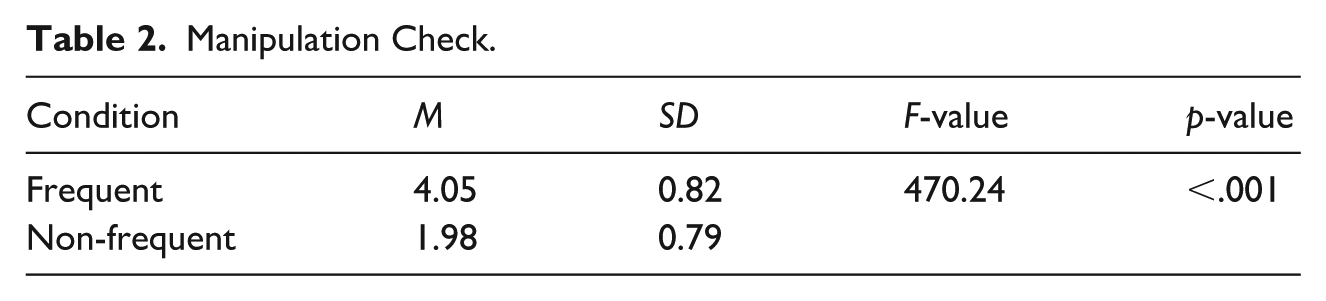
We conducted a manipulation check on the frequency of authority appeals by examining the difference in perceived frequency between the two conditions. The detailed results are presented in Table 2. An ANOVA revealed that participants in the frequent condition reported significantly higher perceived frequency (M = 4.05, SD = 0.82) than those in the non-frequent condition (M = 1.98, SD = 0.79), F(1, 284) = 470.24, p < .001. This suggested that the manipulation of the frequency of authority appeals in this study was successful.
Manipulation Check.
Hypothesis Testing
The main effect of frequent authority appeals
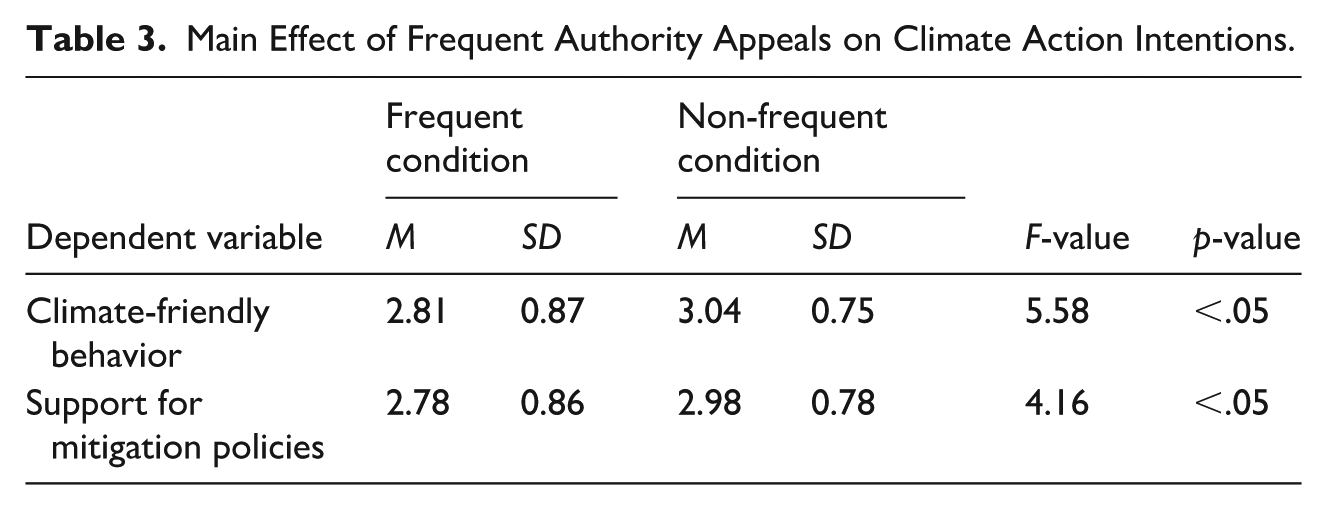
We performed one-way ANOVAs to evaluate how the frequency of authority appeals affects participants’ climate action intentions. The detailed results are presented in Table 3. For climate-friendly behavior, a significant main effect was found, F(1, 284) = 5.58, p < .05. Participants in the frequent condition reported lower intentions to engage in climate-friendly behavior (M = 2.81, SD = 0.87) than those in the non-frequent condition (M = 3.04, SD = 0.75). For support for mitigation policies, a similar pattern emerged, F(1, 284) = 4.16, p < .05. Participants in the frequent condition reported lower support for mitigation policies (M = 2.78, SD = 0.86) than those in the non-frequent condition (M = 2.98, SD = 0.78). These results indicated that exposure to climate change messages with frequent authority appeals has a negative effect on climate action intentions, providing initial support for Hypothesis 1.
Main Effect of Frequent Authority Appeals on Climate Action Intentions.
Mediation analysis
We conducted mediation analyses using PROCESS Model 4 (Hayes, 2018) with 5,000 bootstrap samples to test whether psychological reactance mediates the effect of frequent authority appeals on climate action intentions. The detailed results are presented in Table 4.
Mediation Analysis: Psychological Reactance as Mediator.
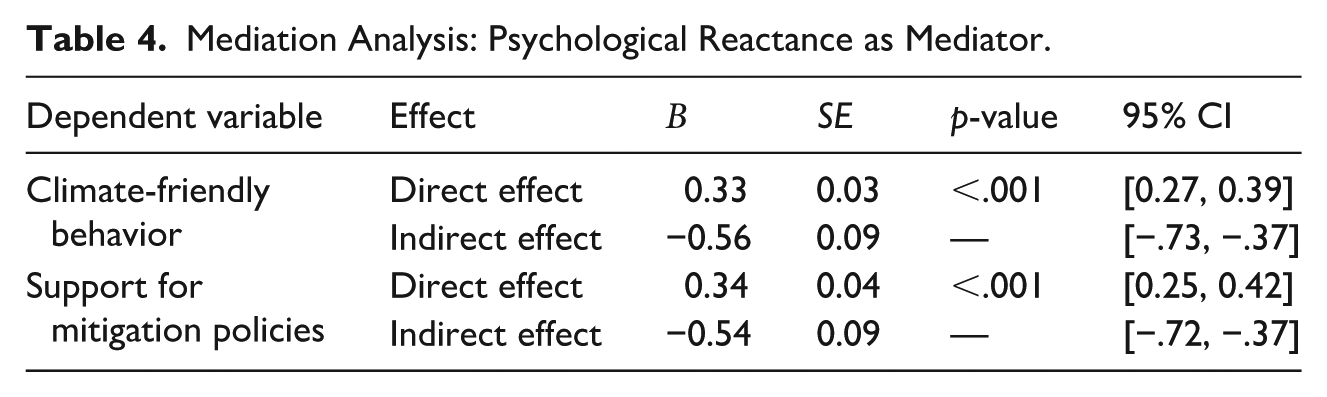
For climate-friendly behavior, the results showed that frequent authority appeals significantly increased psychological reactance (β = 0.55, SE = 0.09, p < .001), and psychological reactance in turn significantly reduced climate-friendly behavior (β = −1.00, SE = 0.02, p < .001). The indirect effect via psychological reactance was significant (β = −0.56, 95% CI [−.73, −.37]), while the direct effect of frequent authority appeals on climate-friendly behavior remained significant (β = 0.33, SE = 0.03, p < .001).
For support for mitigation policies, a similar pattern emerged. Frequent authority appeals significantly increased psychological reactance (β = 0.55, SE = 0.09, p < .001), and psychological reactance significantly reduced support for mitigation policies (β = −0.97, SE = 0.03, p < .001). The indirect effect was significant (β = −0.54, 95% CI [−.72, −.37]), and the direct effect remained significant (β = 0.34, SE = 0.04, p < .001).
These results demonstrate that psychological reactance partially mediates the negative effect of frequent authority appeals on climate action intentions, supporting Hypothesis 1.
Moderation analysis
We examined whether political ideology moderates the effect of frequent authority appeals on climate action intentions by conducting ANOVAs with the interaction term. The detailed results are presented in Table 5. The results revealed significant interactions between the frequency of authority appeals and political ideology for both dependent variables.
Moderation Analysis: Political Ideology as Moderator.
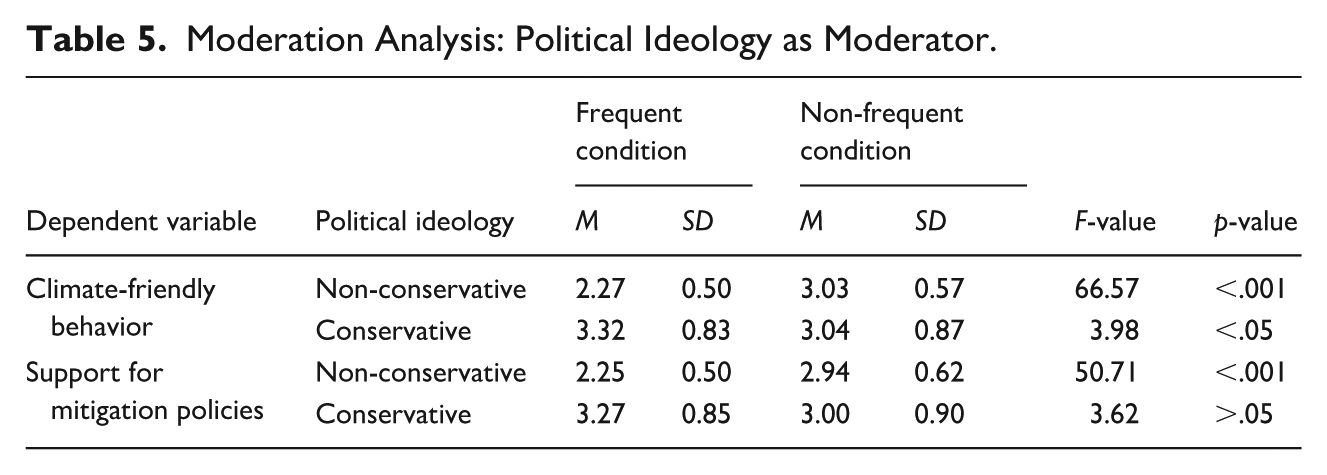
For climate-friendly behavior, the interaction was significant, F(1, 282) = 36.39, p < .001. Simple effects analyses showed that among non-conservatives, frequent authority appeals significantly reduced climate-friendly behavior, F(1, 132) = 66.57, p < .001, with the frequent condition (M = 2.27, SD = 0.50) showing lower scores than the non-frequent condition (M = 3.03, SD = 0.57). Among conservatives, however, frequent authority appeals significantly increased climate-friendly behavior, F(1, 150) = 3.98, p < .05, with the frequent condition (M = 3.32, SD = 0.83) showing higher scores than the non-frequent condition (M = 3.04, SD = 0.87).
For support for mitigation policies, the interaction was also significant, F(1, 282) = 29.61, p < .001. Among non-conservatives, frequent authority appeals significantly reduced support for mitigation policies, F(1, 132) = 50.71, p < .001, with the frequent condition (M = 2.25, SD = 0.50) showing lower scores than the non-frequent condition (M = 2.94, SD = 0.62). Among conservatives, the effect was not statistically significant, F(1, 150) = 3.62, p > .05, although the frequent condition (M = 3.27, SD = 0.85) showed directionally higher scores than the non-frequent condition (M = 3.00, SD = 0.90).
Moderated mediation analysis
To further test Hypothesis 2, we conducted moderated mediation analyses using PROCESS Model 7 (Hayes, 2018) with political ideology as the moderator. Political ideology was coded as 1 = conservative, 0 = non-conservative. The detailed results are presented in Table 6.
Moderated Mediation Analysis: Political Ideology as Moderator.
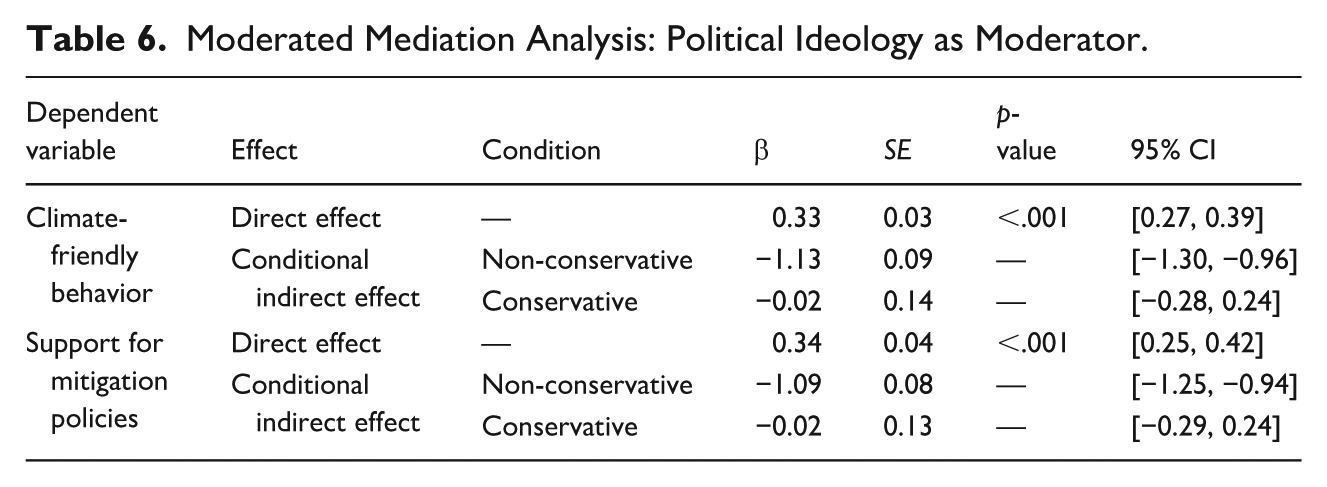
The results revealed a significant interaction between the frequency of authority appeals and political ideology on psychological reactance. For climate-friendly behavior, the interaction term was significant (β = −1.10, SE = 0.16, p < .001). Simple slope analyses showed that among non-conservatives, frequent authority appeals significantly increased psychological reactance (β = 1.13, SE = 0.12, p < .001), whereas among conservatives, the effect was not significant (β = 0.02, SE = 0.11, p > .05).
The conditional indirect effects further supported Hypothesis 2. Among non-conservatives, the indirect effect of frequent authority appeals on climate-friendly behavior via psychological reactance was significant and negative (β = −1.13, 95% CI [−1.30, −0.96]). Among conservatives, the indirect effect was not significant (β = −0.02, 95% CI [−0.28, 0.24]). The index of moderated mediation was significant (β = 1.10, 95% CI [0.79, 1.41]), confirming that political ideology moderates the mediation process.
The same pattern was observed for support for mitigation policies. The interaction between frequency of authority appeals and political ideology on psychological reactance was significant (β = −1.10, SE = 0.16, p < .001). Among non-conservatives, frequent authority appeals significantly increased psychological reactance (β = 1.13, SE = 0.12, p < .001), but not among conservatives (β = 0.02, SE = 0.11, p > .05). The conditional indirect effect was significant for non-conservatives (β = −1.09, 95% CI [−1.25, −0.94]) but not for conservatives (β = −0.02, 95% CI [−0.29, 0.24]). The index of moderated mediation was significant (β = 1.07, 95% CI [0.76, 1.37]).
These results provide strong support for Hypothesis 2: political ideology moderates the effect of frequent authority appeals on climate action intentions. Among conservatives, the effect of frequent authority appeals turns positive because such appeals do not trigger significant psychological reactance among this group, thereby allowing the inherently positive persuasive force of frequent authority appeals to be fully realized.
Study 2
The second study aims to replicate the findings from Study 1 (Hypothesis 1) and test Hypothesis 3 regarding the moderating role of rationale provision. We employed a 2 × 2 between-subject experimental design to examine how providing a rationale alongside authority appeals influences their effectiveness.
Design and Participants
This study used a 2 (frequency of authority appeals: frequent vs. non-frequent) × 2 (rationale provision: with rationale vs. without rationale) between-subject experimental design. We recruited UK adult participants through the online crowdsourcing platform, Prolific. In order to determine the necessary sample size, we established the effect size (f) as 0.2744, which was derived from previous research on psychological reactance intervention strategies (η2 = 0.07; Bessarabova et al., 2017). With a statistical power of 95% and a significance level of α = .05, we determined that a sample size of 175 was required for the study. Given the 2 × 2 design, we recruited approximately 1.5 times the minimum sample size to ensure adequate power for detecting interaction effects.
In April 2026, we successfully recruited 309 participants across the four experimental conditions: 58 in the non-frequent without rationale provision condition, 74 in the non-frequent with rationale provision condition, 89 in the frequent without rationale provision condition, and 88 in the frequent with rationale provision condition. The mean age of the sample was 35.2 years (SD = 9.4), with 54.0% female participants. Moreover, 76.7% of the participants held a college degree or higher, 69.9% reported a monthly income below £3,000, and 38.8% identified their socio-economic status as average. Among them, 103 participants (33.3%) identified as conservatives (i.e., reported a political orientation of conservative or very conservative). The sample characteristics across conditions are presented in Table 7.
Descriptive Statistics and Balance Tests by Experimental Conditions in Study 2.
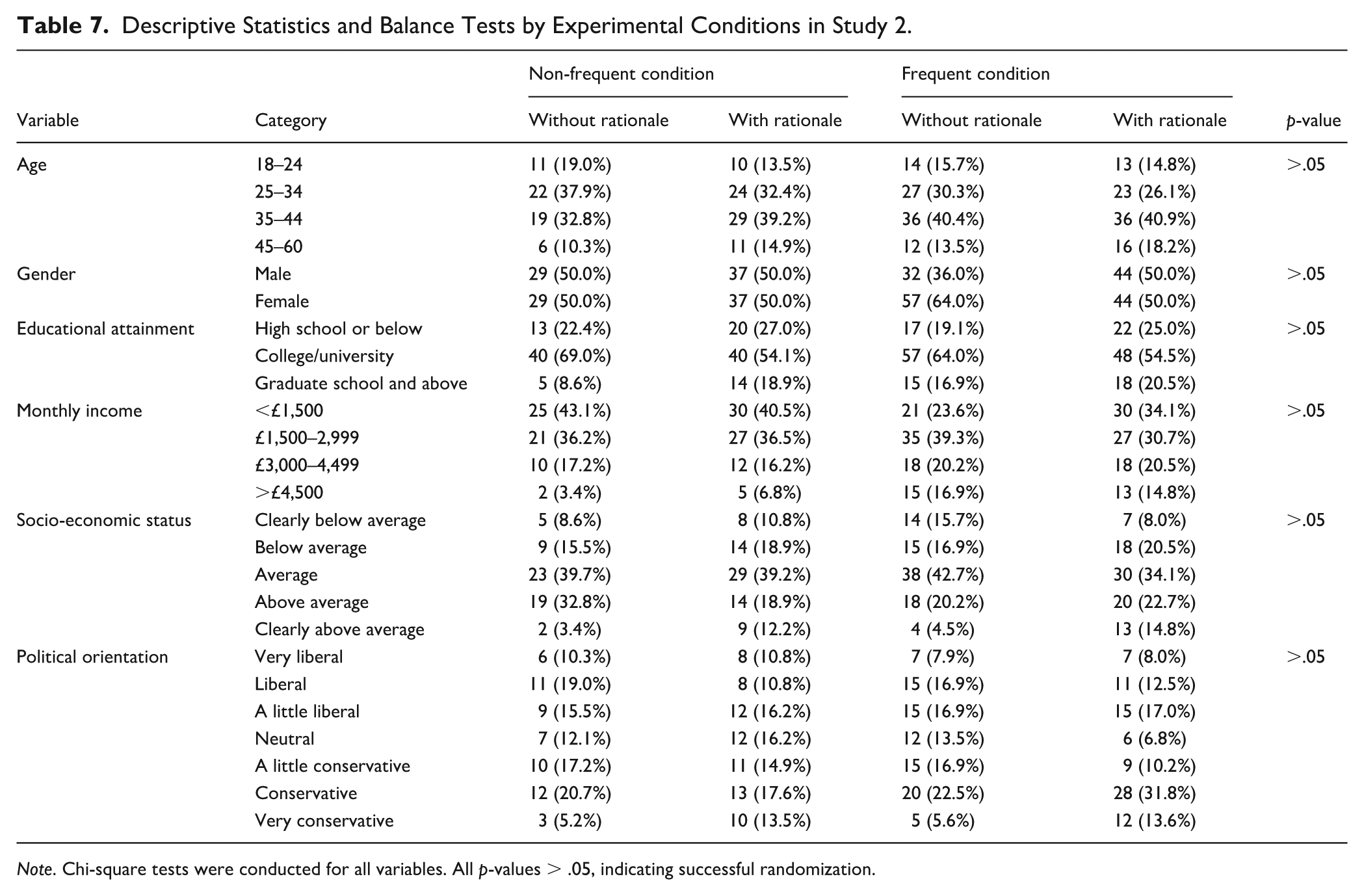
Note. Chi-square tests were conducted for all variables. All p-values > .05, indicating successful randomization.
Procedure and Materials
Frequency of Appeals to Authority
We manipulated the frequency of authority appeals following the same procedure as in Study 1. All participants read a climate change article containing 9 scientific facts. In the frequent condition, all 9 facts were attributed to scientific authority figures, while in the non-frequent condition, only 3 out of 9 facts were attributed to authority figures. The remaining 6 facts in the non-frequent condition were introduced using the same non-authoritative transitional phrasing as in Study 1 to maintain parallel sentence structure across conditions.
Rationale Provision
In the rationale provision condition, each claim was followed by a brief explanation of the reasoning or mechanism behind the conclusion. In the condition without a rationale provision condition, each rationale sentence was strictly replaced by an equal number of words functioning as neutral filler text, ensuring that any differences in outcomes could be attributed exclusively to the presence of rationale rather than differences in text length. All four articles were matched in word count (809 words each). The articles for all four conditions can be found in the Supplementary Material.
After reading the article, participants completed manipulation checks for both experimental factors. The perceived frequency of authority appeals was assessed using the same single item as in Study 1 (“How frequently did the article cite scientific authorities or experts?” rated from 1 = not at all frequently to 5 = very frequently). Perceived rationale provision was measured using a newly developed single item: “After reading, I understood not only what these authorities concluded about climate change, but also the logic behind those conclusions” (1 = strongly disagree to 5 = strongly agree).
Psychological Reactance
Measured using the same items as Study 1 (anger: α = .89; negative cognitions: α = .87).
Climate-Friendly Behavior
Measured using the same twelve items as Study 1 (α = .97).
Support for Mitigation Policies
Measured using the same 10 items as Study 1 (α = .98).
Finally, we collected participants’ demographics, including gender, age, educational attainment, monthly income, political orientation, and socio-economic status.
Results
Manipulation Check
We conducted manipulation checks for both experimental factors. The detailed results are presented in Table 8. For the frequency of authority appeals, an ANOVA revealed that participants in the frequent condition reported significantly higher perceived frequency (M = 3.95, SD = 0.82) than those in the non-frequent condition (M = 1.96, SD = 0.81), F(1, 307) = 450.70, p < .001, confirming successful manipulation of frequency.
Manipulation Checks in Study 2.
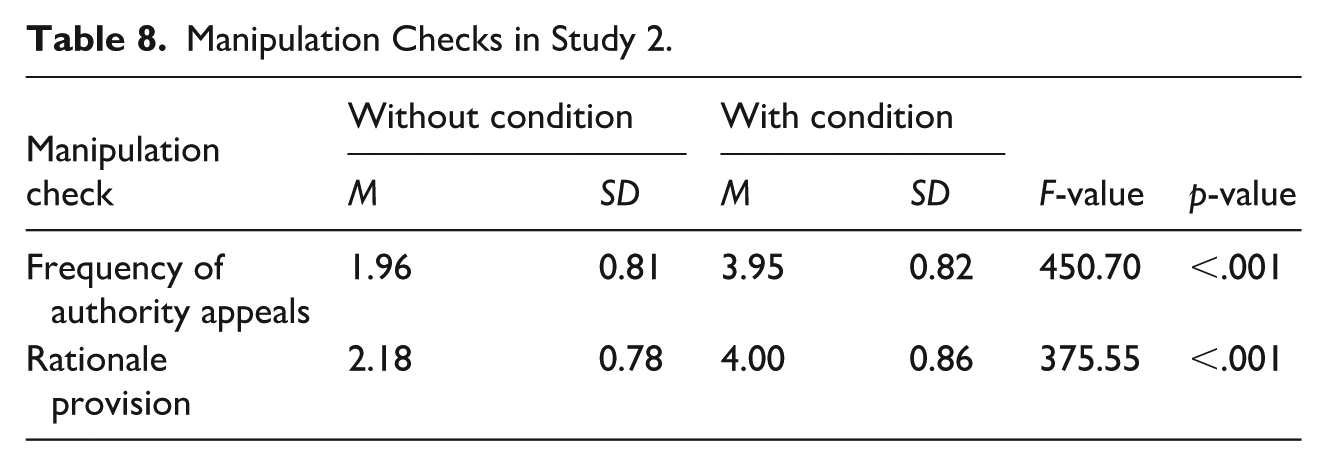
For rationale provision, an ANOVA showed that participants in the with rationale provision condition reported significantly higher understanding of the logic behind authorities’ conclusions (M = 4.00, SD = 0.86) than those in the without rationale provision condition (M = 2.18, SD = 0.78), F(1, 307) = 375.55, p < .001, confirming successful manipulation of rationale provision.
Hypothesis Testing
Replication of the main effect
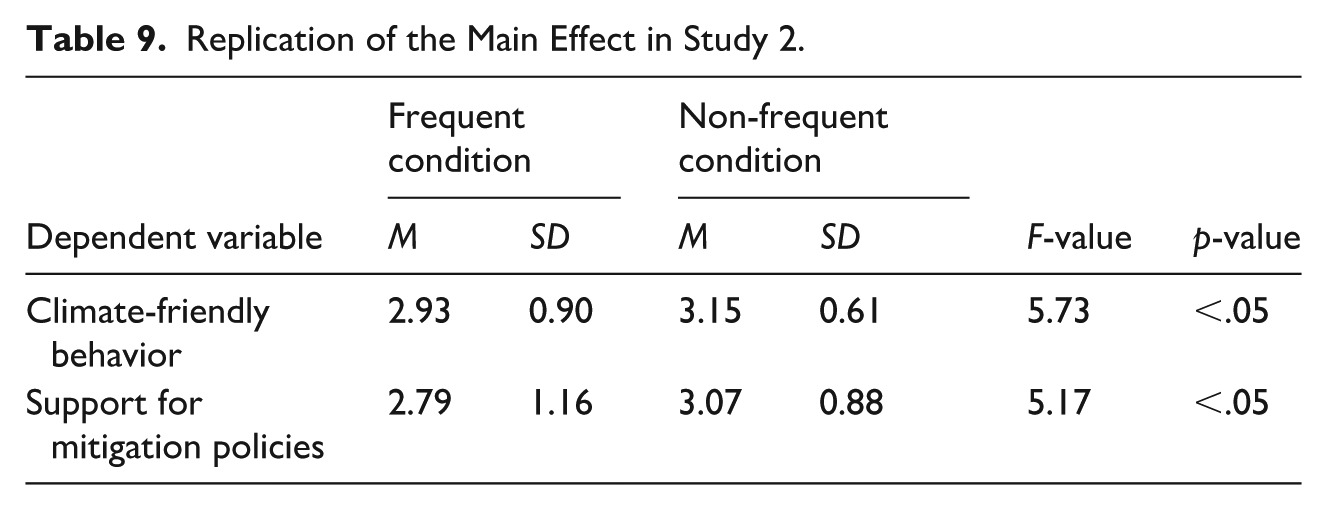
We first examined whether the main effect of frequent authority appeals on climate action intentions could be replicated. The detailed results are presented in Table 9. For climate-friendly behavior, a significant main effect was found, F(1, 307) = 5.73, p < .05. Participants in the frequent condition reported lower intentions (M = 2.93, SD = 0.90) than those in the non-frequent condition (M = 3.15, SD = 0.61). For support for mitigation policies, a significant effect was also observed, F(1, 307) = 5.17, p < .05, with participants in the frequent condition reporting lower support (M = 2.79, SD = 1.16) than those in the non-frequent condition (M = 3.07, SD = 0.88). These results successfully replicated the findings from Study 1.
Replication of the Main Effect in Study 2.
Mediation analysis
We conducted mediation analyses using PROCESS Model 4 with 5,000 bootstrap samples to replicate the mediating role of psychological reactance. The detailed results are presented in Table 10.
Mediation Analysis in Study 2.
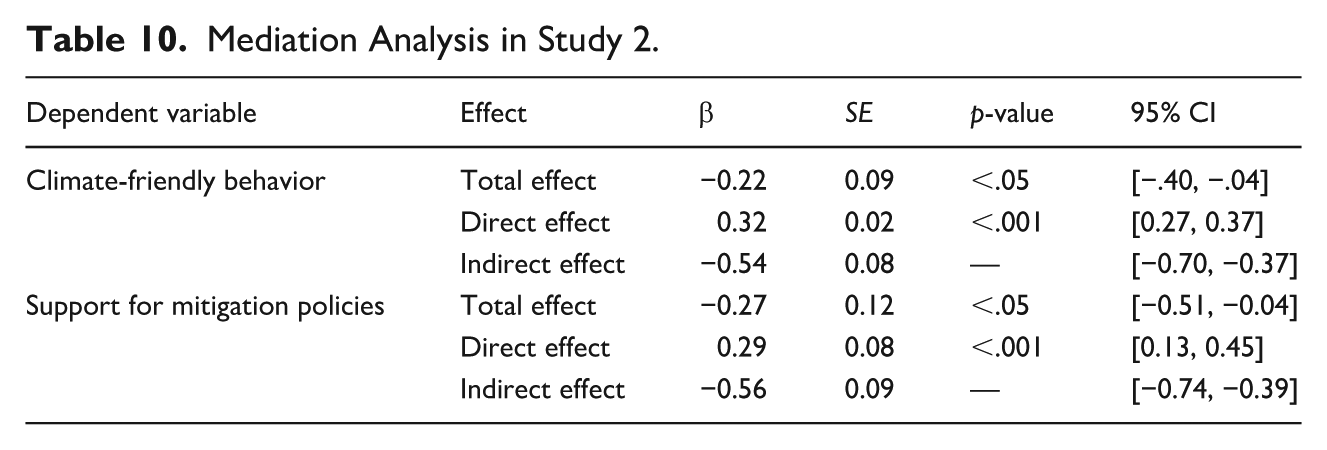
For climate-friendly behavior, the total effect of frequent authority appeals on climate-friendly behavior was significant and negative (β = −0.22, SE = 0.09, p < .05), indicating that frequent appeals reduced behavioral intentions overall. Frequent authority appeals significantly increased psychological reactance (β = 0.55, SE = 0.09, p < .001), and psychological reactance significantly reduced climate-friendly behavior (β = −0.97, SE = 0.01, p < .001). The indirect effect via psychological reactance was significant (β = −0.54, 95% CI [−0.70, −0.37]), confirming the mediating role of psychological reactance. The direct effect of frequency on climate-friendly behavior was positive and significant (β = 0.32, SE = 0.02, p < .001), suggesting that beyond its reactance-inducing effect, frequent appeals may carry some informational value that slightly enhances behavioral intentions.
For support for mitigation policies, the total effect was similarly negative and significant (β = −0.27, SE = 0.12, p < .05). Frequent authority appeals significantly increased psychological reactance (β = 0.55, SE = 0.09, p < .001), and psychological reactance significantly reduced policy support (β = −1.02, SE = 0.05, p < .001). The indirect effect was significant (β = −0.56, 95% CI [−0.74, −0.39]), and the direct effect was also significant and positive (β = 0.29, SE = 0.08, p < .001). Taken together, these results successfully replicated the mediating role of psychological reactance found in Study 1.
Moderation analysis
We conducted 2 × 2 ANOVAs to test whether rationale provision moderates the effect of frequent authority appeals on climate action intentions. The detailed results are presented in Table 11.
Moderation Analysis: Rationale Provision as Moderator.
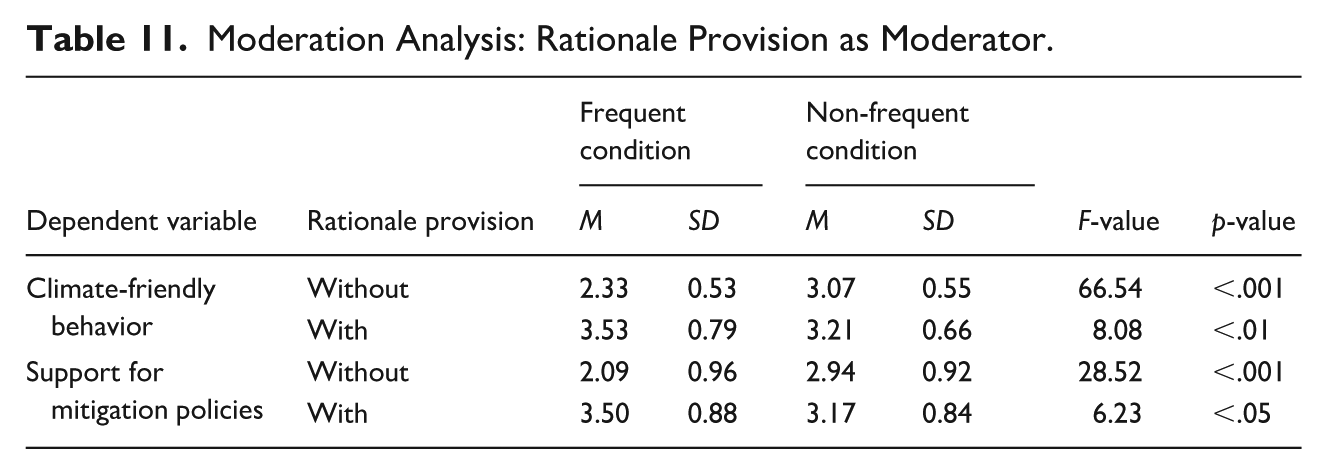
For climate-friendly behavior, a significant interaction was found, F(1, 305) = 51.14, p < .001. Simple effects analyses showed that without rationale provision, frequent authority appeals significantly reduced climate-friendly behavior, F(1, 145) = 66.54, p < .001, with the frequent condition (M = 2.33, SD = 0.53) showing lower scores than the non-frequent condition (M = 3.07, SD = 0.55). However, with rationale provision, this pattern reversed, F(1, 160) = 8.08, p < .01, with the frequent condition (M = 3.53, SD = 0.79) showing higher scores than the non-frequent condition (M = 3.21, SD = 0.66).
For support for mitigation policies, the same interaction pattern emerged, F(1, 305) = 32.69, p < .001. Without a rationale provision, frequent authority appeals significantly reduced support, F(1, 145) = 28.52, p < .001, with the frequent condition (M = 2.09, SD = 0.96) showing lower scores than the non-frequent condition (M = 2.94, SD = 0.92). With rationale provision, frequent authority appeals significantly increased support for mitigation policies, F(1, 160) = 6.23, p < .05, with the frequent condition (M = 3.50, SD = 0.88) showing higher scores than the non-frequent condition (M = 3.17, SD = 0.84).
Moderated mediation analysis
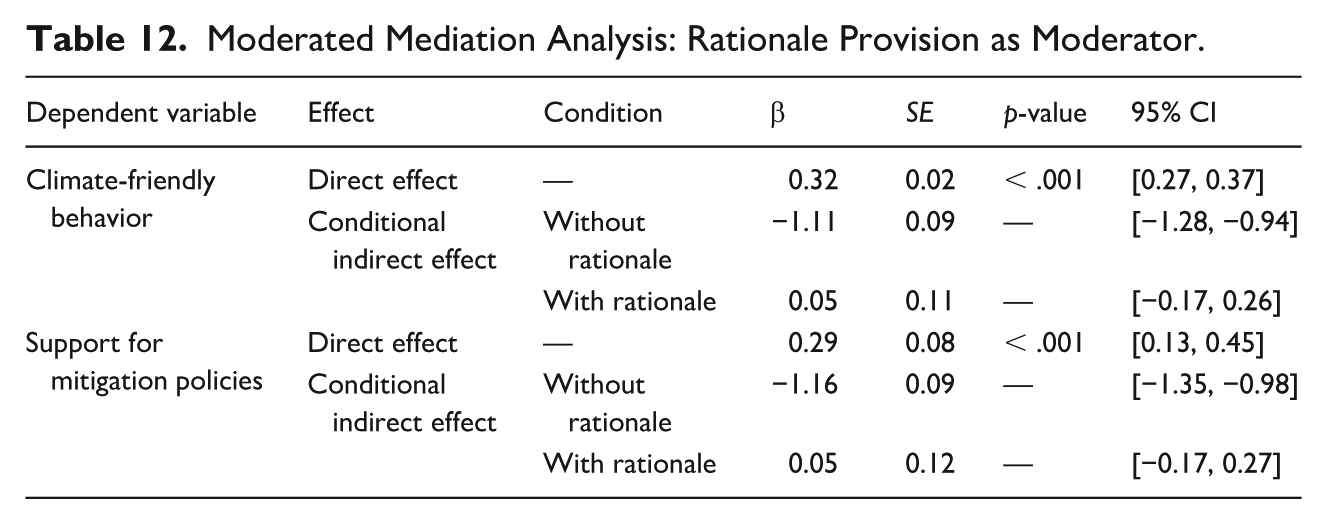
To further test Hypothesis 3, we conducted moderated mediation analyses using PROCESS Model 7 with rationale provision as the moderator. Rationale provision was coded as 1 = with rationale provision, 0 = without rationale provision. The detailed results are presented in Table 12.
Moderated Mediation Analysis: Rationale Provision as Moderator.
The results revealed a significant interaction between the frequency of authority appeals and the rationale provision on psychological reactance. The interaction term was significant (β = −1.19, SE = 0.15, p < .001). Simple slope analyses showed that without rationale provision, frequent authority appeals significantly increased psychological reactance (β = 1.14, SE = 0.11, p < .001), whereas with rationale provision, the effect was not significant (β = −0.05, SE = 0.10, p > .05).
The conditional indirect effects supported Hypothesis 3. For climate-friendly behavior, without rationale provision, the indirect effect of frequent authority appeals via psychological reactance was significant and negative (β = −1.11, 95% CI [−1.28, −0.94]). With rationale provision, the indirect effect was not significant (β = 0.05, 95% CI [−0.17, 0.26]). The index of moderated mediation was significant (β = 1.15, 95% CI [0.88, 1.43]).
For support for mitigation policies, the same pattern was observed. Without rationale provision, the conditional indirect effect was significant (β = −1.16, 95% CI [−1.35, −0.98]), but not with rationale provision (β = 0.05, 95% CI [−0.17, 0.27]). The index of moderated mediation was significant (β = 1.21, 95% CI [0.93, 1.50]).
These results provide strong support for Hypothesis 3: rationale provision moderates the effect of frequent authority appeals on climate action intentions. When a rationale is provided, the effect of frequent authority appeals turns positive because rationale provision prevents the activation of psychological reactance, thereby allowing the inherently positive persuasive force of frequent authority appeals to be fully realized.
Conclusion and Discussion
Discussion
Bridging the gap between public climate action intentions and real-world mitigation requirements demands effective communication strategies aligned with how people process complex information. Because the general public tends to rely on heuristic thinking when engaging with climate science, authority appeal—which cues trust in expert figures to facilitate quick, intuitive acceptance—has emerged as a promising persuasion strategy. Yet prior research has only examined single-instance exposure, leaving unanswered how frequent authority appeals, as commonly observed in real-world climate communication, shape public climate action intentions.
Drawing on Psychological Reactance Theory, the present research addressed this gap through two randomized between-subject experiments to investigate the effect of frequent (vs. non-frequent) authority appeals on public climate action intentions, with psychological reactance as the proposed mediator and political ideology and rationale provision as boundary conditions. Study 1 revealed that frequent authority appeals diminished climate action intentions—including both climate-friendly behavior and support for mitigation policies—with psychological reactance serving as a mediator in this relationship. Moreover, political ideology moderated this mediated process: among non-conservatives, frequent authority appeals triggered substantial psychological reactance and significantly reduced climate action intentions, whereas among conservatives, frequent authority appeals did not elicit significant reactance. This neutralized the negative effect, and even produced a significant positive effect on climate-friendly behavior, though the effect on support for mitigation policies was not statistically significant. Study 2 replicated the main findings of Study 1 and additionally examined rationale provision as a boundary condition. The results showed that when frequent authority appeals were accompanied by explanations of the underlying evidence and reasoning, psychological reactance was no longer triggered, and the negative effect was neutralized—reversing to a positive effect on both climate-friendly behavior and support for mitigation policies.
Theoretical Contribution and Implications
Our research makes three contributions to the existing literature on climate change communication and psychological reactance.
First, our results add to the growing body of literature focused on the role of authority figures in climate change communication. While previous studies have established the potential benefits of appeals to authority (Constantino et al., 2021; Jarke-Neuert et al., 2025; Myers et al., 2015), our findings demonstrate that the frequency with which authority appeals are deployed critically shapes their persuasive outcomes. Frequent authority appeals, rather than amplifying credibility, can backfire by triggering reactance. This highlights the need for researchers to examine persuasion strategies in climate-related messaging in a more nuanced, dose-sensitive manner. In today’s media environment, where individuals are increasingly aware of persuasive intent and skeptical of spin (O’Neill & Nicholson-Cole, 2009), excessive use of authority appeals may undermine rather than support communication effectiveness.
Second, our study replicates and extends previous work on psychological reactance. In terms of replication, our study confirms that exposure to persuasive information can trigger psychological reactance (Brehm & Brehm, 1981). In terms of extension, we identify frequent authority appeals as a novel antecedent of reactance—adding to prior work showing that loss framing, controlling language, emphasis on scientific consensus, and high language variety can all trigger reactance (Chan & Lin, 2022; Ma et al., 2019; Miller et al., 2007; Reinhart et al., 2007; Zhang, 2020). Furthermore, we demonstrate that rationale provision functions as an effective autonomy-supportive strategy to mitigate this reactance. Grounded in Self-Determination Theory (Deci et al., 1994), rationale provision facilitates internalization—helping individuals understand and personally endorse the advocated position—thereby reducing perceptions of external control and attenuating reactance. This complements prior work on freedom restoration techniques (Bessarabova et al., 2017; Zhang, 2020) by offering a proactive mechanism embedded directly within the persuasive message rather than appended after it.
Third, our findings regarding political ideology as a moderator contribute to the literature on ideologically differentiated responses to climate messaging (Chan & Lin, 2022; Fielding et al., 2012; McCright et al., 2016). We demonstrate that conservatives—for whom authority represents a valued moral foundation—are substantially less susceptible to reactance triggered by frequent authority appeals. This suggests that audience segmentation is critical when designing climate communication strategies, as the same message may produce opposite effects depending on recipients’ political ideology.
The practical implications for climate change communicators are threefold. First, communicators should exercise caution when using authority appeals and avoid their excessive deployment, as frequent authority appeals can diminish public intention to engage in climate change mitigation. Second, when frequent authority appeals are necessary—as may be the case in contexts such as documentary films, extended news coverage, or policy briefings (Hiles & Hinnant, 2014; Reynolds-Tylus, 2019; Rosenberg, 2018)—communicators should accompany each appeal with clear explanations of the underlying evidence and reasoning, as rationale provision can effectively neutralize reactance and restore persuasive impact. Third, communicators should consider tailoring their messaging strategies to the political composition of their target audiences: for conservative audiences, frequent authority appeals may be more acceptable and even beneficial, whereas for liberal and politically neutral audiences, restraint in the use of authority appeals is advisable.
Limitations and Future Directions
Several limitations of the present research point to directions for future investigation. First, while we used political ideology as a moderator based on Moral Foundations Theory (MFT), we did not explicitly measure MFT items. Specifically, we assumed that political conservatism serves as a proxy for a stronger endorsement of the Moral Foundation of authority, but this assumption was not directly validated through MFT measurement. Future research should include validated MFT scales to directly test whether the authority foundation drives the differential responses observed between conservatives and non-conservatives. Second, the present study recruited participants exclusively from the United Kingdom, and our samples exhibited an overrepresentation of highly educated individuals (over 75% holding a college degree or higher). Consequently, it remains unknown whether our findings generalize to other countries or to populations with different educational levels. Future research should replicate this study across diverse cultural contexts and educational backgrounds to establish the broader applicability of these effects. Third, we did not assess participants’ actual behaviors; instead, we only measured their behavioral intentions and policy support attitudes. It is well-established that behavioral intentions do not always translate into actual engagement in climate change mitigation. Future research should incorporate measures of actual behavior to better evaluate the downstream consequences of frequent authority appeals on real-world climate action. Fourth, the present study operationalized frequent authority appeals as multiple distinct authority appeals within a single article. However, in real-world climate communication, frequent authority appeals may also manifest as repeated exposure to the same authority appeal across different media channels. Future research should examine whether the effects identified in the present studies extend to this alternative form of frequency and whether rationale provision remains an effective mitigation strategy under such conditions.
Supplemental Material
sj-docx-1-scx-10.1177_10755470261459901 – Supplemental material for When Experts Speak Too Often: How Frequent Authority Appeals Shape Public Climate Action Intentions
Supplemental material, sj-docx-1-scx-10.1177_10755470261459901 for When Experts Speak Too Often: How Frequent Authority Appeals Shape Public Climate Action Intentions by Zhanyu Liu and Jun Yang in Science Communication
Footnotes

Funding
The authors disclosed receipt of the following financial support for the research, authorship, and/or publication of this article: This work was supported by the Excellent Youth Project of the Department of Education of Hunan Province (Grant No. 25B0887) and the Industry-Academia Cooperative Education Program of the Ministry of Education (Grant No. 2023122919339).
Declaration of Conflicting Interests
The authors declared no potential conflicts of interest with respect to the research, authorship, and/or publication of this article.
Author Biographies
References
Supplementary Material
Please find the following supplemental material available below.
For Open Access articles published under a Creative Commons License, all supplemental material carries the same license as the article it is associated with.
For non-Open Access articles published, all supplemental material carries a non-exclusive license, and permission requests for re-use of supplemental material or any part of supplemental material shall be sent directly to the copyright owner as specified in the copyright notice associated with the article.
