






Abstract
Storytelling is often presented as a solution to problems of trust in science communication. Yet stories can attract attention without making science credible, meaningful, or legitimate. This commentary proposes narrative trust as a theoretical perspective for explaining when stories support public trust. Narrative trust emerges when four conditions align: intelligibility, credibility, cultural resonance, and legitimacy of mediation. The framework shifts attention from whether stories “work” to the communicative conditions under which science becomes understandable, believable, socially meaningful, and publicly actionable.
Keywords
The Problem: Stories Do Not Build Trust by Themselves
Science communication increasingly unfolds in fragmented media environments where scientific claims circulate through journalism, institutional channels, social platforms, podcasts, audiovisual formats, museums, community networks, and everyday interpersonal exchange. In these settings, science competes not only with other scientific claims but also with misinformation, political framing, personal testimony, entertainment logics, local experience, and platform-specific forms of visibility (Hirsbrunner, 2021; Metcalfe et al., 2020). This has intensified interest in storytelling as a way of making science more accessible, memorable, and socially meaningful, and reflects broader debates about relationship between science and story (Levy, 2025).
The appeal of storytelling is understandable. Stories can organize complexity, create emotional connection, introduce characters and stakes, and connect abstract evidence to ordinary life. Recent work on science videos, podcasts, environmental campaigns, museum communication, digital storytelling, and narrative experimentation shows that narrative formats can support comprehension, attention, affective engagement, and perceived authenticity (Boy et al., 2020; Fischer & Thies, 2024; Howell et al., 2022; Kaul et al., 2020; Oliveira et al., 2025; Saffran et al., 2020; Seidel et al., 2023).
Yet storytelling should not be treated as a shortcut to trust. A story can be engaging without being credible. A communicator can appear relatable without being trusted. A narrative can feel authentic while still leaving audiences uncertain about the evidence, the expertise behind the claim, or the motives of the mediator. The assumption that stories automatically make science more trustworthy risks confusing attention with credibility, engagement with acceptance, and relatability with legitimacy.
This commentary proposes narrative trust as a theoretical perspective for science communication. Narrative trust refers to trust that emerges when scientific communication aligns with four conditions: intelligibility, credibility, cultural resonance, and legitimacy of mediation. The concept does not suggest that narrative is inherently trustworthy. Rather, it explains why stories sometimes support public trust, sometimes merely increase engagement, and sometimes fail because credibility, cultural resonance, or mediator legitimacy is missing. The contribution of this commentary is to move storytelling from a question of communicative technique to a theory of trust alignment. The central claim is simple: stories do not build trust by themselves; they create conditions under which trust may become possible.
Narrative Trust as a Theoretical Perspective
Science communication often asks whether narrative works. That question is too broad. Narrative can “work” in different and sometimes contradictory ways. It may increase attention, make information easier to remember, personalize a scientific issue, or invite emotional identification. None of these effects necessarily produces trust. Media narratives about scientific failures and discoveries, for example, can shape beliefs about science and support for science, but they do so by influencing how audiences interpret scientific processes, not simply by making those processes more vivid (Ophir & Jamieson, 2021).
Narrative trust therefore begins from a different question: under what conditions does storytelling make science publicly believable? This question matters because science communication is rarely received as information alone. It is encountered through specific formats, communicators, platforms, institutions, and cultural contexts. Trust is produced, strengthened, weakened, or withheld within those mediating conditions.
The framework proposed here treats narrative trust as an alignment problem. A message may be intelligible but not credible. It may be credible but culturally distant. It may resonate culturally but come from a mediator who is not recognized as legitimate. It may be delivered by a legitimate mediator but in a form that obscures uncertainty or evidence. Trust becomes more likely when the four dimensions reinforce rather than undermine one another. Figure 1 summarizes this theorical model.
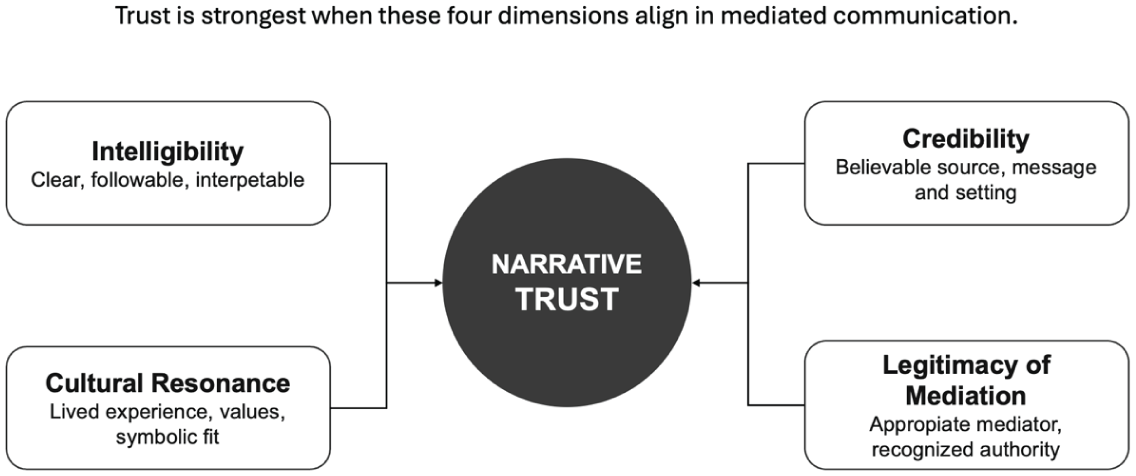
Narrative trust in science communication. Narrative trust emerges when science communication aligns intelligibility, credibility, cultural resonance, and legitimacy of mediation. The model does not treat storytelling as inherently trustworthy but as a communicative form that may support trust when these four conditions reinforce one another.
Four Conditions of Narrative Trust
Intelligibility
The first condition is intelligibility. Science communication must make knowledge understandable, but intelligibility is not the same as simplification. A narrative can help audiences follow scientific claims by sequencing events, clarifying causes, identifying actors, dramatizing stakes, or showing why a scientific issue matters. Audiovisual science communication, YouTube campaigns, podcasts, museum experiences, and infographics all demonstrate how form influences whether audiences can follow and evaluate scientific content (Agley et al., 2021; Boy et al., 2020; Howell et al., 2022; Kaul et al., 2020; Oliveira et al., 2025).
However, intelligibility becomes fragile when storytelling removes the uncertainty, contingency, or evidentiary basis of science. A story that is too smooth may make science easier to consume while making scientific reasoning harder to see. This is especially important in areas such as climate change, public health, food safety, emerging technologies, and pandemic communication, where uncertainty is not a weakness of science but part of how knowledge is produced and assessed (Lima et al., 2024; Molina-Perez et al., 2024; Wolf et al., 2020).
Intelligibility therefore requires more than clarity. It requires communication that helps audiences understand what is known, how it is known, what remains uncertain, and why the claim matters. The task is not to remove complexity but to make complexity navigable.
Credibility
The second condition is credibility. Narrative trust depends on whether audiences judge the scientific claim and its source as believable. Credibility is shaped by evidence, expertise, transparency, source identity, media format, and the perceived motives of the communicator. A compelling story cannot compensate for weak credibility signals. Indeed, when narrative appears too strategic, too emotional, or too detached from evidence, it may weaken rather than strengthen trust.
This is particularly visible in climate and health communication. Research on climate scientists, climate science, and climate misinformation shows that credibility depends not only on the content of a message but also on how scientific authority, uncertainty, and motivation are perceived (Cologna et al., 2024; van Eck & van der Meer, 2025; Zhang & Schmierbach, 2025). Similarly, pandemic and vaccination communication illustrate how narrative authority can be contested when audiences interpret messages through suspicion, polarization, or prior distrust (Harambam, 2023; Kim et al., 2024; Morselli et al., 2025).
This is why narrative credibility must be distinguished from narrative appeal. A message may be memorable because it is dramatic, personal, or emotionally powerful. But credibility requires that narrative form remain anchored in scientific accountability. Stories can support credibility when they make evidence traceable, uncertainty visible, and expertise recognizable. They can undermine credibility when they replace those features with performance, persuasion, or excessive personalization.
Cultural Resonance
The third condition is cultural resonance. Scientific claims are not interpreted in a social vacuum. They are received through language, memory, religion, identity, local experience, community authority, political context, and everyday practice. A science story may be accurate and accessible but still fail if it does not connect with the cultural worlds through which audiences make meaning.
Work on vaccination narratives, community immunization, polio communication, and relational research shows that trust depends not only on what is communicated but also on whether communication is recognizable within local systems of meaning and authority (Aslam et al., 2026; Laursen et al., 2025; Peimbert-Rappaport et al., 2024; Vanderslott et al., 2022). In such settings, narrative is not merely a technique for engagement. It is a form of cultural mediation.
Cultural resonance does not mean adapting science to whatever an audience already believes. Nor does it mean replacing evidence with local values. It means acknowledging that scientific knowledge becomes publicly meaningful when it is connected to the concerns, histories, languages, and interpretive frames through which people encounter the world. Without this connection, science may remain formally credible but socially distant.
This point is especially important for inclusive science communication. Trust is often most fragile where institutions cannot assume legitimacy, where publics have histories of exclusion, or where scientific claims are entangled with political, religious, or community authority. In those contexts, the question is not only whether a message is accurate but also whether it can be heard as meaningful and legitimate.
Legitimacy of Mediation
The fourth condition is the legitimacy of mediation. Publics rarely encounter science directly. They encounter it through journalists, scientists, institutions, influencers, patients, educators, museums, activists, community leaders, knowledge brokers, data visualizations, and platform algorithms. These mediators shape not only how science is represented but also whether it is perceived as trustworthy.
Legitimacy concerns whether the mediator is recognized as an appropriate and accountable actor in a specific communicative setting. Science journalists may be trusted because they are expected to translate and scrutinize expertise. Community brokers may be trusted because they are embedded in local relationships. Patient communicators may be trusted because they speak from lived experience. Scientists may be trusted because they are linked to specialized knowledge. But none of these forms of legitimacy is automatic (Fattorini, 2023; Mahr et al., 2025; Martínez-Sanz et al., 2026; Ndasauka & Kainja, 2024; Ostherr, 2018).
This dimension is especially important in digital environments where boundaries between expertise, experience, advocacy, entertainment, and influence are blurred. Platform visibility may amplify scientific content, but visibility does not guarantee legitimate mediation. A science story can travel widely while becoming detached from the conditions that made it credible in the first place. Popularity-driven science journalism and platform-native communication can make science more visible while also changing how authority, uncertainty, and expertise are interpreted (Molek-Kozakowska, 2018).
Narrative trust therefore asks not only whether a story is well told. It asks who tells it, through which medium, under what conditions, and with what recognized authority.
Implications for Science Communication
The narrative trust perspective changes how science communication should be designed, evaluated, and studied. First, it shifts evaluation from narrative effectiveness to trust alignment. Instead of asking only whether a story increases engagement, science communicators should ask whether the story also preserves credibility, supports understanding, resonates with the intended public, and is mediated by an actor recognized as legitimate in that context. Engagement remains important, but it is not enough.
Second, the framework cautions against universal prescriptions. There is no single narrative form that builds trust across publics, platforms, and issues. A first-person scientist story may increase relatability in one context but raise questions about objectivity in another. A community-based narrative may deepen resonance in one setting but appear anecdotal if not connected clearly to evidence. A visually powerful climate narrative may increase concern but intensify skepticism if audiences perceive exaggeration or strategic framing.
Third, narrative trust clarifies the practical role of cultural mediation. Communication should not be designed only around message clarity or platform reach. It should also consider who can legitimately connect scientific knowledge to public concerns. This may involve journalists, educators, patient advocates, community leaders, local institutions, or hybrid mediators who can translate across knowledge systems without detaching scientific claims from evidence.
Fourth, the framework invites science communication research to move beyond generic publics. Trust is often studied through broad audience categories, but narrative trust is likely to operate differently across communities, languages, media systems, and histories of institutional inclusion or exclusion. Future work should examine how the four dimensions align or fail across specific publics, especially where institutional legitimacy cannot be assumed.
Finally, narrative trust offers a way to study science communication beyond crisis contexts. Much work on trust is shaped by controversy, misinformation, climate change, vaccination, pandemics, and polarized media environments. These contexts are crucial, but they can make trust appear primarily as a response to breakdown. Narrative trust also applies to museums, environmental stewardship, education, public engagement, and everyday forms of science communication where trust is built gradually through repeated, meaningful mediation (Doehring et al., 2023; Sundin et al., 2018).
The practical implication is direct: science communicators should stop asking only how to tell better stories. They should also ask what kind of trust a story is meant to support, what evidence it makes visible, whose cultural world it speaks to, and which mediator is legitimate enough to carry it.
Conclusion
Science communication needs storytelling, but it also needs a clearer theory of what storytelling can and cannot do. Stories can make science more intelligible, relatable, and memorable. They can connect evidence to experience and help publics understand why scientific knowledge matters. But stories do not automatically produce trust.
Narrative trust offers a theoretical perspective for explaining this distinction. It proposes that trust becomes more likely when narrative communication aligns with intelligibility, credibility, cultural resonance, and legitimacy of mediation. When one of these dimensions is missing, storytelling may still generate attention, but it may not generate trust.
The future of trust in science communication will not depend on telling more stories but on understanding the conditions under which stories make science intelligible, credible, culturally resonant, and legitimately mediated.
Footnotes

Funding
The author received no financial support for the research, authorship, and/or publication of this article.
Declaration of Conflicting Interests
The author declared no potential conflicts of interest with respect to the research, authorship, and/or publication of this article.