







Abstract
Gifted education has been criticized for the persistent underrepresentation of Black and Hispanic students. Many explanations have been advanced, including teacher underreferral, test bias and unfairness, and discriminatory policies and procedures (e.g., criteria), to name a few. Themes permeating the aforementioned explanations have been low expectations for Hispanic and Black students, and inadequate preparation among educators and decision makers to be culturally responsive to their issues and needs. In this column, I propose that a great deal of the factors that contribute to and/or exacerbate underrepresentation rest in the painful reality of prejudice and that both intentional and unintentional prejudice must be considered and addressed for progress and equitable change(s) to occur. Two models of prejudice are presented that shed light on different types and degrees of prejudice, with implications for gifted education specifically. This discussion is followed by suggestions grounded in intergroup contact theory.
The Status of Gifted Underrepresentation—Again
Gifted education classrooms and programs—enrichment, compacting, independent study, mentorships, shadowing, academic competitions, and much more—are challenging, engaging, and rigorous when educators have substantive preparation. Unfortunately, Black and Hispanic students seldom experience these challenging and rigorous opportunities. Decades of research reveal that underrepresentations for Black and Hispanic students are assiduous and ubiquitous, with too little progress being demonstrated or evident for these two groups.
Opinions, paradigms, and theories, sometimes accompanied by research, exist. It cannot be denied that underreferral by teachers (including counselors, psychologists, and administrators) has played a meaningful role in underrepresentation (see summary by Ford, Grantham, & Whiting, 2008). Tests and other instruments have been criticized and share the blame. Policies and procedures have been questioned or interrogated to determine whether they have a disparate impact. At some point, all of these factors have been investigated under the auspices of the Office for Civil Rights (Ford, 2011; Ford & Trotman, 2000).
“Gifted education has been criticized for the persistent underrepresentation of Black and Hispanic students.”
It is worth noting and troubling that while teaching preparation and professional development training, alternative (less biased and more fair) measures, policies, and procedures have been implemented in some schools, changes in gifted education demographics have been less than impressive. For decades, underrepresentation nationally has hovered at an average of 50% for Blacks and 40% for Hispanics (Ford et al., 2008). Given the increasing racial diversity of our nation and schools, to accept this magnitude and persistence of underrepresentation is unconscionable. Decades of underrepresentation begs the following question: What really underlies poor referrals and the ongoing use of biased tests and measures, policies and procedures, especially when evidence refutes their efficacy and fairness? Elsewhere, I have lamented over the potency of deficit thinking (Steele, 2010) and associated low and negative expectations as meaningful barriers to change and equity. In this article, I do not review this argument and supporting work but, instead, reinforce and build on it. I offer a complementary, related, plausible, and viable explanation that has been the elephant in the room—intentional and unintentional prejudice; both are described next.
What is Prejudice? A Few Definitions
The term prejudice refers to preconceived judgments toward people or a person because of race, ethnicity, nationality, religion, socioeconomic status, gender, age, disability, and other sociodemographic characteristics that are grounded in stereotypes that are often negative but can be positive as well. Both types of stereotypes have negative consequences (e.g., the model minority image attributed to Asians is one example of a positive stereotype). Stereotypes are unreasonable attitudes that are unusually resistant to rational thinking, even in the face of contradictory examples and data.
Webster’s Dictionary defines prejudices in two major ways: (a) injury or damage resulting from some judgment or action of another in disregard of one’s rights that is especially detrimental to one’s legal rights or claims and (b) preconceived judgment or opinion, such as an adverse opinion or leaning formed without just grounds or before sufficient knowledge, and an irrational attitude of hostility directed against an individual, a group, a race, or their supposed characteristics (see http://www.merriam-webster.com/dictionary/prejudice).
The term aversive racism describes the subtle racial behaviors of a racial group that rationalizes their aversion to a particular group based on majority group’s rules and stereotypes (Gaertner & Dovidio, 1986). Furthermore, Anderson (2010), Dovidio and Gaertner (2004), and Pearson, Dovidio, and Gaertner (2009) theorize that prejudice can be explicit or implicit; its manifestation is dictated by a multitude of forces, too many to describe herein.
Essentially, prejudice means to pre-judge, and thinking is inflexible, irrational, and unfounded (even in face of counter examples and evidence). Victims are basically guilty until proven innocent and/or guilty by association.
This article focuses on one type of prejudice—racial prejudice or racism—defined as the belief that races exist, that physical characteristics determine cultural traits, and that racial characteristics make some groups or individuals of the said group superior (Blackwell, Smith, & Sorenson, 2003). According to the United Nations’ Convention on the Elimination of All Forms of Racial Discrimination,
The term “racial discrimination” shall mean any distinction, exclusion, restriction, or preference based on race, color, descent, or national or ethnic origin that has the purpose or effect of nullifying or impairing the recognition, enjoyment or exercise, on an equal footing, of human rights and fundamental freedoms in the political, economic, social, cultural or any other field of public life. (http://en.wikipedia.org/wiki/Racism#cite_note-20)
By separating people into racial hierarchies, people are able to justify unequal treatment of others due to the out-group’s perceived inferior genetic and cultural differences. According to Blackwell et al. (2003) and Gould (1996), Darwin’s evolutionary studies and Aristotle’s idea of “natural slaves” influenced past and contemporary scientific racism. This concept focuses on socially constructed, subjective hierarchies and how some racial groups, notably those in power, are placed at the top. Racism involves the belief in racial differences, which acts as a justification for discriminating against members of other racial groups.
Racism and other forms of prejudice affect a person’s behavior, thoughts, and feelings—and many factors and outcomes. In education, this includes expectations, relationships, grading practices, gifted referrals, and special education referrals, to name but a few. When considering the various definitions just presented, it is important to note that racism occurs at both the individual and institutional levels (Feagin, 2006), and can be unintentional, as is apparent in the works of Allport and Merton, described next.
Degrees of Prejudice: Learning From Gordon Allport
Allport (1954) defined prejudice as a feeling, favorable or unfavorable, toward a person or thing, prior to, or not based on, actual experience. He asserted that prejudice is a result of generalizations and oversimplifications made about an entire group of people (or members) based on incomplete or incorrect information. He described five degrees of prejudice (Figure 1) as follows:
Antilocution is the mildest degree of prejudice. It consists of negative verbal and nonverbal messages to and/or about a racial group or member. Examples include racial slurs, name-calling, racial jokes, racist signs and symbols, hate speech, and threats.
Avoidance is a form of prejudice where one seeks to distance self from racial group or members. It is acting on one’s beliefs (e.g., stereotypes). Avoidance or social exclusion is the desire to circumvent contact and interactions with a different racial group or member. Common examples are White flight—moving to suburbs—and intentionally not living in culturally different communities. When caregivers deliberately refuse to place their children in schools, classrooms, and programs that have racially different students (and adults), this is also avoidance. An important caveat is that avoidance may not be discriminatory. For example, if a caregiver does not want his or her child to be in a gifted class with Hispanic, Black, Asian, or Native American students, he or she can transfer the child to another school, enroll in private school, or homeschool. On an individual basis, this may not be discriminatory, but on a larger scale (e.g., rezoning communities along racial lines), it may be discriminatory, given school desegregation rulings (i.e., Brown v. Board of Education, 1954; Civil Rights Act of 1964).
Discrimination is also acting on beliefs and is illegal because the action denies an individual’s or group’s rights and opportunities to which they are legally entitled. In gifted education, the majority of allegations and investigations of racial discrimination (e.g., underreferral, criteria, instruments, policies, procedures) involve Black students’ underrepresentation (Ford, 2011; Ford & Trotman, 2000). Two antidiscrimination laws are particularly germane to education. Title IX is a portion of the Education Amendments of 1972 (Pub. L. No. 92-318, 86 Stat. 235). It states, “No person in the United States shall, on the basis of sex, be excluded from participation in, be denied the benefits of, or be subjected to discrimination under any education program or activity receiving Federal financial assistance.” Furthermore, the Civil Rights Act of 1964 (Pub. L. No. 88-352, 78 Stat. 241) outlawed discrimination against racial, ethnic, national, and religious minorities and women. This act ended racial segregation in schools, the workplace, and facilities that serve the general public.
Physical attacks, the fourth prejudice, consists of violence. It is also illegal.
Extermination is the highest degree of prejudice in Allport’s theory. Clearly illegal, it is a large scale and is the intentional act of eliminating a racial group. Examples include murder, sterilization, and genocide.
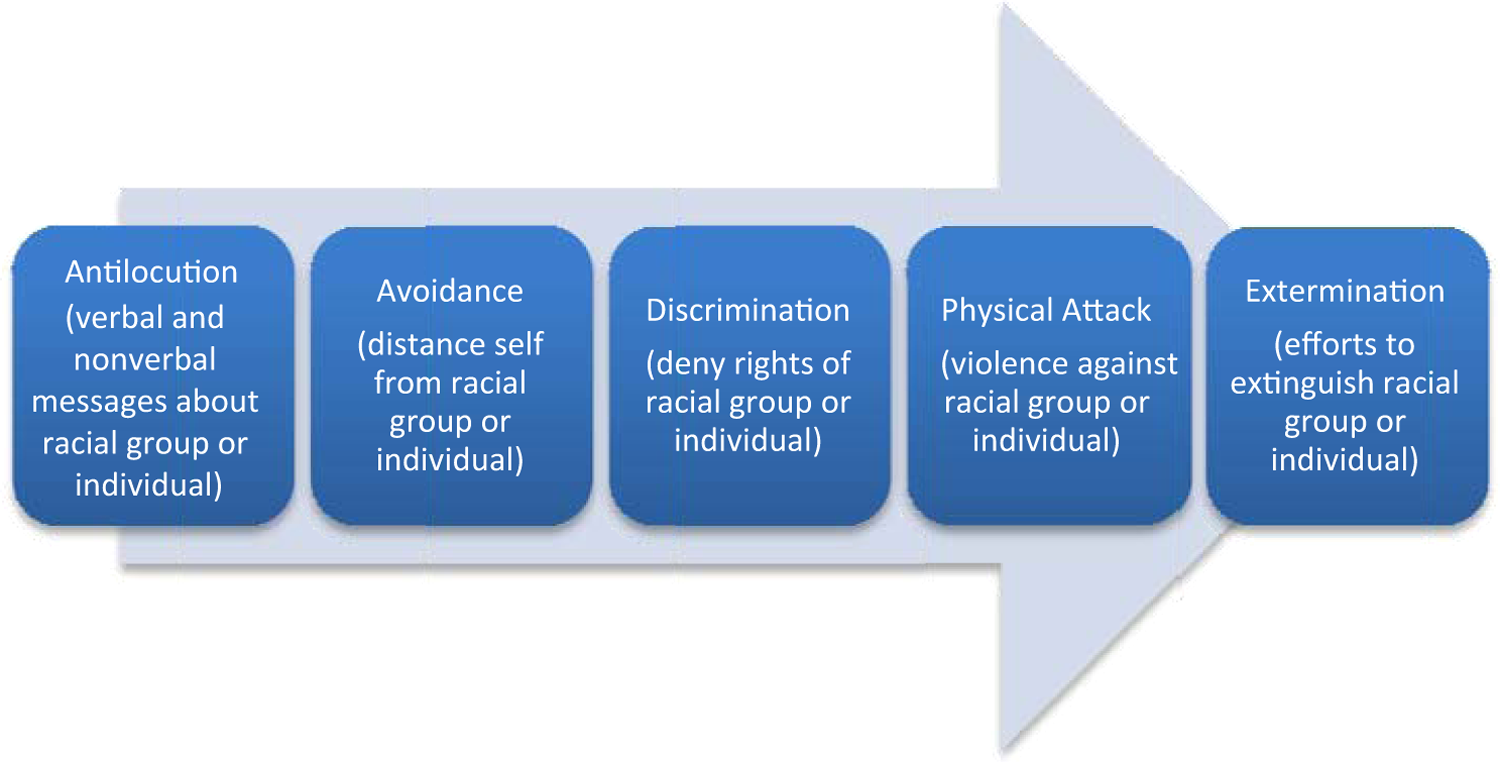
Allport’s theory of prejudice: five degrees from mildest to most severe.
As stated earlier, prejudice exists at the individual and institutional levels. The above examples not only may refer to an individual (e.g., caregiver and avoidance example above) but are also applicable to schools whose instruments, criteria, policies, and procedures pose barriers and hinder access to gifted programs for racial groups and individuals. A final issue to consider is unintentional and intentional prejudice and discrimination.
Intentional and Unintentional Prejudice and Discrimination: Learning From Robert Merton
Scenario 1: Unintentional Car Accident
Imagine just purchasing a new car and someone rear-ends you. The driver apologizes profusely, stating that he or she did not mean to run into you. Your car sustains significant damage, items are damaged, you are injured, you miss several weeks of work, and you must get long-term therapy. Do you feel better that the driver is “sorry?” Do you care that the driver did not mean to hit you? Does it matter that your car’s resale value is now compromised or that it may never drive like new? Does it matter that one of unsalvageable items was a gift for a loved one? Does it matter that you may be in therapy for the rest of your life?
Scenario 2: Unintentional Prejudice
Imagine you are a Hispanic student who has been identified as gifted. You have just moved to a new district, it is the first day of school, and you have just taken a seat in your AP English class. The teacher begins to take attendance. When calling your name, she looks squarely at you and asks sympathetically, “Are you sure you want to be in this class? Grades rely heavily on speaking and writing English well.” The other students chuckle or laugh outright. Humiliated, you state, “I was born in the U.S.” In the awkward silence, which seems to last forever, she apologizes. “Oh, I am sorry. Very sorry. I thought you were an ELL student.” You get up to leave, heading for the office to withdraw from the class. She apologizes again. Do you feel better that the teacher is “sorry?” Do you care that she did not mean to embarrass you? Does it matter that she assumed you did not know English or speak English well? Does it matter that she assumed you were a foreigner? Does it matter that students laughed and makings friends with them might be more challenging had you stayed? Does it matter that English is your favorite subject and you might not get to take AP English if she is the only teacher? Does it matter that you may face such assumptions for the rest of your life?
Despite the differences in the scenarios, they have in common unintentionality and an apology. The driver and teacher meant no harm. Nonetheless, there is damage. If the driver meant to hit you, there is still damage. If the driver did not mean to hit you, there is damage. If the teacher meant to prejudge your language skills, there is damage. If she did not, there is still damage.
For some individuals, the pain, so to speak, may decrease because they believe the person was not intentionally prejudiced. For others, intent does not matter. This is where Merton’s (1957) belief–behavior typology may be informative. His work describes the unanticipated consequences of social actions. According to Merton, unanticipated consequences are actions that have both intended and unintended consequences. People are aware of the intended consequences, but the unintended consequences are more difficult to recognize.
In the 2 × 2 typology (Prejudice/Nonprejudice × Discriminate/Nondiscriminate; Figure 2), prejudice is an attitude or belief and discrimination is the action or behavior. Not surprisingly, Merton illustrates how some prejudiced people do discriminate (“active bigot”) and some nonprejudiced people do not discriminate (“all weather liberal”).
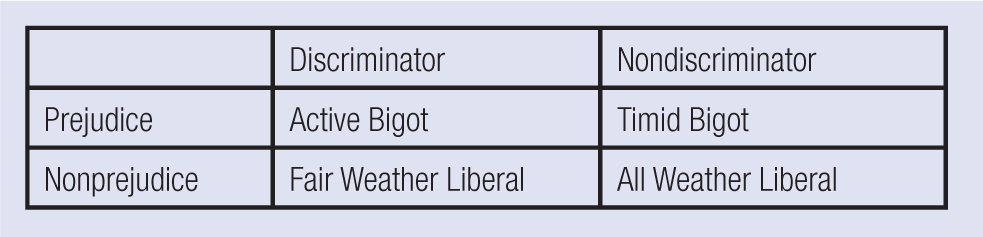
Merton typology of prejudice and discrimination.
However, the next two types are less obvious. Some people are prejudice but do not discriminate (“timid bigot”). An administrator who believes that Blacks are not as intelligent as Whites may still work to decrease or eliminate underrepresentation in the district’s gifted program. A major reason for doing so is to prevent charges of and investigations for alleged discrimination (e.g., from the Office for Civil Rights). A teacher who believes that students who are not proficient in English should not participate in gifted education may still refer them for screening because his principal will reprimand him or her for not doing so.
Last, according to the typology, some people are not prejudice yet discriminate (“fair weather liberal”). For example, prior to 1954, there were educators who believed schools should be desegregated. However, some hid those beliefs and refused to enroll Black students for fear of threats, White flight, being rejected by friends and family members, and other consequences. In contemporary times, this can manifest in educators (e.g., teachers, administrators, board members) neither challenging colleagues nor changing instruments, policies, procedures, and so on that contribute to the underrepresentation of Blacks and Hispanics in gifted education. Bonilla-Silva’s (2003) book titled Racism Without Racists pretty much sums up this last type—how one can discriminate without being racist. In the last two types, social pressures and fear of retribution of some kind are mitigating factors that, despite beliefs, guide behaviors/actions. In the next section, I offer a few suggestions for change.
Moving Forward: Recommendations for Change and Progress
The less we know about others, the more we make up. The more we know about others, the less we make up.
Changing long-held beliefs and attitudes is difficult but not impossible. Change comes with self-reflection and opportunities to challenges to faulty assumptions and stereotypes, as noted in the extensive work of Fisher (2005). Just as important, it cannot be denied that prejudice and discrimination are commonly occurring issues between different racial groups. Cultural clashes are an inevitable reality (see Oberg, 1954, 1960), particularly when prejudice is operating. Education, training, and interaction about and between groups matter.
The contact hypothesis, also known as intergroup contact theory, is one of the most effective methods for improving relations among groups that are conflict. The premise of Allport’s intergroup contact theory is that, under appropriate conditions, interpersonal contact is one of the most effective ways to reduce prejudice between majority and minority group members. When individuals have the opportunity to communicate with others, they are able to understand and appreciate different perspectives and behaviors. As a result of this newfound appreciation and understanding, individual’s prejudices decrease or are eliminated. More specifically, Allport proposed that properly managed contact between the groups has much promise for reducing racial problems, which increases positive interactions. However, for this to occur, four criteria must be present: (a) equal status—both groups given an equal status relationship, (b) common goals—both groups work on a problem/task and share this as a common or subordinate goal, (c) acquaintance potential—group members have an opportunity to get to know each other as friends, rather than as actors playing out social roles or as representatives of their social groups, and (d) support of authorities, laws, and customs—both groups acknowledge some authority and then define social norms that support the contact and interactions between groups’ members (http://en.wikipedia.org/wiki/Contact_hypothesis).
A number of studies support Allport’s hypothesis. For example, Rothbart and John (1985) found contact hypothesis to be an effective technique for reducing prejudice and stereotyping when three criteria are met: (a) the behavior of minority group members is not consistent with their stereotype, (b) the minority members are perceived as typical or representative of their cultural group, and (c) contact between group members occurs often and in several social contexts.
Pettigrew and Tropp (2008) conducted a meta-analysis of more than 500 studies involving 250,000 participants in 38 nations to study whether and how intergroup contact reduces prejudice. They concluded that intergroup contact reduces prejudice by (a) enhancing information about and understanding of the out-group, (b) reducing anxiety and related feelings about contact with the other group, and (c) increasing compassion, empathy, and perspective taking. Dovidio, Eller, and Hewstone (2011) reported that even extended indirect forms of intergroup contact effectively reduce prejudice. Finally, Crisp and Turner (2009) found that by imagining positive interactions, people reduce prejudice. Although not addressed specifically, I hope that individuals in the aforementioned studies were not fair weather liberals (nonprejudiced yet discriminates) described by Merton (1957) but instead were all weather liberals (nonprejudice/nondiscriminator).
The above findings speak to the vital importance of teachers creating classroom environments and learning opportunities that increase contact and positive relationships between students from different racial and cultural groups. Direct and indirect techniques, such as grouping practices, lectures and discussions, and multicultural literature and materials, can be implemented. Ensuring that students are placed in groups where they must interact and depend on each other is one example. Teachers must be strategic, which includes facilitating and monitoring interactions for positive comments and relationships, and addressing negative and positive stereotypes, comments, and behaviors. Holding small group discussions about prejudice and discrimination is also important and should be conducted with the support of professionals trained in multicultural communication, multicultural counseling, and other relevant disciplines. Multicultural curriculum and literature can also facilitate healthy intergroup contact when students read about and are exposed to materials (books, movies, etc.) that promote positive images of culturally different groups and individuals. Doing also helps to counter media images and messages. In Multicultural Gifted Education (Ford, 2011) and Reversing Underachievement Among Gifted Black Students (Ford, 2010), I share curriculum, literature, strategies, and resources for counselors and teachers. To repeat, the more we know about others, the less we make up.
Footnotes
Conflict of Interest
The author declared no potential conflicts of interest with respect to the research, authorship, and/or publication of this article.
Funding
The author received no financial support for the research, authorship, and/or publication of this article.
Bio
Donna Y. Ford, PhD, is a professor in the Department of Special Education and the Department of Teaching and Learning at Vanderbilt University’s Peabody College of Education.