







Abstract

Any educator or parent who has interacted with the field of gifted and talented education has probably come across the “bright versus gifted” or “bright child versus gifted learner” checklist. It seems to have first appeared in a 1989 article by Janice Szabos in Challenge Magazine but was likely around in similar forms long before that. You can find a few links to it at the end of this article—it’s not hard to find and seems to be one of the most ubiquitous publications related to gifted education. I have seen this form included in formal district gifted education plans and even posted to state department of education websites with the implicit endorsement of it and its key distinction as best practice. The overall suggestion seems to be that as a teacher or even as an educational system, educationally useful information comes from knowing if one of your students is “just bright” versus if she is “truly” gifted. In other words, if two children are otherwise identical in their level of achievement, aptitude, creativity, and so on, they should still be treated differently if one is “truly” gifted and one is “just” bright. A few years ago, a colleague of mine, who also happens to be a senior scholar in the field of gifted education, was handed the form as a rationale for why his kindergartener (who was already reading chapter books) was not eligible for gifted services. This case exemplifies what appears to be one of the form’s most common uses—as a means to deny services to a particular student despite overwhelming evidence that the child is under challenged in school.
“The end goal of K-12 gifted education is to provide students in need with some service or intervention that they would not otherwise receive.”
The distinction of whether a child is bright versus gifted is really emblematic of many of the challenges facing the field of gifted education. Let’s imagine for a moment that two identical children walk into your classroom (you playing the role of teacher). Both are very interested in the topic you are about to teach and have already mastered much of what you were going to cover over the next several weeks. Both ask good, probing questions and draw connections to other topics in a way that shows they are both far more advanced than most of their grade-level peers. Both prefer working with others who are at their academic level and have similar interests and both can handle a high degree of independent work. You’ve had a chance to get to know them both and believe they are both being under challenged in school. This kind of “case study” approach to identification and personalized learning is becoming more and more common. All of the evidence you have about these students (e.g., test scores, personal observations) points them toward needing more challenging material. You must now choose how to proceed between two options:
Now the million dollar question: What is gained by first diagnosing giftedness as opposed to moving straight from the observation of an unmet need, using multiple objective and subjective measures, to providing more challenging material? Even if we accept that there is a true distinction between bright children and gifted children and that such a distinction can be measured effectively, which is difficult to support based on the research literature, what is educationally helpful about the distinction of “bright versus gifted” if the students are otherwise the same in what they need from their school or teacher? And, perhaps most importantly, what gifted education interventions can we say with confidence that only “truly gifted” students will benefit from, whereas “just bright” students will not? If we had such evidence then the distinction between bright and gifted would be a worthy endeavor as we don’t want to provide students with an intervention if it will not be beneficial based on their observed needs. Without such evidence, those who deny a service to an otherwise needy and interested child (one who is “just” bright) seem, at best, conflicted or at worst, needlessly discriminatory.
The “bright versus gifted” form, although a seemingly easy way to communicate the population of interest in gifted education, also has many characteristics more commonly observed in students from dominant cultural groups (Peterson, 1999). On this basis, one could make the argument that the use of the form for intervention placement purposes might exacerbate underrepresentation. A further issue is that identifying some students as bright and some as gifted as a trait of their person (as opposed to a temporary state) further reinforces an entity view of ability and further perpetuates a fixed mind-set in educators and students (Dweck, 2007; Ricci, 2013). Bright or gifted? If the students have a similar level of identified need, why does it matter? Either way, schools need to make sure both students are being appropriately challenged and this particular distinction does not contribute toward that goal.
Over the last few years I have become increasingly concerned that many gifted education programs and professionals don’t seem to see “bright kids” as part of their purview or student load. I’ve seen students performing seven or eight grade levels above their age peers who are turned away from gifted services because their scores on intelligence tests aren’t above 130, they don’t score well on creativity tests, or because they seemed to fall more in the “bright” category than the “gifted” category on the aforementioned form. Recently I was told that a student was not gifted (third-grader who was easily reading at the high school level) because his parents read to him frequently and at an early age. Ponder on that for a moment. I have to admit I am still processing the relevance of the person’s point. In all of these cases, we as educators are dealing with students who are drastically under challenged in school but because they are not considered gifted (they’re “just” bright), they are ignored by the very system that should be their champion. Perhaps what may be happening is that overworked and overloaded gifted education teachers and coordinators are simply trying to limit the size of their identified population as to more effectively reach a smaller but seemingly needier group of students. Although based on good intentions, such practices result in students being excluded from interventions from which we have every indication they would benefit. In an age of accountability and growth-focused educational reform, this is a dangerous practice for the longevity of the field.
Many people will likely respond to this argument with points about the unique social and emotional needs of gifted students—needs that apparently don’t exist for “bright” students. Delisle (2014) has argued that knowing a child is gifted and providing him or her that label assures access to services and hence it is educationally necessary. Unfortunately, there is little evidence to support this argument that the social construct of giftedness has, on any large scale, assured access by gifted or bright students to any level of appropriately challenging services—at least in any way that resulted in greater academic gains (see Adelson, McCoach, & Gavin, 2012; Bui, Craig, & Imberman, 2014; Plucker, Hardesty, & Burroughs, 2013). For example, Wisconsin and about 23 other states legally mandate gifted identification and services in Grades K-12 and yet in Wisconsin only about a third of Wisconsin schools even have a named gifted education staff member (despite a legal mandate to do so). In this way, educational systems “having” giftedness or gifted education has not resulted in greater access to services for advanced learners—whether bright or gifted—even when they are legally mandated. Whether or not gifted education is working really isn’t the point. The larger and, in my mind, more important question is whether or not we need to be denying services to students who are “just bright” as opposed to being gifted.
Why can’t we proceed directly from Step 1, recognizing the child is unchallenged, to Step 3, providing an intervention that will result in appropriate challenge? (see Figure 1). Why do we need to go through Step 2 or checking to first make sure the child is really, truly, 100% gifted and not “just” bright?
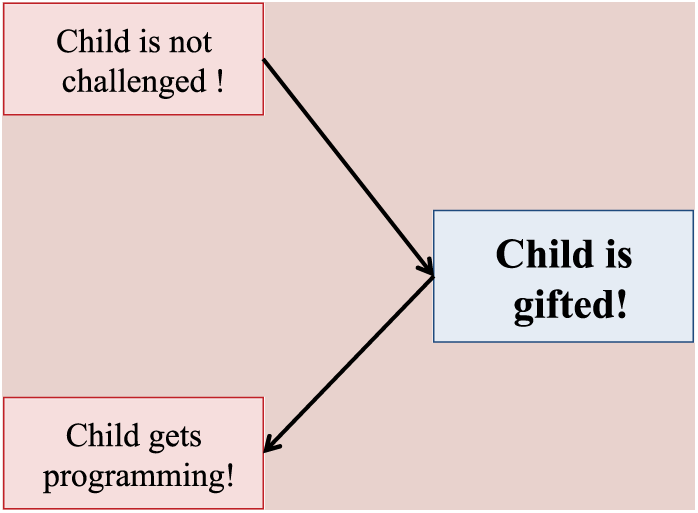
The gifted education flow chart.
The fact is that all labels in education come with costs and benefits. For example, labeling some students as having a “learning disability” comes with some stigma and self-perception challenges as well as unintended consequences, but in theory these costs are outweighed by the benefits that are provided because of the label. Can the same be said for the label of gifted and the assigning of that label to some advanced learners as not to others? Is the cost of having the label and going through the process of deciding if a child is bright versus gifted worth it because of the benefits that come as a result of the label (benefits that could not be realized if they were provided to bright students too)? I have no doubt that in some places at some times the answer is absolutely yes. But on the large scale and based on the available empirical research, I am skeptical.
Let me be abundantly clear about something. I do believe gifted individuals exist (see McBee, McCoach, Peters, & Matthews, 2012, and Peters et al., 2014, for an overview). That is to say that I believe there are people who experience the world in qualitatively different ways, receiving greater stimulation from a given amount of environmental stimuli than is typical in a given population (what McBee et al., 2012, referred to as high ability psychology). My concern is that focusing on this population in the context of K-12 gifted education really misses the boat when it comes to the purposes of such programs and the purposes of public education in general. No matter what theoretical foundation or conceptual framework one uses to define giftedness, the end goal of K-12 gifted education is to provide students in need with some service or intervention that they would not otherwise receive. Some “gifted” (high ability psychology) children are under challenged in their learning in schools and need more challenge. Likewise, some under challenged children are also those “gifted” individuals who experience the world differently. But these two groups are not inherently the same. Why can’t the field just focus on looking for those who are unchallenged or in some way mismatched with their instructional environment, and have as a goal that these students are challenged as much of the time as possible?
So what would this look like? The good news is that nearly all of gifted education “best practice” could stay the way it is. The main difference would be that data would be used to determine current, local level of challenge instead of determining who is bright versus gifted. Data relevant to the intervention would be used to better target educational interventions for all students—including the “just” bright. The field of gifted education would have as its niche to challenge the most advanced learners who are most ill-matched with grade-level curriculum. In doing this, I believe we as a field could have all of the existing benefits of “gifted education” without several of the most common negative side effects. We would also appear much more internally consistent and would serve a larger number of equally needy students.
Footnotes

Conflict of Interest
The author(s) declared no potential conflicts of interest with respect to the research, authorship, and/or publication of this article.
Funding
The author(s) received no financial support for the research, authorship, and/or publication of this article.
Bio
Scott J. Peters, PhD, is an associate professor at the University of Wisconsin–Whitewater. He has presented at the state, national, and international levels on topics dealing with gifted education, educational policy, assessment and data use in K-12 schools, and research methodology and currently serves on committees and as an officer of the Wisconsin Association for Talented and Gifted, the National Association for Gifted Children, and the American Education Research Association. He is the past recipient of the Feldhusen Doctoral Fellowship in Gifted Education, the NAGC Research and Evaluation Network Dissertation Award, the NAGC Doctoral Student of the Year Award, the NAGC Early Scholar Award, and the UW–Whitewater Innovation and Outstanding Research Awards.