







Abstract
This article discusses various key words that facilitate differentiated curricular experiences for gifted students. Key words such as “about,” “in,” “from,” and “with” can present a different perspective on the learning experience and stimulate investigative behaviors. They are also a set of words that are capable of enhancing self-directed study both formally and informally. The application of the key words provides a shift from teacher to student directed learning, from the concept that a study is completed to the concept that a study is ever ongoing, and from the gifted student as an individual seeking scholarship to an individual becoming a scholar.
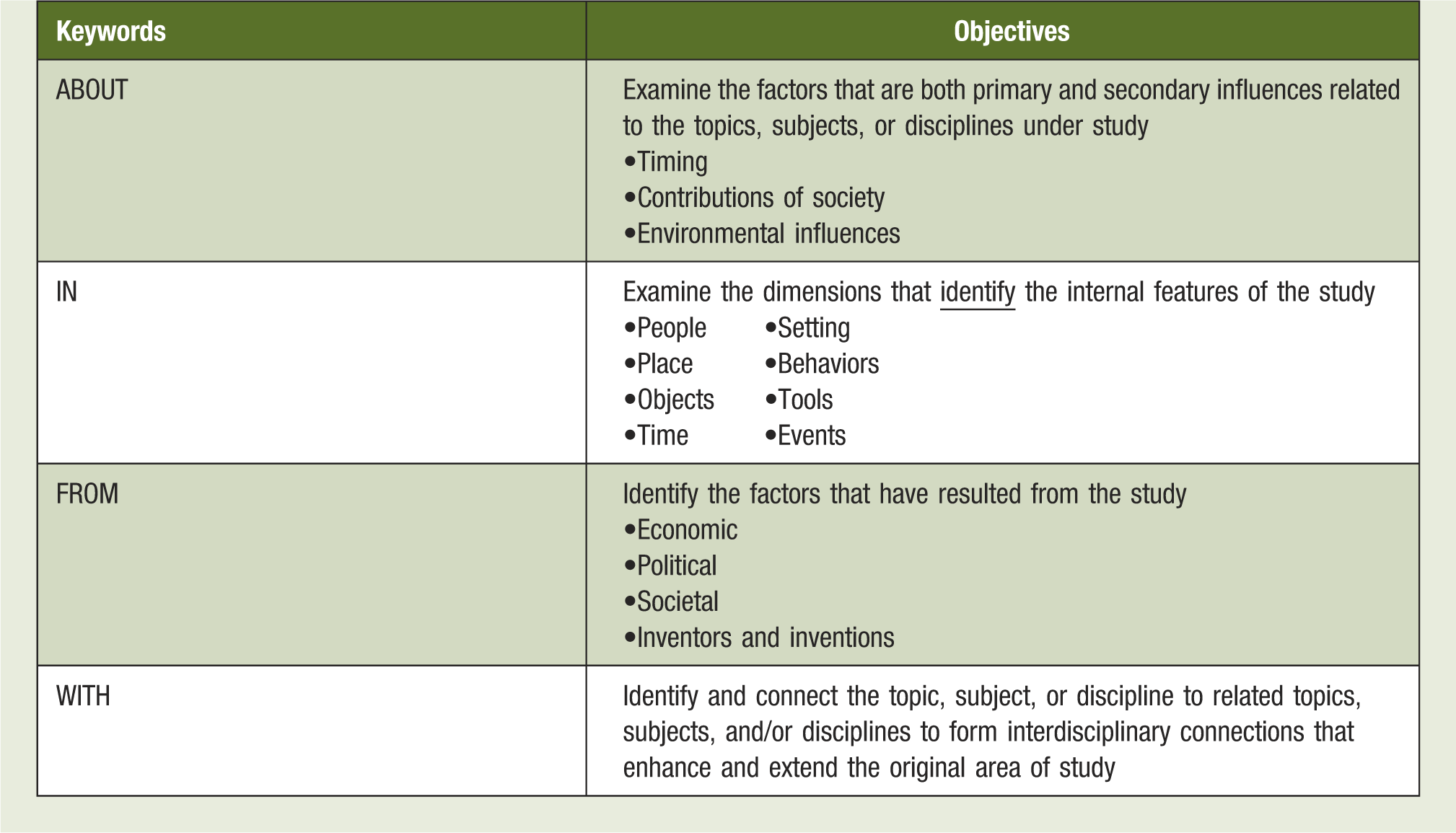
There are many and varied key words that have been suggested to facilitate differentiated curricular experiences for gifted students. Key words have provided the impetus to initiate a teacher or student-directed study of a topic, subject, and/or discipline. Some of the familiar key words introduced in a study include “people,” “purpose,” “significance,” “timeframe,” and “outcomes.” There is acknowledged variability among the key words selected and presented to gifted learners. It can also be stated that the type and purpose of key words can present a different perspective on the learning experience. The selection of the key words “about,” “in,” “from,” and “with” stimulates inquiry regarding the topic, subject, or discipline selected by the gifted student. Rather than pursuing an in-depth analysis of a topic using traditionally acknowledged key words, the major objective related to the key words, “about,” “in,” “from,” and “with,” is introduced to gifted students as a process of examination that redefines the concept of “to know” from depth to breadth.
The justification for teaching key words that stimulate breadth investigative behaviors is related to the following issues: • Breadth introduces and uncovers an awareness of knowledge and skills related to other topics, subjects, or disciplines. • Breadth can unveil areas of interest, ability, and potential that provide new understanding of self as a gifted learner. • Breadth reinforces the concept of inquiry by introducing the relationships that can be forged between and among areas of study.
The basic concept underling the key words “about,” “in,” “from,” and “with” is to promote examination of a topic, subject, or discipline that is analogous to how a viewer observes in order to understand and appreciate a work of art such as a painting, sculpture, or architecture. These key words stimulate the possibility of gifted students developing an appreciation and not just the acquisition of information under study. The multiple methods of examination each provide a different and unique perspective regarding the information under study. The primary goal is not how much the gifted students learn about what is being studied but how many and varied areas of study the one topic can introduce and excite the gifted student to recognize and study within time, over time, or sometime in the future. The importance for gifted students to develop an awareness of what is important to know today and what is possible to know in the future is a critical feature of differentiation for gifted students. Too often the end of a study for gifted students is commensurate with the belief that “the study is complete” rather than the gifted students realizing that the termination of a study is the potential of many and different new studies to engage in at another time.
The application of the key words provides a shift from teacher to student directed learning, from the concept that a study is completed to the concept that a study is ever ongoing, and from the gifted student as an individual seeking scholarship to an individual becoming a scholar.
Footnotes
Declaration of conflicting interests
The author(s) declared no potential conflicts of interest with respect to the research, authorship, and/or publication of this article.
Funding
The author(s) received no financial support for the research, authorship, and/or publication of this article.
