







Abstract
A fault diagnosis method of wind turbine bearing based on intrinsic time-scale decomposition (ITD) is put forward. In the proposed method, the vibration signal of the main bearing is decomposed into several proper rotation components by the ITD method. The frequency centers of the proper rotation components that contain predominant energy are computed and considered as fault feature vectors. The nearest neighbor algorithm is applied to identify the fault types of the wind turbine bearing. The experimental data of the wind turbine spherical roller bearing in four conditions (normal, outer race fault, inner race fault and roller fault) are applied to evaluate the performance of the proposed method. The results demonstrate the feasibility and accuracy of this approach for the diagnosis of the wind turbine bearing faults under uncertain conditions.
Keywords
1. Introduction
The development of renewable energy has attracted widespread attention due to the energy crisis and environmental issues. Renewable energy development is booming worldwide. In particular, the exploitation of wind power has become very rapid, and plays an important role in the energy structure. The wind turbine faults often occur because most wind farms are in poor areas of the environment. As a result, it is important to monitor the condition and detect the fault of wind turbines to ensure their safety and stability (Amirat et al., 2009; An and Jiang, 2010a, b; Barszc and Randall, 2009; Hameed et al., 2009). The bearing faults make up a high percentage of rotating machinery failures (Guo et al., 2009; Soylemezoglu et al., 2010; Trendafilova, 2010), especially for wind turbines that operate in bad weather conditions (storm, ice, high tides, etc.) (Zhao, 2010). The vibration signal of a roller bearing fault is non-stationary and nonlinear due to the instability of wind conditions and the complexity of roller bearing faults. So it is significant to choose appropriate signal processing and fault diagnosis methods to analyze wind turbine faults.
The intrinsic time-scale decomposition (ITD) method can decompose a complex signal into several proper rotation components and extract the dynamic features of non-stationary signals accurately (Frei and Osorio, 2007). It has high decomposition efficiency and frequency resolution. It is appropriate for dealing with the complex and non-stationary signals, and is promising for the application to the real-time data analysis. Thus, a fault diagnosis model of wind turbine spherical roller bearing using ITD is proposed.
2. Intrinsic Time-Scale Decomposition Method
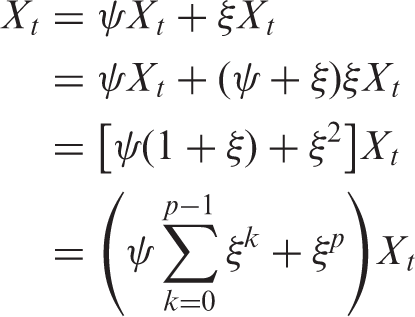
The ITD method decomposes a vibration signal into a series of proper rotation components and a trend component. The instantaneous amplitude and instantaneous frequency of the proper rotation components are analyzed in frequency spectrum. Through analyzing the spectrum, the amplitude modulation and frequency modulation of the vibration signal can be derived, respectively. For the signal X
t
, the ξ is defined as the baseline extraction operator. After extracting a baseline from the signal X
t
, the rest signal becomes an inherent rotation. The first decomposition of the X
t
as follows (Frei and Osorio, 2007):

Supposing {τ
k
, k = 1, 2, … } are the local extrema values of the X
t
, let τ0 = 0. To simplify the symbol, the X(τ
k
) and L(τ
k
) are expressed by using X
k
and L
k
, respectively. Based on the assumption that the L
t
and H
t
have been defined in [0, τ
k
], and the X
t
is also defined in t∈[0, τk + 2]. The subsection linear baseline extraction operator, ξ, is defined in contiguous extrema interval (τ
k
, τk + 1]:

In equation (2), the Lk + 1 can be expressed as

3. Fault Diagnosis of Wind Turbine Bearing Using Itd Method
The decomposed proper rotation components using the ITD method have certain physical meanings. They can effectively reflect the characteristics of the original signal, and are suitable for analyzing the amplitude modulation and frequency modulation signals. In this paper, the vibration signal of a spherical roller bearing fault in a wind turbine is decomposed using the ITD algorithm. The frequency centers of proper rotation components that contain predominant energy are calculated and regarded as bearing fault feature vectors of the wind turbine. In order to detect and locate bearing faults, the nearest neighbor algorithm is adopted. The procedure of the proposed fault diagnosis method can be summarized as follows:
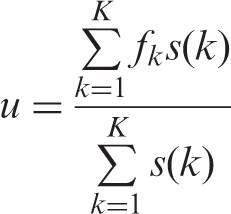
Four experiments (spherical roller bearing normal, outer race fault, inner race fault and roller fault) of a direct-drive wind turbine are carried out. The main shaft of the wind turbine is supported by two spherical roller bearings. The bearing with artificially induced defects is installed closer to the wind wheel. A total of 4N samples are obtained with N samples for each condition. Using the ITD method, each sample signal can be decomposed into a series of proper rotation components, c1, c2, …, cn, with different scales. The frequency center u
i
(i = 1, 2, 3,…, m) of predominant energy proper rotation components are calculated, the U = {u1, u2, u3, …, u
m
} are regarded as bearing fault feature vectors. The frequency center u is defined as: From the 4N datasets, L samples are used to train the nearest neighbor classifier (Duda et al., 2000), and the remaining 4N-L samples are presented to estimate the performance of the proposed method.
4. Experiment and Results
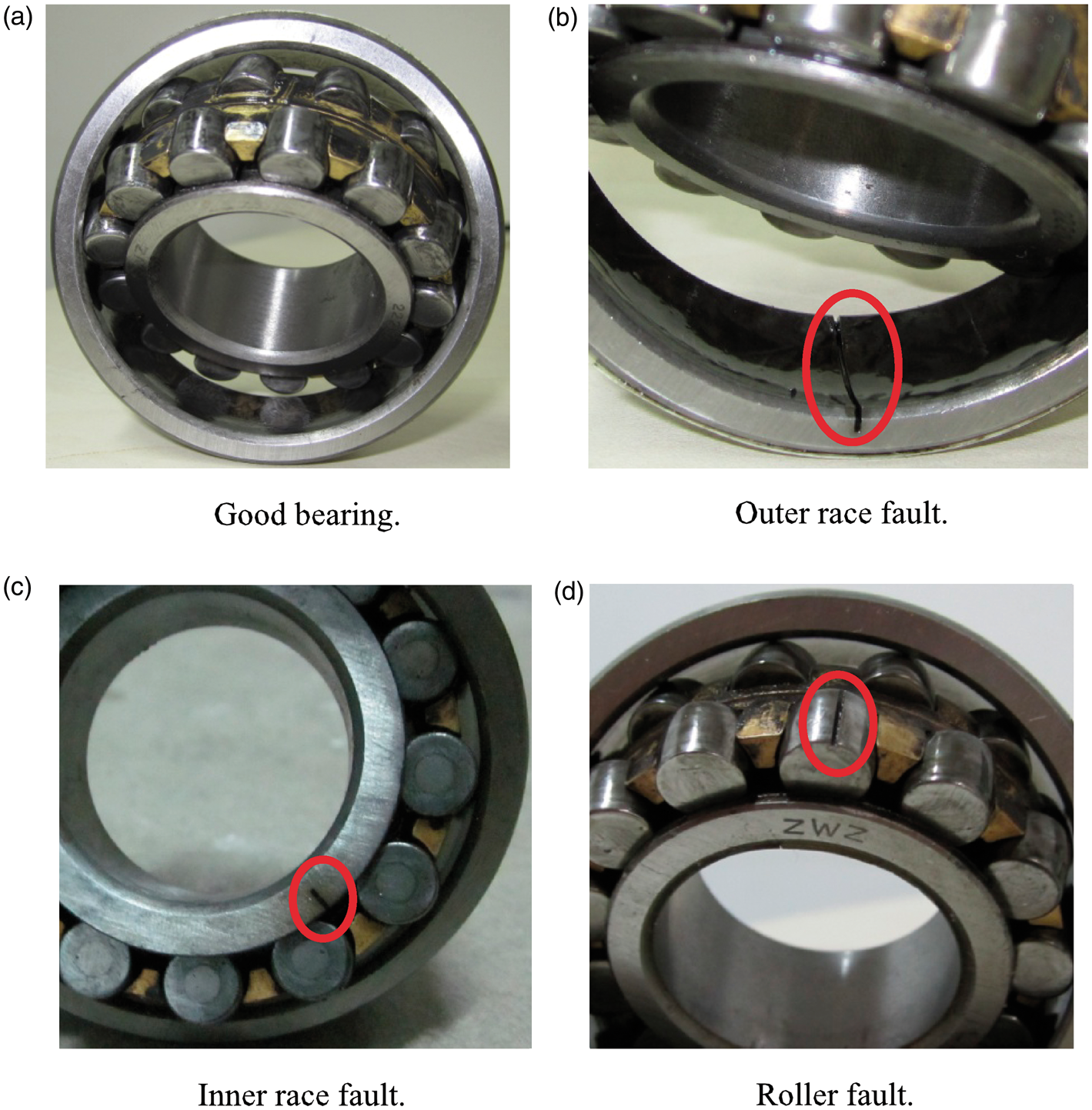
Considering that the bearing faults occur in outer race, inner race or roller, four experiments with spherical roller bearing (22206-type) – normal operation, outer race fault, inner race fault and roller fault are carried out. The direct-drive wind turbine test rig is shown in Figure 1. The bearing faults are set by grooving using a linear cutting method. The sizes of the outer race defect, the inner race defect and the roller defect are the same, with 0.2 mm width and 0.3 mm depth, as shown in Figure 2. The defect bearings are installed in the near wind wheel. The experimental rotating frequency of wind turbine is 4.25 Hz. The sampling rate is 2000 Hz, and sampling length is 8192 for four conditions.
Test stand of direct-drive wind turbine. View of spherical roller bearing in good condition and with three faults.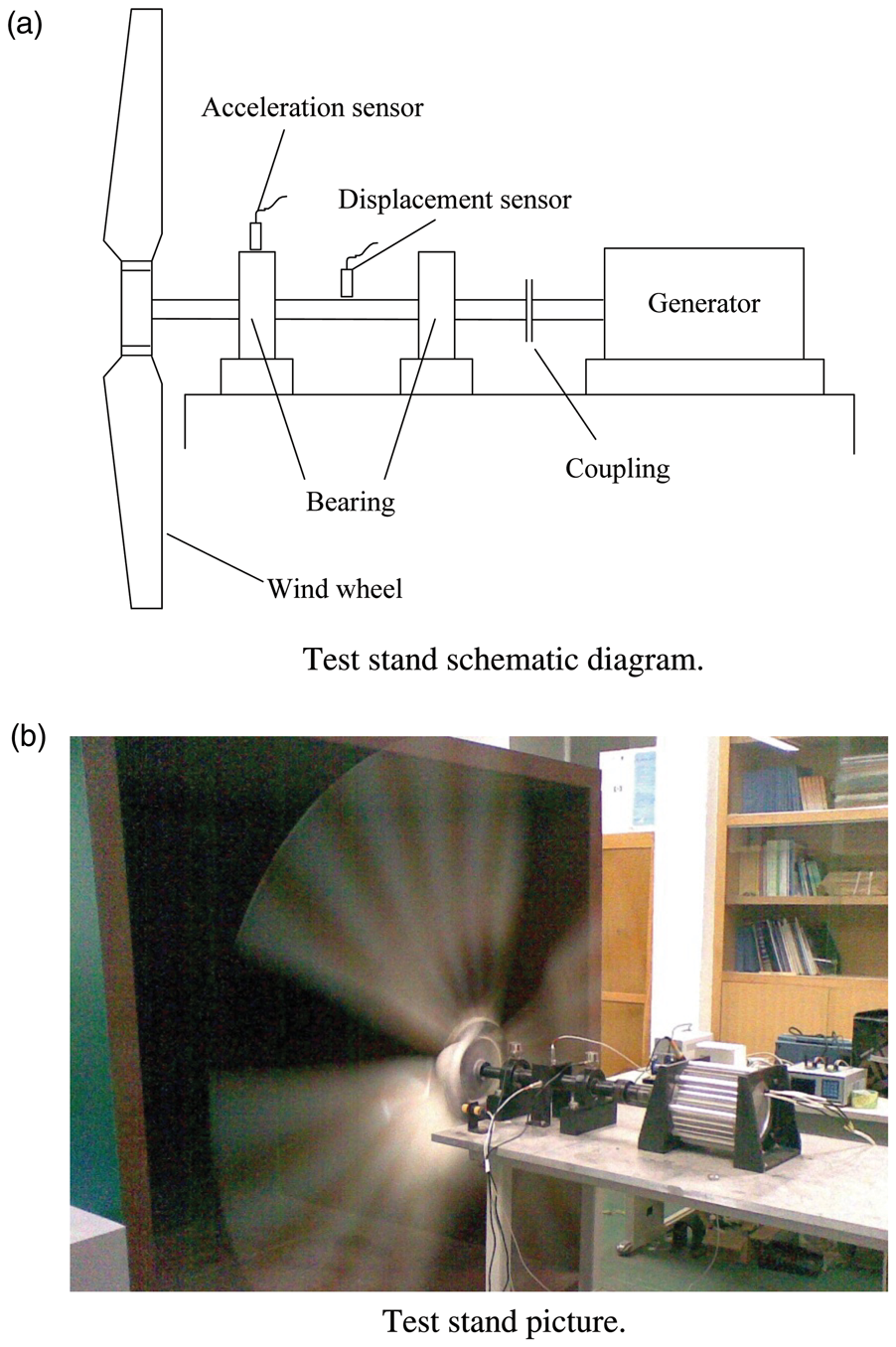
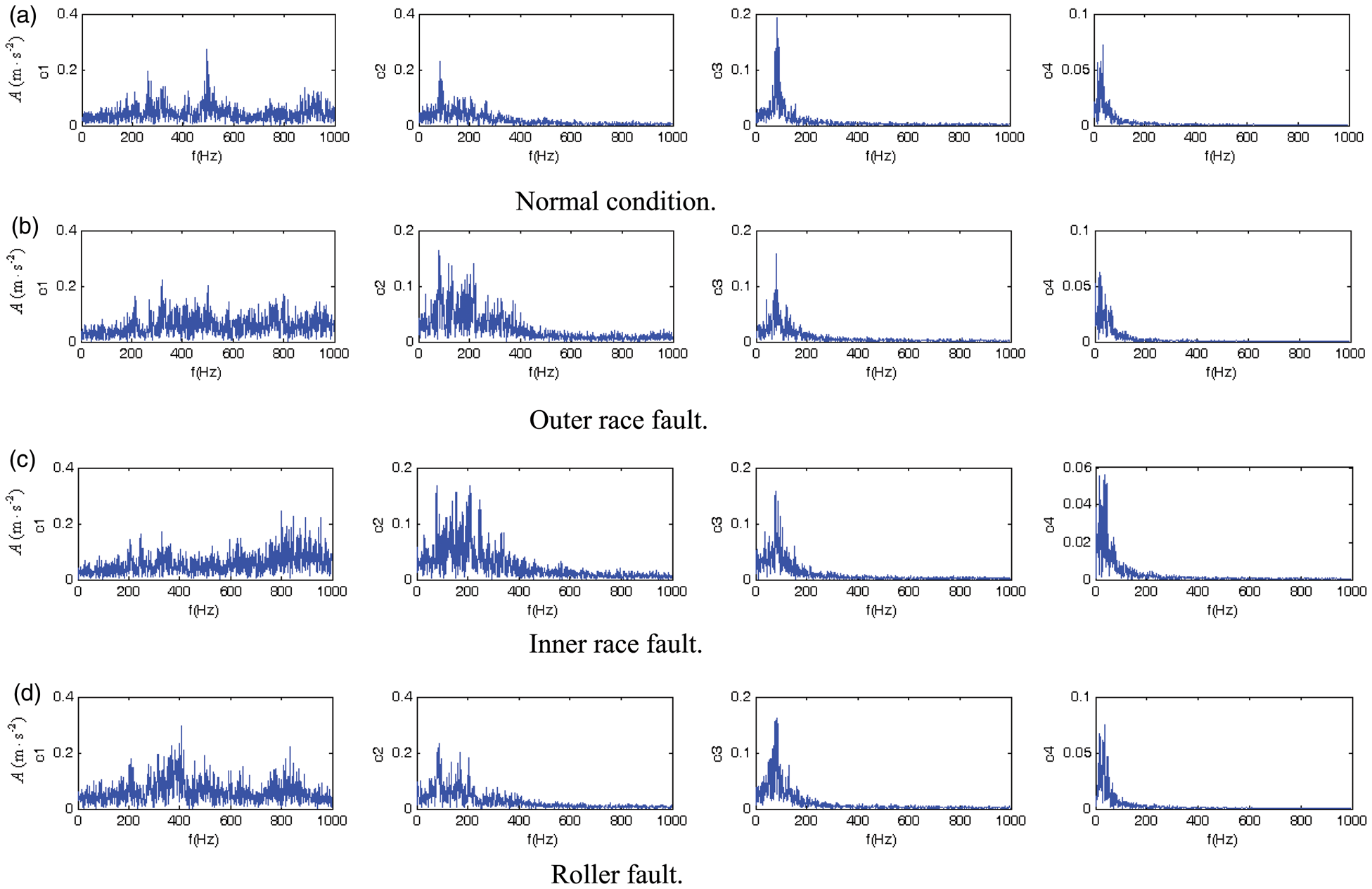
The vibration acceleration signals of wind turbine bearing in four conditions (normal, outer race fault, inner race fault and roller fault) are acquired. Each condition has 24 samples with a total of 24 × 4 samples. The ITD method is used to decompose these samples of different conditions and the proper rotation components of each sample can be obtained. Figure 3 shows the time domain waveform and the ITD decomposed results of main bearing vibration acceleration signals with an inner race fault. It can be seen from the figure that the ITD method can decompose a vibration signal into a series of proper rotation components of different scales. The energies of the first four proper rotation components are predominant. The signals of bearing normal, outer race fault and roller fault are similar to the inner race fault. Figure 4 displays the frequency spectrum of the first four components c1, c2, c3 and c4 in four conditions, respectively. From Figure 4, it is easily seen that the decomposed components have high frequency resolution.
The time domain waveform and intrinsic time-scale decomposition (ITD) decomposed results of main bearing vibration acceleration signals with inner race fault. The spectrum of the proper rotation components c1, c2, c3 and c4 of acceleration signals in four conditions.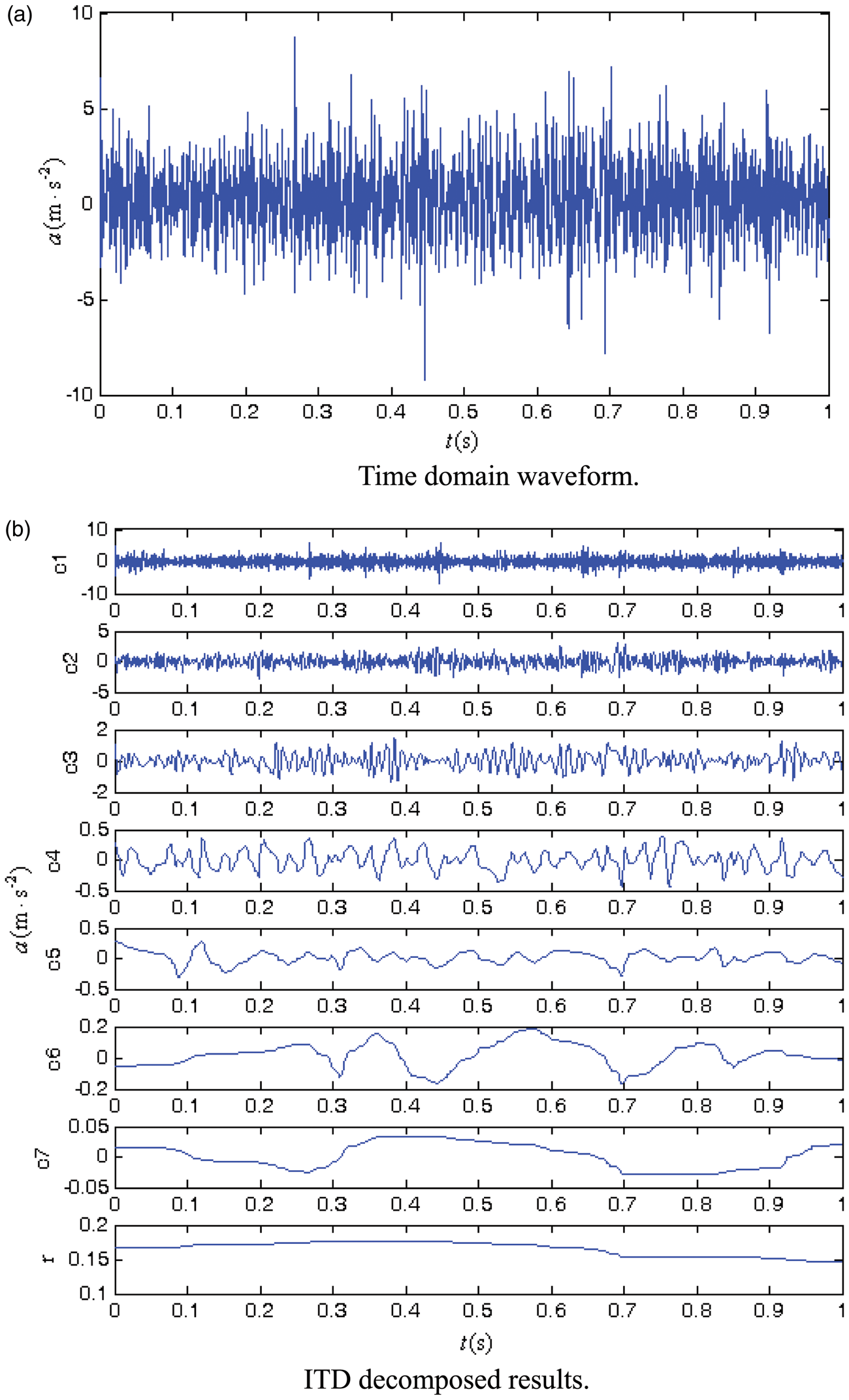
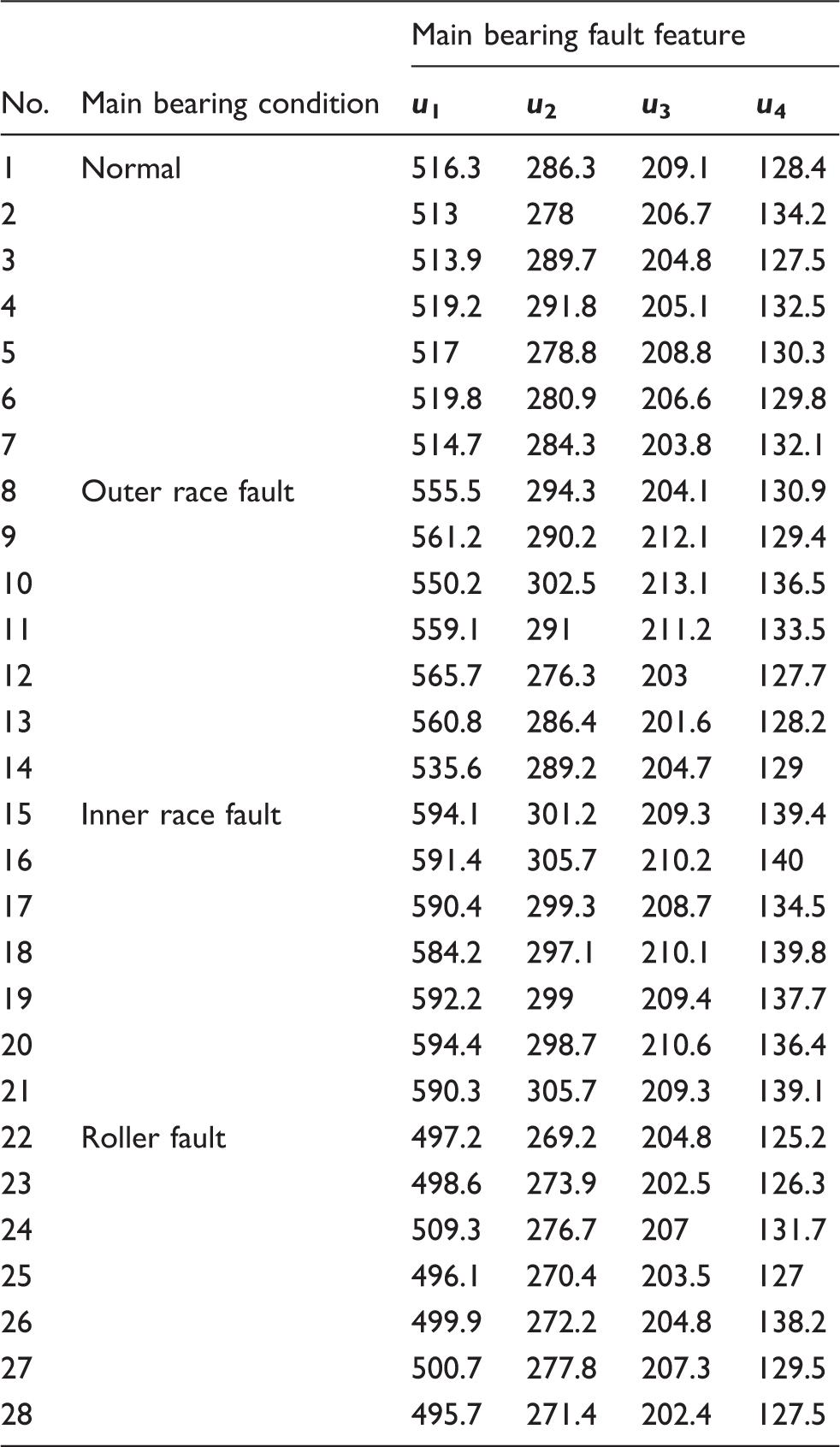
Main bearing fault features of wind turbine based on intrinsic time-scale decomposition
5. Conclusions
The vibration signal of a wind turbine bearing fault is strongly non-stationary and nonlinear due to the instability of wind conditions and the complexity of spherical roller bearing faults. The intrinsic time-scale decomposition method is a new, suitable method for the analysis of non-stationary and nonlinear signals. It can accurately express the dynamic characteristics of non-stationary signals with high time and frequency resolution. Therefore, in this paper, the ITD is applied to decompose the vibration signal into several proper rotation components.The frequency centers of the first few primary proper rotation components are computed as feature vectors of bearing fault diagnosis. The nearest neighbor algorithm is used to identify the operation condition of wind turbine bearings based on these feature vectors. Experimental results show that the proposed ITD-based method has excellent performance for wind turbine bearing fault diagnosis.
Footnotes
Funding
This work is supported by the National Basic Research Program (973 Program) (No. 2007CB210304) and China Postdoctoral Science Foundation funded project (No. 20090460273).