







Abstract
The conjugate gradient method is one of the most useful and the earliest-discovered techniques for solving large-scale nonlinear optimization problems. Many variants of this method have been proposed, and some are widely used in practice. In this article, we study the descent Dai–Yuan conjugate gradient method which guarantees the sufficient descent condition for any line search. With exact line search, the introduced conjugate gradient method reduces to the Dai–Yuan conjugate gradient method. Finally, a global convergence result is established when the line search fulfils the Goldstein conditions.
Keywords
1. Introduction
Conjugate gradient methods are very important tools for solving nonlinear optimization problems, especially for large-scale problems. In fact, the conjugate gradient methods are not among the faster or more robust optimization algorithms for nonlinear problems available today, but are very popular for engineers and mathematicians who are interested in solving large-scale problems (Nocedal, 1992; Polak, 1997). We consider the unconstrained optimization problem






In this article, we consider the descent Dai–Yuan conjugate gradient method for solving (1) (Yu et al., 2008) The descent DY conjugate gradient method generates a sequence of iterates by letting



The article is organized as follows. In Section 2, we prove that, for any inexact line search the proposed direction satisfies the descent condition
2. The proof of the sufficient descent condition
An attractive feature of the descent DY conjugate gradient method, which we establish, is that the search directions always yield descent when
Theorem 1.
Let


Proof.
By multiplying d0 = −g0 by 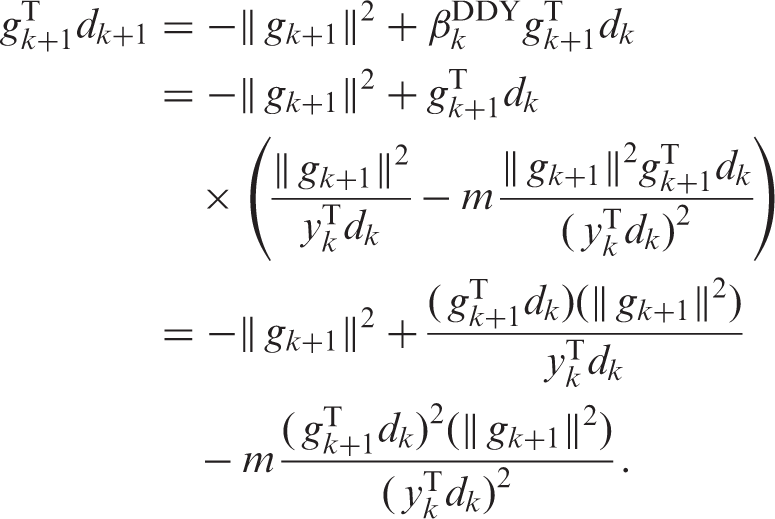
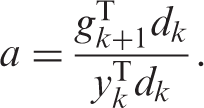

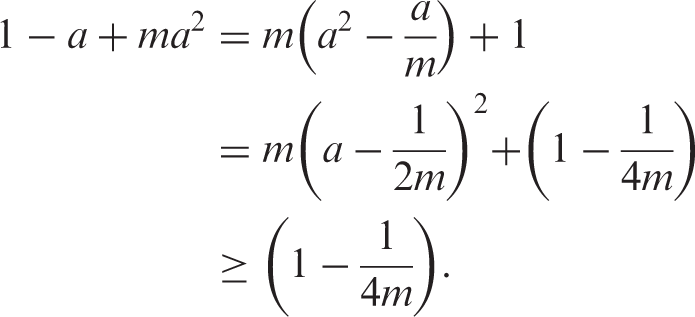

From the above theorem, the introduced direction given by (8) and (9) is a descent direction. In the next section, we present the convergence theorem to the method given by (8) and (9) for a strongly convex function.
3. Convergence of the descent Dai–Yuan conjugate gradient method
In the previous section, it is proved that the direction given by (8) and (9) is a descent direction. In this section, by using (8) and (9), we establish a new convergent method. For this purpose, we need to constrain the choice of α
k
to ensure convergence. There are many approaches for finding an available step-length. Among them, the exact line search is ideal, but is costly or even impossible to use for finding the step-length. Also we know that with exact line search, the descent DY conjugate gradient method reduces to the DY conjugate gradient method. Some inexact line searches techniques are useful and effective in practical computation, such as standard Wolfe line search (Nocedal and Wright, 1999), the strong Wolfe line search (Yuan, 1993), the Armijo line search (Armijo, 1966), the new Armijo line search (Shi and Shen, 2007) and Goldstein line search (Fletcher, 1997). Here, we consider the line search that satisfies the Goldstein conditions:

Now applying (8) and (9), we propose the following algorithm.
Algorithm 1
For convenience, we first present the following assumption which has often been used in the literature to analyze the global convergence of conjugate gradient methods with inexact line searches. Suppose that f is strongly convex and Lipschitz continuous on the level set
Assumption 1.



Under the above assumptions on f, there exists a constant ω such that

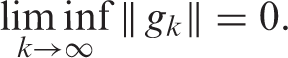
Theorem 2.
Suppose that Assumption 1 holds and the sequence {x
k
} is generated by Algorithm 1. Then either g
k
= 0 for some k, or
Proof.
We proceed by contradiction, assuming that the theorem is not true. Then g
k
≠ 0 for all k and lim infk→∞ ‖g
k
‖ ≠ 0. Hence there exists a positive constant γ such that

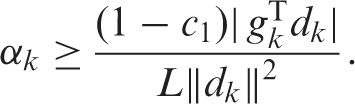

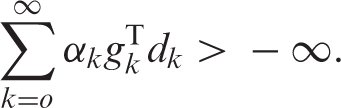

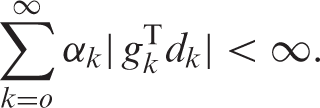
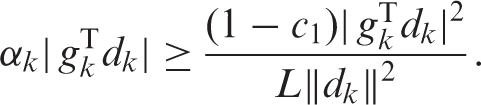
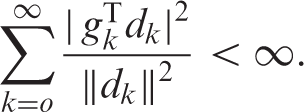

Squaring both sides of the above inequality, gives us
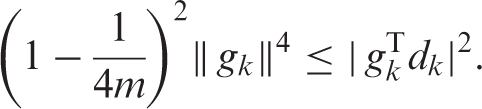
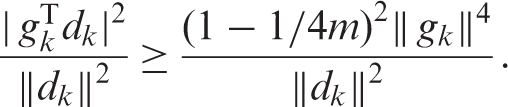
Dividing both sides by ‖d
k
‖2, we have

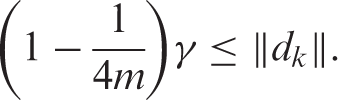
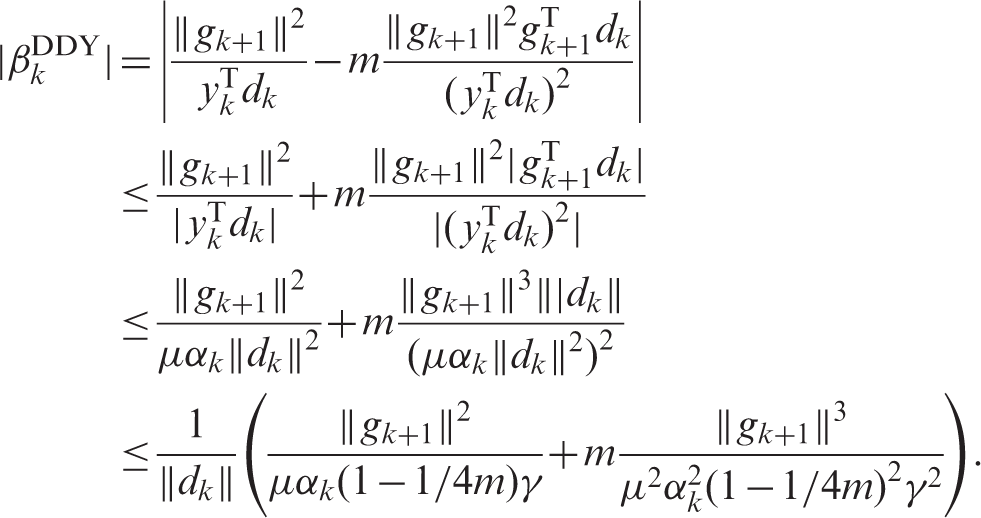
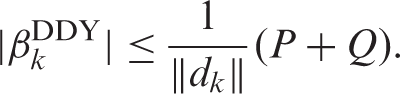
By (29) and the Cauchy–Schwartz inequality, we have




4. Conclusion
The conjugate gradient methods play a special role for solving large-scale nonlinear optimization due to the simplicity of their iteration and their very low memory requirements. In this article, we have studied the descent DY conjugate gradient method, that is Algorithm 1, for solving unconstrained optimization problems. We have proven that the presented direction satisfies the descent condition
Footnotes
Acknowledgments
The authors are very much indebted to the anonymous referees for their valuable comments and careful reading of the manuscript.
Funding
This research received no specific grant from any funding agency in the public, commercial, or not-for-profit sectors.