







Abstract
In 2013 the Editor of Journal of Vibration and Control and SAGE became aware of a peer review ring involving assumed and fabricated identities that appeared to centre around Peter Chen at National Pingtung University of Education, Taiwan (NPUE). SAGE and the Editor then began a complex investigation into the case during the rest of 2013 and 2014. Following an unsatisfactory response from Peter Chen, NPUE was notified.
NPUE were serious in addressing the Journal and SAGE’s concerns. NPUE confirmed that the institution was investigating Peter Chen. SAGE subsequently uncovered a citation ring involving the above mentioned author and others.
We regret that individual authors have compromised the academic record by perverting the peer review process and apologise to readers. On uncovering problems with peer review and citation SAGE immediately put steps in place to avoid similar vulnerability of the Journal to exploitation in the future. More information may be found at www.sagepub.co.uk/JVC_Statement_2014.
The Journal and SAGE understand from NPUE that Peter Chen has resigned his post at NPUE.
The following articles are retracted because after thorough investigation evidence points towards them having at least one author or being reviewed by at least one reviewer who has been implicated in the peer review ring and/or citation ring. All authors have had an opportunity to respond to the allegations and proposed actions.
Chen CY, Chen T-H, Chen Y-H, Yu S-E and Chung P-Y (2013) Information technology system modeling an integrated C-TAM-TPB model to the validation of ocean tidal analyses Journal of Vibration and Control Epub ahead of print 7 May 2013. doi: 10.1177/1077546312472924
Chang R-F, Chen CY, Su F-P and Lin H-C (2013) A two-step approach for broadband digital signal processing technique Journal of Vibration and Control Epub ahead of print 26 April 2013. doi: 10.1177/1077546312472925
Chen TH, Chang CJ, Yu SE, Chung PY and Liu C-K (2013) Nonlinear information analysis and system management technique: the influence of design experience and control complexity Journal of Vibration and Control Epub ahead of print 12 April 2013. doi: 10.1177/1077546312473321
Chen CY, Shih BY, Chen YH, Yu SE and Liu YC (2013) The exploration of a 3T flow model using vibrating NXT: II. Model validation Journal of Vibration and Control Epub ahead of print 10 April 2013. doi: 10.1177/1077546312470481
Chen CY, Shih BY, Chen YH, Yu SE and Liu YC (2013) The exploration of 3T flow model using vibrating NXT: I. model formulation Journal of Vibration and Control Epub ahead of print 6 February 2013. doi: 10.1177/1077546312467360
Lin M-L and Chen C-W (2013) Stability analysis of fuzzy-based NN modeling for ecosystems using fuzzy Lyapunov methods Journal of Vibration and Control Epub ahead of print 6 February 2013. doi: 10.1177/1077546312466687
Chen CY, Chen TH, Chen YH and Chiu J (2012) A multi-stage method for deterministic-statistical analysis: a mathematical case and measurement studies Journal of Vibration and Control Epub ahead of print 20 December 2012. doi: 10.1177/1077546312466579
Shih BY, Lin MC and Chen CY (2012) Autonomous navigation system for radiofrequency identification mobile robot e-book reader Journal of Vibration and Control Epub ahead of print 13 December 2012. doi: 10.1177/1077546312466578
Chang RF, Chen CY, Su FP, Lin HC and Lu C-K (2012) Multiphase SUMO robot based on an agile modeling-driven process for a small mobile robot Journal of Vibration and Control Epub ahead of print 13 December 2012. doi: 10.1177/1077546312464993
Shih B-Y, Lin Y-K, Cheng M-H, Chen C-Y and Chiu C-P (2012) The development of an application program interactive game-based information system Journal of Vibration and Control Epub ahead of print 12 December 2012. doi: 10.1177/1077546312464682
Chen C-Y, Chang C-J and Lin C-H (2012) On dynamic access control in web 2.0 and cloud interactive information hub: technologies Journal of Vibration and Control Epub ahead of print 12 December 2012. doi: 10.1177/1077546312464992
Shin BY, Chen CY and Hsu KH (2012) Robot cross platform system using innovative interactive theory and selection algorithms for Android application Journal of Vibration and Control Epub ahead of print 13 November 2012. doi: 10.1177/1077546312463757
Chen C-W (2014) Applications of neural-network-based fuzzy logic control to a nonlinear time-delay chaotic system Journal of Vibration and Control 20 (4): 589-605. Epub ahead of print 5 November 2012. doi: 10.1177/1077546312461370
Chen C-W (2014) A review of intelligent algorithm approaches and neural-fuzzy stability criteria for time-delay tension leg platform systems Journal of Vibration and Control 20 (4): 561-575. Epub ahead of print 5 November 2012. doi: 10.1177/1077546312463759
Chen C-Y, Chang C-J and Lin C-H (2014) On dynamic access control in web 2.0 and cloud interactive information hub: trends and theories Journal of Vibration and Control 20 (4): 548-560. Epub ahead of print 5 November 2012. doi: 10.1177/1077546312463762
Lin M-L and Chen C-W (2014) Stability conditions for ecosystem modeling using the fuzzy Lyapunov method Journal of Vibration and Control 20 (2): 290-302. Epub ahead of print 23 October 2012. doi: 10.1177/1077546312451301
Chen C-H, Kuo C-M, Hsieh S-H and Chen C-Y (2014) Highly efficient very-large-scale integration (VLSI) implementation of probabilistic neural network image interpolator Journal of Vibration and Control 20 (2): 218-224. Epub ahead of print 22 October 2012. doi: 10.1177/1077546312458822
Chen C-Y (2014) Wave vibration and simulation in dissipative media described by irregular boundary surfaces: a mathematical formulation Journal of Vibration and Control 20 (2): 191-203. Epub ahead of print 22 October 2012. doi: 10.1177/1077546312464258
Chen C-H, Yao T-K, Dai J-H and Chen C-Y (2014) A pipelined multiprocessor system- on-a-chip (SoC) design methodology for streaming signal processing Journal of Vibration and Control 20 (2): 163-178. Epub ahead of print 16 October 2012. doi: 10.1177/1077546312458821
Lin M-L and Chen C-W (2014) Fuzzy neural modeling for n-degree ecosystems using the linear matrix inequality approach Journal of Vibration and Control 20 (1): 82-93. Epub ahead of print 8 October 2012. doi: 10.1177/1077546312458533
Chen C-H, Wu W-X and Chen C-Y (2013) Ant-inspired collective problem-solving systems Journal of Vibration and Control 19 (16): 2481-2490. Epub ahead of print 18 September 2012. doi: 10.1177/1077546312456231
Chen C-H, Yao T-K, Kuo C-M and Chen C-Y (2013) Evolutionary design of constructive multilayer feedforward neural network Journal of Vibration and Control 19 (16): 2413-2420. Epub ahead of print 12 September 2012. doi: 10.1177/1077546312456726
Chen C-W (2013) Applications of the fuzzy-neural Lyapunov criterion to multiple time-delay systems Journal of Vibration and Control 19 (13): 2054-2067. Epub ahead of print 16 August 2012. doi: 10.1177/1077546312451034
Chung P-Y, Chen Y-H, Walter L and Chen C-Y (2013) Influence and dynamics of a mobile robot control on mechanical components Journal of Vibration and Control 19 (13): 1923-1935. Epub ahead of print 20 July 2012. doi: 10.1177/1077546312452184
Chen C-W (2013) Neural network-based fuzzy logic parallel distributed compensation controller for structural system Journal of Vibration and Control 19 (11): 1709-1727. Epub ahead of print 22 June 2012. doi: 10.1177/1077546312442233
Chen C-W, Yeh K, Yang H-C, Liu KFR and Liu C-C (2013) A critical review of structural system control by the large-scaled neural network linear-deferential-inclusion-based criterion Journal of Vibration and Control 19 (11): 1658-1673. Epub ahead of print 18 June 2012. doi: 10.1177/1077546312443377
Chen C-H, Kuo C-M, Chen C-Y and Dai J-H (2013) The design and synthesis using hierarchical robotic discrete-event modeling Journal of Vibration and Control 19 (11): 1603-1613. Epub ahead of print 27 June 2012. doi: 10.1177/1077546312449645
Chang CJ, Chen CY and Chou I-T (2013) The design of information and communication technologies: telecom MOD strength machines Journal of Vibration and Control 19 (10): 1499-1513. Epub ahead of print 27 June 2012. doi: 10.1177/1077546312449644
Shih B-Y, Chen C-Y, Li K-H, Wu T-Y, Chen G-Y (2013) A novel NXT control method for implementing force sensing and recycling in a training robot Journal of Vibration and Control 19 (10): 1443-1459. Epub ahead of print 1 June 2012. doi: 10.1177/1077546312446361
Chen C-W, Chen P-C and Chiang W-L (2013) Modified intelligent genetic algorithm-based adaptive neural network control for uncertain structural systems Journal of Vibration and Control 19 (9): 1333-1347. Epub ahead of print 31 May 2012. doi: 10.1177/1077546312442232
Chen C-Y, Shih B-Y, Shih C-H and Wang L-H (2013) Enhancing robust and stability control of a humanoid biped robot: system identification approach. Journal of Vibration and Control 19 (8): 1199-1207. Epub ahead of print 26 April 2012. doi: 10.1177/1077546312442947
Chang C-J, Chen C-Y and Huang C-W (2013) Applications for medical recovery using wireless control of a bluetooth ball with a hybrid G-sensor and human-computer interface technology Journal of Vibration and Control 19 (8): 1139-1151. Epub ahead of print 24 April 2012. doi: 10.1177/1077546312442948
Hsu W-K, Chiou D-J, Chen C-W, Liu M-Y, Chiang W-L and Huang P-C (2013) Sensitivity of initial damage detection for steel structures using the Hilbert-Huang transform method Journal of Vibration and Control 19 (6): 857-878. Epub ahead of print 29 February 2012. doi: 10.1177/1077546311434794
Chen C-Y, Shih B-Y, Shih C-H and Wang L-H (2013) Human–machine interface for the motion control of humanoid biped robots using a graphical user interface Motion Editor Journal of Vibration and Control 19 (6): 814-820. Epub ahead of print 23 February 2012. doi: 10.1177/1077546312437804
Chen C-Y (2013) Internal wave transport, nonlinear manifestation, and mixing in a stratified shear layer - technical briefs Journal of Vibration and Control 19 (3): 429-438. Epub ahead of print 18 January 2012. doi: 10.1177/1077546311429337
Chen C-W (2013) Delay independent criterion for multiple time-delay systems and its application in building structure control systems Journal of Vibration and Control 19 (3): 395-414. Epub ahead of print 17 January 2012. doi: 10.1177/1077546311429341
Chen C-Y, Shih B-Y, Shih C-H and Wang L-H (2013) Design, modeling and stability control for an actuated dynamic walking planar bipedal robot Journal of Vibration and Control 19 (3): 376-384. Epub ahead of print 17 January 2012. doi: 10.1177/1077546311429476
Liu K-C, Liu Y-W, Chen C-Y and Huang W-C (2013) Nonlinear vibration of structural deterioration in reinforced concrete columns: experimental and theoretical investigation Journal of Vibration and Control 19 (3): 323-335. Epub ahead of print 17 January 2012. doi: 10.1177/1077546311429477
Chen C-Y, Shih B-Y and Ma J-m (2013) Development for low-cost and cross-platform robot control environment Journal of Vibration and Control 19 (2): 228-233. Epub ahead of print 11 January 2012. doi: 10.1177/1077546311430107
Shih B-Y, Chang H and Chen C-Y (2013) Path planning for autonomous robots – a comprehensive analysis by a greedy algorithm Journal of Vibration and Control 19 (1): 130-142. Epub ahead of print 17 January 2012. doi: 10.1177/1077546311429841
Liu T-Y, Chiang W-L, Chen C-W, Hsu W-K, Lin C-W, Chiou D-J and Huang P-C (2012) Structural system identification for vibration bridges using the Hilbert–Huang transform Journal of Vibration and Control 18 (13): 1939-1956. Epub ahead of print 14 December 2011. doi: 10.1177/1077546311428347
Chen C-W (2012) Applications of the fuzzy Lyapunov linear matrix inequality criterion to a chaotic structural system Journal of Vibration and Control 18 (13): 1925-1938. Epub ahead of print 14 December 2011. doi: 10.1177/1077546311428346
Chen C-W (2012) Applications of linear differential inclusion-based criterion to a nonlinear chaotic system: a critical review Journal of Vibration and Control 18 (12): 1886-1899. Epub ahead of print 14 December 2011. doi: 10.1177/1077546311428345
Shih B-Y, Chen C-Y and Chou W (2012) An enhanced obstacle avoidance and path correction mechanism for an autonomous intelligent robot with multiple sensors Journal of Vibration and Control 18 (12): 1855-1864. Epub ahead of print 14 December 2011. doi: 10.1177/1077546311426734
Chen C-W, Yeh K, Liu KFR and Lin M-L (2012) Applications of fuzzy control to nonlinear time-delay systems using the linear matrix inequality fuzzy Lyapunov method Journal of Vibration and Control 18 (10): 1561-1574. Epub ahead of print 18 October 2011. doi: 10.1177/1077546311410765
Chen C-Y (2012) A critical review of internal wave dynamics. Part 2 – Laboratory experiments and theoretical physics Journal of Vibration and Control 18 (7): 983-1008. Epub ahead of print 21 September 2011. doi: 10.1177/1077546310397561
Chen C-Y and Huang P-H (2012) Review of an autonomous humanoid robot and its mechanical control Journal of Vibration and Control 18 (7): 973-982. Epub ahead of print 21 September 2011. doi: 10.1177/1077546310395974
Shih B-Y, Chen C-Y, Chang H and Ma J-m (2012) Dynamics and control for robotic manipulators using a greedy algorithm approach Journal of Vibration and Control 18 (6): 859-866. Epub ahead of print 25 August 2011. doi: 10.1177/1077546311407649
Yeh K, Chen C-W, Lo DC and Liu KFR (2012) Neural-network fuzzy control for chaotic tuned mass damper systems with time delays Journal of Vibration and Control 18 (6): 785-795. Epub ahead of print 15 August 2011. doi: 10.1177/1077546311407538
Chen C-Y, Shih B-Y, Shih C-H and Chou W-C (2012) The development of autonomous low-cost biped mobile surveillance robot by intelligent bricks Journal of Vibration and Control 18 (5): 577-586. Epub ahead of print 21 April 2011. doi: 10.1177/1077546310371349
Chen C-Y (2012) A critical review of internal wave dynamics. Part 1 – Remote sensing and in-situ observations Journal of Vibration and Control 18 (3): 417-436. Epub ahead of print 13 July 2011. doi: 10.1177/1077546310395971
Tseng C-P, Chen C-W and Liu KFR (2012) Risk control allocation model for pressure vessels and piping project Journal of Vibration and Control 18 (3): 385-394. Epub ahead of print 13 July 2011. doi: 10.1177/1077546311403182
Lin M-L and Chen C-W (2011) Stability analysis of community and ecosystem hierarchies using the Lyapunov method Journal of Vibration and Control 17 (13): 1930-1937. Epub ahead of print 9 December 2010. doi: 10.1177/1077546310385737
Chen C-Y, Shih B-Y, Chou W-C, Li Y-J and Chen Y-H (2011) Obstacle avoidance design for a humanoid intelligent robot with ultrasonic sensors Journal of Vibration and Control 17 (12): 1798-1804. Epub ahead of print 26 November 2010. doi: 10.1177/1077546310381101
Chen C-W (2011) Fuzzy control of interconnected structural systems using the fuzzy Lyapunov method Journal of Vibration and Control 17 (11): 1693-1702. Epub ahead of print 23 November 2010. doi: 10.1177/1077546310379625
Shih B-Y, Chen C-Y and Chou W-C (2011) Obstacle avoidance using a path correction method for autonomous control of a biped intelligent robot Journal of Vibration and Control 17 (10): 1567-1573. Epub ahead of print 22 November 2010. doi: 10.1177/1077546310372004
Tang J-P, Chiou D-J, Chen C-W, Chiang W-L, Hsu W-K, Chen C-Y and Liu T-Y (2011) A case study of damage detection in benchmark buildings using a Hilbert-Huang Transform-based method Journal of Vibration and Control 17 (4): 623-636. Epub ahead of print 8 November 2010. doi: 10.1177/1077546309360053
Liu TY, Chiang WL, Chen CW, Hsu WK, Lu LC and Chu TJ (2011) Identification and monitoring of bridge health from ambient vibration data Journal of Vibration and Control 17 (4): 589-603. Epub ahead of print 12 November 2010. doi: 10.1177/1077546309360049
Lin JW, Huang CW, Shih CH and Chen CY (2011) Fuzzy Lyapunov Stability Analysis and NN Modeling for Tension Leg Platform Systems Journal of Vibration and Control 17 (1): 151-158. Epub ahead of print 25 August 2010. doi: 10.1177/1077546309350477
Lee WI, Chen CY, Kuo HM and Sui YC (2010) The Development of Half-circle Fuzzy Numbers and Application in Fuzzy Control Journal of Vibration and Control 16 (13): 1977-1987. Epub ahead of print 22 April 2010. doi: 10.1177/1077546309349849
1. Introduction
The problem of the stabilization of time-delayed systems has often been explored in recent years. Time delays are common in engineering processes. They frequently arise in chemical processes, in long transmission lines and in pneumatic, hydraulic and rolling mill systems. The problem of stability analysis in time-delayed systems has been one of the main concerns of research into the attributes of such systems. Many works on this subject have been published. For example, Hong and Hughes (2001) stated that the effects of such time delays on the performance, or even the stability, of such closed-loop control systems were especially important for lightly damped vibratory responses. This current study focuses on the time-delayed rate feedback control of a lightly damped single-degree-of-freedom (d.f.) harmonic oscillator. Even though this situation is relatively simple, it possesses a lot of interesting characteristics and must be treated carefully. Root loci were analyzed to provide a basis for stability conditions, and stability boundaries were plotted, correcting the results derived many years ago. How to extend these results from one structural mode to an arbitrary number of structural modes is explained.
In the same year, Vahidi and Eskandarian (2001) proposed a predictive control methodology for active vehicle suspension control, taking into account the effect of the time delay as an inherent characteristic of active systems in the absence of preview information. In this method, at each time instant, the control signal was calculated by minimizing a performance index, based on the predicted response in a finite prediction horizon. The discrete predictive approach, compared with the widely used linear quadratic regulator method, is easier to formulate and results in a discrete-time control simulation suitable for digital control, and time delays can be more easily introduced in the formulation. In this study, the predictive control simulation results were compared with passive control results. It is shown that this method is capable of improving the ride performance of a single-degree-of-freedom quarter-car model for a wide range of input frequencies in the presence of a time delay, at the same time maintaining the maximum suspension travel below the maximum of passively controlled suspensions.
In the following year, Wang and Xu (2002), studied the global asymptotic stability of the equilibrium point of Hopfield neural networks with interneuron transmission delays. Some sufficient stability conditions related to the existence of a unique equilibrium point and its global asymptotic stability were derived.
Furthermore, Marzbanrad et al. (2002) studied optimal preview control of a vehicle suspension system traveling on a rough road. They used a three-dimensional seven d.f. car-ride model and several descriptions of the road surface roughness, including haversine (hole/bump) and stochastic filtered white noise models in their analysis. It is assumed that there are contactless sensors affixed to the vehicle front bumper to measure the road surface height at some distances in the front of the car. The suspension systems were optimized with respect to ride comfort and road holding preferences including acceleration of the sprung mass, tire deflection, suspension rattle space and control force. The performance and power demand of the active, active and delay, active and preview systems were evaluated and were compared with those for the passive system. The results showed that the optimal preview control improves all aspects of the vehicle suspension performance while requiring less power. The effects of variation of preview time and variations in the road condition are also examined in this study.
In 2005, Marzban and Razzaghi (2005) presented a method for finding the solution of time-delay systems using a hybrid function. They presented the properties of the hybrid functions, which comprise block-pulse functions plus Taylor series. The method was based upon expanding various time functions in the system to serve as their truncated hybrid functions. Operational matrices of integration and delay were presented and were utilized to reduce the solution of time-delay systems to the solution of algebraic equations. Illustrative examples are included to demonstrate the validity and applicability of the technique in this article.
In the following year, Cai and Yang (2006) asserted that time delay inevitably exists in active control systems. It may cause unsynchronized control forces that can not only degrade the performance of the control systems, but also induce instability in the dynamic systems. In this work, an active vibration controller (with time delay) for a flexible cantilever beam is studied and a method for treating the time delay was proposed. The dynamic equation of the control mode with time delay was first presented using the independent modal space control, and is then discretized and transformed into the standard discrete forms with no explicit time delays by augmenting the state variables. The continuous performance index was also transformed into a discrete form. Then a discrete optimal control algorithm was designed based on the augmented state system. No approximations or assumptions are made in the derivation of the control algorithm, system stability is guaranteed. Furthermore, the method for the extraction of modal coordinates from actual physical measurements and the conversion to the actual control force from the modal one are presented. The feasibility and efficiency of the proposed control algorithm were demonstrated by numerical simulation studies, which indicated that the vibration of the beam may be significantly suppressed using the proposed control algorithm. Instability may occur if the time delays were neglected in the control design.
A shifted Chebyshev series approach for solving the Takagi-Sugeno (TS) fuzzy model based time-delay dynamic equations (TSFMTDE) was later developed by Hsu and Chou (2007). The new method simplified the procedure of solving the TSFMTDE into the solution of the systems of recursive formulae involving only matrix algebra. An algorithm based on these recursive formulae, and including only straightforward algebraic computation was also proposed. The new approach was non-iterative, non-differential, non-integral, straightforward, and well-adapted to computer implementation. Two numerical examples were provided. The first showed that the proposed method, which is based on the shifted Chebyshev series, may yield close-to-exact solutions. The second (a nonlinear mass-spring-damper mechanical time-delay system with a fuzzy parallel-distributed-compensation controller) demonstrated the application of the proposed approach.
Lu et al. (2009) developed a method whereby the time-delay discrete-time equations were derived directly from the differential vibration equations for structures in the state space, with discrete parameters obtained via the precise integration method. A state vector expansion method is then used to transform these equations into ones which do not contain the time-delay terms explicitly. Next, the orders of this system were substantially reduced by using the balanced reduction method to form a dominant subsystem which was based on the eigenmodes of the state subspace with the highest controllability. The controllers were then designed by the discrete time-delay optimal control theory, which contains the control terms not only of the current state but also of a few previous states, to reflect the effect of the time delays. By using the proposed approach, the order of the controller was very substantially reduced without causing any essential difference in the control effect. A numerical example for a shear-type building was presented and it shows the effectiveness of the proposed method even when time delays were quite large.
In the same year, there were also five other papers presenting the time-delay issue in the Journal of Vibration and Control. Karkoub (2009) dealt with the robust control of lateral movement of webs using pivoting guiders. Lateral shifting is generally caused either by changes in the physical properties of the materials being processed, or by variations of the mechanical conditions of the machine. The lateral motion of a web system was usually ignored; however, to achieve high productivity and improve the product quality, the lateral position had to be controlled. The theoretical model presented in this paper was based on the assumption that the moving web is a beam with a very small, but finite, thickness. This leads to a sixth-order transfer function with the time delay. The time delays were the result of the non-colocation of the sensor and actuator. Because there are many sources of errors, a robust control technique was used to control the lateral web shifting. Several controllers were synthesized using the mu-synthesis control design technique, accounting for modeling imperfections as well as the time delay. Robust performance was achieved with the designed controllers and the closed-loop response was acceptable, even under extreme conditions.
Wang and Wang (2009) considered the global exponential robust stability analysis problem for a class of uncertain distributed parameter control systems with time-varying delays. The uncertain parameters are generated from modeling errors as well as parameter variations in the control systems. The purpose of the problem addressed is to derive some easy-to-test conditions such that the dynamics of the uncertain system are globally exponentially robustly stable. By employing a new Lyapunov-Krasovskii function, a linear matrix inequality (LMI) approach is developed to establish the desired sufficient conditions. As a consequence global exponential robust stability for uncertain distributed parameter control systems with time-varying delays can be easily checked by utilizing the numerically efficient Matlab LMI toolbox. A numerical example is used to show the usefulness of the derived LMI-based stability conditions.
Li et al. (2009) developed a stochastic averaging technique for resonant and non-resonant quasi linear systems subject to multi-time-delayed feedback control and wide-band random excitation. The technique is then applied to predict the response of one and two d.f. linear oscillators with nonlinear damping subject to wide-band random excitations and multi-time-delayed feedback control. It is shown through comparison with the results from a Monte Carlo simulation that the proposed technique yields quite good results, even for a case with a long delay time, and that the time-delayed feedback control may result in phenomenological bifurcation.
Xuan et al. (2009) designed a magnetic bearing system for the suppression of rotor vibration. The magnetic bearing is able to support the shaft without mechanical contacts, and is also able to control the rotational vibration. The magnetic bearing is composed of position sensors, a digital controller, actuating amplifiers, and electromagnets. In order to reduce the vibration of a magnetic bearing system effectively, time-delay control (TDC) is utilized. It is suggested that in the design of an optimal controller, when the system has uncertainty, i.e., it has difficulty in extracting the exact mathematical expressions, it also has external disturbances. The observer with the position information is employed as a feedback signal for regulating the rotor whirling motion. A simulation is first performed to check the validity of the proposed controller in suppressing the rotor whirling. Experiments are then performed to guarantee its usefulness in the rotor rig with a magnetic actuator. The suppression of vibration is confirmed with TDC and its effect is compared with that of the proportional and derivative controllers.
Chen and Cai (2009a) studied active control of a flexible cantilever beam with multiple time delays. They designed a controller using a discrete optimal control method with piezoelectric patches used as actuators. The state equation for the control modes with multiple time delays in the system is first obtained using modal orthogonality. Then, the state equation is discretized and transformed into the standard form without any explicit time delays by a particular augmenting for the state variables. A continuous performance index is also discretized into a standard discrete formulation that is a function of the augmented states. Therefore, the discrete controller may be designed based on the augmented system. Every step of the computation for the controller contains not only the current step of the state feedback, but also a linear combination of some former control steps. The simulation results indicate that the system may suffer from instability at a small time delay if it is not treated. It may be well compensated for by the proposed controller and good control may be obtained simultaneously. In addition, the proposed controller may possibly offer more effective control than the one with no time delay.
Chen et al. (2009) combined a Takagi-Sugeno (T-S) fuzzy model approach with a parallel distributed compensation (PDC) scheme for the time-delay control of the response of a tension leg platform (TLP) system subjected to an external wave force. A global PDC-based fuzzy logic controller is constructed by blending all local state feedback controllers. A fuzzy-model-based control is thereby developed which can attenuate the influence of the external wave force. The controller is evaluated in terms of stability analysis, and the linear matrix inequality (LMI) conditions guaranteeing the stability of the TLP system are derived using Lyapunov theory. A simulation example is given to show the feasibility of the proposed fuzzy control approach. The example shows that the concept of a half-circle fuzzy number can be used in fuzzy control and the proposed control method can be employed in the practical engineering problems involved in the construction of oceanic structures.
Later, Tan et al. (2010) proposed the H infinity information control method for structural vibration suppression with control delay within a discrete-time framework. First, the continuous-time system equation with control delay is discretized using the precise computation of matrix exponentials. By introducing an appropriate extended state vector, the time-delay system is transformed into standard discrete formulations without time delays. Then a controller is designed in terms of the discrete time H (infinity) full information control theory. The controller comprised a regular feedback closed-loop and a feed-forward compensator which employed external excitation signals measured in real time. The feed-forward plus feedback controller had better performance than feedback only controllers. The feedback loop of the deduced controller consists of linear combinations of former control inputs besides the current state feedback terms. Thus, the proposed approach was applicable to large time-delay cases. Considering the complexity of the transformed system, a 2(N) algorithm is introduced to seek into the optimal attenuation level and discuss the control law. The present algorithm can be executed in parallel, which makes the design of H infinity controllers very convenient. Finally, numerical simulations of a three-story structure control are implemented. Time-delay effects on the optimal attenuation level were given to show that it was an important factor for system stability. Simulation results demonstrated the feasibility and effectiveness of the proposed control method.
In the same year, Kuske (2010) studied the combined effect of different noise sources on systems with delay. In a model for machine tool vibrations, specifically regenerative chatter, variation of material parameters or external (additive) noise can amplify vibrations via the well-known coherence resonance, while random variation of delay can suppress these vibrations. A key feature was the interplay of the noise with several different inherent time scales in this system: the short period of the intrinsic oscillations, the long time scale of their envelope, and the intermediate time intervals for the variation of the time delays. Optimizing the suppression of vibrations depends on understanding how these time scales and the bifurcation structure influence the combined effect of the noise sources. Furthermore, this multiple-scale viewpoint provides predictions for related types of stochastic dynamics in other systems with time delays.
Furthermore, Yi et al., (2010) considered the problem of feedback controller design via eigenvalue assignment for linear time-invariant systems of linear delay differential equations (DDEs) with a single time delay. Unlike ordinary differential equations (ODEs), DDEs have an infinite eigenspectrum, and it was not feasible to assign all closed-loop eigenvalues. However, it was possible to assign a critical subset of them using a solution to linear systems of DDEs in terms of the matrix Lambert W function. The solution has an analytical form expressed based on the parameters of the DDE, and was similar to the state transition matrix in linear ODEs. Hence, one can extend controller design methods developed based upon the solution forms of systems of ODEs to systems of DDEs, including the design of feedback controllers by eigenvalue assignment. The approach is presented and illustrated using some examples, and then compared with other existing methods.
In 2010, there were also some successful applications in time delay systems. For example, Deshmukh (2010) proposed a method for approximate stability analysis of nonlinear delay differential algebraic equations (DDAEs) with periodic coefficients with a geometric interpretation of evolution of the linearized system. First, a numerical algorithm based on direct integration by expansion in terms of Chebyshev polynomials is derived for linear analysis. The proposed algorithm is shown to have deeper connections and is computationally less cumbersome than the solutions of the underlying semi-explicit systems obtained from a similarity transformation.
A closed-form calculation was also presented by Robert and Gabor (2010) for the analysis of period-doubling bifurcation in the time-periodic delay-differential equation models of interrupted machining processes such as milling, in which the nonlinearity is essentially nonsymmetric. They proved the subcritical sense of this period-doubling bifurcation and approximate the emerging period-two oscillations using the Lyapunov-Perron method for computing the center manifold and by calculating the Poincare-Lyapunov constant of the bifurcation analytically at certain characteristic parameter values. The existence of the unstable period-two oscillations around the stable stationary cutting was confirmed using a numericalcontinuation algorithm for time-periodic delay-differential equations.
Abdel-Rohman et al. (2010) stated that, in order to increase the critical wind speed to avoid the vibrations of flexible suspension bridges, it is necessary to introduce additional damping. One feasible method for introducing additional damping to suspension bridges is to use the semi-active tuned mass damper control mechanisms. Determining the time delay for generating the active control action due to the actuator’s dynamics is, however, a major practical problem which may destabilize the semi-active controlled structure. In this study, the effect of the time delay on the stability of a semi-active controlled suspension bridge is investigated. It is shown that when the time delay for the semi-active controlled suspension bridge is considered, the critical wind speed should be less than that determined when the time delays were neglected. The reduction in the critical wind speed due to the time delays might cause the suspension bridge to gallop at normal wind speeds. The paper showed how to compensate for the time delay effect to ensure the galloping suppression. The time delays compensation were treated by two methods: the first method expresses the delayed control action using a truncated Taylor’s series based on the current control action and its derivatives; the second method expresses the delayed control action as the feedback of the delayed state variables. Both approaches are applied on a linear model derived from the actual nonlinear model. The controlled response considering the time delay is obtained by applying the designed active control on the actual nonlinear model. The results of both methods of time delays’ compensation were discussed and compared using a numerical example.
Han et al. (2010) also studied the effect of parameter mismatch on lag synchronization of chaotic systems with time delay in the framework of a master–slave configuration. It is shown that lag synchronization ofcoupled systems may be weak in the presence of small parameter mismatches. The error bound of lag-synchronization arising from the parameter mismatches was also estimated by rigorous theoretical analysis. Numerical simulations on a Lu oscillator are presented to verify the theoretical results.
Chen (2010) presented a fuzzy robust control design which combines H infinity control performance with T-S fuzzy control for the control of delayed nonlinear structural systems under external excitations. He designed a nonlinear fuzzy controller based on parallel distributed compensation schemes. The controller design problem isreformulated as a linear matrix inequality (LMI) problem as derived from the Lyapunov theory. This robust method is designed to overcome the modeling error that can occur between delayed nonlinear structural systems with T-S fuzzy models. Given the fuzzy-model-based H infinity control and the stability conditions, the stability of a delayed nonlinear structuralsystem under external excitation is ensured. Furthermore, the delayed nonlinear structural system is equipped with a tuned mass damper designed according to the first mode of frequency. The feedback gain of the fuzzy controller is found using the Matlab LMI toolbox. The proposed method is then applied to a delayed nonlinearly tuned mass damper system. The simulation results show that not only is the proposed method able to stabilize delayed nonlinear structural systems, but also has strong robustness in terms of preventing modeling errors and external excitations.
Pai (2010) presented a proportional-integral sliding mode control (PISMC) methodology for the robust control of vibration in a linear uncertain control system with state and input time delays. The systems were assumed to have structured, unmatched and time-varying parameter uncertainties. Based on the Lyapunov stability theorem and linear matrix inequality (LMI) H infinity technique, the sufficient condition is derived to guarantee the global stability of the dynamics and achieve a prescribed H infinity norm bound of disturbance attenuation for all admissible uncertainties without the state predictors. Furthermore, the scheme assures robustness against state delays, input delays, parameter uncertainties and disturbances simultaneously. The simulation results demonstrate the efficacy of the proposed control methodology.
In 2011, Mao and Wang also presented a delay-dependent control design for a time-delay supercavitating vehicle model. By extending a widely cited benchmark model on the pitch-plane dynamics of a supercavitating vehicle, several new models have been proposed that include the memory effect for characterizing the interaction of the vehicle and the cavity. Based on this time-delay supercavitating vehicle model, we develop delay-dependent control designs that explicitly address the cavity memory effect in the supercavitating vehicle dynamics. The pitch-plane dynamics of the vehicle are first reformulated as a time-delay quasi-linear-parameter-varying system, and then delay-dependent H infinity controllers are developed. Simulations are conducted to evaluate the performance and robustness of the proposed delay-dependent controllers for both initial and tracking responses.
In the same year, Wang and Wang (2011) considered global exponential stabilization for a class of distributed parameter control systems with Markovian jumping parameters and time-varying delay. By utilizing a new Lyapunov-Krasovskii function, a linear matrix inequality (LMI) approach is developed to establish some easy-to-check criteria for global exponential stabilization in the mean square for the stochastic systems. A numerical example is used to show the usefulness of the derived LMI-based stabilization conditions.
Yoshimura (2011) was concerned with discrete-time adaptive sliding mode control for a class of uncertain time-delay systems. It was assumed that the dynamic systems were described by a discrete-time time-delay state equation with mismatched uncertainties, and that the states were measured with contamination with independent random noise. The augmented state equations are derived based on the state of the time delay, and the weighted extended Kalman filter and the weighted least squares estimator are proposed as a means to make the estimates for augmented states and uncertainties. The discrete-time adaptive sliding mode control is designed using the integral-type sliding surface and the output information obtained from the estimators. It was verified that the estimation errors converge to zero as time increases, and the states for the dynamic systems were ultimately bounded under the action of the proposed adaptive sliding mode control. The effectiveness of the proposed method was indicated by the simulation experiment in a simple numerical example.
Song and Sun (2011) extended their earlier work on continuous-time approximation of time-delayed dynamical systems by introducing a lowpass filter-based approach. The proposed method substantially improved the accuracy of predictions in frequency as well as time domain. It was applicable to linear and nonlinear dynamical systems, and can be readily incorporated with real-time controls. In this work, they first reviewed the mathematics literature on numerical methods for delayed differential equations including the equivalent abstract Cauchy problem. They show that the mathematics work to provide a solid foundation for several well-studied numerical methods for the time-delayed dynamical systems in the engineering literature. Examples are presented to show the accuracy of the pole prediction for linear systems, and temporal responses for both linear and nonlinear systems. Furthermore, they discussed the bandwidth issue of the method, and demonstrated that many extraneous poles introduced by the discrete approximation of the time-delayed system that do not match any exact poles of the system were still very important and contribute to the accuracy of temporal responses.
However, this current work focuses on two slightly different issues. First of all, most of the results reported above deal with the stability analysis based on T-S fuzzy systems, rather than nonlinear systems. Restated, the T-S fuzzy model is adopted to represent practical nonlinear systems and controllers designed only for fuzzy systems. The effect of modeling errors between nonlinear systems and T-S fuzzy models is not addressed even though this modeling error might influence the performance of the controlled systems. The other issue is the extension of the Lyapunov functions for stability issues in T-S type systems, which is necessary in order to avoid conservatism of stability and stabilization problems. Increasing attention is being paid to multiple Lyapunov functions (Tanaka et al., 2001, 2003; El-Farra et al., 2005). Therefore, in this investigation, we seek to develop a fuzzy Lyapunov approach for the stability analysis of nonlinear systems subjected to external disturbances. To derive a stability condition, the fuzzy Lyapunov approach is extended to the stability analysis of time-delay T-S fuzzy systems by applying the linear matrix inequality (LMI) theory. A novel robustness delay-dependent
The remainder of this paper is structured as follows. First, T-S fuzzy modeling for analysis of the stability of a time-delay system is briefly reviewed, and the parallel distributed compensation (PDC) scheme is utilized to construct a global fuzzy logic controller. The concept of robustness stability is proposed to overcome the modeling error, and LMI is employed to derive the stability conditions. The control performance of the
2. System description and preliminary problem
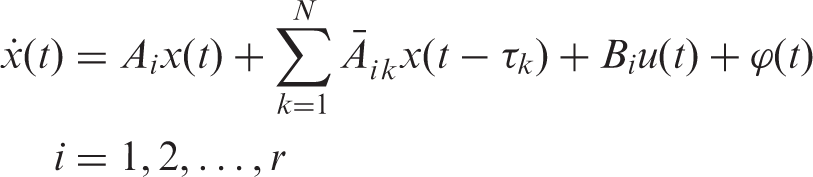
Consider a nonlinear system composed of N multiple time delays represented as follows:
(Khalil, 1992) The solutions for a dynamic system are said to be uniformly ultimately bounded (UUB) if there exist positive constants β and κ, and for every Definition 1

A nonlinear system is described using a set of fuzzy IF-THEN rules developed primarily from Takagi and Sugeno (1985). The T-S model consists of a set of IF-THEN rules. Each rule represents the local linear input-output relation of the nonlinear system, and has the following form:
IF
THEN
control input is
The premise components for the parallel distributed compensation (PDC) controller are the same as for the T-S model. The linear control rule i is derived based on equation (2) in the consequent component of the ith model rule.
IF
THEN


According to the above T-S fuzzy model and the PDC scheme, the model of a nonlinear system (1) can be represented by the following closed-loop controlled system:
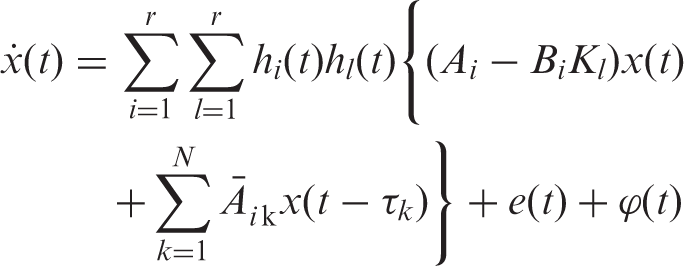
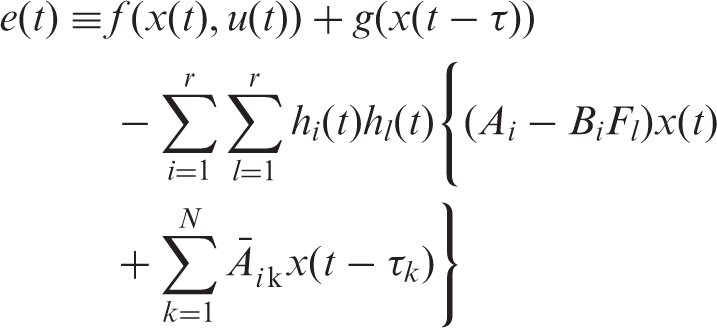

This means that the modeling error is bounded by the matrix H. The proof for equation (6) and the procedures for determining δ and H have been provided by Chen et al., (1999).
3. LMI conditions derived using the single Lyapunov function approach
In this section we derive the LMI conditions. The Lyapunov theory is used to verify the stability of the time-delay T-S fuzzy system. Consider an LMI
Before a typical stability condition for time-delay T-S fuzzy system (5) is proposed, some useful concepts are given. (Li and Souza, 1997) For any A, B (Wang et al., 1996) The equilibrium point of a closed-loop fuzzy system
(Hsiao et al., 2005) Consider the following Lemma 2 gives a sufficient condition for ensuring asymptotic stability of the closed-loop fuzzy system There exists a fuzzy Using the Lyapunov function candidate for the fuzzy system (5)
Lemma 1
Lemma 2
Lemma 3
Theorem 1
Proof of Theorem 1




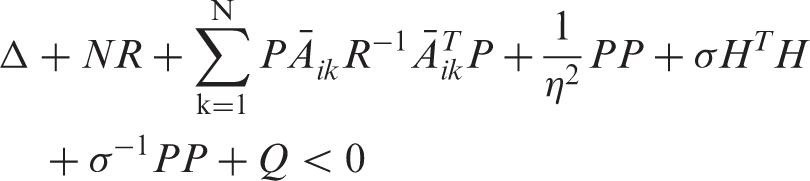



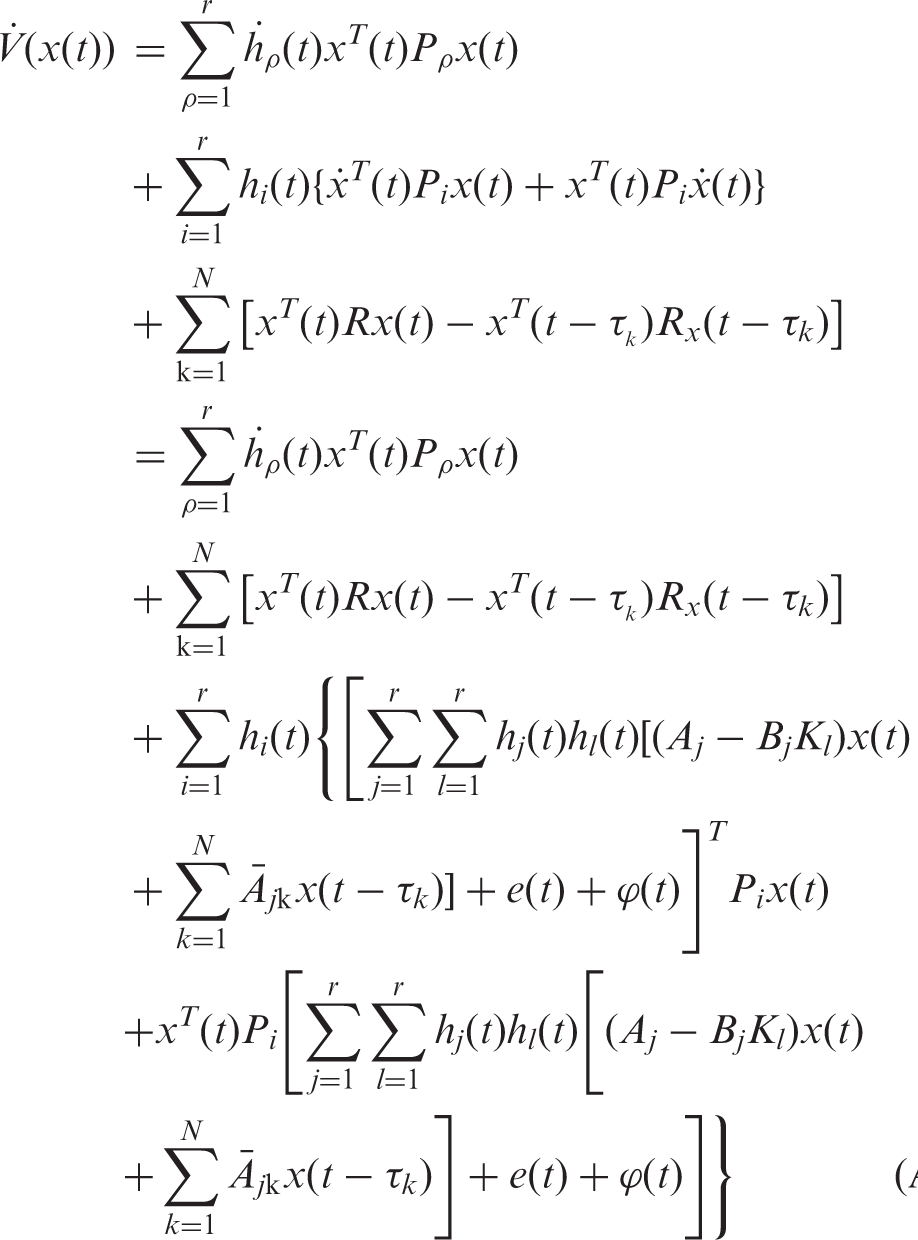
The time derivative of V is then evaluated to yield
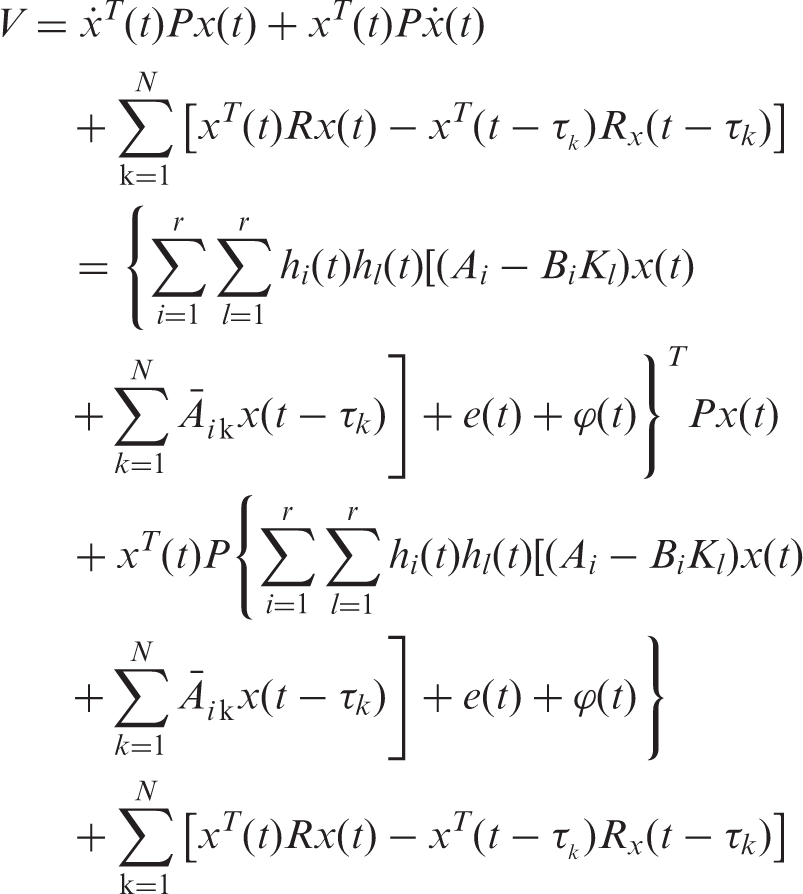
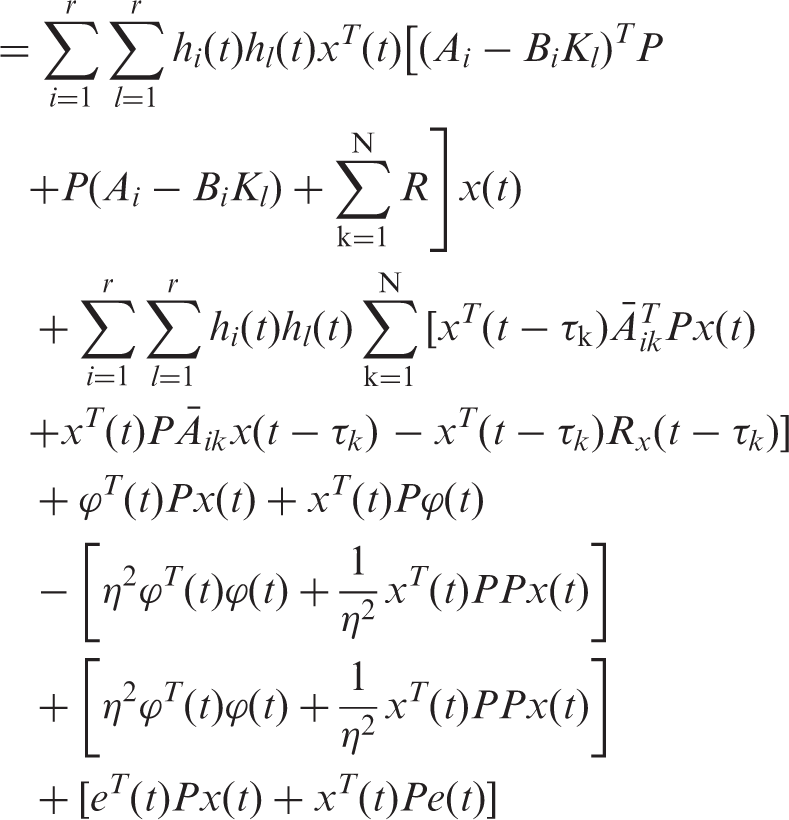
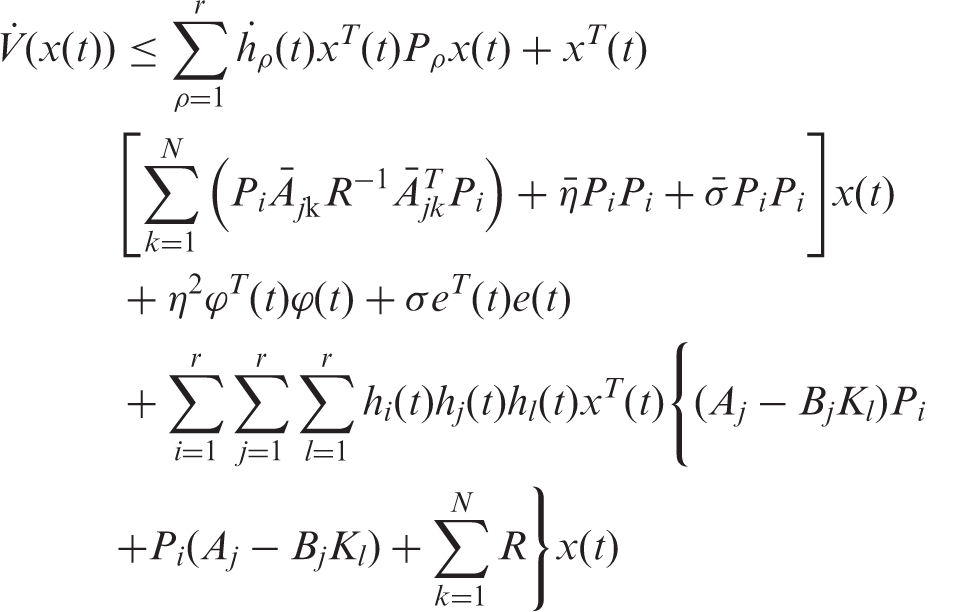
Based on Lemma1, we can obtain

Moreover, the following inequality can be derived


Therefore, equation (A3) becomes
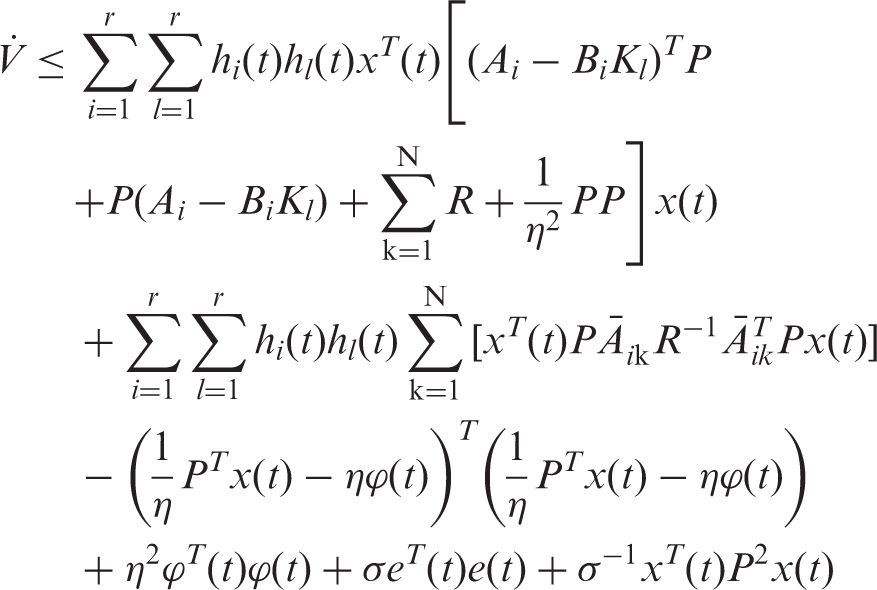
According to the assumption of equation (6) andnoting that
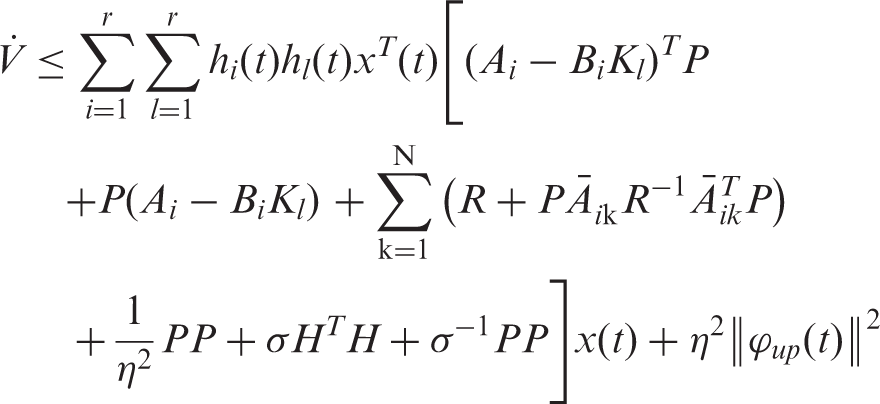
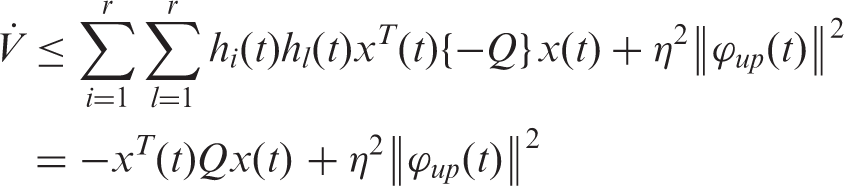
Integrating (A6) from

Equation (A7) is Lemma 3. Therefore, the Since condition (10) implies that condition (11) can be negative, i.e., Theorem 1 can be recast as an LMI problem if the following inequalities hold:new variables Remark 1
Remark 2
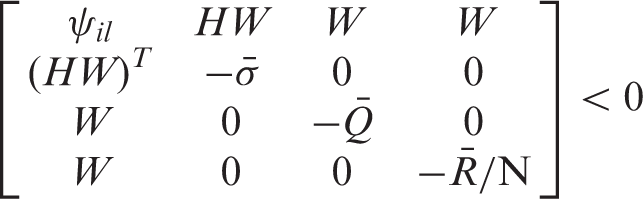
To avoid conservatism of stability and stabilization problems for time-delay T-S fuzzy systems subjected to disturbances, the fuzzy Lyapunov function approach is employed. More generalized criteria are derived, as described in the next section.
4. Fuzzy Lyapunov function approach
Definition 2
(Tanaka et al., 2001, 2003): Equation (13) is said to be a fuzzy Lyapunov function for the T-S fuzzy system if the time derivative of

where Pi is a positive definite matrix.
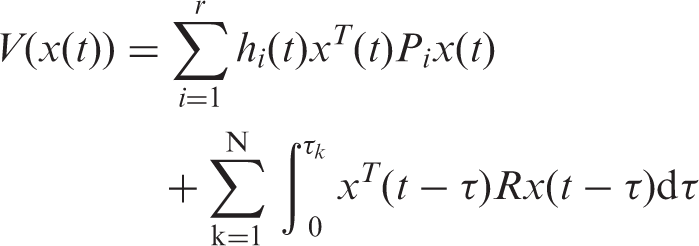
An upper bound of the time derivative, i.e., The fuzzy system (5) is stable in the large if there exist common positive definite matrices Consider the Lyapunov function candidate for the fuzzy system (9)
The time derivative of V is
Based on Lemma1, we can obtain
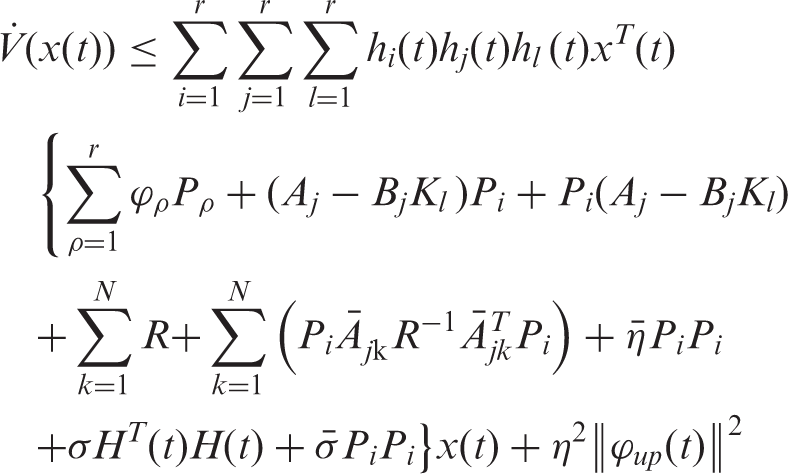
According to (A9) and Lemma 1, we get
According to the assumption of equation (6) and noting that Based on Theorem 2 and equations (A8) and (A11), the following inequality will be satisfied by integration:
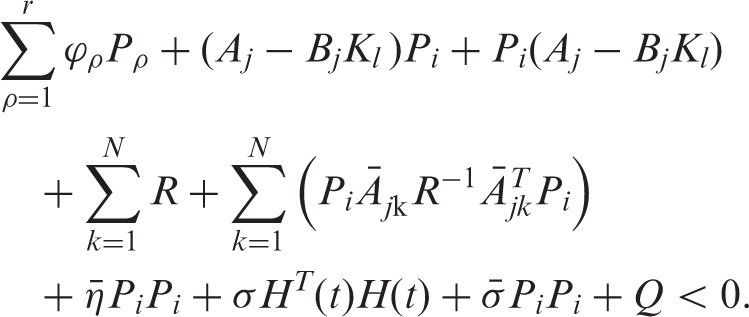
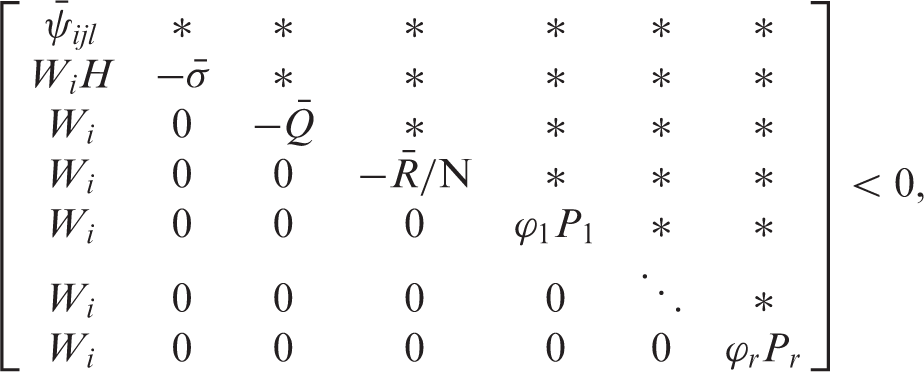
Equation (A12) is Lemma 3. Therefore, Theorem 2 can be reformulated into an LMI problem using the following procedure: We introduce the new variables Equation (14) can be rewritten as
Conditions (14–15) imply that conditions (10–12) are satisfied when the single Lyapunov function is considered. This means the stability criterion of Theorem 2 can be reduced to that of Theorem 1.Theorem 2
Proof of Theorem 2
Remark 3
Remark 4


4.1. Simulation example
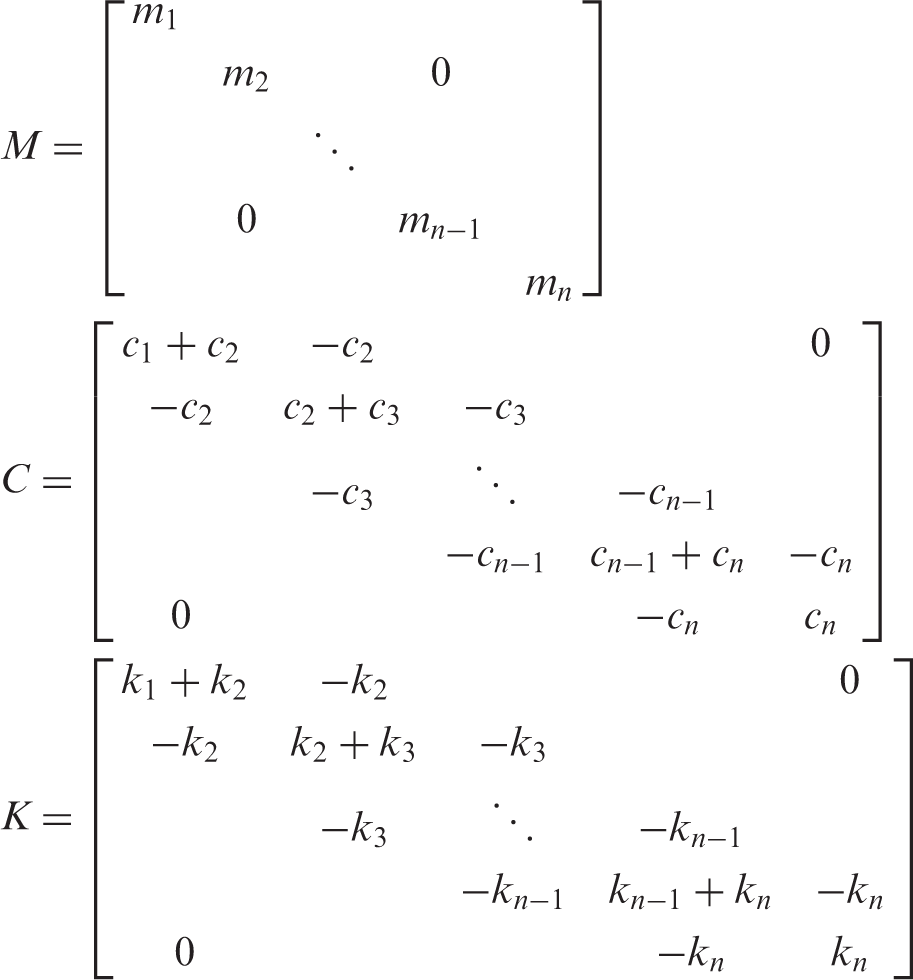
Assume that the motion equation for a shear type building modeled by an n-degrees-of-freedom system controlled by actuators and subjected to external force

The mass, stiffness and damping matrix can be expressed as
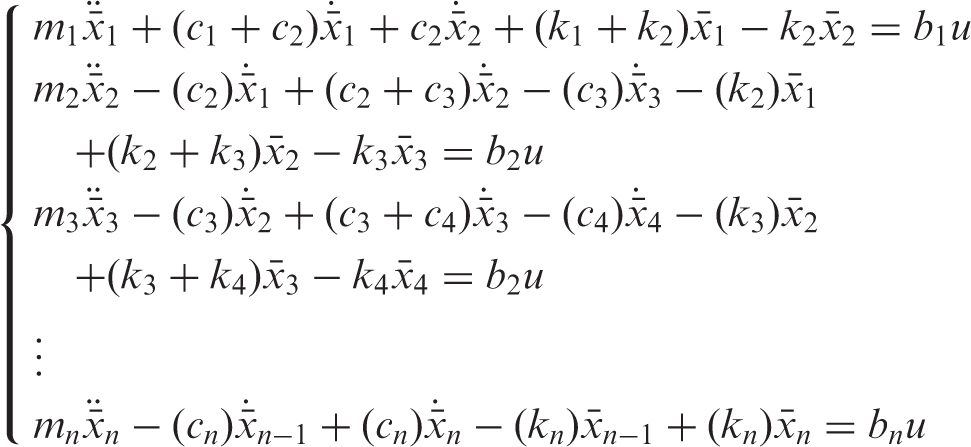
In order to represent the above motion equations without excitations, we rewrite equation (16) as
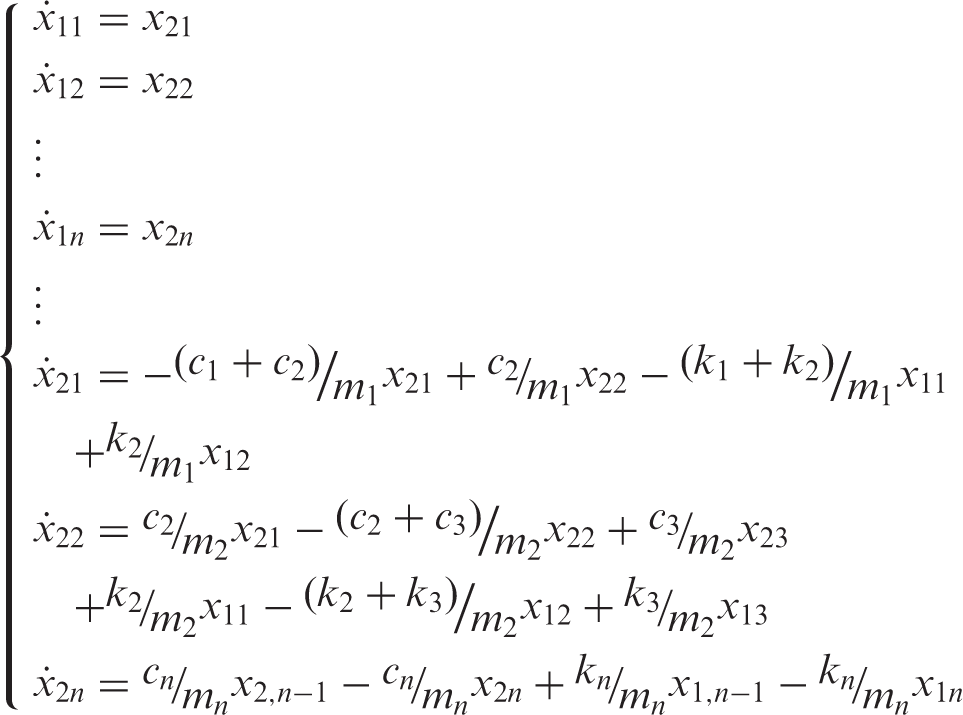
If
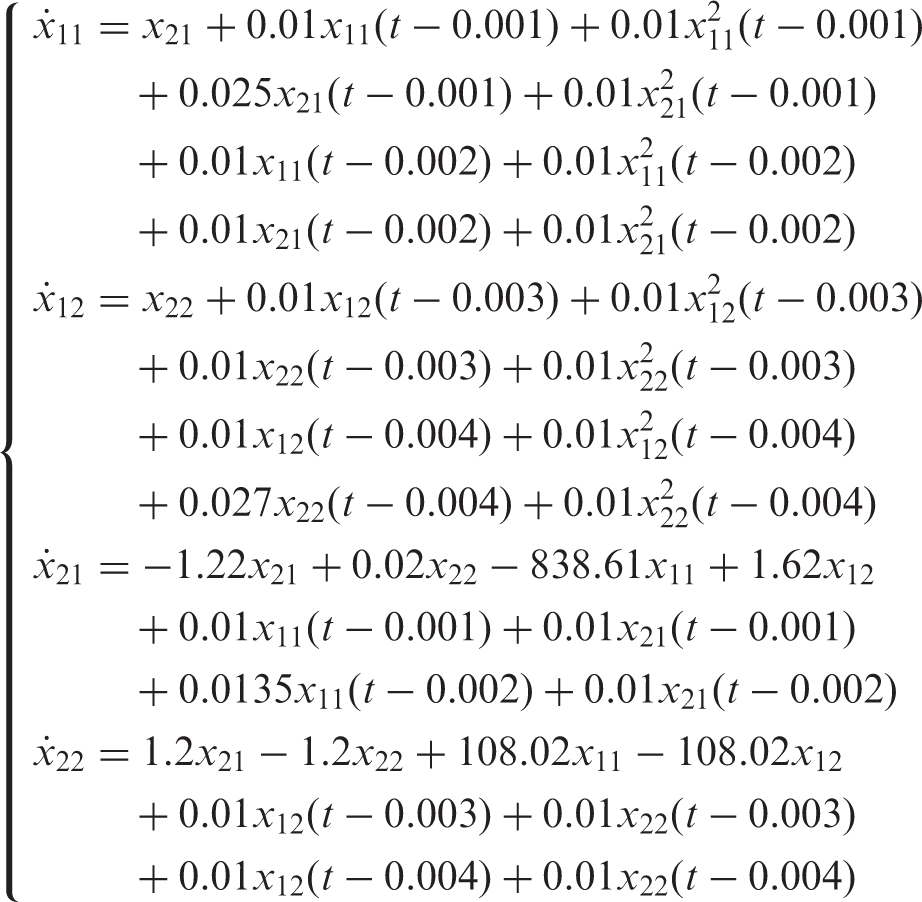
Consider a one-story building. The mass, stiffness and damping ratio of the floor are 345,600 kg, 3.1 The number of rules is minimized to decrease the design complexity. Hence, the nonlinear structural system can be represented by the following fuzzy rules: Rule 1: IF THEN
THEN
Figure 1 illustrates the membership functions for Rule 1 and Rule 2.
Membership function of the structural system: A T-S fuzzy controller is designed based on the PDC scheme. The same fuzzy sets are used for the fuzzy controller as for the fuzzy model in the premise parts. To guarantee H infinity control performance, optimal values should be suitably selected for Step 1

Step 2


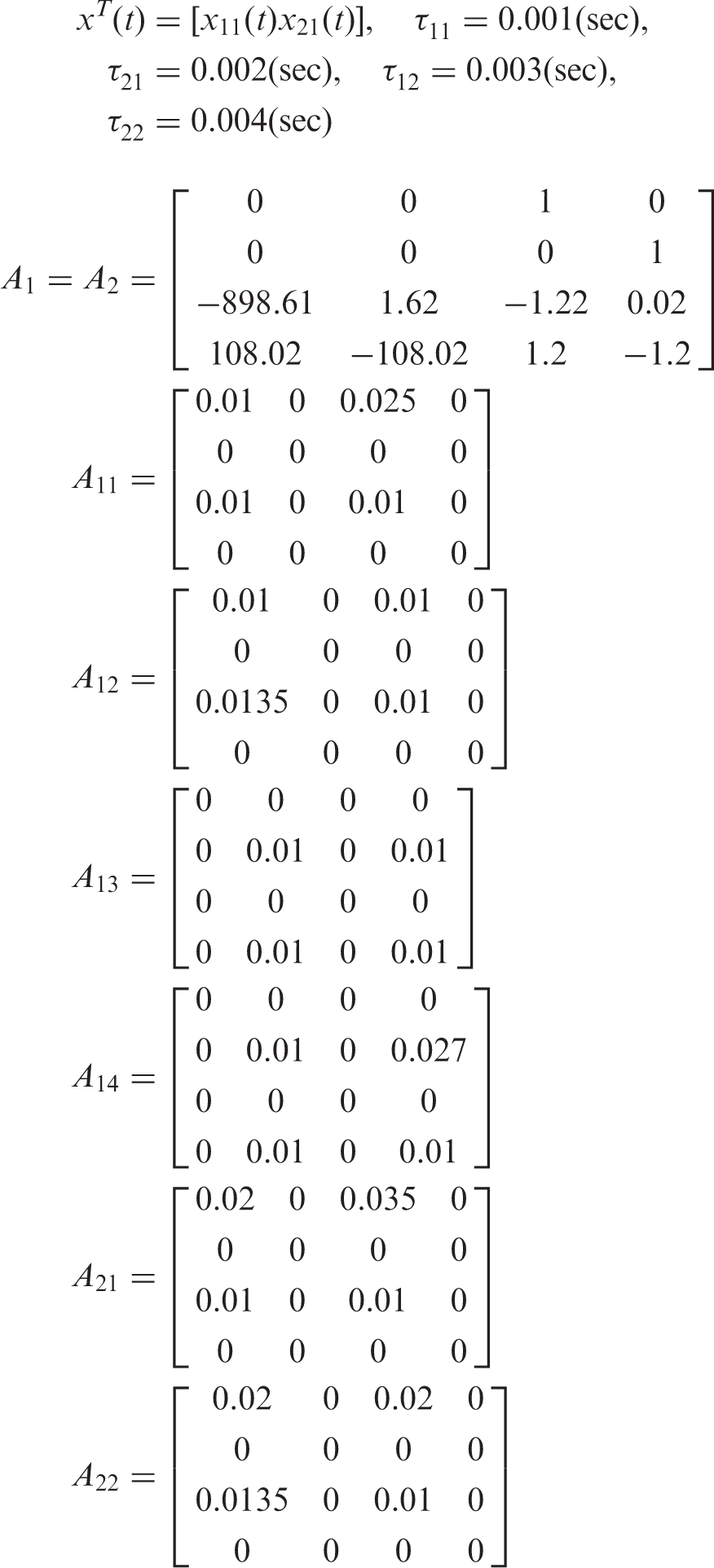
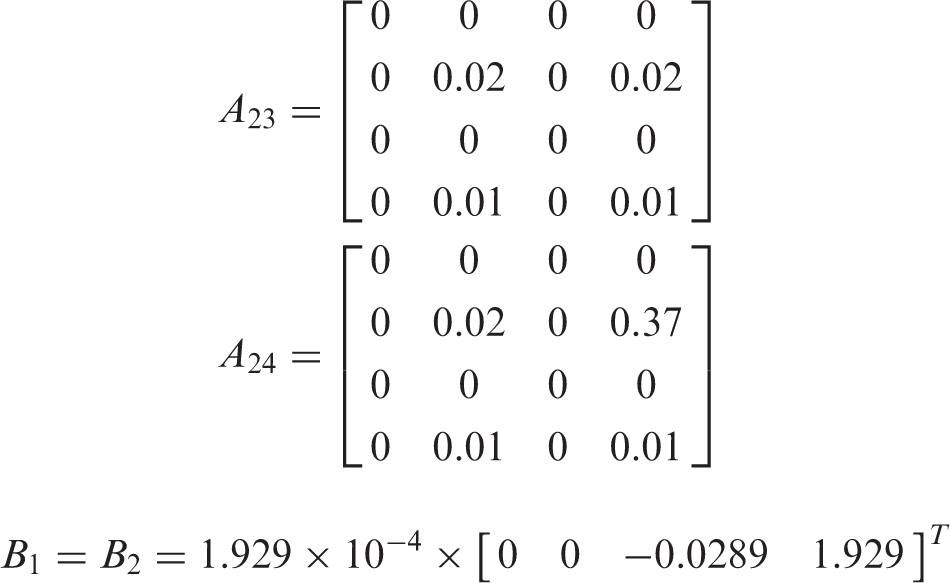
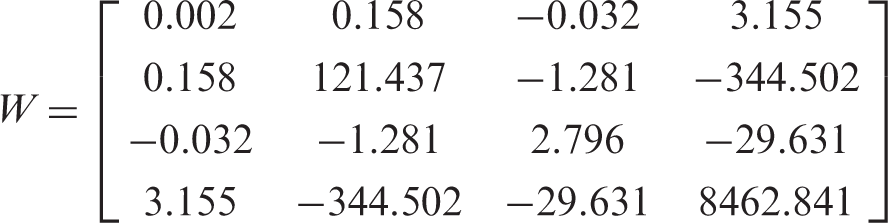
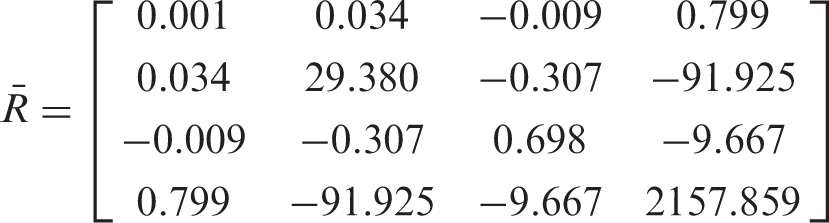
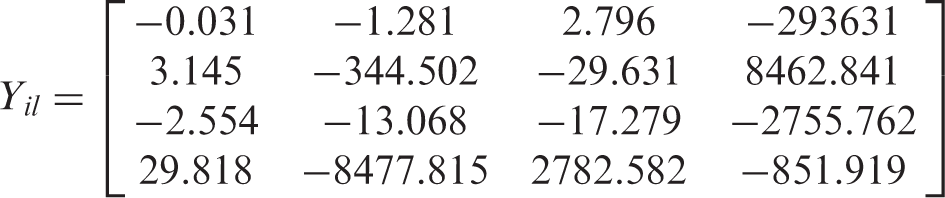
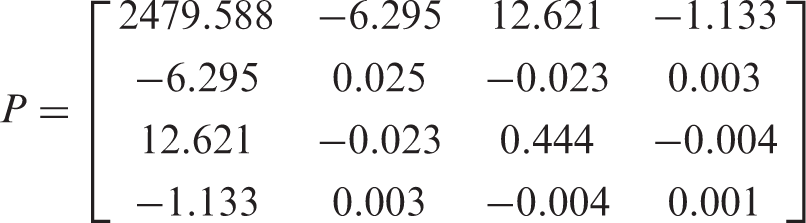
Following the transformation, we obtain a positive definite matrix P(
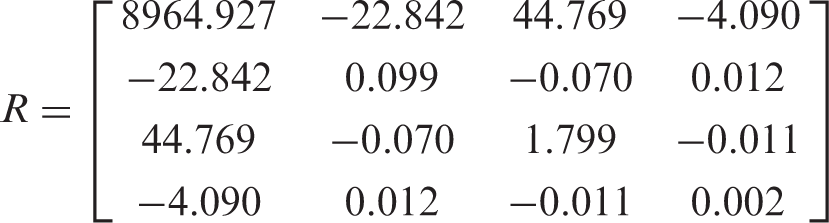
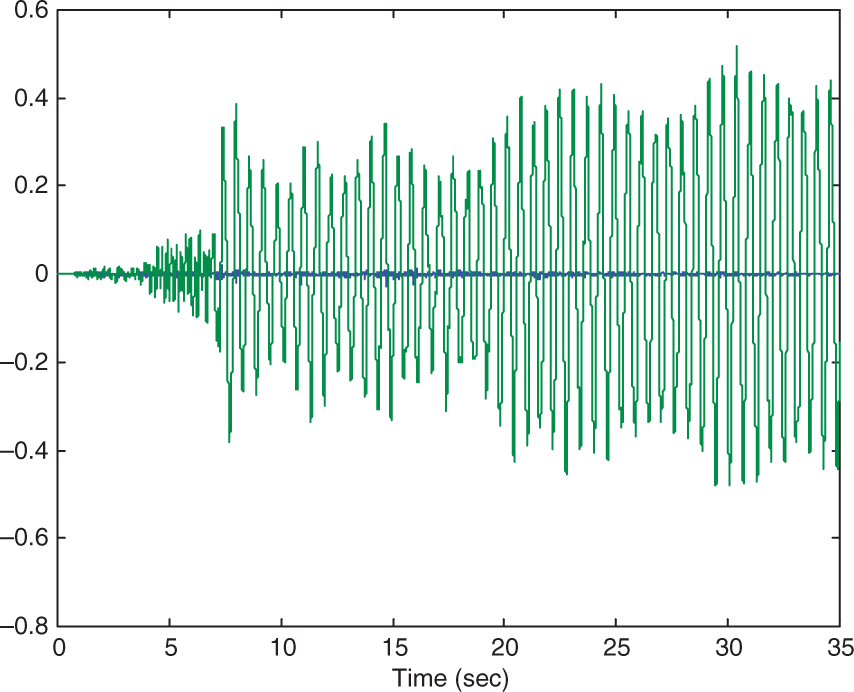
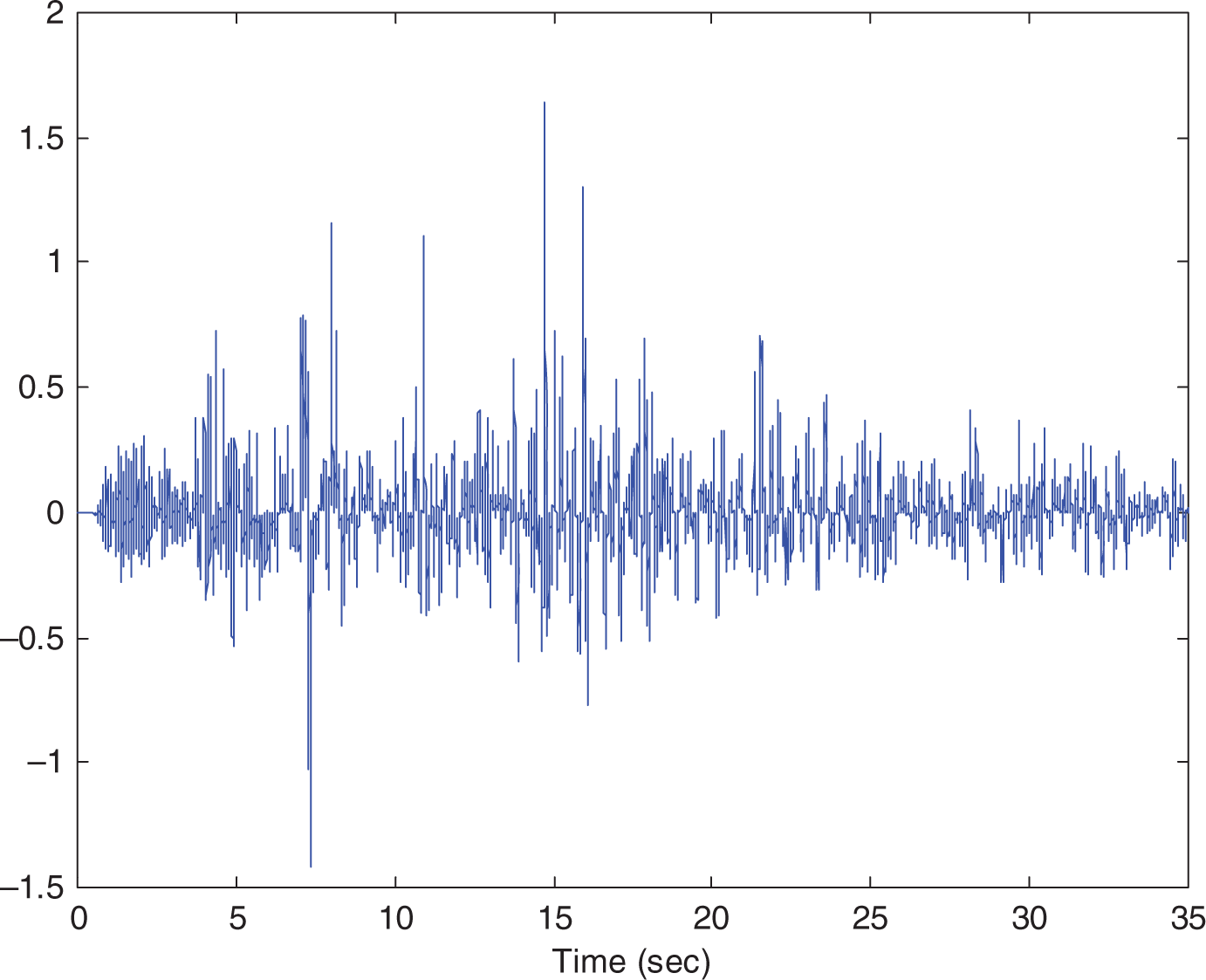
Therefore, according to Theorem 1, the structural system with the TMD equipped subjected to an earthquake is guaranteed to be UUB stabilized. Figures 2–3 indicate that the UUB stability of the primary structural system and tuned mass damper are ensured. This happens because the responses are appropriately controlled under earthquake excitation. Figure 4 displays the time histories of the response quantities of the control force.
Time histories of response quantities in the primary structure with T-S fuzzy control. Time histories of response quantities in the tuned mass damper with T-S fuzzy control. Time histories of control force response quantities.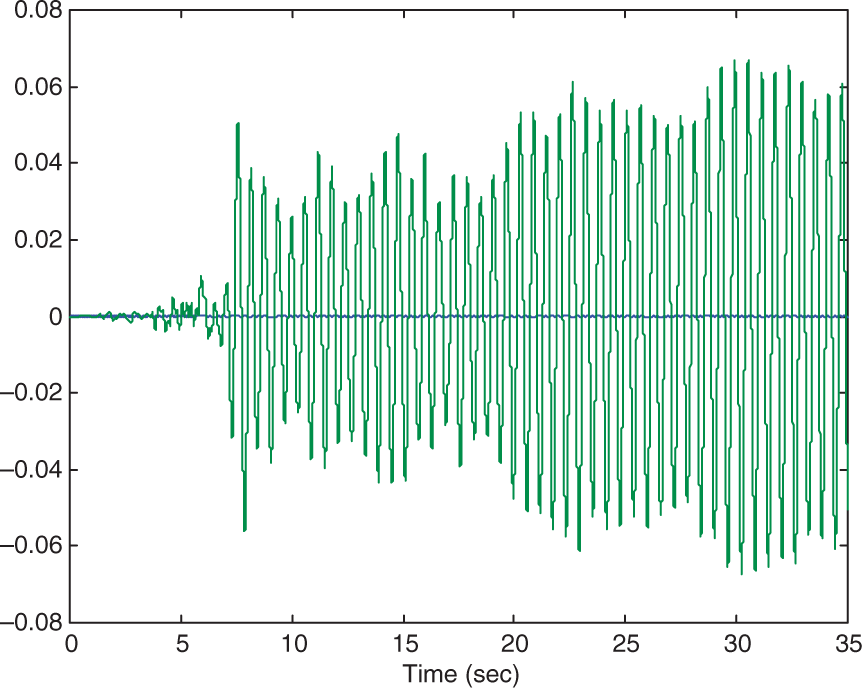
5. Conclusions
Recently, soft computing and artificial intelligence have been successfully applied to nonlinear systems, such as robot manipulation, engineering application and construction managements (Hsiao et al., 2005a,b,c,d,e; Chen et al., 2005a,b, 2006a,b,c, 2007a,b,c,d,e,f, 2008a,b,c,d,e, 2009a, b,c,d,e,f, 2010a,b,c,d,e,f,g,h, 2011a,b,c,d,e,f,g,h, 2012a,b,c,d; Chen, 2006, 2009a,b, 2010a,b, 2011a,b,c,d,e,f,g,h,i, 2012a,b,c; Hsieh et al., 2006; Tsai et al., 2008; Yang et al., 2008a,b; Yeh et al., 2008, 2012; Almutairi and Zribi, 2009; Amini and Vahdani, 2009; Lin et al., 2009a,b, 2010c, 2011a,b; Guclu and Metin, 2009; Lin and Chao, 2009; Omurlu et al., 2009; Tu et al., 2009; Tusset et al., 2009; Zhao et al., 2009; Lin and Chen, 2010; Chen and Chen, 2010a,b; Chen and Saif, 2010; Lee et al., 2010a,b, 2011a,b,c; Li et al., 2010; Solihin et al., 2010; Chiang et al., 2010; Shih et al., 2010a,b,c, d; Chiang and Wang, 2011; Cheng et al., 2011; Chu et al., 2011; Chiou et al., 2011; Shih et al., 2011a,b,c,d; Chen and Huang, 2011; Kuo et al., 2011; Kuo and Chen, 2011; Lin and Chen, 2011; Liu et al., 2011a,b; Jayaswal et al., 2011; Marichal et al., 2011; Metin and Guclu, 2011; Soundarrajan and Sumathi, 2011; Shen et al., 2011; Tang et al., 2011; Tsai and Chen, 2011a,b; Yu et al., 2011a,b; Kuo and Chen, 2012a,b; Lee and Chen, 2012; Lin et al., 2012a,b; Lin and Chen, 2012; Liu et al., 2012a,b; Su et al., 2012; Tseng and Chen, 2012; Tseng et al., 2012a,b,c
Footnotes
♣
Acknowledgements
Grateful thanks to our funding bodies, to Professor Ali Nayfeh, editor of JVC and for constructive suggestions from the anonymous reviewers, all of which have led to the making of several corrections that have greatly aided the presentation of this paper.
Funding
This work was supported by the National Science Council of the Republic of China, Taiwan (grant nos. NSC98-2221-E 366-006-MY2, NSC 100-2221-E-022-013-MY2, and NSC 100-2628-E-022-002-MY2).