







Abstract
In the present work, the effects of initial stress, magnetic field and non-homogeneity on wave propagation of free harmonic waves in isotropic material are discussed. The one-dimensional equation of elastodynamic is solved in terms of radial displacement and different cases of the boundary conditions for the hollow cylinder are considered. The determination is concerned with the eigenvalues of the natural frequencies of the radial vibrations for different boundary conditions in the case of harmonic vibrations. Numerical results are given and illustrated graphically for each case considered. Comparisons are made with the results in the absence of initial stress, magnetic field and non-homogeneity.
1. Introduction
Increased interest in magneto-elasticity during recent years can be attributed to the fact that the study of magneto-mechanical behavior in smart structures. The analysis of dynamic problems of elastic bodies is an important and interesting research field for engineers and scientists. The interaction among magnetic and mechanical fields in a hollow cylinder is usually encountered in space shuttles, supersonic airplanes, rockets, missiles, bridges, cars, planes, plasma physics and the corresponding measurement techniques of magneto-elasticity. Ahmed and Abo-Dahab (2010) investigated the propagation of Love waves in an orthotropic granular layer under initial stress overlying a semi-infinite granular medium. Abo-Dahab and Mohamed (2010) studied the influence of magnetic field and hydrostatic initial Stress on wave reflection from a generalized thermoelastic solid half-space. Abd-Alla and Abo-Dahab (2012a) have investigated the radial deformation and the corresponding stresses in a homogeneous annular fin for an isotropic material. Marin (1998, 2010) studied harmonic vibrations in thermoelasticity of microstretch materials, a new approach of uniqueness in elastodynamics. Abd-Alla and Mahmoud (2010b) investigated magneto-thermoelastic problem in rotating non-homogeneous orthotropic hollow cylindrical under the hyperbolic heat conduction model and the effect of the rotation on propagation of thermoelastic waves in a non-homogeneous infinite cylinder of isotropic material.
Hou et al. (2006) obtained the transient responses of a special non-homogeneous magneto-electro-elastic hollow cylinder for an axisymmetric plane strain problem. Abd-All et al. (2011c) studied the effect of rotation on the radial vibrations in a non-homogeneous orthotropic hollow cylinder. Most works for magneto-electro-elastic composites are focused on the optimization of material properties (Huang et al., 2000). For static problems, Wang and Shen (2002) obtained the general solution of three-dimensional problems in transversely isotropic magneto-electro-elastic media and further derived the fundamental solution for dislocation and Green’s functions in halfspace. In addition, Wang and Shen (2003) studied the two-dimensional problem of inclusions of arbitrary shape in magneto-electro-elastic composites. Liu et al. (2001) obtained the Green’s functions for an infinite two-dimensional anisotropic magneto-electro-elastic medium containing an elliptical cavity. Mahmoud (2010) investigated wave propagation in cylindrical poroelastic dry bones and the effect of the non-homogeneity on wave propagation on orthotropic elastic media. Marin (2010) investigated harmonic vibrations in thermoelasticity of microstretch materials. Some problems of the three-dimensional elastic theory for the axisymmetric free vibrations of hollow circular cylinders were studied and analyzed by Hutchinson and El-Azhary (1986). Abd-Alla and Farhan (2008) investigated the effect of the non-homogeneity on the composite infinite cylinder of orthotropic materials. Wang and Shen (2003) studied the two-dimensional problem of inclusions of arbitrary shape in magneto-electro-elastic composites. Pan (2001) derived the exact solutions for three-dimensional, anisotropic, magneto-electro-elastic, simply supported and multilayered rectangular plates under static loadings. For dynamic problems Pan and Heyliger (2002) studied the free vibrations of simply supported and multilayered rectangular plates and derived the analytical solutions.
Chen et al. (2004, 2005) investigated the free vibration and general solution of non-homogeneous transversely isotropic magneto-electro-elastic hollow cylinders. Sharma and Kumar (2004) investigated asymptotic of wave motion in transversely isotropic plates. Toudeshky et al. (2009) studied sound transmission into a thick hollow cylinder with the fixed end boundary condition. Buchanan (2003) investigated free vibration of an infinite magneto-electro-elastic cylinder. Recently, Abd-Alla, et al. (2011a) studied effect of magnetic field and non-homogeneous in various elastic media. Due to the axis-symmetry of the problem, the sole radial component, u, of the displacement field different from zero is assumed. This assumption obviously produces the radial and hoop stresses in equations, but the not vanishing normal stresses in z-direction are instead neglected, as well as the corresponding boundary conditions (axial forces in z-direction, the general axis-symmetrical (Love) function as displacement potential is not considered. Ding et al. (2003) and Hou et al. (2003) obtained the analytical solution for the axisymmetric plane strain electroelastic dynamics of a non-homogeneous piezoelectric hollow cylinder. Hou and Leung (2004) further study the corresponding problem of magneto-electro-elastic hollow cylinders. Mahmoud (2012) studied the influence of rotation and generalized magneto-thermoelastic on Rayleigh waves in a granular medium under effect of initial stress and gravity field. Abd-Alla and Mahmoud (2012) obtained the analytical solution of wave propagation in non-homogeneous orthotropic rotating elastic media. Abd-Alla et al. (2012b) investigated the effect of the rotation, magnetic field and initial stress on peristaltic motion of micropolar fluid.
The aim of this paper, is to determine the eigenvalues for radial vibrations of a cylindrical region hollow of radius a, b with different boundary conditions (free-fixed-mixed) under the effects of initial stress, magnetic field and non-homogeneity. The equation of elastodynamic media is solved in the uncoupled form and in terms of displacement potentials. The variation of stresses and displacement for different cases are obtained and illustrated graphically. Also, the numerical results of the dimensionless frequency equation are discussed in detail for radially-inhomogenous material by figures.
2. Formulation of the problem
The cylindrical coordinates
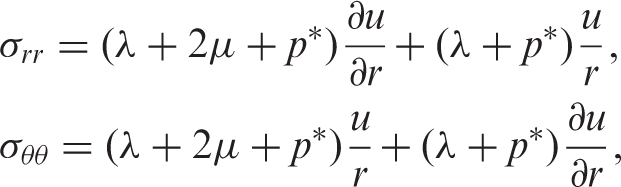

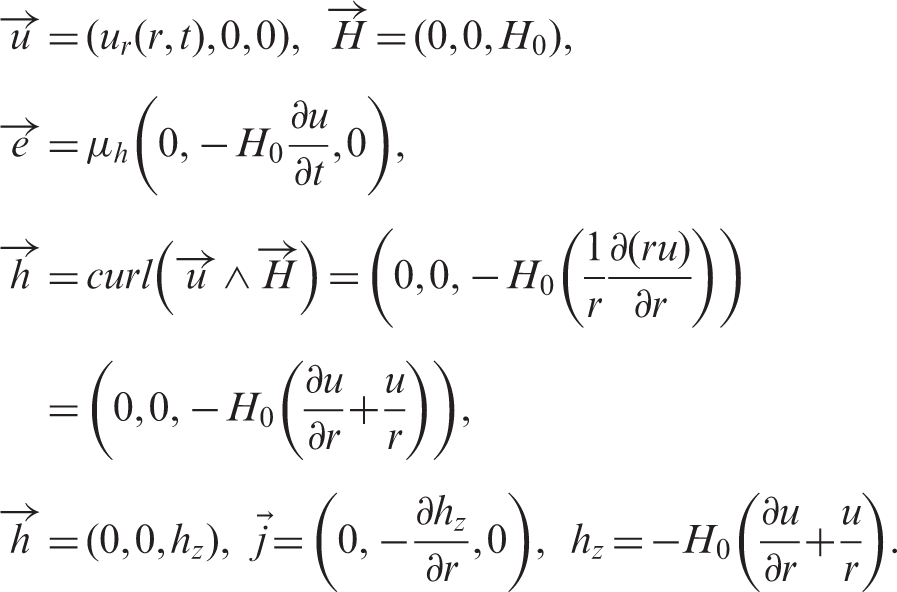
The magneto-elastic dynamic equation of a radially-inhomogenous isotropic hollow cylinder is:

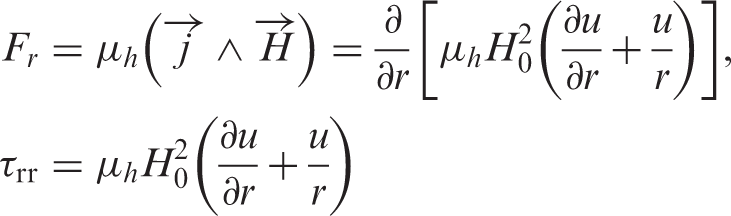
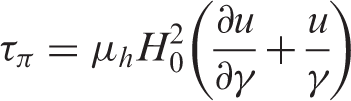
In the above formula, the non-homogeneity of material constants are characterized by a special law Lekhnitskii (1981) and Sadd (2009) as follows:

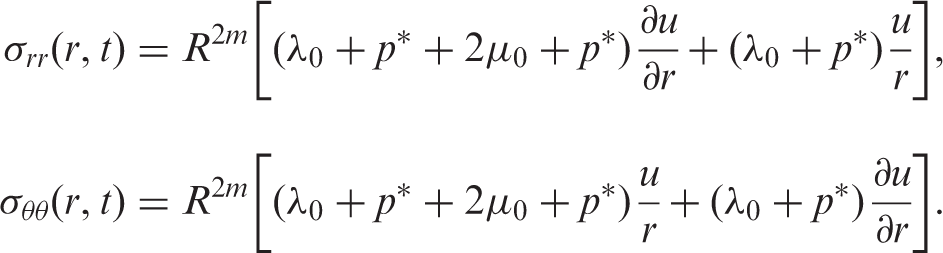
Dimensionless of variables in equations (8) is taken as:
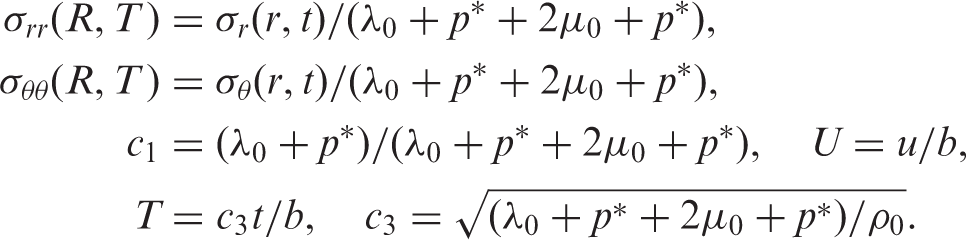
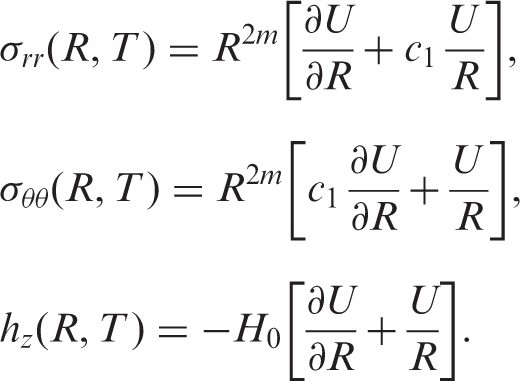
Substituting equation (9) into equations (8) and (3) respectively, yield:
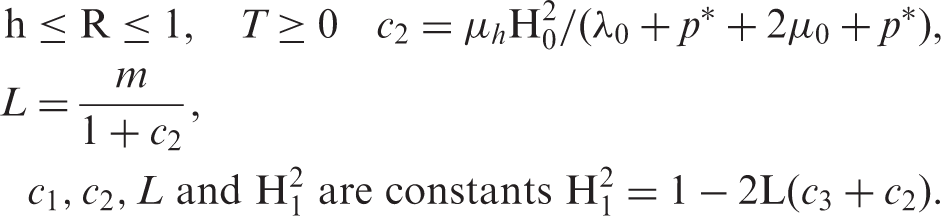
Substituting equations (10) into equation (4), the dimensionless magneto-elastic dynamic equation of the radially-inhomogenous cylinder becomes:
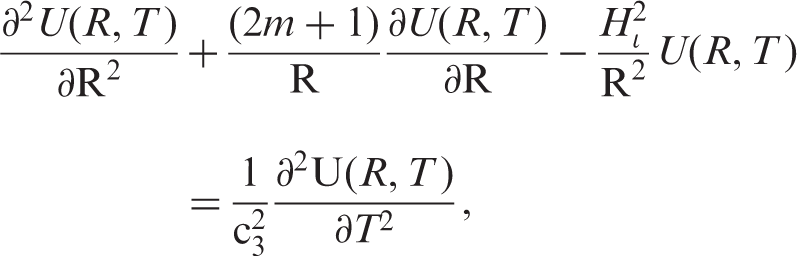
Where
3. Solution of the problem
To determine the angular frequency for radial vibrations for cylindrical region hollow of radius a, b with different boundary conditions,

Then equation (11) becomes:

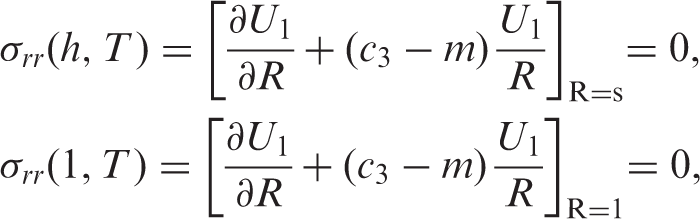
Also, the boundary conditions become:

Putting

Substituting from (16) into equation (13) there follows:

Then equation (17) can be written in the form:



Substituting from (20) into (12), the complete solution of equation (11) is:

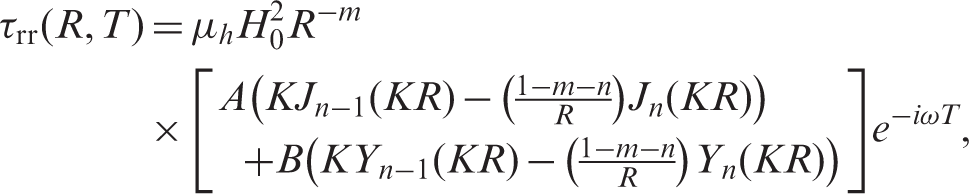
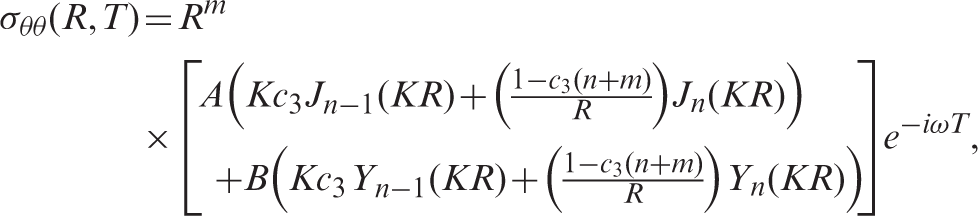
The corresponding stresses in a radially-inhomogenous isotropic case are:



Then from equation (21), (22) and (25) there follows:
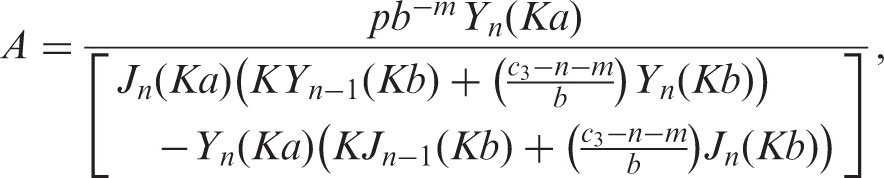
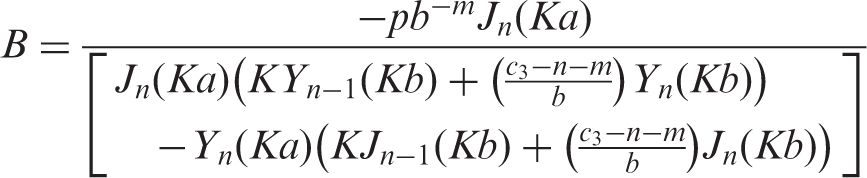
Substituting from (26) into (21) then there is:
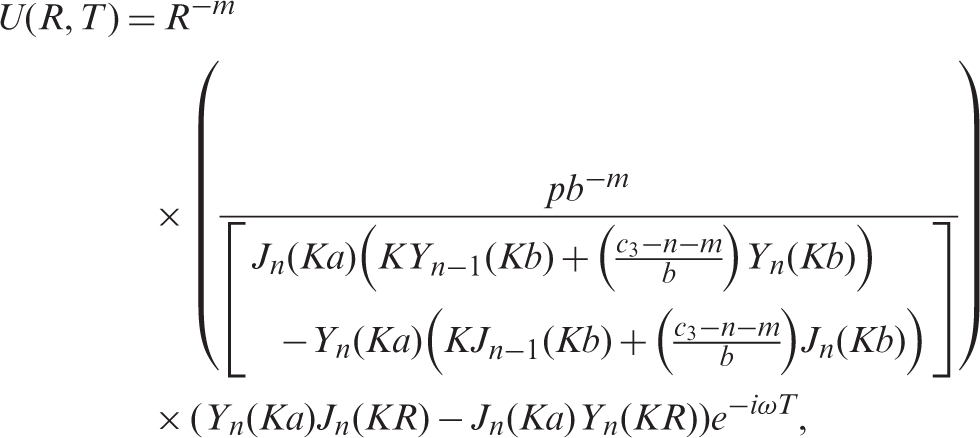
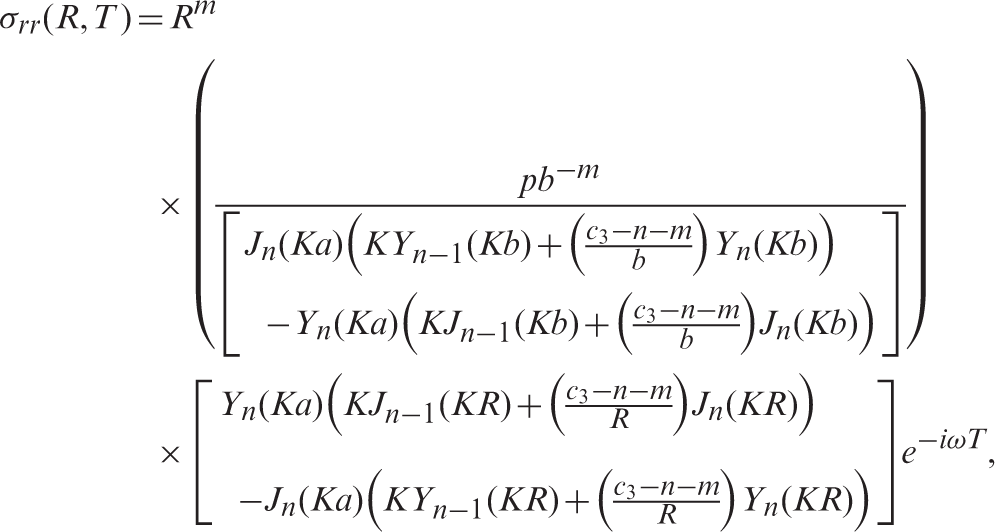
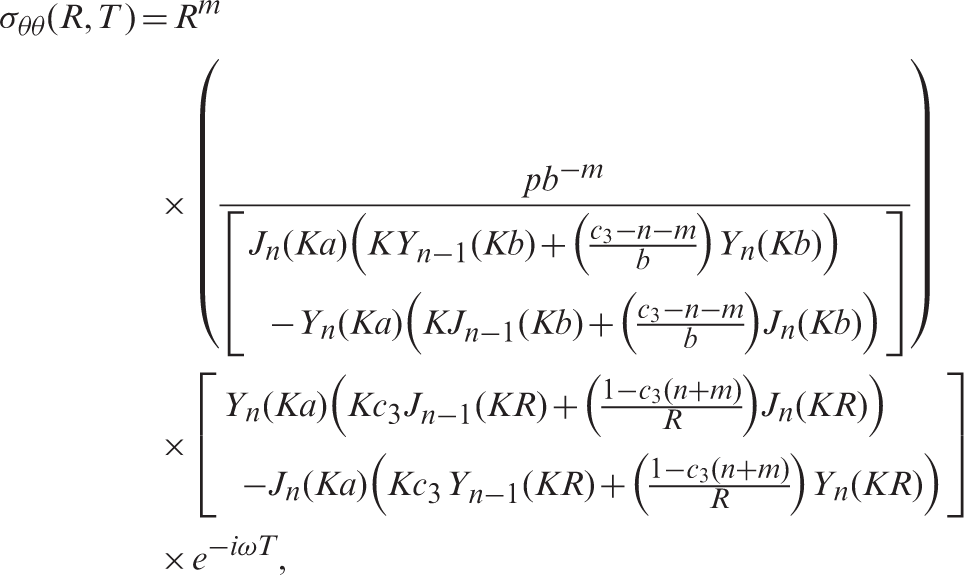
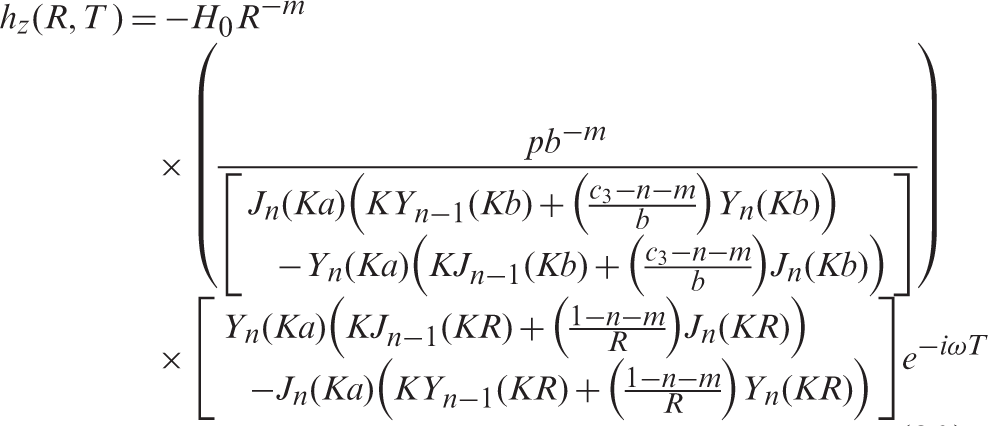
The different cases of the boundary conditions for the hollow cylinder are described.
4. Hollow cylinder
In the following, the different cases of the boundary conditions for the hollow cylinder are applied. The definitions of
4.1. Free surface traction
In this case, the dimensionless frequency equation is to be obtained for the boundary conditions which specify that the free inner and outer surfaces of the hollow cylinder are free traction from stresses:

The following transformations are considered:

To make all the quantities dimensionless in equations (32), where wdenotes the non-dimensional frequency. From equations (21), (31) and (32) are obtained:
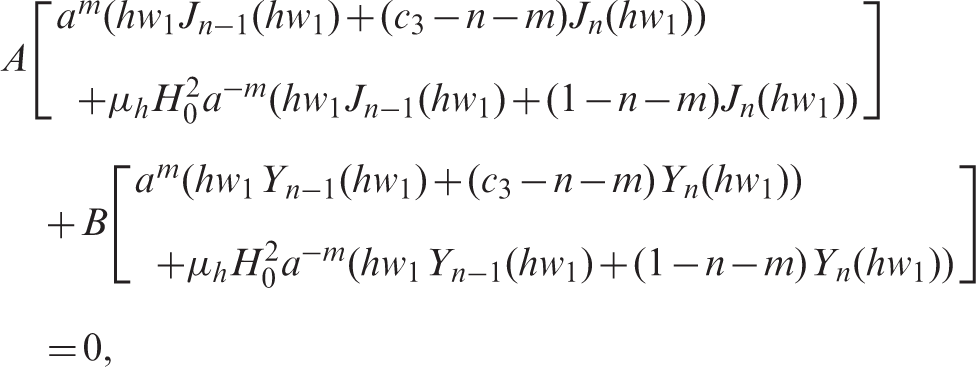
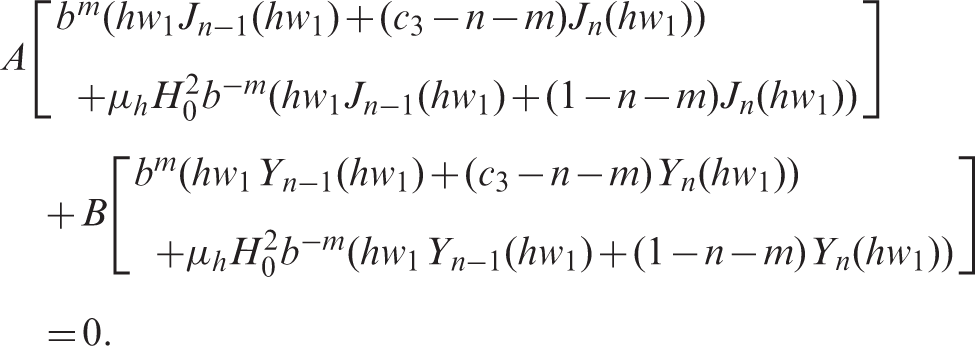
From which the frequency equation isdeduced:


4.2. Fixed surface
In this case, the dimensionless frequency equation is to be obtained for the boundary conditions which specify that the fixed inner and outer surfaces of the hollow cylinder are fixed from displacements.
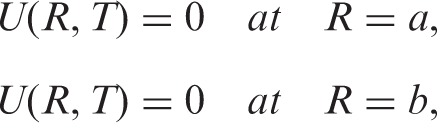
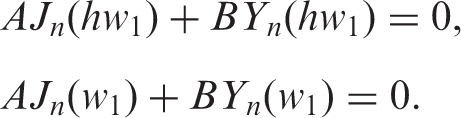
From which the dimensionless frequency equation is deduced in the form:
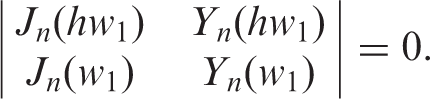
Then

4.3. Inner fixed surface and outer free surface
In this case, the dimensionless frequency equation is to be obtained for the boundary conditions which specify that the inner fixed surface and outer free surface of the hollow cylinder are fixed and free from displacement and stress respectively.

From (21), (22), (32) and (40), there follows:

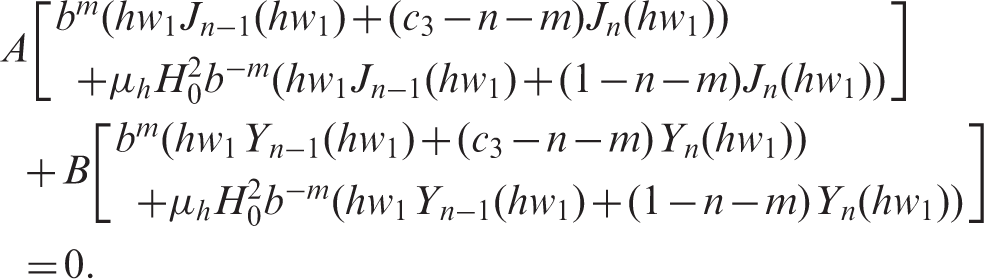
From which is deduced the dimensionless frequency equation in the form


5. The numerical results and discussion
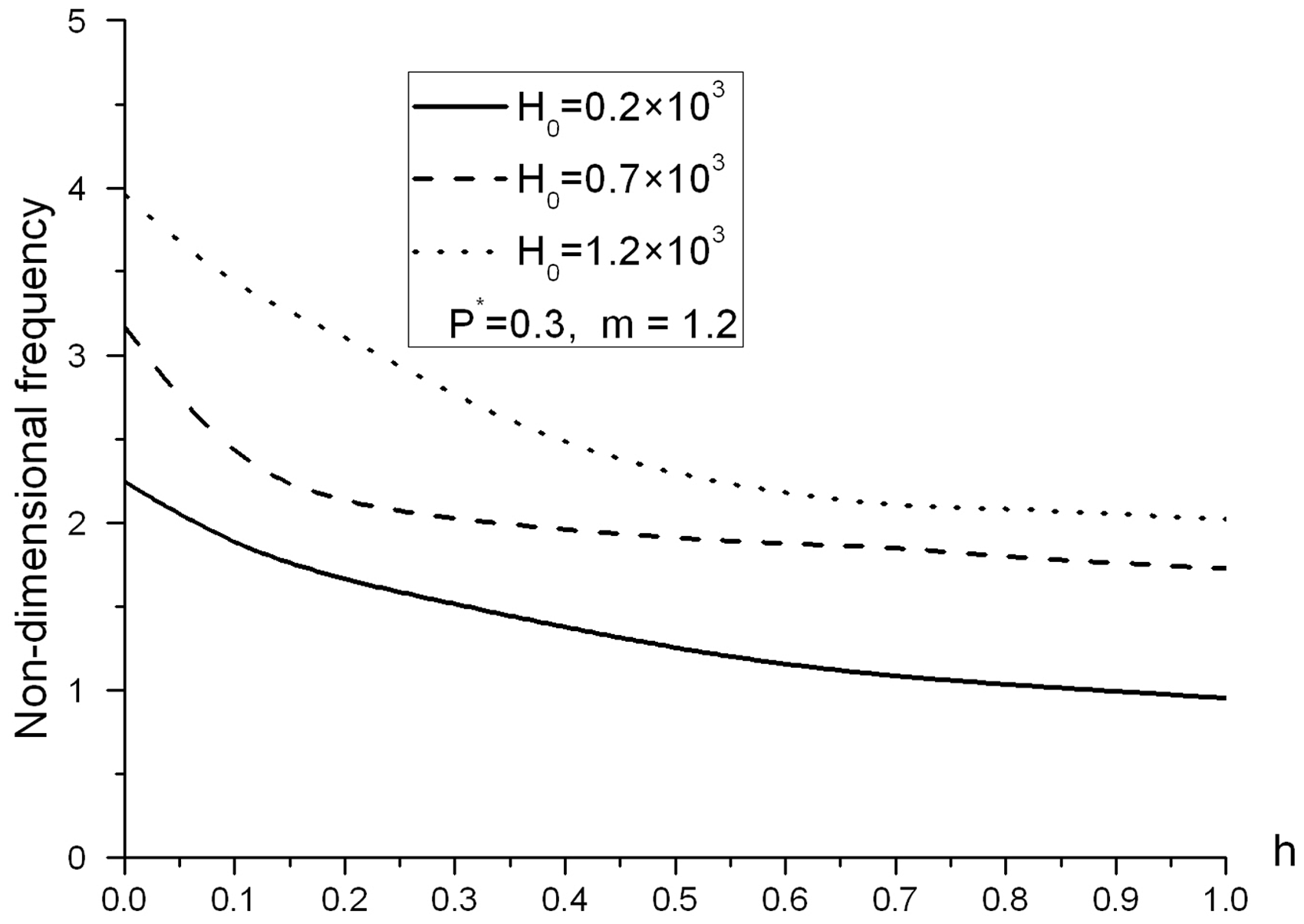
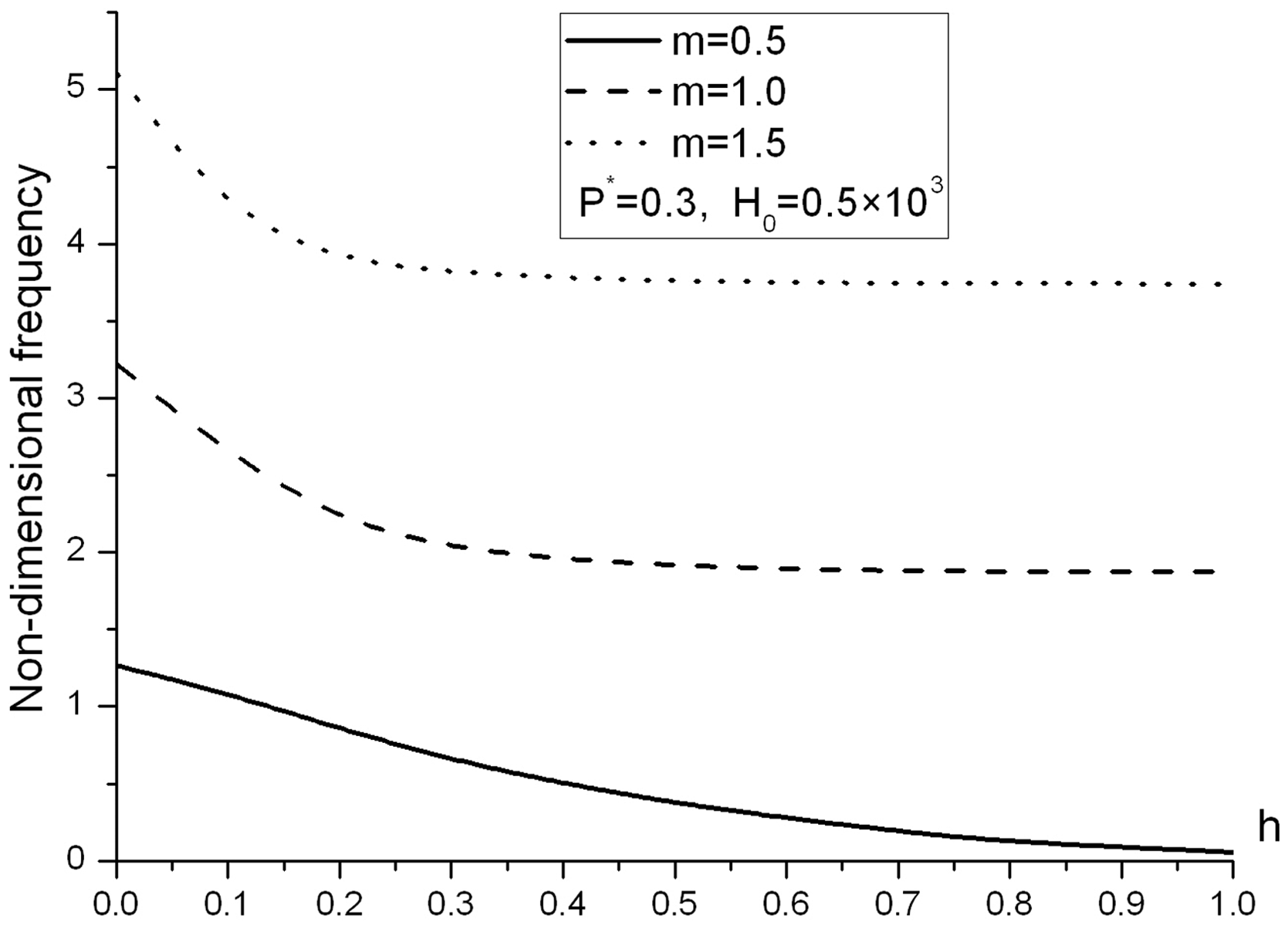
Here, the natural frequencies of the problem considered are obtained by solving the frequency equations numerically. Since these equations are an implicit functional relation of w1 and h it follows to find the variation of natural frequency with aspect ratio h. A Fortran program to evaluate the roots w of the above equations versus different values of h for the first mode was made. The following iterative procedure has been adopted for numerical computations. For a fixed value of h, the determinantal equations are evaluated for various values of the unknown quantity w commencing with the initial value near zero and each time adding a fixed but small increment to that unknown quantity until the value of the determinant changes its signs. Then the half-interval method (Chapra, 2004; Abd-Alla et al., 2010) is applied to locate the root correct to a chosen number of decimal places. With this root as the initial value, the procedure is repeated to find the next root, etc. For a given geometry and elastic constants, the dimensionless frequency equation is essentially an implicit transcendental function for the non-dimensional frequency parameter w. Thus, for a fixed values of h, the dimensionless frequency equation for different cases (free-fixed-mixed) is a function of w only. Values of w were chosen as
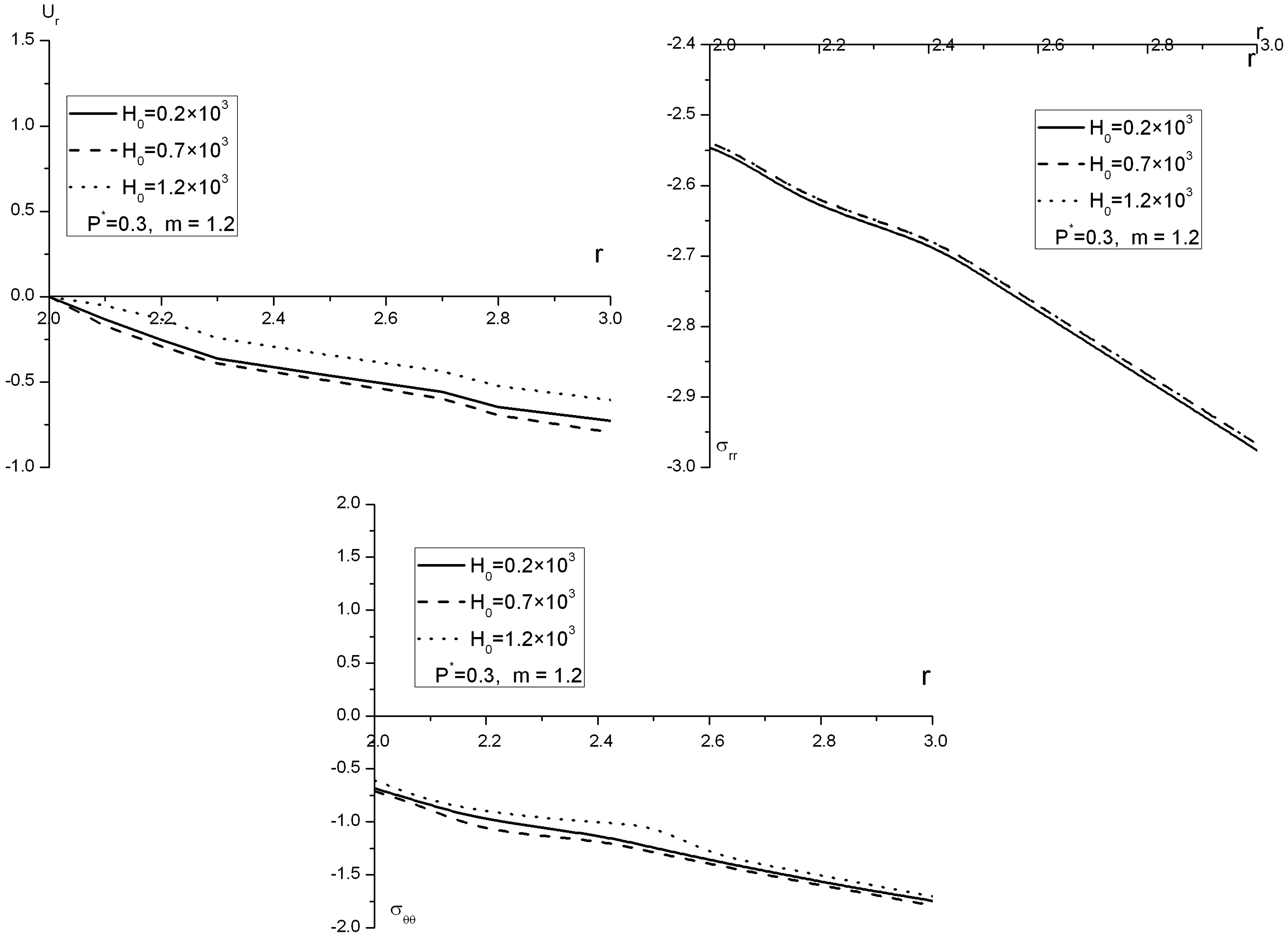
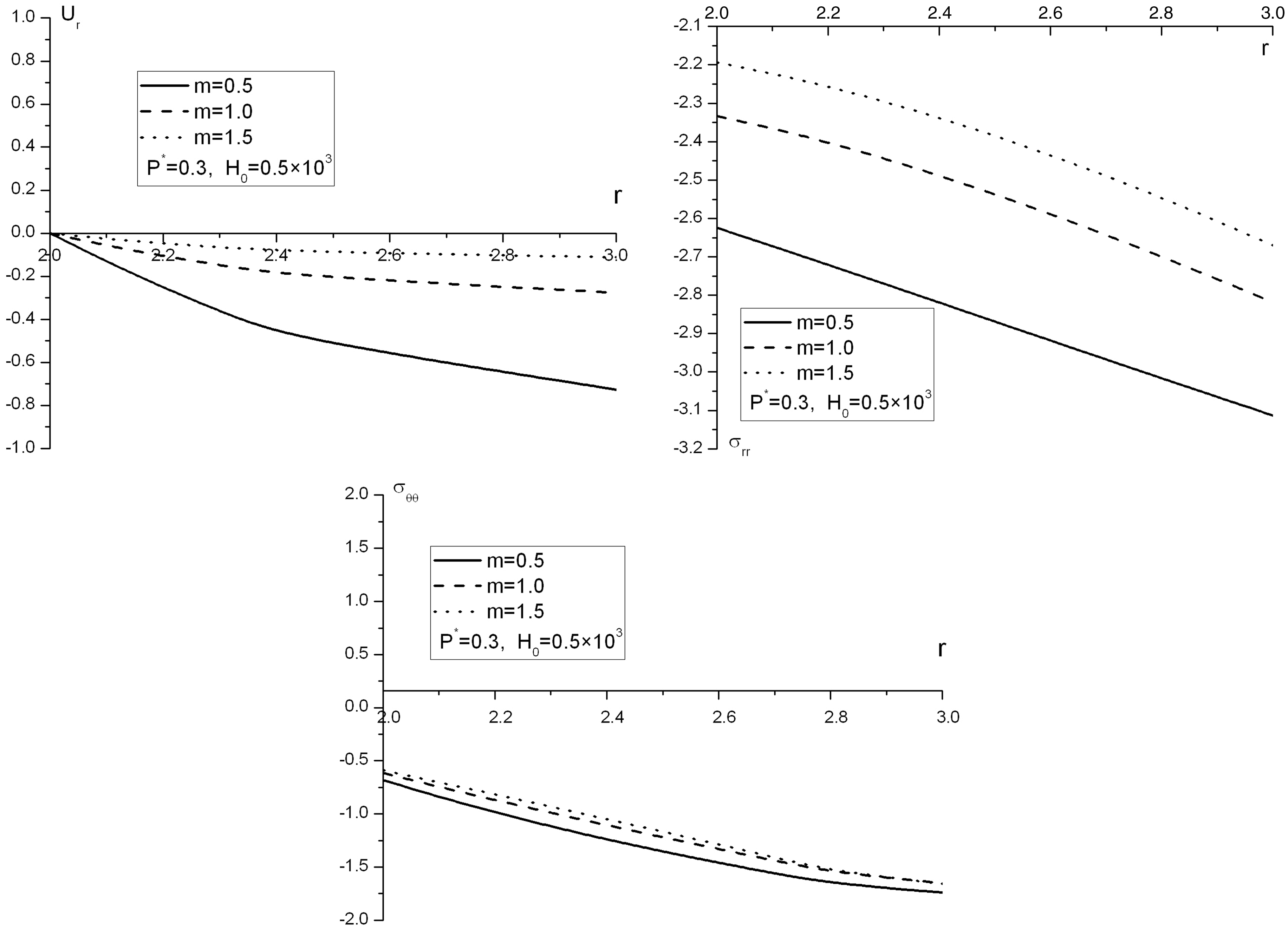
It should be pointed out that since the frequency equations there are an infinite number of frequencies for each class of vibration, the components of displacements, stresses and the natural frequency that are given that are of the most important in engineering designs. Figures 1 to 3 display the components of displacement and Figures 4 to 6 display the non-dimensional frequency for all three cases (fixed-free-mixed). Numerical results have been obtained graphically to show the distribution of radial displacement, the radial stress and the hoop stress, respectively, through the radial direction of the inhomogeneous hollow cylinder. In addition, the non-dimensional frequency w with the aspect ratio h of non-homogeneous material has been obtained under the effect of magnetic field and initial stress. Figure 1 shows that the variation of radial displacement, the radial stress and the hoop stress, respectively, along the radial direction of the inhomogeneous hollow cylinder with different values of the initial stress p*. It is easily seen that the radial displacement and radial stress satisfy the mechanical boundary conditions, the radial displacement and stresses increase with increasing initial stress p* and radial direction r. This is done at Dispersion curves for variation of the radial displacement, radial stress and hoop stress, respectively, with respect to radius r at different values of magnetic field p*. Dispersion curves for variation of the radial displacement, radial stress and hoop stress, respectively, with respect to radius r at different values of magnetic field H0. Dispersion curves for variation of the radial displacement, radial stress and hoop stress, respectively, with respect to radius r at different values of non-homogeneity m.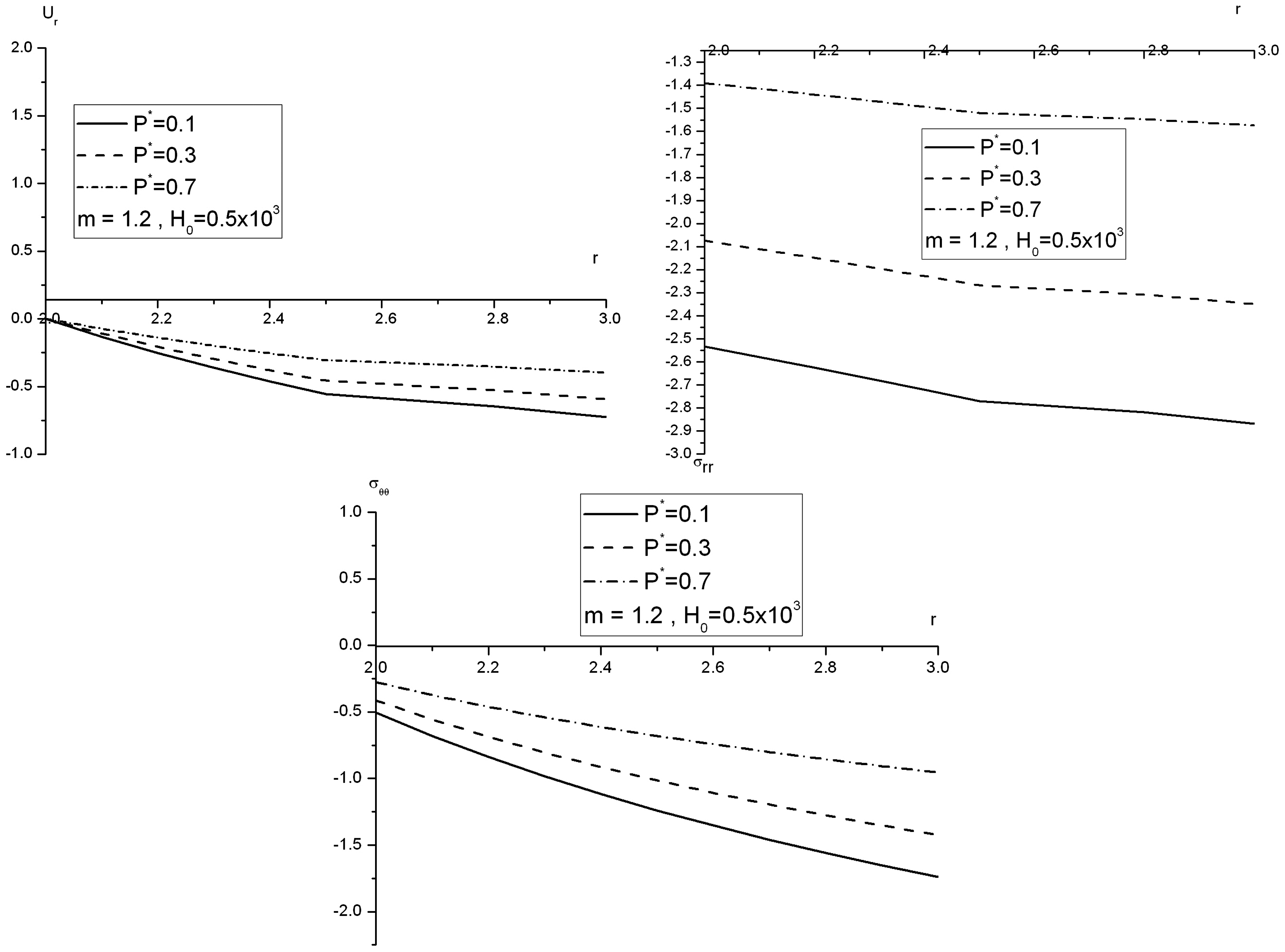
Figures 4 to 6 show that the variation of natural frequencies w along the aspect ratio h with different values of the initial stress p* and magnetic field H0 and inhomogeneity m, respectively. It is easily seen that the natural frequencies satisfy the physical phenomena. Moreover, the non dimensional frequency is affected by initial stress, the magnetic field and inhomogeneity of the cylinder. The natural frequencies w increase with increasing of initial stress p* magnetic field H0 and inhomogeneity m. It is also shown that the non-dimensional frequencies w decreases with increasing aspect ratio h. Finally, the comparison of the results presented in this paper, in the absence of magnetic field, initial stress and inhomogeneity agreement with the results have been obtained in Mahmoud et al. (2011).
Dispersion curves for variation of the non-dimensional frequency w versus the ratio h of the outer and internal radius for free boundary conditions, Dispersion curves for variation of the non-dimensional frequency w versus the ratio h of the outer and internal radius for fixed boundary conditions, Dispersion curves for variation of the non-dimensional frequency w versus the ratio h of the outer and internal radius for mixed boundary conditions, 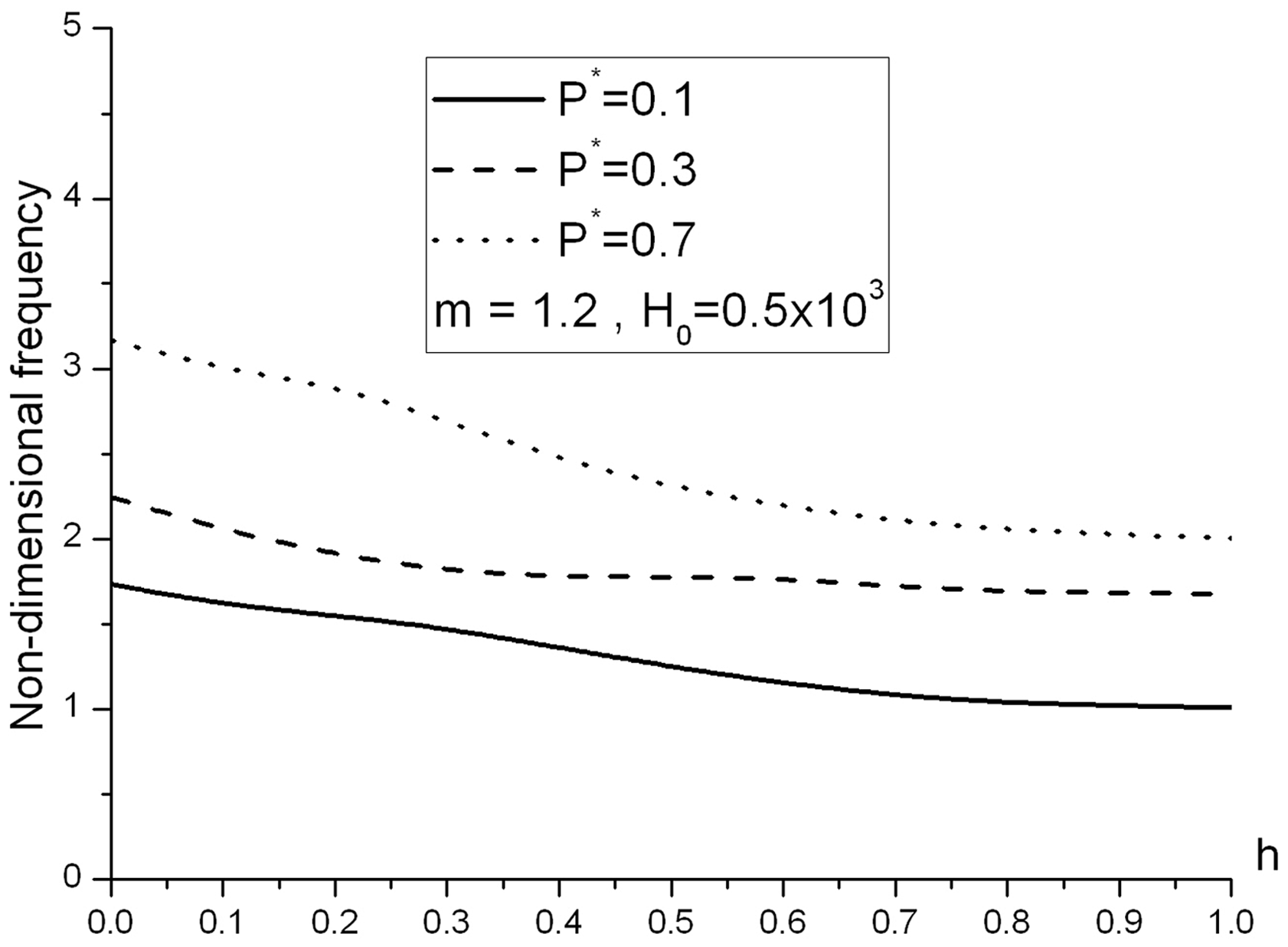
6. Conclusion
The exact solution for an inhomogeneous hollow cylinder subjected to initial stress p* and magnetic field H0 is obtained. All material coefficients are assumed to have the same exponent-law dependence on the radial direction of the hollow cylinder. The distribution of radial displacement, stresses and natural frequencies are drawn and discussed in detail for various boundary conditions. The obtained solution is valid for initial stress p* and magnetic field applied on the hollow cylinder. The results show that the inhomogeneity exponent, initial stress p* and magnetic field have an effect on the radial displacement, stresses and frequencies. By selecting a proper value of m and initial stress p* and magnetic field, it is possible for engineers to design such a cylinder that can meet some special requirements. Finally, this paper considers the case in which the material coefficients are of power function in the radial variable and then the present technique is applicable to other material in -homogeneity. The results indicate that the effect of initial stress, magnetic field and non-homogeneity on frequencies, radial displacement and stresses are very pronounced.
Footnotes
Funding
This research received no specific grant from any funding agency in the public, commercial, or not-for-profit sectors.