







Abstract
In real world systems, implementation areas of mass, force and supports have considerable quantity, unlike homogenized areas in numerical solutions. In this study, the effect of area distributions of non-structural additional mass, external force and supports on linear vibrating plate systems are analyzed. There are two key questions addressed in this study. First, the majority of the previous works cover the range of a fundamental mode, and do not answer the question of how results of the fundamental analyses can be generalized for the higher modes based on investigated parameters, particularly for the case of forced vibration. Second, how structural safety is threatened by focused idealizations has not been adequately studied before. Numerical results of this study are obtained by using the variational difference method (VDM), which is based on a variational procedure in conjunction with traditional finite difference method. VDM is applied for determining free vibration characteristics and steady-state responses to a sinusoidally varying force applied to a viscoelastically supported plate.
Because the results of the investigated systems showed that the vibration characteristics had a high sensitivity to analyzed parameters (the amount of area distributions of non-structural additional mass, external force and supports), the idealization process of areas must be attentively employed. The study provides insight not only for a fundamental mode but also for higher modes. Obviously the results of this deterministic study have showed that theoretical importance shall be considered in practical applications.
Keywords
1. Introduction
The success of a vibration simulation depends on the model used to represent the vibrating system and its environment. As much as the simulation is realistic (namely capable of covering a larger number of phenomena), the achievement of the simulation is more certain.
Homogenous load and support conditions employed in the analysis of vibrating systems’ behavior only represent limited mathematical conditions. The real conditions of systems that generally have considerable applications areas for mass, force and supports are mostly different from models based on classical numeric approaches.
The location and amount of concentrated mass have been considered as the main parameters in the majority of investigations for the effect of mass on vibration behavior of plate systems. There are several studies addressing the free vibrations of a plate with masses in the literature. Simple supported rectangular plate with concentrated mass was examined by Gershgorin (1933) analytically and another analytic solution for similar problems was presented by Amba-Rao (1964) and Magrab (1968). Cha (1997) studied natural frequencies of rectangular plates with concentrated mass. A transverse vibration of thin elastic plates with concentrated masses and internal elastic supports was investigated by Laura and Gutierrez (1981). Elastically supported plates with arbitrarily located springs and masses were analyzed by Li and Daniels (2002).
Although there are several studies on vibrating plates with added concentrated masses in the literature, few reports on plate vibrations with distributed mass loading on the subdomain can be found. The effect of mass distribution on vibrating plate behavior was studied by Kopmaz and Telli (2002), who calculated natural frequencies of a mass loaded plate for different mass distributions, aspect ratios and mass locations, and who gave noticeable graphics for the effect of mass distribution on fundamental mode frequency for two different mass amounts. The effects of the size and location of a distributed mass loading on the plate were investigated in the framework of free vibration analysis by Wong (2002). Wong (2002) showed that both the natural frequency and the mode shape of a certain vibration mode had relatively larger changes if the mass loading was placed on an antinode of the vibration mode. In the three particular cases studied by Wong (2002), it was reported that the added mass would reduce the amplitude of an antinode close to it and all vibration antinodes around the added mass would appear to be shifted towards the loaded region.
Altintas and Goktepe (2007) studied free vibration analysis for the location of mass and forced vibration analysis for both the location of mass and force. The findings of the free vibration part of that study support those of Wong’s (2002) study. Crucially, the distinct differences between the effects of mass and force location on vibrating plate were found by Altintas and Goktepe (2007), where the location of the additional mass was reported to be a more significant parameter than external force location for the occurrence of the peaks on the force transmissibility curves.
Altintas and Bagci (2005) analyzed the effects of variation of the distributed mass area on the characteristics of free and also forced vibrations in the range of the fundamental mode. The results of the free vibration analysis showed that the increase of the non-structural additional mass could lead to the increase of the fundamental frequency value. For a constant quantity of mass, when the distribution area increased, the most considerable effect was the increase of frequency values where the peak of the transmissibility curves occurred. As the force distribution area changed, so did the transmissibility values. However, significant changes did not occur for the frequency parameter of the occurrence points of the transmissibility peaks. When the force distribution area increased, the damping of the external force was better managed.
Avalos et al. (1989) investigated the free vibration of simply supported plates partially embedded in an elastic foundation. In the range of fundamental frequency, the effect of a varying supported area on natural frequency was determined by Altintas and Bagci (2004) for viscoelastically supported anisotropic plates. In their study, the effect of the supported area ratio on fundamental frequency of plate was significant for higher stiffness coefficients of springs for different anisotropy ratios. They also studied the effect of the supported area amount and damping coefficient on response curves. The effect of dampers increased when the supported area increased. The peak values of transmissibility were plotted to determine where the minimum peak values occurred.
A brief investigation of the literature shows that the uncovered examination domains do exist and need the viewpoint of deterministic approaching to vibrating plate problems. For instance, above the range of the fundamental mode region, the effect of area distributions of mass, force and supports for free and forced vibration analysis and efficiency of damping for the abovementioned parameters are not adequately covered.
For using the results of deterministic analyses of this study, idealized parameters were investigated and interpreted with regard to structural safety. Additionally, our investigation looks at whether foresight of behaviors of higher modes based on fundamental analysis is reliable for analyzed parameters or not.
2. Numerical method
To date, various methods have been developed and used to study vibration problems of plates. In this study a variational difference method (VDM) was examined to solve the problem mentioned. Classical finite difference methods (FDMs) were widely examined for analyzing vibration models. But usage of classical FDM is incompetent to solve many vibration problems because of low order accuracy, poor convergence and numeric calculation instabilities. Variational difference method that is based on variational procedure in conjunction with an FDM is more stable than the classical FDMs. This is because using the energy approach in conjunction with the variational procedures applied in the study, the stress boundary conditions are satisfied automatically through the minimization process and only geometric boundary conditions are considered in the analysis.
Recently, VDMs have been examined by many researchers to analyze very complex dynamics’ problems, which are not stable when using classical FDMs (Gladun, 2000; Babich and Khoroshun, 2001; Godzula and Shnerenko, 2002). Using FDM for formulating boundary conditions is inefficient.
The method with implementation of an interlacing grid technique which is about vibrating plate problems was examined by Aksu and Felemban (1992) and Aksu and Al-Kaabi (1987). Using a similar technique, free and forced vibration analysis of viscoelastically supported plates was investigated by Kocatürk and Altintas (2003), Altintas and Bagci (2004, 2005), Altintas and Goktepe (2007) and Altintas (2009).
The numerical method based on VDM by which the analyses have been applied in this study is described briefly. A harmonically vibrating plate with radian frequency, ω, the potential energy and kinetic energy is based on non-dimensional parameters.

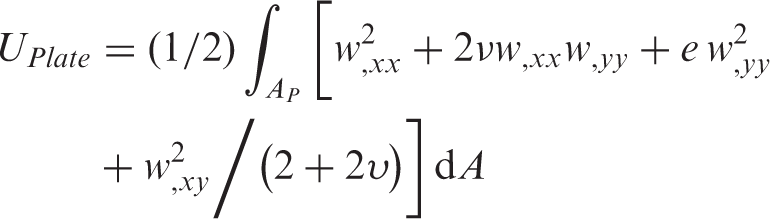
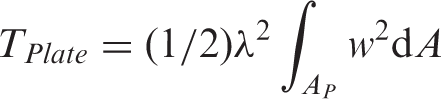
An additional kinetic energy term shown below from additional mass carrying by plate should be added to whole system energy.

In the case of forced vibration the potential energy from external force is


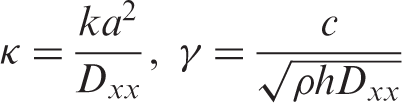
The partial derivatives appearing in the functional, which are represented as finite approximating sums based on the mesh covering the plate, are replaced by variational difference equations with equal intervals in both x and y directions. If the plate is divided into P − 1 and R − 1 subdivisions, the intervals Δx and Δy can be defined as Δx = 1/(P − 1) and Δy = 1/(R − 1).
Total energy of the plate including dissipated energy terms (L) is minimized with respect to VDM discretized displacement by applying Euler’s necessary condition, represented below:

For the whole points of VDM mesh, applying equation (8), the following set of linear algebraic equations are obtained which can be shown in the following matrix form:


The magnitude of the reaction force

3. Numerical analysis
Figure 1 shows the fundamental frequencies of elastically supported plates versus the mass distribution areas. Nine plates with different combinations for the mass amounts and spring coefficients are analyzed. As the value of the mass distribution area increases, so do all of the fundamental frequencies. Figure 1 shows that for the greater values of spring coefficient, fundamental frequency takes the higher values, whereas for the greater values of mass, fundamental frequency takes the lower values. Interchanges of the lines’ order show that the systems analyzed have high sensitivity to changes in the amount of mass distribution.
Effect of mass distribution area amount on fundamental mode of plates with elastic edge supports (Ey/Ex = 1).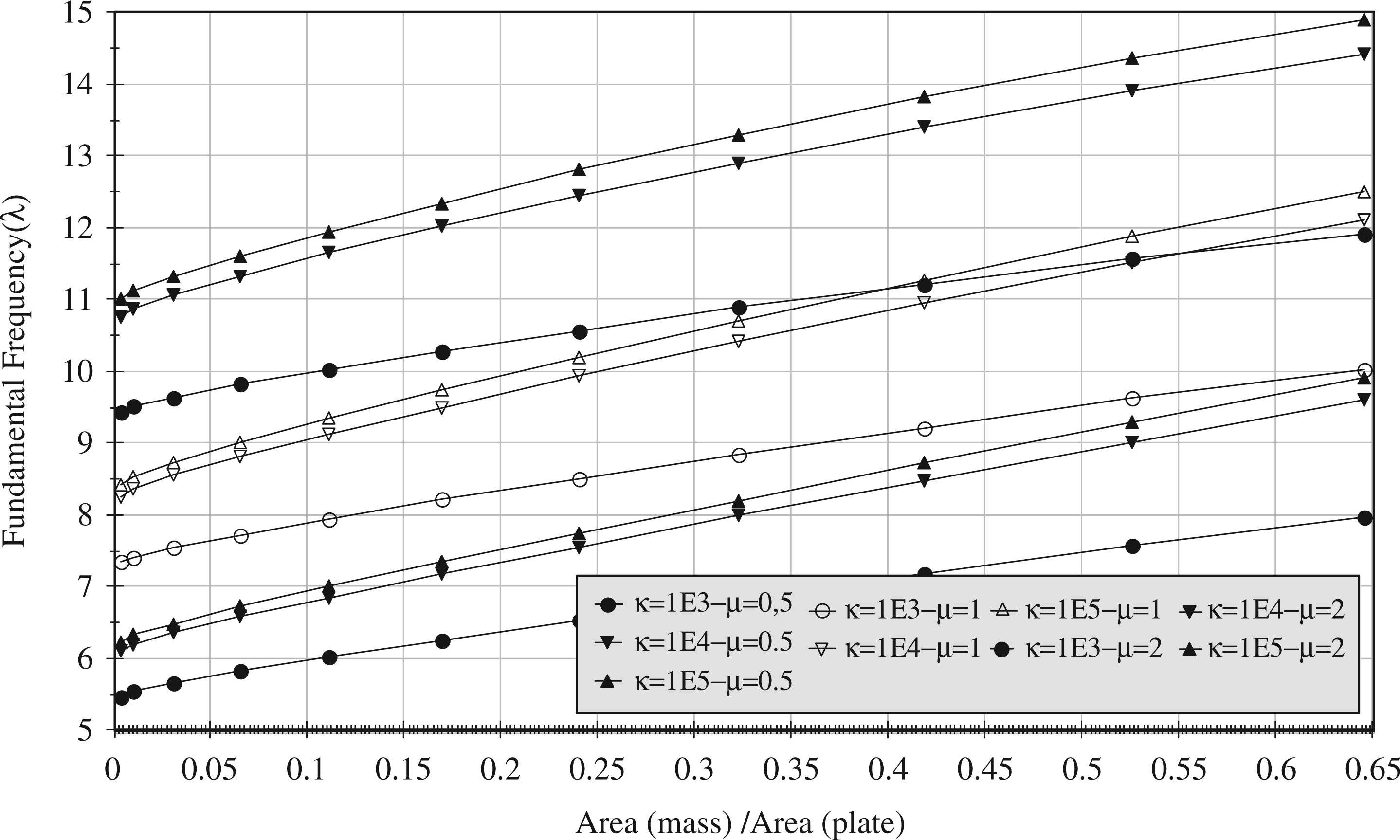
Occurrence of the fundamental mode frequencies of plate systems with different supported area amounts are plotted for the variation of the spring coefficients in Figure 2. Fundamental mode frequencies were higher for increased spring coefficients of supports, which agreed with previous studies addressing the effect of spring coefficients on the natural frequencies. The effect of spring coefficients on the first natural frequency increased rapidly when the supported area increased. The upward trend of natural frequency became more pronounced when the spring coefficient took values higher than 100. Additionally, the effect of the mass distribution area on fundamental frequency significantly increased as the value of area distribution was getting closer to the plate area. However, in plates with lower values of the supported area the fundamental frequencies stabilized before those of higher valued plates.
Effect of spring coefficient amount of supports on fundamental mode of plates with varying supported area (Ey/Ex = 1).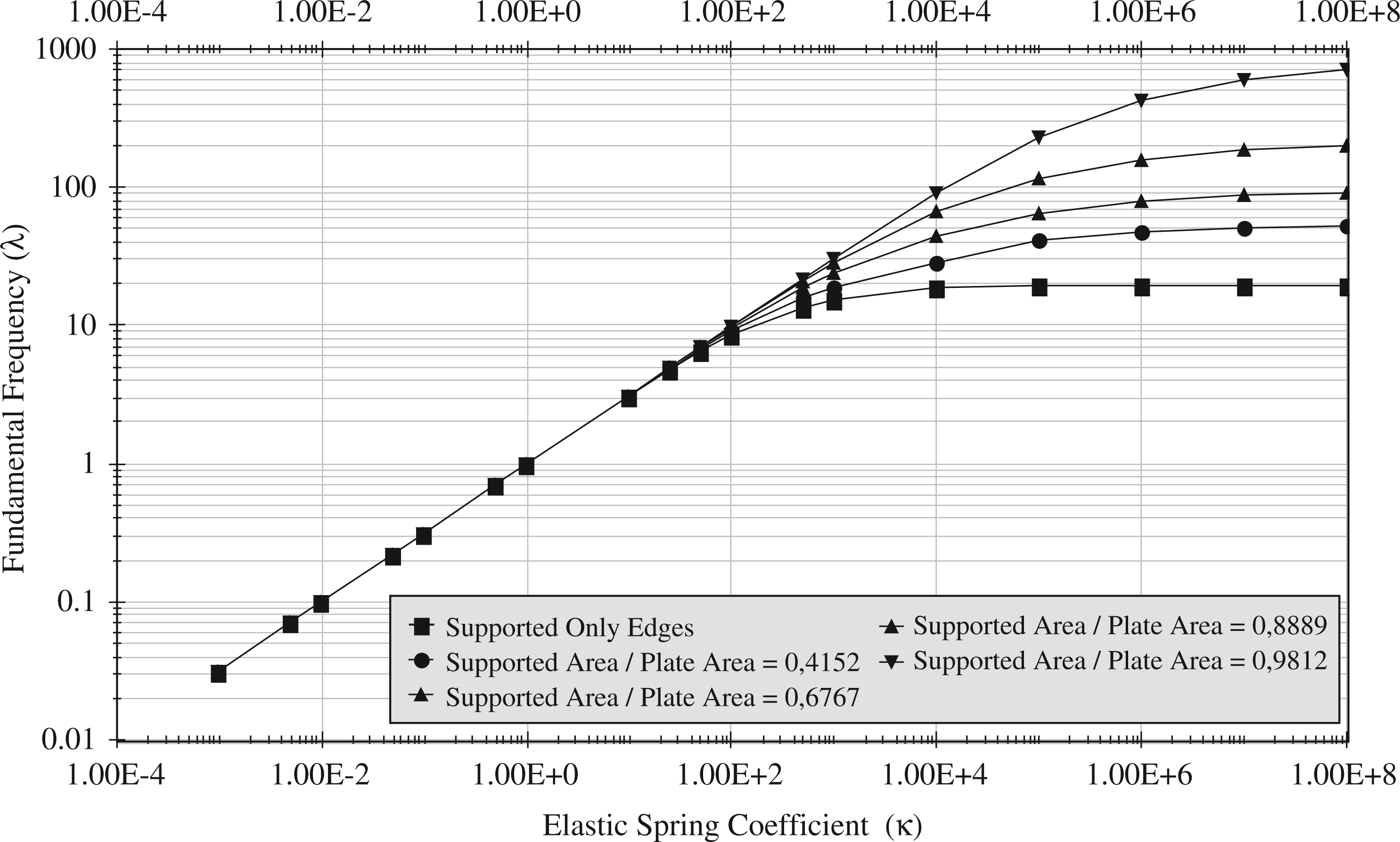
The first 10 natural modes were plotted for mass distribution area in Figure 3. Orthotropic material of the plate systems was chosen to avoid confliction of modal degeneracy as mentioned in Altintas and Göktepe (2007) and Altintas (2009). The geometric center of the distributed mass denoted by (xs; ys) and the geometric center of the plate are at the same point in Figure 3(b), but they are not at the same point in figure 3(a). Figure 3 shows that every different mode has different characteristic behavior for the variation of the mass distribution area. The behavior of any mode cannot be determined based on the knowledge of other modes. Put simply, this consequence shows that the results of the previous analyses, which covered the fundamental mode region, cannot be a guide for understanding higher mode behaviors. Not only does every mode have different trends but there are also different trends for plotted line parts of every mode depending on the different values of the mass distribution domain. The orders of some modes are interchangeable, because the modes have different trends and different sensitivity to the mass distribution. Figure 3 reveals that mass distribution is a very important parameter for the free vibration analysis and must be cautiously used in the analyses of real world systems by designers and scientists.
Effect of mass distribution area on first 10 modes of plates with elastic edge supports, (κ = 1000, Ey/Ex = 0.6). (a) xs = 0.57; ys = 0.63 (b) xs = 0.50; ys = 0.50.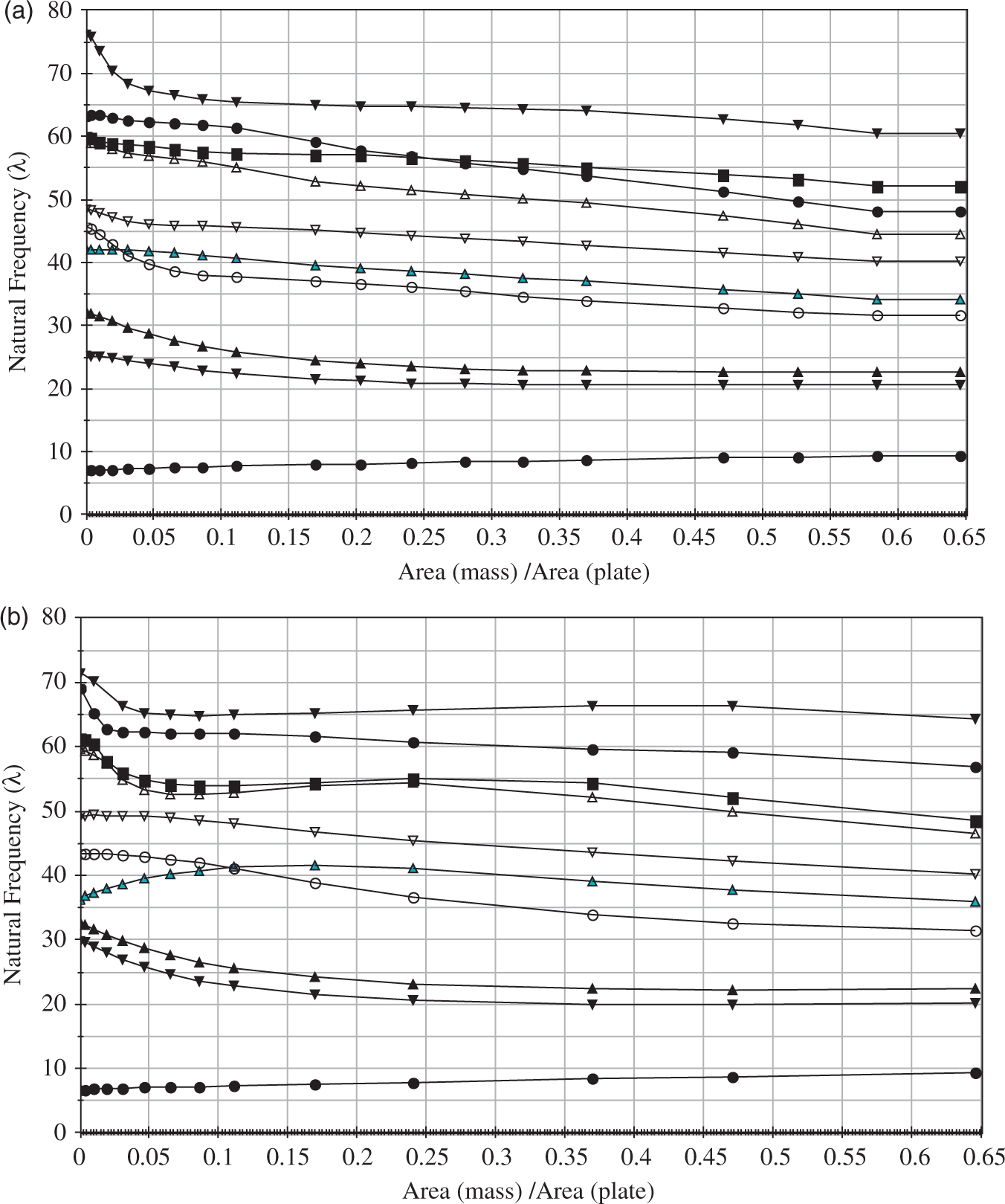
In Figure 4, natural frequencies of the first 10 natural modes were plotted for the variation of the supported area distribution. Similar to the mass distribution effect, every mode is affected differently by variation of the supported area, that is, one cannot estimate behavior of higher modes based on the behavior of the fundamental mode. The interchange effect of the supported area distribution on the mode is less than the effect of mass distribution.
Effect of supported area amount on first 10 modes of plate, (κ = 1000, Ey/Ex = 0.6).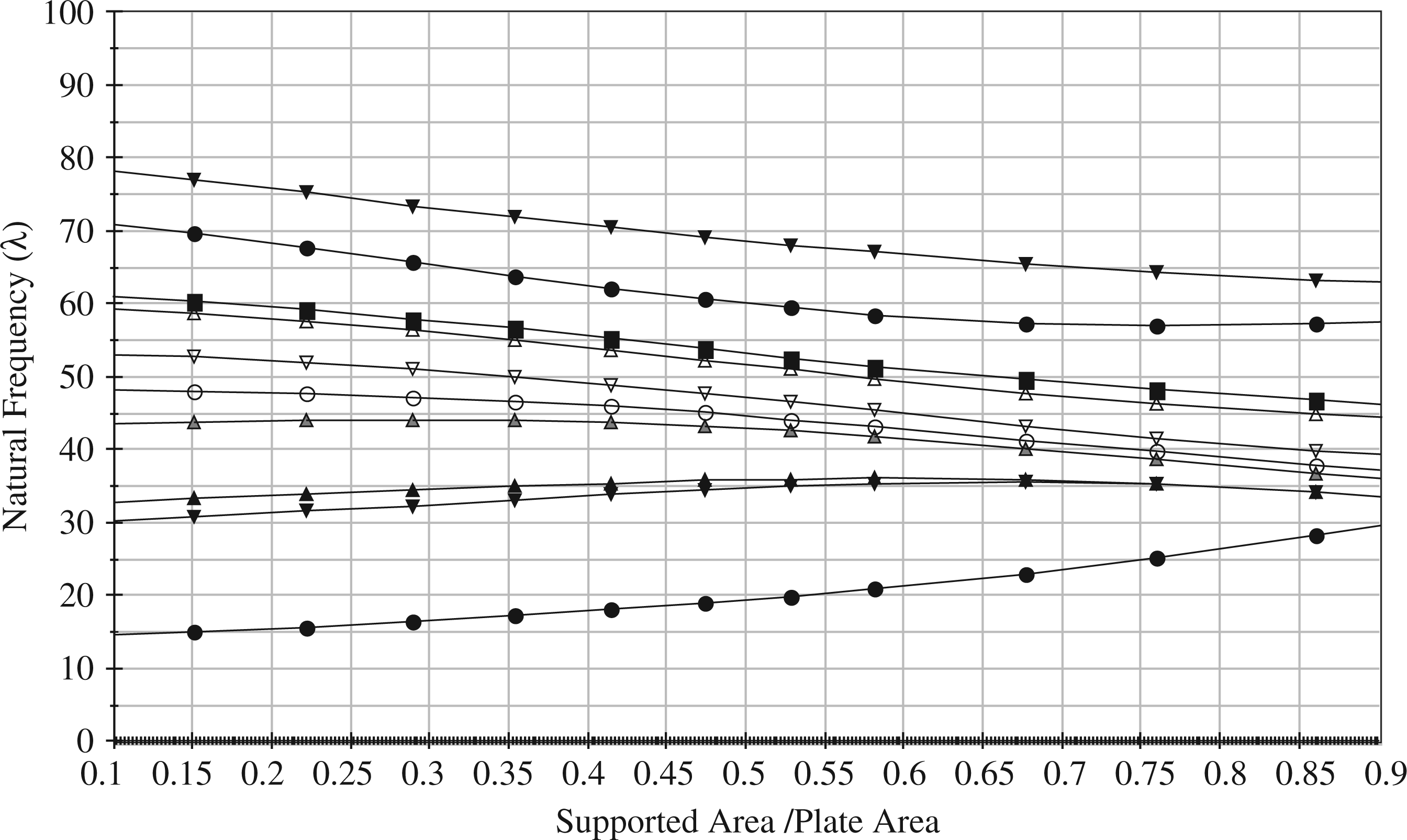
Force transmissibility curves of the viscoelastically supported plate systems having a different mass distribution area are plotted for variation of the external force frequency in Figure 5. Similar to free vibration analysis, there is no certain rule for the frequencies where the peak values of the transmissibility curves occur. Additionally, there is no certain relationship between the mass distribution area and the peak of the transmissibility values.
Effect of mass distribution area amount on force transmissibility values of plates with viscoelastic edge supports, (κ = 10000, Ey/Ex = 0.6, µ = 1). (a) γ = 100 (b) γ = 500.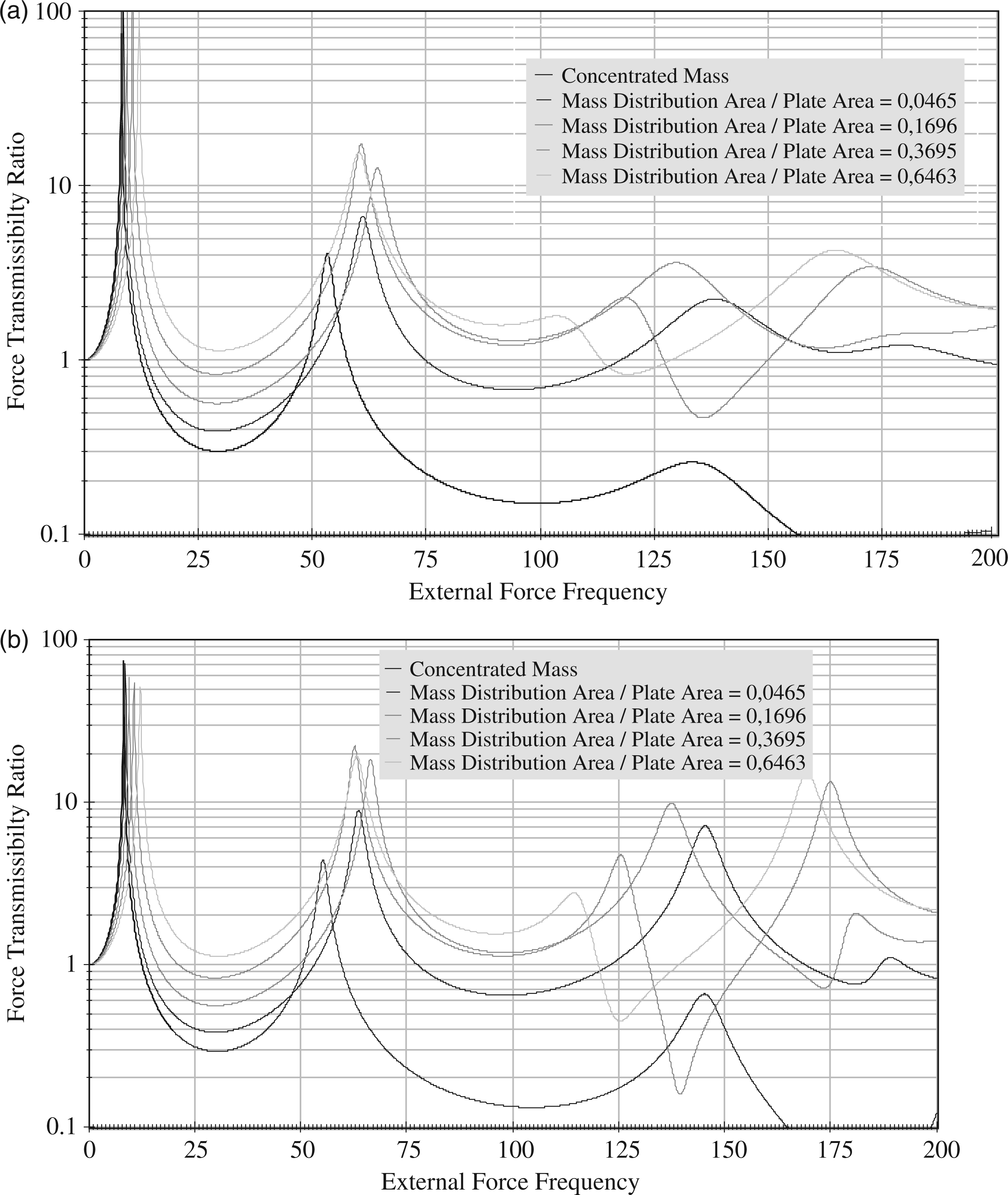
The effect of the amount of supported area on the force transmissibility curves is shown in Figure 6. The usage of the bigger supported area provides better force damping than that of the smaller supported area for the constant total value of the spring and the damping coefficients. This fits well with the case of free vibration analysis, where the frequency values of the transmissibility peaks increased with the increase in the supported area. Figure 6 shows the importance of the supported area variation especially for the energy dissipation. As a result, variation of the supported area values can be used for the adjustment of damping of external forces.
Effect of supported area amount on force transmissibility values of plates (κ = 10000, Ey/Ex = 0.6, µ = 0). (a) γ = 100 (b) γ = 500.
Force transmissibility curves are plotted for the variation of the external force distribution area in Figure 7. Transmissibility values of the peaks show that when the external force application area increases, the dissipation efficiency of the supports also increase. All the peaks of the curves occur in the same frequency value for every different mode region because the external force does not affect the free vibration characteristics of the linear vibrating systems.
Effect of force distribution area amount on force transmissibility values of plates with viscoelastic edge supports, (κ = 10000, Ey/Ex = 0.6, µ = 1). (a) γ = 100 (b) γ = 500.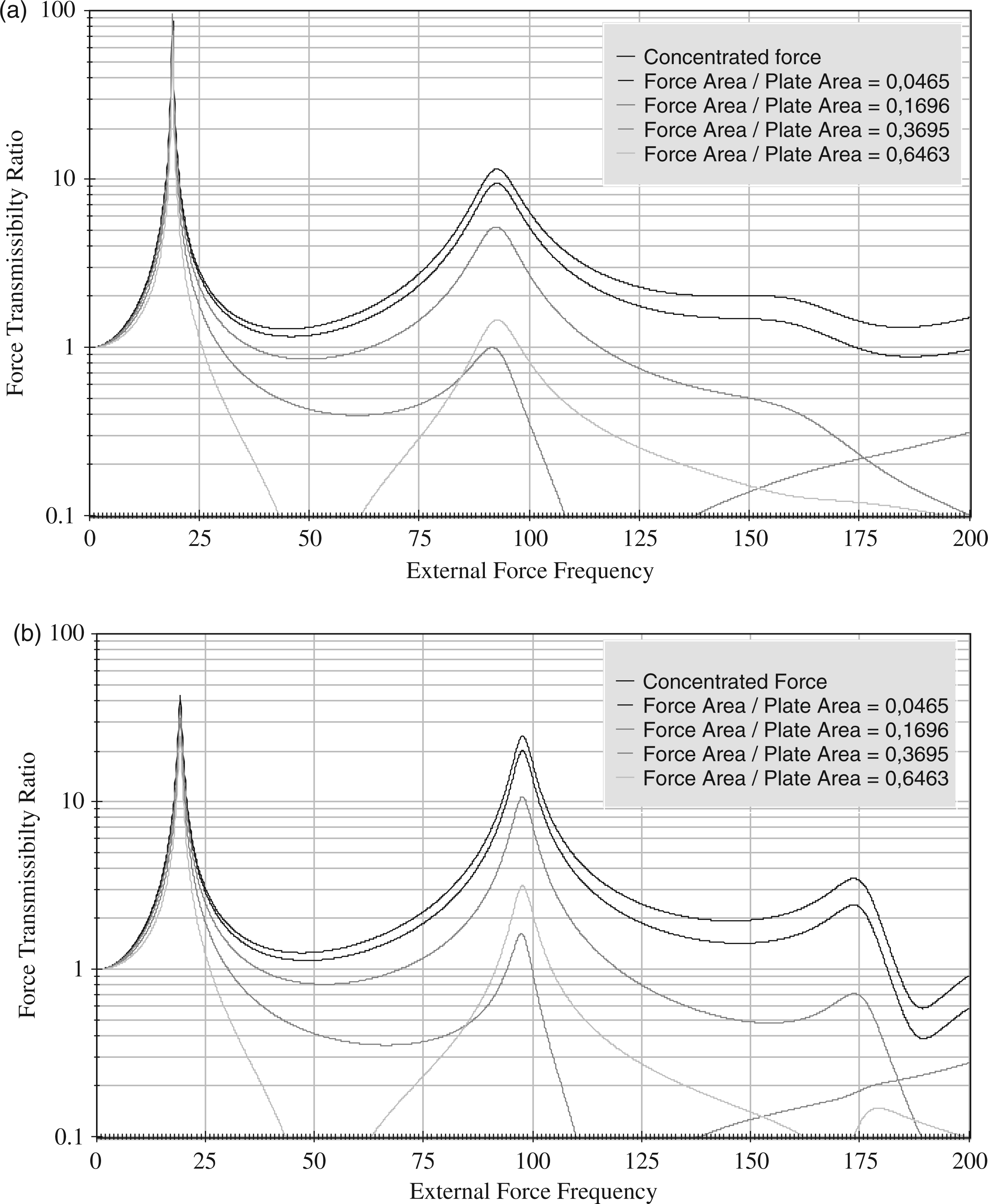
4. Conclusions
The conclusions below cover the results that are unveiled for the first time by this study and do not include repetitive results that have also appeared in previous studies.
The effect of the support distribution area on the free vibration behavior of the analyzed systems was very significant. But the interchange effect of the support distribution on the mode was less effective than the effect of mass distribution. The main effect of support distribution on the system was observed in the case of forced vibration. In this context, when the supported area increased, so did damping efficiency of the viscoelastic supports. As a result, it can be concluded that the idealization process of real supports which have a considerable support area do not threaten the structural safety from the standpoint of the damping of external forces.
The obtained results of the analyzed systems showed that the free vibration characteristics had high sensitivity to variation of the distributed mass area. The reflection of this sensitivity in the forced vibration analysis was reflected in the changes of the frequency values where the peaks occurred on the transmissibility curves. Despite the high sensitivity, there are no certain rules for the effect of mass distribution on behavioral trends of parameters of the free and the forced vibration.
Remembering that many results have been reported for vibrating plates in the range of the fundamental mode region, this study clearly shows that the behavior of the fundamental mode region cannot be a guide for understanding behaviors of the higher modes based on analyzed parameters.
Footnotes
Funding
This research received no specific grant from any funding agency in the public, commercial, or not-for-profit sectors.