







Abstract
This paper concerns free vibration analysis of single-story multi-bay planar frame structures. An exact analytical solution is obtained using a wave vibration approach, in which vibrations are described as waves propagating along uniform structural elements and are reflected and transmitted at structural discontinuities. The coupling effects between bending and longitudinal vibrations in the multi-bay frames are taken into account. Both natural frequencies and modeshapes are obtained. Numerical examples are presented along with comparisons to results available in the literature.
1. Introduction
Resonant vibration analysis of plane frameworks is of great importance. This is because resonant vibrations are the main causes of structural failure. However, owing to the inherent algebraic complexity, exact analytical solutions to vibration problems in multi-bay planar frames have rarely been sought. Approximate solutions have been obtained by considering the number of bays of the framework to be infinite, or by assuming the structure consisting of massless, elastic members with the structural mass concentrated at the column crossbar junctions. The only analytical study on multi-bay planar frames available in the literature is by Rieger and McCallion (1965), who analyzed single-story multi-bay planar frames using the conventional modal analysis approach. In their study, all the structural members are assumed to have continuously distributed mass and elasticity. However, the authors only considered bending motions in the multi-bay planar frames.
In this paper, a wave-based vibration approach is introduced, in which vibrations are described as waves that propagate along uniform structural elements and are reflected and transmitted at structural discontinuities (Graff, 1975; Cremer et al., 1987; Doyle, 1989). The author has successfully applied this approach in analyzing vibrations in simple built-up frames, such as H- and T-shaped (Mei, 2010), and L-shaped and portal planar frames (Mei, 2012).
In this study, the wave vibration approach is adopted for analyzing coupled bending and axial vibration analysis in complex multi-bay structures. The analysis is based on classical vibration theories with the coupled bending and axial motions, which was neglected in the previous analytical study by Rieger and McCallion, taken into account. The coupling is introduced by the joints, where incident bending waves in one beam element generate axial waves in an element normal to it and vice versa. As a result, considering the coupling effect is critical for accurately analyzing vibrations in a multi-bay structure. This accurate analytical study provides a benchmark for future numerical studies.
This paper is organized as follows. In the next section, the wave analysis approach and the equations of motion are presented. The reflection and transmission matrices at “L” and “T” joints, which were derived by the author earlier (Mei, 2010, 2012), are listed in the Appendix for the convenience of readers. In Section 3, the propagation, reflection, and transmission matrices are combined to provide a concise and systematic approach for in-plane vibration analysis of coupled flexural and longitudinal vibrations in single-story multi-bay planar frame structures. The approach is illustrated using two numerical examples, which are compared with available results in the literature. Concluding remarks are given in Section 4.
2. Wave analysis and equations of motion in a single-story multi-bay planar frame
Coupled bending and axial vibrations in single-story multi-bay planar frames are analyzed using the wave vibration approach. In this study, both bending and axial vibrations are modeled using classical vibration theories. The classical axial vibration theory assumes that the axial deformations along the neutral axis of the rod are the same in all points of the cross section, and assumes no transverse deflections. The two key assumptions in the classical Euler-Bernoulli bending theory are that the material is linear elastic according to Hooke’s law and that plane sections remain plane and perpendicular to the neutral axis during bending. As a result, the results are accurate at a lower frequency range, typically, when the transverse dimensions are much smaller than the wavelength and the lateral displacements due to axial vibrations are negligible. At higher frequencies, Timoshenko bending theory and Mindlin–Herrmann axial theory shall be adopted to take into account the effects of rotary inertia and shear distortion in bending vibration and the lateral displacements in axial vibration.
Figure 1 shows a single-story multi-bay planar frame. The n bay frame consists of n uniform cross beams and (n + 1) uniform columns. The discontinuities include two “L” joints, (n−1) “T” joints, and (n + 1) boundaries. Regardless of the complexity of a structure, from the wave standpoint, it consists of only structural elements and structural joints. Vibrations propagate along a uniform structural element, and are reflected and/or transmitted at joints and boundaries. Assembling these propagation, reflection, and transmission matrices offers a concise and systematic approach for analyzing coupled bending and longitudinal vibrations in a single-story multi-bay frame structure.
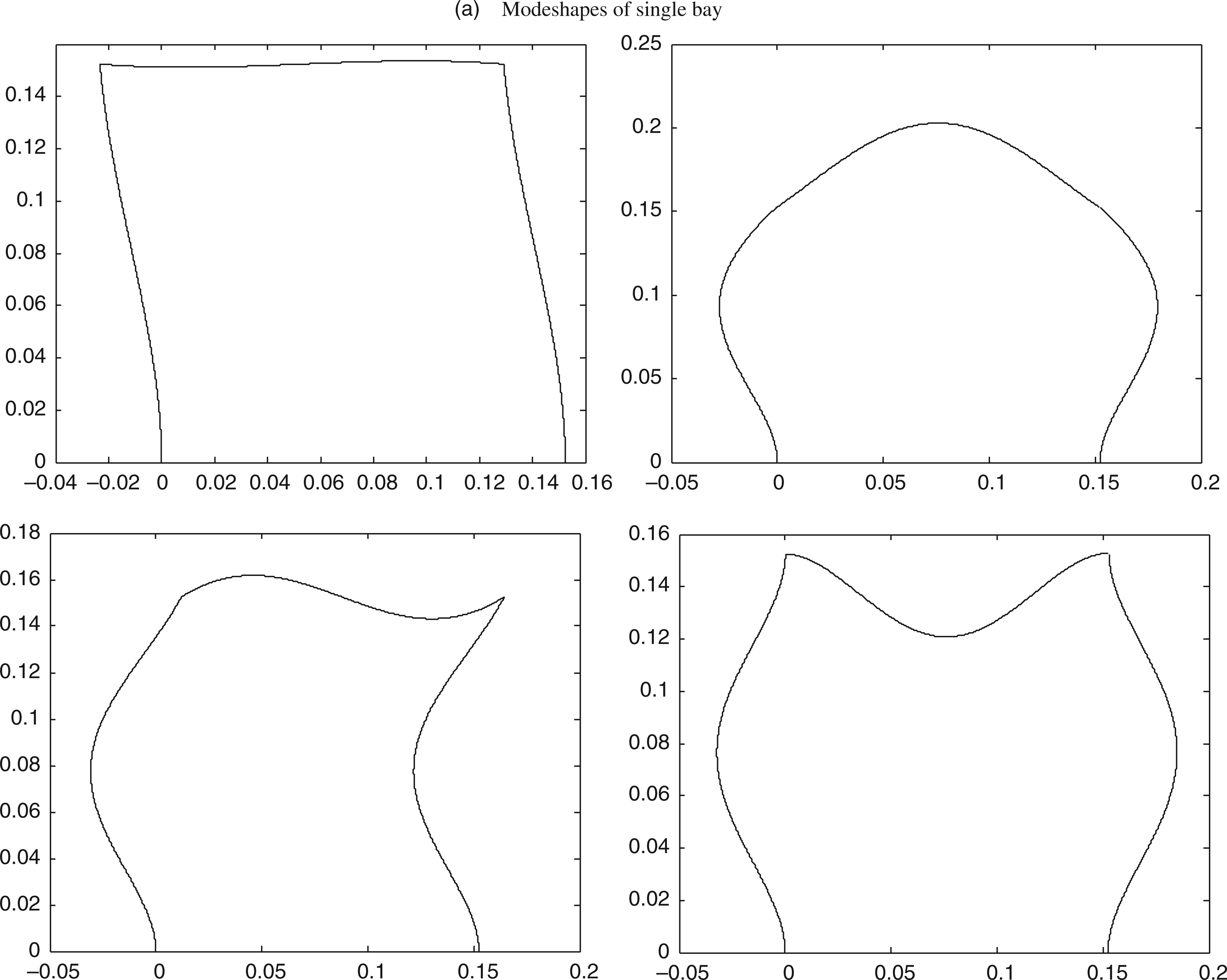
A single-story multi-bay plane frame. Modeshapes of a single-story multi-bay plane frame.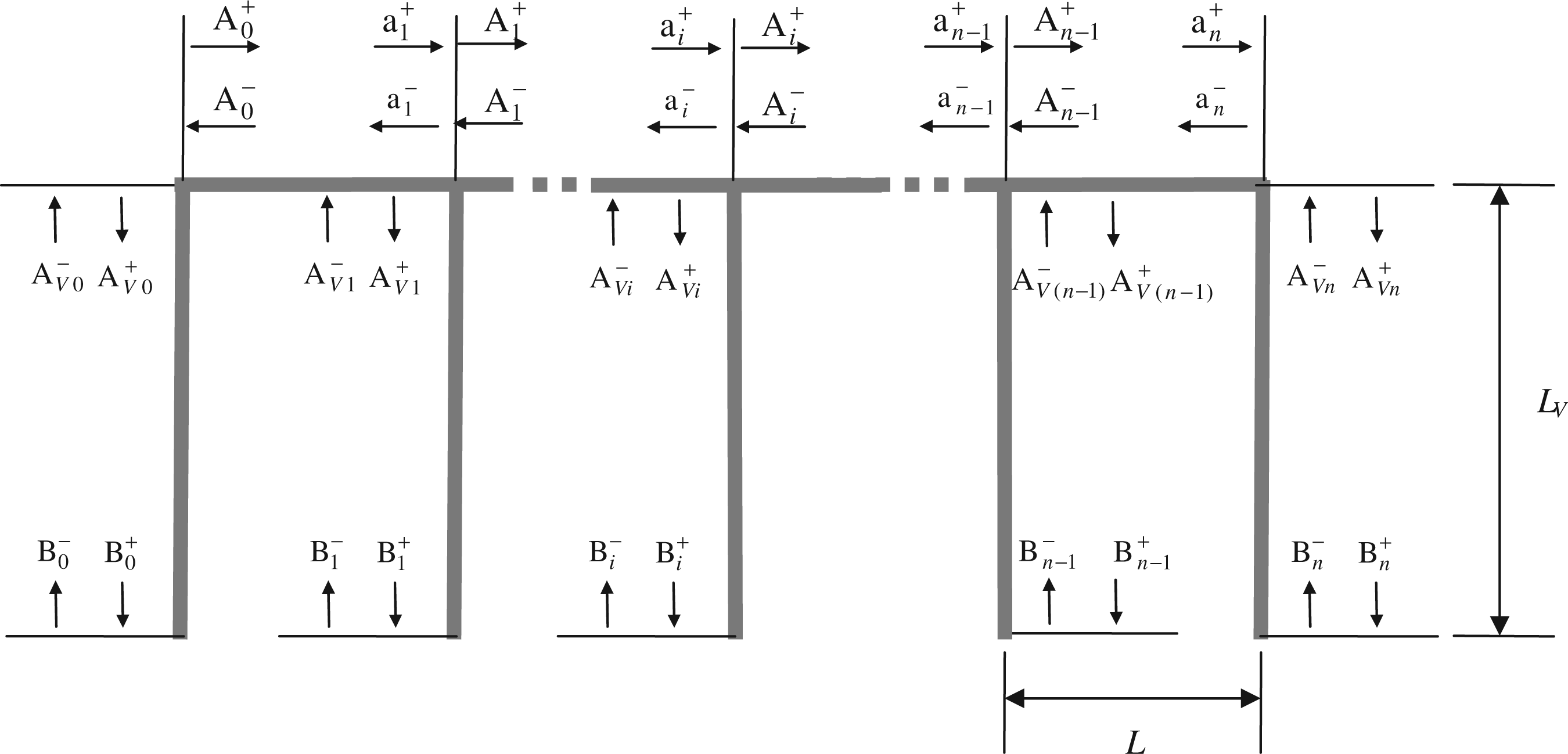
The approach introduced in this section applies to general situations where all the beams and columns are of different material properties and dimensions. For convenience, however, the cross beams are assumed uniform and of the same material properties and dimensions as all columns.
The n pairs of propagation relations along the cross beam elements are

The (n + 1) pairs of propagation relations along the column elements are

The reflection and transmission relations of the waves at “T” joints are

The reflection and transmission relations of the waves at the two “L” joints are

The reflections at the boundaries are

Writing the above equations in matrix form gives

Both bending and longitudinal vibrations exist in a multi-bay planar structure due to wave mode conversion at the “L” and “T” joints. Based on classical vibration theories, the equations of motion are as follows (Inman, 1994):


For a free bending vibration problem, the differential equation of motion becomes


With the time dependence



Again assuming time harmonic motion and using separation of variables, the solution to equation (9) can be written in the form
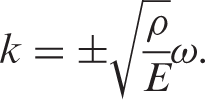
With the time dependence

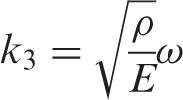
Consider two points A and B on a uniform beam a distance x apart. Waves propagate from one point to the other, with the propagation being determined by the appropriate wavenumber. Denoting the positive and negative going wave vectors at points A and B as

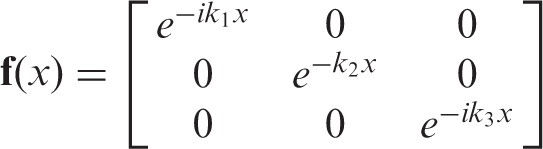

Waves propagate along uniform waveguide and are reflected and transmitted at structural discontinuities. Details on reflection at classical boundaries, as well as reflection and transmission at “L” and “T” joints can be found in the Appendix. Putting the propagation, reflection, and transmission equations in matrix form of equation (2) and setting the determinant of the coefficient matrix
It has been observed that for periodical beam structures, there exist the so-called “passing” and “stopping” bands. That is, the natural frequencies are clustered. As will be seen in the numerical studies that follow, the “passing” and “stopping” bands are observed in multi-bay frames as well. The number of natural frequencies in a cluster equals the number of bays. This observation can be applied to optimal structural design from a vibration suppression standpoint. For example, a multi-bay structure can be so designed as to allow the disturbance frequencies to fall into the gaps between two clustered natural frequencies. Such a design can be achieved by carefully choosing the materials, dimensions, and boundary conditions of a multi-bay frame structure, which together determine the natural frequencies of the frame.
3. Numerical examples
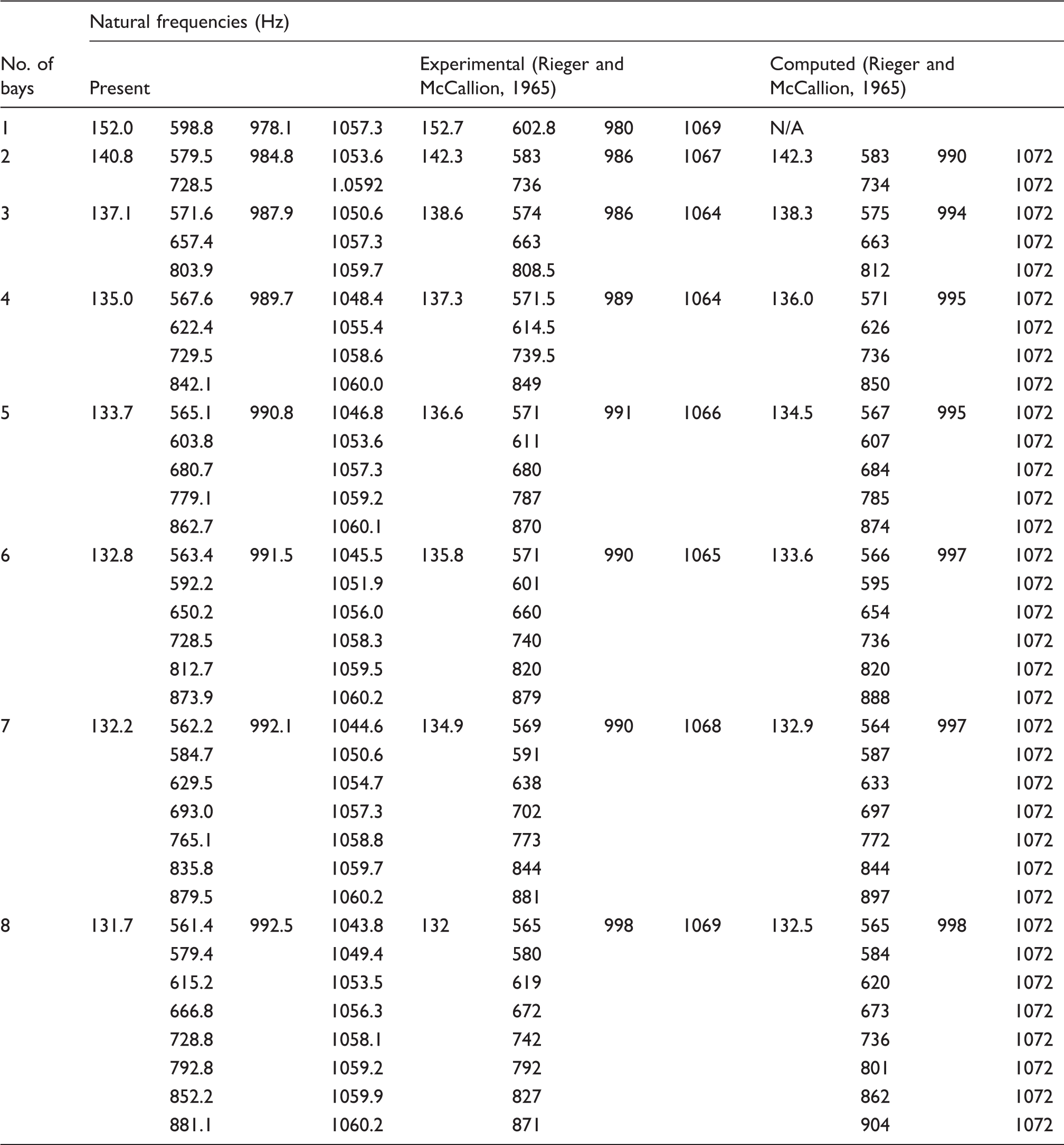
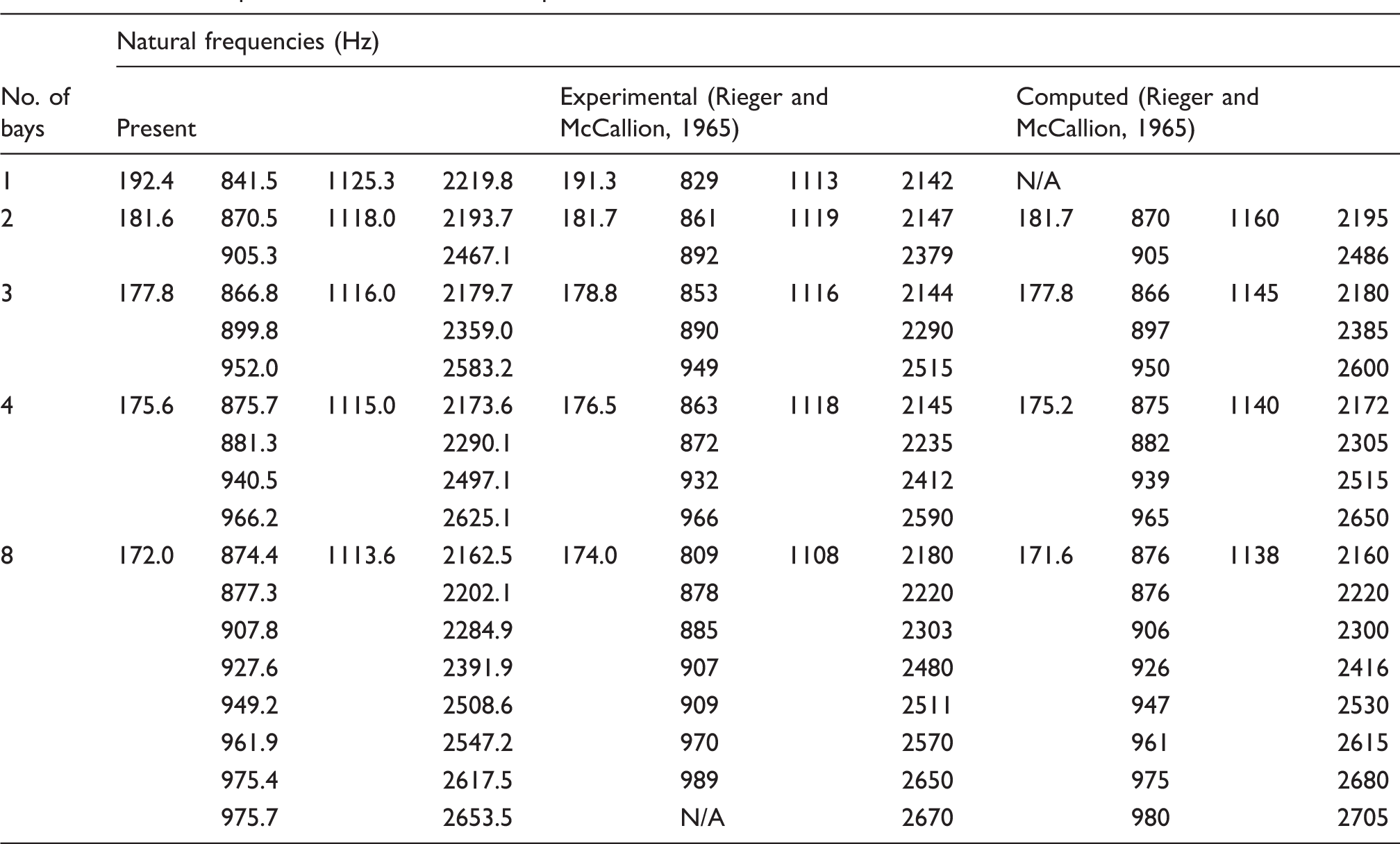
For comparison purposes, the same single-story multi-bay planar frame structure studied using the conventional modal approach in (Rieger and McCallion, 1965) is analyzed using the proposed wave approach. As a result, the physical properties are chosen to be the same as those in Rieger and McCallion (1965) and they are as follows:
Lengths of columns are
Natural frequencies of the first example frame
Natural frequencies of the second example frame
The modeshapes are obtained by deleting one raw of the coefficient matrix
4. Discussions and conclusions
In this paper, in-plane vibrations in single-story multi-bay planar frames are analyzed using the wave approach. The vibrations are modeled using classical vibration theories. The coupled bending and longitudinal vibrations are taken into account. With the availability of the propagation, reflection, and transmission matrices, vibration analysis of single-story multi-bay planar frames becomes systematic and concise: it involves a simple assembly of the involved matrices. The procedures are illustrated using two numerical examples, and both show good agreements with the results available in the literature.
Footnotes
Acknowledgements
The author gratefully acknowledges the support on this project from the Civil, Mechanical and Manufacturing Innovation Division of the National Science Foundation.
Funding
This work was supported by the Civil, Mechanical and Manufacturing Innovation Division of the National Science Foundation (grant number #0825761).