The correlation criterion proposed in this article and called nc2o (normalized cross complex orthogonality) is based on the bi-orthogonality properties between rotor mode shapes calculated at different speeds of rotation. This criterion is proved using an industrial laminated rotor composed of disks and two fluid film bearings, whose characteristics depend on the speed of rotation. The industrial finite element model shows that the nc2o criterion provides a more efficient mode pairing of rotor shapes than those obtained by using classical correlation criteria. Moreover this criterion makes it easier to plot Campbell diagrams for strongly speed-of-rotation-dependent structures.
Predicting the lateral dynamics of industrial rotating machines has been a common task for several decades and many reference books can be cited, see for example Dimentberg (1961), Lee (1993), Lalanne and Ferraris (1998) and Genta (2005). In addition to natural frequencies, the main objective of such predictions is stress field distributions, a decisive step in the design process of both rotating and nonrotating machines. Thus estimating deformed shapes is an efficient way of obtaining qualitative stress field distributions. Therefore information related to deformed shapes, i.e. mode shapes, is useful especially in frequency domain responses. However, when dealing with rotating machines, gyroscopic effects induce the well known dependence of natural frequencies and associated mode shapes with respect to the speed of rotation, a dependence that is, most of the time, enhanced by bearing characteristics. It involves a frequently encountered problem in Campbell diagram plotting because, at each speed of rotation, the eigenvalue problem solver classically provides natural frequencies sorted in ascending order, whereas mode shapes can switch their orders. Consequently being able to know which mode shape is associated with the kth natural frequency at a speed of rotation does not ensure that this shape corresponds to the kth natural frequency at another speed. The complexity of gyroscopic systems emanates from veering or crossing phenomena which makes the tracking of rotor shapes versus the speed of rotation difficult, as it does determining which mode shape is excited.
So-called mode pairing may overcome the latter problem by correlating two sets of mode shapes. In this way, several correlation criteria have been developed over the past 30 years. They consist of filled matrices with terms between zero and one, the latter indicates a perfect correlation while zero stands for a poor one. The most popular is certainly the mac (modal assurance criterion), introduced in Allemang and Brown (1982), which was tried and tested in models, the job of which was to update to correlate numerical and experimental mode shapes (Ewins, 1984, Heylen and Janter, 1990, Ting et al., 1993 and Blaschke and Ewins, 1997). Other criteria using stiffness or mass matrices were later established to estimate the orthogonality between compared mode shapes such as the nco (normalized cross orthogonality) (Lieven, 1994 and Morales, 2005). In Brehm et al. (2010), an automatic mode-pairing strategy was suggested by using a criterion based on a combination of the mac and modal strain energies. The ieri criterion used in Bodel (2009) estimates the correlation between mode shape difference. Unlike the mac, these criteria are well adapted to correlating real mode shapes because they ensure collinearity and overall orthogonality with respect to structural matrices, as introduced by modal theory. Furthermore an orthogonality guarantee is a powerful concept which implies small correlation terms even if the mode shapes seem to be close. These terms, reaching zero, greatly facilitate the pairing of shapes whose corresponding terms are usually close to unity. Nevertheless some authors still prefer the mac when dealing with the pairing of real shapes of parametric systems which are subject to veering or crossing phenomena such as in Saito et al. (2009) which regards the mode shapes of a constrained eigenvalue problem of a cracked plate. In the same manner, although the authors of Du Bois et al. (2009) had noticed that the off-diagonal terms of the mac were of the order of 0.4, they decided not to benefit from the orthogonality properties of the eigenvectors of the prestressed truss they studied. In contrast to Perkins and Mote (1986), in which criteria were established to distinguish veerings from crossings, in the present paper we intend to provide an efficient criterion for pairing complex mode shapes and tracking any shape needed, especially for the finite element model of complex damped gyroscopic structures without analytical solutions.
This paper presents a new correlation criterion called nc2o (normalized cross complex orthogonality) based on the orthogonality properties between rotor mode shapes calculated at different speeds of rotation . Indeed the quadratic and nonsymmetric natures of the related eigenvalue problem involve complex eigenvectors which do not satisfy the same properties given in previous criteria. Therefore, applying them to rotor mode shapes does not take advantage of the orthogonality properties in the mode-pairing process. The motion equations for damped gyroscopic structures are presented as well as their associated quadratic eigenvalue problems. After revising the bi-orthogonality properties of complex mode shapes, the nc2o criterion is developed. The nc2o criterion and the other criteria are tested on a finite element model of an industrial laminated rotor composed of disks and two fluid film bearings whose stiffness and damping are clearly -dependent.
2. Background equations
The steady-state dynamic behavior of a discretized damped gyroscopic structure is governed by a set of nδ equations
where δ(t) the generalized displacement vector and (·) stands for derivative with respect to time t. The mass matrix is denoted by M whereas the K and C matrices represent stiffness and viscous damping as well as gyroscopic effects respectively, both of them including -dependent fluid film bearing characteristics. ℱ(t) is the external force vector.
Introducing the general solution in the homogenous part of equation (1) involves the following eigenvalue problem
whose quadratic nature involves k = 1, … , nδ couples of complex conjugate eigenvalues and right eigenvectors denoted by λk and Ψk respectively. In addition, by adding a trivial identity of order nδ (Gmür, 1997 and Bavastri et al., 2008)
the quadratic problem can be written in a more convenient 2nδ order linear form, i.e. by introducing a state space representation of equation (1) described with the state vector y(t) including displacements and speeds (Meirovitch, 1974 and Khulief and Mohiuddin, 1997)
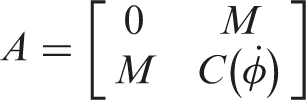
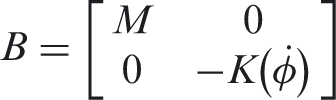
where ( )t is the transpose operator and the augmented matrices A, B are defined by
Considering the general solution to equation (4) and the unsymmetric nature of the matrices A, B, the state space problem admits a generalized eigenproblem (6a) and an associated dual one (6b) with the same eigenvalues
where rϒ and lϒ denote the right and left eigenvector matrices of the state space system respectively, whose kth column holds
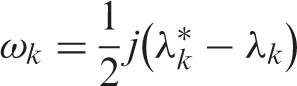
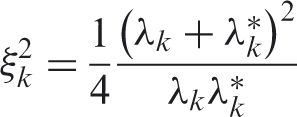
where Θk is the kth left eigenvector of the homogenous part of equation (1) and Λ contains the nδ couples of complex conjugate eigenvalues as a function of the natural frequency ωk and modal damping factor ξk deduced by
where j2 = −1 and ( )* is the complex conjugate operator. Thus natural frequencies enable us to plot a Campbell diagram and determine critical speeds.
The well known bi-orthogonality properties of left and right eigenvectors with respect to augmented matrices (Nelson, 1976 and Sui and Zhong, 2006) are written
where αqk, and δqk is the Kronecker symbol.
The right and left eigenvectors {Ψk, Θk} and the bi-orthogonality properties defined in equation (9) permit the uncoupling and solving of equation (1) while reducing cpu-time.
3. A new criterion for rotor mode shape tracking
The homogenous part of equation (1) is solved for each , and provides the set of the first m sorted natural frequencies ωi in ascending order, and the associated right Ψi and left Θi mode shapes; the upperscript stands for the ith speed. Note that the Campbell diagram has to illustrate the evolution of the natural frequency ωΨk related to its own mode shapes Ψk and not the ascending sorted ωk. Defining a criterion that identifies which shape is related to is therefore required since the inequality q ≠ k frequently holds true if crossings occur, i.e. when associated with does not correspond to related to .
Thus developing an efficient correlation indicator, which takes advantage of the bi-orthogonality properties of equation (11), is feasible and could have the following expression
where | | is the modulus operator. We have suggested the name nc2o (normalized cross complex orthogonality) for this criterion as an extension of nco applied to damped gyroscopic structures. Thus, in a complex mode-pairing strategy related to a Campbell diagram, we consider two sets of eigenelements at both and such that nc2o takes the form
where the row and column indicies k, q are related to shapes, at , , and assuming the following correspondences
The weighting matrix is defined by
Remark:
nc2o can be applied to damped gyroscopic structures reduced in the modal basis of the undamped and nonrotating associated structure (Lalanne and Ferraris, 1998). So modal matrices and associated eigenelements have to be used in equation (13).
4. Industrial application
4.1. Finite element model
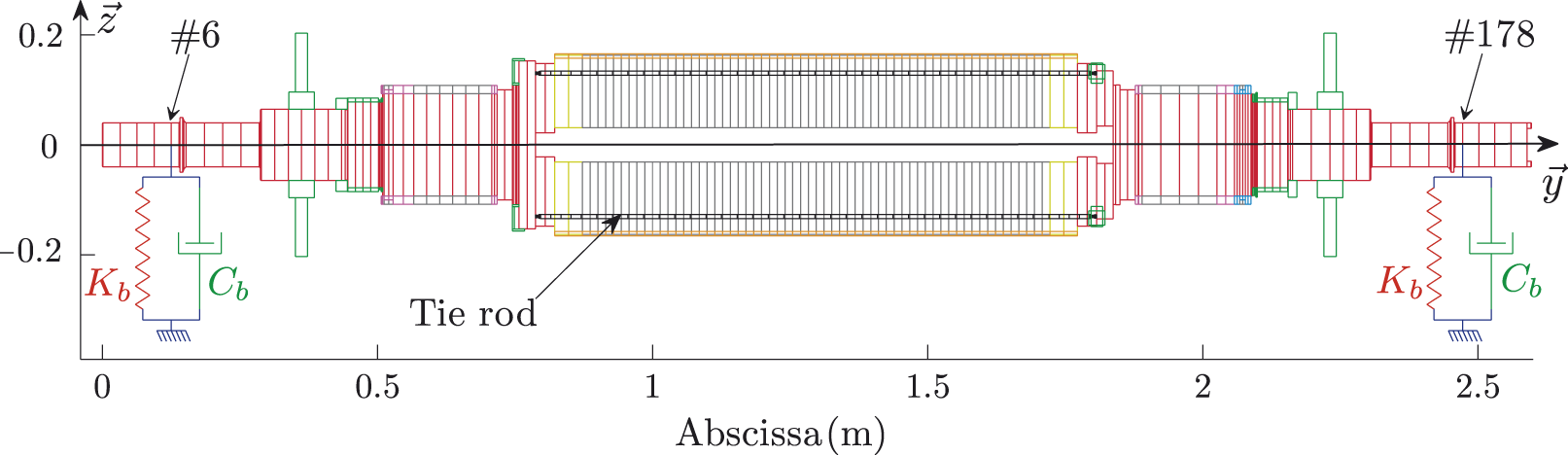
The industrial application consists of an induction rotor made of a prestressed laminated stack with tie rods as presented in Mogenier et al. (2010a, 2010b and 2011). The total mass and length were 1026 kg and 2.6 m. By coupling Timoshenko theory (Przemieniecki, 1985) and the Euler angles ψ, θ, φ, i.e. precession, nutation and intrinsic rotation roughly around , and respectively, the rotor is discretized in Ne = 239 two node elements (nδ = 956 degrees of freedom, DOFs), all of them containing eight DOFs stored in eδ such as
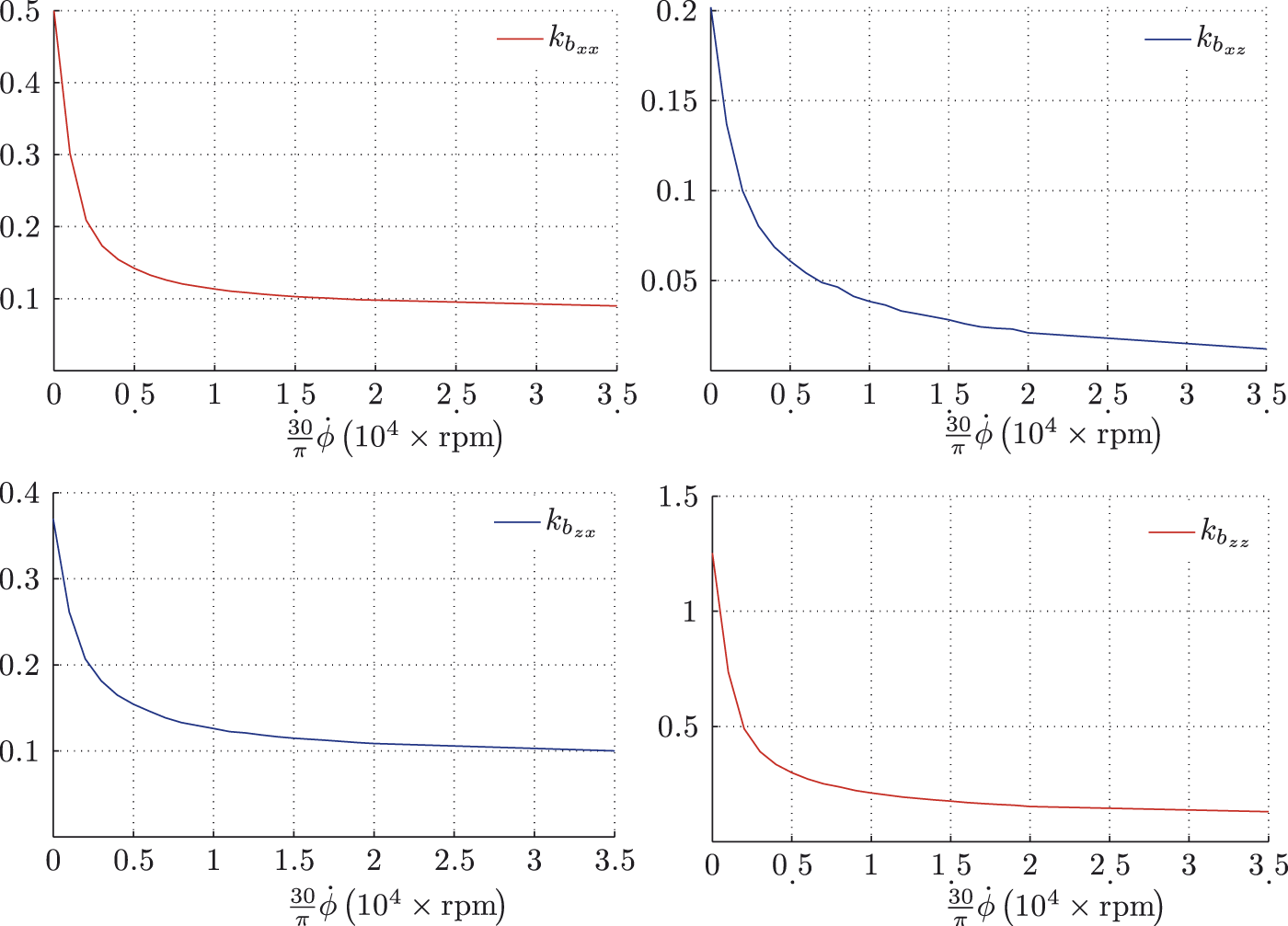
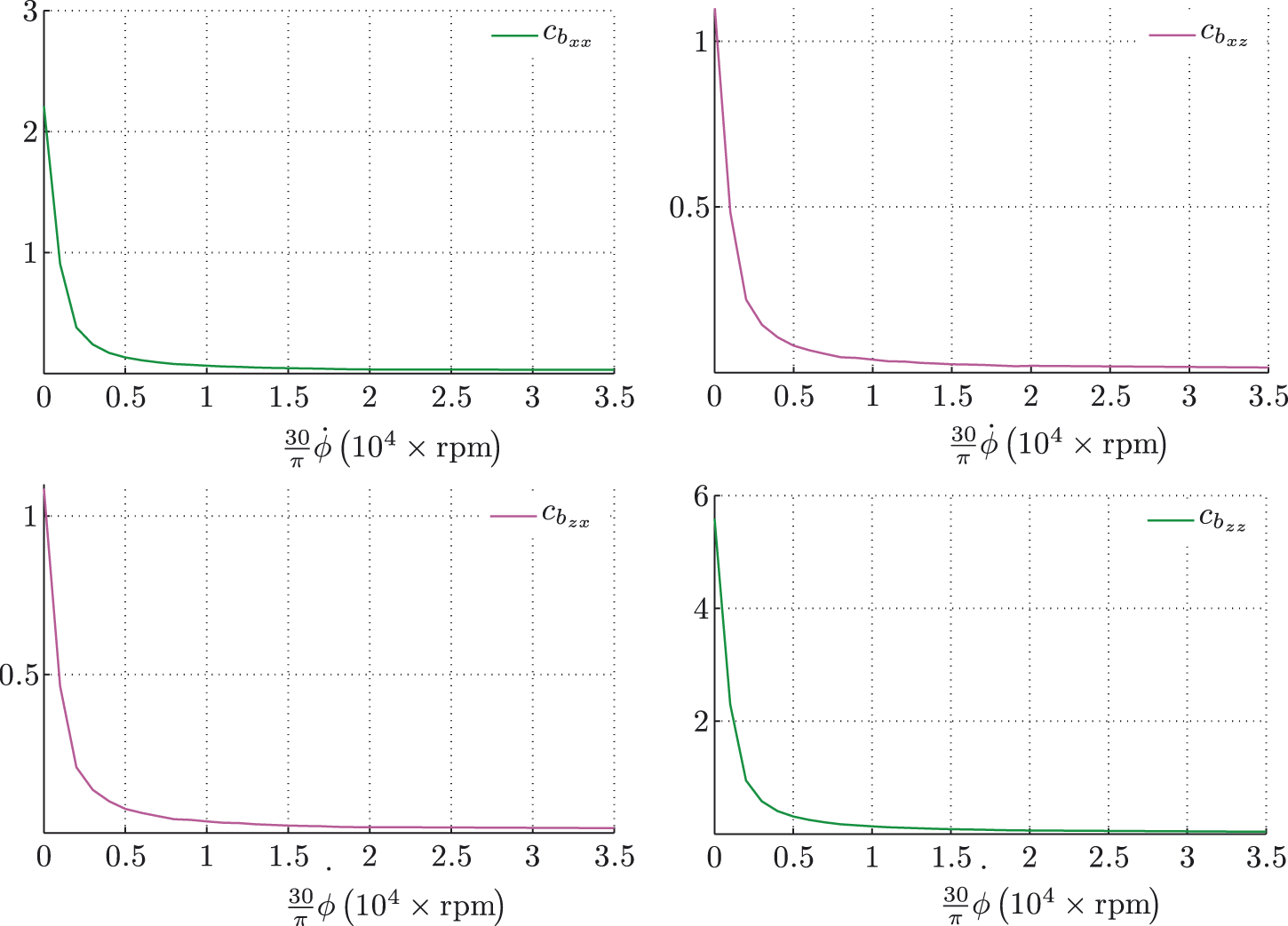
where u, w are lateral DOFs along , respectively while ψ, θ stand for associated rotations around and . It is assumed that the rotor is supported by two identical fluid film bearings located at nodes #6 and #178, see Figure 1. The bearing characteristics are given in Figures 2 and 3 for the [0, 3.5 × 10⁴] rpm speed range.
Branched finite element model of the industrial rotor.
Bearing stiffness (109 × N m−2).
Bearing damping (106 × N s m−1).
Thus both steel disks mounted on shaft-ends as well as bearing stiffnesses and dampings should induce a strongly gyroscopic -dependent dynamic behavior in the rotor.
4.2. Campbell diagram calculation
Natural frequencies and complex mode shapes are obtained by solving equation (6), at each constant speed . For the sake of matrix reduction, the pseudo-modal method is preferred (Lalanne and Ferraris, 1998) by projecting the homogenous part of equation (1) in a nonrotating modal basis containing m = 12 mode shapes, which reduces cpu-time and enables the introduction of modal damping factors e.g. 1% on each mode.
Moreover the speed of rotation dependence of bearing characteristics involves the calculation of a new modal basis at each , by solving the eigenvalue problem
with Λ0 containing undamped eigenvalues, at rest.
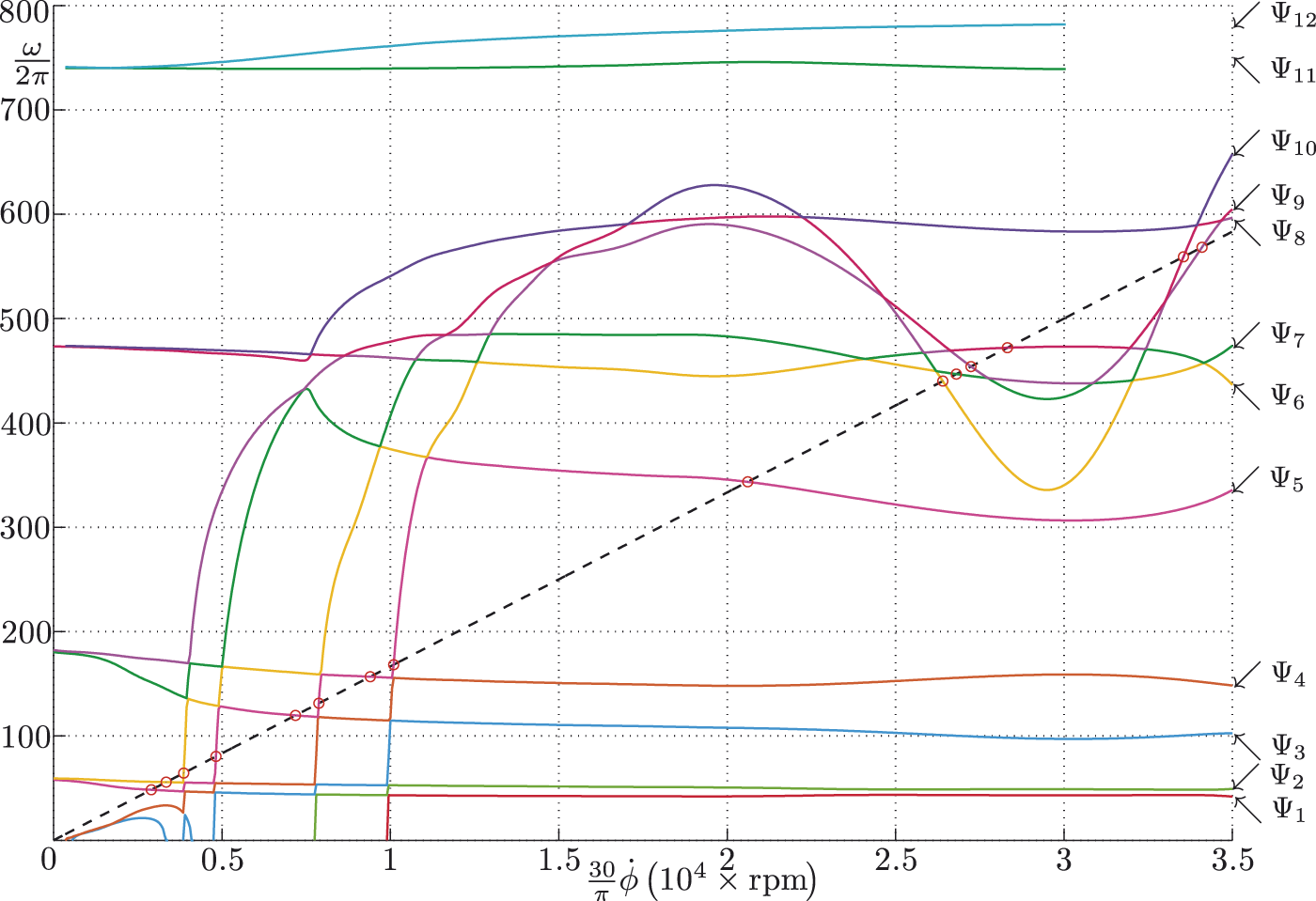
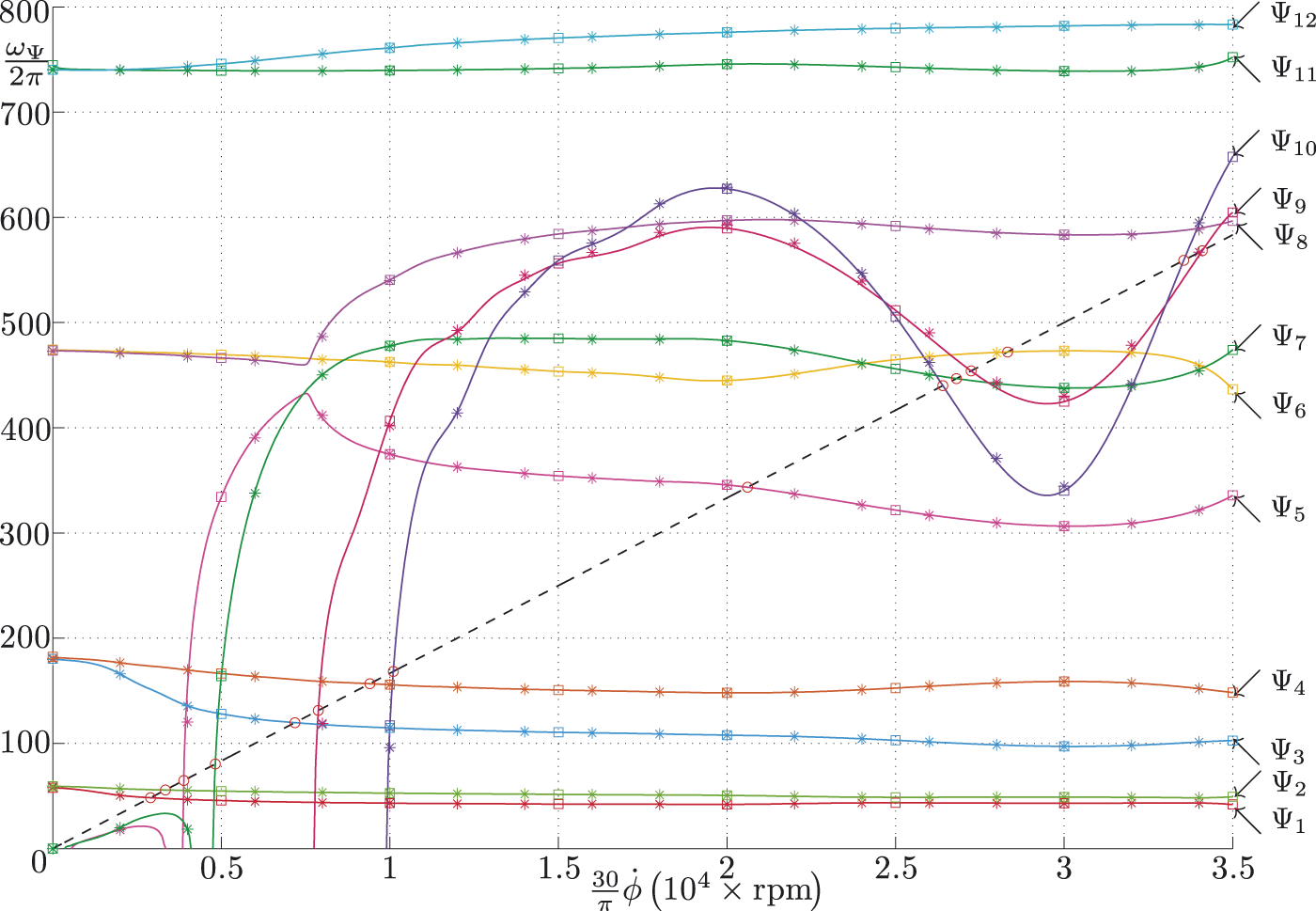
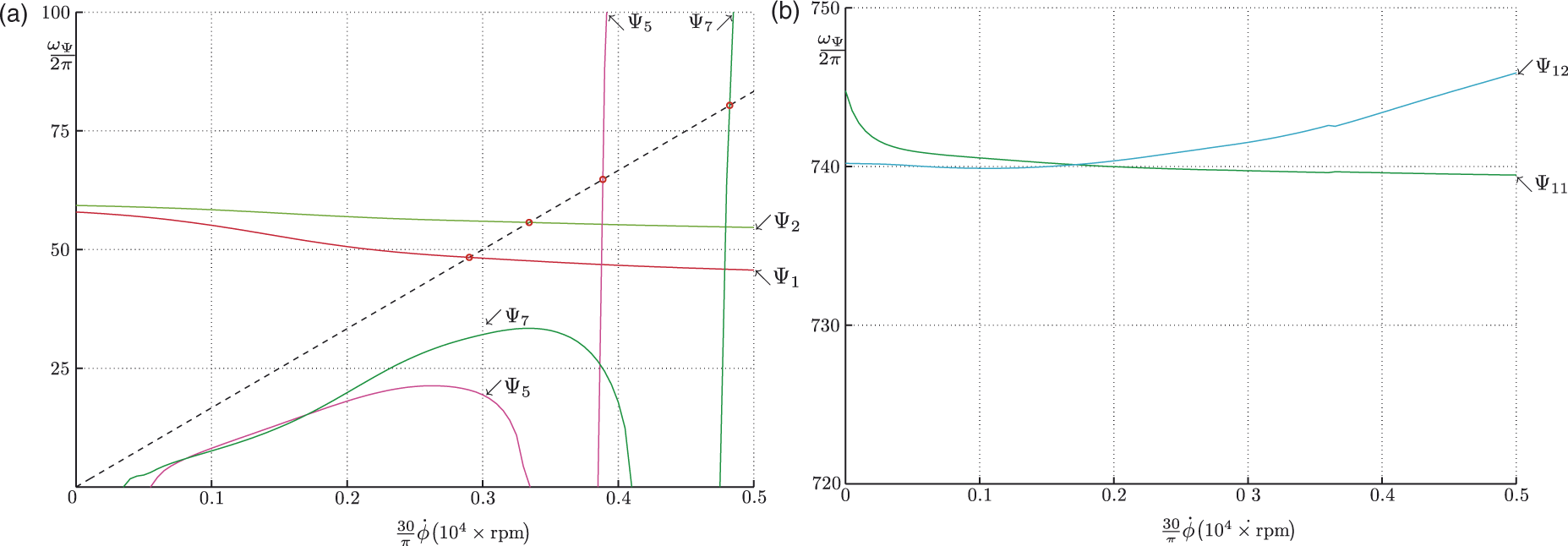
By setting the step of speed of rotation at 50 rpm, an initial Campbell diagram can be illustrated in Figure 4 as the evolution of the first m natural frequencies ω sorted in ascending order, i.e. without using a mode-pairing process. On the other hand, Figure 5 presents the Campbell diagram which benefits from a mode-pairing process, especially the one using the nc2o criterion. It should be noted that complex shapes are arbitrarily indexed, at the upper bound , by associating them with the indicies of the corresponding sorted natural frequencies in ascending order. Actually, the Campbell diagram shows several crossing and veering phenomena and it may be stated that each natural frequency crosses another in the considered speed range, see Figure 6. Indeed one veering occurrence clearly appears between complex shapes Ψ5 and Ψ8 around 7.5 × 10³ rpm. Furthermore no fewer than 56 crossing occurrences can be counted between the first m natural frequencies which demonstrates the strongly -dependent behavior of the supported rotor.
A Campbell diagram without mode pairing. Natural frequencies are plotted in Hz. The circles (○) and dashed line (–) indicate critical speeds and 1× excitation respectively.
A Campbell diagram using the nc2o mode pairing for different -steps: 5 × 101 (−), 2 × 10³ (*) and 5 × 10³ rpm (□).
Enlargement of a Campbell diagram emphasizing crossing phenomena between: (a) Ψ1, Ψ2 and Ψ5 and (b) Ψ7, Ψ11 and Ψ12.
5. Overcoming veering and crossing phenomena
To prove the nc2o criterion, Figure 5 includes star and square symbols which correspond to Campbell diagrams obtained with speed of rotation steps of 2 × 10³ rpm and 5 × 10³ rpm respectively. Although the latter steps are larger than the initial step (continuous lines), all of the Campbell diagrams coincide whatever their step lengths and crossings or veerings, e.g. it can be stated that ωΨ9 and ωΨ10 cross other natural frequencies 13 and 16 times, respectively. This underlines the efficiency of nc2o in the mode-paring process, which provides Campbell diagrams that allow any mode shape tracking.
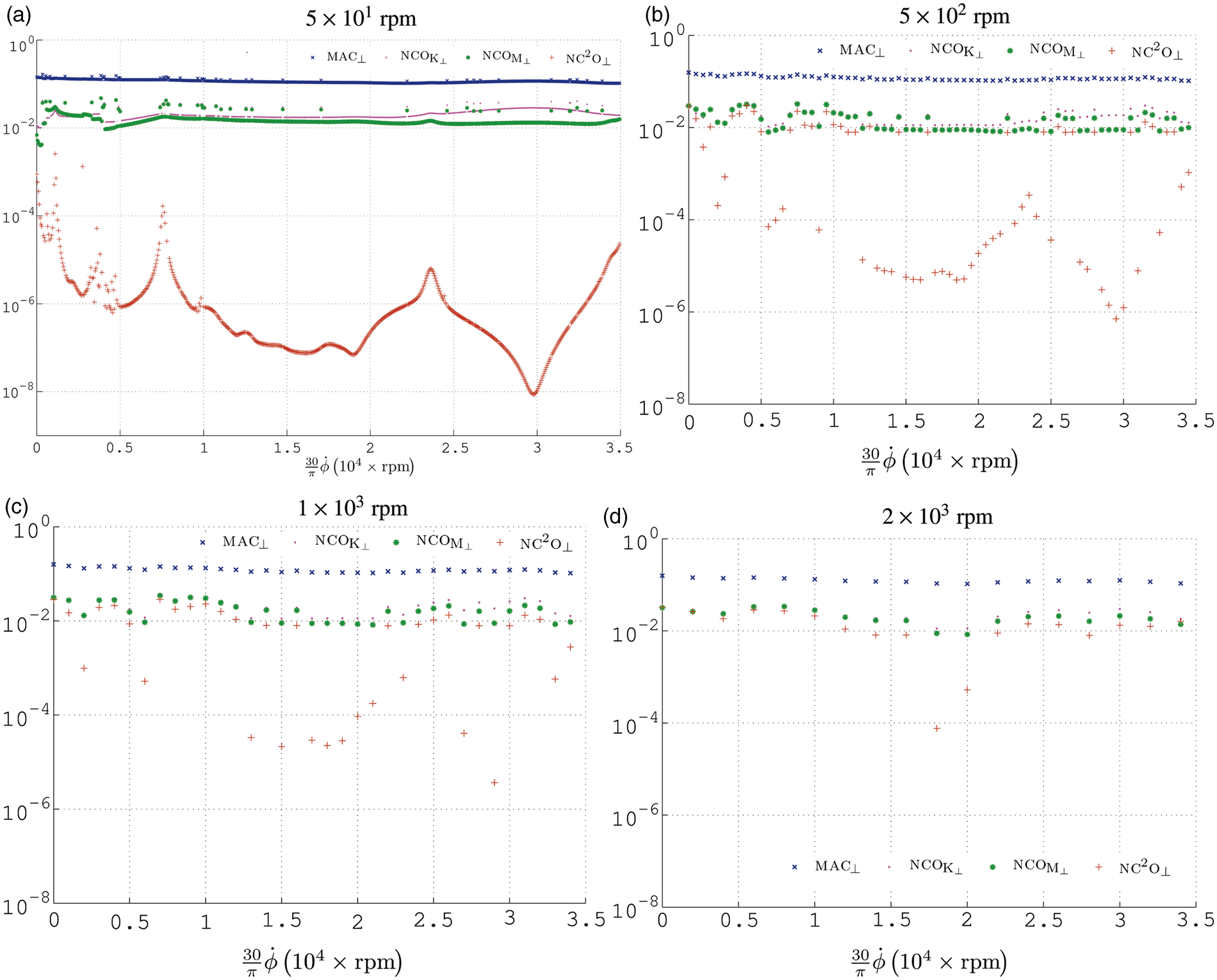
In addition, Figure 7 presents the following quantities
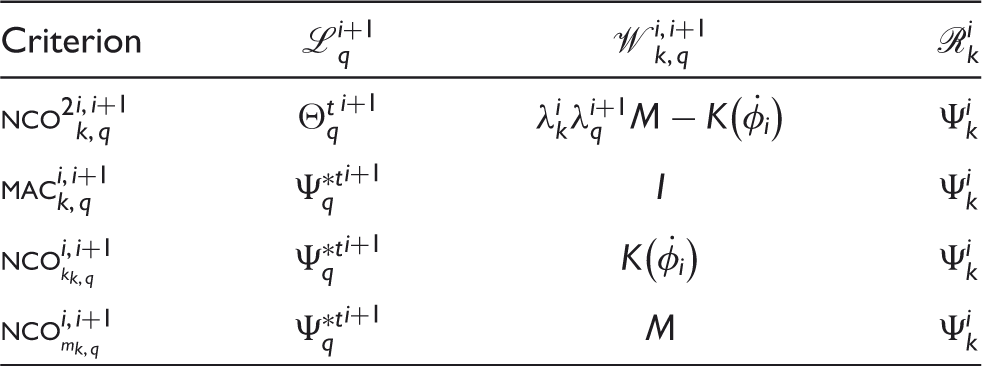
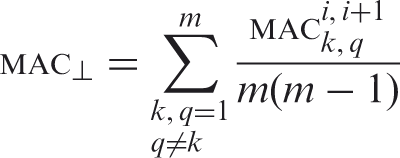
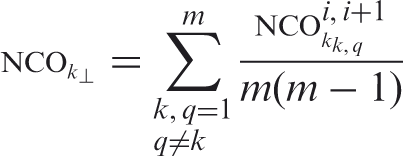
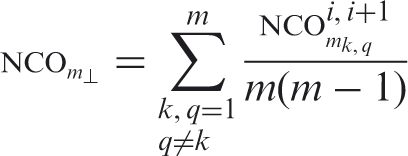
as averages of the off-diagonal terms of the well known correlation criteria listed in Table 1. For different step sizes of rotation speed, Figure 7 underlines the difference of order of magnitude between the off-diagonal terms of the nc2o and the other criteria evaluated at speeds , , with regard to the Campbell diagram shown in Figure 5. The mac off-diagonal terms are of the order of 10−1 while those related to the nco calculated either with the mass or stiffness matrices are of the order of 10−2. Nevertheless, there is a significant difference in comparison with those terms provided by nc2o which are mainly of the order of 10−6 and reach 10−8. As a result, small terms greatly facilitate the pairing process, and also argue for using a correlation criterion based on bi-orthogonality properties.
Off-diagonal term averages of mac⊥ (×), ncok⊥ (.), ncom⊥ (*) and nc2o⊥ (+) correlation criteria for different step sizes.
Correspondences between correlation criteria
Criterion
I
M
5.1. Veering
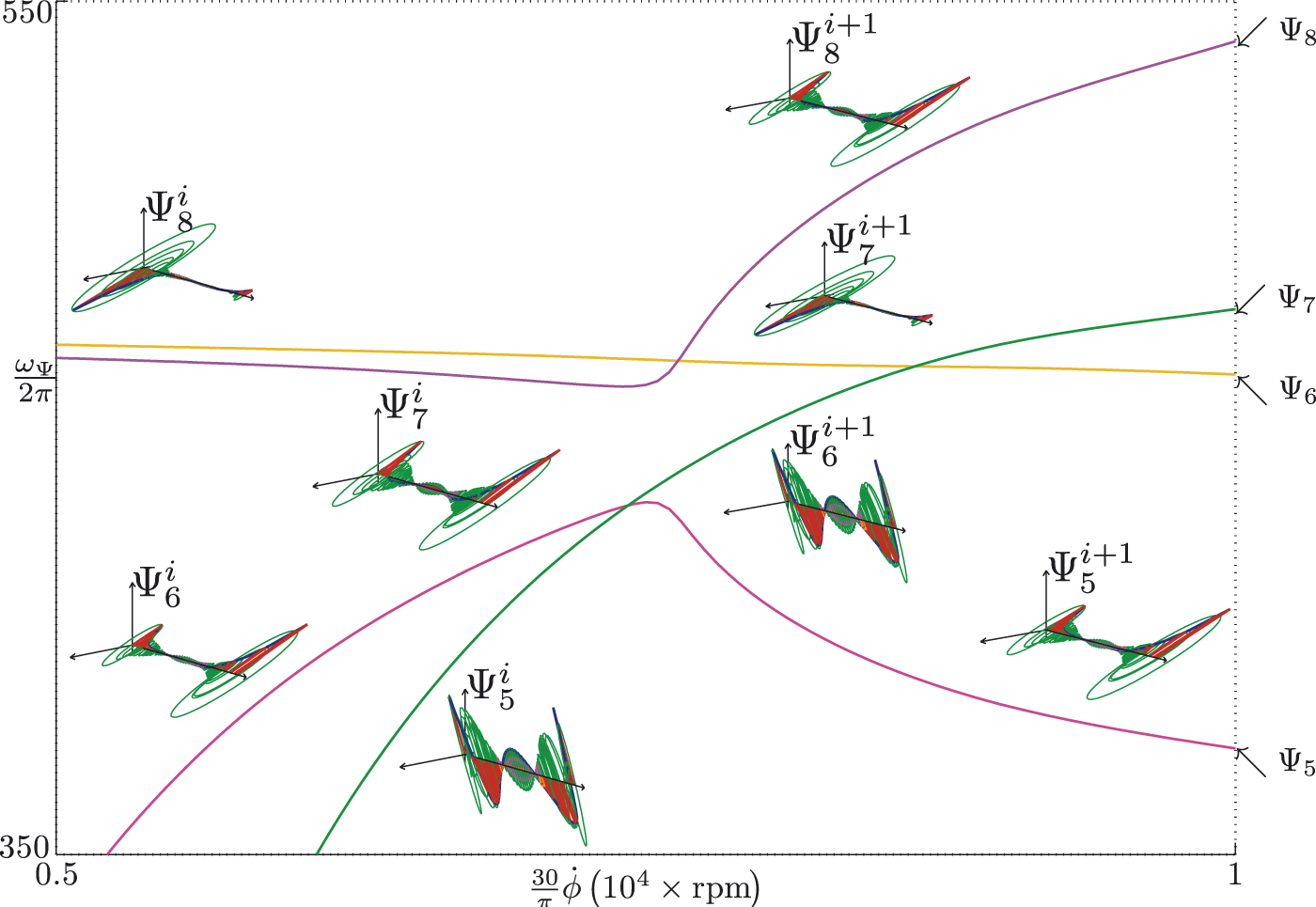
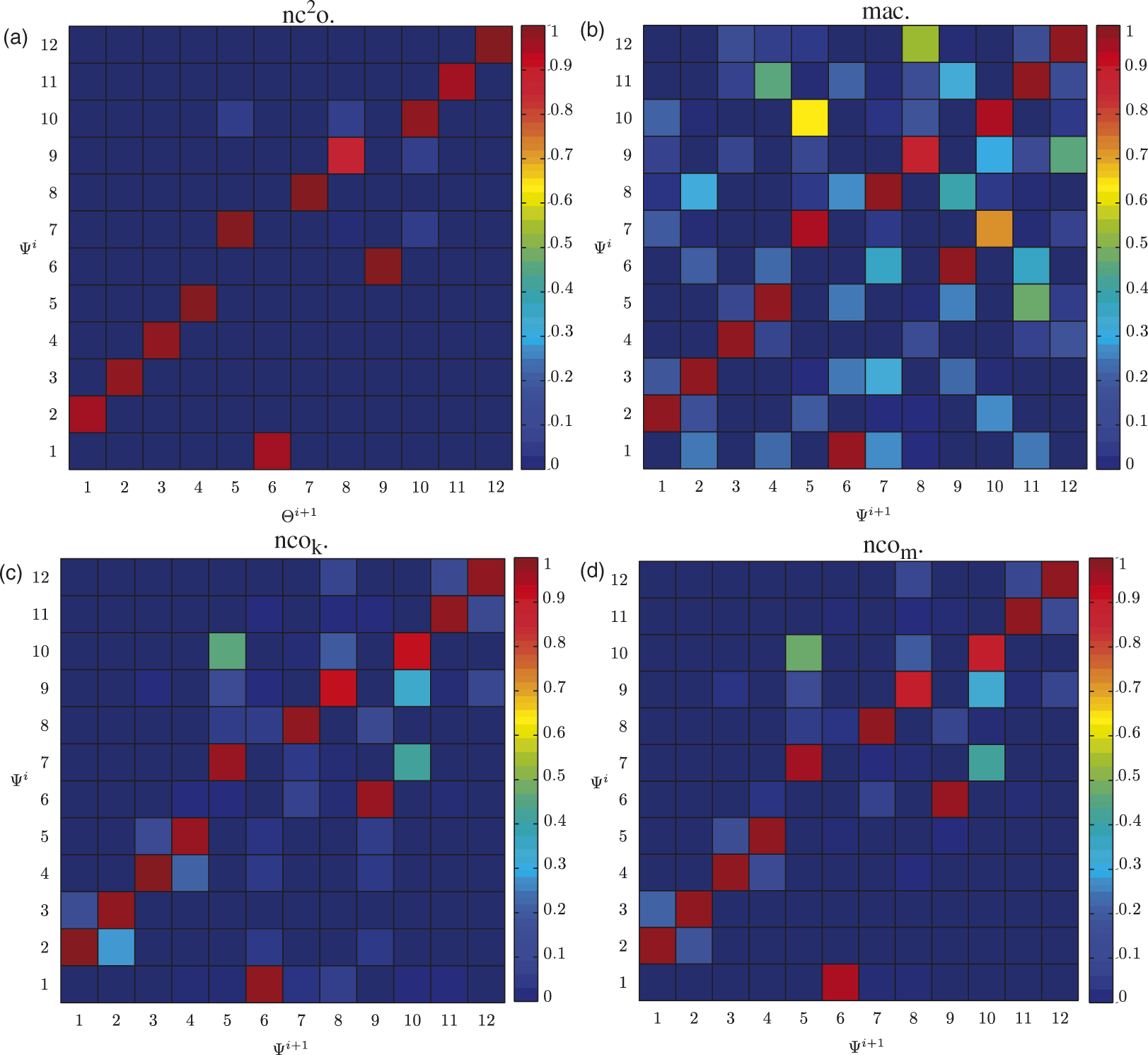
A veering obviously appears between complex shapes Ψ5 and Ψ8 around 7.5 × 10³ rpm as shown in the zoom-in plotted between speeds rpm and rpm in Figure 8. Indeed, the natural frequencies ωΨ5 and ωΨ8 tend to get closer in the vicinity of 7.5 × 10³ rpm while being crossed by ωΨ7 and ωΨ6 respectively. Actually, Figure 9(a) shows that this phenomenon is distinctly noticed by the nc2o criterion by correlating shapes to to shapes , , and respectively.
Veering phenomenon between 7.4 × 10³ and 7.65 × 10³ rpm.
Criteria calculated between 7.4 × 10³ and 7.65 × 10³ rpm.
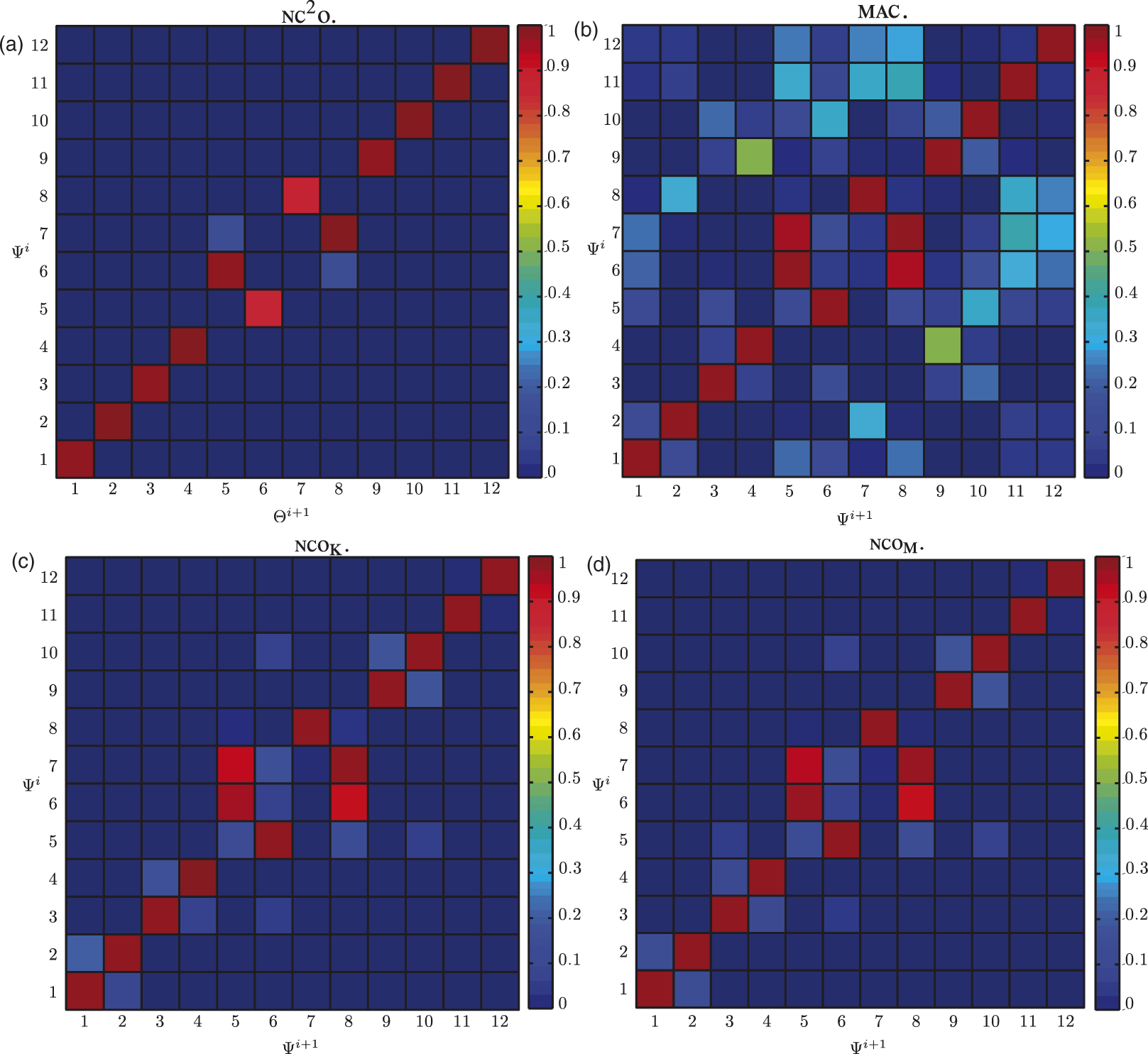
On the other hand, whatever the correlation criteria illustrated in Figure 9(b)–(d), artefacts occur, e.g. correlation terms higher than 0.9, which correlate artificially the shape to shapes and . Moreover, in the same way the shape seems to also correspond to shapes and whereas Figure 8 proves the contrary.
The notion of difference of order of magnitude between nc2o terms is significantly highlighted by Figure 9(b), which illustrates mac matrix calculated with right mode shapes Ψ, and Figure 9(a) that shows the nc2o matrix emanated from right and left eigenelements {Λ, Θ, Ψ} at the same speeds. It can be seen that the mac terms associated with a pair of noncoincident complex mode shapes can be higher than 10−1 (0.5) whereas those obtained with the nc2o reach 10−4, see Figure 7.
5.2. Crossing
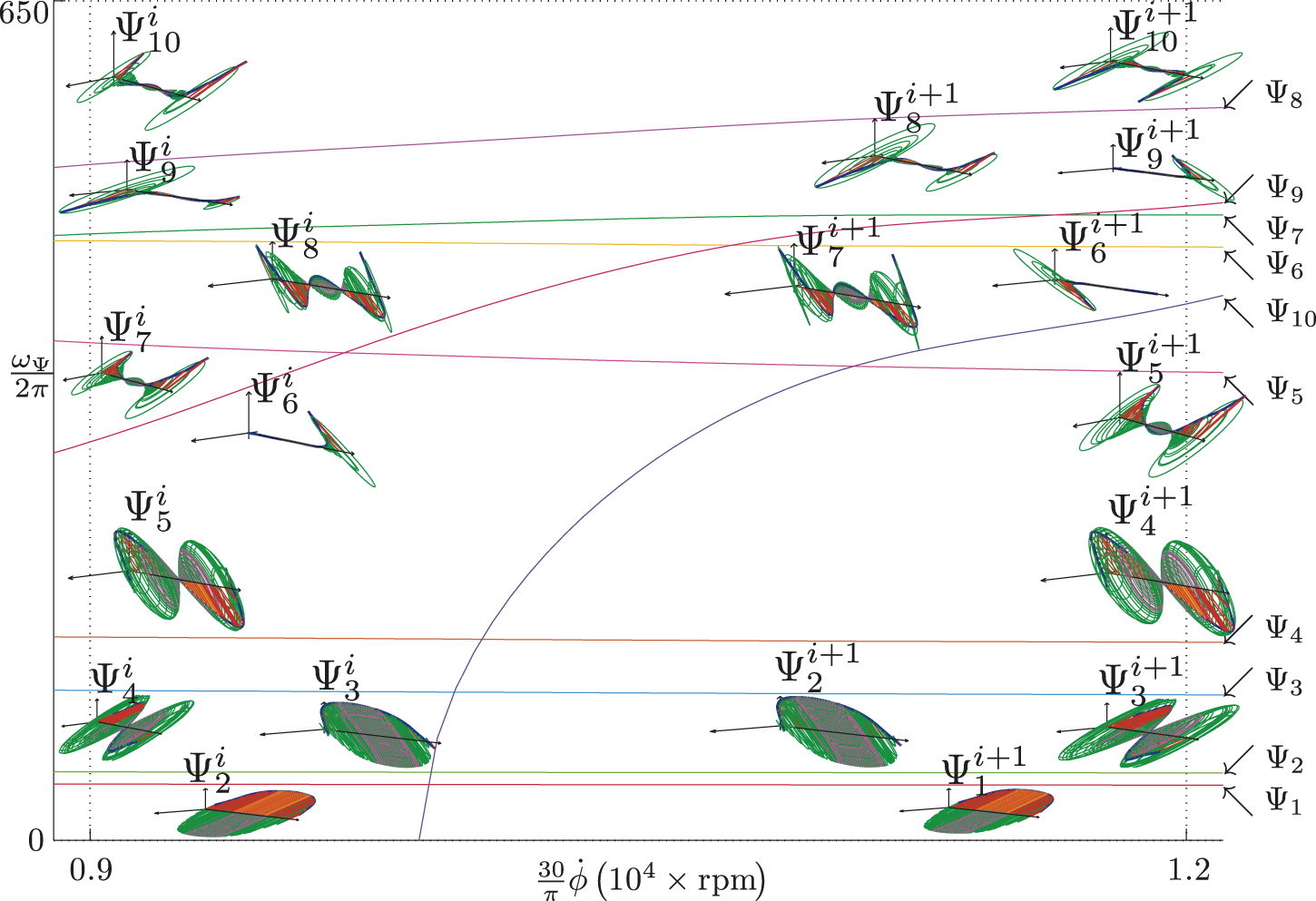
As previously mentioned, several crossing occurrences appear between the first m natural frequencies ωΨ in the speed range. It can be stated that ωΨ9 and ωΨ10 cross other natural frequencies 13 and 16 times, respectively. Figure 10 presents a zoom-in of Figure 5 between rpm and rpm while Figures 11(a)–(d) represent the nc2o, mac, ncok and ncom correlation matrices respectively.
Crossing phenomena between 9 × 10³ and 1.2 × 10⁴ rpm.
Criteria calculated between 9 × 10³ and 1.2 × 10⁴ rpm.
Even if correlation criteria were calculated between speeds far from the one at which veering occurs, the mac suggests a virtual correlation between the shapes subjected to veering and associated to ωΨ5 and ωΨ8, i.e. the 7th and 10th mode shapes , calculated at and the 10th and 5th shapes , calculated at . Indeed, the noncorrespondence terms of the mac are higher than 10−1 (0.7) whereas both ncok and ncom provide terms of order of 0.5.
In addition to the fact that nc2o is not disturbed by high-value terms, and despite being evaluated between speeds spaced out over 3 × 10³ rpm, Figure 11(a) shows a good correspondence between complex shapes of the -interval bounds, and is therefore in good agreement with Figure 10.
5.3. Assessment
Figures 9(a) and 11(a) indicate that the nc2o criterion presents a typically binary behavior due to the Kronecker symbol of equation (12), i.e. two sets of noncoincident eigenelements involving terms that are almost null. Furthermore it has been stated that veering phenomena are clearly observed and distinguished by the nc2o, the latter being set without any disturbed term values such as doubloons or artefacts significantly higher than zero, as appear in the mac, see Figure 9(b) or Figure 11(b). Consequently, nc2o does not possess any of the drawbacks of the other criteria and is an efficient criterion either to pair complex shape bases or to track any complex mode shape, particularly in Campbell diagram cases.
6. Mode shape-pairing process
By correlating two bases of complex shapes Ψi and Ψi+1 at speeds and , the mode shape-pairing process provides correspondence between the kth natural frequency and the qth one . It makes identification of the natural frequencies ωΨk associated with their own shape possible. Then let ς be the index matrix which satisfies
Qualitatively, mode-pairing process could be envisaged, between , , as a double-entry table whose row and column correspond to mode shapes Ψi, Ψi+1 respectively, the latter ones being related to sorted natural frequencies ωi, ωi+1 in ascending order. By subsequently comparing row and column shapes, it becomes pertinent to associate coincident mode shapes of both sets Ψi, Ψi+1. Quantitatively, digital translation of this table should consist of assigning to cells of coordinates (k, q) distinct values to pair coincident shapes , and noncoincident ones.
Thus, choosing any correlation criterion might be a solution to incrementing this table, but a more efficient solution consists of using the nc2o correlation matrix which benefits from bi-orthogonality properties according to the coincidence degree of the mode shapes Ψi and Ψi+1, and then assigning values with a high difference in order of magnitude. Thereby the ς matrix may be incremented as follows
by associating of the kth row with of the q*th column, and consequently with , i.e. . The process consists of an iterative procedure that evidently requires an initialization setting conveniently defined by
Finally, Algorithm 1 yields the classification of natural frequencies with respect to their own complex mode shapes, and provides Campbell diagrams as illustrated by Figure 5, i.e. as an evolution of ωΨ rather than ω, versus , see Figure 4.
7. Conclusion
A novel correlation criterion was proposed by taking advantage of the bi-orthogonality properties of the right and left eigenvectors of damped gyroscopic structures. The nc2o criterion greatly facilitates rotor mode shape pairing even if its associated natural frequencies are highly dependent on the speed of rotation. As a numerical test, the proposed criterion was tested on an industrial application by taking into account hydrodynamic bearings characteristics, the latter being strongly -dependent. Moreover, it should be observed that the tested rotor is not an academic case since its gyroscopic effect and bearings properties give it highly speed-of-rotation varying behavior as illustrated by the Campbell diagram bringing out significant and unusual veerings and crossings phenomena.
The robustness of the nc2o was shown firstly by using different step sizes of speed of rotation from 5 × 101 rpm to one hundred times more and secondly by comparing the low values of the off-diagonal terms of the nc2o with those of classical correlation criteria. This showed numerically the efficiency of the criterion in the mode-pairing process by illustrating the evolution of each natural frequency associated with its own complex mode shape. Furthermore, note that a 5 × 10³ rpm step size is very large since the Campbell diagram, Figure 5, contains only seven different speeds of rotation over the considered speed range from 0 to 3.5 × 10⁴. It should be noted that the key here is to present a criterion which provides an efficient tracking of natural frequencies that are highly -dependent. This tracking makes sense only if the Campbell diagram is plotted with a relatively fine step of rotation speed in such a way that all the changes in natural frequency can be tracked and observed.
Finally, a way to improve the robustness of the nc2o might be to consider other mechanical systems which are complex, implying important eigenelements changes with respect to mechanical parameters such as modes of coalescence in rubbing systems.
Footnotes
Acknowledgements
The authors thank Converteam for its technical assistance and its authorization to publish this research.
Funding
This work was supported by CONVERTEAM (grant number 4300028086/C03) and ANRT (grant number 447/2007).
References
1.
Allemang R and Brown D (1982) A correlation coeffcient for modal vector analysis. In: 1st international modal analysis conference (IMAC), Orlando, USA, 8–10 November 1982, pp. 110–116. New York: Union College.
2.
BavastriCFerreiraEEspíndolaJ (2008) Modeling of dynamic rotors with flexible bearings due to the use of viscoelastic materials. Journal of the Brazilian Society of Mechanical Sciences and Engineering30(1): 22–29.
3.
BlaschkePEwinsDJ (1997) Themacrevisited and updated. Proceedings of SPIE, the International Society for Optical Engineering3089(1): 147–154.
4.
Bodel C (2009) Opérateur mac_modes. Report No. U4.52.15, Analyse modale, Code_Aster, France.
5.
BrehmMZabelVBucherC (2010) An automatic mode pairing strategy using an enhanced modal assurance criterion based on modal strain energies. Journal of Sound and Vibration329(25): 5375–5392.
6.
DimentbergF (1961) Flexural Vibrations of Rotating Shafts, London: Butterworth.
7.
Du BoisJAdhikariSLievenN (2009) Eigenvalue curve veering in stressed structures: An experimental study. Journal of Sound and Vibration322(4–5): 1117–1124.
8.
EwinsDJ (1984) Modal Testing: Theory and Practice, Philadelphia: Research Studies Press.
9.
GentaG (2005) Dynamics of Rotating Systems, New York: Springer.
10.
GmürT (1997) Dynamique des Structures: Analyse Modale Numérique, Lausanne: Presses Polytechniques et Universitaires Romandes.
11.
HeylenWJanterT (1990) Extensions of the modal assurance criterion. Journal of Vibration, Acoustics, Stress, and Reliability in Design112(4): 468–472.
12.
KhuliefYMohiuddinM (1997) On the dynamic analysis of rotors using modal reduction. Finite Elements in Analysis and Design26(1): 41–55.
13.
LalanneMFerrarisG (1998) Rotordynamics Prediction in Engineering, New York: John Wiley & Sons.
14.
LeeC (1993) Vibration Analysis of Rotors, Boston: Kluwer Academic Publishers.
15.
Lieven N (1994) Error location using normalised orthogonality. In: 12th international modal analysis conference, Honolulu, USA, 31 January–3 February 1994, pp. 761–764. New York: Union College.
16.
MeirovitchL (1974) A new method of solution of the eigenvalue problem for gyroscopic systems. AIAA Journal12(10): 1337–1342.
17.
MogenierGBarangerTDufourR (2010a) Identification of constitutive properties of a laminated rotor at rest through a condensed modal functional. Mécanique & Industries11(5): 309–326.
18.
MogenierGDufourRFerraris-BessoG (2010b) Identification of lamination stack properties. Application to high speed induction motors. IEEE Transaction on Industrial Electronics57(1): 281–287.
19.
MogenierGBarangerTDufourR (2011) Efficient model development for an assembled rotor of an induction motor using a condensed modal functional. Journal of Computational and Nonlinear Dynamics6(2): 1–8.
20.
MoralesC (2005) Comments on themacand thencoand a linear modal correlation coefficient. Journal of Sound and Vibration282(1–2): 529–537.
21.
NelsonR (1976) Simplified calculation of eigenvector derivatives. AIAA Journal14(9): 1201–1205.
22.
PerkinsNMoteCJr (1986) Comments on curve veering in eigenvalue problems. Journal of Sound and Vibration106(3): 451–463.
23.
PrzemienieckiJS (1985) Theory of Matrix Structural Analysis, New York: Constable.
24.
SaitoACastanierMPierreC (2009) Estimation and veering analysis of nonlinear resonant frequencies of cracked plates. Journal of Sound and Vibration326(3–5): 725–739.
25.
SuiYZhongW (2006) Eigenvalue problem of a large scale indefinite gyroscopic dynamic system. Applied Mathematics and Mechanics27(1): 15–22.
26.
TingTChenTTwomeyW (1993) Correlating modes shapes based on the modal assurance criterion. Finite Elements in Analysis and Design14(4): 353–360.