






Abstract
In the present paper the continuous model method is applied to the prototype of a wind turbine tower in order to perform its modal structural analysis. This mathematical analysis is used as an alternative approach to the modal analysis method that uses discrete models. It is well known that in discrete models with high-level discretization and a large number of finite elements, several open questions on the accuracy, the convergence and the stability of the solution arise during the modal or response history analysis. In this sense, the results of the analysis by means of discrete modeling are in several cases doubtful and, therefore, a modal analysis by applying a continuous model as an effective alternative is recommended. To this end, the present paper proposes a continuous model approach to calculate the eigen-frequencies, periods and mode shapes to a wind turbine tower prototype. Starting from the equilibrium of forces on a differential element of the structure, the equation of motion of the tower is formulated and using in turn the known boundary conditions at the two ends of the wind tower, the tower eigen-problem is numerically treated and solved. The action of the higher mode-shapes is very important and may become critical in the case that the tower is subjected to strong dynamic loading (cf. e.g. wind) and simultaneously is excited by a strong seismic motion.
1. Introduction
The wind energy market is nowadays considered as the most promising sector of renewable energies due to the fact that wind energy is expected to correspond to the biggest part of energy produced by renewable energy systems during the next decades (Baniotopoulos et al., 2010; Gasch and Twele, 2012). To this end, a plethora of Aeolian parks corresponding to a very significant number of new generation wind energy structures needs to be installed. These new generation wind energy structures correspond to strong wind turbines (2–7.5 MW) supported by high towers (70–150 m) corresponding in most cases to the steel tubular tower type. During the next decade, such wind energy structures are expected to be designed even higher tending to a duplication of their height, a fact that introduces a lot of structural analysis issues (Stavroulakis, 2009). Recently, a special mathematical model of a horizontal axis wind turbine with flexible tower and blades developed by Kessentini et al. (2010), where the eigen-value problem was solved both analytically and numerically using the differential quadrature method. On the other hand, the use of finite element method at tower analysis in combination with the identification of tower dynamic characteristics via ambient vibrations is often a common technique for the substantiation of the tower modeling (Bayraktar et al., 2011).
From a structural engineering point of view, a wind turbine tower is a cantilever whose section forms a thin-walled cylindrical shell. Although this structural system macroscopically seems to be very simple for analysis, a lot of difficulties appear due to the complexity of both the combination of the acting static, quasi-static and dynamic loadings and the complicated form of the detailing of the structure (Lavassas et al., 2003). As a matter of fact, during the tower analysis several significant issues arise (cf. e.g. the local buckling analysis of the shell structure, the stress concentration states around the openings and the tower modal analysis) that need to be thoroughly examined (Baniotopoulos et al., 2004).
In the present paper a method is proposed for the effective calculation of the mode-shapes of the aforementioned towers. In particular, a modal analysis of a prototype tubular tower clamped at its bottom is carried out by applying the well-known continuous model method (Clough and Penzien, 1975; Chopra, 1995). Note that the results obtained by applying the continuous model correspond always to the exact solution of the problem as it constitutes a closed mathematic solution. Thus, considering a model with continuously distributed mass and flexural stiffness, the problem of the tubular tower mode-shapes is first formulated in its mathematical form and in turn, treated numerically, so that the relevant mode-shapes of the tower can be obtained. The proposed approach is illustrated by means of a numerical application that concerns the prototype of a steel wind turbine tubular tower.
2. Formulation of the problem
2.1. Equation of motion without damping
In order to formulate the equation of motion of a wind turbine tower, which has distributed flexural rigidity Tower with continuous distributed mass and flexural stiffness.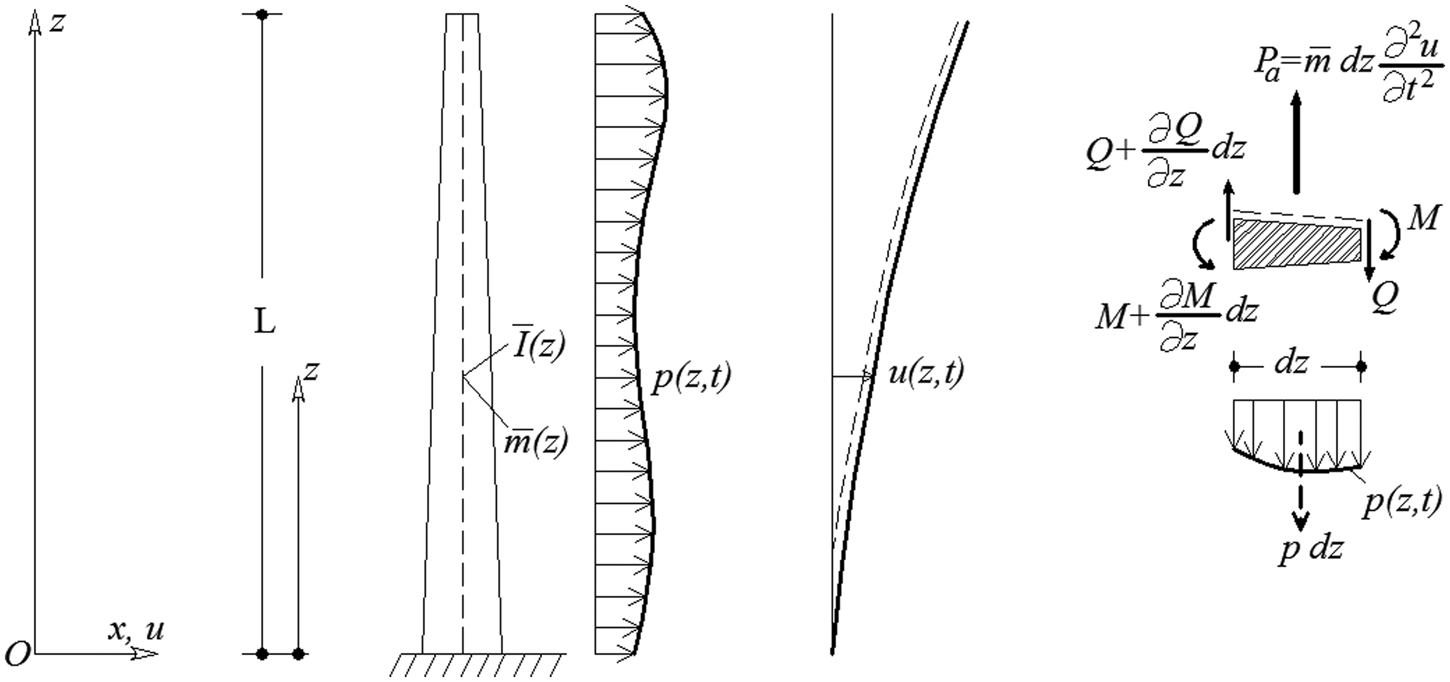
Consider the general loading case, where the tower is subjected to an external distributed dynamic loading
In the case that inertial moment associated with angular acceleration of the element is neglected, then the equilibrium of moment on the middle surface of the differential element dz leads to the following equation
Furthermore, considering that shear deformation and higher-order infinitesimals are neglected and using equations (1) and (2), the displacement
Inserting equations (2) and (3) into equation (1), the following relation is obtained
In order to obtain a unique solution to equation (4), two boundary conditions at each end of the wind turbine tower are considered. In particular, the wind turbine tower is considered to exhibit (fully) fixed boundary conditions, whereas its top is free.
2.2. Translational horizontal seismic excitation at the tower base
In order to examine the case of the seismic translational excitation at the tower base, the total displacement
Inserting equations (2) and (3) into equation (6), the following relation is obtained
Comparing equations (4) and (7), it comes out that the case of the seismic excitation on the tower base is identical with the case of the response of the wind tower subjected to external dynamic forces Tower subjected to seismic horizontal translational excitation at its base.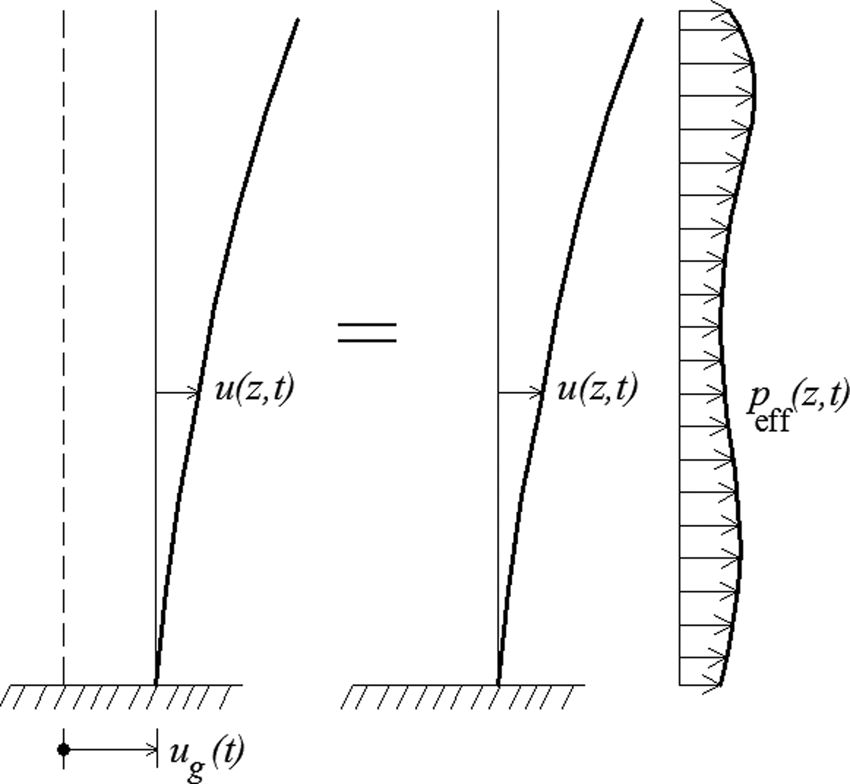
It is worthy to underline that equation (7) is the basic equation of motion of the wind turbine tower for its horizontal seismic vibration due to horizontal translational seismic excitation at its base. Based on equation (7), the tower mode-shapes are analytically calculated in the following sections.
2.3. Formulation of the tower eigen-problem
In order to calculate the natural vibration frequencies of the tower, the case of free vibration of the wind tower is first considered. In this case, equation (7) is expressed in the form
The solution of equation (9) should had the form
Thus
Inserting equation (11) into equation (9) the following relation is obtained
The left-hand part of equation (13) is a function of only one variable (time t), whereas the right-hand part depends only on the length z. In order for the previous equation (13) to have a solution for all values of time t and height z, the two parts have to be constant and equal to the same positive amount, say
It is clear that equation (14) represents the free vibration of an single degree of freedom system with circular frequency ω, while equation (15) represents the eigen-problem of the wind turbine tower.
In the case where both functions, the flexural rigidity
3. Mathematic analysis
3.1. Data of the wind turbine tower
The prototype of the tubular wind tower at hand carries a 2 MW wind turbine. The height of the tower is L = 76.15 m and the total height of the wind turbine including the rotor and the blades is 123 m. The shell diameter at the base is 4.30 m and the diameter at the tower top is 3.0 m, linearly decreased. Shell thicknesses vary from 30 mm at the bottom to 12 mm at the top, linearly. The steel quality of the tower body is S355, while its modulus of elasticity is Ε = 210 GPa. It is worthy to note that the steel tower is embedded into the reinforced concrete foundation, where fixed conditions are engaged. The self-weight of the tower is 1422 kN and the blade self-weight is
In order to calculate the total distributed mass
3.2. Solution of tower eigen-problem
Taking into account the abovementioned tower data and inserting equations (16) and (17) into equation (15), the following relation is obtained
Next, by setting
This solution contains four unknown coefficients,
Thus, taking
Similarly, applying
Thus,
Applying the two boundary conditions at the free end of the wind tower (for z = L), where the flexural moment and the shear force are both zero (namely,
The shear force
Rewriting equations (25) and (27) in matrix form, the following system is formulated
It is worthy to note that in order to calculate numerically the mode-shapes, the nonzero solution of the above system has to be calculated according to the procedure described in the next section. In addition, in order for a nonzero solution for equation (28) to exist, its determinant has to be zero
4. Numerical application – modes shapes
With respect to the calculation of the parameter Graphic numerical solution for finding of the first three roots Circular and cyclic frequencies. Periods of the wind tower with fixed base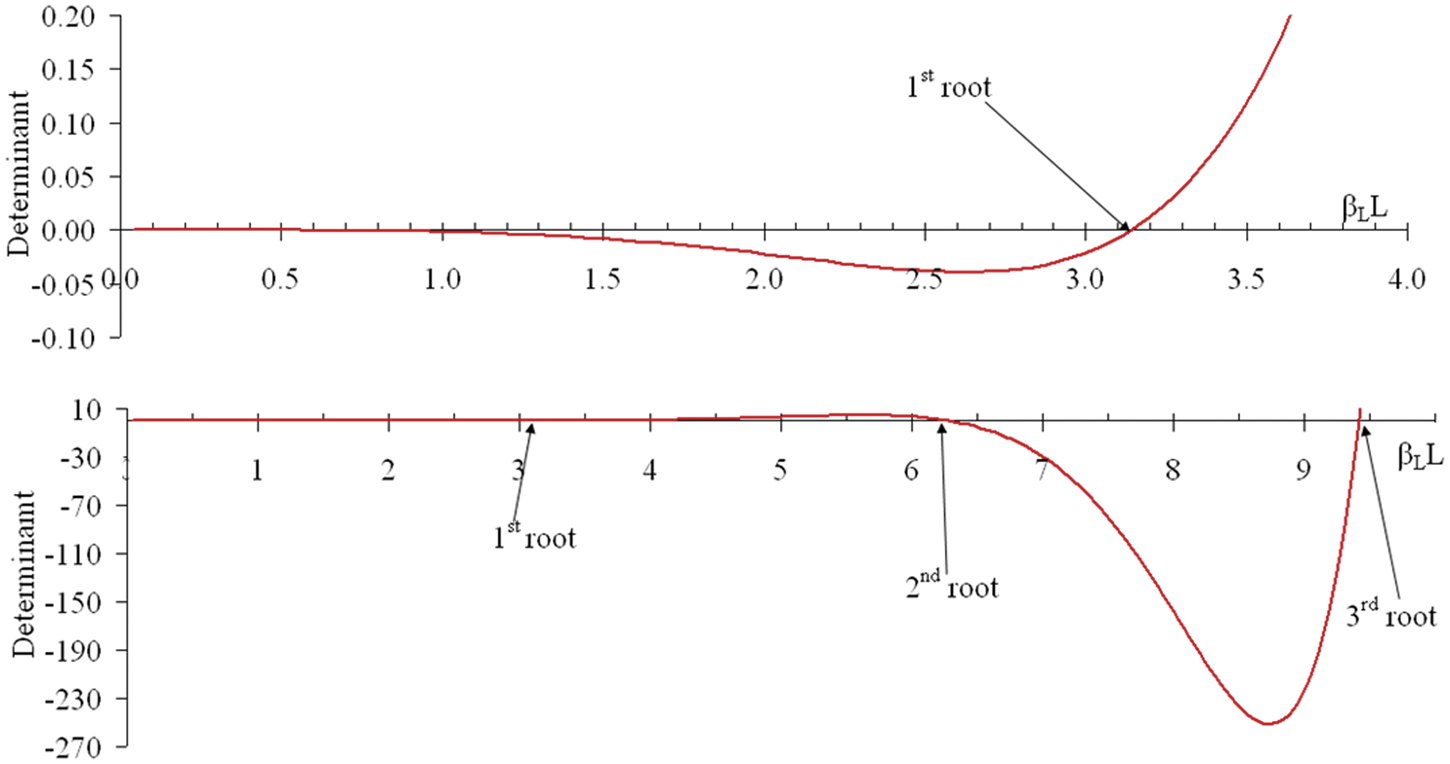

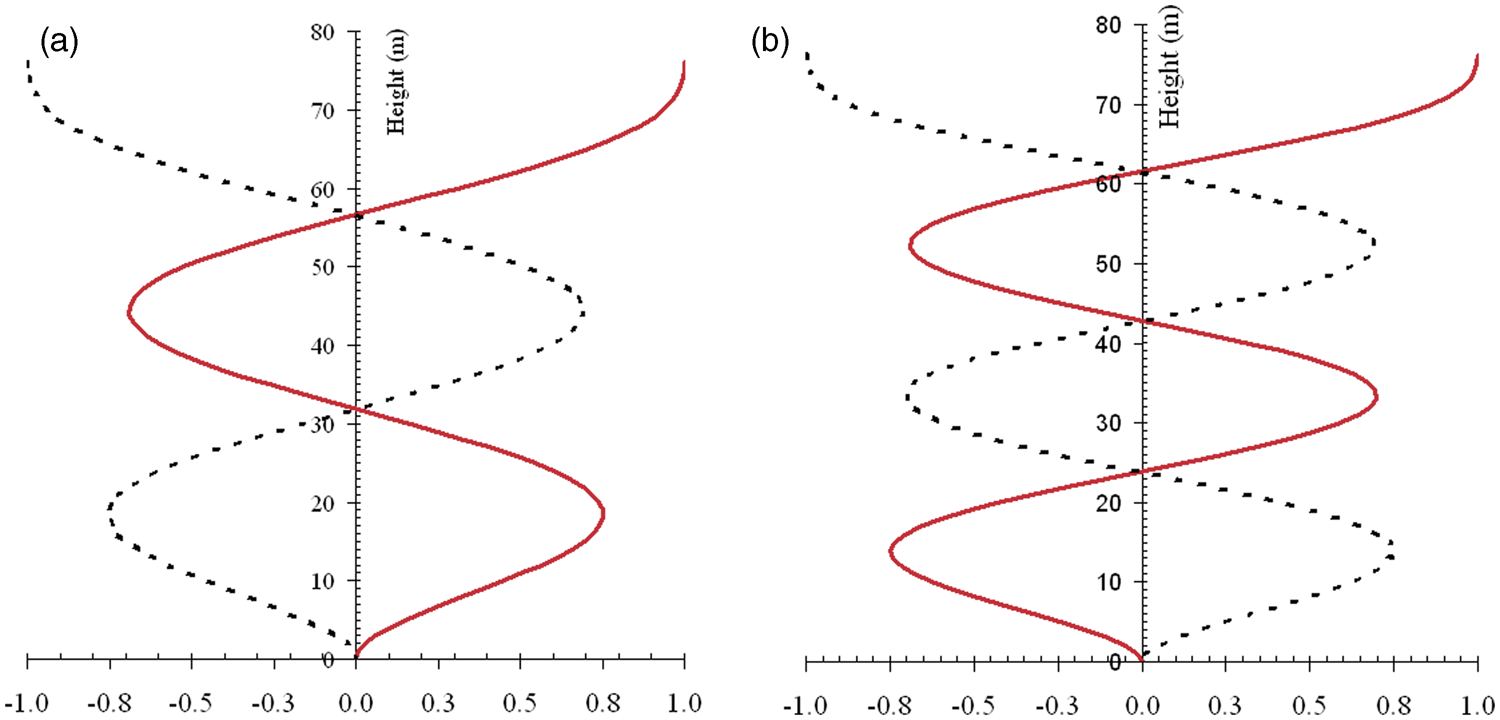
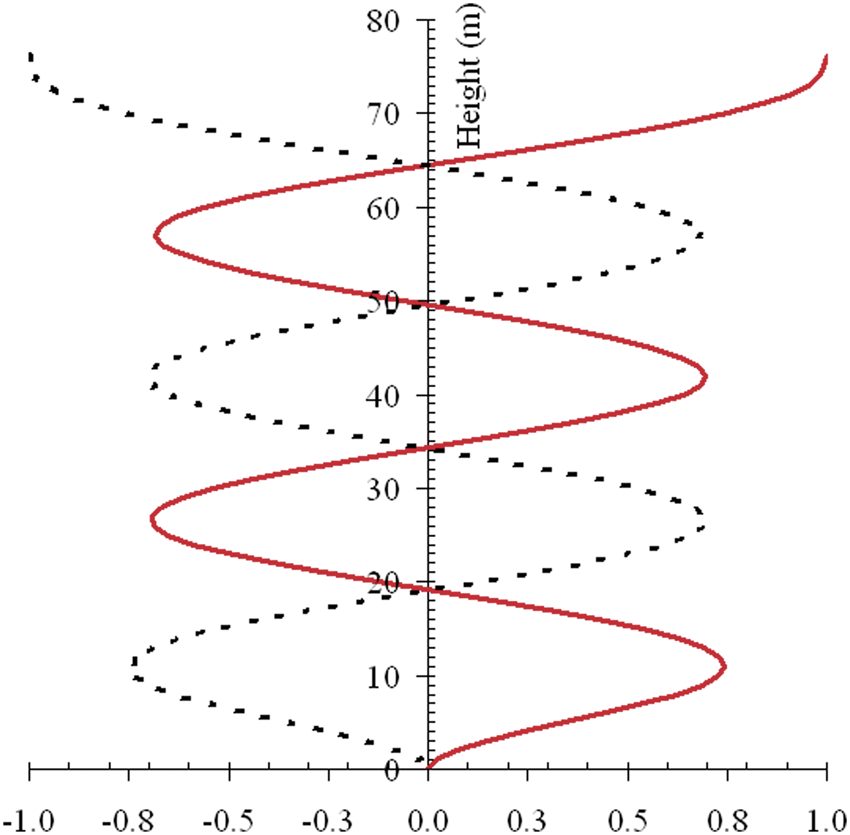
Furthermore, for each eigen-value parameter The first two mode shapes The third (a) and the fourth (b) mode shapes The fifth mode shape 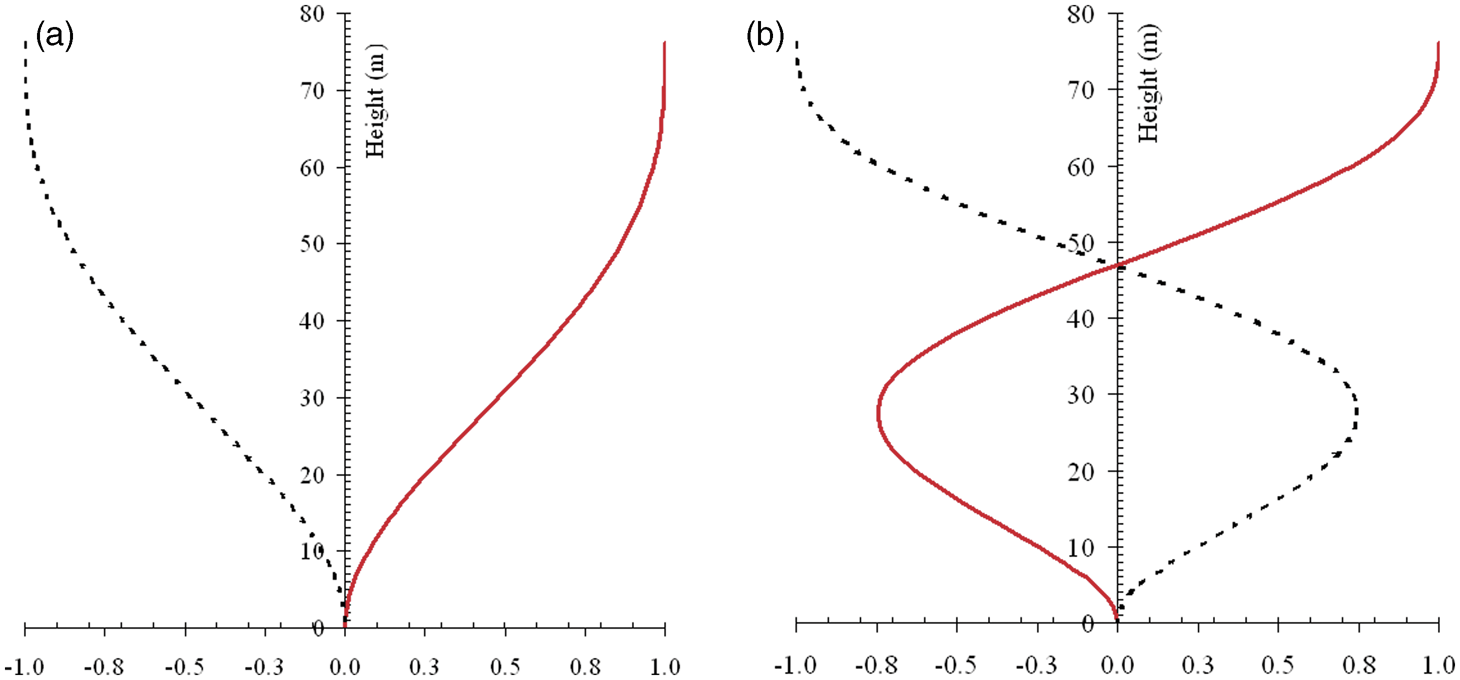
5. Discussion
It is well-known that a modal analysis method applied to a large structure such as a wind turbine tower and in the case that it is based on the substitution of the numerical model by finite elements induces several issues that sometimes lead to erroneous results. The latter happens due to the fact that models with a high level of discretization and a very large number of shell elements leads to several issues concerning accuracy, convergence and stability arising during the modal or the response history analysis; these problems are amplified in a modal or dynamic analysis of the tower because many significant mode shapes of the structure (until the total ratio of modal masses reaches 90%) must be computed. Moreover, due to the complexity of the structural forms, several unrealistic assumptions may be inserted in the modeling of such structures with reference to the density of mass-joints and thus, the finite element analysis is often doubtful.
The herein proposed method proposes the substitution of the numerical model of a prototype steel tubular tower by a continuous model. In particular, the present paper deals with the modal analysis of such towers using mathematical analysis after having formulated the continuous model of the structure. Starting from the equilibrium of forces on an infinitesimal element of the tower, the equation of motion of the tower is formulated, and, afterwards, using the boundary conditions at the ends of the wind tower, the tower eigen-problem is treated numerically. In this way the eigen-frequencies with the respective periods and mode shapes of the wind tower are effectively computed. These results constitute exact values and can be used for checking of the discrete model results. Furthermore, the results of the continuous model of the prototype wind tower are useful in the case of analysis of the tower response against dynamic actions as are, for instance, the actual dynamic wind strong loading with coexistence moderate or seismic ground strong motions at moderate or high seismic hazard areas.
Because of the fact that the prototype fixed base wind turbine tower has a first fundamental period of about 2 s, the phenomenon of resonance between the tower and the seismic strong motion is not able to appear since the tower’s first fundamental period is away from the predominant period of the earthquake strong motion; it is worth noting that the structure seismic demand displacements are large, for moderate to high earthquakes. As a matter of fact, the lateral stiffness of the tower is relatively small and leads to the appearance of large demand displacements independently from any seismic action. On the other hand, the second fundamental mode shape, having a period 0.48 s, falls on the plateau of the design acceleration spectrum proposed by seismic codes (cf. e.g. Eurocode EN 1998-1, 2004), thus leading to resonance phenomena due to the relative neighboring values between the second mode shape and the seismic excitation. This is a significant conclusion, since the effective mass of the first mode shape is moderate (about 50–60% of the total mass) and thus, all of the rest of the tower mode shapes that activate the remaining 30–40% of the total mass, are in resonance with the seismic excitation. As a result of the latter phenomenon, the tower is subjected to a strong shear at its base in the framework of the aforementioned higher mode shapes. Note that the action of the higher mode shapes is very significant and maybe critical in the case that the tower is subjected to strong dynamic wind loading and simultaneously to a strong ground seismic motion in moderate or high seismicity hazard areas.
Therefore, taking into account the above-mentioned conclusions, the following must be taken into account.
According to paragraph 4.3.1(2) of Eurocode EN 1998-6 either the Response Spectrum Analysis (using many mode shapes until the modal mass reaches the 90% of the total one) or the Response History Analysis are strongly recommended to be applied instead of more simplified methods (cf. e.g. the equivalent static analysis ones); in addition, the last methods have to be forbidden for the seismic analysis of such structures.
Although paragraph 4.5 of Eurocode EN 1998-6 does not request this case, it would be advisable to apply a loading combination of the earthquake action and the wind loading such as ±E ± 0.5 W, where E and W are the design analysis values for the earthquake and the wind, respectively.
In order to encounter the issue of “fictitious change” of the important-first eigen-periods of the tower due to the fact of inserting unrealistic assumptions to the model, as well as the previously mentioned various accuracy, convergence and stability issues, the design spectrum for elastic analysis proposed in paragraph 3.2.2.4 of EN 1998-1 should be modified as follows for all ground types, so that no reduction of the total seismic base shear is observed
The proposed design acceleration spectrum of Figure 7 is almost identical to the Eurocode EN 1998-1 one with only two different characteristics: (a) the plateau is extended until the period 1.60 s and (b) the characteristic period TD is ignored. In this way, the fictitious change of the large tower eigen-periods due to unrealistic assumptions of the model is encountered without amplification of the design earthquake.
Proposition of new design acceleration spectrum for elastic analysis of towers for all ground types.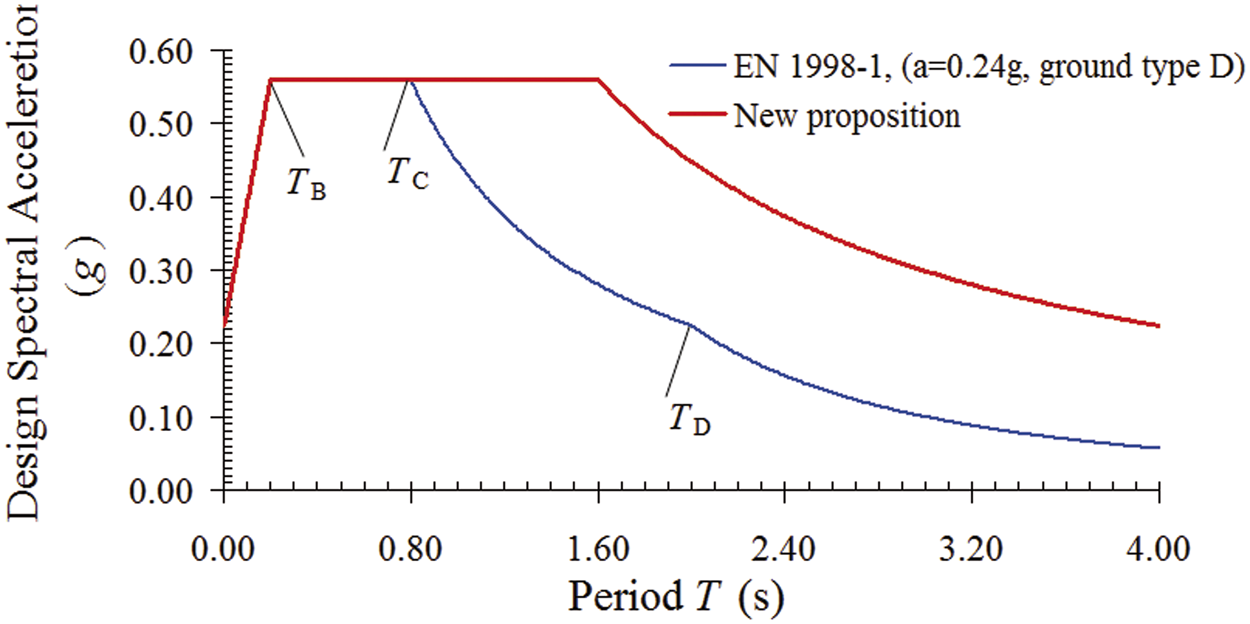
Footnotes
Funding
This research received no specific grant from any funding agency in the public, commercial, or not-for-profit sectors.