







Abstract
The present investigation is concerned with interaction due to a mechanical source in transversely isotropic micropolar elastic media, determined using the finite element method. A particular type of normal force has been taken to illustrate the utility of the approach. The components of displacement, stress and microrotation are obtained and depicted graphically for a specific model. A special case of interest is also deduced from the present investigation.
1. Introduction
Classical mechanics deals with the basic assumption that the effect of the microstructure of a material is not essential for describing mechanical behavior. Such an approximation has been shown in many well-known cases. Often, however, discrepancies between the classical theory and experiments are observed, indicating that the microstructure might be important. For example, discrepancies have been found in the stress concentrations in the areas of holes, notches and cracks; elastic vibrations characterized by high-frequency and small wavelengths, particularly in granular composites consisting of stiff inclusions embedded in a weaker matrix, fibers or grains; and the mechanical behavior of complex fluids, such as liquid crystals, polymeric suspensions and animal blood. In general, granular composites, for example porous materials, are widely used in the area of passive noise control as sound absorbers, and the effect of acoustical waves characterized by high frequencies and small wavelengths become significant.
To explain the fundamental departure of microcontinuum theories from the classical continuum theories, a continuum model embedded with microstructures to describe the microscopic motion or a nonlocal model to describe the long range material interaction is developed. This theory extends the application of the continuum model to microscopic space and short time scales. Micromorphic theory (Suhubi and Eringen, 1964; Eringen, 1999) treats a material body as a continuous collection of a large number of deformable particles, with each particle possessing finite size and inner structure. Using assumptions such as infinitesimal deformation and slow motion, micromorphic theory can be reduced to Mindlin's microstructure theory (Mindlin, 1964). When the microstructure of the material is considered rigid, it becomes the micropolar theory (Eringen, 1966).
Eringen's micropolar theory is more appropriate for geological materials such as rocks and soils, since this theory takes into account the intrinsic rotation and predicts the behavior of material with an inner structure. Different researchers have discussed different types of problems in transversely isotropic elastic material. Abubakar (1962) discussed free vibrations of a transversely isotropic plate. Suvalov et al. (2005) described the long-wavelength onset of the fundamental branches for a free anisotropic plate with arbitrary through-plate variation of material properties. Payton (1992) has studied wave propagation in a restricted transversely isotropic elastic solid whose slowness surface contains conical points. Tomar (2005) and Kumar and Deswal (2006) studied some problems of wave propagation in micropolar elastic media with voids. However, no attempt has been made to study the deformation in micropolar transversely isotropic material using the finite element method.
The exact solution of the governing equations of the micropolar generalized thermoelastic theory for a coupled and nonlinear/linear system exists only for very special and simple initial and boundary problems. A numerical solution technique is used to calculate the solution of general problems. For this reason the finite element method is chosen.
The finite element method is a powerful technique originally developed for the numerical solution of complex problems in structural mechanics, and it remains the method of choice for complex systems. A further benefit of this method is that it allows physical effects to be visualized and quantified regardless of experimental limitations. Abbas and Abd-alla (2008), Abbas and Palani (2010), Abbas and Othman (2011, 2012), Othman and Abbas (2011, 2012) and Abbas (2012a, 2012b) have successfully applied the finite element method to various problems in generalized thermoelastic materials.
The aim of the present study is to enhance our knowledge about the application of the finite element method in a micropolar transversely isotopic media. This study has many applications in various fields of science and technology, namely, atomic physics, industrial engineering, thermal power plants, submarine structures, pressure vessels, aerospace, chemical pipes and metallurgy.
The present investigation determines the components of displacements, microrotation and stress due to a mechanical source in transversely isotropic micropolar media. Such mechanical normal loading may produce a severe deformation in a thin zone near the half-space surface and thereby cause excessive wear and even cracking near the contact zone. It is therefore useful to analyze this class of problems by using a formulation that is as exact as possible and to provide results for the surface and/or near-surface field quantities (displacements, microrotation, stresses) that may be required for design purposes. The solution to the problem investigated here has practical applications in the fields of geomechanics, engineering, fiber-wound composites and laminated composite materials.
2. Basic equations
Following Eringen (1999), the constitutive relations and balance laws in general micropolar anisotropic medium possessing a center of symmetry, in the absence of body forces and body couples, are given by
Constitutive relations:



Balance laws:


3. Formulation of the problem
We have used appropriate transformations, following Slaughter (2002), on the set of Equations (1) to derive equations for the micropolar transversely isotropic medium. In the present paper, we consider a homogeneous, transversely isotropic micropolar elastic half-space Geometry of the problem.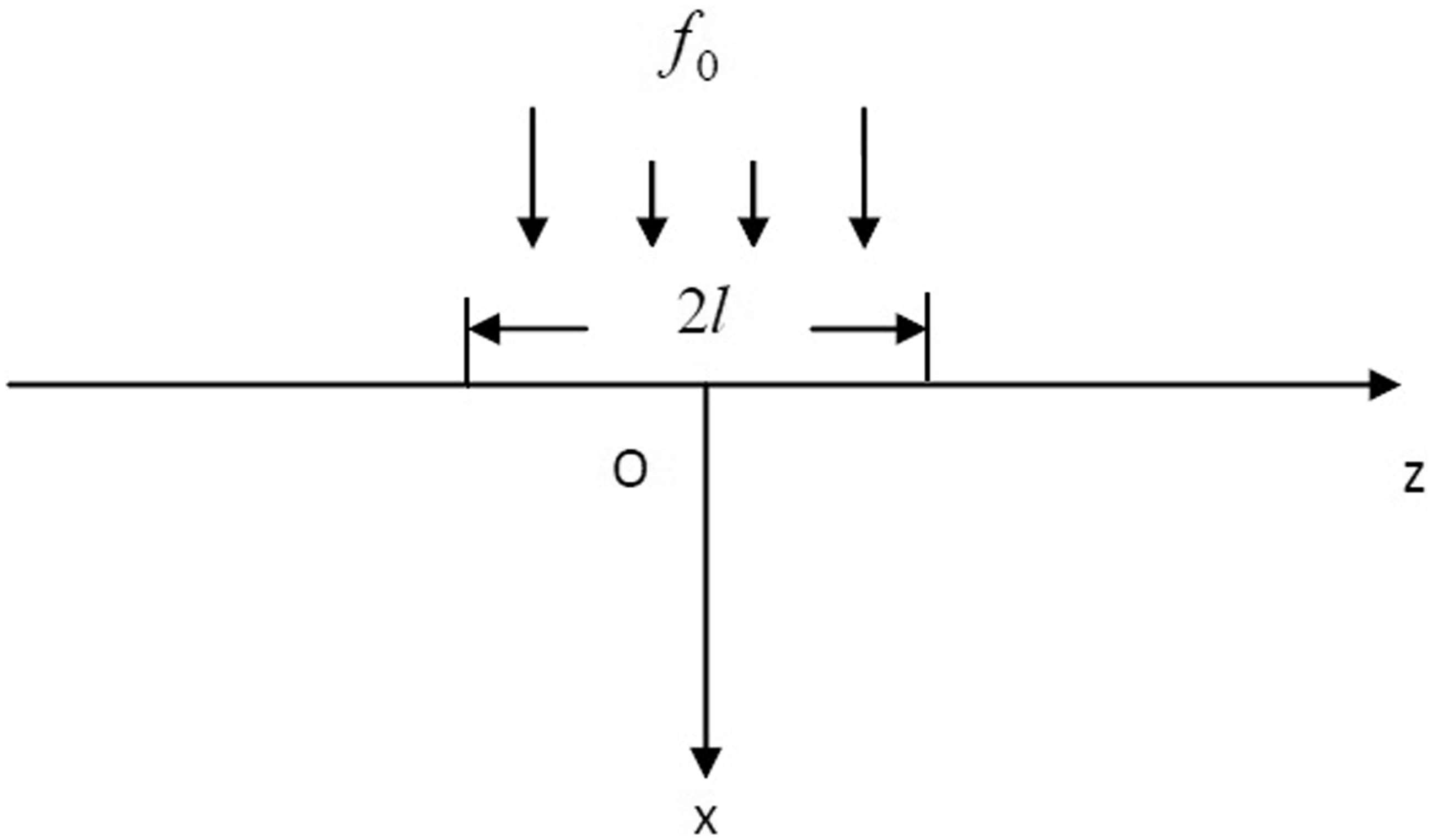

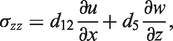
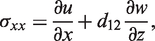
Making use of (3) in Equations (1) and (2) yields




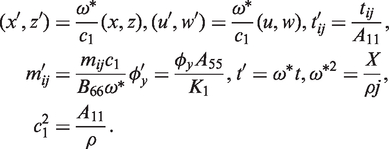
For further considerations, it is convenient to introduce the dimensionless variables defined by




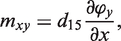
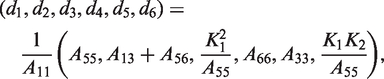
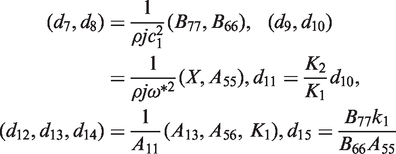
4. Initial and boundary conditions
The above equations, solved subject to initial conditions and boundary conditions, are


5. Finite element formulation
In this section, the governing equations of micropolar transversely isotropic half-space are summarized, followed by the corresponding finite element equations. In the finite element method, the displacement components u, w and microrotation component


It should be noted that appropriate boundary conditions associated with the governing equations (8)–(10) must be adopted in order to properly formulate a problem. Boundary conditions are either essential (or geometric) or natural (or traction) types. Essential conditions are prescribed displacements

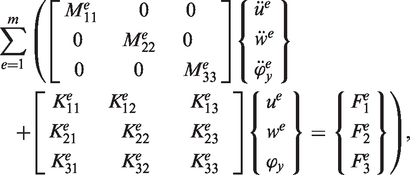
where the coefficients in Equation (20) are given below:
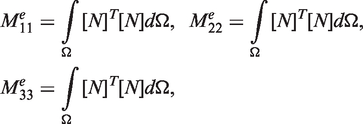
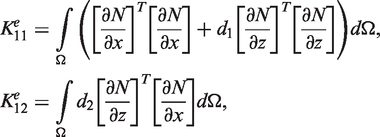

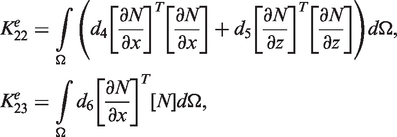



Symbolically, the discretized equations of Equations (20) can be written as

6. Special case
If we take
7. Numerical results and discussion
For the purpose of numerical computation, the following values of the relevant parameter are taken as A11 = 15.974 × 10¹⁰ Nm–2, A33 = 13.843 × 10¹⁰ Nm–2, A55 = 5.357 × 10¹⁰ Nm–2, A66 = 5.42 × 10¹⁰ Nm–2, A13 = 9.59 × 10¹⁰ Nm–2, A56 = 5.89 × 10¹⁰ Nm–2, B77 = 1.779 × 10⁹ N, B66 = 2.779 × 10⁹ N, ρ = 1.74 Kg/m3, j = 0.2 m2
Figures 2–7 exhibit the variation of displacement, stress components and couple stress components with Variation of displacement component u with distance x. Variation of couple stress component mxy with distance x.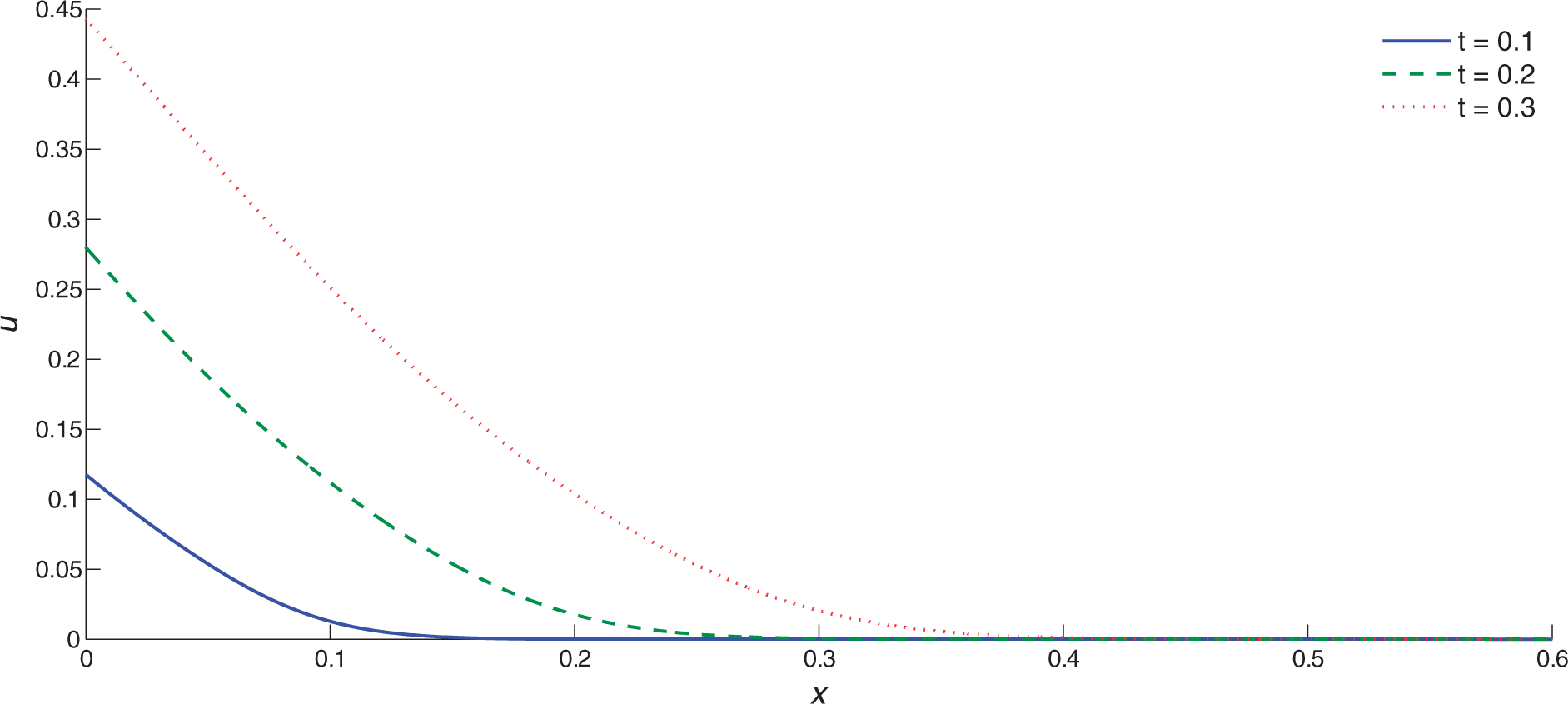
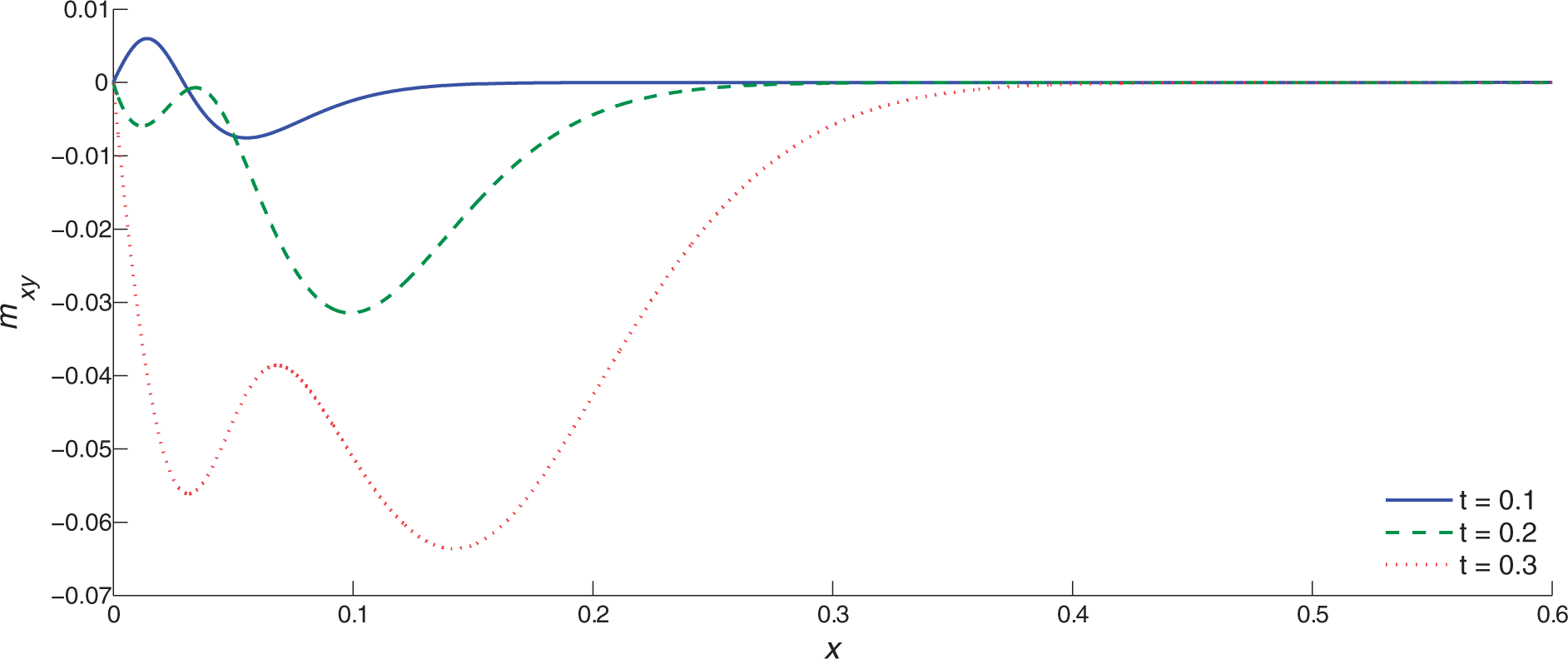
Figure 2 depicts the variations of normal displacement u with x. The values of u decrease for smaller values of x, whereas for higher values of x, it becomes constant (for all values of t). It is noticed that the values of u remain more for the case of (in comparison with Variation of displacement component w with distance x.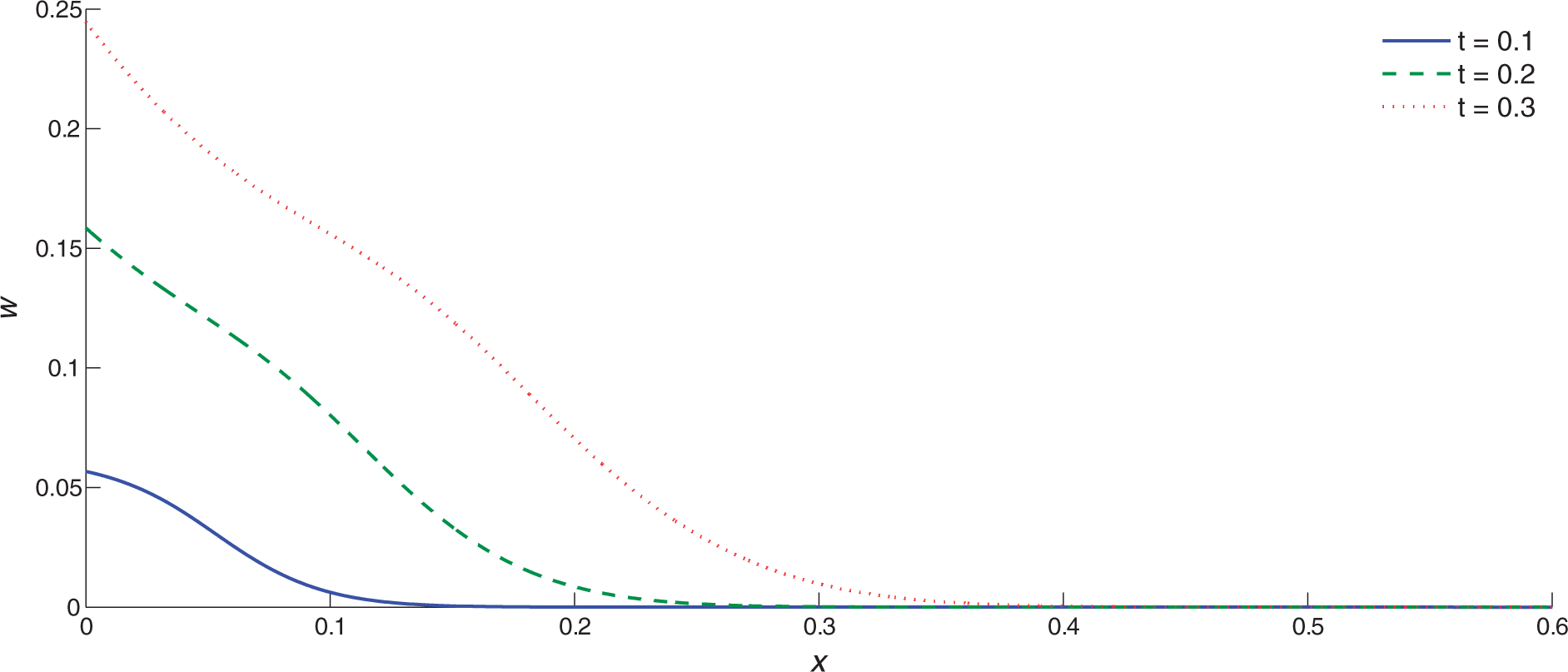
Figure 4 depicts the variations of microrotation component Variation of microrotation component φy with distance x. Variation of stress component σxx with distance x.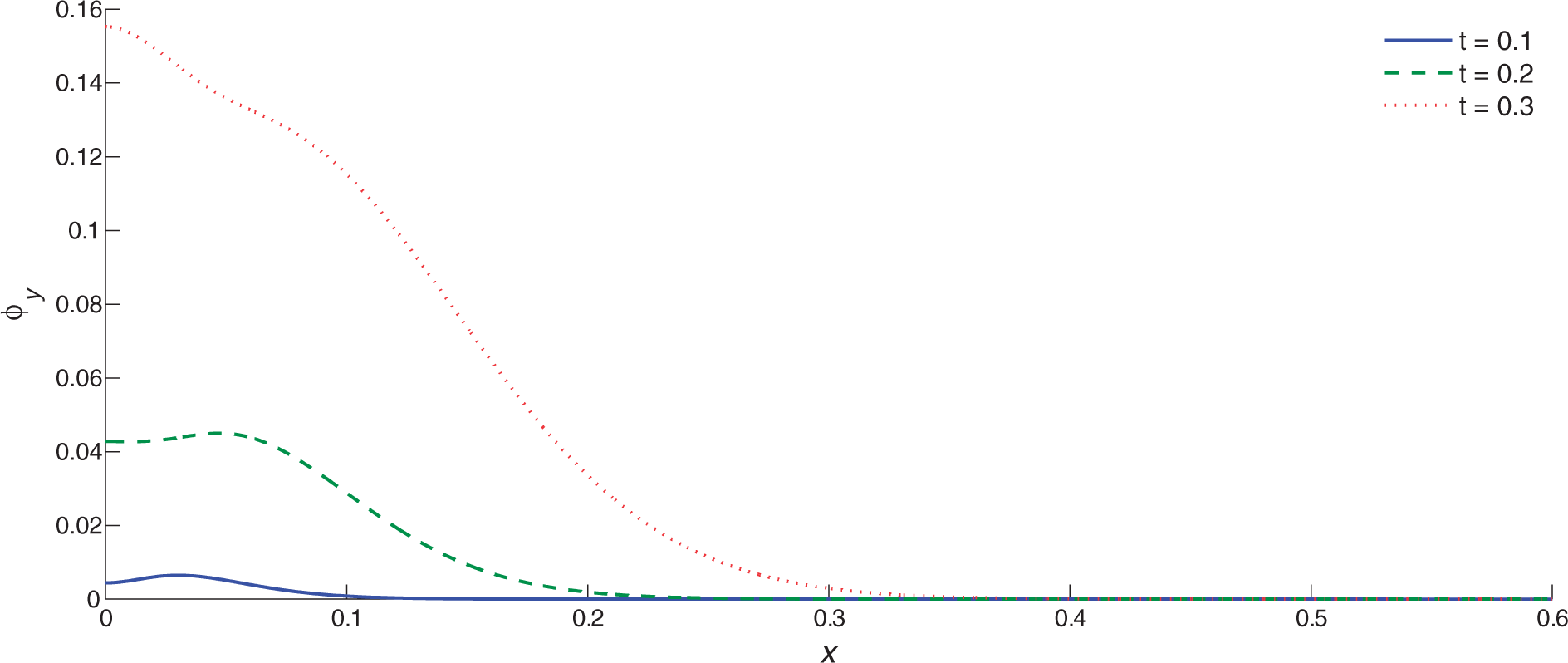

Figure 6 exhibits the variation of tangential stress component Variation of stress component σxz with distance x.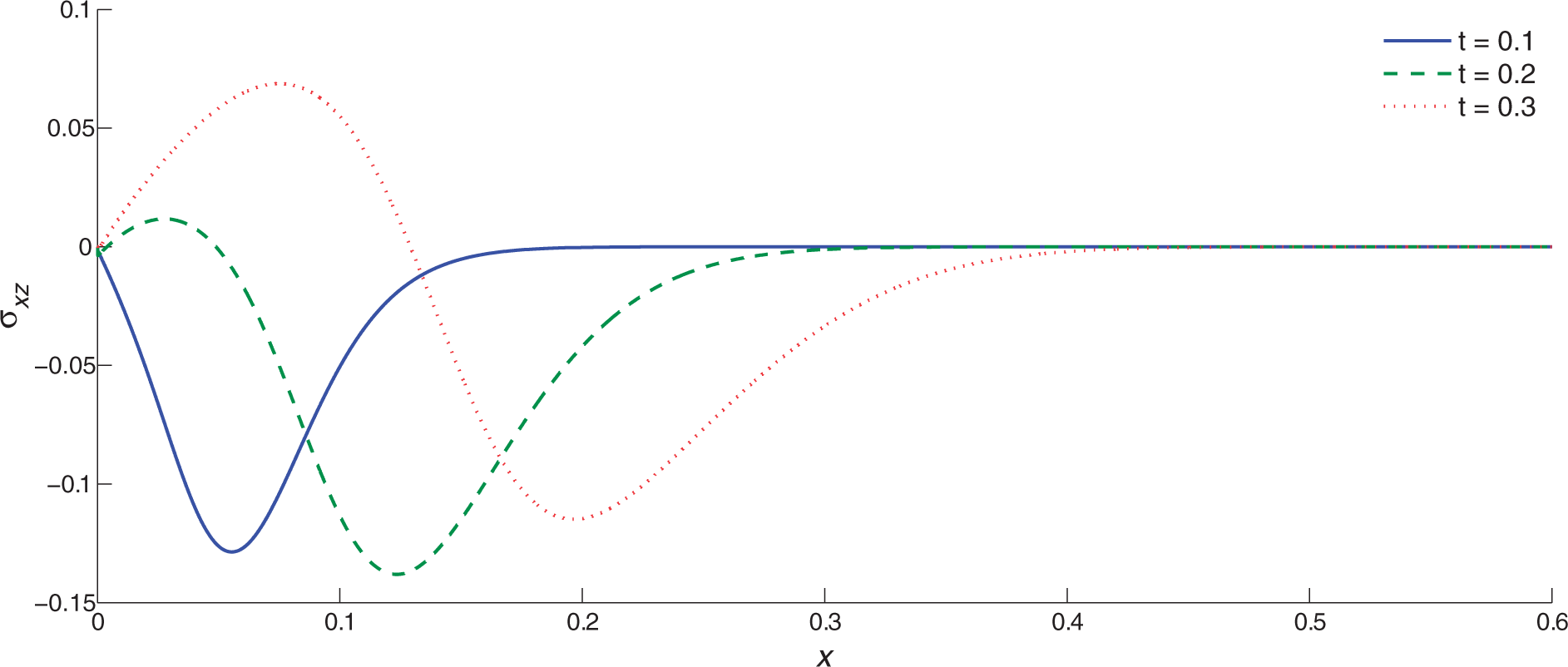
8. Conclusion
The two-dimensional problem of micropolar transverse material is solved numerically by the finite element method due to normal force. It is observed that as t increases, the values of the displacement and microrotation components decrease; near the application of the source, the values are higher; away from the source, the values decrease. Also, the stress components have oscillatory behavior; near the application of the source, the stress components have higher values; away from the application of the source, they oscillate and then converge to the boundary surface.
Footnotes
Funding
This research received no specific grant from any funding agency in the public, commercial or not-for-profit sectors.