







Abstract
In this paper, a discretized multi-freedom-degree (DMFD) model is presented to predict the lowest locally resonant (LR) band gap in phononic structures. The DMFD model is adopted to improve the accuracy and the application of previous conventional prediction models. Firstly, the model is applied to the one-dimensional ternary LR structure to show the improvement in precision that is independent of the decrease of the density of the scatterer. Then, the model is extended to the evaluation of the resonance frequencies in a two-dimensional binary LR structure, and the estimates from the present model, which are in good agreement with the previous results, verify our model. Each parameter in the DMFD model allows a clear physical insight into the band-gap mechanism. This model could provide a pre-estimation of the lowest gap of binary and ternary LR structures.
1. Introduction
Phononic crystals (PCs) are artificial structures composed of periodically arrayed materials that differ in their densities and elastic properties. The similar fundamental characteristics resemble those in the PCs where the propagation of electromagnetic waves is regulated; the propagation of elastic waves is prohibited by the PCs, as the frequency of the waves falls into the confinements of the periodic structure. PCs are used in the sound and vibration fields as isolators, mechanical filters, elastic waveguides, etc. (Wen et al., 2005; Wu et al., 2005; Tongele and Chen, 2006; Sun and Wu, 2007; Mohammadi et al., 2009).
There are two mechanisms for PCs: the Bragg scattering mechanism (Sigalas and Economou, 1992; Kushwaha et al., 1993, 1994) and the locally resonant (LR) mechanism (Liu et al., 2000a; Coffaux et al., 2002). For the Bragg mechanism gaps, the spatial modulation in the PCs is of the same order as that of the wavelength in the gap, and the modulation requires low wave speeds or large lattice constants to isolate the machinery’s vibration (Sigalas and Economou, 1992). The other mechanism, the LR mechanism, was first presented by Liu et al. (2000a). In their research, the three-dimensional PCs, consisting of cubic arrays of coated spheres immersed in an epoxy matrix, showed that the wavelength of the gap with lattice constants is two orders of magnitude smaller than that at the Bragg frequency. The machinery of the LR mechanism has been the focus of interest in recent years (Liu et al., 2005b; Hirsekorn and Delsanto, 2006; Yilmaz and Hulbert, 2010; Xiao et al., 2011; Liu and Hussein, 2012).
The finite element method (FEM) is a commonly used calculation to effectively describe the band gaps (Safavi-Naeini and Painter, 2010). Compared with other traditional theoretical methods, such as the transfer-matrix (TM) method (Richards and Pines, 2003; Yu et al., 2006), the multiple scattering theory (MST) method (Kafesaki and Economou,1999; Liu et al., 2000b), the plane-wave expansion (PWE) method (Kushwaha and Djafari-Rouhani, 1998; Li et al., 2003), the finite difference time domain (FDTD) method (Sigalas and García, 2000; Tanaka et al., 2000), the variational method (Coffaux and Sánchez-Dehesa, 2003) and the lumped-mass (LM) method (Wang et al., 2004a, 2004b), the FEM has some merits, such as its compatibility, a good convergence and a high accuracy and efficiency. However, the FEM is computationally very time-consuming. Thus, some heuristic models for the estimation of the LR gap are presented that are capable of efficiently limiting the parameter range for the numerical simulations. Coffaux et al. (2002) and Coffaux and Sánchez-Dehesa (2003) first performed a simple mechanical model of a mass-spring system to give a physical insight regarding the formation of gaps in elastic systems that consist of localized resonance units in a matrix host. Wang et al. (2004a) established a similar quasi-one-dimensional (1D) model to clarify the origin of the LR band gaps when they studied the two-dimensional (2D) binary LR PCs. However, the parameters of these models are prescribed under phenomenological evaluation. Hirsekorn (2004) proposed a different model for evaluating the lower edges of the band gaps in 2D ternary LR PCs, with parameters obtained from physical conclusions. Hirsekorn’s model is used as model I in this paper. In model I, the coated layer was treated as a massless spring, which caused the discrepancy between the prediction results and the numerical simulations, particularly when the mass of the scatterer was decreased to 0. Therefore, based on model I, Liu et al. (2005a) and Wang et al. (2006) presented model II, which separated the coated layer by a static point, and attached the two separated parts to the matrix host and the scatterer, respectively. However, the prediction accuracy for the cutoff frequency is scarcely improved when the density of the scatterer is decreased to 0. In addition, all of the prediction models listed above failed to be applied to the binary LR structure according to released reports.
The LM idea was first applied to calculate the band gap in the study of Wang et al. (2004a, 2004b). Then, several studies used lumped parameter models to investigate some of the characteristic properties of the band gaps in the continuum system in PCs and attained the expected results (Jensen, 2003; Martinsson and Movchan, 2003; Hussein and Frazier, 2010; Narisetti et al., 2010). This paper proposes a discretized multi-freedom-degree (DMFD) model using the LM idea that only discretized the coated layer based on the conventional model for the lowest local resonant gap in phononic structures. The DMFD model can improve the accuracy and extend the scope of application of model I and model II. Every parameter is assigned a physical significance. The structural and material parameters are in agreement with those in the corresponding references.
The contents are organized as follows. A DMFD model is presented in Section 2. Then, we applied this model to a 1D ternary phononic shaft and a 2D binary LR phononic structure in Section 3. Finally, in Section 4, the work in this paper is summarized.
2. Discretized multi-freedom-degree model
Previous research revealed that the vibration in the first lower edge is located in the scatterer (Hirsekorn, 2004) and that, in the first upper edge, two bulks of mass (the matrix host and the scatterer) vibrated in the opposite direction (Wang et al., 2004a) in the LR phononic structure. The resonance modes corresponding to the first lower and upper edges can be represented by a mass-spring model and a mass-spring-mass model, respectively. The coated rubber layer acted as the spring between the matrix host and the scatterer. In model I, the mass of the coated rubber layer was neglected and treated as a massless spring, which induces the incremental discrepancy as the density of the scatterer drops (Hirsekorn, 2004). By involving the masses of the rubber layer in the analog model II, the masses of the coated layer were separated by a static point; one part was attached to the matrix host, whereas the other was attached to the scatterer (Liu et al., 2005a; Wang et al., 2006). However, the cutoff frequency in model II cannot be predicted well when the density of the scatterer is closer to the density of the rubber ring, and no physical insight can be further gleaned. In addition, all of the models listed above failed to be applied to the binary LR structure according to released reports. In this section, a DFMD model is presented using the LM idea based on previous models.
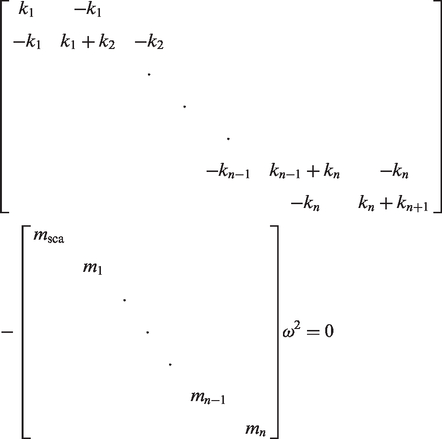
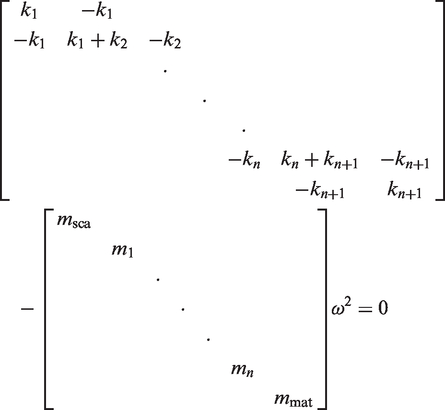
According to the LM idea (Wang et al., 2004a, 2004b), the mass of the soft rubber layer is decomposed into n layers. Each layer is equivalent to balance its distribution of the mass to its middle circle and is assumed to be connected to the adjacent layer by linear elastic springs. The resonance modes corresponding to the first lower and upper edges and the section sketch based on the different models of the LR structure are sketched in Figure 1. Figures 1(a)–(c) depict model I, (d)–(f) show model II and (g)–(i) illustrate the DFMD model. mrub, msca and mmat represent the masses of the rubber layer, scatterer and the equivalent mass of the matrix host media in a lattice, respectively; k represents the stiffness of the coated rubber layer, which acts as a spring connecting msca and mmat. In the DFDM model, the inner radius and the outer radius in the jth (j = 1,2 … . ,n) discretized rubber layer can be expressed as The resonance modes corresponding to the lower and upper edges of the lowest band gap and the section sketch based on the different theories of locally resonant structure. (a)–(c) depict model I, (d)–(f) show model II and (g)–(i) illustrate our present model. mrub, msca and mmat represent the masses of the rubber layer, scattering layer and the equivalent mass of matrix host media in a lattice, respectively; k represents the stiffness of the coated rubber layer that acts as a spring connecting msca and mmat for model I and model II; in (g)–(i) mj is the mass of the jth (j = 1,2 … . , n) discretized layer, and kj is the corresponding stiffness between the adjacent discretized layers; in (i), rj–1 and rj are the inner and the outer radius in the jth (j = 1,2 … . , n) discretized rubber layer, respectively, and 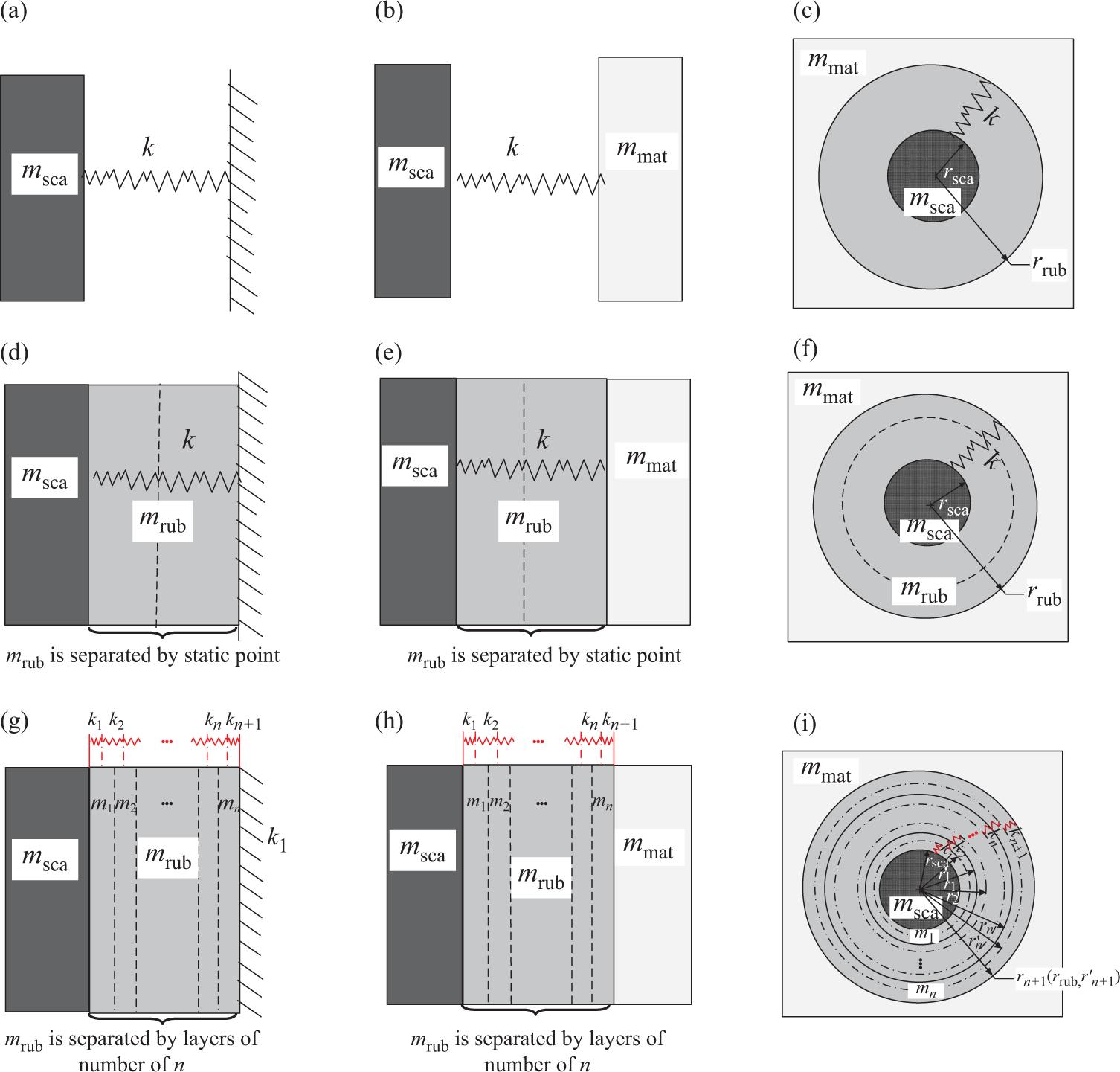
3. Prediction results and discussion
3.1. 1D ternary phononic structure
Yu et al (2006) studied the propagation of the torsional wave in a 1D ternary phononic shaft attached to local resonators, which consisted of a soft rubber ring enclosed by an outer lead ring, as Figure 2 shows. The materials of the matrix host in the LR structure simulations are the epoxy. The space between adjacent resonators is a. The length of the rings is l. The radius of the epoxy shaft is rmat. The outer radii of the rubber ring and the scattering ring are rrub and rsca, respectively. Gmat, ρmat, Grub, ρrub and Gsca, ρsca are the shear modulus and density of the shaft, rubber ring and metal ring, respectively. The structure exhibited low-frequency gaps based on the LR mechanism.
The sketch of the one-dimensional ternary shaft with the locally resonant structure. Reproduced with kind permission from Elsevier (Yu et al., 2006).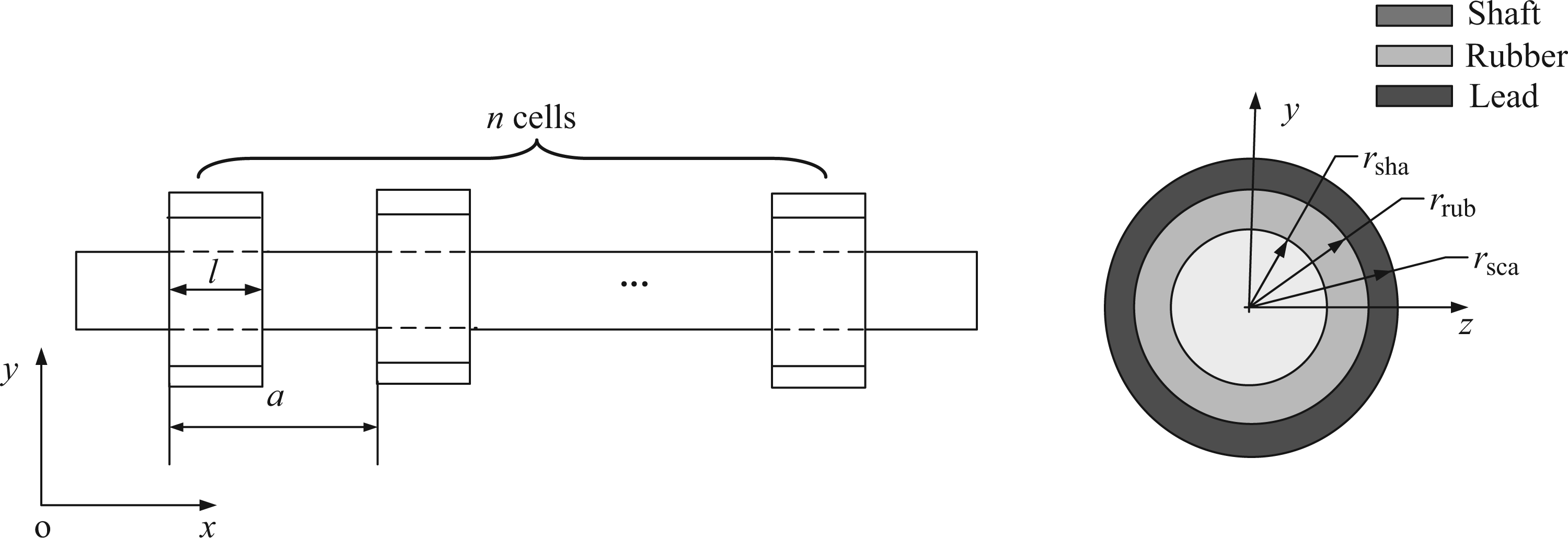
In Yu et al.’s study, only the first lower edge of the band gap in their structure was predicted by model I and was formulated by
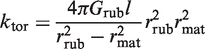

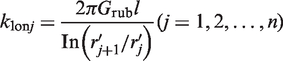
We predict the first lower and upper edge of his structure by the DMFD model using Equations (1) and (2) when n = 2 and n = 3, where the torsional stiffness (Ernst, 1974) between the adjacent discretized rubber layers can be demonstrated as

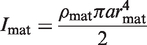
The moment of inertia of the jth discretized rubber layer is

The TM method was used to calculate the band gap of this structure in Yu et al.’s (2006) study, with the rubber ring also treated as a massless spring. Therefore, we compared the results using different models with those from the FEM, which considers the mass of the rubber ring. Figure 3 illustrates the effects of the density of the scatterer on the discrepancy of the frequency edges obtained by different models and by the FEM. For the purposes of normalization, the frequencies are shown by The effects of the density of the scattering ring on the discrepancy of the frequency edges obtained by different models and the finite element method.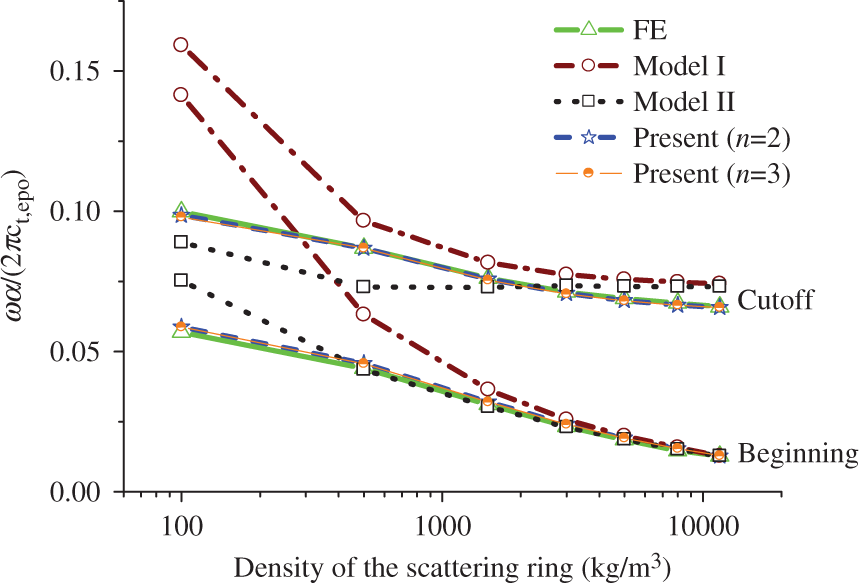
In addition, our predicted results when n = 3 are almost the same as the results for n = 2. In our present model, the computational requirements increased as the number of n increased. As shown in Figure 3, our proposed model has already achieved a good estimate when n = 2, independent of the density of the scatterer. Therefore, n = 2 is sufficient for estimating the lowest LR band edges well with a decreased scatterer density of for the ternary LR structure.
3.2. 2D binary phononic structure
To our knowledge, there is no prediction model that can pre-estimate the lowest band edges for a binary LR structure. In this section, we will extend the ranges of our DFDM model to the 2D binary LR structure and give the reasonable derivation of each parameter in this model, as planned in Section 1.
Wang et al. (2004a) observed frequency gaps in 2D binary periodic systems composed of periodic soft rubber cylinders immersed in an epoxy host due to the high contrast of the mass density and the elastic contrast of the soft rubber. The lattice constant is a and the radius of the rubber cylinder is rcore. The application of the DMFD model is different from that in the above section because the mass of the scatterer is one part of the rubber cylinder
The beginning frequency


According to Wang et al.’s (2004a) study, whose structural parameters are a = 20 mm and rcore = 8 mm, we first select rsca = 4 mm and n = 1 (actually, the rubber cylinder is discretized into two layers) to calculate the band edges of our prediction model, which range from 0.0047 to 0.0068. This range agrees well with the theoretical results of 0.0046–0.0058 obtained by the theoretical method in the study of Wang et al. (2004a), where the cutoff frequency differs at the fixed rsca.
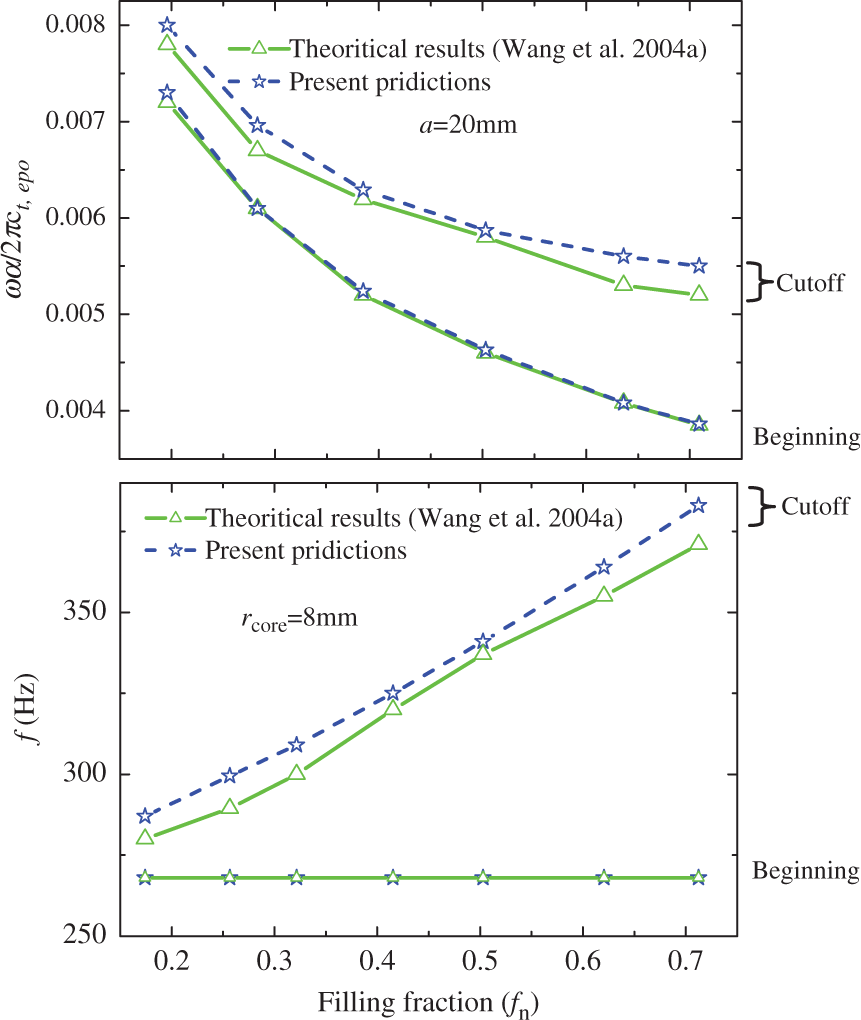
Figure 4 shows the effects of the value rsca/rcore and the discretization number n in our model. It can be found that the accuracy of our present model is low when n = 1, and a high expected accuracy could be achieved with an increased value of n. The value of n has a great effect on the results when the value of rsca/rcore is insignificant. For the condition of rsca/rcore < 3/8, the accuracy of our proposed model can only be improved by increasing the value of n, which will lead to the increased computational requirements. The accuracy of our model cannot be improved even by increasing the value of n when rsca/rcore exceeds 3/8, because the more elastic part of rsca/rcore is simplified as a rigid mass. The prediction results of our model agree well with the theoretical results of Wang et al. (2004a) when rsca/rcore = 3/8 and n = 2 or n = 3. To verify the generality of our approach, Figure 5 plots the comparison of the band edges between our model and the previous results versus the different fill fractions at rsca/rcore is 3/8 and n = 2: (a) when the lattice constant a is a constant; (b) when the radius of the rubber cylinders rcore is a constant. In Figure 5(a), the lattice constant a is a constant; in Figure 5(b), the radius of the rubber cylinders rcore is a constant. It can be found that our DFMD model can estimate the band edges of the 2D binary LR structure well, which demonstrates that our model can be applied to the 2D binary LR structure, except for small discrepancy at the cutoff frequencies, which is due to the fixed value of rsca/rcore.
The effects of the value rsca/rcore and the discretization number n in our model. The comparison of the band edges between our model and the previous results versus the different fill fractions at rsca/rcore is 3/8 and n = 2: (a) when the lattice constant a is a constant; (b) when the radius of the rubber cylinders rcore is a constant.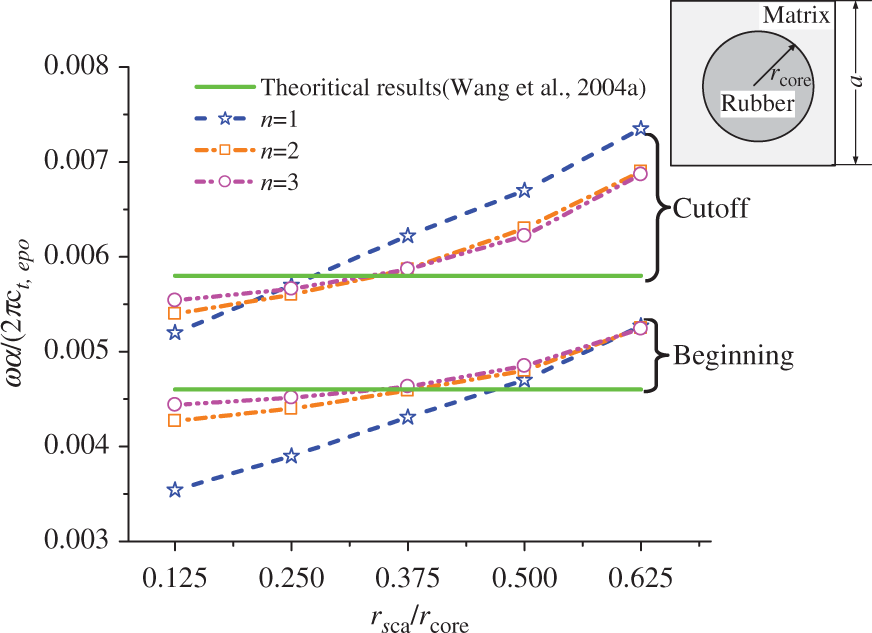
4. Conclusions
This paper presents a DFMD model for the prediction of the band edges of the LR structure. This model, independent of the density of the scatterer, improves the accuracy not only in the ternary LR structure compared to the previously reported models, but also enables an extended range for the binary LR structure.
The results predicted in the 1D ternary shaft by the DFMD model when n = 2 are similar to results calculated by the FEM rather than to those obtained by models I and II, and the accuracy is independent of the density of the scatterer. For the 2D binary LR structure, when the value of
Footnotes
Funding
This research received no specific grant from any funding agency in the public, commercial or not-for-profit sectors.