The problem of reflection of plane waves due to an incident longitudinal wave at a plane free fibre-reinforced thermoelastic half-space has been investigated. There exist three types of plane waves which are longitudinal, transverse and thermal waves in the thermoelastic medium. The analytical expressions of their velocities are obtained and it is observed that they depend on the angle of propagation. Using appropriate boundary conditions, the amplitude and energy ratios for the reflected waves are derived and computed numerically.
The analysis of stress and strain in fibre-reinforced composite materials is an important area of research in solid mechanics. Structures made up of fibre-reinforced materials are very useful due to their low weight and high strength. The characteristic property of a reinforced composite material is that its components act together as a single anisotropic unit as long as they remain in the elastic condition. This means that the components in the reinforced composite material are bound together so that there is no relative displacement between them. Spencer (1941) explained the concept of deformation in fibre-reinforced materials. Nayfeh and Nasser (1971) discussed the problem of thermoelastic waves in solids with thermal relaxation. They used the Maxwell’s modified heat conduction equation to explain plane harmonic waves in unbounded media as well as Rayleigh’s surface waves propagating along a half-space consisting of linearly elastic materials that conduct heat. Dhaliwal and Sherief (1980) discussed the problem of generalized thermoelasticity for anisotropic media. They proved the uniqueness theorem of the governing equation of generalized thermoelasticity for an anisotropic media and explained the variation principle for the equation of motion. Belfield et al. (1983) investigated the anisotropic characters of fibre-reinforced composite materials and presented the equation of motion in such a medium. Sharma and Singh (1985) studied the problem of thermoelastic surface waves in a transversely isotropic half-space with thermal relaxations and derived the dispersion relation.
Sengupta and Nath (2001) discussed the problem of surface waves in fibre-reinforced anisotropic elastic media. They derived the frequency equation for the surface waves. Chattopadhyay et al. (2002) studied the problem of reflection of quasi- P and quasi- SV waves at the free and rigid boundaries of a fibre-reinforced medium. They obtained the expressions of phase velocities of quasi- P and quasi- SV waves. Singh and Khurana (2002) attempted the problem of reflection of P and SV waves at the free surface of a monoclinic elastic half-space. They obtained a method to obtain the angles of propagation of reflected waves in the anisotropic medium and derived the reflection coefficients of the reflected waves. Singh (2006) investigated the problem of propagation of plane waves in a fibre-reinforced, anisotropic, generalized thermoelastic media and derived the frequency equation. Ponnusamy (2007) studied the problem of wave propagation in a generalized thermoelastic solid cylinder of arbitrary cross-section using Fourier expansion collocation method and derived the frequency equation. Aouadi (2008) discussed the problem of generalized theory of thermoelastic diffusion for anisotropic media and presented the governing equation for generalized thermoelastic diffusion media with one relaxation time. Abbas and Abd-alla (2011) studied the problem of generalized thermoelastic interaction in an infinite fibre-reinforced anisotropic plate containing a circular hole using the Lord and Shulman (1967) theory. They investigated the effects of the presence and absence of reinforcement on temperature, stress and displacement using a finite-element method. Abbas (2011) discussed a two-dimensional problem for a fibre-reinforced anisotropic thermoelastic half-space with energy dissipation using the Green and Naghdi (1993) theory and the results with energy dissipation and without energy dissipation are compared. Ponnusamy and Rajagopal (2011) investigated the problem of wave propagation in a transversely isotropic thermoelastic solid cylinder of arbitrary cross-section. They obtained the frequency equations for longitudinal and flexural (symmetric and antisymmetric) modes of vibration and computed numerically for elliptic and parabolic cross-sectional zinc cylinders. Some problems of wave propagation in the thermoelastic materials have been discussed by Anderson (1961), Singh and Sharma (1985), Sharma et al. (2000), Singh (2003, 2004), Singh and Singh (2004), Tomar and Singh (2006), Singh and Tomar (2007), Tian et al. (2007), Kumar and Kansal (2008), Kumar and Devi (2010), Sharma (2008, 2010) and Verma (2011a,b).
In this paper, the problem of incident longitudinal wave at a plane free boundary of thermally conducting linear fibre-reinforced composite half-space has been attempted within the context of Lord–Shulman theory. Using appropriate boundary conditions, we have obtained the amplitude and energy ratios of the reflected waves. These ratios are computed numerically for a particular model and the results are depicted graphically.
2. Basic equations
The linear equations governing thermoelastic interactions in homogeneous anisotropic solid may be written as (Singh, 2006):
strain and displacement relation
stress, strain and temperature relation
equation of motion
heat conduction equation
where ρ is density, , T is the temperature change of a material particle, T0 is the reference uniform temperature of the body, Kij is the thermal conductivity tensor, Cijkl are the elastic parameters, is the thermal elastic coupling tensor, Ce is the specific heat at constant strain and the superimposed dot denotes the differentiation with respect to time, while comma is used for spatial derivatives.
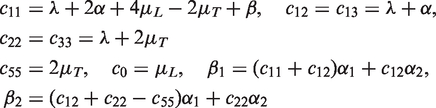
Let us consider a two-dimensional xy-plane so that the displacement and . Consider the Cartesian coordinate system in which the x- and z-axes are perpendicular to one another and laying horizontally, while the y-axis is vertical with the positive direction pointing vertically downward. The requisite components of stress tensor are given (see Singh, 2006) as
where
, are material constants and are coefficients of linear thermal expansion.
Inserting these stress components into (3), the equations of motion without body force and heat source densities for a generalized thermoelastic fibre-reinforced elastic material are given by
where are coefficients of thermal conductivity, and is thermal relaxation time. In the equations of motion given by (5)--(7), the displacement components u1, u2 and the thermal variable T are coupled with one another.
In the absence of thermal effect, i.e., , , and the above equations of motion reduce to
There is coupling between the displacement components u1 and u2 and these equations correspond to the equations of motion in the fibre-reinforced elastic medium.
3. Propagation speed of plane waves
Suppose that the displacement components of the incident waves due to longitudinal wave, transverse wave and thermal wave are represented by
where A, B and C are the amplitude constants, is the phase factor and is the angular frequency.
In the case of reflection from a plane free boundary, the displacements are given by
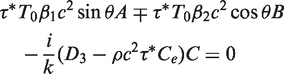
where is the phase factor. Using Equations (10) and (11) into (5)–(7), we have
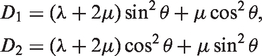
where the upper sign corresponds to the incident waves while the lower sign corresponds to the reflected waves, the expressions of D1, D2, D3 and are given by
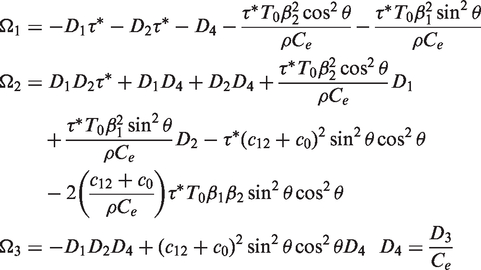
For the non-trivial solutions in Equations (12)–(14), the determinant of the coefficient matrix must vanish which gives
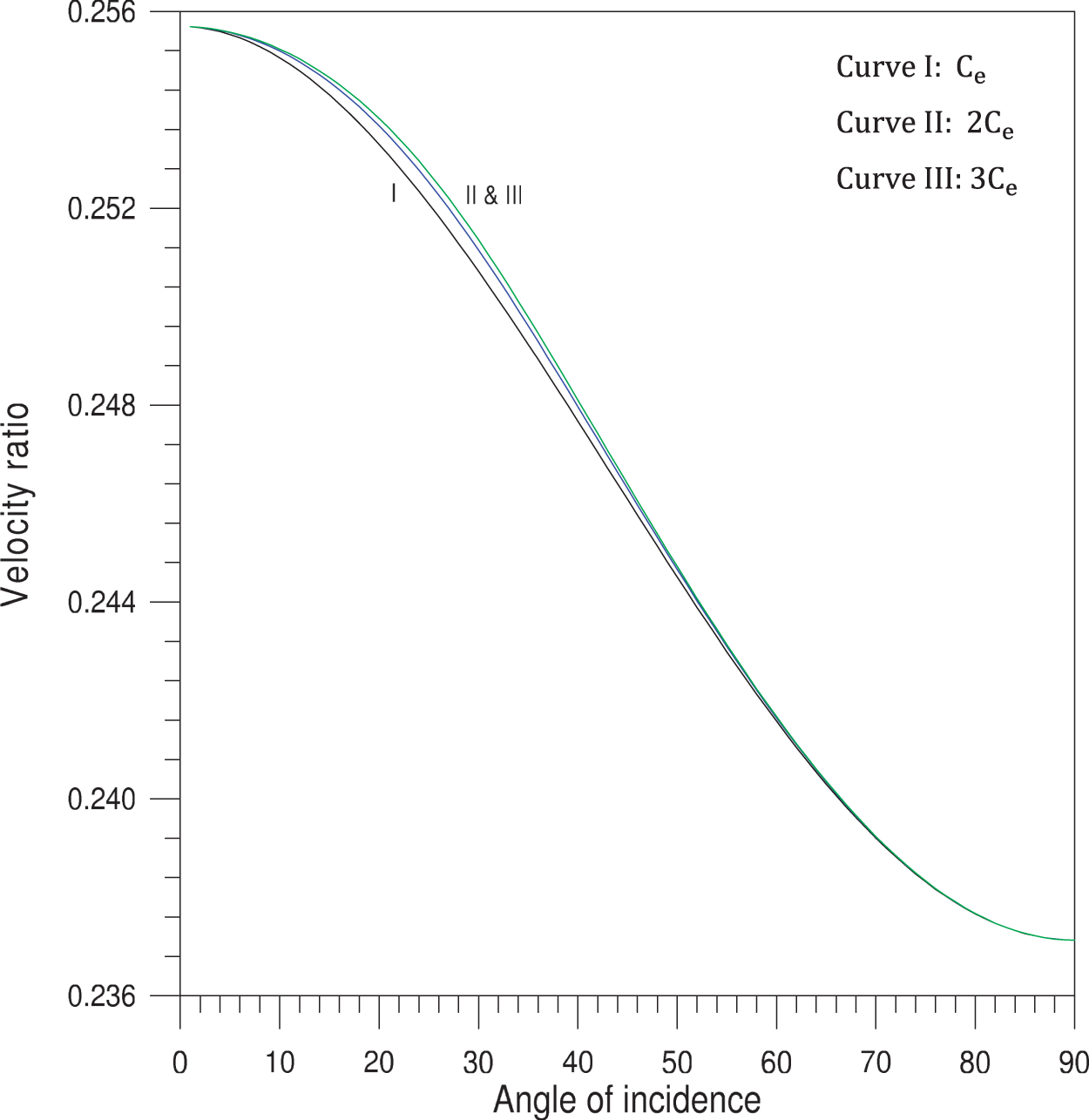
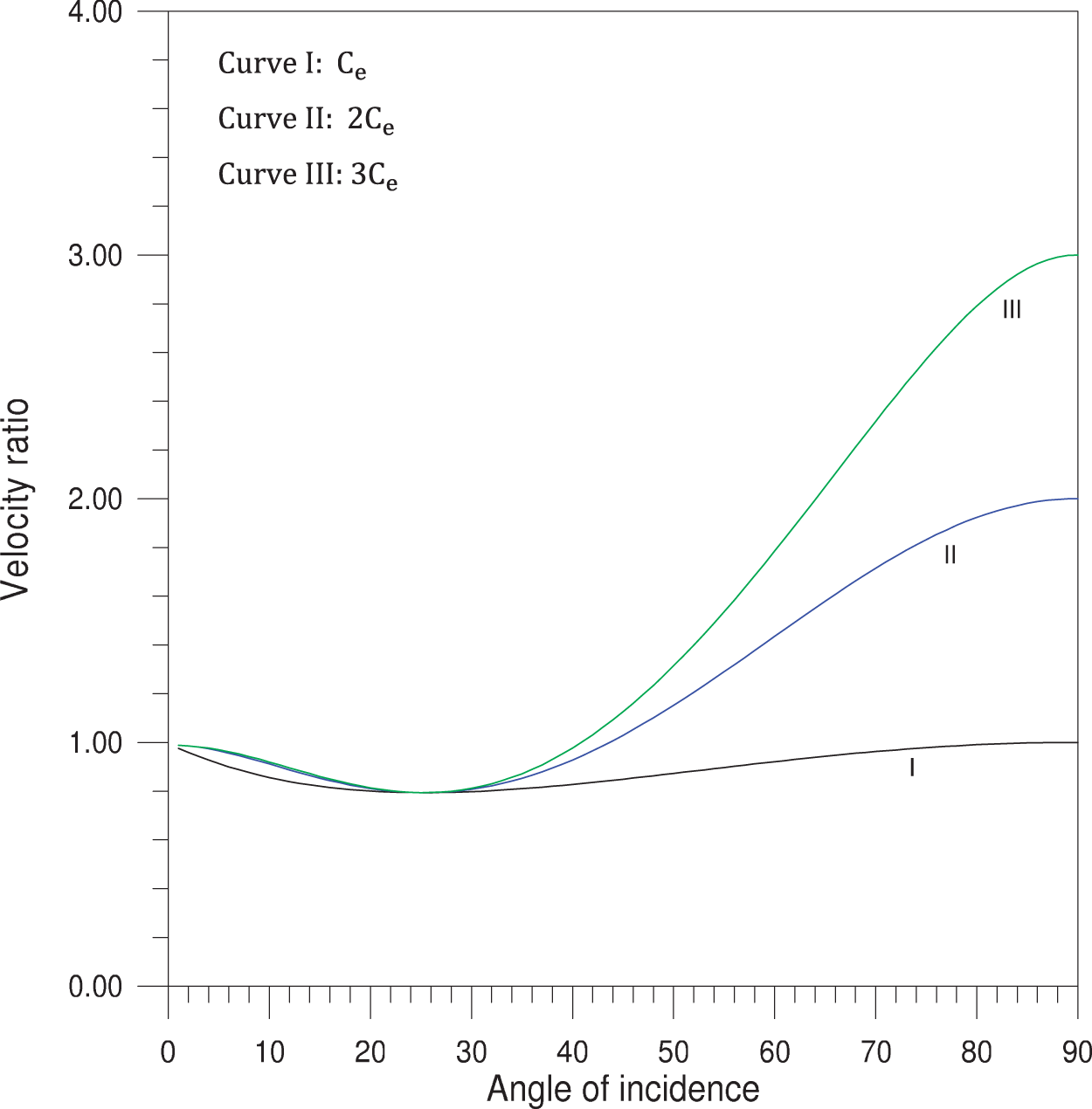
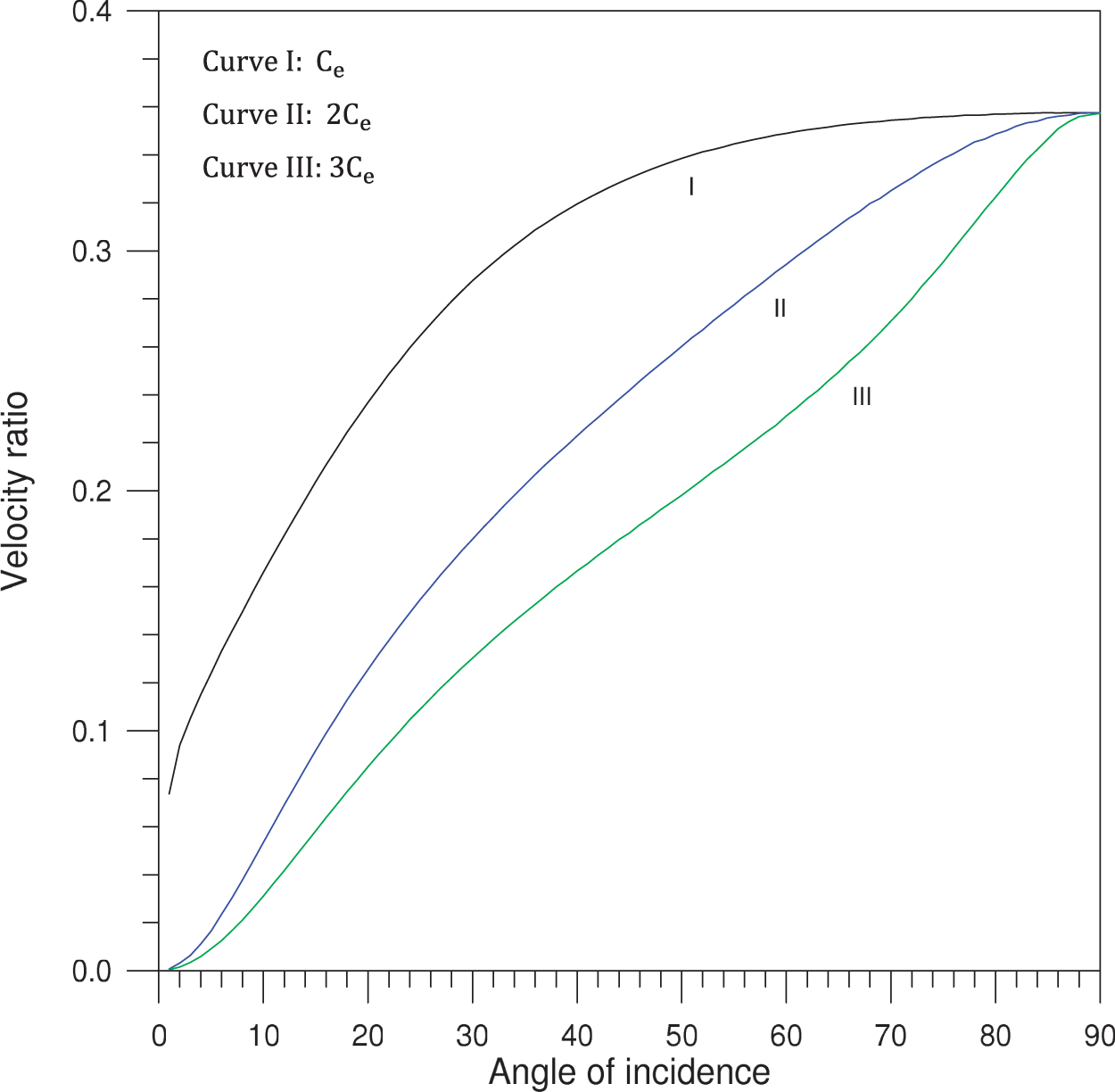
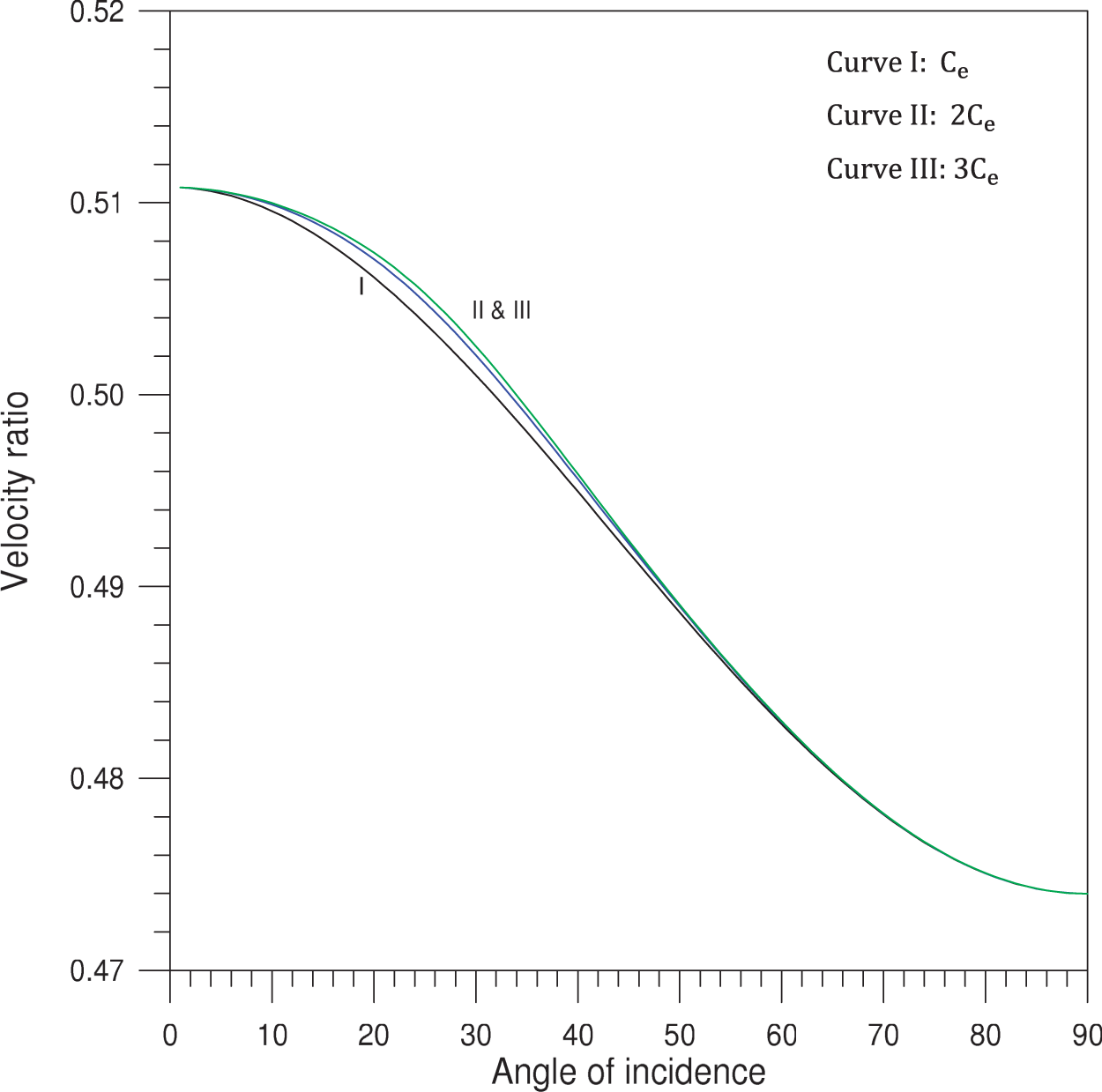
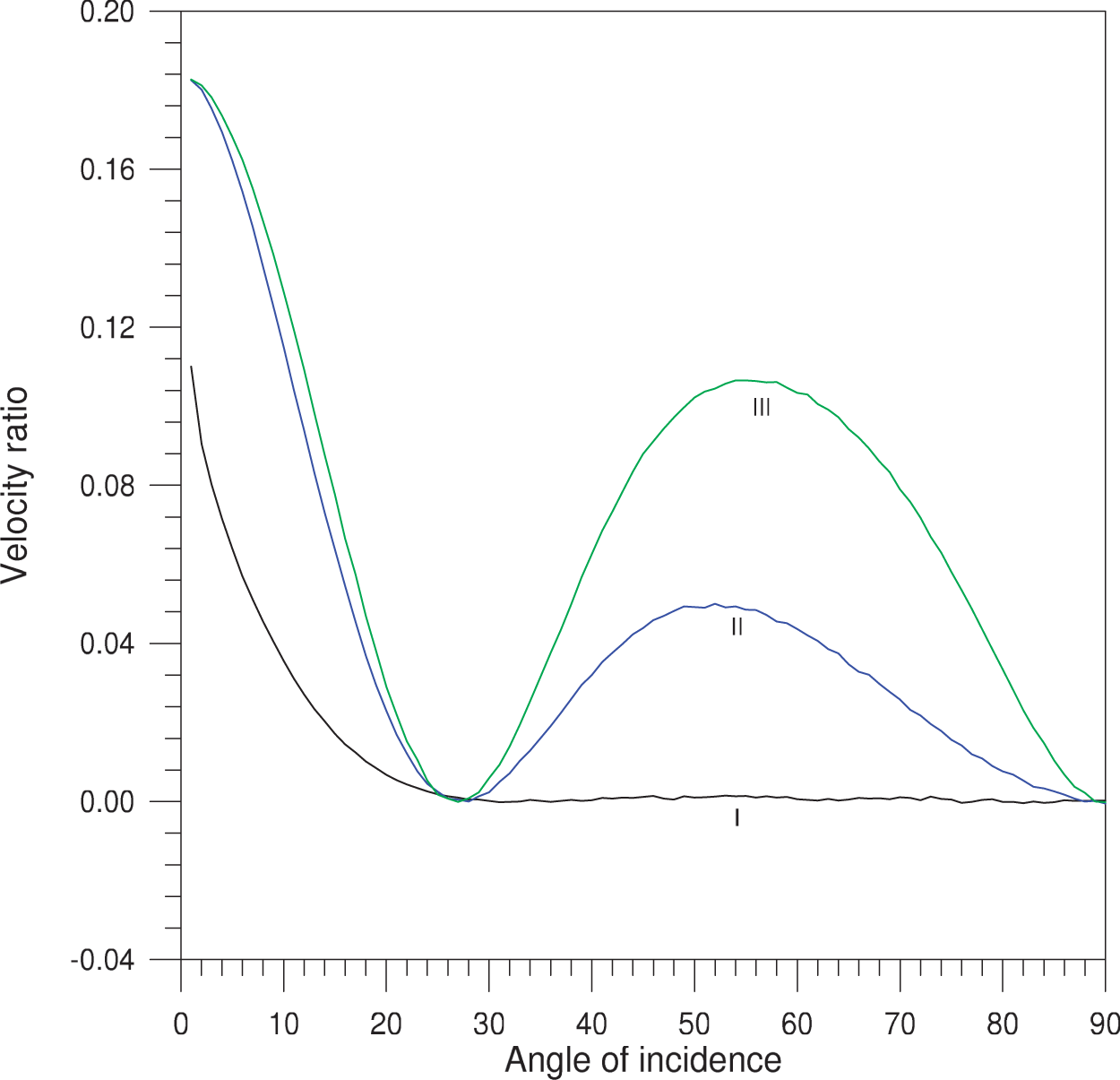
These roots , and give the propagation speeds of three waves. The modulus of these speeds of propagation have been depicted graphically through Figures 1–3. We have observed that these velocities depend on the angle of propagation, material constants and thermal parameters of the medium. These values are complex, i.e. they have attenuation parts, and these attenuation parts will be depicted graphically.
Variation of the modulus of the non-dimensional velocity with .
Variation of the modulus of the non-dimensional velocity with .
Variation of the modulus of the non-dimensional velocity with .
When the medium is in the absence of a thermal effect, the following quantities reduce to zero:
where and This equation gives the expression for velocity of longitudinal (qP-wave) and transverse waves (qSV-wave) in fibre-reinforced elastic medium as
These results are the same results as those of Singh and Singh (2004) for fibre-reinforced materials.
When the medium reduces to isotropic medium, we have
Under this condition, the Equation () reduces to
so that
This equation gives respectively the phase speeds of longitudinal (P-wave) and transverse waves (SV-wave) as and for the isotropic elastic solid.
4. Reflection phenomena
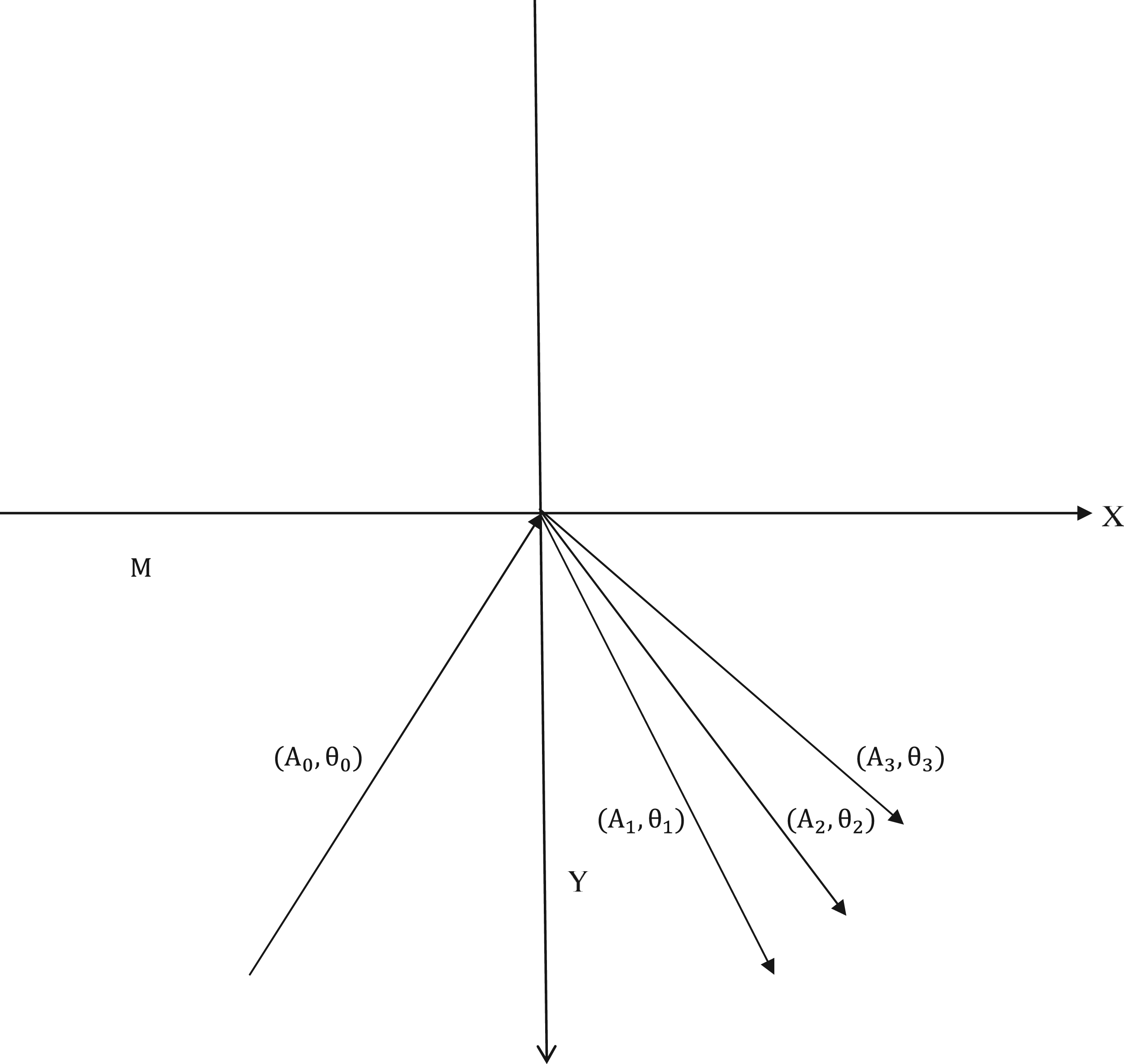
Consider a homogeneous thermally conducting transversely isotropic fibre-reinforced medium () in the undeformed state at a uniform temperature T0. The direction of the fibre is assumed to be parallel to x-axis. If a plane wave of longitudinal nature making an angle with the y-axis is incident at the stress free boundary, y = 0 there are reflected waves which are a longitudinal wave, transverse wave and thermal wave in the half-space M. The geometry of the problem is given by Figure 4.
Geometry of the problem.
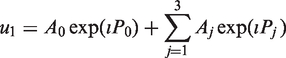
The total displacement due to incident and reflected waves in the half-space M may be given (see Singh, 2006) as
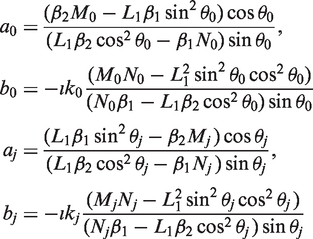
where is the phase factor of the incident longitudinal wave at angle with A0 as amplitude constant, are the phase factors of the reflected waves corresponding to amplitude constants Aj at angles and expressions of the coupling constants and bj are given as
We have seen that longitudinal, thermal and transverse waves are coupled with one another. The Snell’s law of this problem which gives the relation of the angles of incident and reflected waves is given by
5. Boundary conditions
The boundary of the half-space y = 0 is free from mechanical stresses, i.e. all components of stress tensor must vanish at y = 0. Mathematically, these conditions may be expressed as: at y = 0
Here, Equations (25) and (26) are due to vanishing of normal and shear components of stress tensor, while Equation (27) is due to vanishing of temperature gradient on the free boundary surface.
Substituting the expressions of and T from Equations (21)–(24) into the boundary conditions (25)–(27), we have
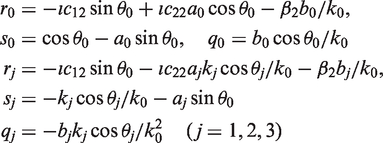
where
These equations will give the amplitude ratios corresponding to the reflected waves.
6. Amplitudes and energy
The amplitudes and energy corresponding to the incident and reflected waves are given by solving the boundary conditions.
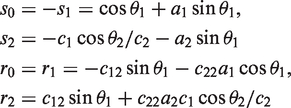
These equations give the amplitude ratios of the reflected coupled waves. We have observed that these ratios depend on the thermal parameters, material constants and the angle of incidence of the incident wave.
In the absence of thermal effect, i.e. , , and , the equations of motion reduce to Equations (8) and (9). There is no more thermal wave. Using the first two boundary conditions given in Equations (25) and (26), the expression of the amplitude ratios are given by
where
These results are the same results as those of Singh and Singh (2004) for the relevant problem.
6.2. Energy ratios
Consider the energy partition of the various reflected waves due to incident longitudinal wave at the plane free surface The rate of energy transmission is given by Achenbach (1976) as
The energy equation due to incident wave is given by
where
The energy ratios of the various reflected waves are defined as the ratios of energy corresponding to the reflected waves to the energy of the incident wave. The modulus of energy ratios of the coupled reflected waves are given as
where , and .
These energy ratios of the reflected waves are the functions of the amplitude ratios, thermal parameters, material constants and the angle of incidence of the incident wave.
7. Discussion of numerical computation
For the numerical computations, we take the following values of the relevant parameters for fibre-reinforced thermoelastic materials M (modified values of Singh, 2006) as
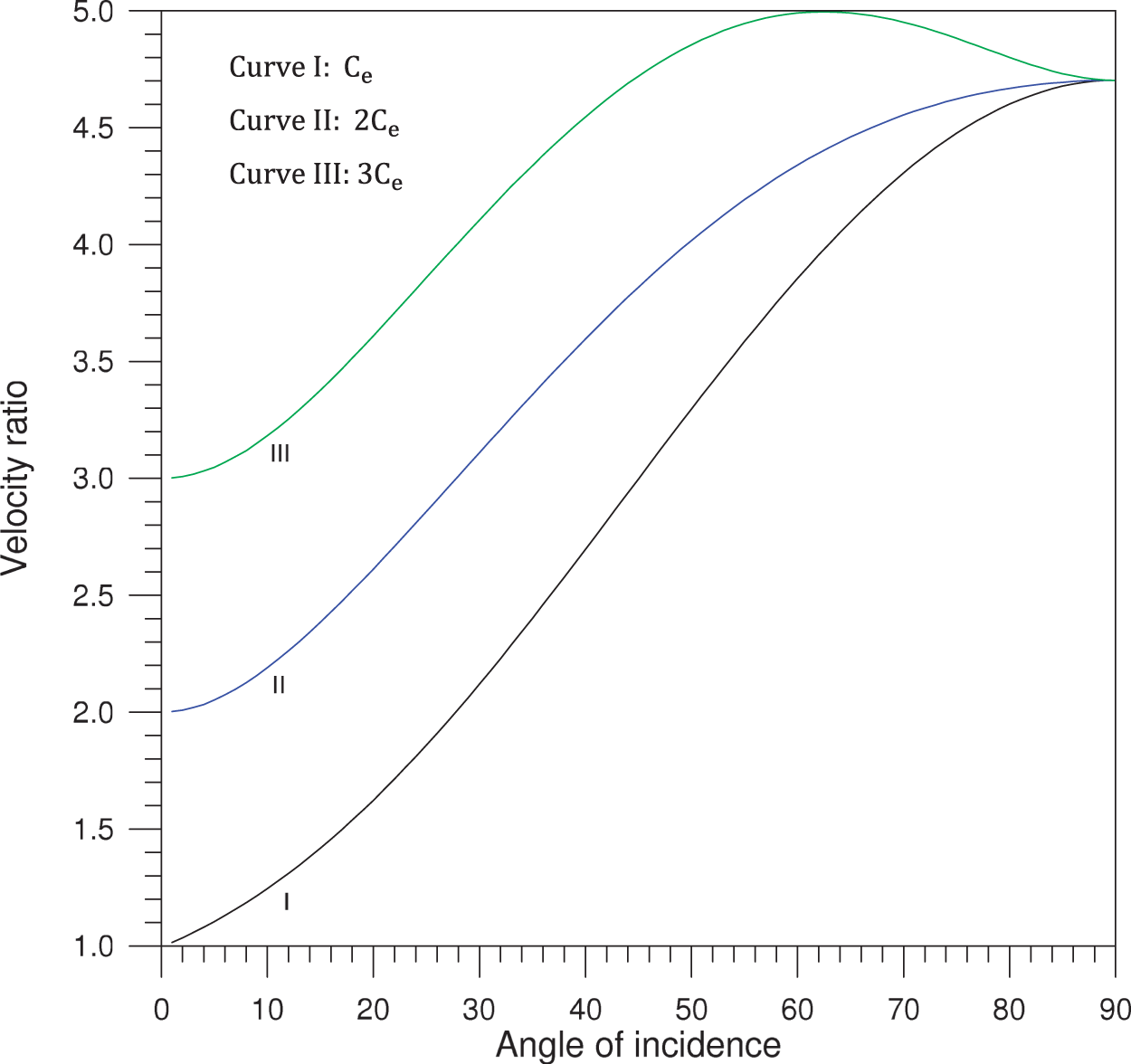
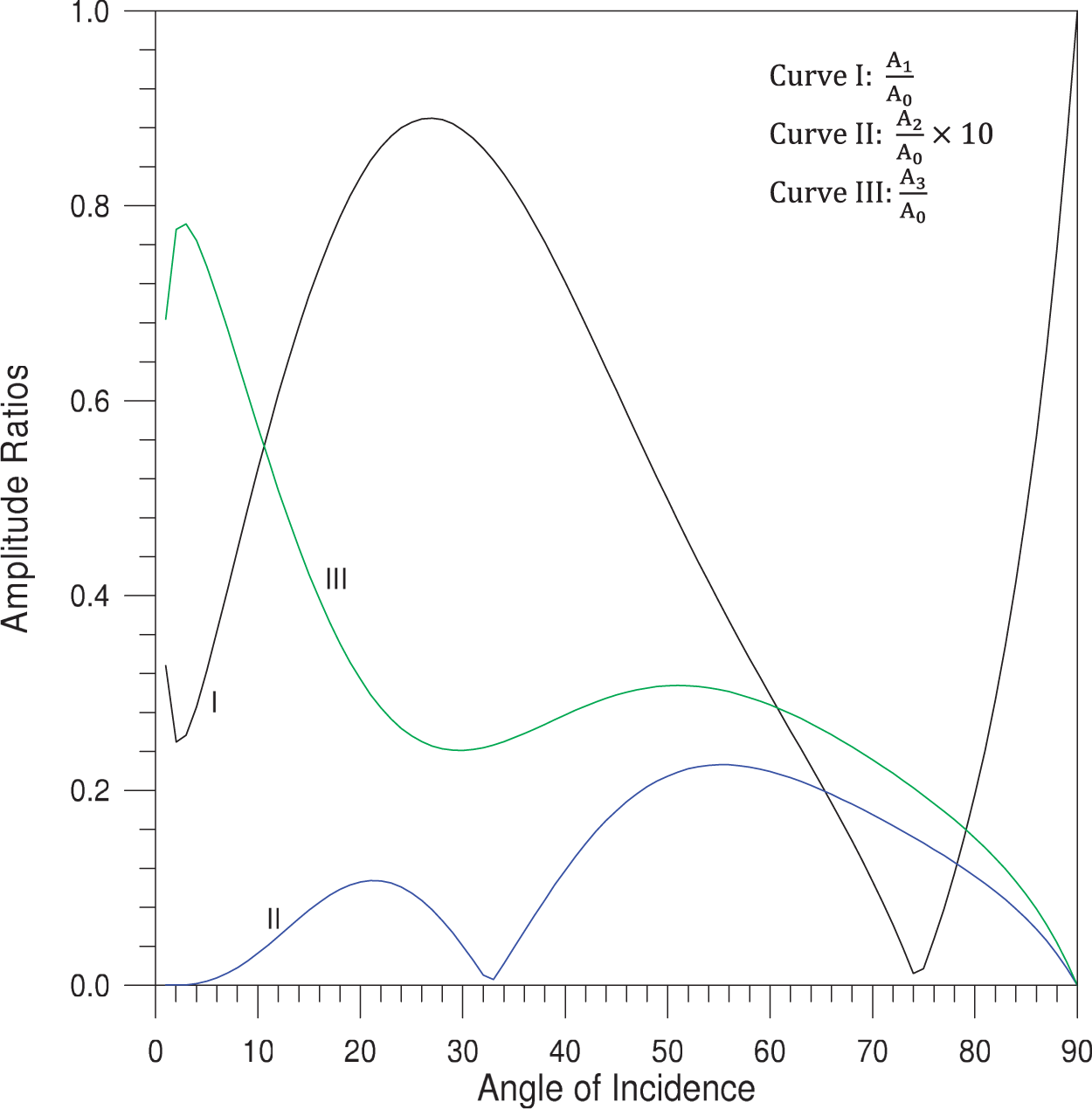
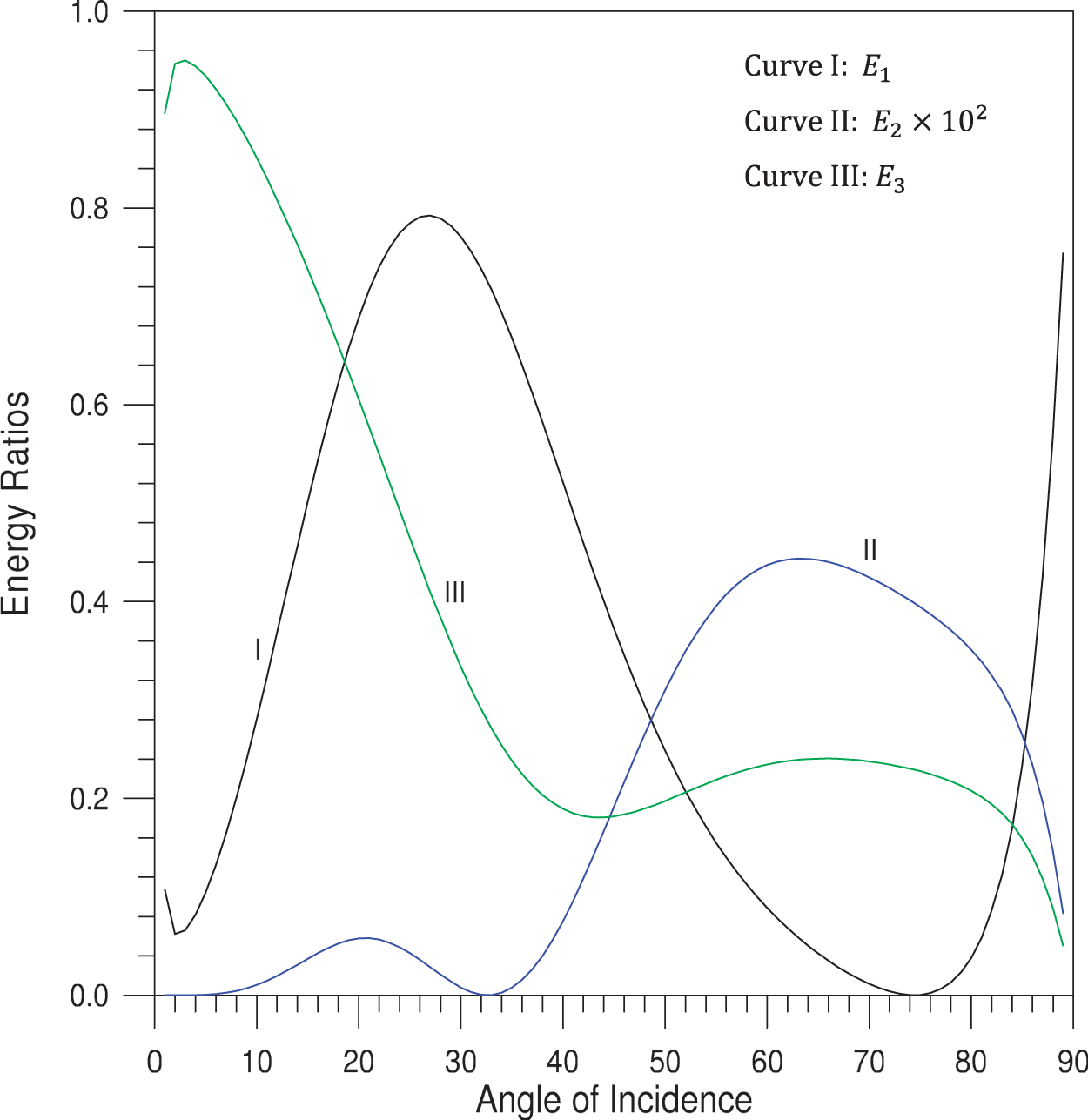
The variation of the non-dimensional velocity , and with angle of incidence are depicted in Figure 1–3 and 5–7 for different values of specific heat Ce. In Figure 1, the modulus of non-dimensional velocity, , corresponding to the reflected longitudinal wave increases with the increase of angle of incidence up to certain value of and then it decreases thereafter. We have observed that the values of increases with the increase of Ce. In Figure 5, the non-dimensional attenuation part of shows similar behaviour with the variation of modulus of , but here in this condition with the increase of Ce, the attenuation values decrease. Figures 2 and 6 show that the variation of the modulus of the values of and its attenuation part decreases with the increase of and it is obtained that the non-dimensional velocity corresponding to thermal waves is not affected much with the change of Ce. The variation of the non-dimensional velocity, corresponding to transverse waves is shown in Figures 3 and 7. We have observed that the modulus of starts from certain value which decreases until and thereafter increases with the increase of . The value of is not affected much by the change of Ce near but its effect increases after this value of angle of incidence. It may be noted that the attenuation part of decreases with the increase of and make a parabolic region in . Figure 8 depicts the variation of amplitude ratios , and of the reflected waves with the angle of incidence. Curve I shows that the variation of starts from certain value and decreases sharply to and, then, increases to which decreases thereafter attaining the minimum value at and then increases sharply. Curve II shows the variation of has two parabolic regions, i.e. and . In curve III, the values of increase sharply in the region and then decreases to which then increases again to , thereby decreasing the values of with the increase of . Figure 9 shows the variation of modulus of energy ratios, E1, E2 and E3 of the reflected waves with angle of incidence. In curve I, E1 starts from certain value and then decreases sharply to . It increases to and then decreases again to and thereafter E1 increases with the increase of . Curve II shows that E2 increases to from certain value and then, decreases to . It increases again to and thereafter E2 decreases with the increase of . In Curve III, the modulus of E3 increases sharply in the region and then decreases to . Again it increases with the increase of to , and decreases thereafter with the increase of . We have observed that the sum of energy ratios is close to unity.
Variation of the attenuation part of non-dimensional with .
Variation of the attenuation part of non-dimensional with .
Variation of the attenuation part of non-dimensional with .
Variation of the modulus of amplitude ratios of the reflected waves with .
Variation of the modulus of energy ratios of the reflected waves with .
8. Conclusion
The problem of reflection of elastic waves for the incident longitudinal wave at the plane free boundary of thermally conducting fibre-reinforced composite materials has been investigated. We have observed that there are three coupled waves, i.e. longitudinal waves, thermal waves and transverse waves can exist in the linear thermoelastic composite materials. The amplitude and energy ratios corresponding to the reflected waves have been obtained and computed numerically. We may conclude that:
all of the amplitude and energy ratios are functions of the elastic parameters, thermal parameters and angle of incidence;
the values of non-dimensional velocity corresponding to a longitudinal wave increase with the increase in specific heat Ce;
the non-dimensional velocity corresponding to a thermal wave is not affected much with the change of specific heat Ce;
the sum of energy ratios is found to be close to unity at free surface during reflection at each angle of incidence.
Footnotes
Funding
This work was supported by the Department of Science and Technology (DST), New Delhi, India (grant number SR/FTP/MS-017/2010).
References
1.
AbbasIA (2011) A two-dimensional problem for a fibre-reinforced anisotropic thermoelastic half-space with energy dissipation. Sadhana36(3): 411–423.
2.
AbbasIAAbd-allaAN (2011) A study of generalized thermoelastic interaction in an infinite fibre-reinforced anisotropic plate containing a circular hole. Acta Physica Polonica A119(6): 814–818.
3.
AchenbachJD (1976) Wave propagation in elastic solids, New York: North-Holland Publishing Company.
4.
AndersonDL (1961) Elastic wave propagation in layered anisotropic media. Journal of Geophysical Research66(9): 2953–2963.
5.
AouadiM (2008) Generalized theory of thermoelastic diffusion for anisotropic media. Journal of Thermal Stresses31(3): 270–285.
6.
BelfieldAJRogersTGSpencerAJM (1983) Stress in elastic plates reinforced by fibres lying in concentric circles. Journal of the Mechanics and Physics of Solids31: 25–54.
7.
ChattopadhyayAVenkateswarluRLKSahaS (2002) Reflection of quasi- P and quasi- SV waves at the free and rigid boundaries of a fibre-reinforced medium. Sadhana27(6): 613–630.
8.
DhaliwalRSSheriefHH (1980) Generalized thermoelasticity for anisotropic media. Quarterly of Applied Mathematics38: 1–8.
9.
GreenAENaghdiPM (1993) Thermoelasticity without energy dissipation. Journal of Elasticity31: 189–208.
10.
KumarRDeviS (2010) Wave propagation in mixture of generalized thermoelastic solids half-space. Journal of Solid Mechanics2(3): 199–213.
11.
KumarRKansalT (2008) Propagation of Lamb waves in transversely isotropic thermoelastic diffusive plate. International Journal of Solids and Structures45: 5890–5913.
12.
LordHWShulmanY (1967) A generalized dynamical theory of thermoelasticity. Journal of the Mechanics and Physics of Solids15(5): 299–309.
13.
NayfehANasserSN (1971) Thermoelastic waves in solids with thermal relaxation. Acta Mechanica12: 53–69.
14.
PonnusamyP (2007) Wave propagation in a generalized thermoelastic solid cylinder of arbitrary cross-section. International Journal of Solids and Structures44: 5336–5348.
15.
PonnusamyPRajagopalM (2011) Wave propagation in a transversely isotropic thermoelastic solid cylinder of arbitrary cross-section. Acta Mechanica Solida Sinica24: 527–538.
SharmaMD (2008) Inhomogeneous waves at the boundary of a generalized thermoelastic anisotropic medium. International Journal of Solids and Structures45: 1483–1496.
18.
SharmaMD (2010) Existence of longitudinal and transverse waves in anisotropic thermoelastic media. Acta Mechanica209: 275–283.
19.
SharmaJNKumarVSudSP (2000) Plane harmonic waves in orthorhombic thermoelastic materials. Journal of the Acoustic Society of America107(1): 293–305.
20.
SharmaJNSinghH (1985) Thermoelastic surface waves in a transversely isotropic half-space with thermal relaxations. Indian Journal of Pure and Applied Mathematics16: 1202–1219.
21.
SinghB (2003) Wave propagation in an anisotropic generalized thermoelastic solid. Indian Journal of Pure and Applied Mathematics34: 1479–1485.
22.
SinghB (2004) Plane waves in a thermally conducting viscous liquid. Sadhana29(1): 27–34.
23.
SinghB (2006) Wave propagation in thermally conducting linear fibre-reinforced composite materials. Archive of Applied Mechanics12: 1–7.
24.
SinghBSinghSJ (2004) Reflection of plane waves at the free surface of a fibre-reinforced elastic half-space. Sadhana29(3): 249–257.
25.
SinghHSharmaJN (1985) Generalized thermoelastic waves in transversely isotropic media. Journal of the Acoustic Society of America77: 1046–1053.
26.
SinghSJKhuranaS (2002) Reflection of P and SV waves at the free surface of a monoclinic elastic half-space. Proceedings of the Indian Academy of Sciences (Earth and Planetary Science)111(4): 401–412.
27.
SinghSSTomarSK (2007) Shear waves at a corrugated interface between two dissimilar fiber-reinforced elastic half-spaces. Journal of Mechanics of Materials and Structures2(1): 167–188.
28.
SpencerAJM (1941) Deformation of fibre-reinforced materials, Oxford: Clarendon.
29.
TianXZhangJShenYLuTJ (2007) Finite element method for generalized piezothermoelastic problems. International Journal of Solids and Structures44: 6330–6339.
30.
TomarSKSinghSS (2006) Plane SH-waves at a corrugated interface between two dissimilar perfectly conducting self-reinforced elastic half-spaces. International Journal of Numerical and Analytical Methods in Geomechanics30(6): 455–487.
31.
VermaKL (2011a) Generalized thermoelastic waves in laminated structures. Journal of Computer and Mathematical Sciences2(4): 675–682.
32.
VermaKL (2011b) The general problem of thermoelastic wave propagation in multilayered anisotropic media with application to periodic media. International Journal of Applied Engineering Research, Dindigul1(4): 908–922.