






Abstract
In this paper, the free vibration of an orthotropic beam undergoing finite strain are studied. The second Piola-Kirchhoff stress tensor and Green-Lagrange strain tensor according to finite strain assumption were used to obtain Euler-Bernoulli beam governing equations. The Galerkin method and Generalized Differential Quadrature method were employed for solving the governing equations and boundary condition. The effect of beam thickness and different boundary conditions were considered in finite strain formulation of the beam equations. Natural frequencies of different composite materials are obtained and compared. The results revealed that by increasing the beams thickness, the difference between maximum vibration amplitude increased between von Karman and finite strain formulations. Also, in a beam with simply- simply supports, differences between linear and non linear mode shapes was remarkable.
1. Introduction
Nonlinear vibration in beams is one of the greatest concerns, and accurate calculation of its frequency is a necessary step for various industrial applications. The nonlinear geometrical vibrations are divided to two main groups: 1) vibrations with large deformations and small strains, and 2) vibrations which are affected by finite strain. In finite strain vibrations, in addition to the large deformations, strains are not limited to infinitesimal strain. A great deal of research with various assumptions has been performed on geometrical nonlinear vibrations of the beams. The majority of these studies have used the large deformation and small strain assumptions and have been performed on the basis of von Karman assumptions. Silva (1988) with estimation of motion locative response changed the partial differential equation of motion to common differential equation with time variable and solved the equation for clamp-clamp and clamp- simply support boundary conditions by employing perturbation method. Singh et al. (1990) employed finite element method to investigate the free vibration of a beam with high amplitude. Lewandowski (1994) studied the nonlinear free vibrations of Euler-Bernoulli beam with von Karman assumptions by finite element method. Foda (1999) studied the nonlinear free vibrations of Timoshenko beam with high amplitude by using multi scale method. He compared his findings with Euler-Bernoulli beam and showed that the effect of shearing deformation in high amplitude is more than the rotational inertia effect.
Ribeiro and Petyt (1999) studied the free and forced nonlinear vibrations of Euler-Bernoulli beam with von Karman assumptions by balance harmonic and finite element method. They indicated the existence of internal resonance phenomenon for clamp-clamp and simply-simply supported beams. Marer (2001) presented a brief review on performed works by finite element method in the field of nonlinear vibrations of beams. An exact solution for the free vibrations of a flexible beam undergoing an overall two-dimensional motion using the Euler-Bernoulli beam theory was obtained by Nayfeh et al. (2003). Malatkar (2003), Malatkar and Nayfeh (2003) and Nayfeh and Pai (2004) performed a comprehensive review of published articles in the field of nonlinear vibration of beams, considering the different effects such as rotational inertia, shearing deformation and longitudinal deformation.
Agrawal et al. (2006) investigated the high amplitude vibration of composite beam, considering the model of Timoshenko beam by finite element method. They used von Karman nonlinear assumptions in dynamic analysis. The vibrational frequencies and mode shape functions of Euler-Bernoulli Beams with an arbitrary number of non-breathing cracks, when subjected to axial loading in different boundary conditions was investigated by Aydin (2008). Gupta et al. (2009) presented a new method in finite element to investigate the Euler-Bernoulli nonlinear vibration under the von Karman assumptions. Amabili and Reddy (2010) investigated the forced vibration of a multi-layer composite shell by employing the higher order shear deformation theory of laminated shells. They illustrated, when amplitude of vibration is more than two times of the shell thickness, the calculated results according to the von Karman assumptions are not accurate and the nonlinear components due to the longitudinal deformation of the beam have to be considered in modeling. Zhang et al. (2011) investigated periodic steady state response of a viscoelastic beam with longitudinal motion in the amplitude of critical speed and obtained the equation of motion using von Karman assumption. Numerical simulations demonstrated that the periodic steady-state responses exist in the transverse vibration and a resonance with a softening-type behavior occurs if the external load frequency approaches the linear natural frequency in the supercritical regime. A finite element model of large amplitude free vibrations of thin functionally graded beams with immovably supported is formulated based on Euler-Bernoulli beam theory and von Karman geometric nonlinearity by Taeprasartsit (2013).
In this research, the free vibration of a composite beam affected by finite strain and subjected to different boundary conditions is investigated. In order to drive the equation of motion and apply the boundary conditions of composite beam all nonlinear terms of Green-Lagrange strain tensor are considered according to finite strain assumption. For solving the equation of motion, using Galerkin method, time is eliminated from the equation and the problem is turned to a problem of special quantity of locative nonlinear. Then the problem is solved and results are compared with available results in the literature for linear vibration.
2. Governing equations
In this research, equations of motion and boundary conditions are obtained according to Hamilton’s rule. Based on this principle, in the absence of external forces the following relation is obtained (Attard, 2003)
Using finite strain (Attard, 2003) theory, the first parameter of Green-Lagrange strain tensor by substitution of Euler-Bernoulli relation is obtained as the follows
Kinetic energy variations of the beam by ignoring the kinetic energy of the longitudinal vibrations and rotational inertia effect of the beam equals to
The stress resultants for composite beam have been defined as (Reddy, 2003)
By employing the
For a single generally orthotropic layer, the stiffnesses can be expressed in terms of the transformed coefficients
Substituting the variations of kinetic and potential energy equations (4) and (5) (in Hamilton principle) and using equations (6) to (8) the equation of motion and boundary conditions are obtained as
Boundary conditions in
Resultant stresses are computed in displacement terms and replaced in equations (9), (10a) and (10b) to obtain a simplified form of the equation of motion and boundary conditions as
Boundary condition in
By introducing the following dimensionless quantities
The equation of motion has turned to the dimensionless form as
And boundary condition at
The above equation of motion is in cubic type and nonlinear terms are in three order.
3. Free vibration of a composite beam with finite strain
In this section equations (14) and (15) will be solved to obtain the free vibration of a unidirectional composite beam with finite strain assumption. For simplicity purpose in continuation of this research, the dimensionless quantities
Using the Galerkin method (Marion and Temam, 1989) the problem of nonlinear special quantity according to location variable and dimensionless boundary conditions are obtained
Boundary conditions in
When vibration of beam undergoing finite strain was surveyed, no approximation was made on equations and none of the nonlinear terms were eliminated. Subsequently, all boundary conditions were nonlinear. The generalized differential quadrature method (GDQM) developed by Du et al. (1995) are used to solve the nonlinear equation (18) and boundary conditions equation (19).
4. Numerical results and discussion
This section consists of free vibration analysis with comprehensive information on natural frequency of unidirectional composite beams. Three sets of boundary conditions are considered in the present analysis: a clamp-clamp (case 1), a clamp-free (case 2) and a simple-simple (case 3). In the study of different boundary conditions the ratio of thickness to length is assumed to be 0.02. Also the effect of thickness in finite strain formulation for ratio of thickness to length equals to 0.02, 0.1 and 0.2 and the effect von Karman assumption are discussed. Finally natural frequencies of two rectangular composite beams made of glass/epoxy and carbon/epoxy composite are obtained and compared.
4.1. Vibration analysis of a clamp-clamp composite beam
The clamp-clamp boundary conditions at two ends of the beam are given as
The backbone curve for the first three mode of vibration of clamp-clamp composite beam can be seen in Figure 1. In Figure 1, bifurcation points in each mode are congruous on linear frequency of that mode. This behavior in nonlinear vibrations is well-known (Foda, 1999). In the backbone curves, Wm, λ and The backbone curve for the first three mode of vibration of clamp-clamp supported beam.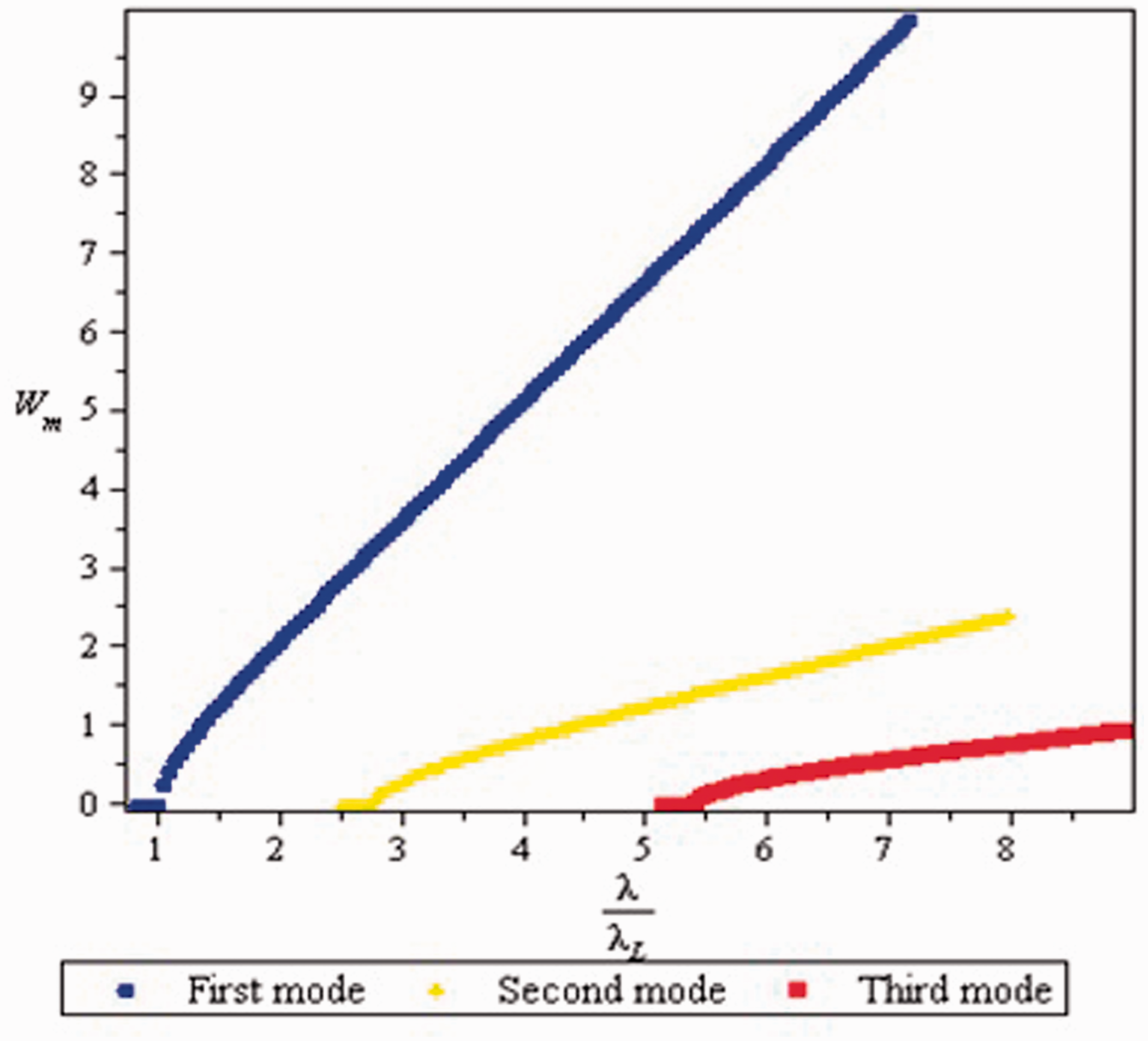
Linear frequencies of unidirectional composite beam.

According to Figures 2–4, the slope of the curves of nonlinear vibration are more than linear vibration. These three figures show that with increasing the frequency, the slope of the curve was increased at the clamped ends. These results have been confirmed by other researchers findings (Marur, 2001). In the mode of vibration curves, Wm, W and X are maximum dimensional displacement, longitudinal displacement and length of the beam, respectively.
First mode of vibration of clamp-clamp supported composite beam. Second mode of vibration of clamp-clamp supported composite beam. Third mode of vibration of clamp-clamp supported composite beam.


4.2. Vibration analysis of clamp-free composite beam
The clamp-free boundary conditions at two ends of the beam are given as
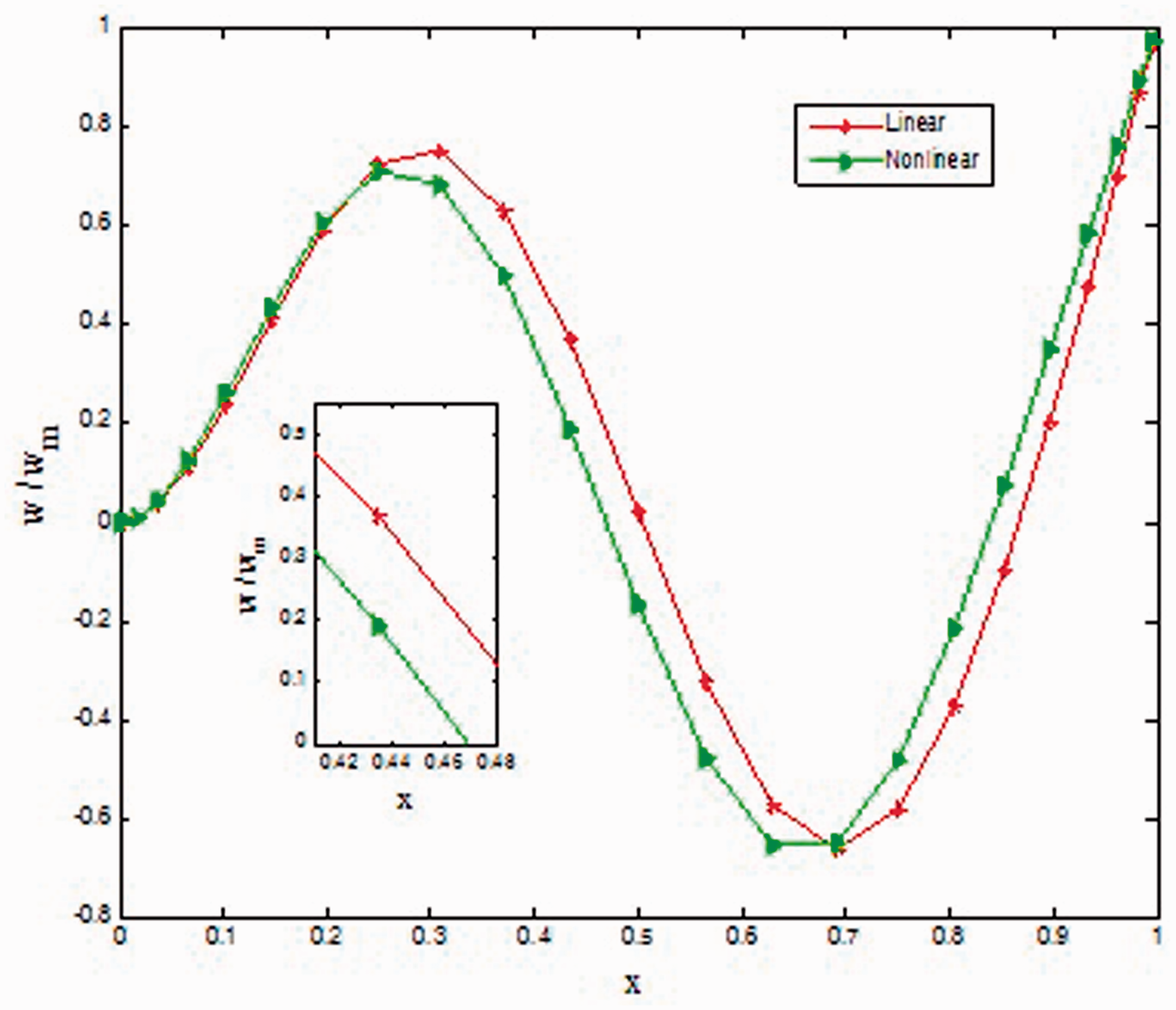
The linear frequencies of clamp-free boundary conditions of the composite beam and the ratio of linear frequencies are shown in Table 1. As depicted in the backbone curve of Figure 5, bifurcation points in each mode are congruous on linear frequency of that mode. In Figures 6–8 three-dimensionless mode shapes are shown. Also in this case, the hardening effect was observed in each mode of vibration. These three figures showed that with increasing the frequency, slope of the curve was increased at the clamped ends and decreased at the free ends.
The backbone curve for the first three mode of vibration of clamp-free supported beam. First mode of vibration of clamp-free supported composite beam. Second mode of vibration of clamp-free supported composite beam. Third mode of vibration of clamp-free supported composite beam.


4.3. Vibration analysis of a simply- simply composite beam
The simply support boundary conditions at two ends of the beam are given as
The linear terms of this equation are the same were appeared in Euler-Bernoulli beam and the nonlinear terms are related to the finite strain assumption. After applying the GDQ method to equation (18), the backbone curve for the first three mode shapes of a unidirectional composite beam are obtained and depicted in Figure 9.
The backbone curve for the first three mode of vibration of simply-simply supported beam.
The linear frequencies of simply-simply boundary conditions of the composite beam and the ratio of linear frequencies are shown in Table 1.
Linear and nonlinear mode shapes in the dimensionless form are shown in Figures 10–12 for three mode shapes. It was shown in this research that in opposition to the findings of other researchers (Foda, 1999) in simply-simply supported beam, the mode shapes of linear and nonlinear modes are not equal, and differences are recognizable.
First mode of vibration of simply-simply supported composite beam. Second mode of vibration of simply-simply supported composite beam. Third mode of vibration of simply-simply supported composite beam.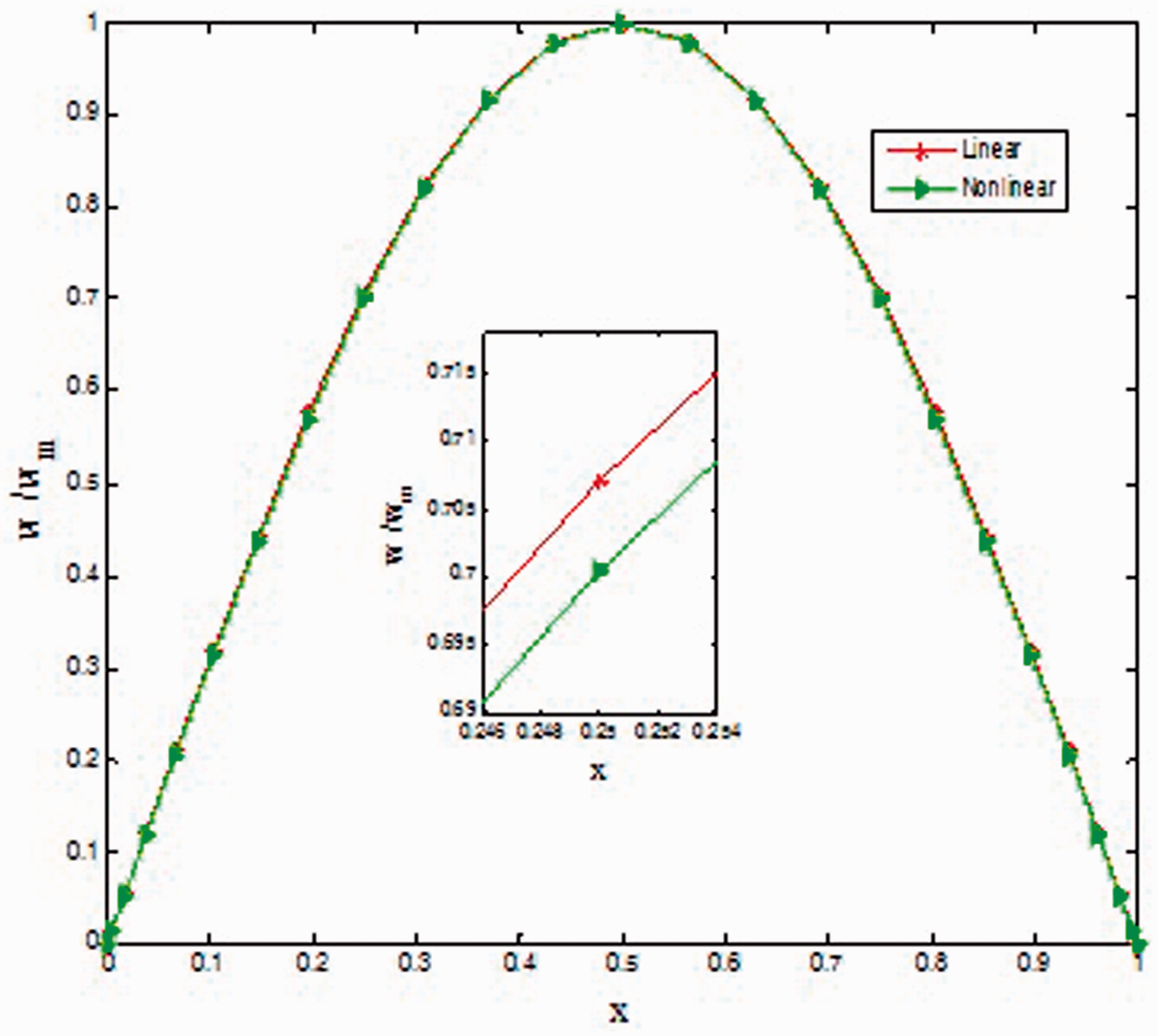
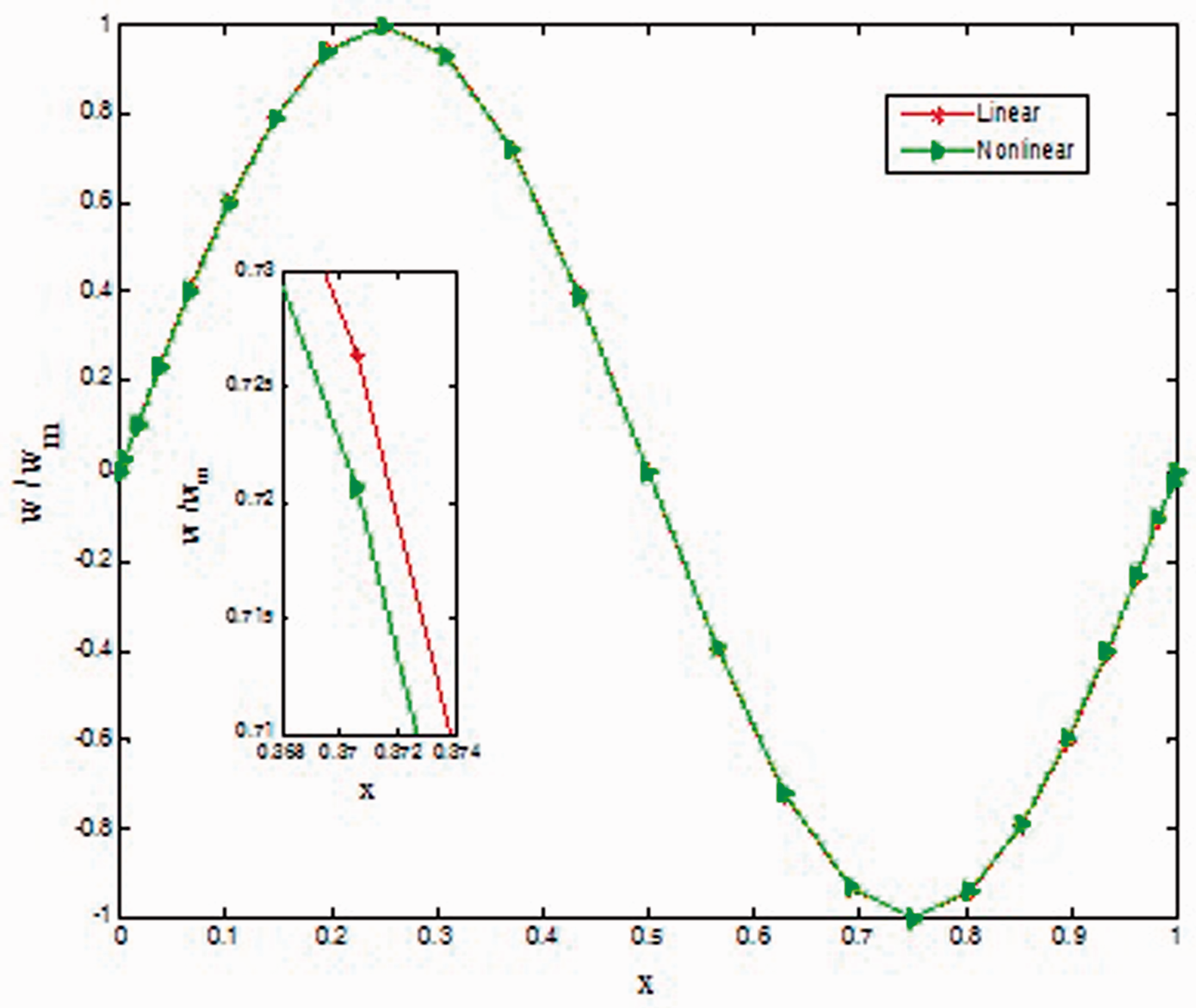
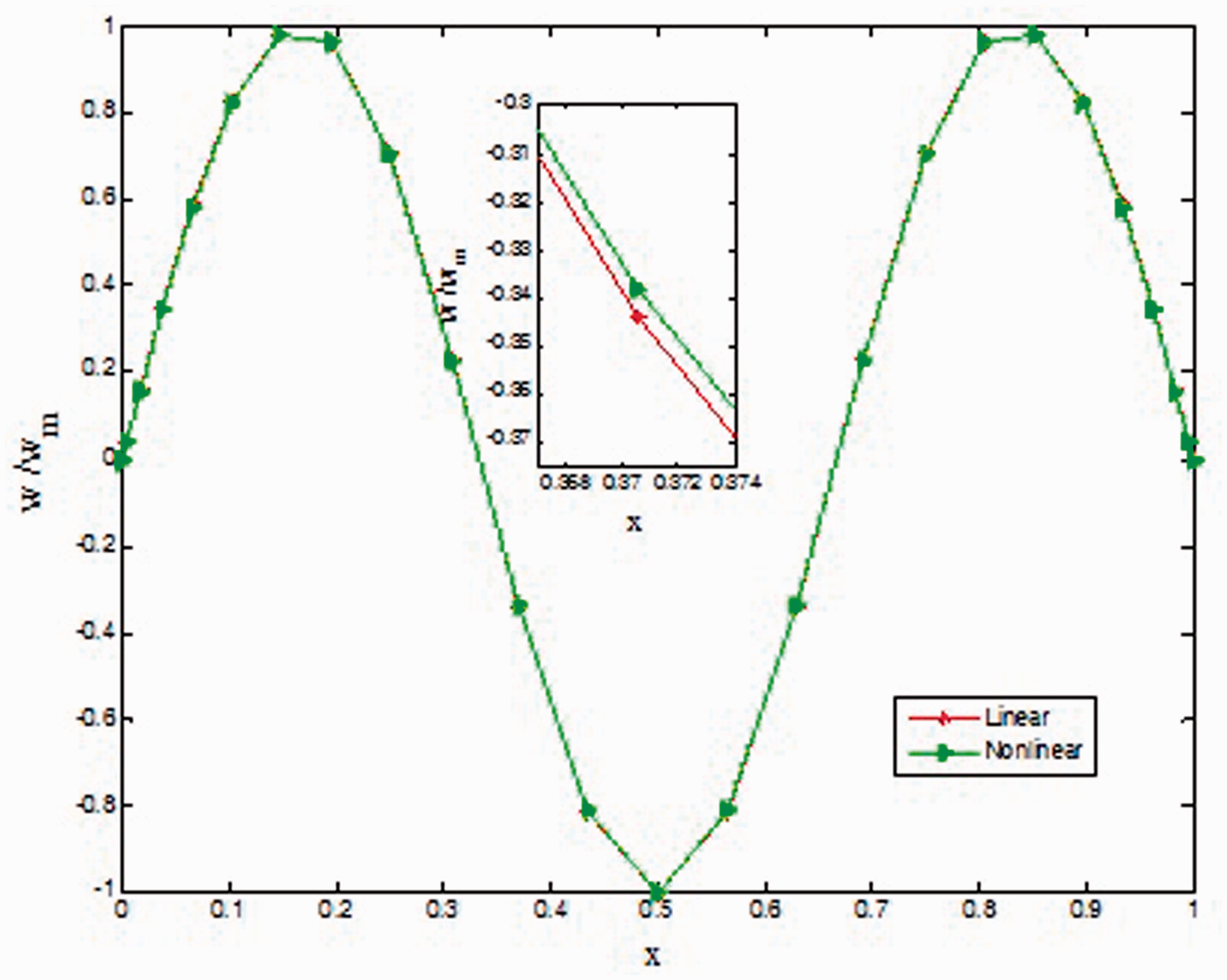
Other researchers (Marur, 2001) used von Karman assumptions with linear boundary conditions, while in this research governing equations and boundary conditions are all nonlinear. As it is shown in the Figures 10–12, by increasing the amplitude of vibration, the slope of the curves is decreased near to the end parts of the beam and this reduction for the first mode is more perceptible.
4.4. The Effect of thickness in finite strain vibration
In this section, the effect of thickness on the free vibration response of the beam with von Karman and finite strain assumptions are studied. This comparison is done for clamp-clamp beam and three different geometry as h/L = 0.02, 0.1 and 0.2. von-Karman equation in dimensionless form is independent of the beam geometry but equation with finite strain consideration is dependent on the geometry parameter (h/L). The backbone curve for first mode shape of von Karman beam and finite strain in clamp-clamp case is shown in Figure 13. In this figure, the maximum difference of vibration amplitude for von Karman and finite strain beams with h/L = 0.02 is limited and almost is negligible, but with increasing the thickness and other geometrical proportions, this difference becomes considerable. It can be seen from Figure 13 that in a given frequency, the vibration amplitude of the finite strain beam is less than von Karman beam. In addition, stiffness of finite strain beam is more than von Karman beam and this property becomes larger by increasing the beam thickness.
The first mode of the backbone curve for various thickness finite strain and von Karman.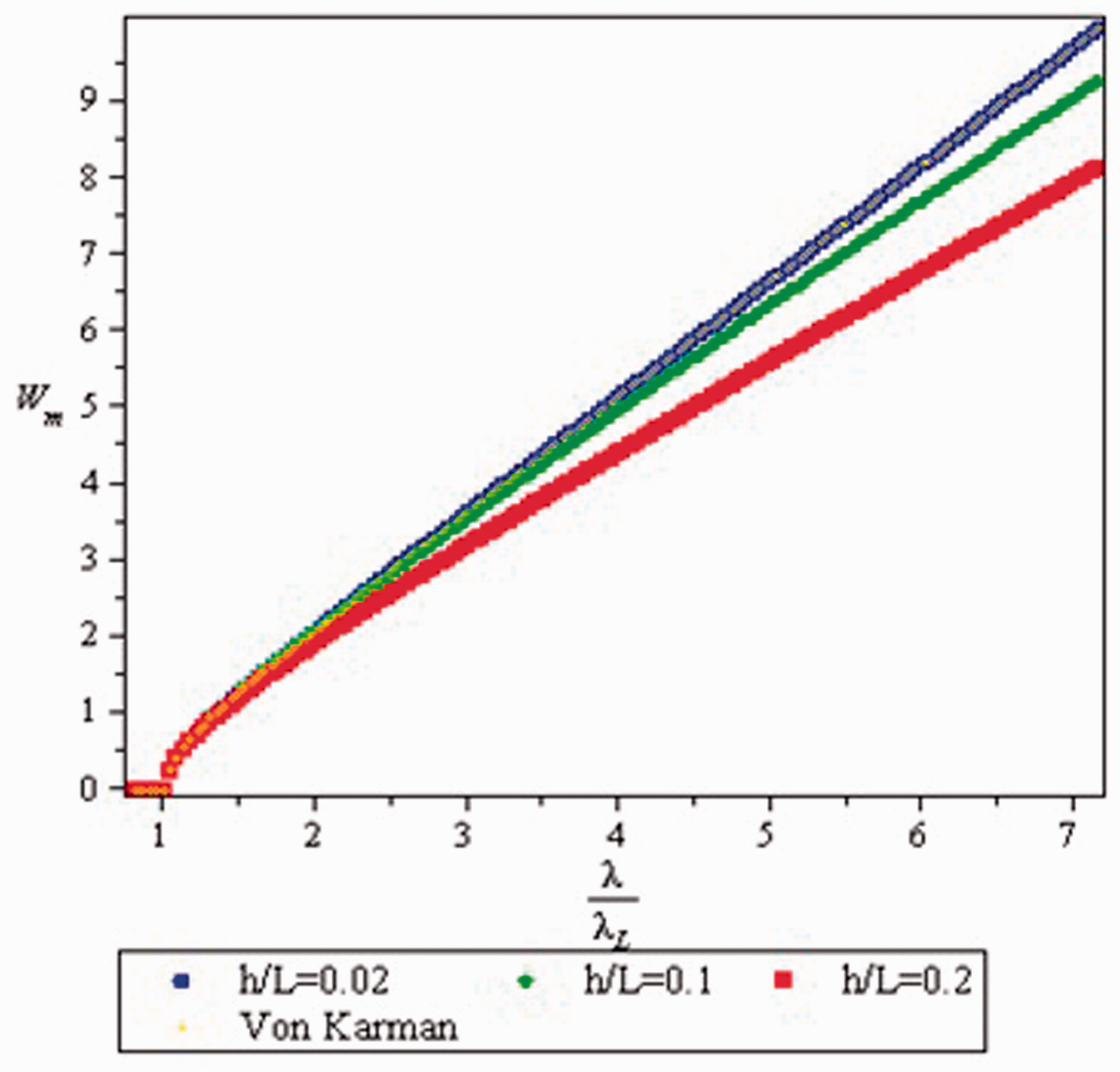
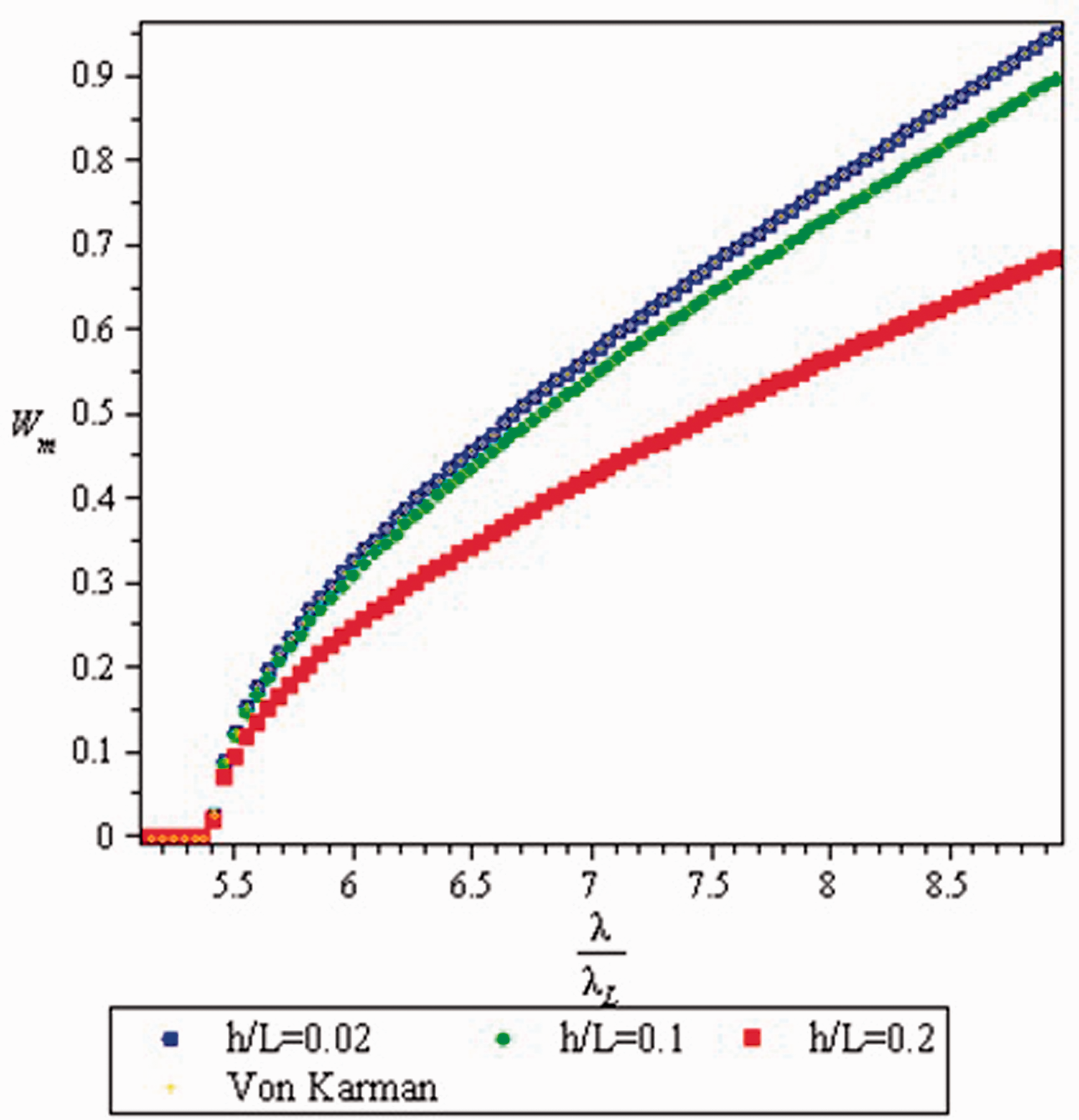
Figures 14 and 15 illustrate the backbone curve of von Karman and finite strain beam in second and third modes. In these two modes, difference between von Karman and finite strain beams for h/L = 0.02 is very small, however, for two other geometrical proportion h/L = 0.1 and 0.2 this difference becomes remarkable. By comparing Figures 13–15 it was understood that the difference of maximum amplitude of von- Karman and finite strain beams in higher modes were more remarkable. In addition, by increasing the beams thickness, the difference between von Karman and finite strain beam was increased. For explanation of this difference, it should be considered that in very thin beams, there is possibility of beam vibration with high amplitude and infinitesimal strain, however, by increasing the beam’s thickness, the strains are increased and the assumption of infinitesimal strain is not valid. Increasing the strains result in increasing the difference between predictions of von Karman and finite strain beams.
The second mode of the backbone curve for various thickness finite strain and von Karman. The third mode of the backbone curve for various thickness finite strain and von Karman.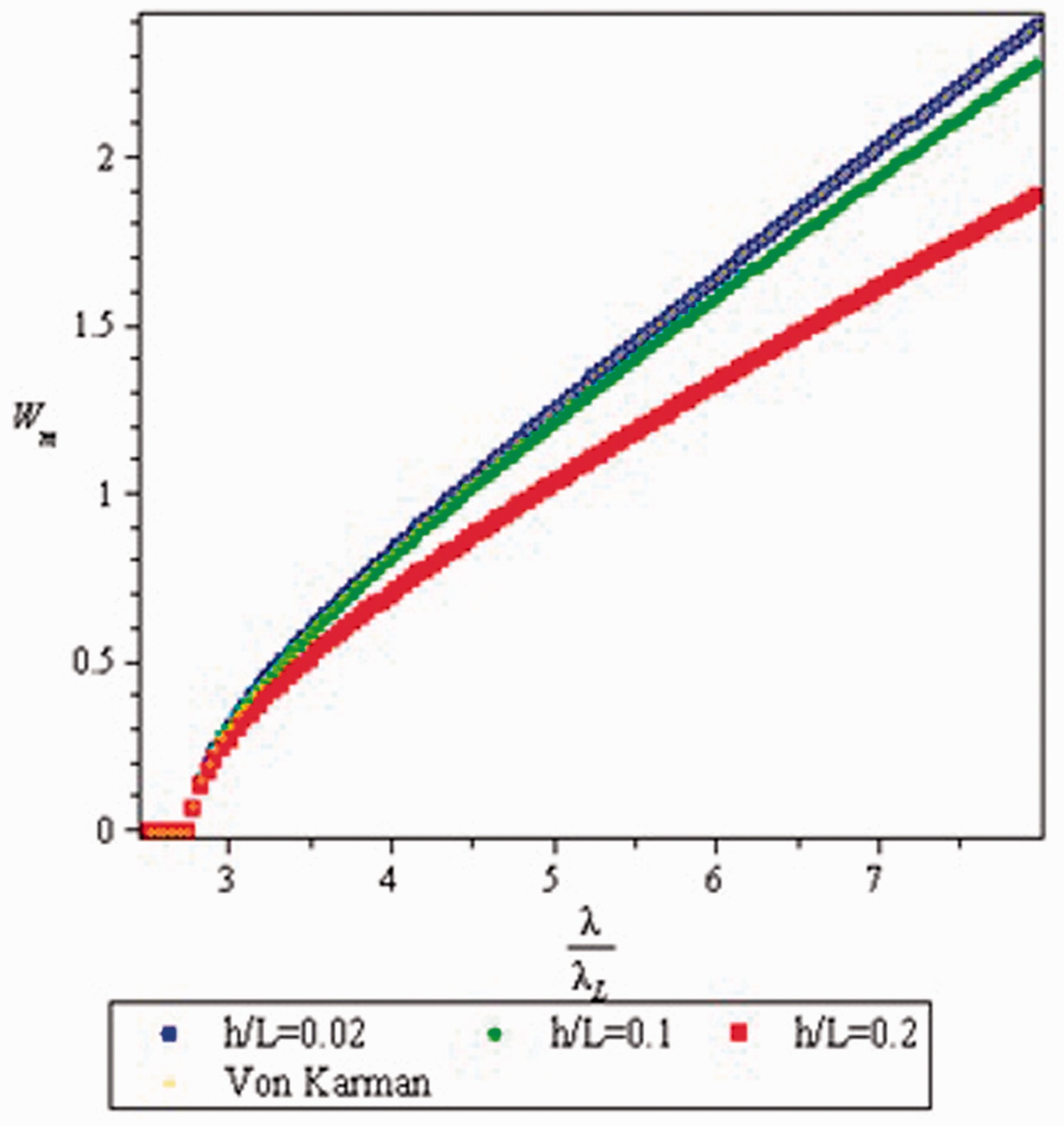
4.5. The effect of material properties
Elastic properties of glass/epoxy and carbon/epoxy.

Natural frequencies of carbon/epoxy and glass/epoxy composite beams.

a) von Karman, b) finite strain.
4.6. Validation
Ratio of the nonlinear to linear frequency for Euler-Bernoulli beams.

5. Conclusion
In this article, the Green-Lagrange strain tensor was used to obtain the equation of free vibration of Euler-Bernoulli composite beam. Numerical solution of the governing equations with finite strain assumption is performed for different boundary conditions and Backbone curves were obtained for first three mode shapes. In Backbone curves, bifurcation points in each mode are congruous on linear frequency of that mode. When increasing the vibration amplitude, frequency is increased. The results showed that for the clamped –clamped case, the slope of the nonlinear vibration curves at the clamped ends are more than the slope of the linear vibration curves. Also for the beam with clamped-free boundary condition, the slope of the nonlinear vibration curve was higher and lower than the linear vibration case at the clamped and free ends, respectively. It has been shown during this research that for simply-simply supported beam, differences between linear and nonlinear mode shapes were remarkable. Also, comparison between von-Karman and finite strain equations was performed for clamp-clamp beam. The von-Karman equation in dimensionless form is independent of the beam geometry, however, equation with finite strain consideration is dependent on the geometry parameter (h/L). The maximum difference of vibration amplitude for von Karman and finite strain beams with h/L = 0.02 is limited and almost is negligible.
Results revealed that in a given frequency, the vibration amplitude of the finite strain beam is less than von Karman beam. In addition, by increasing the beams thickness, the difference between von Karman and finite strain beams were increased.
Footnotes
Funding
The authors are grateful to the University of Kashan for supporting this work by grant number 255980/02.