






Abstract
A two-stage approach based on residual force vector and response sensitivity analysis is proposed for structural damage identification in this study. Local damage is represented by a perturbation in the elemental stiffness parameter of the structural finite element model. Primarily, the difference between the virtual residual force vector of an intact and damaged structure is used to localize the damage. Then, a response sensitivity-based method is adopted to identify the perturbation of the stiffness parameter (i.e., the extent of the local damage) from the measured dynamic responses. Numerical simulations are conducted to identify both single and multiple structural damages under sinusoidal or impulsive excitation. The proposed approach gives satisfactory results with artificial measurement noise.
Keywords
1. Introduction
Many structures are subject to damage because of, for example, impact, earthquake, fatigue and corrosion. Because of the many requirements for high-quality and reliable structures, the vibration-based damage identification methods have become major topics of research over the past few decades. The main idea of vibration-based damage identification methods is that the modal parameters or vibration characteristics (such as natural frequency, mode shape, modal damping etc.) are related to the structural physical properties (mass, damping and stiffness). Therefore, structural damage alters the physical properties, and the changes in the physical properties have obvious influences on the modal characteristics or dynamic responses of the structure.
Modal parameters have been used extensively to identify the location and extent of local structural damage. Most of the existing damage identification methods are mainly based on the changes in natural frequencies (Chinchalkar, 2001; Kim and Stubbs, 2003; Urgessa, 2011), mode shapes (Rizos et al., 1990; Pandey et al., 1991; Ratcliffe, 1997), modal flexibility (Pandey and Biswas, 1994; Wu and Law, 2004; Yang, 2011) or frequency response functions (Maia et al., 2003; Chatterjee, 2010).
The residual force vectors, derived from the natural frequencies and mode shapes of the intact and damaged structure, have been used to identify structural damages. Ricles and Kosmatka (1992) used residual modal force vectors to locate possible damaged regions, and then determined the extents of stiffness variations using a weighted sensitivity analysis based on a first-order Taylor series expansion of mode shapes and eigenvalues of an undamped structural system. Zimmerman and Kaouk (1994) made use of a minimum rank update theory to detect structural damages. Damage locations are determined firstly by the damage vectors and the damage extents are assessed by a minimum rank update theory. Li and Smith (1995) used residual force vectors directly to solve the parameter changes of damaged elements, but again they used experimentally undamped mode shapes and natural frequencies in the damage estimation. Liu and Yang (2006) made use of an original finite element model (FEM) and a subset of measured eigenvalues and eigenvectors to determine the number of damaged elements and localized the damage elements by the damage localization matrix. After that, the damage extent could be easily obtained. In general, the residual force vector is used to locate damage, and other methods of damage quantification is used to assess the extent of the damage. However, the damage estimation scheme mentioned above is valid only for undamped structures.
Recently, the structural damage identification in the time domain has attracted the interest of many researchers (Hjelmstad et al., 1995; Ge and Soong, 1998). Choi and Stubbs (2004) utilized the damage indices, which are formulated by a mean strain energy in a specified time period, to identify the locations and corresponding extents of the possible damage. Cattarius and Inman (1997) used time histories of the vibration response of the structure for identifying the presence of damage. Lu and Law (2007) developed a response sensitivity-based FEM updating method to identify structural damages from the measured dynamic responses. Although this only needs a few measurement points, it still provides a high damage identification accuracy as it takes advantage of the plentiful time history data. However, this approach requires long computional time when the number of updating parameters is large.
To overcome the problems mentioned above, in this study an improved approach based on residual force vector and response sensitivity analysis is presented to identify structural damage. Damage location is first determined by the residual force vector. Then the extent of damage is assessed by using a response sensitivity-based model updating method. As the residual force vector localizes the damaged sites beforehand, it reduces the number of unknowns in the model updating, which increases the efficiency of calculation and also improves the accuracy. It is also helpful for selecting the measurement points that can be more close to the damaged elements. Three numerical examples are studied to show the effectiveness and accuracy of the proposed method, including a planar truss, a cantilevered plate and a multiple-span continuous beam. Both single damage and multiple damages can be identified successfully by using the proposed method and it is insensitive to artificial measurement noise.
2. Theory
2.1. Brief introduction to the virtual residual force vector method
The equation of motion for a general FEM of a linear elastic undamaged structural dynamic system can be expressed as
When neglecting the damping term and the external excitation force equals to zero, equation (1) will lead to the equation of undamped free vibration:
And the solution of equation (2) can be obtained from the eigenvalue equation, as follows:
In the case of damage detection, it usually assumes that there is a perturbation on the stiffness property as damage occurs while the mass parameter remains unchanged. Therefore, equations (1) and (2) can be expressed as follows:
The change of structural stiffness matrix
Substituting equation (6) into equation (5), we have
The residual force vector (RFV) (Zimmerman and Kaouk, 1994; Yang and Liu 2007)
And equation (8) can also be expressed as
It should be pointed out that the residual force obtained from a single mode shape may miss some damaged element. To obtain a more robust damage localization result, the virtual residual force vector
2.2. Response sensitivity with respect to damage parameters in time domain
As the local damage is represented by a perturbation of the elemental stiffness parameter
Since
2.3. Quantifying the damage extent from response sensitivity-based model updating
The objective function for the model updating is defined as minimizing the residual between the measured and calculated structural dynamic responses, for instance, the acceleration responses
Then the penalty function method (Friswell and Mottershead, 1995) is generally used for modal sensitivity with a truncated Taylor series expansion of the dynamic responses in terms of the parameter α, which are used to derive the sensitivity-based formulation. For finding the vector
Let
or
Like many other inverse problems, equation (16) is an ill-conditioned problem. In order to provide bounds to the solution, the damped least-squares method (DLS) (Tikhonov, 1963) and singular-value decomposition is used in the pseudo-inverse calculation. Equation (16) can be written in the following form using the DLS method
2.4. Effect of artificial measurement noise
The numerical examples will study the effect of artificial measurement noise on the identification, because the measured data are usually contaminated with the measurement noise Numerically, white noise is added to the calculated acceleration responses to simulate the noisy data with
The relative error is defined as
3. Numerical simulations
3.1. A planar truss structure
As shown in Figure 1, a two-dimensional truss structure is studied as an example to evaluate the effectiveness of the proposed method. The physical parameters of the structure are as follows: mass density A planar truss structure under study.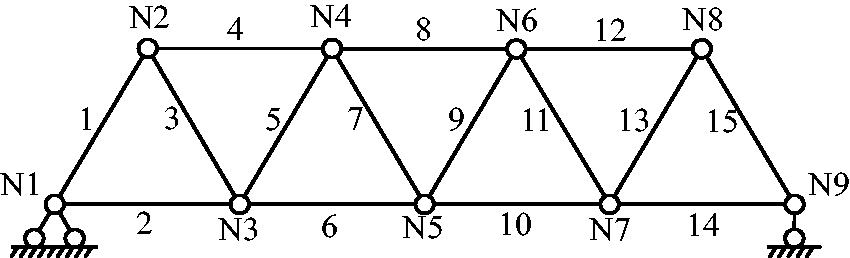
To obtain the dynamic responses for damage quantification, a sinusoidal excitation force is used to excite the structure. The sinusoidal force is taken as
3.2. Identification of single damage
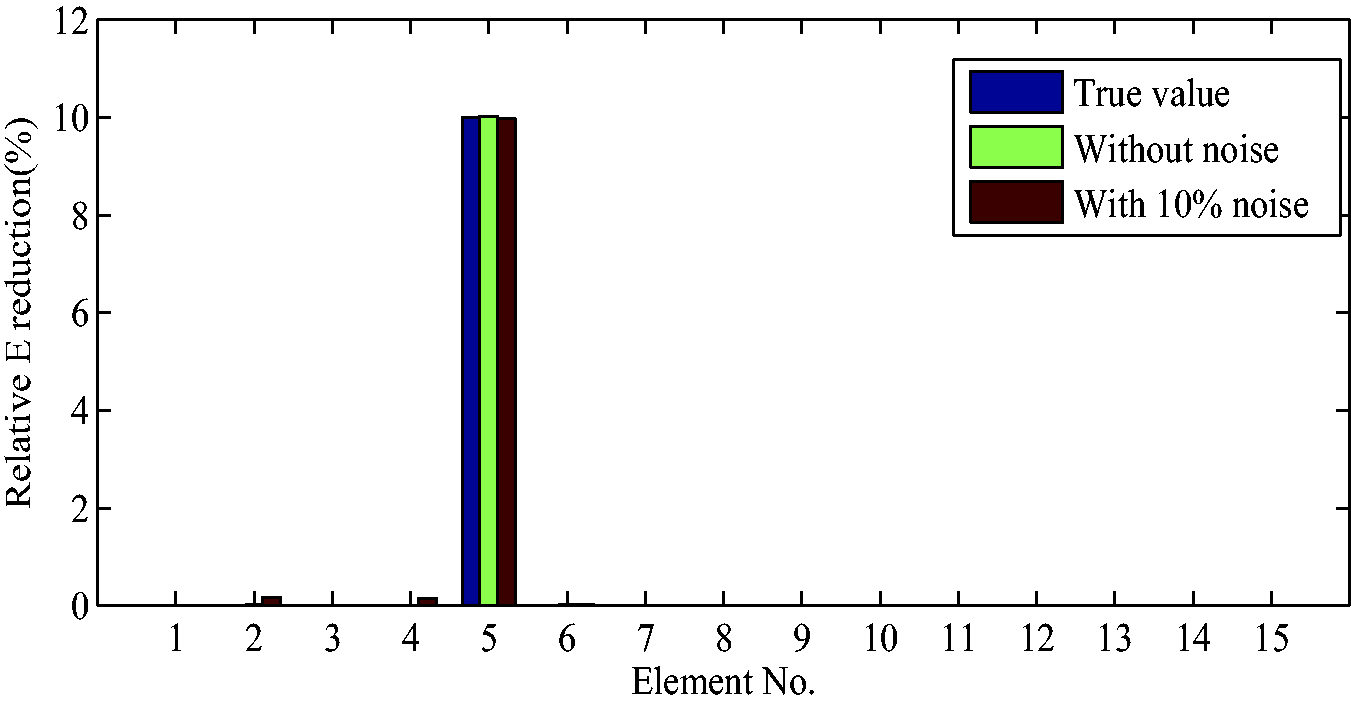
The first damage case assumes that a single damage occurs in the fifth element with 10% loss of Young’s modulus. For the first damage case, the VRFV values of the 18 d.f. are shown in Figure 2, where nodes 3 and 4 are the nodes of the most suspected damaged element because their VRFV values are much larger than others. According to Figure 1, the second, third, fourth, fifth, sixth, seventh, and eighth elements are the corresponding elements associated with nodes 3 and 4. Knowing the possible locations of damage make it more accurate and easier to identify the extent of damage. In the case of no artificial measurement noise and 10% noise level, the identified reduction in the fifth element is shown in Figure 3. Compared with the true value, the identified reduction in the fifth element is 10% with no artificial measurement noise, and even with 10% noise level, the relative error of the identified result is 0.03%. This shows the accuracy and efficiency of the proposed method.
The virtual residual force vector (VRFV) value of a planar truss with single damage. The relative E reduction of a planar truss with single damage.
3.3. Identification of multiple damages
The second damage case assumes that the fourth, fifth and sixth elements are damaged with 20% reduction in the Young’s modulus of each element. This is the same example studied by Liu and Yang (2006). Thus, a comparison can be made for the results from the proposed method and those from the residual force vector approach. In this case, the VRFV values for all d.f. are shown in Figure 4. Since each node has two d.f. and the VRFV values at the third, fifth, sixth, seventh, eighth and ninth d.f. are larger than those of others, it is found that their relative nodes 2, 3, 4 and 5 are nodes of the most probably damaged elements. The virtual residual force vector (VRFV) value of a planar truss with multiple damages. The relative E reduction of a planar truss with multiple damages.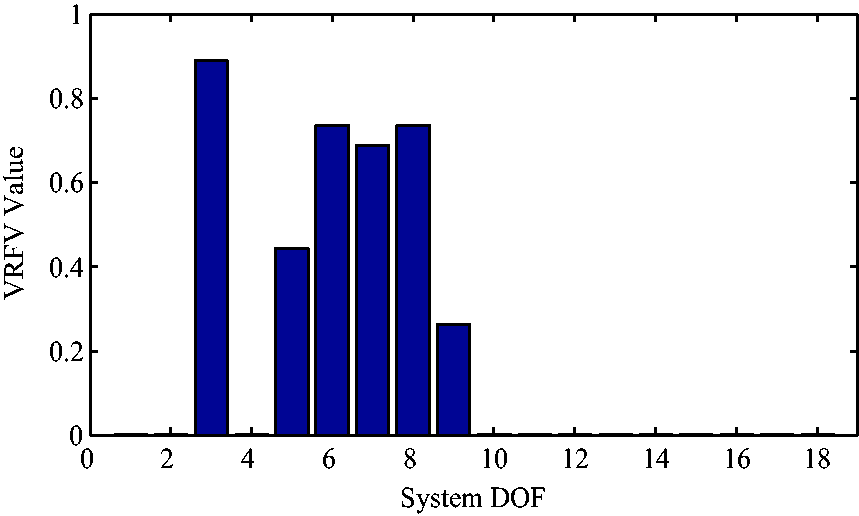
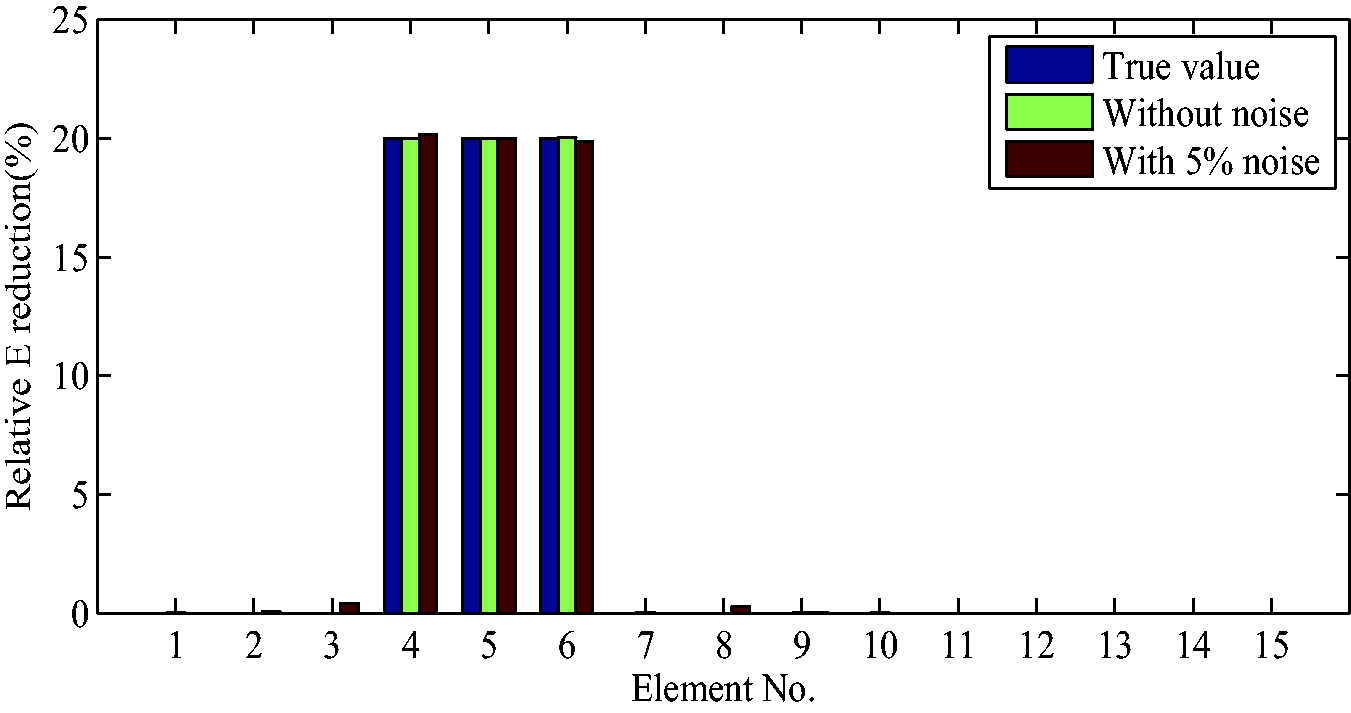
Results for damage identification of the planar truss.

Red.: E reduction; res: relative errors. Scenarios 5 and 6 are the results of Liu and Yang (2006).
3.4. A cantilevered plate
A steel cantilevered plate that has the dimensions of A cantilevered plate under study.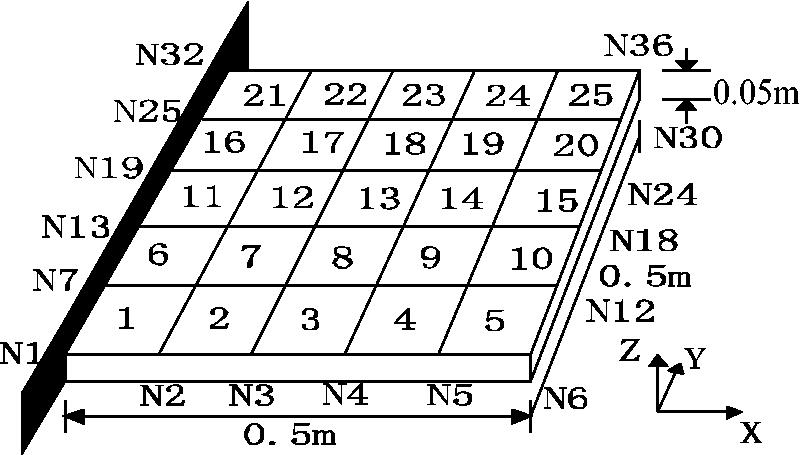
3.5. Identification of single damage
This case assumes that there a single damage occurs in the fifth element with 5% reduction in the Young’s modulus. An impulsive excitation is assumed to act on the 24th node of the plate, and it is expressed mathematically as
A sinusoidal excitation is also used to give a comparison on the results from impulsive excitation in damage identification. The sinusoidal force is taken as
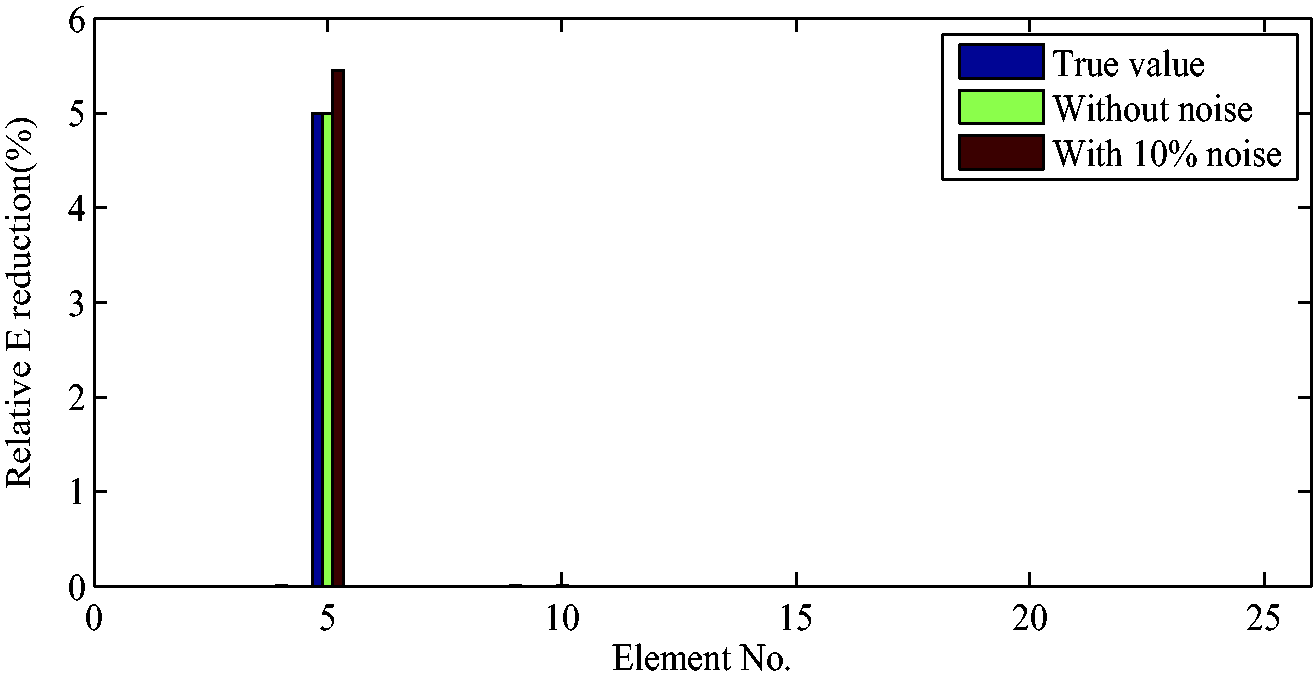
In the first step, differences of the VRFV value of each d.f. are plotted in Figure 7. There are peak values at d.f. of 10, 11, 12, 15, 25, 26, 27, 28, 29, and 30. Each node has three d.f., and d.f. of nodes 1, 7, 13, 19, 25, and 32 are neglected because they lie on the fixed end. It reveals that nodes 5, 6 11 and 12 are the nodes of the most suspected damaged elements. According to Figure 6, the fourth, fifth, ninth and tenth elements are the corresponding damaged elements. Then, the response sensitivities approach is used to identify the perturbation in the Young’s modulus (i.e., the damage extent). Figure 8 shows the identified extent of damage with no artificial measurement noise and 10% artificial measurement noise, respectively. The damage extent has been identified accurately.
The virtual residual force vector (VRFV) value of a cantilevered plate with single damage. The relative E reduction of a cantilevered plate with single damage.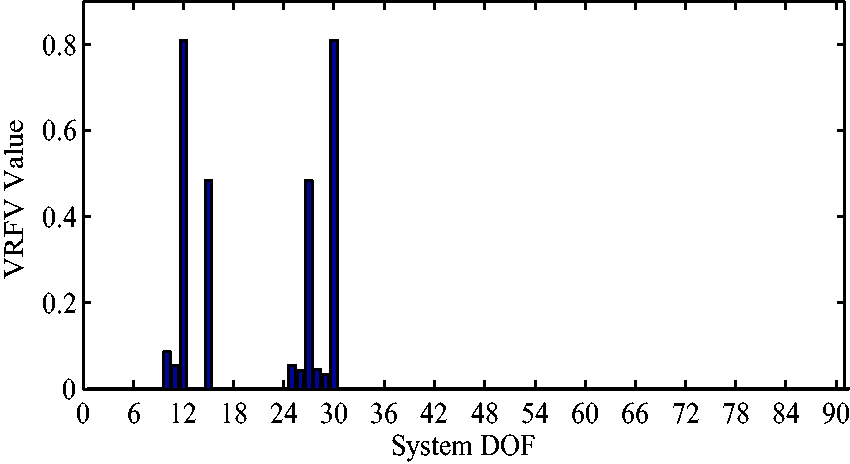
Results for single damage identification of the cantilevered plate.

Red.: E reduction; res: relative errors.
3.6. Identification of multiple damages
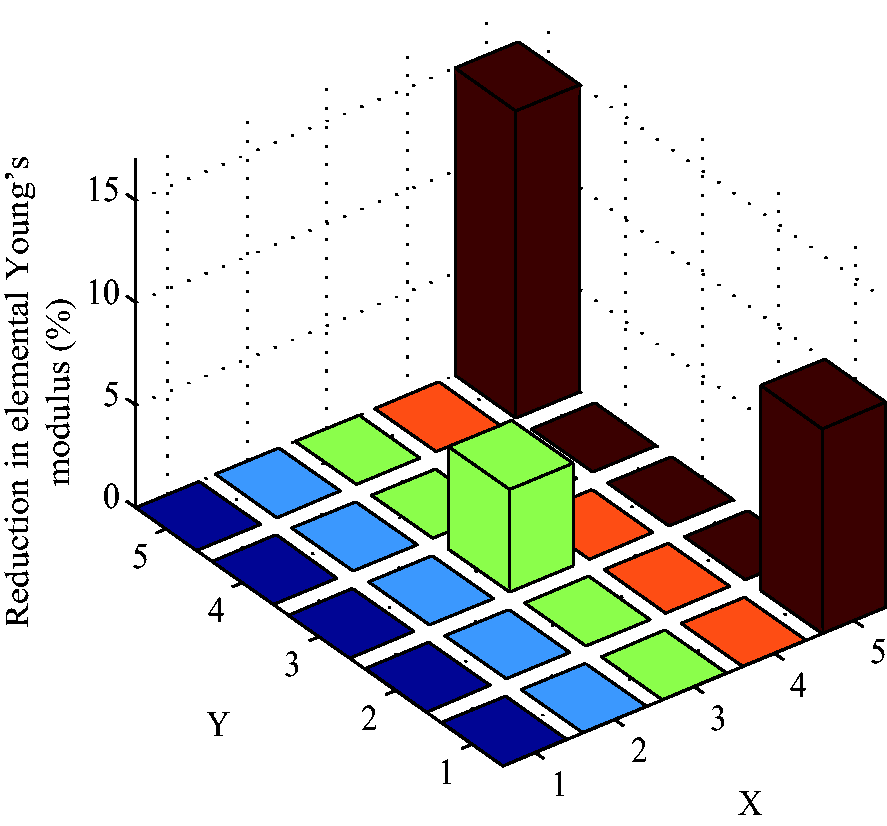
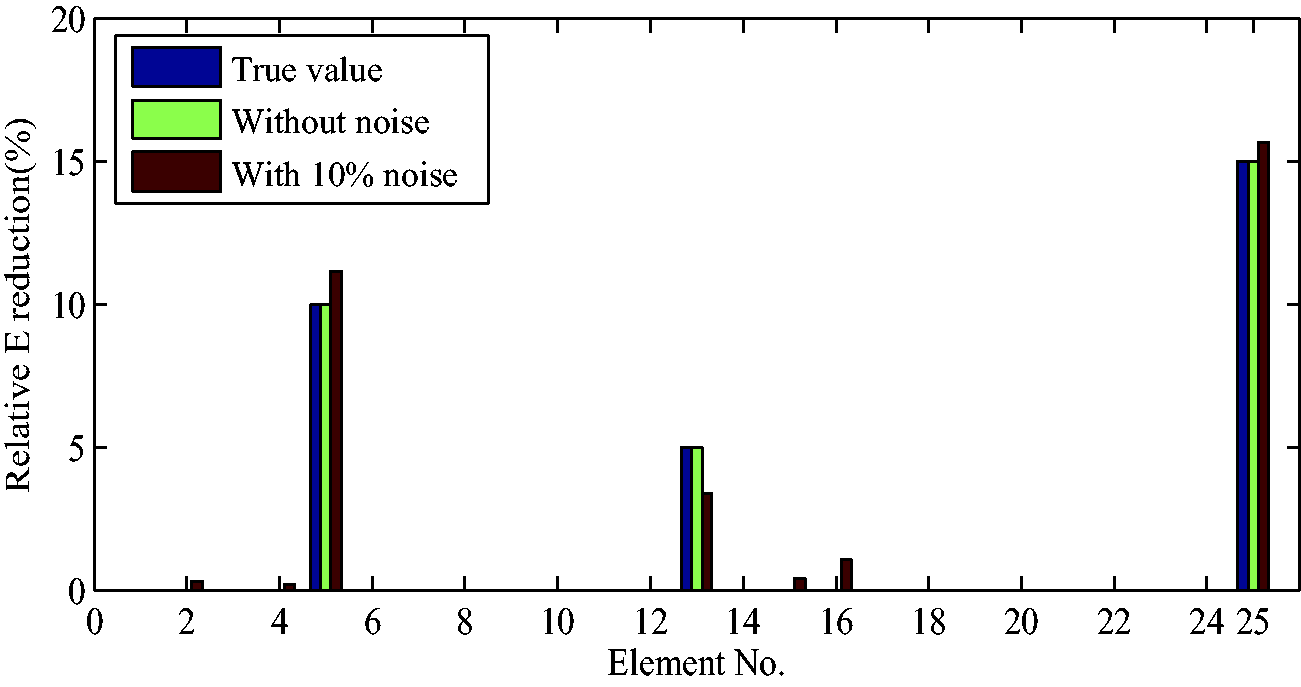
Three damages are assumed to occur at the fifth, 13th and 25th elements, respectively. The relative damage severities are arbitrarily assumed to be 10%, 5%, and 15% loss in the Young’s modulus, respectively. And the same impulsive excitation as the above case is used. The calculated VRFV values are shown in Figure 9. There are peak values at d.f. of 10∼12, 15, 25∼27, 28∼30, 34∼39, 49∼54 70∼75 and 85∼90. And each node has three d.f. as mentioned above. According to the VRFV values, nodes 5, 6, 11, 12, 15, 16, 21, 22, 29, 30, 35 and 36 are the nodes of the most probably damaged element. And according to Figure 6, the suspected damaged elements are the members related to the nodes mentioned above, which are the 4th, 5th, 7th∼10th, 12th∼14th, 17th∼20th and 24th∼25th elements. After localizing the damaged elements, the damage extents of each element are identified accurately by using the response sensitivity method as shown in Figure 10. Figure 11 shows the identified results of damage extent without localization first by the VRFV method, including two situations (no artificial measurement noise and 10% noise level). It reveals that the identified results are just slightly different from the true values when there is no artificial measurement noise. However, the maximum identification error is around 1.1% at the 16th element when the artificial measurement noise is 10%. It may be mistaken for a damaged element.
The virtual residual force vector (VRFV) value of a cantilevered plate with multiple damages. The relative E reduction of a cantilevered plate with multiple damages under no artificial measurement noise. The relative E reduction of a cantilevered plate with multiple damages under no virtual residual force vector (VRFV) localization.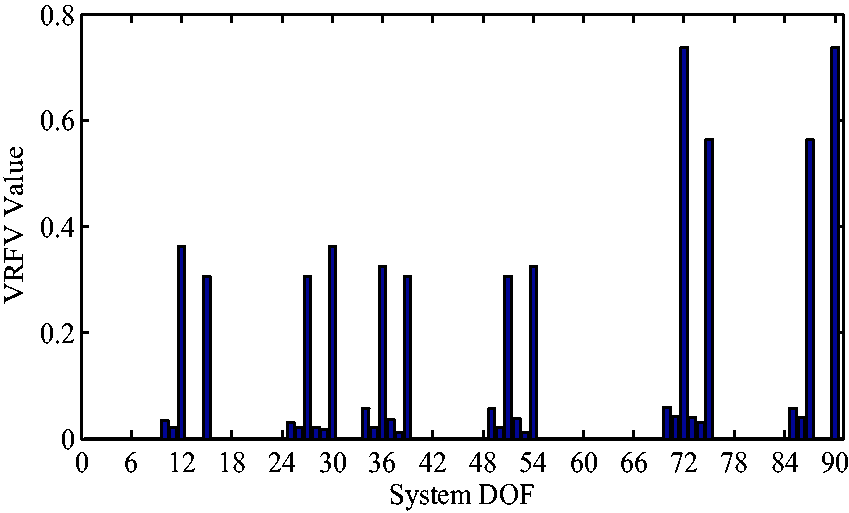
Results for multiple damages identification of the cantilevered plate.

Red.: E reduction; res: relative errors.
3.7. Identification of multiple damages in a continuous beam
In this numerical example, identification of multiple damages in a two-span continuous beam is studied to further illustrate the effectiveness of the proposed method. Figure 12 shows the continuous beam that is under study. The physical parameters of the beam are: mass density A two-span continuous beam under study.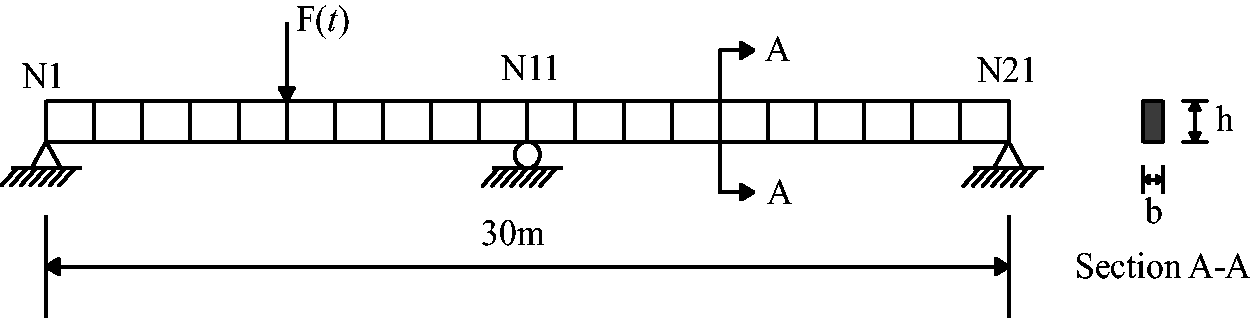
To obtain the dynamic responses of the beam, an impulsive force is assumed to act at 7.5 metres from the left support at 0.05 seconds and last for 0.05 seconds. It is expressed mathematically as
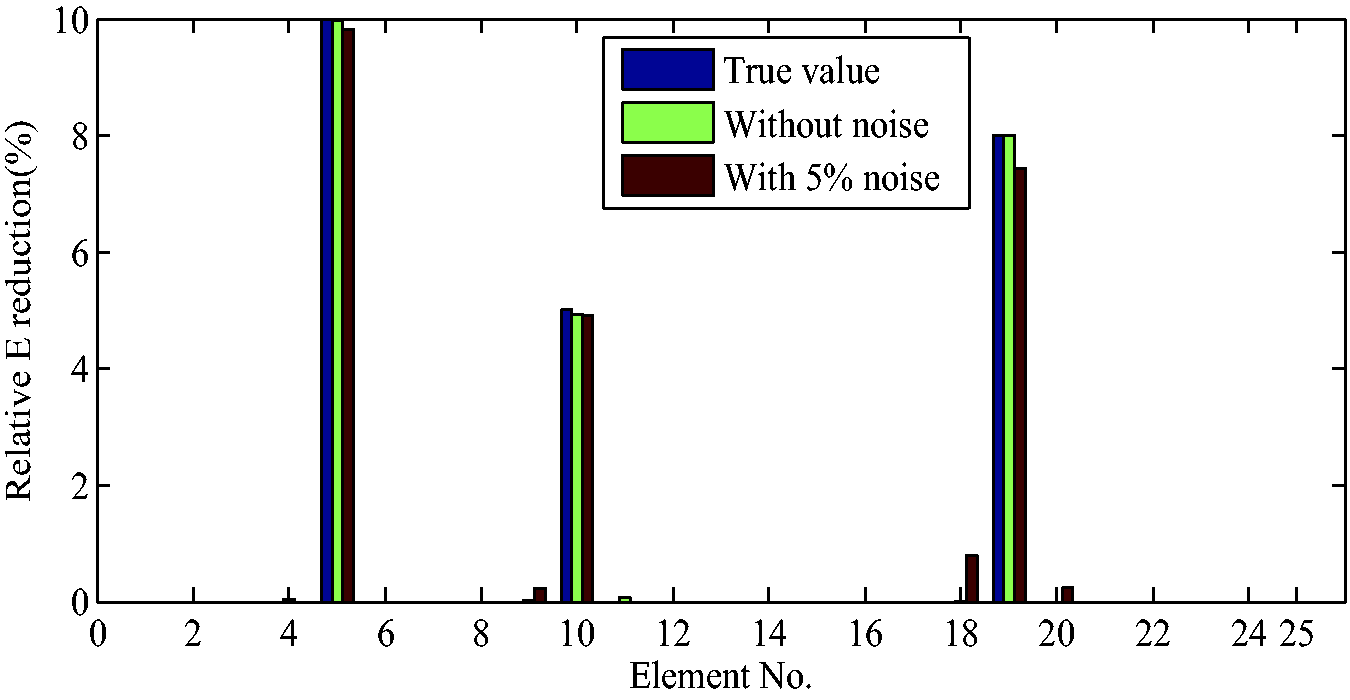
In this case, a two-span continuous supported beam with multiple damages is studied under different artificial measurement noise circumstances. It assumes that three damages occur in the fifth, 10th and 19th elements with a Young’s modulus loss of 10%, 5% and 8%, respectively.
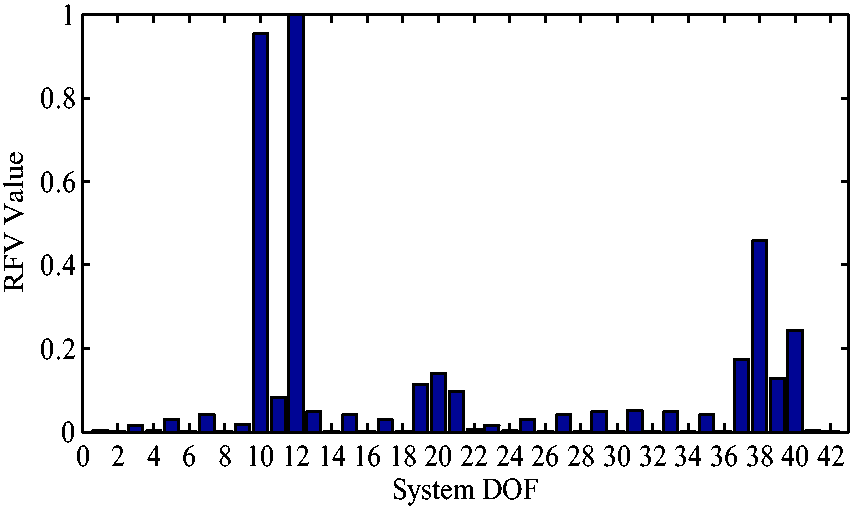
As shown in Figure 13, it is easy to identify that nodes 5, 6, 10,11, 19, and 20 are nodes of the most suspected damaged elements. Figure 14 shows RFV values when only the first mode is used . Comparing Figure 13 with Figure 14, it can be seen that the VRFV method distinguishes the damaged and undamaged elements more clearly than does the RFV method. The VRFV method highlights the damaged elements. In addition, the extents of these damaged elements are assessed as the reductions in the elemental Young’s modulus shown in Figure 15. When the noise is free, the identified results are exactly the same as the assumed damage extents in each elements. In addition, the identified results are 9.82%, 4.91%, and 7.45% in the case of 5% noise level, which are just slightly different from the true values.
The virtual residual force vector (VRFV) value of a two-span continuous beam with multiple damages. The residual force vector (RFV) value of a two-span continuous beam with multiple damages. The relative E reduction of a two-span continuous beam with multiple damages.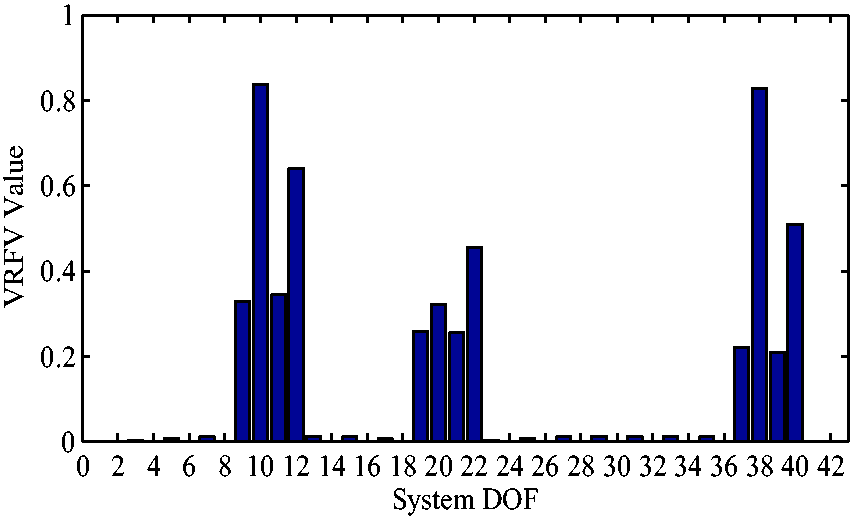
Results for the multiple damages identification using different number of measurements.

Red.: E reduction; res: relative errors.
4. Conclusions
A combined approach based on residual force vector and response sensitivity analysis is proposed for structural damage identification. Although both the residual force method and the response sensitivity analysis are not new, the novelty of the combination of the two methods lies in the improvement of the accuracy and efficiency of the damage identification. With the help of virtual residual force vector, it is convenient to find the location of the local damage. Consequently, it reduces the number of updating parameters in response to the sensitivity-based method and increases the efficiency of damage quantification so that it does not need a lot of measurement points. Both impulsive excitation and sinusoidal excitation can be used for damage identification. But the impulsive excitation seems to give better identified results when the data is contaminated by noise. Both single damage and multiple damages can be identified successfully from the proposed method and it is insensitive to artificial measurement noise. It is also found that when more measurements are used around the suspected elements, better identified results can be obtained.
Footnotes
Funding
This work was supported in part by the National Natural Science Foundation of China (grant numbers 11172333 and 11272361), the Fundamental Research Funds for the Central Universities (grant number 13lgzd06), the Doctoral Program Foundation of the Ministry of Education of China (grant number 20130171110039), and the Guangdong Province Science and Technology Program (grant number 2012A030200011). These financial aids are gratefully acknowledged.