







Abstract
It has been known for a long time that the problem of identifying two small cracks in a simply supported beam from the first three natural frequencies can be analytically formulated and solved if the two cracks have equal severity. In this paper we extend this result to the case of cracks with different severity. Each crack is simulated by a rotational elastic spring and the inverse problem is solved in terms of the damage-induced changes in the first four natural frequencies. Closed-form expressions of the damage parameters in terms of the measured frequencies are obtained. The results can be extended to the identification of two cracks in a longitudinally vibrating beam based on a suitable set of natural frequency and antiresonant frequency data. Numerical simulations support the theory, and show that if accurate input data are available and the cracks are not too close, then damage identification leads to satisfactory results.
1. Introduction
This paper is focussed on the identification of two cracks in beams and rods from natural frequency and antiresonant frequency data.
Morassi and Rollo (2001) considered the problem of identifying two cracks in a simply supported uniform beam in bending vibration from minimal natural frequency data. Each crack was assumed to remain open during vibration and was modeled as a linearly elastic rotational spring located at the damaged cross-section. By considering the damaged beam as a perturbation of the undamaged one (e.g. under the assumption of small damage), the authors proved that the inverse problem can be formulated and solved in terms of the first three natural frequencies, provided that the two cracks have equal severity. The inverse problem turns out to be ill-posed; namely, even by leaving symmetrical positions aside, cracks in two sets of different locations can produce identical changes in first three natural frequencies. An analogous result holds for a free–free longitudinal rod with two cracks. It is worth noticing that closed-form expressions of the damage parameters in terms of the frequency shifts were obtained in Morassi and Rollo (2001). This fact is not trivial at all, since the resolving system of equations is highly nonlinear in the crack position.
The above result has been recently extended in the case of free–free uniform longitudinally vibrating rods with two small open cracks. Under the assumption of cracks of equal severity, it was shown in Rubio et al. (2013) that a suitable use of lower resonant and antiresonant frequency data allows us to exclude all the symmetrical crack locations occurring in the formulation by Morassi and Rollo (2001). Even in this case, closed-form expressions of the damage parameters in terms of the data were provided.
Both the papers Morassi and Rollo (2001) and Rubio et al. (2013) leave an important question unsolved, namely the identification of two cracks having different severity. The present paper addresses this problem.
In the case of a simply supported uniform beam in bending vibration with two small open cracks, we show in Section 2 that the inverse problem can be formulated and solved in closed form in terms of the first four natural frequencies of the beam. The strategy of the proof is different from that of the papers Morassi and Rollo (2001) and Rubio et al. (2013), and it strongly relies on the peculiar structure of the resolving system of four nonlinear equations obtained by linearizing the function expressing the dependence of the natural frequency on the severity of the damage in a neighborhood of the undamaged configuration. More precisely, by introducing two auxiliary variables defined both in terms of the position and the severity of each crack, it was possible to find the crack positions as solutions of a second-degree polynomial equation and, next, to recover information on damage severity. Since only natural frequencies are used as data and the undamaged configuration is symmetrical, the two cracks are uniquely determined up to symmetry with respect to the mid-span cross-section.
Concerning the indeterminacy due to the structural symmetry, in the second part of the paper (Section 3) we consider the identification of two small cracks of different severity in a free–free uniform rod under longitudinal vibration. We show that the use of the first two natural frequencies and the first two antiresonant frequencies of the driving point frequency response function (FRF) evaluated at one end of the rod allows us to exclude the spurious solutions due to the symmetry of the undamaged configuration. Even in this case, closed-form solutions are available for the damage parameters in terms of the data.
The last part of both Sections 2 and 3 collects the results of an exhaustive numerical analysis of the inverse problem for beams and rods with two cracks. In particular, the analysis of cases with neighboring or distant cracks having different severities is carefully developed. Numerical simulations support the theoretical results and show that if the cracks are sufficiently distant from each other and frequency data are affected by errors relatively small with respect to the frequency changes induced by the damage, then the proposed methodology leads to satisfactory indications.
The mathematical tool used to prove the above results strongly relies on the general property that in beam-like structures the change in a natural frequency produced by a small single crack may be represented as a product of two terms, of which one is proportional to the severity and the other depending solely on the location of the damage (Adams et al., 1978; Gudmundson, 1983; Morassi, 1993; Gladwell, 2004). An important consequence is the following: if a single crack is present, then the ratios of the change in different natural frequencies depend only on the damage location, not on its severity. Hearn and Testa (1991), Liang et al. (1992) and Rubio (2009), among others, have used this property for a damage localization analysis in beam-like structures. Narkis (1994) followed this approach for identifying a single crack in a uniform free–free rod under longitudinal vibration and proved that a single crack can be uniquely localized (up to symmetry) by using the first two natural frequencies. Morassi (2001) extended Narkis’s results to beams and rods with a single crack under different sets of end conditions and for different pairs of natural frequencies. He showed that the problem of determining the location of the crack from changes in two natural frequencies is generally ill-posed: if the system is symmetrical, then damage at any one of a set of symmetrical points will produce identical changes in natural frequencies. Even if the system is not symmetrical, damage at different locations can still produce identical changes in two natural frequencies. In Dilena and Morassi (2004) it was shown how the use of antiresonant frequency data coupled with natural frequency data can be useful to exclude the spurious symmetrical positions of the damage occurring in initially symmetrical beams.
In the case of multiple cracks, the damage-induced change on a natural frequency takes into account the global damage pattern; see equations (8) and (62) for bending and longitudinal vibrations, respectively. The general property mentioned above connecting ratios of different natural frequencies and damage locations obviously is no longer true. Therefore, the identification procedure becomes more involved with respect to the case in which the damage is restricted to one location, as emerges from the analysis shown in Sections 2 and 3.
Finally, it is appropriate to recall that other approaches have been followed in the literature to identify multiple cracks in beams. Without claim of completeness, and referring to Sekhar (2008) and Caddemi and Caliò (2014) for an updated overview of the topic, and to Caddemi and Caliò (2009) for a comprehensive presentation of the direct vibrational problem, here we restrict attention to methods in which only lower resonant/antiresonant frequency data are used in identification.
Assuming, as above, the linear concentrated flexibility model to describe cracks in rods and beams, one approach consists in considering (at least) as many natural frequencies as the unknowns of the problem (e.g. two unknowns for each crack, the position and the severity), and then numerically solving the system formed by the characteristic equation written for all the natural frequencies in terms of the damage parameters (Cerri and Vestroni, 2000; Vestroni and Capecchi, 2000; Attar, 2012; Mazanoglu and Sabuncu, 2012). Inverse transcendental eigenvalue problems for the identification of multiple open cracks in a longitudinally vibrating rod were considered by Singh (2009). The author noticed that the possible presence of spurious solutions (due to the symmetry of the undamaged configuration) found in solving the nonlinear system of characteristic equations can be avoided by carefully selecting the data and using simultaneously natural frequency and antiresonant frequency measurements. In general terms, this is a powerful class of methods, but has the drawback of requiring strong support on numerical simulation, with the consequence of making it difficult to find out general properties, such as, for example, the indication of optimal data to be used in order to reduce nonuniqueness effects in the inverse problem solution.
Another common approach to multi-cracked identification in beams consists in transforming the inverse problem into an optimization problem. In general terms, the damage parameters are determined such that the natural frequencies of the mechanical model are closest (in a least squares sense) to those found experimentally; see Ruotolo and Surace (1997), Cerri and Vestroni (2000), Vestroni and Capecchi (2000), Khiem and Lien (2004) and, for a linearized version suitable in the case of small cracks, Patil and Maiti (2003) and Rubio (2009). More recently, Khiem and Toan (2014) proposed a procedure for multiple-crack detection in beams by natural frequency measurements. Their method combines a second-order approximation of natural frequencies with respect to crack magnitudes via Rayleigh’s quotient, a suitable Tikhonov regularization method, and the so-called crack scanning method to estimate the number of cracks. This class of techniques allows us to consider systems of high complexity and beams with a large number of cracks. However, the approach generally requires subtle analysis in order to deal with the possible nonconvexity of the error function and, as a consequence, with the appearance of multiple local and global minima. In connection with this point, see the interesting analysis presented in Vestroni and Capecchi (2000) and the recent contribution by Greco and Pau (2012) on crack identification in a frame.
2. Inverse problem in a bending vibrating beam
2.1. Formulation of the problem
Let us consider a straight thin simply supported beam under bending vibration. We assume that the beam is uniform and has two cracks at two different cross-sections of abscissa s1, s2, with 0 < si < L for i = 1, 2, where L is the length of the beam. Assuming that cracks remain open during the vibration, every crack is represented by inserting a massless rotational linearly elastic spring with stiffness Ki, i = 1, 2, at the cracked cross-section. We refer, for example, to Freund and Herrmann (1976) for a justification of this localized flexibility model of a crack based on fracture mechanics arguments, and to Caddemi and Morassi (2013) for an alternative derivation. The magnitude of the spring stiffness depends on the geometry of the cracked cross-section and on the material properties of the beam. The free undamped bending vibrations of the cracked beam with radian frequency
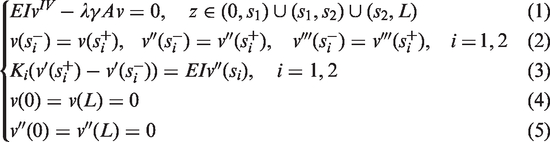

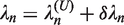

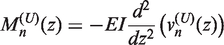

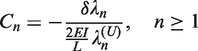
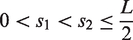
We are concerned with the problem of finding the position and severity of the two cracks, namely the four parameters {(s1, K1), (s2, K2)}, from a minimal set of natural frequency data. Before embarking on the calculations, it should be observed that, due to the symmetry of the undamaged beam, the damage configurations {(s1, K1), (s2, K2)}, {(L−s1, K1), (L−s2, K2)}, {(L−s1, K1), (s2, K2)}, {(s1, K1), (L−s2, K2)} are indistinguishable from natural frequency input data. In fact, all of them correspond to the same natural frequency shifts evaluated from the undamaged configuration. Therefore, taking into account this intrinsic lack of uniqueness of the problem, as in Morassi and Rollo (2001) we shall assume
2.2. Identification of two cracks in a simply supported beam by frequency data
In this section we shall show how to select minimal frequency data in order to properly formulate the diagnostic problem and to find closed-form expressions of the damage parameters.
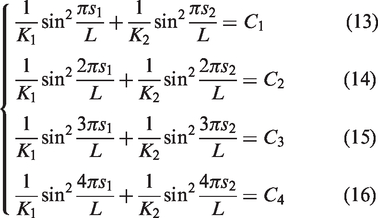
Since four parameters need to be determined, we consider as minimal data the changes in the first four natural frequencies. This choice has the merit of allowing an analytical treatment of the inverse problem. Moreover, it is also justified from the point of view of applications, since experiments show that the one-dimensional model (1) to (5) is able to reproduce the low-frequency behavior well, while it loses precision as the order of the natural frequency increases (Davini et al., 1995; Caddemi and Morassi, 2013). By writing equation (10) for the first four frequencies, we obtain the following system of four nonlinear equations in the unknowns (s1, K1) and (s2, K2):


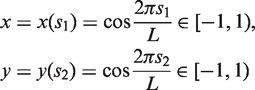
By using standard trigonometric identities and recalling that

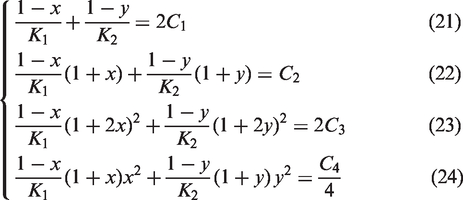
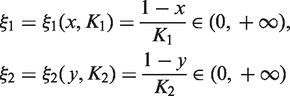
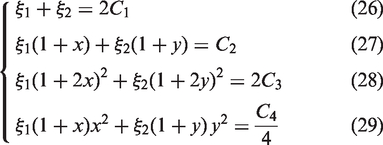



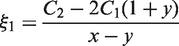
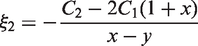









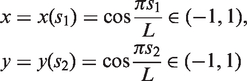
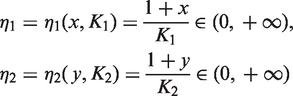
Now, by the definition (43) of P and S, the variable position x turns out to be the root of the second-order polynomial equation

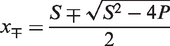
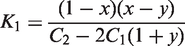
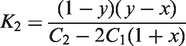

Finally, by noticing that y− = x+, y+ = x− and that K1+ = K2−, K2+ = K1−, it is easy to show that the two damage configurations (51) actually coincide. Therefore, we have shown that the knowledge of the first four natural frequencies allows us to uniquely determine the two cracks, up to symmetry with respect to the mid-span cross-section (see condition (12)).
Nonuniqueness of the solution is a typical pathology of inverse problems in vibration, and it is known that it can occur even when, as in the present case, the number of pieces of data is equal to the number of unknowns to be determined. A way to reduce, or even to remove, such an indeterminacy consists in introducing information coming from a spectrum associated to somehow different end conditions. This idea is developed in Section 3 with the aim of identifying two cracks having different severity in a free–free longitudinally vibrating rod.
2.3. Applications
The present section is devoted to outlining some applications of numerical character. The inverse problem is formulated in terms of pseudo-experimental data, that is, natural frequency values are obtained by solving the direct problem in undamaged conditions and for a given set of damage scenarios {(s1, K1), (s2, K2)}. The specimen is a uniform simply supported beam, of length L, with rectangular cross-section b × h, where Simply supported beam with two cracks.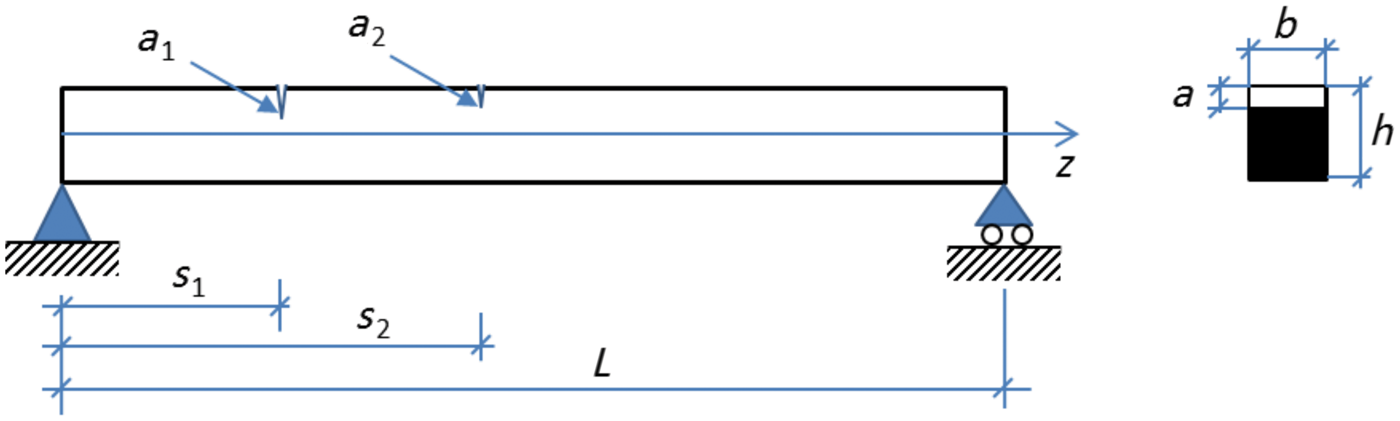
A single open edge crack, with crack front parallel to the side b and depth ai, is supposed to be present at the cross-section of abscissa si, i = 1, 2. The stiffness of the rotational spring simulating the damage at si, i = 1, 2, is

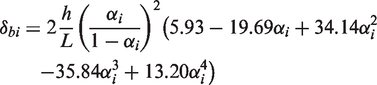
An exhaustive set of numerical simulations has been carried out for different locations of the cracks and various levels of damage. Three main different damage scenarios among several studied are presented and discussed in the sequel: they are illustrative of the main features of the inverse problem and of the identification technique. The first case, δb1 = 0.00139 and δb2 = 0.00531 (corresponding to α1 = 0.05, α2 = 0.10, respectively) is characterized by ‘very small–small’ damage (XS–S), that is, the values of the flexibility δbi are chosen such that the variations of the first four natural frequencies are up to 0.6% of the undamaged values. The second case involves ‘moderate–large’ damage (M–L), δb1 = 0.0115157 and δb2 = 0.0313333 (α1 = 0.15, α2 = 0.25), and it corresponds to variations of the same spectral data up to 3.5%. In the third case there are two equal ‘small–small’ cracks (S–S), δb1 = δb2 = 0.00531 (α1 = α2 = 0.10), corresponding to frequency variations of up to 0.9% of the referential values. Identification results are presented for three sets of damage locations, namely s1 = L/4, s2 = 7 L/20 (close cracks, denoted by C in what follows), s1 = L/4, s2 = 9 L/20 (distant cracks, case D1), and finally s1 = L/4, s2 = L/2 (distant cracks, with one centered crack, case Dc).
First four dimensionless frequencies for the undamaged beam (
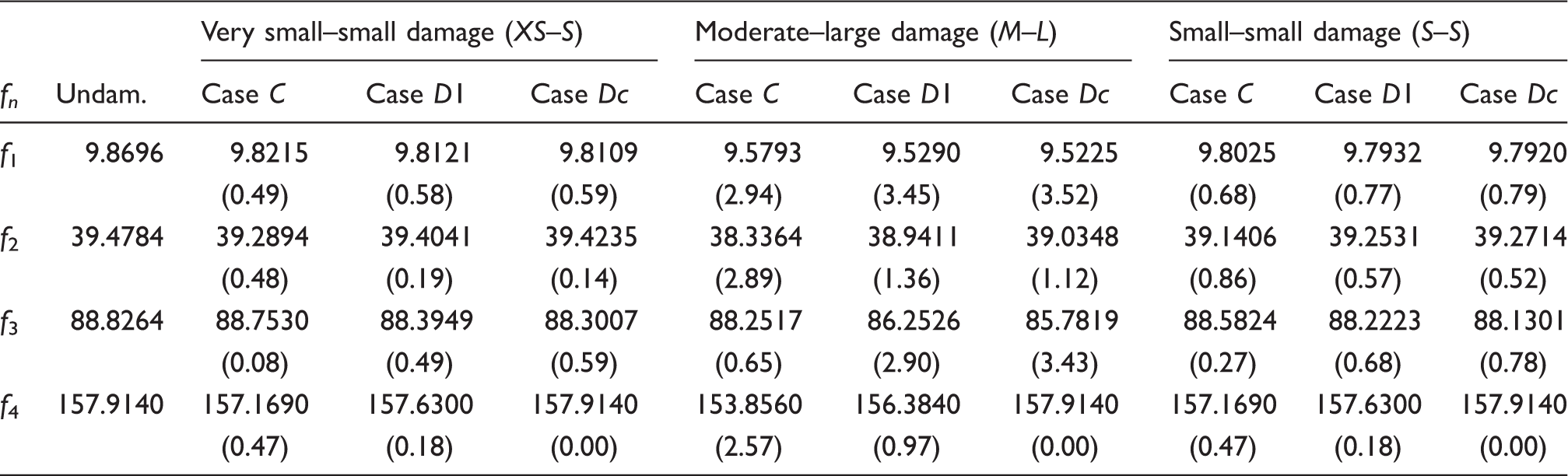
Results of damage identification from frequency data (cases free of error). Determination of the damage severity
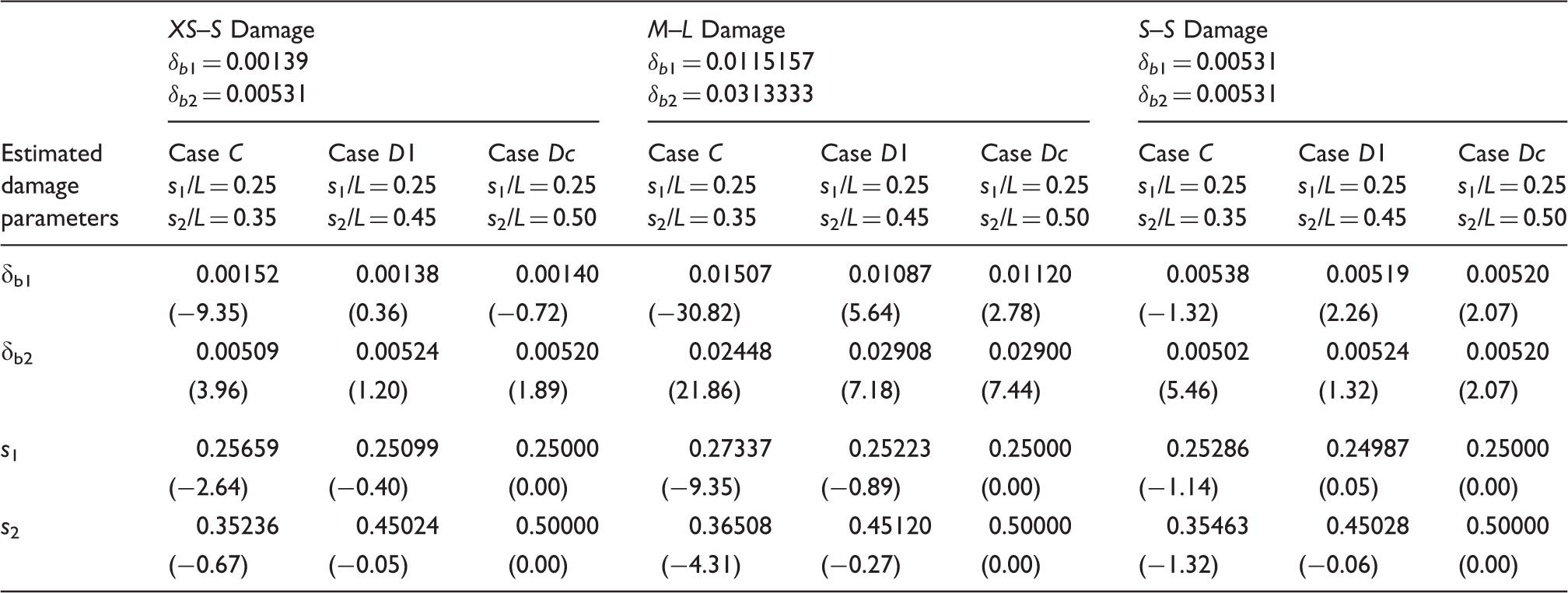
It is possible to observe that the solution predicted by the theory generally is a satisfactory estimate of the actual solution of the diagnostic problem. The discrepancies between identified and actual damage parameters are exclusively due to the perturbation assumption of small damage. Deviations are typically smaller for less severe damage, as it is expected because the inverse problem is linearized in a neighborhood of the undamaged beam. For the sake of completeness, we note that numerical simulations have not led to accurate results in the case of close cracks. The motivation of this discrepancy is connected with the reconstruction procedure illustrated in Section 2.2 and, particularly, with the inversion of the two-by-two linear system (44) and (45). By (46), the determinant of the corresponding two-by-two matrix vanishes with order
In order to test the robustness of identification to possible errors, numerical simulation has been repeated in the presence of random noise on the data. In practical applications, one of the main sources of error is due to the inaccuracy of the analytical model that is used to interpret the experiments. Damage-induced changes are typically small and, therefore, it may happen that even small modeling errors can affect the outcome of identification. Frequency values 
Results of damage identification (cases with random error). C=close cracks; D1 = distant cracks; Dc = distant cracks, with one centered crack. XS–S = very small–small damage; M–L= moderate–large damage; S–S = small–small damage.
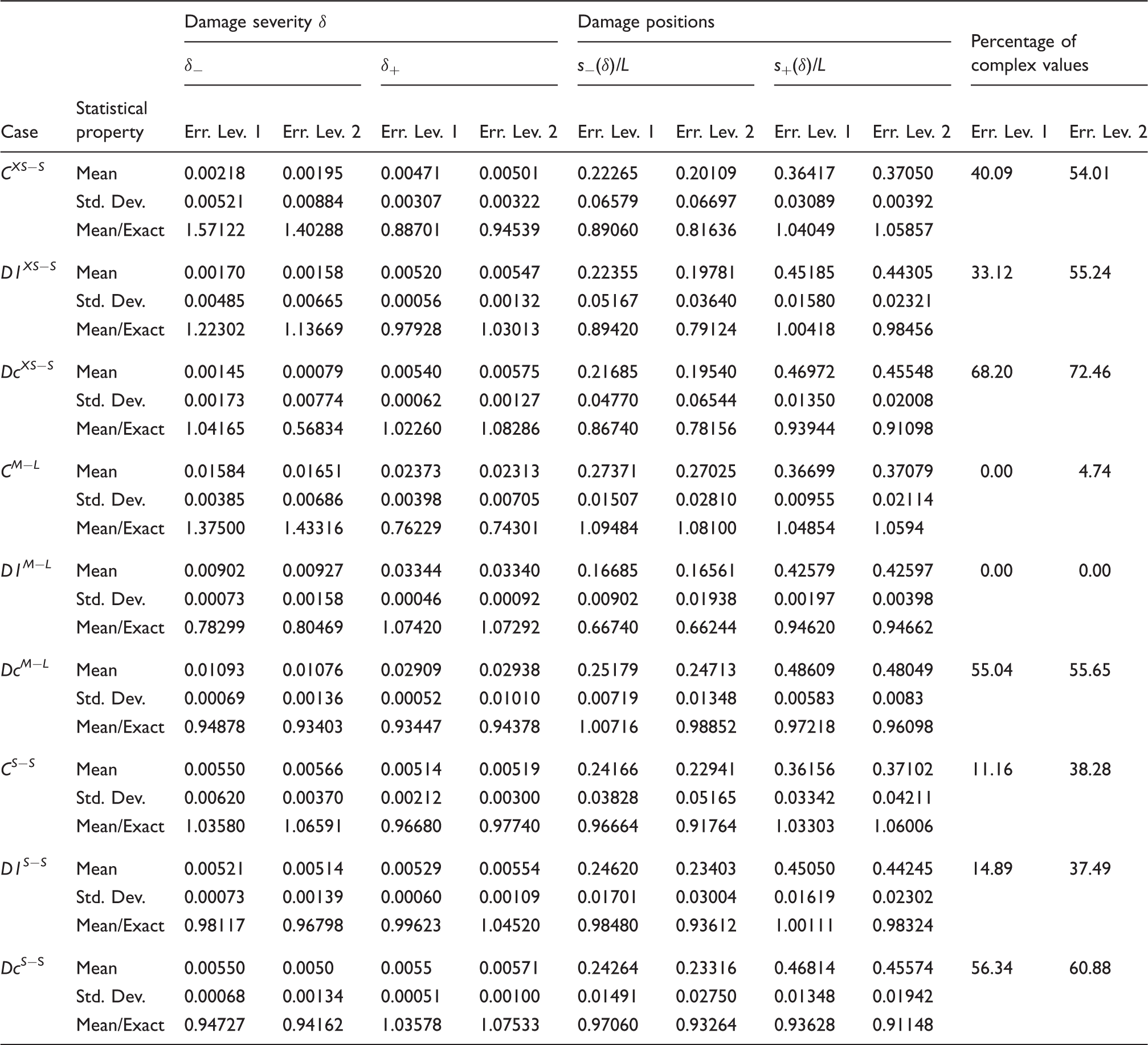
For the sake of completeness, we notice that complex values of the damage parameters are obtained in a certain number of simulations: see the last two columns of Table 3. The highest percentage of complex values has been found in case Dc, that is, when the cracks are located at 
Finally, as expected from previous free-of-error simulations, the case of close cracks still remains the most problematic.
3. Inverse problem in a longitudinally vibrating rod
3.1. Formulation of the problem
Consider a straight thin rod under longitudinal vibration and with free–free end conditions (F–F). We assume that the rod is uniform and has two cracks at two different cross-sections of abscissa s1, s2, with 0 < si < L, i = 1, 2, where L is the length of the rod. Each crack is assumed to remain open during vibration and is modeled as a massless longitudinal linearly elastic spring with stiffness Ki, i = 1, 2. The value of Ki can be determined in terms of the geometry of the cracked cross-section and of the material properties of the beam (Freund and Herrmann, 1976). In this section we determine the first-order changes induced by damage both on natural frequencies and a specific set of antiresonances of the rod. The free undamped vibrations of the rod with radian frequency 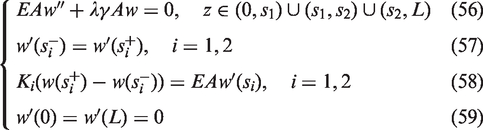
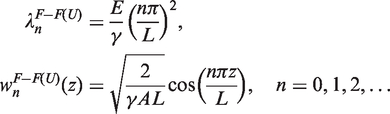




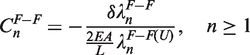
In addition to resonant frequencies, we consider the antiresonant frequencies of the driving point FRF of the rod
The eigenvalues of the supported–free rod will be denoted by 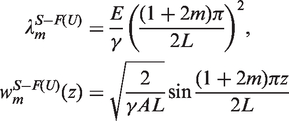

3.2. Identification of two cracks by resonant/antiresonant frequency data
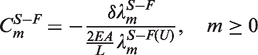
In this section we are concerned with the problem of determining the two cracks, namely the four damage parameters {s1, K1), (s2, K2)}, from minimal spectral data. By the analogy between this inverse problem and the corresponding problem for the cracked beam in bending discussed in Section 2.2 (compare the expressions (10) and (64)), the use of the first four (positive) natural frequencies of the free–free rod clearly leads to nonunique solution, because of the symmetry of the undamaged configuration. In the sequel, we show how one can properly select resonant and antiresonant data in order to avoid the nonuniqueness of the solution and to find closed-form expressions for the damage parameters. We assume that frequency data consist of the first and second antiresonant frequencies of the driving point FRF 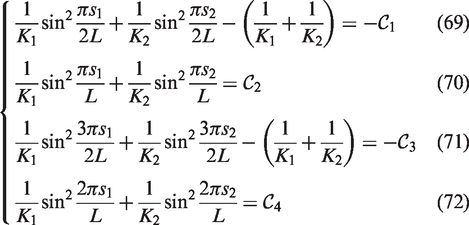


Let us define
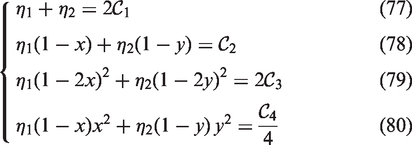




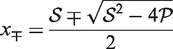
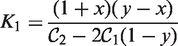
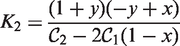

In conclusion, we have shown that the two cracks {(s1−, K1−), (s2−, K2−)} can be uniquely determined by the knowledge of the first and second antiresonant frequencies of H(ω, 0, 0) and the second and third natural frequencies of the rod.
3.3. Applications
An exhaustive series of numerical simulations has been carried out for different locations of the cracks and various damage levels in a free–free rod, of length L, with rectangular cross-section b × h, where Free–free rod with two cracks.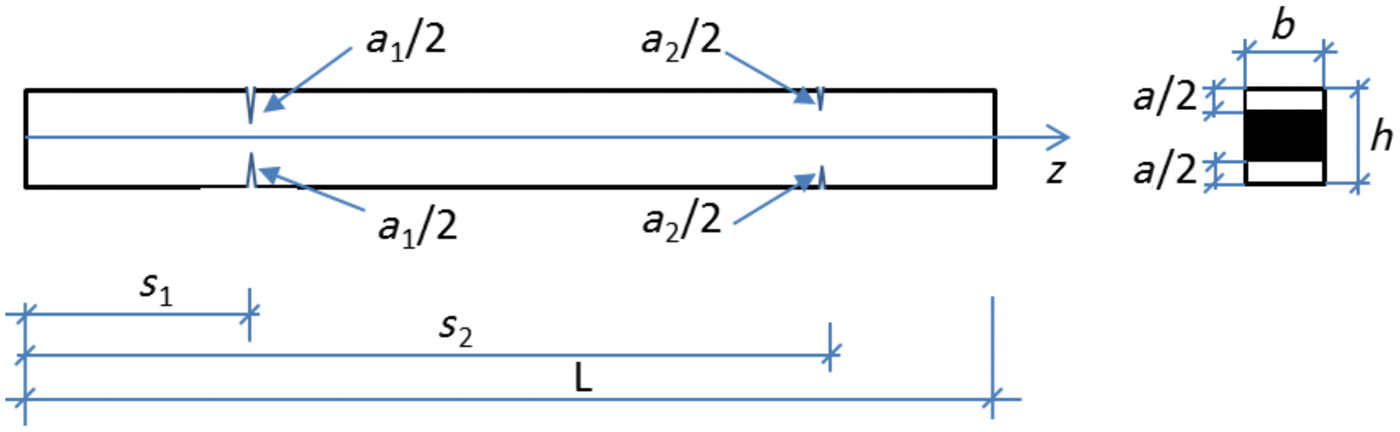
A pair of symmetric open edge cracks, each with crack front parallel to the side b, is supposed to be present at the cross-section of abscissa si, i = 1, 2. Denoting by 

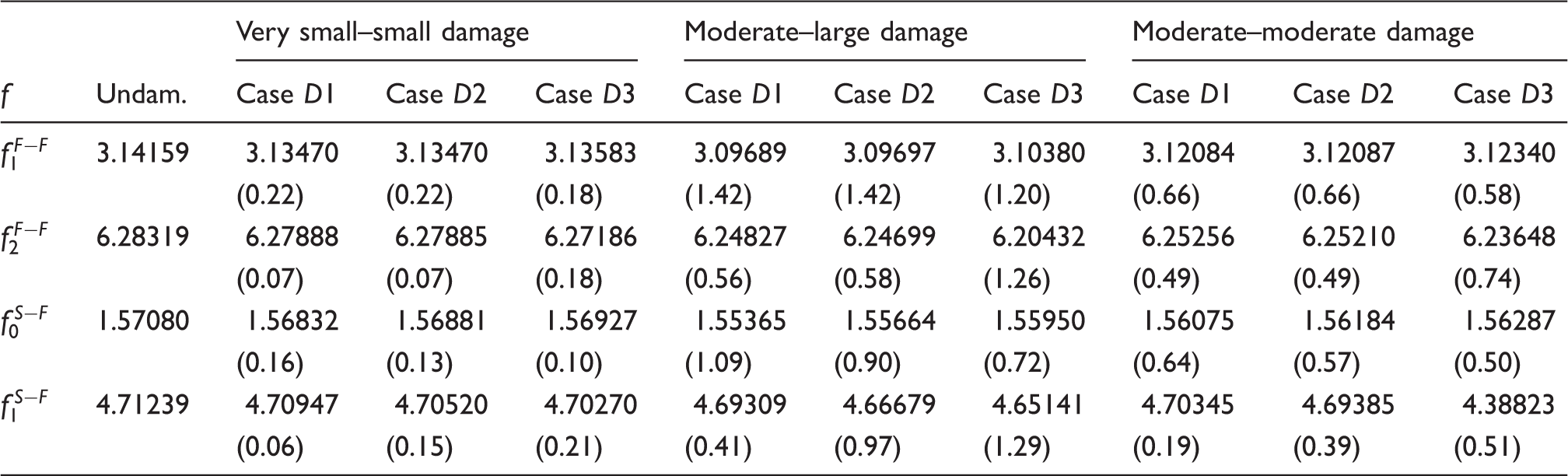
First two dimensionless frequencies and dimensionless antiresonances for the undamaged rod (
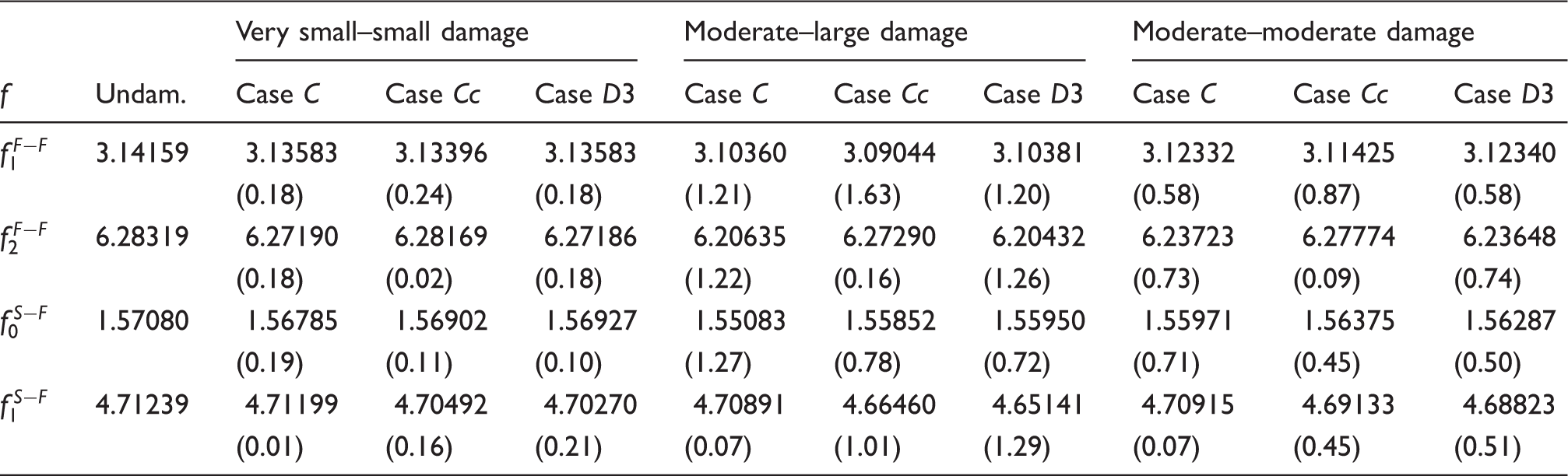
Results of damage identification frequency data (cases free of error). Determination of the damage severity
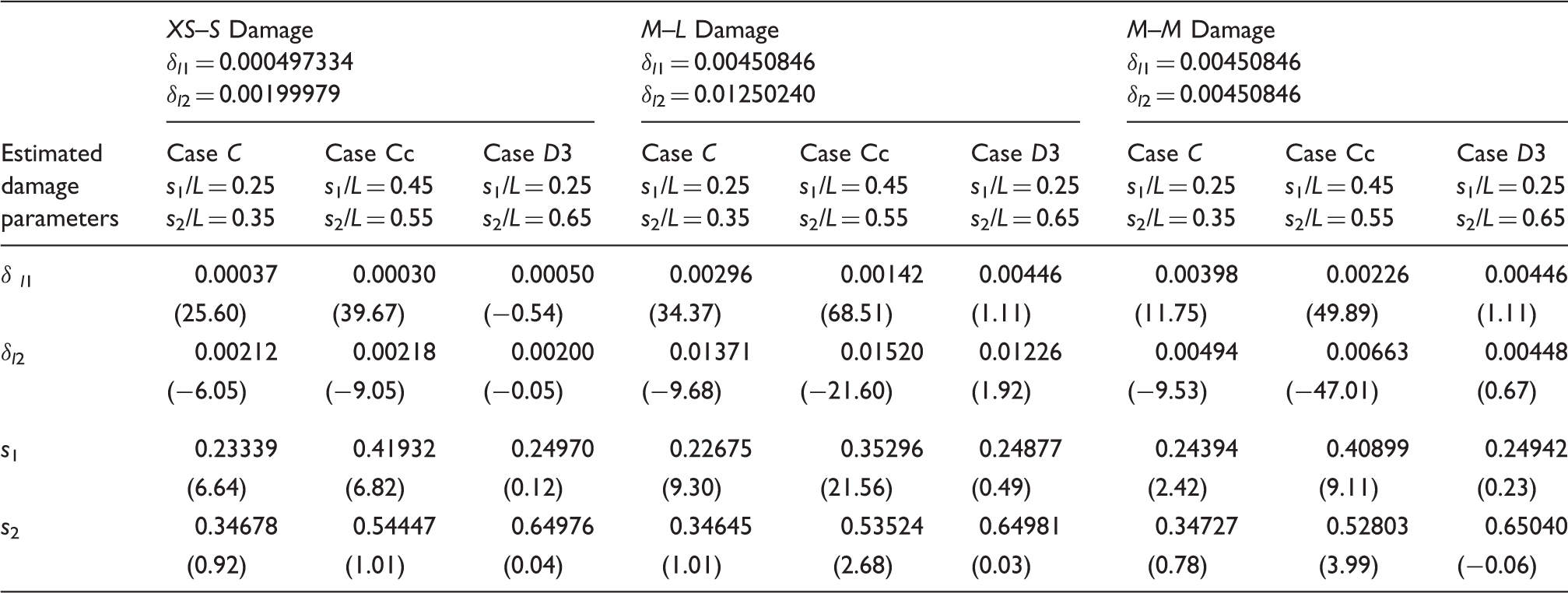
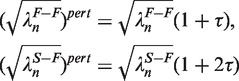
First two dimensionless frequencies and dimensionless antiresonances for the undamaged rod
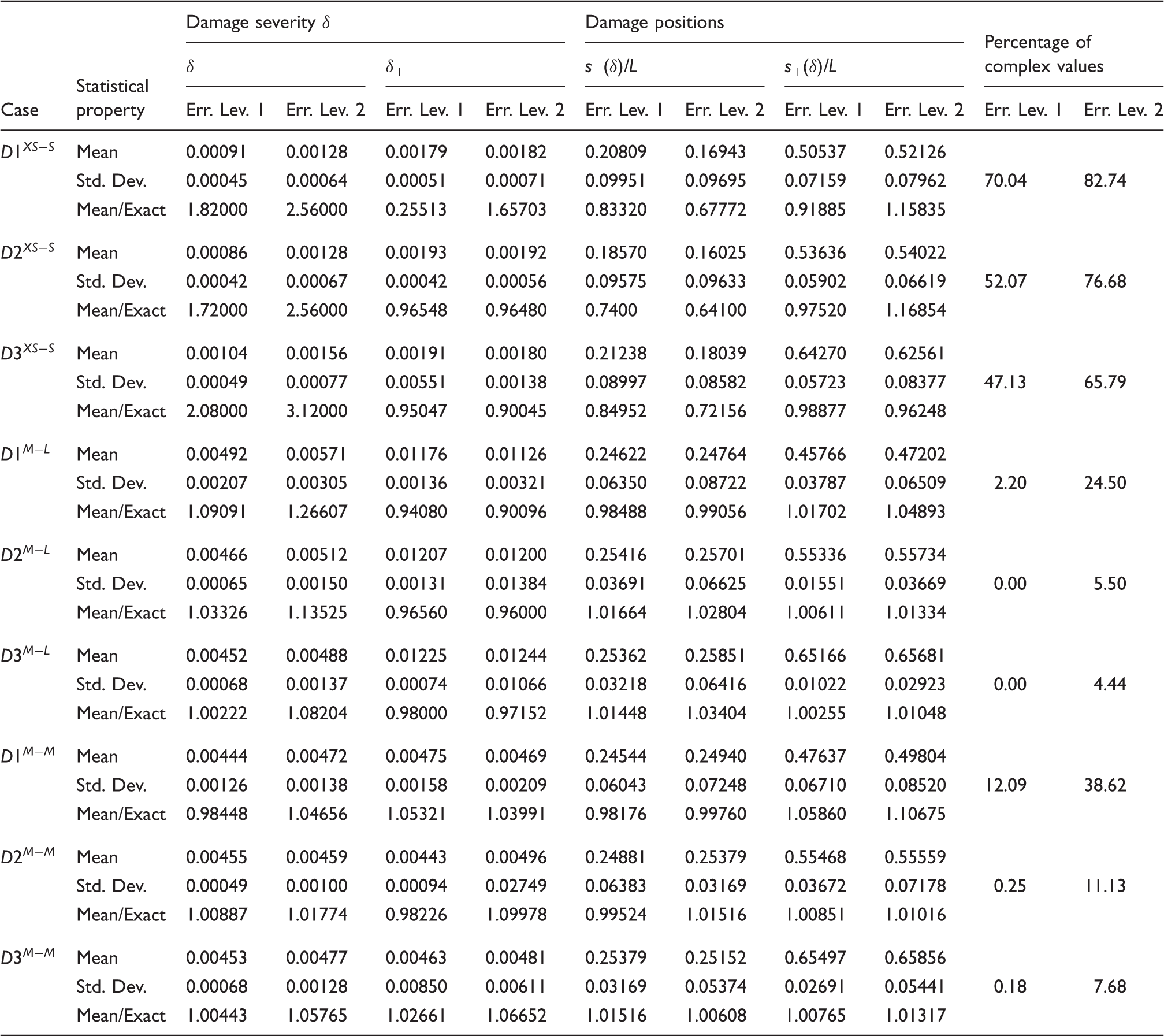
Results of damage identification (cases with random error) corresponding to cases D1, D2 and D3 of Table 6. XS–S = very small–small damage; M–L = moderate–large damage; M–M = moderate–moderate damage.
4. Conclusions
In this paper we were concerned with the identification of two open small cracks in an initially uniform beam in bending vibration from a knowledge of the damage-induced shifts in the low natural frequencies. Each crack is modeled by a linearly elastic rotational spring located at the damaged cross-section, for a total of four unknowns, namely, the two positions and the two severities of the cracks. It was shown that the inverse problem can be formulated and solved in terms of the first four natural frequencies. This set of data allows for the unique identification of the two cracks, apart from the symmetry with respect to the mid-span cross-section. Closed-form solutions are provided both for the position and the severity of each crack in terms of the data.
Previous results on this problem were available only for the case of two cracks with equal severity. The proposed method enables us to overcome this restriction and to solve the general case of two cracks having different severity.
The method can be extended to deal with double-cracked free–free rods under longitudinal vibration. In this case, each crack is modeled by a translational spring acting along the direction of the beam axis and located at the damaged cross-section. It was shown that the use of the first two natural frequencies and the first two antiresonant frequencies of the driving point FRF evaluated at one end of the rod allows us to exclude the spurious solution due to the symmetry of the undamaged configuration. Even in this case, closed-form solutions are available for the damage parameters in terms of the data.
Analytical results were confirmed by an extended series of numerical simulations carried out on cracked beams and rods under various damage scenarios, with and without errors on the data. When errors on the data are absent, the solution predicted by the theory generally is a good estimate of the actual solution of the diagnostic problem, with the exception of cases in which the two cracks are close, namely, in our experience, when the distance between the two cracks is approximately less than one-tenth of the beam length. It is likely that other approaches based on resonant/antiresonant data must be developed for the identification of neighboring cracks. Numerical results also show that if the frequency data used in identification are affected by errors relatively small with respect to the shifts induced by the cracks, then the method leads to satisfactory estimates of the damage parameters.
Footnotes
Acknowledgement
A Morassi wishes to thank the colleagues of University Carlos III of Madrid, especially Professors L Rubio and J Fernández-Sáez, for the warm hospitality at the Department of Engineering Mechanics.
Funding
The work of A Morassi is supported by University Carlos III of Madrid, Banco de Santander Chairs of Excellence Programme for the 2013–2014 academic year.