Free in-plane and out-of-plane vibrations of two-dimensional magnetically affected ensembles of single-walled carbon nanotubes (MAESWCNTs) are of concern. Using Maxwell’s equations, nonlocal Rayleigh, Timoshenko, and higher-order beam theories, and Hamilton’s principle, the discrete equations of motion of both in-plane and out-of-plane vibrations for the proposed models are constructed. When the number of single-walled carbon nanotubes (SWCNTs) within the ensemble is large enough, evaluation of the frequencies of the nanostructure would not be an easy task. To overcome such a dilemma, some useful nonlocal continuous models are proposed. Through various numerical studies, the accuracy of such models is validated. The obtained results display that the in-plane and out-of-plane frequencies rely on the strength of the longitudinal magnetic field, small-scale parameter, number of SWCNTs with the ensemble, intertube distance, and the geometrical properties of the constitutive SWCNTs of the ensemble. The roles of these crucial factors in the fundamental frequencies of the MAESWCNTs are comprehensively examined via many numerical studies. The capabilities of the proposed nonlocal continuous models in predicting the bending frequencies are also discussed.
The structural geometry of a single-walled carbon nanotube (SWCNT) can be expressed as one layer of graphene rolled in a seamless cylinder. Such materials have been the focus of attention of scientists because of their astonishing mechanical, electrical, thermal, and chemical properties. A two-dimensional (2D) aligned ensemble of SWCNTs consists of parallel SWCNTs which are placed in a plane in the vicinity of each other. This is also called in-plane-aligned membrane of SWCNTs (Walters et al., 2001). These tiny nanotubes interact with each other through the intertube van der Waals (vdW) forces (Girifalco et al., 2000; Dai, 2002). The intertube distance and radius of the SWCNT are among the major factors controlling such interactional forces. For the constitutive SWCNTs of the ensemble, both in-plane and out-of-plane vibrations are possible. As will be stated in an upcoming section, such relative deflections result in exertion of extra in-plane and out-of-plane vdW forces on the neighboring tubes. The minimum intertube distance is equal to the mean diameter of the tube plus the thickness of the equivalent continuum structure (ECS) associated with each tube. As the intertube distance increases, the vdW forces resulting from deflections of nanotubes will drastically reduce. This matter is more obvious for the in-plane component of the vdW force. In this work, both in-plane and out-of-plane vibrations of magnetically affected membranes of SWCNTs are of particular interest. Further, the roles of the intertube distance and radius of the SWCNT in the dynamical characteristics of the nanostructure will be addressed.
The distribution of the electrical and magnetic fields within the nanostructure can be best described by Maxwell’s equations. When an ensemble of SWCNTs is subjected to a magnetic field, electro-magnetic body forces (i.e. Lorentz forces) are exerted on all atoms of the nanostructure. Based on Lorentz’s formula, the magnitude of the applied magnetic force depends on the constitutive relations of the nanostructure as well as the strength of the magnetic field. Additionally, for highly conductive SWCNTs, it can be proved that such forces also rely on the displacement field of the nanostructure. It implies that the stiffness and natural frequencies of the highly conducting ensembles of SWCNTs would be affected by the magnetic field. Such an insight also guides the designers to control both free and forced vibrations of ensembles of SWCNTs by appropriate application of magnetic fields. This issue is of great importance when such nanostructures are aimed to be exploited as vibrating nanodevices such as resonators, nanosensors, or nano-electro-mechanical systems.
So far, various theoretical aspects of vibrations of individual CNTs have been investigated and an inclusive knowledge regarding them has been provided. For instance, free vibrations (Wang, 2005; Wang and Varadan, 2006; Wang and Wang, 2007; Ke et al., 2009; Kiani, 2013), vibrations in the presence of a longitudinal magnetic field (LMF) (Wang et al., 2010, 2012; Murmu et al., 2012a,b; Narendar et al., 2012; Kiani, 2014a,c) as well as a three-dimensional magnetic field (Kiani, 2014b), forced vibrations due to inside fluids flow (Lee and Chang, 2008; Wang and Ni, 2008; Wang, 2009) as well as moving nanoparticles (Simsek, 2010, 2011; Kiani, 2014d,e), and SWCNTs as nanomechanical sensors (Chiu et al., 2008; Chowdhury et al., 2009; Joshi et al., 2010; Elishakoff et al., 2011; Kiani, 2014f). Recently, free dynamic analysis, forced vibrations, and column buckling of vertically aligned ensembles of SWCNTs have been addressed using nonlocal beam theories (Kiani, 2014g,h,i). At the nanoscale level, the classical theory of elasticity fails to predict the true vibration behavior of nanostructures since the inter-atomic bonds or dependency of the stress at each point on those of other points is not considered. Commonly, the nonlocal continuum theory of Eringen (1966, 1972, 2002) has been adopted for dynamic analysis of the nanostructures. It is mainly related to its simplicity in expressing the equations of motion. Based on this theory, the stress state at each point of the nanostructure does not only depend on the stress state at that point, but also on the stresses of its neighboring points. This fact is called the nonlocality effect, and is incorporated into the constitutive equations by a crucial factor, called a small-scale parameter. By vanishing of this parameter, the resulting nonlocal equations of motion reduce to their classical version which is obtained by the classical theory of elasticity. Through selecting an appropriate value for the small-scale parameter, the results predicted by the nonlocal models will be in good agreement with those of atomistic-based approaches (Duan et al., 2007; Zhang et al., 2009; Ansari et al., 2011; Narendar et al., 2011; Huang et al., 2012).
According to the literature, the dynamic response of membranes of SWCNTs subjected to in-plane magnetic fields has not been studied yet. In this paper, free flexural vibrations of 2D ensembles of SWCNTs in the presence of a LMF are of concern. Based on the nonlocal Rayleigh, Timoshenko, and higher-order beam theories through using Maxwell’s equations, the discrete equations of motion which describe both in-plane and out-of-plane vibrations of the magnetically affected ensembles of SWCNTs (MAESWCNTs) are obtained. The in-plane and out-of-plane flexural frequencies are numerically evaluated via discrete models. To analyze the problem in a more convenient manner and general context, several nonlocal continuous models are established which are very useful for dynamic analysis of highly populated MAESWCNTs. By some effort, the explicit expressions of both in-plane and out-of-plane frequencies are derived. The results predicted by the continuous models are compared with those of discrete models and reasonably good agreement is reported. Subsequently, the roles of the crucial factors in the free vibrations of the MAESWCNTs are displayed and discussed.
2. Description of the nanomechanical problem
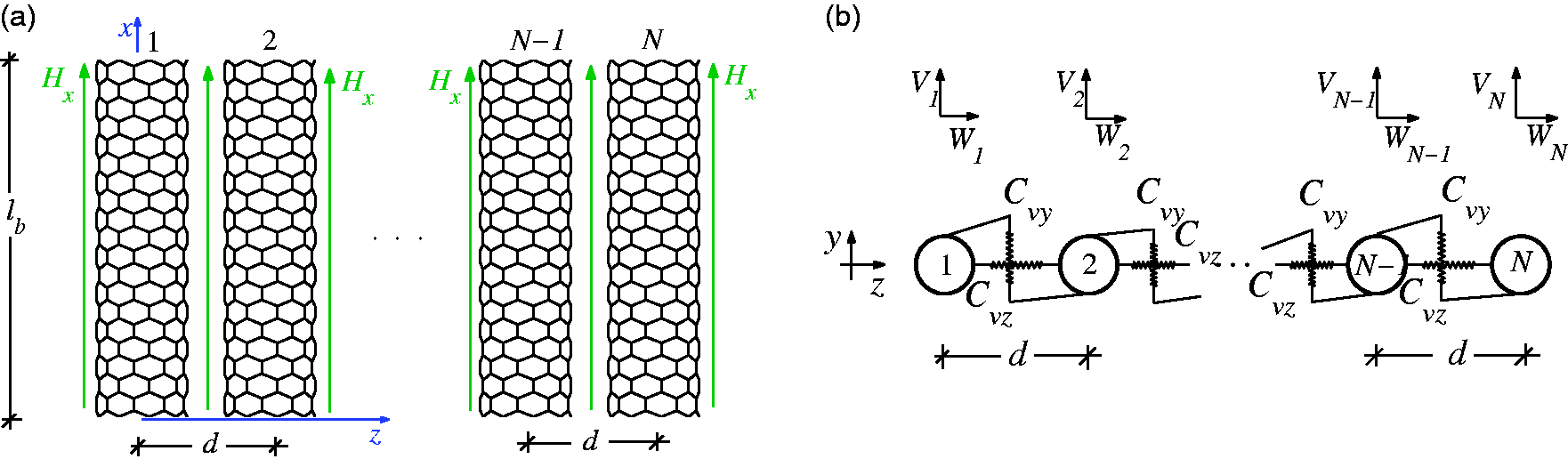
Consider a set of N vertically aligned SWCNTs of length lb with intertube distance d as shown in Figure 1(a). Such a system is called an in-plane membrane or 2D ensemble of SWCNTs since all tubes have been placed in just a single plane, namely xz. The coordinate system has been attached to the nanostructure such that the x-axis is coincident with the revolutionary axis of the first tube, the y-axis points out of the plane of the ensemble, and the z-axis is perpendicular to the revolutionary axes of the SWCNTs. For free vibration analysis of the problem, the ECS pertinent to each tube is taken into account. Such a structure is a hollow cylindrical shell whose length and mean radius, rm, in order are identical to the length and radius of the SWCNT. Based on the work of Gupta and Batra (2008), the wall thickness of the ECS, tb, is set equal to 0.34 nm. Additionally, the density, cross-sectional area, moment inertia of the cross-section, elastic moduli, shear elastic moduli, and Poisson’s ratio of the ECS in order are denoted by ρb, Ab, Ib, Eb, Gb, and νb. The ensemble is subjected to a LMF whose strength is Hx. Each SWCNT interacts both in- and out-of-plane of the ensemble with its neighboring tubes through the vdW forces. For small lateral deformations of the SWCNTs, such interactional forces along the y- and z-axes can be modeled by continuous lateral springs of constants Cvy and Cvz, respectively (see Figure 1(b)). The values of these constants are determined based on the work of Kiani (2014j).
(a) Schematic representation of a single-layered membrane of SWCNTs acted upon by a LMF; (b) the continuum-based model for the in-plane and out-of-plane vibrations of the MAESWCNTs.
Herein, free in-plane and out-of-plane vibrations of MAESWCNTs are of concern. Using Hamilton’s principle as well as nonlocal Rayleigh beam theory (NRBT), nonlocal Timoshenko beam theory (NTBT), and nonlocal higher-order beam theory (NHOBT), the discrete governing equations are derived and the in-plane and out-of-plane frequencies of the nanostructure are evaluated. Subsequently, the continuous versions of the governing equations of the discrete models are developed and their efficiencies are discussed.
3. Exerted Lorentz forces on a continuum-based beam model of an SWCNT
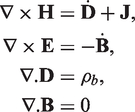
According to Maxwell’s equations (Maxwell, 1861a,b, 1862a,b), the B-D-E-H-J relations are given by the following four equations:
where E, H, J, B, and D in order are the electric field intensity, magnetic field, current density vector, magnetic field density, and the displacement current density. The overdot sign and ∇ represent the first derivative with respect to time and the gradient operator, respectively. The constitutive relations for the ECS are considered to be
where ε and η are, respectively, the permittivity and the permeability of the CNT. It is assumed that the displacement current density as well as its derivative with respect to time is negligible. Let E = E0 + e and H = H0 + h where e and h are the small disturbances associated with E0 and H0, respectively. For the problem under study, E0 = 0. On the other hand, the generalized Ohm’s law explains: where σ and v represent the electrical conductivity and the velocity field vector of the SWCNT. By assuming SWCNT to be a highly conductive medium (i.e. a large value for σ), one can write where , and u = u(x, y, z, t) is the displacement field of the SWCNT. Assuming h ≪ H0, using the recent relation, and equation (2), one has . By using the latter obtained relation as well as equations (1) and (2), one can obtain According to the Lorentz formulas, the exerted electro-magnetic force per unit volume of the medium is given by fm = J × B. Using this relation, equation (1), and above-mentioned assumptions, the Lorentz force is expressed in terms of the displacement field of the SWCNT as well as the strength of the magnetic field as
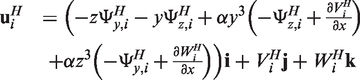
Based on the Rayleigh, Timoshenko, and higher-order beam theories, the displacement vectors of the ECS pertinent to the ith tube of the ensemble are respectively given by
where i, j, and k in order denote the unit base vectors pertinent to the x-, y-, and z-axes, and . Furthermore, the quantities with superscripts R, T, and H are those associated with the Rayleigh, Timoshenko, and higher-order beam theories, respectively; ui[.] ([.] = R,T, and H) represents the displacement field vector of the ith tube; V i[.] and W i[.] in order are its transverse displacements along the y- and z-axes; in order are the deflection angles of the ith tube about the y- and z-axes based on the Timoshenko beam theory; and denote the deflection angles about the y- and z-axes of the ith SWCNT using a higher-order beam model, respectively. For the problem at hand, the LMF is denoted by H0 = Hxi where Hx represents the strength of the longitudinal magnetic field (SLMF). By substituting equations (4a) to (4c) into equation (3), the magnetically applied force per unit length of the ECS for the ith tube is obtained:
4. Free vibrations of 2D MAESWCNTs via discrete models
4.1. Development of a discrete model based on the NRBT
4.1.1. Nonlocal equations of motion using NRBT
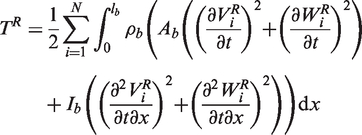
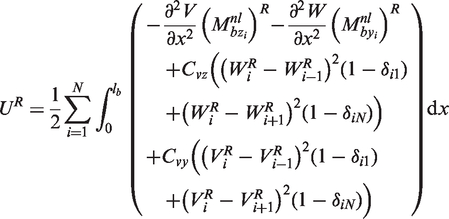
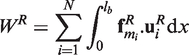
Using Rayleigh beam model in the framework of the nonlocal continuum theory of Eringen, the kinetic energy, TR, the elastic strain energy of a 2D SWCNT’s ensemble, UR, and the work done by the applied LMF on the ensemble, WR, are expressed by
where t, δij, represent the time parameter, Kronecker delta tensor, and the nonlocal bending moments of the ith SWCNT about the y- and z-axes based on the NRBT, respectively. In the context of the nonlocal continuum theory of Eringen, the nonlocal bending moment of each tube based on the NRBT is given by (Peddieson et al., 2003; Sudak, 2003; Wang, 2005)
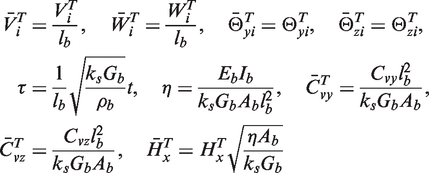
where e0a denotes the small-scale parameter. The quantity a is the length of a C–C bond (≈0.142 nm), and e0 is commonly scaled for the problem by comparing the obtained results of the nonlocal model with those of an atomic approach. So far, different values of e0 have been reported for mechanical problems associated with CNTs (Wang and Haiyan, 2005; Zhang et al., 2005; Duan et al., 2007; Shen and Zhang, 2010). The work of Duan et al. (2007) also showed that the magnitude of this parameter depends on the chirality, aspect ratio and boundary conditions of the CNT. In this research work, e0a is considered in the range 0–2 nm. By employing Hamilton’s principle through using equations (7a), (7b), and the following dimensionless quantities:
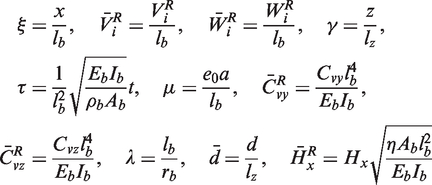
where ξ, τ, μ, λ, rb, and lz in order denote the dimensionless spatial coordinate, dimensionless time, dimensionless small-scale parameter, slenderness ratio, gyration radius of the ECS’s cross-section, and the distance between the revolutionary axis of the first tube and that of the Nth tube (i.e. lz = (N − 1)d), the dimensionless discrete equations of motion describing both in-plane and out-of-plane vibrations of a MAESWCNT based on the NRBT are obtained as follows:
where and
4.1.2. Free vibration analysis of the MAESWCNTs using assumed mode method
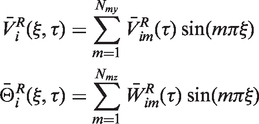
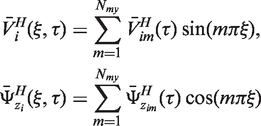
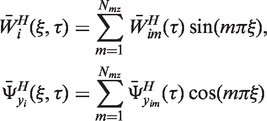
Using the assumed mode approach, the dimensionless transverse displacements for a simply supported MAESWCNT can be stated as
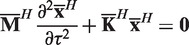
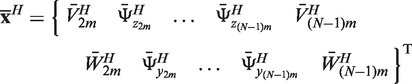
where Nmy and Nmz are the number of the considered vibration modes pertinent to the transverse motion of the ensemble along the y- and z-axes, respectively. Further, the exterior SWCNTs are kept fixed along both y- and z-axes. Thereby, and . Through imposition of these boundary conditions as well as by substituting equations (10a) and (10b) into equations (9a) and (9b), the following set of ordinary differential equations (ODEs) is obtained:
where the nonzero elements of vectors and matrices in equation (11) are
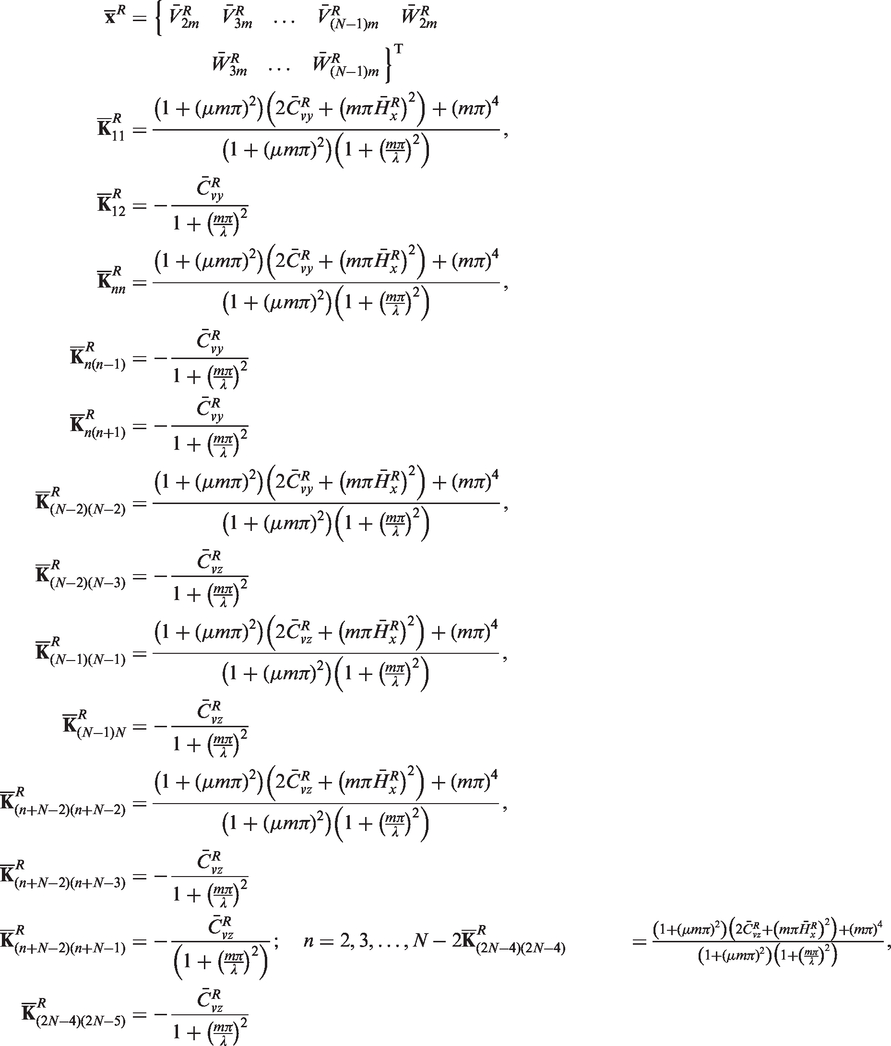
Now let where is the vector of dimensionless amplitudes, and ϖR denotes the dimensionless frequency of the nanostructure modeled in accordance with the NRBT. By substituting this relation into equation (11), after solving the resulting set of eigenvalue equations, the dimensionless frequencies of the 2D MAESWCNTs could be determined.
4.2. Development of a discrete model based on the NTBT
4.2.1. Nonlocal equations of motion using NTBT
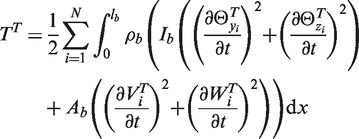
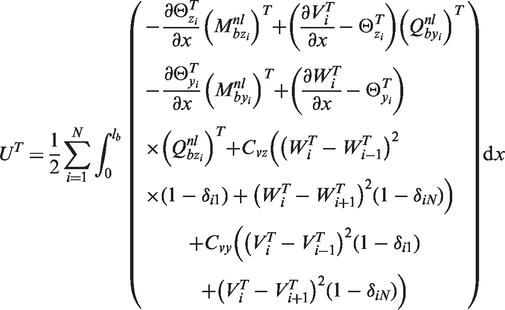
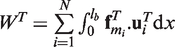
Using the Timoshenko beam theory plus the nonlocal continuum theory of Eringen, the kinetic energy, TT, the elastic strain energy, UT, and the work done by the LMF on the ensemble of SWCNTs, WT, are stated as
where , , and in order denote the nonlocal shear resultant forces of the ith tube along the y- and z-axes, and the nonlocal bending moments about the y- and z-axes, on the basis of the NTBT. According to the nonlocal continuum theory of Eringen, the nonlocal shear force and bending moment within the ith tube are given by (Wang et al., 2006, 2007; Wang and Wang, 2007)
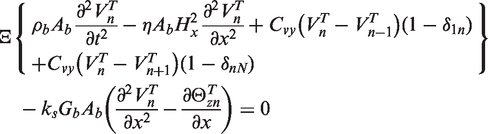
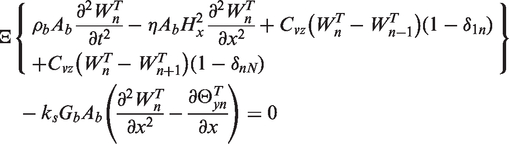
where ks is the shear correction factor. By using equations (14a) to (14d) and Hamilton’s principle, the discrete governing equations of MAESWCNTs can be extracted in the following form:
where In order to study the problem in a more general context, the following dimensionless parameters are taken into account:
By introducing equation (16) to equations (15a) to (15d), the dimensionless discrete equations of motion of the MAESWCNTs on the basis of the NTBT are obtained as
where equations (17a) to (17d) represent 4N coupled partial differential equations.
4.2.2. Free vibration analysis of the MAESWCNTs using assumed mode method
Using the assumed mode method, the deformation fields of the ith tube of the simply supported MAESWCNTs based on the NTBT can be expressed as
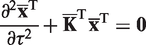
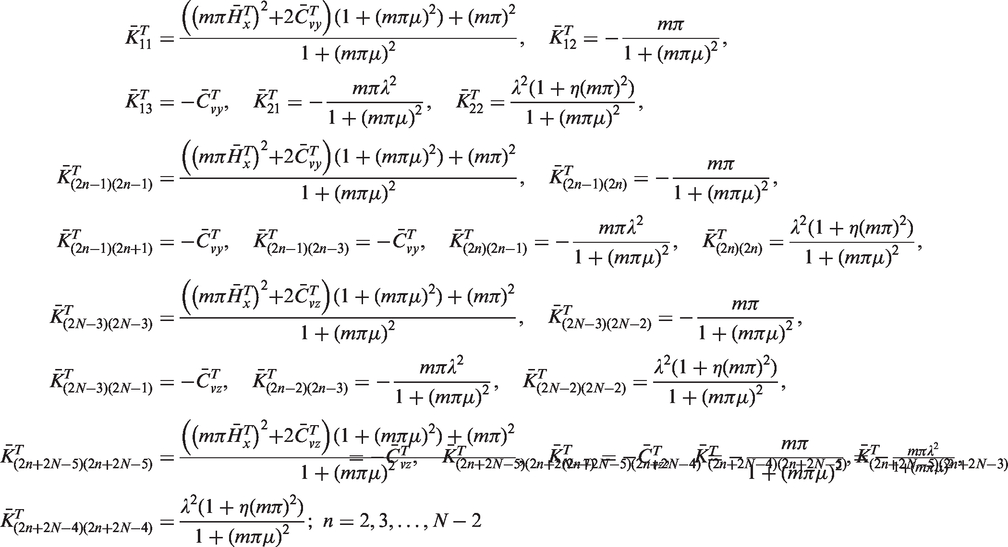
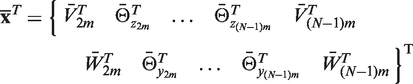
Furthermore, the exterior SWCNTs are prohibited from any movement. Thereby, and and N. By enforcing these conditions as well as substituting equations (18a) to (18d) into equations (17a) to (17d), one can arrive at the following set of ODEs:
where the nonzero elements of are
and is given by
In order to evaluate the natural frequencies of the nanostructure, the vector of the unknowns is considered in the following harmonic form: . In this relation, represents the vector of the dimensionless amplitudes and ϖT is the dimensionless frequency of the nanostructure modeled based on the NTBT. By introducing the recent relation to equation (19) and solving the resulting set of eigenvalue equations for ϖT, the dimensionless frequencies of the nanostructure can be easily calculated.
4.3. Development of a discrete model based on the NHOBT
4.3.1. Nonlocal equations of motion using NHOBT
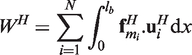
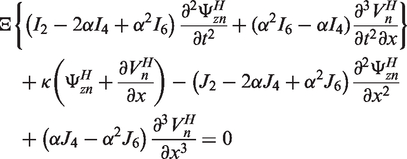
Using the higher-order beam theory of Reddy (1984) in the context of the nonlocal continuum theory of Eringen, the kinetic energy, TH, the elastic strain energy of the 2D ensemble of SWCNTs, UH, and the work done by the LMF on the nanostructure can be written as follows:
where , , and in order denote the deflection field along the y- and z-axes, angle of deflection about the y- and z-axes, nonlocal bending moment about the y- and z-axes, and nonlocal shear force along the y- and z-axes of the ith SWCNT modeled based on the NHOBT. In the framework of the NHOBT, the nonlocal forces within the ith tube are related to the deformation fields as (Reddy, 2007; Kiani, 2014e)
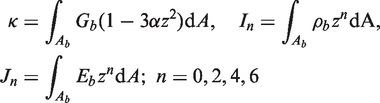
where
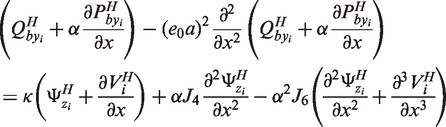
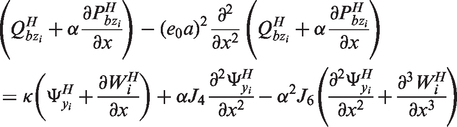
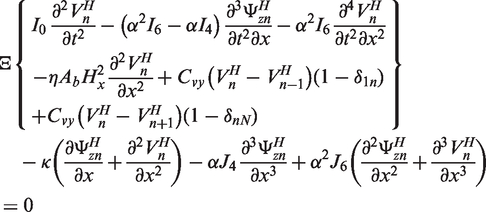
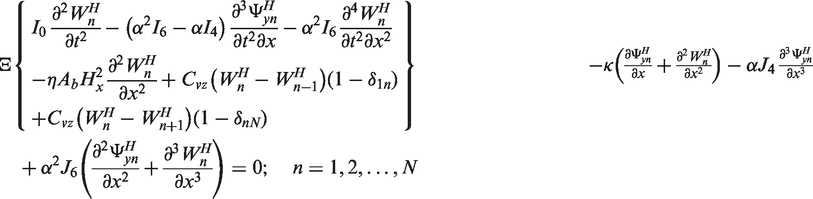
In order to construct the equations of motion of the constitutive SWCNTs of the ensemble, Hamilton’s principle is implemented. After taking the required integration by parts, the discrete governing equations of the MAESWCNTs based on the NHOBT are obtained as
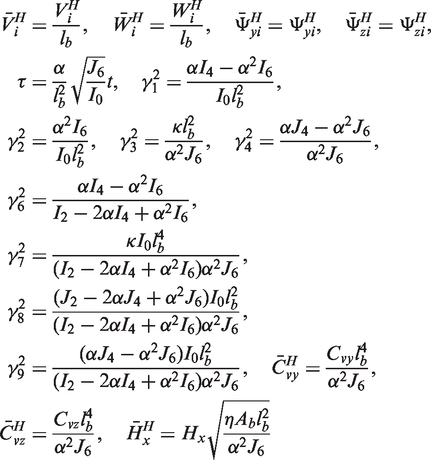
To study the problem at hand in a more general context, the following dimensionless quantities are introduced:
By introducing equation (26) to equations (25a) to (25d), the dimensionless equations of motion of the MAESWCNTs on the basis of the NHOBT are derived in the following forms:
4.3.2. Free vibration analysis of the MAESWCNTs using discrete NHOBT
For simply supported SWCNTs using modal analysis, the deformation fields of the SWCNTs according to the NHOBT are expressed as
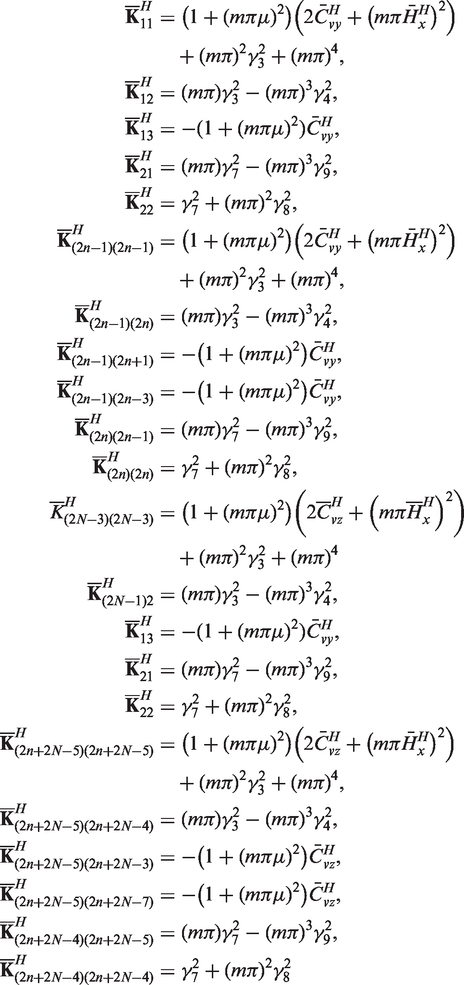
On the other hand, the exterior SWCNTs are prevented from any lateral movement. It implies that and N. In view of these boundary conditions, by substituting equations (28a) and (28b) into equations (27a) to (27d), the following set of ODEs is derived:
where the nonzero elements of the vectors and matrices in equation (29) are
5. Free vibration analysis of MAESWCNTs via continuous models
5.1. The basic concepts
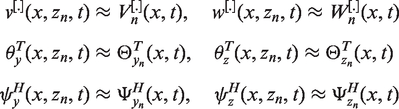
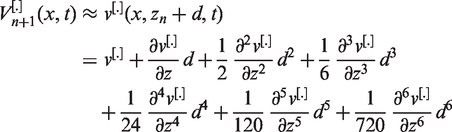
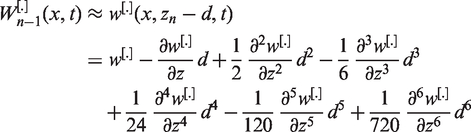
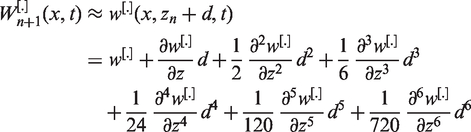
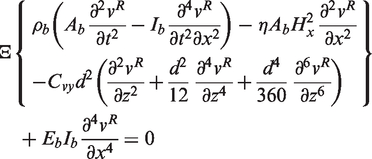
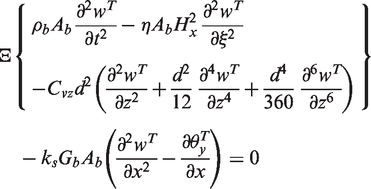
For presenting the discrete relations in equations (9), (15) and (25) in a continuous form along the z-direction, the continuous displacements as well as angles of deformation are considered such that
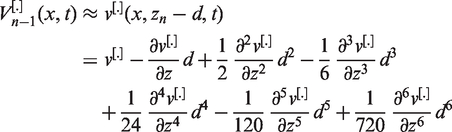
where . Therefore,, , and should be appropriately stated as a function of their corresponding continuous displacements at z = zn. For this purpose, the sixth-order expansions of the Taylor series of , , , and about d = 0 are employed:
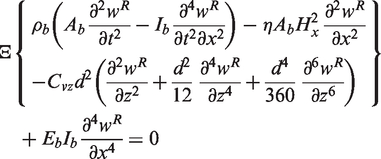
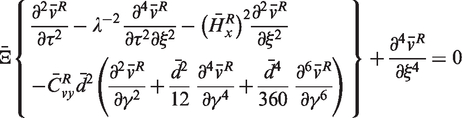
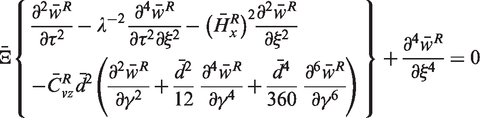
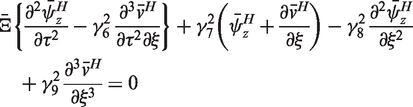
5.2. Development of a continuous model for 2D arrays of SWCNTs based on the NRBT
5.2.1. Nonlocal continuous equations based on the NRBT
Using equations (32a) and (32b), equations (9a) and (9b) can be modified to the following continuous forms:
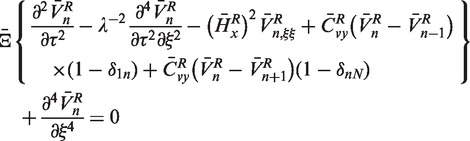
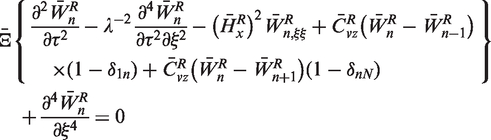
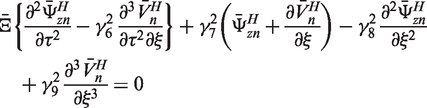
Equations (33a) and (33b) display the nonlocal continuous equations of motion of 2D ensembles of SWCNTs which are uniformly distributed along the z-axis. By introducing equation (8) to equations (33a) and (33b), they can be obtained in dimensionless form as
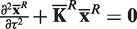
where and Equations (34a) and (34b), respectively, denote the out-of-plane and in-plane dimensionless governing equations of 2D ensembles of SWCNTs in the presence of a LMF based on the NRBT. In the following part, an analytical solution will be developed to predict the free dynamic response of the MAESWCNTs.
5.2.2. Free dynamic analysis of 2D MAESWCNTs using NRBT
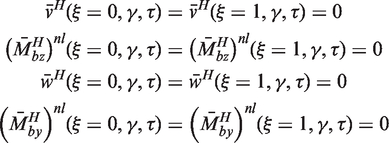
Since all SWCNTs have simply supported ends and those located at the edges are not allowed to move, the following boundary conditions should be satisfied:
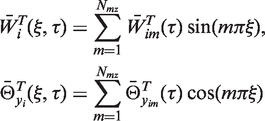
The in-plane and out-of-plane displacements can be considered as a sum of admissible mode shapes which satisfy the conditions in equation (35). Therefore,
where denote the dimensionless amplitudes of displacements associated with the (m,n) vibration mode.
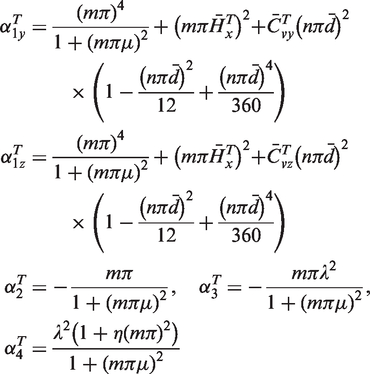
By introducing equations (36a) and (36b) to equations (34a) and (34b), one can arrive at a set of eigenvalue equations whose eigenvalues are the dimensionless flexural frequencies of the MAESWCNTs based on the NRBT. As a result, the in-plane and out-of-plane frequencies are obtained as follows:
5.3. Development of a continuous model for 2D arrays of SWCNTs based on the NTBT
5.3.1. Nonlocal continuous equations based on the NTBT
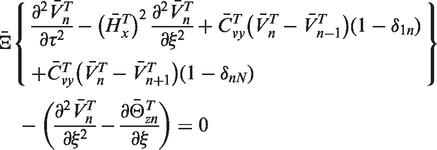
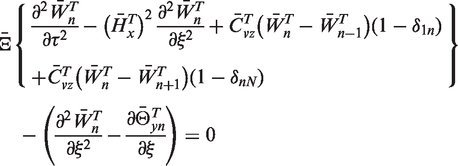
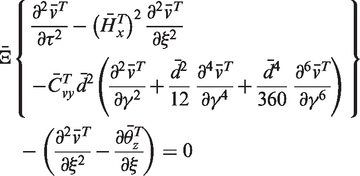
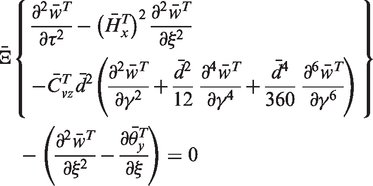
By introducing equations (32a) and(32b) to equations (15a) to (15d), the continuous governing equations of MAESWCNTs based on the NTBT are derived as follows:
By introducing the dimensionless parameters in equation (16) to equations (38a) to (38d), the continuous version of dimensionless equations of motion of MAESWCNTs accounting for both in-plane and out-of-plane vibrations is stated as
where , , , and
5.3.2. Free dynamic analysis of 2D MAESWCNTs using NTBT
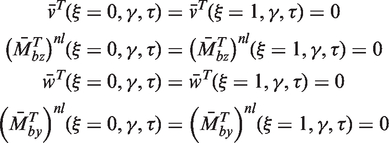
For a 2D ensemble of SWCNTs in which both ends of each SWCNT are simply supported and the exterior tubes have been kept fixed, the following boundary conditions should be satisfied for the proposed continuous model based on the NTBT:
A solution to equations (39a) to (39d) with the boundary conditions given in equations (40a) and (40b) can be sought as follows:
where , , , and denote the dimensionless amplitudes associated with their corresponding (m, n) mode shapes of the deformations , , , and , respectively. By substituting equations (41a) to (41d) into equations (39a) to (39d) and solving the resulting set of eigenvalue equations for the flexural frequencies,
where
Equations (42a) and (42b) display the explicit expressions of out-of-plane and in-plane frequencies of the MAESWCNTs based on the NTBT. The greatest advantage of such expressions compared to those evaluated from equation (19) is that their magnitudes can be easily evaluated for a wide range of magnetic field strengths, slenderness ratios, and small-scale parameters.
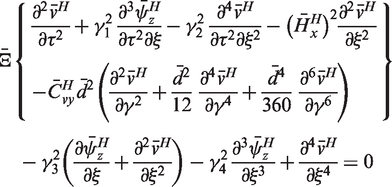
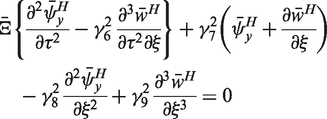
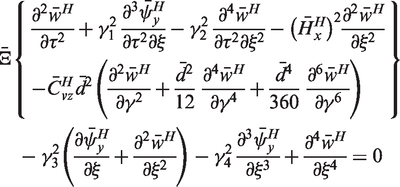
5.4. Development of a continuous model for 2D arrays of SWCNTs based on the NHOBT
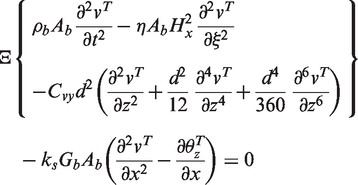
5.4.1. Nonlocal continuous equations based on the NHOBT
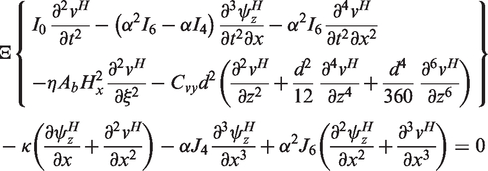
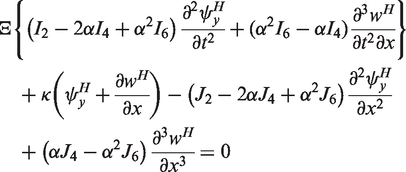
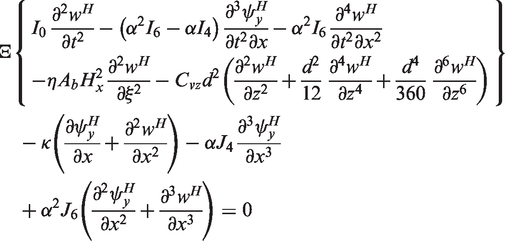
By introducing equations (32a) to (32d) to equations (25a) to (25d), the continuous equations corresponding to the free transverse motion of an ensemble of SWCNTs in the presence of the LMF on the basis of the NHOBT are obtained as
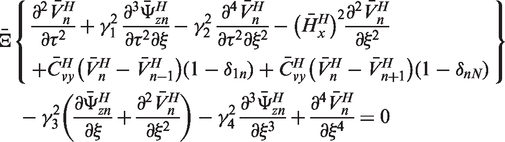
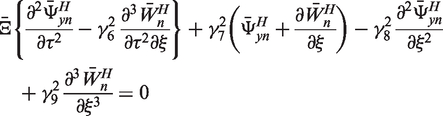
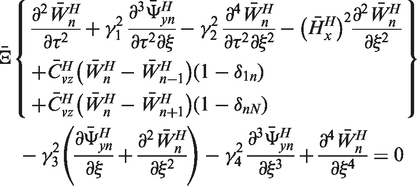
Using equation (26), the dimensionless continuous equations of transverse motion of 2D ensembles of SWCNTs acted upon by a LMF based on the NHOBT are written as
where , , , and
5.4.2. Free dynamic analysis of 2D MAESWCNTs using NHOBT
The SWCNTs of the ensemble have simple supports at both ends. Further, the exterior tubes are prevented from making any lateral motion. Such conditions in order are displayed by the following relations:
Based on the assumed mode methodology, the continuous in-plane and out-of-plane displacements of the MAESWCNTs can be expressed as a sum of trigonometric functions such that the boundary conditions are satisfied. These dimensionless displacements for the conditions in equation (46) are
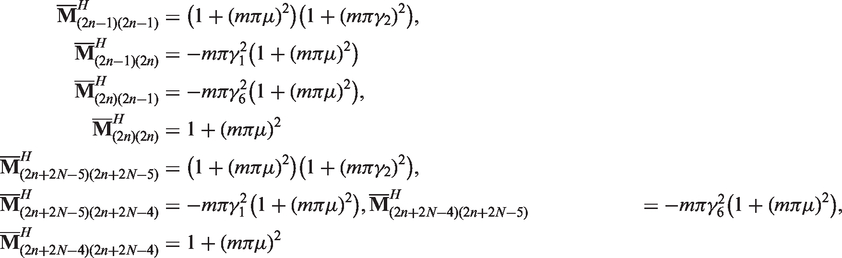
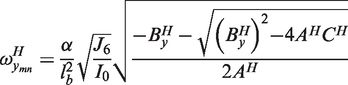
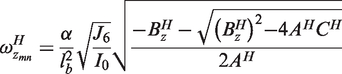
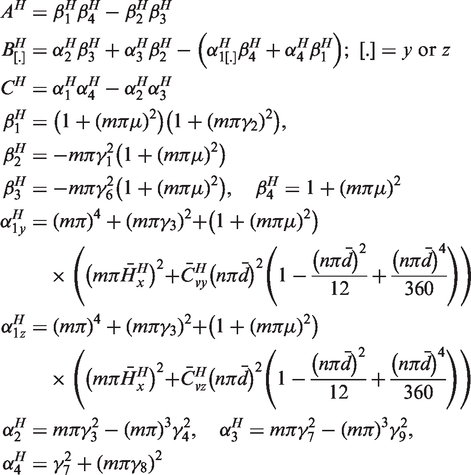
where , , , and in order are the dimensionless amplitudes, and ϖyH and ϖzH are the dimensionless flexural frequencies pertinent to the transverse vibration of the MAESWCNTs along the y- and z-axes, respectively. By substituting equations (47a) to (47d) into equations (45a) to (45d), the requirement for a nontrivial solution to the resulting set of equations leads to the following frequencies:
where
6. Results and discussion
6.1. A comparison study
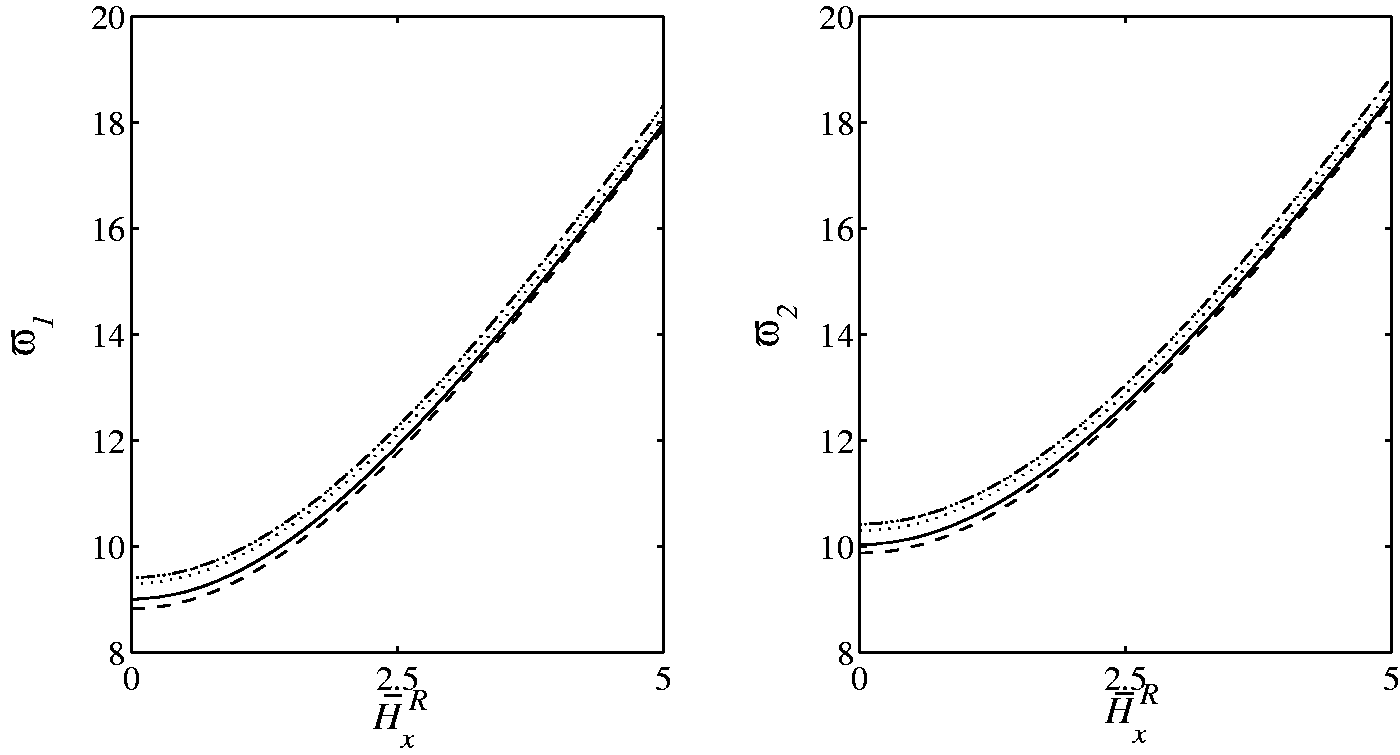
In order to validate the proposed discrete models, the predicted results are checked with those of another work for a particular case. Consider a magnetically affected double-SWCNTs-system with the following data: Eb = 1 TPa, νb = 0.2, ρb = 2300 kg/m3, tb = 0.34 nm, rm = 3.5 nm, lb = 50 nm, and . Both SWCNTs have simple supports and they are free from any lateral constraint and restraint. The natural flexural frequencies of such a system were investigated by Murmu et al. (2012b) via the nonlocal Euler–Bernoulli beam model. The frequencies associated with both synchronous and asynchronous phases were explicitly derived. The dimensionless flexural frequencies predicted by the proposed models in terms of the dimensionless SLMF as well as those of the model of Murmu et al. (2012b) are plotted in Figure 2. The dimensionless frequencies associated with the synchronous and asynchronous phases are denoted by ϖ1 and ϖ2, respectively. As is seen, there is fairly good agreement between the results predicted by the NRBT and those of Murmu et al. (2012b) for all levels of the SLMF. Due to the consideration of the shear effects in the proposed NTBT and NHOBT, their results are generally lower than those of NRBT. As the SLMF increases, the discrepancies between the results of the proposed models reduce.
6.2. Numerical studies
The primary goals of this part are to investigate the efficiency of the proposed novel continuous models as well as to determine the roles of the crucial parameters on both in-plane and out-of-plane vibration behaviors of the nanostructure. To this end, consider a MAESWCNT with the following data: ρb = 2500 kg/m3, Eb = 1012 Pa, e0a = 2 nm, ν = 0.2, tb = 0.34 nm, and rm = 1 nm. In all calculations, where λ0 = 100.
6.2.1. Accuracy of the proposed continuous models
In Tables 1 and 2, the predicted first three in-plane and out-of-plane frequencies of a simply supported MAESWCNT for four levels of the population of the ensemble (i.e. N = 5, 10, 15, and 20) and three levels of the SLMF (i.e. , 25, and 50) are provided. The considered SWCNTs are fairly stocky (i.e. λ = 10), and their intertube distances are set equal to 2.4 nm. As is seen in Tables 1 and 2, there exists a reasonably good agreement between the results predicted by the discrete models and those of the continuous ones. According to the obtained results, for all levels of the SLMF, both in-plane and out-of-plane frequencies will reduce as the number of SWCNTs increases. The rate of decreasing of the in-plane frequencies is higher than that of the out-of-plane frequencies. Generally, the effect of the population of the ensemble on both in-plane and out-of-plane frequencies becomes inconspicuous as the influence of the SLMF becomes highlighted. The obtained results reveal that the variation of the population of the ensemble is more influential on the variation of the lower frequencies. All proposed models confirm that both in-plane and out-of-plane frequencies magnify with the SLMF. A more detailed role of the SLMF in the frequencies of the MAESWCNTs will be explained in an upcoming part. Regarding the capabilities of various beam models in predicting the frequencies of the nanostructure, the NRBT commonly overestimates the results predicted by both NTBT and NHOBT (i.e. nonlocal shear deformable beam theories (NSDBTs)). It is mainly related to not considering the effect of shear deformation in the formulations of the NRBT. It means that the predicted deflection of a nanostructure due to an applied load via NSDBTs is greater than that of the NRBT. In other words, the predicted bending stiffness of the nanostructure by the NSDBTs is commonly less than that by the NRBT. Therefore, the frequencies predicted by the NRBT are generally greater than those of the NSDBTs. The obtained results display that the results of the NHOBT are between those of the NRBT and NTBT in most of the cases. Furthermore, the results of the NTBT and those of the NHOBT are commonly in line and closer to each other. At higher levels of the SLMF, the discrepancies between the higher frequencies predicted by the NRBT and those of the NSDBTs are more apparent. The influence of the population of MAESWCNTs on the discrepancies of the predicted fundamental frequencies by various nonlocal beams will be comprehensively discussed in a coming part.
The first three dimensionless out-of-plane frequencies of the MAESWCNTs for different numbers of SWCNTs as well as various levels of the SLMF (λ = 10, d = 2.4 nm).
i
N = 5
N = 10
N = 15
N = 20
Hx = 0
Discrete models
NRBT
1
1.982758
1.976549
1.975607
1.975301
2
4.623157
4.621062
4.620745
4.620642
3
6.411680
6.410565
6.410396
6.410341
NTBT
1
1.697490
1.689896
1.688742
1.688368
2
3.212952
3.208997
3.208397
3.208202
3
3.898918
3.895617
3.895117
3.894954
NHOBT
1
1.801483
1.794429
1.793358
1.793011
2
3.667137
3.663848
3.663349
3.663188
3
4.676715
4.674163
4.673777
4.673651
Continuous models
NRBT
1
1.982759
1.976549
1.975607
1.975301
2
4.623157
4.621062
4.620745
4.620642
3
6.411680
6.410565
6.410396
6.410341
NTBT
1
1.697490
1.689896
1.688742
1.688368
2
3.212952
3.208997
3.208397
3.208202
3
3.898918
3.895617
3.895117
3.894954
NHOBT
1
1.801483
1.794429
1.793358
1.793011
2
3.667137
3.663848
3.663349
3.663188
3
4.676715
4.674163
4.673777
4.673651
Discrete models
NRBT
1
2.880396
2.876125
2.875478
2.875268
2
5.926908
5.925274
5.925026
5.924946
3
7.998103
7.997208
7.997073
7.997029
NTBT
1
2.728009
2.723306
2.722592
2.722361
2
5.306384
5.304050
5.303696
5.303581
3
7.413098
7.411511
7.411270
7.411192
NHOBT
1
2.782753
2.778204
2.777514
2.777290
2
5.507292
5.505168
5.504846
5.504742
3
7.616796
7.615422
7.615214
7.615146
Continuous models
NRBT
1
2.880396
2.876125
2.875478
2.875268
2
5.926908
5.925274
5.925026
5.924946
3
7.998103
7.997208
7.997073
7.997029
NTBT
1
2.728009
2.723306
2.722592
2.722361
2
5.306384
5.304050
5.303696
5.303581
3
7.413098
7.411511
7.411270
7.411192
NHOBT
1
2.782753
2.778204
2.777514
2.777290
2
5.507292
5.505168
5.504846
5.504742
3
7.616796
7.615422
7.615214
7.615146
Discrete models
NRBT
1
4.625228
4.622569
4.622167
4.622036
2
8.740263
8.739155
8.738987
8.738932
3
11.513021
11.512400
11.512306
11.512276
NTBT
1
4.585288
4.582524
4.582105
4.581969
2
8.739912
8.738818
8.738653
8.738599
3
10.230600
10.230528
10.230517
10.230514
NHOBT
1
4.600245
4.597519
4.597106
4.596972
2
8.740058
8.738958
8.738791
8.738737
3
10.566957
10.566801
10.566777
10.566769
Continuous models
NRBT
1
4.625228
4.622569
4.622167
4.622036
2
8.740263
8.739155
8.738987
8.738932
3
11.513021
11.512400
11.512306
11.512276
NTBT
1
4.585288
4.582524
4.582105
4.581969
2
8.739912
8.738818
8.738653
8.738599
3
10.230600
10.230528
10.230517
10.230514
NHOBT
1
4.600245
4.597519
4.597106
4.596972
2
8.740058
8.738958
8.738791
8.738737
3
10.566957
10.566801
10.566777
10.566769
The first three dimensionless in-plane frequencies of the MAESWCNTs for different numbers of SWCNTs as well as various levels of the SLMF (λ = 10, d = 2.4 nm).
i
N = 5
N = 10
N = 15
N = 20
Hx = 0
Discrete models
NRBT
1
2.106747
2.002786
1.986562
1.981269
2
4.666154
4.629952
4.624443
4.622654
3
6.434646
6.415301
6.412365
6.411412
NTBT
1
1.847145
1.721915
1.702136
1.695669
2
3.293457
3.225762
3.215379
3.212003
3
3.966373
3.909616
3.900944
3.898125
NHOBT
1
1.941250
1.824198
1.805802
1.799792
2
3.734303
3.677795
3.669155
3.666347
3
4.729014
4.684990
4.678281
4.676102
Continuous models
NRBT
1
2.106748
2.002786
1.986562
1.981269
2
4.666155
4.629952
4.624443
4.622654
3
6.434647
6.415301
6.412365
6.411412
NTBT
1
1.847147
1.721915
1.702136
1.695669
2
3.293458
3.225762
3.215379
3.212003
3
3.966373
3.909616
3.900944
3.898125
NHOBT
1
1.941251
1.824198
1.805802
1.799792
2
3.734304
3.677795
3.669155
3.666347
3
4.729015
4.684990
4.678281
4.676102
Discrete models
NRBT
1
2.967108
2.894218
2.883015
2.879371
2
5.960507
5.932210
5.927911
5.926515
3
8.016525
8.001006
7.998652
7.997888
NTBT
1
2.823258
2.743225
2.730894
2.726880
2
5.354278
5.313955
5.307817
5.305823
3
7.445714
7.418247
7.414072
7.412717
NHOBT
1
2.874967
2.797473
2.785543
2.781661
2
5.550892
5.514181
5.508595
5.506782
3
7.645046
7.621255
7.617640
7.616466
Continuous models
NRBT
1
2.967109
2.894218
2.883015
2.879371
2
5.960508
5.932210
5.927911
5.926515
3
8.016525
8.001006
7.998652
7.997888
NTBT
1
2.823259
2.743225
2.730894
2.726880
2
5.354278
5.313955
5.307817
5.305823
3
7.445714
7.418247
7.414072
7.412717
NHOBT
1
2.874968
2.797473
2.785543
2.781661
2
5.550892
5.514181
5.508595
5.506782
3
7.645046
7.621255
7.617640
7.616466
Discrete models
NRBT
1
4.679720
4.633848
4.626859
4.624589
2
8.763082
8.743859
8.740943
8.739996
3
11.525827
11.515038
11.513403
11.512872
NTBT
1
4.641915
4.594250
4.586984
4.584624
2
8.762381
8.743461
8.740584
8.739650
3
10.232072
10.230833
10.230644
10.230583
NHOBT
1
4.656102
4.609085
4.601919
4.599591
2
8.762672
8.743626
8.740733
8.739794
3
10.570174
10.567466
10.567054
10.566920
Continuous models
NRBT
1
4.679721
4.633848
4.626859
4.624589
2
8.763082
8.743859
8.740943
8.739996
3
11.525827
11.515038
11.513403
11.512872
NTBT
1
4.641916
4.594250
4.586984
4.584624
2
8.762381
8.743461
8.740584
8.739650
3
10.232073
10.230833
10.230644
10.230583
NHOBT
1
4.656103
4.609085
4.601919
4.599591
2
8.762672
8.743626
8.740733
8.739794
3
10.570174
10.567466
10.567054
10.566920
Tables 3 and 4 display the role of the slenderness ratio in the first three in-plane and out-of-plane frequencies of the MAESWCNTs. The frequencies predicted by both discrete and continuous models are given for MAESWCNTs consisting of 12 SWCNTs with intertube distance equal to 2.4 nm. Four levels of slenderness ratio (i.e. λ = 10, 15, 50, and 100) and three levels of the SLMF (i.e. Hx0R= 0, 25, and 50) are considered for the understudy MAESWCNTs. It is obvious from Tables 3 and 4 that each continuous model can successfully reproduce the results of its counterpart discrete model with a high level of accuracy. Such a result plus those obtained from the previous part ensure the high efficiency of the proposed continuous models in predicting free vibration behaviors of MAESWCNTs. As a result, in upcoming parts, the results predicted by only continuous models will be presented. According to Tables 3 and 4, irrespective of the SLMF, both in-plane and out-of-plane frequencies lessen as the slenderness ratio increases. The rate of the reduction of frequencies in terms of slenderness ratio is less obvious for higher levels of the SLMF. Further, the influence of slenderness ratio on the frequencies pertinent to the higher vibration modes is more obvious. However, such a consequence lessens by increasing the SLMF. The obtained results indicate that the in-plane frequencies become closer to those of out-of-plane vibration as the SLMF magnifies. It implies that the in-plane and out-of-plane vibration behaviors become fairly identical at high levels of the SLMF. This matter is regarded as a crucial point in the design of the next generation of nanoelectromechanical systems made of vertically aligned ensembles of SWCNTs, particularly when identical dynamical behaviors of the nanostructure for the in-plane and out-of-plane motions are expected. Concerning the out-of-plane vibration, the variation of the SLMF is more influential in the variation of the fundamental frequencies of more slender ensembles of SWCNTs. However, regarding the in-plane vibration, the SLMF has the most influence on the variation of the fundamental frequencies of stockier SWCNTs’ ensembles. Regarding the capabilities of the proposed nonlocal beam models in capturing the frequencies of the MAESWCNTs, for low levels of the slenderness ratio, there exists an obvious discrepancy between the results of the NRBT and those of the NSDBTs, particularly for higher frequencies. As the SLMF increases, such discrepancies reduce. For high levels of the slenderness ratio (i.e. λ = 100), both the in-plane and out-of-plane frequencies predicted by the NRBT are very close to those of the NTBT and NHOBT. The main reason for this fact is the reduction of the ratio of shear strain energy to flexural strain energy as the slenderness ratio increases. In an upcoming part, the role of the slenderness ratio in both in-plane and out-of-plane vibrations will be displayed in some detail.
The first three dimensionless out-of-plane frequencies of the MAESWCNTs for different levels of slenderness ratio as well as SLMF (N = 12, d = 2.4 nm).
i
λ = 10
λ = 15
λ = 50
λ = 100
Hx = 0
Discrete models
NRBT
1
1.976020
1.035981
.128248
.072322
2
4.620884
2.935533
.417952
.127190
3
6.410470
4.620888
.864466
.247637
NTBT
1
1.689248
.954839
.127476
.072300
2
3.208660
2.324948
.404928
.126411
3
3.895336
3.208667
.807797
.243361
NHOBT
1
1.793828
.986150
.127792
.072309
2
3.663568
2.536373
.410157
.126730
3
4.673946
3.663574
.829902
.245098
Continuous models
NRBT
1
1.976020
1.035981
.128248
.072322
2
4.620884
2.935533
.417952
.127190
3
6.410470
4.620888
.864466
.247637
NTBT
1
1.689248
.954839
.127476
.072300
2
3.208660
2.324948
.404928
.126411
3
3.895336
3.208667
.807797
.243361
NHOBT
1
1.793828
.986150
.127792
.072309
2
3.663568
2.536373
.410157
.126730
3
4.673946
3.663574
.829902
.245098
Discrete models
NRBT
1
2.875762
1.765028
.455567
.230532
2
5.925135
3.983863
.964440
.455270
3
7.997132
5.925138
1.553927
.699415
NTBT
1
2.722905
1.725702
.455377
.230526
2
5.303851
3.662318
.959604
.455080
3
7.411376
5.303855
1.527625
.698104
NHOBT
1
2.777816
1.740713
.455454
.230529
2
5.504987
3.771997
.961535
.455158
3
7.615305
5.504991
1.537786
.698634
Continuous models
NRBT
1
2.875762
1.765028
.455567
.230532
2
5.925135
3.983863
.964440
.455270
3
7.997132
5.925138
1.553927
.699415
NTBT
1
2.722905
1.725702
.455377
.230526
2
5.303851
3.662318
.959604
.455080
3
7.411376
5.303855
1.527625
.698104
NHOBT
1
2.777816
1.740713
.455454
.230529
2
5.504987
3.771997
.961535
.455158
3
7.615305
5.504991
1.537786
.698634
Discrete models
NRBT
1
4.622343
3.039987
.883641
.443722
2
8.739060
6.134542
1.787884
.883488
3
11.512347
8.739062
2.723389
1.331447
NTBT
1
4.582288
3.027619
.883579
.443720
2
8.738725
6.079511
1.786305
.883426
3
10.230522
8.738727
2.714978
1.331020
NHOBT
1
4.597287
3.032421
.883604
.443721
2
8.738864
6.099983
1.786940
.883451
3
10.566787
8.738866
2.718272
1.331193
Continuous models
NRBT
1
4.622343
3.039987
.883641
.443722
2
8.739060
6.134542
1.787884
.883488
3
11.512347
8.739062
2.723389
1.331447
NTBT
1
4.582288
3.027619
.883579
.443720
2
8.738725
6.079511
1.786305
.883426
3
10.230522
8.738727
2.714978
1.331020
NHOBT
1
4.597287
3.032421
.883604
.443721
2
8.738864
6.099983
1.786940
.883451
3
10.566787
8.738866
2.718272
1.331193
The first three dimensionless in-plane frequencies of the MAESWCNTs for different levels of slenderness ratio as well as SLMF (N = 12, d = 2.4 nm).
i
λ = 10
λ = 15
λ = 50
λ = 100
Hx = 0
Discrete models
NRBT
1
1.993685
1.071322
.304279
.264116
2
4.626857
2.946776
.499935
.283749
3
6.413651
4.626915
.906156
.354042
NTBT
1
1.710829
.993531
.303971
.264111
2
3.219931
2.340655
.489246
.283416
3
3.904745
3.220040
.852631
.351123
NHOBT
1
1.813883
1.023500
.304097
.264113
2
3.672942
2.550396
.493526
.283552
3
4.681221
3.673033
.873471
.352305
Continuous models
NRBT
1
1.993685
1.071322
.304279
.264116
2
4.626857
2.946776
.499935
.283749
3
6.413651
4.626915
.906156
.354042
NTBT
1
1.710829
.993531
.303971
.264111
2
3.219931
2.340655
.489246
.283416
3
3.904745
3.220040
.852631
.351123
NHOBT
1
1.813883
1.023500
.304097
.264113
2
3.672942
2.550396
.493526
.283552
3
4.681221
3.673033
.873471
.352305
Discrete models
NRBT
1
2.887928
1.786000
.532615
.343033
2
5.929794
3.992155
1.002694
.521159
3
7.999683
5.929839
1.577499
.743776
NTBT
1
2.736302
1.747391
.532462
.343030
2
5.310507
3.672230
.998111
.521001
3
7.415901
5.310571
1.551786
.742569
NHOBT
1
2.790776
1.762129
.532524
.343031
2
5.511043
3.781370
.999941
.521066
3
7.619224
5.511101
1.561720
.743058
Continuous models
NRBT
1
2.887928
1.786000
.532615
.343033
2
5.929794
3.992155
1.002694
.521159
3
7.999683
5.929839
1.577499
.743776
NTBT
1
2.736302
1.747391
.532462
.343030
2
5.310507
3.672230
.998111
.521001
3
7.415901
5.310571
1.551786
.742569
NHOBT
1
2.790776
1.762129
.532524
.343031
2
5.511043
3.781370
.999941
.521066
3
7.619224
5.511101
1.561720
.743058
Discrete models
NRBT
1
4.629922
3.052212
.925721
.511288
2
8.742220
6.139930
1.808806
.919177
3
11.514119
8.742251
2.736907
1.355276
NTBT
1
4.590169
3.040001
.925666
.511287
2
8.741845
6.085280
1.807275
.919121
3
10.230727
8.741875
2.728621
1.354867
NHOBT
1
4.605059
3.044743
.925688
.511287
2
8.742001
6.105617
1.807891
.919144
3
10.567234
8.742031
2.731868
1.355034
Continuous models
NRBT
1
4.629922
3.052212
.925721
.511288
2
8.742220
6.139930
1.808806
.919177
3
11.514119
8.742251
2.736907
1.355276
NTBT
1
4.590169
3.040001
.925666
.511287
2
8.741845
6.085280
1.807275
.919121
3
10.230727
8.741875
2.728621
1.354867
NHOBT
1
4.605059
3.044743
.925688
.511287
2
8.742001
6.105617
1.807891
.919144
3
10.567234
8.742031
2.731868
1.355034
6.2.2. Effect of the population of the MAESWCNTs on the in-plane and out-of-plane frequencies
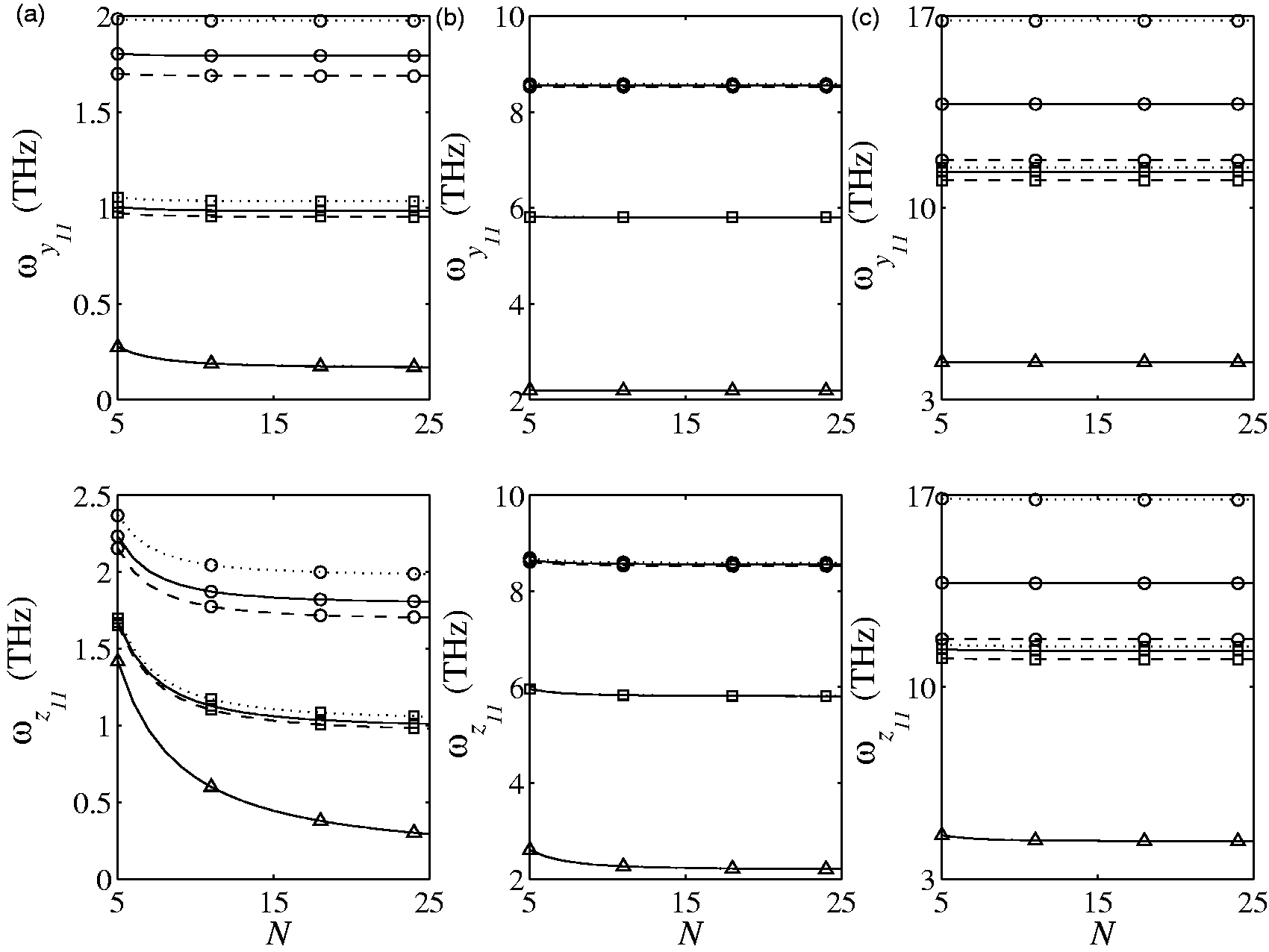
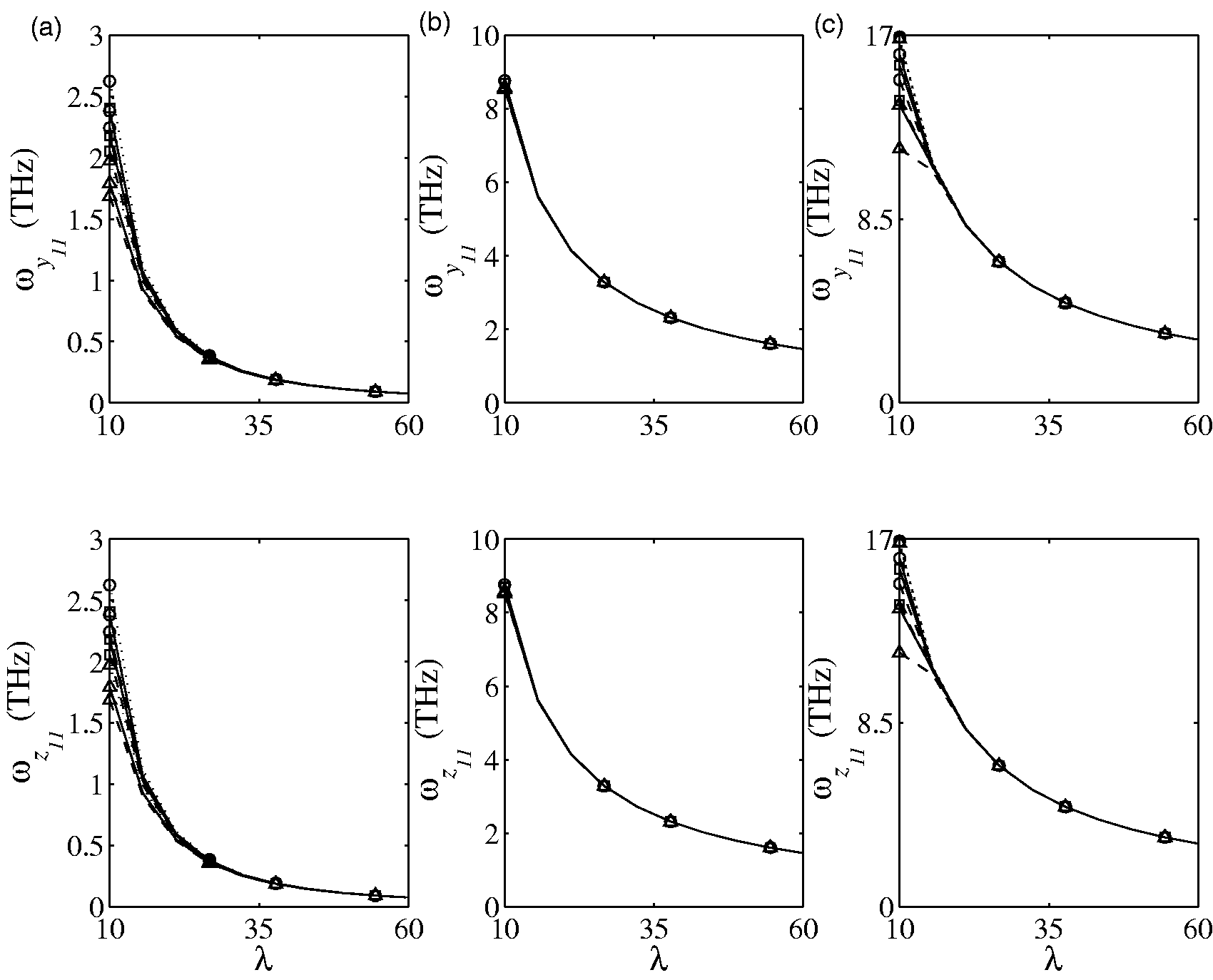
An instructive study has been conducted to determine the role of the number of SWCNTs within an ensemble in its in-plane and out-of-plane vibration behaviors. For this purpose, the plots of in-plane and out-of-plane fundamental frequencies as a function of MAESWCNTs’ population are demonstrated in Figure 3. Such plots are provided for three levels of the SLMF (i.e. =0, 100, and 200) as well as three levels of the slenderness ratio (i.e. λ = 10, 15, and 40) in the case of d = 2.34 nm and e0a = 2 nm. For such an ensemble, irrespective of the values of slenderness ratio and SLMF, both in-plane and out-of-plane frequencies reduce with the number of SWCNTs within the ensemble. Such a reduction is more apparent for in-plane vibration in the absence of the LMF (see Figure 3(a)). As the influence of the SLMF becomes highlighted, the out-of-plane frequency of the ensemble is affected by its population with a lower rate. In the absence of the LMF, close scrutiny of the plotted results reveals that the discrepancies between the frequencies predicted by the proposed models will increase as the number of SWCNTs increases (see Figure 3(a)). This fact is more apparent for in-plane fundamental frequencies. However, in the presence of the LMF, such discrepancies would reduce with the population of the ensemble (see Figure 3(b) and (c)). It should be noted that such discrepancies commonly increase with the SLMF and will reduce as the slenderness ratio increases. In most of the cases, the frequencies predicted by the NHOBT are overestimated (underestimated) by the NRBT (NTBT). In the cases =0, 100, and 200, the NRBT respectively overestimates the out-of-plane frequency of the NHOBT with relative error lower than 10.5%, 0.4%, and 22% for λ = 10. Furthermore, in such a case, the NTBT underestimates the out-of-plane frequencies predicted by the NHOBT with relative error lower than 6%, 0.35%, and 15% for the above-mentioned levels of the SLMF, irrespective of the ensemble’s population.
Comparison of the predicted flexural frequencies of a double-SWCNT-system by the proposed models with those of another work: (…) NRBT; (– –) NTBT; (—) NHOBT; (–ċ–) the proposed model by Murmu et al. (2012b).
6.2.3. Effect of the SLMF on the in-plane and out-of-plane frequencies
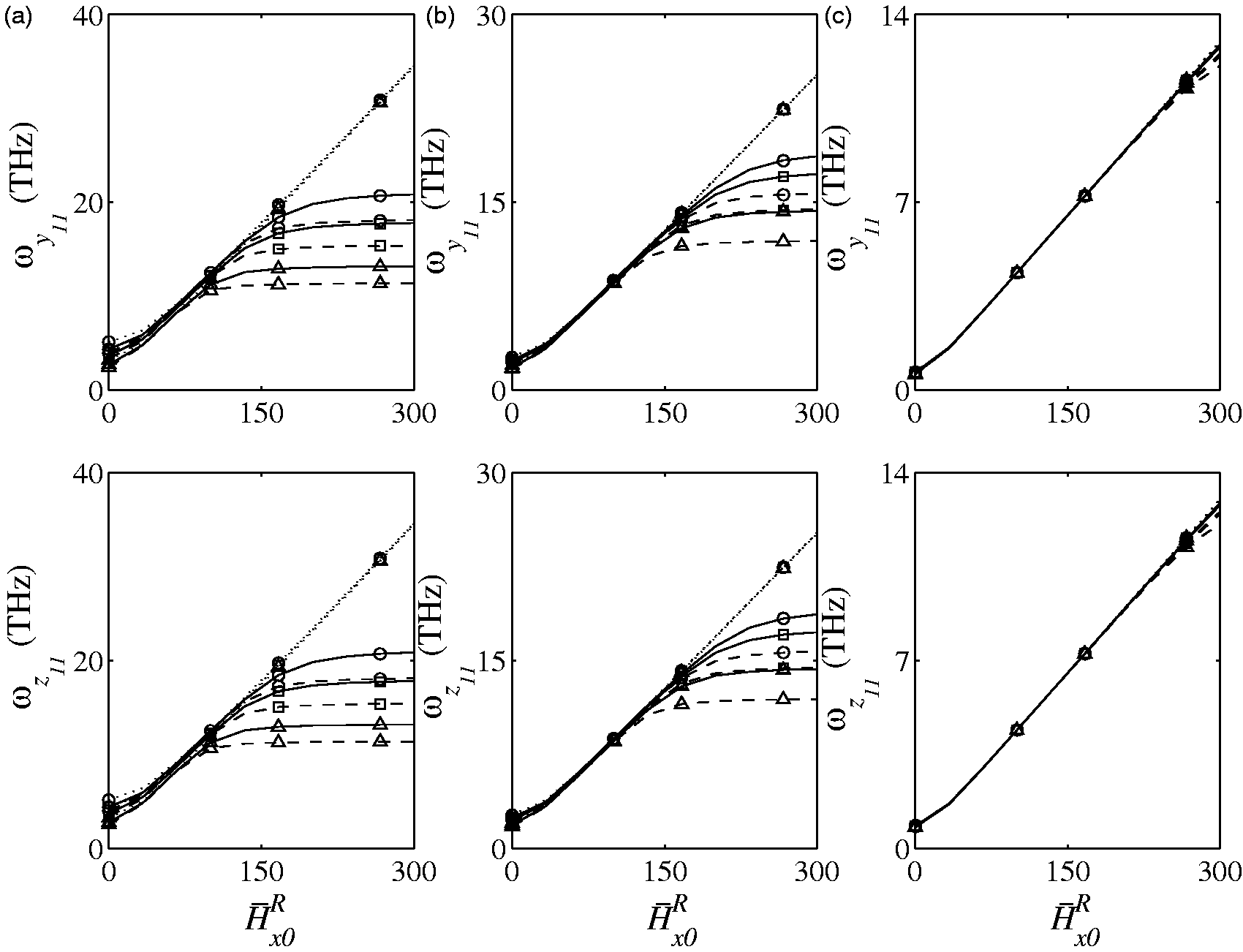
The role of the SLMF in the free vibration behavior of 2D ensembles of SWCNTs is of high concern. In Figure 4(a) to (c), the plots of fundamental in-plane and out-of-plane frequencies as a function of Hx0R are provided for three levels of the slenderness ratio (i.e. λ = 7, 10, and 20) as well as small-scale parameter (i.e. e0a = 0, 1, and 2 nm). The considered ensemble of SWCNTs is a very low-populated one (i.e. N = 12) whose intertube distances are equal to 2.4 nm. A brief survey of the demonstrated results in Figure 4(a) to (c) indicates that the overall in-plane and out-of-plane vibration behaviors of the ensemble are similar. It is mainly related to the fairly weak vdW interaction forces between two adjacent vibrating tubes for the considered intertube distance. According to the demonstrated results, for all levels of the slenderness ratio of the MAESWCNTs, the fundamental frequency predicted by the NRBT will approximately vary linearly as a function of the SLMF. In contrast to the results of the NRBT, the frequencies predicted by both NTBT and NHOBT vary fairly linearly up to a particular level of the SLMF; thereafter, the variation of the SLMF has a trivial influence on the variation of the frequencies which are predicted by these NSDBTs. For higher levels of the SLMF, variation of the small-scale parameter has a slight influence on the variation of the predicted frequency by the NRBT. However, the influence of the small-scale parameter on the frequencies predicted by the NSDBTs becomes highlighted for high levels of the SLMF. This fact is also more obvious for stocky MAESWCNTs (see Figure 4(a)). The demonstrated results display that the frequencies predicted by both NTBT and NHOBT are overestimated by the NRBT in most of the cases. A more detailed survey of the obtained results reveals that the discrepancies between the results of the NRBT or NTBT and those of the NHOBT will reduce up to Hx0R=100; subsequently, such discrepancies will magnify as the SLMF increases. In most of the cases, the plots of the NTBT are close to those of the NHOBT. Irrespective of the level of the SLMF, the discrepancies between the results of the NRBT or NTBT and those of the NHOBT will increase as the influence of the small-scale parameter becomes highlighted.
Effect of the number of SWCNTs within the MAESWCNTs on the in-plane and out-of-plane fundamental frequencies: (a) = 0, (b) = 100, (c) = 200; (…) NRBT, (– –) NTBT, (—) NHOBT; (○) λ=10, (□) λ = 15, (△) λ = 40; d = 2.34 nm; e0a = 2 nm.
6.2.4. Effect of the intertube distance on the in-plane and out-of-plane frequencies
In another interesting and crucial study, the role of the intertube distance on the free dynamic behavior of MAESWCNTs is examined. The plots of both in-plane and out-of-plane fundamental frequencies of the MAESWCNTs in terms of intertube distance are given in Figure 5(a) to (c) for three levels of the SLMF (i.e. = 0, 100, and 300) as well as three values of the small-scale parameter (i.e. e0a=0, 1, and 2 nm). The MAESWCNT under study is a fairly slender ensemble (i.e. λ = 15) consisting of 20 vertically aligned SWCNTs. A detailed study of the plotted results in Figure 5(a) to (c) shows that the in-plane fundamental frequencies slightly decrease with the intertube distance. Irrespective of the small-scale parameter considered and for ≤ 100, the out-of-plane fundamental frequencies lessen as the intertube distance increases up to d = 2.366 nm. For d > 2.366 nm, these frequencies magnify with the intertube distance such that their rates of change reduce for high levels of the intertube distance. The main reason for such behavior can be searched for in the variation of the coefficients of the vdW forces in terms of the intertube distance. More investigations display that the coefficient of the in-plane vdW force will drastically decrease with the intertube distance up to d = 2.366 nm. Thereafter, this coefficient magnifies as the intertube distance increases. Further, the coefficient of the out-of-plane vdW force reduces with the intertube distance up to d = 2.353 nm; for d > 2.353 nm, such a coefficient will magnify with the intertube distance. Such studies also reveal that the rate of change of the coefficient of the out-of-plane vdW force as a function of the intertube distance is more noticeable than that of the coefficient of the in-plane vdW force; however, the coefficient of the in-plane vdW force is about 40 times greater than that of the out-of-plane vdW force. As a result, we see in Figure 5(a) to (c) that the variation of the intertube distance is more influential in the variation of the in-plane fundamental frequency. By application of the LMF, the fundamental frequency of the nanostructure magnifies for all considered levels of the intertube distance. Further, at high levels of the SLMF, the influence of the intertube distance on both in-plane and out-of-plane frequencies lessens (see Figure 5(c)). Concerning the capabilities of the proposed models in predicting the free vibration behaviors of the MAESWCNTs, in the absence of the LMF, the discrepancies between the in-plane frequencies of the NRBT or NTBT and those of the NHOBT will generally increase with the intertube distance (see Figure 5(a)). In such a case, the NRBT can capture the in-plane and out-of-plane frequencies of the NHOBT with relative error lower than 5%. Further, the NTBT underestimates the results of the NHOBT with relative error lower than 3.5%. In both cases of = 100 and 300, the discrepancies between the results predicted by the NRBT or NTBT and those of the NHOBT will decrease as the intertube distance increases. However, by increasing the small-scale parameter, such discrepancies will magnify. It is mainly related to the incorporation of the small-scale parameter into the shear strain energy of the nanostructure.
Effect of the SLMF on the in-plane and out-of-plane fundamental frequencies: (a) λ = 7, (b) λ = 10, (c) λ = 20; (…) NRBT, (– –) NTBT, (—) NHOBT; (○) e0a = 0, (□) e0a = 1, (△) e0a = 2 nm; d = 2.34 nm; N = 12.
6.2.5. Effect of the radius of SWCNTs on the in-plane and out-of-plane frequencies
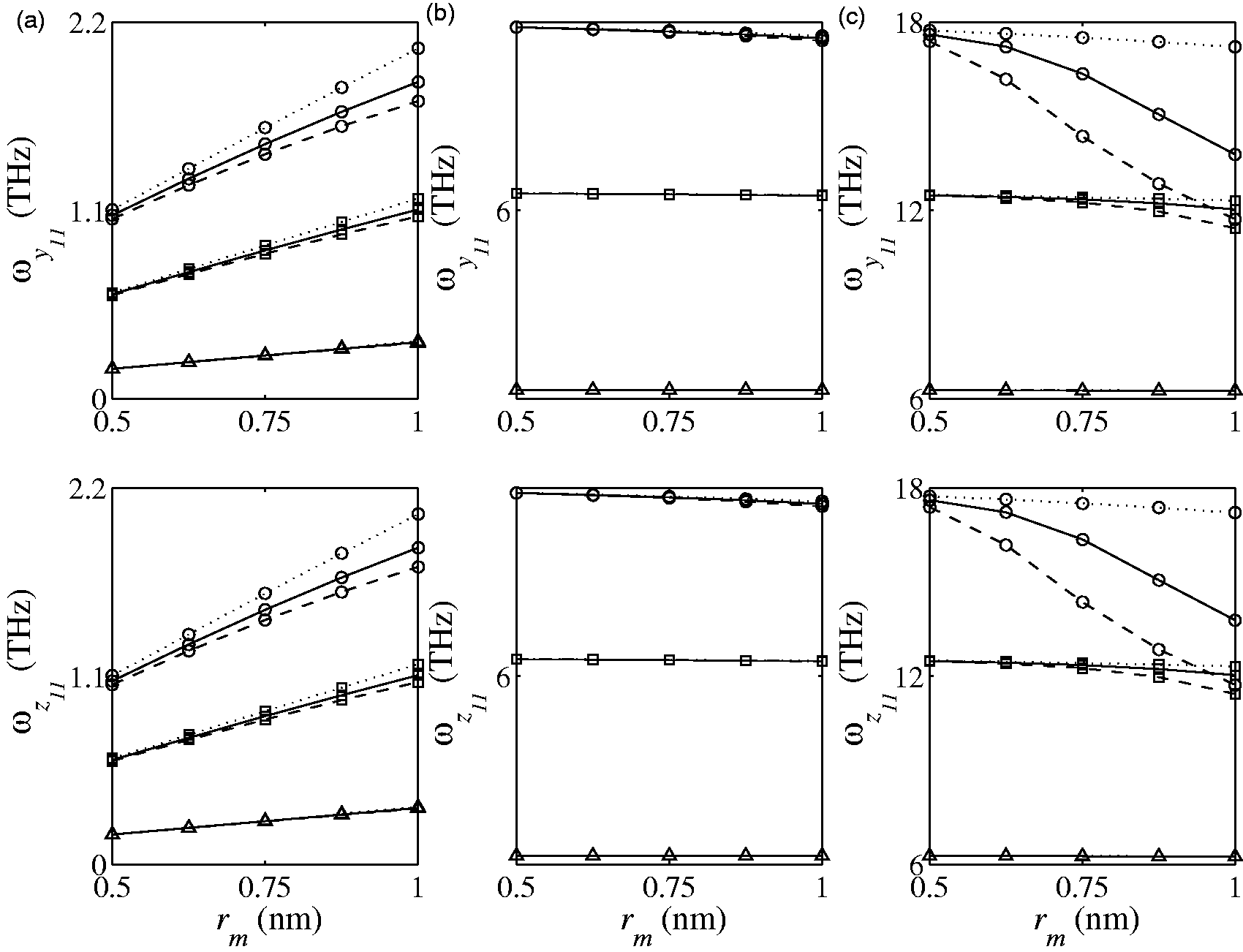
The plots of the in-plane and out-of-plane frequencies as a function of the radius of SWCNTs are demonstrated in Figure 6(a) to (c) for three levels of the SLMF (i.e. = 0, 100, and 200) as well as three levels of the length of the SWCNTs (i.e. lb = 7, 10, and 20 nm). The plotted results are associated with a highly populated MAESWCNT with d = 2rm + 0.34 nm and e0a = 2 nm. In the absence of the LMF (see Figure 6(a)), the flexural frequencies predicted by all nonlocal continuous models will increase with the radius of the SWCNTs. It is mainly related to this fact that the vdW forces between tubes will increase as the radius of the SWCNTs increases. Thereby, the internal flexural stiffness of the nanostructure increases which leads to an increase of the fundamental flexural frequency. According to Figure 6(a), the influence of the radius of the SWCNTs on fundamental frequencies is more obvious for stockier MAESWCNTs. By increasing the SLMF on slender MAESWCNTs (i.e. lb = 20 nm), the dependency of the fundamental frequencies on the radius of the SWCNTs reduces. However, for a stocky MAESWCNT (i.e. lb = 7 nm) subjected to a high SLMF, all proposed continuous models predict that the fundamental frequencies will decrease with the radius of the SWCNTs. Concerning the capabilities of the proposed nonlocal models in predicting the flexural frequencies, the discrepancies between the results obtained by the proposed models will increase as the radius of the SWCNTs increases. Such a fact is mainly related to the growing of the shear strain energy of the nanostructure due to an increase of the radius of the SWCNTs. Furthermore, the discrepancies between the results of the NRBT and those of the NHOBT are more obvious with respect to other cases. For example, in the absence of the LMF, the NTBT (NRBT) could capture the results of the NHOBT for lb = 7, 10, and 20 nm with relative error lower than 6% (11%), 4% (6%), and 1% (2%), respectively. In the case of = 100 and lb = 7 nm, both NRBT and NTBT can reproduce the results of the NHOBT with relative error lower than 0.45%. Finally, in the case of = 200, the discrepancies between the results of the NTBT (NRBT) and those of the NHOBT for lb = 7 and 10, in order, would be about 15% (25%) and 5% (2.5%).
Effect of the intertube distance on the in-plane and out-of-plane fundamental frequencies: (a) = 0, (b) = 100, (c) = 300; (…) NRBT, (– –) NTBT, (—) NHOBT; (○) e0a = 0, (□) e0a = 1, (△) e0a = 2 nm; λ = 15; N = 20.
6.2.6. Effect of the slenderness ratio on the in-plane and out-of-plane frequencies
The role of the slenderness ratio in the in-plane and out-of-plane fundamental frequencies of the MAESWCNTs is of concern. The graphs of such frequencies as a function of slenderness ratio are provided in Figure 7(a) to (c) for three levels of the SLMF (i.e. = 0, 100, and 200) and three values of the small-scale parameter (i.e. e0a = 0, 1, and 2 nm). The results have been obtained for a highly populated MAESWCNT with d = 2.34 nm (i.e. N = 10,000). As is seen in Figure 7(a) to (c), both in-plane and out-of-plane frequencies lessen as the slenderness ratio of the nanostructure increases. The influence of the SLMF on the fundamental frequencies of stockier MAESWCNTs is more obvious. Further, for higher levels of the SLMF, the variation of the fundamental frequencies in terms of slenderness ratio will be followed by a higher rate. The discrepancies between the results of the proposed nonlocal models for lower levels of the slenderness ratio and higher levels of the small-scale parameter are more apparent. Close scrutiny of the obtained results indicates that such discrepancies reduce as the slenderness ratio magnifies. However, no regular trend for such discrepancies as a function of the SLMF is observed. In the case of Hx = 0 and λ = 10, the NTBT (NRBT) can capture the fundamental frequency of the NHOBT with relative error lower than 6% (10.5%) for all considered values of the small-scale parameter. At λ = 60, the discrepancy between the frequency predicted by the NTBT (NRBT) and that of the NHOBT would be about 0.25% (0.35%). In the case of = 100, both NRBT and NTBT can reproduce the results of the NHOBT with relative error lower than 0.4% for the considered ranges of both small-scale parameter and slenderness ratio. Regarding the case = 200 and e0a = 2 nm, the NRBT and NTBT can capture the frequency predicted by the NHOBT with relative error of about 15% and 22%, respectively. Close scrutiny of the plotted results also reveals that such discrepancies would reduce the value of the small-scale parameter lessens. Basically this fact is related to the incorporation of the small-scale parameter into the nonlocal Lorentz forces exerted on the SWCNTs.
Effect of the radius of the constitutive SWCNTs of the ensemble on the in-plane and out-of-plane fundamental frequencies: (a) = 0, (b) = 100, (c) = 200; (…) NRBT, (– –) NTBT, (—) NHOBT; (○) l b = 7, (□) lb = 10, (△) lb = 20 nm; d = 2rm + 0.34 nm; e0a = 2 nm; N = 10,000.
6.2.7. Effect of the small-scale parameter on the in-plane and out-of-plane frequencies
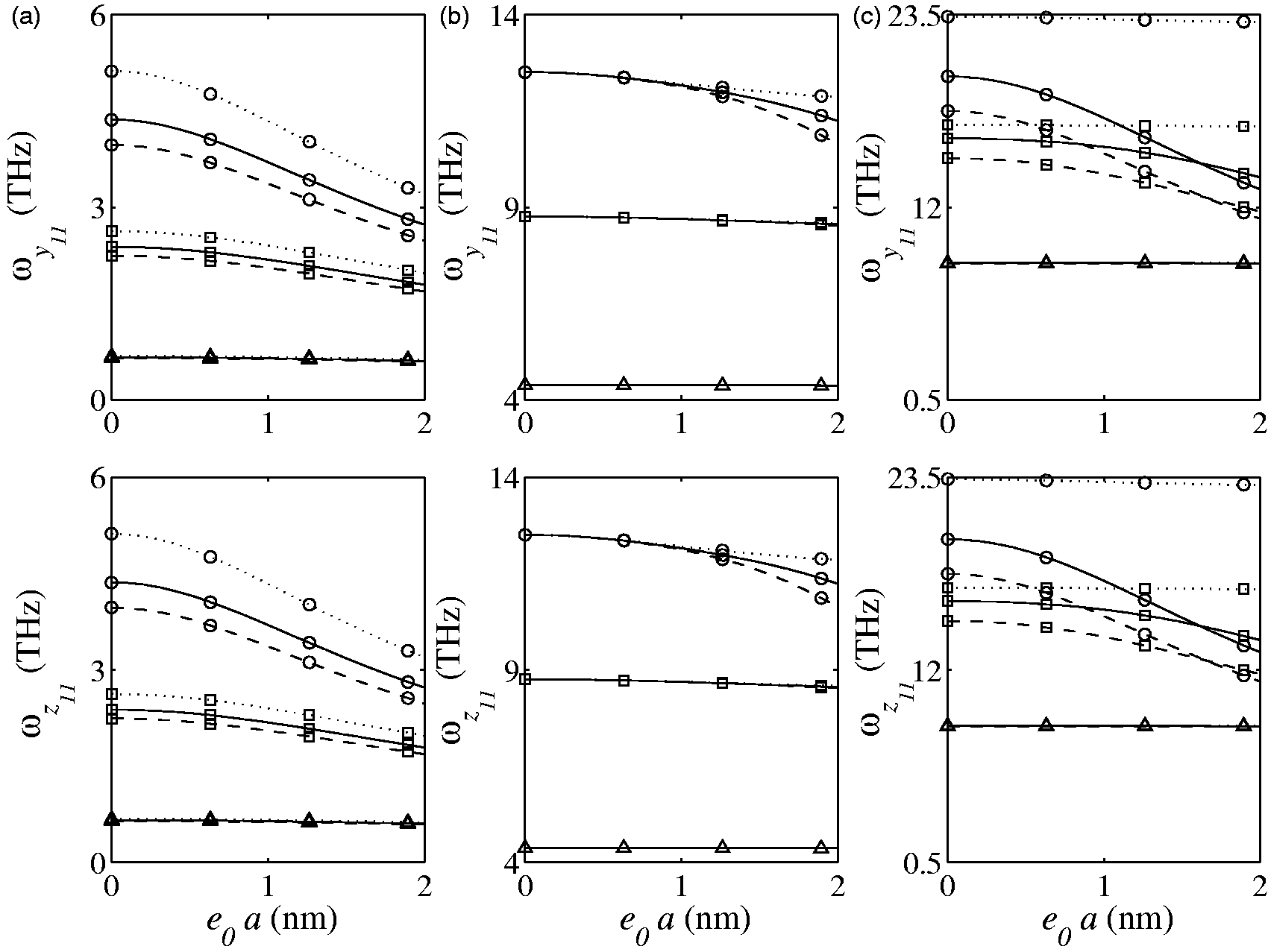
The plots of the in-plane and out-of-plane fundamental frequencies in terms of the small-scale parameter are provided in Figure 8(a) to (c) for three levels of the SLMF (i.e. = 0, 100, and 200) and the slenderness ratio (i.e. λ = 7, 10, and 20). Such results are pertinent to a highly populated MAESWCNT with d = 2.34 nm. Generally, the fundamental frequencies decrease as the small-scale parameter increases. For higher levels of the SLMF, such a frequency reduction as a function of the small-scale parameter is followed by a higher rate. As was explained earlier, it is mainly related to the incorporation of the small-scale parameter into the exerted forces on the SWCNTs due to the application of the LMF. This fact is also more obvious for stockier MAESWCNTs. In these nanostructures, the effect of the shear deformation on their vibrations becomes more important. On the other hand, the small-scale parameter is incorporated into the shear strain energy of the nanostructure in which modeled based on the NSDBTs. As a result, the influence of the small-scale parameter on the deformation of the stockier nanostructures becomes more highlighted. In the absence of the LMF, a careful examination of the obtained results displays that the NTBT (NRBT) can capture the results of the NHOBT in the cases of λ = 7, 10, and 20 with relative error lower than 9% (17.5%), 6% (10.5%), and 2% (3%), respectively. In the case of = 100, both NRBT and NTBT can regenerate the results of the NHOBT with relative error lower than 5.5% for all considered levels of the slenderness ratio. Concerning the case of = 200, the discrepancies between the frequencies predicted by the proposed models would increase with the small-scale parameter, particularly for stockier MAESWCNTs. For instance, in the cases of e0a = 0, 1, and 2 nm and λ = 7, the discrepancies between the frequencies of the NTBT (NRBT) and those of the NHOBT, in order, are about 10.5% (18%), 12% (34%) and 15% (76.5%).
Effect of the slenderness ratio of the SWCNTs on the in-plane and out-of-plane fundamental frequencies: (a) = 0, (b) = 100, (c) = 200; (…) NRBT, (– –) NTBT, (—) NHOBT; (○) e0a = 0, (□) e0a = 1, (△) e0a = 2 nm; d = 2.34 nm; N = 10,000.
Effect of the small-scale parameter on the in-plane and out-of-plane fundamental frequencies: (a) = 0, (b) = 100, (c) = 200; (…) NRBT, (– –) NTBT, (—) NHOBT; (○) λ = 7, (□) λ = 10, (△) λ = 20; d = 2.34 nm; N = 10,000.
7. Concluding remarks
Free in-plane and out-of-plane vibrations of MAESWCNTs in the context of the nonlocal continuum theory of Eringen are studied. By employing Hamilton’s principle, the nonlocal discrete and continuous governing equations of the nanostructure are obtained using the NRBT, NTBT, and NHOBT. The crucial results obtained are summarized as follows:
Irrespective of the slenderness ratio and the SLMF, both in-plane and out-of-plane frequencies will lessen as the number of SWCNTs within the ensemble increases. This issue is more obvious for the out-of-plane fundamental frequency. Generally, the discrepancies between the results of the proposed nonlocal models reduce with the number of SWCNTs.
The fundamental flexural frequencies of the MAESWCNTs magnify as the SLMF increases. The NSDBTs predict that the frequencies are linearly proportional to the SLMF up to a certain level. For SLMF greater than this level, such frequencies are slightly affected by the SLMF.
For higher levels of the SLMF and stockier MAESWCNTs, the effect of the small-scale parameter on the fundamental frequencies of the nanostructure is more apparent. It is mainly attributed to the incorporation of the small-scale parameter into the both shear strain energy and nonlocal Lorentz forces exerted on the ensemble.
The alteration of the intertube distance has a trivial effect on the out-of-plane fundamental frequency. The in-plane frequency generally decreases with the intertube distance up to a certain level. For intertube distance greater than such a level, the in-plane frequency slowly grows as the intertube distance increases. As the SLMF increases, the influence of the intertube distance on both in-plane and out-of-plane frequencies will reduce.
In the absence of the LMF, all proposed models predict that both in-plane and out-of-plane frequencies will increase with the radius of the SWCNT since the interaction vdW forces between SWCNTs intensify as the radius of the SWCNT increases. For high levels of the SLMF, both NTBT and NHOBT predict that the flexural frequencies of the MAESWCNTs will lessen as the radius of the SWCNT increases. The influence of the radius of the SWCNT on the flexural frequencies of stockier ensembles is more apparent.
Both in-plane and out-of-plane frequencies decrease as the slenderness ratio of the ensemble increases. For higher levels of the SLMF, variation of the slenderness ratio on the flexural frequencies becomes more highlighted. The discrepancies between the proposed nonlocal models are more apparent for lower slenderness ratio and higher small-scale parameter. However, variation of such discrepancies as a function of the SLMF does not obey a systematic rule.
Footnotes
Funding
The financial support of the Iran National Science Foundation (INSF) as well as Iran Nanotechnology Initiative Council for the undertaken work is gratefully acknowledged.
References
1.
AjayanPM (1999) Nanotubes from carbon. Chemical Reviews99: 1787–1800.
2.
AnsariRRouhiHSahmaniS (2011) Calibration of the analytical nonlocal shell model for vibrations of double-walled carbon nanotubes with arbitrary boundary conditions using molecular dynamics. International Journal of Mechanical Sciences53: 786–792.
ChiuHYHungPPostmaHWC (2008) Atomic-scale mass sensing using carbon nanotube resonators. Nano Letters8: 4342–4346.
7.
ChoiESBrooksJSEatonDL (2003) Enhancement of thermal and electrical properties of carbon nanotube polymer composites by magnetic field processing. Journal of Applied Physics94: 6034–6039.
8.
ChowdhuryRAdhikariSMitchellJ (2009) Vibrating carbon nanotube based bio-sensors. Physica E: Low-dimensional Systems and Nanostructures42: 104–109.
9.
ColemanJNKhanUGun’koYK (2006) Mechanical reinforcement of polymers using carbon nanotubes. Advanced Materials18: 689–706.
10.
DaiH (2002) Carbon nanotubes: Opportunities and challenges. Surface Science500: 218–241.
11.
DresselhausMSDresselhausGEklundPC (1996) Science of Fullerenes and Carbon Nanotubes: Their Properties and Applications, New York, NY: Academic Press.
12.
DuanWHWangCMZhangYY (2007) Calibration of nonlocal scaling effect parameter for free vibration of carbon nanotubes by molecular dynamics. Journal of Applied Physics101: 024305.
EringenAC (1966) Linear theory of micropolar elasticity. Journal of Mathematics and Mechanics15: 909–923.
15.
EringenAC (1972) Nonlocal polar elastic continua. International Journal of Engineering Science10: 1–16.
16.
EringenAC (2002) Nonlocal Continuum Field Theories, New York, NY: Springer-Verlag.
17.
FujiwaraMOkiEHamadaM (2001) Magnetic orientation and magnetic properties of a single carbon nanotube. The Journal of Physical Chemistry A105: 4383–4386.
18.
GarmestaniHAl-HaikMSDahmenK (2003) Polymer-mediated alignment of carbon nanotubes under high magnetic fields. Advanced Materials15: 1918–1921.
19.
GirifalcoLAHodakMLeeRS (2000) Carbon nanotubes, buckyballs, ropes, and a universal graphitic potential. Physical Review B62: 13104.
20.
GuptaSSBatraRC (2008) Continuum structures equivalent in normal mode vibrations to single-walled carbon nanotubes. Computational Materials Science43: 715–723.
21.
HongHWrightBWenselJ (2007) Enhanced thermal conductivity by the magnetic field in heat transfer nanofluids containing carbon nanotube. Synthetic Metals157: 437–440.
22.
HuangLYHanQLiangYJ (2012) Calibration of nonlocal scale effect parameter for bending single-layered graphene sheet under molecular dynamics. Nano7: 1250033.
23.
IijimaS (1991) Helical microtubules of graphitic carbon. Nature354: 56–58.
24.
JoshiAYHarshaSPSharmaSC (2010) Vibration signature analysis of single walled carbon nanotube based nanomechanical sensors. Physica E: Low-dimensional Systems and Nanostructures42: 2115–2123.
25.
LeeSHMaCCMYuenSM (2011) Magnetic field enhances the graphitized structure and field emission effect of carbon nanotubes. Thin Solid Films519: 4166–4173.
26.
KeLLXiangYYangJ (2009) Nonlinear free vibration of embedded double-walled carbon nanotubes based on nonlocal Timoshenko beam theory. Computational Materials Science47: 409–417.
27.
KianiK (2013) Longitudinal, transverse, and torsional vibrations and stabilities of axially moving single-walled carbon nanotubes. Current Applied Physics13: 1651–1660.
28.
KianiK (2014a) Elastic wave propagation in magnetically affected double-walled carbon nanotubes. Meccanica. DOI: 10.1007/s11012-014-9957-2 [Epub ahead of print 2 July 2014].
29.
KianiK (2014b) Vibration and instability of a single-walled carbon nanotube in a three-dimensional magnetic field. Journal of Physics and Chemistry of Solids75: 15–22.
30.
KianiK (2014c) Longitudinally varying magnetic field influenced transverse vibration of embedded double-walled carbon nanotubes. International Journal of Mechanical Sciences87: 179–199.
31.
KianiK (2014d) Nonlinear vibrations of a single-walled carbon nanotube for delivering of nanoparticles. Nonlinear Dynamics76(4): 1885–1903.
32.
KianiK (2014e) Nanoparticle delivery via stocky single-walled carbon nanotubes: A nonlinear-nonlocal continuum-based scrutiny. Composite Structures116: 254–272.
33.
KianiK (2014f) Magnetically affected single-walled carbon nanotubes as nanosensors. Mechanical Research Communications60: 33–39.
34.
KianiK (2014g) Nonlocal discrete and continuous modeling of free vibration of stocky ensembles of single-walled carbon nanotubes. Current Applied Physics14: 1116–1139.
35.
KianiK (2014h) Nonlocal continuous models for forced vibration analysis of two- and three-dimensional ensembles of single-walled carbon nanotubes. Physica E: Low-dimensional Systems and Nanostructures60: 229–245.
36.
KianiK (2014i) Axial buckling analysis of vertically aligned ensembles of single-walled carbon nanotubes using nonlocal discrete and continuous models. Acta Mechanica225: 3569–3589.
37.
KianiK (2014j) In- and out-of-plane dynamic flexural behaviors of two-dimensional ensembles of vertically aligned single-walled carbon nanotubes. Physica B: Condensed Matter449: 164–180.
38.
KimuraTAgoHTobitaM (2002) Polymer composites of carbon nanotubes aligned by a magnetic field. Advanced Materials14: 1380–1383.
39.
Kosuri A (2005) Alignment of carbon nanotubes in composites. PhD Thesis, Florida State University, FL.
40.
LeeHLChangWJ (2008) Free transverse vibration of the fluid-conveying single-walled carbon nanotube using nonlocal elastic theory. Journal of Applied Physics103: 024302.
41.
MaxwellJC (1861a) On Faraday’s lines of force, part I: The theory of molecular vortices applied to magnetic phenomena. Philosophical Magazine21: 161–175.
42.
MaxwellJC (1861b) On Faraday’s lines of force, part II: The theory of molecular vortices applied to electric currents. Philosophical Magazine21: 338–348.
43.
MaxwellJC (1862a) On Faraday’s lines of force, part III: The theory of molecular vortices applied to statical electricity. Philosophical Magazine23: 12–24.
44.
MaxwellJC (1862b) On Faraday’s lines of force, part IV: The theory of molecular vortices applied to the action of magnetism and polarized light. Philosophical Magazine23: 85–95.
45.
MurmuTMcCarthyMAAdhikariS (2012a) Vibration response of double-walled carbon nanotubes subjected to an externally applied longitudinal magnetic field: A nonlocal elasticity approach. Journal of Sound and Vibration331: 5069–5086.
46.
MurmuTMcCarthyMAAdhikariS (2012b) Nonlocal elasticity based magnetic field affected vibration response of double single-walled carbon nanotube systems. Journal of Applied Physics111: 113511.
47.
NarendarSGuptaSSGopalakrishnanS (2012) Wave propagation in single-walled carbon nanotube under longitudinal magnetic field using nonlocal Euler–Bernoulli beam theory. Applied Mathematical Modelling36: 4529–4538.
48.
NarendarSMahapatraDRGopalakrishnanS (2011) Prediction of nonlocal scaling parameter for armchair and zigzag single-walled carbon nanotubes based on molecular structural mechanics, nonlocal elasticity and wave propagation. International Journal of Engineering Science49: 509–522.
49.
ParadiseMGoswamiT (2007) Carbon nanotubes: Production and industrial applications. Materials and Design28: 1477–1489.
50.
PeddiesonJBuchananGRMcNittRP (2003) Application of nonlocal continuum models to nanotechnology. International Journal of Engineering Science41: 305–312.
51.
PopovVN (2004) Carbon nanotubes: Properties and application. Materials Science and Engineering: R: Reports43: 61–102.
ReddyJN (1984) A simple higher-order theory for laminated composite plates. Journal of Applied Mechanics51: 745–752.
54.
ReddyJN (2007) Nonlocal theories for bending, buckling and vibration of beams. International Journal of Engineering Science45: 288–307.
55.
SimsekM (2010) Vibration analysis of a single-walled carbon nanotube under action of a moving harmonic load based on nonlocal elasticity theory. Physica E: Low-Dimensional Systems and Nanostructures43: 182–191.
56.
SimsekM (2011) Nonlocal effects in the forced vibration of an elastically connected double-carbon nanotube system under a moving nanoparticle. Computational Materials Science50: 2112–2123.
57.
ShenHSZhangCL (2010) Torsional buckling and postbuckling of double-walled carbon nanotubes by nonlocal shear deformable shell model. Composite Structures92: 1073–1084.
58.
SudakLJ (2003) Column buckling of multiwalled carbon nanotubes using nonlocal continuum mechanics. Journal of Applied Physics94: 7281–7287.
59.
ThostensonETRenZChouTW (2001) Advances in the science and technology of carbon nanotubes and their composites: A review. Composites Science and Technology61: 1899–1912.
60.
WaltersDACasavantMJQinXC (2001) In-plane-aligned membranes of carbon nanotubes. Chemical Physics Letters338: 14–20.
61.
WangCMZhangYYHeXQ (2007) Vibration of nonlocal Timoshenko beams. Nanotechnology18: 105401.
62.
WangCMZhangYY (2006) Buckling analysis of micro- and nano-rods/tubes based on nonlocal Timoshenko beam theory. Journal of Physics D: Applied Physics39: 3904.
63.
WangHDongKMenF (2010) Influences of longitudinal magnetic field on wave propagation in carbon nanotubes embedded in elastic matrix. Applied Mathematical Modelling34: 878–889.
64.
WangL (2009) Dynamical behaviors of double-walled carbon nanotubes conveying fluid accounting for the role of small length scale. Computational Materials Science45: 584–588.
WangLNiQ (2008) On vibration and instability of carbon nanotubes conveying fluid. Computational Materials Science43: 399–402.
67.
WangQ (2005) Wave propagation in carbon nanotubes via nonlocal continuum mechanics. Journal of Applied Physics98: 124301.
68.
WangQVaradanVK (2006) Vibration of carbon nanotubes studied using nonlocal continuum mechanics. Smart Materials and Structures15: 659.
69.
WangQWangCM (2007) The constitutive relation and small scale parameter of nonlocal continuum mechanics for modelling carbon nanotubes. Nanotechnology18: 075702.
70.
WangXShenJXLiuY (2012) Rigorous van der Waals effect on vibration characteristics of multi-walled carbon nanotubes under a transverse magnetic field. Applied Mathematical Modelling36: 648–656.
71.
YooHJLeeSYYouNH (2013) Dispersion and magnetic field-induced alignment of functionalized carbon nanotubes in liquid crystals. Synthetic Metals181: 10–17.
72.
ZhangYQLiuGRXieXY (2005) Free transverse vibrations of double-walled carbon nanotubes using a theory of nonlocal elasticity. Physical Review B71: 195404.
73.
ZhangYYWangCMTanVBC (2009) Assessment of Timoshenko beam models for vibrational behavior of single-walled carbon nanotubes using molecular dynamics. The Advances in Applied Mathematics and Mechanics1: 89–106.