






Abstract
This paper presents a new method which can identify the structure parameters (such as the bearing parameters, the nonlinear rub-impact parameters, and so on) of a nonlinear rotor-bearing system. Based on an improved kriging surrogate model and evolutionary algorithm (IKSMEA), the new method can provide more accurate results with less computation time. The initial kriging surrogate model (KSM) is constructed by the samples of varying structure parameters and their response values. According to the identified process, a multi-point addition criterion is proposed and more appropriate predicted points are added to update the KSM. Numerical studies and experimental validation of a nonlinear rotor-bearing system are performed. Comparing to the previous method (KSM and evolutionary algorithm), the new method satisfies the condition of convergence with less updating steps and increased robustness to noise. The identified results indicate that the IKSMEA can identify the nonlinear rotor system more effectively and accurately.
Keywords
1. Introduction
It is common that a rotor system always exhibits nonlinear behavior due to asymmetric structures, hydrodynamic effects, and other dynamic factors. In recent years, the nonlinear dynamic analysis of a rotor-bearing system has attracted extensive attention in malfunction diagnosis, parameter identification, and the dynamic characteristics optimization. Some articles have been published about the variety of analysis on the dynamics of nonlinear rotor systems (Zheng and Hasebe, 2000; Wang and Khonsari, 2006; Zhang et al., 2008; Ghorashi and Nitzsche, 2009; Xia et al., 2009).
As one of the nonlinear effects, rub-impact is a serious malfunction that often occurs between the rotor and stator in rotating machinery. Recently, researchers have expressed great concern about this nonlinear problem in the rotor system (Shen et al., 2007; Liska et al., 2011; Ma et al., 2014). Cao et al. (2011) studied the nonlinear dynamic characteristics of a rub-impact rotor system with fractional order damping. The results of their analysis showed that the fractional order rub-impact rotor system exhibited strong dynamic behaviors. Chu and Zhang (1998) investigated the nonlinear vibration characteristics of a rub-impact Jeffcott rotor. The results are highly significant in the fault diagnosis of the rub-impact problem. Patel and Darpe (2009) investigated the rotor-stator interaction effects on the response of a rotor in the presence/absence of a transverse crack.
In recent years, nonlinear system identification has attracted much attention. There has been a large number of studies in this field (Yang et al., 2005; Szolc et al., 2009; Lee et al., 2010), some of which are on the determination of rubbing parameters and structure parameters. Chu and Lu (2001) presented a dynamic stiffness-based method to detect the rubbing position in a multi-disk rotor system. They proposed a new method to determine the rubbing location according to the dynamic stiffness increase as the rubbing developed. However, this method cannot detect all the simulation of the rubbing location except the position where the response can be measured. Wang and Chu (2001) presented a method based on acoustic emission signals and the wavelet transform to determine the rubbing location, but the acoustic emission signals were obtained by a special device which is inconvenient in actual conditions.
With the development of the parameter identification problem, researchers have proposed a variety of optimization techniques. In recent years, optimization techniques have also been used in rotor systems. As an alternative technique, one of the most traditional optimization algorithms is least squares method (Chen and Lee, 1995). Chen and Lee (1997) formulated a minimization problem between measured unbalance response and the estimated response and then the least squares method was used as an optimizer. However, from other studies (Edwards et al., 2000; Kim et al., 2007), the noise (such as rotor bow, misalignment) existing in the test data results in the local minima problem and the nonlinear affects (such as nonlinear rub-impact, oil-film force of the journal bearing) results in a nonlinear relationship between the dynamic parameters, which means the least square optimizer cannot guarantee global minimum and the identified results may not be the best ones in the rotor system. Recently, intelligent algorithms have been getting a lot of attention, such as the colony algorithm (Chen et al., 2008), simulated annealing algorithm (Ethni et al., 2009), genetic algorithm (Choi and Yang, 2000; Mat et al., 2004), and so on. A method based on the genetic algorithm to detect the rubbing location was presented by Lu et al. (2005). Other improved intelligent algorithms have also been reported in this area (Reddy and Ganguli, 2003; Wang et al., 2005; Kim et al., 2006; Quaranta et al., 2010; Chen and Chien, 2011). Nevertheless, due to the repeated analysis and interactive strategy in simulation models during the optimization process, higher computation time is a huge disadvantage of these intelligent algorithms.
It is desirable to construct a simple relationship between the variable and the objective or constraint functions to avoid the repeated analysis of computationally expensive finite element (FE) models during the optimization process. As alternatives, surrogate models based on neural networks (NNS) (Czeslaw and Teresa, 2003; Kankar et al., 2009) and polynomial response surface method (PRS) (Lian and Liou, 2005; Gao et al., 2008) were investigated to estimate the responses of the system. These models still require a large number of samples and might result in limited accuracy when the response data to be modeled have multiple local extrema.
Compared with these methods, the kriging surrogate model (KSM) has attracted much attention. KSM is a desirable method which can build an explicit relationship between the input and output parameters in linear or nonlinear systems (Sakata et al., 2003; Liu and Maghsoodloo, 2011; Gao et al., 2013). KSM often requires only a small number of samples, which can reduce the computation time required to obtain the optimal parameters significantly. As a result, KSM has been used in many areas, such as aerodynamic optimization (Wang et al., 2010), structural reliability problems (Kaymaz, 2005), and structural design optimization (Sakata et al., 2003). At the same time, it has been augmented and combined with other algorithms to improve the original KSM and make it more powerful. A new approach, called polynomial chaos kriging, was developed by Schöbi et al. (2014) and Schöbi and Sudret (2014); this algorithm is based on the universal kriging model where the tread is represented by a set of orthonormal polynomials. Echard et al. (2011) developed an active learning method which combines kriging and Monte Carlo simulation. This is a more efficient reliable method in estimating the failure. As an improved approach on solving the design optimization problem, Dubourg et al. (2011) explored a new method based on kriging and subset simulation. Liu and Maghsoodloo (2011) combined Taylor kriging (TK) and an evolutionary algorithm; TK, which is an enhanced version of kriging obtained by introducing a Taylor expansion to serve as a drift function, it improves the interpolation accuracy of kriging. In our previous work (Han et al., 2013), the bearing parameters of a linear rotor-bearing system were identified based on a kriging surrogate model and evolutionary algorithm (KSMEA). There is still a scope to find an easy way to improve the KSM which can update the surrogate model with the requirement of the identified process and is more efficient in a nonlinear rotor-bearing system.
This paper explores an improved kriging surrogate model with evolutionary optimization (IKSMEA) which can save computation time in parameter identification of nonlinear rotor-bearing systems. The advantages of the IKSMEA are that it is computationally inexpensive and easy to find optimal solutions in nonlinear rotor systems. The multi-point addition criterion is an enhanced version in the updating process of the KSM.
The rest of this paper is organized as follows. In Section 2, the mathematical model of the nonlinear rotor-bearing system is presented. In Section 3, the KSM with multi-point addition criterion is introduced. In Section 4, the identification process is described. In Section 5, the nonlinear rotor-bearing system is simulated to verify IKSMEA. In Section 6, an experimental result is provided to indicate the reliability and accuracy of IKSMEA. Finally, the conclusion is given.
2. Mathematical model of a nonlinear rotor-bearing system
2.1. Equations of motion
A rub-impact rotor system with two disks is modeled using Euler–Bernoulli beam elements. Based on the theory of rotor dynamics, a numerical example and experimental model with rub-impact are established using the finite element method (FEM). The generalized FE equation of motion is:
2.2. Nonlinear rub-impact force
The process of rub-impact is short in one period; therefore, an elastic impact model is used. In addition, the radial impact force Model of rub-impact.
From this equation, it is clearly indicated that when
2.3. Nonlinear oil film force of the journal bearing
According to the classic oil film force theory of a short bearing, the nondimensional formula of the oil film force is as follows (Liu et al., 2008):
μ is the viscosity of fluid film; P is the half weight of the disk; C is the radial clearance of the bearing; L and R are the length and radius of the bearing respectively; ω is the rotational speed of the shaft;
3. Theory of KSM with multi-point addition criterion
3.1. Construction of the KSM
Kriging is a spatial statistical technique that originally emerged in mining geostatistics for the estimation of geophysical resources. It is an accurate nonlinear interpolation tool (Krige, 1951) and maps the input parameters to the corresponding responses by a modal function, which can be modeled by
The unknown correlation parameters β and
By differentiating the log-likelihood function with respect to β and
The responses at new points
3.2. Multi-point addition criterion (MAC)
As a statistics-based interpolated method, adding more than one new point to the samples can improve the accuracy of the KSM. Expecting the current point, the better points from the multi-point addition criterion (MAC) are also added to the training sample set to construct a precise KSM. The MAC can select more appropriate predicted points based on a chaotic searching criterion. The operation of MAC is as follows:
Defining the condition parameters. ζ controls the process of added points and Generating a series of new points around the current optimal point, and the chaotic searching criterion is carried out, as follows:
Using the Gaussian correlation function to calculate the spatial correlation between the current optimal point and the new points. The correlation increases along with the reduction of the distance between the current optimal point and new points. The Gaussian correlation function is as follows:
The values of chaos system. Discussing the added point condition according to the value of objective function. We define the simple different function (SDF) as one of the termination criteria. At the beginning,

The MAC can help to construct a more precise KSM and evolve the model until it satisfies the termination condition in a short time. At the same time, as one of the optimal methods, the evolutionary algorithm is used in this parameter identification of the rotor-bearing system. In the updating process of the surrogate model, the quality of the KSM can be estimated by the prediction accuracy. The squared multiple correlation (SMC) and SDF are used as the termination criteria in this work. They are as follows:
3.3. The bias–variance tradeoff
Here, the mean prediction error is calculated by the root mean squared error (RMSE):
From Yu et al. (2006) and Baker and Ellison (2008), the mean squared error (MSE) can be decomposed into “bias,” “variance,” and “noise” in the following:
Note that the variance of the noise cannot be minimized; it is independent of the surrogate model. The best surrogate model requires minimization of the MSE; thus we need a compromise between the conflicting requirements of small bias and small variance. But it is a tradeoff because decreasing the bias will result in higher variance, and vice versa.
In this paper, the IKSMEA searches more available data to reduce bias and keep a small change of variance. According to equations (17) and (18), we plot the RMSE of each step to compare the KSMEA and IKSMEA.
4. Identification procedure
The flowchart of IKSMEA to determine the unknown parameters of a nonlinear rotor system is shown in Figure 3. After constructing the initial KSM using samples of various rotor parameters X and the corresponding response vector Y, the parameter identification procedure is as follows:
Flowchart of IKSMEA.
5. Numerical simulation
A numerical simulation of a two disks rotor system is presented to demonstrate the accuracy and efficiency of the proposed method. Figure 4 depicts a schematic illustration of the rotor-bearing system considering nonlinear rub-impact force from the second disk and nonlinear oil film force from the rotor bearing.
A nonlinear rotor-bearing system with two disks.
Structure parameters of nonlinear rotor-bearing system.

The nonlinear rub-impact force is one of the important factors of the nonlinear dynamic characteristics of the rotor system. In this study, we choose the rub-impact parameters
At first, the Latin hypercube (Stein, 1987) is used to generate the samples of identified parameters. Considering the rotating speed 1500 rad/s, the corresponding nonlinear response on the second disk is calculated by FEM. The samples of identified parameters and their responding values construct the initial KSM.
In order to obtain the best results in a short time, the MAC, which is proposed in this paper, is used to update the KSM and the differential evolution (DE) algorithm is also combined in the identified process. Meanwhile, 10% Gaussian noise is added to the simulation responses to simulate an actual rotor system and examine the robustness of IKSMEA.
The actual and identified nonlinear parameters are reported in Table 2. When we considered 50, 100, and 200 samples using IKSMEA, very good agreement between the actual and identified parameters of the nonlinear rotor system is obtained without noise. It seems that the initial sampling size do not directly affect the precision of the identified results, but do change the required updating steps. Figure 5 compares the response values (RV) predicted by IKSMEA and corresponding FEM when sampling size is 100. It indicates that the IKSMEA is accurate enough as a substitute for FEM in the nonlinear rotor system without noise.
RV predicted by the IKSMEA and FEM for 100 samples without noise. Identified results using IKSMEA without noise.

To investigate the improvement of the IKSMEA, the identified results between the new method proposed in this paper and KSMEA are listed in Table 3. The identified results are not affected by these two methods, but IKSMEA improved the efficiency of the identified process significantly. Figures 6 to 8 show the comparison of updating steps of IKSMEA and KSMEA without noise. The horizontal axis is the number of updating steps and the vertical axis is the value of the objective function. For the two methods, the values of the objective function are reduced with the iteration of surrogate model updating. In particular, the values of IKSMEA are reduced quickly, which can satisfy the convergence of the objective function in a short time. It is worth nothing that after certain steps, some values of the objective function are increasing (e.g. k = 3 when sampling size is 50, k = 3, 6 when sampling size is 100 and so on), which indicates another minimum may exist around this optimal solution.
The comparison of updating steps of IKSMEA and KSMEA for 50 samples without noise. The comparison of updating steps of IKSMEA and KSMEA for 200 samples without noise. The comparison of identified results of different methods without noise.


From equation (18), the variance and the bias can be expressed by the MSE of an individual predictor. We therefore plot the RSME in each step of IKSMEA and KSMEA, which can provide a way to estimate a better method. Figure 9 shows the comparison of RSME of the two methods for 100 samples without noise. In the first three steps, the RMSE of IKSMEA fluctuates and some of them are larger than KSMEA. However, the RMSE values of IKSMEA tend to a steady state after the fourth step and are much smaller than those of KSMEA. This proves that the nonlinear responses calculated by the IKSMEA are closer to the actual responses with less updating steps.
The comparison of RMSE in each step of IKSMEA and KSMEA for 100 samples without noise.
In this case, the IKSMEA can search the optimal solutions and add more than one point to update KSM. This may make the KSM more accurate in describing the relationship between nonlinear parameters and response values and also make the value of the objective function satisfy the condition of convergence quickly.
Table 4 lists the identified results using IKSMEA with 10% Gaussian noise. For three different sampling sizes, the nonlinear parameters are all identified and the errors are less than 3% compared to the reference values. It also shows that the KSM updating steps and the computation time increase with the increase of the sampling sizes. From Figure 10, the response values predicted by IKSMEA are almost the same as those by FEM.
RV predicted by the IKSMEA and FE model for 100 samples with noise. Identified results using IKSMEA with noise.

The comparison of identified results of different methods with noise.

Figures 11 to 13 illustrate the comparison of the updating steps and the accuracy of KSM of these two methods during the nonlinear parameter identified process. According to the accuracy of the KSM in each step, the IKSMEA adds more available points to update KSM and make the KSM satisfy the convergence condition as quickly as possible. It clearly indicates that the IKSMEA is a more efficient identified method of nonlinear rotor systems for the noisy case, and it can be seen that the KSM seems to be insensitive to random noise.
The comparison of updating steps of IKSMEA and KSMEA for 50 samples with noise. The comparison of updating steps of IKSMEA and KSMEA for 100 samples with noise. The comparison of updating steps of IKSMEA and KSMEA for 200 samples with noise. The comparison of updating steps of IKSMEA and KSMEA for 100 samples without noise.

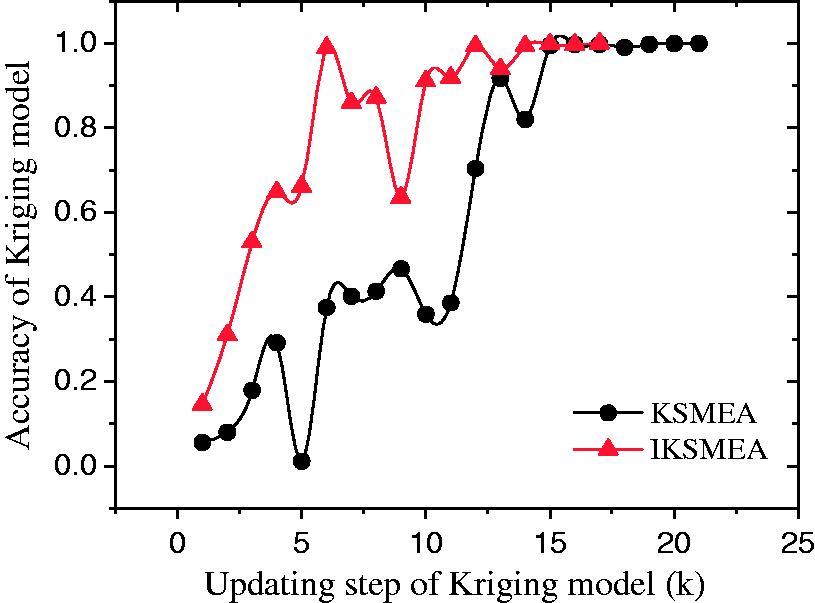

Figure 14 shows a plot of the RMSE of both IKSMEA and KSMEA. There is no dramatic decrease of RSME in the updating steps because of the existence of the noise. Even though the RMSE values of IKSMEA are larger than those of KSMEA in the first eight steps, the RMSE values of IKSMEA are smaller in the following updating process.
The comparison of RMSE in each step of IKSMEA and KSMEA for 100 samples with noise.
6. Experimental verification
6.1. Description of the test rig
Figure 15 shows a RK-4 rotor system with two disks installed between the two bearings. A short metal stick is installed near the right disk with little clearance to the shaft, which can simulate the effect of the rub-impact. The vertical and horizontal response values are captured at the stick by the sensors. The parameters of the Rotor-Kit system are listed in Table 6 and the equivalent FEM is given in Figure 16.
Laboratory test rig. The FE model of rotor-bearing system with one disk. Parameters of test rig.


6.2. Experimental results and discussion
In this case, the identified parameters are kxx, kyy, and δ, where kxx and kyy are the horizontal and vertical stiffness coefficients, respectively, and δ is the initial clearance between rotor and stator. When the rotating speed is 1500 rad/s, the response values on the seventh node are chosen to construct the initial KSM.
A comparison of identified results of IKSMEA and KSMEA is given in Table 7. For three different sampling sizes, IKSMEA costs less updating steps and computation time in each case. More accurate identified results can be obtained by IKSMEA in each case. Figure 17 shows that the response values predicted by IKSMEA correspond to the value measured by the experiment.
RV predicted by the IKSMEA and measured by experiment with 100 samples. The comparison of identification results of different methods.

We also plot the comparison of RMSE in each step of IKSMEA and KSMEA for 100 samples (Figure 18). After the first two steps, the RMSE values of IKSMEA are smaller than those of KSMEA. This shows that the new method is better than the original one along with the identified process.
The comparison of RMSE in each step of IKSMEA and KSMEA for the experiment with 100 samples.
7. Conclusions
An improved method based on IKSMEA for parameter identification of a nonlinear system is presented in this paper. In order to make the KSM more accurate as quickly as possible, more than one appropriate point are added to update the KSM. The effectiveness of the IKSMEA is examined through numerical simulation and experiment. The identified results of IKSMEA and KSMEA are compared, and different sampling sizes for 50, 100, and 200 are considered to construct the initial KSM. It demonstrates that the identified results from IKSMEA are in good agreement with the reference results even though 10% Gaussian noise is considered in the numerical simulation. Moreover, compared to KSMEA, IKSMEA satisfies the condition of the convergence with less updating steps and is more robust to the noise. The results clearly show its usefulness and accuracy. An experiment with a rotor bearing system exhibiting nonlinear rub-impact was also conducted to verify the effectiveness of IKSMEA. More accurate identified results can be obtained by IKSMEA. Nevertheless, there may be some discrepancies between FEM predictions and experimental results due to inevitable uncertainties in material properties and boundary conditions. Therefore, the model updating strategy should be considered before parameter identification in real applications. In addition, the KSM should be further improved to simulate more complex structures. This issue will be discussed in the future.
Footnotes
Conflict of interest
The authors declare no conflict of interest
Funding
This research received no specific grant from any funding agency in the public, commercial, or not-for-profit sectors.