







Abstract
One important issue in the investigation of axially moving systems is the viscoelastic constitutive relation. In the present paper, the effects of viscosity on the natural frequency of transverse vibration of an axially moving viscoelastic beam are studied. The viscoelastic material of the moving Euler-Bernoulli beam obeys the Kelvin model. For the first time, the qualitative difference between the natural frequencies with the material time derivative and the partial time derivative in the constitutive relation is investigated. The method of multiple scales with three terms is directly applied to obtain the approximate analytical solutions of the natural frequency. An interesting phenomenon is found in this study. Specifically, for an axially moving viscoelastic beam constituted by the material time derivative, the natural frequencies of transverse vibration may increase with the axial speed. Furthermore, the validity of the analytical results is examined by comparing with two numerical approaches, the differential quadrature methods (DQM) via separating variables and DQM combined with the fast Fourier transforms. There is qualitative difference between the results based on the constitutive relations with the material time derivative and the partial time derivative. Therefore, the results of this work provide an possible approach to determine which kind of the constitutive relation should be adopted to describe the viscoelastic property of axially moving materials.
Keywords
1. Introduction
In order to model engineering structures, including axially moving materials, an important research topic is to account for the dissipative mechanisms of materials (An and Su, 2014; Öz et al., 1998; Chen, 2005a; Yurddas, 2014). Since beam-like engineering devices are usually composed of some viscoelastic metallic materials and viscoelastic polymeric materials, viscoelasticity is an effective way to model the dissipative mechanism. The general form of a differential integral equation of a travelling string is derived with the integral constitutive law of linearly viscoelastic material (Fung et al., 1997). Axially moving strings constituted by the Boltzmann superposition principle are studied for the resonance response (Chen, 2005b). The three parameter standard viscoelastic solid model is applied to model the shear behavior of the moving plate (Hatami, 2008). The effects of the internal damping on the dynamic behaviour of the axially moving viscoelastic beam are numerically investigated by modeling the beam material as the three-parameter Zener element (Marynowski and Kapitaniak, 2007). The above papers showed that several constitutive relations have been adopted in the study on the vibrations of the axially moving systems. However, the Kelvin model, as a simple viscoelastic material, is the most frequently chosen to describe the viscoelastic property of axially moving materials.
Based on the Kelvin viscoelastic model with partial time differential, the linear viscoelastic differential constitutive law, Zhang and Zu (1998) discovered that the viscoelastic model can be used to describe accurately the damping mechanism of moving belt materials. Lee and Oh (2005) found that only first natural mode becomes unstable with flutter in the case of a viscoelastic moving beam, while a single coupled mode flutter may occur for the case of a pure elastic moving beam. Recently, the Kelvin model has been adopted in many researches on the linear (Chen and Yang, 2006) or nonlinear response of axially moving materials (Ding, 2015; Ding and Zu, 2014; Ghayesh and Amabili, 2014; Ghayesh et al., 2015; Yao et al., 2012; Liu et al., 2012; Yang and Zhang, 2014). The two-parameter Kelvin viscoelastic model is compared with a four-parameter viscoelastic model of material in the form of the Bürgers element by Marynowski and Kapitaniak (2002). The comparison demonstrated that the Kelvin viscoelastic model is less appropriate for the materials with larger damping coefficient.
A ‘‘steady dissipation’’ term, due to the axial motion of the string, is included in the viscous material model by Mockensturm and Guo (2005) for studying nonlinear vibration of axially moving strings. Therefore, the strings are constituted by a viscoelastic constitutive law containing the material time derivative. The authors found that this steady state dissipation shows significant effects and they suggested that the material time derivative should be adopted. Quantitative differences between the linear (Ding and Chen, 2008) or nonlinear (Chen and Ding, 2010; Yan et al., 2015) characteristics of axially moving beams with the material and the partial time derivatives in the constitutive relation are discovered. Based on free vibration of the axially moving plate, Marynowski (2010) compared a three-parameter Zener model and a Kelvin model with the material time derivative. The author found that the critical transport velocity predicted by the Zener model is higher. For analyzing axially moving panels, Saksa et al. (2012) found that the model with the partial derivative predicts the smaller value of the critical velocity than the model with the material derivative does. In above-mentioned works, there are the differences between the predictions of the dynamics of axially moving viscoelastic materials given by the viscous model with the material derivative and the partial derivative in the viscoelastic relations. However, so far no proposal, which can be experimentally validated, has been found on which viscous material model should be chosen for moving viscoelastic materials. In this paper, a possible approach is proposed. The investigation focused on the effects of the material time derivative and the partial time derivative in the viscoelastic relations on the natural frequency of transverse vibration of axially moving beams.
2. Mathematical model
Figure 1 shows a general axially moving tensioned beam with initial tension P0. The symbol U(X,T) is the transverse displacement of the moving beam at the neutral axis coordinate X and time T. With the uniform constant transport velocity V, the beam travels between two boundaries separated by distance L. At the two boundaries, the frictionless sleeves are modeled as simple supports with torsion springs whose spring stiffness constant are all K. Nullifying the transverse displacements and balancing the bending moment at two boundaries lead to the following boundary conditions
Schematic representation of an axially moving beam.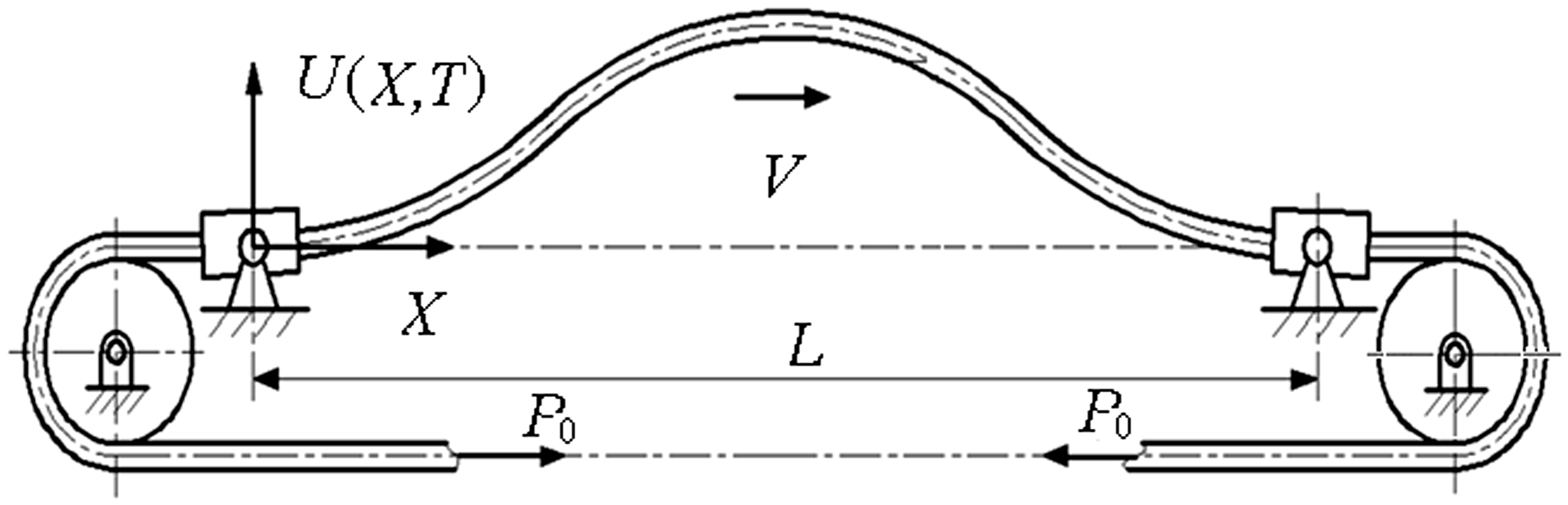
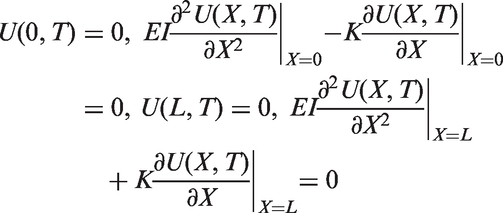
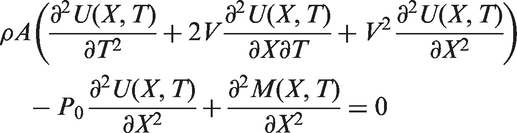

The viscous material model, as shown in equation (3), includes a ‘‘steady dissipation’’ term due to the axial translation of the beam. Therefore, the material time derivative in the constitutive relation takes into account the effects of translation speed on material viscous dissipation. Neglecting the ‘‘steady dissipation’’ term lead to the following viscoelastic moment–curvature relationship with the partial time derivatives

In order to cast the governing equations (2), (3), and (4) dimensionless for avoiding round-off due to manipulations with small or large numbers in numerical calculation, the following dimensionless parameters and variables are introduced
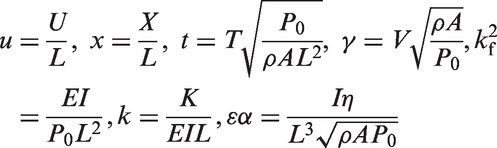
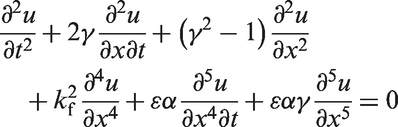
Similarly, equation (2) with the partial time derivatives is cast into the dimensionless form

Furthermore, the boundary conditions (1) is cast into the dimensionless form as

3. Method of multiple scales (MMS)
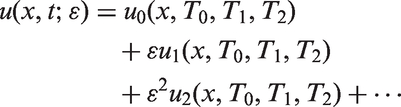
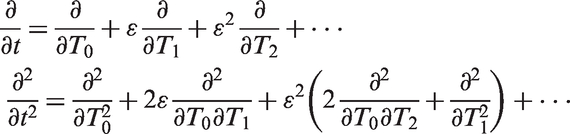
For investigating the effects of viscoelasticity on free transverse vibration, a second order approximation is needed. Suppose that the second order uniform approximate solution to equation (6) is

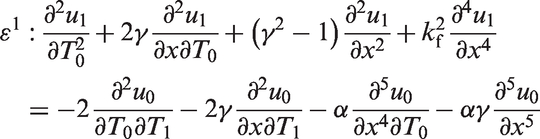
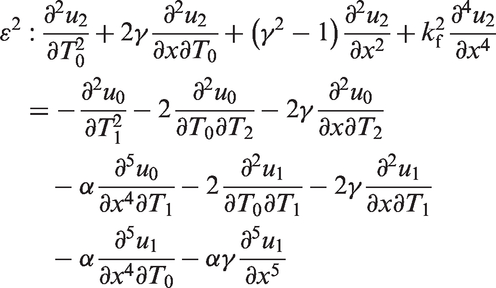
Chen and Yang (2006) have obtained the modal solution to equation (11)

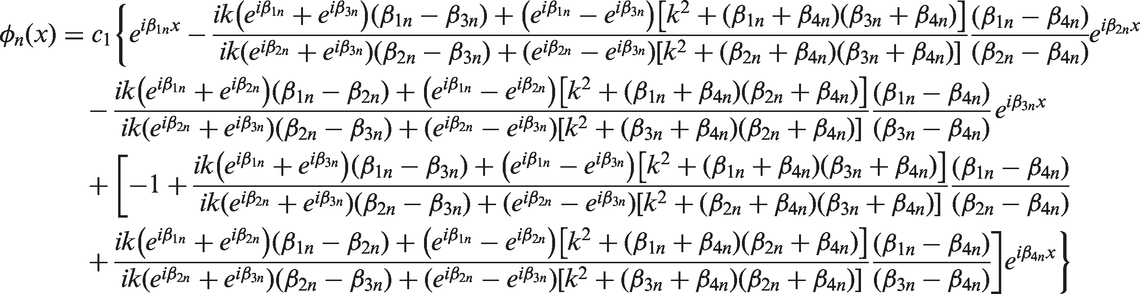
where c1 is a constant to be determined and βjn (j = 1,2,3,4; n = 1,2,…) are four roots of the characteristic equation which can be numerically solved.
If k = 0, the boundary conditions equation (8) are reduced to the simply supported ends as

If k→∞, the boundary conditions equation (8) are reduced to the fixed ends as

Furthermore, the corresponding modal function reduces to (Öz and Pakdemirli, 1999)
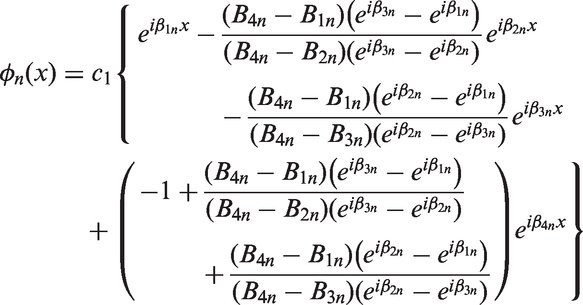
Substitution of equation (14) into equation (12) leads to
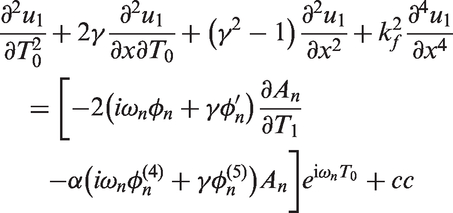
The solvability condition leads the following orthogonal relationships for all the n-th modal functions


Similarly, equation (7) with the partial time derivatives yields
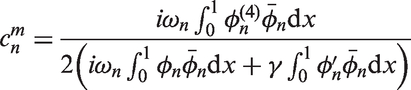
The solution to equation (21) is


Based on the condition of equation (20),
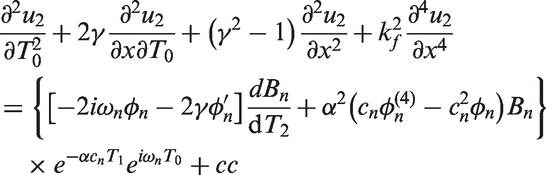
The solvability condition yields

For the viscoelastic moment–curvature relationship with the partial time derivatives, cn in equation (26) should be


In the following numerical examples, the bookkeeping device ɛ is set as 1.
4. The natural frequencies with viscoelastic constitutive relations
In this section, numerical instances are presented to describe the effects of the viscosity coefficient, the viscoelastic constitutive relations, the boundary conditions, and the axial speed on the natural frequency of transverse vibration. The first two natural frequencies of transverse vibration of the axially moving viscoelastic beam with the hybrid boundary conditions are shown in Figure 2 based on equation (28). In Figure 2, the bending stiffness kf2 = 0.64, the axial speed γ = 1.5 and the spring stiffness k = 2.0. As it is seen from Figure 2, the first two natural frequencies decrease with the increase viscosity coefficient. Furthermore, the second natural frequency is more sensitive to the viscosity of the beam. Moreover, comparison in Figure 2 indicates that the natural frequencies with the material time derivative in the constitutive relation are larger than those with partial time derivative. In addition, the difference between the natural frequencies with two viscoelastic constitutive relations increases with the growing viscosity of the moving beam. Besides, the first natural frequency is more sensitive to the different viscoelastic constitutive relations. Therefore, only the first natural frequency is presented in the following numerical investigation.
Comparison of the two kinds of constitution relations versus viscoelastic coefficient: hybrid supports.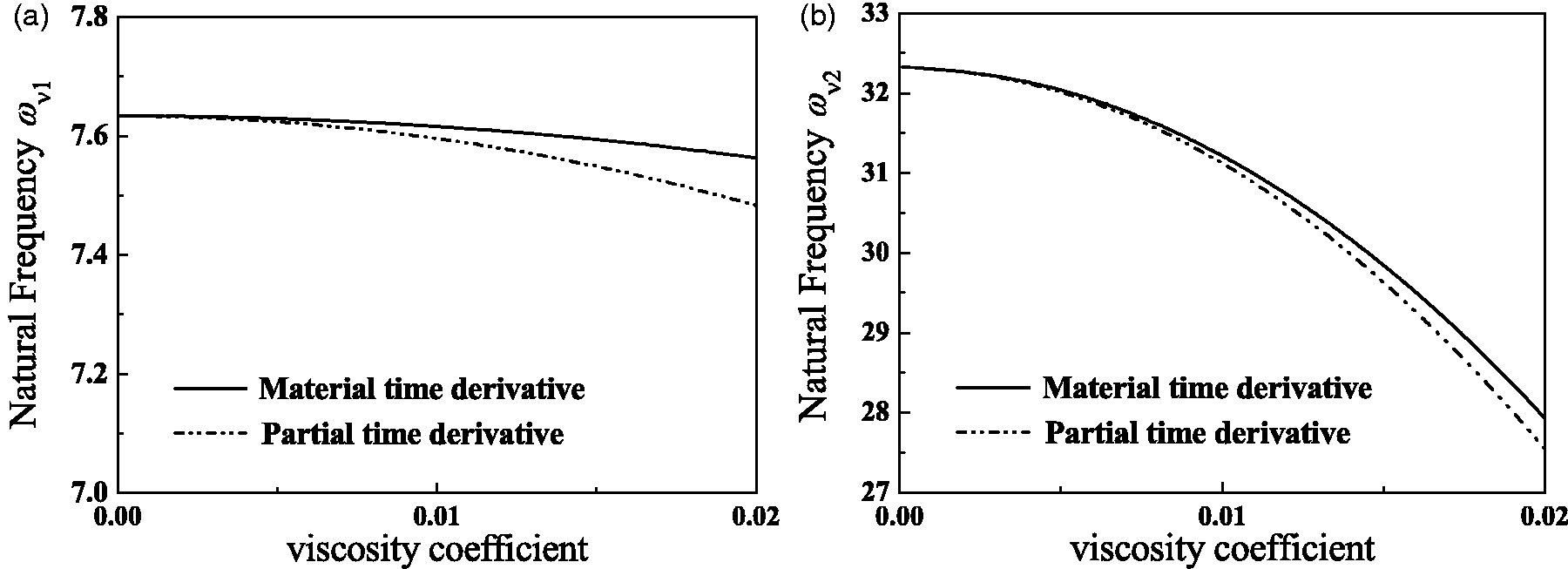
The first natural frequency of transverse vibration of the moving viscoelastic beam with simply supported boundary conditions and the fixed ends are presented in Figure 3 with kf2 = 0.64 and γ = 1.5. As shown in Figure 3, the decrease of the first natural frequency with the viscosity of the beam becomes slower for the material time derivative in the constitutive relation. Furthermore, the numerical results illustrate that the viscosity coefficient has a more great impact on the frequency of the beam with the fixed ends. However, for the two viscoelastic constitutive relations, the differences between the natural frequencies of the beam with both classic boundary conditions are all decrease with the increase viscosity coefficient.
Comparison of the two kinds of constitution relations versus viscoelastic coefficient.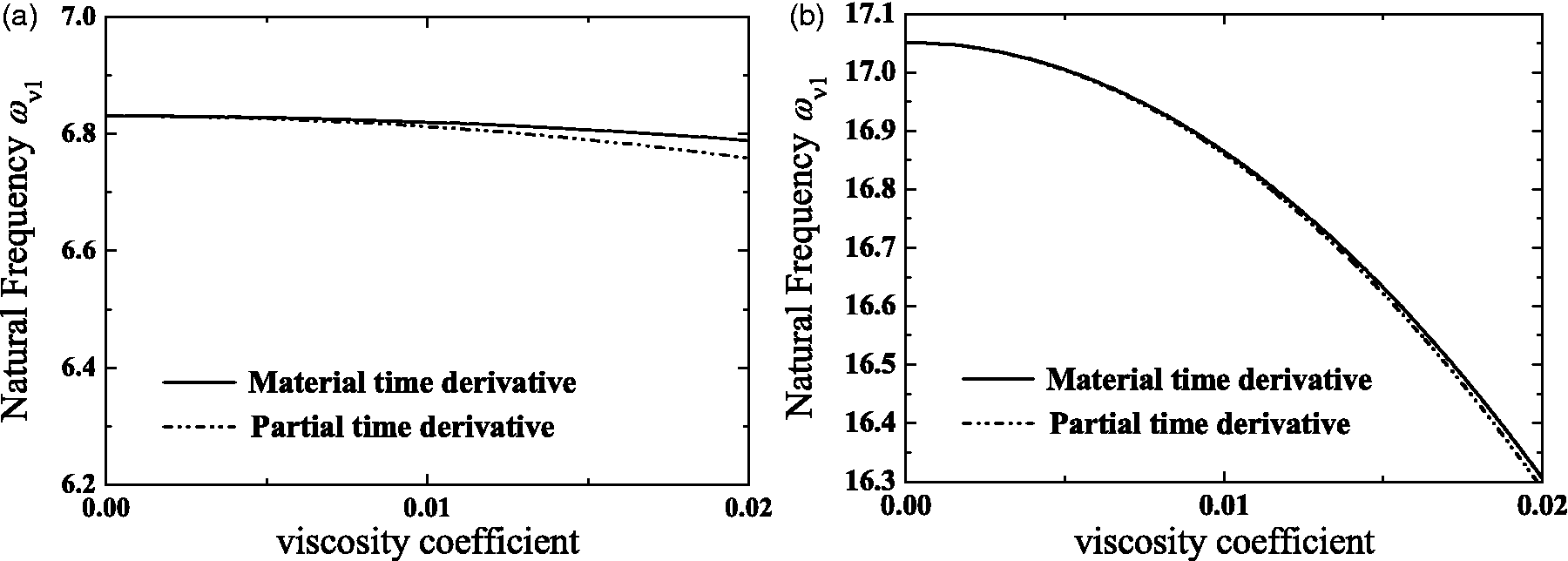
With kf2 = 0.64, Figures 4(a) and 4(b), respectively, show that the tendency of the first natural frequency of transverse vibration of the axially moving beam changes with the axial speed for the simply supported boundary conditions and the fixed ends of the beam. In Figure 4(a), the viscosity coefficient α = 0.04. Meanwhile, the viscosity coefficient α = 0.02 in Figure 4(b). It should be noted that, an interesting phenomenon is presented in Figure 4. At a relative high axial speed, the natural frequencies of transverse vibration of the axially moving viscoelastic beam, with the material time derivative in the constitutive relation, increase with the axial speed. Nonetheless, the frequency with partial time derivative always decreases with the axial speed. From references (Chen and Yang, 2006; Özkaya and Pakdemirli, 2000), one can find that the natural frequencies always decrease with axial speed. The authors believe that, this is the first time to find that the natural frequencies of the axially moving beam may increase with the axial speed.
Comparison of the two kinds of constitution relations versus axial speed. (a) Simply supported (b) Fixed ends.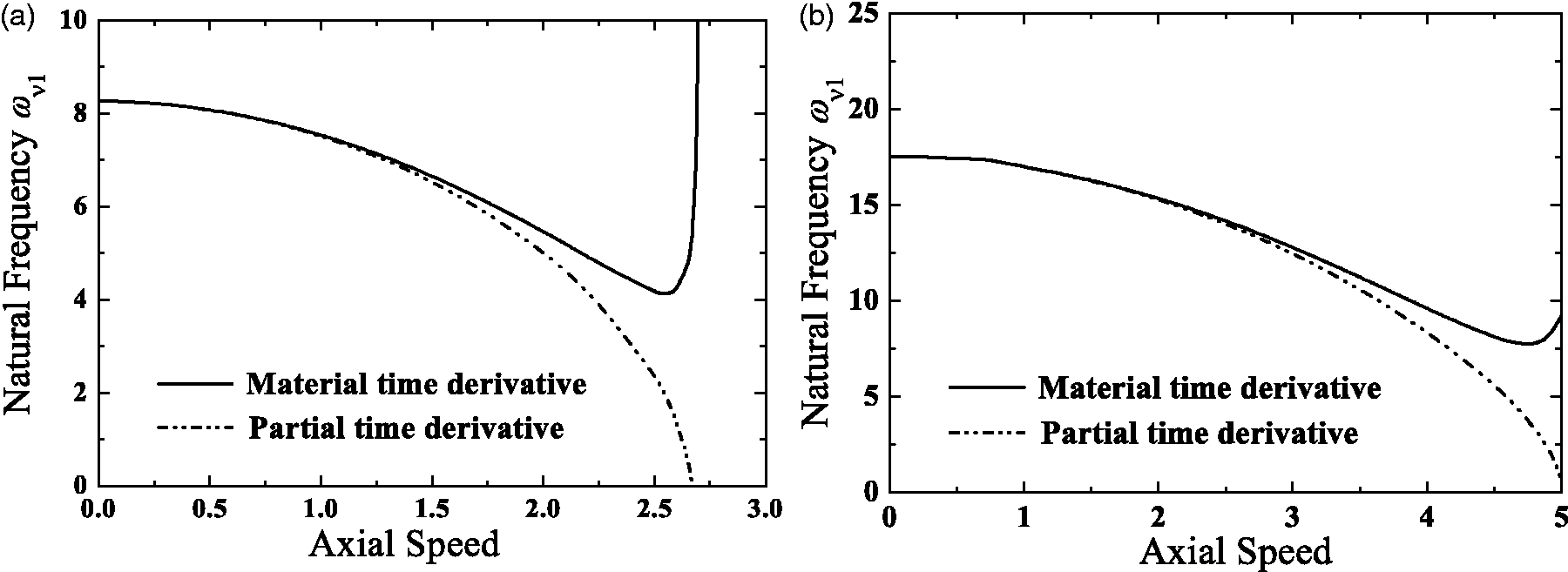
5. Numerical verification
For verifying the approximate analytical analysis results from the MMS, two numerical approaches are utilized to numerically determining the natural frequencies of transverse vibration of the axially moving viscoelastic beam in the following investigation. Specifically, the differential quadrature method is applied by separating variables, as well as combined with the fast Fourier transforms.
5.1. Differential quadrature method
Suppose that the transverse displacement of the axially moving beam is

Substitution of equation (29) into equations (6) and (7) leads to


Substitution of equation (29) into equation (16) leads to

Assume xj is a space discrete point of the beam, where j = 1, 2,…, N, and N is number of unequally spaced sampling points of the neutral axis coordinate. For the boundary condition (32), xj is defined as

The essence of the differential quadrature method is that the nth–order partial derivative of a function with respect to x at a given point xj is approximated by a weighted linear summation of the function values at all of the sampling points. The differential quadrature method is with very high order of accuracy. The differential quadrature rule for an nth–order derivative is written as

where f(x, t) is an arbitrary function, fi = f(xi, t), and
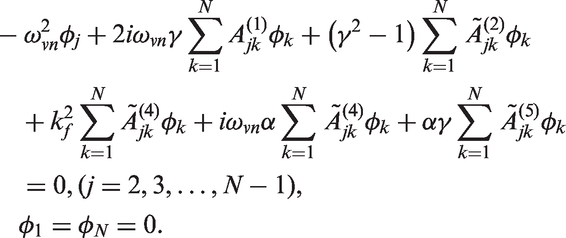

Substitution of equation (29) into equation (17) leads to

For the boundary condition (37), xi is defined as
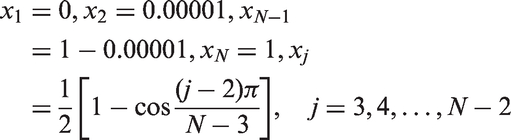
Moreover, the number of sampling points for the fixed ends boundary condition is set as N = 13. Substitution of equation (34) into equations (30) and (31) yields
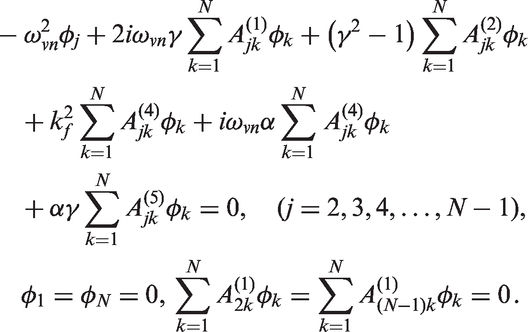
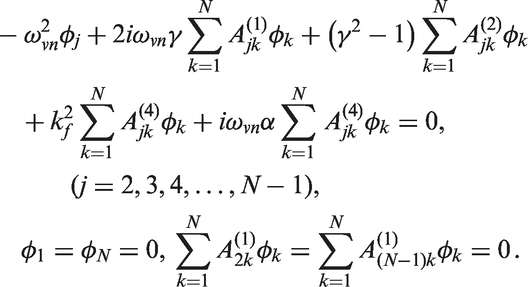
Equations (35), (36), (39) and (40) can be written in matrix-vector form. Non-triviality of solutions to matrix-vector equation requires its determinant of coefficients to be zero. Therefore, the natural frequencies of transverse vibration of an axially moving viscoelastic beam ωvn can be obtained by using the differential quadrature method.
5.2. The fast Fourier transforms
For the simply supported boundary condition, substitution of equation (34) into equations (6) and (7) yields a series of ordinary differential equations
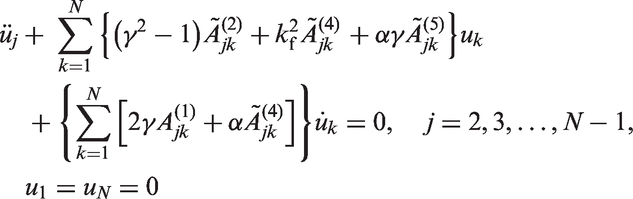
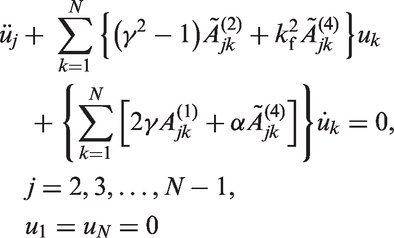
For the fixed boundary condition, substitution of equation (34) into equations (6) and (7) yields
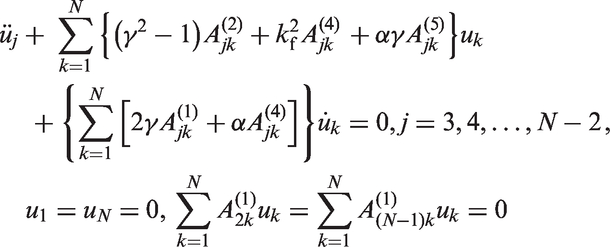
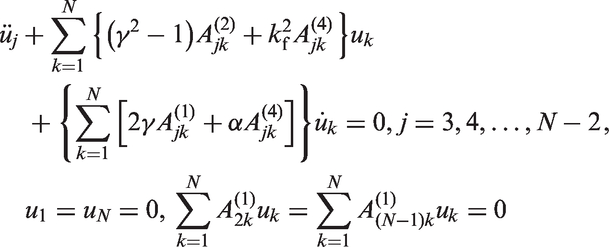
The initial conditions are all defined as follows

With the initial excitation, the time history of the transverse vibration of the beam is obtained. By using fast Fourier transforms (FFTs), the frequency spectrum of the dynamic system can be determined from the time history (Ding and Chen, 2011). Therefore, the natural frequencies of transverse vibration of a moving viscoelastic beam ωvn can be obtained based on FFTs.
5.3. Numerical examples
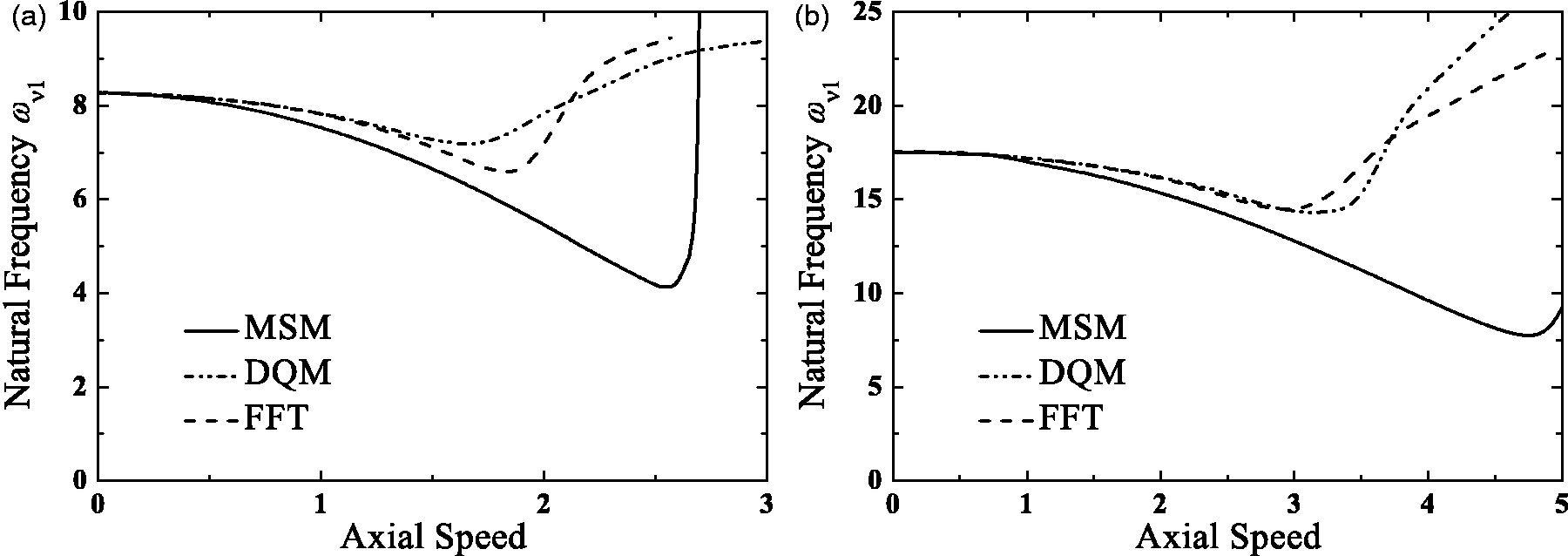
Comparisons of the first natural frequency of the transverse vibration of the axially moving beam via the MMS and the approaches of the differential quadrature method are represented in Figures 5 and 6 with kf2 = 0.64. The viscosity coefficient α is set as 0.04 for the simply supported boundary conditions of the moving beam. Meanwhile, α = 0.02 for the fixed ends. As seen from Figure 5, for the simply supported boundary conditions and fixed ends, three approaches predict the same results of the first natural frequency of transverse vibration of the axially moving beam with the partial time derivative in the viscoelastic relations. Therefore, Figure 5 shows that the MMS provides rather high precision results. With the material time derivative in the constitutive relations, the numerical results in Figure 6 show the comparison of the first natural frequency of the three approaches. The results illustrate that there are certain differences between the frequencies based on the approximate analytical analysis and the two kinds of numerical approaches. Nevertheless, as a new result, the three approaches all predict that the natural frequencies of the axially moving viscoelastic beam increase with the axial speed at certain speed values.
Quantitative comparison between the results of MSM, DQM and FFTs: Partial time derivative. Qualitative comparison between the results of MSM, DQM and FFTs: Material time derivative.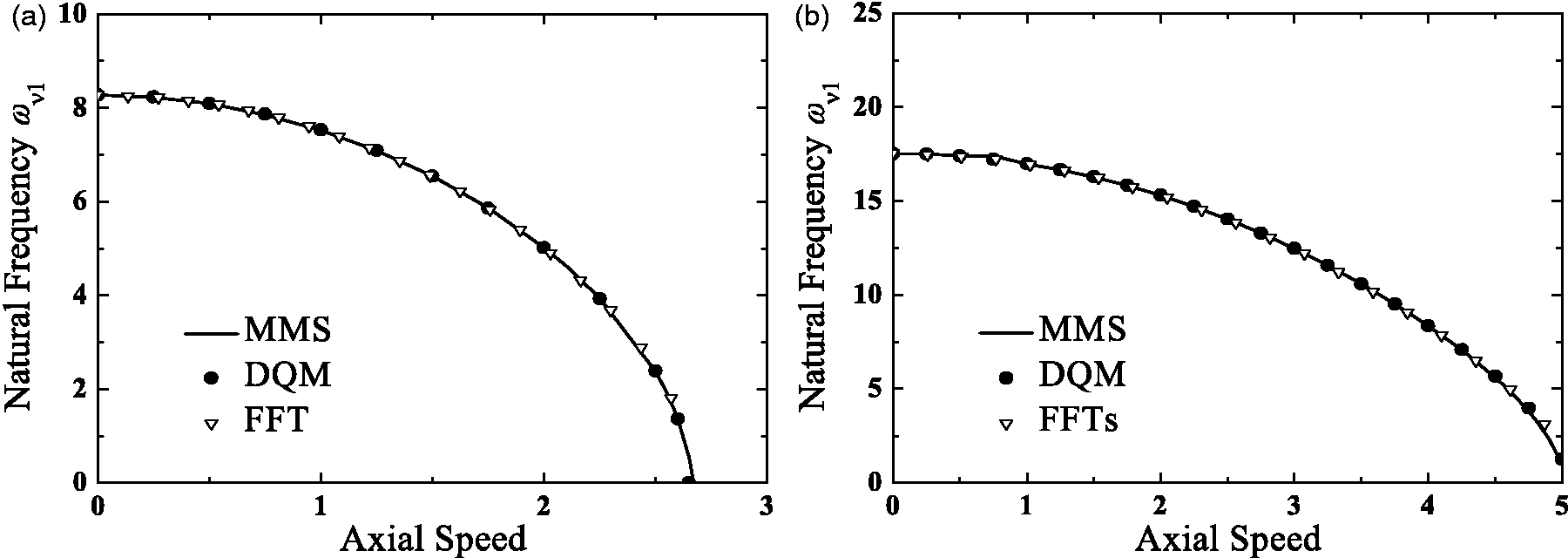
6. Conclusions
Based on the constitutive relations with the material time derivative and the partial time derivative, the natural frequencies of transverse vibrations are determined for an axially moving viscoelastic beam. At both ends, the moving beam is constrained by simple supports with torsion springs. This hybrid boundary condition is reduced to two classic boundary conditions, the simply supported boundary conditions and the fixed ends. The natural frequencies of transverse vibration are investigated by using the MMS with three terms. Furthermore, two numerical approaches based on the differential quadrature scheme are developed to verify the results of MMS.
The three approaches all demonstrate that the natural frequencies with the material time derivative in the constitutive relation are always larger than those with the partial time derivative. Moreover, the transverse frequency with the partial time derivative in the viscoelastic relation decreases with the axial speed or the viscosity coefficient all the time. Nevertheless, the natural frequencies with the material time derivative may increase with the axial speed. Therefore, the material time derivative in the constitutive relation qualitatively changes the characteristic of the free vibration of an axially moving viscoelastic beam.
Footnotes
Declaration of Conflicting Interests
The author(s) declared no potential conflicts of interest with respect to the research, authorship, and/or publication of this article.
Funding
The author(s) disclosed receipt of the following financial support for the research, authorship, and/or publication of this article: The authors gratefully acknowledge the support of the State Key Program of the National Natural Science Foundation of China (grant number 11232009) and the National Natural Science Foundation of China (grant number 11372171, 11422214).