This paper presents an adaptive fuzzy backstepping sliding mode control for multi-input and multi-output uncertain nonlinear systems in semi-strict feedback form. The systems are described by a discrete-time state equation with uncertainties viewed as the modeling errors and the unknown external disturbances, and the observation of the states is taken with independent measurement noises. Combining the adaptive fuzzy backstepping control with the sliding mode control approach for the comprehensive improvement in the stability and the robustness, the adaptive fuzzy backstepping sliding mode control is approximately designed where the design parameters are selected using an appropriate Lyapunov function. The uncertainities are approximated as fuzzy logic systems using the fuzzy inference approach based on the extended single input rule modules to reduce the number of the fuzzy IF-THEN rules. The estimates for the un-measurable states and the adjustable parameters are taken by the proposed simplified weighted least squares estimator. It is proved that the trajectory of the tracking error and the sliding surface is uniformly ultimately bounded. The effectiveness of the proposed approach is indicated through the simulation experiment of a simple numerical system.
The adaptive backstepping control (ABC) is one of systematic approaches to design controllers with the comprehensive improvement in the system stability and the robustness for a class of uncertain nonlinear systems. Various approaches for the ABC have been presented for single-input single-output (SISO) and multi-input multi-output (MIMO) uncertain nonlinear continuous and discrete-time systems in strict or semi-strict feedback form (Kanelakopoulos et al., 1991; Kokotovic et al., 1991; Pan and Basar, 1998; Yao and Tomizuka, 2001; Kristic, 2004; Nesic and Teel, 2006; Chang and Cheng, 2010; Yu and Zhong, 2010). The ABC is designed as a recursive approach based on the selection of an appropriate Lyapunov function. The adavantage is to resolve the systems with mismatched uncertainties that are linearly parametrized uncertainties, modelling errors and external disturbances. However, the problem of the explosion of complexity due to repeated differentiations of nonlinear functions is caused in the design of the ABC as a drawback, and it more grows as the system-order more increases. Then, the adaptive dynamic surface control (ADSC) has been addressed to remove the problem by introducing a first-order filter (Gerdes and Hedrick, 1997; Yip and Hedrick, 1998).
The sliding mode control (SMC) is a powerful design approach for the robust controllers in uncertain nonlinear systems. The SMC draws the trajectory of the states from the initial location to the location of the given sliding hyperplane and slides along the sliding hyperplane towards the origin. Combining the ABC with the SMC approach for a class of uncertain nonlinear systems in semi-strict feedback form, the adaptive backstepping sliding mode control (ABSC) has benefit from the combined both approaches in the improvement of the system performance and the robustness (Yao and Tomizuka, 1997; Ferrara and Giacomini, 1998; Koshkouei et al., 2004; Koshkouei and Burnham, 2011; Van et al., 2014).
However, in the real situation there are complicated and uncertain nonlinear systems whose accurate mathematical models are not available or difficult to formulate where those systems are assumed in semi-strict feedback form. Various approaches of the adaptive controls for the uncertain nonlinear systems have been developed from the practical viewpoint, and most parts of the approaches have provided approximations for the uncertainties using fuzzy logic systems or neural networks. Combining the ABC with the fuzzy logic control (FLC) approach to obtain the benefit from both approaches, the adaptive fuzzy backstepping control (AFBC) has been presented (Hsu and Fu, 2001; Yang et al., 2004; Chen et al., 2007; Chen et al., 2010). In the above-mentioned researches, all the states are assumed obtainable for the measurement. However, it is not suitable for the real situation because the observation of the states is restricted by measurement sensors and/or is taken with measurement noises. When all the states are not obtainable for the measurement, the observer-based AFBC for the uncertain nonlinear systems has been presented by introducing observers to take the estimates for the un-measurable states (Tong et al., 2004; Tong and Li, 2009; Tong et al., 2009; Li et al., 2011; Liu et al., 2011). While, combining the ABC with the neural networks control (NNC) approach to obtain the benefit from both approaches, the adaptive neural networks backstepping control (ANBC) has been presented (Kwan and Lewis, 2000; Zhang et al., 2000; Li et al., 2004; Wang et al., 2008). However, the problem of the explosion of complexiy due to the repeated differentials of nonlinear functions is caused in the design of the AFBC or the ANBC. Combining the AFBC with the aforementioned ADSC (Gerdes and Hedrick, 1997; Yip and Hedrick, 1998), the adaptive fuzzy backstepping dynamic surface control (AFBDC) has been proposed (Tong et al., 2010; Kim et al., 2012). While, combining the ANBC with the ADSC approach, the adaptive neural networks backstepping dynamic surface control (ANBDC) has been presented (Wang and Huang, 2005; Yoo et al., 2006; Li et al., 2010). The combined AFBDC and ANBDC have the benefit that the controllers are obtained as a simple recursive form and provide the comprehensive improvement in the system stability and the robustness. However, although uncertain nonlinear systems in pure-feedaback form are more representative than uncertain nonlinear systems in strict or semi-strict form, the former is more troublesome to design the AFBC or the ANBC, and the AFBDC or the ANBDC than the latter. There are some for SISO uncertain nonlinear systems in pure-feedback form based on the FLC (Zou et al., 2008; Zhang et al., 2010) or based on the NNC (Ge and Wang, 2002; Zhang and Ge, 2008), but there are few for MIMO uncertain nonlinear systems in pure-feedback form (Tong et al., 2012).
The purpose of this paper presents a new adaptive fuzzy backstepping sliding mode control (AFBSC) for MIMO uncertain discrete-time nonlinear systems in semi-strict feedback form whose mathematical models are not available or difficult to formulate. The observation of the states are taken with independent measurement noises. The proposed AFBSC is approximately constructed by combining the AFBC with the SMC approach to obtain the comprehensive improvement in the system performance and the robustness. While, as the number of the fuzzy IF-THEN rules is sufficiently large to enhance the approximation accuracy, the number of the adjustable parameters is exponentially increased and also the online computation burden is relatively increased. Although the approximation accuracy is much improved by using excessive number of functions, the transient estimation performance of the adjustable parameters becomes poor so that the performance of the states and the controller is degraded. Therefore, the number of the adjustable parameters is reduced and the shapes of the membership functions are modified by evaluating the root mean squares of the time evolutions of the states and the controller, and by reviewing the waveforms of their time evolutions. As approaches to reduce the number of fuzzy IF-THEN rules, the Nussbaum-type functions (Tong et al., 2010; Liu et al., 2011) and the extended single input rule modules (SIRMs) (Yoshimura, 2015a, 2015b) have been proposed. In the design of the proposed AFBSC, the fuzzy inference approach based on the extended SIRMs composing of a set of SISO fuzzy rules is introduced because the number of the fuzzy IF-THEN rules based on the extended SIRMs more reduces than the general fuzzy IF-THEN rules. Afterwards, the simplified weighted least squares estimator (SWLSE) is designed to take the estimates for the un-measurable states and the adjustable parameters. It has less computational burden than the weighted least squares estimator (WLSE) (Yoshimura, 2011, 2013, 2015a, 2015b). As mentioned above, the proposed AFBSC is important from the practical view-point. However, to my best knowledge, the AFBSC for MIMO uncertain nonlinear discrete-time systems using noisy measurements has not been presented till now.
The organization of this paper is as follows. In section 2, the MIMO uncertain discrete-time nonlinear systems in semi-strict feedback form are presented. The uncertainties are viewed as the modelling errors and the unknown external disturbances, and that the observation of the states is taken with independent measurement noises. In section 3.1, the fuzzy inference approach based on the extended SIRMs is presented where the uncertainties are approximated as the fuzzy ligic systems. In section 3.2, the AFBC is presented, and it is proved that the trajectory of the tracking errors is uniformly ultimately bounded. In section 3.3, based on the AFBC described in section 3.2, the AFBSC is proposed, and it is proved that the trajectory of the tracking error and the sliding surface are uniformly ultimately bounded. In section 3.4, the SWLSE to take the estimates for the un-measurable states and the adjustable parameters is presented. In section 3.5, the procedure to design the AFBSC is described in detail. In section 4, it is shown that the proposed AFBSC is more effective in the system performance and the robustness than the AFBC for the simulation experiment in a simple numerical example. Finally, the conclusion is given in section 5.
2. Uncertain nonlinear systems
Consider MIMO nonlinear systems described by a discrete-time state equation with the uncertainties viewed as the unknown modeling errors and the unknown external disturbances. Assuming that the control signals are generated only at the sampling instant and is kept over the entire sampling interval where and is the constant sampling interval, the MIMO uncertain discrete-time nonlinear systems in semi-strict feedback form are
where is the state vector defined as , and is the sub-state vector satisfying the inequality and , and for and for , is the control vector, is the bounded uncertainty vector composing of the modeling error vector and the unknown external disturbance vector , , , , are respectively the known constant matrices, and are the known constant invertible matrix. The observation of is taken with independent measurement noise given as
where is the measurement vector and is the measurement noise vector with the zero-mean independent random sequence.
3. Adaptive fuzzy backstepping sliding mode control
3.1. Fuzzy inference approach based on the extended SIRMs
In the general fuzzy IF-THEN rules, the number of the fuzzy IF-THEN rules exponentially more increases as the number of the inputs more increases. Hence, it is indispensable to subject the heavy computational burden to take the estimates for the adjustable parameters. The fuzzy inference approach based on the extended single input rule modules (SIRMs) (Yoshimura, 2015a, 2015b) are introduced because the extended SIRMs more reduces the number of the fuzzy IF-THEN rules than the general fuzzy IF-THEN rules. The fuzzy IF-THEN rules based on the extended SIRMs is expessed as follows. Approximate the column of as where is the estimate for , and is the adjustable parameter vector. Denoting the column of for the input and for the output, then the fuzzy IF-THEN rules based on the extended SIRMs are given as
where and , and and are respectively the fuzzy sets whose membership functions are respectively given as and . Using the strategy of the singleton fuzzification, the center-average defuzzificaion and the product inference, the fuzzy logic system is
where and for , and and for are respectively the adjustable parameter vector and the fuzzy basis function vector defined as
and and are respectively given as
with . When the unknown external disturbance is assumed to be a function of time, it is included in and in (5) given as
where column of is expressed as . If the time variation of is assumed relatively slow, the estimation for is carried out under the assumption that the time variation of is viewed as time-invariant, and its effectiveness has been proved (Yoshimura, 2015a, 2015b). Hence, according to and expressed in (7), the fuzzy logic system given as equation (4) is rewritten as
where is the column of .
3.2. Design of the adaptive fuzzy backstepping control (AFBC)
Design the proposed AFBC as follows. Approximate as where is defined as
Since is an artificial quantity required for the analysis where , , and are respectively the suitable compact sets, it is the unknown optimal adjustable parameter vector. Throughout this section, define the tracking error vector as where , the estimation error vector as and the universal approximation error vector (Wang, 1994) as respectively where is replaced as given as
Based on the above information, the proposed AFBC is constructed as follows.
Step 1
Substituting into the first equation of equation (1), the virtual control is
where is the estimate for , is the pseudo-inverse matrix defined as , and is the constant matrix. Substituting equation (11) into the first equation of equation (1) is
where .
Step 2
Substituting into the second equation of equation (1) is
Then, the AFBC is
where is the constant matrix. Substituting equation (14) into equation (13) is
where . Taking an approximation of in equation (14) as the one-step ahead prediction of and is
Using equation (12), the one-step ahead prediction is obtained as
where
Using equations (17) and (18), the one-step ahead prediction can be obtained. Therefore, substituting equations (16), (17) and (18) into equation (14), the AFBC is
Theorem 1
For the bounded initial condition, and in equations (12) and (15) are uniformly ultimately bounded if and are respectively bounded.
The proof of Theorem 1 is presented in Appendix 1.
3.3. Design of the proposed adaptive fuzzy backstepping sliding mode control (AFBSC)
Design a new AFBSC based on the AFBC described in section 3.2. Using equations (13) and (14), is expressed as
It is seen from equation (20) that the AFBC is derived by replacing , , and respectively as , ,and with , and equating the left hand of the equation to zero. To obtain the proposed AFBSC, assume the sliding surface to be
where is the sliding surface vector and is the constant coefficient matrix. Substituting equation (18) into equation (21) where , and are respectively replaced as , and , and applying the SMC approach to the resultant equation, the proposed AFBSC is derived as
where the last term on the right hand of equation (22) is the switching control whose role is to increase the quick response of the trajectory (Yoshimura, 2015a, 2015b). Substituting equations (16), (17) and (18) into equation (22), yields
However, given by equation (23) is not realizable in the present form because the estimates, , , , and are unknown, and the design parameters, and are not selected. These estimates and the design parameters are respectively selected in Sections 3.4 and 3.5. While, substituting equations (12), (20) and (22) into equation (21), the sliding surface is
Theorem 2: For the bounded initial condition, and are uniformly ultimately bounded if and are suitably selected, and and are respectively bounded.
The proof of Theorem 2 is presented in Appendix 2.
3.4. Design of the proposed simplified weighted least squares estimator (SWLSE)
Design the simplified weighted least squares estimator (SWLSE) in a simpler form than the WLSE (Yoshimura, 2011, 2013, 2015a, 2015b). Rewriting equation (1) in a state space form is
To design the proposed SWLSE in a simple form, the correlations between and and and (), are ignored. Then, the proposed SWLSE to take the estimates, and , for and is
with the initial condition, , , and where
In equations (29)-(36), and are respectively the columns of and , is the diagonal element of , is the diagonal element of , is the diagonal sub-matrix of , and cv is the positive constant denoting the weighting factor. Using equations (18) and (21), the estimate for is
While, the estimation errors, and , are uniformly ultimately bounded for the bounded initial condition if , and are respectively bounded. It has been proved in (Yoshimura, 2011, 2015a, 2015b).
3.5. Procedure to construct the proposed AFBSC
The procedure to design is shown in Steps 1 – 5.
Step 1
The number of the fuzzy IF-THEN rules and the shapes of the membership functions are respectively assumed.
Step 2
In the proposed AFBSC and the SWLSE, the design parameters, , , , and cv are respectively assumed.
Step 3
Based on the information given in Steps 1 and 2, the root mean squares of the time evolutions of the states and the controller are evaluated by using the AFBSC and the SWLSE.
Step 4
The number of the adjustable parameters is gradually reduced and the shapes of the membership functions are modified at the same time by evaluating the root mean squares of the time evolutions of the states and the controller, and by reviewing the waveforms of their time evolutions.
Step 5
The procedure for Steps 1 – 4 is continued till the performance is attained till the acceptable limit.
4. Numerical example
Consider the uncertain nonlinear system described as follows,
where is the state vector, is the control vector, is the nonlinear uncertainty vector viewed as the modeling errors and the unknown external disturbances, and , , and are respectively the constant matrices. Defining the state vector , rewriting equation (38) into the equation, and applying the forward difference method to the equation with , the uncertain discrete-time nonlinear system in semi-strict feedback form is
In above equations, and . In equation (38), assuming the matrices given as
and , the matrices in equation (39) are respectively obtained as
The measurement equation is given as
and the uncertainties are given as
The proposed given by equation (23) can be expressed as
where
The SWLSE to take the estimates for the un-measurable states and the adjustable parameters is given by equations (29)–(36). When the number of the adjustable parameters is excessively increased, the approximation accuracy for the uncertainties is much improved. However, the undesirable high frequency components are frequently caused in the time evolutions of the states and the controller. Therefore, by performining repeatedly the simulation experiment, the number of the fuzzy IF-THEN rules is reduced gradually and the shapes of the membership functions are modified at the same time by evaluating the root mean squares of the states and the controller, and reviewing the waveforms of their time evolutions. According to the procedure described in section 3.5, , , , cv, , and are respectively selected as
where is obtained from Appendix 2, and the uniformly ultimate boundness is satiafied. The fuzzy IF-THEN rules for are respectively given as
where are respectively the fuzzy sets whose membership functions are respectively given as
and is given as
where
The parameters for the membership functions given by equation (44) are respectively determined as
and the universal approximation errors are respectively given as
The simulation experiment is carried out where rhe initial conditions are respectively given as
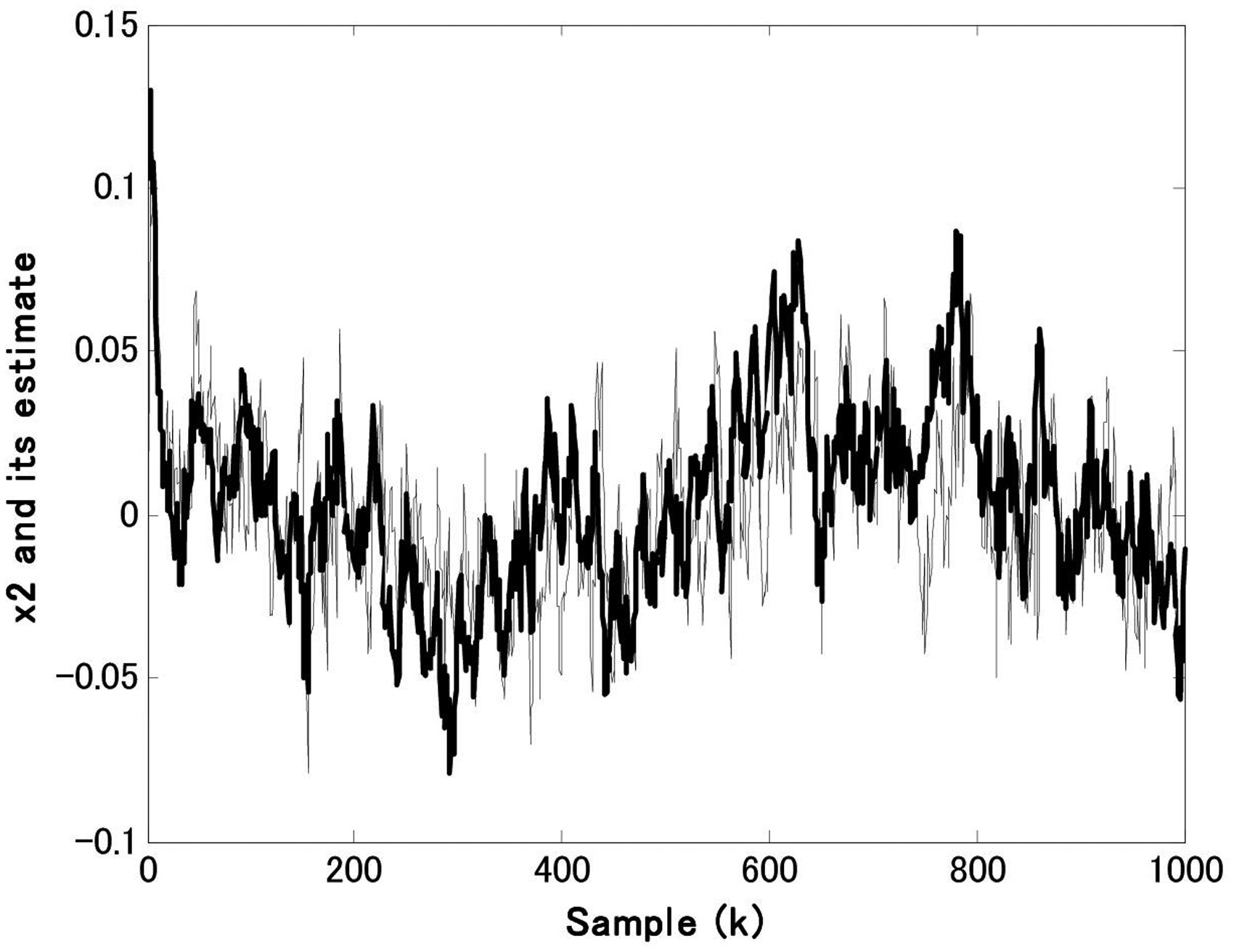
and the measurement noise vector is assumed to be the zero-mean independent random sequence whose variances are given by ∼ = . In Figures 1–8, the time evolutions of the states, , , and , and their estimates, , , and , the uncertainties, and , and their estimates, and , the proposed AFBSC, and , and the sliding surfaces, and are respectively shown where the total sampling number is given as 1000. It is seen from Figures 1–4 that the time evolutions of the states and their estimates are respectively bounded, and the estimation errors remain in the vicinity of zero. In Figures 5 and 6, the approximation accuracy for and is acceptable, but the high frequency components are contained in the waveforms of the estimates. In Figure 7, the time evolutions of the proposed AFBSC are bounded and acceptable, but contain the high frequency components. In Figure 8, the time evolutions of the sliding surfaces are acceptable because those remain in the vicinity of zero. The root mean squares of the time evolutions for , , , , , , , , , , and obtained by the proposed AFBSC are respectively shown in Table 1 where the total sampling number is given as 1000. From the time evolutions illustrated in the figures and the root mean squares of the time evoluions shown in Table 1, the proposed AFBSC provides the reasonable performance in the control and the estimation.
The time evolutions of the state 1 (: thick line) and its estimate (thin line).
The time evolutions of the state 2 (: thick line) and its estimate (: thin line).
The time evolutions of the state 3 (: thick line) and its estimate (: thin line).
The time evolutions of the state 4 (: thick line) and its estimate (: thin line).
The time evolutions of the uncertainty 1 (: thick line) and its estimate (: thin line).
The time evolutions of the uncertainty 2 (: thick line) and its estimate (: thin line).
The time evolutions of the AFBSC 1(: thick line) and the AFBSC 2(: thin line).
The time evolutions of the sliding surface 1 (: thick line) and the sliding surface 2 (: thin line).
Root mean squares for the variables.
AFBSC
AFBC
0.0378
0.0429
0.0371
0.0393
0.2006
0.2093
0.2143
0.2191
0.0256
0.0256
0.0286
0.0283
0.0939
0.0928
0.0878
0.0871
0.2940
0.3666
0.2761
0.2567
2.8490
2.8535*
2.4101
2.4177*
Compare the result obtained by the proposed AFBSC with that obtained by the AFBC . Using equation (19), is
where
and and are respectively evaluated as
where the initial conditions and the design parameters are identical to those of the proposed AFBSC. Performing the simulation experiment, the root mean squares of the time evolutions for , , , , , , , , , , and are respectively shown in Table 1. Comparing the root mean squares obtained by the proposed AFBSC with those obtained by the AFBC, the former more improves the performance in the states, , , and , and the controllers, and , than the latter. Hence, it is concluded from the simulation experiment that the proposed AFBSC provides effective performance and it is realizable in the practical engineering situation.
5. Conclusion
In this paper, a new AFBSC for MIMO uncertain nonlinear systems in semi-strict feedback form has been proposed. It was assumed that the systems were described by a discrete-time nonlinear state equation with uncertainties whose accurate mathematical models were not available or impossible to formulate. The observation of the states was taken with independent random noises. The proposed AFBSC was approximately designed by combining the AFBC with the SMC approach, and the design parameters were obtained by selecting an appropriate Lyapunov function. The uncertanties were approximated as the fuzzy logic systems by using the fuzzy inference approach based the extended SIRMs. The number of the adjustable parameters was reduced and the shapes of the membership functions were modified according to the information of the root mean squares of the states and the controller and the waveforms of the time evolutions of the states and the controller. It was proved that the tracking error and the sliding surface were uniformly ultimately bounded for the bounded initial condition. While, the estimates for the un-measurable states and the adjustable parameters were taken by using the proposed SWLSE. The simulation experiment indicated that the proposed AFBSC provided more improved the system performance than the AFBC.
Footnotes
Declaration of Conflicting Interests
The author(s) declared no potential conflicts of interest with respect to the research, authorship, and/or publication of this article.
Funding
The author(s) received no financial support for the research, authorship, and/or publication of this article.
Appendix 1
Appendix 2
References
1.
AminiFVahdaniR (2008) Fuzzy optimal control of uncertain dynamic characteristics in tall buildings subject to seismic excitation. Journal of vibration and Control14: 1843–1867.
2.
ChangYChengCC (2010) Block backstepping control of multi-input nonlinear systems with mismatched perturbations for asymptotic stability. International Journal of Contol83: 2028–2039.
3.
ChenBTongSCLiuXP (2007) Fuzzy approximate disturbance decoupling of MIMO nonlinear systems by backstepping. Fuzzy Sets of Systems158: 1097–1125.
4.
ChenWSJiaoLCLiRHLiJ (2010) Adaptive backstepping fuzzy control off nonlinearly pa rameterized systems with periodic disturbances. IEEE Transactions on Fuzzy Systems18: 674–685.
5.
FerraraAGiacominiL (1998) On multi-input backstepping design with second order sliding modes for a class of uncertain nonlinear systems. International Journal of Control71: 767–788.
6.
GeSSWangC (2002) Adaptive NN control of uncertain nonlinear pure-feedback systems. Automatica38: 671–684.
7.
GerdesJCHedrickJK (1997) Vehicle speed and spacing control via coordinated throttle and brake actuation. Control Engineering Practice5: 1607–1614.
8.
GucluRYaziniH (2008) Vibration control of a structure with ATMD against earthquake using fuzzy logic controllers. Journal of Sound and Vibration318: 36–49.
9.
HaciogluYYagizN (2011) Adaptive backstepping control with estimation for the vibration isolation of buildings. Journal of Vibration and Control18: 1996–2005.
10.
HoHFWongYKRadAB (2007) Robust fuzzy tracking control for robotic manipulators. Simultion Modelling Practice and Theory15: 801–816.
11.
HsuFYFuLC (2001) A novel adaptive fuzzy variable structure control for a class of nonlinear uncertain systems via backstepping. Fuzzy Sets of Systems22: 83–106.
12.
KanellakopoulosIKokotovicPVMorseAS (1991) Systematic design of adaptive controller for feedback linearizable systems. IEEE Transactions on Automatic Control36: 1241–1252.
13.
KimBSHanSILeeJM (2012) Adaptive fuzzy output feedback dynamic surface sliding mode control for a nonlinear dynamic system. Institution of Mechanical Engineers Journal of Systems and Control Engineering227: 214–229.
14.
KokotovicPVKanellakopoulosIMorseAS (1991) Adaptive feedback linearization of nonlinear systems in Kokotovic PV Ed. Foundation of Adaptive Control. Springer Verlag. Berlin 455–493.
15.
KoshkoueiAJBurnhamKJ (2011) Adaptive backstepping sliding mode control for feedforward uncertain systems. International Journal of Systems Science42: 1935–1946.
16.
KoshkoueiAJZinoberASIBurnhamKJ (2004) Adaptive sliding mode backstepping control of nonlinear systems with unmatched uncertainty. Asian Journal of Control6: 447–453.
17.
KristicK (2004) Feedback linearizability and explicit integrator forwarding controllers for classes of feedforward systems. IEEE Transactions on Atutomatic Control49: 1668–1682.
18.
KwanCLewisFL (2000) Robust backstepping control of nonlinear systems using neural networks. IEEE Transactions on Systems, Man and Cybernetics Part A: Systems and Humans30: 753–766.
19.
LiCTongSCLiYM (2011) Observer-based adaptive fuzzy backstepping control for a class of stochastic nonlinear strict-feedback systems. IEEE Transactions on Systems, Man and Cybernetics Part B: Cybernitics41: 1693–1704.
20.
LiTSWangDFengG (2010) A DSC approach to robust adaptive NN tracking control for strict-feedback nonlinear systems. IEEE Transactions on Systems, Man and Cybernetics Part B: Cybernitics40: 915–927.
21.
LiYQiangSZhuangXKaynakO (2004) Robust and adaptive backstepping control for nonliner systems using RBF neural networks. IEEE Transactions on Neural Networks15: 693–701.
22.
LinJSHuangCJ (2004) Nonlinear backstepping active suspension design applied to a half-car-model. Vehicle Systems Dynamics42: 373–393.
23.
LiuYJTongSCLiTS (2011) Observed-based adaptive fuzzy tracking control for a class of uncertain nonliner MIMO systems. Fuzzy Sets and Systems164(1): 25–44.
24.
NesicDTeelAR (2006) Stabilization of sampled-data nonlinear systems via backstepping on their Euler approximate model. Automatica42: 1801–1808.
25.
PanZBasarT (1998) Adaptive controller design for tracking and disturbance attenuation inparametric strict-feedback nonlinear systems. IEEE Transactions on Automatic Control43: 1066–1083.
26.
TongSCChaiTYLiHX (2004) Observer-based adaptive fuzzy control for SISO nonlinear systems. Fuzzy Sets and Systems148: 355–376.
27.
TongSCLiCYLiYM (2009) Fuzzy adaptive observer backstepping control for MIMO nonlinear systems. Fuzzy Sets and Systems160: 2755–2775.
28.
TongSCLiYM (2009) Observer-based fuzzy adaptive control for strict-feedback nonlinear systems. Fuzzy Sets and Systems160: 1749–1764.
29.
TongSCLiYMShiP (2012) Observer-based adaptive fuzzy backstepping output feedback control of uncertain MIMO pure-feedback systems. IEEE Transactions on Fuzzy Systems20: 771–785.
30.
TongSCLiuCLLiYM (2010) Fuzzy adaptive decentralized control for large-scale nonlinear systems with dynamical uncertainties. IEEE Transactions on Fuzzy Systems18: 845–861.
31.
VanMKangHJShinKS (2014) Backstepping quasi-continuous high-order sliding mode control for a Takagi-Sugeno fuzzy system with an application for a two-link robot control. Institution of Mechanical Engineers, Part C : Journal of Mechanical Engineering Science228: 1488–1500.
32.
WangDHuangJ (2005) Neural network-based adaptive dynamic surface control for a class of uncertain nonlinear systems in strict-feedback form. IEEE Transactions on Neural Networks16: 195–202.
33.
WangLX (1994) Adaptive Fuzzy Systems and Control: Design and Stability Analysis, Englewood Cliffs, New Jersey: Prentice-Hall.
34.
WangMChenBShiP (2008) Adaptive neural control for a class of perturbed strict-feedback nonlinear time-delay systems. IEEE Transactions on Systems, Man, and Cybernetics Part B: Cybernetics38: 721–730.
35.
YangYSFengGRenJS (2004) A combined backstepping and small-gain approach to robust adaptive fuzzy control for strict-feedback nonlinear systems. IEEE Transactions on Systems, Man, and Cybernetics Part A: Systems and Humans34: 406–420.
36.
YaoBTomizukaM (1997) Adaptive robust control of SISO nonlinear systems in semi-strict feedback form. Automatica33: 893–900.
37.
YaoBTomizukaM (2001) Adaptive robust control of MIMO nonlinear systems in semi-strict feedback forms. Automatica37: 1305–1321.
38.
YipPPHedrickJK (1998) Adaptive dynamic surface control: A simplified algorithm for adaptive backstepping control of nonlinear systems. International Journal of Control71: 959–979.
39.
YooSJParkJBChoiYH (2006) Adaptive dynamic surface control of flexible - joint robots using self-recurrent wavelet neural networks. IEEE Transactions on Systems, Man and Cybernetics Part B: Cybernitics36: 1342–1354.
40.
YoshimuraT (2011) Discrete-time adaptive sliding mode control for a class of uncertain time delay systems. Journal of Vibration and Control17: 1009–1020.
41.
YoshimuraT (2013) Discrete-time adaptive sliding mode controller for vehicle steering systems with preview. Journal of Vibration and Control19: 1587–1600.
42.
YoshimuraT (2015a) Adaptive fuzzy sliding mode control for uncertain multi-input multi-output discrete-time systems using a set of noisy measurements. International Journal of Systems Science46: 255–270.
43.
YoshimuraT (2015b) Design of an adaptive fuzzy sliding mode control for uncertain discrete-time nonlinear systems based on noisy measurements. International Journal of Systems Science47: 617–630.
44.
YuYZhongYS (2010) Robust backstepping output tracking control for SISO uncertain nonlinear systems with unknown virtual control coefficients. International Journal of Control83: 1182–1192.
45.
ZhangTPGeSS (2008) Adaptive dynamic surface control of nonlinear systems with unknown dead zone in pure feeback form. Automatica44: 1895–1903.
46.
ZhangTPWenHZhuQ (2010) Adaptive fuzzy control of nonlinear systems in pure feeback form based on input-to state stability. IEEE Transactions on Fuzzy Systems18: 80–93.
47.
ZhangYPPengPYJiangZP (2000) Stable neural controller design for unknown nonlinear systems using backstepping. IEEE Transactions on Neural Networks11: 1347–1360.
48.
ZouAMHouZGTanM (2008) Adaptive control of a class of nonlinear pure-feedback systems using fuzzy backstepping approach. IEEE Transactions on Fuzzy Systems16: 886–897.