






Abstract
Composite materials are extensively utilized today as strategic products. Although this widespread use, their vibro-acoustics characteristics have not been examined extensively. Specifically, the interactive coupling between the vibration and acoustics of composite plate- cavity systems is an untapped field. In this paper, the results of a modal structural-acoustic coupling analysis for plates with different composite parameters are presented. Natural frequencies of the coupled systems are tabulated. The effects of material, ply angle and number of layers on the coupled vibro-acoustic characteristics of composite plate-cavity systems have been examined and compared with the behaviour of isotropic plate systems.
Keywords
1. Introduction
Thin plate-cavity combination is a system extensively used in industry such as aviation, automotive and medical applications. Therefore, this system has received attention of the researchers since 1960s and its vibro-acoustics has been examined by different approaches. Lyon (1963) and Pretlove (1965) have made first analytical studies for a flexible plate backed by a fluid containing cavity under weak coupling assumption. As it is known, analytical models could lead to exact solutions for vibrations of uniform structures. Thanks to numerical techniques such as finite element method (FEM), boundary element method (BEM) or hybrid methods that solution of today’s structures composed of complex geometries might be possible. Zienkiewicz and Newton (1969) have solved fluid-structure interaction problems using finite elements to represent both the structure and the fluid. Craggs has examined the coupled systems first by using finite elements for both parts (Craggs, 1971a); then using the finite element method for the structure and volume displacement theory for the fluid (Craggs, 1971b). In these leading works of the field, vibrating plates are made up of isotropic material.
In the last decades, composite materials are being used in most of the industrial applications for their superior characteristics. The studies of composite structures first have initiated with analyses of their mechanical and material properties. The process has progressed with dynamic and vibro-acoustic solutions of these structures. These studies include vibration and sound characteristics of various types of composites solved using different methods (Mejdi and Atalla, 2012; Chronopoulos et al., 2014; Täger et al., 2015; Guillaumie, 2015; Shen et al., 2016).
The vibro-acoustics of composite wall and back cavity systems has not been extensively examined yet, though its importance for sensitive solutions in industrial applications such as aircraft and automobile production. The vibro-acoustic interconnection between composite plates and their back cabins has been analysed first by Niyogi et al. (2000). In that work, a hybrid FEM/BEM modelling has been used and response analysis to the harmonic pulses of a surface piston has been performed. The effects of composite wall parameters such as thickness, fiber angle and damping ratio on the boundary and interior acoustic pressure have been examined. Sarıgül and Karagözlü (2014) have presented the fundamental coupled frequencies of a plate-cavity system with different composite material, number of ply and ply angles obtained by a FEM/FEM formulation. Sadri and Younesian (2016) have presented recently coupled vibro-acoustic analysis of a sandwich panel with an enclosure. They have formed an analytical model and predicted the free and forced responses of the system. A parametric study, including the effects of cavity depth, aspect ratio, resilient layer stiffness and thickness, on the vibro-acoustic characteristics of the system has been performed.
In the present paper, the study in Sarıgül and Karagözlü (2014) was extended to include the higher order modes. Therefore, the effect of coupling on both natural frequencies and modal characteristics of the coupled composite plate-cavity systems might be possible. The tabulated frequencies constitute an extensive and reliable database for the researchers of this field. On the other hand, the results of a benchmarking study for the coupling characteristics of isotropic and composite plate cavity systems are presented herein.
2. Finite element analysis
Structural, acoustical and coupled vibro-acoustic modal analyses result in different FEM matrix equations.
2.1. Structural modal analysis
For an elastic plate, equation of motion may be written in the following general form:

Here,
2.2. Acoustical modal analysis
For an acoustic volume, the equation of motion may be written in terms of pressure p in the following general form:

Here,
2.3. Coupled vibro-acoustic modal analysis
In the coupled vibro-acoustic analysis, coupled solutions of equations (1) and (2) are performed. If displacement and acoustic pressure are assumed as harmonically varying functions in time, for no damping case, homogeneous form of the coupled equation set may be written as,

3. Modelling and solution of plate-cavity systems
Three analyses were performed using FEM models of different plates with FEM models of back cavities including air. FEM solution of plates were carried out on the basis of Mindlin Plate Theory. Firstly, the coupled system solutions of the isotropic plates were performed and validated. Then, the vibro-acoustic behaviour of composite plate-cavity systems with different material, ply angle and number of layers was examined. The last analysis led to the comparison of isotropic and composite plate-cavity systems in terms of their vibro-acoustic characteristics.
3.1. Coupled solution of isotropic plate-cavity system
As the first problem, for testing the validity of the present solutions, the plate-cavity system used by Pretlove (1965) was solved. This system is composed of an aluminium flexible plate at the top of a box as shown in Figure 1. Plate is connected to the box with simply supported boundary conditions. In the present FEM/FEM solution, the plate was modelled by using 32 × 64 linear shell elements whereas acoustic cavity by 32 × 64 × 32 linear volume elements. Natural frequencies of the system presented in Table 1 show fairly well correspondence of the linearly modelled FEM/FEM solution with the analytical results.
Coupled system geometry of Pretlove (1965). Natural frequencies of the coupled isotropic plate-cavity system (Hz).

3.2. Coupled solutions of composite plate-cavity systems
This analysis was performed for different combinations of composite material, ply angle and number of ply. The system solved is presented in Figure 2. The validity of the structural FEM solutions for composite plates has been shown by Sarıgül and Karagözlü (2014) for different type and number of elements. Quadratic shell elements have been preferred due to the requirement of sensitive solutions for the composite plates. Quadratic elements produced reasonably sensitive results for 30x30 discetization of the square composite plate. Acoustic volume was also modelled by quadratic elements with 30x30x6 discretization. Clamped conditions were applied for the plate-wall boundaries.
Coupled system geometry used in this study.
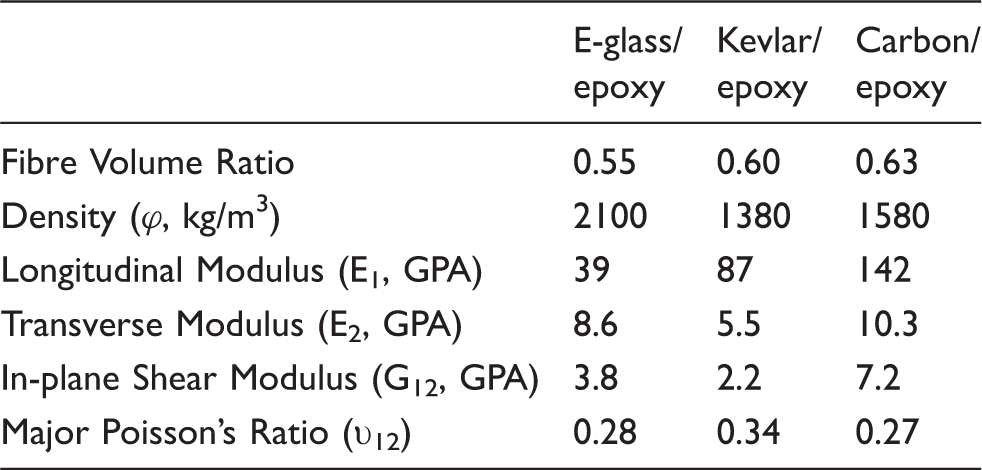
Physical parameters of the composite materials (Seçgin et al., 2009).
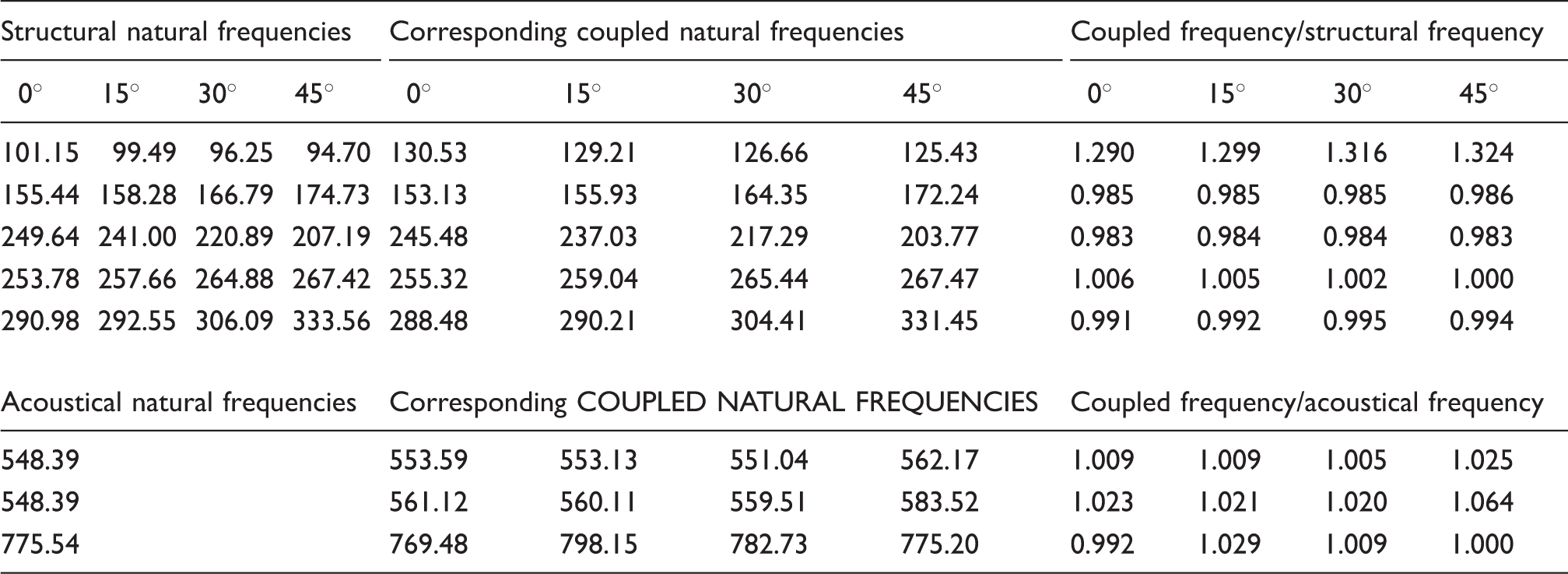
Natural frequencies of three ply E-glass/epoxy plate-cavity system (Hz).
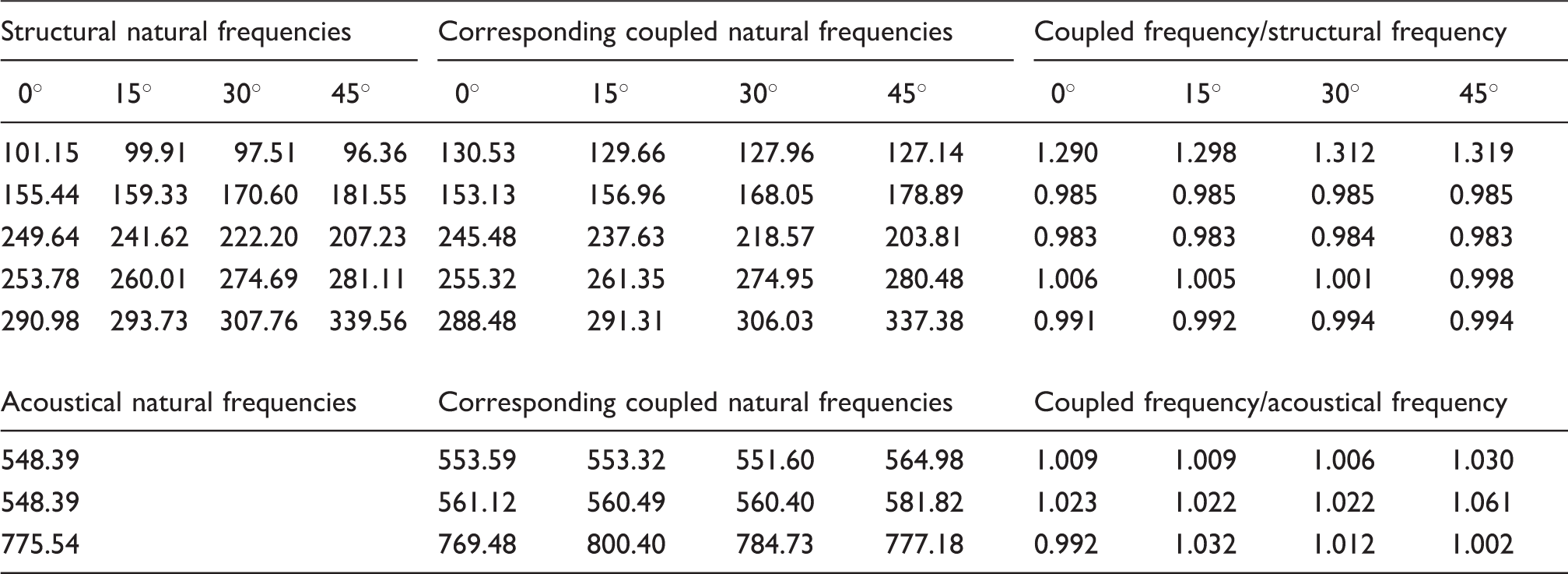
Natural frequencies of four ply E-glass/epoxy plate-cavity system (Hz).
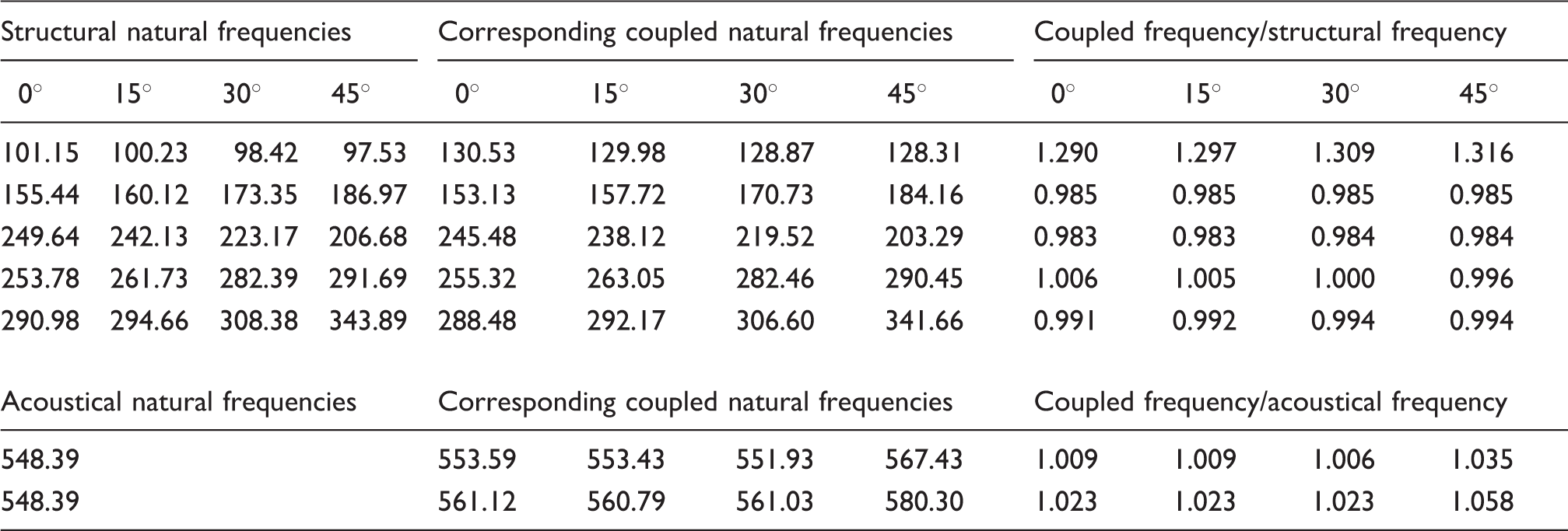
Natural frequencies of five ply E-glass/epoxy plate-cavity system (Hz).
Natural frequencies of three ply Kevlar/epoxy plate-cavity system (Hz).

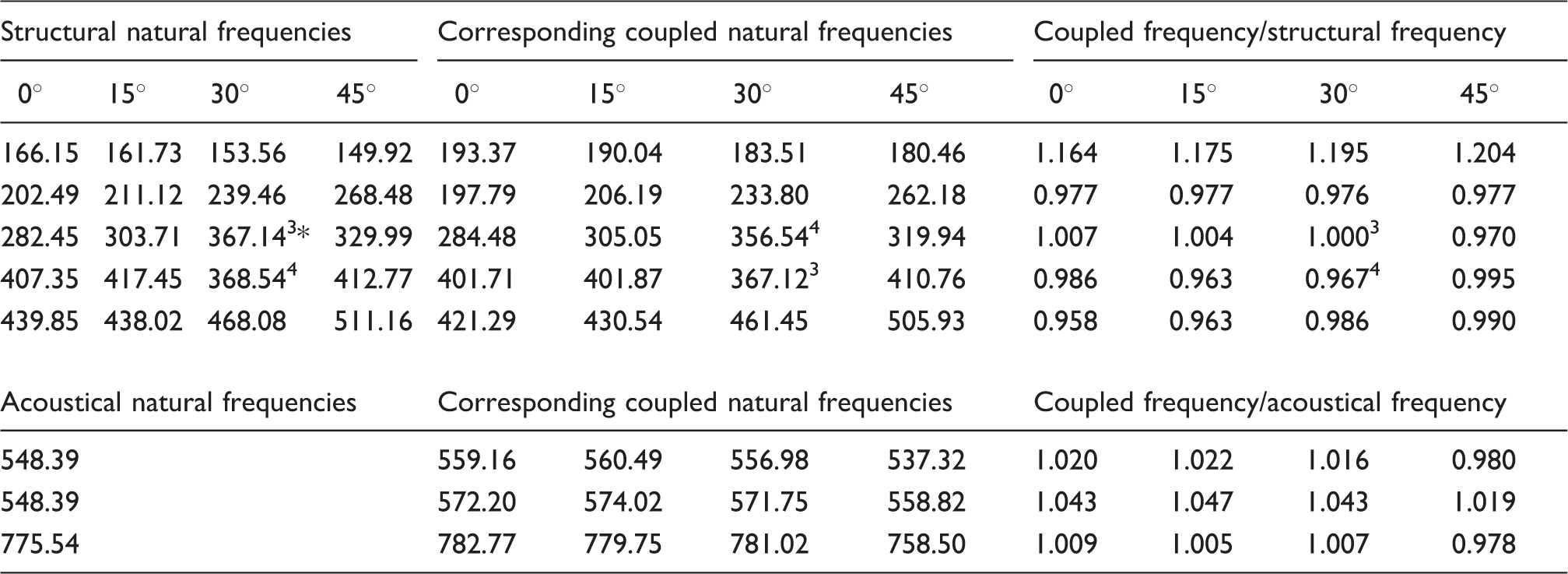
In Tables 3–11, the coupled natural frequencies of the plate-cavity system are presented with uncoupled structural and acoustical natural frequencies. Tables 3–5 are for E-glass/epoxy material with three, four, five layers respectively. Tables 6–8 are for Kevlar/epoxy and Tables 9–11 are for Carbon/epoxy plates with the previous number of layers. These tables include the coupled/uncoupled frequency ratios and reflect the effect of coupling on composite plate-cavity systems. Considering physical parameters of the composite materials, the highlights of the modal response may be summarized as the following.
As it is known, there is a direct proportion between the modulus of elasticity of the structure’s material and its natural frequencies; and an inverse proportion between the density and the frequencies. The same relations are also valid for the coupled natural frequencies. From the point of view of coupling, the dominant parameter is the flexibility of the plate material. Increasing flexibility, raises the influence of the acoustic pressure on the plate and hence the degree of coupling. Therefore as being the most flexible material, E-glass/epoxy has the most coupling effect; whereas the least flexible material Carbon/epoxy has the least effect. The same conclusion has been drawn from the regression analysis presented in Sarıgül and Karagözlü (2014) for the fundamental frequencies. On the other hand, from the viewpoint of the acoustic domain there is a slight change in this trend. The cavity frequencies of Carbon/epoxy system seem to be more affected compared to the others. Another prominent phenomenon come across for the higher coupled frequencies of more rigid materials is that the change of the mode order. Structural modes are numbered in increasing order and this increase is consistent with the increase of nodes, nodal lines, etc. However for some coupled frequencies this consistency may deteriorate. For example, in Table 7 for 30° four ply Kevlar/epoxy plate, frequencies of the 3rd and the 4th structural modes are 367.14 Hz and 368.54 Hz, respectively. In the coupled analysis, the 3rd and the 4th highest frequencies are obtained as 356.54 Hz and 367.12 Hz respectively. However, when the mode shapes at these frequencies given in Figure 3 are examined it is observed that the behaviour of the plate at the coupled frequency 367.12 Hz is the same as that at the 3rd structural frequency 367.14 Hz. Similarly, the mode shape of the plate at the coupled frequency 356.54 Hz is the same as that at the 4th structural frequency 368.54 Hz. Therefore coupled frequencies 356.54 Hz and 367.12 Hz are denoted as the 4th and the 3rd corresponding coupled natural frequencies respectively. The interchanging modes up to the 5th order are marked on the tables presented. Since the cavity has two equal dimensions, acoustical natural frequencies have two repeated values. However this property disappears for the corresponding coupled frequencies due to the asymmetrical fibers. Coupling is more effective on the three ply plates. Increasing the number of layers increases the structural frequency and its coupled counterpart but reduces the coupling effect, for ply angles other than 0°. For 0° however, the natural frequencies are the same for different numbers of ply. The role of the ply angle however is variable and different from the effects of material and number of ply. Since the change of the angle affects the lateral and longitudinal elasticity of the plate in different order, some natural frequencies increase whereas the others decrease. However it can be seen that ply angle positively influences the coupling effect for the fundamental frequency, as 45° angle solutions have maximum frequency ratios. Natural frequencies of four ply Kevlar/epoxy plate-cavity system (Hz). Superscript numbers designate interchanging mode orders in the coupled analysis. Natural frequencies of five ply Kevlar/epoxy plate-cavity system (Hz). Natural frequencies of three ply Carbon/epoxy plate-cavity system (Hz). Superscript numbers designate interchanging mode orders in the coupled analysis. Coupled natural frequencies designated by “-” correspond to a structural natural frequency higher than 5 th mode. Natural frequencies of four ply Carbon/epoxy plate-cavity system (Hz). Superscript numbers designate interchanging mode orders in the coupled analysis. Coupled natural frequencies designated by “-” correspond to a structural natural frequency higher than 5 th mode. Natural frequencies of five ply Carbon/epoxy plate-cavity system (Hz). Superscript numbers designate interchanging mode orders in the coupled analysis. Coupled natural frequencies designated by “-” correspond to a structural natural frequency higher than 5 th mode. Mode shapes of four ply Kevlar/epoxy plate-cavity system. a) 3rd structural, b) 3rd coupled, c) 4th structural and d) 4th coupled modes.


3.3. Comparison of solutions for isotropic and composite plate-systems
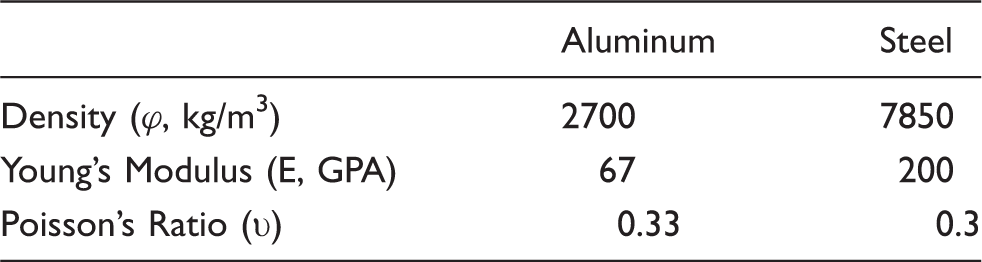
In addition to the comparison among the composite materials a comparative study between composite and isotropic plate systems were carried out. The systems are as given in Figure 2; and for isotropic plate systems linear shell and volume elements were used. Isotropic plates are made of aluminium and steel with physical properties given in Table 12. Composite plates are composed of the three ply with 0° fiber angle. The coupled and uncoupled frequencies of the systems with five different plate materials are presented in Table 13. Coupled/Uncoupled frequency ratios for the first four modes of these plates are also compared in Figure 4. Table 13 and Figure 4 show that:
The coupled fundamental frequencies are higher than the corresponding structural and acoustical frequencies for all materials. In fact, this is a result of the proportion of the plate- cavity dimensions as stated by Pretlove (1965) for the structural frequencies. Aluminium being a lighter and elastic isotropic material compared to steel, its plate-cavity system is more affected from the coupling. For isotropic plate systems, the repeating values of the uncoupled natural frequencies due to the symmetry are preserved in the coupled solution. For composite plates, there is no repetition even for the structural frequencies. The repetition of the acoustical frequencies fail in the coupled frequencies as stated before. Composite plate-cavity systems are highly affected from the coupling compared to isotropic plate systems. Physical parameters of the isotropic materials. Natural frequencies of isotropic and composite plate-cavity systems (Hz). Superscript numbers designate interchanging mode orders in the coupled analysis. Lightly underlined frequencies belong to first acoustical modes and their corresponding coupled modes; and boldly underlined ones to second modes. Comparison of the Coupled/Uncoupled frequency ratios for the first four modes of the plates with different materials.


Consequently, it seems vital to include the structural-acoustic coupling effect for a sensitive vibro-acoustic analysis of composite plate-cavity systems. However, as depicted by Sarıgül and Karagözlü (2014) a regression analysis may quite safely be utilized for the rapid computation of the coupled frequencies.
4. Conclusion
The extensive replacement of materials from isotropic ones to composites has accelerated vibro-acoustic analysis of composite structures. However for long years, it is not sufficient for this trend to comprise thin composite wall-cavity systems that have numerous applications specifically in the transportation sector. It is supposed that this study with limited number of others will serve to fill a gap in this field. The tabulated results and interpretations may be utilized both in academia and industry.
Vibro-acoustic coupled analyses of composite plates with back cavities performed in the present study put forward the following facts:
Plates made up of more elastic materials and less number of layers are more influenced by the presence of cavity. The increase in ply angle has a positive effect on the fundamental coupled frequencies. The consideration of coupling effect and also the inspection of mode shapes have prominence for a reliable vibro-acoustic analysis of these systems. Composite plate-cavity systems display distinct vibro-acoustic characteristics compared to isotropic systems that merit such detailed analyses.
Footnotes
Declaration of Conflicting Interests
The author(s) declared no potential conflicts of interest with respect to the research, authorship, and/or publication of this article.
Funding
The author(s) received no financial support for the research, authorship, and/or publication of this article.