The theory of time scales that can unify and extend continuous and discrete analysis has proved to be more accurate in modeling the dynamic process. The Lie symmetry approach, which is an effective way to deal with different kinds of dynamical equations in a variety of areas of applied science, is to be analyzed on time scales. We begin with the Lie group of point infinitesimal transformations on time scales and its corresponding extensions. And the invariance of dynamical equations on time scales under the infinitesimal transformations is discussed. More specifically, the Lie symmetries for dynamical equations of mechanical systems on time scales including Lagrangian systems on time scales, Hamiltonian systems on time scales, and Birkhoffian systems on time scales are investigated as applications. Thus, the corresponding conserved quantities for mechanical systems on time scales are derived by using the Lie symmetries. Examples are given to illustrate the application of the results.
The analytical method of symmetry is an effective way to search for an invariant solution or first integral which can implement the reduction of order of dynamical equations. The well-known Noether theorem reveals a connection between symmetries and conserved quantities (Noether, 1918). New directions of the applications for Noether theorems such as the fractional dynamical equations (Atanacković et al., 2009; Frederico and Torres, 2007; Zhai and Zhang, 2016), the dynamical equations with time delay (Frederico and Torres, 2012; Jin and Zhang, 2015; Zhai and Zhang, 2014), and the equations derived by the variational problems of Herglotz type (Santos et al., 2015; Zhang, 2016a) can be found. And the method of Noether symmetry which presents the invariance of action under the infinitesimal transformations has been used successfully to find the conserved quantities for dynamical systems on time scales. Bartosiewicz and Torres (2008) used a technique of time-reparameterization to prove the Noether theorem for problems of calculus of variations on time scales. Inspired by this viewpoint, specific applications on constrained mechanical systems on time scales, for example, the nonconservative and nonhonolomic systems on time scales (Cai et al., 2013), the nonconservative systems with time delay on time scales (Zhai and Zhang, 2017), the Hamiltonian systems on time scales (Song and Zhang, 2017; Zhang, 2016b), and the Birkhoffian systems on time scales (Song and Zhang, 2015) have been investigated profoundly.
Moreover, the method of Lie symmetry which presents the invariance of dynamical equations under the infinitesimal transformations is the other important approach in searching for solutions, reducing order or the number of variables, linearizing, etc. and this useful method has been applied in dealing with problems about classical mechanics, quantum mechanics, physics, vibration and control, differential geometry, numerical analysis, etc. (Bluman and Kumei, 1989; Olver, 1986). Lutzky (1979) obtained the Noether-type conserved quantities, which are invariants of Lie symmetry for the second-order dynamical systems under velocity-dependent transformations of the coordinates and time, and the results show that the connection between Noether conserved quantities and dynamical symmetries is not too direct. In addition, the other new type of conserved quantities can also be derived from Lie symmetries. This important result originated from Hojman's (1992) work on the new conserved quantities constructed without using either Lagrangians or Hamiltonians. Mei (1999, 2013) introduced the applications of the Lie group theory to constrained mechanical systems systematically. More profound studies about Lie symmetries for constraint mechanical systems were discussed. The Lie symmetries for the differential equations of motion of the systems in the high dimensional extended phase space were given by Zhang et al. (2000). Zhang (2002) considered that the Lie symmetrical transformations depended on the Birkhoffian variables and derived a set of conserved quantities of the Birkhoffian systems. By using Lie symmetry of the Lagrangian system, Fang (2010) derived a new type of conserved quantity which is different from the Noether-type one and the Hojman conserved quantity directly. For the systems with unilateral holonomic constraints, the Lutzky conserved quantities were obtained by using the velocity-dependent Lie symmetries (Zhang, 2006). Luo et al. (2013) obtained a new conservation law for generalized Hamiltonian systems by using a Lie symmetrical basic integral variable relation. In recent years, this topic is still popular in studying discrete mechanical systems, nonholonomic systems, and the disturbed generalized Birkhoff systems (Han et al., 2013; Jiang et al., 2012; Shi et al., 2008). Also, the Lie symmetry analytic approach has been extended to deal with differential equations with derivatives of fractional order (Baleanu et al., 2018; Fu et al., 2016; Gazizov et al., 2007; Inc et al., 2018; Prakash and Sahadevan, 2017; Sun et al., 2014) which could describe some physical phenomena that depended not only on the time instant but also on the time history. However, the variables of the equations are still considered continuous.
In the recent work of Cai et al. (2017), the Lie symmetries of the nonconservative systems on time scales and the nonholonomic systems on time scales were discussed preliminarily, but the infinitesimal generator vector was given directly. However, according to the recognized results in the literature, the Lie symmetry method is still not sufficiently developed in the time scales version, and therefore specific proofs of Lie symmetries on time scales should be presented.
This paper will present the Lie symmetry analysis in the time scales version, that is, the variables and the extended infinitesimals are defined on time scales which not only allow both continuous case and discrete case into a single version, but also extend to any other cases since that a time scale can be any subset of the real numbers. More precisely, the Lie group of point infinitesimal transformations on time scales is defined and the corresponding extended infinitesimal transformations are derived. Thus, the Lie symmetries of the differential equations of the first order and the second order on time scales are derived. And the applications on mechanical systems on time scales including Lagrangian systems on time scales, Hamiltonian systems on time scales, and Birkhoffian systems on time scales are illustrated to show how the Lie symmetry approach in the time scales version provide an effective way to find the conserved quantity of the differential equations on time scales.
We begin with some basic knowledge about time scales calculus needed in the sequel and present the Lie group of point infinitesimal transformations on time scales as well as the corresponding extensions.
2. Preliminaries on time scales
In this section, we remind the reader of some basic definitions, useful properties, and algorithms about the time scales calculus. Also, we refer the reader to the articles by Bohner and Georgiev (2016) and Bohner and Peterson (2001), and references therein for other discussions and proofs on time scales calculus.
A time scale is an arbitrary nonempty closed subset of the real numbers . For each , the following operators are used.
(a) The forward jump operator, , for all ;
(b) The backward jump operator,, for all ; and
(c) The graininess function, , for all .
The delta derivative of f is denoted as , where . For are delta differentiable at t, are any constant, then the following formulae hold.
(a) ;
(b) ; and
(c)
where we denote by .
Definition 1
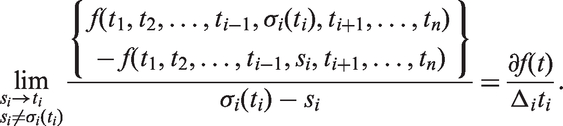
Let be a function. The partial delta derivative of f respect to is defined as the limit
Theorem 1
(The Chain Rule) Let be fixed. Assume
is -completely delta differentiable at the point . If the functions
have delta derivatives at the point , then the composite function
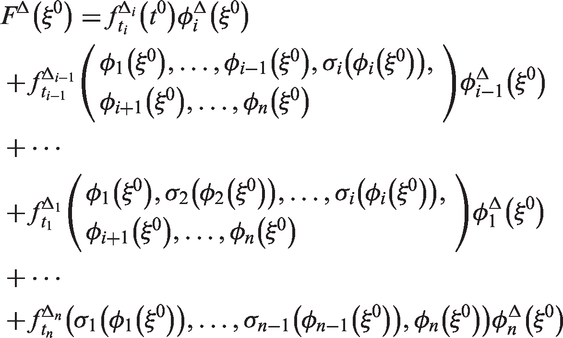
has a delta derivative at that point, which is expressed by the formula
Remark 1
The chain rule on time scales is different from the classical one. For the example of , let and , then we have .
3. Extended infinitesimal transformations on time scales
In this section, we introduce the Lie group of point infinitesimal transformations on time scales and prove the recurrence relation between the extended infinitesimals on time scales. For the classical Lie group of continuous point transformations see Bluman and Kumei (1989) and Olver (1986).
Let us consider a differential equation on time scales which has one independent variable and one dependent variable, namely
where , .
Introduce the one parameter infinitesimal transformations
where ξ and η are infinitesimals and the infinitesimal parameter .
The corresponding infinitesimal generator X is
Definition 2
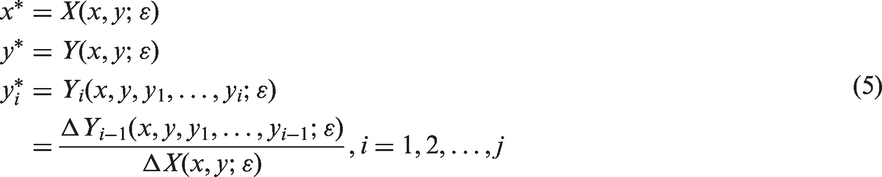
The jth extension of one parameter Lie group of point transformations on time scales can be defined as
where , and Δ is the total delta derivative operator and .
Hence the jth extended transformations can be expressed as
where are extended infinitesimals.
And the infinitesimal generator X reads
Theorem 2
The jth extended infinitesimal on time scales satisfies the following recurrence relation
Proof
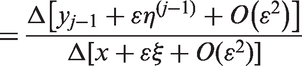
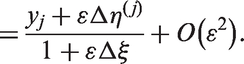
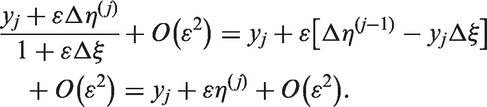
We have by Definition 2 and equations (5) and (7)
By performing Taylor series expansion at the point , then we get
The proof is complete.
Remark 2
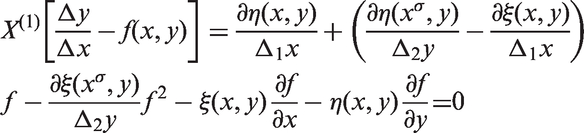
If the differential equation of the first order on time scales
is invariant under the transformation equations (2) and (3), namely
then equation (11) is the conformal invariant corresponding to equation (10), where is the conformal factor. Moreover, we have by equation (7)
From equation (12), we have by retaining the first-order infinitesimal of ɛ
Equation (13) is the determining equation for the infinitesimal transformations on time scales.
Remark 3
If the differential equation of the second order on time scales
is invariant under the transformation equations (2) and (3), we have by equation (7)
From equation (15), we have by retaining the first-order infinitesimal of ɛ
Equation (16) is the determining equation for the infinitesimal transformations on time scales.
4. Lie symmetry analysis for mechanical systems on time scales
In this section, we study the Lie symmetry for differential equations of motion for mechanical systems on time scales including Lagrangian systems on time scales, Hamiltonian systems on time scales, and Birkhoffian systems on time scales. And the determining equations are derived respectively. By applying the Lie symmetries, corresponding conserved quantities for mechanical systems on time scales are derived respectively.
4.1. Lie symmetry for Lagrangian systems on time scales
The Hamilton action on time scales can be expressed as
According to the Hamilton principle on time scales
which satisfies the relations
and the boundary conditions
The differential equations of motion for Lagrangian systems on time scales can be derived as
where is Lagrangian and the generalized coordinates . This result can be found in the article by Bohner (2004).
Here, assume that the system is nonsingular, namely
and by equation (21), we have
The one parameter infinitesimal transformations of group of time t and generalized coordinates are
where and are infinitesimals and the infinitesimal parameter .
The corresponding infinitesimal generator X is
the first extended infinitesimal generator is
and the second extended infinitesimal generator is
From Remark 2, we know that the invariance of the equation (23) under the transformation equations (24) and (25) can be expressed as
namely
Equation (30) is the determining equation of the Lie symmetries for equation (21) under the infinitesimal transformation equations (24) and (25) on time scales.
Theorem 3
If the infinitesimals and of the infinitesimal transformation equations (24) and (25) satisfy the determining equation (30) and there exists with a gauge function such that
then the Lie symmetries of the Lagrangian system lead to conserved quantity of the form
Proof
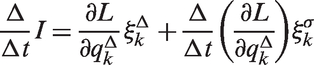
According to the definition of the conserved quantity, we have
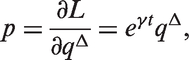
By using the Euler–Lagrange equation (21) and the following energy equation (Bartosiewicz et al., 2010)
then we have
We complete the proof.
Remark 4
Let , then , , equation (21) becomes the classical Euler–Lagrange equation
and the Lie symmetries of the Lagrangian system equation (21) lead to the classical conserved quantity
Remark 5
Let , then , , equation (21) becomes the discrete Euler–Lagrange equation
and one obtains the conserved quantity of the discrete form
where .
Example 1
Considering the Kepler problem on time scales , the Lagrangian of planar motion is
The equations of motion are
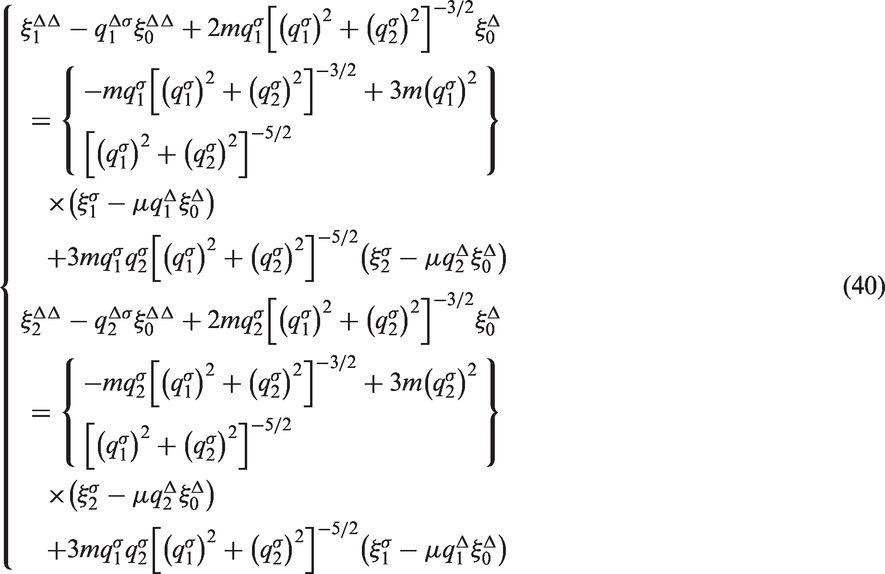
The determining equation (30) of the Lie symmetries under the infinitesimal transformation equations (24) and (25) on time scales gives
The infinitesimals
and
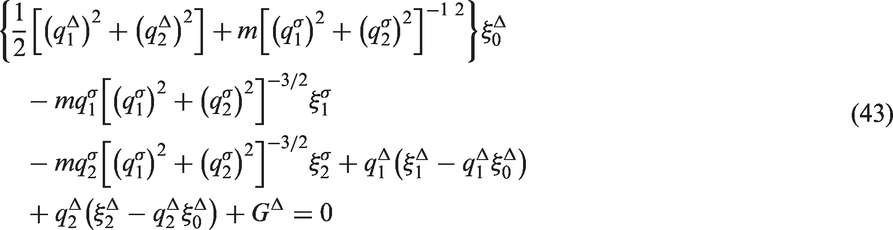
satisfy the determining equation (40). The infinitesimals equations (41) and (42) are corresponding to the Lie symmetric transformation. And the equation (31) gives
then we can find the gauge function with respect to the infinitesimals equations (41) and (42).
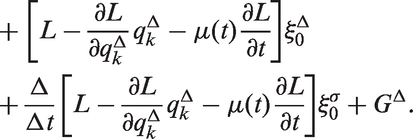
According to Theorem 1, we can find the conserved quantities of the system. The equation (32) gives
and
4.2. Lie symmetry for Hamiltonian systems on time scales
The Hamilton action in phase space on time scales can be expressed as
According to the Hamilton principle equation (18) on time scales, the Hamilton canonical equations on time scales can be expressed as
Here, we introduce the one parameter infinitesimal transformations of group
where , and are infinitesimals and the infinitesimal parameter .
The corresponding infinitesimal generator X is
and the first extended infinitesimal generator is
The invariance of the equations (47) under the transformation equations (50)–(52) can be expressed as
namely
Equations (57) and (58) are the determining equations of the Lie symmetries for equations (47) under the infinitesimal transformation equations (50)–(52) on time scales.
Theorem 4
If the infinitesimals , and of the infinitesimal transformation equations (50)–(52) satisfy the determining equations (57) and (58) and there exists with a gauge function such that
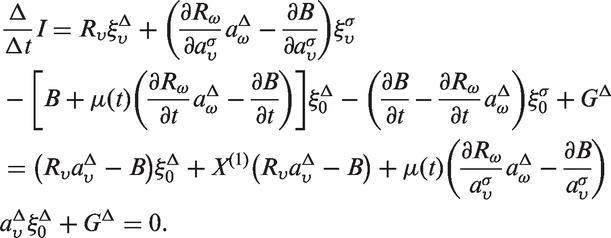
then the Lie symmetries of the Hamiltonian system lead to conserved quantity of the form
Proof
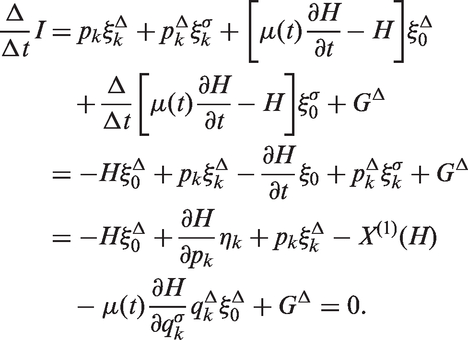
The I is a conserved quantity of the system. Namely, the equation
holds.
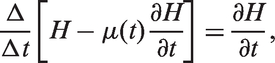
Actually, by using the transformation equation (49) and the energy equation (33), we get
then we have
We complete the proof.
Remark 6
Let , equation (47) becomes the classical the Hamilton canonical equation
and the Lie symmetries of the Hamiltonian system equation (47) lead to the classical conserved quantity
Remark 7
Let , where is constant and , , equation (47) becomes the discrete Hamilton canonical equation
and one obtains the conserved quantity of the discrete form
Example 2
Let us study the Lie symmetry and the conserved quantity of the linear vibration system on time scales , the equation of which is
where is constant and , .
The Lagrangian of the system can be expressed as
Then we can derive
The determining equations (57) and (58) of the Lie symmetries under the infinitesimal transformation equations (50)–(52) on time scales give
The infinitesimals
and
satisfy the determining equation (68). The infinitesimals equations (69) and (70) are corresponding to the Lie symmetric transformation. And the equation (59) gives
then we can find the gauge function with respect to the infinitesimals equation (69) and with respect to the infinitesimals equation (70).
According to Theorem 2, we can find the conserved quantities of the system. The equation (60) gives
and
4.3. Lie symmetry for Birkhoffian systems on time scales
The Birkhoffian system in which the Birkhoff's equations and the Pfaff–Birkhoff principle are two important keys is a kind of more general dynamic system than Hamiltonian system. Profound applications in statistical mechanics, quantum mechanics, atomic and molecular physics, and biological physics can be found (Santilli, 1983) .
The Pfaff–Birkhoff action on time scales can be expressed as
According to the Pfaff–Birkhoff principle on time scales, the Birkhoff's equations on time scales can be derived, that is
and is Birkhoffian and are Birkhoff's functions. This result can be found in the article by Song and Zhang (2015).
If we take
Then we can get the Hamilton action equation (46) and the Hamilton canonical equation (47).
Here, we introduce the one parameter infinitesimal transformations of group
where and are infinitesimals and the infinitesimal parameter .
The corresponding infinitesimal generator X is
and the first extended infinitesimal generator is
The invariance of the equation (75) under the transformation equations (77) and (78) can be expressed as
Equation (81) is the determining equation of the Lie symmetries for equation (75) under the infinitesimal transformation equations (77) and (78) on time scales.
Theorem 5
If the infinitesimals , of the infinitesimal transformation equations (77) and (78) satisfy the determining equation (81) and there exists with a gauge function such that
then the Lie symmetries of the Birkhoffian system leads to conserved quantity of the form
Proof
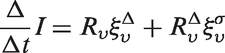
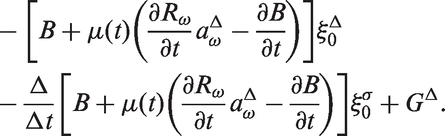
According to the definition of the conserved quantity, we have
Similar to the energy equation (33), we have
Then we get
We complete the proof.
Remark 8
Let , equation (75) becomes the classical Birkhoffian equation
and the Lie symmetries of the Birkhoffian system equation (75) lead to the classical conserved quantity
Remark 9
Let , where is constant and , , equation (75) becomes the Birkhoff's equation of the quantum form
and one obtains the conserved quantity of the quantum form
Example 3
Let and the Birkhoffian and Birkhoff's functions are
The equation of the system is
Similarly, for the system equation (89), we can choose the infinitesimals
which satisfy both the equations (81) and (82). Therefore, the conserved quantity of the system is
5. Conclusions
Because of the complexities of time scales, many problems in the time scales version such as the symmetries on time scales, the properties of dynamical equations on time scales, and corresponding solving methods, etc. are in the preliminary stage.
In this paper, we introduced a one parameter () Lie group of point infinitesimal transformations on time scales in which the infinitesimal generators were in classical definitions and proved the recurrence relation equation (9) between the extended infinitesimals on time scales which plays an important role in studying symmetries. Thus, the Lie symmetries for the first-order differential equation on time scales and the second-order differential equation on time scales were analyzed and its applications on finding Lie symmetries for Lagrange equations on time scales, Hamilton canonical equations on time scales, and Birkhoff's equations on time scales were illustrated. By using the obtained Lie symmetries, we derived conserved quantities of the above dynamical equations on time scales respectively. The results of this paper are universal: the continuous case (), the discrete case , the quantum case , and any other cases can be naturally obtained because of the unification and extension of the time scales calculus.
It is worth mentioning that the conserved quantities we obtained were Noether-type. The discussion on the nonNoether-type conserved quantities, such as the Hojman-type conserved quantity, remains an interesting aspect. Other symmetries, for instance, Mei symmetry, symmetry of Lagrangians, and symmetry of Birkhoffians are worthy of further investigation.
Moreover, the symmetry theory on time scales is worthy of further development in many other interesting research fields, such as the infinite horizon optimal control problems (Jajarmi et al., 2011), the nonlinear large-scale optimal control problems (Jajarmi et al., 2012), and the controllable mechanical system. Corresponding numerical methods also require further study.
Over the course of this study, a discrete analogue of fractional differential equations should be discussed because of the difficulty of solving those equations. Therefore, the research trends also require further study about the fractional differential equations on time scales and corresponding symmetry analysis.
Footnotes
Declaration of Conflicting Interests
The author(s) declared no potential conflicts of interest with respect to the research, authorship, and/or publication of this article.
Funding
The author(s) disclosed receipt of the following financial support for the research, authorship, and/or publication of this article: This work is supported by the National Natural Science Foundation of China (Grant Numbers 11572212 and 11272227).
References
1.
AgarwalRPBohnerMO'ReganDet al.(2002) Dynamic equations on time scales: A survey. Journal of Computational and Applied Mathematics141(1–2): 1–26.
2.
AhlbrandtCDBohnerMRidenhourJ (2000) Hamilton systems on time scales. Journal of Mathematical Analysis and Applications250(2): 561–578.
3.
AkhmetMFenMO (2015) Li–Yorke chaos in hybrid systems on a time scale. International Journal of Bifurcation and Chaos25(14): 411–416.
4.
AlmeidaRTorresDFM (2008) Isoperimetric problems on time scales with nabla derivatives. Journal of Vibration and Control15(6): 951–958.
5.
AtanackovićTMKonjikSPilipovićSet al.(2009) Variational problems with fractional derivatives: Invariance conditions and Nöther's theorem. Nonlinear Analysis71(5-6): 1504–1517.
6.
BaleanuDIncMYusufAet al.(2018) Lie symmetry analysis, exact solutions and conservation laws for the time fractional Caudrey–Dodd–Gibbon–Sawada–Kotera equation. Communications in Nonlinear Science and Numerical Simulations59: 222–234.
7.
BartosiewiczZTorresDFM (2008) Noether's theorem on time scales. Journal of Mathematical Analysis and Applications342(2): 1220–1226.
8.
BartosiewiczZMartinsNTorresDFM (2010) The second Euler–Lagrange equation of variational calculus on time scales. European Journal of Control17(1): 9–18.
9.
BlumanGWKumeiS (1989) Symmetries and Differential Equations, New York, NY: Springer-Verlag.
10.
BohnerM (2004) Calculus of variations on time scales. Dynamic Systems and Applications13(12): 339–349.
11.
BohnerMGeorgievSG (2016) Multivariable Dynamic Calculus on Time Scales, Cham, Switzerland: Springer International Publishing.
12.
BohnerMMartynyukAA (2007) Elements of Lyapunov stability theory for dynamic equations on time scale. International Applied Mechanics43(9): 949–970.
13.
BohnerMPetersonA (2001) Dynamic Equations on Time Scale: An Introduction with Applications, Boston, MA: Birkhäuser.
14.
CaiPPFuJLGuoYX (2013) Noether symmetries of the nonconservative and nonholonomic systems on time scales. Science China Physics, Mechanics and Astronomy56(5): 1017–1028.
15.
CaiPPFuJLGuoYX (2017) Lie symmetries and conserved quantities of the constraint mechanical systems on time scales. Reports on Mathematical Physics79(3): 279–298.
16.
ChenAChenF (2009) Periodic solution to BAM neural network with delays on time scales. Neurocomputing73(1–3): 274–282.
17.
ErbeLPetersonA (2002) Oscillation criteria for second-order matrix dynamic equations on a time scale. Journal of Computational and Applied Mathematics141(1–2): 169–185.
18.
FangJH (2010) A new type of conserved quantity of Lie symmetry for the Lagrange system. Chinese Physics B19(4): 040301-1–040301-4.
19.
FredericoGSFTorresDFM (2007) A formulation of Noether's theorem for fractional problems of the calculus of variations. Journal of Mathematical Analysis and Applications334(2): 834–846.
20.
FredericoGSFTorresDFM (2012) Noether's symmetry theorem for variational and optimal control problems with time delay. Numerical Algebra Control and Optimization2(3): 619–630.
21.
FuJLFuLPChenBYet al.(2016) Lie symmetries and their inverse problems of nonholonomic Hamilton systems with fractional derivatives. Physics Letters A380(1–2): 15–21.
22.
GardTHoffackerJ (2003) Asymptotic behavior of natural growth on time scales. Dynamic Systems and Applications121(1): 131–148.
23.
GazizovRKKasatkinAALukashchukSY (2007) Continuous transformation groups of fractional differential equations. Vestnik USATU 93(21): 125–135.
24.
HanYLWangXXZhangMLet al.(2013) Special Lie symmetry and Hojman conserved quantity of Appell equations for a Chetaev nonholonomic system. Nonlinear Dynamics73(1–2): 357–361.
25.
HilgerS (1988) Ein Maßkettenkalkül mit Anwendung auf Zentrumsmannigfaltigkeiten. [A dimensional chain calculus with application to center manifolds]. PhD Thesis, Universtät Würzburg, Germany [In German.].
26.
HojmanSA (1992) A new conservation law constructed without using either Lagrangians or Hamiltonians. Journal of Physics A: General Physics25(7): L291–L295.
27.
IncMYusufAAliyuAIet al.(2018) Lie symmetry analysis, explicit solutions and conservation laws for the space–time fractional nonlinear evolution equations. Physica A: Statistical Mechanics and Its Applications496(3): 371–383.
28.
JajarmiAParizNEffatiSet al.(2011) Solving infinite horizon nonlinear optimal control problems using an extended modal series method. Journal of Zhejiang University SCIENCE C (Computers & Electronics)12(8): 667–677.
29.
JajarmiAParizNEffatiSet al.(2012) Infinite horizon optimal control for nonlinear interconnected large-scale dynamical systems with an application to optimal attitude control. Asian Journal of Control14(5): 1239–1250.
30.
JiangWLiLLiZet al.(2012) Lie symmetrical perturbation and a new type of non-Noether adiabatic invariants for disturbed generalized Birkhoffian systems. Nonlinear Dynamics67(2): 1075–1081.
31.
JinSXZhangY (2015) Noether theorem for non-conservative systems with time delay in phase based on fractional model. Nonlinear Dynamics82(1–2): 663–676.
32.
LuoSKLiZJPengWet al.(2013) A Lie symmetrical basic integral variable relation and a new conservation law for generalized Hamiltonian systems. Acta Mechanica224(1): 71–84.
33.
LutzkyM (1979) Dynamical symmetries and conserved quantities. Journal of Physics A: General Physics12(7): 973–981.
34.
MeiFX (1999) Applications of Lie Groups and Lie Algebras to Constrained Mechanical Systems, Beijing, China: Science Press.
35.
MeiFX (2013) Analytical Mechanics II, Beijing, China: Beijing Institute of Technology Press.
36.
Noether AE (1918) Invariante variationsprobleme [Invariant variation problems]. Nachrichten von der Akademie der Wissenschaften zu Göttingen Mathematisch-Physikalische Klasse pp.235–257. [In German.].
37.
OlverPJ (1986) Application of Lie Groups to Differential Equations, New York, NY: Springer-Verlag.
38.
PrakashPSahadevanR (2017) Lie symmetry analysis and exact solution of certain fractional ordinary differential equations. Nonlinear Dynamics89(1): 305–319.
39.
Santilli RM (1983) Foundations of Theoretical Mechanics II. New York, NY: Springer-Verlag.
40.
SantosSPSMartinsNTorresDFM (2015) Variational problems of Herglotz type with time delay: DuBois–Reymond condition and Noether's first theorem. Discrete and Continuous Dynamical Systems35(9): 4593–4610.
41.
ShiSYFuJLChenLQ (2008) The Lie symmetries and Noether conserved quantities of discrete non-conservative mechanical systems. Chinese Physics B17(2): 385–389.
42.
SongCJZhangY (2015) Noether theorem for Birkhoffian systems on time scales. Journal of Mathematical Physics56(10): 102701-1–102701-9.
43.
SongCJZhangY (2017) Conserved quantities for Hamiltonian systems on time scales. Applied Mathematics and Computation313(3): 24–36.
44.
SunYChenBYFuJL (2014) Lie symmetry theorem of fractional nonholonomic systems. Chinese Physics B23(11): 110201-1–110201-7.
45.
TisdellCCZaidiA (2008) Basic qualitative and quantitative results for solutions to nonlinear, dynamic equations on time scales with an application to economic modelling. Nonlinear Analysis, Theory, Methods and Applications68(11): 3504–3524.
46.
ZhaiXHZhangY (2014) Noether symmetries and conserved quantities for Birkhoffian systems with time delay. Nonlinear Dynamics77(1–2): 73–86.
47.
ZhaiXHZhangY (2016) Noether symmetries and conserved quantities for fractional Birkhoffian systems with time delay. Communications in Nonlinear Science and Numerical Simulation36(1): 81–97.
48.
ZhaiXHZhangY (2017) Noether theorem for non-conservative systems with time delay on time scales. Communications in Nonlinear Science and Numerical Simulation52(1): 32–43.
49.
ZhangJFanMZhuH (2010) Periodic solution of single population models on time scales. Mathematical and Computer Modelling52(3): 515–521.
50.
ZhangY (2002) A set of conserved quantities from Lie symmetries for Birkhoffian systems. Acta Physica Sinica51(3): 461–464.
51.
ZhangY (2006) Lutzky conserved quantities and velocity-dependent symmetries for systems with unilateral holonomic constraints. Acta Physica Sinica55(5): 2109–2114.
52.
ZhangY (2016a) Generalized variational principle of Herglotz type for nonconservative system in phase space and Noether's theorem. Chinese Journal of Theoretical and Applied Mechanics48(6): 1382–1389.
53.
ZhangY (2016b) Noether theory for Hamiltonian system on time scales. Chinese Quarterly of Mechanics37(2): 214–224.
54.
ZhangYShangMMeiFX (2000) Symmetries and conserved quantities for systems of generalized classical mechanics. Chinese Physics9(6): 401–407.