







Abstract
This paper investigates the small- and large-amplitude vibrations of thermally postbuckled graphene-reinforced composite (GRC) laminated plates resting on elastic foundations. The piecewise GRC layers are arranged in a functionally graded (FG) pattern along the thickness direction of the plate. The anisotropic and temperature-dependent material properties of the FG-GRC layers are estimated through the extended Halpin–Tsai micromechanical model. Based on the Reddy's higher order shear deformation plate theory and the von Kármán strain–displacement relationships, the motion equations of the plates are derived. The foundation support, the thermal effect, and the initial deflection caused by thermal postbuckling are also included in the derivation. A two-step perturbation approach is applied to determine the thermal postbuckling equilibrium paths as well as the nonlinear vibration solutions for the FG-GRC laminated plates. The numerical illustrations concern small- and large-amplitude vibration characteristics of thermally postbuckled FG-GRC laminated plates under a uniform temperature field. The effects of graphene reinforcement distributions and foundation stiffnesses on the vibration responses of FG-GRC laminated plates are examined in detail.
Keywords
1. Introduction
Composite laminated plates are widely used in the aerospace industry owing to their specific higher strength-to-weight and stiffness-to-weight ratios. These plates may be subjected to mechanical and/or thermal loadings. This may lead to postbuckling of the plate where the plate deflection is in the order of the plate thickness. It is well known that the thermal postbuckling equilibrium path of a plate under a uniform temperature field is stable. Hence, the vibration response of a thermally postbuckled plate subjected to a uniform or nonuniform temperature rise is an important problem for engineering design. The geometrically nonlinear vibration characteristics of thermally postbuckled isotropic/anisotropic laminated plates were studied by Yang and Han (1983), Librescu et al. (1996a, 1996b), Librescu and Lin (1997), Lee and Lee (1997a, 1997b), Oh et al. (2000), Girish and Ramachandra (2005a, 2005b), Fazzolari and Carrera (2013) and Samadpour et al. (2015). Thermally postbuckled plates made of functionally graded (FG) metal/ceramic composite were studied by Park and Kim (2006), Xia and Shen (2008), and Taczala et al. (2016), whereas thermally postbuckled plates made of FG carbon nanotube-reinforced composite (CNTRC) were investigated recently by Fan and Wang (2016), Shen and Wang, (2017), and Fazzolari (2018). A comprehensive survey of these studies can be found in Shen and Wang (2017).
Many studies have been carried out on the thermal postbuckling of FG material (FGM) plates and FG-CNTRC plates subjected to thermal loading (Bouderba et al., 2016; El-Haina et al., 2017; Menasria et al., 2017). However, as in the case of simply supported asymmetric cross-ply laminated plates, due to the stretching–bending coupling effect the bifurcation buckling temperature does not exist for the simply supported FGM and FG-CNTRC plates subjected to uniform or nonuniform temperature rise unless the FGM or FG-CNTRC plate is geometrically mid-plane symmetric (Shen, 2007; Shen and Zhang, 2010); otherwise the results may be physically incorrect (Javaheri and Eslami, 2002; Wu, 2004; Ganapathi and Prakash, 2006; Bodaghi and Saidi, 2010; Talha and Singh, 2011).
As pointed out by Alijani et al. (2011), Huang and Shen (2004) were the pioneers in studying the nonlinear vibrations of thick FG plates. Gupta and Talha (2017) studied the nonlinear vibrations of geometrically imperfect FG plates. The main difference for the initial deflection caused by geometric imperfection and by thermal postbuckling is that the initial geometric imperfection is usually assumed to be a constant in the whole large deflection region, whereas the initial deflection caused by thermal postbuckling varies in the thermal postbuckling region as the temperature rises.
Graphene possesses exceptional mechanical, thermal, and electrical properties which enable graphene sheets to be considered as ideal reinforcement materials for creating high performance nanocomposites. Researchers have reported that the material properties of graphene sheets are anisotropic and temperature dependent (Reddy et al., 2006; Giannopoulos and Kallivokas, 2014; Ni et al., 2010; Shen et al., 2010). Ni et al. (2010) observed anisotropic mechanical properties for a graphene sheet along different load directions. Reddy et al. (2006) confirmed that graphene behaves like an orthotropic material; in particular the shear modulus is much lower than that of a graphene when it is treated as an isotropic material. Shen et al. (2010) found that the Young's modulus of a single layer graphene sheet decreases with increasing in temperature, whereas the shear modulus of the graphene sheet depends weakly on temperature variation. Graphene sheets can be aligned in polymer matrix to achieve better reinforcement as reported by Zhao et al. (2010) and Liang et al. (2011). Yousefi et al. (2014) obtained highly aligned graphene/polymer nanocomposites by an all aqueous casting method. It is well known that the physical interactions between graphene and polymer matrix are weak due to graphene's perfect bonding structure among its carbon atoms. Therefore, the load transfer efficiency between graphene and polymer matrix in nanocomposites is relatively low (Milani et al., 2013). When comparing with carbon fiber reinforced composites which may contain more than 60% volume fraction of carbon fibers, the volume fraction of graphene reinforcement in nanocomposites may only reach about 21% (Putz et al., 2010) and further increase of the volume fraction of graphene reinforcement may actually lead to the deterioration of the mechanical properties of the nanocomposites (Milani et al., 2013). Motivated by the idea of FGM, Shen et al. (2017a, 2017b) introduced the concept of FG graphene-reinforced composite (GRC) in which aligned graphene sheets are functionally distributed in a piecewise pattern to improve the mechanical properties and obtain the desired response of the structures. Shen et al. (2017a, 2017b) confirmed that FG-GRC thermal postbuckling equilibrium paths of FG-GRC laminated plates are stable, and the frequency-amplitude curves of FG-GRC laminated plates are hardening type. In their analysis, the graphene sheets are assumed to be aligned and oriented in the matrix layer-by-layer and the anisotropic and temperature-dependent material properties of the GRC are estimated by the extended Halpin–Tsai model which contains the graphene efficiency parameters. Song et al. (2017) and Wu et al. (2017) proposed a transverse isotropic multilayer model for the linear vibration and thermal buckling analyses of graphene platelet-reinforced composite (GPLRC) beams with each layer being isotropic but having different GPL weight fraction. In their analyses, the GPLs are assumed to be randomly oriented and uniformly dispersed in the matrix, and the material properties are assumed to be temperature independent. The equivalent isotropic Young's modulus of the GPLRC is obtained by using the modified Halpin–Tsai model, where two homogenization weight coefficients 3/8 and 5/8 are used. Note that the GPL should have aspect ratio l GPL /w GPL = 5/3 when this equivalent isotropic model is adopted, otherwise the results may be incorrect (Gholami and Ansari, 2018; Reddy et al., 2018; Sahmani et al., 2018). Following the works of Shen et al. (2017a, 2017b), Kiani (2018a, 2018b) studied the thermal postbuckling and nonlinear vibration of graphene reinforced laminated plates based on the first order shear deformation plate theory.
In the current study, small- and large-amplitude free vibration analyses are presented for a thermally postbuckled GRC laminated plate under a uniform temperature field and resting on an elastic foundation. We consider that the plate is of the graphene reinforcement either uniformly distributed (UD) or functionally graded (FG) in a piecewise pattern. The anisotropic and temperature-dependent material properties of GRCs are obtained by the extended Halpin–Tsai model which contains the graphene efficiency parameters estimated by matching the Halpin–Tsai model results against the elastic moduli of GRCs from the molecular dynamics (MD) simulations. The Reddy's higher order shear deformation plate theory is employed to derive the motion equations of the GRC laminated plate which take into consideration of the von Kármán-type nonlinear strain–displacement relationships, the initial thermal deflection caused by thermal postbuckling and the plate-foundation interaction. The motion equations can be separated into two sets of nonlinear equations which may be solved in sequence. From the first set of nonlinear equations, we will obtain the thermal postbuckling deflection that will serve as initial thermal deflection of the plate for the nonlinear vibration analysis. Thereafter, we need to solve a nonlinear vibration problem of an initially deflected plate to determine the nonlinear frequencies in the prebuckling and postbuckling states.
2. Large-amplitude vibration of postbuckled plates
We consider a rectangular plate of length a, width b, and thickness h under thermal environmental conditions. The plate consists of N plies with each ply being a mixture of graphene reinforcement and polymer matrix and having different graphene volume fraction. The graphene reinforcement is either zigzag (refer to as 0-ply) or armchair (refer to as 90-ply). The origin of the rectangular coordinate system is set at the corner of the plate on the middle plane. The plate rests on an elastic foundation. As is customary (Lue et al., 2009; Bakhadda et al., 2018), the foundation is assumed to be the Pasternak-type elastic foundation which provides not only a support in the normal direction, but also a shear layer support between the plate and the foundation. The interaction force p0 between the plate and the foundation can be obtained by
The plate is assumed to be subjected to a transverse dynamic load q in a uniform temperature field. Based on the Reddy's higher order shear deformation plate theory (Reddy, 1984) with the von Kármán-type of kinematic nonlinearity, the motion equations for a GRC laminated plate can be expressed by
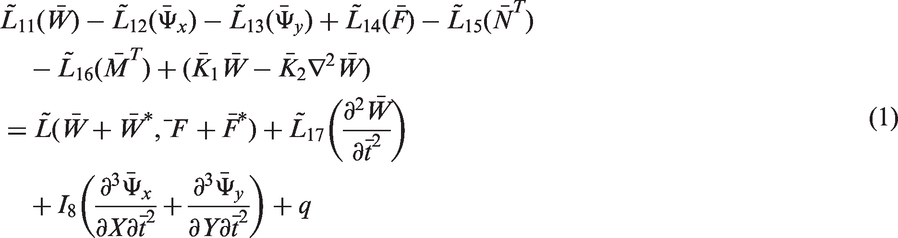




In the above equations,
The plate–foundation interaction is included in the terms associated with




Several micromechanical models have been developed to predict the effective material properties of GRCs, e.g. the Mori–Tanaka model (García-Macías et al., 2018), the Voigt model (rule of mixture) (Sperling, 2006), and the Halpin–Tsai model (Halpin and Kardos, 1976). The Mori–Tanaka model is applicable to microparticles and the rule of mixture model is suitable for the fiber fillers. The Halpin–Tsai model was developed for two-dimensionally aligned anisotropic fillers. It has been reported that in nanoscale these three models cannot predict the effective material properties of GRCs accurately and should be modified (Hu et al., 2014). Following Shen et al. (2017a, 2017b), the effective material properties of the GRCs can be predicted by the extended Halpin–Tsai model:






Due to the surface effects, strain gradients effect and intermolecular effect, in nanoscale the GRC mechanical properties cannot be directly estimated by the conventional Halpin–Tsai model. Therefore, we introduce the efficiency parameters
In the current study, the material properties of both the graphene sheet and the matrix will be considered to be temperature dependent (Lin et al., 2017). The thermal expansion coefficients in the longitudinal and transverse directions of the GRC layer are defined as



Similarly, the mass density ρ of the GRC layer is given by

All four edges of the GRC laminated plates are assumed to be simply supported with in-plane immovable, i.e. no in-plane displacements in the X- and Y-directions. For such a plate, the boundary conditions can be given by
X = 0, a:



Y = 0, b:



The conditions expressing the in-plane immovability conditions (14c) and (14f) are fulfilled on the average sense as


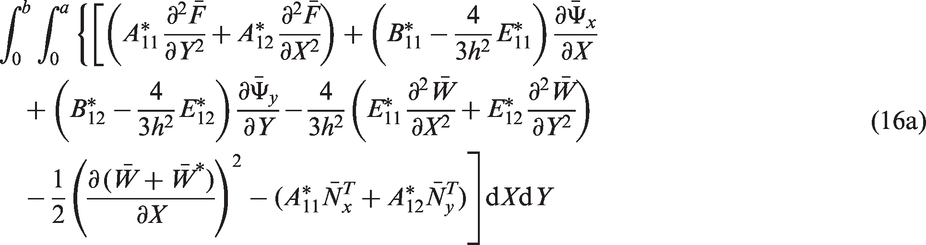
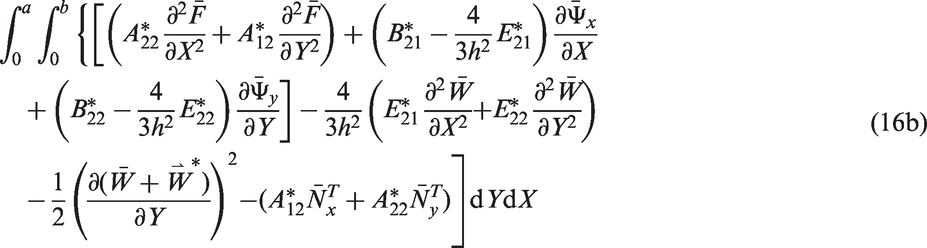
In the above equations, the reduced stiffness matrices [
3. Solution procedure
Many different methods are used to solve the nonlinear problems of FG plate structures (Lai et al., 2009; Civalek, 2013; Zhu et al., 2014; Kiani, 2018a, 2018b). A two-step perturbation technique has been developed for nonlinear analysis of beam, plate and shell structures (Shen, 2013). This approach gives explicit analytical expressions of all the variables in the large deflection region. The advantage of this method is that it is unnecessary to guess the forms of solutions which can be obtained step by step, and such solutions satisfy both the governing equations and the boundary conditions accurately in the asymptotic sense. To use this two-step perturbation approach, the motion equations (1)–(4) are first rewritten in the dimensionless forms as




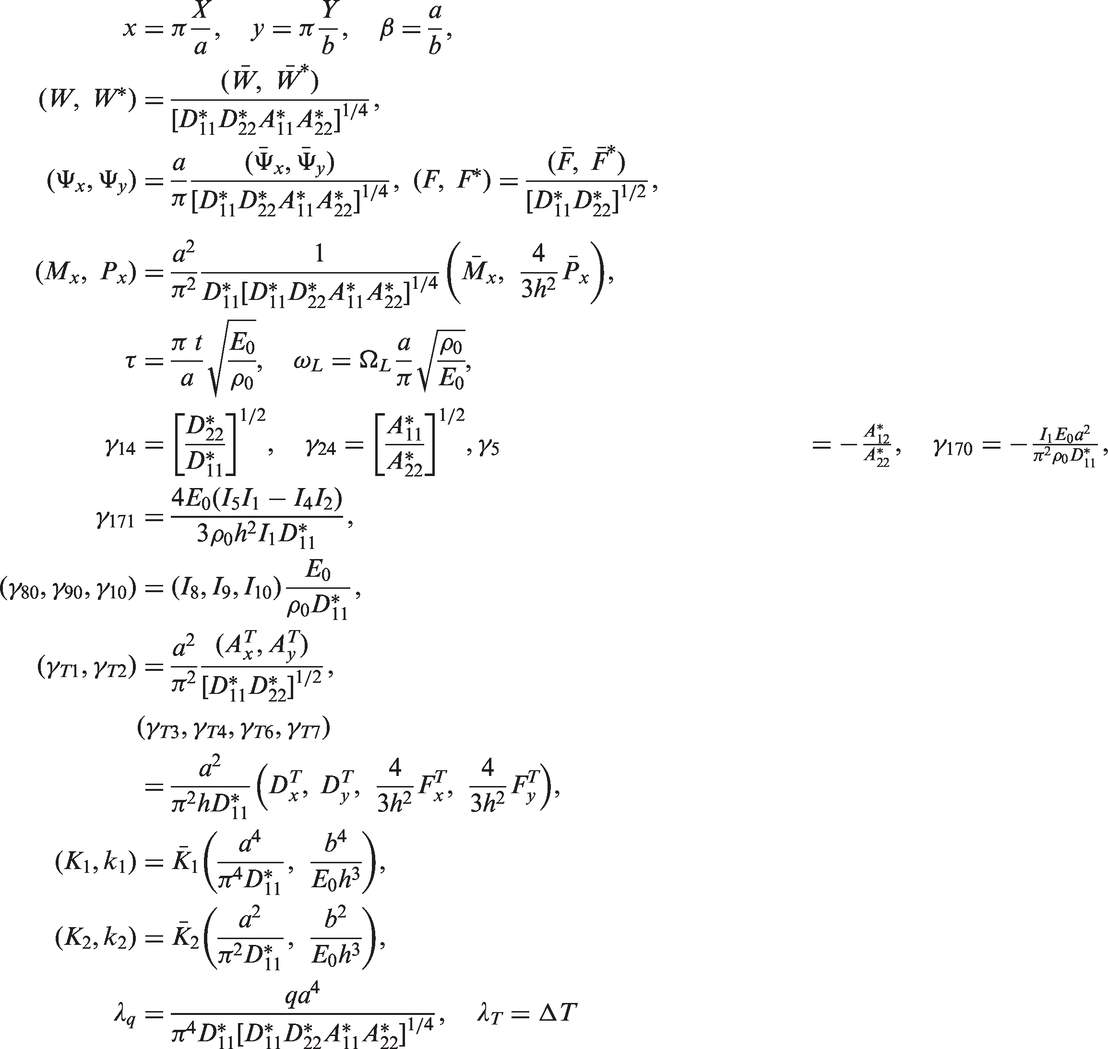

The boundary conditions of equation (14) become
x = 0, π:



y = 0, π:



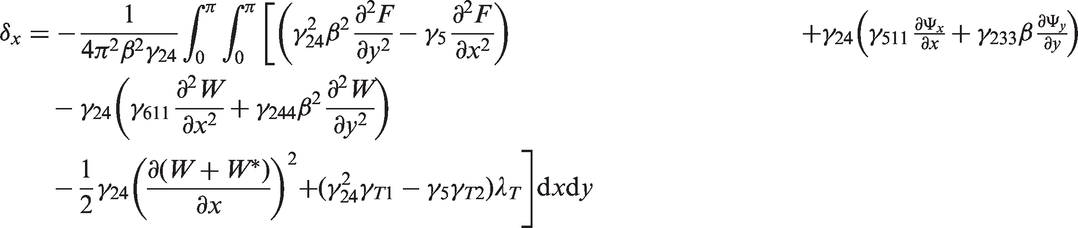
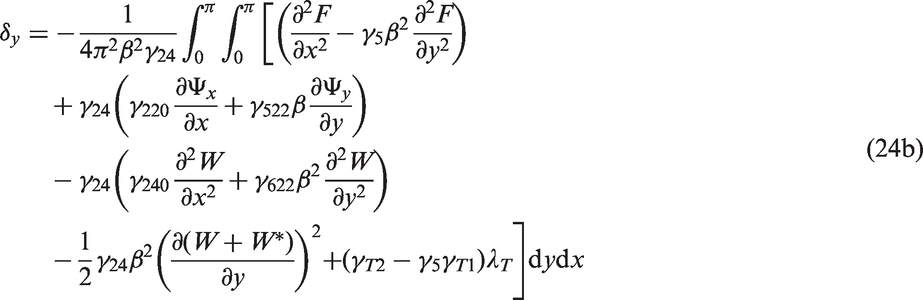
In equations (17), (18), (24a), and (24b),
Thereafter, a large-amplitude vibration problem for a thermally postbuckled plate needs to be solved. We assume the solution of equations (17)–(20) to be such that
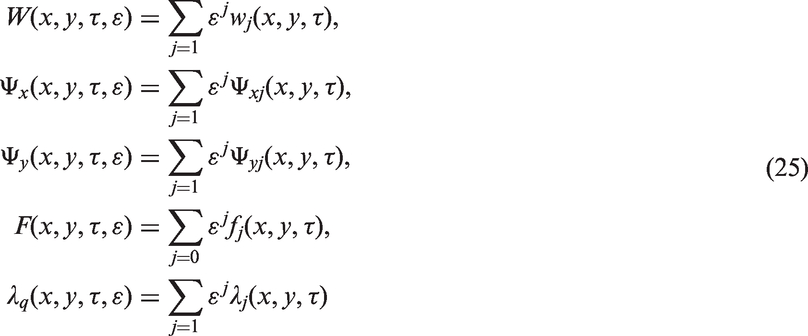


Substituting equation (25) into equations (17)–(20), collecting the terms of the same order of ɛ, we obtain a set of perturbation equations. Applying equation (26) as the first step solution to the perturbation equations, the fourth order asymptotic solutions can be obtained step by step:

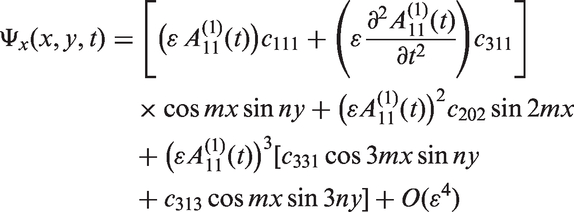
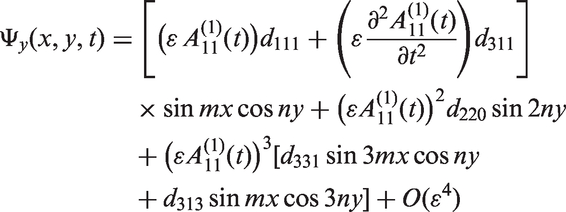
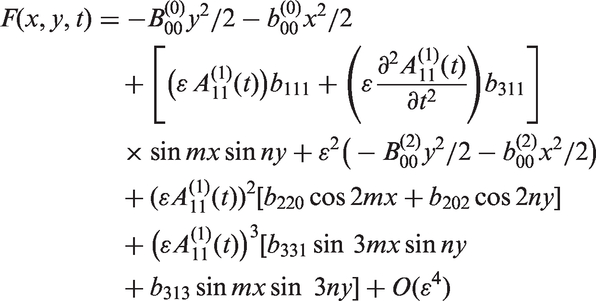
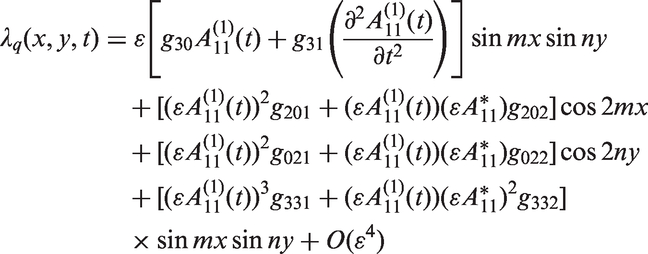
Note that equation (32) contains (

In equation (33), the terms g30, g31, g32, and g34 are described in detail in Appendix B, and the solution of which may be expressed by



4. Numerical results and discussions
The thermal postbuckling and large-amplitude vibration behaviors are presented in this section for GRC laminated plates resting on elastic foundations under a uniform temperature field. Poly(methyl methacrylate), referred to as PMMA, is selected for the matrix, and the material properties of PMMA are assumed to be ρ
m
= 1150 kg/m3, ν
m
= 0.34, α
m
= 45(1 + 0.0005ΔT) × 10−6/K, and E
m
= (3.52−0.0034T) GPa, where T = T0 + ΔT and T0 = 300 K (room temperature). Hence, we have α
m
= 45.0 × 10⁻⁶/K and E
m
= 2.5 GPa when T = 300 K. The zigzag (refer to as 0-ply) graphene sheets with ρ
G
= 4118 kg/m3 and effective thickness h
G
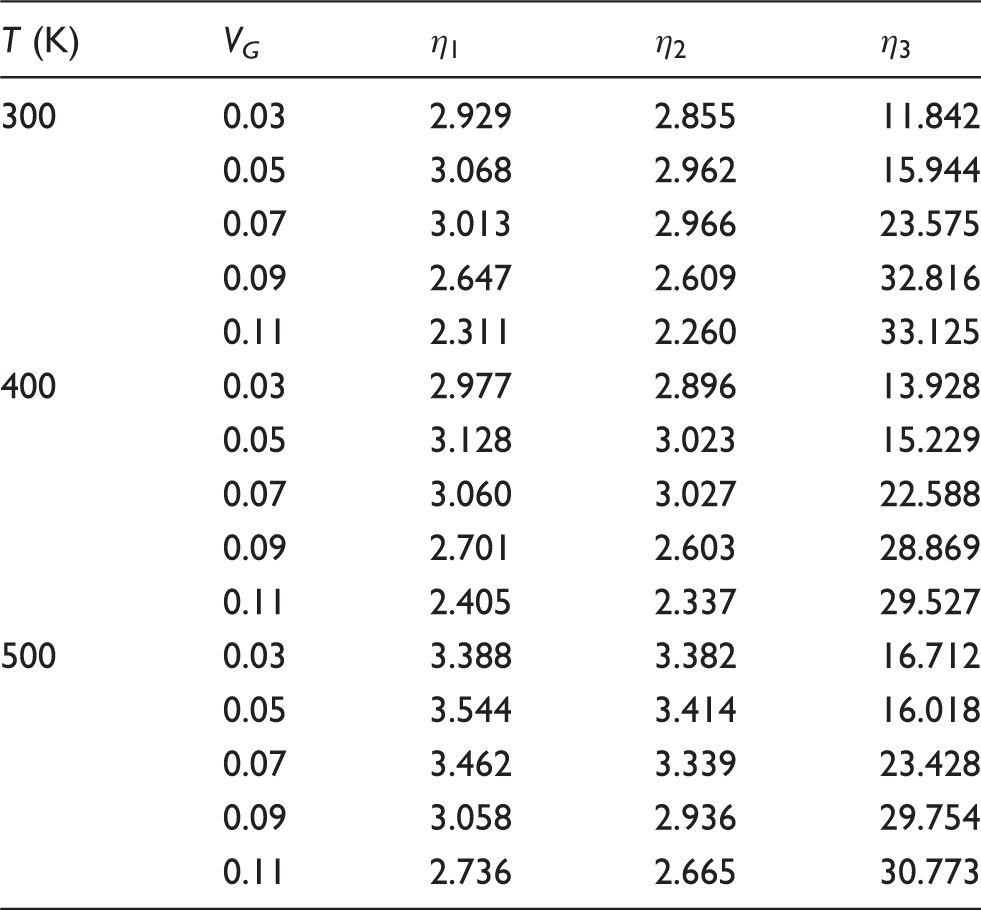
= 0.188 nm are selected as reinforcements. The temperature-dependent material properties of zigzag graphene sheets are adopted as previously reported in Lin et al. (2017). The variation of thermomechanical properties of zigzag graphene sheets with respect to temperature within 300 ≤ T ≤ 1000 are as follows:

Temperature-dependent efficiency parameters of graphene/PMMA nanocomposites.
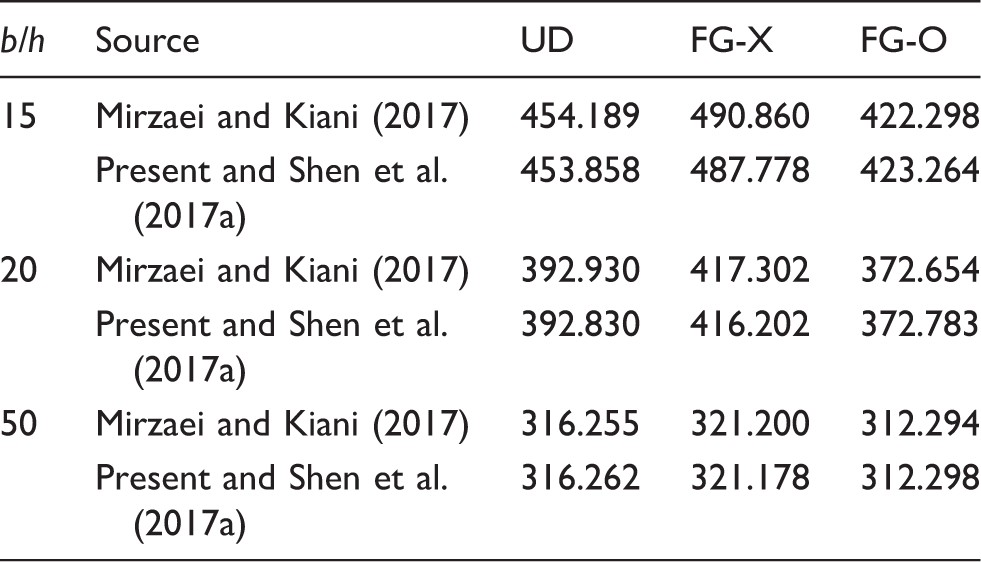
Comparisons of buckling temperatures Tcr (in K) for perfect, (0/90/0/90/0)S GRC plates under a uniform temperature field [a/b = 1, h = 2 mm, (m, n) = (1, 1)].
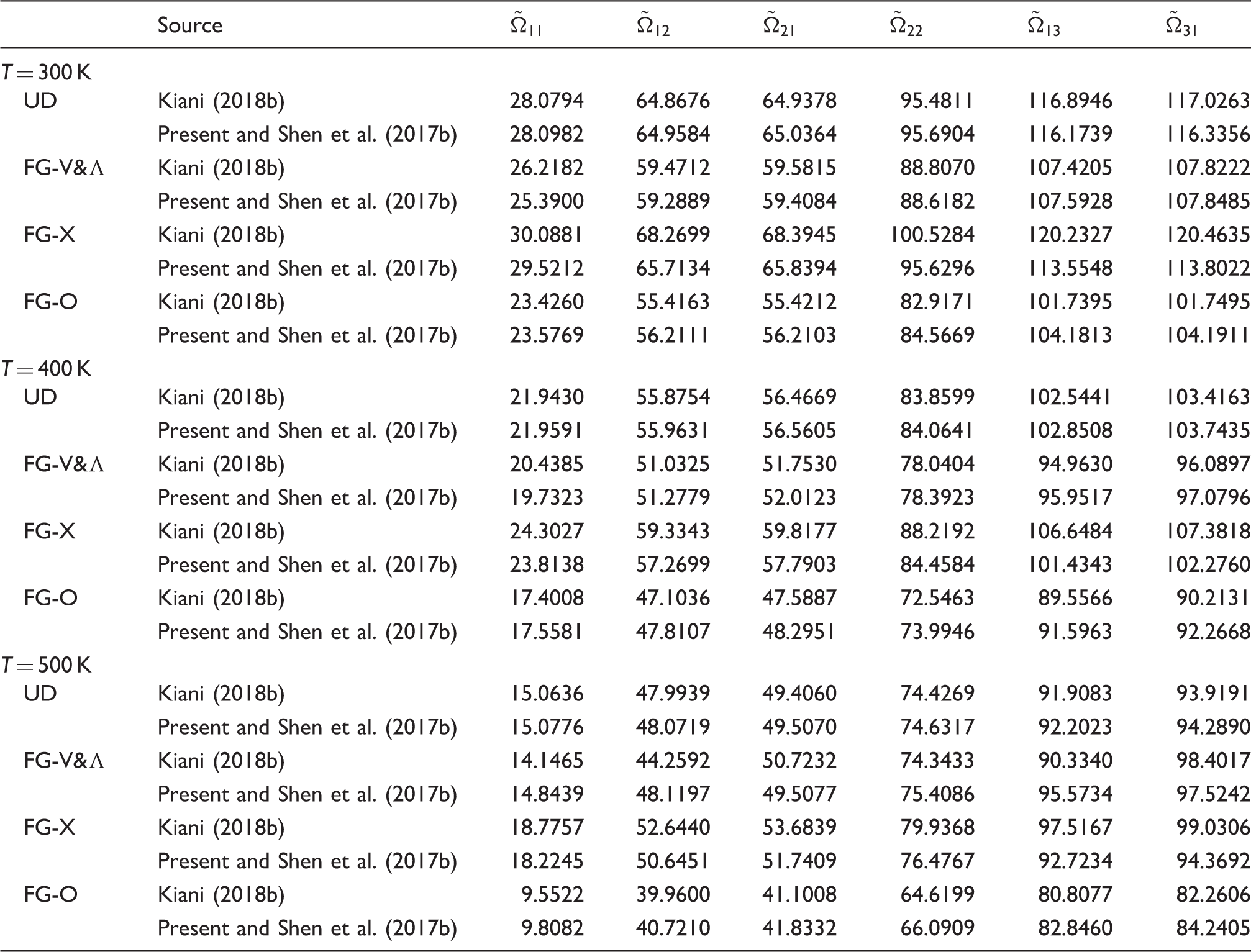
Comparisons of natural frequency
After validating the present formulation and the method of solution, parametric studies have been carried out. Typical results are shown in Figures 1–6. For the following examples, the geometric parameters of the plate are taken to be a/b = 1, h = 2 mm, and b/h = 20, 30, and 40. In the present analysis, only two types of FG-GRC laminated plates, namely FG-O and FG-X, are considered. It has been reported that GRCs may contain the volume fraction of graphene reinforcement by up to 21% (Putz et al., 2010). The maximum volume fraction of graphene reinforcement in a GRC layer is 11% in the current study. The FG-O GRC laminated plate has a mid-plane symmetric graded distribution of graphene reinforcements [0.03/0.05/0.07/0.09/0.11]S, while the FG-X GRC laminated plate has the reversed graphene distributions [0.11/0.09/0.07/0.05/0.03]S. The UD GRC laminated plate has ten GRC layers with the same graphene volume fraction V
G
= 0.07. In such a way, the UD and the two FG GRC laminated plates will have the same value of total volume fraction of graphene reinforcement.
Thermal postbuckling load–deflection curves of (0/90/0/90/0)S GRC laminated plates of three types of graphene reinforcement distributions. Thermal postbuckling load–deflection curves of FG-X (0/90/0/90/0)S GRC laminated plates with different values of b/h ratio.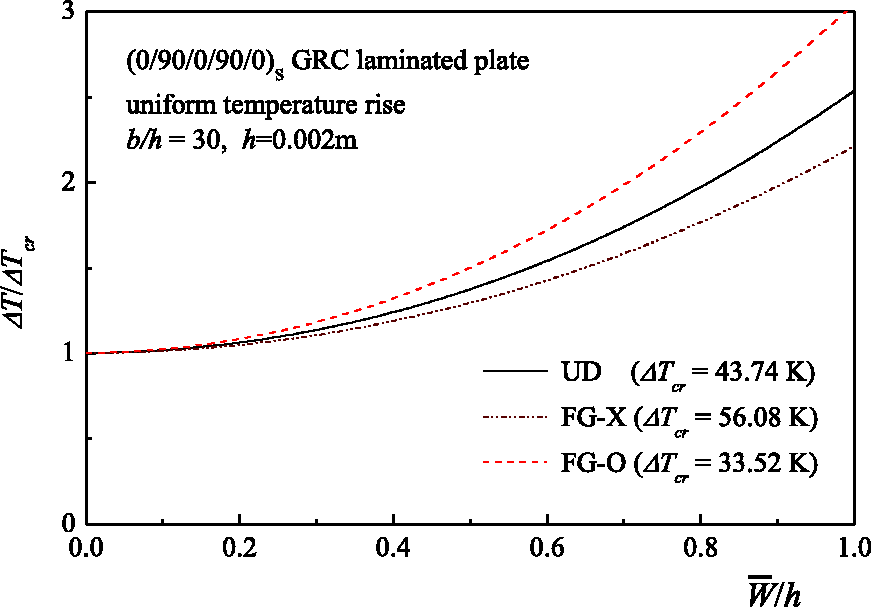
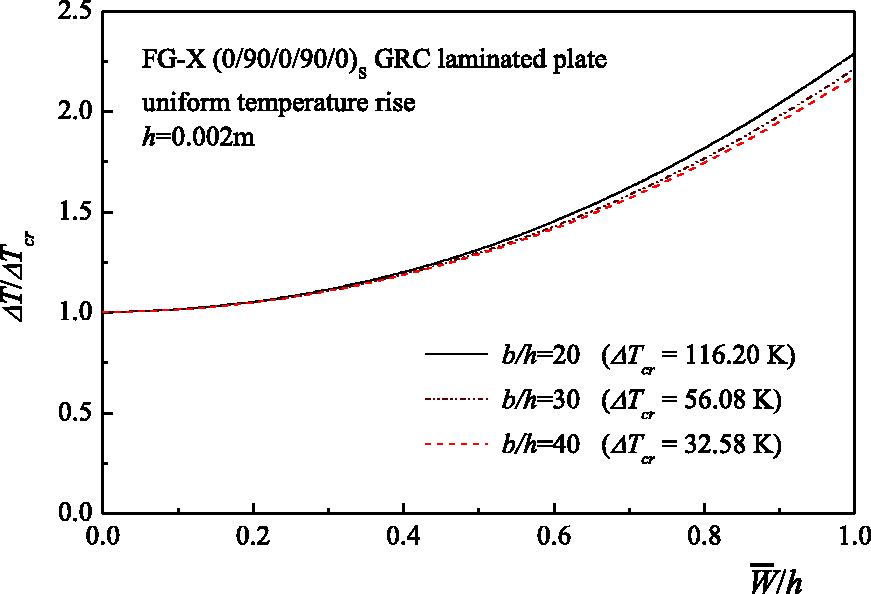
Figures 1–3 present the nondimensional thermal postbuckling equilibrium paths of (0/90/0/90/0)S GRC laminated plates resting on or without elastic foundations and in a uniform temperature field. It is worth noting that the material properties are assumed to be functions of temperature, and the temperature is also assumed to be an unknown in the thermal postbuckling analysis, hence, an iterative scheme is necessary to obtain the numerical results as previously shown in Shen (2001). It can be observed that the thermal postbuckling load–deflection curves for all cases in Figures 1–3 show stable equilibrium paths with buckling mode of m = 1 which enables us to determine the temperatures and the deflections of the postbuckled plates that will be used as inputs for the nonlinear vibration analysis of thermally postbuckled GRC laminated plates. It is worth noting that, unlike in Shen (2017a), three dimensionless thermal postbuckling load-deflection curves in each figure have opposite orders as those shown in Shen (2017a).
Thermal postbuckling load–deflection curves of FG-X (0/90/0/90/0)S GRC laminated plates supported by elastic foundations.
Figure 4(a) presents the linear fundamental frequencies Vibration of thermally buckled (0/90/0/90/0)S GRC laminated plates of three types of graphene reinforcement distributions: (a) linear frequencies; (b) nonlinear to linear frequency ratio ωNL/ω0.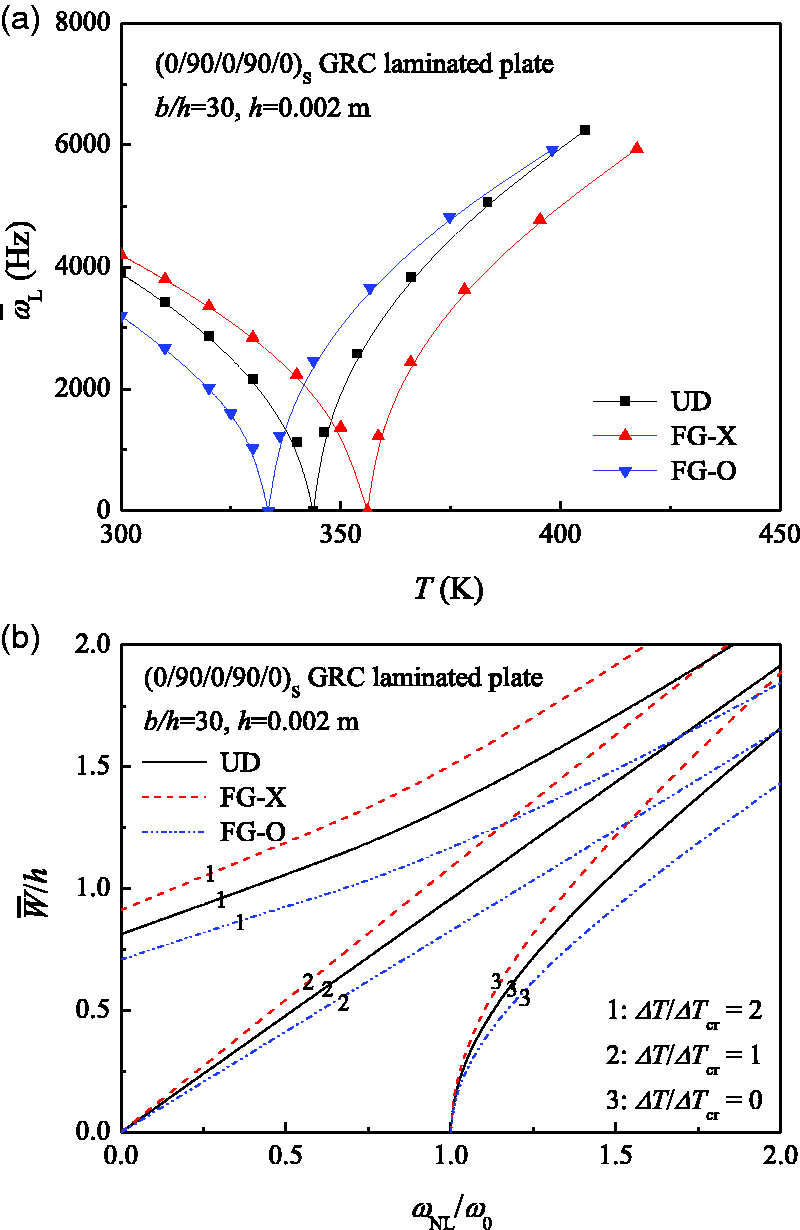
Figure 5 depicts the effect of the plate width-to-thickness ratio b/h ( = 20, 30, and 40) on the linear fundamental frequencies The effect of b/h ratio on the vibration characteristics of thermally buckled FG-X (0/90/0/90/0)S GRC laminated plates: (a) linear frequencies; (b) nonlinear to linear frequency ratio ωNL/ω0. The effect of foundation stiffness on the vibration characteristics of thermally buckled FG-X (0/90/0/90/0)S GRC laminated plates: (a) linear frequencies; (b) nonlinear to linear frequency ratio ωNL/ω0.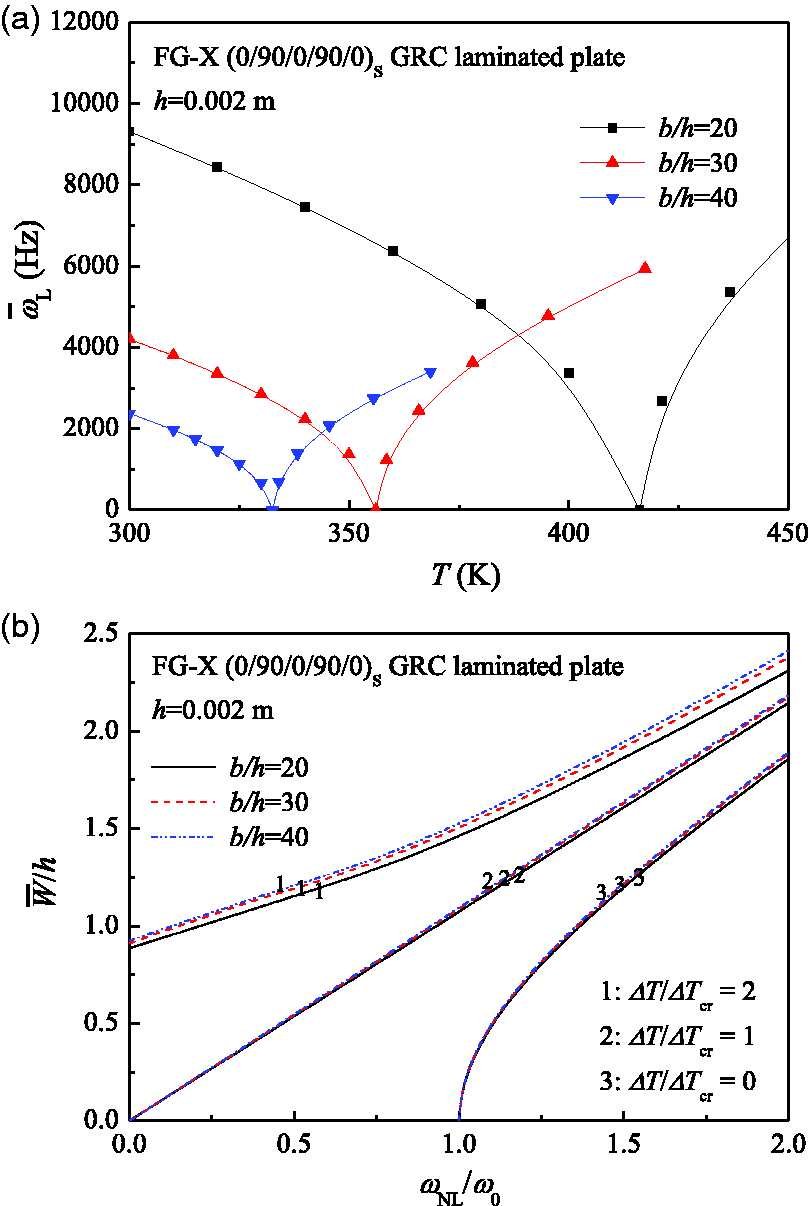
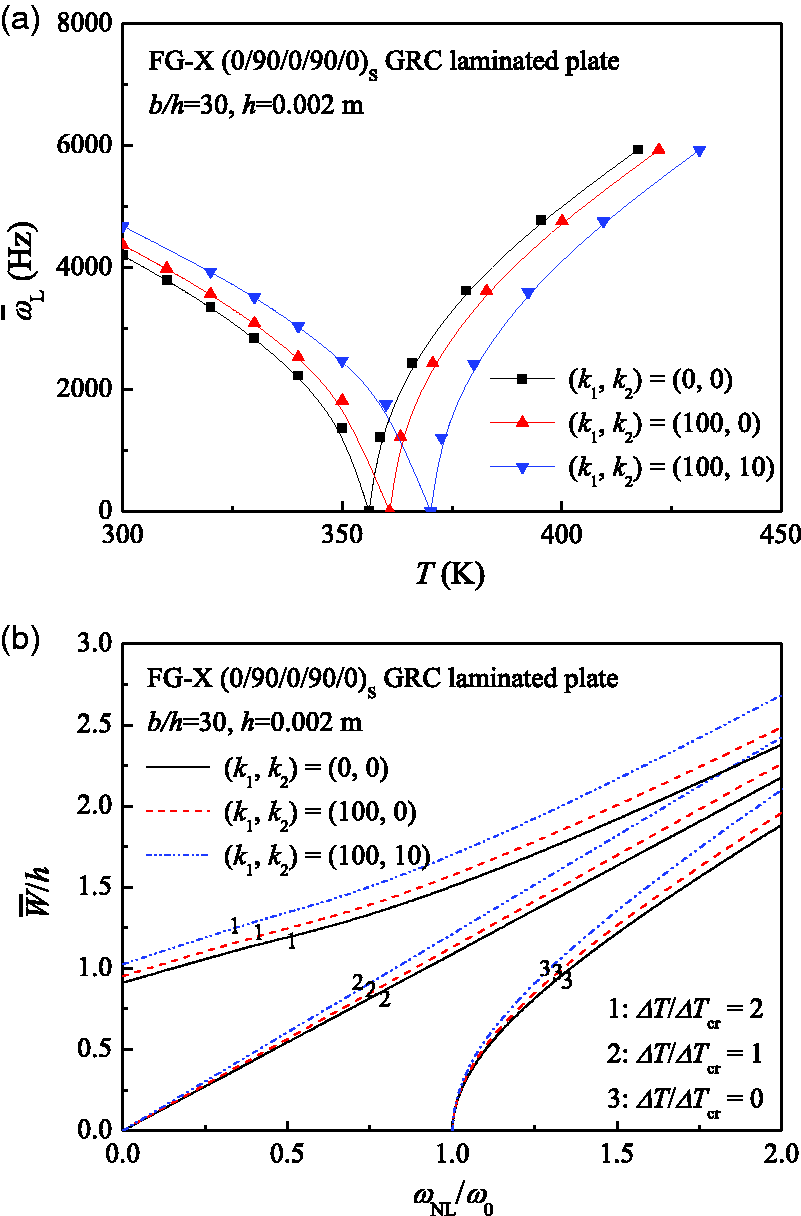
The influence of foundation stiffness on the linear fundamental frequencies
5. Concluding remarks
Small- and large-amplitude vibration characteristics for thermally postbuckled GRC laminated plates have been investigated using a multi-scale approach. The volume fraction of graphene in each ply may be different, which results in a piecewise FG-GRC plate. The extended Halpin–Tsai model is adopted to estimate the anisotropic and temperature-dependent material properties of GRCs. The novelty of this study is that the temperature-dependent material properties and initial deflections caused by the thermal postbuckling are both taken into account, and such an initial deflection is not a constant in the large-amplitude vibration region. Numerical illustrations have been carried out for UD, FG-O, and FG-X GRC laminated plates with low graphene volume fractions. The buckling temperature, thermal postbuckling equilibrium path and temperature-dependent frequency for FG GRC laminated plates are obtained. We observe that the fundamental frequencies of the GRC laminated plates are increased but the nonlinear to linear frequency ratios of the GRC laminated plates are decreased with increase in foundation stiffness. The results show that the plate width-to-thickness ratio has a significant effect on the fundamental frequencies, but has a weak effect on the frequency-amplitude curves in both prebuckling and postbuckling states. The results confirm that a piecewise FG reinforcement distribution has a significant effect on the nonlinear vibration characteristics of thermally postbuckled GRC laminated plates.
Footnotes
Acknowledgement
The authors are very grateful for financial support.
Declaration of Conflicting Interests
The author(s) declared no potential conflicts of interest with respect to the research, authorship, and/or publication of this article.
Funding
The author(s) disclosed receipt of the following financial support for the research, authorship, and/or publication of this article: This work was supported by the National Natural Science Foundation of China (grant number 51779138) and the Australian Research Council (grant number DP140104156).