






Abstract
This paper presents an analytical model to embed porous materials in a finite cylindrical shell in order to obtain the sound transmission loss coefficient. Although the circumferential modes are considered only for calculating the amount of the transmitted noise through an infinitely long cylinder, the present study employs the longitudinal modes in addition to circumferential ones to analyze the vibroacoustic performance of a simply supported cylinder subjected to the porous core based on the first order shear deformation theory. To achieve this goal, the structure is immersed in a fluid and excited by an acoustic wave. In addition, the acoustic pressures and the displacements are developed in the form of double Fourier series. Since these series consist of infinite modes, it is essential to terminate this process by considering adequate modes. Hence, the convergence checking algorithm is employed in the form of some three-dimensional configurations with respect to length, frequency and radius. Afterwards, some figures are plotted to confirm the accuracy of the present formulation. In these configurations, the obtained sound transmission loss from the present study is compared with that of the infinite one. It is shown that by increasing the length of the structure, the results are approached to sound transmission loss of the infinite shells. Moreover, a new approach is proposed to show the transverse displacement of a finite poroelastic cylinder at different frequencies. Based on the outcomes, it is found that by enhancing the length of the poroelastic cylinder, the amount of the transmitted sound into the structure is reduced at the high frequency domain. However, the sound insulation property of the structure is improved at the low frequency region when the radius of the shell is decreased.
Keywords
1. Introduction
In recent years, the application of the sandwich structures in various engineering industries including aerospace, marine and automotive has been increased. Hence, many authors have modeled these structures by adding a porous material as an intermediate layer because of its light weight and its excellent sound absorption capability. These materials consist of two phases involving a solid and a fluid. Accordingly, although various works have been presented on the acoustic analysis of an infinitely long cylinder, modeling the porous material as a core in a finite shell causes to present more accurate and reliable results. Then, a new approach is proposed in this study to inspect the vibroacoustic performance of a finite cylinder subjected to a porous material.
In order to analyze the wave propagation on the poroelastic materials, some theories with various approximate calculations can be found in the literature. Biot (1956a, 1956b) is known as the researcher who proposed a perfect model of wave propagation through porous materials. In Biot’s model, although the shear wave propagates, no deformation in the solid phase is created. Biot’s theory was then extended by Bolton et al. (1996) to obtain the sound transmission loss (STL) of an infinite sandwich panel subjected to the porous core. Following the past researches, Biot’s theory was investigated by Ahmed Shah (2011) to study the STL of a poroelastic cylinder. Son and Kang (2012) also used this method to show the effect of shear waves in a transversely isotropic layer lined with a porous material, regarding the geometry as well as the boundary condition. Guo et al. (2017) analyzed the far-field acoustic radiation through a finite length cylinder submerged at a finite depth from the water surface. For this purpose, the structure was excited by pressure fluctuation because of the turbulent boundary layer (TBL). Talebitooti et al. (2016b) determined the STL of an infinitely long composite cylinder. They also added a porous material into an infinite cylinder under various boundary configurations (Talebitooti et al., 2018a). In other works (Talebitooti et al., 2018d; Talebitooti and Zarastvand, 2018c), the focus was specially placed on the vibroacoustic behavior of the infinite shells based on the first and third order shear deformation theories. They also inspected the effect of a porous material on the sound insulation property of the infinite and finite doubly curved shells (Talebitooti and Zarastvand, 2018b; Talebitooti et al., 2018e). In addition, in other works (Talebitooti et al., 2017; 2019), an optimization method based on the genetic algorithm (GA) was used to optimize the STL of the poroelastic structures. Ghassabi et al. (2019a) achieved the acoustic response of a shell structure considering the three-dimensional (3D) theory. They also inspected the acoustic performance of the nanocomposite doubly curved shells (Ghassabi et al., 2019b).
Study of the previous works clearly shows that although a lot of researchers calculated the STL of various infinitely long sandwich structures including the plate and cylinder, this issue on the finite cylindrical shells is very restricted. Furthermore, the response of a finite length cylinder under incident sound waves has not been thoroughly explored yet. For instance, as one of the few papers in this field, a finite length cylinder interlayered with porous materials and excited by pressure fluctuation due to the exterior TBL has been studied by Zhou et al. (2015) based on the simplified method, which involves some disadvantages. In this technique, the poroelastic material is replaced by an equivalent fluid. In addition, it is a complicated method with the rather low punctuality particularly in the small radius cases. As another consequence, the authors (Zhou et al., 2015) considered neither the STL of the structure nor the effect of the length on the structural response. On the contrary, a new approach is presented in this study to obtain the amount of the transmitted noise into a simply supported poroelastic cylinder based on the Full method. In order to prove the reliability of the outcomes, they are validated by enlarging the length of the poroelastic structure. Finally, the effects of various parameters on the STL of a finite cylinder are discussed.
2. Formulation
2.1. System modeling
As depicted in Figure 1(a), a simply supported cylinder subjected to the porous core encounters an acoustic wave having angle (a) Schematic diagram of wave propagation through a simply supported poroelastic cylindrical shell under excitation of an acoustic wave with an incident angle of α. (b) Side view of propagation of the acoustic wave on the multilayered cylinder subjected to porous materials.
2.2. Wave propagation through the porous medium
Since Biot’s theory is considered for modeling the poroelastic material, the following equations can be presented (Biot, 1956a)
The displacements of the solid and fluid phases can be expressed as below
2.3. Shell equations
Since first order shear deformation theory (FSDT) is considered to analyze the dynamic behavior of a finite cylinder, the below equations for the outer
2.4. Boundary conditions
By developing equations (31)–(35) for the inner and outer shells, 10 equations are obtained. However, the number of unknown parameters is higher than that of equations, so it is necessary to get some new equations. Accordingly, employing the geometrical boundary conditions, as well as the acoustic boundary conditions, which take into account coupling of the solid–fluid interactions, along with the interlayered boundary conditions, which consider the porous material–shell interfaces are required. It is noteworthy that since in this study a finite poroelastic cylinder is acoustically analyzed, the structure is modeled in such a way that the both ends of the cylinder are under the simply supported boundary condition.
2.4.1. Geometrical boundary condition
Since in this study a simply supported poroelastic cylinder is excited by an acoustic wave, the displacements and rotations of the outer and inner shells with specified geometric boundary conditions can be shown as a sum of the longitudinal and circumferential modes as below
2.4.2. Acoustic boundary condition
As obviously defined, it is essential to satisfy the continuity condition between fluid particle and inner
2.4.3. Interlayered boundary condition
At the outer
2.5. Acoustic pressures
In this section, the procedure is followed to determine the acoustic pressures for the special case of a simply supported cylinder. Herewith, the below wave equation is applied
2.6. STL
In order to determine the amount of the transmitted noise through a finite poroelastic cylinder, firstly it is essential to solve the following matrix equation, obtained by developing equations (31)–(35) for the outer and inner shells along with equations (42)–(45) as
3. Results
3.1. Convergence checking
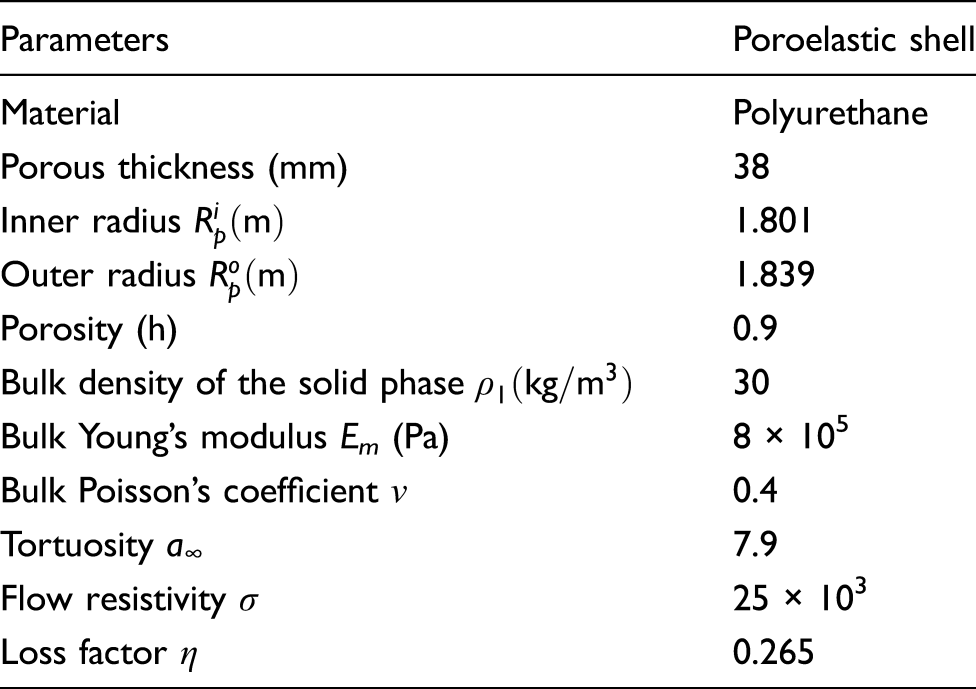
In order to meet enough accuracy in the calculation of the STL, sufficient number of modes should be employed in the solution process. Figure 2 shows an algorithm for this convergence procedure. Herewith, in each frequency, two convergence loops for the longitudinal and circumferential modes, together with a convergence condition for each loop, are necessary. Thus, when these conditions are met, the loops are terminated and then STL is calculated at this corresponding frequency. Accordingly, in the following, some various 3D configurations are plotted in Figures 3–5 to, respectively, show the effects of the excitation frequency, length and radius of the structure on the convergence. For this purpose, the geometrical properties of the shell and the porous core are listed in Tables 1 and 2. Schematic of the solution algorithm for presenting the sound transmission loss of the structure. Mode convergence diagram of double Fourier series solution (–) and its projections on the orthogonal planes (‐ ‐) and (‐ ‐) for structure with respect to various excitation frequencies including (a) 50 Hz, (b) 100 Hz, (c) 500 Hz and (d) 1000 Hz. Mode convergence diagram of double Fourier series solution (–) and its projections on the orthogonal planes (‐ ‐) and (‐ ‐) for structures with respect to various lengths involving (a) L = 20 m, (b) L = 20 m, (c) L = 40 m and (d) L = 80 m at the given excitation frequency of 50 Hz. Mode convergence diagram of double Fourier series solution (–) and its projections on the orthogonal planes (‐ ‐) and (‐ ‐) for structure with respect to various radii including (a) R = 0.5 m, (b) R = 1.0 m, (c) R = 2.0 m and (d) R = 3.0 m at the given excitation frequency of 50 Hz. Geometrical and acoustical properties of the used material. Poroelastic core properties.


As illustrated in Figure 3, further modes in both of the circumferential and longitudinal directions should be involved in this procedure to converge the STL at higher frequencies. This is predictable because once the solution is converged at a given frequency, it should be converged at all frequencies lower than that frequency.
Figure 4 shows the influence of increasing the length on the STL convergence of the structure. Although by increasing this parameter the number of the essential longitudinal modes is increased, no change is created in the number of circumferential modes. On the contrary, by enhancing the radius of the shell, the number of the required circumferential modes is increased, whereas the number of the longitudinal one remains constant, as displayed in Figure 5.
In Figure 6, the transverse displacement of the structure is plotted at various frequencies. The achieved outcomes indicate that by enhancing the frequency, the number of the required longitudinal and circumferential modes is increased. Transverse displacements of a simply supported cylinder subjected to the porous core with respect to different frequencies containing (a) f = 5 Hz, (b) f = 10 Hz, (c) f = 20 Hz and (d) f = 40 Hz.
3.2. Model verification
As obviously defined in literature, although various works can be found through power transmission of the infinitely long cylindrical shells, this study analyzes the acoustic behavior of a finite length cylinder subjected to the porous core. Herewith, in order to validate the formulation, by increasing the length of the finite configuration, the corresponding outcomes are compared with those of infinitely long ones.
As depicted in Figure 7, the obtained results from the present study are compared with those of Liu and He (2015), Talebitooti et al. (2016a) and Zhou et al. (2014) for a poroelastic cylinder with a radius of Comparison of the sound transmission loss spectra between current prediction for a simply supported cylinder (by enhancing the length to infinite) and those of Talebitooti et al. (2016a), Liu and He, (2015) and Zhou et al. (2015).
In order to ascertain the accuracy of the current formulation for structure with other radii, Figure 8 is presented to show a new comparison between the present results and those of infinite shells (Talebitooti et al., 2016a) with a radius of Comparison of the sound transmission loss spectra between current prediction for a simply supported cylinder (by enhancing the length to infinite) and those of infinite one by Talebitooti et al. (2016a).
3.3. The influence of length of structure
As shown in Figure 9, the effect of the length of the structure on the amount of the transmitted noise through a simply supported cylinder subjected to the porous core is presented and discussed. For this purpose, the initial length of the structure The effect of varying the length through acoustic transmission of a simply supported poroelastic sandwich cylindrical shell.
3.4. The influence of shell radius
Figure 10 presents the influence of various radii on the STL of a finite cylinder. As obviously defined in this configuration, by varying the radius, the STL of the structure is changed in stiffness and mass control regions, whereas it remains constant in the coincidence control domain. In fact, by reducing the radius, the stiffness of structure is enhanced and leads to decrease in the vibrational acceleration of the shell and the amount of the transmitted sound into the structure. Hence, the STL is enhanced in this domain (stiffness control) below the ring frequency. In addition, at the mid frequency region between the ring and coincidence frequencies, which is known as mass control, the mass of the structure is considered as a key parameter. Since there is a direct effect between the radius and the mass, then by reducing the radius, it is decreased. This issue enhances the amount of the transmitted sound into the structure. On the contrary, the STL of a finite poroelastic cylinder is not sensitive to radius at the high frequency region over The effect of varying the radius through acoustic transmission of a simply supported poroelastic sandwich cylindrical shell.
3.5. The effect of the porous thickness
As indicated in Figure 11, the vibroacoustic performance of a finite structure can be improved by varying the porous thickness. For this purpose, the initial porous thickness of the structure The effect of varying the porous thickness through acoustic transmission of a simply supported poroelastic sandwich cylindrical shell.
4. Concluding remarks
In this study, the vibroacoustic performance of a simply supported cylinder interlayered with porous materials was presented and discussed. In fact, a new approach was presented to model the poroelastic core in a finite cylinder based on the Full method. The main aim was devoted to inspect the effect of the length of the structure in the formulation, contrary to the infinite cylindrical shells. For this purpose, an analytical solution was proposed, wherein the displacements and the acoustic pressures were developed based on the circumferential and longitudinal modes. Subsequently, the model was validated with the obtained results of an infinite cylinder. It was shown that the STL curve of a finite length cylinder is approached to an infinite one when the length increases. This fact confirmed the accuracy of the formulation and the numerical code, applied in this study. Furthermore, the results indicated that changing the length and radius of the structure would affect the required modes for convergence in the longitudinal and circumferential directions. As other consequences, enhancing the length of the shell leads to improvement in the STL at the high frequency domain. However, by increasing the radius, the STL curve behaves in the opposite way particularly at the low frequency region. In addition, the porous thickness was considered as the parameter which improved the behavior of the STL curve in regions where wavelengths are short enough.
Footnotes
Declaration of conflicting interests
The author(s) declared no potential conflicts of interest with respect to the research, authorship, and/or publication of this article.
Funding
The author(s) received no financial support for the research, authorship, and/or publication of this article.

Appendix 1
Generally, equations (1a) and (1b) are considered to analyze the wave propagation through the poroelastic material. Since these equations include a series of parameters involving scalar and vector potentials, equations (4)–(8) are assumed based on the characteristics of a finite cylinder subjected to the porous core. Subsequently, by inserting the Laplacian operator from equations (2) and (3) into (1a) and (1b), the following equations can be derived
As obviously defined, equations (63)–(67) present the five Bessel differential equations. For instance, one of these equations (equation (63)) is solved, in the following form.
In order to summarize equation (63), not only it is considered that
Therefore, equation (63) can be rewritten as below
It is noteworthy that equation (69) has a solution as below
Appendix 2
In order to extract the displacements of the solid and fluid phases of the porous core, the below equations are, respectively, considered
Since these displacements should be developed in
To develop equation (73) for the solid phase in the
Consequently, by replacing the assumed values for scalar and vector potentials based on equations (4)–(8) into (75), the above relationship is obtained
Similar to the applied technique, the other displacements are determined as below
Appendix 3