Optimal parallel-distributed-compensation controller design for a class of time-varying Takagi–Sugeno fuzzy model–based time-delay systems by using the orthogonal function approach–assisted genetic algorithm
Available accessResearch articleFirst published online May, 2021
Optimal parallel-distributed-compensation controller design for a class of time-varying Takagi–Sugeno fuzzy model–based time-delay systems by using the orthogonal function approach–assisted genetic algorithm
This study proposes a method of designing quadratic optimal fuzzy parallel-distributed-compensation controllers for a class of time-varying Takagi–Sugeno fuzzy model–based time-delay control systems used to solve the finite-horizon optimal control problem. The proposed method fuses the orthogonal function approach and the improved hybrid Taguchi-genetic algorithm. The Taguchi-genetic algorithm only requires algebraic computation to perform the algorithm used to solve time-varying Takagi–Sugeno fuzzy model–based time-delay feedback dynamic equations. The fuzzy parallel-distributed-compensation controller design problem is simplified by using the Taguchi-genetic algorithm to transform the static parameter optimization problem into an algebraic equation. The static optimization problem can then be solved easily by using the improved hybrid Taguchi-genetic algorithm to find the quadratic optimal parallel-distributed-compensation controllers of the time-varying Takagi–Sugeno fuzzy model–based time-delay control systems. The applicability of the proposed integrative method is demonstrated in a real-world design problem.
However, the authors of the above studies agree that, for some time-varying nonlinear time-delay control systems, the fuzzy membership function absorption time varying is very difficult to apply in time-invariant exact TS fuzzy model–based time-delay control systems. Therefore, minimizing the quadratic integral performance index in the design of a time-varying TS fuzzy model–based time-delay control system with quadratic optimal PDC controllers is worth studying. However, the LMI method (Chou et al., 2006; Guan and Chen, 2004) cannot be used to design time-varying TS fuzzy model–based time-delay control systems with quadratic-optimal PDC controllers. Although genetic algorithms (GAs) can be used to solve complex static optimization problems (Chou and Cheng, 2019), they are very difficult to use for dynamic optimization when designing quadratic optimal PDC controllers for time-varying TS fuzzy model–based time-delay control systems. To the best of our knowledge, no studies have proposed designs for time-varying TS fuzzy model–based time-delay control systems with quadratic optimal PDC controllers. Even though the authors have previously obtained the preliminary research results (Hsu et al., 2007), the optimal design algorithm is incomplete. Therefore, this issue is still worth to further study in both completeness and depth for the optimal design algorithm. Hence, by proposing an improved optimal design algorithm named the improved hybrid Taguchi-genetic algorithm (IHTGA), this study proposes an integrative method for time-varying TS fuzzy model–based time-delay control systems with quadratic optimal PDC controllers under the constraint of a minimum quadratic integral performance index. Besides, the systematic and step-by-step design procedures are also proposed in this study.
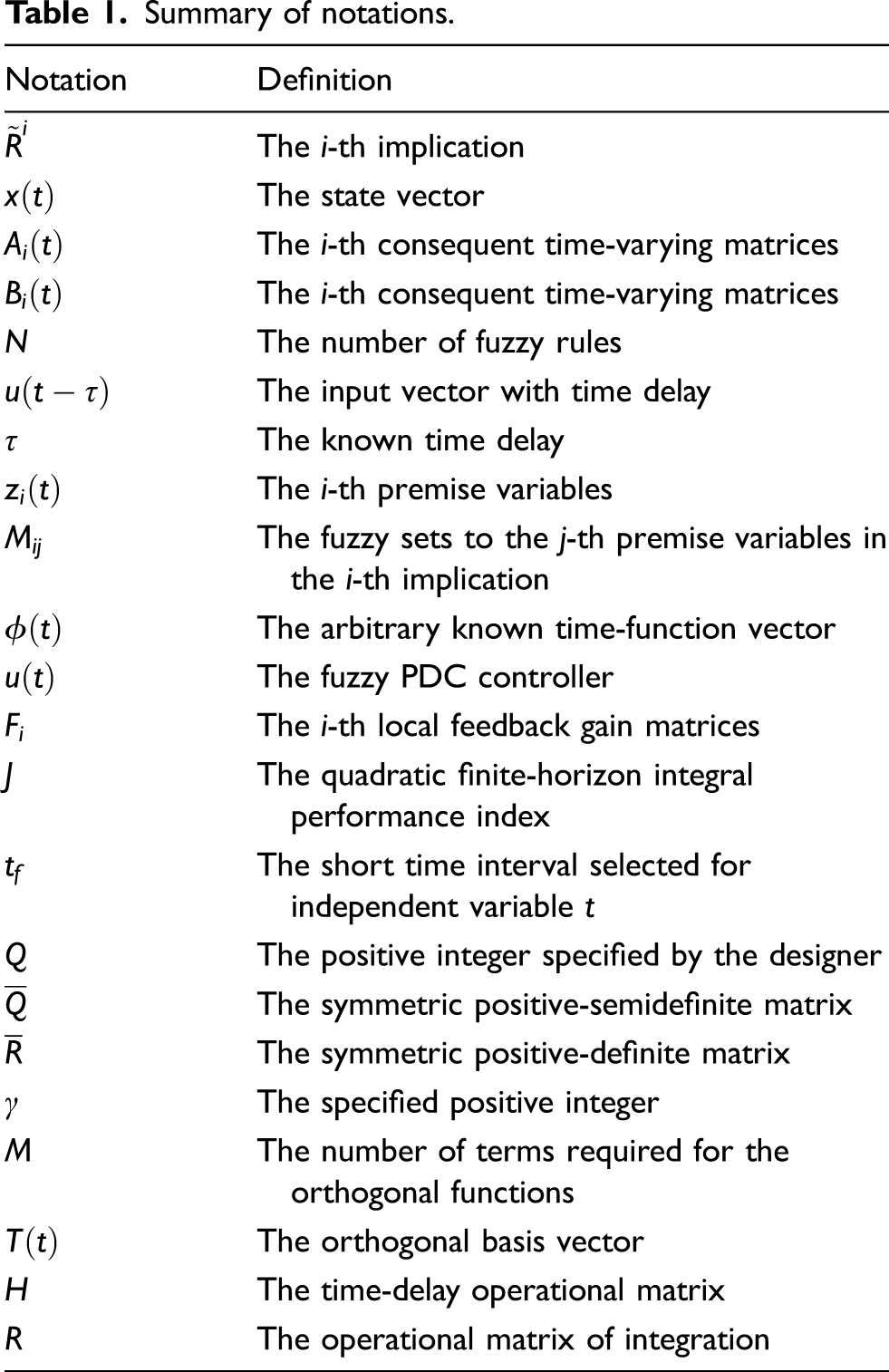
The proposed method integrates the orthogonal function approach (OFA) and IHTGA. OFA simplifies the problem of optimizing a time-varying TS fuzzy model–based time-delay control system by transforming the dynamic optimization problem into a static optimization problem expressed as an algebraic equation. Notably, however, when solving the dynamic optimization problem described above, OFA alone cannot find the fuzzy PDC controllers, and using only GA to find the fuzzy PDC controllers is difficult. Therefore, this study developed an integrative method of solving this design problem. The IHTGA is to improve the HTGA which was presented by Tsai et al. (2004). Tsai et al. (2004) and Ho et al. (2016) previously have demonstrated that the HTGA outperformed the conventional GA. Finally, the feasibility of the proposed integrative method is demonstrated in a real world application. Table 1 describes the notations of this study.
Summary of notations.
Notation
Definition
The i-th implication
The state vector
The i-th consequent time-varying matrices
The i-th consequent time-varying matrices
N
The number of fuzzy rules
The input vector with time delay
The known time delay
The i-th premise variables
The fuzzy sets to the j-th premise variables in the i-th implication
The arbitrary known time-function vector
The fuzzy PDC controller
The i-th local feedback gain matrices
J
The quadratic finite-horizon integral performance index
The short time interval selected for independent variable t
Q
The positive integer specified by the designer
The symmetric positive-semidefinite matrix
The symmetric positive-definite matrix
The specified positive integer
M
The number of terms required for the orthogonal functions
The orthogonal basis vector
H
The time-delay operational matrix
The operational matrix of integration
2. Problem statement
For construction of a sector nonlinearity fuzzy model (Tanaka and Wang, 2001), we can use the following form
where the initial state vectors are and (for t < 0), is the i-th implication, N is the number of fuzzy rules, is the n-dimensional state vector, and are the and consequent time-varying matrices, respectively, is the p-dimensional input vector with time delay, is the known time delay, are the premise variables, ( and ) are the fuzzy sets of using sector nonlinearity in fuzzy model construction (Tanaka and Wang, 2001), and is an n-dimensional arbitrary known time-function vector.
The time-varying TS fuzzy model–based time-delay dynamic system inferred from equation (1) is expressed as
in which , , , and are the grades of membership of in fuzzy sets .
Equation (4) is used to design the fuzzy PDC controller in equation (3) by minimizing the following quadratic finite-horizon integral performance index
where denotes a short time interval selected for independent variable t, q is a positive integer specified by the designer, is a symmetric positive-semidefinite matrix, and is a symmetric positive-definite matrix. Here, the time interval of interest is designated as to , where is the initial time and is the final time of the control period.
Now, consider the time interval , where is chosen for the independent variable t, and let us define
and
where is a specified positive integer with , , and .
The state vector , time-function vector , and consequent time-varying matrices and , within , can be approximated by their respective truncated orthogonal functions
where m is the number of terms required for the orthogonal functions (OF), denotes the orthogonal basis vector, denote the OF, and are the coefficient vectors, and are the expansion coefficient matrices of and , respectively, and and are the coefficient matrices of and , respectively.
Before inferring the consequent output within , let the value of be for at . Then
where , , and .
Next, considering and integrating equation (4) from to within , we can get
where .
Now, the attribute is obtained by using the following orthogonal function (Hsu et al., 2006)
In addition, equations (8)–(11), , , and can be represented by their respective orthogonal-function representations
where , , and are the coefficient vectors and , and are the coefficient matrices, in which
where denotes the elements of the time-delay operational matrix H given as described in Hsu et al. (2006).
and equations (7), (8), and (15), equations (12) and (13) can be rewritten as
and
where R is the operational matrix of integration for the orthogonal functions given as described in Ho and Chou (2006) and Hsu et al. (2006).
Equations (16a), (16b), and (16c) can be rewritten as
and
where
and
In addition, the Kronecker product and equations (19a), (19b), and (19c) can be used to rewrite equations (18a) and (18b) as
and
where denotes the identity matrix, denotes the Kronecker product (Barnett, 1979), and
Finally, the explicit form for the solution can be directly derived by equations (21a) and (21b) as
and
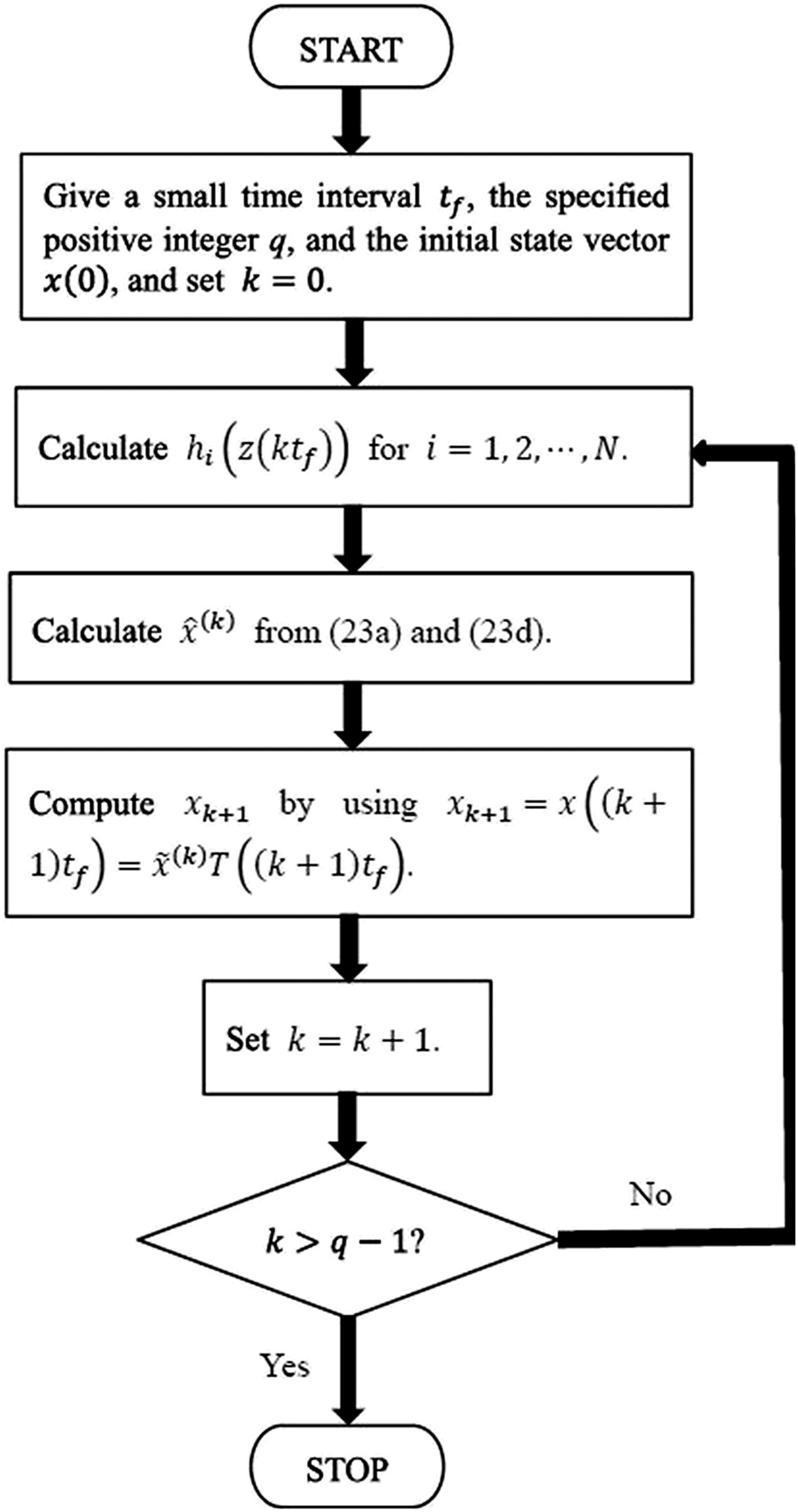
where denotes the identity matrix. The algebraic formulae in equations (23a) and (23b) can be used to calculate within any time interval . This implies that can be obtained by equations (23a) and (23b). The flowchart of the proposed model only involves the algebraic computation as shown in Figure 1.
Flowchart of the proposed model.
In addition, substituting equation (3) and the truncated OF representation of in equation (8) into the quadratic finite-horizon integral performance index in equation (5) gives a quadratic finite-horizon integral performance index J in the following algebraic form
where the constant matrix W is the product integration matrix of two OF basis vectors (Ho and Chou, 2006).
can then be calculated with in equations (18a) and (18b) by performing only the algebraic computation. The value obtained by equation (24) is actually determined by , which means
where (, and ) denote the elements of . Therefore, the fuzzy PDC controller optimal design problem equates to the minimum problem
subject to , for , , and , where are positive real numbers given in the practical application, respectively. Therefore, for the quadratic finite-horizon optimal PDC controller design problem, OFA can be used to express the static optimization problem as an algebraic equation according to the time-varying TS fuzzy model–based time-delay control system. This greatly simplifies the problem of optimizing a fuzzy PDC controller. Although any evolutionary optimization approaches can be used in this study and the HTGA has been applied in many different cases, the HTGA still gives better and robust results than those of the existing improved GA reported in the literature (Ho et al., 2016). Genetic algorithm is a well-known optimization method. To reduce the length of the article, for the detailed explanation of the genetic algorithm, the readers may refer to the work by Tsai et al. (2004). Furthermore, in this study, by improving the HTGA, an IHTGA is proposed and used to obtain a better performance index. The IHTGA is used to solve the static optimization problem as shown in equation (26). The IHTGA improves the HTGA by using the generation-based crossover rate and the generation-based mutation rate , where , , , , as well as and are the current generation and the maximum of generation, respectively. In this study, the maximum generation number is 250. On the other hand, the Taguchi method is a well-known local optimization approach and has been merged into the GA by Tsai et al. (2004) for obtaining both better and robust results. To reduce the length of the article, for the detailed explanation of the hybrid Taguchi-genetic algorithm (HTGA), the readers may refer to the work by Tsai et al. (2004), where the Taguchi method has been explained in detail therein.
4. Illustrative example
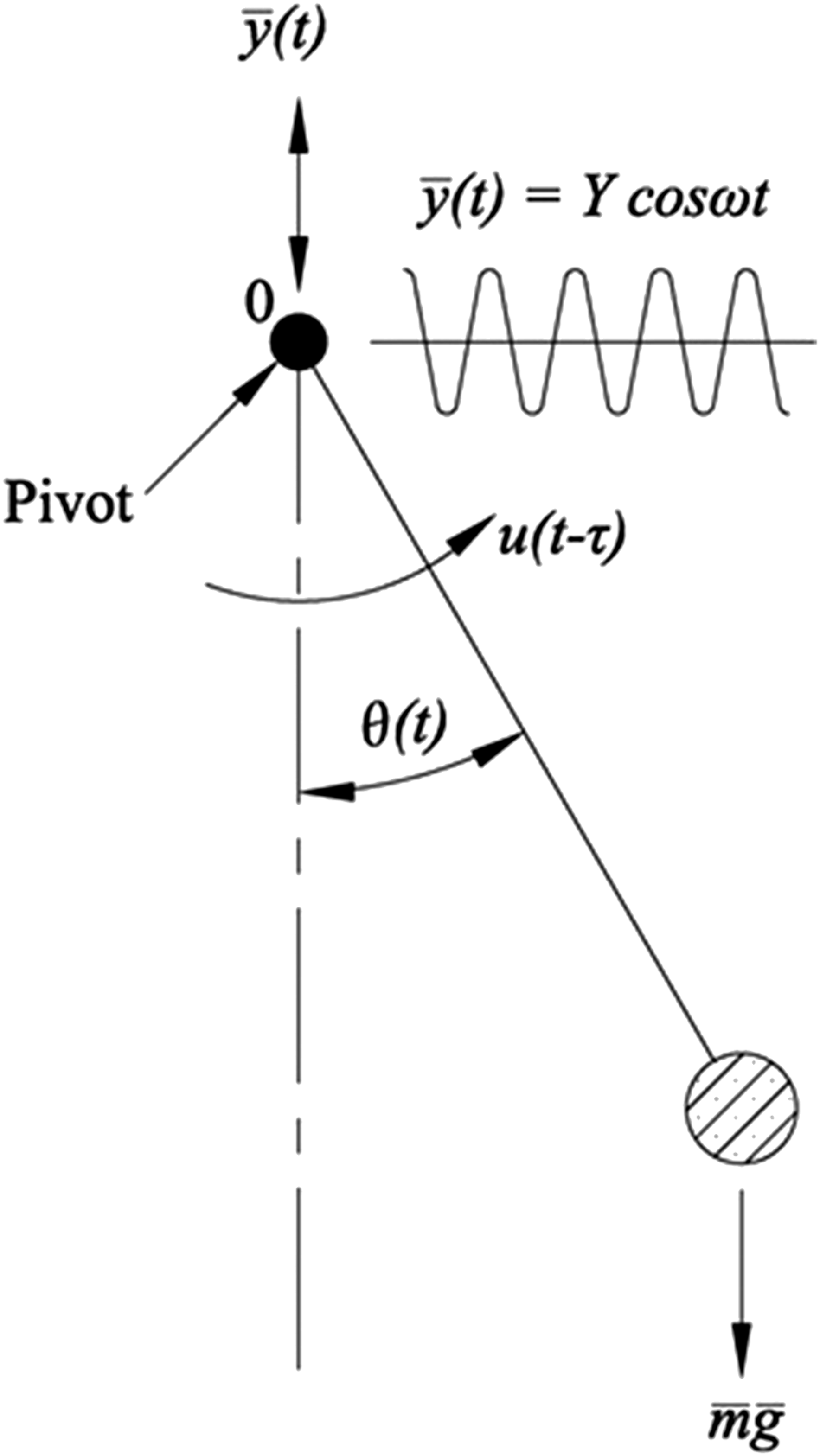
Figure 2 shows the illustrative example in which Y is the amplitude, is the oscillation frequency, and is the displacement of the pivot point in the vertical direction (Rao, 1995). The pendulum pivot point vibrates as
Pendulum time-delay system with vibration vertical to the pivot point.
The nonlinear equation for the motion of the time-varying pendulum system with time-delay torque applied to the system mass can be derived as
where is the system mass of the pendulum system, l is the length of the pendulum system, is the acceleration of gravity, is the acceleration of the pivot point in the vertical direction, is the angle of the pendulum system and changes between and , is the angular acceleration of the pendulum system, is the torque with time delay applied to the system mass, and is the known time delay.
The quadratic finite-horizon integral performance index is
in which , , , and .
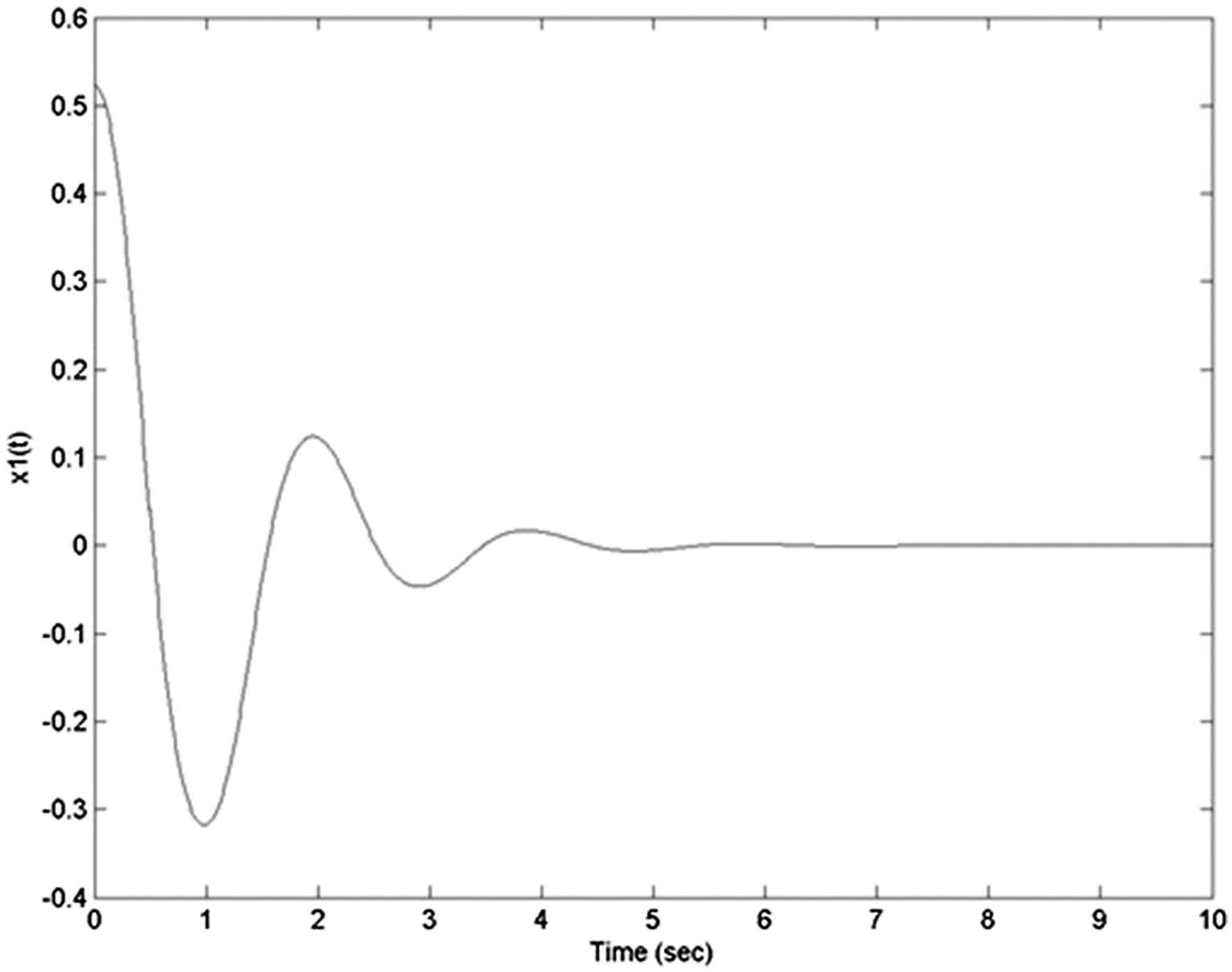
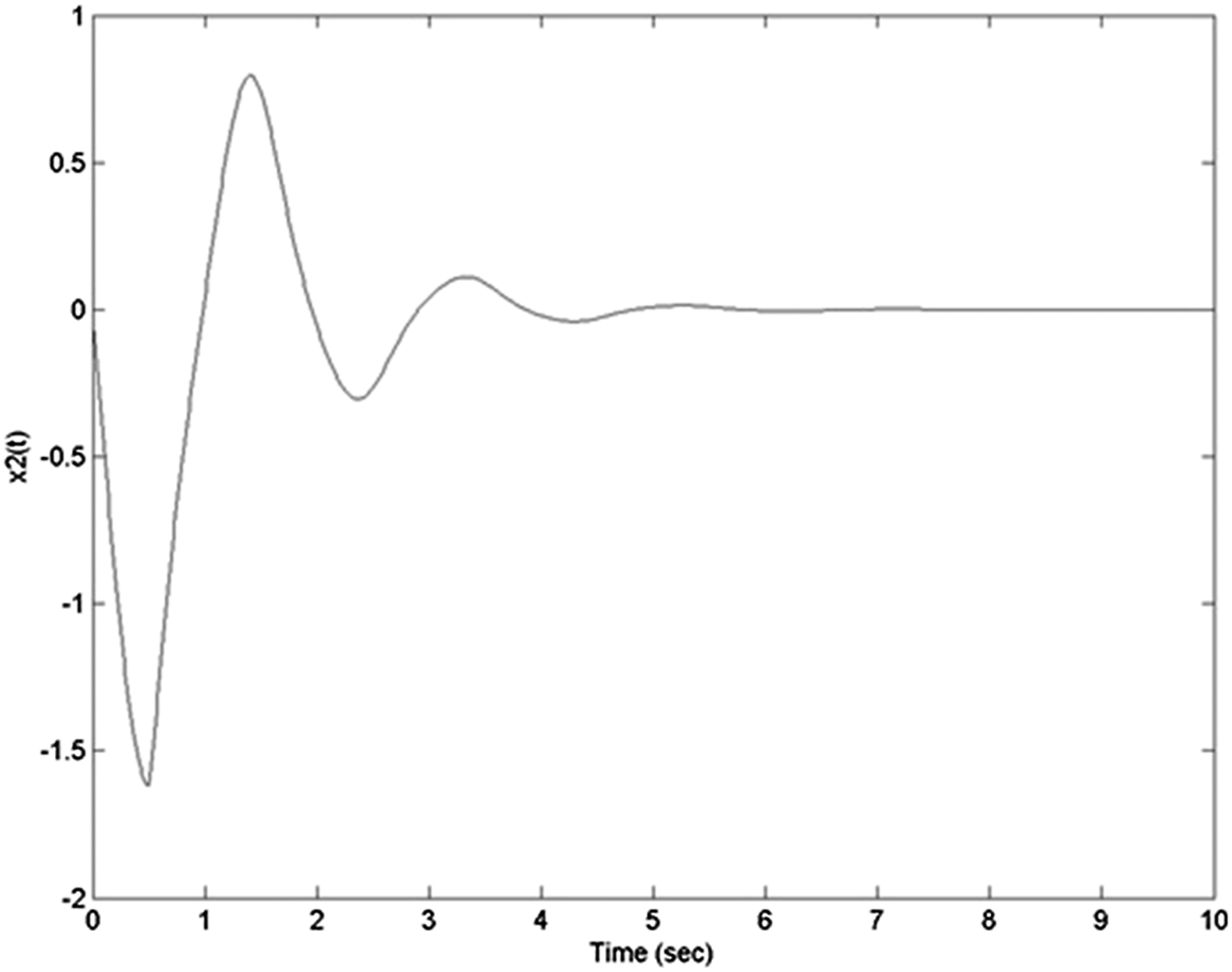
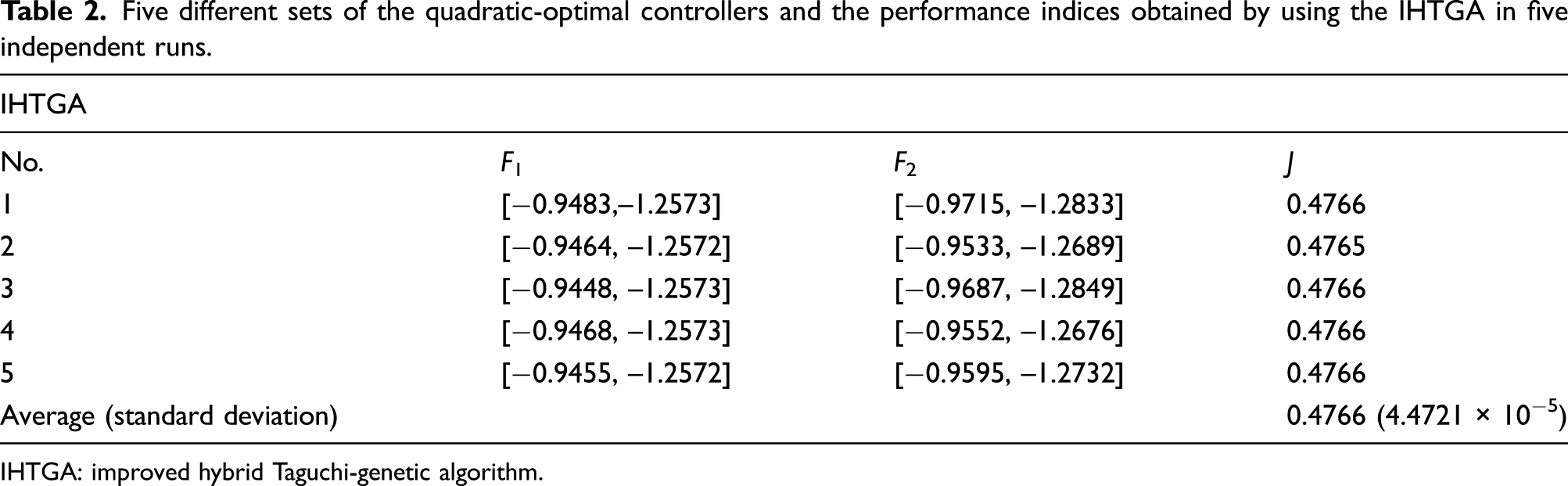
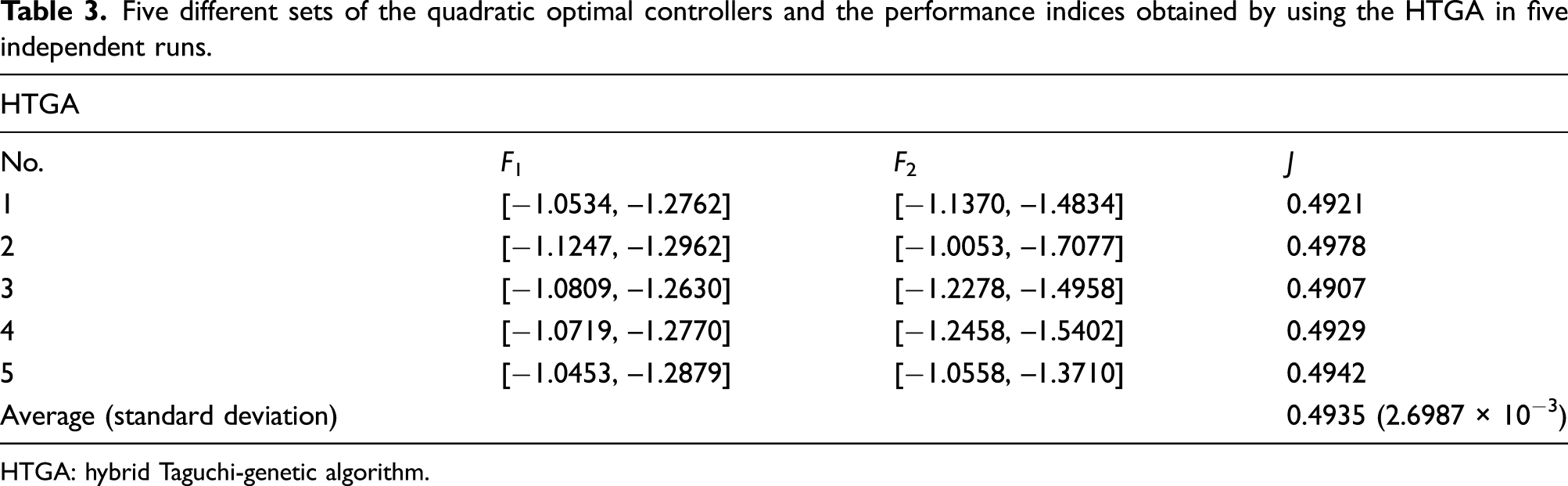
If and ( and ), the proposed approach gives , and . The responses for angle in Figure 3 and for angular velocity in Figure 4 confirm that the control results are satisfactory in this example, in which the orthogonal function is the shifted Chebyshev function. Under the same performance index in equation (33) and executing five independent runs, in Tables 2 and 3, it can be shown that we can obtain a better average performance index of by using the IHTGA than the average result with by using the HTGA as well as the proposed IHTGA, which gives a more robust result.
Response of angle for a time-varying pendulum time-delay system with the proposed quadratic optimal parallel-distributed-compensation controller.
Response of angular velocity response for a time-varying pendulum time-delay system with the proposed quadratic optimal parallel-distributed-compensation controller.
Five different sets of the quadratic-optimal controllers and the performance indices obtained by using the IHTGA in five independent runs.
IHTGA
No.
F1
F2
J
1
[−0.9483,–1.2573]
[−0.9715, –1.2833]
0.4766
2
[−0.9464, –1.2572]
[−0.9533, –1.2689]
0.4765
3
[−0.9448, –1.2573]
[−0.9687, –1.2849]
0.4766
4
[−0.9468, –1.2573]
[−0.9552, –1.2676]
0.4766
5
[−0.9455, –1.2572]
[−0.9595, –1.2732]
0.4766
Average (standard deviation)
0.4766 (4.4721 × 10⁻⁵)
IHTGA: improved hybrid Taguchi-genetic algorithm.
Five different sets of the quadratic optimal controllers and the performance indices obtained by using the HTGA in five independent runs.
HTGA
No.
F1
F2
J
1
[−1.0534, –1.2762]
[−1.1370, –1.4834]
0.4921
2
[−1.1247, –1.2962]
[−1.0053, –1.7077]
0.4978
3
[−1.0809, –1.2630]
[−1.2278, –1.4958]
0.4907
4
[−1.0719, –1.2770]
[−1.2458, –1.5402]
0.4929
5
[−1.0453, –1.2879]
[−1.0558, –1.3710]
0.4942
Average (standard deviation)
0.4935 (2.6987 × 10⁻³)
HTGA: hybrid Taguchi-genetic algorithm.
5. Conclusions
When solving the quadratic finite-horizon optimal control problem, OFA can be used to express static parameter optimization problems as algebraic equations based on time-varying TS fuzzy model–based time-delay control systems. Because the proposed integrative method only requires algebraic computation, it greatly simplifies the process of designing quadratic-optimal PDC controllers for time-varying TS fuzzy model–based time-delay control systems. The IHTGA easily solves the static optimization problem in time-varying TS fuzzy model–based time-delay control systems with quadratic optimal PDC controllers. The illustrative example demonstrates the applicability of the proposed integrative method and the proposed IHTGA having a better and more robust result.
Footnotes
Declaration of conflicting interests
The author(s) declared no potential conflicts of interest with respect to the research, authorship, and/or publication of this article.
Funding
The author(s) disclosed receipt of the following financial support for the research, authorship, and/or publication of this article: This work was supported by the Ministry of Science and Technology, Taiwan under grants MOST 108-2221-E-037-007 and MOST 108-2218-E-992-304, and the “Intelligent Manufacturing Research Center” (iMRC) from the Featured Areas Research Center Program within the framework of the Higher Education Sprout Project by the Ministry of Education (MOE) in Taiwan.
ORCID iDs
Ming-Ren Hsu
Wen-Hsien Ho
References
1.
AliMSUshaMCaoJ, et al. (2019) Synchronisation analysis for stochastic T-S fuzzy complex networks with coupling delay. International Journal of Systems Science50: 585–598.
2.
BabuskaR (1998) Fuzzy Modeling for Control. Boston: Kluwer.
3.
BaleghiNAShafieiMH (2019) Stability analysis and stabilization of a class of discrete-time nonlinear switched systems with time-delay and affine parametric uncertainty. Journal of Vibration and Control25: 1326–1340.
4.
BarnettS (1979) Matrix Methods for Engineers and Scientists. New York: McGraw-Hill.
5.
CaoYYFrankPM (2000) Analysis and synthesis of nonlinear time-delay systems via fuzzy control approach. IEEE Transactions on Fuzzy Systems8: 200–211.
6.
CaoY-YFrankPM (2001) Stability analysis and synthesis of nonlinear time-delay systems via linear Takagi–Sugeno fuzzy models. Fuzzy Sets and Systems124: 213–229.
7.
ChangWJChangW (2006) Model-based fuzzy controller design for time-delay affine Takagi–Sugeno fuzzy models via ILMI algorithm. Journal of Intelligent and Fuzzy Systems17: 647–663.
8.
ChenBLiuX (2005) Delay-dependent robust control for T-S fuzzy systems with time delay. IEEE Transactions on Fuzzy Systems13: 544–556.
9.
ChouCCUangHJTsengCS (2006) Mixed Fuzzy control design of nonlinear systems with time delays. In: Proceedings of the 14th national conference on fuzzy theory and its applications, Kaohsiung, Taiwan, 14–15 December 2006, pp. A131–A136. Taipei: Taiwan Fuzzy Systems Association.
10.
ChouF-IChengM-Y (2019) Optimal design of reduced-order observers with specified eigenvalues and performance measurement of minimizing estimation errors using evolutionary optimization. Journal of Low Frequency Noise, Vibration and Active Control38: 728–739.
11.
ErMJLinDH (2002) A new approach for stabilizing nonlinear systems with time delays. International Journal of Intelligent Systems17: 289–302.
12.
FarinwataSSFilevDLangariR (2000) Fuzzy Control: Synthesis and Analysis. Chichester: John Wiley & Sons.
13.
GoodwinGCGraebeSFSalgadoME (2001) Control System Design. New Jersey: Prentice-Hall.
14.
GuanX-PChenC-L (2004) Delay-dependent guaranteed cost control for T-S fuzzy systems with time delays. IEEE Transactions on Fuzzy Systems12: 236–249.
15.
HoWHChouJH (2006) Design of optimal controllers for Takagi-Sugeno fuzzy model based systems. IEEE Transactions on Systems, Man and Cybernetics, Part A37: 329–339.
16.
HoW-HTsaiJ-TChouJ-H, et al. (2016) Intelligent hybrid Taguchi-genetic algorithm for multi-criteria optimization of shaft alignment in marine vessels. IEEE Access4: 2304–2313.
17.
HsuMRHoWHChouJH (2006) Numerical solutions of time-varying TS-fuzzy-model-based time-delay dynamic equations via orthogonal functions. International Journal of Systems Science38: 377–387.
18.
HsuMRHoWHChouJH (2007) Optimal design of PDC controllers for time-varying TS-Fuzzy-model-based time-delay systems. In: Proceedings of the 2007 IEEE international conference on fuzzy systems. London, UK, 23–26 July 2007. New York: IEEE.
19.
LiZ (2006) Fuzzy Chaotic Systems: Modeling, Control and Applications. Berlin: Springer.
20.
LiuYHuSS (2003) Fuzzy H∞ robust feedback control for uncertain nonlinear system with time-delay based on fuzzy model. Control Theory & Applications20: 497–502.
21.
LuoYBCaoYYSunYX (2008) Robust stability of uncertain Takagi-Sugeno fuzzy systems with time-varying input-delay. Acta Automatica Sinica34: 87–92.
22.
MardaniMMVafamandNKhoobanMH, et al. (2019) Design of quadratic D-stable fuzzy controller for DC microgrids with multiple CPLs. IEEE Transactions on Industrial Electronics66: 4805–4812.
23.
MoodiHKazemyA (2019) Robust controller design for Takagi-Sugeno systems with nonlinear consequent part and time delay. International Journal of Fuzzy Systems21: 745–754.
24.
ParkPGLeeSSChoiDJ (2003) State-feedback stabilization for nonlinear time-delay systems: a new fuzzy weighting-dependent Lyapunov–Krasovskii functional approach. In: Proceedings of the 42nd IEEE conference on decision and control, Maui, USA, 9–12 December 2003, pp. 5233–5238. New York: IEEE.
25.
RaoSS (1995) Mechanical Vibrations. New York: Addison-Wesley.
26.
SakthivelRSelvarajPKaviarasanB (2020) Modified repetitive control design for nonlinear systems with time delay based on T-S fuzzy model. IEEE Transactions on Systems, Man, and Cybernetics: Systems50: 646–655.
27.
ShengYLewisFLZengZ, et al. (2019) Stability and stabilization of Takagi–Sugeno fuzzy systems with hybrid time-varying delays. IEEE Transactions on Fuzzy Systems27: 2067–2078.
28.
ShinHKimEParkM (2003) The state feedback control based on fuzzy observers for T-S fuzzy systems with unknown time-delay. IEICE Transactions on Fundamentals of Electronics, Communications and Computer SciencesE86-A: 2333–2339.
29.
SongXWangMSongS, et al. (2019) Quantized output feedback control for nonlinear Markovian jump distributed parameter systems with unreliable communication links. Applied Mathematics and Computation353: 371–395.
30.
TanakaKWangHO (2001) Fuzzy Control Systems Design and Analysis: A Linear Matrix Inequality Approach. New York: John Wiley & Sons.
31.
TongSCWangTWangYP, et al. (2004) Design and Stability Analysis of Fuzzy Control Systems. Beijing: Science Press.
32.
TsaiJ-TLiuT-KChouJ-H (2004) Hybrid Taguchi-genetic algorithm for global numerical optimization. IEEE Transactions on Evolutionary Computation8: 365–377.
33.
WangJMaSZhangC (2019) Finite-time H∞ control for T-S fuzzy descriptor semi-Markov jump systems via static output feedback. Fuzzy Sets and Systems365: 60–80.
34.
WangLLamH-K (2018) A new approach to stability and stabilization analysis for continuous-time Takagi-Sugeno fuzzy systems with time delay. IEEE Transactions on Fuzzy Systems26: 2460–2465.
35.
WangLLamH-K (2019) New stability criterion for continuous-time Takagi-Sugeno fuzzy systems with time-varying delay. IEEE Transactions on Cybernetics49: 1551–1556.
36.
YangYZhangDHanQ-L (2018) Networked active vibration control of structural systems: a nonsmall input delay approach. Journal of Vibration and Control24: 5391–5400.
37.
ZhangXPangRMaK (2017) Input–output stabilization-based finite-time robust control of disturbed systems using linear matrix inequality approach. Journal of Vibration and Control24: 5152–5168.