






Abstract
Based on the repeatability and nonlinearity of the actual system, the time-varying pilot factor–iterative learning control algorithm is proposed previously. To make this algorithm more intelligent and get a better control effect, an improved control algorithm is proposed. The improved control method mainly addresses the error divergence problem of the system under the influence of the phase delay. The convergence of the system under the control of this new control algorithm has been mathematically proved by using the repeatability and periodicity of the system, and the sufficient condition is given. The improved control algorithm converges even if the initial state of each iteration of the system is inconsistent. In the last section of this article, the improved algorithm is experimentally verified in an actual hydraulic servo system. The experimentally verified data shows that this new improved algorithm with control parameter learning has a faster convergence rate and better control effect than the previous time-varying pilot factor–iterative learning control algorithm.
Keywords
1. Introduction
In recent years, there has been some interest in intelligent control in many industrial fields because of its intelligence and ease of use. Therefore, many intelligent control methods, such as the iterative learning control method (ILC), the neural network control method, the fuzzy control method, etc., are further developed and applied. The ILC control algorithm was first proposed in 1978 by Japanese scholar Uchiyama (1978). After this, other scholars around the world have developed many other ILC-based control algorithms (Ahn et al., 2007; Fravolini and Fabietti, 2014; Huang et al., 2013; Li et al., 2013; Meng et al., 2012).
Because the ILC algorithm has many advantages, such as simple structure and easy implementation and so on, it has practical applications in many control areas, such as robot trajectory control (Jinrong et al., 2018; Tao et al., 2018; Xi et al., 2014), servo motor motion control (Tan et al., 2001), and precision control system (Xiao-ming et al., 2013). Because of the rapid development of ILC control theory, many other ILC control algorithms have been available in recent years, such as the parameter optimization ILC method, the high-order ILC method (Bouakrif and Zasadzinski 2018; Ronghu et al., 2018), and feedback–feedforward ILC method and so on.
Regardless of the phase delay of the system, if the classic open-loop ILC control algorithm is applied directly to the real electrohydraulic servo system, the system will lose control after a few iterations. We have analyzed and solved this problem and proposed the time-varying pilot factor–iterative learning control algorithm (TPF-ILC) (Jing et al., 2019). After that, to make the TPF-ILC control algorithm more intelligent and get better control effects, some improvements have been made in this study and a TPF-ILC control algorithm with control parameter learning ability has been proposed.
The system’s convergence under the influence of the ILC learning law is an important part of the ILC, it is also an important basis for judging whether the control algorithm is effective in theory. The convergence proofs in most previous articles have an assumption, assuming that the initial state of each system iteration cycle is consistent (Kim et al., 2017; Longman, 2000; Wei et al., 2012; Xiao-ming et al., 2013). But we all know that this assumption is difficult to achieve in practical systems. Because of the existence of this assumption, the ILC control algorithms also have certain limitations in practical applications (Ruan et al., 2012).
The classical ILC algorithm uses the control error of each iteration cycle to optimize the input signal of the system, thereby achieving the effect of improving the control accuracy. One disadvantage of this algorithm is that the system may run out of control during actual application. Different from the classic ILC control algorithm, the signal of the new algorithm iterative learning is the introduced guide signal, which replaces the previous system’s input signal. In the closed-loop control mode, the system always follows the guide signal, so the control process of the system will not be uncontrolled or divergent. The convergence of the system under the action of this new algorithm has also been proved, even if the initial state of each iteration is inconsistent. Based on the previous TPF-ILC algorithm, some improvements are proposed. The learning parameter of the learning law L is no longer a constant, but it also learns and improves itself after each iteration cycle. Therefore, the newly proposed algorithm has faster convergence speed and better control effect than the TPF-ILC algorithm. The structure of this proposed control algorithm is described in detail in Section 2.
The new algorithm is also simulated accordingly and the simulation result is compared with the classic ILC algorithm and the algorithm before improvement. The result shows that the new algorithm has faster convergence speed and better control effect.
In Section 5 of this article, experiments were performed in an electrohydraulic servo loading system. The effectiveness and practicability verification is carried out by no external interference experiment and external interference experiment. The experimental data show that the improved control algorithm has better control effect and strong suppression effect on external interference.
The content organization of other sections of this article is briefly explained as follows. In Section 2, the mathematical proof of the convergence of the systematic error is given. It is finally proved that the algorithm is convergent. The influence of the phase delay factor on the ILC algorithm is analyzed and discussed in Section 3, and an improved method is proposed. The simulation results and analysis are in Section 4. The experimental results and data of the electrohydraulic servo loading system are given in Section 5. The article is summarized in Section 6.
2. The convergence proof and analysis of the system
A kind of periodic discrete linear time invariant (LTI) system can be expressed by the following equation of state
The mathematical equation of the classic ILC of discrete LTI system can be written as equation (2)
The classic open-loop ILC control algorithm is applied to the electrohydraulic servo loading system. The output of the system is shown in Figure 1. We can see that the system starts to run out after two iterations. There are three reasons for this result, the first reason is the system is in open-loop control mode, the second reason is that the initial state of each iteration of the system is always changing, and the third reason is that when applying the classic ILC control method in a real hydraulic servo system, phase delay is a factor that cannot be ignored. Application result of iterative learning control method.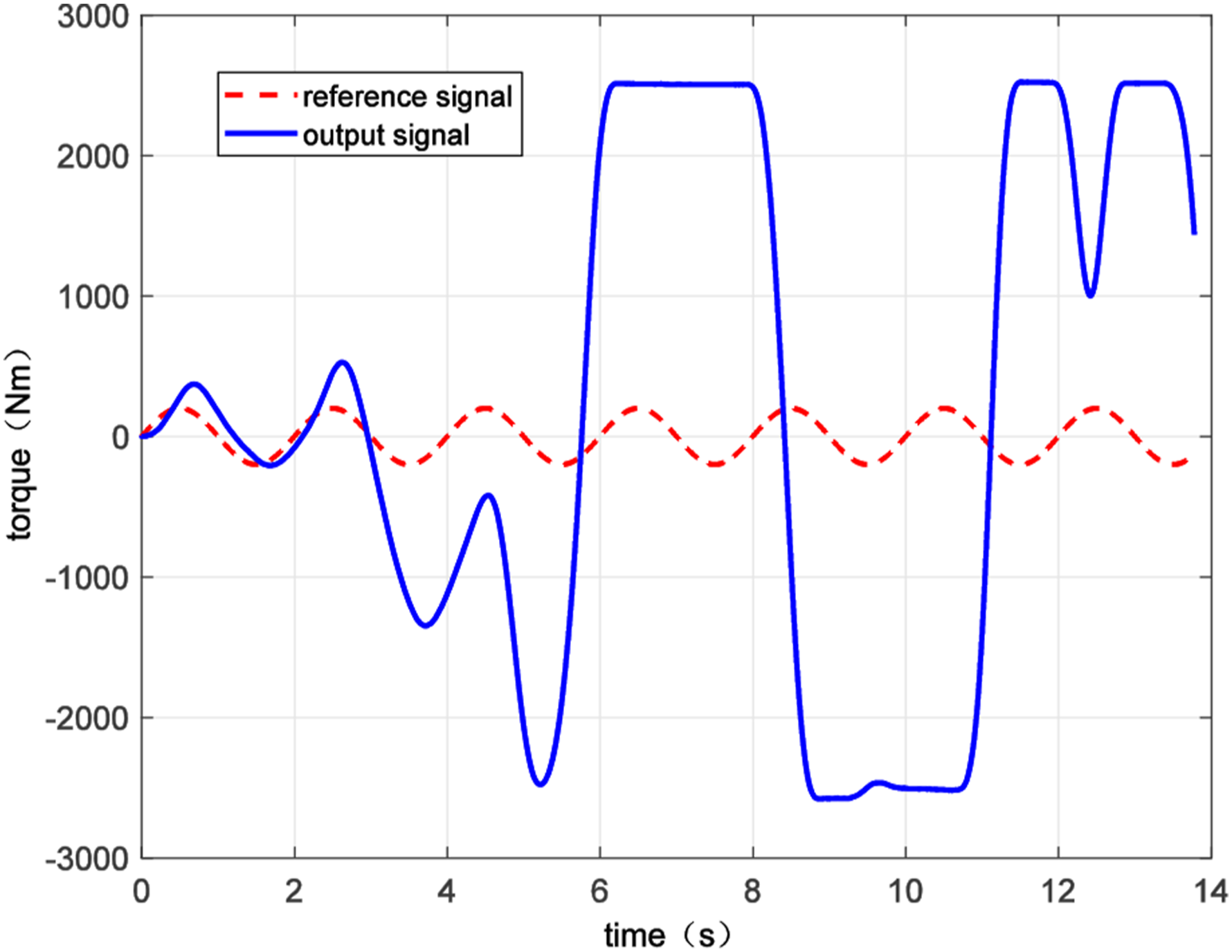
The calculation of the input signal for each single iteration defaults to the same initial state for each iteration cycle, and the next iteration’s input signal is learned from the input signal and error signal of the current iteration cycle. Therefore, once the initial state changes, which means the previous assumption is not satisfied, then the input signal calculated according to the learning law is no longer applicable to the next iteration. With the continuation of the iterative process, the control effect of the system input signal becomes worse, which means that the effect of the system output signal tracking the input signal is deteriorated.
To solve the problem of system error divergence, the TPF-ILC control method is proposed before, which can be described by equation (3). The iterative improvement signal of the classical ILC control method is usually the input signal
The convergence of the system must be proven mathematically. Based on equation (1), the output signal of the system
To simplify mathematical expressions, let
Therefore, the system’s output signal
Because the operating condition of the system is continuous and periodic, when the system reaches a steady state, that is, if System periodic output.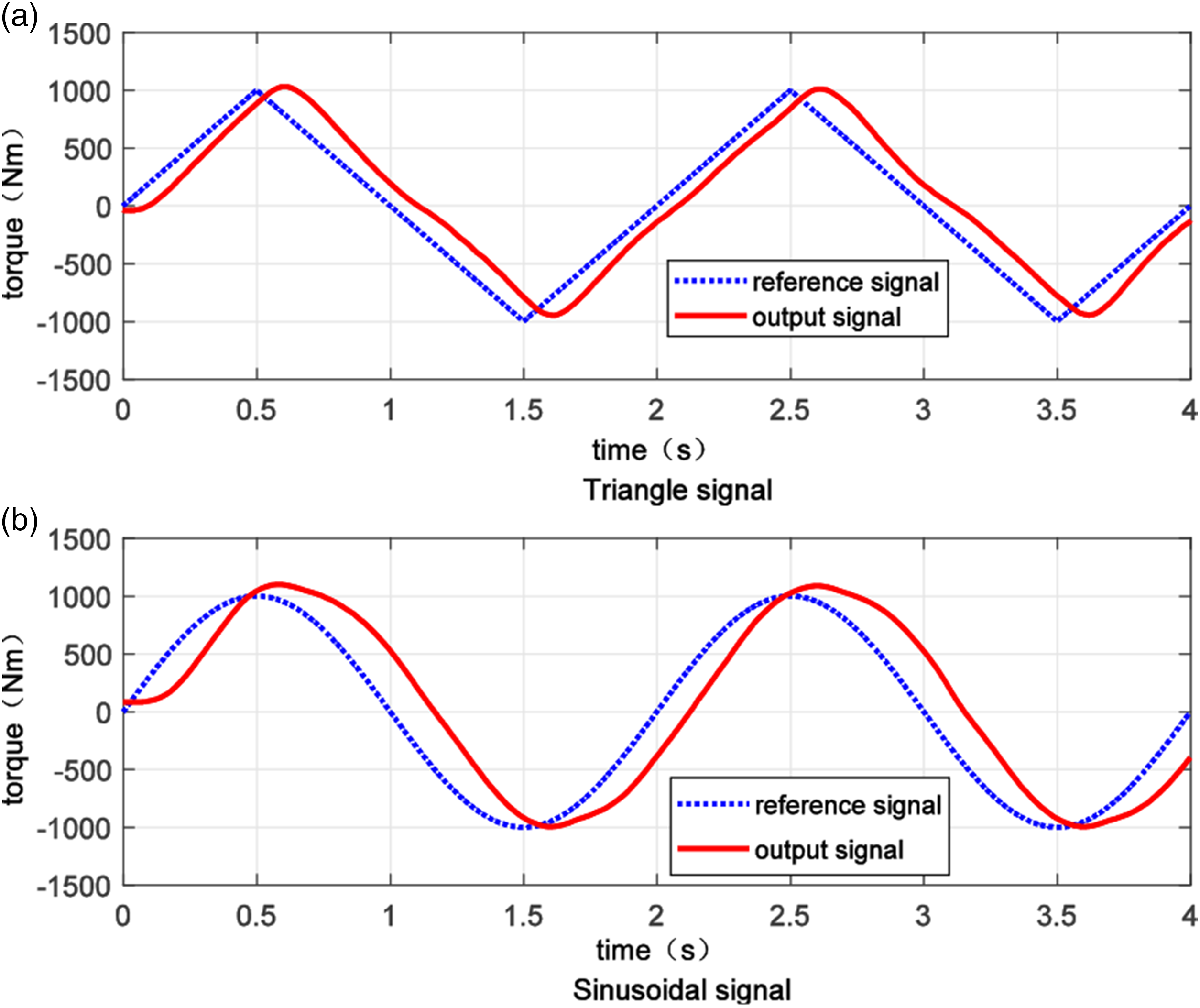
At the same time, we also notice that the control system studied in this article has superposition characteristics, which means if the input signal is composed of multiple signals, then the output is also formed by superimposing the output signals corresponding to these multiple signals. Therefore, even if the signal of the next iteration Schematic diagram of system superposition.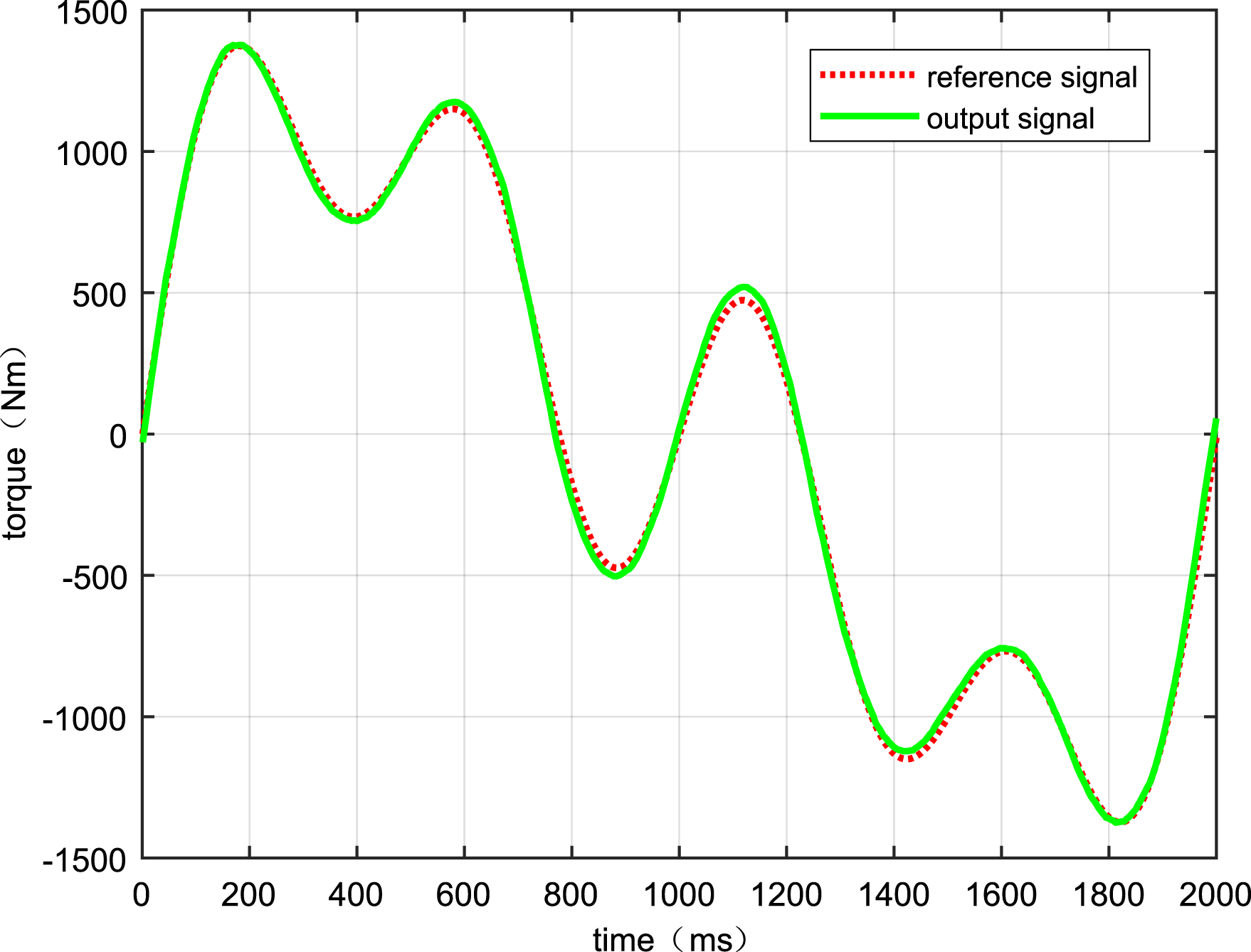
Then, if
Because it is a continuous and periodic system,
Substituting equation (6) into (7), equation (8) can be derived given as follows
Let
Equation (9) is the system’s nature when the system is periodic. According to equations (1)–(9), the control error of the system
So, the relationship between
According to equation
Notice that
Then, equation (12) can be further written to another equation as follows
Based on equation (9), equation (14) can be further transformed into another form as (15)
Based on equation (15), equation (11) can be rewritten in the form of (16)
Notice that the matrix
Take norms on the left and right sides of equation (17) and use the basic inequalities of the norm
Before proving the convergence of the system, Lemma 1 (MingXuan and BaoJian, 1999) will be introduced.
If nonnegative real sequence Based on Lemma 1 and inequality (18), the sufficient condition for system convergence can be given, which is inequality (21). This means that if inequality (21) is satisfied, then The convergence of this new control algorithm is finally proved, and the sufficient condition for the convergence of the system is given out. The above proof process does not require that the initial state of each iteration of the system be consistent, which is closer to the actual situation.
3. Analysis of the influence of phase delay
The new proposed algorithm is simulated to determine whether it is effective. But during the simulation, a previously ignored issue was discovered. The phase delay of the system has a great influence on the control error of the system. Although the sum of squared errors over the entire iteration period is convergent, the errors at some time points may be increased and divergent, if the phase delay is not considered. This situation is shown in Figure 4. Influence of the phase delay.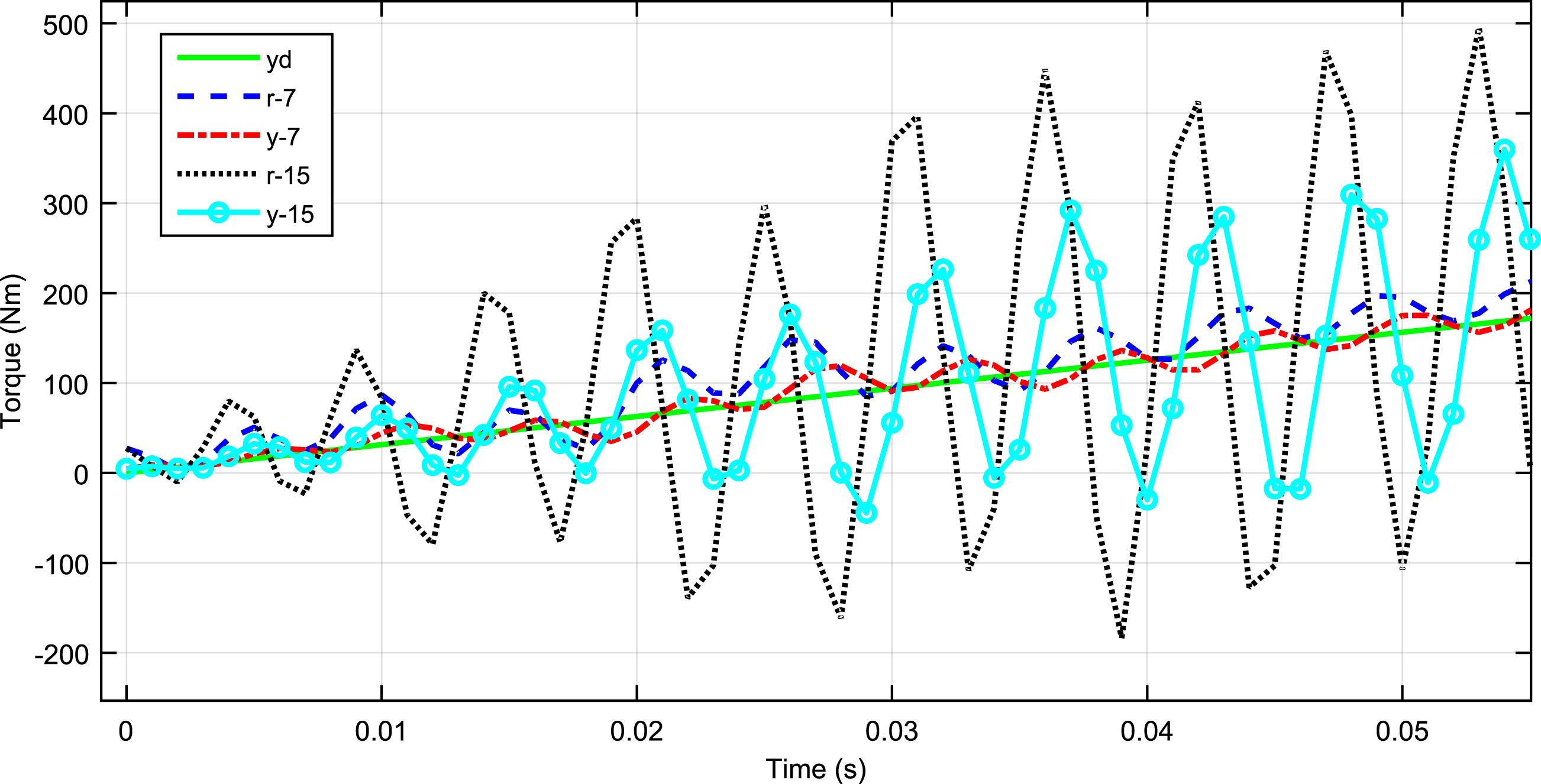
The reason for this situation is that the phase delay makes learning effect inaccurate. Phase delay is a common phenomenon in control systems (Deng et al., 2019; Gu et al., 2019; Wang et al., 2019a), which means that the output signal of the system is always delayed compared with the input signal. This is the nature of the system itself, and some scholars have begun to study the system delay in iterative learning algorithms (Liang et al., 2018; Wang et al., 2019b). For example, if the phase delay of the system is j sampling times, that means the output signal
So, the control algorithm expressed in equation (3) needs to be further modified as equation (22)
Using the same system and the same parameters, the output signal contrast diagram of the system at the 15th iteration cycle is shown in Figure 5. As shown in this figure, the system has no oscillation, the tracking effect of the output signal is better and the control precision is improved by using the modified control algorithm. Comparison of phase delay before and after correction.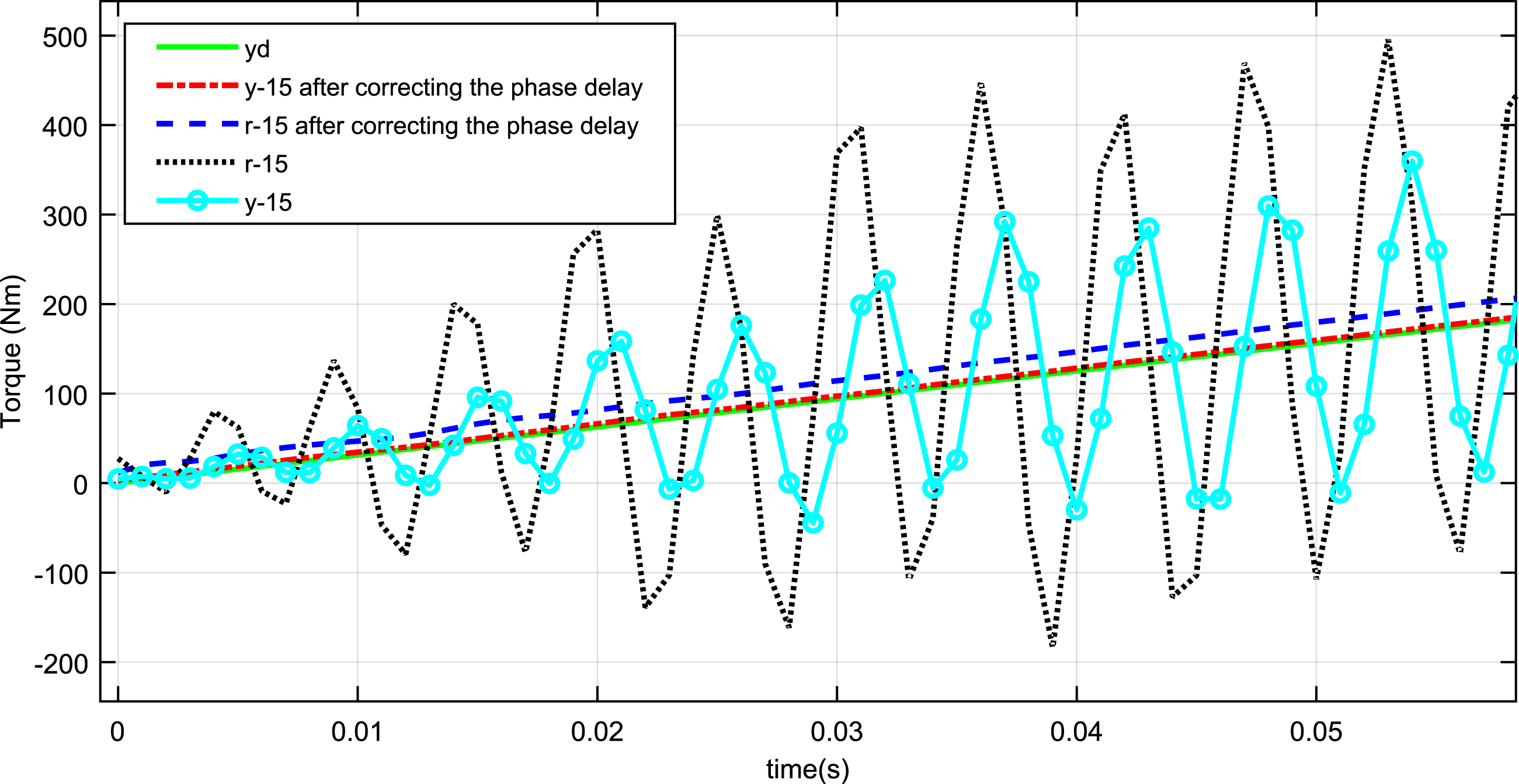
Now, let us mathematically analyze the convergence of equation (22). Notice that
Notice that
Expand the mathematical equation of
Then, we get equation (26)
From equations (12) and (26), the following equation can be derived
Notice that in equation (9)
According to equations (11) and (28), another equation can be obtained as follows
Notice that the matrix
Take the norm on the left and right sides of equation (31) and use the basic inequalities of the norm
According to equation (24), inequality (32) can be transformed into inequality (33)
Based on Lemma 1 and inequality (33), the sufficient condition for system convergence can be given, which is inequality (34). This means that if inequality (34) is satisfied, then
Convergence of the new control algorithm after phase delay correction was finally proven, and the sufficient condition for the convergence is given out.
4. Simulation verification
The new control algorithm is verified by computer simulation. First, the system identification of the actual electrohydraulic servo system was performed. The system model was selected as a 4th-order system. The parameters of the system identification model were obtained through identification experiments. Finally, the system’s identification model is shown in equation (35)
First, based on the identification model of the system, the ILC algorithm of guidance signal with control parameter learning is simulated. And the output of the first 5 cycles of the system is given in Figure 6. Compared with Figure 1, the problem that the system is out of control under the control of the classic ILC control algorithm has been effectively solved. It can be clearly seen from Figure 6 that the output signal y of the system goes from no output in the first iteration cycle to the reference signal y
d
of the system in the fourth iteration cycle. This result shows than the new control algorithm can control the system and improve the control effect at each iteration cycle. Output curve of the system.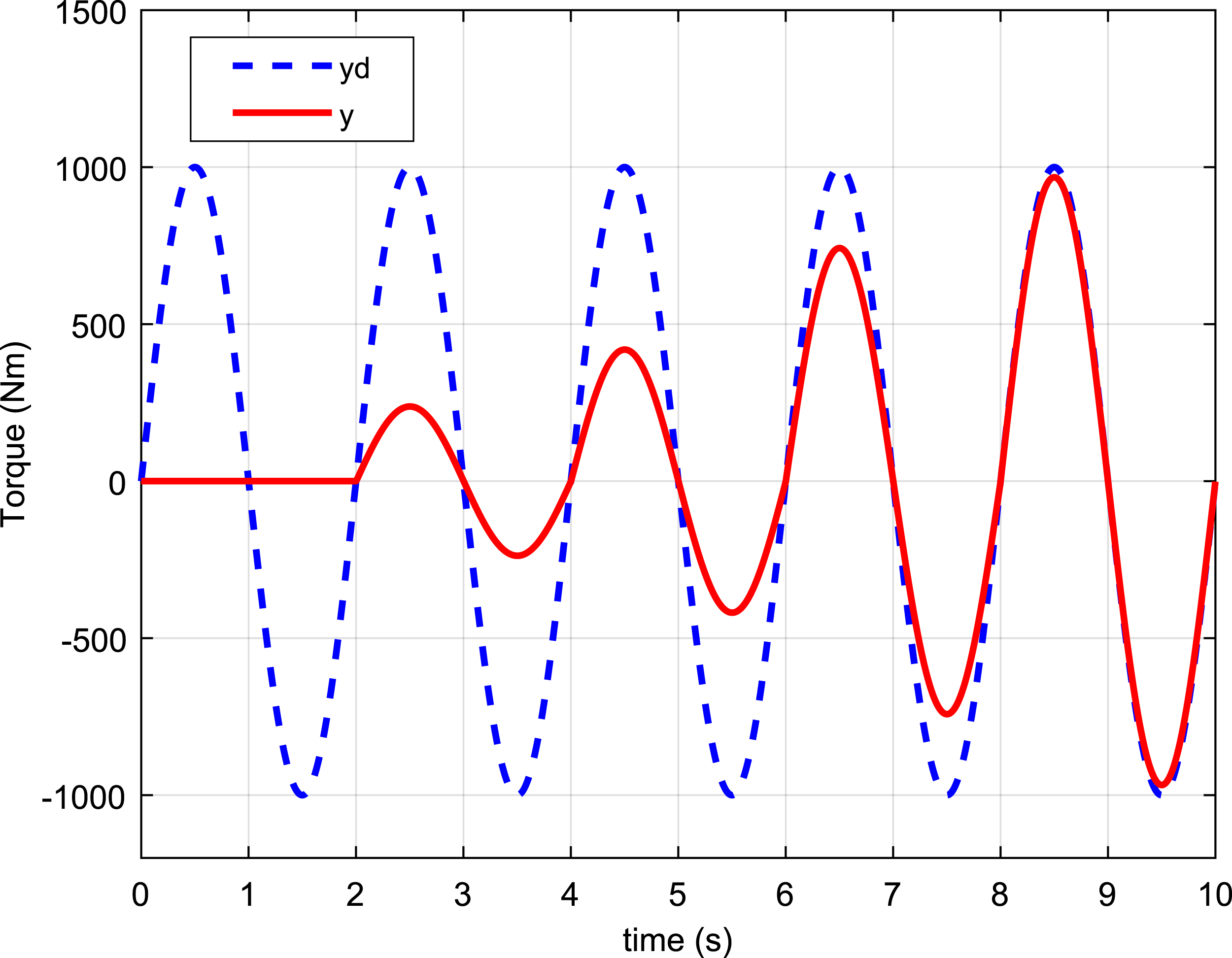
Second, we select three control algorithms for the simulation, they are the classic ILC method and ILC method of guidance signal without or with control parameter learning. The type of these three methods is P-type, and the parameters of this new method are Comparison of error convergence. Control effect comparison table.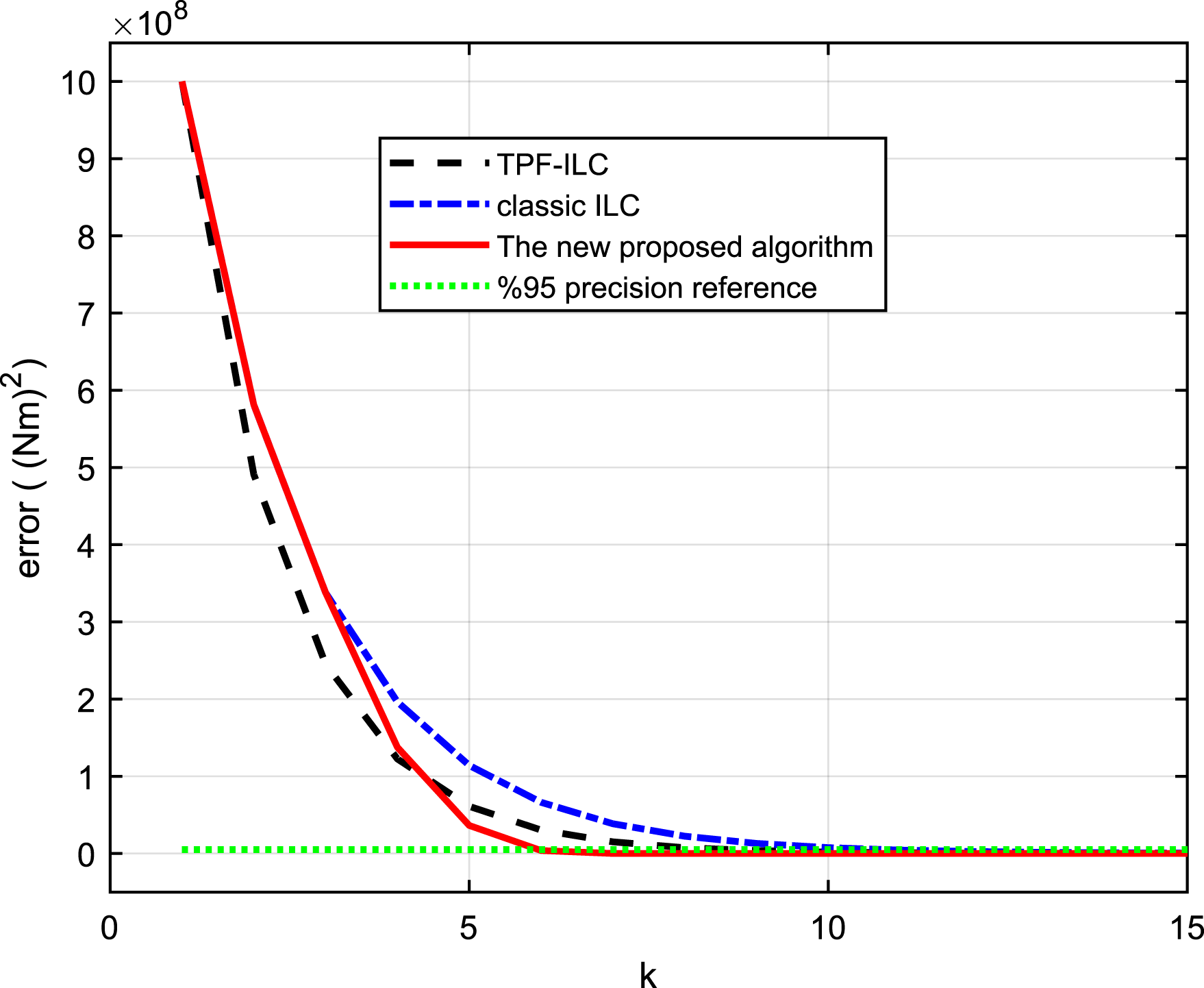

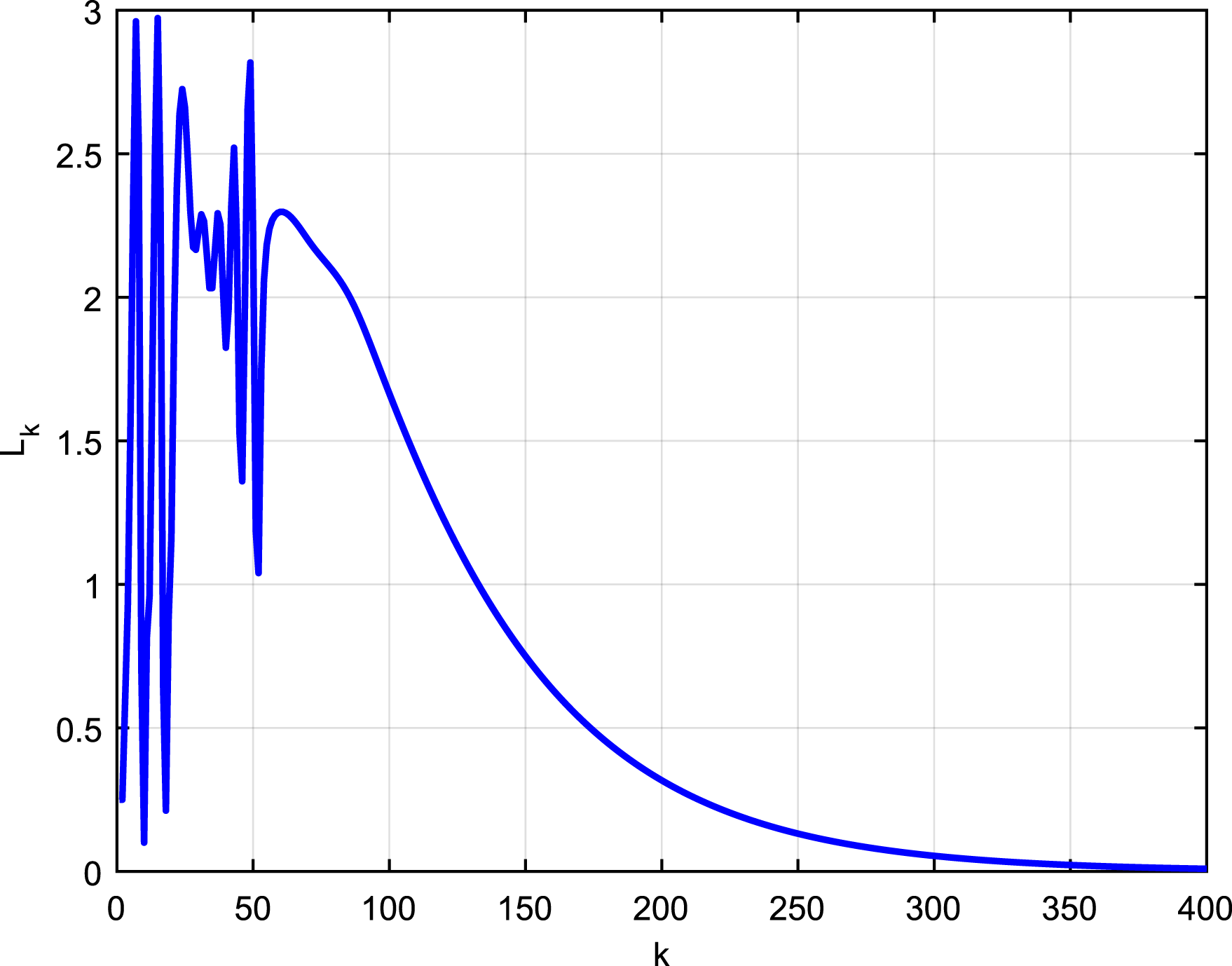
The learning process of Learning process of L
Third, robust simulation verification of this newly proposed algorithm is performed. It is assumed that the measured mechanism generates a sinusoidal position disturbance, which is superimposed on the loading system at 0.4 s in the first iteration of the system. Set the control parameter p = 0.003. The system simulation output is shown in Figure 9. It can be seen from the figure that the load torque of the system will change abruptly after the load-bearing mechanism starts to move independently at 0.4 s, but the disturbance torque is well suppressed by the new control algorithm. Obviously, after eight iterations, the control effect of the system is improved, and the disturbance torque is well suppressed. Simulation results of external interference suppression.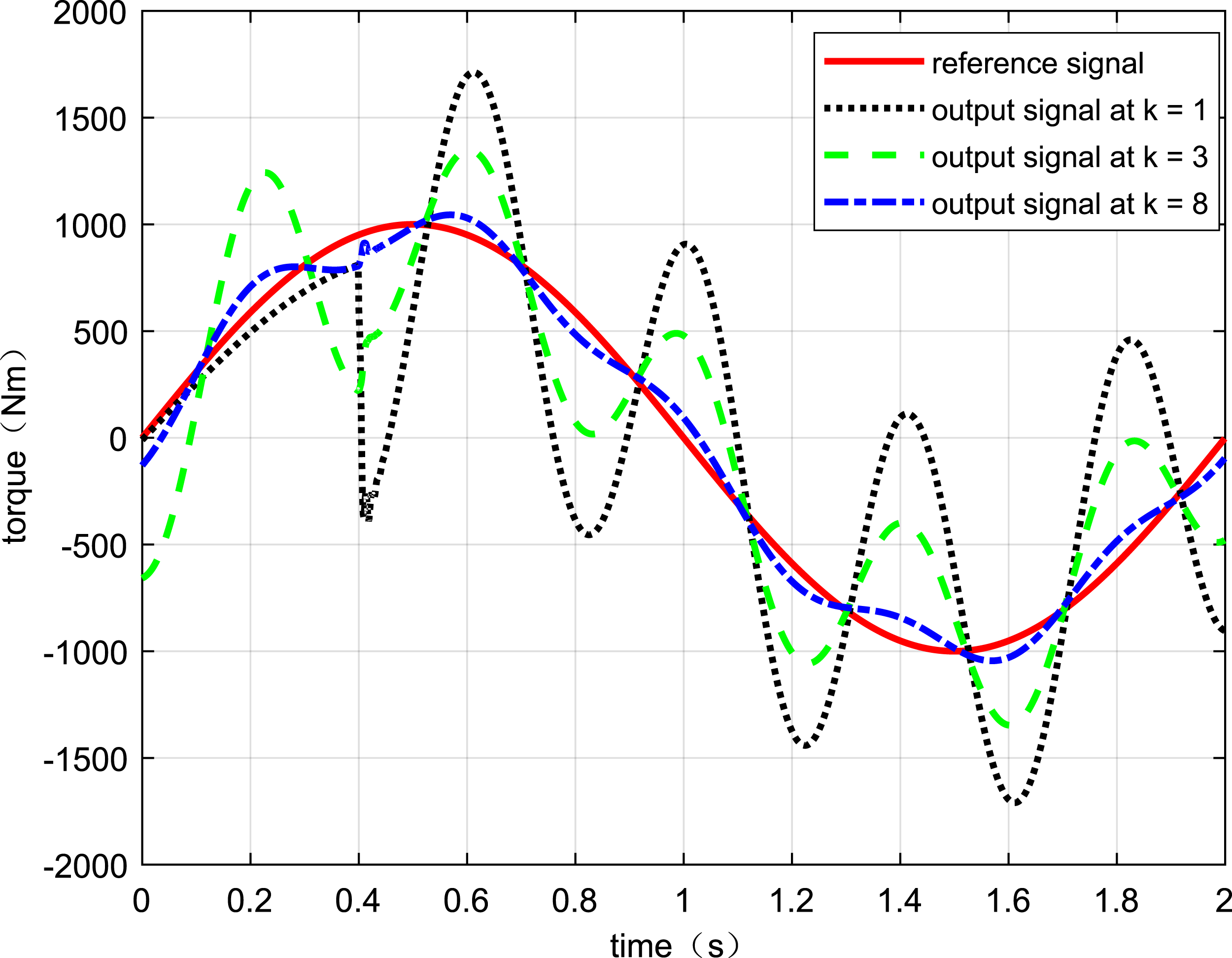
Under external interference, the system’s error convergence curve and the final output are shown in Figure 10. The robustness simulation results show that the new control algorithm is robust to external interference and can finally track the reference signal. Robustness diagram of the system.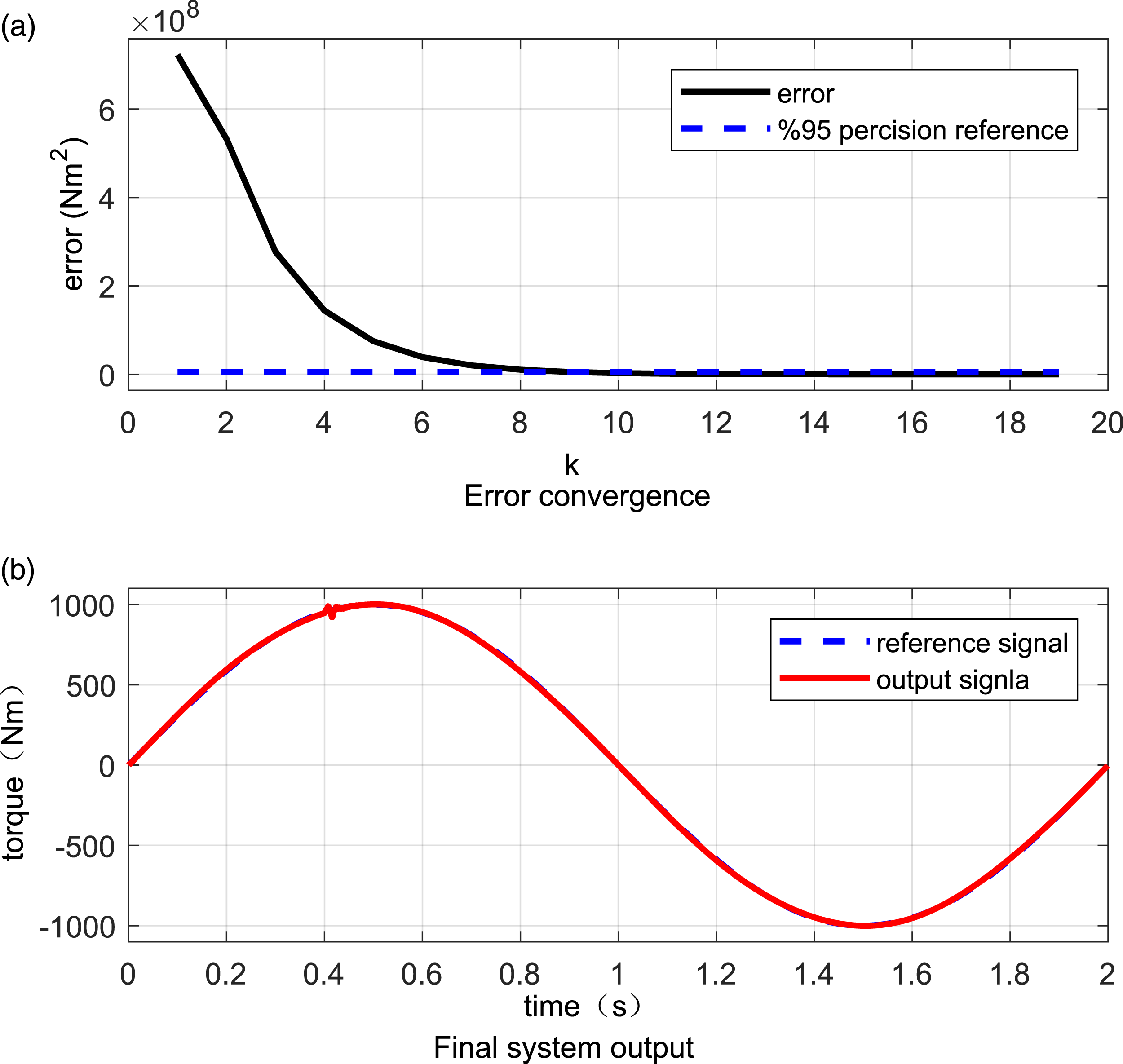
5. Experimental verification
To verify the actual control effect of this new control algorithm, it is applied to the real hydraulic servo system. The mechanical structure of the hydraulic servo system is shown in Figures 11–14. General mechanical structure diagram. Schematic diagram of the connection structure of loading mechanism convergence. Physical map of mechanical system. Physical map of hydraulic pump station.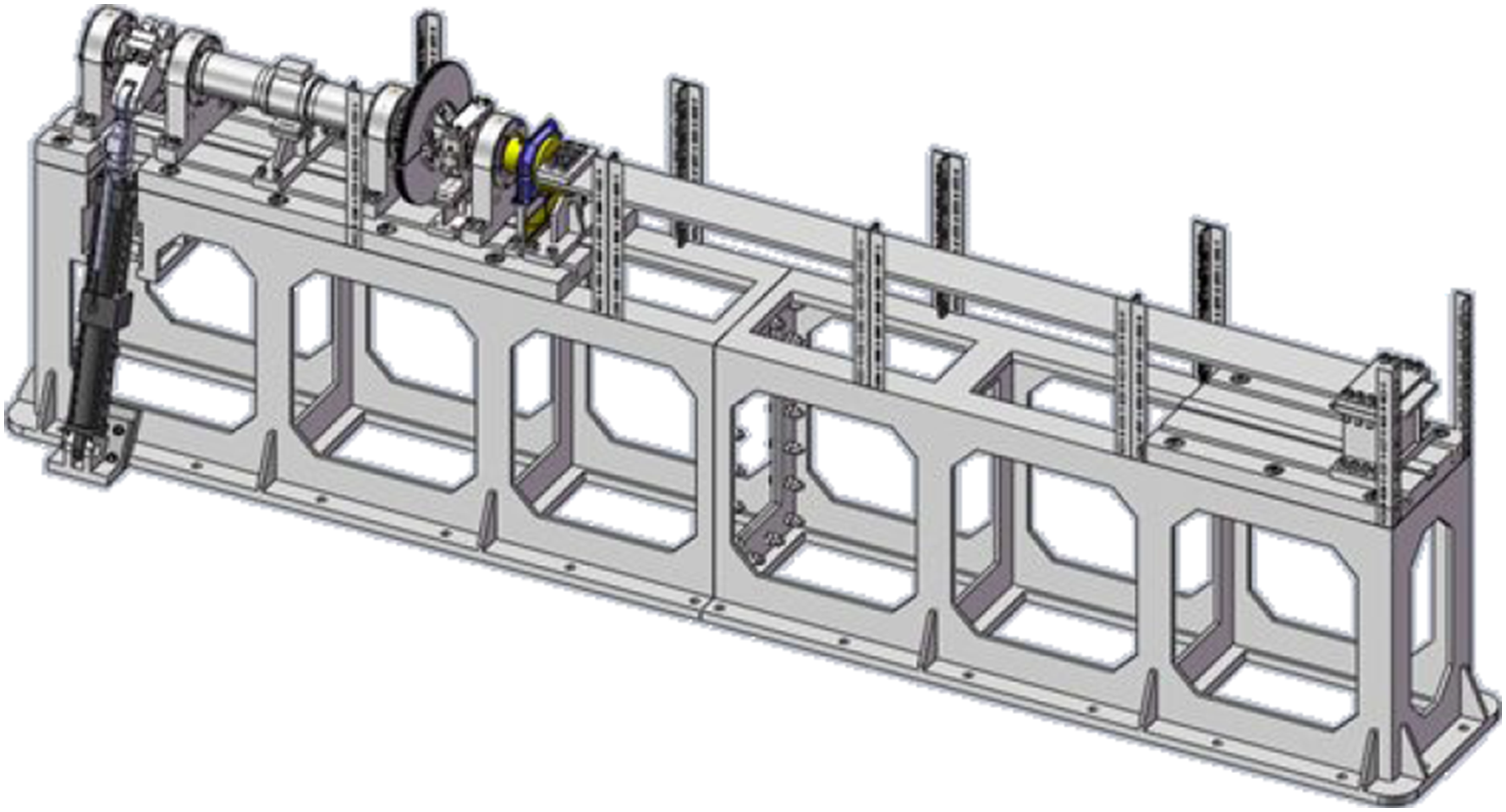
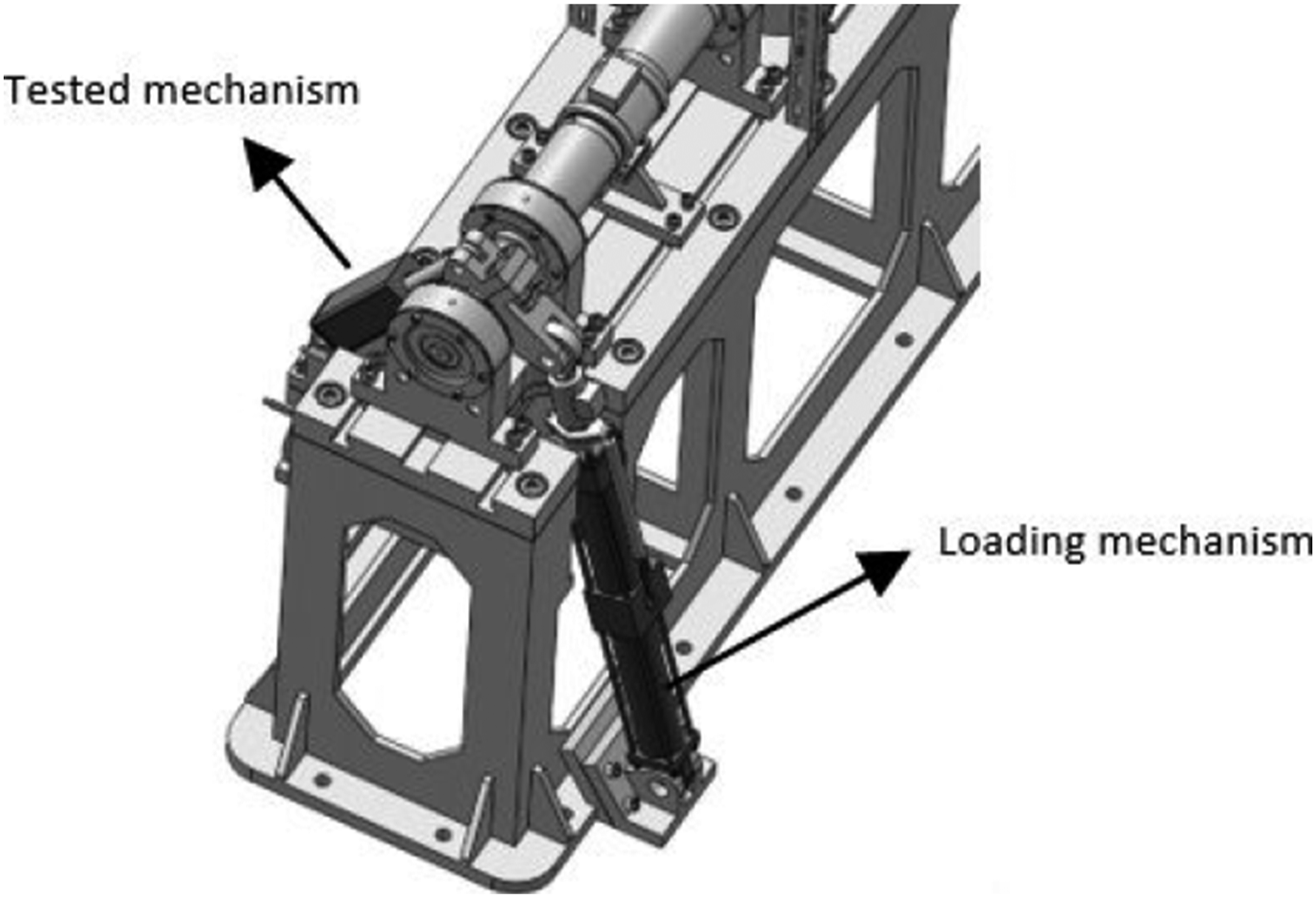
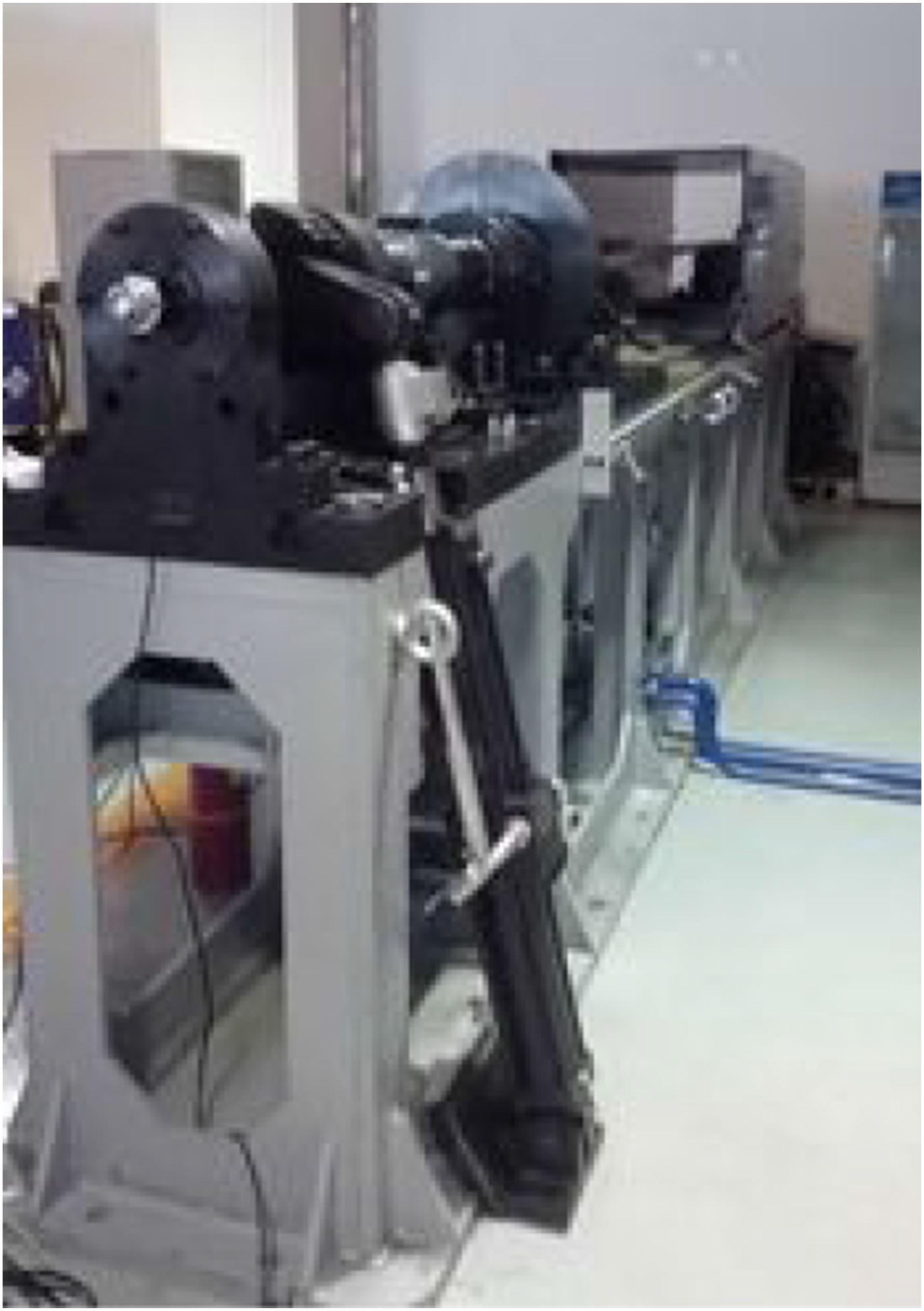
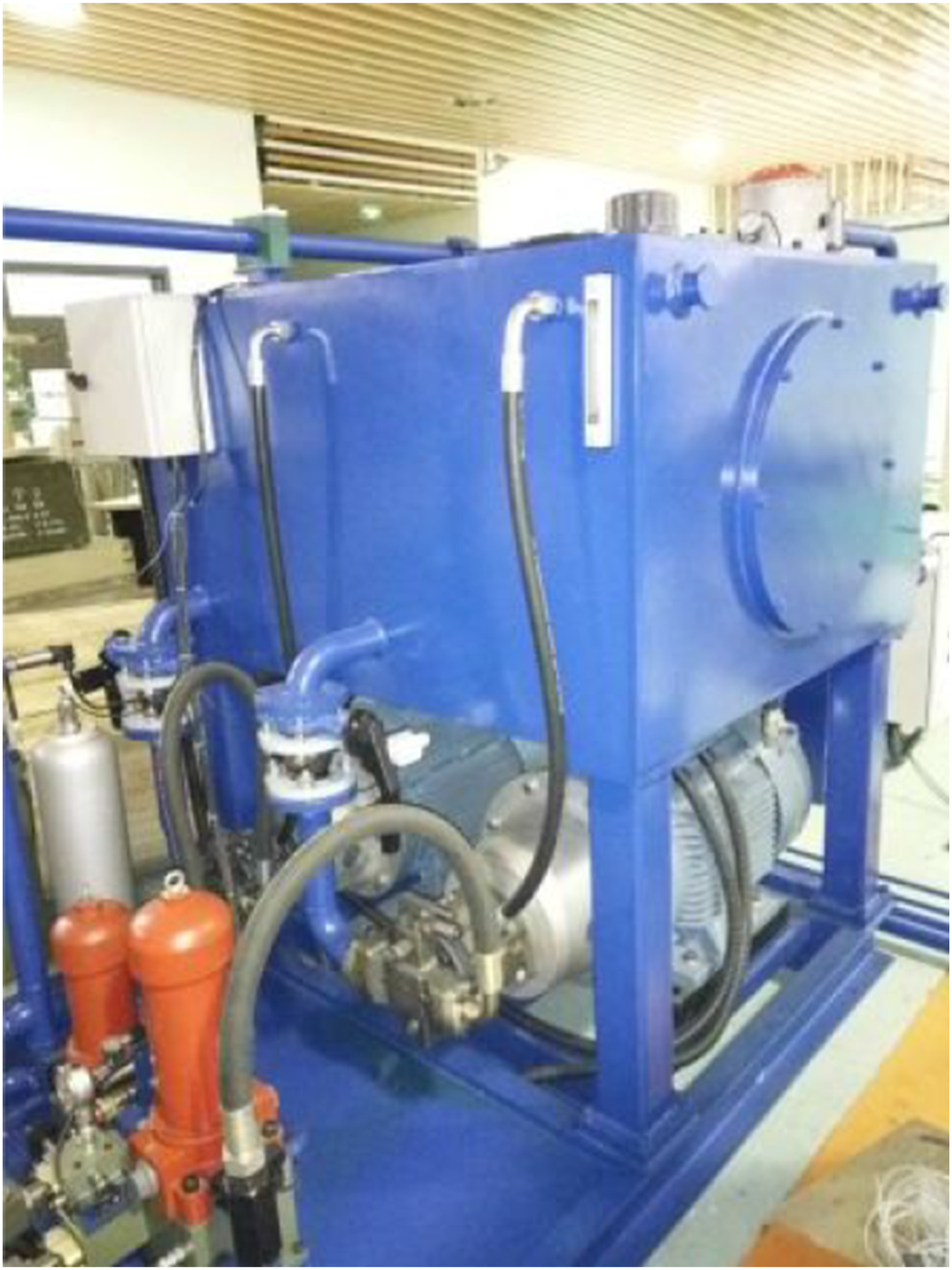
The loading mechanism loads the torque to the tested mechanism through the connecting piece. In this process, the tested mechanism will be independently controlled by the displacement control system, so it will cause external interference to the loading torque of the loading system.
In this loading situation, the control system of the loading mechanism not only needs to track the reference signal but also needs to have a good suppression effect on the external disturbance. The new proposed control algorithm is applied to the hydraulic servo loading system, and the control effect test is carried out for the sine wave control signals of different frequencies. To confirm the initial value of Tracking effect diagram of the sinusoidal signal without interference.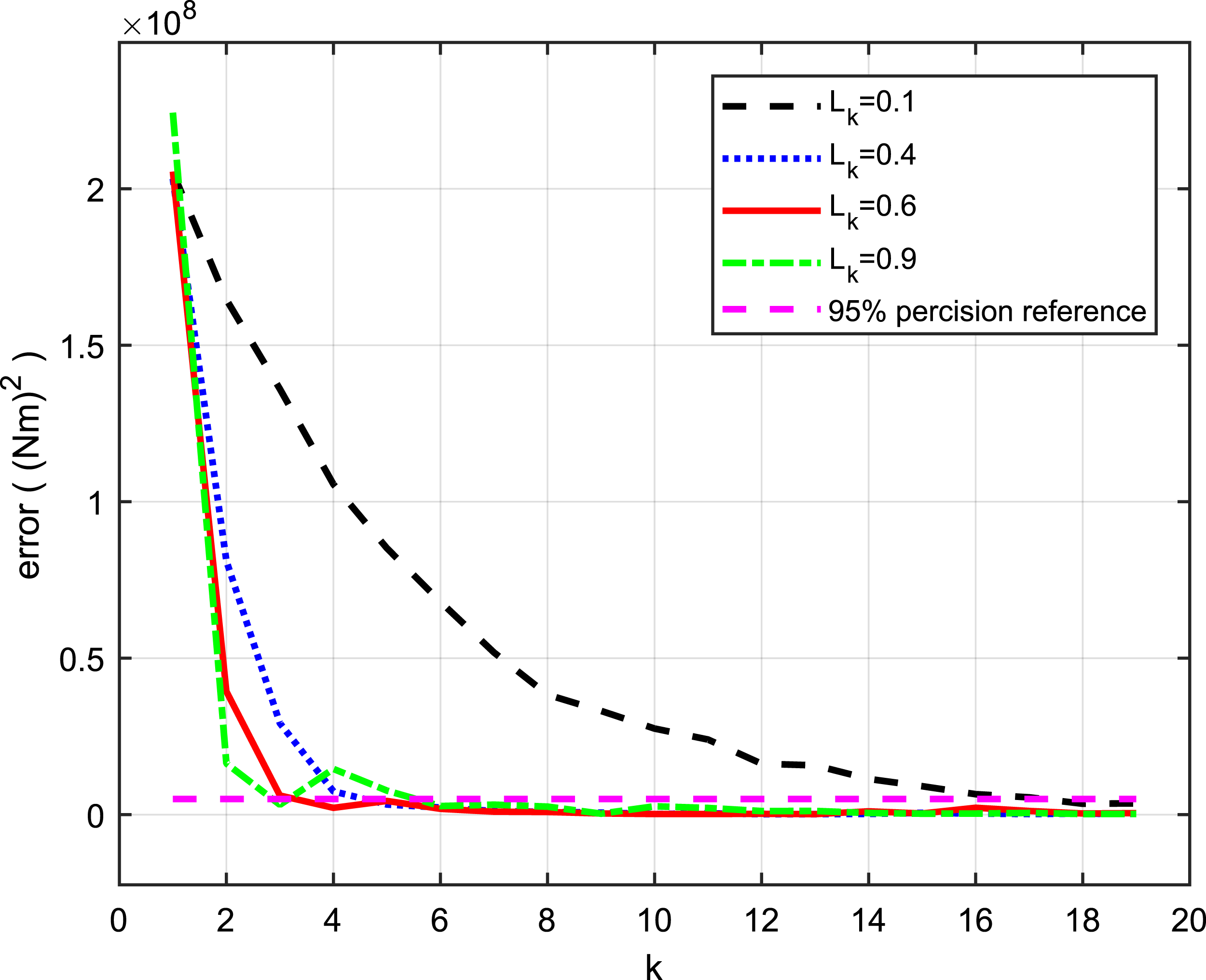
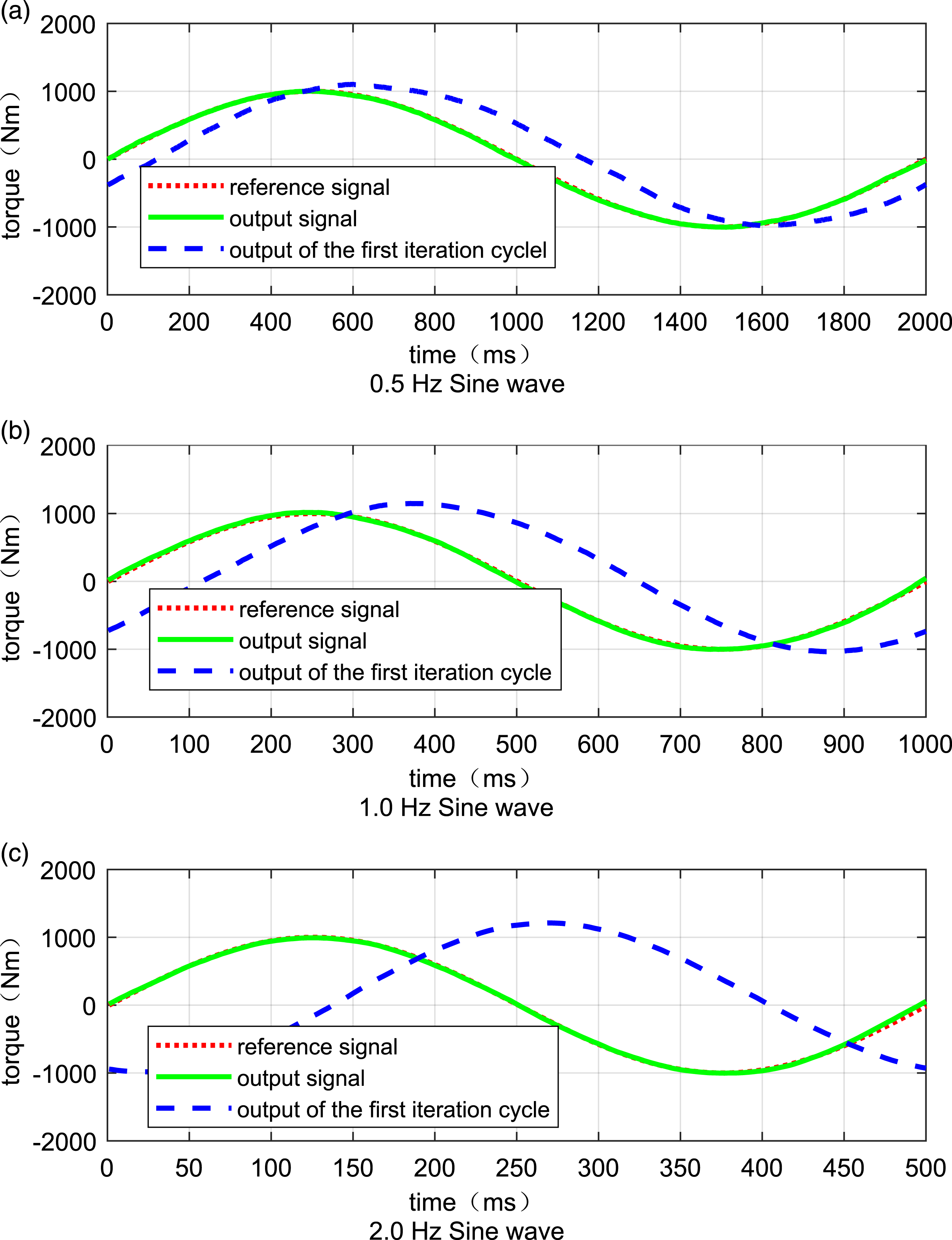
There are three sets of experiments, which are 0.5 Hz, 1 Hz, and 2 Hz sinusoidal control signals for tracking effect verification. As can be seen from the graph of Figure 16, the loading system has a good tracking effect for these three frequencies. And compared with the first iteration cycle, the newly proposed control algorithm can track the reference signal after iterative learning.
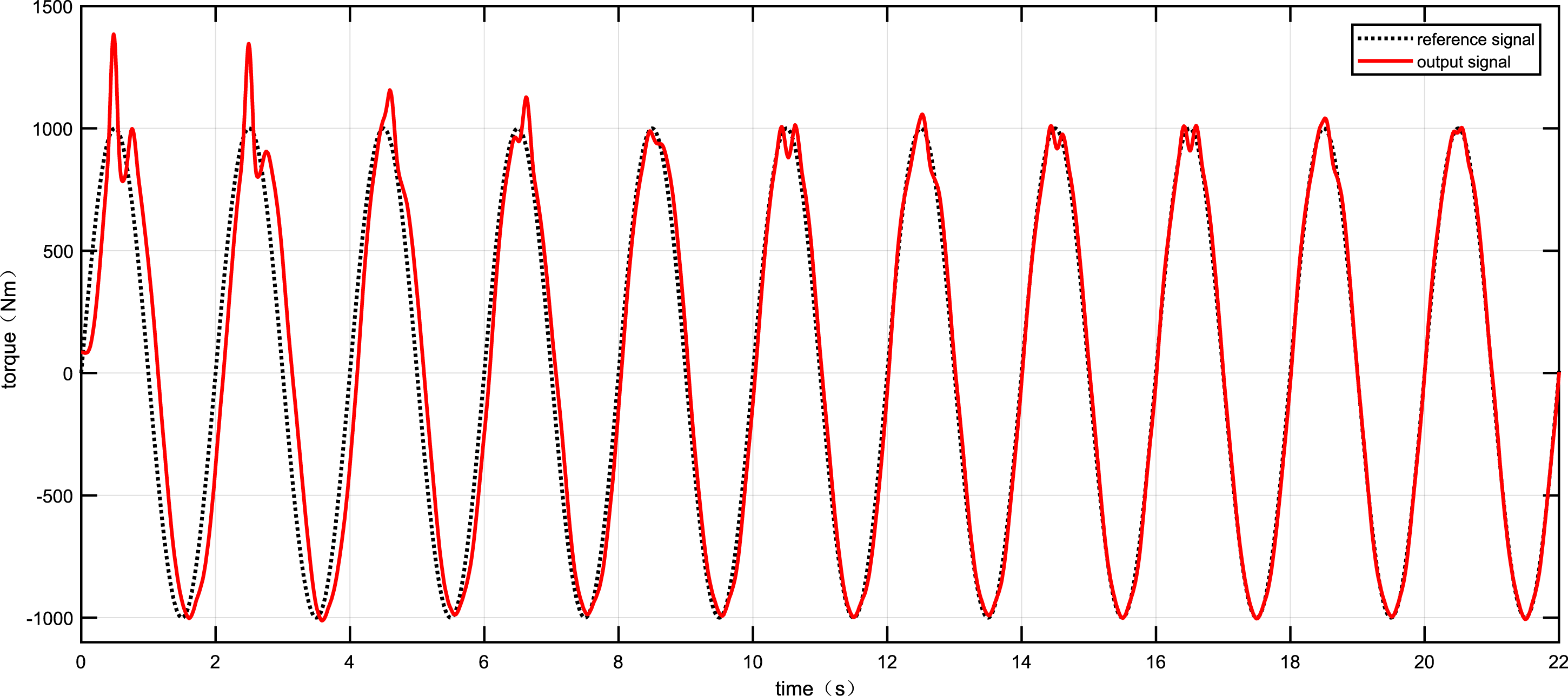
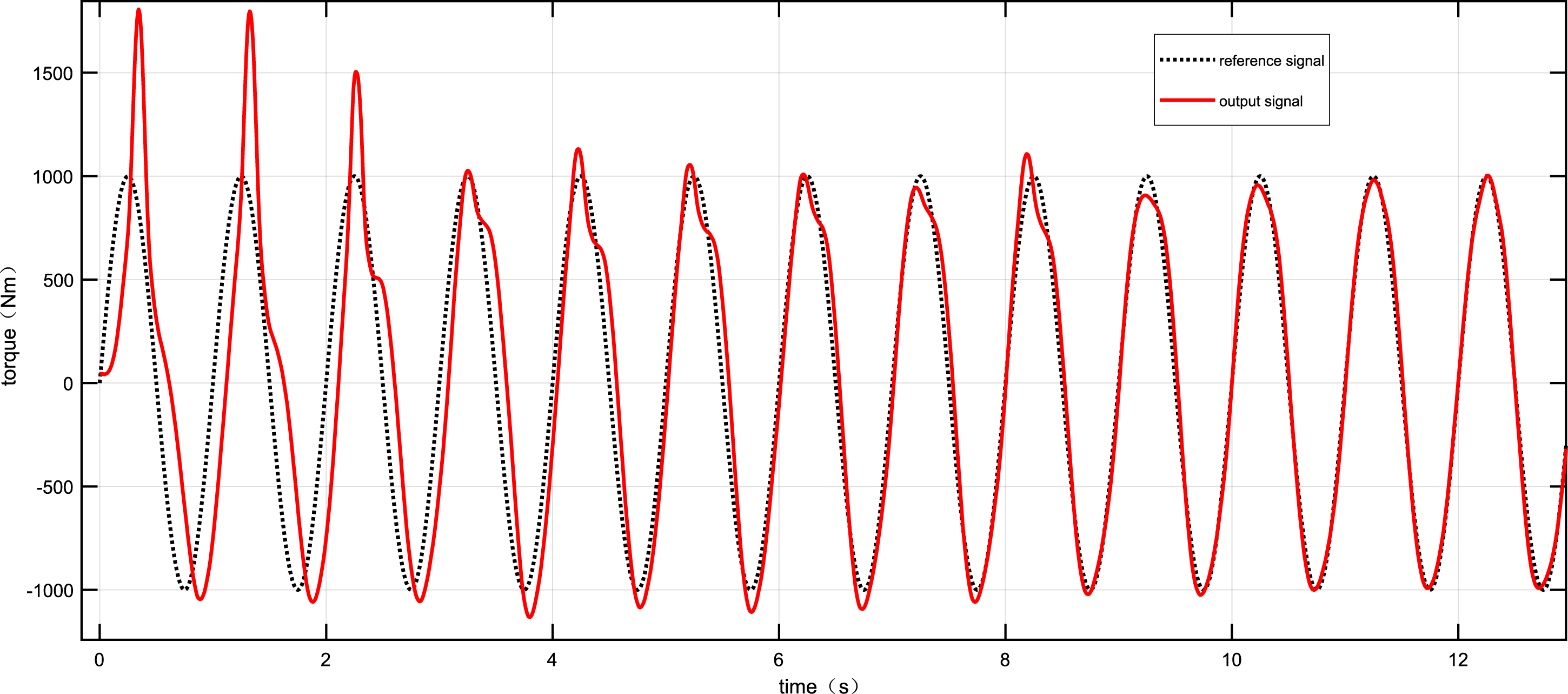
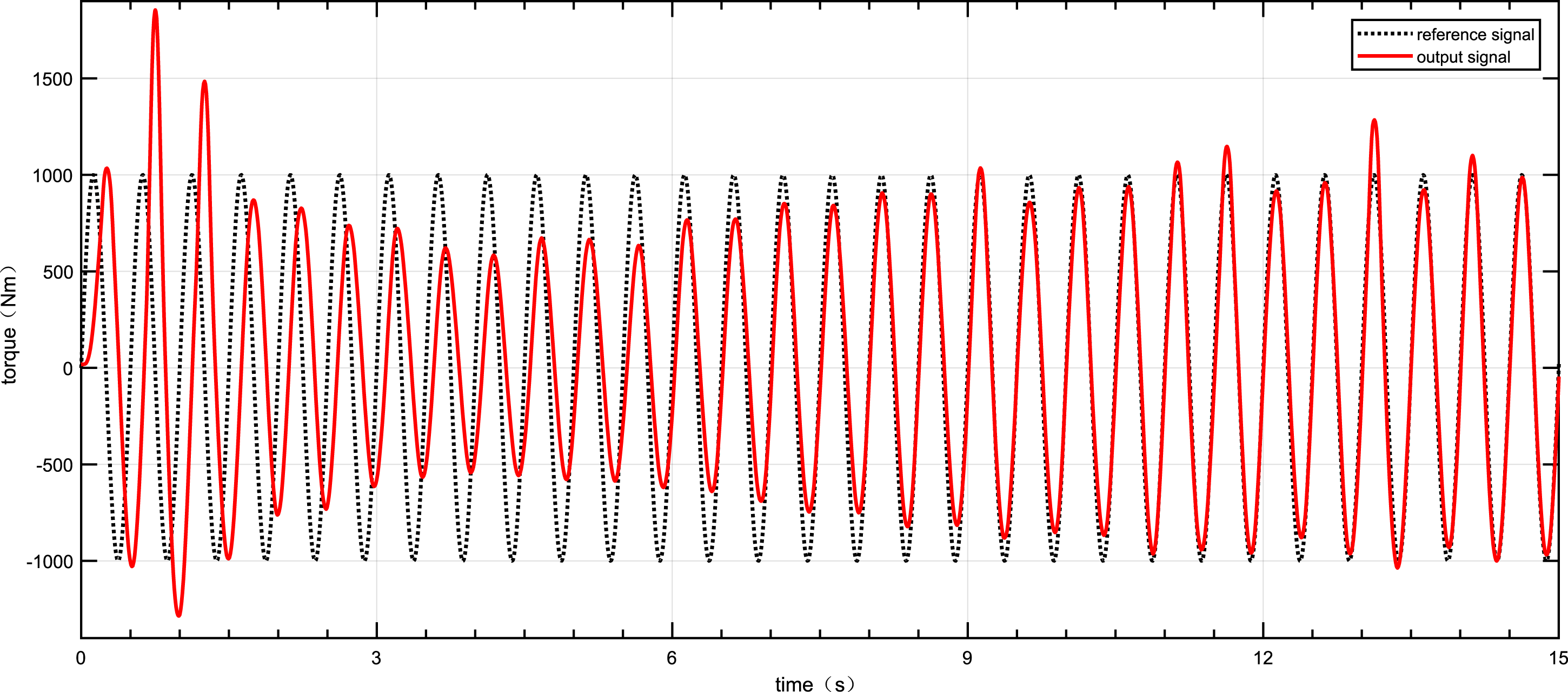
To further verify the control effect of this newly proposed control algorithm, further testing is required in case of external interference. During the torque loading process of the loading system, the measured mechanism has independent position control, which will cause external interference to the loading system. The control algorithm of the loading system needs to overcome external interference and track the reference signal during this loading process. As usual, the sinusoidal control signal is used as an example, and the interference and output of the system are shown in the figure below.
As can be seen from Figure 17, the system has an obvious distortion in the output of the system at the first iteration because of the presence of external interference. But as the iterative learning continues, the final output of the system also tracks the reference signal well. The continuous process of the output of the system under the action of the new algorithm at 0.5 Hz, 1 Hz, and 2 Hz frequency is shown in Figures 18–20. Tracking effect diagram of sinusoidal signal with interference. External interference suppression process diagram of 0.5 Hz. External interference suppression process diagram of 1 Hz. External interference suppression process diagram of 2 Hz.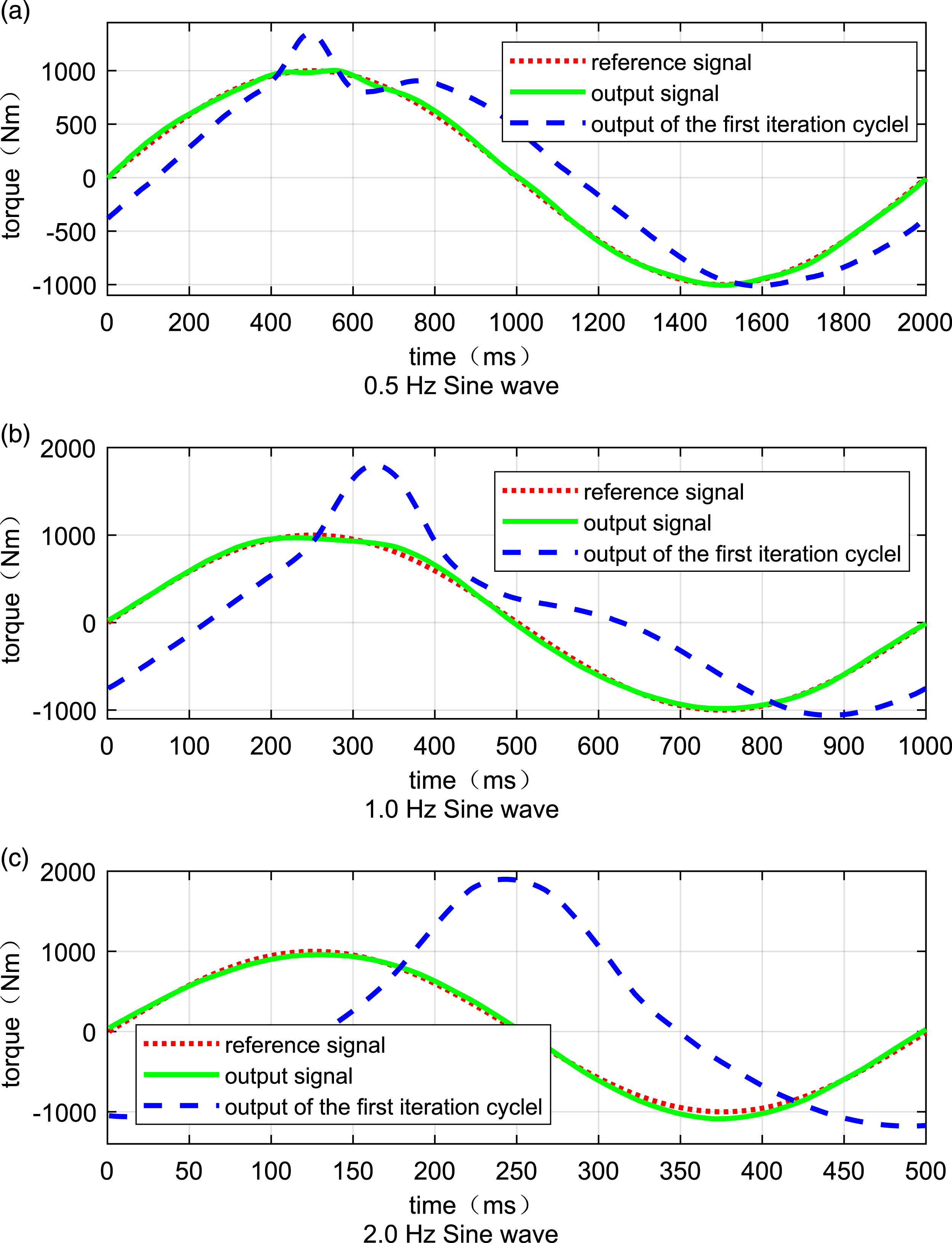
In the case of external interference, the error convergence of the system is shown in Figure 21. The system effectively suppresses external interference and makes the control accuracy reach 95% after 10 iterations. Error convergence diagram with external interference of 1 Hz.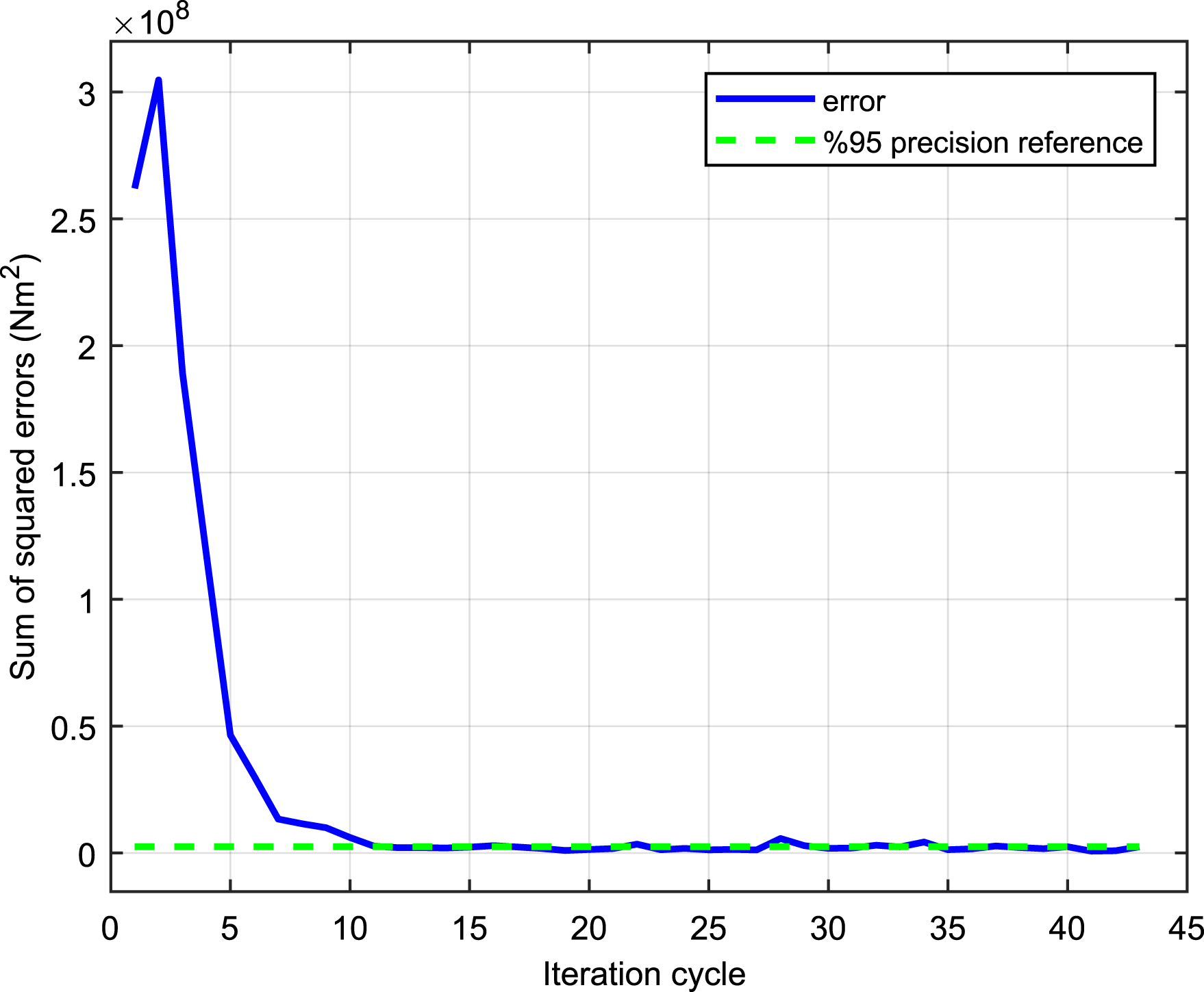
In this section, to verify the actual control effect of the control algorithm, experiments with no external interference and experiments with external interference are performed. Experimental results at different frequencies illustrate the effectiveness of the new algorithm.
6. Conclusion
To solve the problem of error divergence under the control of the classical open-loop ILC algorithm of the electrohydraulic servo system, a TPF-ILC control algorithm with control parameter learning is proposed. The convergence of this new algorithm is discussed, and the sufficient condition of convergence is given.
After that, a comparative simulation is carried out. First, the simulation result shows that the new algorithm can solve the problem of the divergence of the classic ILC method in the electrohydraulic servo system. Second, the control method with control parameter learning has a faster convergence speed and better control accuracy than the learning method without control parameter learning.
Finally, the control algorithm was applied to the real electrohydraulic servo loading system, and experimental verification was carried out. The experimental results and data prove that this new control algorithm proposed in this article has a better control effect and strong external interference suppression ability.
Footnotes
Declaration of conflicting interests
The author(s) declared no potential conflicts of interest with respect to the research, authorship, and/or publication of this article.
Funding
The author(s) disclosed receipt of the following financial support for the research, authorship, and/or publication of this article: The Fundamental Research Funds for the Central Universities grant number No. 2019RC042
