






Abstract
This study presents dynamic responses of a composite thick beam with a functionally graded porous layer under dynamic sine pulse load. The boundary conditions of the composite beam are considered as viscoelastic supports. Three layers are considered, and face sheet layers have porous functionally graded materials in which the distribution of material gradation through the graded layer is described by the power law function, and the porosity is depicted by three different distributions (i.e., symmetric distribution, X distribution, and ◊ distribution). The layered composite thick beam is modeled as a two-dimensional plane stress problem. The equation of motion is obtained by Lagrange’s equations. In formation of the problem, the finite element method is used with a 12-node 2D plane element. In the solution process of the dynamic problem, a numerical time integration method of the Newmark method is used. In numerical analyses, influences of stiffness and damping coefficients of viscoelastic supports, material gradation index, porosity parameter, and porosity models on the dynamic response of thick functionally graded porous beam are investigated under the pulse load.
Keywords
1. Introduction
Beams and plates are used in various applications, such as aerospace, marine, automotive, and defense sectors, where continuous elements of these types are required. Necessity for concurrent thermal and mechanical strengths has led to the invention of plate and beam structures with functionally graded material (FGM) properties (Ghayesh, 2019). The FGM is described by a continuous and smooth variation in both composition profile and material properties along one or more than one direction to accomplish desired structural performance (Zhao et al., 2020a). Structures with functionally graded (FG) porous constituents have been deemed by research communities and industries because of their outstanding energy absorption capability, high specific strength, low thermal conductivity, and other special characteristics (Kannan et al., 2008; Miyamoto et al., 2013). Recently, there has been increasing interest in the development of porous bone implant FG materials that exhibit an architecture mimicking that of human bone because the porous structure can provide space for new bone tissue ingrowth and body fluid circulation (Yuan et al., 2019).
For one-dimensional beam structure, Şimşek and Kocatürk (2009) investigated the free and forced vibrations of an FG simply supported beam subjected to concentrated moving harmonic load. Ergut and Altintas (2013) presented the effect of application area distributions of mass, force, and support on free and forced vibration behaviors of viscoelastically supported plates. Demir and Oz (2014) exploited the finite element method (FEM) to investigate resonance frequencies of the FG beam under viscoelastic boundary conditions. Hamed et al. (2016) presented vibration characteristics of both nonlinear symmetric power and sigmoid FG nonlocal nanobeams by using the nonlocal differential Eringen’s elasticity model. Frikha et al. (2016) presented a 2-node, 4 degree of freedom/node beam element based on a higher-order shear deformation theory for axial–flexural–shear FGM. Akbas (2016a) studied wave propagation of edge-cracked damped cantilever FG beam excited by a transverse triangular force impulse by the FEM. Akbaş (2016b, 2017) exploited the modified couple stress theory and the Kelvin–Voigt viscoelastic model to investigate the vibration response of full and cracked viscoelastic nanobeams rested on Winkler–Pasternak elastic foundation under forced excitation. Ding et al. (2017) presented effects of viscosity on the natural frequency of transverse vibration of an axially moving viscoelastic beam modeled by the Euler–Bernoulli beam and Kelvin model. Şimşek and Al-Shujairi (2017) examined static, free, and forced vibrations of FG sandwich beams under the action of double moving harmonic loads traveling with constant velocities using the Timoshenko beam theory. Fan et al. (2018) studied low-velocity impact response of FG graphene-reinforced composite laminated beam rested on visco-Pasternak foundations and subjected to transverse impact load in thermal environments. Eltaher et al. (2018) presented a modified porosity model that represents porosity and Young’s modulus in an implicit form to study static and dynamic behaviors of FG porous nonlocal nanobeams. Li et al. (2018) exploited the even and uneven dispersion patterns of porosity to present size-dependent the nonlinear free vibration behavior of porous beams with geometric imperfections. Emam et al. (2018) developed an analytical model to study postbuckling and free vibration of multilayer imperfect composite nanobeams under a prestress load. Yang et al. (2018, 2019) investigated the nonlinear instability of FG multilayer graphene reinforced composite shallow arches under a central point load and mechanical and thermal loading.
Ebrahimi et al. (2019) investigated frequency response of curved magneto–electro–viscoelastic FG nanobeams resting on viscoelastic foundation by incorporating the Euler–Bernoulli beam model and Eringen’s nonlocal theory. Hamed et al. (2019) studied effects of four porosity models on the static behavior of size-dependent nonlocal FG nanobeams. Jrad et al. (2020) developed analytical and finite element solutions of free and forced vibrations of unrestrained and braced thin-walled beams. Ghayesh (2019) investigated resonant vibrations of viscoelastic FG imperfect Timoshenko beams by using the Kelvin–Voigt scheme. Silva and Bavastri (2019) developed an optimal design of physical parameters, positions, and viscoelastic materials of simple dynamic absorbers for passive vibration control. Hamed et al. (2020a) and Eltaher and Mohamed (2020) studied the buckling stability of sandwich composite beam structure under varying axial loads and resting on elastic foundation by using the unified beam theory. Hamed et al. (2020b) presented the influence of axial load function and optimization on static stability of sandwich FG beams with porous core. Melaibari et al. (2020a, 2020b) studied the buckling stability of FG beams under variable axial load with different gradation (i.e., power, symmetric, and sigmoid) functions. Yang et al. (2020a, 2020b) investigated in-plane and out-of-plane free vibrations of FG composite arches with graphene reinforcements under a step central point load. Faroughi et al. (2020) studied wave propagation in 2D FG porous rotating nanobeams using a general nonlocal higher-order beam model. Abu-Alshaikh and Almbaidin (2020) used the Caputo and Caputo–Fabrizio fractional derivative models to investigate the response of the FG Euler beam under moving mass. Abida et al. (2020) investigated a viscoelastic–viscoplastic model with hygromechanical coupling for flax fiber–reinforced polymer composites. Zghal and Dammak (2020) investigated the vibrational behavior of beams made of FGMs using double field of displacements and stresses, which offers the possibility of the development of low-order linear elements with enhanced accuracy. Zghal et al. (2020) studied static bending analysis of beams made of functionally graded porous materials using a refined mixed finite element beam model.
Recently, lots of researchers modeled thick beam structures by two-dimensional constitutive equations. Eltaher et al. (2018) and Soliman et al. (2018a, 2018b) presented nonlinear transient analysis and cracked FG pipe subjected to internal pressure and unsteady temperature by using the 2D elasticity model and FEM. Trabelsi et al. (2018) studied thermal postbuckling analysis of FGM structures by using a modified first-order shear deformation theory (FSDT) with a parabolic shape function. Akbaş (2018) exploited the plane solid continua model to investigate forced vibration response of FG porous deep beams by using even and uneven porosity models. Akbaş (2019a) modified the previous model to investigate the forced response of the sandwich FG thick beam by using the FEM. Akbaş (2019b) analyzed the nonlinear behavior of a FG nonuniform hygrothermal cantilever thick beam using the plane solid continua model. Trabelsi et al. (2019, 2020) investigated thermal buckling analysis of functionally graded plates and cylindrical shells by using the Kirchhoff–Love model and modified FSDT-based four-node finite shell element. Foroutan et al. (2020) presented analytical and semianalytical approaches to study the nonlinear dynamic and static hygrothermal buckling analysis of imperfect FG porous cylindrical shells under hygrothermal loading including effect of the von Kármán strain–displacement kinematic nonlinearity. Moleiro et al. (2020) addressed the modeling and analysis of multilayered plates with embedded FGM layer(s) under hygro–thermo–mechanical loadings by using the layerwise mixed model. Zhao et al. (2020b) exploited closed-cell cellular solids under the Gaussian random field scheme to describe the relationship between the elastic modulus and mass density of the material and then to study dynamic instability of FG porous arch reinforced with uniformly distributed graphene platelets. Akbaş et al. (2020) developed a comprehensive model to investigate the vibration response of FG porous thick beams under the dynamic sine pulse load including the damping effect. Mohseni and Shakouri (2020) studied free vibration, damping, and forced responses of sandwich plates with viscoelastic core and graphene nanoplatelet–reinforced face sheets.
As per authors’ knowledge and literature, the transient dynamic behaviors of FG deep 2D porous beams under pulse load and supported with viscoelastic end conditions have not been analyzed and investigated elsewhere. So, this article tries to fill this gap and study influences of viscoelastic supports, gradation index, porosity parameter, and porosity type on the response of FG deep beam by using the numerical FEM. The rest of this article is organized as follows: mathematical formulations, constitutive equations, and numerical formulation are introduced through Section 2. The validation of model and parametric investigation of gradation parameter, porosity model, porosity index, and viscoelastic supports on dynamic response of thick multilayer porous FG beams are examined in Section 3. Conclusion points and main remarks are summarized through Section 4.
2. Problem formulation
2.1. Mathematical formulation
A viscoelastic supported thick beam with three layers under a pulse load Viscoelastic-supported thick-layered beam with porous functionally graded layers under a pulse load.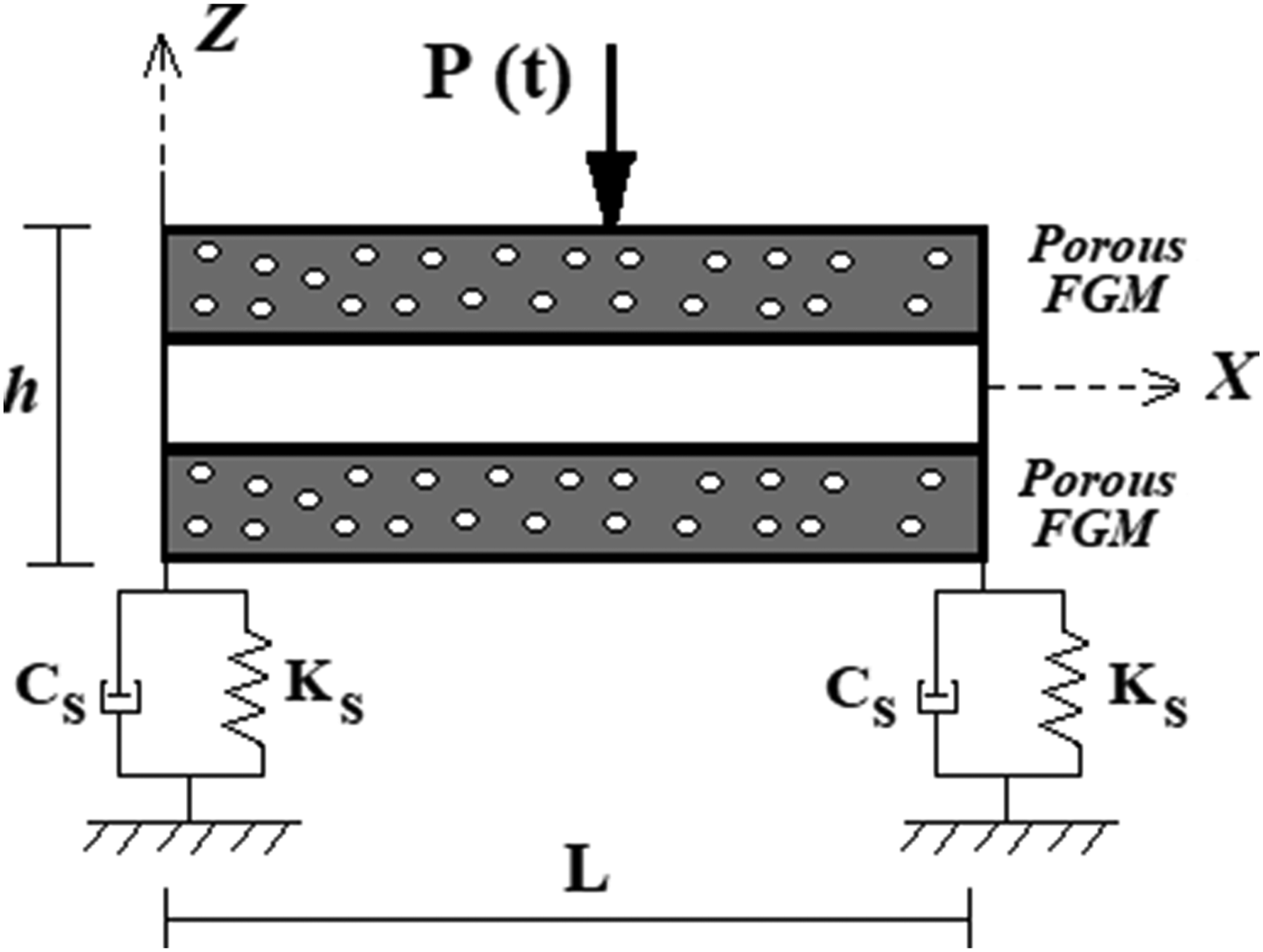
Assuming that, the gradation of material through the layer thickness is assumed to be symmetrical to the midplane axis, and each layer has the same thickness. Based on this assumption, the properties of material constituent are varied through the beam thickness according to the following power law, (Eltaher et al., 2014) Porosity distribution through a gradated layer (Akbaş, 2018).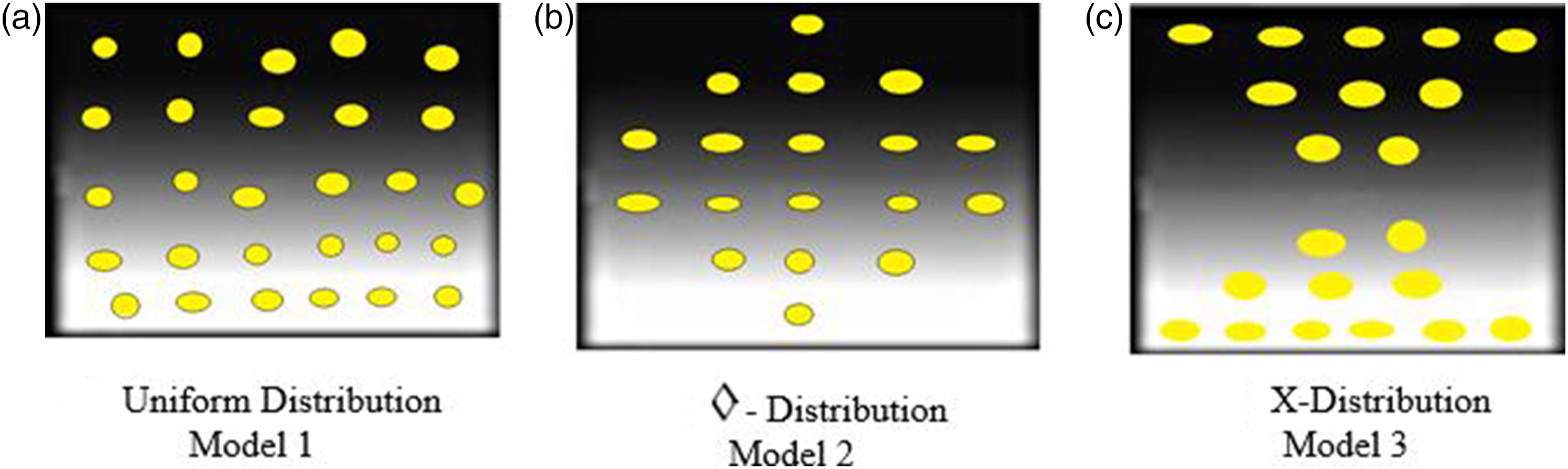
The current analysis focuses on the analysis of FG deep beam structures. Thus, to describe the mechanical behavior of this system accurately, 2D plane stress constitutive relation is exploited. Therefore, the kinematic strain–displacement relations are described by (Akbaş, 2018)
In the condensed matrix form, equation (5a) becomes
In the abbreviated matrix form, equation (6a) turns into
2.2. Finite element formulation
Through this section, the Lagrangian equation is exploited to derive the governing equation of motion of FG porous thick beam structure. The Lagrangian equation can be described by
The potential energy Twelve-node 2D plane element and finite element model.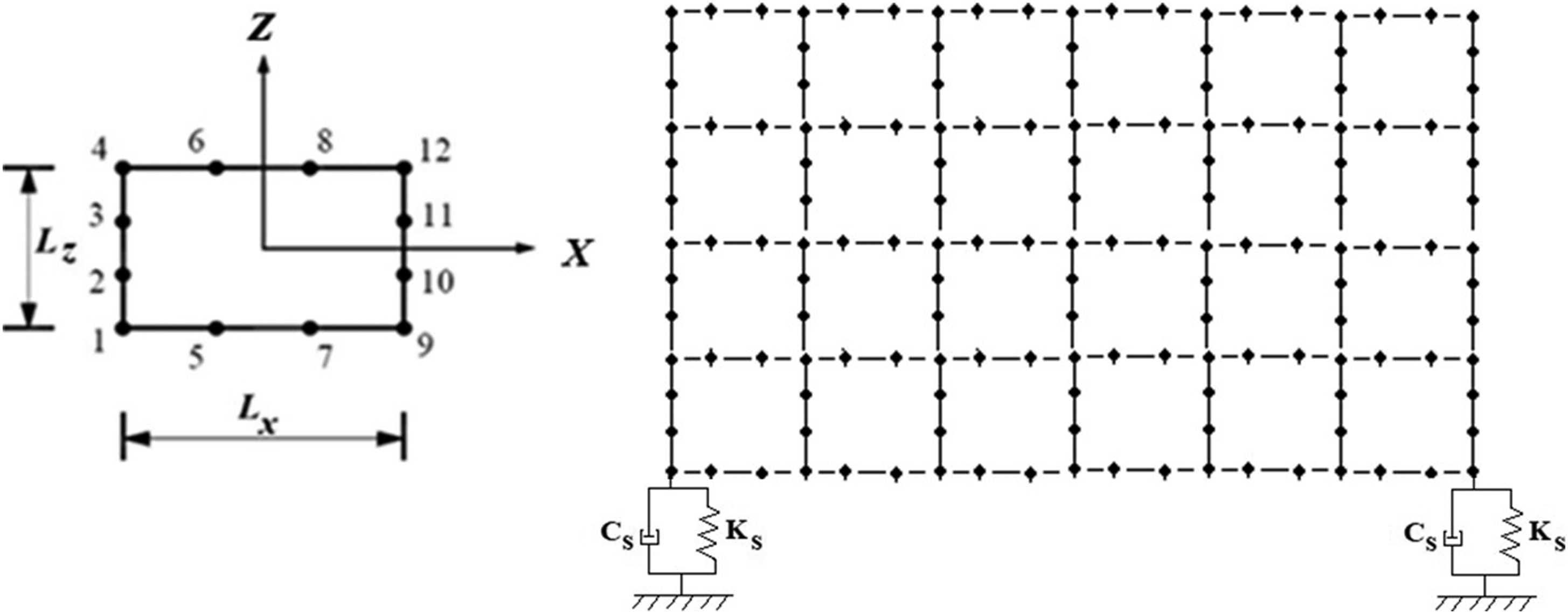
The displacement vector for the 12-node plane element can be represented by
Substituting equation (13) into energy equations (9)–(2) and Lagrange’s equations (8), the dynamic equation of motion can be presented as
The load point harmonic pulse function
Once calculating
The dimensionless stiffness and damping coefficients of viscoelastic supports are given as follows
3. Numerical results
3.1. Validation
To validate the proposed model, a comparison study with ANSYS software is presented. In the comparison study, the vertical displacements at the free end of a homogeneous zirconia/homogeneous aluminum/homogeneous zirconia beam are obtained and compared with ANSYS Workbench program under pulse load without damping and porosity effects for L/h = 7, P0 = 1000 kN, Ω = 5 rad/s, and Comparison study: time responses of the homogeneous zirconia/homogeneous aluminum/homogeneous zirconia beam under pulse load without damping effect for L/h = 7, P0 = 1000 kN, Ω = 2 rad/s, and 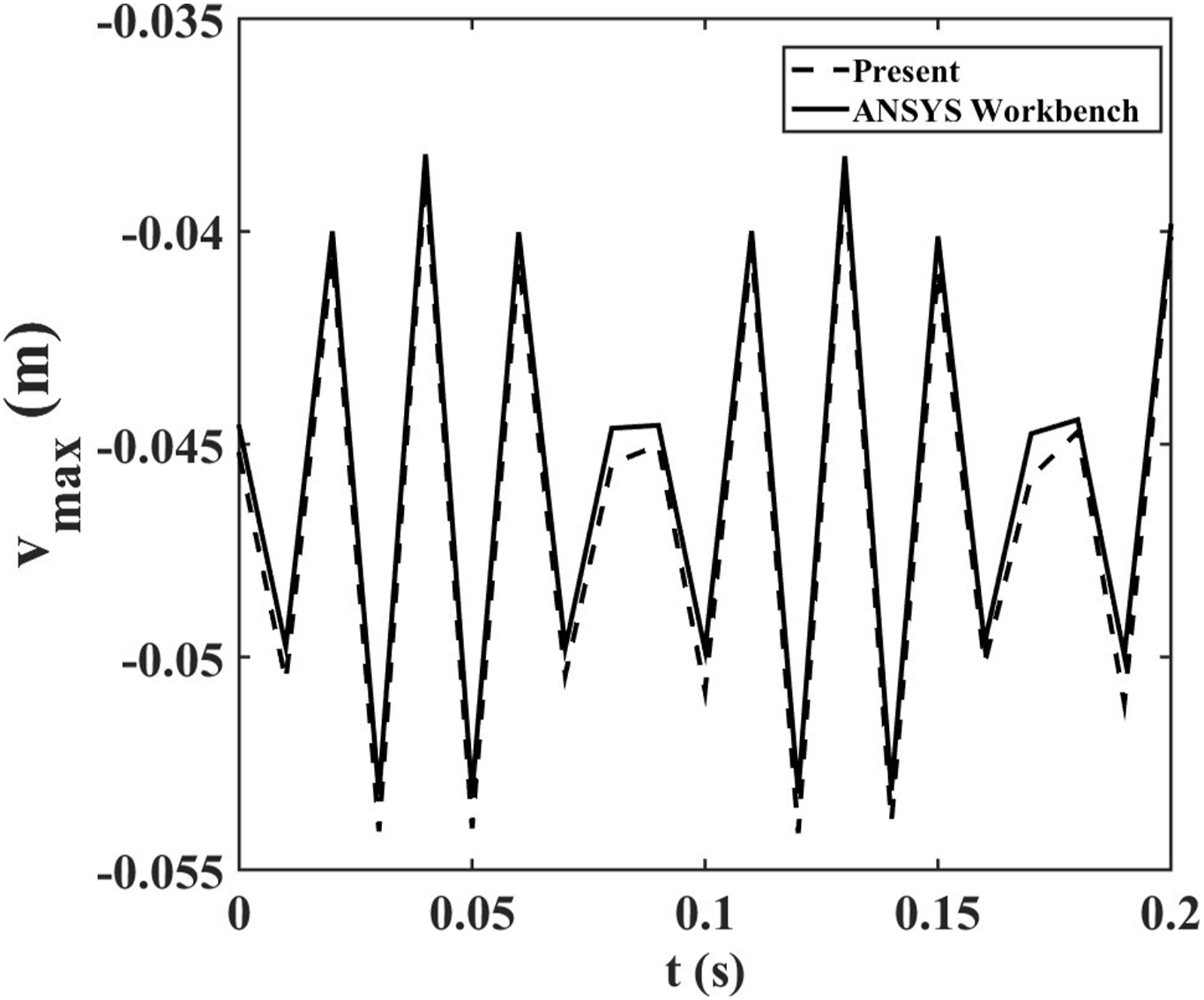
3.2. Parametric studies
In the numerical study, effects of stiffness and damping coefficients of viscoelastic supports, material gradation index, porosity parameter, and porosity models on the time response of thick multilayer FGM beams under pulse load with viscoelastic support will be investigated. The materials of FG layers are considered as a combination of aluminum metal (Al; E = 70 GPa, ν = 0.3, and ρ = 2702 kg/m3) and zirconia ceramic (E = 151 GPa, ν = 0.3, and ρ = 3000 kg/m3). The material of the core layer is considered aluminum, and the material of the two face layers are considered the gradation of aluminum and zirconia (1. layer: zirconia–Al, 2. layer: fully Al, and 3. layer: Al–zirconia). The dimensions of the FG thick beam are considered as follows: b = 0.15 m, h = 0.15 m, and the length of beam varied according to the aspect ratio L/h = 7 in the numerical process. The height of each layer is equal.. The five-point Gaussian integration is used for calculation of element matrices. In the numerical process, the finite element number is taken as 30 in both X and Z directions.
In Figure 5, the vertical displacements (v
m
) at the midpoint of thick layered FGM beam with different porosity factor (a) and gradation parameter (n) are presented for porosity models 1, 2, and 3, respectively. For these figures, the parameters of sinusoidal pulse load are taken in frequency Ω = 2 rad/s and P0 = 10,000 kN. The viscoelastic support parameters are taken as Material gradation parameter (n)—vertical displacements at midpoint of the beam with different porosity factors for porosity distribution models: (a) model 1, (b) model 2, and (c) model 3.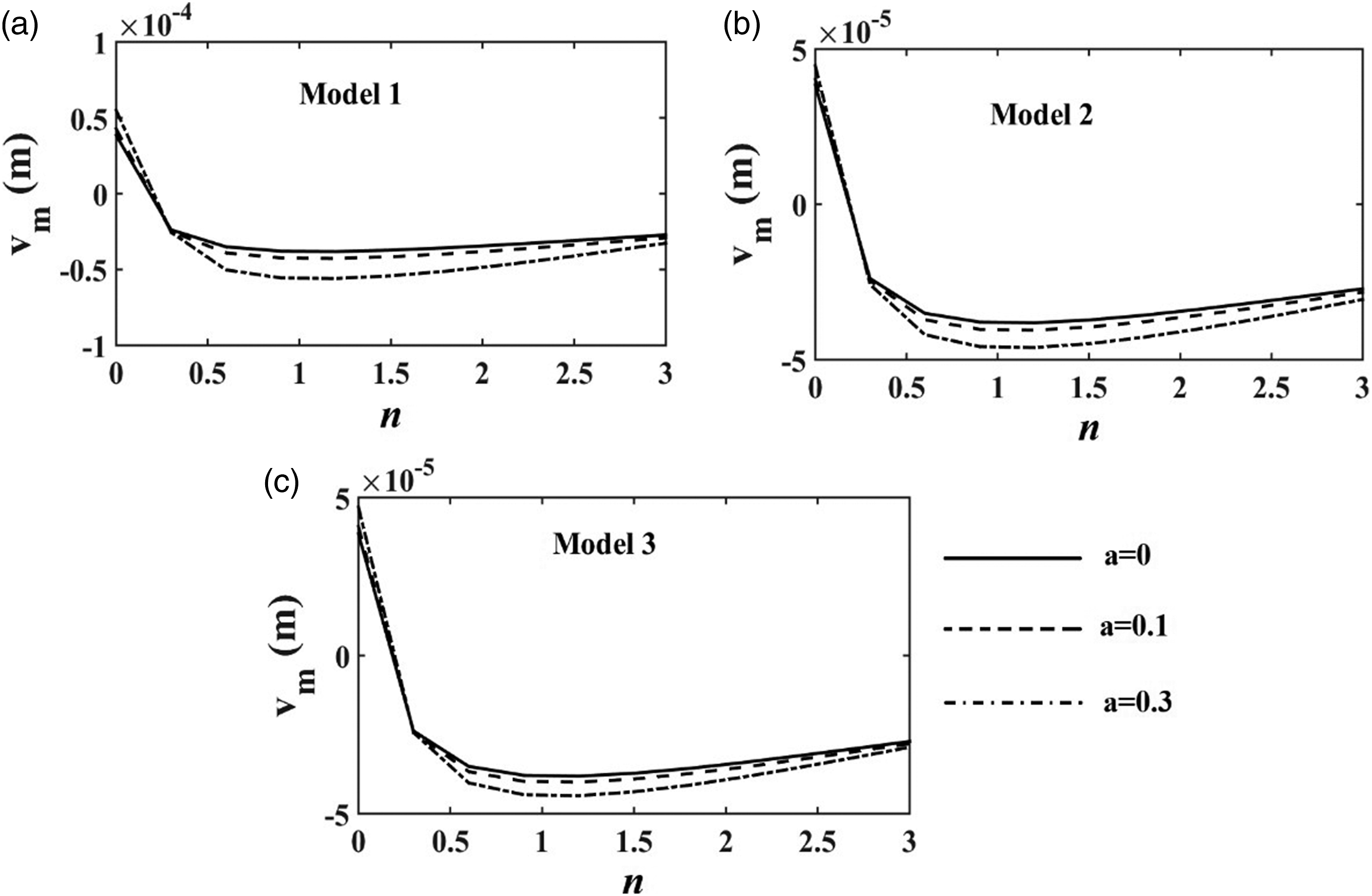
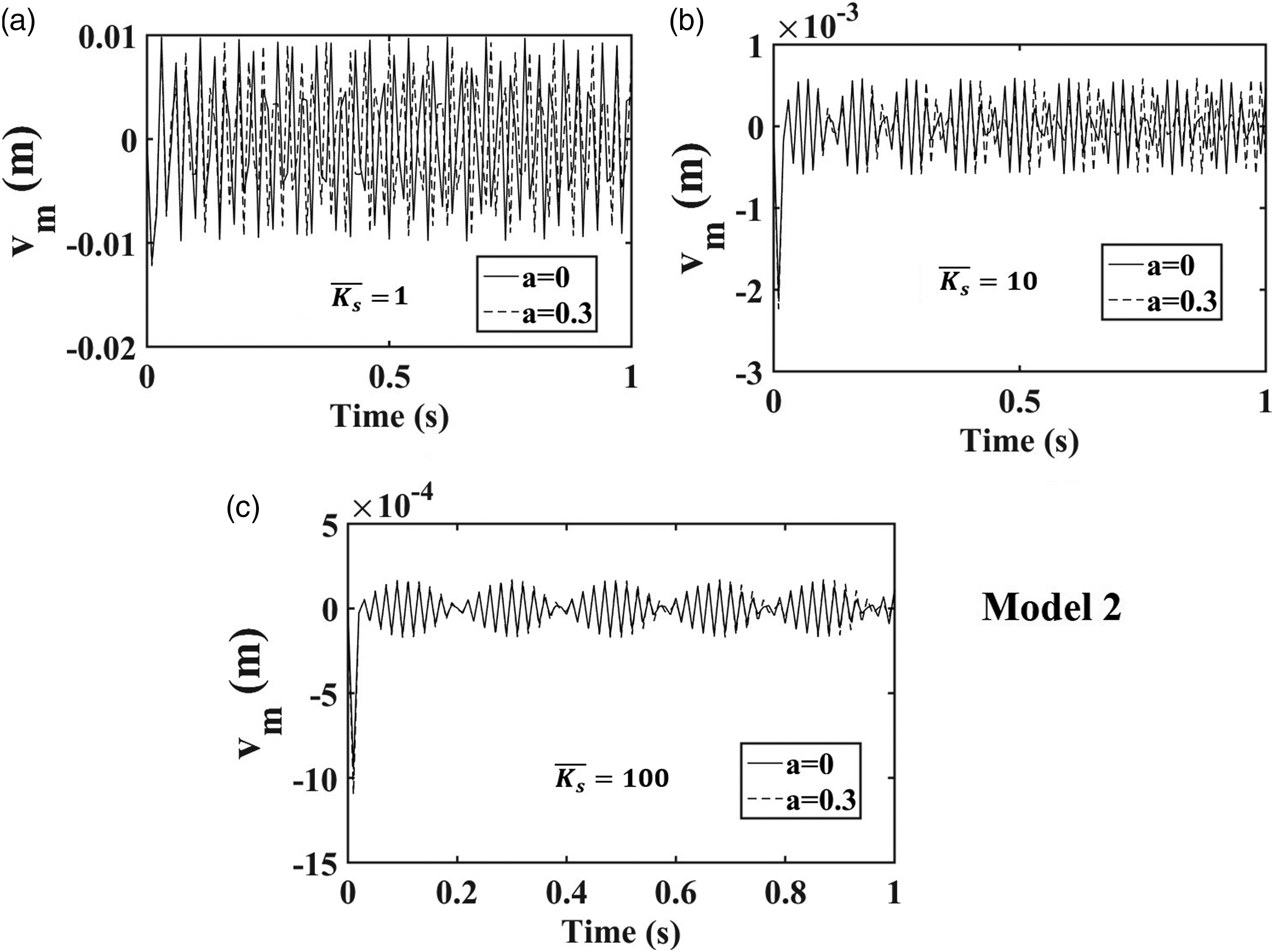
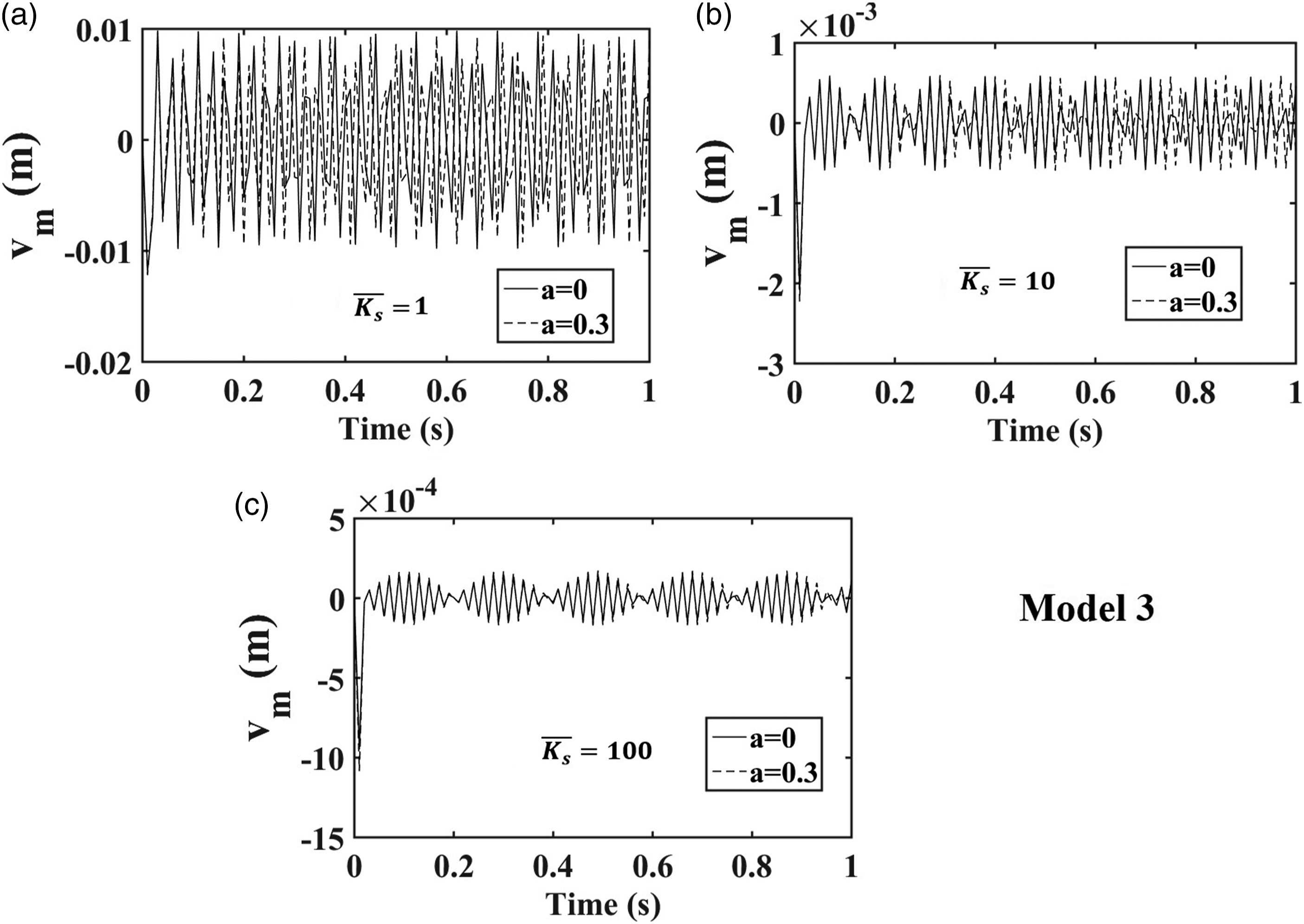
In Figures 6–8, effects of stiffness of viscoelastic support on the time history of the thick beam are presented for different porosity factors for porosity model 1, porosity model 2, and porosity model 3, respectively. In these figures, the damping of the support is neglected, and the following parameters are used: n = 1, Time–vertical displacements at midpoint of the beam for model 1 with different dimensionless stiffness coefficients of support for a) Time–vertical displacements at midpoint of the beam for model 2 with different dimensionless stiffness coefficients of support for a) Time–vertical displacements at midpoint of the beam for model 3 with different dimensionless stiffness coefficients of support for a) 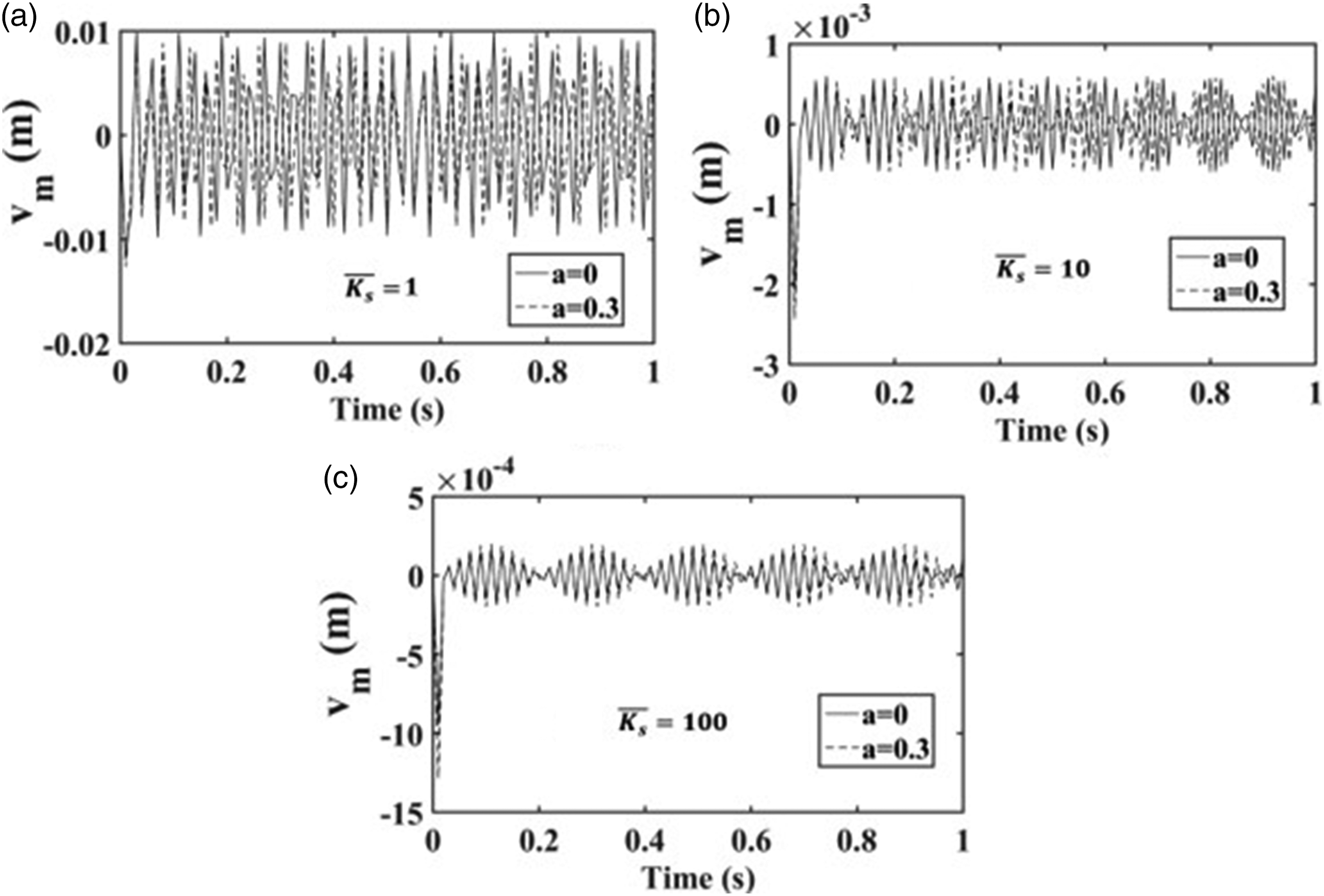
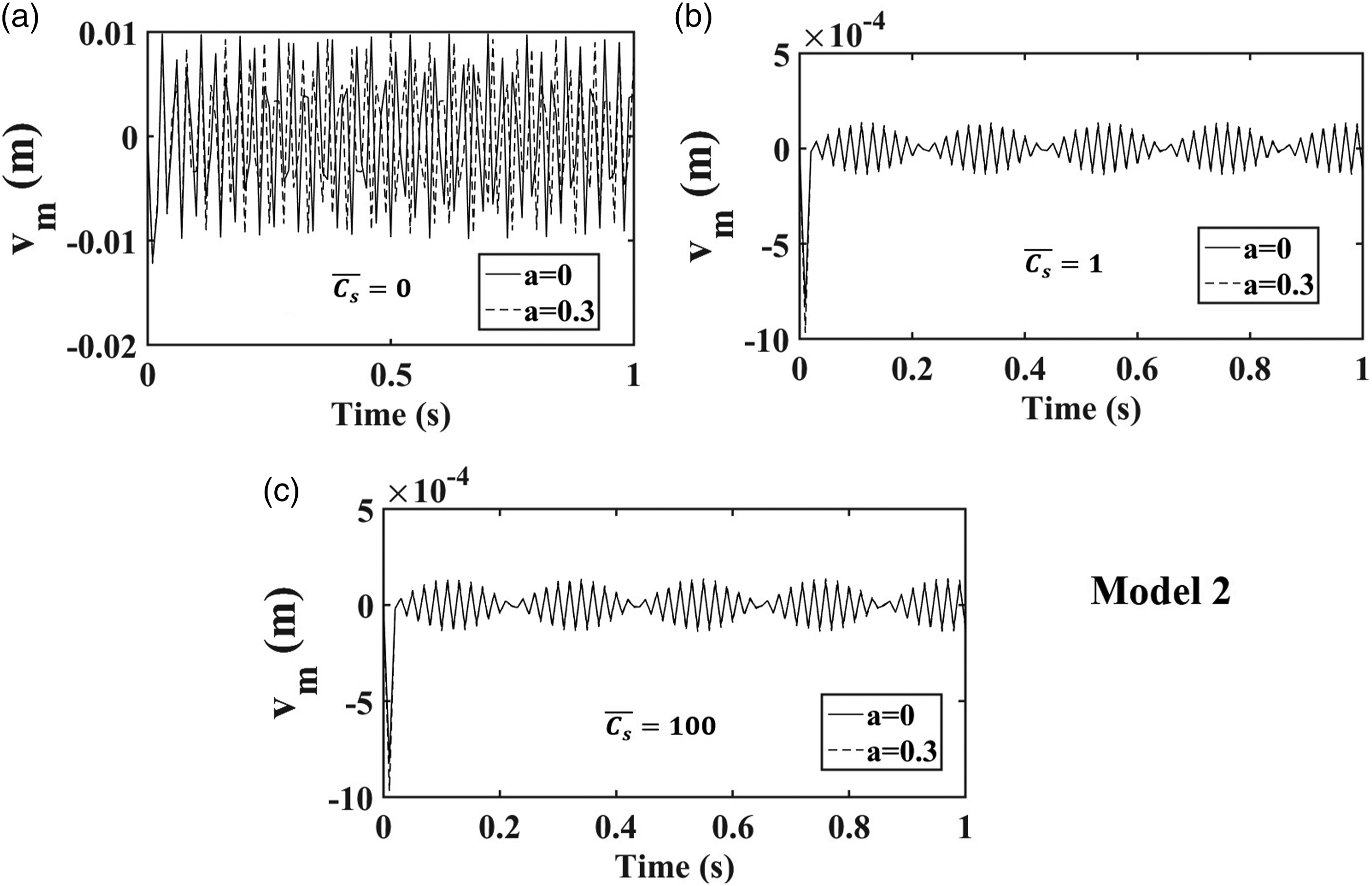
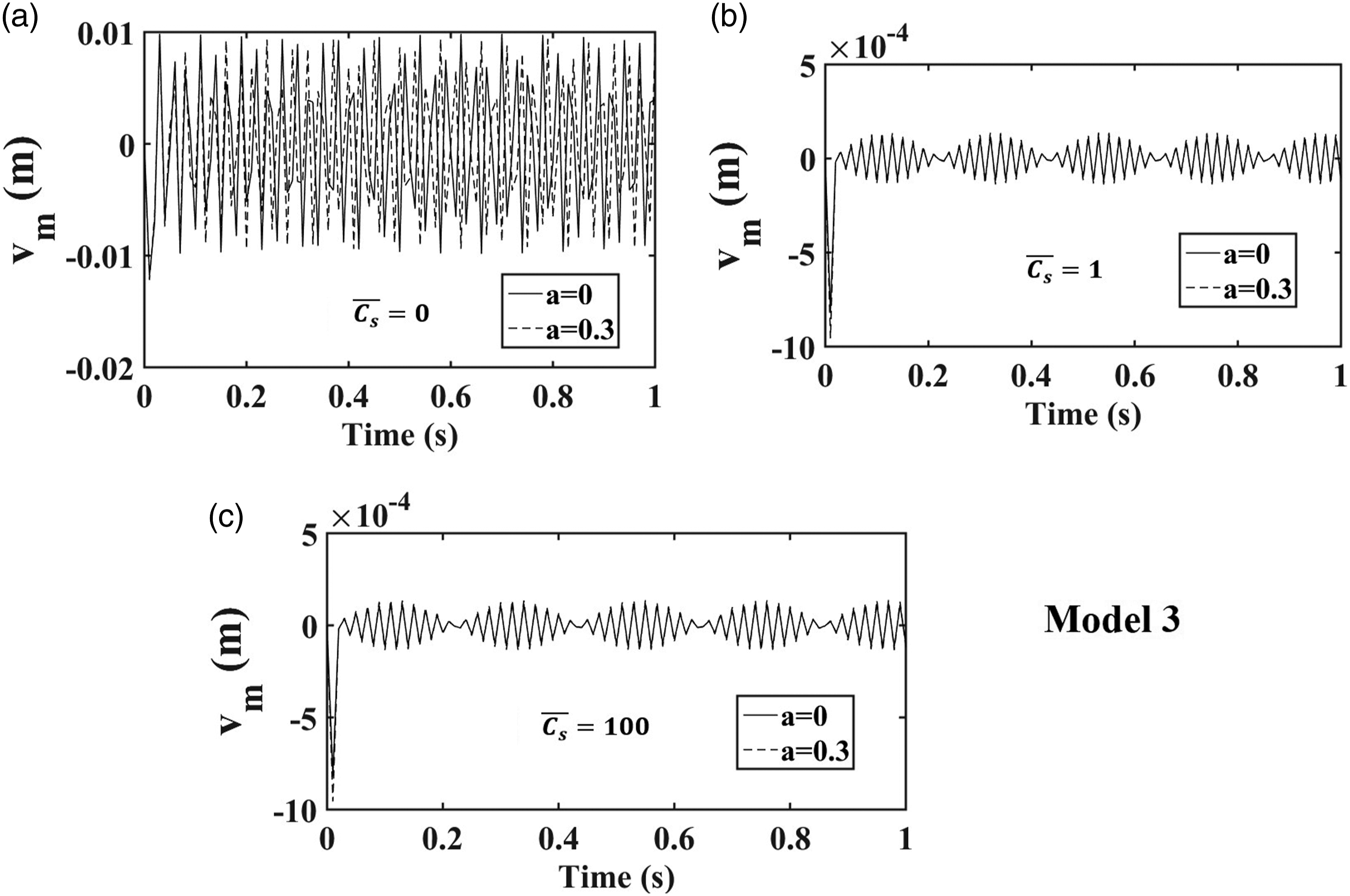
In Figures 9–11, the effects of damping of viscoelastic support on the time history of the thick beam are presented for different porosity factors for porosity model 1, porosity model 2, and porosity model 3, respectively. In these figures, the following parameters are used: n = 1, Time–vertical displacements at midpoint of the beam for model 1 with different dimensionless damping coefficients of support for a) Time–vertical displacements at midpoint of the beam for model 2 with different dimensionless damping coefficients of support for a) Time–vertical displacements at midpoint of the beam for model 3 with different dimensionless damping coefficients of support for a) 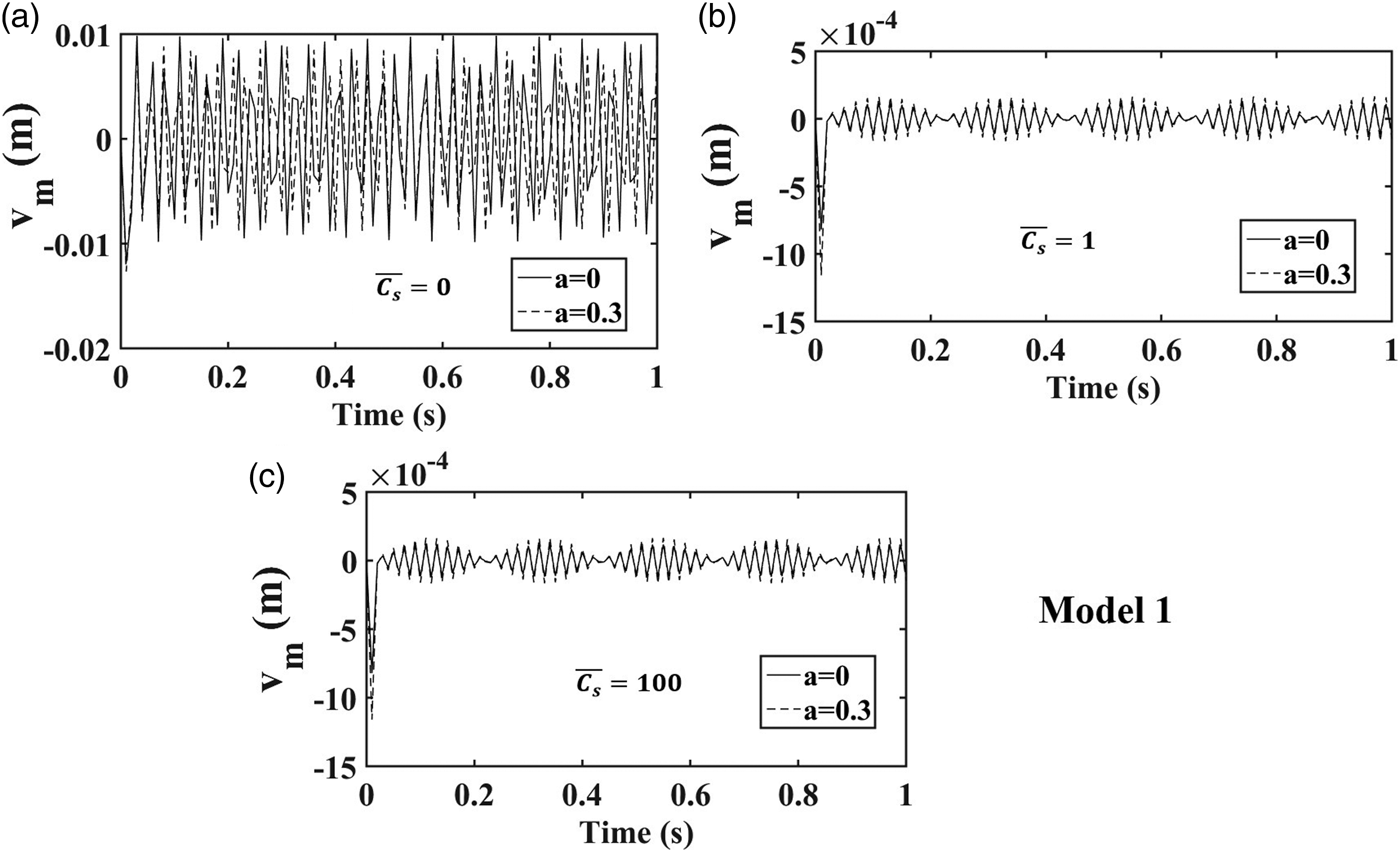
4. Conclusions
A dynamic response of FG porous multilayer thick beams under pulse load and rested on the viscoelastic supports is studied in the framework of the 2D plane stress problem. The numerical finite element formulation and Newmark integration method are exploited to solve the equation of motion incrementally. Material properties are graded through the beam thickness and modeled by the generalized power law. Uniform distribution, ◊ distribution, and X distribution of porosity are the three models of porosity assumed through the analysis. The most findings of this article can be summarized as follows: The gradation parameter (n) has significant effects on dynamic response and amplitude of oscillation. The displacement of FG beam decreased dramatically as the gradation index n increased from 0 to 0.5. As the gradation index increased from 0.5 to 3, the displacement increased with a small rate. The displacement for uniform porosity model 1 is higher than that for the other two porosity models, ◊ and X distributions. Thus, O and X distributions of porosity models are more significant on the dynamic response rather than the uniform porosity distribution. The dynamic response at By adding the damping to the elastic boundary condition, the amplitude of vibration is reduced significantly, and the oscillation period is increased.
Footnotes
Declaration of conflicting interests
The author(s) declared no potential conflicts of interest with respect to the research, authorship, and/or publication of this article.
Funding
The author(s) received no financial support for the research, authorship, and/or publication of this article.
