






Abstract
In this article, a composite controller is proposed for the manipulator with the flexible joint and link under uncertainties and time-varying disturbances. The dynamic of the system is developed by the Euler–Lagrange and assumed mode method, which is a nonlinear, strong coupling, and underacted system. Therefore, based on the singular perturbation theory, the dynamic is decomposed into a slow and fast subsystem. For the slow dynamic, a novel adaptive-gain super-twisting sliding mode controller is designed to guarantee joint tracking under the uncertainties and disturbances. For the fast dynamics, adaptive dynamic programming is used to deal with the uncertainty. The simulation result shows that the proposed composite controller can effectively track the trajectory and suppress the vibration simultaneously.
Keywords
1. Introduction
The flexible manipulator has many advantages such as lower power consumption, higher payload-to-robot weight ratio, lower manufacturing cost, and easier transportation. So, the application of a flexible manipulator is broad, such as in space robotics, nuclear maintenance, and waste storage tank remediation. Because of the broad application prospect, the control of the flexible manipulator has been received much attention among the research areas. Unlike the rigid manipulator, the flexible manipulator is a distributed parameter, nonlinear, infinite order, and uncertain system, which is a challenging problem to improve the accuracy of tracking trajectory and suppress vibration simultaneously. Therefore, enhanced control approaches are a critical factor to make the application feasible.
In the last years, the controller design for the flexible link or flexible joint manipulator has been extensively studied. Many advanced technologies have been applied in the flexible link, such as sliding mode control (Xu et al., 2000; Mujumdar et al., 2015), boundary control (Jiang et al., 2018; Mamani et al., 2012), neural network (NN) control (Gao et al., 2019; Hu et al., 2020a, 2020b; Xu, 2018), fuzzy control (Jnifene and Andrews, 2005; Lin and Lewis, 2003; Tinkir et al., 2010), robust control (Lee and Lee, 2002; Shafei et al., 2020), and singular perturbation (SP) approach (El-Badawy et al., 2010; Siciliano and Book, 1988). In Choi and Cheon (2004), a sliding mode controller was already reported. Adaptive control of manipulator with uncertain load disturbances was reported in Pi and Wang (2011) and Wang et al. (2017).
On the other hand, there are also many studies about flexible joints (Ge, 1996; Huang et al., 2006; Macnab et al., 2004; Yoo et al., 2008). In Spong (1987), the dynamics of elastic joint robots were proposed, and a nonlinear controller was designed based on a SP. In Huang and Chen (2004), an adaptive sliding control was proposed for a single-link flexible-joint robot with mismatched uncertainties by backstepping control. In He et al. (2018), Yang et al. (2020), a neural learning–based controller was proposed to solve the constrained state with uncertainties and time-varying disturbances.
Compared with a flexible link or flexible joint, it is more important to research the manipulator with flexible joints and links. Because to reduce energy consumption and prolong life, the manipulator with flexible joints and link is the better choice. However, the achievement of the manipulator with flexibilities in both joints and links is not mature enough. In Yang and Donath (1988), the dynamic modeling of the manipulator with flexible joint and link was first proposed by the Euler–Lagrange Assumed Mode Method. In Xi and Fenton (1994), the author investigated the coupling effect of a flexible joint and link. And in Al-Bedoor and Almusallam (2000), similar work was presented. In Pala Prasad Reddy et al. (2012), the precise nonlinear modeling of the flexible link flexible joint manipulator in presence of damping and friction effects was reported. Because the dynamic of the manipulator with both flexible joint and link is a strong nonlinear and underactuated system, it is difficult to design the controller based on conventional model-based control schemes. However, the SP is a powerful tool for reduced-order; by the SP mode, the complex system can be reduced to a slow subsystem which only consists of the rigid motion of the manipulator and a fast subsystem that contains the flexure of both link and joint. Therefore, we can find the direct relationship between the control signal and joint angle and flexible mode, which can help us design a better controller.
The singular perturbation theory has attracted wide attention. There are a lot of relevant articles. In Kim and Croft (2019), proposed a practical method to realize tracking control for industrial manipulators with the elastic joint by SP theory. The chattering is removed because the proposed controller does not require the acceleration and jerk of link states. In Yang et al. (2020), reports a composted controller for the flexible joint manipulator based on the SP theory. In her report, the NN was used to approach the uncertainty, and the disturbance was observed by the terminal sliding mode. About the flexible link, in Peng et al. (2018), the author designs a boundary controller by SP. In Xu (2018), uses the NN to approximate the uncertainty and use disturbance observer technology to estimate the compound disturbance. In Subudhi and Morris (2002), a composite controller was proposed. In that article, the slow subsystem and fast subsystem were controlled by using the computed torque method and linear quadratic regulator (LQR), respectively. In Kv and Jacob (2012), a similar controller was being reported. In Subudhi and Morris (2003), a novel composite controller was proposed to improve the control performance under model uncertainties by using the NN. Although some progress has been achieved, the two issues of system uncertainties and time-varying disturbances should gain more attention.
Sliding mode control is a robust method to deal with nonlinear uncertain systems under parametric uncertainties and time-varying disturbances (Hung et al., 1993; Utkin, 1977). However, the drawback of the sliding mode control is the chattering phenomenon, which can damage both the actuator and cause high frequency resulting in system instability. Several efforts have been made to prevent this drawback, such as high-order sliding mode control (Moreno and Osorio, 2008; Polyakov and Poznyak, 2009) and an observer-based solution. Among the high-order sliding mode algorithms, the super-twisting control law (STW) is the most popular method because it only requires the sliding variable (Levant, 2003) and doesn't need the time derivative of the variable sliding. Besides, the STW has a good robustness property, and it can drive the sliding variable and its derivate to zero in finite time (Kochalummoottil et al., 2011). But the main disadvantage of the traditional STW is that it requires the knowledge of the boundaries, which is hard to estimate in practical cases. So, designing an adaptive STW is necessary. In recent years, many novel adaptive-gain super-twisting sliding mode controllers (ASTSMCs) are proposed (Moreno and Osorio, 2008; Nagesh and Edwards, 2014; Polyakov and Poznyak, 2009; Shtessel et al., 2012; Utkin and Poznyak, 2013). However, the transient response performance of those adaptive-gain super-twisting controllers is poor because the increase rate of the adaptive gain cannot adjust dynamically in terms of the value of the sliding mode variable. Therefore, it is meaningful to propose a novel adaptive-gain super-twisting controller that is of better transient response performance.
Inspired by the learning behavior from biologic, adaptive dynamic programming (ADP) has been broadly applied for optimal control for linear systems with completely unknown dynamics (Jiang and Jiang, 2013). Adaptive dynamic programming can effectively deal with the optimal control problem of linear systems with completely unknown dynamics by using a function approximation structure (Jiang and Jiang, 2012). By using the ADP, the optimal controller can be solved by solving the algebraic Riccati equation based on the information of the inputs and states, which can guarantee satisfactory results even if the system is completely unknown.
In this article, aiming at handling the manipulator with flexible joint and link under uncertainties and disturbances, a novel composite controller is proposed based on the SP theory. The composite controller includes a novel ASTSMCs for a slow subsystem and an adaptive optimal controller based on the ADP theory for a fast subsystem. Compared with the existing works, the main contributions of this article include the following: The problem of trajectory tracking and vibration suppression of a manipulator with flexible joints and linkages is studied in the presence of uncertainties and disturbances. A novel ASTSMC is designed to guarantee the performance of the tracking trajectory. The new controller removes the assumption of requiring the knowledge of the boundaries and improves the converge rate. The new stabilizer ADP is used to suppress the flexure of both link and joint. The ADP is a data-driven method, which can stabilize the fast subsystem in the presence of uncertainties by using only the state and input information.
The rest of this article is organized as follows. The dynamics of the system is derived in Section 2. A two-timescale singularly perturbed model is presented in Section 3. A composite controller is proposed for tracking the desired trajectory and suppressing vibration simultaneously in Section 4. Simulations are implemented to illustrate the performance of the proposed controller by comparing it with the performance of Computed torque control (CTC) + LQR, which is reported (Subudhi and Morris, 2002) in Section 5. The article is concluded with a summary in Section 6.
2. Problem formulation and modeling of the system
Figure 1 shows a structural diagram of the manipulator with a flexible joint and link simulated. It is assumed that the flexible link is considered as an Euler–Bernoulli beam in the modeling process, and the motion is assumed to be in the horizontal plane. So, the influence of shear, rotary inertia, and gravity is ignored. Also, the kinetic energy of the rotor is mainly because of its rotation only, and the rotor inertia is symmetric about its axis of rotation. The flexible joint is considered as a linear torsional spring connecting the motor shaft with inertial Schematic of the manipulator with flexible joint and link.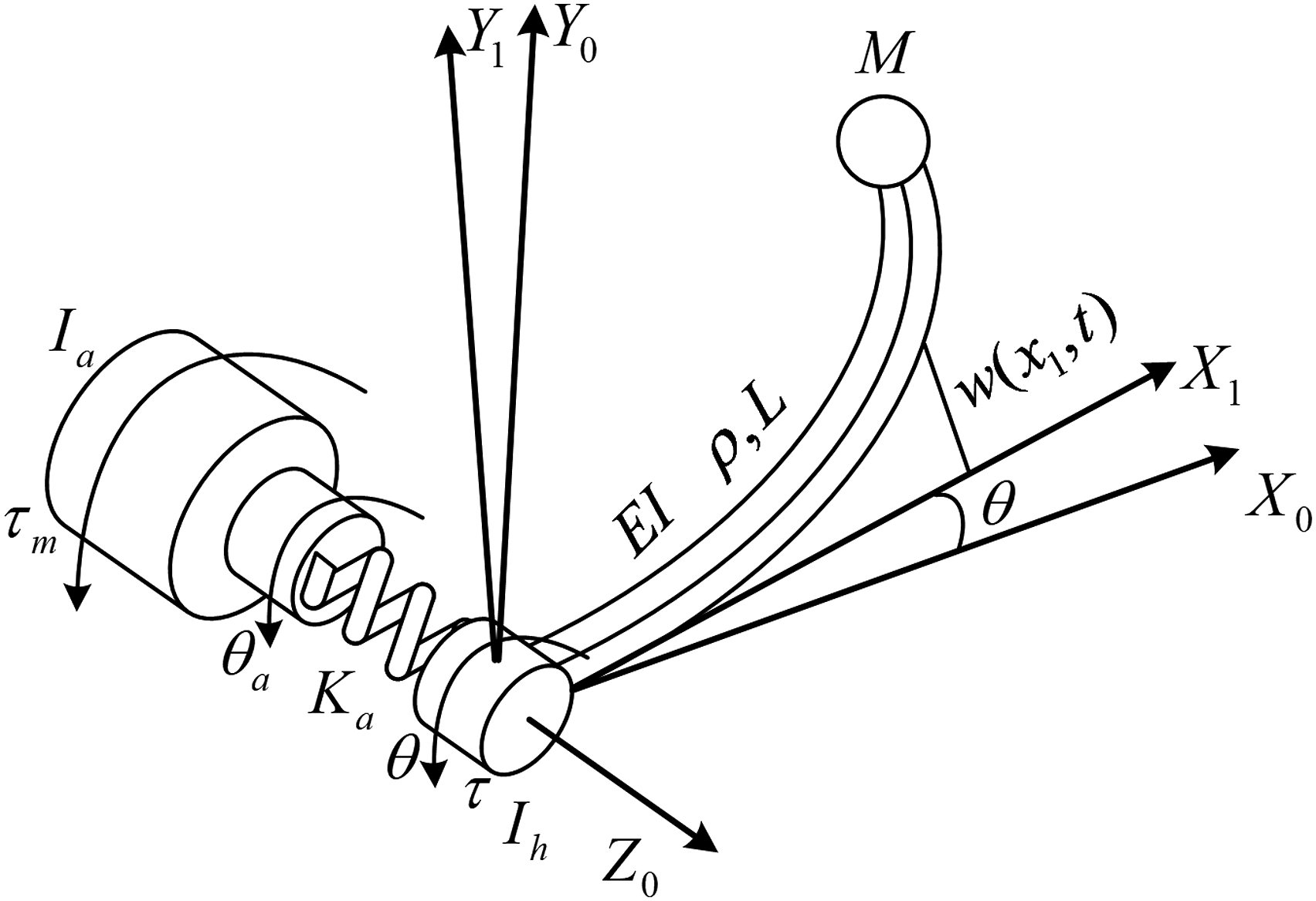
The deflection
Next, neglecting the effects of gravity, the total potential energy of the system can be written as
The work is performed by the control torque of the motor as
Considering a clamped-mass configuration of the manipulator, the boundary conditions can be written as
Applying the assumed mode method to describe the elastic deflection of flexible link
Substituting (9) into (6) gives
From (10),
Applying the Euler–Lagrange equation, the dynamic equation is obtained as
3. Two-time-scale singular perturbation model
Control of the manipulator with a flexible joint and link is difficult because the system is nonlinear, strong coupling, and underacted. The vibration of the flexible manipulator and joint position has to be controlled by adjusting a single motor torque. To efficiently deal with this problem, the SP method is used. Thus, the dimensionality of the system can be reduced, which is beneficial to the realization of the control goal. Besides, to improve the performance, a flexible joint compensator is designed in this controller.
By substituting (16) into (15), the dynamics of the motor can be written as
Define the motor torque as following
By substituting (18)–(20) into (14)–(16)
Define
Because the inertia matrix
Then, (21) and (22) can be written
Now, define a common scale factor
Let
By substituting (30) and (31) into (27), the dynamics of the slow subsystem can be written as
Define fast timescale and new variable as follows
Based on the above SP decomposition, the slow subsystem (32) and the fast subsystem (34) can be obtained. Therefore, the control goal is to guarantee the slow subsystem to track the desired trajectory and stabilize the fast subsystem around the equilibrium trajectory defined by the slow subsystem simultaneously. For the slow subsystem, the main difficulty is the uncertainties and unknown boundary time-varying disturbances, so a novel ASTSMC is designed. For the fast subsystem, the main difficulty is the model uncertainties including parameter uncertainties and un-modeled high-frequency modes, so an adaptive optimal controller based on dynamic program is proposed.
4. Composite controller design
4.1. Adaptive-gain super-twisting sliding mode control for the slow subsystem
The slow subsystem only comprises the rigid motion of the manipulator. So, many techniques used in a rigid manipulator can be applied to the slow subsystem. Based on (32), considering the uncertainties, the slow subsystem can be written
Define the tracking error as
Define the sliding mode variable as
Then, the derivative
By substituting (36) into (39), (39) can be written as
Define the control of the slow subsystem as
Define
By substituting (41), (42) into (40), then
Based on the super-twisting algorithm (Kochalummoottil et al., 2011), defining To reduce chattering of the sliding mode controller,
For system (43), the disturbances satisfy (44) and if the adaptive law for
By substituting (45) into (43), we get Define the new state variable as Define The Lyapunov function is chosen as Based on Assume 1, we get Let By substituting (47) into (56), If Because Then, (55) can be written as Because Then, (62) can be written as By substituting (47) into (64), the derivative Then,
(58) can be achieved in finite time because
There exists a positive constant
4.2. ADP-based control for the fast subsystem
The fast subsystem consists of the flexible modes of the link and joint. Also, the fast subsystem is a linear system (34). At this point, the fast subsystem is required to be uniformly stable along the equilibrium trajectory given by (30) and (31). Because the main goal of flexible manipulator control is to suppress the deflections at a steady state as fast as possible, the optimal control can be designed. The ADP-based controller can obtain an optimal feedback matrix by only measuring the input and the state variable of the fast subsystem, which can get a satisfying performance when there are uncertainties on the fast subsystem.
In the fast timescale, the performance index can be chosen as
Implement the optimal feedback control, and
The stabilizing initial feedback gain matrix Then, the fast subsystem controller can be designed as Define two operators as Use an initial control input on the time interval 2. 3. Let 4. Let
(Jiang and Jiang, 2012)If there exists an integer Then,
Starting from a stabilizing
The detailed proof is shown in Jiang and Jiang (2012).
4.3. Composite controller
Combining the control of the slow subsystem (41) and the input of the fast subsystem (76), the composite control can be designed as
In terms of SP theory in Siciliano and Book (1988), a fundamental result can be obtained that the state vectors of the full system can be approximated by Flowchart of the composite controller.
5. Simulation results and discussion
Parameters of the manipulator.

Because the harmonic signals cover most of the periodic signals and the periodic signals are easy to cause the resonance of the flexible structure (Wang et al., 2017), which are the main disturbances needed to be suppressed in the flexible control, the disturbance is set as
The ASTSMC parameters are set as
To verify the robustness of the proposed controller with respect to the flexural rigidity, the flexural rigidity is changed to
To verify the robustness of the proposed controller with respect to the payload mass, the payload is changed to
To verify the robustness of the proposed controller with respect to the flexural rigidity and payload, the flexural rigidity is changed to For the above results, the joint tracking and its error show that the performance of the ASTMC + ADP is better than CTC + LQR in all cases because the ASTMC controller can increase dynamically the gain of super-twisting sliding mode control to satisfy condition (58), which makes the slow subsystem asymptotically stable. More importantly, the proposed adaptive-gain super-twisting sliding mode control not only removes the assumption of requiring the knowledge of boundaries but also improves the rate of convergence and the transient response performance. The disadvantage is that the Figure 3–14 proposed control is essentially a sliding mode control, so there is a chattering of control torque. Compared with the proposed controller in this article, the tracking trajectory performance of CTC + LQR is not satisficing because it requires accurate information of the fast subsystem; then, it just makes the subsystem stable but not asymptotic when there are uncertainties and disturbances. For the fast subsystem, it can be seen from the mode and elasticity of the flexible link that the ADP controller has greater performance. Different from the traditional LQR, the ADP-based control is a truly model-free method (Jiang and Jiang, 2012), which can remove this assumption on partial knowledge of system dynamics. This method can use the ADP technique to iteratively solve the algebraic Riccati equation just using the online state and input information of the fast subsystem. Therefore, the ADP-based vibration stabilizer can obtain the accurate feedback gain matrix in presence of uncertainties. However, the LQR controller depends on the accurate information of the dynamic model; then, its performance of vibration stabilization is inferior to the ADP-based stabilizer. The control input of ASTSMC + ADP is more “chattering” than CTC + LQR because the proposed controller is essentially a sliding mode control (Hung et al., 1993). Despite adaptive super-twisting sliding mode control results in smooth control, chattering can still in presence of un-modeled dynamics for the system (Edwards and Shtessel, 2016). Further research is to weaken the chattering as much as possible. In general, the proposed composite controller has better performance in both the slow subsystem and the fast subsystem.

Controller performance of Case 1: (a) joint angle tracking and (b) tracking error.
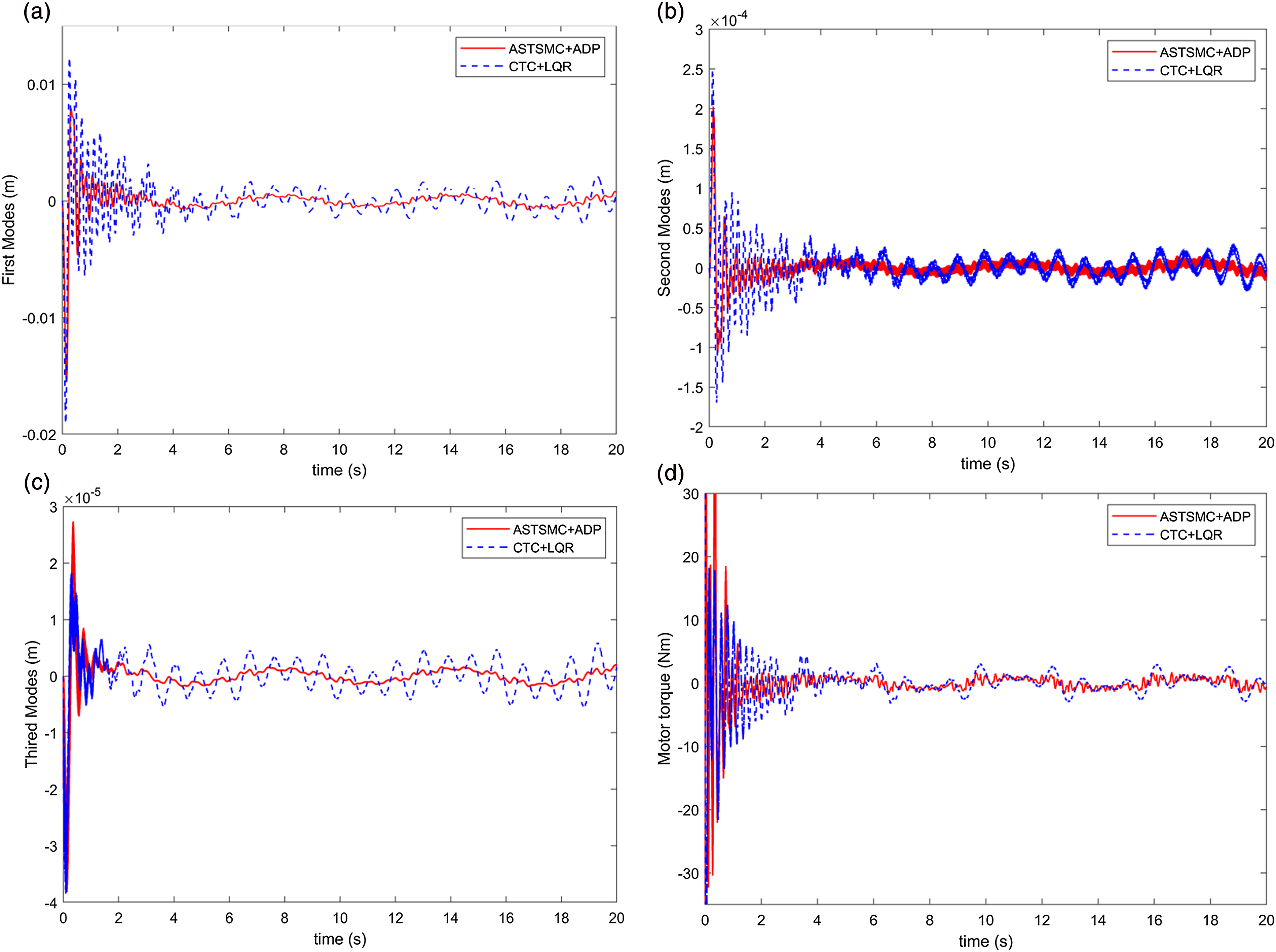
Controller performance of Case 1: (a) first mode; (b) second mode; (c) third mode; and (d) control torque signals generated.
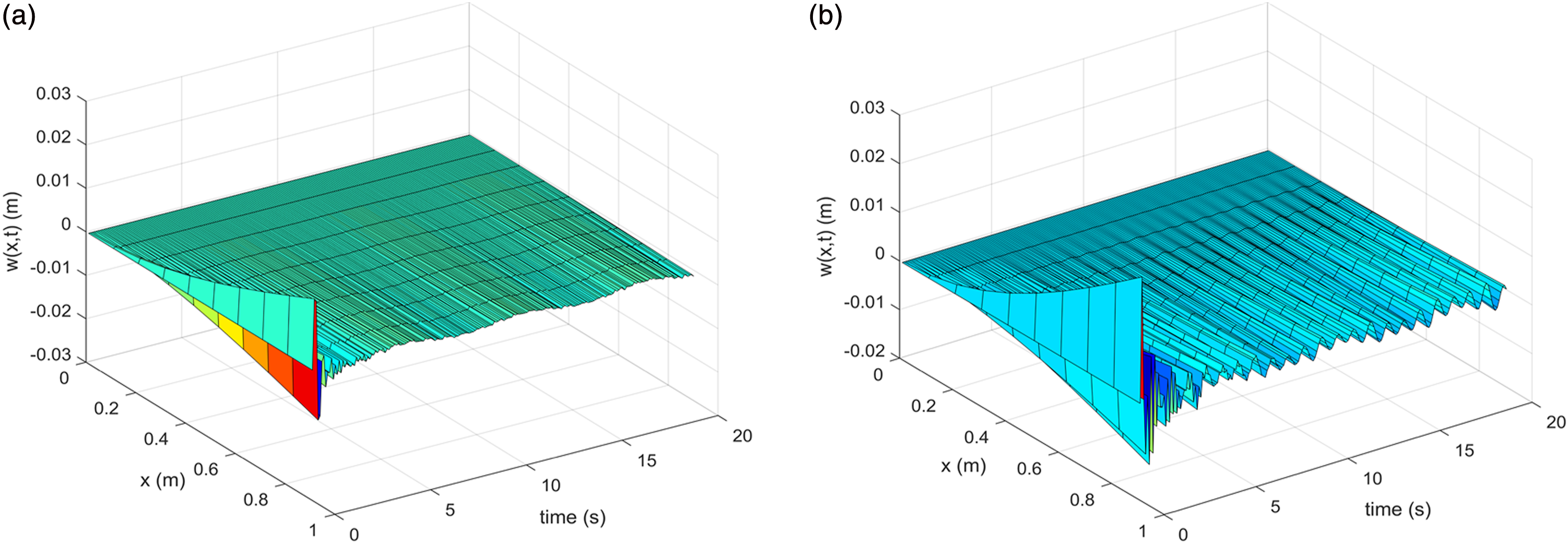
Elastic deflection of the flexible link of Case 1: (a) ASTSMC + ADP and (b) CTC + LQR. Note: ASTSMC: adaptive-gain super-twisting sliding mode controller; ADP: adaptive dynamic programming; LQR: linear quadratic regulator.
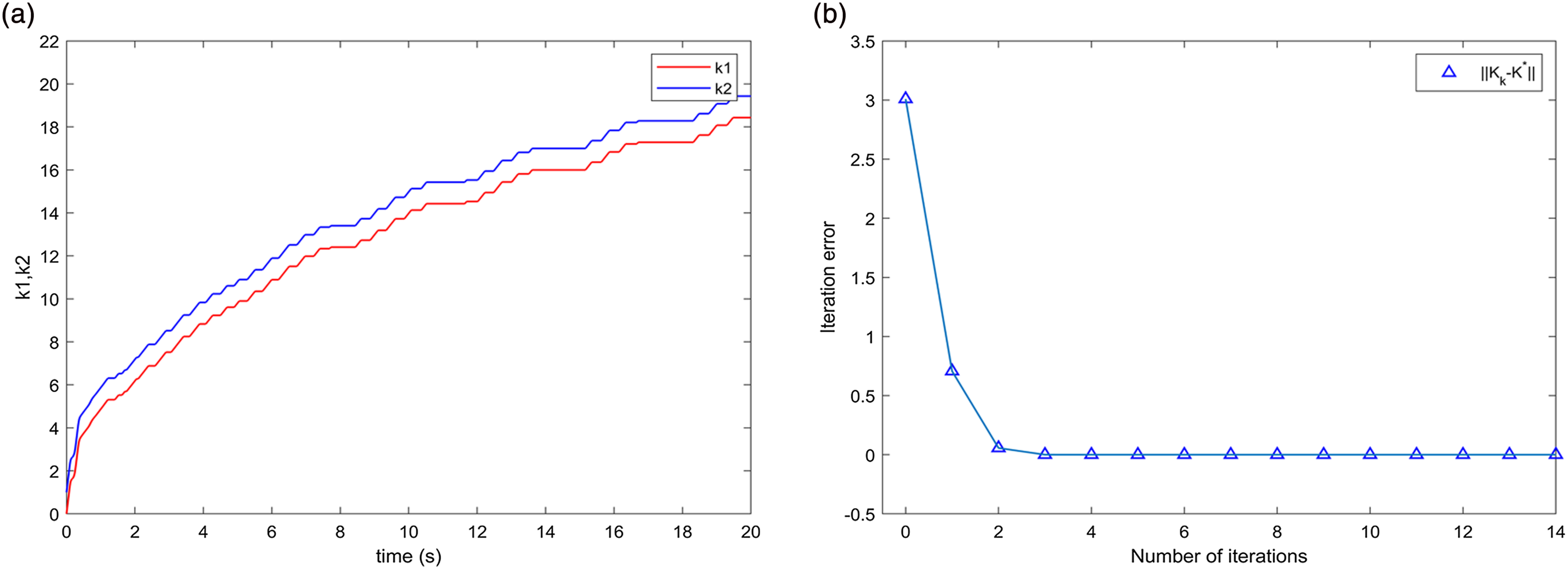
Controller performance of Case 1: (a) adaptive gain and (b) convergence of
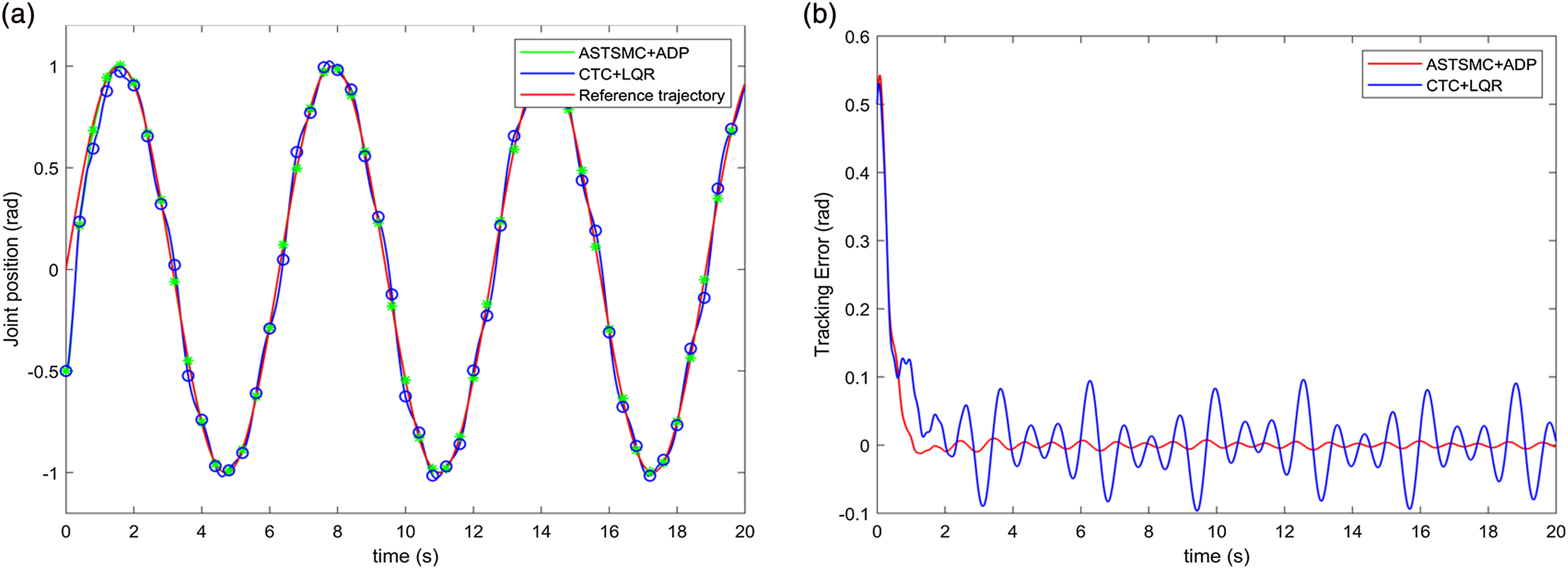
Controller performance of Case 2: (a) joint angle tracking and (b) tracking error.
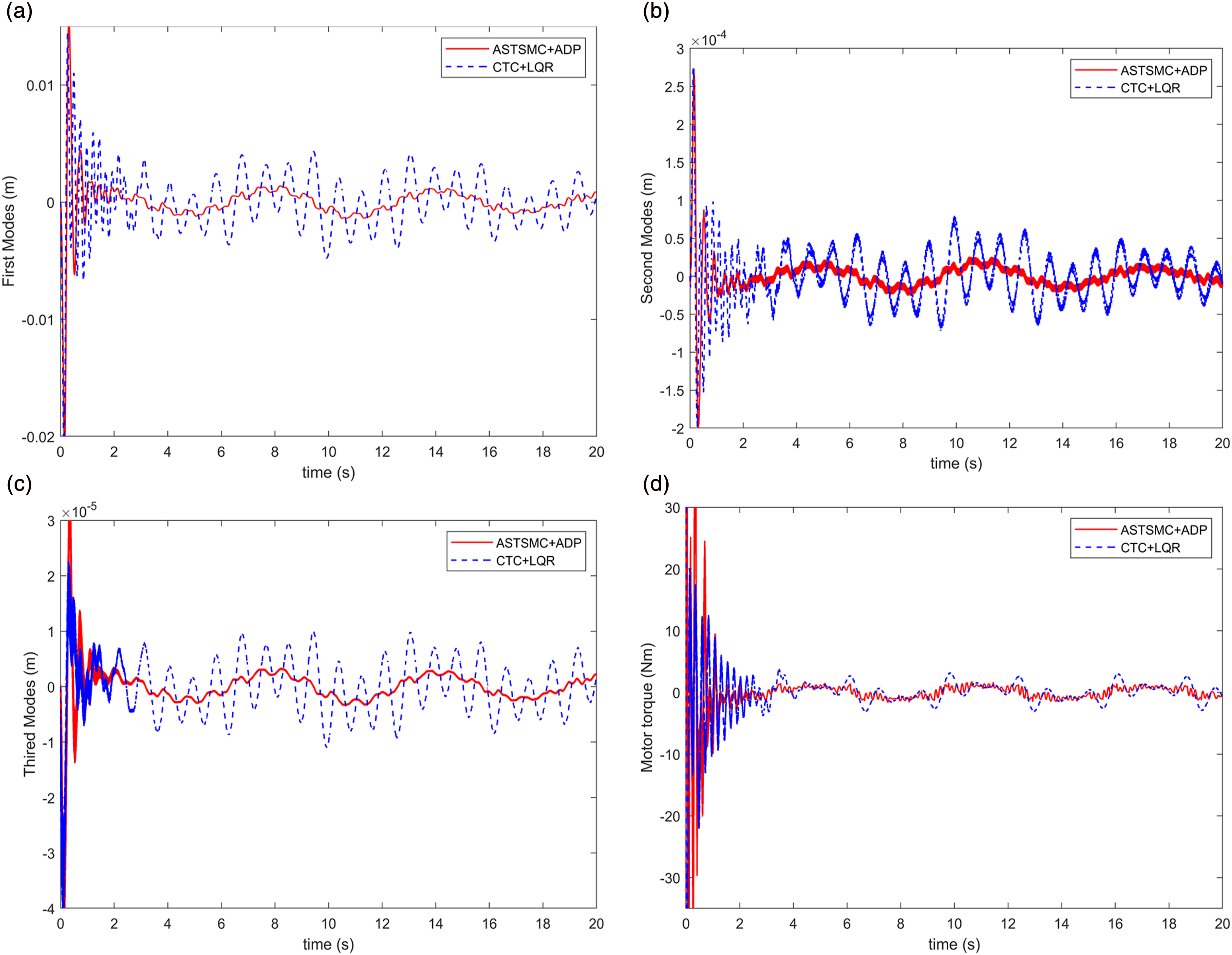
Controller performance of Case 2: (a) first mode; (b) second mode; (c) third mode; and (d) control torque signals generated.
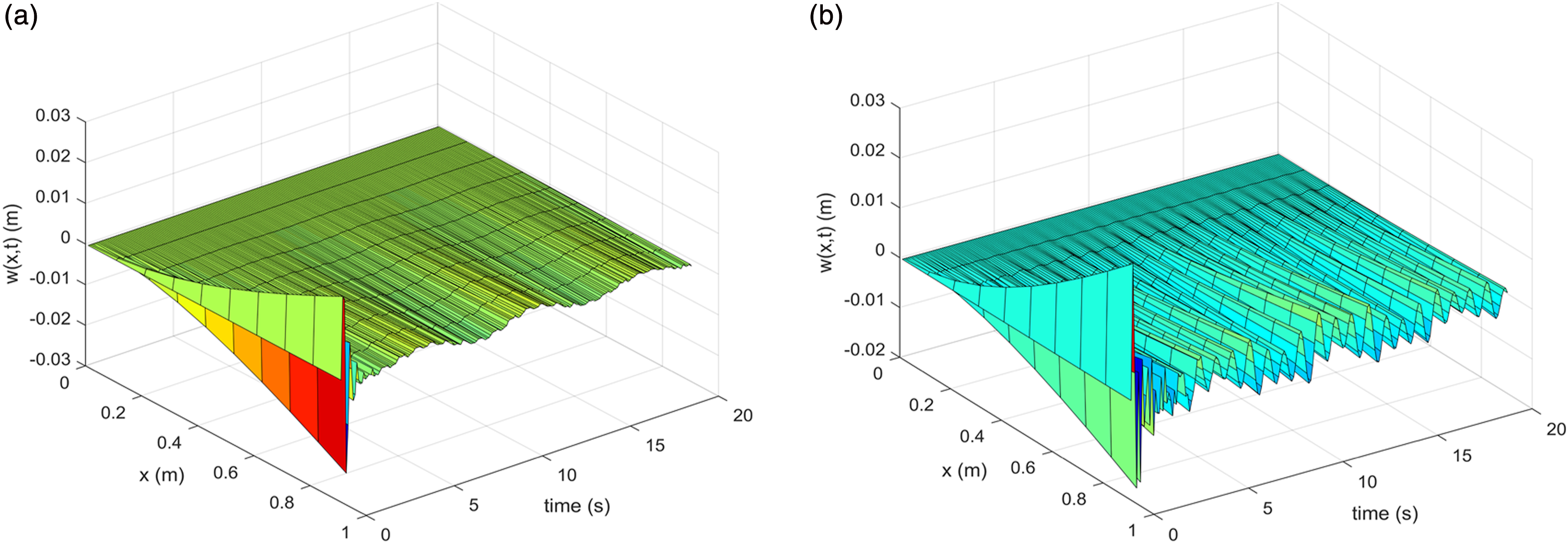
Elastic deflection of the flexible link of Case 2: (a) ASTSMC + ADP and (b) CTC + LQR. Note: ASTSMC: adaptive-gain super-twisting sliding mode controller; ADP: adaptive dynamic programming; LQR: linear quadratic regulator; CTC: Computed torque control.
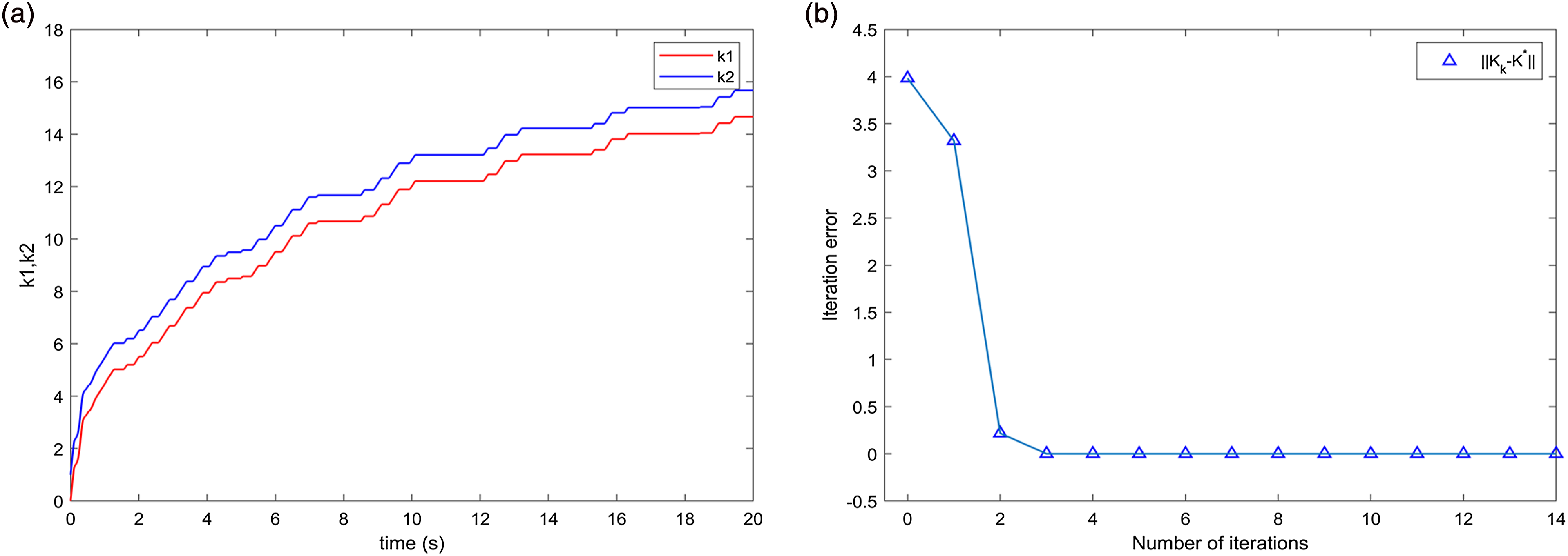
Controller performance of Case 2: (a) adaptive gain and (b) convergence of
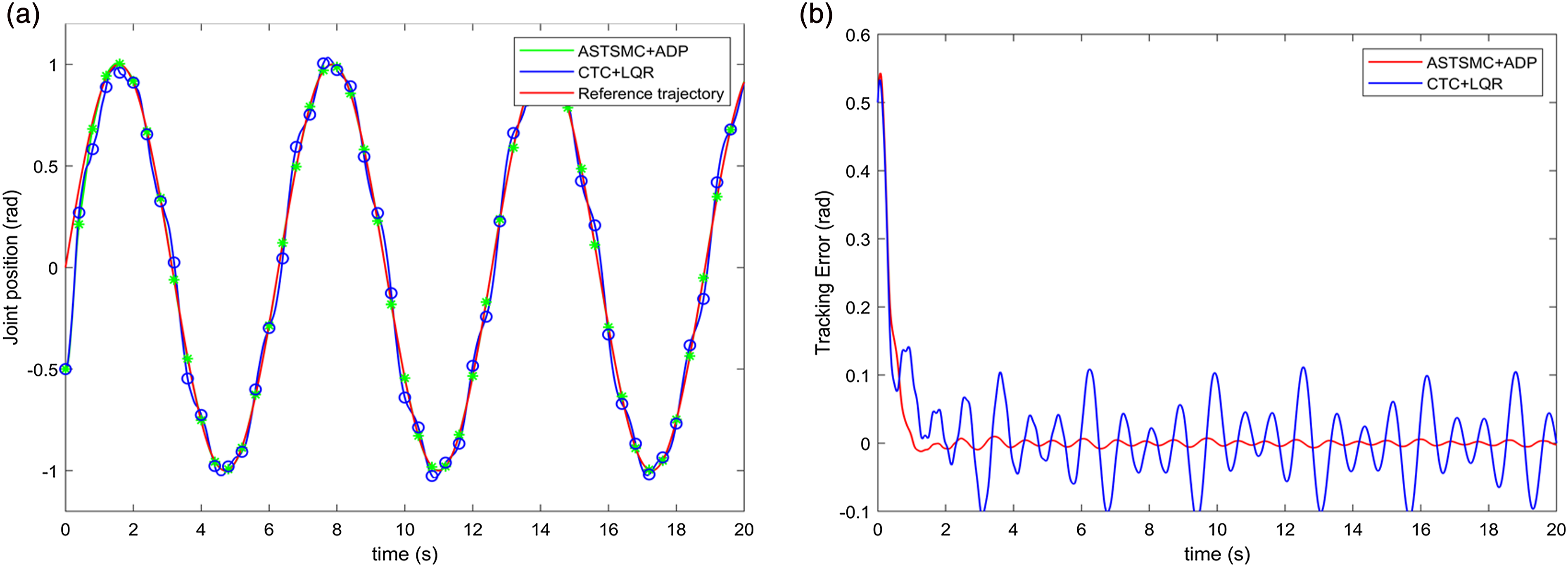
Controller performance of Case 3: (a) joint angle tracking and (b) tracking error.
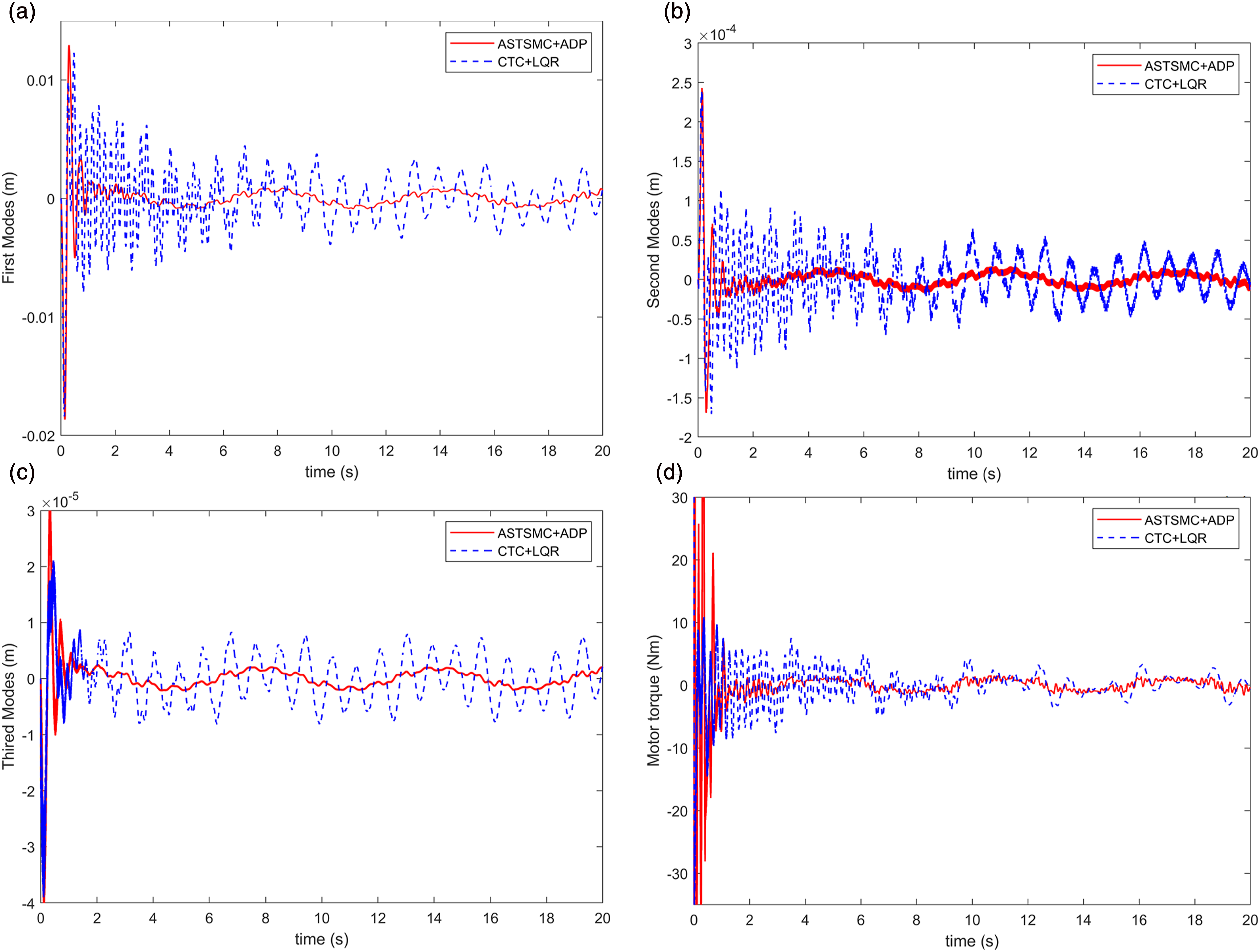
Controller performance of Case 3: (a) first mode; (b) second mode; (c) third mode; and (d) control torque signals generated.
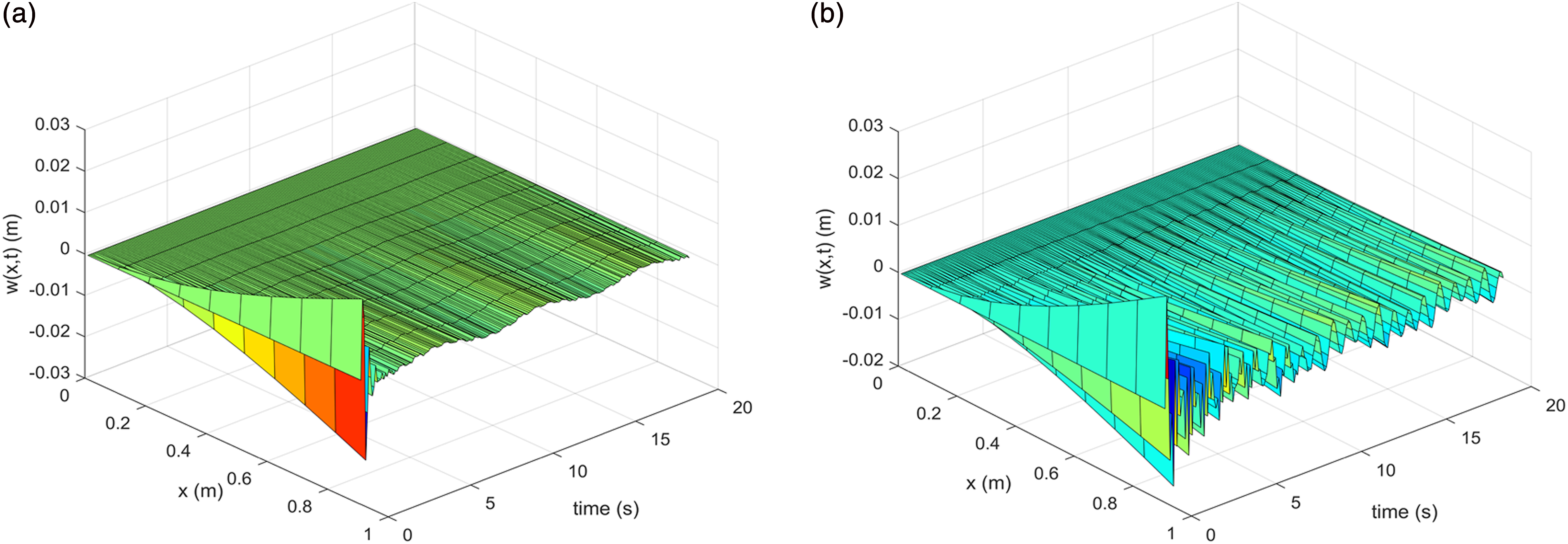
Elastic deflection of the flexible link of Case 3: (a) ASTSMC + ADP and (b) CTC + LQR. Note: ASTSMC: adaptive-gain super-twisting sliding mode controller;ADP: adaptive dynamic programming;LQR: linear quadratic regulator; CTC: Computed torque control.
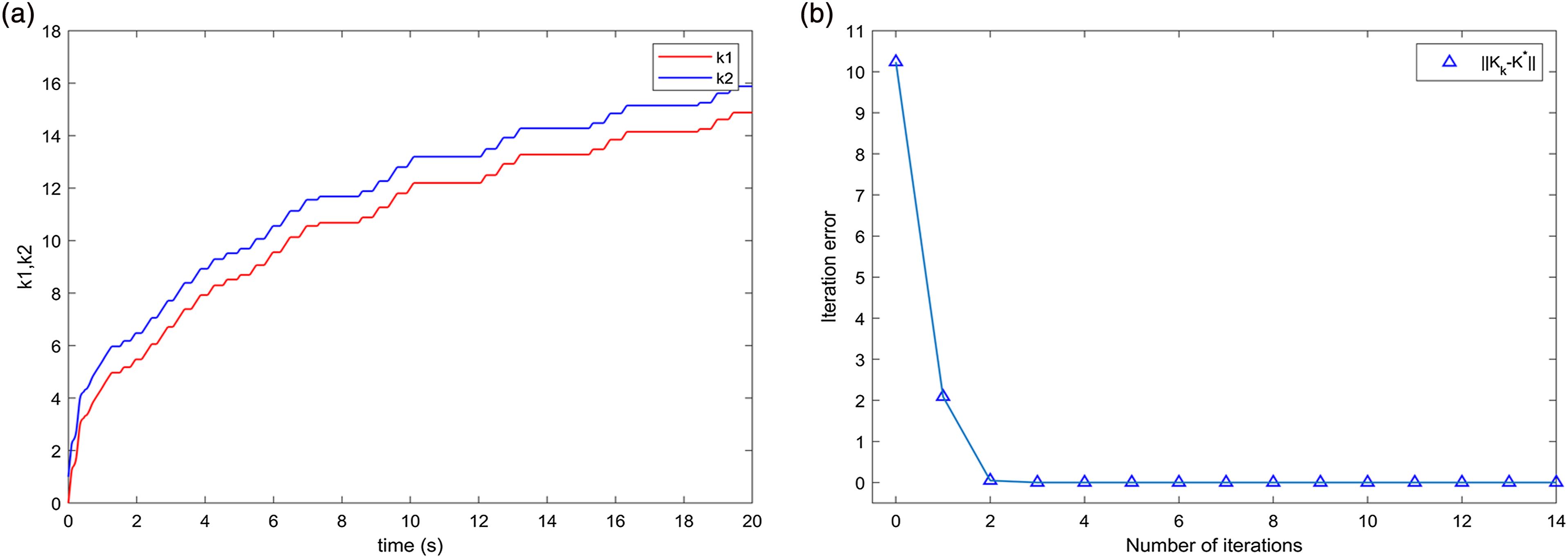
Controller performance of Case 3: (a) adaptive gain and (b) convergence of
6. Conclusion
In this article, the nonlinear dynamics equation of the manipulator with flexible joint and link under uncertainties and time-varying disturbances is derived by the Euler–Lagrange and assumed mode method. And a novel composite controller ASTSMC + ADP is presented based on the SP. Using the SP technique, the dynamic is decomposed into two order-reduced subsystems, which include a slow subsystem and a fast subsystem. For the slow subsystem, a novel ASTSMC is designed to guarantee the performance of the tracking trajectory. For the fast subsystem, the ADP theory is used to stabilize the boundary layer. To verify the effectiveness of the proposed controller, a simulation result is given. It can be seen from the above simulation results that the proposed controller has a good performance in tracking the desired trajectory and suppressing the vibration simultaneously in presence of parameter uncertainties and time-varying disturbances.
Footnotes
Acknowledgements
The authors would like to express their sincere gratitude to the reviewers and the editor for their valuable and meticulous suggestions, which significantly improved the quality of our study.
Declaration of conflicting interests
The author(s) declared no potential conflicts of interest with respect to the research, authorship, and/or publication of this article.
Funding
The author(s) disclosed receipt of the following financial support for the research, authorship, and/or publication of this article. This work was supported by the National Key Research and Development Program of China (Grant no. 2018YFC0808004).
