







Abstract
A novel design procedure for tuned mass dampers in isolated structures is presented. The proposed optimization method is specifically developed to control base displacements or to solve the large isolator displacement problem in this type of structures under earthquakes. Therefore, it is based on a displacement transmissibility function, T, a particular case of the general transmissibility concept, which comes from Vibration Isolation. Three contributions are: 1) application of new seismic displacement narrowbandness, 2) simpler relative transmissibility function, and 3) compound design of isolation plus tuned mass damper. A standard isolated model is used to show that the base displacement can be controlled at levels in the proximity of the ground motion (T ≈ 1), which results in a positive comparison with previous isolation plus tuned mass damper solutions; this is one of the main conclusions and it is based on novelty 3 above; in fact, other solutions in the literature compare their attained displacements with respect to the structure without tuned mass damper. Comparison with isolated results is not, therefore, possible herein, but it is not desirable either; actually, what is possible is a positive and more demanding comparison, which is with respect to the very seismic ground displacement itself. The large isolator displacement problem can be solved or attenuated by properly designing a tuned mass damper subsystem jointly with the isolation one.
Keywords
1. Introduction
It is already well established that base isolation is a very successful anti-seismic technique (Chopra, 2012; Naeim and Kelly, 1999) that has demonstrated very good performance indeed during real earthquakes (Komodromos, 2000; Nagarajaiah and Xiaohong, 2000); this design basically eliminates deformations in the superstructure (Barbat et al., 1995; Kelly, 1999; Morales, 2003). However, an important problem of the technique is the large displacement levels at base, which is a main side effect of it (Morales, 2003). Now, the large base displacement (LBD) problem can be explained and tackled considering either the relative base displacement (Kelly, 1999; Taniguchi et al., 2008) or studying the absolute motion (Barbat et al., 1995; Morales, 2003). The usual analysis, for a good reason explained next, is the first in which case, the problem has been lately called also isolator displacement demand (De Domenico and Ricciardi, 2018a; Zargar et al., 2017).
Now, the second LBD problem has been solved, or it has been demonstrated that the absolute base displacement can be decreased to well under ground displacement levels (Morales, 2003). However, the physical design of a base-isolation system is more concerned with the relative displacement than with the absolute one; the main reason is that the width of the moat and the flexibility of service connections depend on that displacement. Next, we review several proposals to solve this first or more important LBD problem, within passive control. To reduce the isolator displacement, there are tuned mass dampers (TMDs) (Palazzo et al., 1997; Taniguchi et al., 2008; Tsai, 1995), hysteretic isolators (Jangid, 2007), and application of absolute transmissibility from mechanical vibrations (Morales, 2003); also imported from mechanical engineering is the Zener isolator (Vu et al., 2016). This work is concerned with the linear TMD isolation technique; thus, a detailed review on this will be presented in a separate and next section. There are of course other solutions than purely passive control to the problem, but these are more expensive and complex; nevertheless, we do refer to the fact that the displacement demand drawback is not exclusive of civil buildings; isolated structures as electric substation transformers and nuclear power plants have the same problem under earthquakes (Ala et al., 2010; Sarebanha et al., 2018).
This work is concerned with the solution of the LBD problem in isolated structures through the combination with inertial dampers, which we call TMD isolation. The study is based on the frequency-domain concept of relative transmissibility from Vibration Isolation; this displacement transmissibility approach is in turn based on a relatively new fact, that of the seismic ground displacement being narrowband (Morales, 2010) which is a contribution of this work: if the problem is displacement, the focus regarding excitation should be on ground displacement rather than acceleration. Another novelty is an expression for TMD-isolation relative transmissibility, which was presented before but the function is simpler here. Another contribution is a compound optimization of both, the isolation and TMD subsystems, because the displacement evaluation in the literature is with respect to isolated response (without TMD). A more demanding comparison is with respect to the very ground displacement itself, and this is also novel; moreover, the resulting design method is valid under both, near-field and far-field excitations. The time response of a standard 2-degree-of-freedom (2 DOF) model valid for isolated structures with TMD, under very strong seismic records, is obtained and analyzed. The interest is primarily on the isolator displacement because as no energy (active control) is driven into the system and the solution is not based directly on increasing damping, the superstructure accelerations will be kept under usual minimal isolated levels. The levels of control of the displacement are compared to previous ones obtained by passive means and particularly by similar TMD isolation.
2. Review of linear tuned mass damper isolation
Tuned mass damper isolation is the combination at base of isolation and mass damping. The first truly abates the superstructure stresses while the second controls the base displacement. Because this article is focused on this particular passive control, a separate review on TMD isolation to specifically solve the LBD problem is presented; additionally, it is limited to articles where linear models for both base subsystems are considered.
Yang et al. (1991) were the first to propose the combination as solution to the problem. There was no design (optimization) of the isolation system, and the TMD design was based simply on its natural frequency being equal to the natural frequency of the isolated structure, ω t = ω s (t stands for TMD and s for main structure). Additionally, the ground motion considered was not only one, but it was an artificial signal; moreover, the results comparison is done solely with respect to the not designed isolated structure (without TMD). Nevertheless, a reduction of 25% in the base displacement is obtained with a mass ratio (TMD over structure) μ = 0.1.
A second important article on the subject of linear TMD isolation is the one by Tsai (1995) where the subsystem design is the proposal; in fact, the isolation is not designed either. This design of TMD parameters: ω t and damping ζ t is based on previous optimal formulas valid for harmonic excitation. Four real earthquakes were considered, but these events are now more than 50 years old; in other words, the famous and much newer (at the time) Loma Prieta (1989), Cape Mendocino, and Landers (1992) were not considered even though all three are above-7 earthquakes. Now, for μ = 0.1 good displacement reductions between 10 and 35% with respect to pure isolation are presented for an isolation damping ζ b = 0.02; thus, reduction with respect to ground displacement is not presented either, or is even not possible because the precise records used are not clear; vagueness about station and component is not uncommon in earthquake engineering articles (Morales, 2021b).
A third important article was in the frequency domain solely (Palazzo et al., 1997); that is, there are no results in the final time domain. A Clough–Penzien model for the excitation is used, and reduction results are in terms of displacement standard deviations of isolated structure with and without a vibration absorber, which is how TMDs are called in mechanical engineering (Rao, 2011). For μ = 0.1 and ζ b = 0.02 (same parameters as above), the results show a reduction above 50%, but again, the excitation is simply a doubly filtered stationary white noise.
There is finally the work by Taniguchi et al. (2008) where plain white-noise excitation is used in the optimization of the absorber subsystem and there is no attempt to design the isolation subsystem either; on the other hand, time-domain displacements results are obtained. The use of a 2-DOF model for particularly solving the LBD problem is fully explained and justified. The reduction results in the frequency domain are in terms of standard deviations of structure displacement with and without TMD (μ = 0.05 and ζ b = 0.05) and these are between 20 and 25%. Now, the time-history results which include Loma Prieta and Northridge records are more valuable and are the evaluation of the frequency-domain design proposed; these are lower reductions of 19 and 11% for far and near field records, respectively. Additionally, another improvement is that there is clearer seismological information which implies the possibility of comparison with respect to ground displacement itself, although this comparison is not done. Thus, we have obtained the transmissibility T (base over ground displacement), and the mean value is 1.4 (far-field) and 1.2 (near-field) which is a very interesting fact, that may seem in contradiction with the previous results, but it is not the case because the results with TMD are being compared with different displacements.
In conclusion, there has not been isolation subsystem design, and the TMD optimization is accomplished based on either harmonic or (filtered) white noise models for ground acceleration as input; moreover, the comparison of the reduced isolator displacement is with respect to the simply isolated case; for the record, the reduction in the three works (time domain) is between 10 and 35%. Herein, we propose to optimize both systems jointly; base this design procedure on a novel spectral characterization of ground displacement; it should be clear that if the problem is displacement, the focus regarding the excitation should be on ground displacement, and the most direct output–input relationship is displacement transmissibility; and compare results with ground displacement, through transmissibility, because the compound optimization proposed makes comparison with simply isolated displacement senseless; this is novel because the evaluation in previous works is with respect to isolated response.
3. Method
It has been demonstrated in countless works that the superstructure deformation is truly negligible in isolated structures (Chopra, 2012). This implies that a one-DOF model for structure is sufficient in many analyses, in particular if the concern is the isolator displacement (Kulkarni and Jangid, 2002); in fact, in TMD isolation a 2-DOF system is a usual model (Taniguchi et al., 2008; Tsai, 1995). Thus, we use that same 2-DOF system (Figure 1); indeed, it has been demonstrated that “bearing displacement can be accurately obtained by modeling the superstructure as a rigid body” (Kulkarni and Jangid, 2002). The linear isolation in Figure 1 is suitable for isolation systems based on laminated rubber bearings (LRBs); nevertheless, the nonlinear lead-rubber bearing or NZ system (NZ is used because LRB is reserved for the laminated bearings) can be also addressed if equivalent linearization is performed (Palazzo et al., 1997). 2-degree-of-freedom model of isolated structure with tuned mass damper to control base or rigid motion.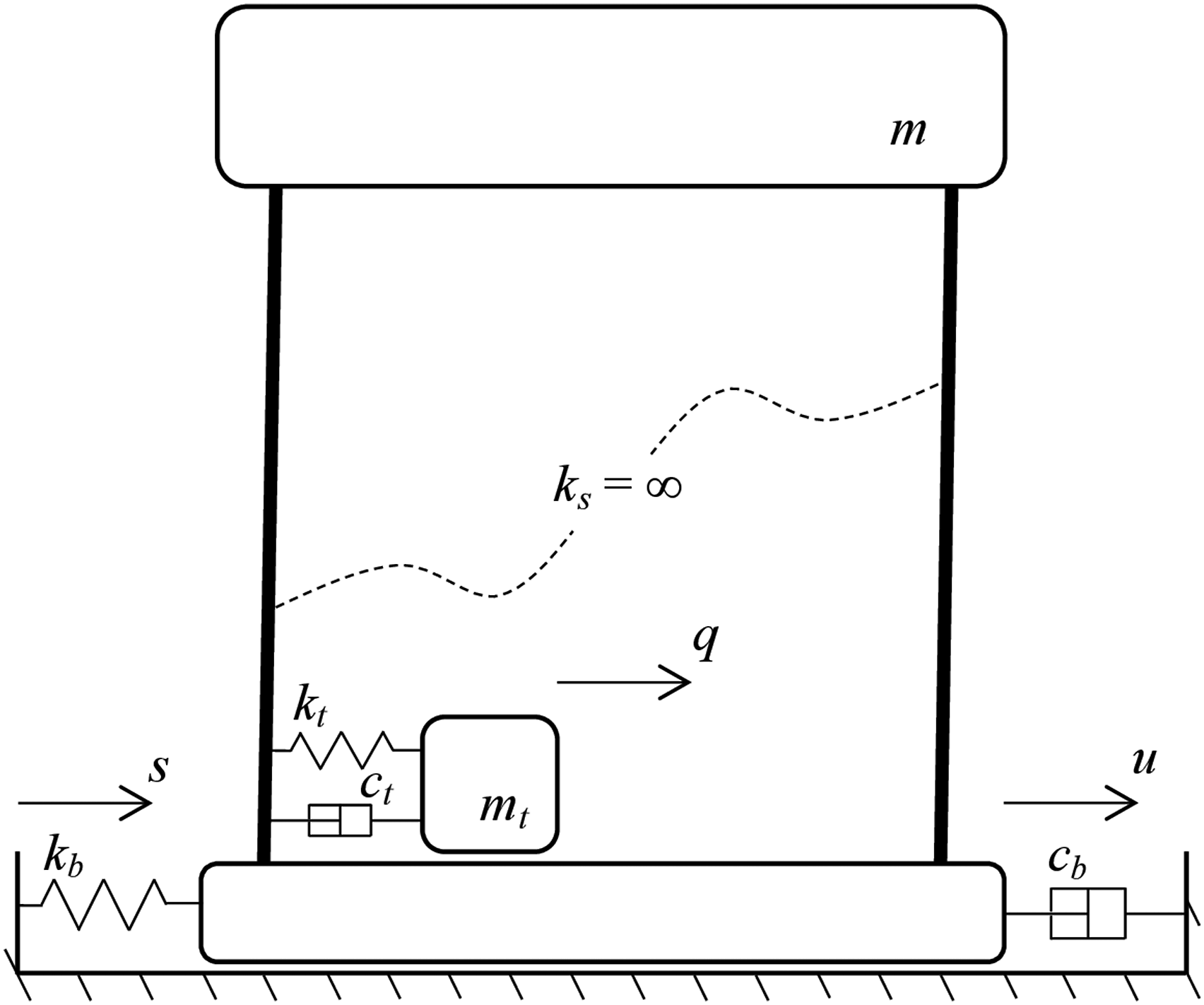
We denote by s the ground displacement, by u the main structure relative displacement, and by q the absorber relative displacement. The equations of motion are given by
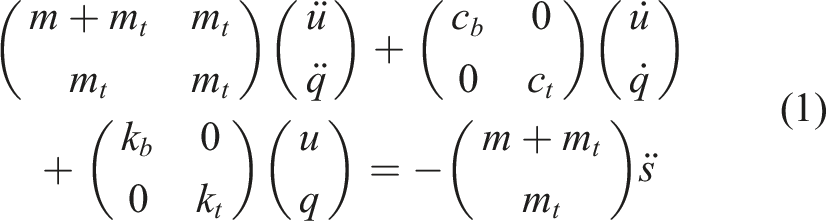
In addition to basically cancelling the superstructural mechanical stress, any or a correctly designed isolation system reduces the absolute accelerations from the levels in the fixed case (Morales, 2003), but the isolator deformation is large. The objective of this article is to mitigate this problem by combined TMD isolation and through transmissibility concepts, mainly from machinery isolation, which is an idea in the frequency domain. From an engineering point of view, the reduction of relative displacement is very important because it has direct impact on the seismic gap (costly space between structure and moat walls), the expense of flexible utility connections and isolators size. Nevertheless, it must be pointed out that isolator deformation is unavoidable in the technique. The displacement cannot be reduced substantially because that would imply similar base and ground displacements, that is, no isolation.
Now, the 2-DOF model proposed for solving the displacement problem facilitates the application of vibration isolation concepts in standard use by mechanical engineers. However, relative displacement transmissibility for 2-DOF systems is not a function that has been considered much in the literature. There are two reasons for this: isolation clearance is not of great concern in mechanical engineering, and relative transmissibility applies only for displacement isolation whereas the absolute one applies for both, motion and force attenuation (Harris and Piersol, 2002). Moreover, transmissibility for multi-DOF systems is a relatively new research avenue (Maia et al., 2001). Nonetheless, we have found two independent derivations of “magnitude of relative amplitude ratio between main system and foundation” (Ioi and Ikeda, 1978) and “ratio of the displacement amplitude of main mass to input amplitude” (Tsai and Lin, 1993) which are the same function: main relative motion transmissibility for 2-DOF structures, which is the ratio of the amplitudes of main structure and support displacements, when this input is harmonic as s = S cos ωt. It can be demonstrated in general that if a 2-DOF system is excited by a stationary harmonic support motion, the main mass relative displacement is also harmonic with the same frequency, as U cos(ωt-ϕ). This special transmissibility function, T, is not derived in the articles, nor we will show our derivation. We do comment that the derivations are long; more importantly that the independent results by Ioi and Tsai teams are verified and confirmed by our results. Nevertheless, while both teams worked with the frequency ratios ω
t
/ω
s
and ω/ω
s
, we have worked with both frequency ratios defined by the input frequency ω, as

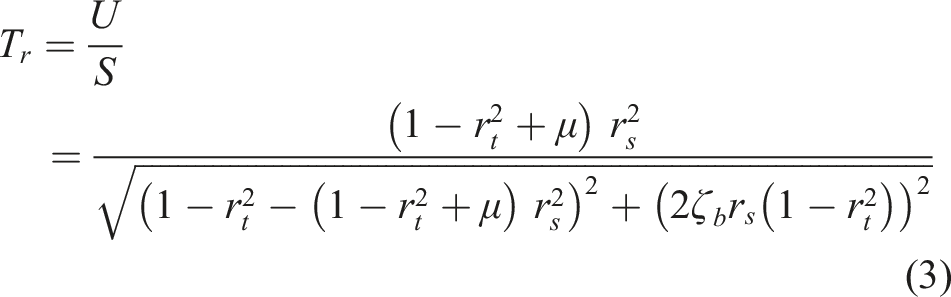
A plot of this 4-variable function is shown in Figure 2 where a damping factor of 0.3 and a mass ratio of 0.15 have been set in order to have this simpler and more efficient plot. It is emphasized that displacement control will not be through damping, which has been already studied (Jangid and Kelly, 2001; Kelly, 1999); thus, a reasonable damping is selected. Regarding mass ratio μ, while most research works consider 10% (0.1) as a technical limit or actually the value used because lower ratios do not have an engineering effect, there are studies that consider larger mass ratios, one of which establishes 0.15 as a value that divides traditional TMDs from large-mass-ratio TMDs (Kang and Peng, 2019) in civil engineering; we select this 15% ratio, or the maximum before the realm of nontraditional TMDs. Aside from the fact that the previous two variables are either less significant in this study or very limited to vary, as compared to the frequency ratios r
s
and r
t
, setting ζ
b
and μ is necessary because the plot of T should be practical to solve the displacement problem. Relative transmissibility function T.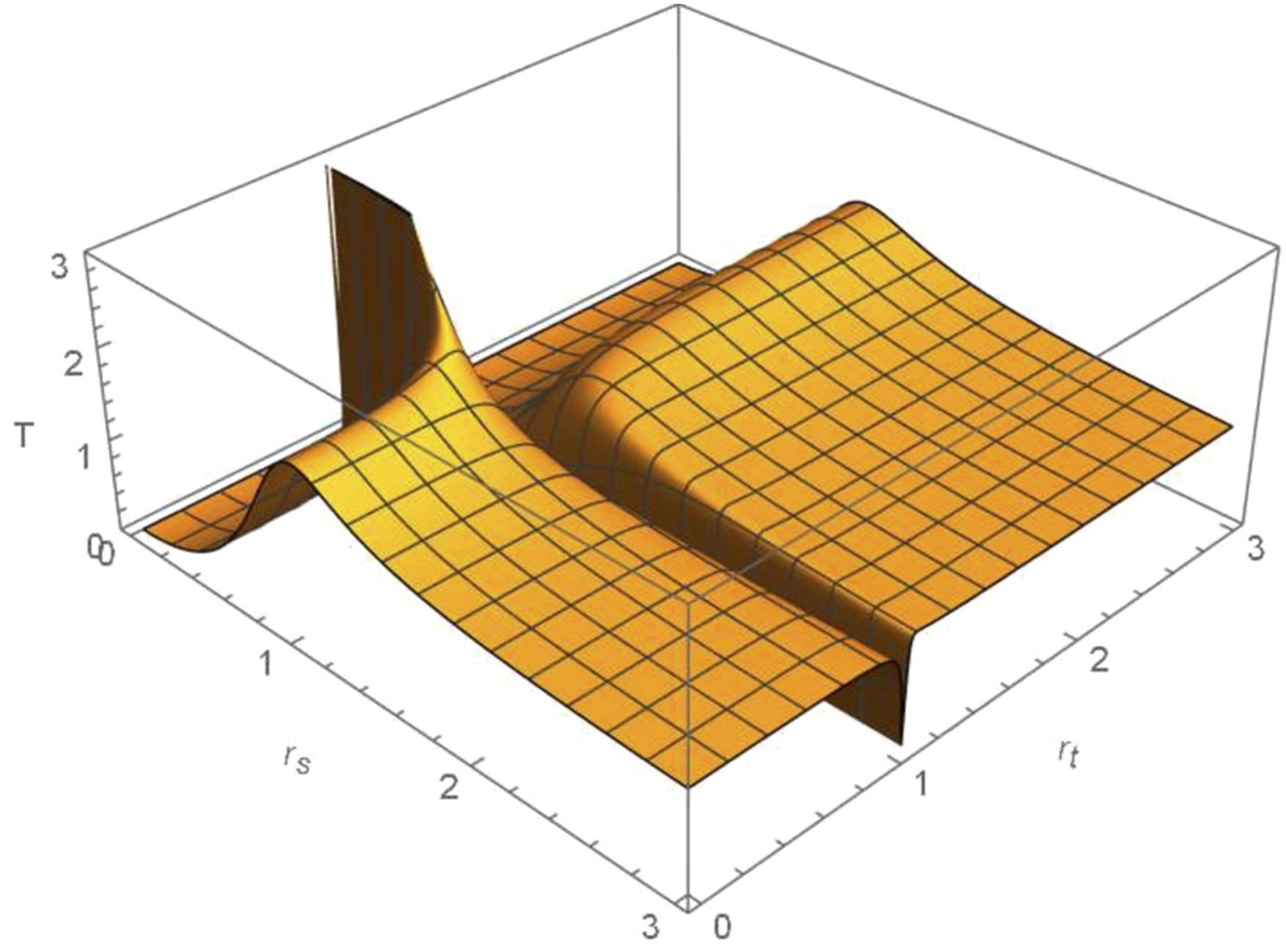
Therefore, establishing design criteria based on controlling or minimizing transmissibility is a natural next step; this minimization is not strictly mathematical because of the new and realistic input model. First, it is stated that isolation or no relative amplification is attained if the design is governed by T < 1 (peak isolator displacement below peak ground displacement); now, a first analysis of the function (Figure 2) clearly shows the usual narrowband of effectiveness associated with TMDs in general (Rao, 2011). This antiresonance limited band is centered at r
t
≈ 1.07 and it is evident that on that narrowband T << 1. The plot also shows the two resonances; these are also a hallmark of TMD-controlled structures which are basically a 2-DOF systems. Now, the antiresonant stripe is more clearly seen on a contour plot, which is Figure 3. Mathematically and in general, it can be easily shown that Contour plot of T (contours up to 2 in steps of 0.25).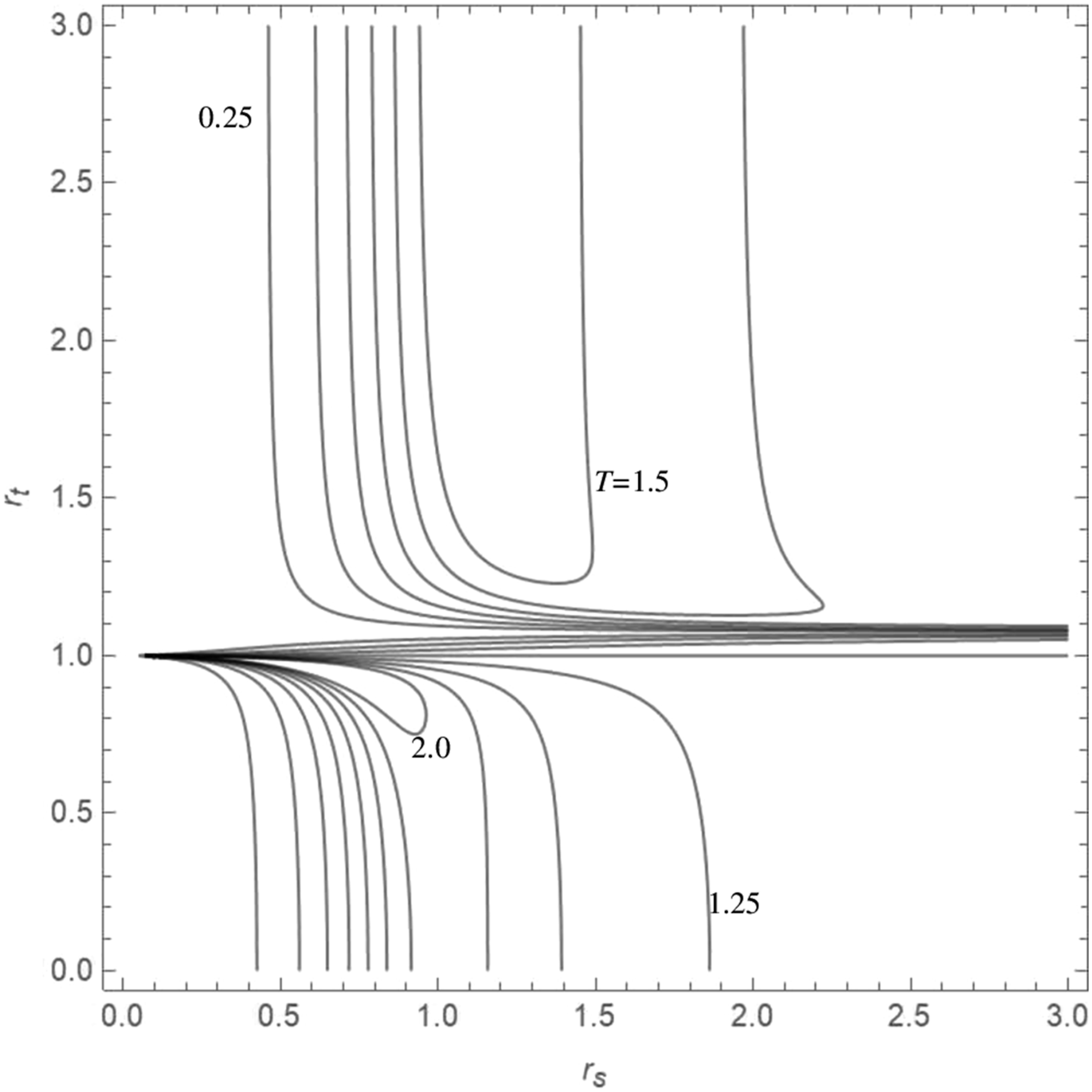

It has been reported that ground displacement is highly narrowband (Morales, 2010) which is not a minor fact; moreover, it has been confirmed recently (Morales, 2021a). These results are very different to what characterizes the common ground acceleration which is considered highly wideband (Lai, 1982); in fact, it is even modeled as a white-noise process in previous TMD-isolation works (Taniguchi et al., 2008). To be more precise on this ground motion narrowbandness, what has been discovered is that the dominant frequencies are confined to the very short range of 0.06–0.32 Hz for near-fault records (Morales, 2010); this highly circumscribed band does permit the TMD to be efficient as it is a device that “is effective over a narrowband of frequencies” (Rao, 2011). Moreover, the fact that the significant energy is distributed over the band does positively allow for the avoidance of “ideal” but undesirable T ≈ 0. Now, for the peak-power frequency a mean value of 0.13 Hz has been obtained by Morales (2003, 2010) which can be considered the dominant frequency over the band, and this frequency (0.82 rad/s) is employed, as explained next, to define the first design criterion.
The proposed design procedure for isolation plus TMD consists of two parts: first, the absorber is defined, and second the isolation subsystem is designed. Thus, the first criterion comes from equation (4) which defines the natural frequency of the TMD (ω
t
, as if it were fixed) or its stiffness and mass ratio as

The TMD inertia, m
t
, is limited to 15% of the main structure mass, as discussed (μ = 0.15); therefore, equation (5) will actually define the TMD stiffness only, by

It is stressed that the ground displacement dominant frequency of 0.13 Hz has been confirmed in more than 10 near-field strong motion records (Morales, 2003, 2010), as discussed just previously.

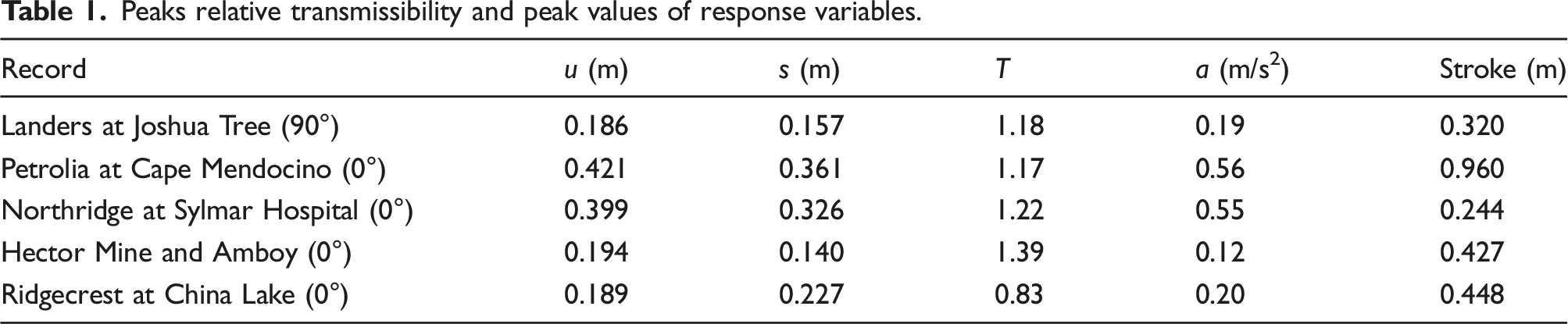
Peaks relative transmissibility and peak values of response variables.
There are two important comments; it is stressed first that the two design criteria proposed directly originate from the objective of controlling the relative displacement which is our goal. Second, it might be proposed to design for low r s ≈ 0 while the other ratio is either r t >> 1 or r t << 1, with the argument that T ≈ 0; the problem with this was thoroughly discussed in this section; we refer now to a more important issue with this argument, which is that the main advantage of a TMD would not be employed: its antiresonant effect.
4. Results
This LBD problem solution is evaluated in the decisive time domain and with real earthquakes. This implies in turn an evaluation of the main hypothesis of the frequency-domain analysis: that seismic displacement is narrowband. This has been studied in very few articles; consequently, positive results will be important in validating it.
The focus is on controlling the isolator displacement; therefore, the structural model is the two-DOF system, one DOF for the main structure and the other for the TMD, which is a standard model in previous works with the very same objective (Taniguchi et al., 2008; Tsai, 1995). Thus, if a superstructure is given, its mass is specified and this is added to the base mass; then, equation (7) defines the isolation stiffness. The isolation damping coefficient is also defined, by the damping factor selected in the Method section. Similarly, equation (5) all but defines the TMD subsystem, through its natural frequency, as explained right below that equation. The only definition left is the TMD damping factor, for which we consider the value employed by Taniguchi et al. (2008) or ζ t = 0.1; crucially, from this similar article transmissibilities can be retrieved for comparison. Summarizing, the structural sample is defined by ω s = 0.10 Hz, ζ b = 0.3, ω t = 0.12 Hz, and ζ t = 0.1, where the first three are established by the compound optimization method proposed; this is in contrast to the similar works reviewed in Section 2 where the first subsystem is not designed at all, and this is a novel contribution of this research work.
The seismic inputs have to be defined next; real records instead of artificial ones are used; in fact, these are seismograms of truly major earthquakes. Four sizable events are Landers, Cape Mendocino (Petrolia), Hector Mine, and Ridgecrest, all of magnitude larger than 7. These were more powerful than the more famous earthquakes of Loma Prieta and Northridge, all in the context of California but a state (province) with one of the highest station densities in the world, only surpassed by some Japanese prefectures (Havskov and Alguacil, 2016); nevertheless, the damage of the former ones was in comparison not as significant because those occurred in sparsely populated areas. The 1994 Northridge event is employed also, as an example of near-source records and, importantly, for direct comparison with other works in which the LBD problem is tackled by passive means and where the effect of near-fault input on isolated structures is studied.
For the Landers earthquake, the seismic station considered is Joshua Tree, which was the closest to epicenter. It is important in seismic engineering articles to also clearly indicate the component, for comparison purposes; it is the 90° one in this case which is the component with the largest peak displacement (Center for Engineering Strong Motion Data, 2021). The ground displacement and relative base displacement are shown in Figure 4; it is observed that the latter are a bit higher than former. In particular, the peak base displacement is 18.6 cm, and the peak ground displacement is 15.7 cm, which implies a peaks transmissibility of 1.18, or 18% amplification. Indeed, this T is the important result because it gauges in the time domain the correctness of the optimization in the frequency domain. A transmissibility in time-history results between 1 and 1.5 validates the ground displacement narrowbandness centered at 0.13 Hz because these T levels imply that that spectral characterization is right as indicated (narrowband) for the TMD to work effectively but “wide” enough to not permit a final T ≈ 0; otherwise, we would observe (a) some resonant behavior which is associated to T > 3, or (b) the other highly undesirable unisolated behavior: the elimination of the very isolation concept (associated with T ≈ 0). Base and ground displacement (Landers at Joshua Tree 90°).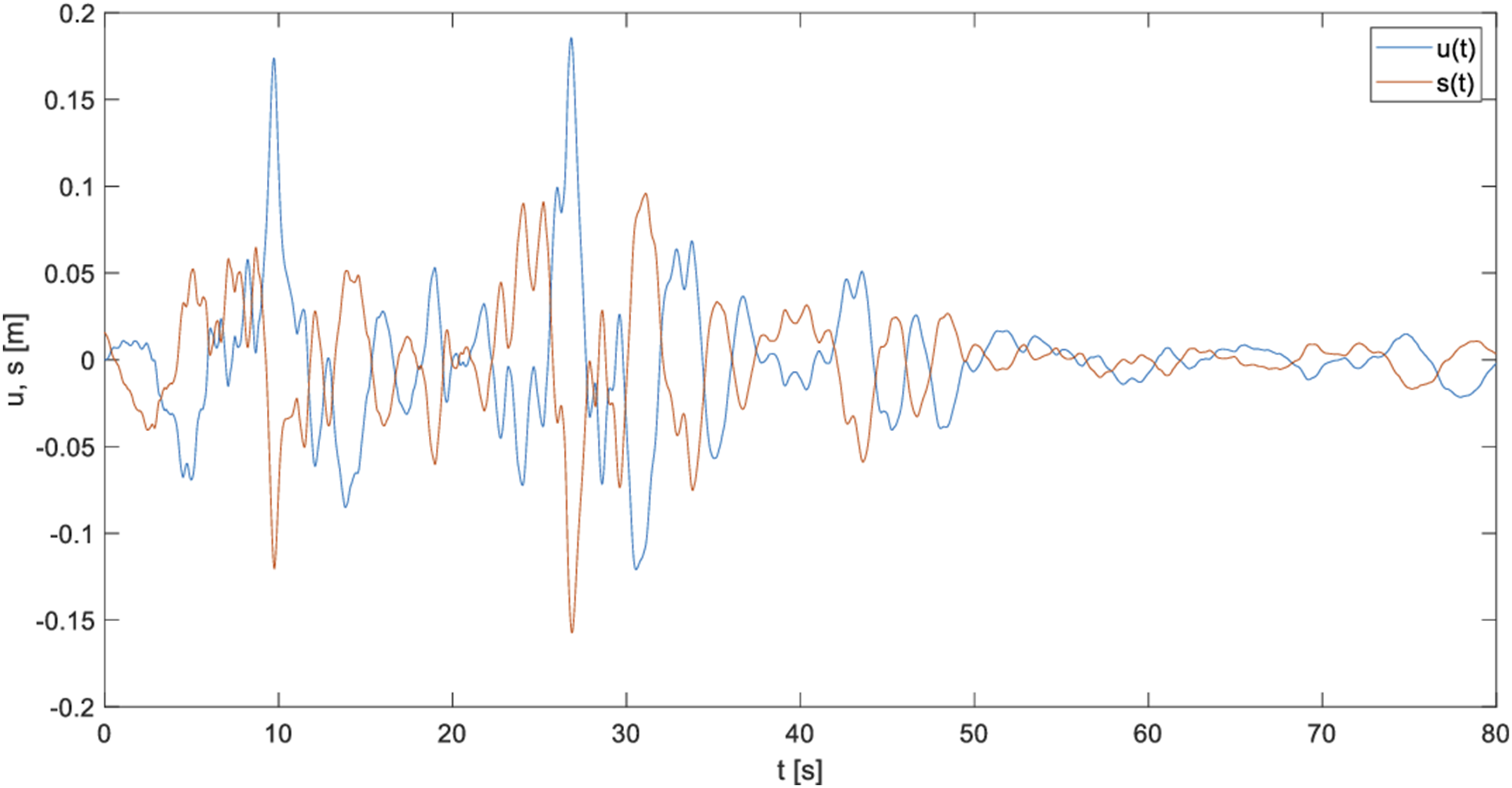
The transmissibility result must be compared with previous results in which TMD isolation is proposed to solve the LBD problem. However, not all these works present seismic information clearly enough to permit the comparison; the main reason is that they evaluate the TMD with respect to the response without it: there is no clear presentation of the ground displacement. The results by Taniguchi et al. (2008) do allow for the retrieval of T, and the mean value is 1.20 (near field) and 1.40 (far field). Thus, for a first significant earthquake, the results are a bit better to ones in previous work where there is no isolation optimization. Now, although it has been established in countless works that accelerations in isolated structures are knocked down from the levels in the fixed case (Meirovitch and Stemple, 1997; Morales, 2003) we show the structure absolute acceleration, a, in Figure 5 because when solving the LBD problem the concern in the literature is if the accelerations are increased from isolated levels (Alhan and Öncü-Davas, 2016; Jangid and Kelly, 2001; Kelly, 1999). It is observed that the peak value is just 0.19 m/s2, very well under the stringent limit of 2.5 m/s2 indicated for isolated structures (Alhan and Öncü-Davas, 2016). More important is to monitor the stroke of the absorber; formally, it is the maximum length travelled by the device (over base) between two consecutive peaks; this important response can be obtained from the TMD displacement q(t); however, it is not q if one is to use formal mechanical engineering terminology. Nonetheless, this relative motion is presented in Figure.6, and a stroke length of 32 cm is simply retrieved from it. The term stroke has not been used with precision in civil engineering because the peak value of q is presented as “TMD stroke” (De Domenico and Ricciardi, 2018b; Etedali and Rakhshani, 2018; Xiang and Nishitani, 2014). Thus, for comparison purpose only, this peak value in our case is 17 cm whereas in the second of the three previous references for the same Landers event, the value is above 3 meters; moreover, in the first article 1.5 meters is established as limit for “stroke.” Main mass absolute acceleration (Landers at Joshua Tree 90°). Tuned mass damper relative displacement (Landers at Joshua Tree 90°).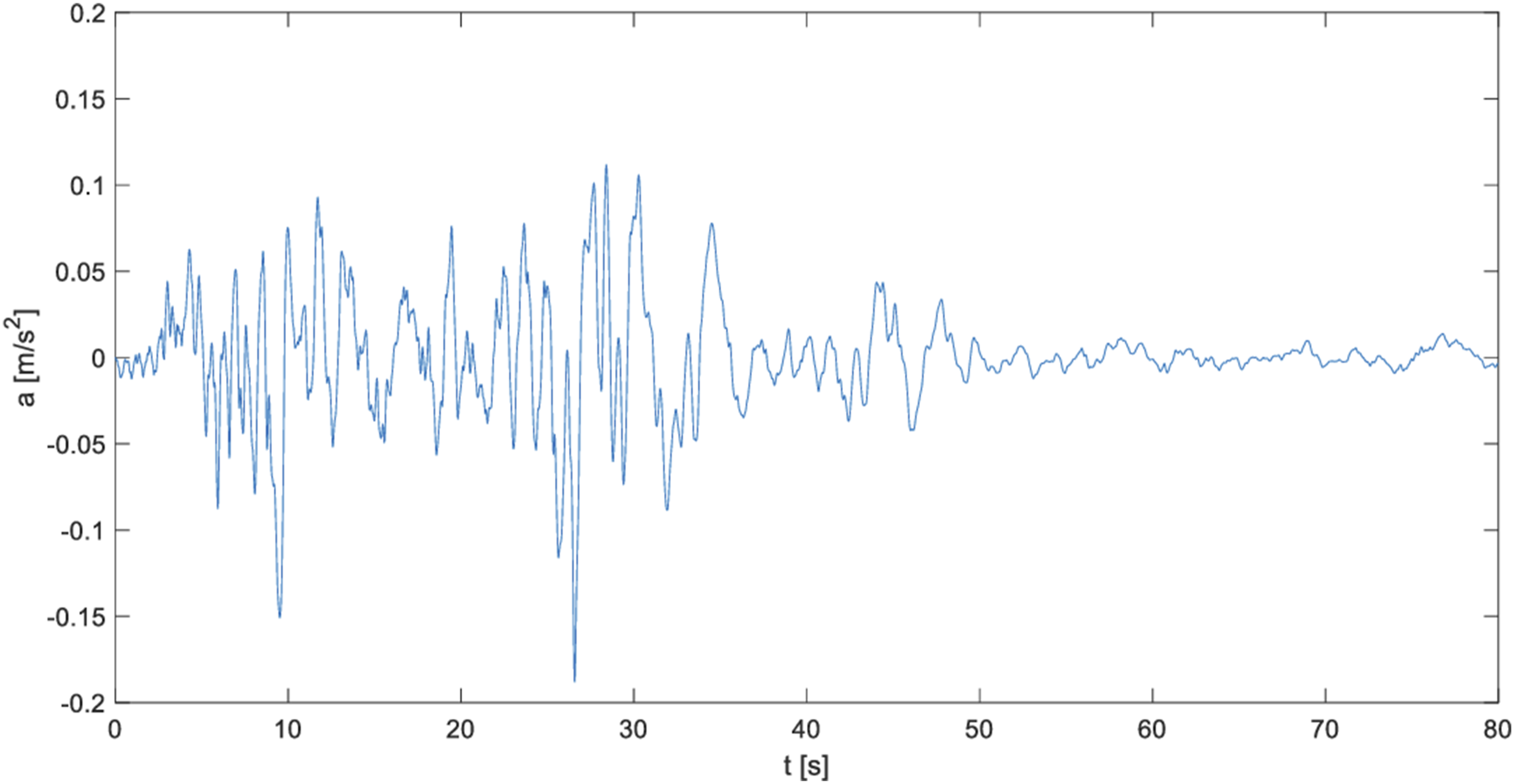
Next, the Cape Mendocino earthquake is considered (0° component); it is stressed that the California records are not chosen arbitrarily; the events are recent, of magnitude above 7, and the station is the closest to epicenter. The isolator and ground displacements are shown in Figure 7; the peak values are 42.1 and 36.1 cm, respectively, for T = 1.17, very close to the one above of 1.18 which is quite interesting. It is pointed out that the ground displacement amplitude is quite noteworthy, more than 1/3 of meter. The peak acceleration in this case is 0.56 m/s2, again below the strict limit of 2.5 m/s2 indicated for isolated accelerations (Alhan and Öncü-Davas, 2016). The acceleration results confirm the ones obtained by Taniguchi et al. (2008) who conclude: “reduction in the displacement demand is not achieved at the expense of increasing the acceleration response, as may be the case with other alternatives, such as the provision of supplemental damping.” It can be argued that the 2-DOF model gives structure accelerations but not superstructure acceleration; nevertheless, it has been established with 3-DOF models, both theoretically (Palazzo et al., 1997) and experimentally (Petti et al., 2010) that superstructure accelerations not only do not increase, but decrease. Base and ground displacement (Petrolia at Cape Mendocino 0°).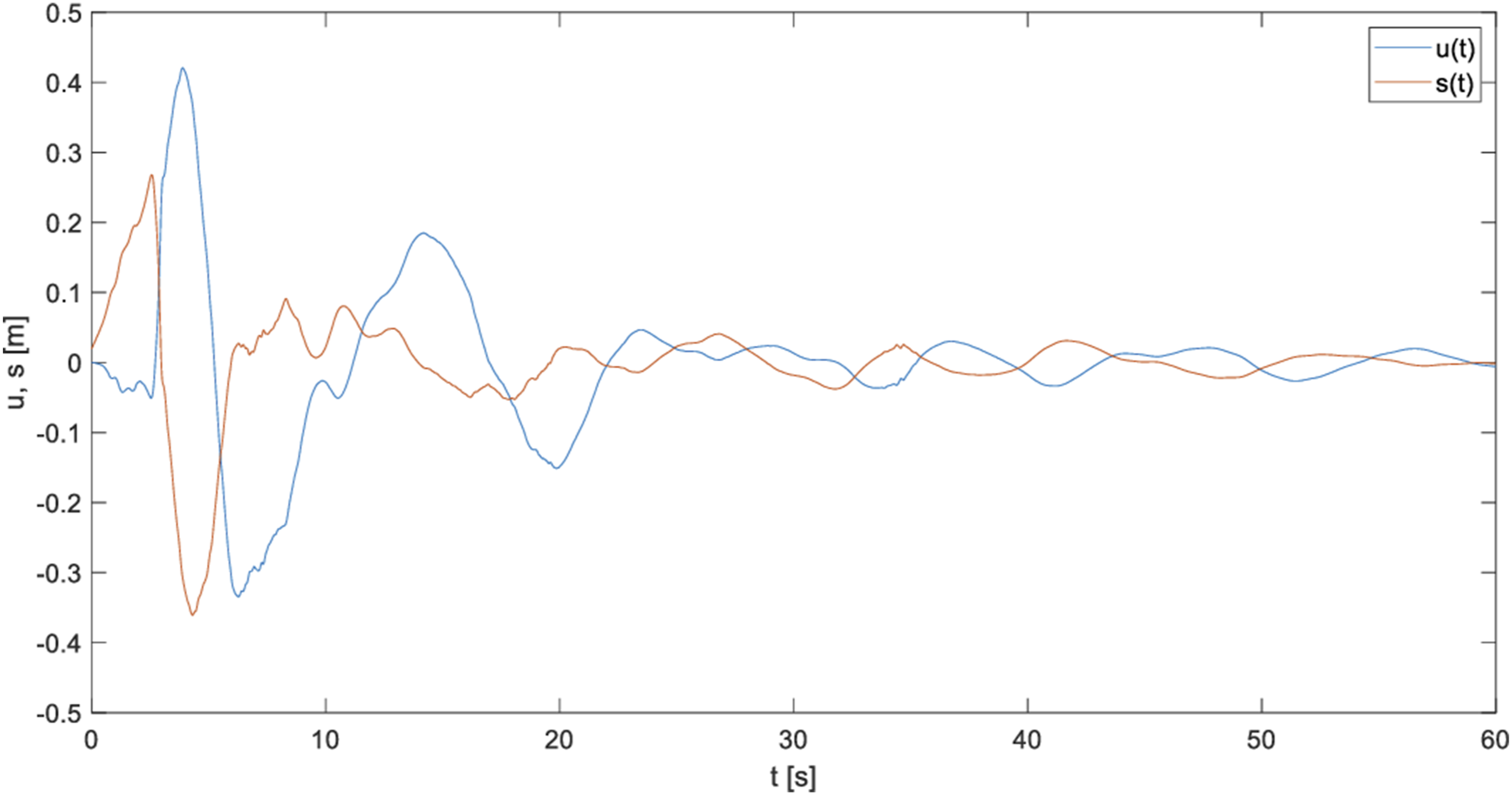
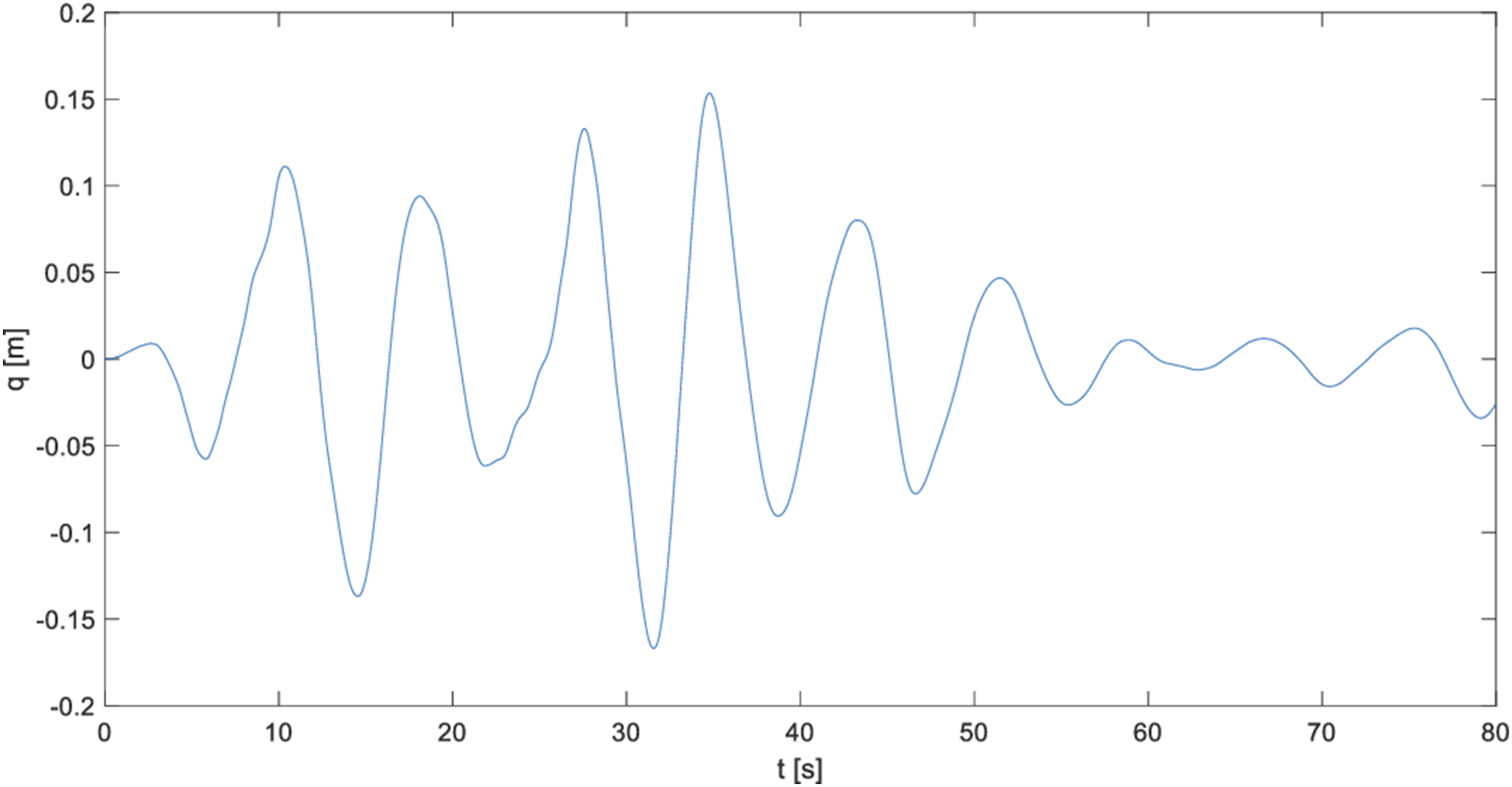
A more interesting measure is TMD stroke; it is 96 cm (Table 1) which is very reasonable; unfortunately, it cannot be compared with previous work because the concept of stroke has not been gotten right in the literature on seismic absorbers; in fact, this discussion, in the paragraph just above, can be considered a contribution of this work.
Now, a Northridge record that has been given plenty of attention is the Sylmar County Hospital one because of the pulse-type motion observed which is due to its near-fault location (Hall et al., 1995; Kelly, 1999). This type of seismic motion has caused much concern because of the resulting large isolator displacements (Heaton et al., 1995; Jangid and Kelly, 2001; Kelly, 1999). Therefore, our methodology is tested with this signal (360° component) which has been considered challenging in similar works (Jangid, 2007; Jangid and Kelly, 2001; Zelleke et al., 2015). The isolator and ground motion are shown in Figure 8, and the peak values are 39.9 and 32.6 cm, respectively, for T = 1.22. Remarkably, it is extremely close to the two previous ones (1.18 and 1.17) for a mean value of 1.19. The structure acceleration and TMD full stroke length are presented on Table 1. It is emphasized that this record is a special one or that has previously caused concern because of its effect on base displacement; in fact, two works resorted to nonlinear or lead-rubber isolation to attain T = 1.30 (Jangid, 2007) and to resilient-friction isolation to reach a better 0.97 (Zelleke et al., 2015) for the same example structure (in these two articles). Base and ground displacement (Northridge at Sylmar Hospital 0°).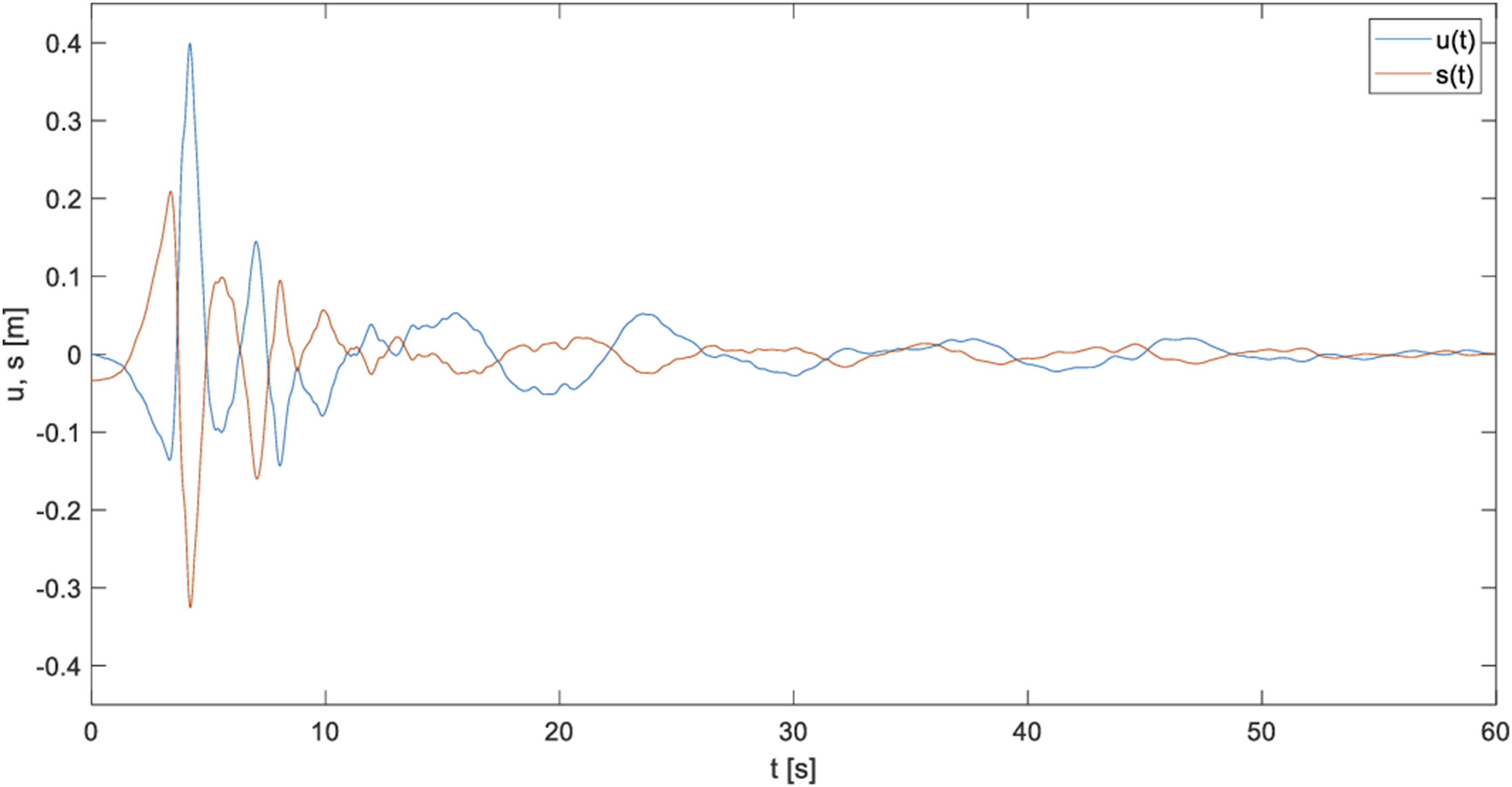
Two more recent (1999 and 2019) above-7 seisms are Hector Mine and Ridgecrest; the stations (components) and results are shown in Table 1. It can be concluded that T is not very close to 1.2 as in the three cases from the early 90s; one is 1.39 but the other is a very positive 0.83. It is finally stressed that in the present research there were no trials with the many records available for each of the three major events: we chose right from the start the station closest to hypocenter.
5. Discussion
For very sizeable seismic records, this design method has attained isolator displacement levels close to the ground displacement ones, in one case even below. The transmissibilities are in the narrow range of 0.83–1.39, with 1.16 as mean. These gained transmissibilities are compared with ones in other passive-control works solving the problem. One of the earliest works in which the LBD problem is considered is by Meirovitch and Stemple (1997) which shows T = 1.23 with basic isolation for a structure with isolated period of 3.6 s and excited only by the classic El Centro record.
More recent articles that consider more than just one event are by Jangid (2007) and Zelleke et al. (2015) who in fact do consider the prominent and challenging near-source Sylmar Hospital record (Northridge) that is studied here. Moreover, the same structure with isolated period of 2.5 s is employed in both former works where—more importantly—transmissibilities of 1.30 and 0.97 were achieved with nonlinear bearings and R-FBI system, respectively. The bearing yield strength to weight was high: F 0 = 0.15; actually, for F 0 = 0.075 they obtained T = 1.91 (Jangid, 2007). The friction coefficient had to be μ = 0.075 to get the low transmissibility reported (Zelleke et al., 2015).
Nonetheless, the main comparison should be with research that implemented a TMD for the solution of the problem; in addition, the results should allow for the retrieval of T which more often than not is difficult as precise information on the seismic station (component) is not available (to retrieve ground displacement). This problem found in the literature, or inability to compare results, is because previous discussions of results were relative to isolated response: they need not present precise seismological data; it is pointed out that not only vagueness in seismological data is common, but even errors are also in the literature (Morales, 2021b). Taniguchi et al. (2008) do present clearly the stations analyzed, and now we present their results (mean) for the 10 seismic records analyzed and it is T = 1.30. It is a 30% amplification which can now be compared to our result of 16%; that is, the compound design methodology permits a reduction in displacement with respect to previous results in which only the TMD is optimized. In addition, one of the major earthquakes considered is Northridge which also we considered, and therein T = 1.36 whereas we got T = 1.22; nonetheless, it is noted that although both records are near-field the stations are not the same. Direct comparisons with other works are not possible as explained just above, facts that are related to the isolation not being optimized therein. We cannot gauge our TMD-isolation results with simple isolation because the isolation design is simultaneous to the absorber one.
An important comment about this transmissibility is that ground displacement is always absolute whereas the base displacement must be measured relatively; therefore, the terms isolation and amplification do not have a full physical meaning as when the both variables of the ratio are absolute, but there is no choice in earthquake engineering. Another comment is on the isolation and TMD subsystems linearity which is a limitation; nonetheless, it was necessary to derive this simple transmissibility expression. Finally, the favorable results validate the assumptions of the frequency-domain optimization.
6. Conclusion
The LBD problem can be solved by properly designing a TMD jointly with the isolation. It was demonstrated that this passive control is able to control the relative base displacements, while keeping the acceleration levels under strict isolated limits. In particular, it is shown that in the case of the five extremely large events studied, the transmissibility is close to 1.16 (mean), that is, base to ground peak displacements; moreover, the peak isolator displacement is in all cases below 0.45 m, being that a limit of 0.4 m is considered quite stringent in the literature. The positive results have been compared to other transmissibility results from previous base isolation and TMD-isolation articles, and the outcome was not unfavorable.
Footnotes
Declaration of conflicting interests
The author(s) declared no potential conflicts of interest with respect to the research, authorship, and/or publication of this article.
Funding
The author(s) disclosed receipt of the following financial support for the research, authorship, and/or publication of this article: Universidad Peruana de Ciencias Aplicadas (C-025-2020).
