






Abstract
A negative stiffness device composed of two horizontal pre-compression springs is proposed to isolate the vibration of the simply supported beam. The nonlinear vibration equation of simply supported beam installed with a negative stiffness device is established by using Hamilton principle first. The lower degree of freedom dynamic equation of the system is derived by using Galerkin truncation approach. The influence of support position and negative stiffness parameters on the natural frequency of the beam are obtained from the modal analysis of the free vibration system. According to the dynamic internal force of the beam, the force transmissibility at the support end is defined and the displacement transmissibility of any point on the beam is also defined to facilitate the analysis of the vibration isolation effect. The influence of negative stiffness support parameters on the amplitude–frequency curve and the transmissibility curve of the simply supported beam is discussed. The results show that the fundamental frequency of the system can be significantly reduced by the negative stiffness device, while the frequencies of high-order modes are changed a little bit only. Increasing the horizontal spring stiffness will reduce the first-order resonance frequency and the initial frequency of vibration isolation. Consequently, the aim of lower frequency vibration isolation for the simply supported beam can be achieved. This paper provides an effective approach to the vibration isolating design of flexible structures.
Keywords
1. Introduction
The simply supported beam is a common structure in aerospace, mechanical, and civil engineering. In practical application, it often must bear different types of external excitation, which leads to harmful vibration of the beam and the connected structure, affecting the operation state of the equipment (Liu et al., 2021). In the past decades, the research on vibration control mainly focused on absorbing and consuming vibration energy, and developed a series of vibration reduction measures, such as the constrained damping materials (Lu et al., 2020), the tuned mass damper (Zhang et al., 2021), the nonlinear energy sink (Tsiatas and Karatzia, 2020), and the active vibration control based on external energy input (Poplawski et al., 2021), which play a very good role in structural vibration control. Recently, to reduce the vibration transmission between the simply supported beam and the connected structure, extending the vibration isolation bandwidth of the beam is an effective approach and has been paid more and more attention by scientists and engineers (Grossi and Quintana, 2008; Mao et al., 2017; Raei and Dardel, 2020).
The negative stiffness devices have the function of reducing the dynamic stiffness of the discrete system, leading to a small fundamental frequency which has been widely used in discrete system vibration isolation (Ibrahim, 2008). Molyneau (1957) used two horizontal spring elements to construct a negative stiffness device, paralleling it with the vertical spring to form a high-static-low-dynamic stiffness isolator. Based on the work of Molyneau (1957), Alabuzhev et al. (1989) adjusted the negative stiffness support parameters to make the single degree of freedom vibration isolation system achieve quasi-zero stiffness. Carrella et al. (2012) systematically analyzed the static and dynamic characteristics of the three-spring vibration isolator, proving that the negative stiffness device can reduce the dynamic stiffness of the spring mass system without affecting the static bearing capacity of the vertical spring. Sadeghi and Li (2019) studied a unique asymmetric quasi-zero stiffness property from the pressurized fluidic origami cellular structure, verifying the feasibility and efficiency of using such a nonlinear property for low-frequency vibration isolation. Li et al. (2020) summarized the development process of the negative stiffness devices and classified them in detail according to their working principles. Through the above literature review, it can be found that there are many kinds of negative stiffness structures, but their basic principle is similar to the negative stiffness device consisting of two horizontal pre-compression springs (Zheng et al., 2021). In addition, few literatures have reported that the negative stiffness device is used in flexible structures.
The initial solution to the vibration isolation of the simply supported beam is to change the constraints at both ends of the beam by employing the spring support instead of the hinged support to achieve vibration isolation (Xu et al., 2016; Ding, Dowell, and Chen, 2018). However, to obtain better vibration isolation efficiency, it is often necessary to reduce the spring stiffness, which results in excessive static deformation of the beam and affect the stability of the system. Recently, referring to the principle of negative stiffness structures, the quasi-zero-stiffness isolator is used to support the flexible beam to achieve low-frequency vibration isolation in the literature. Ding and Chen (2018), Ding et al. (2019) installed the quasi-zero-stiffness isolators at the two ends of the slightly curved beam and the preloaded beam, respectively, to study the vibration isolation efficiency of the negative stiffness support on the system and to analyze the influence of multi-mode interaction on the vibration isolation of the flexible structures. The results showed that adjusting the negative stiffness support parameters can reduce the initial frequency of vibration isolation, improving the vibration isolation bandwidth of the flexible structure. Bouna et al. (2020) used the quasi-zero-stiffness isolator for vibration isolation of multi-span bridges and pointed out that the quasi-zero-stiffness isolator could reduce the vibration amplitude of the beam bridge around the resonance frequency region.
Whether the linear elastic support or the quasi-zero-stiffness support is used, the vibration isolation schemes reported in the literature will reduce the static stiffness of the simply supported beam and weaken the stability of the system. Noticing this problem, Hui et al. (2011) investigated the transmissibility at the support end of the curved beam and proposed a curved beam isolator, but the low-frequency vibration isolation efficiency is not very ideal. On the premise of not changing the static stiffness of the simply supported beam, it is full of prospects that the negative stiffness device is used in vibration isolation of the simply supported beam.
In this paper, a negative stiffness device composed of two horizontal pre-compression springs is proposed to isolate the vibration of the simply supported beam. First, the nonlinear vibration equation of the simply supported beam installed with a negative stiffness device is established by using Hamiltonian principle. Then, the lower degree of freedom dynamic equation is derived by using the Galerkin truncation method, and the influence of the support position and negative stiffness parameters on the fundamental frequency of the simply supported beam is obtained from the modal analysis of the free vibration system. By solving the low degree of freedom dynamic equations, the influence of negative stiffness support parameters on the amplitude–frequency curve and the transmissibility curve of the simply supported beam is studied. Simulation results clearly show that by adjusting the negative stiffness support parameters, the vibration isolation bandwidth of the simply supported beam can be expanded and the low-frequency vibration isolation efficiency can be improved without changing the static stiffness of the beam.
2. Dynamical model of the beam installed with a negative stiffness device
Consider a slender beam simply supported at both ends commonly used in practical engineering as shown in Figure 1. The beam is modeled as the Euler–Bernoulli beam, and the vibration isolation of the beam is realized through a negative stiffness device installed on the beam. The cross-section of the beam is uniform. The mass density and elastic modulus of the beam are denoted by the Simply supported beam installed with a negative stiffness device.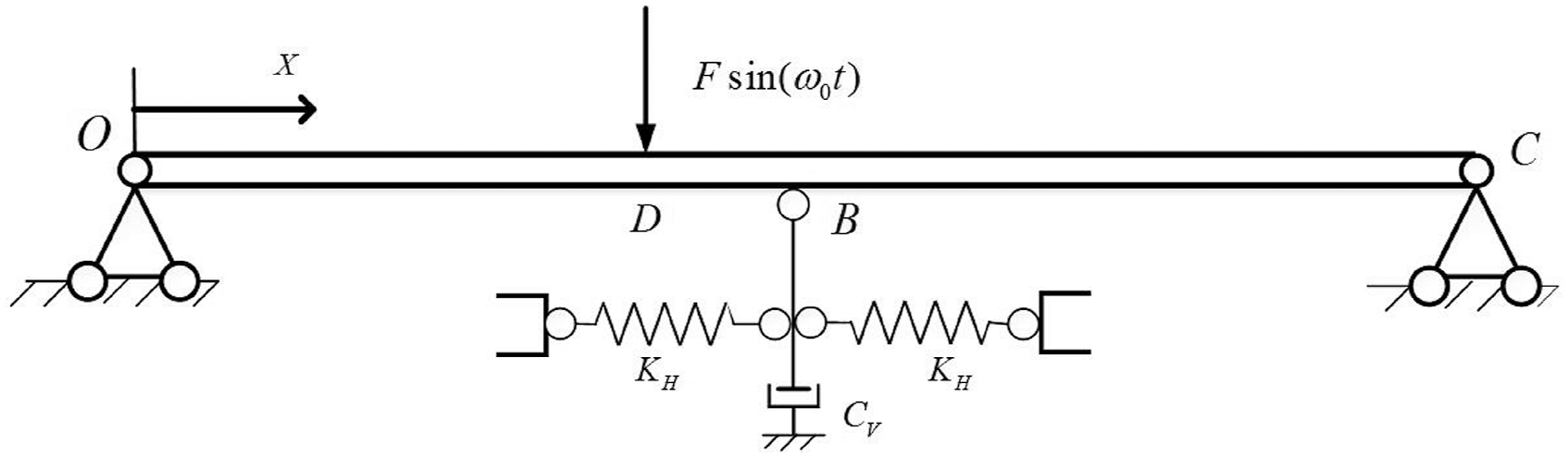
2.1. Elastic potential energy of the negative stiffness device
The negative stiffness device is the core element to realize vibration isolation of the simply supported beam. Its mechanism under consideration is schematically shown in Figure 2. The negative stiffness device is composed of two horizontal pre-compression springs. The stiffness of the horizontal spring is Schematic representation of the negative stiffness device.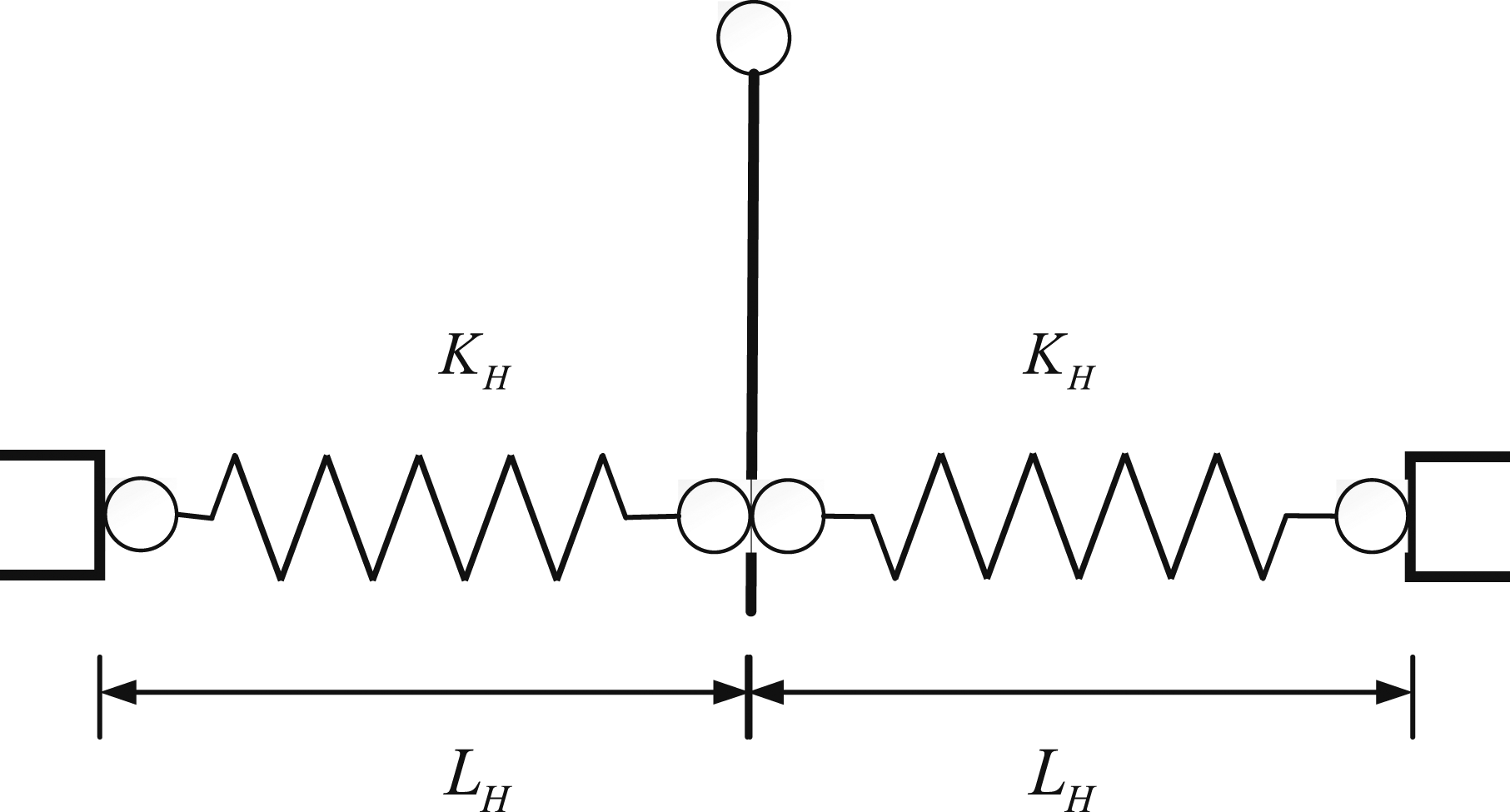
According to the geometric relationship, the force-displacement characteristic of the negative stiffness device is described as
To facilitate the analysis of the nonlinear force caused by the negative stiffness device, the approximate expression of the nonlinear force can be obtained by reserving the Taylor expansion of the function
According to the approximate expression, the elastic potential energy of the negative stiffness device is expressed as
2.2. Governing equation of motion for the beam install with a negative stiffness device
Based on von-Karman’s strain hypothesis and Kirchhoff’s hypothesis, the strain-displacement relationship of the simply supported beam can be described as
Then, the potential energy of the beam is obtained as
The kinetic energy of the beam can be written as
The virtual work done by the external force
By using the generalized Hamilton principle, we have
Considering the damping in the structure, substitution of equations (3), (6), (7), and (8) into equation (9) leads to (Ding et al., 2018a)
As a prelude to investigating the nonlinear dynamic responses of the system, it is useful to introduce some natural scales to obtain a dimensionless equation of motion. Introducing the dimensionless variables and parameters
Substituting the expressions listed in equation (11) into equation (10), the nonlinear vibration equation can be expressed as a dimensionless form (hereafter, the superscript “*” is omitted to simplify the expression)
The equation (12) can be truncated to ordinary differential equations by the Galerkin truncation method. The transverse displacement of the simply supported beam is assumed as
Substituting equation (13) into equation (12), multiplying both sides of the resulting equation by
3. Inherent characteristic analysis
In this section, by studying the linearized system, the natural frequencies of the system can be solved. Neglecting the damping and nonlinear terms in the equation (14), the differential equation of free vibration is obtained as follows
Supposing the solution of equation (15) is
Substituting equation (16) into equation (15) yields
The condition that equation (17) has a non-zero solution is
The natural frequencies of the structure can be obtained from the above formula.
Geometric dimensions and physical properties of the simply supported beam installed with a negative stiffness device.

Unless otherwise stated, the above parameters will be used in the following calculation examples. According to equations (15) and (18), by changing the value of Influence of the position of the negative stiffness device on the first four natural frequencies of the simply supported beam (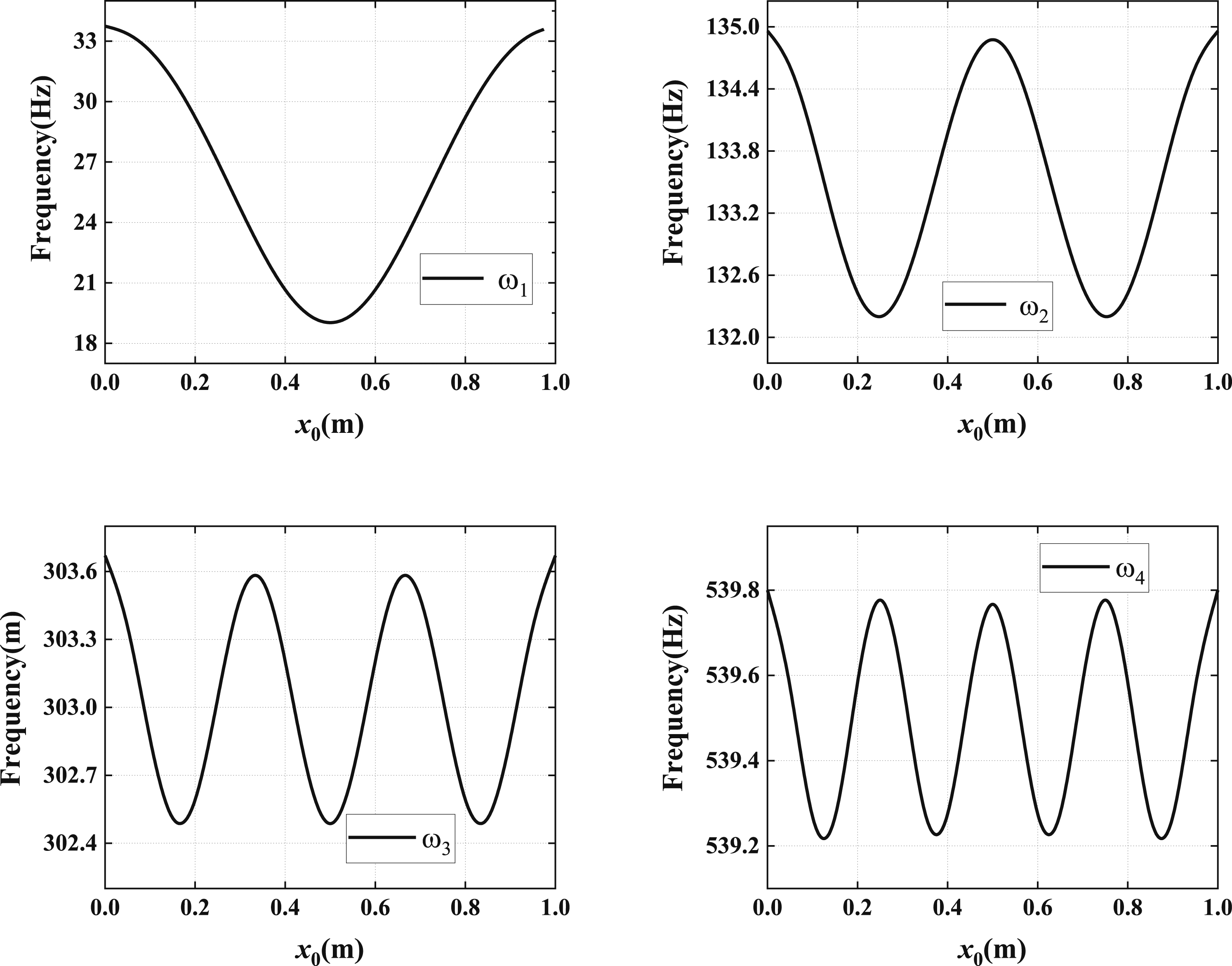
Figure 4 shows the difference between the first-order natural frequency and the second-order natural frequency when the negative stiffness device is installed in different positions. It can be found that when the negative stiffness device is installed in the middle of the simply supported beam, the difference is taken as the largest value. This implies that the negative stiffness device leads to the maximum efficiency of vibration isolation for the simply supported beam when it is installed on the midpoint of the beam. Therefore, in the follow-up study, the negative stiffness device will always be installed in the middle of the beam. Difference between the first natural frequency and the second natural frequency (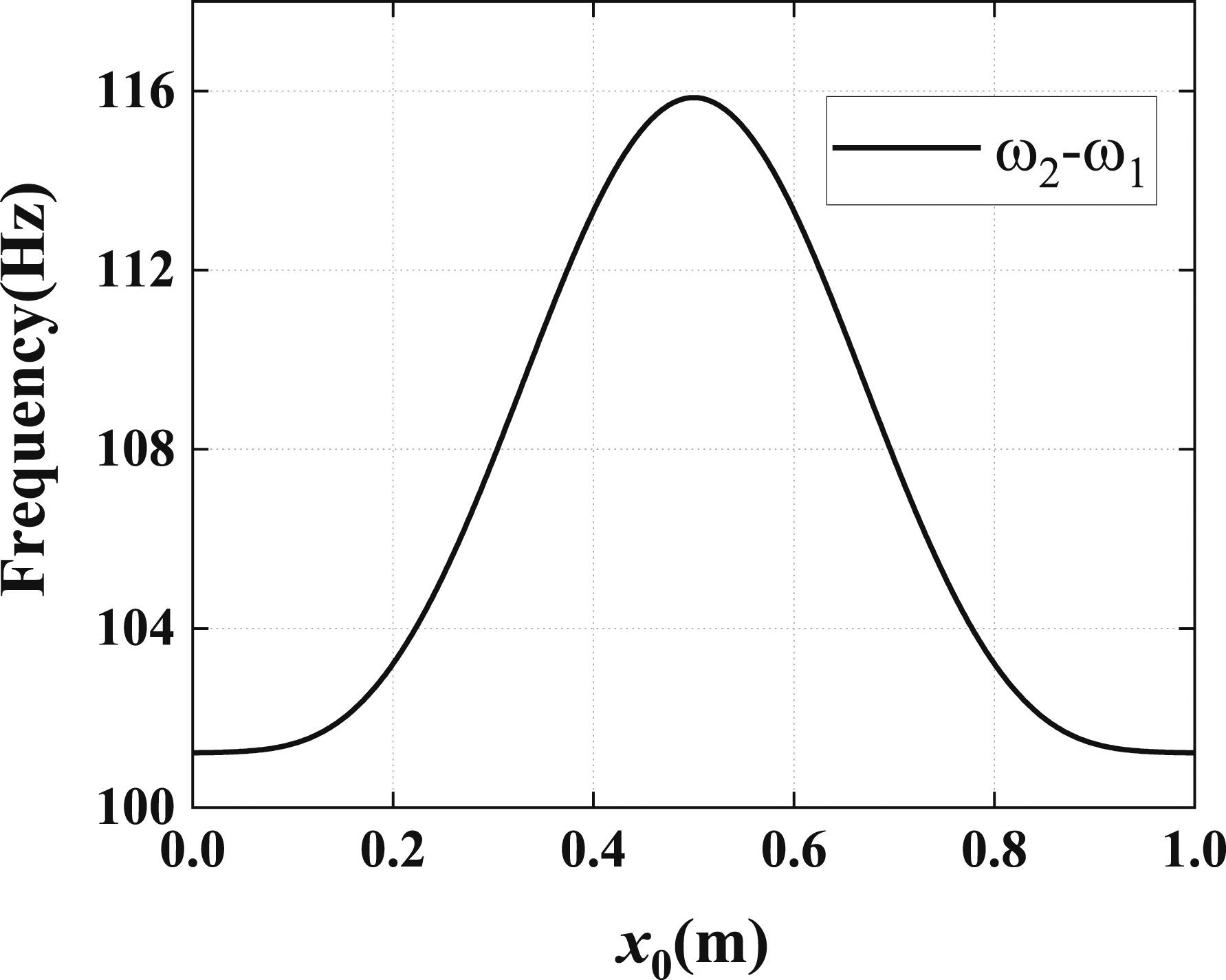
The effects of horizontal spring stiffness on the first four natural frequencies of the system are demonstrated in Figure 5. Generally, the change of the support stiffness has a greater impact on the low-order natural frequency but has a small effect on the high-order natural frequency. As seen, with the increase of the spring stiffness, the first natural frequency decreases continuously. However, the higher natural frequencies changes very slightly. Therefore, the frequency band of vibration isolation between the first natural frequency and the second natural frequency can be extended to the low frequency by adjusting the spring stiffness. Effect of horizontal spring stiffness on the first four natural frequencies of the system.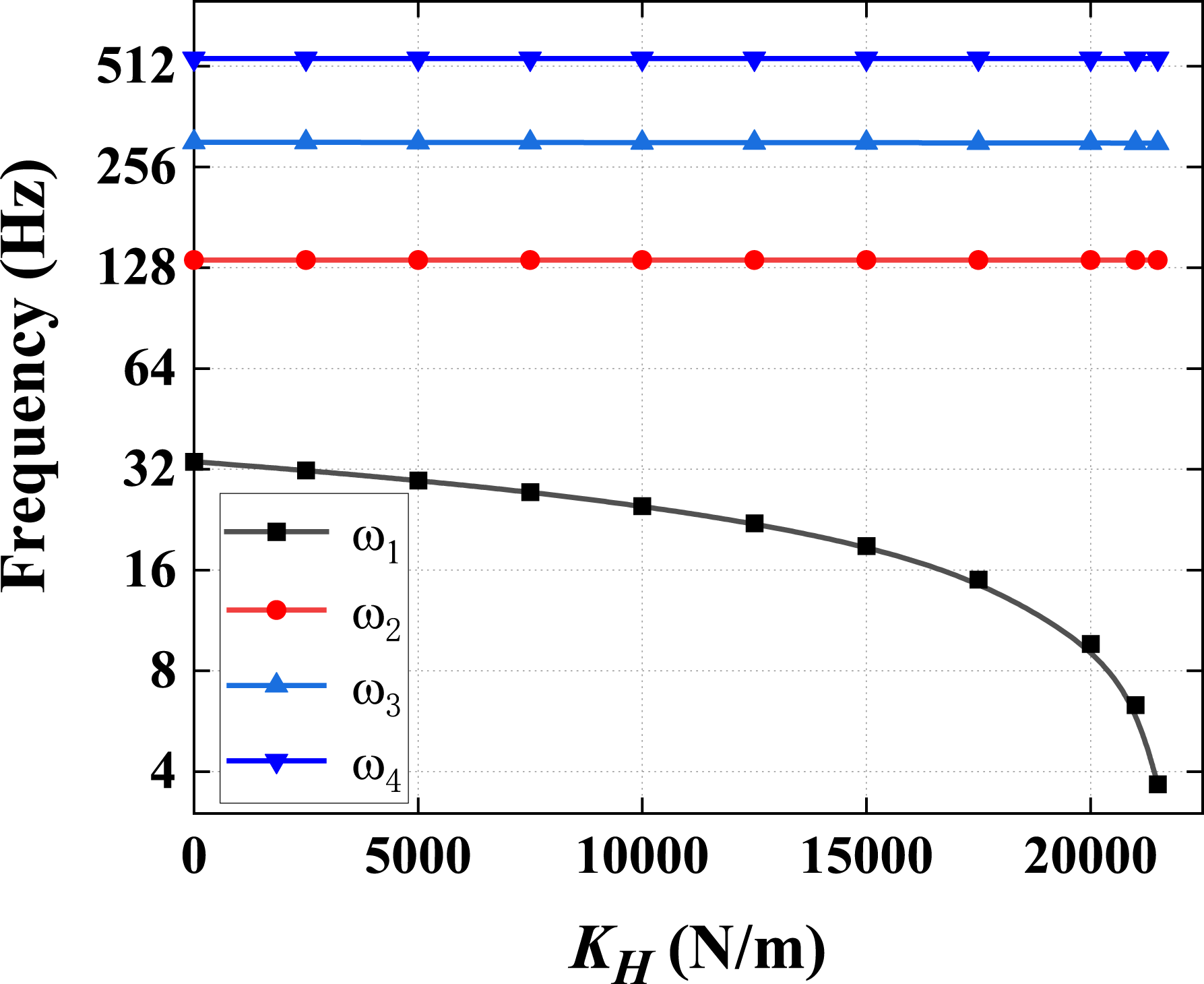
4. Dynamic response analysis of the simply supported beam under excitation of external force
In this section, the force transmissibility at the support end is defined first. Then, by utilizing the Runge–Kutta method, dynamic behaviors and vibration isolation performance of the beam under excitation of external force are presented.
The force transmissibility at the support end is defined as (Hui et al., 2011)
The fourth-order Runge–Kutta method is employed to solve equation (14) to obtain the vibration response of the beam. Subsequently, the force transmissibility at the support end can be obtained from the formula given in equation (19). The initial values of equation (14) are set as
4.1. Convergence analysis
In this investigation, the negative stiffness device is installed in the middle of the simply supported beam, and the simple harmonic excitation force
The amplitude–frequency curve of the point D and the force transmissibility curve of the left end of the beam are drawn in Figure 6. It can be observed from Figure 6 that the vibration responses calculated by taking the first four modes of the simply supported beam is almost the same as that by taking the first six modes. This means the dynamic model formed by taking the first four modes can well reflect the dynamic characteristics of the system. Therefore, the dynamic model truncated by using the first four modes is considered in the following calculations. Comparisons between four-term Galerkin truncation and six-term Galerkin truncation. (a) Amplitude–frequency curve of the point D, (b) transmissibility curve of the left end of the simply supported beam.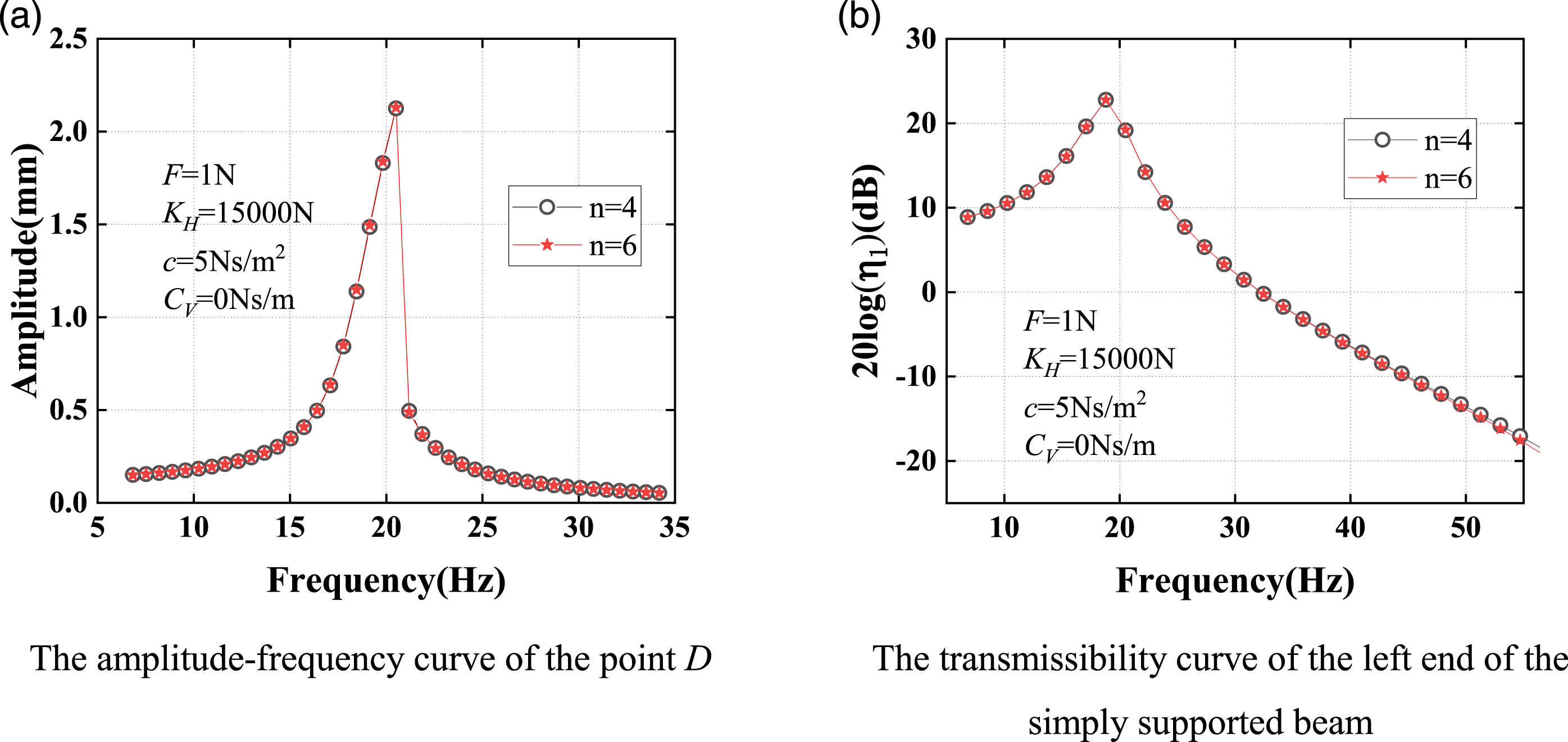
4.2. Dynamic response analysis
With the external excitation acting on the L/3 of the simply supported beam, the effects of horizontal spring stiffness on the first two resonance peaks of the beam installed with a negative stiffness device are shown in Figure 7. It can be observed from Figure 7 that the increase of the horizontal spring stiffness causes the first resonance peak to move toward the low-frequency region. Meanwhile, the second resonant peak hardly changes, which is consistent with the law of the inherent characteristics in the previous section. This means that the negative stiffness device can be used to reduce the fundamental frequency of the beam and broadened the isolation frequency band. Effect of horizontal spring stiffness on the first two resonance peaks of the simply supported beam installed with a negative stiffness device 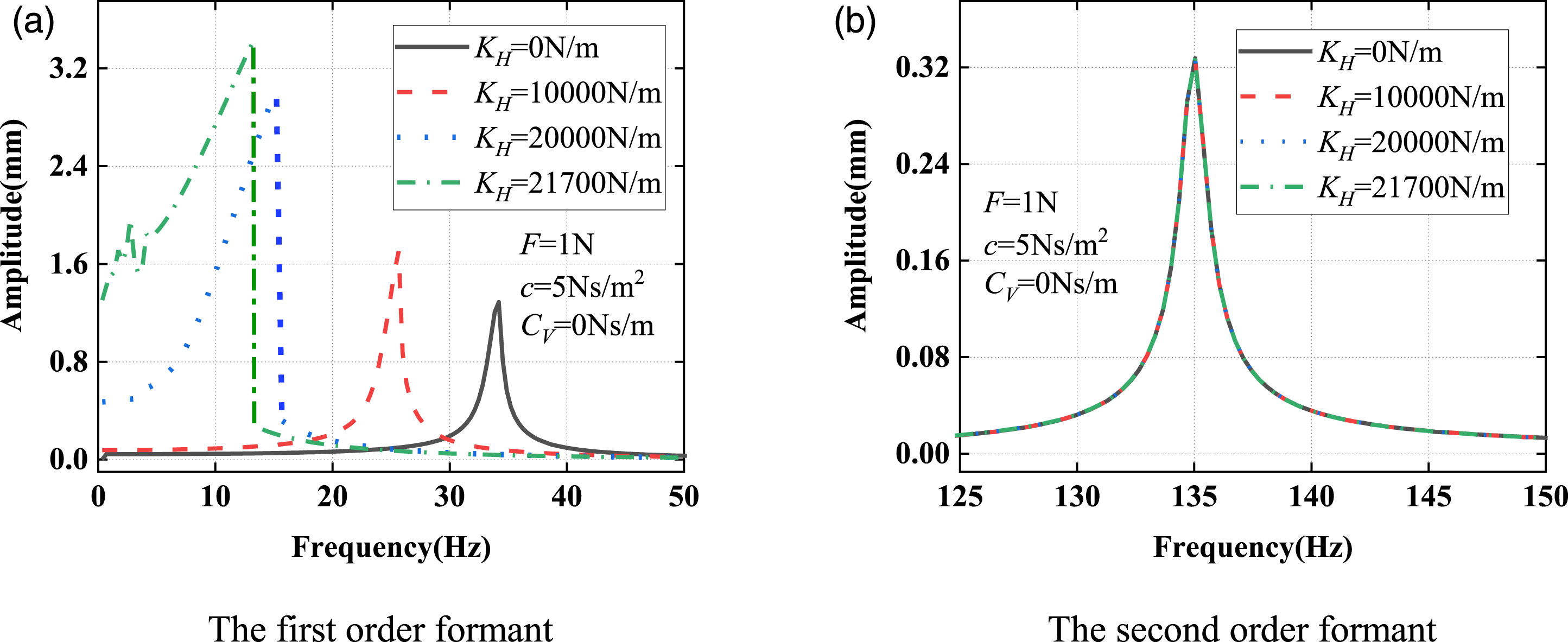
The frequency value Force transmissibility curve of the simply supported beam 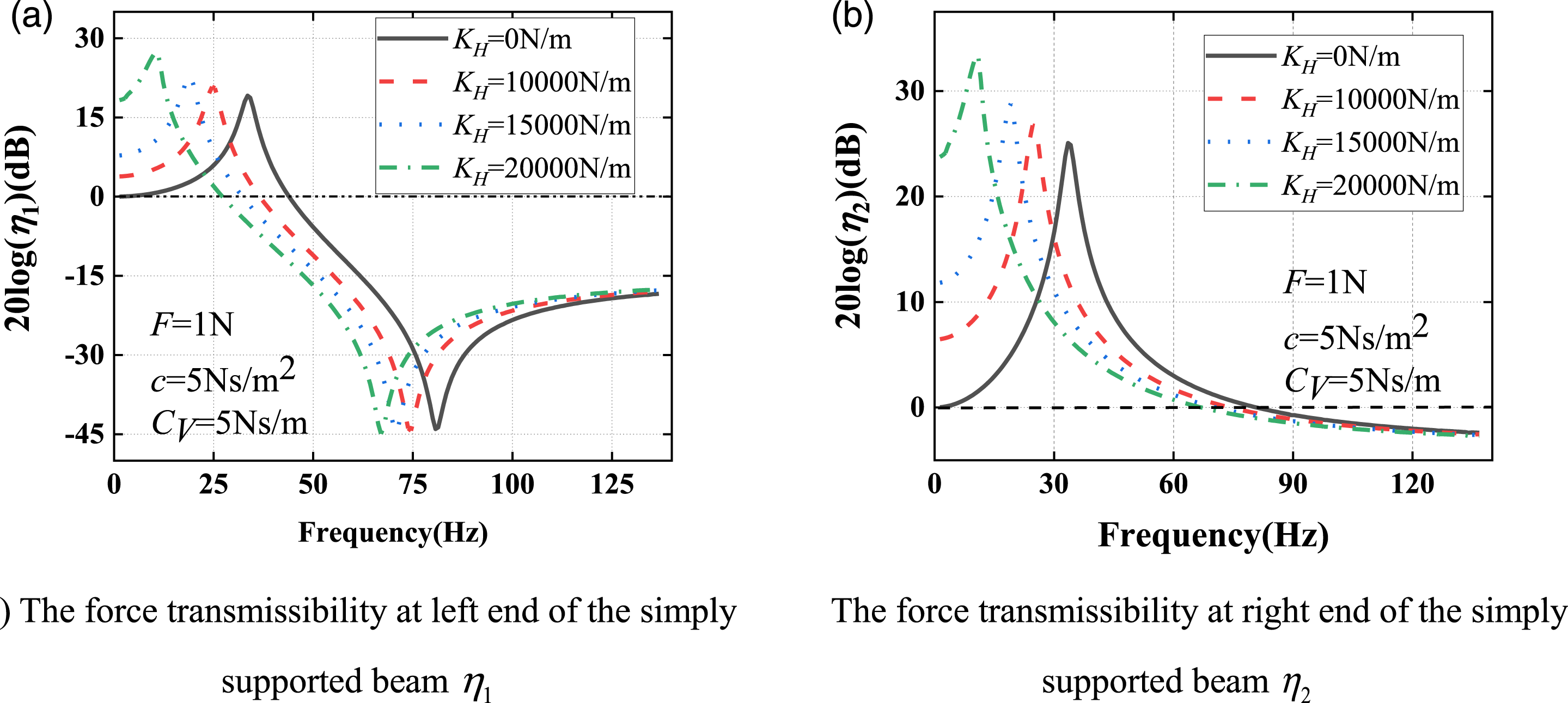
Figure 9 illustrates the influence of horizontal spring stiffness on amplitude–frequency curve and force transmissibility curve when external force is applied at point B. As seen, the amplitude–frequency curve and the force transmissibility curve of the system are similar to those of the external excitation acts on the point D. However, because the external excitation acts on the second mode node, the second-order resonance will not occur, and the force transmissibility diminishes gradually after the initial frequency of vibration isolation. Amplitude–frequency curve and force transmissibility curve of the simply supported beam 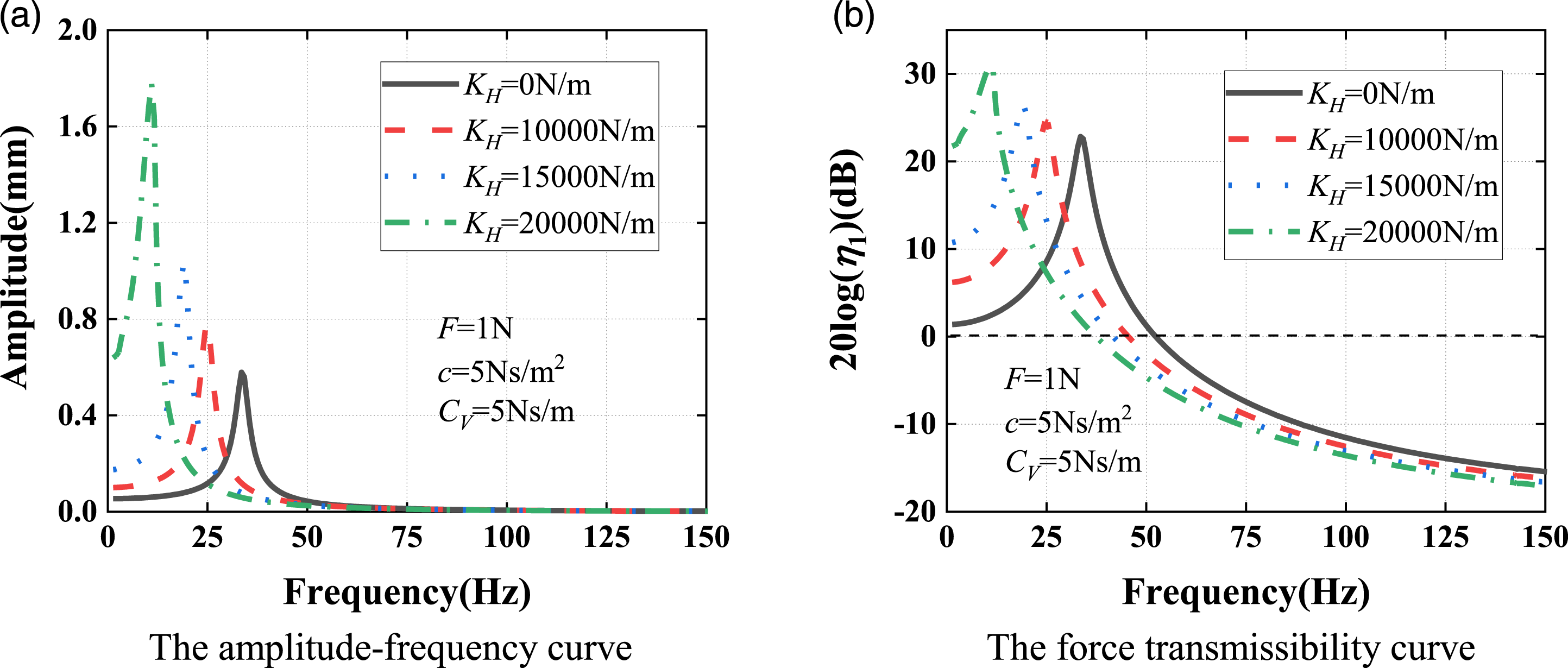
Figure 10 demonstrates the effects of the linear damping on the amplitude–frequency curve and force transmissibility curve. As shown in Figure 10, with the increase of the damping coefficient of the damper, the peak value of resonance and the peak value of force transmissibility decrease, but the vibration amplitude in the non-resonance region and the initial frequency of vibration isolation almost remain unchanged. Effect of linear damping on the amplitude–frequency curve and force transmissibility curve 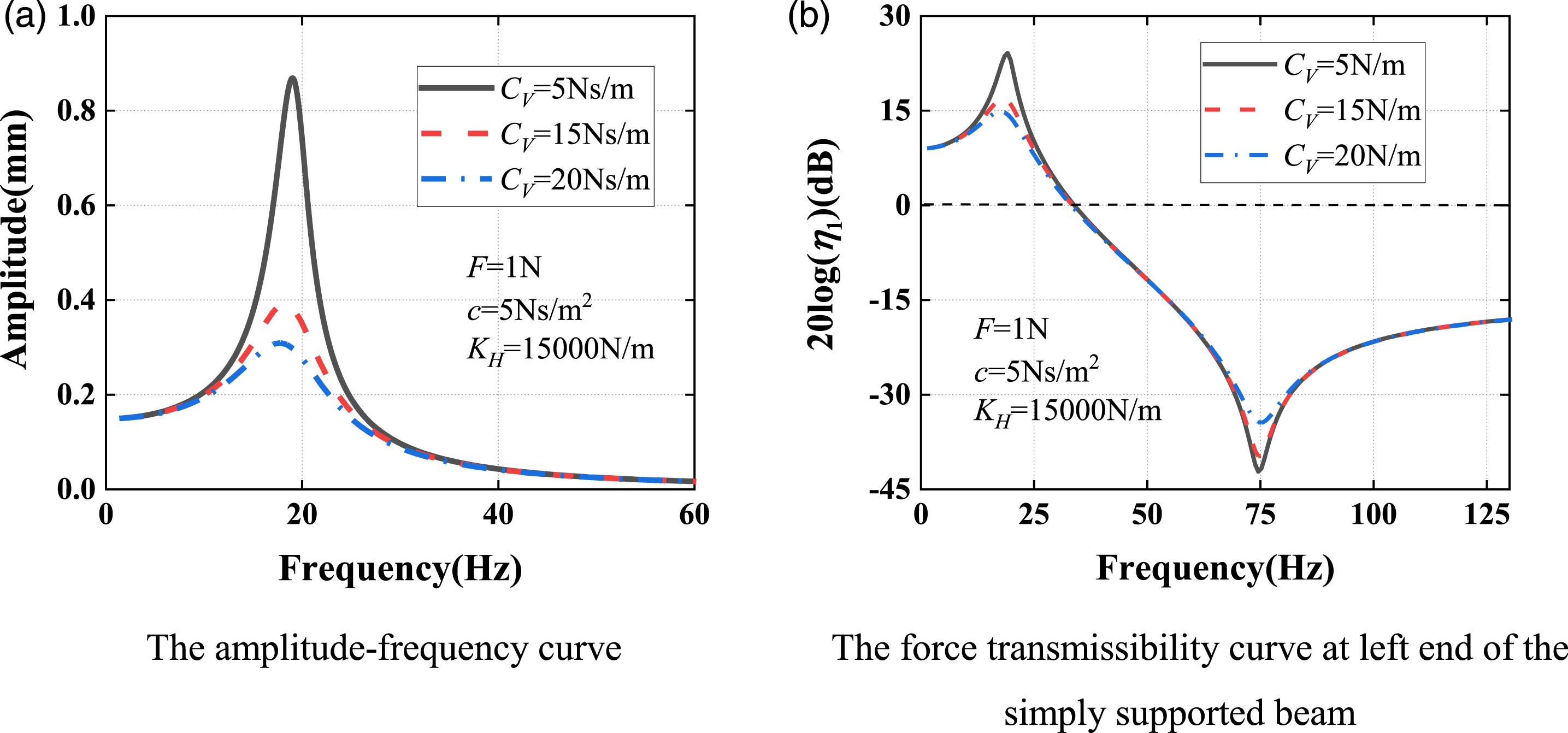
5. Dynamic response analysis of the harmonic displacement excitation of the base
In this section, the displacement transmissibility is investigated by considering the case of base excitation. The relative displacement is introduced into equation (12) to obtain the nonlinear vibration equation of the beam. Then, by utilizing the Galerkin truncation method, the dynamic behaviors and vibration isolation performance of the beam is presented.
The simply supported beam is excited by the displacement excitation of the base, and the relative displacement is introduced first
By substituting equation (23) into equation (12) and omitting the term of external excitation force, the nonlinear vibration equation of the beam under the displacement excitation of the base is derived as
where
Based on equation (24) and the parameters listed in Table 1, the steady-state response and amplitude–frequency curve of the base displacement excitation system are presented in Figure 11. Due to the influence of geometric nonlinearity of the simply supported beam, as shown in Figure 11, the first-order formant of the beam without a negative stiffness device deviates to the right, and the bifurcation jump phenomenon is obvious. With the increase of the horizontal spring stiffness, the first resonance frequency and the peak value of the beam will get smaller and the nonlinear phenomenon is weakened, but the third resonance peak only change little. Because of the anti-symmetric of the second-order mode of the system, the second-order resonance will not occur. The system will form a large non-resonant region between the first and third resonance peaks, which is beneficial for controlling structural vibration. Effect of the horizontal spring stiffness on the first and third order resonance peaks 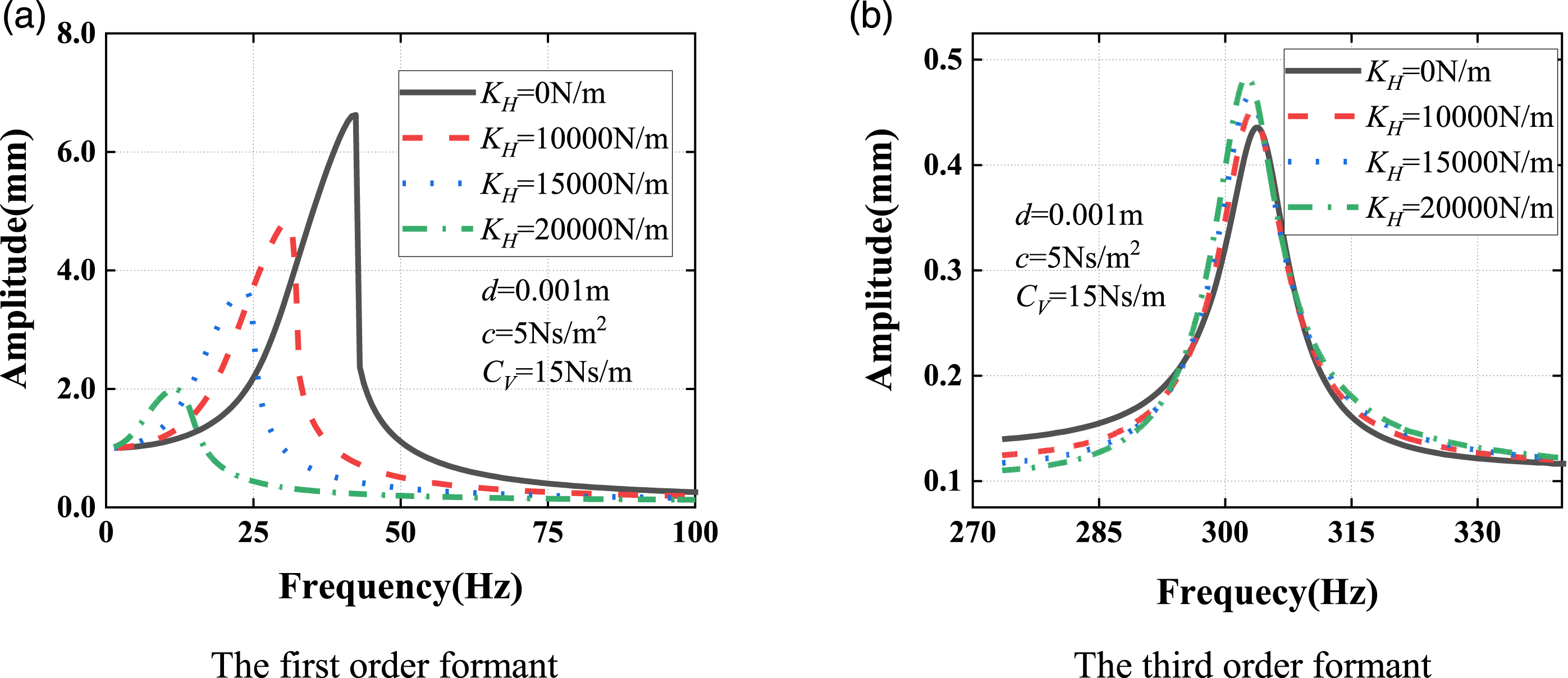
The frequency value Displacement transmissibility of the simply supported beam installed with a negative stiffness device 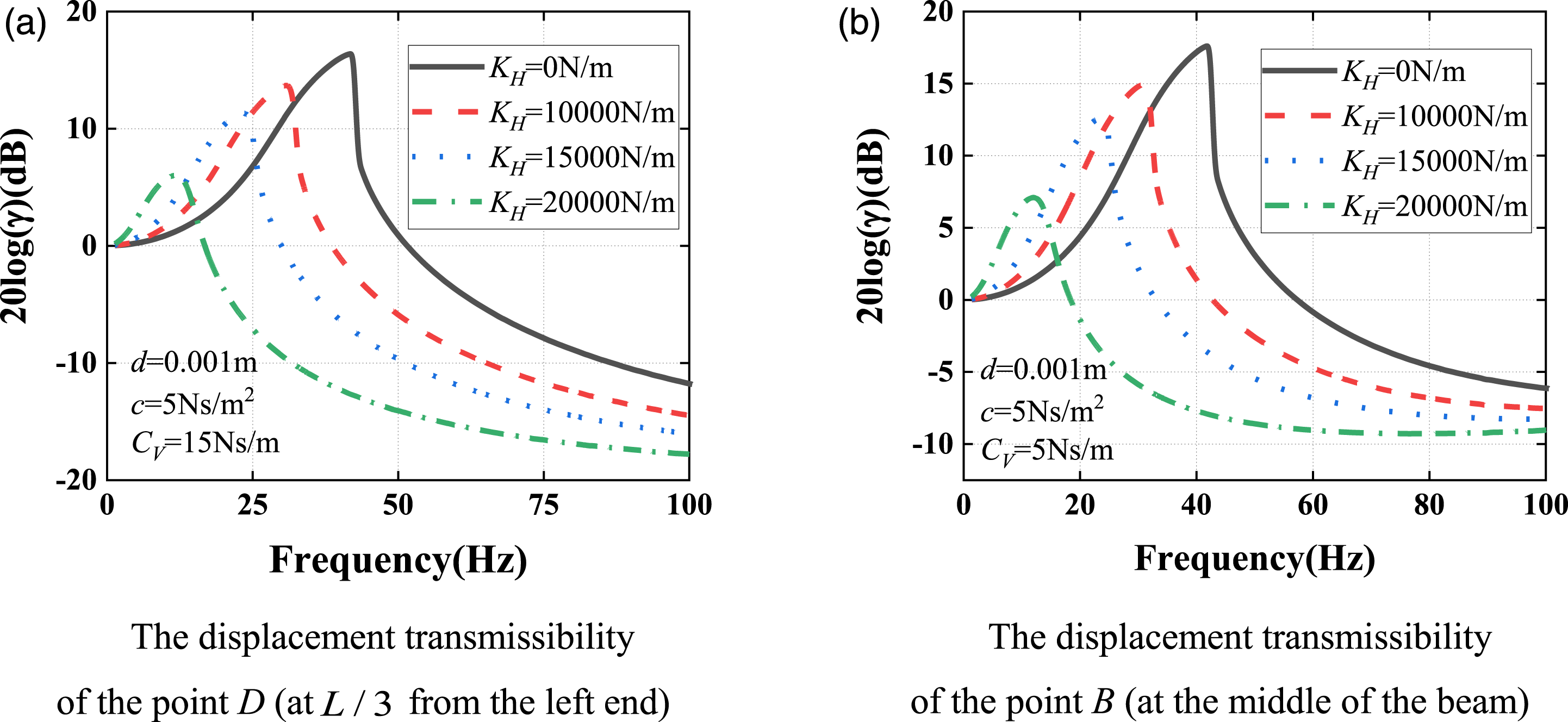
Figure 13 demonstrates the effects of the linear damping on the amplitude–frequency curve and force transmissibility curve. The results in Figure 13 show that increasing the damping coefficient of the damper slightly can well restrain the phenomenon of the right deviation jump of the amplitude–frequency curve and the displacement transmissibility curve. At the same time, the initial frequency of vibration isolation is reduced. However, the increase in the damping coefficient has little effect on the displacement transmissibility in the high-frequency region, which means excessive increase in the damping coefficient will not obtain a better isolation effect. Effect of linear damping on the amplitude–frequency curve and the displacement transmissibility curve 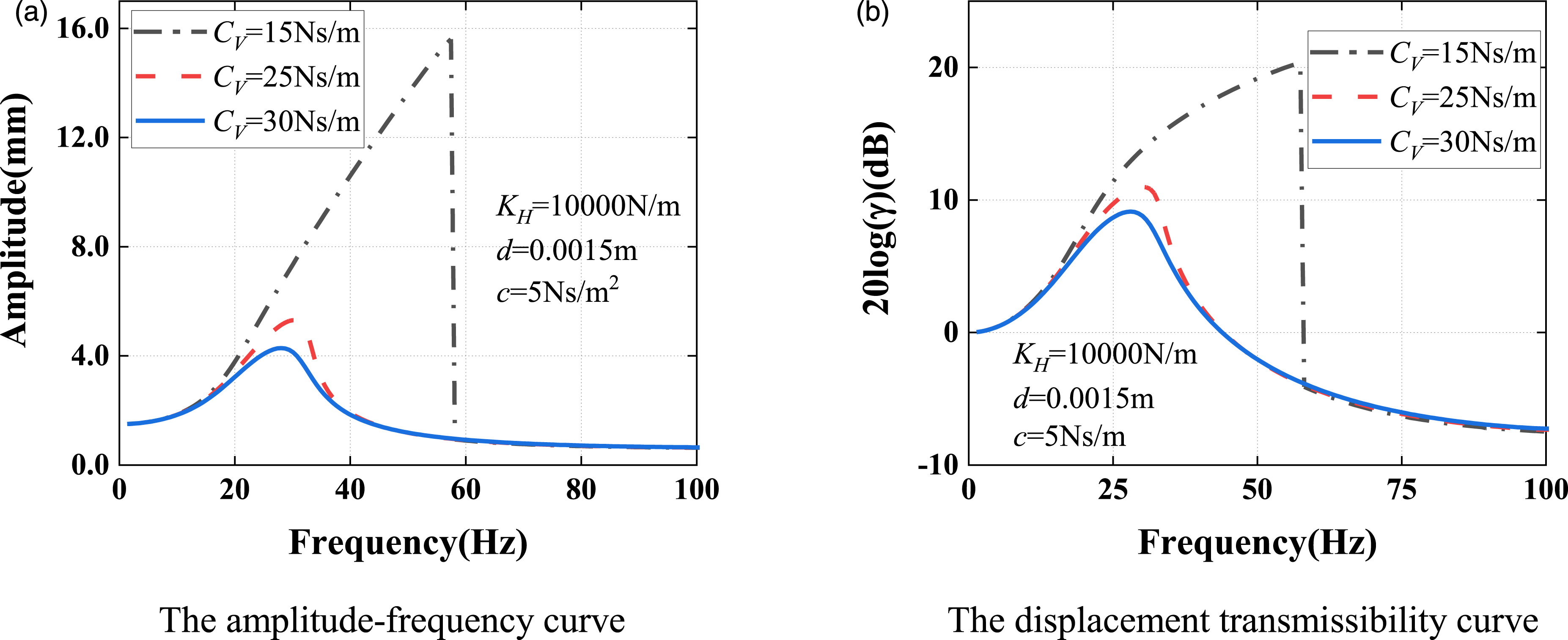
6. Conclusion
In this paper, the vibration isolation of the simply supported beam installed with a negative stiffness device has been studied under different external excitation conditions. The nonlinear vibration equations of the beam installed with a negative stiffness device under harmonic force excitation or base displacement excitation have been established by using the Hamiltonian principle. The influence of support position and negative stiffness parameters on the natural frequencies of the simply supported beam were obtained from the modal analysis of the free vibration system. The effects of parameters of the negative stiffness device on amplitude–frequency curve and transmissibility curve are studied by the dynamic responses of the system obtained by using the Galerkin truncation method. Through theoretical analysis and numerical examples, the following conclusions can be drawn: (1) The efficiency of vibration isolation is taken as the maximum value when the negative stiffness device is installed at the midpoint of the simply supported beam. With the increase of the horizontal spring stiffness, the fundamental frequency of the simply supported beam can be significantly reduced, while the frequencies of other modes are changed a little bit only. This implies that the negative stiffness device can be used to reduce the fundamental frequency of the simply supported beam and broadened the isolation frequency band. (2) In the case of simply supported beam excited by the external force, with the increase of the horizontal spring stiffness, the first resonance frequency and the initial frequency of vibration isolation of the beam move to the low-frequency region, while the second resonance frequency and the resonance peak value hardly change. (3) In the case of simply supported beam excited by the base displacement, with the increase of the horizontal spring stiffness, the first-order resonance frequency and the initial isolation frequency of the beam also move to the low-frequency region, and the resonance peak and the displacement transmissibility peak become smaller. The third-order resonance frequency and resonance peak are almost unchanged. (4) Increasing the damping coefficient of the damper can reduce the resonance peak and the initial frequency of vibration isolation. However, it has a little effect on the transmissibility in the high-frequency region. Therefore, blindly increasing the damping coefficient will not improve the vibration isolation efficiency in the high-frequency region.
It can be seen from the above conclusion that by adjusting the negative stiffness support parameters, the vibration isolation bandwidth of the simply supported beam can be expanded and the low-frequency vibration isolation efficiency can be improved without changing the static stiffness of the simply supported beam. This paper provides a simple and effective approach to the vibration isolating design of flexible structures.
Footnotes
Declaration of conflicting interests
The author(s) declared no potential conflicts of interest with respect to the research, authorship, and/or publication of this article.
Funding
The author(s) disclosed receipt of the following financial support for the research, authorship, and/or publication of this article: This work is supported by the National Key Research and Development Program of China under Grant No. 2020YFB1506702-03, the National Natural Science Foundation of China under Grant No. 11,732,005 and the National Engineering Laboratory for Digital Construction and Evaluation Technology of Urban Rail Transit under Grant No. 2021JZ01.
