






Abstract
In the present study, author analyses the vibration of protein microtubules and its interaction with the surrounding elastic medium and electromagnetic and gravitational forces. Protein microtubules are dynamic Nano fibers found inside the cell’s cytoplasm, strengthening the cytoskeleton and gives shape to the cell. When the cell undergoes deformation microtubules vibrate. Understanding the vibration of these Nano fibers within the elastic medium and along with the body forces as electromagnetic and gravitational forces is crucial. The main purpose of this study is to explore the effects of surrounding elastic medium and electromagnetic and gravitational forces on the vibration of protein microtubules. The findings reveal that the effects of surrounding medium and the external influences on the vibration of these Nano fibers are significant. The study presents the numerical values in the form of table associated with microtubules in various conditions: free, embedded, and in the presence of electromagnetic and gravitational forces.
Highlights
Vibration of protein microtubules within the elastic medium along with electromagnetic and gravitational forces by using orthotropic elastic shell model • Microtubules are embedded in elastic medium of cytoplasm in living cells. • An orthotropic-Wikler like model is developed along with the electromagnetic and gravitational forces to study the vibration of embedded MTs within the elastic medium. • Flexural rigidity of MTs is increased with stiffening of coupled elastic matrix. • Effect of electromagnetic and gravitational forces are more pronounced on longitudinal and torsional wave frequencies in the present case. • While radial wave frequency is affected lesser and the least longitudinal wave velocity by the elastic medium.
1. Introduction
In the realm of cellular biology, every living cell contains one of the very important components, called the cytoplasm, composed of a network of protein fibers extending from the nucleus toward the cell membrane and beyond it (Zwerger et al., 2011), (Forgacs and Newman, 2005; Scheibel, 2005). Similar protein networks form the cytoskeleton system in various living organisms. In eukaryotic cells, the cytoskeleton is a dynamic structure consisting of three major protein components: microtubules (MTs), microfilaments (MFs), and intermediate filaments (IFs) (Kellogg et al., 2017; Pollard and Cooper, 2009; Herrmann and Aebi, 2000; Chanet and Martin, 2014). These protein fibers play a significant role in facilitating the rapid expansion or deconstruction of cells depending on their specific needs (Sharma et al., 2022; Swamy, 2013). Among the above three cytoskeleton components, MTs are the stiffest and primarily responsible for maintaining the cell shape and structure (Safeer et al., 2019; Pegoraro et al., 2017). MTs can be visualized as long hollow cylinders with an inner diameter of about 13 nm, an outer diameter of 26 nm, and a persistent length ranging from 10 s to 100 s microns (Kadam, 2018; Kononova et al., 2017; Lee and Nam, 2013).
The fundamental building blocks of MTs are the tubulin dimers, which connect longitudinally to form 13 parallel protofilaments (PFs) that constitute the primary structural components of MTs (Fourniol et al., 2010; Sui and Downing, 2010; Michaels et al., 2020; Taj and Muhamm, 2019), as shown in Figure 1. As the most critical cytoskeleton components of the cell, MTs serve various functions such as providing mechanical support, organizing the cytoplasm, facilitating transportation, enabling cell motility, and helping in the chromosomes separations during the cell division (Ilan, 2019; Bachand et al., 2014; Ali and Yang, 2020; Canty et al., 2021). In particular, MTs known as neuro babbles have been found to influence the dynamics of other cytoskeleton components within the cell found in developing neurons (Flaxman et al., 2017; Huber et al., 2015; Soheilypour et al., 2015). Furthermore, MTs are involved in trending chromosome movement and the formation of mitotic spindles during the division of cells (Vicente and Wordeman, 2019; Hoffmann, 2021; Hadders and Lens, 2022). MTs also act as electrical transmission lines, translating and transmitting electrophysiological impulses entering the cerebral cortex besides their structural and organizational roles (Lemoine et al., 2012; Tuszynski et al., 2018), (Wang et al., 2021). Consequently, the vibrations of MTs have become one of the most prominent research areas for many researchers (Soylemezoglu et al., 2010; Kiangala and Wang, 2020; Heireche et al., 2010; Li et al., 2019), (Wang et al., 2006). While the majority of studies focused on the vibration of MTs in the absence of a surrounding elastic matrix, it is important to note that MTs are naturally embedded in the viscoelastic medium and therefore presence of surrounding elastic medium affects the vibration characteristics of MTs (Morris et al., 2019; Arpanahi et al., 2019), (Wang et al., 2023; Ghamami et al., 2019). When MTs are immersed in the elastic medium, there are considerable effects on their mechanical properties (Taj and Zhang, 2012; Ghorbanpour et al., 2018; Ghorbanpour Arani et al., 2018; Han et al., 2023). In the last two decades numerous research have been conducted to investigate the mechanical properties of MTs without the account of elastic medium by using the orthotropic elastic shell model (OESM), such as oscillation or vibration of MTs (Taj and Zhang, 2012; Arani et al., 2015), (Taj and Muhammad, 2019; Zahran, 2015; Safeer et al., 2019; Kabir et al., 2015; Farajpour et al., 2017; Kabir et al., 2020). Sine MTs have anisotropic mechanical properties, meaning they exhibit different mechanical responses depending on the direction of loading (Hamant et al., 2019). Along the axial (longitudinal) direction, they are more rigid, while they are more flexible in the radial direction. An orthotropic model allows these directional variations to be accurately represented, which is impossible with an isotropic model. In a similar manner, an orthotropic model can better capture the mechanical behavior of MTs by allowing distinct stiffness values for different directions. On the other hand, an isotropic model assumes equal stiffness in all directions, which does not reflect the actual properties of MTs (Gittes et al., 1993). Moreover, MTs are essential in various cellular processes, including cell division and intracellular transport. The mechanical properties of MTs have implications for their biological functions. An orthotropic model provides a more realistic representation of MTs behavior in the context of these cellular processes. Experimental studies have shown that MTs exhibit anisotropic mechanical properties (Landrein and Hamant, 2013). By using an orthotropic elastic shell model (OESM), researchers can better match experimental data and validate the accuracy of their model. If researchers aim to study more complex mechanical behaviors of MTs in various loading scenarios, an orthotropic model can provide more accurate results and insights than an isotropic model (Torre and Brischetto, 2022; Somireddy and Czekanski, 2020).
However, both the isotropic and orthotropic elastic shell models for MTs have certain limitations, particularly in their neglect of the elastic medium environment, the IESM assumes uniform mechanical properties in all directions, which might not be accurate for MTs (Tounsi et al., 2010; Civalek and Akgoz, 2010). By neglecting the anisotropic nature of MTs, the model may not fully capture the complexities of their mechanical behavior (Gruber et al., 2022). On the other hand, the OESM considers directional-dependent mechanical properties, but it still ignores the elastic medium environment surrounding the MTs. The interactions between microtubules and their environment can significantly influence their mechanical response (Sui and Downing, 2010; Spedden et al., 2012). Therefore both models may overestimate the vibration frequencies of MTs because they fail to account for the dissipative effects due to interactions with the surrounding medium. Neglecting the damping effects from the environment can lead to inaccurate predictions of MTs dynamics and behavior. In reality, MTs are immersed in a viscoelastic medium, and the neglect of this interaction can result in erroneous conclusions regarding their behavior and functionality. But the OESM is advantageous over the IESM in accurately capturing the asymmetry of MTs because it considers different material properties in different directions, which better reflects the anisotropic nature of MTs. To capture the surrounding elastic effects on MTs vibration Winkler model (WM) is used. The utilization of the WM and its combination with the OESM in this study represents a significant step forward in understanding the elastic properties of MTs and their response to external forces. The findings will likely pave the way for further advancements in related fields and contribute to a more accurate understanding of MTs mechanics.
Consequently, it is advisable to use OESM, instead of the isotropic elastic shell model (IESM) since the longitudinal modulus of elasticity order of magnitude is larger than that of circumferential modulus or radial or shear modulus. Furthermore, the theoretical results obtained by using OESM closely match the experimental findings in the literature (Szatkowski et al., 2019; Otoom et al., 2022).
In summary, using an orthotropic elastic shell model to study microtubules is necessary because it allows for an accurate representation of their anisotropic mechanical properties, which is crucial for understanding their biological functions and behaviors in various cellular processes.
Winker model (WM) is commonly applied to couple the surrounding elastic matrix along the MTs (Roland, 2011; Buwa and Balasubramanian, 2022), (Taj and Zhang, 2011). In addition to OESM and WM, a two-dimensional Lorentz force vector is used in the current work to incorporate the electromagnetic and gravitational force as a body force (Farid and Taj, 2022). Like the previous studies (Strozzi et al., 2020; Lakis et al., 1998) OESM and WM are used with the two-dimensional Lorentz force vector to analyze the vibration of MTs (del Prado et al., 2014).
2. Research methodology
In the present work, an orthotropic elastic shell model (OESM) is used to model the MTs as described in the previous work by Wang et al. (2006). Viscoelastic properties of the surrounding media were captured by the WM, proposed by Gerolymos and Gazetas (2006). Additionally, the external forces acting on the system were modeled as electromagnetic forces based on the Lorentz law, followed by the research of (Farid and Taj, 2022). The resulting coupled equations established a Winkler-like-orthotropic elastic shell model (WOESM), consisting of three partial differential equations. The unknown, in this system is three displacements along longitudinal, circumferential, and radial directions, respectively. To solve this coupled system Galerkin method was employed.
The governing equations of an orthotropic elastic shell model for MTs can be solved using the Galerkin method. MTs are hollow cylindrical structures that are found in cells, and because of their unique mechanical characteristics in various directions, they behave in an anisotropic way. These directional mechanical properties are taken into account by an OESM, making the Galerkin technique appropriate for its solution. The Galerkin technique efficiently approximates the behavior of MTs under varied loads and boundary conditions by discretizing the problem area and representing the unknowns using a collection of trial functions. This approach, however, has certain drawbacks: a) The number of terms taken into account in the approximation as well as the trial function selection affects how accurate the Galerkin approach is. If the selected functions are unable to accurately represent the complicated behavior of MTs, convergence problems could develop, producing unreliable findings. b) When using 3D models, the Galerkin approach frequently necessitates solving complicated equation systems, which can be costly in terms of calculation time. c) Applying the Galerkin approach to problems with clearly defined boundary conditions and regular geometries yields the best results. The Galerkin method may encounter difficulties since real MTs may have complex boundary conditions and irregular forms. d) The underlying assumptions and constitutive equations employed in the orthotropic elastic shell model play a significant role in the correctness of any numerical model, including the Galerkin technique. It is important to carefully consider if these hypotheses are valid for accurately describing the behavior of MTs.
3. Mathematical formulations
The equilibrium equations for orthotropic MTs along with the surrounding viscoelastic matrix and body forces are written as, Schematic diagram of protein microtubules.
3.1. Orthotropic Elastic Shell Model
Orthotropic elastic shell model (OESM) can be mathematically expressed using four independent material constants: the longitudinal, circumferential and the shear modulus,
The variable
3.2. Elastic effects
To couple the effects of surrounding elastic matrix, we will use Winkler model proposed by Gerolymos and Gazetas (2006) defined mathematically as,
The forces,
Although the Winkler model offers a quick and effective method for examining the behavior of shallow foundations, it has drawbacks that could reduce the accuracy of its predictions in more intricate and actual situations. Engineers must carefully evaluate these presumptions and constraints to decide whether the model is appropriate for a certain project or whether more sophisticated analysis techniques are needed.
3.3. Electromagnetic and gravitational forces
In the present work, we account the effects of electromagnetic and body forces as gravitational force along with the Winkler-like orthotropic elastic shell model for protein MTs. Lorentz law describes the coupling between the electromagnetic force and the deformation field, denoted and defined as,
The mechanical properties of MTs can be measured by using different techniques. Keep in mind that these techniques may require specialized equipment and expertise. Here’s an overview of some methods that researchers might use, Atomic Force Microscopy (AFM), Optical Tweezers, Micropipette Aspiration, Beads-on-a-String Assay, Microrheology and Simulation, and Computational Modeling (Wells and Aksimentiev, 2010; Liew et al., 2015; Hawkins et al., 2010; Kis et al., 2002; Qian et al., 2007).
Numerical values of Independent parameters of MTs.

3.4. Governing equations of embedded orthotropic MTs along with electromagnetic and gravitational forces
The governing equations of orthotropic MTs within the viscoelastic medium along with the electromagnetic and gravitational force are obtained by incorporating equations (5) and (6) in equation (3) as under,
3.4.1 Vibration of protein microtubules
MTs are often considered as simply supported in mathematical formulations due to their structural characteristics and behavior. This simplification allows for easier analysis and modeling while capturing essential aspects of their mechanical properties. However, it's important to note that this simplification might not fully represent the complex interactions and dynamic behaviors of MTs in biological systems. Therefore, in the present case, MTs are considered as simply supported on both sides and the vibration of protein MTs is considered by the solution of the form,
4. Results and discussions
4.1. Wave frequencies for axisymmetric waves (n=0)
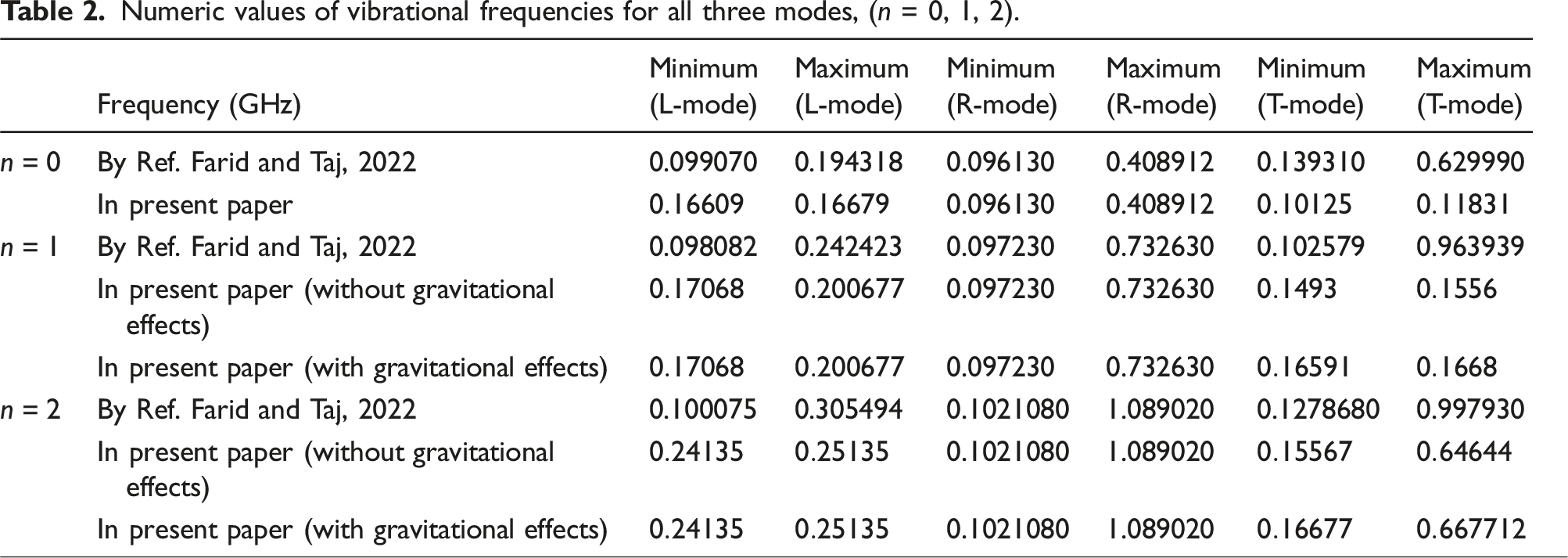
The frequency curves of axisymmetric waves are shown in Figure 2 in different configurations: free, embedded, and embedded with external forces like electromagnetic and gravitational forces. According to the graph, the current longitudinal wave frequencies lie between 0.16609 and 0.16679 GHz. The values of 0.099070 and 0.194318 GHz recorded in the study by Farid and Taj (2022) have changed significantly from this point on. The elastic media has a considerable impact Figure 3. Axisymmetric (n = 0) wave frequencies of longitudinal waves for orthotropic MTs. Axisymmetric (n = 0) wave frequencies of circumferential waves for orthotropic MTs.

According to the current study, the lowest and greatest wave frequencies under axisymmetric conditions in the circumferential direction are 0.10125 GHz and 0.11831 GHz, respectively. These numbers are different from the frequencies of 0.139310 GHz and 0.629990 GHz that Farid and Taj, 2022 published for each, respectively. It is noteworthy that the torsional mode is mostly impacted by external pressures.
The frequency distribution of radial waves is seen in Figure 4. The minimum and maximum wave frequencies in the radial direction of the axial symmetric scenario are 0.096130 and 0.408912 GHz, which are consistent with the results of an earlier work by Farid and Taj (2022). As a result, it can be said that external influences have little impact in this particular direction. Axisymmetric (n = 0) wave frequencies of radial waves for orthotropic MTs.
4.2. Wave frequencies for rod-like waves (n = 1)
According to measurements, the longitudinal rod-like waves seen in Figure 5 have frequencies of 0.17068 and 0.200677 GHz. In contrast, earlier research in the literature points to frequencies of 0.098082 and 0.242423 GHz. Notably, the wave frequencies are significantly changed when external influences are taken into account. Rod-like-wave (n = 1) frequencies of longitudinal waves for orthotropic MTs.
According to Figure 6, the frequency of circumferential waves for rod-like waves range from 0.1659—0.1668 GHz. These frequencies were found to be between 0.102579 and 0.963939 GHz in earlier investigations. Rod-like (n = 1) wave frequencies of circumferential waves for orthotropic MTs.
The wave frequency range shown in Figure 7 ranges from 0.097230 to 0.732630 GHz in the radial direction, which is comparable with the range discovered in the work by Farid and Taj (2022), which also covers this range. Consequently, the surrounding matrix’s pressure on the outside world has a very small effect. Rod-like (n = 1) wave frequencies of radial waves for orthotropic MTs.
4.3. Wave frequencies for non-axisymmetric waves (n = 2)
In contrast to earlier study, which found that these frequencies spanned from 0.100075 to 0.305494 GHz, the non-axisymmetric wave patterns for longitudinal waves depicted in Figure 8 lie between 0.24135 and 0.25135 GHz. Consequently, the effect of the elastic medium is noteworthy in this instance. Non-axisymmetric (n = 2) wave frequencies of longitudinal waves for orthotropic MTs.
External pressure regularly has a large impact on the circumferential mode. The spectrum of wave frequencies in the current scenario, shown in Figure 9, ranges from 0.16677 to 0.667712 GHz, as opposed to the range of 0.1278680–0.997930 GHz stated in the work by Farid and Taj (2022). Non-axisymmetric (n = 2) wave frequencies of circumferential waves for orthotropic MTs.
The non-axisymmetric case’s wave frequencies in the radial direction range from 0.16677 to 0.667712 GHz, while earlier studies suggested a range of 0.1278680–0.997930 GHz. This discrepancy emphasizes how the radial wave frequencies are affected by the elastic medium around them.
Figures, (2–10) display the frequency characteristics curves of three distinct modes observed in protein MTs, namely, axisymmetric, rod-like, and non-axisymmetric structures. In Figure 2, the frequencies of longitudinal axisymmetric waves (n = 0) are depicted for free, embedded MTs within medium, and externally influenced MTs, Figure 3, illustrates the frequency distribution of circumferential waves for axisymmetric case (n = 0), depicted for free, embedded within medium, and externally influenced MTs, and Figure 4 shows the plot of axisymmetric radial wave frequencies. Similarly, Figures 5–10, present the distribution of wave frequencies of rod-like (n = 1) and non-axisymmetric (n = 2) structures of protein MTs, including longitudinal, circumferential, or torsional, and radial waves. These wave frequencies correspond to various states of MTs, namely, free, embedded, and externally influenced MTs. In the figures, the colored curves indicate the frequencies of these waves, where red represents wave frequencies of free MTs, black represent the frequencies of embedded MTs within elastic medium, green is for embedded MTs affected by external electromagnetic forces, and the yellow color symbolizes the gravitational effect in the circumferential or torsional mode. Non-axisymmetric (n = 2) wave frequencies of radial waves for orthotropic MTs.
Numeric values of vibrational frequencies for all three modes, (n = 0, 1, 2).
5. Conclusion
In the present study, the author employed the orthotropic elastic shell model and Winkler model to examine the vibration of embedded microtubules in the elastic medium, considering the influence of external forces such as electromagnetic and gravitational forces. The microtubules were represented as orthotropic elastic shells, while the surrounding elastic media was modeled as Winkler model. The external forces as electromagnetic and gravitational, were accounted for using two-dimensional Lorentz force and gravitational force vectors, respectively. The findings indicate that the vibration frequencies in all three modes are influenced by the inclusion of elastic medium. Therefore, the obtained results clearly demonstrate that the external influences and the properties of surrounding elastic medium significantly affect the vibrational frequencies of protein microtubules across all three modes. To compare the axisymmetric (n = 0), rod-like (n = 1), and non-axisymmetric (n = 2), vibrational frequencies of protein microtubule, Table 2 is presented, where the obtained results are compared with the already existing results in the literature. This table specifically presents the axisymmetric, rod-like, and non-axisymmetric wave frequencies for free microtubules, embedded microtubules within the elastic medium, and the effects of external influences on these nanofibrous. The obtained results demonstrate that both the external influences as electromagnetic and gravitational forces and elastic medium exert the significant impact on the vibration of protein microtubules.
In the envisioned future work, building upon the present study, the focus will expand to explore advanced modeling techniques and simulations that encompass a wider range of external forces beyond electromagnetic and gravitational forces and elastic medium. This will involve incorporating more intricate interactions between protein microtubules and their surroundings, considering varying material properties, and exploring the effects of dynamic changes in external conditions. The investigation will delve into the interplay of additional forces, such as mechanical, thermal, and chemical influences, on the vibrational behavior of protein microtubules. The goal is to provide a comprehensive understanding of how these multifaceted factors collectively shape the vibrational frequencies across different modes, further contributing to the growing body of knowledge in this intricate field.
Footnotes
Declaration of conflicting interests
The author(s) declared no potential conflicts of interests with respect to the research, authorships, and/or publication of this article
Funding
The author(s) received no financial support for the research, authorship, and/or publication of this article.
