






Abstract
This study investigates a specific type of fractional optimization problems, subject to a dynamical system including the Caputo–Hadamard fractional differentiation. In this way, a novel class of basis functions known as the fractional logarithmic Chebyshev cardinal functions is introduced. An operational matrix regarding the Hadamard fractional integral of these fractional functions is derived and employed to develop an efficient numerical method for the provided problem. The established algorithm converts the solution of the primary fractional optimization problem into the solution of an algebraic system of equations by representing the state and control variables via the introduced fractional functions. Two test problems are considered to confirm the effectiveness of the suggested method. The derived outcomes of solving these examples highlight the satisfactory accuracy and efficiency of the designed method.
Keywords
1. Introduction
Control theory is concerned with how a dynamic system can be influenced to achieve a desired goal. Control theory has made significant progress since the pioneering works of Pontryagin and colleagues in the late 1950s, and is now recognized as an important area of applied mathematics. In optimal control, the aim is to minimize or maximize a numerical value of a specified quantity that depends on the behavior of the system. Optimal control has already found its way into diverse fields of science and engineering (Bai et al., 2021; Guo et al., 2023a, 2023b; Luo et al., 2023; Mohammadzadeh et al., 2024).
In recent decades, fractional calculus has become a valuable topic of research because of its diverse applications in different fields of science and engineering, like, computer science, biology, microchemistry, mechanics and physics (Deng et al., 2020; Hilfer, 2000; Ionescu et al., 2017; Li, 2020; Tarasov, 2011). The most celebrated definitions of fractional operators are the Riemann–Liouville derivative and integral, the Grunwald–Letnikov differentiation, the Caputo differentiation, and the Hadamard integral and derivative (Kilbas et al., 2006; Li and Cai, 2019; Podlubny, 1998). Another interesting fractional operator, originally introduced by Hadamard in 1892 (Hadamard, 1892), has been used in a wide range of practical problems in mechanics and engineering (Cai et al., 2022; Garra et al., 2017, 2018). In recent years, several texts have been devoted to describe the properties and applications of Hadamard integral and differential operators. One of the remarkable texts is the book written by Kilbas et al. (2006). In 2012, Jarad et al. (2012) proposed a new derivative by modifying the Hadamard derivative with the Caputo one, known as the Caputo–Hadamard derivative, and studied the properties of such an operator. By changing the order of its differential and integral parts, the Caputo–Hadamard derivative can be obtained from Hadamard derivative. Like other fractional differential equations, expressing solutions of Caputo–Hadamard fractional differential equations in explicit form is challenging. Recently, some numerical techniques have been developed to solve fractional differential equations including Caputo–Hadamard fractional derivative. Some of the techniques outlined are as follows: The predictor-corrector method (Gohar et al., 2020), incomplete Gamma function via Whittaker M function (Toh et al., 2021), logarithmic Jacobi collocation method (Zaky et al., 2022), mapped Jacobi logarithmic orthogonal functions (Zhao et al., 2023), and nonuniform L1-type formula method (Wang and Sun, 2024).
It is difficult to think of an area of science or engineering where fractional calculus has not been applied. One of these areas is optimal control problems. Note that the analytical solution of nonlinear fractional optimal control problems (FOCPs) is quite challenging and almost impossible in all cases. As a result, it is very important to establish numerical methods to deal with this kind of problems. Recently, different numerical strategies have been established to solve FOCPs. Here is a brief overview of some of these methods: Agrawal who was the first to introduce a general formulation and a solution approach for FOCPs (Agrawal, 2004). The author derived the Euler–Lagrange equations for these problems by employing the calculus of variations, the Lagrange multiplier method and the fractional integration by parts formula. Additionally, a numerical method was devised to solve the resulting equations effectively. As earlier research regarding the formulation of problems, derivation of optimality conditions and development of solution methods for FOCPs, we can refer to Baleanu et al. (2009), Pooseh et al. (2014) and Ezz-Eldien et al. (2017). Following these early studies, extensive research has been conducted to establish and implement computational techniques that effectively address these problems. Some of these techniques are the ones based on the Genocchi polynomials (Phang et al., 2018), orthonormal wavelets (Sahu and Saha Ray, 2018), generalized Chebyshev polynomials (Hassani et al., 2019), radial basis functions (Soradi-Zeid, 2020), shifted Chebyshev polynomials (Abdelhakem et al., 2019), orthonormal piecewise Chelyshkov functions (Heydari and Razzaghi, 2022), piecewise Chebyshev cardinal functions (Heydari and Razzaghi, 2021), fractional Boubaker wavelets (Rabiei and Razzaghi, 2023), piecewise fractional Legendre functions (Zhagharian et al., 2023), Mittag–Leffler wavelet functions (Ghasempour et al., 2024), and modified fractional homotopy method (Qing and Pan, 2024).
There are significantly fewer numerical methods for problems with the Hadamard fractional derivative (Fan et al., 2022), Gohar et al. (2020) compared to those developed for Riemann–Liouville and Caputo derivatives (Diethelm et al., 2005; Li and Cai, 2019), particularly in the field of FOCPs. Zguaid et al. (2023) investigated the Hadamard FOCPs and proposed an algorithm to solve the resulting equations from the necessary optimality conditions. The lack of different numerical approaches for the Hadamard FOCPs prompted us to establish a numerical strategy for a category of such problems. A set of studies on the Hadamard-type fractional derivatives have revealed that logarithmic functions can play a crucial role in solving fractional problems involving such derivatives. For instance, see Istafa and Rehman (2023), Zaky et al. (2022) and Zhao et al. (2023). The application of this idea for FOCPs involving the Caputo–Hadamard derivative has the potential to produce favorable outcomes.
In this work, we aim to develop a highly accurate method that uses the fractional logarithmic Chebyshev cardinal functions, as the basis functions, for solving Caputo–Hadamard FOCPs. The major contributions of this study are briefly provided as follows: • The fractional logarithmic Chebyshev cardinal functions, as a suitable basis for the Hadamard-type fractional problems, are introduced for the first time. • A new Hadamard fractional integral matrix for the fractional logarithmic functions is derived. • A numerical method based on the introduced fractional functions is developed for a class of the Caputo–Hadamard FOCPs. • The accuracy of the proposed method is investigated on some numerical examples.
The structure of the ongoing research is as follows: Some definitions and features regarding the Hadamard-type fractional calculus are reviewed in Section 2. Section 3 is devoted to the problem formulation. The fractional logarithmic Chebyshev cardinal functions are defined in Section 4. The Hadamard fractional integral matrix of these functions is derived in Section 5. Section 6 presents a numerical procedure for the introduced FOCPs. Section 7 provides some numerical examples to display the performance of the suggested scheme. At the end, a conclusion is provided in Section 8.
2. Preliminaries
Beginning with Hadamard’s original work (Hadamard, 1892), numerous studies have concentrated on analyzing fractional operators with logarithmic kernels. To see more details in this regard, see Kilbas (2001) and Kilbas et al. (2006). This section provides a concise overview of the concepts and fundamental features of the Hadamard fractional calculus.
(Hadamard, 1892) The Hadamard fractional integral with order ρ > 0 for a given function
(Hadamard, 1892) If ρ > 0, β > 0 and a > 0, then we have
(Kilbas, 2001) Let
(Jarad et al., 2012) The Caputo–Hadamard fractional differentiation with order
(Jarad et al., 2012) If
(Jarad et al., 2012) Let
(Kilbas et al., 2006) The generalized hypergeometric series can be defined by the following expression In the special case of p = 2 and q = 1, this function is referred to the Gaussian hypergeometric function
3. Problem statement
In this study, we investigate a class of nonlinear FOCPs defined as
4. Fractional logarithmic cardinal functions
In the sequel, we introduce a general strategy to construct the fractional logarithmic Chebyshev cardinal functions. Let a and b are positive real numbers, and
The fractional logarithmic Chebyshev cardinal functions expressed in (4.1) can also be represented in a more appropriate form as For instance, in the case of n = 3 and μ = 3/4, the fractional logarithmic Chebyshev cardinal functions defined on Using the above basis functions, any function
5. Hadamard fractional integral matrix
This section presents a formula for calculating the Hadamard fractional integral matrix of the fractional logarithmic Chebyshev cardinal functions.
For a specific value ρ > 0, the fractional integral in the Hadamard sense of order ρ of the vector
For any 1 ≤ m ≤ n + 1, we get One can approximate the above result as Thus, we obtain
6. The suggested approach
To solve the FOCP presented in (3.1)–(3.3) using fractional logarithmic Chebyshev cardinal functions, we assume
Utilizing the interpolation attribute of the fractional logarithmic Chebyshev cardinal functions and substituting relations (6.2) and (6.3) into relation (3.1), yield
We can simplify relation (6.5) by utilizing the cardinality of the fractional logarithmic Chebyshev cardinal functions as follows
One can derive an algebraic system from equation (6.6) as
By applying the technique of Lagrange multipliers, we get
By solving the nonlinear algebraic system generated in (6.7), the elements of
7. Test problems
To evaluate the accuracy and efficiency of the suggested approach, we investigate two examples. MAPLE 18 (with 50 decimal digits) is used to do all required numerical simulations. Additionally, the following formulas are employed to verify the accuracy of the results.
Consider the following FOCP The problem’s optimal solution is The approximate solutions of The absolute errors for The errors of 


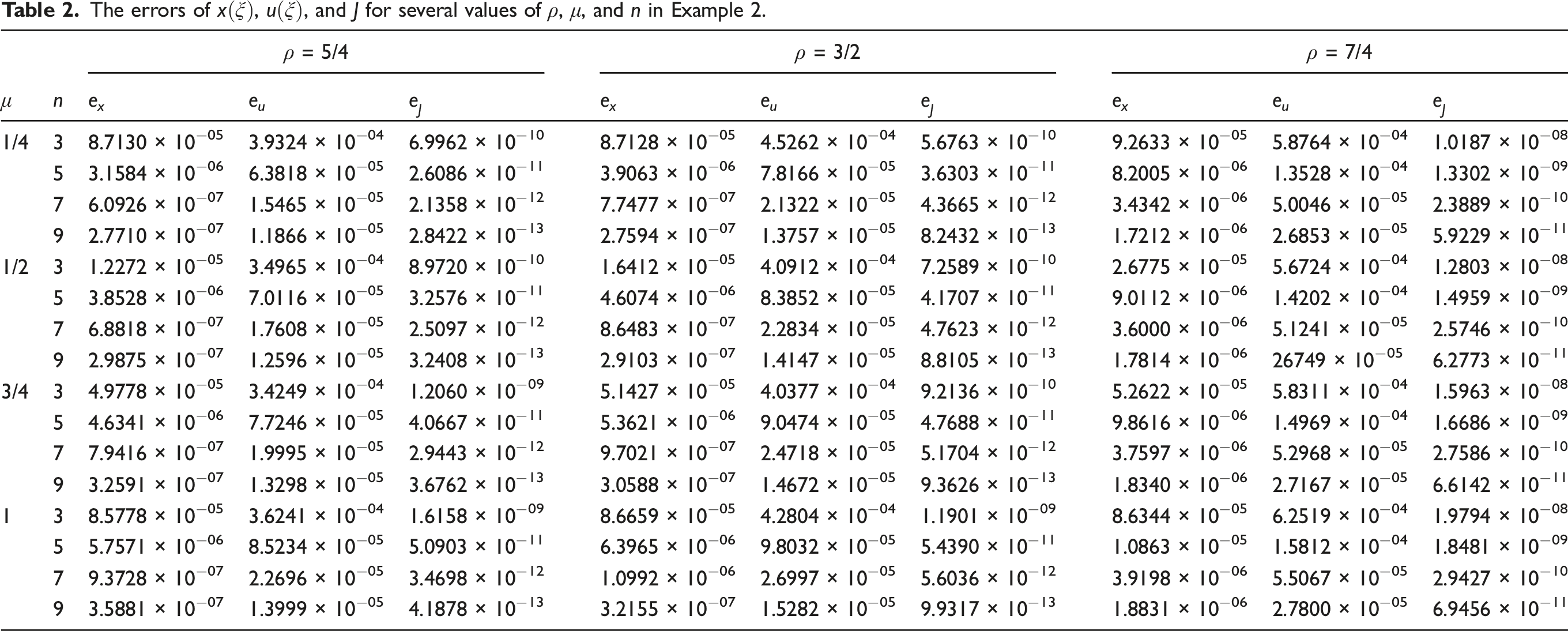
Consider the following FOCP The problem’s optimal solution is The approximate solutions of The absolute errors for The errors of 

In this example, we consider the vibration of a mass-spring-damper system subjected to an external force. In particular, the response to harmonic excitations is examined. In many environments, rotating machinery, motors, and so on, cause periodic motions of structures to induce vibrations into other mechanical devices and structures nearby. On summing the forces, the equation for the forced vibration of the system illustrated in Figure 5 is given as follows. It is common to approximate the driving forces, By substituting the classical derivative with the Caputo–Hadamard fractional derivative and employing the parameters provided in Table 3, we obtain the following FOCP The problem’s optimal solution in the case of ρ = 1 is as follows The numerical method described in the previous section is applied to this example. Table 4 lists the approximate solutions of Schematic of the forced mass-spring-damper system and free body diagram of the system in Example 3. The values of parameters in Example 3. The approximate solutions of The approximate solutions of The absolute errors for 



8. Conclusion
This study introduced a novel set of cardinal functions known as fractional logarithmic Chebyshev cardinal functions to devise a numerical strategy for a family of Hadamard FOCPs. To achieve this, the Hadamard integral operational matrix of this new family of fractional functions was derived. The suggested approach transformed solving the original problem into finding the solution of an algebraic system of equations which was extracted by utilizing the specified integration operational matrix and representing the unknown control and state variables via the introduced fractional logarithmic functions. The validity of the expressed scheme was verified by solving two illustrative examples. The obtained results confirmed the high accuracy of the established algorithm. In addition, it was demonstrated that increasing the number of fractional logarithmic Chebyshev cardinal functions used in the developed scheme improves the accuracy of the outcomes.
Footnotes
Declaration of conflicting interests
The authors declared no potential conflicts of interest with respect to the research, authorship, and/or publication of this article.
Funding
The author(s) did not receive any financial support about the research, authorship, and/or publication of this article.
